29 December 2014

China Steps In as World's New Bank

DEC 25, 2014

Thanks to China, Christine Lagarde of the International Monetary Fund, Jim Yong Kim of the World Bank and Takehiko Nakao of the Asian Development Bank may no longer have much meaningful work to do.

Beijing's move to bail out Russia, on top of its recent aid for Venezuela and Argentina, signals the death of the post-war Bretton Woods world. It’s also marks the beginning of the end for America's linchpin role in the global economy and Japan's influence in Asia.

What is China's new Asian Infrastructure Investment Bank if not an ADB killer? If Japan, ADB's main benefactor, won't share the presidency with Asian peers, Beijing will just use its deep pockets to overpower it. Lagarde's and Kim’s shops also are looking at a future in which crisis-wracked governments call Beijing before Washington. 

China stepping up its role as lender of last resort upends an economic development game that's been decades in the making. The IMF, World Bank and ADB are bloated, change-adverse institutions. When Ukraine received a $17 billion IMF-led bailout this year it was about shoring up a geopolitically important economy, not geopolitical blackmail.

Chinese President Xi Jinping's government doesn't care about upgrading economies, the health of tax regimes or central bank reserves. It cares about loyalty. The quid pro quo: For our generous assistance we expect your full support on everything from Taiwan to territorial disputes to deadening the West’s pesky focus on human rights.

This may sound hyperbolic; Russia, Argentina and Venezuela are already at odds with the U.S. and its allies. But what about Europe? In 2011 and 2012, it looked to Beijing to save euro bond markets through massive purchases. Expect more of this dynamic in 2015 should fresh turmoil hit the euro zone, at which time Beijing will expect European leaders to pull their diplomatic punches. What happens if the Federal Reserve’s tapering slams economies from India to Indonesia and governments look to China for help? Why would Cambodia, Laos or Vietnam bother with the IMF’s conditions when China writes big checks with few strings attached?

Beijing’s $24 billion currency swap program to help Russia is a sign of things to come. Russia, it's often said, is too nuclear to fail. As Moscow weathers the worst crisis since the 1998 default, it’s tempting to view China as a good global citizen. But Beijing is just enabling President Vladimir Putin, who’s now under zero pressure to diversify his economy away from oil. The same goes for China’s $2.3 billion currency swap with Argentina and its $4 billion loan to Venezuela. In the Chinese century, bad behavior has its rewards.

If ever there were a time for President Barack Obama to accelerate his "pivot" to Asia it's now. There's plenty to worry about as China tosses money at rogue governments like Sudan and Zimbabwe. But there’s also lots at stake for Asia's budding democracies. The so-called Washington consensus on economic policies isn't perfect, but is Beijing's model of autocratic state capitalism with scant press freedom really a better option? With China becoming Asia's sugar daddy, the temptation in, say, Myanmar might be to avoid the difficult process of creating credible institutions to oversee the economy.

China Steps In as World's New Bank

DEC 25, 2014

Thanks to China, Christine Lagarde of the International Monetary Fund, Jim Yong Kim of the World Bank and Takehiko Nakao of the Asian Development Bank may no longer have much meaningful work to do.

Beijing's move to bail out Russia, on top of its recent aid for Venezuela and Argentina, signals the death of the post-war Bretton Woods world. It’s also marks the beginning of the end for America's linchpin role in the global economy and Japan's influence in Asia.

What is China's new Asian Infrastructure Investment Bank if not an ADB killer? If Japan, ADB's main benefactor, won't share the presidency with Asian peers, Beijing will just use its deep pockets to overpower it. Lagarde's and Kim’s shops also are looking at a future in which crisis-wracked governments call Beijing before Washington. 

China stepping up its role as lender of last resort upends an economic development game that's been decades in the making. The IMF, World Bank and ADB are bloated, change-adverse institutions. When Ukraine received a $17 billion IMF-led bailout this year it was about shoring up a geopolitically important economy, not geopolitical blackmail.

Chinese President Xi Jinping's government doesn't care about upgrading economies, the health of tax regimes or central bank reserves. It cares about loyalty. The quid pro quo: For our generous assistance we expect your full support on everything from Taiwan to territorial disputes to deadening the West’s pesky focus on human rights.

This may sound hyperbolic; Russia, Argentina and Venezuela are already at odds with the U.S. and its allies. But what about Europe? In 2011 and 2012, it looked to Beijing to save euro bond markets through massive purchases. Expect more of this dynamic in 2015 should fresh turmoil hit the euro zone, at which time Beijing will expect European leaders to pull their diplomatic punches. What happens if the Federal Reserve’s tapering slams economies from India to Indonesia and governments look to China for help? Why would Cambodia, Laos or Vietnam bother with the IMF’s conditions when China writes big checks with few strings attached?

Beijing’s $24 billion currency swap program to help Russia is a sign of things to come. Russia, it's often said, is too nuclear to fail. As Moscow weathers the worst crisis since the 1998 default, it’s tempting to view China as a good global citizen. But Beijing is just enabling President Vladimir Putin, who’s now under zero pressure to diversify his economy away from oil. The same goes for China’s $2.3 billion currency swap with Argentina and its $4 billion loan to Venezuela. In the Chinese century, bad behavior has its rewards.

Counter-terrorism in Central Asia requires international cooperation

By Galymzhan Kirbassov 
December 26

The following is a guest post from Galymzhan Kirbassov, a Ph.D. candidate in political science at SUNY Binghamton. 

With most eyes on Syria, Iraq, and Afghanistan, it is easy to miss the fact that Central Asia is also facing an increasingly complex security situation. 

First, the impressive victories and territorial gains of the Islamic State against Iraqi and Syrian governments have made the group even more attractive to foreign fighters from Central Asia. According to severalreports, more than a thousand Central Asian citizens have joined and even have been establishing ethnic sub-groups within the Islamic State; there are also newly released propaganda videos about Kazakh child soldiers within the Islamic State. The head of the KNB, Kazakhstan’s intelligence agency, recently reported (English here) that 300 Kazakhstani citizens joined the Islamic State, half of whom were women. Analysts predict that these fighters will pose significant security threats to Central Asian nations upon their repatriation. 

Second, the withdrawal of U.S. troops from Afghanistan will benefit insurgent and terrorist groups currently operating in the Waziristan region between Afghanistan and Pakistan. Terrorist groups, such as the Islamic Movement of Uzbekistan, whose ultimate goal is to be operational in Central Asia again, are likely to relocate to the north and reestablish bases closer to the region. These armed groups often operate across borders and fund their activities through transnational drug trafficking. The fact that the opium poppy cultivation in Afghanistan in 2014 was at a record high according to the UN Office on Drugs and Crime, despite the U.S. spending $7.6 billion on counter-narcotics, indicates that insurgency and terrorism is likely to thrive in the near future. 

To counter these threats, Kazakhstan and other Central Asian governments have been reevaluating their national counter-terrorism strategies. Counter-terrorism cooperation under the Collective Security Treaty Organization and the Shanghai Cooperation Organization has its limits because not all the Central Asian governments are members of the organizations. Also these strategies have been mainly established to counter terrorism within the member states, not the ones stemming from other regions. 

Studies suggest that an integrated long-term strategy is an effective way to combat geographically dispersed and decentralized international terrorism. This comprehensive strategy has two parts: integration across actors and integration across policies. 

Rearranging the Subcontinent

December 25, 2014

The division of the Indian subcontinent between two major states, India and Pakistan (as well as a minor one, Bangladesh), may not be history's last word in political geography there. For, as I have previously observed, history is a record of many different spatial arrangements between the Central Asian plateau and the Burmese jungles.

For example, Pakistan can only be considered artificial if one is ignorant of the past in the region. Pakistan is merely the latest of various states and civilizations anchored either in the Indus River valley or in that of the Ganges. For example, the chieftaincies of the late fourth to mid-second millennium B.C., comprising the Harappan civilization, stretched from Balochistan northeast up to Kashmir and southeast almost to Delhi and Mumbai - that is, greatly overlapping both present-day Pakistan and India. From the fourth to the second century B.C., large areas of Afghanistan, Pakistan and India all fell under Mauryan rule. There was, too, the Kushan Empire, whose Indo-European rulers governed at times from what used to be Soviet Central Asia all the way to Bihar in northeastern India. And so it goes: For so much of history, there was simply no border between Afghanistan, Pakistan and the northern third of India - the heart of the Gangetic state.

And whereas the geography between Afghanistan and northern India was often politically united, the geography between today's northern India and southern India was often divided. The point is, nothing we see on the current map should be taken for granted or, for that matter, is particularly anchored in history.

It was the British who actually created what in logistical terms is the subcontinent, uniting what is now India, Pakistan and Bangladesh in the late 19th century through a massive railway grid that stretched from the Afghan border in the northwest to the Palk Strait near Sri Lanka in the deep south, and from Karachi in Pakistan to Chittagong in Bangladesh. (The Mughals and the Delhi sultanate also unified many of these areas, but through a looser system of control.) Because Afghanistan was ultimately unconquerable by British forces in the 19th century and also had a difficult terrain, it was left out of this modern railway civilization. But don't assume that this particular British paradigm will last forever.

In fact, it has been crumbling for decades already. Pakistan's de facto separation from Afghanistan began to end somewhat with the Soviet invasion of the latter country in December 1979, which ignited a refugee exodus down the Khyber and other passes that disrupted Pakistani politics and worked to further erode the frontier between the Pashtuns in southern and eastern Afghanistan and the Pashtuns in western Pakistan. By serving as a rear base for the Afghan mujahideen fighting the Soviets during that decadelong war, which I covered first hand, the Soviet-Afghan war helped radicalize politics inside Pakistan itself. Johns Hopkins University Professor Jakub Grygiel observes that when states involve themselves for years on end in irregular, decentralized warfare, central control weakens. For a concentrated and conventional threat creates the need to match it with a central authority of its own. But the opposite kind of threat can lead to the opposite kind of result. And because of the anarchy in Afghanistan in the 1990s following the Soviet departure and the continuation of fighting and chaos in the decade following 9/11, Pakistan has had to deal with irregular, decentralizing warfare across a very porous border for more than a third of a century now. Moreover, with American troops reducing their footprint in Afghanistan, the viability of Afghanistan could possibly weaken further, with a deleterious effect on Pakistan.

New Tragedies


In West Asia today, the tunnel is long and dark: the only sign of light is news that the US is perhaps encouraging Saudi Arabia to normalise ties with Iran.

As we survey the West Asian scenario at the end of 2014, it is difficult to recall those heady days four years ago when the Arab Spring had revealed its first promise of freedom and dignity, and opened for the Arab people a season of hope and infinite possibility. Over the years, those expectations have died a painful death, and the region has returned to its all-too-familiar expressions of animosity, intolerance, and violence, amidst scenes of individuals and communities murdered on social media, and millions condemned to refugee camps with no expectation of ever going back to the homes they knew.

Over all these developments is the looming presence of the Islamic State (IS) that has set up a Sunni caliphate, straddling the borders of Iraq and Syria, re-opening old sectarian and doctrinal faultlines, and overturning the regional geopolitical order.

The three principal nations in the region—Saudi Arabia, Iran and Turkey—rich in history and contemporary influence—are themselves deeply divided and mutually suspicious. They make vain attempts to grapple with the deteriorating situation, but achieve little since they have competing interests and cannot unite their efforts to confront the common scourge.

The regional situation is further complicated by the dramatic and unexpected fall in oil prices, to the extent of nearly 40 percent in six months, denying the countries of the region billions of dollars they desperately need for national development and to appease their restive populations lest they clamour for political change that would give them a voice in determining their own and their nations’ destiny.

In this confusing situation, it is important to go back to the first causes of this malaise. The Arab Spring posed a significant challenge to the political status quo that had characterised the region for several decades. The fact that this challenge came from Islamist groups made it even more daunting since their values and agenda were anchored in both Islam and modernity, proposing a fusion of Islamic principles and modern western political theory consisting of constitutionalism, political parties, elections, parliaments, and above all acceptance of universal human rights.

They thus resonated most effectively with the Arab populations and constituted a threat to the pre-modern patron-client political order and the attendant authoritarianism of the Arab polities. The latter struck back, taking advantage of the errors and ineptitude of the Islamist rulers in Egypt, and then demonising Iran for the promotion of its sectarian and hegemonic interests in the Arab world. The battle lines were thus drawn in Syria, whose leadership was now seen as an Alawi/Shia regime and therefore a sectarian enemy.

Rethinking Our Strategy in Iraq and Syria

December 22, 2014 

Rethinking Our Strategy in Iraq and Syria

The war against the self-styled Islamic State is beginning to look more and more like the late, unlamented war in Vietnam. The Obama administration has placed self-imposed limitations on the use of ground forces, thereby creating the kind of sanctuary that North Viet Nam represented from 1963-75. Like President Johnson, Barak Obama had pledged no ground troops, but eventually sent in “advisors” and “defensive forces” to protect the advisors bases as well as the aircraft that were supporting the host nation government’s forces who were supposed to be doing the actual fighting; albeit poorly. This looks exactly like the Vietnam War in 1964-65 that I remember watching on TV and reading about in high school.

Since the Ivy League schools that produced the Obama Administration’s brain trust no longer require the serious study of history, the people who are planning the war effort don’t see the irony. It will take local political solutions to stabilize Syria and Iraq, but those political solutions will not happen until the conventional military power of the Islamic State is destroyed; that can be done in 3-4 months if we apply US-led western military forces in an overwhelming punitive campaign, to include ground forces, to crush the Islamic State’s army.

There are also two unexamined assumptions driving the current strategy. Both of these are rooted in Vietnam, a war that few in the administration seem to have seriously studied. The first is that there are no military solutions. The reality is that the Vietnam War ended with a tank-led conventional invasion of South Vietnam by the North Vietnamese. The end in Vietnam was a purely military solution; it was not a guerilla triumph. The unification of Vietnam under Communist rule was a strategy that Ho Chi Minh pursued relentlessly from 1945 to 1975; he vowed to use both military and political means, and he did so brilliantly. The romantic guerilla myth was perpetuated by aging American liberals, most of whom worked hard in their youth to stay as far away from Vietnam as possible; most of these arm chair revolutionaries learned to worship Ho Chi Minh, Che Guevara , and Chairman Mao in college as somehow being morally superior to American the American military as they saw it.

The second myth is that foreign ground intervention is always bad. In Vietnam, American intervention stymied North Vietnamese ambitions for a decade and built a South Vietnamese counterinsurgency capability that virtually annihilated the Viet Cong. By the early seventies, the only Viet Cong fighting formations were those that were effective manned by North Vietnamese regulars who traded their uniforms for Viet Cong black pajamas. The North Vietnamese felt comfortable with a conventional invasion in 1975 because they knew that the 1974 class of Democrats, who dominated the Congress, would not allow the United States to intervene; the war in Vietnam was settled by the use of naked conventional force made possible by the withdrawal of foreign forces.

Iranian Army affiliated twitter account: Our soldiers are on Israel's borders


"IRGC soldiers of the Islamic Republic are at the border of occupied Palestine," said the tweet.
A twitter account affiliated with the Iranian Revolutionary Guard (IRGC) tweeted photos of IRGC soldiers with blurred faces supposedly on the border of Israel.

"IRGC soldiers of the Islamic Republic are at the border of occupied Palestine," said the tweet, according to MEMRI, which was published on Dec. 25th.

The same photos were previously posted on December 17, 2014 on a blog affiliated with the Iranian Army (newss.blog.ir) with the soldiers' faces visible. According to MEMRI, the blog claimed the photos were taken in southern Lebanon in the Beqaa and Baalbeq region, and that the blog post was titled, "We are arriving... near the Mother of Corruption, the accursed Israel;soon we will pass over their bodies, Allah willing."

The date "October 24, 2014" can clearly be seen in the photos uploaded on the blog with a caption that reads "Uploaded @ Military.ir."

In early October, the Iranian-backed Lebanese militia Hezbollah took responsibility for detonating two bombs in the Mount Dov region along the border with Lebanon, wounding two IDF soldiers.

Inside Isis: The first Western journalist ever to be given access to the 'Islamic State' has just returned – and this is what he discovered

21 December 2014

Jรผrgen Todenhรถfer, 74, spent 10 days in Isis-controlled territory. He says the reality on the ground is different from what anyone in the West realises 

The first Western journalist in the world to be allowed extensive access to Isis territories in Syria and Iraq has returned from the region with a warning: the group is “much stronger and much more dangerous” than anyone in the West realises. 

Jรผrgen Todenhรถfer, 74, is a renowned German journalist and publicist who travelled through Turkey to Mosul, the largest city occupied by Isis, after months of negotiations with the group’s leaders.

He plans to publish a summary of his “10 days in the Islamic State” on Monday, but in interviews with German-language media outlets has revealed his first impressions of what life is like under Isis.

Speaking to the website Der tz, Todenhรถfer revealed that he actually stayed in the same hotel in Benghazi as James Foley, the US journalist who was beheaded on camera by Isis in August.

“Of course, I’ve seen the terrible, brutal video and it was one of my main concerns during the negotiations as to how I can avoid [the same fate],” he said.

Once within Isis territory, Todenhรถfer said his strongest impression was “that Isis is much stronger than we think here”. He said it now has “dimensions larger than the UK”, and is supported by “an almost ecstatic enthusiasm that I have never encountered in any other warzone”.

“Each day, hundreds of willing fighters arrive from all over the world,” he told tz. “For me it is incomprehensible.”

Putin Could Become Even More Dangerous In 2015

DEC. 23, 2014

REUTERS/Maxim ZmeyevRussian President Vladimir Putin speaks during his annual end-of-year news conference in Moscow December 18, 2014.

Russia's financial crisis will get worse before it gets better. 
Western sanctions probably aren't going to convince Putin to cease his aggression in Ukraine and elsewhere because Putin and most Russians seem to enjoy being despised by the West. 
Economic sanctions from the West might actually encourage more aggression from Russia. 

December 2014 is the month Putin’s Russia was plunged into undeniable crisis.

With the dramatic drop in oil prices, the collapse of the ruble, and Western sanctions pressure, Russians are going into the new year in a dramatically different, and lessened, economic situation than the one they enjoyed at the beginning of the year.

This will bring myriad hardships to Russians, particularly because even Moscow is admitting that low oil prices may be the “new normal” until the 2030’s.

Caveats abound here. The vast majority of Russians don’t travel abroad, much less have vacation properties in Europe, nor do they have hard-currency mortgages (the ruble now having returned to its Soviet-era pariah status).

Moreover, the average Russian has a physical and mental toughness about getting by in tough times — it is an unmistakable point of national pride — that Westerners cannot really fathom.

In no case now does Russia face the sort of complete economic collapse that it endured in the 1990s, when the Soviet implosion pushed poor Russians to the edge of survival. Life in Yeltsin’s Russia, particularly beyond the bright lights of Moscow and St. Petersburg, where few Westerners visit, was harsh and frankly dismal.

Nevertheless, the economic undoing of Putinism over the last weeks, brought about by Western sanctions in response to Moscow’s aggression against Ukraine which began in early 2014, heralds major changes for the Kremlin, and not just in its domestic affairs.

While Russia has far deeper hard currency reserves than it possessed the last time the ruble’s bottom fell out in 1998, and it’s clear that Moscow will try to prevent banks from failing, there should be little optimism among Putin’s inner circle.
The Power Of Sanctions

Four EU countries in top 10 world economies

26.12.14 
http://euobserver.com/news/127046

BRUSSELS - Four European countries are in the world’s 10 largest economies, according to research by the Centre for Economic and Business Research.

The annual World Economic League Table 2015 published on Friday (26 December) by the London-based think tank puts the US as the world’s main economic powerhouse, followed by China and Japan.

Germany, the UK and France take the fourth, fifth and sixth spots, respectively, with Italy, in the eighth place, the only other EU country in the top 10.

The UK has edged ahead of France into fifth place in this year's rankings, although the Cebr comments that the $1 billion (€850 million) gap in output between the two countries is “well within the margin of error” and would likely be extinguished if France's markets in drugs and prostitution, which “may prove to be 'larger than their British counterparts”, were included.

In June, the UK economy received a statistical boost of £65 billion (€80 billion) following the introduction of new EU accounting rules allowing the so-called ‘grey economy’, which includes proceeds from drug trafficking and prostitution, to be recorded.

Meanwhile, Russia is the main loser in the new list, dropping from eighth place to tenth in the rankings, with Cebr chief executive Douglas McWilliams suggesting that Moscow’s role in the ongoing Ukraine conflict was a factor in the country’s economic decline.

“The fun of the world economic league table is that it brings things back to hard figures,” said McWilliams.

He added that “countries like Russia and Argentina, who have invaded neighbouring countries and whose leaders spout aggressively nationalistic rhetoric, are brought down to earth by their falls in the league table as their economies collapse".

The Russian economy is poised to endure a 4.5 percent recession in 2015 as a result of falling oil prices and the effects of western sanctions.

Last week the country’s central bank was forced to spent around €3 billion of its foreign currency reserves to prevent a run on the rouble currency.

But the next 15 years are likely to be about the continuing rise of some of the 'Bric' countries - Brazil, Russia, India, and China.

China is projected to overtake the US by 2025 as the world’s largest economy, the Cebr forecasts, while the "unstoppable" rise of India will see it become the world’s third-largest economy by 2024.

In Europe, meanwhile, Cebr predicts that Germany’s ageing and declining population, coupled with the weakness of the euro, will allow the UK to overtake it by 2030.

Is Putin to blame for the plunging rouble?

Ben Judah

Vladimir Putin accused the US and EU of conspiring to weaken Russia at his end-of-year news conference on Thursday, but as the country's economy tanks he has nobody to blame but himself, argues Russia analyst Ben Judah.

Russia blames the West. Not only for the war in Ukraine - the result, it says, of a revolution orchestrated by Western powers - but for the slump in the oil price, and the collapse of the rouble. There is talk in the Kremlin of an American-Saudi conspiracy and Nato economic warfare.

But in reality the war and the rouble crisis could have been avoided, and nowhere is this more evident than in relation to the oil-dependent economy.

The Kremlin has known, ever since the oil boom took off 10 years ago, that a political system was being built on the basis of the one thing in Russia that Vladimir Putin could not control - the price of oil. The Kremlin's own accounts estimate that sales of oil and gas accounted for 50% of Russia's federal budget revenue in 2013. And ominously, roughly half the Russian population lives off the state budget - either as state employees, pensioners or as benefit claimants.

Ben Judah is the author of Fragile Empire: How Russia Fell In And Out Of Love With Vladimir Putin.

He is now writing a book about London as a global city.

This means that a collapse in the oil price threatens the fragile foundations of the current system, in which the Kremlin buys the loyalty of the majority with state handouts. The Kremlin needs the price of oil to remain high, and even to rise if it is to continue to deliver rising living standards.

Instead Russians may now have to face austerity.

We have not done much of what we were planning to do and saying we would do to diversify our economy for the past 20 years”

Vladimir Putin

"If the situation continues to develop unfavourably like this, we will have to adjust our plans, and it is certain that cuts in some areas will have to be made," Putin said at his news conference.

Russia's 2015 spending plans had assumed that oil would remain over $100. The country can only balance its budget with the oil price around that mark. The Kremlin may soon no longer have the cash to buy Russians' enthusiastic patriotism with television extravaganzas like the Sochi Olympics (price tag $50bn), or the sudden invasion and annexation of Crimea ($75bn, according to one estimate).

For the masses, the association between Vladimir Putin and rising living standards may soon be broken, while for the elite the Russian president no longer looks like a guarantor of economic stability. Within government there is talk of significant cutbacks and even mass lay-offs at state corporations like Gazprom. There is also a risk that to escape the currency crisis Russia may face a period of inflation, inflicting further wounds on ordinary people's living standards. Russia's middle classes are already facing onerous mortgage repayments, and the imported goods and foreign holidays they enjoy may become unaffordable.

Major oil spill in world's largest mangrove forest threatens area's rare wildlife


Local fishermen have taken to the water with sponges and sacks to try and stop the slick from spreading 

Authorities in Bangladesh are assessing the level of damage to the world’s largest mangrove forest, following a major oil spill in the Sundarbans conservation area in the south of the country. 

There are fears that the area’s wildlife could be under threat after an oil tanker carrying 350,000 litres of oil sunk just outside of the Unesco World Heritage site on Tuesday.

The ship was salvaged by a rescue vessel on Thursday, nearly 30 hours after it first got into trouble.

Within that time, thousands of gallons of oil had escaped two of the damaged containers on the ship, polluting two of the main rivers that run through the Sundarbans, as well as a number of interlinked canals that cover the area.

In total, it is believed that the new slick has already covered 80km and is predicted to spread further.

Environmental agencies in Bangladesh are still in the dark as to the impact this has had on the wildlife in the area and have not yet come up with a plan on how to deal with the spill.

Tapan Kumer Dey, Chief Conservator of Forest Wildlife, said that wildlife agencies had noticed restricted movement throughout the Sundurban’s crocodile population and unusual behaviour had been observed in the extremely rare Irrawaddy dolphins that live in the mangroves.

ISIS Forces in Iraq and Syria Hit by New Wave of U.S. Air Strikes

December 27, 2014

Islamic State Targeted in 39 Strikes by U.S., Allies-Task Force

WASHINGTON — U.S. forces and their allies staged 39 air strikes on Islamic State forces in Iraq and Syria over the past two days, the Combined Joint Task Force said on Friday.

Fighters, bombers and remotely controlled aircraft hit 19 targets in Syria while 20 strikes were carried out in Iraq, a task force statement said.

In Syria, 17 strikes were concentrated on an area near the city of Kobani and destroyed several Islamic State buildings, vehicles and fighting positions.

Two air strikes near Hasakah and one near Raqqa also caused damage.

In Iraq, the strikes hit near Al Asad, Sinjar, Mosul, Al Qaim, Baiji, Kirkuk, Falluja and Tal Afar, the statement said.

(Combined Joint Task Force corrects the number of strikes to 39 from 31 and time element to Thursday and Friday from just Friday)

The electronic equivalent of war

December 24, 2014 

North Korea’s state-run news agency claims that suggestions Pyongyang was behind the cyber-attack on Sony Pictures are “wild rumor.” But, according to the New York Times and other media sources, U.S. intelligence officials have concluded otherwise. The attack, those officials say, “was both state-sponsored and far more destructive than any seen before on American soil.”

Now the question is: What is the United States going to do about it?

The cyber-attack will cost Sony an estimated $100 million, not including the losses that will result after threats of violence by hackers caused the withdrawal of its movie “The Interview,” a Seth Rogen comedy featuring an assassination plot against North Korean leader Kim Jong-un.

Imagine a team of North Korean saboteurs planting explosives under Sony’s sound stages and information technology equipment – then blowing them all up in the dead of night. This cyber-attack is a precise analogue. A company has been attacked on U.S. soil; our sovereignty has been violated.

At a White House briefing Thursday, spokesman Josh Earnest said that U.S. officials were considering an “appropriate response.” He said that the hacking was the work of a “sophisticated actor,” but, so far, the U.S. government has not directly accused the North Korean government.

It’s not always easy to determine a return address on a cyber-attack, and, if a specific government is accused with details to back up the charge, U.S. officials worry about revealing too much evidence of how they drew that conclusion. In this case, for example, officials say off the record that the attacks were launched from outside North Korea but “were sanctioned by North Korean leaders.”

But, the Sony attack is a watershed event. The pretending is over. There is a real cyber-war going on, and we should admit it and develop serious, transparent policies in response. The New York Times reported Thursday that some “administration officials said a direct confrontation with the North would provide North Korea with the kind of dispute it covets.”

Maybe, but that’s a minor issue. Far more important is to make it clear that the United States sees no difference between an attack using electronic weapons and one using gunpowder or plastic explosives. These attacks – sanctioned or committed by state actors or their surrogates or by non-state terrorists – should be treated not as crimes, like theft or fraud, but as what they are: military interventions, or, to paraphrase George Orwell, the electronic equivalent of war.

More severe attacks have been escalating. In the past several months, we’ve seen invasions of White House and State Department computers – with Russia under suspicion. Hackers are believed to have the power to throw our financial system and power grid into chaos and to disable some of our most powerful weapons, such as nuclear-powered aircraft carriers.

Beyond Phishing: Experts Predict The Cybercrime Of 2015

STUART DREDGE
DEC. 24, 2014

Will 2015 be a happy new year for internet users? Not if cybercriminals have their way.

Online security companies have been making their predictions for 2015, from the malware that will be trying to weasel its way onto our computers and smartphones to the prospect of cyberwar involving state-sponsored hackers.

Here’s a summary of what you should be watching out for online in 2015, based on the predictions of companies including BitDefender, KPMG, AdaptiveMobile, Trend Micro, BAE Systems, WebSense, InfoSec Institute, Symantec, Kaspersky, Proofpoint and Sophos. The links lead to their full predictions.
Targeted attacks and sophisticated spam

The more we do and share online, the more vulnerable we may be to “targeted” attacks to steal our passwords and data. “It is possible that our willingness to share and shop online will let criminals become more selective about who they target,” suggests Stephen Bonner of KPMG.

“They won’t need to maintain the current ‘hit and hope’ approach of spear phishing, instead only attacking specific users and computers based on the data these give away about their owners.”

Meanwhile, you may see more spam emails in your inbox in 2015, as the technology used to send them becomes more sophisticated.

“Cybercriminals upping their game are perfecting their campaign abilities previously associated only with advanced, targeted attacks. These advanced tactics designed to evade most modern email security solutions are quickly becoming the new norm as more sophisticated email threats increase,” suggests WebSense.

“As a result, although spam volumes are decreasing, most users will begin to witness an increase in the amount of spam they receive in their inbox, because most email security measures will be incapable of detecting them in the Cloud scrubbing prior to passing to a user’s inbox.”
Banking and healthcare companies at risk

Microsoft India Chairman Bhaskar Pramanik on 2014 IT trends

December 22, 2014

Microsoft India Chairman Bhaskar Pramanik said India is on the path to becoming a digitally empowered knowledge economy and the landscape in India is evolving at a rapid pace.

Reinventing productivity

Triggered by new leadership, both India and Microsoft saw exciting developments in 2014. As part of Microsoft’s transformation journey, we focused on helping people and companies all over the world thrive in this mobile-first, cloud-first world by reinventing productivity and providing platforms to work from.

When we talk about productivity, we are not just referring to being more productive at work. We see productivity as the engine of human progress, and helping people get more out of their time, whether it be for work, family time or to conquer their own pursuits. It’s not just a software category, and it’s not about simply producing more technology, but rather having the right tools and platforms to help anyone make the most of any moment.

The ambitious goals set by the new Indian Government, including the focus on technology to promote economic growth, are heartening. India is on the path to becoming a digitally empowered knowledge economy and the landscape in India is evolving at a rapid pace. The mindset of users across the board has undergone a significant shift. This demands innovation at every step, and that is our driving force.

Strong performance

So what made it such a successful year for us? Backed by strong performance across commercial and consumer segments, we delivered global revenue of $23.20 billion for the quarter ended September 30, 2014. With 47 percent growth in global devices and consumer business, and 10 percent growth in global commercial business, we ended the year as the second most valuable company in the world.

Cloud for everyone

Back to Basics 2: Returning to the “Poor Game” of Modern US Warfare


December 25, 2014  

Editor’s Note: One of the first posts I ever wrote for Havok Journal was an analysis of modern US warfare, titled “Back to Basics: The Poor Game of the Modern US Way of War.” In it, I covered everything from the writings of Emmanuel Kant to a critique of the Democratic Peace Theory. WIth even more troops heading back to Iraq (despite assurances by President Obama of “no boots on the ground”), I thought it might be time to update that article and share it again. Here it is.

It’s time to face the facts: we are never going to win another war. Not the way we’re thinking and acting these days.


The modern US military is obsessed with non-issues and distracted by non-military missions, and is hobbled by debilitating conditions inflicted on the military from the outside, chief among them the following: risk aversion, casualty avoidance, political pandering, and over-indulgence in the discredited theory of democratic peace.

Inhibiting the flexibility and effectiveness of the US military are politically-driven conditions which foist upon the military the expectation it needs to be “good,” but not “too good” at killing the enemy, and that avoiding casualties, either US or foreign, civilian or military, is far more important than actually achieving victory. This leads to a system in which calculated risk-taking, a key component of strategic military success throughout recorded history, has been abandoned in favor of a system of zero tolerance and calculated risk-avoidance, which paradoxically leads to longer wars and greater loss of life.

How’s all that “democratic peace” working out for us in Palestine?

Then there is the national obsession with the democratic peace theory, which holds that mature democracies do not fight wars against each other. So if this is true, then the solution for world peace is simply to establish democracy everywhere. The problem with this theory is, of course, it completely overlooks human nature. Some peoples in the world aren’t ready for Western-style liberal democracy. Other peoples don’t want it. Then there is the problem that the democratic process sometimes produces results that are fundamentally at odds with America’s values. And what is a “democracy,” really?

The elections giving rise to Hezbollah’s pre-eminence within the Palestinian Authority and the ascension of the Muslim Brotherhood in Egypt are prime examples of the flaws inherent in Democratic Peace Theory. Palestine has long had governments elected through democratic processes, but they continue to viciously attack Israel. Simultaneously, Putin is called the “president” of Russia, but he had no problem biting off large chunks of Ukraine, a neighboring democracy. Democratic Peace Theory wilts in the bright light of international realism, yet we in the West cling to it, because it makes us feel good to think that there is hope for humanity… if we can only make them be just like us.

Russia promotes conventional forces in new doctrine

26 December 2014 

Russian soldiers deployed across Crimea during the crisis in March
President Vladimir Putin of Russia has signed a revised version of the country's military doctrine, which identifies major threats to security.

The new document promotes the use of Russia's conventional, non-nuclear forces as a deterrent.

Chief among new threats identified by planners are the armed conflict in neighbouring Ukraine as well as events in the Middle East and Afghanistan.

Russian forces are believed to be operating covertly in eastern Ukraine.

Their reported intervention on the rebel side, as well as the annexation of Crimea from Ukraine in March after a disputed referendum, has been met with economic sanctions by Western states.

Russia's air force has also stepped up patrolling in international airspace close to Nato states while the Russian navy has raised its international profile to a lesser extent.

'Indirect action'

Nato expansion into eastern Europe remains the main military threat identified in the new planning document, published (in Russian) on the Kremlin website, which replaces the 2010 doctrine.

Ukraine's parliament voted this week to drop the country's non-aligned status and work towards Nato membership. However, its prospect of actually joining the alliance is questionable, given its territorial dispute with Russia over Crimea and the continuing conflict in its eastern regions.

Creativity…Operationalized

https://medium.com/@FrontLineLeader/creativity-operationalized-f70a4abce1c5

In the post titled “Unleashing The Creative Mind” , the writer states “The challenge to most leaders comes in recognizing the outward signs of a creative mind, seeing the spirit of innovation for what it is rather than what it isn’t.” I agree. We need to operationalize creativity by identifying leaders who are creative, visionary thinkers and team them up with leaders that are critical and efficient. Together these leader teams will be designed to be more creative and innovative and put their ideas into action.

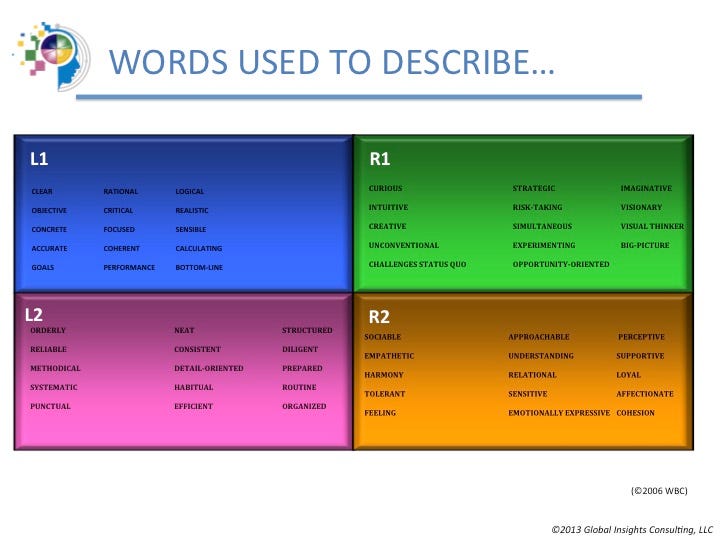
Using assessments like the Neethling Brain Instrument ( NBI), we can assess thinking preferences and determine what a person’s thinking preferences are. In general, right-brain people can be described as “creative and strategic” thinkers and left-brain people as more “detailed and analytical” thinkers. Neuroscience research shows that given a choice of left-brain vs. right-brain as well as high vs. low-road types of thinking tasks, there tends to be a correlation between what one prefers doing and those things with which one is skilled at. People tend to develop skills in the areas they prefer; which is not to say that they can’t develop skills in areas not aligned with their thinking preferences. It is like writing with your non-dominant hand. You can do it, and with practice you will be able to use that hand as well as your dominant hand but it will generally always feel awkward. Same thing goes for thinking preferences.

Below is a diagram with words used to describe the type of thinking that happens in each quadrant of the brain. I happen to be a very high R2, high R1, and average L1.

 
If you are a total left-brainer then you probably do not measure high in empathy or strategic thinking and if you are strictly right-brain you most likely are not a details-oriented or highly systematic person. As mentioned, people can develop skills in areas not aligned with their thinking preferences.

Tools of the Trade A Lieutenant’s Life Lessons in Leadership, Part II


“There I was, no shit… “

There’s an old adage that all good war stories begin with those five words. This story is no different. It begins on a summer day in 1989, in a maintenance shop on the far side of Fort Campbell, Kentucky, where I was busy combing through a deadline report when a line of warrant officers filed by the shop counter, bound for the exit.

“Where are you guys headed?” I asked.

“WOLT,” the CW4 leading the group responded, moving on by as if this was an everyday occurrence.

As they passed through the exit and down the stairs into the hot morning sun, I looked over to my maintenance control sergeant, a newly-promoted master sergeant who until recently had been my platoon sergeant.

“WOLT?” I asked. “What the hell is ‘WOLT’?”

“Warrant Officer Lunch Time,” he replied flatly.

“It’s only 1100,” I answered. “Isn't that a little early?”

“They're warrant officers, L-T, what do you expect?” Good point.

In the months that followed, I learned about WOLT – and its nefarious cousin, EWOLT (Early Warrant Officer Lunch Time) – as I matured into my job and grew closer to the maintenance technicians in my charge. Long before books like Coffee Lunch Coffee became popular and social media was the norm, WOLT and EWOLT were the networking tools of choice. During lengthy lunches of ice tea and jaeger schnitzel at the old Rod and Gun Club, we devised detailed maintenance plans, strategized with Logistics Assistance Representatives, and synchronized a steady flow of repair parts that secured readiness across much of the division. For a young lieutenant, however, the education extended beyond the “shop talk” that dominated our meals.

Irascible on the surface, underneath the gruff exterior was a seasoned mentor with a lifetime of lessons to impart on those willing to listen.

The most senior of the warrants was a decorated Vietnam veteran at the twilight of a distinguished career. Chuck Hunley was old enough to be my father, and wise enough to deftly mold a young officer in his formative years. A man who could master any job on the shop floor with a rubber sledge hammer and 18” Crescent wrench, Chief Hunley was the stereotypical “crusty old warrant.” Irascible on the surface, underneath the gruff exterior was a seasoned mentor with a lifetime of lessons to impart on those willing to listen. Where others would ignore an old Soldier whose best years were behind him, I listened. Closely.

The Big Problem Faced By Military Spouses Around The Country


December 22, 2014

Employers can't seem to look beyond the "military spouse" title.

From the outside looking in, the military lifestyle has a halcyon, Mayberry-type glow about it. Spouses, generally wives, stay home in their identical homes that military housing provides and keep house through deployment after temporary duty after deployment, watching the children who pause to render customs and courtesies during Retreat. Peter Van Buren even went so far as to claim that military communities, such as Camp Lejeune in North Carolina, recreate “the America of the glory days as accurately as a Hollywood movie.”

But if there’s one small flaw in this rendering it is this: Military spouses want to find employment, yet are struggling to work outside the home. As Congress increasingly eyes axing pay and benefits for military service members, this probably shouldn’t be all that surprising that more and more military spouses seek careers of their own to provide additional financial stability to their families (and maybe some personal career satisfaction). However, the Military Spouse Employment Report released by the Institute for Veterans and Military Families in February 2014 demonstrates that even though military spouses are generally better educated than civilian females in the workforce, they are more likely to be unemployed. For 18- to 24-year-old military spouses, the unemployment rate is as high as 30% — three times higher than their civilian equivalents — while 25- to 44-year-old spouses face an unemployment rate approaching 15%. For many, unemployment is not by choice. According to the report, “over 55% of respondents indicated they ‘need’ to work, while 90% indicated they ‘want’ to work.”

It would be easy to dismiss unemployment as a geographic anomaly, except that the report explicitly accounts for this, demonstrating the unemployment rate among military spouses can range from 29% in metropolitan areas all the way up to 40% in rural areas. Education, normally the pathway to employment in America, doesn’t even begin to bridge the divide between civilian and military spouses, with nearly 31% of unemployed military spouses holding a graduate degree. And should a military spouse be lucky enough to get a job, she or he is likely to face being underemployed according to education and skill level.

A noticeably large income gap between military spouses and civilian spouses continues to exist, with military spouses earning close to $15,000 less in 2012. Even something as innocuous as listing a residential address on a military installation can cost a female military spouse nearly $10,000 a year in gross income. Understandably, many spouses are reluctant to even admit that they are married to service members when searching for employment, with over 40% saying that they would not tell a prospective employer.

The Five Most-Powerful Navies on the Planet


It’s a universal truth handed down since antiquity: a country with a coastline has a navy. Big or small, navies worldwide have the same basic mission—to project military might into neighboring waters and beyond.

The peacetime role of navies has been more or less the same for thousands of years. Navies protect the homeland, keep shipping routes and lines of communication open, show the flag and deter adversaries. In wartime, a navy projects naval power in order to deny the enemy the ability to do the same. This is achieved by attacking enemy naval forces, conducting amphibious landings, and seizing control of strategic bodies of water and landmasses.

The role of navies worldwide has expanded in the past several decades to include new missions and challenges. Navies are now responsible for a nation’s strategic nuclear deterrent, defense against ballistic missiles, space operations, humanitarian assistance and disaster relief. With that in mind, here are the five most powerful navies in the world.

United States

First place on the list is no surprise: the United States Navy. The U.S. Navy has the most ships by far of any navy worldwide. It also has the greatest diversity of missions and the largest area of responsibility.

No other navy has the global reach of the U.S. Navy, which regularly operates in the Pacific, Atlantic and Indian Oceans, as well as the Mediterranean, Persian Gulf and the Horn of Africa. The U.S. Navy also forward deploys ships to Japan, Europe and the Persian Gulf.