13 March 2015

The Real Target of ISIS’s Child Soldier Execution Video


03.11.15

The latest ISIS shock tactic—using a young boy to shoot at point-blank range a ‘spy’ for Israel—is aimed at stifling internal dissent amid reported infighting and losses in Iraq.

In ISIS’s ongoing war in Iraq and Syria, the group regularly publicizes its killing of civilians. And as part of its messaging campaign, its highly produced videos have been timed for deliberate effect: to deliver threats, sway public opinion, or attract new recruits.

Past high profile ISIS videos have typically featured foreign hostages who are likely to attract more international attention for the group. In earlier media releases it beheaded American journalists James Foley and Steven Sotloff, and burned alive a captured Jordanian pilot, Muadh al Kasasbeh, while threatening both Jordan and the United States for participating in an anti-ISIS military coalition.
Ammar Awad/Reuters

The timing of ISIS’s latest video, which appears to show a child soldier executing an Arab Israeli man accused of being a spy, is “aimed at emphasizing the rigid security apparatus of the Islamic State against spying and potential dissent,” said ISIS analyst Aymenn al Tamimi.

If that is indeed the message ISIS is trying to deliver with the 13-minute clip released Tuesday, it is likely in response to signs of infighting that have reached the media. Last month, The Daily Beast’s Jamie Dettmer reported on fracturing within the group. This week The Washington Post’s Liz Sly had her own account of internal dissension among ISIS members.

At the same time, ISIS is facing a serious challenge to its territorial control. In Iraq the government has launched its largest military operation to date to retake cities that ISIS has held for months. It’s too early to say what the final outcome of that campaign will be, but by most accounts ISIS has already suffered significant setbacks.

International Lenders Bet on Tajikistan

March 12, 2015

Parliamentary elections in Tajikistan have overshadowed the recent commitments by international lenders to finance projects in the country. Both the European Bank for Reconstruction and Development (EBRD) and the Asian Development Bank (ABD) have allocated funds, giving a boost to Tajikistan’s image. Chinese lenders also have turned their eyes towards the mountainous Central Asian country, as Tajikistan may become a crucial node for Beijing’s Silk Road initiative. The West is also focusing on Dushanbe, as it is regarded as a solid garrison from which to engage with Afghanistan and Pakistan to the south.

Indeed, Tajikistan has an important role to play with Afghanistan and Pakistan. Recently, Dushanbe concluded several agreements to export electricity to its southern neighbors under the Dushanbe-sponsored and U.S.-backed CASA-1000 program. Afghanistan received around 1.1 billion kWh in 2014 from Tajikistan alone, a slight increase on the previous year. Under the same umbrella program, Pakistan, separated from Tajikistan by the Wakhan corridor, is supposed to receive more than 5 billion kWh every year. Tajikistan will participate with 70 percent of the supply, while the rest will be sent southbound from Kyrgyzstan. In terms of costs, which rounds up to 1 billion dollars, Tajikistan will finance one quarter out of the total tally.

Tajikistan is interested in becoming a regional hub for electricity trade. The EBRD has recently opened up a program to refurbish the 126 MW Kayrakkum hydroelectric project, operating a dam on the Syr Darya. The 75 million dollar project gathered international consultants to assess both electricity production and climate change issues. The World Bank participates in Tajikistan’s development through important infrastructure projects, such as the Central Asia Road Links program, for which Dushanbe is receiving 45 million dollars. Since 1996, the World Bank has allocated almost 1 billion dollars to aid Tajikistan’s plans. Most importantly, the World Bank is heavily involved in the co-financing of the Rogun dam, a massive hydroelectric project to which citizens of Tajikistan had to subscribe as well.

Other lenders are helping with infrastructure projects. In this respect, Tajikistan plays a crucial role in the common projects of the Chinese government and of ADB. Tajikistan lies at the crossroads of Beijing’s own Silk Road initiative and ADB’s CAREC (Central Asia Regional Economic Cooperation). ADB vice president Zhang Wencai said in an interview that “Large investment needs for infrastructure in the region create large funding gaps,” which in turn create the opportunity for other investors to participate.

Remembering Boris Nemtsov


Keith Gessen 

It would be hard to imagine a less likely political martyr than Boris Nemtsov. He was loud, brash, boastful, vain and a tireless womaniser. My favourite story about him came from a Moscow journalist who once shared a cab with Nemtsov and a photographer whom he’d been wooing to no avail. It was late at night and he fell asleep. The photographer was the first to be dropped off, and Nemtsov suddenly woke up. ‘So what do you say?’ he asked. Receiving another no, he went back to sleep.

Nemtsov was a young physicist in Nizhny Novgorod when perestroika began. He got involved in protest politics and was elected to the first democratic Supreme Soviet in 1990, associating himself with the anti-Soviet, ‘democratic’ wing. He caught Boris Yeltsin’s eye and was appointed governor of Nizhny Novgorod. After six years with mixed results, he was called back to the Kremlin to join the cabinet of ‘young reformers’ who, it was claimed, would renew economic progress for Yeltsin’s second term. Nemtsov was the most handsome among them, and a physicist, and Jewish! Looking at photos of him with Yeltsin, who sometimes presented Nemtsov as his successor, one couldn’t help but be filled with hope. Then Nemtsov opened his mouth. The first time I saw him on TV was during a celebration of the ageing pop singer Alla Pugacheva; he reminded her that she’d once said she liked sleeping with her husband because he reminded her of Nemtsov. It was a strange performance for the future hope of Russian democracy.

I spent a week with Nemtsov many years later, in 2009, when he was running for mayor of Sochi. He was still amazing. It was early spring in Russia and yet Nemtsov had a full tan. Everywhere we went he wore blue jeans, a black jacket and a white shirt with the top three buttons undone. He addressed everyone he met with the familiar ty,which was rude, and he hit on all the women journalists. But he was totally committed to what he was doing, and bizarrely, bull-headedly, fearless. By this point he had started publishing short, well-researched reports about corruption in both the presidential administration and the Moscow mayoralty. Later he would publish one about construction of the various Olympic sites in Sochi. Whoever he was speaking to he would say: ‘Have you read my book about that? You need to read my book about that.’ And he would start making arrangements to send them a pamphlet.

His campaign in Sochi was quixotic. This former governor and deputy prime minister, ten years out of government, was travelling around in a rented yellow minivan, trying to get people on the street to talk to him. Most of them recognised him, he was a celebrity, but they weren’t about to stick their necks out for him. His rallies were poorly attended. His volunteers put up posters with his handsome face only to find they’d been torn down overnight. (The Kremlin had agreed to let him register his candidacy but had no intention of letting him win.) He was subjected to relentless attacks on his character in the local and national media. A group of young men, who for some reason were wearing dresses, splashed ammonia on him before a press conference.

The Damage to U.S. Interests Abroad of Domestic Political Intemperance

March 11, 2015 

Tom Cotton's sophomoric stunt of an open letter to the Iranians telling them not to have confidence in whatever the United States puts on the negotiating table has received the broad and swift condemnation it deserves. Some of the strong criticism has come from editorial pages and other sources of commentary that generally are not very friendly toward the Obama administration in general or even to its policies on Iran in particular. A bright side to this incident that embarrasses and disgraces half of the United States Senate comes in the clarity it provides in terms of what games are being played and what is at stake. Even before this latest antic, Cotton deserved credit for being more honest about his objective than most of his colleagues who are engaged in the same destructive efforts to undermine diplomacy on Iran. Cotton has stated openly and explicitly that his goal is to kill off any agreement at all with Iran. Unlike many others, he has not tried to fool us with the subterfuge that legislative sabotage is aimed at getting a chimerical “better deal” with Iran. Now with the letter, the unwritten alliance between American hardliners and Iranian hardliners in opposing any agreement is made more open than ever.

What is going on here is not just the work of Tom Cotton. The outrageous letter to the Iranians flows naturally from a broader ongoing process. The fact that the great majority of Republican senators signed the letter is the most obvious indication of that. There no doubt is today much regret in the senatorial offices involved, but the fact is that 47 of them signed it. There are a couple of possible interpretations of what took place among the members, neither of which makes those members look good. One is that they are so distracted or careless that they can let a 37-year-old who has been in the Senate only two months rope them into doing something this stupid. The other, which is the more plausible interpretation, is that Cotton's letter was only the latest vehicle for a journey that the whole party has already been taking for some time.

The letter was a natural next step after bringing Benjamin Netanyahu to the Capitol for the express purpose of denouncing and opposing U.S. policy toward Iran. In each case it was a matter of Congressional Republicans enlisting foreigners to try to sabotage a major element of current U.S. foreign policy. Because Israel is considered an “ally,” Netanyahu got to use the podium in the House chamber whereas Iranian hardliners do not get that privilege. But the fundamental nature and purpose of what was taking place was the same.

The impact of all of this on the immediate prospects for completing a nuclear deal between the P5+1 and Iran is certainly important and has been the subject of much of the immediate commentary about the letter. There is a basis for optimism that this clownish overplaying of their hand by some of those who would like to sabotage the diplomacy will lessen the danger of such sabotage. The episode at least demonstrates why, if one wants U.S. policy toward Iran to be formulated and executed in a responsible and adult way, then for the time being the less Congressional involvement there is the better.

Guess Who’s Training to Hunt Terrorists Near Boko Haram Territory

by JOSEPH TREVITHICK

U.S. commandos—with troops from 27 other countries

As militants in Libya and Nigeria aligned themselves with Islamic State, commandos from 28 countries finished up a huge training session—nicknamed Flintlock—in northwest Africa.

Since 2005, the Pentagon’s Special Operations Task Force in the region has organized the annual event. During the latest exercise in Chad, which ended March 9, American troops and their allies taught African soldiers skills to help them hunt down rebels and terrorists.

The exercise is one of the most visible symbols of America’s growing military presence in Africa. It’s also representative of how the United States now prefers to wage war—largely in the background while supporting smaller, regional armies.

And it’s no coincidence the U.S. held the exercise in Chad—near territory controlled by the Nigerian terror group Boko Haram. Chadian Brig. Gen. Zakaria Ngobongue described Flintlock as a “warm-up” for the multi-national campaign against the jihadi organization, according to a U.S. Africa Command news story.
“There is no doubt that this exercise takes place in the context of a regional environment facing major security issues, provoked by terrorist[s], in particular Boko Haram,” Ngobongue said.

A day before the exercise ended, soldiers from Chad and Niger launched amajor offensive into Nigeria—something which Nigerian Pres. Goodluck Jonathan has resisted allowing during an election year.

RUSSIA DECLARES RIGHT TO DEPLOY NUCLEAR WEAPONS IN CRIMEA — AND, MAY HAVE ALREADY DONE SO

by RC Porter 
March 11, 2015

Russia Declares Right To Deploy Nuclear Weapons In Crimea — And, May Have Already Done So

www.fortunascorner

Adam Withnall, writing on the British newspaper, The Independent’s website this morning (Mar. 11, 2015) notes that “Russia has said it has the right to deploy nuclear weapons to Crimea; — one year after Vladimir Putin seized the territory from Ukraine.” “I don’t know if there are nuclear weapons there now,” a Russian Foreign Ministry spokesman told The Interfax News Agency on Wednesday. “I don’t know about any plans; but in principal, Russia can do it.,” said Mikhail Ulyanov, who head’s the ministry’s department on arms control.” As Mr. Withnall notes, “these statements come amidst increasingly bold statements by the Kremlin, of how it took Crimea. Yesterday, Tuesday, it “emerged that Vladimir Putin only allowed the people of Crimea to hold a referendum on joining Russia, after an “unofficial” poll showed a majority of citizens in Crimea would vote in favor of joining Russia.”

Mr. Withnall adds that “Russian state-run TV channel, Rossiya One is preparing to run a documentary about the annexation entitled: :Crimea: The Road Back Home,” which include some startling revelations by the Kremlin. These include the moment Putin ordered officials to begin the process of seizing Crimea — the night of February 22, 2015 — long before the March 16, 2015 referendum. The documentary reveals that the Kremlin’s decision to take Crimea, came as a direct response to Ukraine ousting its pro-Russian President, Viktor Yanukovich — and, the operation to evacuate him involved heavy weapons, “so there wouldn’t be much discussion about it.”

No one should really be surprised by these revelations; and, Putin’s increasingly bold statements about his blatant intentions to reclaim some of the Soviet Union’s prior territorial sphere of influence. Then POTUS Bill Clinton persuaded Ukraine to give up its nuclear weapons in exchange for a U.S./Ukraine treaty, whereby the U.S. guaranteed Ukraine’s territorial sovereignty. Obviously, the U.S. did not honor this treaty; serving to only embolden Putin to continue his slow seizure of former Soviet territories. Putin has sized up POTUS Obama and his national security team of Susan Rice and company — and found them wanting, and weak. Putin has no fear of the United States, and is likely betting that Europe won’t have the stomach to follow through on harsher sanctions against Russia. And, since the U.S. has no intention of honoring its previous pledge to Ukraine, Putin has made the calculation that Washington doesn’t really care all that much about Ukraine’s territorial integrity, nor our previous promises to come to their aid if ever challenged — as they are now. It is truly a sad state of affairs; and, not one of America’s more finer moments. Our enemies and adversaries don’t fear us; and, out allies don’t trust us. V/R, RCP

US Navy Secretary: We Will Have Over 300 Ships by 2020

March 12, 2015

Secretary for the Navy Ray Mabus noted in his statement yesterday that the US pivot to Asia is continuing as planned. 

Yesterday, Secretary for the U.S. Navy Ray Mabus noted in a testimony in front of the Senate Committee on Armed Services that the United States will field a fleet of 304 ships by 2020 despite an “uncertain budgetary environment” and “the threat of the return of sequestration.”

“Let me state this very clearly: our fleet is growing and will number greater than 300 ships before the end of this decade,” the navy secretary vehemently underlined. The U.S. Navy is requesting $161 billion (a $11.8 billion increase from the previous year) in funds for the fiscal year 2016 budget process.

According to Mabus, the acquisitions plan includes the following:

“We will purchase Virginia Class attack submarines at a rate of two per year for a total of ten across the FYDP [Future Years Defense Program], with the inclusion of the Virginia Payload Module by FY19 for at least one boat per year. We also will continue to procure Arleigh Burke class destroyers at a rate of 2 per year, with the first Flight III DDG funded in FY16 and delivered in FY21. Fourteen ships of the Littoral Combat Ship class, of which at least the last five will be the frigate variant, will also be procured in this FYDP. We will also continue the construction of amphibious ships, mobile landing platforms, high speed vessels, and combat logistics ships.”

He also notes that cuts to the domestic shipbuilding programs would be the least reversible in their impact on the U.S. Navy’s ability to execute its mission. Consequently, Mabus notes that he is “committed, to the maximum extent possible, to preserve ship construction and to seek reductions in every other area first, should further budget reductions such as sequestration become reality.”

Mabus also emphasized that during his first five years as secretary, the U.S. Navy contracted 70 ships and purchased 1,300 aircraft, which is “is 40 percent more than the Navy and Marine Corps bought in the five years before this administration took office,”according to his testimony.

Your Guide to the UN Climate Change Talks

By Fiona Harvey
March 11, 2015

Why 2015 could be the most important year ever for curbing climate change. 

The original version of this article appeared on Ensia. It is republished here with kind permission.

Climate change negotiations seem to crawl along interminably at the pace of the glaciers they are meant to protect, with little perceptible progress as meeting follows meeting and conference follows lackluster conference. But this year we are seeing remarkable momentum building toward a historic conference in Paris in the closing days of 2015, by the end of which we will either have a new international agreement on cutting greenhouse gas emissions, or we will have seen the last of truly global efforts to strike a deal on saving our planet.

We began the year with the outcome of Lima, last December’s United Nations gathering at which delegates drafted the outline of such an agreement that would come into force starting in 2020. That in turn followed alandmark deal between the U.S. and China in November to set limits on their greenhouse gas output. By the end of spring, all of the world’s major economies should be coming up with similar plans. Then, after some months of considering these proposals, and as 2015 ends, Paris will host COP 21 — the most important meeting on global warming since the Copenhagen talks six years earlier. What is decided there will determine the future of Earth’s climate for decades to come.

What is supposed to happen in Paris?

Governments will meet for two weeks to hammer out a new global agreement that will establish targets for bringing down global greenhouse gas emissions after 2020. Both developed and developing countries are expected to bring stringent goals to the table: absolute cuts in greenhouse gas emissions for industrialized countries, and curbs or relative reductions — such as cuts in CO2 produced per unit of GDP — in the case of poorer nations.

Why after 2020?

The world’s major economies, and many smaller ones, already have agreed on targets on their emissions up to 2020. These were settled at the Copenhagen climate summit in 2009, which marked the first time both developed and developing countries had agreed on such aims at the U.N. But that meeting was overshadowed by scenes of chaos and bitter fighting, so the 2020 targets — while still valid — could not at that time take the form of a full international and legally binding pact. The hope is that Paris will see less discord and a more constructive approach to continuing action on emissions to 2030 and beyond.

What is at stake?

Putin: Russia’s Last Remaining Pragmatist?

March 11, 2015

Dimitri K. Simes explains why Washington must pursue tough yet enlightened policies towards Moscow.

Russian-American relations are at their frostiest levels since the cold war. Can the two sides reach an accommodation? Or are relations doomed to continue their downward spiral?

These are some of the questions that Dimitri K. Simes, the President of theCenter for the National Interest, who visited Russia for a series of high-level meetings with officials and other experts last week, addressed at a luncheon this Tuesday.

Simes was the speaker at an event at the Center for the National Interest titled The Crisis in U.S.-Russia Relations. Ambassador Zalmay Khalilzad, ambassador to the UN, Iraq and Afghanistan during the George W. Bush administration, moderated.

Simes carefully distinguished between two groupings in the Russian government, the first convinced that relations with the West can conceivably be repaired; the second, that Russia must prepare for a protracted conflict. Putin himself, Simes emphasized, is still inclined toward the first camp and is not ideologically driven. He is “not crazy” and “not a Communist,” Simes said. Putin, along with Foreign Minister Sergey Lavrov, in particular, are relatively moderate on Ukraine and relations with the United States, particularly when contrasted with what Simes called a “second school of thought” in Russia, which believes that the Kremlin should “absolutely challenge the existing world order” and treat the United States as Moscow’s main enemy.

Analysis: What Do We Know About the Size and Strength of Russian Military Forces in the Eastern Ukraine?

Mark Urban
March 10, 2015

How many Russians are fighting in Ukraine?

Western arguments about how to counter President Vladimir Putin’s support for east Ukraine separatists are leading to clashes over the question of how deeply involved Russia’s military is in the conflict.

The latest salvo between Nato allies came in a German government briefing to Spiegel magazine that accuses the alliance’s supreme commander (American Gen Philip Breedlove) of disseminating “dangerous propaganda” on the extent of Russian military involvement, trying to undermine a diplomatic solution to the war.

The Kremlin has denied its forces are directly involved in combat, but the latest estimate by US Lt Gen Ben Hodges, commander of the US Army in Europe, says 12,000 Russian troops are operating inside the neighbouring country. 

As the conflict there has worn, on this intervention has become increasingly hard to hide, growing bigger, with more advanced weapons, and capturing more territory for the nominal “separatist army”.

The Russian army determined a change in the way it would use force across the border, forming composite units of volunteers from a variety of garrisons and units so their identity would be harder to prove”

UK Foreign Secretary Blames ‘Apologists’ for Terrorism, Not Intel Agencies

March 11, 2015 

UK foreign minister: ‘Apologists’ partly to blame for terror 

LONDON (AP) — People who act as “apologists” for terrorists are partly to blame for their actions, Britain’s foreign minister said Tuesday, rejecting claims that slip-ups by the intelligence services helped turn young Britons into jihadi militants. 

Foreign Secretary Philip Hammond was countering allegations by Muslim advocacy organization CAGE, which says heavy-handed attention from British spies helped radicalize Londoner Mohammed Emwazi, who has been identified as the Islamic State militant known as “Jihadi John.” 

Hammond said “the responsibility for acts of terror rests with those who commit them. But a huge burden of responsibility also lies with those who act as apologists for them.” 

Hammond strongly defended Britain’s intelligence services in a speech to defense think tank the Royal United Services Institute, saying that “the sheer number and range” of threats — from state-sponsored aggression to terrorist groups and lone-wolf attackers — “amounts to the greatest challenge to our collective security for decades.” 

"It is only thanks to the dedication, and in many cases the brilliance, of our intelligence officers that we have succeeded to detect and contain these threats," he said. 

Britain’s intelligence services have been criticized for allowing Emwazi to slip their net and travel to Syria, even though he had been on their radar for years. And the families of other young Britons who have joined militants in Syria have accused intelligence and law-enforcement officials of doing too little to stop them. 

On Tuesday, Parliament’s Home Affairs committee will hear from relatives of three 15- and 16-year-old London schoolgirls who left Britain last month and are now believed to be in an IS-controlled region of Syria. The families have accused police of failing to communicate concerns that the girls were at risk of radicalization. 

Hammond said parents, schools and community workers, “as well as the authorities and airports and airline operators,” must be responsible for stopping young people becoming militants. 

Iran’s Drones Loom Over the World’s Oil Tankers

by ADAM RAWNSLEY

Drone footage places armed robot over the Strait of Hormuz

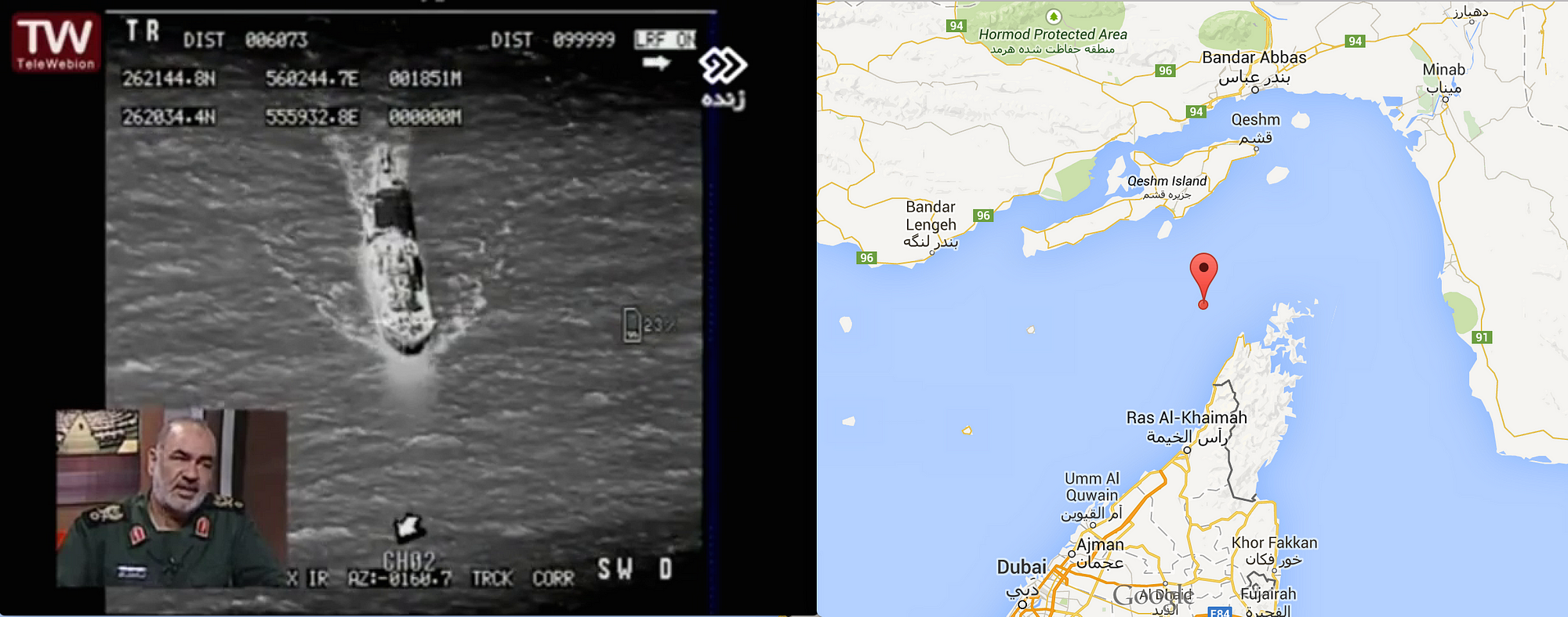
Though Iran’s Great Prophet-9 military exercise ended last month, you can count on Tehran’s military to wring every last drop of bellicosity from the event—such as showing off an apparently armed drone taking a bead on a ship crossing the Strait of Hormuz.

Iran conducted the exercise during the last week of February, and centered it around the theatrical, Michael Bay-esque destruction of a stationary wooden aircraft carrier prop floating off Iran’s Larak Island.

The fake Nimitz-like mockup, which Tehran reportedly used as a set for an upcoming film, served as an effigy of the U.S. Navy’s most iconic warship. American carriers are a constant irritant to Iran as they loom off its coast.

But the exercise contained another threat to a different U.S. strategic interest—shipping.

It was a subtle threat, and to figure it out takes some sleuthing. Helpfully, Iran recently broadcasted the drone’s surveillance footage and its coordinates on state television.

Here’s the footage—which shows video from the Shahed-129’s camera. Deputy commander Hossein Salami of the Iranian Revolutionary Guards Corps narrated the events from a studio.

The Shahed-129 outwardly resembles the British Watchkeeper and Israeli Hermes 450. The machine represents Iran’s foray into building a medium altitude, long endurance UAV—a larger, more capable vehicle than the tactical drones that make up much of Tehran’s arsenal.

STATE DEPT. SAYS IT NEEDS TO REBUILD CLASSIFIED COMPUTER NETWORKS AFTER HACK

March 11, 2015

The State Department says it needs to reconstruct its classified computer systems after suffering a hack the agency has said only affected its unclassified networks.

This detail, buried in a 2016 funding request document, combined with State’s failing data protection grades on a recent government-wide report card, paints a picture of an agency ripe for another attack, security experts say.

“I assume (and hope) that emails sent between the President and Secretary of State are heavily encrypted and never touch the public Internet,” Christopher Soghoian, principal technologist for the American Civil Liberties Union, tweeted Monday.

That might not be the case. Zero percent of State’s email was sent via systems configured to encrypt messages — or code the contents so they are unreadable if intercepted, according the White House’s annual report to Congress on agency information security. The messages were all sent in clear text.

It’s unclear what kind of data protections former State Secretary Hillary Clinton had in place when she emailed President Barack Obama from her homemade email system.

State has asked Congress for $10 million to support “the necessary re-architecting of the classified and unclassified networks” at the department, according to current Secretary of State John Kerry’s budget justification. The budget request also proposes spending $17.3 million on “architecture services.” The overhaul will establish new security controls and help reduce “known security vulnerabilities.”

New Details On Chinese PLA Cyber Spying on Taiwan

Lo Tien-pin and Jason Pan 
March 10, 2015

PLA cyberunit targeting Taiwan named

Senior intelligence officials have identified the specific Chinese military outfit and technical surveillance unit tasked with cyberwarfare against Taiwan and say it is located on the campus of Wuhan University, in Wuhan, Hubei Province.

They said the Wuhan University-based unit is actually the Sixth Bureau of the People’s Liberation Army (PLA) General Staff Department’s (GSD) Third Department.

The Sixth Bureau is engaged in technical aspects of surveillance and intelligence-gathering on important Taiwanese agencies, intercepting telecommunications signals, hacking computers and mobile phone service networks, and satellite imagery reconnaissance against Taiwan, according to recent statements and interviews with Military Intelligence Bureau (MIB) and Ministry of National Defense (MND) officials.

“China’s espionage activities and intelligence-gathering against Taiwan and other countries is always hidden under the guise of academic research centers, non-profit foundations or private sector companies,” said a ministry official who declined to be named.

“It is the same for the PLA’s GSD Sixth Bureau. Its units have network specialists, computer technicians, analysts and trained hackers working in offices at Wuhan University,” he said.

“These offices are installed on campus under the cover of research centers and telecommunication laboratories,” he said.

Other nations who have come under cyberattack and digital information theft have also reported that Chinese cyberarmy units are operating inside university campuses.

Indonesia Threatens Australia With ‘Human Tsunami’

March 11, 2015

Minister warns of unorthodox response if Canberra’s protests over executions continue. 

Indonesia could release a “human tsunami” of more than 10,000 asylum seekers to Australia if Canberra continues to give Jakarta grief over the execution of two Australian nationals for drug offenses, an Indonesian minister warned earlier this week.

Over the past few weeks, Australia has been repeatedly urging Indonesia not to execute Andrew Chan and Myuran Sukumaran, the ringleaders of the so-called “Bali Nine” heroin smuggling gang. The incident has roiled ties between the two nations, with Indonesia taking particular offense at Australian Prime Minister Tony Abbott’s suggestion that Jakarta “reciprocate” for the $1 billion in aid Canberra contributed following the 2004 Boxing Day tsunami. Australia has also warned of diplomatic consequences should the executions be carried out.

At a university speech broadcast on local television, Tedjo Edhy Purdijatno, Indonesia’s coordinating minister for political, legal and security affairs, seemed to offer a threat of his own by stressing that Jakarta could stop helping Canberra ease the flow of asylum seekers into the country.

“If Canberra keeps doing things that displease Indonesia, Jakarta will surely let the illegal immigrants go to Australia,” Tedjo said on Metro TV according to Fairfax Media.

“There are more than 10,000 [asylum seekers] in Indonesia today. If they are let go to Australia, it will be like a human tsunami.”

He also said it was “no big deal” if Australia halted trade ties with Indonesia after the executions.

“We have calculated in fact, Australia enjoys the surplus on the Indonesia-Australia trade,” he said.

Getting Disaster Resilience Right

By Shamshad Akhtar
March 11, 2015

In a region prone to disasters, a major conference must draw on the lessons of the past. 

World leaders and decision-makers from more than 100 countries will gather in a few days month in Sendai, Japan, to finalize a new global framework for disaster risk reduction which will replace the 2005 Hyogo Framework for Action (HFA). The stakes could not be higher, especially for the countries of Asia and the Pacific – by far the most disaster-prone region in the world.

2014 was a year without a single large-scale Asia-Pacific earthquake or tsunami, yet 119 disasters still caused more than 6,000 fatalities and economic losses of almost $60 billion, as storms, floods and landslides wreaked havoc.

Many developing and smaller economies remain highly vulnerable to natural disasters, and climate dynamics add to the risk. With the growing frequency and intensity of disasters, enhancing resilience calls for effective pre- and post-disaster frameworks that include supportive regulations, risk-based preparedness, and mitigation approaches, as well as innovative risk financing mechanisms.

Ten years of HFA implementation have seen major investments and many successes, but new research by the United Nations Economic and Social Commission for Asia and the Pacific (ESCAP) points to five important lessons.

First, disaster risk reduction fails in a policy vacuum. Tackling disasters is most effective in countries where disaster risk reduction is integrated with wider development and financial planning and poverty reduction strategies. Getting the right political momentum, coupled with the right expertise within economic and finance ministries, helps effective execution.

By 2011, the midpoint of HFA implementation, fewer than one Asia-Pacific country in five had fixed allocations for disaster risk management in national budgets, indicating significant gaps in achieving the right blend of financing. This needs to change, as the growing impact of disasters threatens to roll back development gains and undermine sustainable development. With multiple overlapping shocks and crises, countries ignore this lesson at great peril.

The Curious Draw of the Battlefield


MARCH 11, 2015 

Once a year the streets of Philadelphia overflow with Marines, both active duty and veterans, celebrating the Marine Corps’ birthday on Nov. 10th. And it was in the “City of Brotherly Love” that I met a fellow Marine infantry veteran, Patrick Maxwell, last fall. We didn’t speak with each other much, but he knew my wars were over. What I didn’t know was that his weren’t.

Patrick didn’t share his plans with me then, but it wasn’t long before he contacted me from a village near Kirkuk, in northern Iraq. He’d just come back from patrol with the Kurdish peshmerga forces. Patrick, honorably discharged in 2011, had returned to fight alongside the Kurds against the self-proclaimed Islamic State just weeks after our conversation. Not as a Marine, but as a civilian volunteer.

The full story of Patrick’s journey is told here. But his story began long before he traveled to Iraq to fight a second time.

In 2006, Patrick deployed to Iraq’s deadliest province, Anbar, in the south. But he never fired his weapon and I could understand his disappointment. I had spent the first months of my deployments in Iraq and Afghanistan anxious and saddened because I hadn’t pulled my trigger – the very thing Marines are trained to do. So I knew what he meant when he said he “felt robbed.” And so I understood why he went to fight alongside the peshmerga.

Even though I carry the weight of the lives I’ve stolen, some of them innocent, I was jealous of him and it upsets me that I don’t fully understand why. A part of me wanted to fight beside him. The other half despises the very thought. My desire for war is something I believe I will always struggle with even though my longing for peace is much stronger.

The first time I killed someone I was not under fire. A scrawny man with a Kalashnikov lurked toward our position in Falluja, Iraq. I watched as he fell to the ground with one slow, steady press of my rifle’s trigger. At first, all I felt was recoil. But I kept looking back. I couldn’t believe I had killed a man. And I did so with a smile. Because he could have killed one of us.

When my battalion fought in the siege of Falluja in 2004, the images of the World Trade Centers and Pentagon burning that drove me to enlist were no longer on my mind. The American lives lost on the fourth hijacked plane, Flight 93, weren’t what compelled me to squeeze my trigger. For me, combat had nothing to do with America or Old Glory. All aspects of my wars forged a brotherhood of Marines that cannot be replicated; an impenetrable circle of riflemen fighting to live, killing for each other. Perhaps I have been missing that.

Yet when you live life knowing that you’ve killed someone, it is scary. When I reflect on what it took for me to end a person’s life, I cannot recreate my mindset. To spill blood and end a life, I forced myself to rationalize that another human should die. And power over life is addicting. Very addicting. You miss it. You daydream about it. Nothing is more petrifying than being aggressively hunted by another human. And there is nothing more exhilarating than when you kill them first.

Karl Haushofer and the Rise of the Monsoon Countries

By Francis P. Sempa
March 10, 2015

This writer understood geopolitical potential of the Indo-Pacific decades ago. 

Long before Robert Kaplan identified the Indian Ocean and its surrounding region as the new geopolitical pivot of world politics in his 2010 book Monsoon: The Indian Ocean and the Future of American Power, the leading intellectual theorist of German geopolitics in the 1920s and 30s, Karl Haushofer, foresaw the power potential of what he called the “Indo-Pacific” or “Asiatic Monsoon countries” and urged German policymakers to promote the geopolitical unity of this region to offset British and American sea power.

Born in Munich on the eve of the Franco-Prussian War, Haushofer studied at the Royal Maximilian Gymnasium before joining the Bavarian Army in 1887. He excelled at the Military Academy (Kriegsschule), attended artillery and engineering school, and from 1895 to 1898 studied at the General Staff College (Kriegsakademie). Between 1898 and 1908, Haushofer served with the troops at various posts, taught military history at the Military Academy, and worked on the General Staff.

In 1908, Major Haushofer was assigned to the German Embassy in Tokyo to observe and study the Japanese military that had so recently stunned the world by besting the great Russian Empire in the Russo-Japanese War. On his way there, he stopped at Cyprus, Alexandria, Aden, India, Singapore and elsewhere and noticed the Union Jack flying from those strategic outposts. Haushofer’s trip to the Orient shaped all of his subsequent geopolitical writing. As Andreas Dorpalen noted in The World of General Haushofer, it was in Japan and the Far East that his “transformation from political geographer to geopolitican was completed.”

Haushofer studied the geopolitical works of Friedrich Ratzel, Rudolf Kjellen, and Sir Halford Mackinder, calling Mackinder’s 1904 “The Geographical Pivot of History” the greatest of all geographical world views. Like Ratzel and Kjellen, Haushofer believed that nation-states were living organisms that either expanded or declined and eventually died. He included factors such as location, size, population, national unity, and economics in his analyses of the power potential of nations. Haushofer wrote his Ph.D thesis in 1911 on the geographic foundations of Japan’s power. Between 1913 and 1923 – with a gap for his service in the First World War – he wrote five more books on Japan and the Far East. Then, in 1924, he wrote his most important geopolitical work,The Geopolitics of the Pacific Ocean. In that book and in articles written for Geographische Zeitschrift andZeitschrift fur Geopolitik, Haushofer urged German leaders to align their country to the Indo-Pacific peoples of India, China and Japan.

12 March 2015

Fight deforestation through a Google-powered map

MARC GUNTHER
March 12, 2015

The forestry website Mongabay recently reported that United Cacao, a London-listed company that promises to produce ethical, sustainable chocolate, had “quietly cut down more than 2,000 hectares of primary, closed-canopy rainforest ” in the Peruvian Amazon. The company claimed that the land had been previously cleared, but satellite images showed otherwise.

The satellite images came from an online platform called Global Forest Watch, which provides reliable and up-to-date data on forests worldwide, along with the ability to track changes to forest cover over time.

Launched a year ago by the World Resources Institute (WRI), the platform has brought an unprecedented degree of transparency to the problem of deforestation, pointing to ways in which big data, cloud computing and crowdsourcing can help attack other tough sustainability problems.

Before Global Forest Watch came along, actionable information about forest trends was scarce. “In most places, we knew very little about what was happening to forests,” said Nigel Sizer, the global director of the forests programme at WRI. “By the time you published a report, the basic data on forest cover and concessions was going to be years out of date.”

Several technology revolutions have changed that. Cheap storage of data, powerful cloud computing, Internet connectivity in remote places and free access to U.S. government satellite images have all made Global Forest Watch possible. None were widely available even a decade ago.

Governments and NGOs are both using Global Forest Watch, as are companies like Unilever, Asia Pulp, and Paper and Wilmar, all of which have made commitments to stop deforestation.

An ambitious undertaking, Global Forest Watch brought together a broad coalition of NGO, corporate and government partners. Working closely with WRI are more than 60 partners, including Google (which supported the software development and provides computing power), ESRI (a privately-held mapping company), the University of Maryland’s department of geographical sciences (home to mapping and land-use expert Matt Hansen), Brazil-based Imazon, the Center for Global Development (a Washington DC-based think tank), and the UN Environment Programme. The multimillion dollar programme is funded by governments like Norway, the U.S. and U.K.

A sketchy road map for health policy

NIDHI KHURANA
March 12, 2015

The Hindu“The swine flu epidemic was met with a shoddy response from the public health machinery.” Picture shows schoolchildren in Mumbai wearing masks to protect themselves from the infection.

Much of the National Health Policy document reads like a report of health issues and systemic challenges, and is sorely wanting on policy detail

Health impoverishment — falling into poverty due to health care costs — affects 63 million individuals in India every year. This is a damning statistic, especially when read with the fact that 18 per cent of all households face catastrophic health expenditures (health expenditure greater than 10 per cent of total household consumption expenditure or 40 per cent of total non-food consumption expenditure). We are at an urgent precipice in time for making health policy work for the poor in India — the deep end of dire straits. The 2015 draft National Health Policy (NHP) is pregnant with possibilities. The first federal health bill to come out in more than a decade is a salient opportunity for the Narendra Modi government to present a coherent plan to deliver equitable, efficient and sustainable health care to India’s billion plus citizenry.

The cliff notes version of the NHP recommendations reads thus: make health a fundamental and justiciable right; increase public expenditure on health from 1 per cent of GDP to 2.5 per cent of GDP; raise revenues mainly through general taxation while exploring the possibility of sin taxes (mainly taxes on tobacco and alcohol), and earmarks for health (akin to the education cess); and strengthen health services provisioning through strategic purchasing from the public and private sector.

Jumping the gun

India's Got a Plan For South China Sea Disputes (And China Won't Like It)

March 11, 2015
India’s got a preferred solution for South China Sea disputes — and it’s not a surprise. 

In recent years, India has started to become increasingly more vocal about what it feels is the correct way for the five main territorial disputants in the South China Sea to resolve their differences. What’s particularly interesting is that the rhetoric coming out of New Delhi seems to be growing more specific and pointed as time goes on. Early on Wednesday, the Manila Times reported that that Indian ambassador to the Philippines, Shri Lalduhthlana Ralte, said that India explicitly supported international law and arbitration in resolving these disputes. “Our view with that such kind of disputes [is that], the claimant countries should observe international law and norms that disputes are to be settled peacefully. We should allow ourselves to be subjected to international law,” Ralte said, according to the report.

The ambassador’s comments bookend a string of policy statements by New Delhi that mostly began in 2013. Back then, Indian Prime Minister Manmohan Singh, speaking at the East Asia Summit, noted that “A stable maritime environment is essential to realize our collective regional aspirations.” Keen to make his approval known for multilateral processes in Southeast Asia (which I recently expressed some skepticism about), Singh added: “We welcome the collective commitment by the concerned countries to abide by and implement the 2002 Declaration on the Conduct of Parties in the South China Sea and to work towards the adoption of a Code of Conduct in the South China Sea on the basis of consensus. We also welcome the establishment of the Expanded ASEAN Maritime Forum for developing maritime norms that would reinforce existing international law relating to maritime security.”

Those statements failed to draw much attention. Beijing probably raised its eyebrows at New Delhi’s interest in the South China Sea, but there was little in the prime minister’s statements that suggested a firm backing for a specific resolution mechanism. In early 2014, Shri Anil Wadhwa, Secretary (East) of India’s Ministry of External Affairs, pushed the Indian position a bit further into the realm of clarity. “We advocate that the lines, the channels of trade and communication should be kept open and of course the sea, which, according to UN (United Nations) international law of the sea, is common to all the countries that use it. Definitely we are concerned,” he told journalists at the annual ASEAN-India dialogue in New Delhi. “Our position has always been India stands for freedom of navigation on high seas. We would like to ensure that all countries in the region adhere to the international conventions on the law of the sea in this issue,” he clarified.

Time Bomb: The Islamic State Implodes

March 11, 2015

Washington will defeat ISIS by waiting it out as the organization cracks from within.

The Arab League’s call this week for a multi-national force to push Daesh (the Islamic State) out of its strongholds in Syria and Iraq may will be appealing to those who fear the impact of the growing Iranian position in Syria and Iraq but remain concerned that the U.S.-led airstrikes aren’t an effective solution to an on-the-ground insurgency. Boko Haram’s opportunistic pledge of loyalty to Daesh stokes further fears about the group’s growing position in the international jihadi movement and the need for a more assertive solution, which both pushes Daesh back and stems its ability to recruit foreign fighters.

However, Daesh is facing its own existential crisis in terms of both its organization and ideology. Confronted by war on a number of fronts, Daesh’sself-proclaimed Caliph, Abu Bakr Al-Baghdadi, has struggled to create a state in practice, focusing more of the group’s attention on further expansion and elaborate media stunts than establishing an actual institutional polity.

In theory, Daesh has an organizational hierarchy to “govern” its territory, but this structure is dependent on a growing number of Arab and foreign fighters, who have varying aims, motivations, and differences amongst them. As Liz Sly noted this week in The Washington Post, foreign and Arab fighters are unhappily co-existing with the local population and fighting at times with one another over Daesh’s war aims, their status within the new state, and the allocation of the state’s resources.

This raises critical questions about whether Baghdadi will be able to maintain his “state” as he is increasingly pressed on multiple fronts. Numerous reports suggest that Syrians and Iraqis living under Daesh’s rule are finding that life in the new state isn’t what many had hoped for after decades of mismanagement under the former regimes.

THE TROUBLE WITH OUR AFGHAN “LED” CAMPAIGN

March 10, 2015 

War on the Rocks is expanding, and we need your help! 

Code Black is the story of a British Army Officer, Captain Mark Evans, and his deployment to Afghanistan in the summer of 2008. In particular, it focuses on a seven-week period during which Evans and a small multiple of British troops – supported by an Afghan National Army kandak (battalion) – were left fighting for their lives in the district of Nad Ali. In 2008, the focus of the International Security Assistance Force (ISAF) in Helmand was directed mainly towards the movement of a third turbine to the Kajaki dam in the north of the province. While the brigade’s head was turned, however, hundreds of enemy fighters pushed upwards from the south and took the town of Marjah (later to be the scene of the clearance operation in 2010 called Op Moshtarak). The enemy were now heading towards the provincial capital of Lashkar Gah and Nad Ali was next in line for their attack. As ever, the UK deployed a woefully under-manned and under-resourced team to try and hold them back. Code Black is a powerful story of defensive warfare and the pressures of command in dangerous circumstances.

In previous articles, I have disapprovingly acknowledged how almost every junior officer’s Afghan tour ends up as a published memoir these days. It’s a well-trodden route and consequently there is rarely any scope for true originality in these types of books anymore. That said, Code Black is firmly focused on a battle that was fought well away from the media spotlightand, as such, it’s fair to say that Evans’ story is a little known vignette of the UK’s war in Afghanistan – one which shares a great many parallels with the fabled Battle of Rorke’s Drift – the defense of a tiny garrison station during the Anglo-Zulu War of 1882.

I am pleased to report that Captain Evans’ book is different in another key aspect too: It is an altogether much more humble effort than many of its contemporaries. Objective and authentic, Evans doesn’t attempt to present himself in a heroic light but instead he makes a point of discussing his own short-comings and moments of self-doubt in leadership. I like that in an author. Guards officers are not generally known for their humility but, in this case, the memoir is not dominated by the author. Instead, Code Blackprovides plenty of space for other characters to play a full role and, ultimately, I think that one of book’s key successes lies in its descriptions of the relationships between different people at war.

OSAMA BIN LADEN’S FILES: THE PAKISTANI GOVERNMENT WANTED TO NEGOTIATE

March 10, 2015 

Recently released files recovered in Osama bin Laden’s compound show that parts of the Pakistani government made attempts to negotiate with al Qaeda in 2010. The letters were released as evidence in the trial of Abid Naseer, who was convicted on terrorism charges by a Brooklyn jury earlier this month.

One of the files is a letter written by Atiyah Abd al Rahman (“Mahmud”), who was then the general manager of al Qaeda, to Osama bin Laden (identified as Sheikh Abu Abdallah) in July 2010. The letter reveals a complicated game involving al Qaeda, the Pakistani Taliban, the brother of Pakistan’s current prime minister, and Pakistan’s intelligence service.

“Regarding the negotiations, dear Sheikh, I will give you an overview, may God support me in this,” Rahman wrote. “The Pakistani enemy has been corresponding with us and with Tahreek-i-Taliban (Hakeemullah) for a very short time, since the days of Hafiz, may God have mercy on him.” Hakeemullah Mehsud was the head of the Pakistani Taliban at the time. The “Hafiz” mentioned is Mustafa Abu Yazid (Sheikh Saeed al Masri), who served as al Qaeda’s general manager prior to his death in May 2010. Rahman succeeded Yazid in that role.

“We discussed the matter internally, then we talked with Abu-Muhammad later once we were able to resume correspondence with him,” Rahman explained. “Abu-Muhammad” is the nom de guerre of Ayman al Zawahiri. As a result of these discussions, al Qaeda was willing to broker a deal in which the jihadists’ would ease off the Pakistanis so long as the military and intelligence services stopped fighting al Qaeda and its allies.

“Our decision was this: We are prepared to leave you be. Our battle is primarily against the Americans. You became part of the battle when you sided with the Americans,” Rahman wrote, explaining al Qaeda’s position towards the Pakistani government. “If you were to leave us and our affairs alone, we would leave you alone. If not, we are men, and you will be surprised by what you see; God is with us.”

Pakistan Test Fires Shaheen III Nuclear-Capable Missile

March 10, 2015

Pakistan Test-Fires Nuclear Capable Ballistic Missile

ISLAMABAD — Pakistan test-fired a nuclear-capable ballistic missile on Monday, the military said, less than a week after the first high-level talks with arch-rivals India for nearly a year.

The military said the Shaheen III surface-to-surface missile had a range of 2,750 kilometers (1,700 miles) and can carry nuclear and conventional warheads.

"The test launch, with its impact point in the Arabian Sea, was aimed at validating various design and technical parameters of the weapon system at maximum range," the military said in a statement.

India and Pakistan — which have fought three wars since independence from Britain in 1947 — have routinely carried out missile tests since both demonstrated nuclear weapons capability in 1998.

Pakistan’s most recent missile test came last month with the launch of a low-flying, terrain-hugging cruise missile capable of carrying a nuclear warhead.

Indian Foreign Secretary Subrahmanyam Jaishankar visited Islamabad last week for talks with his Pakistani counterpart.

It was the first senior-level dialogue between the nuclear-armed rivals since their prime ministers met in New Delhi last May.