17 March 2015

Strength Is Weakness


MARCH 13, 2015 

We’ve been warned over and over that the Federal Reserve, in its effort to improve the economy, is “debasing” the dollar. The archaic word itself tells you a lot about where the people issuing such warnings are coming from. It’s an allusion to the ancient practice of replacing pure gold or silver coins with “debased” coins in which the precious-metal content was adulterated with cheaper stuff. Message to the gold bugs and Ayn Rand disciples who dominate the Republican Party: That’s not how modern money works. Still, the Fed’s critics keep insisting that easy-money policies will lead to a plunging dollar.

Reality, however, keeps declining to oblige. Far from heading downstairs to debasement, the dollar has soared through the roof. (Sorry.) Over the past year, it has risen 20 percent, on average, against other major currencies; it’s up 27 percent against the euro. Hooray for the strong dollar!

Or not. Actually, the strong dollar is bad for America. In an immediate sense, it will weaken our long-delayed economic recovery by widening the trade deficit. In a deeper sense, the message from the dollar’s surge is that we’re less insulated than many thought from problems overseas. In particular, you should think of the strong dollar/weak euro combination as the way Europe exports its troubles to the rest of the world, America very much included.

Some background: U.S. growth has improved lately, with employment rising at a pace not seen since the Clinton years. Yet the state of the economy still leaves a lot to be desired. In particular, the absence of much evidence for rising wages tells us that the job market is still weak despite the fall in the headline unemployment rate. Meanwhile, the returns America offers investors are ridiculously low by historical standards, with even long-term bonds paying only a bit more than 2 percent interest.

Currency markets, however, always grade countries on a curve. The United States isn’t exactly booming, but it looks great compared with Europe, where the present is bad and the future looks worse. Even before the new Greek crisis blew up, Europe was starting to resemble Japan without the social cohesion: within the eurozone, the working-age population is shrinking, investment is weak and much of the region is flirting with deflation. Markets have responded to those poor prospects by pushing interest rates incredibly low. In fact, many European bonds are now offering negative interest rates.

This remarkable situation makes even those low, low U.S. returns look attractive by comparison. So capital is heading our way, driving the euro down and the dollar up.

Stratfor Predicts Loose Nukes In Russia Will Be ‘The Greatest Crisis Of The Next Decade’


The most alarming prediction in the Decade Forecast from private intelligence firm Strategic Forecasting, or Stratfor, involves a Russian collapse leading to a nuclear crisis.

The firm believes the Russian Federation will not survive the decade in its present form, after a combination of international sanctions, plunging oil prices, and a suffering ruble trigger a political and social crisis. Russia will then devolve into an archipelago of often-impoverished and confrontational local governments under the Kremlin’s very loose control.

“We expect Moscow’s authority to weaken substantially, leading to the formal and informal fragmentation of Russia” the report states, adding, “It is unlikely that the Russian Federation will survive in its current form.”

If that upheaval happened, it could lead to what Stratfor calls “the greatest crisis of the next decade”: Moscow’s loss of control over the world’s biggest nuclear weapons stockpile.

Russia is the world’s largest country and its 8,000 weapons are fairly spread out over its 6.6 million square miles. According to a Bulletin of the Atomic Scientists study, Russia has 40 nuclear sites, which is twice as many as the US uses to house a comparable number of warheads. This policy of dispersal makes it difficult for an enemy to disable the Russian nuclear arsenal in a single attack, but it also makes the Russian stockpile difficult to control.

The Bulletin report also found that the Russia was uncertain exactly how many short-range “tactical” or city-busting “strategic” nukes it has, nor what the weapons’ state of assembly or alert status may be.

Stratfor fears that the dissolution of the Russian Federation could cause an unprecedented nuclear security crisis. Not only could the command-and-control mechanisms for Russia’s massive and highly opaque nuclear arsenal completely break down. Moscow might lose its physical control over weapons and launch platforms as well.

“Russia is the site of a massive nuclear strike force distributed throughout the hinterlands,” the Decade Forecast explains. “The decline of Moscow’s power will open the question of who controls those missiles and how their non-use can be guaranteed.”

In Stratfor’s view the U.S. is the only global actor that can formulate a response to this problem, and ever that might not be enough to prevent launch platforms and weapons from falling into the wrong hands.

Air Force To Hold Close Air Support Summit; May Need New Weapon

February 12, 2015 

ORLANDO: The Air Force, under heavy pressure from Congress to keep the A-10 Warthog in the air, will hold a mini-summit with the Army, Navy and Marines to figure out the best ways to do Close Air Support, the politically sensitive mission of aircraft protecting troops on the ground.

Gen. Hawk Carlisle, head of Air Combat Command, told reporters here at the Air Force Association’s annual winter conference that the service would be looking at all manner of ways to kill enemy troops shooting at American and allied troops. Carlisle said the service would consider buying a new weapon to do CAS.

“What does the Army think? What do the Marines think? We are looking at all of that,” he said. “Another weapons program may be what we need to consider.”

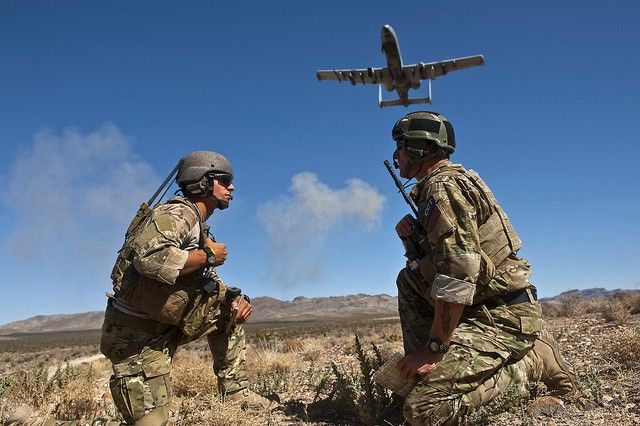
An A-10 Warthog flies over Joint Terminal Air Controllers

If you want to get some idea as to why the Air Force really wants to retire the A-10 and save an estimated $4.2 billion over the next five years, look at what is happening in Syria and Iraq.

Air Force Central Command confirmed today in an email that A-10s have “conducted a small number of missions in Syria (few dozen), primarily airborne interdiction on the Syrian side of the border. The vast majority of their strikes/sorties are in Iraq.”

So A-10s are striking targets in Iraq but they have tackled only a few operations against ISIL in Syria. Why was that, I asked Carlisle?

He pointed to the shoot-down of the F-16 Jordanian pilot, who was so horribly murdered by ISIL after his capture.

“The A-10 is significantly more vulnerable in a contested environment,” he noted. Its range and speed (and speed is closely related to one’s ability to survive an attack by a ground to air missile) limit its use.

Carlisle was careful to say there was no line drawn barring the A-10 from the area, but he made clear other newer and more advanced aircraft are much better suited to operating across most of the Syria, which is protected by advanced Russian-built air defenses.

One path that is highly unlikely to be taken is trying to use drones such as the MQ-9 Reaper to do CAS. Carlisle made clear the drones are just too vulnerable to being shot down to be considered for that mission.

Congress will have much to say about the way ahead, as Sen. Kelly Ayotte, whose husband is a former A-10 pilot, and Sen. John McCain, chair of the Senate Armed Services Committee, continue to oppose all efforts by the Air Force to retire the aging but beloved Warthog

More U.S. Law Enforcement Agencies Secretly Using STINGRAY Cellphone Tracking Device

Matt Richtel
March 16, 2015

A powerful new surveillance tool being adopted by police departments across the country comes with an unusual requirement: To buy it, law enforcement officials must sign a nondisclosure agreement preventing them from saying almost anything about the technology.

Any disclosure about the technology, which tracks cellphones and is often called StingRay, could allow criminals and terrorists to circumvent it, the F.B.I. has said in an affidavit. But the tool is adopted in such secrecy that communities are not always sure what they are buying or whether the technology could raise serious privacy concerns.

The confidentiality has elevated the stakes in a longstanding debate about the public disclosure of government practices versus law enforcement’s desire to keep its methods confidential. While companies routinely require nondisclosure agreements for technical products, legal experts say these agreements raise questions and are unusual given the privacy and even constitutional issues at stake.

“It might be a totally legitimate business interest, or maybe they’re trying to keep people from realizing there are bigger privacy problems,” said Orin S. Kerr, a privacy law expert at George Washington University. “What’s the secret that they’re trying to hide?”

The issue led to a public dispute three weeks ago in Silicon Valley, where a sheriff asked county officials to spend $502,000 on the technology. The Santa Clara County sheriff, Laurie Smith, said the technology allowed for locating cellphones — belonging to, say, terrorists or a missing person. But when asked for details, she offered no technical specifications and acknowledged she had not seen a product demonstration.

Buying the technology, she said, required the signing of a nondisclosure agreement.

“So, just to be clear,” Joe Simitian, a county supervisor, said, “we are being asked to spend $500,000 of taxpayers’ money and $42,000 a year thereafter for a product for the name brand which we are not sure of, a product we have not seen, a demonstration we don’t have, and we have a nondisclosure requirement as a precondition. You want us to vote and spend money,” he continued, but “you can’t tell us more about it.”

The technology goes by various names, including StingRay, KingFish or, generically, cell site simulator. It is a rectangular device, small enough to fit into a suitcase, that intercepts a cellphone signal by acting like a cellphone tower.

The technology can also capture texts, calls, emails and other data, and prosecutors have received court approval to use it for such purposes.

Cell site simulators are catching on while law enforcement officials are adding other digital tools, like video cameras, license-plate readers, drones, programs that scan billions of phone records and gunshot detection sensors. Some of those tools have invited resistance from municipalities and legislators on privacy grounds.

The nondisclosure agreements for the cell site simulators are overseen by the Federal Bureau of Investigation and typically involve the Harris Corporation, a multibillion-dollar defense contractor and a maker of the technology. What has opponents particularly concerned about StingRay is that the technology, unlike other phone surveillance methods, can also scan all the cellphones in the area where it is being used, not just the target phone.

Steven Pinker is wrong about violence and war

Friday 13 March 2015
Source Link

A new orthodoxy, led by Pinker, holds that war and violence in the developed world are declining. The stats are misleading, argues Gray – and the idea of moral progress is wishful thinking and plain wrong

 
For an influential group of advanced thinkers, violence is a type of backwardness. In the most modern parts of the world, these thinkers tell us, war has practically disappeared. The world’s great powers are neither internally divided nor inclined to go to war with one another, and with the spread of democracy, the increase of wealth and the diffusion of enlightened values these states preside over an era of improvement the like of which has never been known. For those who lived through it, the last century may have seemed peculiarly violent, but that, it is argued, is mere subjective experience and not much more than anecdote. Scientifically assessed, the number of those killed in violent conflicts was steadily dropping. The numbers are still falling, and there is reason to think they will fall further. A shift is under way, not strictly inevitable but enormously powerful. After millennia of slaughter, humankind is entering the Long Peace.

This has proved to be a popular message. The Harvard psychologist and linguistSteven Pinker’s The Better Angels of Our Nature: a history of violence and humanity (2011) has not only been an international bestseller – more than a thousand pages long and containing a formidable array of graphs and statistics, the book has established something akin to a contemporary orthodoxy. It is now not uncommon to find it stated, as though it were a matter of fact, that human beings are becoming less violent and more altruistic. Ranging freely from human pre-history to the present day, Pinker presents his case with voluminous erudition. Part of his argument consists in showing that the past was more violent than we tend to imagine. Tribal peoples that have been praised by anthropologists for their peaceful ways, such as the Kalahari !Kung and the Arctic Inuit, in fact have rates of death by violence not unlike those of contemporary Detroit; while the risk of violent death in Europe is a fraction of what it was five centuries ago. Not only have violent deaths declined in number. Barbaric practices such as human sacrifice and execution by torture have been abolished, while cruelty towards women, children and animals is, Pinker claims, in steady decline. This “civilising process” – a term Pinker borrows from the sociologist Norbert Elias – has come about largely as a result of the increasing power of the state, which in the most advanced countries has secured a near-monopoly of force. Other causes of the decline in violence include the invention of printing, the empowerment of women, enhanced powers of reasoning and expanding capacities for empathy in modern populations, and the growing influence of Enlightenment ideals.

Pinker was not the first to promote this new orthodoxy. Co-authoring an article with Pinker in the New York Times (“War Really Is Going Out of Style”), the scholar of international relations Joshua L Goldstein presented a similar view inWinning the War on War: the Decline of Armed Conflict Worldwide (2011). Earlier, the political scientist John E Mueller (whose work Pinker and Goldstein reference) argued in Retreat from Doomsday: The Obsolescence of Major War (1989) that the institution of war was disappearing, with the civil wars of recent times being more like conflicts among criminal gangs. Pronounced in the summer of 1989 when liberal democracy seemed to be triumphant, Francis Fukuyama’s declaration of “the end of history” – the disappearance of large-scale violent conflict between rival political systems – was a version of the same message.

Cyber Threat Information Sharing

MAR 10, 2015 
Recommendations for Congress and the Administration 

There is broad consensus that improved information sharing is critical to combating cyber threats. This report offers a set of recommendations to address outstanding obstacles to improved sharing of information related to cyber threats. It is the product of a series of three roundtables that the CSIS Strategic Technologies Program hosted over three months with stakeholders from government, industry, and privacy groups. The recommendations incorporate feedback from each of these interested parties and cover both structural and legal challenges to cyber threat information sharing. 


US military force sizing for both war and peace

March 10, 2015


The Pentagon employs a force-sizing construct to define the upper limits of what the military is able to do. Although the capability to fight two major, near-simultaneous wars has served as a traditional force-sizing construct and benchmark for America’s superpower status, this standard has been watered down in recent years and proved insufficient over the last decade.

Fighting and winning the nation’s wars is only one mission of America’s military. Daily, the US military is active in maintaining a regular presence, reassuring allies, and deterring potential aggressors. These peacetime activities are the most effective use of military power.

The Pentagon must more accurately size the military to not only fight and win two major wars at once but also conduct the multitude of routine missions, deployments, and forward presence that advance and protect American interests overseas.

To plan the size of the US military, Pentagon officials rely on what is known as a force-sizing construct, which reflects the upper limits of what the military is able to do. Most famously, in the wake of the Cold War, Pentagon planners relied on the two-war standard, which called for a military sized to fight two near-simultaneous wars if necessary. But in recent years, the two-war standard has been watered down even as demands on US forces have grown. Not only has it been scaled back, but the force-sizing construct also diminished after it was exposed as inadequate to meet the demands placed on the military in the aftermath of 2001 in both Iraq and Afghanistan.

Yet returning to a true two-war standard is a necessary but insufficient step to create a modern force-sizing construct. Rather than only incorporating demands for forces in wartime, the Pentagon’s construct must also include regular peacetime demands on US forces. While steady-state demands such as forward presence abroad, training missions with partner militaries, and rotational deployments do not rise to the magnitude of major contingency operations, they form the backbone of day-to-day US military activities. Moreover, they serve a vital role in shaping the international environment to advance American interests, preserving a norm-based international order, reassuring allies, and deterring potential aggressors.

A New Way of Warfare: The Strategic Logic of Harnessing Non-Violent Combat

March 11, 2015 

It has been said that the US Army has hit an inflection point.[i] The hard-earned insights of combat in the War on Terror have been gained through plenty of sacrifice and action. Now, more than ever, the nation requires the Army to make fundamental changes to ensure it is prepared for the complex challenges of the future. Novel concepts and debates focused on this problem, e.g. The Strategic Landpower Initiative, CSA Strategic Studies Group, and Force 2025 Maneuvers, have ignited the critical thinking needed to bring about necessary change. The fiscal environment, troop reductions, ongoing threats, and many other issues compound the problem and illumine many concerns that demand attention. Countries like Iran continue to extend and grow their influence over the Middle East and groups like ISIS threaten stability throughout the region. Our nation’s enemies thrive in poorly governed spaces and operate where our reach is limited. This is not new and creative approaches to project power and strike the enemy have evolved but brought limited success. The Army’s ability to deliver ordnance and “break things” remains unmatched in the world. Although this ability to deliver violence requires continued refinement, I argue for the development of a new and robust capability that can masterfully shape, influence, and condition an environment to meet desired outcomes and objectives. This is a new way of warfare. As Clausewitz reminds us, the nature of war does not change but its character does.[ii] To strike a better balance in our art of waging war the military must exercise its imagination and take an unprecedented approach to harness a new way of warfare: non-violent combat.

Warfare is an art that is supported by science. Technological gains through science provide protection, increased lethality, and improved situational awareness. Conversely, scholars argue that the overwhelming emphasis on science and the so called “Revolution in Military Affairs (RMAs)” have hurt the appreciation for the “art” in warfare[iii]. The pursuit of a technological “silver bullet” or panacea may have prevented the innovative development of new concepts needed to wage war. However, the freshly published Army Operating Concept (AOC) “Win in a Complex World” emphasizes the importance of the human domain. The “increased velocity and momentum of human interactions” coupled with the growing connectedness in the world elucidate the fact that war and conflict remain a human endeavor.[iv] There is no substitute for the intellectual faculty required to thrive in this human domain. The rebalance of the art and science presented in this essay can be compared to a metaphor about martial arts described by prominent scholars: Gilles Delueze, Felix Guttari, and Gene Sharp.

The Future Fallacy: A Conversation about the “Certainty Principle”

March 12, 2015 

The “future of war” is a persistently present topic of discussion among national security professionals. Last year, the New America Foundation, a think tank, teamed with Arizona State University to create a “Future of War Project.”[i] Another Washington think tank—the Center for Strategic and Budgetary Assessments—describes itself as “specializ[ing] in thinking about the future of warfare.”[ii] Peter Singer of Brookings presented a “TED talk” in 2009 on warrior robots that has garnered nearly 1.2 million online views.[iii] Both the Navy and the Army have small, specially-selected annual cohorts chartered to be novel, independent, and to “think big thoughts” on the long-term future of their respective Services, “unconstrained” by present policy and doctrine.[iv] In early 2015, the Army’s Combined Arms Center at Fort Leavenworth sponsored a writing competition on the “future of war.”[v] The Army’s senior leadership seems to routinely probe the future when faced with a smaller Army and fewer resources than desired, and more threats than are comfortable.[vi] This essay tries an unconventional approach—a Socratic dialogue[vii]—to express a contrarian view. While not dismissing thoughtful, limited attempts to forecast the future as substantively wrong, this essay argues that even the attempt to make those forecasts—especially by those in uniform—may, under certain conditions, be misguided, distracting, and ultimately undermine the military’s credibility. The following dialogue is entirely fictional: what it may lack in realism, it may gain ground in its original take on a persistent problem.

Special Assistant to the Chairman of the Joint Chiefs of Staff [SA-CJCS]: Hey there, stranger! I know it’s late today, but thanks for sitting down with me, Tom. 

Want a beer? 

Professional Staff Member, Senate Armed Services Committee [PSM-SASC]: [taking his seat at the bar] Sure, Jane. Thanks. Not a problem—you know we always have time to chat. With the hearing coming up next week, I assumed you’d call. 

The Committee is obviously working hard to make sure the “event” [making air quotes with his fingers] goes better than last time. You remember.

SA-CJCS: [sigh] Well, I was a back-bencher, as they say. I can’t—and won’t—take credit for that…event. I know the General certainly doesn’t want to be put in a position like that again—he was caught between his role as a confident and advisor to the President and the Senator’s request for a personal opinion about a subject that was still being batted around inside the Administration.[viii]

Your guys really put him in a tight spot, you knew it, and you kept squeezing.

PSM-SASC: I got it. But understand: Goldwater-Nichols[ix] requires him to respond to Congress with his candid opinion when asked. …the Committee has a right to know what you all are thinking in the Building. Besides, your guy has been in a unique position—not really on the Joint Chiefs, not really in the NSC…he’s just like Maxwell Taylor was in the early 60’s, before Kennedy made him Chairman.[x] And you all get it wrong as often as you get it right, so Congress has a legitimate interest in…let’s say helping the process along by injecting a little transparency.[xi]

Cyber Subs: A Decisive Edge For High-Tech War?

March 10, 2015 

THE FUTURE: Imagine you’re a Chinese high commander, taking stock at the outbreak ofthe next great war. All your aides and computer displays tell you the same thing: For hundreds of miles out into the Western Pacific, the sea and sky are yours. They are covered by the overlapping threat zones of your long-range land-based missiles, your Russian-madeSukhoi aircraft, your home-grown stealth fighters, and your ultra-quiet diesel submarines, all cued by your surveillance network of sensors on land, sea, air, and space.

The net effect is what the West calls Anti-Access/Area Denial (A2/AD) and you call counter-intervention. Now you can deal with the Japanese imperialists and Taiwanese separatistswithout American interference. As Mao’s followers once sang, the East is Red.

Then it all starts rotting from the inside out.

Here and there, in patches, your sensor coverage goes fuzzy, communications become erratic: American jamming. But the interference isn’t at the periphery of the defense zone, where US sea, land, and air forces are slamming away from the outside. It’s emerging close to the Chinese coast. The source can only be American submarines.

Chinese aircraft scrambled to stop the jamming find antennas on buoys, unmanned boats, or small drones. Each one is easily destroyed, but there are a lot of them. For each one you wipe from your screens, another two pop up. Meanwhile the American submarines themselves remain elusive, silently dropping expendable, unmanned jammers that wait for the sub to get well away before they go active. When your sub-hunters do find something underwater, it’s usually an unmanned submersible or a weapons pod lying on the seafloor.

At least part of the problem is inside your network, too. Radars and radios are failing in places out of range of any jammer. Some submarine-launched system must have hacked into your wireless transmissions and injected a virus.

Close Air Support Summit Sparks Nod To Textron’s Scorpion

March 09, 2015 

PENTAGON: Army Chief of Staff Gen. Ray Odierno. Air Force Chief of Staff Gen. Mark Welsh. Marine Commandant Gen. Joseph Dunford. National Guard Bureau Chief Army Gen. Frank Grass. Gen. Hawk Carlisle, head of Air Force Air Combat Command. That’s a lot of stars and command authority gathered in one place and they all came together at a week-long summit to discuss the future of one of the military’s most sensitive and important missions:Close Air Support (CAS).

Organized by Gen. Welsh, the summit focused on the future of CAS. Carlisle told us “gaps” were spotted in training and to, some degree, in future equipment.

The biggest gap in Close Air Support right now, Carlisle told reporters, is the training CAS pilots currently have to operate in what the Air Force nicely calls “contested environments” — places where the enemy has a decent chance of shooting you down.

“Adversaries see what we do,” he said. “Every adversary in the world who has the potential to challenge us will say, if the Americans own the air they will destroy us. So they are continually trying to counter.”

And Carlisle mentioned one particular hot spot as an example: “We talk about particular scenarios like eastern Ukraine. What would that look like, and what would we do.” Of course, the Russians would protect the area using their IADS. Given the relative vulnerabilities of the A-10 that probably means we would use bombers and fighters such as the F-16, but Carlisle didn’t address any specifics.

The Air Force plans to use a lot of simulators and other virtual environments to hone CAS training. Pilots have operated in uncontested environments over the last 13 years and haven’t had time to train for high-end operations, the general said.

The other gap of interest to our readers may lie in aircraft flying CAS in less contested environments. There’s been talk about an A-X aircraft, but the Air Force can’t afford a new plane as long as the Budget Control Act remains in force, Carlisle told us. And the three versions of the F-35 will, Carlisle noted, be the main CAS weapons operating in hot environments. But, he said, we “may need more capacity at a lower cost.”

Would Textron’s Scorpion, an all-composite aircraft designed to boast low operating costs, as well as be relatively cheap to procure, fit the bill, he was asked. “It could. It may be,” he said. “We’ve gone out and looked at other platforms that could provide for low cost per flying hour.” The Scorpion is designed to cost less than $20 million over plane and cost less than $3,000 per flying to operate.

For those who are late to the party, CAS is the act of using aircraft to kill the enemy when he gets close to our troops. It requires great communications, spectacular accuracy, fabulous flying and great care on the part of the Joint Terminal Attack Controller (JTAC) who usually provides the plane with targeting information. (Carlisle noted that the military doesn’t have enough JTACs. In 1990, he said, there were 450 JTACs and they fulfilled all the military’s requirements. “We have 1,500 today and we’re still not meeting the requirements,” he said.)

FALLOUT The Residual Effects of Toxic Leadership


Nathan Wike is an officer and a strategist in the U.S. Army. The opinions expressed are his alone, and do not reflect those of the U.S. Army, the Department of Defense, or the U.S. Government 

There has been much ado recently about toxic leaders and their immediate effects on their environment. Like the first seconds of a nuclear explosion, witnesses report seeing a blinding flash of incompetence, risk-aversion, or antagonism. They hear a defining roar like a furnace spewing conflicting guidance, vague directives, and unclear intent. The shock wave advances, enveloping impressionable young leaders and experienced older leaders alike. The ground shakes with the coming of the toxic leader as all who are within the blast radius desperately attempt to seek cover by looking busy or disappearing behind a container in the motor pool. Toxic leaders advance through the ranks of the military, leaving destruction in their wake. They could be anyone from the soldier sporting a new set of corporal’s stripes to a commanding general. Oftentimes they do not realize that they are toxic — that their leadership style is what it is and subordinates need to fall into line. Just as frequently they do not realize or appreciate the power of their toxicity, nor the lasting damage they may have on the organization.

The immediate effects of a toxic leader, like a nuclear blast are nothing short of awesome. Victims who are not immediately consumed are left dazed and confused at what just occurred. With just a few words, the toxic leader may have undermined the authority of a platoon leader, usurped the responsibilities of a non-commissioned officer, or eroded the confidence of a soldier. Entire operations, meetings, and briefs grind to a halt. How could any one person be so erroneous, unreasonable, or indecisive? Why did the government allow the creation of weapons capable of such wanton destruction?

But what of the more insidious residual effects? The shock wave has passed — the toxic one has moved on, been relieved, or has disappeared back into their office. Exactly what constitutes toxicity is difficult to define, though it has been well covered in posts by other, much better informed authors. Yet a topic that has only just started to garner notice are the long term effects of a toxic leader on an individual and an organization. As a leader one is expected to be a steward of the profession. But if a leader is toxic, their judgment and their guidance is at best not to be trusted. This brings into question all their decisions, advice, recommendations, and their very legacy. It is a question that may echo through the future across multiple organizations and the careers of multiple individuals. How can one be expected to survive and thrive in the environment they have left in their wake? 

Uploading John Boyd The Legend Delivering His Opus is Now Online — and is as Relevant as Ever


ason M. Brown is a group commander in the U.S. Air Force. He is a graduate of the U.S. Air Force Weapons School, Marine Corps Command and Staff College, Marine Corps School of Advanced Warfigthing, and Air War College. The opinions expressed are his alone, and do not reflect those of the U.S. Air Force, the Department of Defense, or the U.S. Government. 

As our national security environment morphed into an enigmatic state over the past year, I found myself once again invoking John Boyd — the legendaryfighter pilot and theorist who “changed the modern military,” as James Fallows once wrote. As I thought through the consequences of misjudging rapid geopolitical change, the fiasco of clear/hold/build, and the challenges of strategic patience, I recalled Boyd’s important advice…don’t just be a reactor, be a shaper.

Adapting Isn’t Good Enough: “…don’t just be a reactor, be a shaper too.”

Slide from John R. Boyd’s “Patterns of Conflict” Briefing to Accompany the Video Excerpt Above: “Adapting Isn’t Good Enough”

Several years ago, I tracked down a rare video of Boyd delivering “Patterns of Conflict,” the famous (and lengthy) briefing that framed his theory of warfare. At the urging of some junior officers (and a little technical coaching), I recentlyuploaded the video to YouTube. While my views on Boyd have matured over the years, the videos reveal the sage discourse I sought from him, as well as prudent counsel appropriate for today.

In 2006, I was heading to Marine Corps Command and Staff College when a friend suggested I readRobert Coram’s biography of Boyd. At first, I had no idea what the “OODA loop guy” had to do with the Marine Corps. After devouring Coram’s book, I saw the clear linkages to Marine Corps doctrine, and also discovered why Boyd became so revered. Having returned from a series of frustrating deployments to the Middle East, Boyd seemed to offer answers on what we were doing wrong and how we could do it right. It was easy to see why some (and eventually many) in the U.S. national security establishment embraced Boyd’s ideas in the era after Vietnam.

WHAT DID OFFICERS READ BEFORE CLAUSEWITZ?


A few weeks ago, I visited Stratfield Saye, the Berkshire country estate of the Duke of Wellington. Acquired in 1817 as a reward for the decisive victory he gained at Waterloo two years earlier, grand plans were drawn up to knock down the old house and erect an enormous palace on the scale of Blenheim. As ever, Wellington refused to let good money go to waste, and insisted on retaining the beautiful old house, and with it a beautiful library.

My purpose in visiting was to access the Duke’s personal library. My question: was there anything among these dusty old tomes that might have sparked the genius he demonstrated in India, the Peninsula and finally and decisively at Waterloo? In advance, I had found a considerable quantity of early eighteenth century treatises on the art of war and military operations, usually written in peacetime by officers on half-pay kicking their heels and looking for something to supplement their income. None of these were apparent (although I only got as far as D in the immense two volume catalogue).

Unexpectedly, I found possible new dimensions being added to a man about whom I had only investigated the military side. Was he really that interested in birds? And fishing? Amongst the volumes of non-military material I did find several books on military operations, army field regulations and the like, but the earliest was dated 1811, and most originated after Wellington retired from active military service. I did find ‘Military Instructions for Young Officers Detached in the Field’ dating from 1774, and a ‘A Treatise on Military Discipline’ dating from 1759.

However, what caught my eye was a clear interest in military history. There was ‘The Commentaries of Julius Caesar’ published in 1677; a ‘Military History of Prince Eugene and the Duke of Marlborough’ published in 1736, and ‘Reveries, or Memoirs Concerning the Art of War’ by Maurice, Comte de Saxe.

The latter is particularly interesting. It’s not the first time I have encountered Saxe whilst researching where British Army officers got their ideas about tactical and operational innovation in the eighteenth century. One explanation is the new and challenging terrain and means of fighting that the British encountered between the 1750s and the 1790s. The other is previous experience, and reading about the experience of others.

Saxe had a long and distinguished career in the French Army, eventually receiving his marshal’s baton in 1743. Among his many military exploits, he fought the Ottoman Empire in his early twenties. This exposed him to irregular warfare and the use of loose and light troop formations. He adapted these ideas and deployed them in combination with regular infantry formations against the British at the Battle of Fontenoy on 11 May 1745 during the War of the Austrian Succession.

How to fight ISIS on social media

Mar 11, 2015


MANILA, Philippines – Three British schoolgirls, aged 15 and 16, follow ISIS accounts on social media, and get on a flight to Turkey to join ISIS. An Indonesian fighter explains why it’s every Muslim’s duty to join ISIS. A young Canadian recruit speaks with passion about why he joined ISIS, and his video ends with his death or “martyrdom” as portrayed by ISIS.

In nearly every language and with startling sophistication, ISIS is reaching out to young kids around the world and enticing them to see the world in new ways. While Twitter and Facebook have tried to control the spread of its message, ISIS comes back with new tools, like its own social media network launched Sunday.

The spread of radicalization on social media is so alarming that governments, the private sector and civic society are belatedly coming together to find a way to protect their children. The goal: to find ways to win the war they are losing – a battle for the hearts and minds of disenfranchised youth, primarily Muslim, around the world.

“The one key assumption is that the answer is in this room,” said Ori Brafman, author of The Starfish and the Spider: The Unstoppable Power of Leaderless Organizations, a book about the power of distributed, decentralized networks to effect change.

Brafman was in front of a roomful of policymakers, foreign officials, law enforcement officers and community leaders at the White House Summit on Countering Violent Extremism (CVE) in Washington, DC, last February, which pulled together ministers from more than 65 countries, civil society leaders from over 50 nations, two dozen private sector leaders, the heads of the UN and regional organizations, the World Bank and the World Economic Forum to addess the problem.

The Coaching Tree The Impact of Leadership through the Generations

Major General Fox Conner

In his recent post on mentorship at Beyond the Objective, Army Major Nate Finney raised four key points needing further examination: 

The effect of both “toxic” and phenomenal leaders on their subordinates 

The difficulty in balancing time, work, family, AND mentoring 

The challenges in working up through an ossified bureaucracy 

The personal reasons for continuing (or leaving) military service 

At a time when people seem to be increasingly pushed aside as we race toward an uncertain future, each of these issues represents an essential component of contemporary mentoring. But it’s the first point that brought us here today.

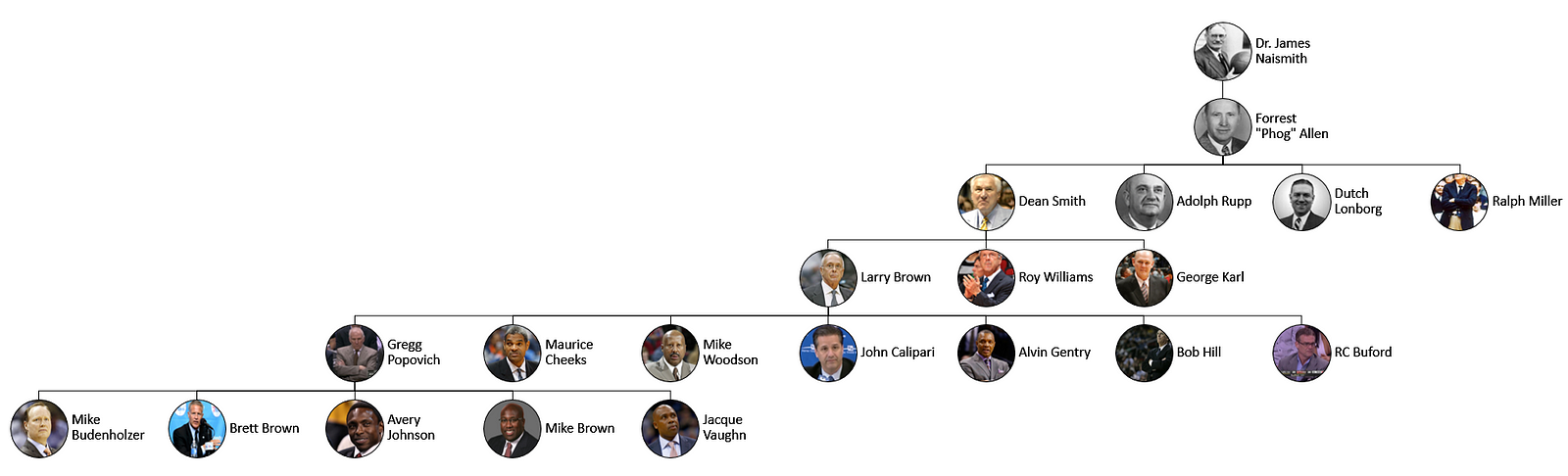
The coaching tree of Dr. James Naismith, the inventor of basketball

Any student of mentoring will recognize the name Fox Conner. His influence on the leaders of “The Greatest Generation” has been the subject of monographs, books, and countless articles. If you were to scribble Connor’s “mentoring tree” on the back of a napkin, it would probably look very similar to the “coaching tree” of Dr. James Naismith, whose influence on the sport of basketball is still visible today. Connor’s tree would likely feature the names of his early proteges, leaders such as George C. Marshall, Dwight D. Eisenhower, Omar Bradley, and George S. Patton. It would branch into subsequent generations and capture the incredible influence of a humble man whose subtle leadership defined how we view mentoring today.

The Art of War in 7 Charts A new version of the millennia-old classic—with Venn diagrams

KATHY GILSINAN
MAR 10 2015
Jessica HagyThe Art of War may be one of the most adaptable books of the past two millennia. There's an Art of War for small businesses. There's an Art of War fordating. There's even an Art of War for librarians.

According to Jessica Hagy, author of the newest version, The Art of War Visualized, the book has spawned so many interpretations because it can be read as not really being about war at all. "It's about creative problem-solving," Hagy told me. Hagy, who doodles the quasi-mathematical logic of human foibles on the popular blog Indexed, found three copies of Sun Tzu's classic among college textbooks and Tom Clancy novels while cleaning out her basement last year, and she saw in its short verses the kind of logic she likes to draw, as in this recent example from Indexed:

Jessica Hagy"It was so much less hypermasculine and bloodthirsty and vicious than you think it is, and it's very thoughtful," Hagy said of The Art of War. “About the first read through I really saw that war was just a metaphor for hassles and problems and issues that people face in every scale of life from really petty, stupid things to really big, world-changing, ‘Should we invade this country?’ sorts of questions,” Hagy said. 

Indeed, one under-appreciated feature of The Art of War is how much of it is devoted to avoiding actual fighting. “Supreme excellence consists in breaking the enemy’s resistance without fighting," Sun Tzu wrote. Also: "[T]he skillful leader subdues the enemy's troops without any fighting; he captures their cities without laying siege to them; he overthrows their kingdom without lengthy operations in the field." He also explained why this is: "When you engage in actual fighting, if victory is long in coming, then men's weapons will grow dull and their ardor will be damped."

Adventures in Higher Education A Post-9/11 Veteran’s Long Road to Learning


I sat in the back of a HMMWV, shuttling troops back from a Fort Hood range with the commander and XO of what would be my last active duty unit. I was attempting to be quiet, sitting behind the driver, when the commander realized he had never spoken to me since I joined his troop. Not once. He turned around in his seat and gave me the routine he probably saw in a briefing somewhere: “Sergeant White, are you getting out? What are you plans? Are you a good student?” All in an overly patronizing tone. The final question seemed innocuous enough on the surface, but made my blood boil: “What school do you want to attend?”

I replied, “UT, sir.” The CO and XO looked at each other with sarcastic smirks. Both scoffed and looked back at me with a half-smiles, as if I were a child that said, “Gee golly, guys, I wanna be an astronaut!” Their expressions and attitudes infuriated me and, for a moment, made me question myself. However, I made a decision to dig deeper and redouble my efforts, perhaps even set my sights a little higher.

Earlier that year, I had made the decision to end my service and put together a hasty plan to pursue my dreams of higher education. More than anything, I wanted to attend the University of Texas at Austin. When I spoke to the admissions office, they promptly told me the quickest way to gain entry was to attend a local community college and transfer after accumulating enough credit hours. Sounds easy enough, right?

The answer is yes, but if you want to be competitive for more prestigious universities you have to get involved in the community in a meaningful way while maintaining respectable grades. Good places to start for me included volunteering for a political campaign, helping register people to vote, and tutoring other veterans. The other side of the equation was simple — work hard. I worked harder than I did in the military, this time without needing the First Sergeant driving me to get results. This was my choice, my decision.

Before I separated from the Army, I enrolled at Austin Community College and started the long process of working my ass off to get into UT. Along the way, some of my professors advised me to think bigger, to set my sights higher. So I started looking into Harvard, Yale, Amherst and other elite New England colleges. There’s no use in having goals if you don’t set them high enough, right?

CLAUSEWITZ AND CORBETT ARE NOW TOO MUCH


STEVEN WILLS
MARCH 5, 2015

Carl von Clausewitz
The 20th century American strategist Rear Admiral J.C. Wylie said, “I believe deeply that strategy is everyone’s business.”1 The expansion of internet-based strategic commentary, and the greater distribution of traditional sources of strategic discussion like the U.S. Naval Institute Proceedings, and The Naval War College Review have certainly played a role in achieving Admiral Wylie’s desire. The works of strategic theorists such as Carl von Clausewitz, Alfred Thayer Mahan, Sir Julian Corbett, and Wylie himself are discussed on a daily basis in multiple global mediums. Many would-be strategic thinkers are happy to drop comments from all four of these experts within their writings in support of the policy they advocate. These “hipster” strategists and their overly-familiar homilies to the teachings of “Uncle Carl” and “Sir Julian” (as if these long-dead strategists were their drinking companions) often obscure the backgrounds, geopolitical world views, and national goals of these noted military theorists. The world is rapidly leaving behind the period of the U.S. “unipolar moment” (1991-2008). It is now entering a new multipolar period of great power and non-state actor activity reminiscent of the period that ended in 1945 with the defeat of the Axis powers. While the works of all four have a role to play in determining the next U.S. military strategy, the writings of Mahan and Wylie have much more currency than those of Clausewitz and Corbett. Their focus on operational vice strategic issues is a handicap in a new age when preliminary strategic decision rather than operational art is the key. While it is evident that both Clausewitz and Corbett were masters of the strategic geography and warfare methods in their own times, their applicability in the second decade of the 21st century is problematic at best. For these reasons, the U.S. should ignore the strategic “hipsters” and their plethora of Corbett and Clausewitz quotations and instead embrace the sound combination of strategic, operational, and tactical thinking found in the works of Admirals Alfred Thayer Mahan and J.C. Wylie.

We Need Defense Innovators More Than They Need Us

BY COL. S. CLINTON HINOTE


If knowledge is power, we should all be feeling more powerful.

The defining trend of our time is the ever-increasing connectedness made possible by technologies such as the Internet, satellite communication, and cell phones. With this connectedness comes instant access to a large portion of the world’s knowledge. Want to know how to build a nuclear reactor, make a carrot cake, or train for a marathon? Type it into your search engine, and it’s there. Remember when we used to do research in a library by looking up books in a card catalog? I don’t think my kids have ever done that, but they have access to more knowledge through their phones than I could have dreamed of when I was their age.

Getting Connected

A major consequence of connectedness is that individuals and small teams enjoy a level of access to knowledge that only large, well-resourced institutions had in the past. These knowledge-empowered individuals and teams can use this access to challenge large institutions directly, and sometimes they win. Such was the case with Facebook, the company who harnessed the power of the internet to connect people. As of this writing, Facebook’s market capitalization (i.e. the company’s total value on the stock market) was over $75B greater than Cisco Systems Inc. This demonstrates the irony of the Information Age, as Cisco was once responsible for much of the physical infrastructure—the actual routers, switches, and connections—of the internet. Facebook’s creators rode this infrastructure to create value, not in buildings, factories, or land, but in how they gathered information and used it to connect people in the virtual world. As a result, they built one of the most valuable companies in the world.

16 March 2015

Looking beyond nuclear liability

RAKESH SOOD
March 16, 2015

While breaking the logjam on nuclear liability is perceived as the most significant outcome of the Obama visit, such a narrow focus misses the larger picture. An underlying broader political objective has driven the India-U.S.-nuclear dialogue since the end of the Cold War, and in the talk of ending the logjam, Narendra Modi and Barack Obama clearly had the larger political objective in view

A month has passed since U.S President Barack Obama was in Delhi as the chief guest at the Republic Day and had his famous “chai pe charcha” with Prime Minister Narendra Modi. An overview of the Indian commentary about the Obama visit would reveal that breaking the logjam on nuclear liability is perceived as its most significant outcome. Both leaders focussed on it at their joint press conference and Paragraph 43 of the Joint Statement states that “the Leaders welcomed the understandings reached on the issues of civil nuclear liability and administrative arrangements for civil nuclear cooperation, and looked forward to U.S.-built nuclear reactors contributing to India’s energy security at the earliest.”

Political objective in mind

A lack of details initially led to considerable speculation about the nature of the breakthrough and the assurances provided. To clarify matters, the Ministry of External Affairs took the unusual step of putting out a seven page ‘Questions and Answers’ explanatory paper which sparked yet another round of debate on whether this was really a breakthrough or not. However, such a narrow focus on nuclear liability misses the larger picture; there is an underlying broader political objective which has driven the nuclear dialogue between India and the United States since the end of the Cold War, and when Mr. Modi and Mr. Obama talked of breaking the logjam, they clearly had the larger political objective in view.