9 May 2015

Kazakhstan to Host Syria Talks

May 08, 2015

Is the Central Asian nation an ideal mediator for international disputes? 

Kazakhstan will host talks on the Syrian crisis later this month, according to a report from Tengrinewsciting RIA Novosti, the Russian state news agency. The talks, Tengrinews says, will occur in Astana from May 25 to 27.

In early April, Randa Kassis, an opposition figure, said at the Syria talks in Moscow that some of the opposition would reach out to explore the possibility of Astana’s participation in mediation the Syrian conflict. By late April, Kazakhstan’s foreign ministry was saying that a number of Syrian opposition groups — which it did not name — had asked the Kazakh president, Nursultan Nazarbayev, to host talks and a group visited Astana on April 27 to further explore the possibility.

This series of events seems to have built to actually scheduling talks, but it’s not time to celebrate yet. Not only have Syrian peace talks to-date yielded little tangible results, but Kazakhstan has scheduled talks on other disputes in recent months that have be postponed.

The Moscow and Geneva Syria peace talks have made little progress and Kazakhstan’s foreign minister, Erlan Idrissov, insisted that the country had no “intention to substitute the existing platforms.”

Islamic State and Jihadi Realignments in Khorasan

By Hekmatullah Azamy and James Weir
May 08, 2015

The delicate yet volatile balance of jihadi movements and insurgents within Afghanistan may be about to shift. 

The relationship between the Taliban and the Islamic State (IS – also known as ISIS, ISIL and Da’esh) is emerging as the most influential factor in the future of violent jihadi movements in the Afghanistan and Pakistan region. To date, however, the Taliban finds itself in a bind, able to neither welcome nor resist IS in Afghanistan. For the Taliban, IS poses a strategic, potentially existential, threat, as both appeal to similar recruits; but the Taliban leadership has been reluctant to take a stand against IS due to their similar ideological and political goals, and shared enemies. Meanwhile, as the Afghan Taliban enter a peace process with the Kabul government, fear of losing their more radical or criminal supporters to IS likely weighs upon negotiations.

While concern deepens about the growing influence of IS in Afghanistan, the extent of their presence remains difficult to determine. Afghan President Ashraf Ghani, during a visit to the United States in March 2015, warned that IS poses a “terrible threat” to Afghanistan, and the region. A month later Ghani blamed IS for a deadly bank attack in Jalalabad, the capital of Nangarhar province, which killed 35 and wounded more than 125. The top UN representative in Afghanistan, Nicholas Haysom, has testified to the UN Security Council that IS has a foothold in the country. The Russian special envoy in Kabul, Zamir Kabulov, claims IS has established four training camps in Afghanistan. But naysayers also exist. Both former President Hamid Karzai and his intelligence chief Amrullah Saleh described concerns about IS as “media hype” and “psychological warfare,” suggesting Afghan circumstances, at least thus far, are not conducive to an impactful IS presence in Afghanistan.

In early September 2014 reports emerged of IS fliers distributed in Peshawar, Pakistan and nearby Afghan regions soliciting pledges of allegiance to the movement and its self-declared caliph, Abu Bakr al-Baghdadi. An organizational presence appeared a few weeks later when six former Tehreek-e-Taliban Pakistan (TTP) and a few Afghan Taliban announced allegiance to IS. In January 2015, IS leadership declared the Afghanistan-Pakistan region part of its Khorasan chapter, appointing Hafiz Sayed Khan (former TTP) as the Khorasan head, and selecting a high-profile Afghan Taliban commander, Abdul Rauf Khadim, as Sayed’s deputy.

Explained: Why ISIS Can Survive without Baghdadi

May 7, 2015 

Martin Chulov at the Guardian reported last month that Abu Bakr al-Baghdadi, the leader of the Islamic State, had been “seriously wounded” in a coalition airstrike in al-Baaj, Iraq on March 18. Although al-Baghdadi’s injuries were life threatening at first, the report asserts he has since recovered. The report notes, however, that al-Baghdadi has not resumed day-to-day control of the organization, yet. Despite the Pentagon disputing this occurrence, the possible implications of targeting al-Baghdadi raise interesting concerns pertaining to the effectiveness of so-called “decapitation strikes” vis-à-vis the survivability of the Islamic State and its leadership, and consequently, the manner in which this should affect the coalition’s targeting practices.

One must note that al-Baghdadi was not deliberately targeted by the coalition air strike. In fact, this was an attack meant to target “local ISIS leaders” and, as Chulov specifies, “[coalition] officials did not know at the time that Baghdadi was in one of the cars.” This should raise concerns about the coalition’s intelligence gathering and targeting practices. The attack was designed to target the aforementioned ISIS leaders—and in that respect, it may have even succeeded—but the fact that coalition forces were entirely unaware of who else was present in the three-car convoy reemphasizes the fact that the United States does not knowwho it is targeting. This raises questions regarding the diligence with which these airstrikes are being carried out, especially with regard to collateral damage.

Russia prepares for hybrid wars

Denis Kungurov, specially for RIR
May 7, 2015 

‘Hybrid’ warfare, a military strategy that combines conventional warfare, irregular warfare including use of weapons of mass destruction, and cyber and information warfare is a leading form of international conflict today. The General Staff of the Russian armed forces accused the United States of conducting such war against Russia. RIR found out the meaning of “hybrid wars” and whether Russia can counter them.

National Defence Management Centre (NDMC) was established in 2014. Source: Alexey Nikolsky / RIA Novosti

The term “hybrid threat” incorporates a wide range of hostile circumstances and intentions, Alexander Bartosh, director of the Information Centre for International Security at Moscow State Linguistic University, said in an address at a round table (RT) on “Hybrid wars of the XXI century.” The RT was held in the Military University in January 2015 with the participation of representatives of law enforcement agencies and other departments.

Hybrid warfare is a military strategy that combines conventional warfare, irregular warfare and cyber warfare. Hybrid warfare is also used to describe attacks by nuclear, biological and chemical weapons, improvised explosive devices (IEDs) and information warfare. It is being viewed as a complex, potent variation of warfare.

Instead of direct conflicts, the circumstances of hybrid wars comprise cyber war, a scenario of asymmetric low-intensity conflicts, global terrorism, piracy, illegal migration, corruption, ethnic and religious conflicts, demographic challenges, transnational organized crime, the problem of globalization and the proliferation of weapons of mass destruction (WMD).

The Arab-US Strategic Partnership in the Gulf

By Anthony H. Cordesman, with the assistance of Michael Peacock 
MAY 7, 2015 

The coming summit between the leaders of the Gulf Cooperation Council (GCC) and the U.S. provides a key opportunity for both the Arab Gulf States and the U.S. to create a stronger strategic partnership, and address the need for common action in Syria, Iraq, and Yemen. The summit will provide the opportunity for the GCC countries to not only to deal with the threat of Jihadist extremism, but also the fact that each country is to some extent a failed state with far deeper problems that must also be addressed to offer any change of lasting future stability and development.

It also offers a chance to deal with the full range of challenges posed by Iran – which go far beyond its efforts to acquire nuclear weapons. These challenges include: 
Iran’s nuclear programs, and the extent to which any final agreement not only meets the security needs of the CCC states as well as the U.S., but the potential threat posed by Iran’s chemical weapon sand capabilities to create biological weapons as a replacement for its nuclear programs. 

The broader threat posed by Iran’s steadily larger and more capable mix of cruise and ballistic missiles, and the risks posed by Iran’s efforts to develop long-range, conventionally armed strike systems using precision guidance – developments which could hit critical military and infrastructure targets and effective replace nuclear weapons with “weapons of mass effectiveness”. 

Japan's Nuclear Diplomacy

May 07, 2015

A lantern floating ceremony on the anniversary of the Hiroshima bombing.

At the NPT review conference, Japanese politicians and citizens push for a nuclear-weapons-free world. 
Japanese actors, including diplomats, mayors, andhibakusha (victims of the atomic bombing), are again playing a prominent role at the ninth review conference of the 1970 nuclear Non-Proliferation Treaty (NPT) to press for the elimination of the estimated 16,000 nuclear weapons in the world today.

The NPT is intended to promote the development of nuclear energy for peaceful purposes, stop the proliferation of nuclear weapons, and eventually eliminate nuclear weapons. Five states have signed on recognized as nuclear states, including the United States, Russia, the United Kingdom, France, and China. These states have the burden of “negotiating in good faith” to reduce and ultimately destroy their nuclear arsenals. The remaining 186 signatories — particularly Japan — are getting frustrated at the slow pace of progress toward nuclear disarmament.

These review conferences are held every five years, with this year’s being held from April 27 to May 22 at the UN headquarters in New York City. The tone of this year’s conference is very different from that of 2010, when U.S. President Barack Obama pledged to seek a nuclear-free world. In 2015, there are new concerns over “Cold-War style tensions” stemming from the Ukraine crisis, conflicts in the Middle East, and concerns about terrorists. As Angela Kane, the high representative for disarmament affairs, put it, “Since the 2010 last review conference, the world has changed.”

Germany’s Nuclear Cutback Is Darkening European Skies


May 7, 2015

If Germany wants to phase out nuclear power, coal is the only realistic option 

Germany’s influence in Europe is unquestionable, but it appears that some of its neighbors may be adversely affected by recent German decisions; and Greece is not the neighbor in question here. France has beenreporting heavy levels of air pollution which authorities in the country are blaming on diesel cars there. But the real culprit may in fact be the renewed German penchant for coal power. 

Up until a few years ago, Germany, along with France, was at the forefront of nuclear power use. But after the Fukushima disaster in Japan in 2011, the Germans were quick to begin phasing out nuclear power. In some countries, phasing out nuclear power would be easy, but in 2011, Germany obtained 25% of its power from nuclear sources. This nuclear power generated no carbon dioxide emissions of course, and little in the way of other forms of pollution. But after starting the phase out of nuclear power, Germany still needed to find a source of replacement power. 

Renewables like wind and solar sound great in theory, but the sporadic nature of power generation from those sources makes them imperfect substitutes for the consistency of nuclear. In that sense then, battery solutions like that announced by Tesla last week, or the solutions from General Electric, may eventually provide a solution for Germany. But as of now, the grid battery industry is still too nascent to provide serious help to Germany. 

Why America Should Really Fear Russia's Armata T-14 Tank

May 8, 2015 

Russia could become "the arsenal of autocracy."

There have been two general reactions in the West to the first public glimpses of the T-14 Armata tank, the first completely post-Soviet Russian design for a main battle tank. The first is to view its claims—of greater speed, maneuverability, firepower and survivability vis-à-vis anything being produced for Western armies—as being Potemkin in nature. In other words, the new model that will be appearing in the May 9 Victory Parade is good for show and propaganda, but won't actually be able to deliver in the field. The second is a high degree of incredulity that a country already under Western sanctions and whose economy has entered into a recession would devote an ever-shrinking pool of state resources to building a next-generation battle tank. Indeed, if Vladimir Putin continues to adhere to a military buildup plan that was developed under far different economic conditions, does he risk repeating one of the fundamental mistakes that led to the failure of the Soviet Union—having defense spending eat up more and more of the country's gross domestic product?

Yet there is another, compelling reason for investing in the research and design capacities of the Russian military-industrial complex—and highlighting the results: Moscow's bid for securing its position as the supplier of choice for a variety of countries around the world looking to bolster their defense capabilities—even when such plans may draw Washington's disapproval—becoming the world's "arsenal of autocracy", so to speak (although a number of Russia's best customers are in fact democratic states).

How America and Russia Could Start a Nuclear War

May 7, 2015

"As during the Cold War, the keys to a strategic nuclear exchange are rigid military planning, political misperception, and natural human frailty."

A few weeks ago, I directed Harvard Extension School’s “Crisis Game,” in which students had to play out a hypothetical Cold War crisis involving nuclear weapons. The realization that a crisis could escalate to nuclear war shocked younger students who had never given much thought to this issue, especially when they found the game sliding from an exercise in negotiation toward nuclear doom. (“I was literally sweating,” one of the players later said.)

But is a nuclear war between Russia and America possible today? After all, there is no longer a Cold War, the Soviet Union and its military alliance were dismantled long ago, and both Russia and America have slashed their nuclear inventories. What could cause a nuclear conflict? How would such an exchange start, and how would it progress?

Unfortunately, nuclear war is still possible. Now, as during the Cold War, the keys to a strategic nuclear exchange are rigid military planning, political misperception, and natural human frailty.

Part of the problem is that Russia now openly considers the use of nuclear weapons in any scenario in which they begin to lose to a superior force. In an ironic reversal of the situation during the Cold War, NATO is now the dominant conventional coalition in Europe, while Russia is a weak state with a large but less powerful army. The Russian Federation has no significant ability to project power far from its borders, and likely cannot sustain a major conventional engagement with a capable opponent for any prolonged period.

The Geopolitics of the Iran Nuclear Deal

http://nationalinterest.org/feature/the-geopolitics-the-iran-nuclear-deal-12827?page=show

The United States and its partners must employ both intense pressure and intense engagement to set the terms for a new relationship with Iran.

As the United States and Iran near an historic nuclear agreement there is an intense debate about whether a deal represents capitulation to Iranian interests in the Middle East or an opportunity to help stabilize the region. If the United States and its partners learn the lessons of previous nuclear negotiations with Iran, and pursue a tightly coordinated strategy in the region, there is a potential over the next few years to ameliorate the conflict-ridden Middle East. For the deal itself is only half the challenge: the other half is to craft a geopolitical framework following the deal that constrains Iranian ambitions.

Since early 2009, President Barack Obama pursued a strategy of engagement and pressure with Iran with regards to the nuclear program, consistently offering to negotiate but also applying increasing economic and diplomatic pressure. But Iran refused to comply.

This approach failed to yield a change in Iranian behavior as long as the Iranian leadership believed that while international sanctions were a nuisance, they did not present a genuine threat. That changed with the application of tough energy and financial sanctions that, starting in 2012, took half of Iran’s oil exports off the market.

The Russian Air Force's 5 Most Deadly Weapons of War

May 8, 2015 

It may not be as large or as powerful as the Soviet Union, but Russia's Air Force continues to pack a powerful punch.

In 1990, the air forces of the Soviet Union consisted of over ten thousand aircraft, excluding those operated by the Soviet Army (mostly helicopters). This included not only the Soviet Air Force proper, divided between Frontal Aviation, Long Range Aviation, and Military Transport, but also the Soviet Air Defense Command, and Soviet Naval Aviation.

Together, these forces could support the advance of the Red Army, conduct strategic nuclear combat against the United States, interdict Atlantic and Pacific shipping lanes, and protect the Soviet homeland.

Times have changed. The Soviet air forces were divided among the Soviet successor states, then downsized dramatically in the economic collapse of the 1990s. What remains today is a force roughly a fifth the size of the Soviet air forces (estimates vary based on judgements about readiness), but that continues to operate the most lethal platforms of the late Cold War. This article examines five of those platforms.

Su-35

Since the late stages of the Cold War, the Flanker family has presented an increasingly formidable problem for Western air forces. Developed as the heavy half of the high/low split that many air forces adopted in the 1970s and 1980s, the Flanker first entered service as the Soviet Union began to collapse.

Since then, the Flanker has proven a remarkably flexible platform, capable of accepting a wide array of modifications and improvements. The Flanker now serves as a carrier-based fighter in two navies, an air superiority aircraft, and a long-range strike aircraft.

The Su-35 represents the most lethal of the Flanker configurations.Exceptionally maneuverable and very heavily armed, the Su-35 has the potential to tangle with the best Western aircraft, even the F-22 Raptor. Currently, the Russian Federation operates 34 Su-35s, with another dozen on the way. Given the problems with the PAK-FA, it may remain the premier fighter in Russian service for some time to come.

Tu-22M

RETHINKING SECTION 660: DEMOCRACY, POLICE, AND U.S. FOREIGN ASSISTANCE

May 7, 2015

Last month the incumbent president of Burundi, Pierre Nkurunziza, was selected as his party’s nominee in the presidential elections to be held in late June. This would be Nkurunziza’s third term, in violation of Burundi’s peace agreement andconstitution. Even though the nomination was validated by the constitutional court, it appears that this decision was obtained through threats and intimidation. While these political machinations are worrisome, the public unrest and the police response to that unrest are more worrisome as Burundi faces the worst political and violent crisis since the end of its civil war in 2005.

Earlier this week the Associated Press reported Burundi’s national police responded to protests with water cannons, tear gas, and small arms fire, leaving at least three dead and 45 wounded. This represents the latest example of Burundi’s national police acting as the enforcement arm of the ruling the party instead of providing order and ensuring respect for the laws, as their mission was laid out in the Arusha peace agreement. Late last month, six protestors were killed, Burundi’s last independent radio station was shut down, and an arrest warrant was issued for an opposition leader. A few months before that came reports of police (and army forces that typically remain neutral) conducting extrajudicial killings.

What’s happening in the South China Sea?

7 May 2015
http://www.aspistrategist.org.au/whats-happening-in-the-south-china-sea/

While China’s recent assertiveness in the South China Sea might shock and surprise today’s observers, its behaviour has actually been remarkably consistent over recent decades.
China first exercised its power in the region in January 1974 when it ejected South Vietnam from the Crescent Islands. In March 1988, the Chinese Navy clashed with Vietnamese vessels, which resulted in Chinese occupation of seven islands in the Spratlys.

In 1995, China occupied Mischief Reef which fell in the exclusive economic zone (EEZ) of the Philippines. It then began building and reinforcing structures on neighbouring reefs. In April 2012 China’s clashes with the Philippines continued over Scarborough Shoal, which was eventually occupied by China. Chinese attention then moved to Second Thomas Shoal. In March 2014, Chinese coast guard vessels prevented Philippines cargo vessels from resupplying a contingent of marines stationed in a wrecked vessel there.

In April 2014 China moved the Haiyang Shiyou 981 oil rig into an area claimed by Vietnam, creating conflict with Vietnam that was only settled when the rig was removed ahead of schedule.

US Navy’s Deadly New Gun Won’t Be Ready for Some Time

May 07, 2015

Naval Surface Warfare Center test firing in January 2008.

Given the global proliferation of guided-missile technologies and the ever increasing costs of defending against them, the U.S. Navy has put high hopes in the development of directed energy weapons systems, such as electrically powered electromagnetic projectile launchers (aka rail guns).

According to gizmag, “a rail gun is basically an electric motor that’s been folded out and laid flat. Like an electric motor, the rail gun uses an alternating electromagnetic field to pull along an armature (…) When it reaches the end of the rail, the armature releases the projectile, which flies toward its target.”

This new weapons system is capable of firing an aerodynamic shell at speeds of Mach 7.5 (5,700 mph /9,200 km/h) and having a reach of 110 nautical miles (126 mi / 203 km). With neither explosives nor propellant, rail guns rely only on electromagnetic forces to destroy an opponent. However, despite the hype, progress in acquiring this new weapon system has been slow.

Shinzo Abe’s ‘Glass Jaw’ and Media Muzzling in Japan

By Aurelia George Mulgan
May 08, 2015

The pressure on the press, both domestic and foreign, in Japan has been unprecedented under Abe. 

If there is anything that Japan’s current Abe-led administration and ruling Liberal Democratic Party (LDP) dislike intensely, it is media criticism of its actions and policies. This might explain the crackdown on freedom of the media in both electronic and paper formats in recent months. This is a worrying development that has even been picked up by the international press and by international organizations such as Reporters Without Borders, which has moved Japan down two notches to 61st place in its global freedom of press rankings.

The list is long of media-muzzling behaviors to which the prime minister and his office (Kantei) and the ruling Liberal Democratic Party (LDP) are increasingly prone. A short list includes: interpreting media criticism as “unfair” coverage; calling for “fair and neutral [namely uncritical] reporting” (e.g. on Abenomics and the 2014 election); labeling criticism of the government and its policies as media “bias”; grilling media executives by subjecting them to “questioning” over aired programs and complaining directly to them about their coverage; objecting to curb-side interviews and refusing to grant media interviews or to appear on TV programs until broadcasters apologize; threatening media organizations with action under the Broadcasting Law; and making references to the government’s authority to stop commercial TV stations from broadcasting. These behaviors are not unique to the Abe administration in Japan nor internationally, but are now setting the tone of government-media relations in Japan, which is new.

Australia-Indonesia Relations After the Executions

Public outrage at the execution of the Bali Nine ringleaders runs into political, diplomatic and economic reality. 
On April 29, 2015, Bali Nine ringleaders Andrew Chan and Myuran Sukumaran were executed by firing squad in Indonesia following a decade of legal challenges, intense Australian government and diplomatic pressure, and impassioned public opinion on both sides of the Timor Sea. As Australia continues to mourn this loss of life, and as Indonesia continues to justify its decision, attention now turns to the future of bilateral relations.

In the wake of the executions, Australian Prime Minister Tony Abbott has made it clear that bilateral relations will not simply continue in a “business as usual” fashion, while Foreign Minister Julie Bishop took a similar position, stating that the executions would “have consequences.” Speculation on the possible repercussions has followed, with some commentators specifically turning to the question of a potential reduction in Australian foreign aid to Indonesia as part of the upcoming May budget.

At a highly publicized press conference in the wake of the executions, Abbott and Bishop announced that Australia’s Ambassador to Indonesia Paul Grigson would be recalled. Other countries had already taken the same step in the wake of earlier executions in Indonesia, but this was a first for Australia. Still, while the seriousness of the recall should not be understated, there is little indication that it will be the harbinger of a more permanent freeze in relations. Indeed, shortly after the announcement, Indonesian Attorney-General Muhammad Prasetyo reportedly dismissed the withdrawal as a “temporary reaction.”

Close Neighbor

Tomorrow’s Small Wars Won’t Just Be Land Wars

MAY 6, 2015
The naval and coastal aspects of counterinsurgency get dangerously short shrift.

Imagine a crisis in a coastal country where terrorists and insurgents turn the littorals to their advantage. Are the United States and its allies ready for naval forces to play a key role in counterinsurgency?

Events in Yemen suggests this situation is already upon us. Houthi rebels, pushing deeper into a country surrounded on two sides by sea, have precipitated a regional crisis with several maritime dimensions. The rebels have received arms by sea, leading Saudi Arabia to blockade Yemeni ports, the United States to board freighters, and Iran to dispatch its own warships to the area. Saudi warships also shelled Houthi positions to prevent a takeover of the port city of Aden, while China, India, and Pakistan have evacuated their citizens by sea.

Meanwhile, Al Qaeda in Yemen has a deadly track record in the maritime space. In 2000, the group killed 17 American sailors aboard the USS Cole as it refueled in Aden. Two years later, it bombed the oil tanker MV Limburg off Yemen’s coast. In 2013, Ahmed Warsame, whom the Justice Department describes as a senior terrorist leader and who pled guilty to a material-support charge, was arrested on a boat in the Gulf of Aden while traveling between Somalia and Yemen. That same year, the Yemeni government reportedly disrupted a plot to attack shipping in the Bab al Mandeb strait. And just this month, Al Qaeda’s Yemeni affiliate overran a brigade defending the coast along Mukalla, the capital of Yemen’s largest province, and seized the city’s port.

Russia's Greatest Weapon May Be Its Hackers

MAY 7, 2015 

In hacker jargon, it’s called a “cyber-to-physical effect.” It’s when a hacker reaches out from the virtual world into the real one—often with catastrophic consequences. The Americans and Israelis pioneered the technique back in 2009 when the Stuxnet program infiltrated Iranian computer systems and wrecked thousands of uranium-enriching centrifuges. But now other players—especially the Russians and Chinese—are getting into the game of remotely using computer networks to destroy infrastructure and threaten human lives. Last year, according to a report by Germany’s Federal Office for Information Security, a blast furnace melted down in an unnamed industrial city in Germany after a digital attack on its control systems, causing “massive damage.”

It nearly happened in the United States too, when unknown hackers succeeded in penetrating U.S. electrical, water and fuel distribution systems early in 2014. While old-fashioned, relatively low-tech data hacks make headlines—for instance, high-profile break-ins over the last 12 months to the email systems and databases of the White House, State Department, Department of Homeland Security, Department of Defense and Sony Pictures Inc.—what has security officials seriously worried is the new and dangerous world of cyber-to-physical infrastructure attacks.

“This is not theoretical,” National Security Agency Director Admiral Michael Rogers told the U.S. House of Representatives’ Intelligence Committee recently. Hacking attacks on the U.S. and its allies are “costing us hundreds of billions of dollars,” Rogers warned, and will result in “truly significant, almost catastrophic failures if we don’t take action.

According to Alexander Klimburg, an affiliate of the Harvard Kennedy School of Government’s Belfer Center and senior research fellow at the Hague Centre for Strategic Studies, “cyberspace today is like Europe in 1914, before World War I. Governments are like sleepwalkers. They do not comprehend the power of new technology and the consequences of misunderstanding each other’s activities.”

Whatever Happened to Russia’s Silicon Valley?

James Appell
May 7, 2015

The Short Life and Speedy Death of Russia’s Silicon Valley

In the world of tech, six years is a long, long time. In 2009, the iPad was but a twinkle in Steve Jobs’s eye; 20 percent of the mobile phones sold in the United States were made by BlackBerry; and some of 2015’s finest procrastination tools — Instagram, Snapchat, even Candy Crush Saga — were still years away from release. It was in September 2009, against the backdrop of the world economic crisis, that the then-president of Russia, Dmitry Medvedev, unveiled an ambitious modernization program for his country.

Of the world’s major economies, Russia’s had fared the worst in the aftermath of the global downturn. GDP shrank by 7.9 percent across 2009, including a record 10.9 percent in the second quarter. Unemployment hit a peak of 9.4 percent in February of that same year. Going into the crisis, oil and natural gas had accounted for some two-thirds of exports. Many had already long recognized that Russia’s dependence on commodities exports was making it vulnerable, but Medvedev was the first Russian president to actively engage with the problem.

His solution was a set of reforms, sketched out in a 4,000-word treatise titled “Go Russia!” The reforms were designed to harness technology in order to equip Russia for the 21st century, and they covered industries ranging from nuclear power to space technology to pharmaceuticals. Medvedev’s reforms called for, among other things, a 40 percent reduction in Russia’s energy consumption by 2020, and the commercial generation by 2050 of power by thermonuclear fusion.

Russian Hackers May Be Putin’s Most Important Secret Weapon

Owen Matthews
May 7, 2015

Russia’s Greatest Weapon May Be Its Hackers

In hacker jargon, it’s called a “cyber-to-physical effect.” It’s when a hacker reaches out from the virtual world into the real one—often with catastrophic consequences. The Americans and Israelis pioneered the technique back in 2009 when the Stuxnet program infiltrated Iranian computer systems and wrecked thousands of uranium-enriching centrifuges. But now other players—especially the Russians and Chinese—are getting into the game of remotely using computer networks to destroy infrastructure and threaten human lives. Last year, according to a report by Germany’s Federal Office for Information Security, a blast furnace melted down in an unnamed industrial city in Germany after a digital attack on its control systems, causing “massive damage.”

It nearly happened in the United States too, when unknown hackers succeeded in penetrating U.S. electrical, water and fuel distribution systems early in 2014. While old-fashioned, relatively low-tech data hacks make headlines—for instance, high-profile break-ins over the last 12 months to the email systems and databases of the White House, State Department, Department of Homeland Security, Department of Defense and Sony Pictures Inc.—what has security officials seriously worried is the new and dangerous world of cyber-to-physical infrastructure attacks.

US Navy Expanding Its Cyber Attack and Defensive Forces

Joe Gould

US Navy Cyber Launches Strategic Plan

WASHINGTON — The commander of US Navy Cyber announced a five-year strategy, and like the Pentagon’s cyber strategy announcement two weeks earlier, acknowledged the dire need for talented workers with the skills to fend off the nation’s foes.

Vice Adm. Jan Tighe, who assumed command of Fleet Cyber Command/10th Fleet a year ago, said the US Navy is strengthening its ability to defend against intrusions, launch offensive cyber weapons and field 40 cyber mission teams — a task that is halfway done.

Cyber Strategy Relies on Deterrence, Industry

“You don’t get there from here unless you invest in the capacity pieces,” Tighe said of the Navy’s offensive cyber ambitions, “and that’s essentially what the cyber mission force has done; it’s granting capacity.”

The strategy re-conceptualizes the network as a “war-fighting platform,” which in real terms means assuring awareness, control and security of its networks. The plan comes after Iran reportedly breached Navy networks in 2013, though Tighe said there had been no such breaches since.

Imagine: F-22 Raptors For Export

May 08, 2015

So, who wants the F-22 Raptor? 

What if the U.S. Congress had never passed the Obey Amendment, and export of the F-22 Raptor had not been banned?
In 1997, the United States government determined that the Raptor, America’s most advanced air superiority fighter, could not be exported to any foreign government, even those of close allies. The unstated reason for this ban was suspicion that Israel would, if it gained access to the F-22, transfer technology associated with the aircraft to Russia or China. The United States cannot, as a political matter of course, single out Israel for a ban on the sale of advanced technology, and so the F-22 export ban covered all potential buyers.

On the upside, this left the United States as the sole operator of what is probably the world’s most effective air superiority aircraft. On the downside, it forced U.S. allies (not to mention Lockheed Martin) to rely heavily on the success of the F-35 Joint Strike Fighter, as well as legacy platforms.

Today, the F-22 might fly in the air forces of Japan, South Korea, Singapore, and Australia. Japan only slowly gave up its aspirations for the aircraft; while the production line for the F-22 still operated, Japan seemed to hold out some hope that the United States would come to its senses. If Japan had acquired the Raptor, the United States almost certainly would have also sold it to Seoul, if only to avoid a serious diplomatic incident. Australia would likely have become interested as well, and Singapore has proven a reliable customer for the most advanced U.S. systems.

A Better American Way of War

May 8, 2015 


"When we repeat the mistakes of the past, it is not because we are forced to because of bad habits. It is because we have failed to embrace the challenges of the future."

A global power with global interests can’t always afford to pick how it wants to fight. That is an essential insight for understanding the American way of war. And strategists are always eager to understand our way of war—especially when it seems to have failed us.

Consider Vietnam. After that humiliating defeat, American strategists entered into an intense state of soul-searching. What went wrong? One of the most compelling arguments came from historian Russell Frank Weigley. His bookThe American Way of War: A History of United States Military Strategy and Policy came out in 1973, the year the United States called it quits in Vietnam.

Weigley could not have been timelier. Everybody was looking for somebody to blame. The historian blamed our history. The strategic culture that emerged from America’s military past dictated a particular way to fight and win the nation’s wars. Following the Civil War, Weigley concluded, we grew addicted to a style of conflict that demanded massive resources, overwhelming force, superior technology, a dash of hubris and decisive, complete victory.

In Southeast Asia that formula failed. America fell into a funk.

Nevertheless, Weigley’s influence waned. Our obsession with the tragedy of Vietnam faded as the U.S. military went on a streak of wins from Panama to Desert Storm.

Soldiers take tough stance on physical fitness test failures

May 5, 2015
http://www.army.mil/article/147940

A Soldier, assigned to the 8th Military Police Brigade, completes a situp as part of an Army Physical Fitness Test during the 8th Military Police Brigade's Best Warrior Competition at Schofield Barracks, Hawaii, April 10, 2012.

WASHINGTON (Army News Service, May 5, 2015) -- Soldiers at the first-ever NCO Solarium said they felt the Army has gone soft on those who have failed their Army Physical Fitness Tests, or APFT, too many times - and called for more discipline in enforcing standards.

Sgt. 1st Class Jason Ruiz, Headquarters Services Company, U.S. Army North, said allowing Soldiers, who have repeatedly failed their APFT to stay in the Army is inconsistent with the idea that physical fitness is important.

"When Soldiers end up being retained, we feel it is a detriment to the unit and other units, who see that Soldier being retained," Ruiz said. "One of our recommendations is to remove the commander's ability to decline a separation packet for APFT failures."

Ruiz served as the spokesperson for the physical fitness group during the 2015 NCO Solarium on Fort Leavenworth, Kansas. During the Solarium, about 80 NCOs, from throughout the Army, were tasked to come up with solutions to problems involving education, Army culture, training, mission command, physical fitness, and Army vision and branding. Those Soldiers were then asked to brief the sergeant major of the Army on their findings.

EDUCATING THE U.S. MILITARY: IS REAL CHANGE POSSIBLE?

May 7, 2015

Editor’s Note: This is the latest article in our special series, “The Schoolhouse.” The aim of this series is to explore and debate the state of advanced graduate education in international affairs. We aim to move beyond the often-repetitive and tiresome debates about the usefulness of scholarship to policy. We believe there are deeper issues at stake. In this article, Joan Johnson-Freese addresses issues afflicting the sometimes-underrated and misunderstood field of professional military education.

Joint professional military education (JPME) in the United States needs to be fixed. And yet too few seem willing to take on the challenge. Through JPME members of the United States military learn professional skills, and as they progress in rank, they are prepared to transition from tactical to operational leaders, and eventually strategic leaders. Its importance was legislatively recognized when the 1986 Goldwater-Nichols Act mandated educational parameters for the military that have since developed into a continuum of learning. But alas, Congressional attention to PME has waned since its last champion and watchdog, Ike Skelton, left Congress in 2011.

Top military brass including Chairman of the Joint Chiefs Gen. Martin Dempsey say the right things. A 2012 speech by Dempsey at National Defense University was peppered with all the right words… “education is the strongest and most secure bridge to the future”…. “I want to ensure that our educational practices align with our needs and our expectations”… “education helps make military service the nation’s preeminent leadership experience.” He even called for “senior education leaders through the Military Education Coordination Council (MECC) to conduct a review… to update the value proposition of our joint professional education enterprise to meet — to determine whether we’ve got the attributes right, the outcomes rights [sic] that are demanded by the future security environment.”

The MECC, composed of representatives of the joint and service schools and any other JPME-accredited schools, is responsible for advising the office of the Joint Chiefs of Staff on scholarship and key educational issues. In effect, it controls military education.

8 May 2015

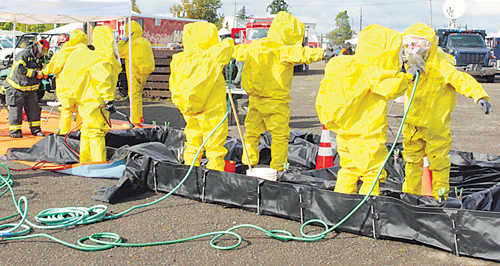
Threat of chemical weapons

Bhaswati Mukherjee
May 8 2015 

With the ISIS declaring an Islamic Caliphate, the alarming prospect of the use of WMDs (Weapons of Mass Destruction), including chemical weapons falling into jihadi hands, could become a reality. The issue re-emerged recently with ongoing media reports about the alleged use of toxic chemicals in several barrel bomb attacks in Idlib governate between March 16 and 31, 2015. These raised troubling questions. The scenario becomes more complex because Idlib has fallen to rebel forces. On March 18 Islamist group Jabhat al-Nusra and other armed opposition groups opened a major offensive against government forces in Idlib that culminated in its capture on March 28.

According to media reports, witnesses filmed remnants of barrel bombs. Among the remnants were containers typically used for refrigerants in refrigerators and air-conditioners. Videos and photos from the aftermath of five attacks, including material shared by the Syrian Civil Defence, show containers of a size, shape, and design commonly used for refrigerants. These canisters are easy to refill with other gases and widely available in Syria.

For Saudi Arabia, thanks but no tanks

F.S Aijazudin
May 8 2015 

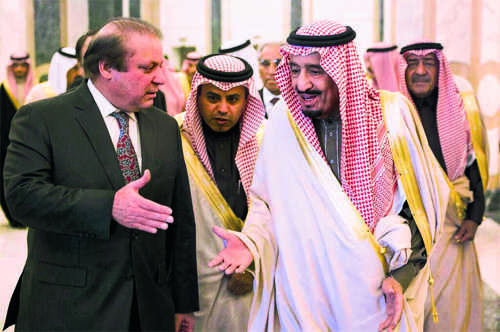
IF there is a name Prime Minister Nawaz Sharif has heard once too often, it is that of Bruce Riedel. Riedel retired from the CIA in 2006. His wife still works there. (The CIA like subcontinental politics and the US presidency is a family business.) In July 1999, when Nawaz Sharif made his lightning visit to Washington to invoke Bill Clinton's intervention after the Kargil fiasco, the only other person allowed in the meeting at Blair House, was a note-taker — Bruce Riedel. Within three months, Nawaz Sharif heard the name again. Bruce Riedel helped broker Nawaz Sharif's escape from Attock Fort. “After Sharif's ouster in a coup by Pervez Musharraf in 1999,” Riedel recalled, “he went into exile to Saudi Arabia, an agreement negotiated by myself for the Clinton administration to forestall Nawaz's execution. The deal was arranged with the influence of Saudi ambassador to the US, Prince Bandar bin Sultan.”

In 2011, Riedel (now a senior fellow at the Brookings Institution, Washington) revealed Saudi interest in Pakistan's nuclear programme. Riedel wrote: “In October 2003, then Crown Prince Abdullah visited Pakistan for a state visit. Several experts reported after the trip that a secret agreement was concluded that would ensure Pakistan would provide Saudi Arabia with nuclear technology and a bomb if Saudi Arabia felt threatened by a third party nuclear programme in the future. Both countries, of course, denied the stories.”