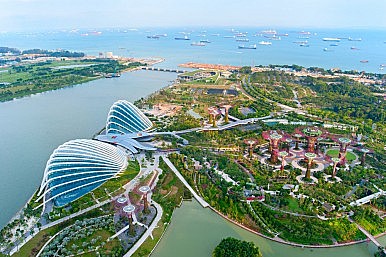
As the leading industrialized economies move to intelligent manufacturing – or industry 4.0 – it will be interesting to see whether the developing economies of Southeast Asia can take the opportunity to leapfrog ahead with economic development. Industry 4.0 goes hand-in-hand with smart production and energy use. The latter may be referred to as Energy 4.0, with the pre-oil era, the oil era, and the new and renewable energy era, as Energy 1.0, 2.0, and 3.0, respectively. This article proposes a vision to invite further discussions in the region’s policy-making and think-tank communities. The point is that Industry 4.0 and Energy 4.0 should be promoted and developed in juxtaposition with conventional industrialization and conventional energy infrastructure systems in the region.
22 May 2015
India’s Missed Iran Opportunity
On a recent trip to Tehran, India’s Minister for Road Transport, Highways and Shipping, Nitin Gadkari inked a memorandum of understanding (MoU) with his Iranian counterpart for the development of Chabahar port. The port, situated in southeastern Iran, is seen by India as a gateway to both Afghanistan and Central Asiaand a possible counter-balance to Gwadar port in Pakistan, which is now operated entirely by China.
“With the signing of this MoU, Indian and Iranian commercial entities would now be in a position to commence negotiations towards finalization of a commercial contract under which Indian firms will lease two existing berths at the Port and operationalize them as container and multi-purpose cargo terminals,” read a statement released by the Indian Ministry of External Affairs.
More Chinese Citizens Injured in Spillover From Myanmar Conflict
Once again, Chinese citizens are caught in the crossfire of Myanmar’s ethnic tensions.
On May 14, several Chinese citizens were injured during a Myanmar government shelling operation against armed ethnic rebels. Radio Free Asia, citing local sources, reports that eight people in the township of Nansan were injured in the blasts. Witness reported five separate explosions in a half-hour period on the evening of May 14. One resident told RFA the incident wasn’t an isolated occurrence: “There have been bombs exploding a lot in recent days, and a lot of people are terrified.” Residents also reported gunfire from the fighting hitting buildings in their town.
The May 14 incident came just over two months after Myanmar government jets accidentally bombed the Chinese side of the border, killing five Chinese citizens and injuring eight. In response, China stepped up air patrols of the border region and a top military officialwarned that the “Chinese military will take resolute measures to protect the safety of Chinese people and their assets.”
SHANGRI-LA WON’T BE A FAIRYLAND FOR BEIJING
Chinese Military Declares the Internet an Ideological ‘Battleground’
The piece begins by repeating a claim China has made often: that Internet or cyber sovereignty is a manifestation of national sovereignty. Over the past year, China has called attention to this concept in media articles and official speeches, seeking to win international recognition of its conceptualization of how the internet should be governed. The PLA Daily piece makes it clear that China’s “cyber territory” must be defended as vigorously as physical territory. The article warned that if China doesn’t occupy and defend its “cyber territory,” then nameless “hostile forces” will use it as a “bridgehead” to attack China.
America's 'China Consensus' Implodes
May 21, 2015
With China challenging the U.S.-led regional framework in Asia, Americans are being forced to reconsider long-standing assumptions.
Though the Nixon opening was a strategic counter to the USSR, as China reformed and modernized its economy post-1979, U.S. policy has assumed that as a Chinese middle class grew, political reform, if not democratization would follow. This has been the case across Asia over the past three decades—in the Philippines, South Korea, Taiwan, Mongolia, Thailand and Indonesia. It may eventually occur—China is, by several orders of magnitude larger than other Asian democratized states with a 3,000-year-old culture—but in its own way and on its own timeline. For now, the Communist Party has tightened political control.
China's Emerging Vision for World Order
May 21, 2015
China’s mulling of the risks and benefits of global leadership reveals its judgment that it cannot allow its chief competitor to protect its interests.
How McMahon Drew His Line, and Why China Wants It Changed
Prime Minister, Narendra Modi was virtually silent on the vexed border issue during his just concluded visit to China, belying the expectations of many in Arunachal Pradesh. While there were 24 bilateral agreements signed, a majority of them business related, both the countries for the moment seem to think the border issue can wait. Hence, in the eastern sector, India will continue to consider the McMahon Line as its undisputed boundary, and China will continue to treat the line as illegal. Arunachal domiciles intending to travel to China will also have to continue be content with stapled visas.
Revealed: The Islamic State's Two Most Powerful Weapons
May 20, 2015
The ominous shadow of the notorious Islamic State of Iraq and Syria (ISIS) looms over Southeast Asia and Australia, judging from the scores of recent arrests throughout the region.
The core fundamentalist theology of ISIS emphasizes a deity that is punitive, keen on preserving religious purity above else. Consequently outsiders—Muslims who disagree with them; Shia, Christians and other minority groups and their religious symbols—can be disposed of as they are regarded as filth to be cleansed, not parties to a negotiable dispute.
Is Iraq's Military Hopelessly Incompetent?
May 21, 2015
What ISIL’s capture of Ramadi tells us about the Iraqi Security Forces.
The Islamic State
Introduction
In June 2014, after seizing territories in Iraq’s Sunni heartland, including the cities of Mosul and Tikrit, the Islamic State proclaimed itself a caliphate, claiming exclusive political and theological authority over the world’s Muslims. Its state-building project, however, has been characterized more by extreme violence than institution building. Beheadings of Western hostages and other provocative acts, circulated by well-produced videos and social media, spurred calls in the United States and Europe for military intervention, while mass violence against local civilians, justified by references to theProphet Mohammed’s early followers, has been a tool for cementing territorial control. Widely publicized battlefield successes have attracted thousands of foreign recruits, a particular concern of Western intelligence.
Fall of Ramadi raises new questions about U.S. strategy in Iraq
May 19
Speaker of the House John A. Boehner (R-Ohio) is demanding that President Obama develop a new strategy for dealing with Islamic State militants after the group’s takeover of the city Ramadi in Iraq. (Reuters)
The fall of Ramadi to the Islamic State has raised new questions about the Obama administration’s Iraq strategy, including its efforts to resurrect Iraqi security forces and the focus of U.S. and Iraqi attention on retaking the city of Mosul by the end of this year.
President Obama was briefed on the latest developments during a National Security Council meeting Tuesday, according to a White House statement, although officials said no formal strategy review is underway.
White House press secretary Josh Earnest said that the fall of Ramadi was undoubtedly a “setback” but stressed “how important it is for us to maintain some perspective on this.” He cited successes such as the defeat of militants last month in Tikrit and Saturday’s raid by U.S. Special Operations forces that killed a senior Islamic State operative in Syria.
Fall of Ramadi raises new questions about U.S. strategy in Iraq
May 19
Speaker of the House John A. Boehner (R-Ohio) is demanding that President Obama develop a new strategy for dealing with Islamic State militants after the group’s takeover of the city Ramadi in Iraq. (Reuters)
The fall of Ramadi to the Islamic State has raised new questions about the Obama administration’s Iraq strategy, including its efforts to resurrect Iraqi security forces and the focus of U.S. and Iraqi attention on retaking the city of Mosul by the end of this year.
President Obama was briefed on the latest developments during a National Security Council meeting Tuesday, according to a White House statement, although officials said no formal strategy review is underway.
White House press secretary Josh Earnest said that the fall of Ramadi was undoubtedly a “setback” but stressed “how important it is for us to maintain some perspective on this.” He cited successes such as the defeat of militants last month in Tikrit and Saturday’s raid by U.S. Special Operations forces that killed a senior Islamic State operative in Syria.
By NICK GASS
5/19/15
Bob Gates: U.S. has no Middle East strategy 'at all'
Former Defense Secretary Robert Gates said Tuesday that when it comes to the Middle East, he does not think the United States has a strategy “at all.”
“We’re basically sort of playing this day to day,” Gates said in a discussion on MSNBC’s “Morning Joe.” “I think our interests remain important in the Middle East.”
Story Continued Below
Gates said that during his “several decades” in the Situation Room, oil was never the reason for an invasion of the region. Early on, he said, the Soviet Union proved the impetus, and later it was Iran.
The ISIS March Continues: From Ramadi on to Baghdad?
BY HASSAN HASSAN
MAY 19, 2015
Anyone telling you the Islamic State is in decline isn’t paying attention.
The ISIS March Continues: From Ramadi on to Baghdad?
Once again, in less than a year, Iraqi soldiers abandoned their positions en masse and fled in the face of advancing Islamic State forces. The fall of the city of Ramadi, the provincial capital of Anbar province, leaves no doubt about the jihadi group’s capabilities: Despite U.S. attempts to paint it as a gravely weakened organization, the Islamic State remains a powerful force that is on the offensive in several key fronts across Syria and Iraq.
Ramadi is far from the only front on which the Islamic State is advancing. The group last week launched an offensive, supported by multiple suicide operations, in the eastern Syrian city of Deir Ezzor against President Bashar al-Assad regime’s holdouts in the military air base. In the central city of Palmyra, it attacked a regime base near the ancient Roman ruins. It also recently clashed with Syrian rebels and the regime in the eastern countryside of Aleppo, the provinces of Homs and Hama, and the southern city of Quneitra, near the border with Israel.
FIGHTING AND WINNING IN THE “GRAY ZONE”
May 19, 2015
But trends such as globalization, mass access to technology and communications, and asymmetric reactions to U.S. tactics in Afghanistan and Iraq are converging into an era where more and more conflicts are being fought at the lower end of the conflict spectrum. These form a “gray zone” between traditional notions of war and peace.
Is The Iraqi Army’s Collapse at Ramadi a Game-Changer?
Dexter Filkins
May 19, 2015
The Real Problem in Iraq
Over the weekend, as ISIS fighters rolled into Ramadi, the capital of Iraq’s Anbar Province, one of them posted a video to the Internet. It was shot from a recently captured Iraqi police station, and showed box after box of American mortar shells and bullets that appeared shiny and new. Several Humvees, apparently not long out of the packing crates, sat abandoned nearby. “This is how we get our weapons,” the narrator said in Arabic. “The Iraqi officials beg the Americans for weapons, and then they leave them here for us.”
Depressing, isn’t it? The fall of Ramadi is not just a bleak symbolic defeat for the Iraqi government and its allies, including the United States. During the nearly nine years that American troops fought in Iraq, Anbar Province was one of the most lethal places for American soldiers and Marines; some thirteen hundred died there. In 2008, though, when the Americans finally handed the city back to the Iraqi Army, many of the American Marines present at the ceremony there were not even carrying weapons. After so much bloodshed, Ramadi had become one of the safest cities in the country.
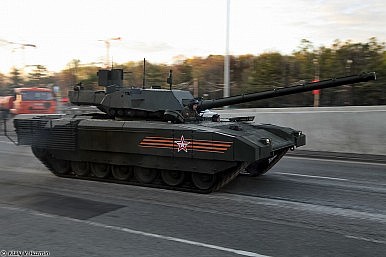
Is the 'World’s Deadliest Tank' Bankrupting Russia?
According to an analysis conducted by Forbes Magazine, Russia will spend an estimated 5.34 percent of its economic output on defense in 2015. This estimate is based on the assumption that the Russian economy will contract by 3 percent and a 15 percent hike in the real value of the military budget.
However, another estimate quoted in the Wall Street Journal based on Russian government data notes that country’s GDP may even decrease by 4.6 percent largely due to lower oil prices and Western sanctions. Consequently, Prime Minister Dmitry Medvedev recently announced that this year’s 3.3 trillion rubles military budget will need to be adjusted and cut by five percent or 157 billion rubles.
Even worse, according to newly published budget data of the first three months of 2015, military expenditure exceeded 9 percent of quarterly GDP – almost twice the amount cited in Forbes Magazine.
Egypt's Religious Freedom Farce
May 21, 2015
Sisi sounds the right notes on pluralism, but penalties for “insulting” a faith are enforced only for the majority creed.
Egypt takes religion seriously. By law, Egyptians are only allowed to practice one of the three recognized monotheistic religions: Islam (implicitly Sunni Islam—the faith of the overwhelming majority), Christianity (representing some ten percent of the population) and Judaism (today, Egypt has exactlyseven Jews, down from 75,000 in 1947). Still, Egyptians may only practice the creed they’re born into—the government does not recognize Muslim conversions to Christianity, and conversion from either faith to Judaism is nonexistent—unless the target faith is Islam.
Why the Drones Keep Firing
May 20, 2015
President Obama's announcement last month that earlier this year a “U.S. counterterrorism operation” had killed two hostages, including an American citizen, has become a fresh occasion for questioning the rationales for continuing attacks from unmanned aerial vehicles aimed at presumed, suspected, or even confirmed terrorists. This questioning is desirable, although not mainly for hostage-related reasons connected to this incident. Sometimes an incident has a sufficient element of controversy to stoke debate even though what most needs to be debated is not an issue specific to the incident itself. More fundamental issues about the entire drone program need more attention than they are getting.
The plight of hostages held by terrorists has a long and sometimes tragic history, almost all of which has had nothing to do with drones. Hostage-taking has been an attractive terrorist tool for so long partly because of the inherent advantages that the hostage-holders always will have over counterterrorist forces. Those advantages include not only the ability to conceal the location of hostages—evidently a successful concealment in the case of the hostages mentioned in the president's announcement—but also the ability of terrorists to kill the hostages themselves and to do so quickly enough to make any rescue operation extraordinarily difficult. Even states highly skilled at such operations, most notably Israel, have for this reason suffered failed rescue attempts.
England's Submarines Are One Step from Nuclear Disaster
May 21, 2015
"If airport security and nuclear weapon security were both compared to prisons, the airport would be Alcatraz and Base security would be house arrest."
William McNeilly, a submariner who has served on Royal Navy Trident subs, is under arrest right now for disclosing official secrets. But in the 18-page document he leaked, McNeilly paints a picture of Britain's seagoing nuclear deterrent as so comical that the name of at least one sub should be changed toHMS Pinafore.
McNeilly who describes his job as "Engineering Technician Weapons Engineer Submariner," comes across as a bit of an Edward Snowden-esque character. He eavesdrops on meetings between his sub's officers. When he wants to copy a top-secret Trident missile manual that isn't allowed to leave a secure compartment, he brings along his Android smartphone and dictates the contents into the device.
Corruption in the Nigerian Military and Why Nigeria Had to Outsource the War Against Boko Haram to Mercenaries
Overkill Works
Since early in 2015 there were rumors that Nigeria, desperate to deal with the growing success of Islamic terrorists (Boko Haram) in the largely Moslem north had hired South Africa mercenaries. Turns out the rumor was true, but the truth of the subsequent defeat (but not destruction) of Boko Haram says more about the sorry state of the Nigerian armed forces than it does about the use of highly skilled mercenaries.
The basic problem was that the Nigerian military, and the rest of the government, were very (notoriously is not too strong a term here) corrupt and had been for decades. This meant too many officers were more concerned with stealing than maintaining and leading well trained, equipped and supplied troops. The main reason the United States would not provide modern weapons to Nigeria was the corruption and the likelihood that some of those weapons would end up with Boko Haram, gangsters or some other bunch of Islamic terrorists. That had already happened with some of the weapons Nigeria already had and that sort of thing had become such a problem that some officers were being prosecuted for it. But the government refused to take measures to eliminate the corruption in the military leadership.
Ukrainian Government Parades 2 Captured Russian Special Ops Soldiers Before the Media
Kiev shows off captured ‘Russian soldiers’ to media
May 19, 2015
Kiev (AFP) - Kiev on Tuesday showed off two purported Russian soldiers it captured during a gun battle in the separatist east that Ukraine’s pro-Western leadership says proves the Kremlin’s direct involvement in the war.
The two wounded men – recovering in a Kiev military hospital under the guard of masked state security men – have turned into pawns in a bitter public relations battle being waged by Moscow and Kiev since Saturday’s firefight.
Russia insists that Captain Yevgeny Yerofeyev and Sergeant Aleksander Aleksandrov had been decommissioned from the armed forces by the time Kiev believes they entered the Ukrainian war zone more than a month ago.
Moscow acknowledges the presence of Russian “volunteers” and off-duty servicemen in Ukraine while rejecting charges that they were there under orders from President Vladimir Putin’s generals.
Preventing Conflict in Cyberspace Triggered by Miscalculation
by Micah Zenko
May 20, 2015
A technician monitors power output in the control room at the operating nuclear power plant in France.
Today, the Center for Preventive Action released aContingency Planning Memorandum, “The Risks of Ambiguity in Cyberspace,” which I am tremendously proud to say directly addresses these issues and much more.
Written by Benjamin Brake, a CFR international affairs fellow and foreign affairs analyst in the Bureau of Intelligence and Research at the Department of State, this report details how the Obama administration can strengthen its ability to correctly and efficiently attribute an attack, reduce the likelihood of escalation, and mitigate the consequences of an ambiguous attack. This report does not reflect the position of the U.S. government, but tracks closely with how many officials and staffers in cyber-related agencies are thinking.
Strategic Risks of Ambiguity in Cyberspace
Release Date May 2015
Introduction
The Art of (Cyber) War: Cybersecurity Tactics for All Financial Institutions From Bloomberg
By Richik Sarkar and James J. Giszczak
May 19, 2015
Richik Sarkar, a member of McDonald Hopkins LLC, regularly advises banks and bank vendor on risk management issues. His expertise is in contracts, commercial law, sales and trade practices, business torts, professional negligence and malpractice, financial services law, internal investigations, corporate governance and compliance and risk management. James J. Giszczak, who is Vice Chair of the firm's Litigation Department and Chair of its Data Privacy and Cybersecurity Practice Group, advises clients regarding data security measures and responding to security breaches involving sensitive personal information and protected health information.
As financial institutions of every type and size -- national, regional and community banks, thrifts, mutuaIs, credit unions, and non-bank lenders -- increase their collection of personal information about their customers and employees, they become larger targets for a data privacy incident. Financial institutions are truly in a cyber war and must fight this battle on four fronts: external threats, intentional misappropriation by rogue employees, data accidentally lost or misplaced, and vendor negligence; accordingly, proper tactics and strategy are essential for survival.
In line with DoD CIO, Army pushes forward with new cloud policy
April 10, 2015
In line with broader Defense Department initiatives, the Army expects to soon release a new commercial cloud services provider policy that will outline service-specific acquisition requirements and provide further details about the Army's growing use of the commercial cloud.
See our complete coverage of the C4ISR & Networks Conference at our Show Reporter site.
How DISA defends DoD networks
May 13, 2015
The Defense Information Systems Agency is charged with a significant role in defending the Defense Department's networks, a role that is changing under evolving threats, policies and IT infrastructure. The launch of DoD's joint regional security stacks (JRSS), the transition to the Joint Information Environment (JIE) and a new cyber strategy from the Defense secretary all comprise a changing cyber landscape for the military.
"In JIE, we are looking at the evolution of our security architecture. And, ultimately, moving toward a single security architecture, which really gets down to the notion of trying to do inspection at the minimal number possible of points, centralized commands and the full end-state of where we really want to get with security," said Jack Wilmer, DISA deputy chief technology officer for enterprise services.
DISA Director LtGen Ronnie Hawkins takes a last look ahead
Barry Rosenberg, Editor
May 19, 2015
Lt Gen Ronnie Hawkins, Jr., is the director of the Defense Information Systems Agency (DISA), a job he has held since early 2012. He said 2015 will be his last year on the job, and in written responses to questions from C4ISR & Networks Editor Barry Rosenberg, he discusses cloud, cyber, the agency's reorganization, as well as his legacy as DISA director.
With support of the war fighter a given, what's at the top of your to-do list?
HAWKINS: Enabling mobility in its many forms is always at the top of DISA's to-do list. We have made great progress in establishing mobility for DoD, and we still have a lot to do. DISA's top priority when it comes to secure mobile technology is producing enterprise capabilities that the entire DoD, as well as other federal agencies, can leverage.
The Army Is Shopping for Cyber Weapons
MAY 19, 2015
As part of the Pentagon's plan to beef up its capabilities, the service is reaching out to providers to see what kinds of tools are available.
Aliya Sternstein reports on cybersecurity and homeland security systems. She’s covered technology for more than a decade at such publications as National Journal's Technology Daily, Federal Computer Week and Forbes. Before joining Government Executive, Sternstein covered agriculture and derivatives ... Full Bio
A new market survey aimed at identifying suppliers is the third Defense Department document issued over the past month that points out a need to be able to execute “cyber effects.”
A cyber effect typically refers to a hack, disruption or other impact to an adversary’s network, according to security experts.
The Navy Is Trying To Hack-Proof Its Drones
Aerial robots weren't expected to become part of the Internet of Things, but now the Navy needs to protect them from cyber threats.
Aliya Sternstein reports on cybersecurity and homeland security systems. She’s covered technology for more than a decade at such publications as National Journal's Technology Daily, Federal Computer Week and Forbes. Before joining Government Executive, Sternstein covered agriculture and derivatives ... Full Bio
“Don’t Weaken Encryption”, Tech Giants Tell Obama
Nicole Perlroth
Tech Giants Urge Obama to Reject Policies That Weaken Encryption
SAN FRANCISCO — A collection of tech industry giants like Facebook, Google,Apple and Microsoft, as well as civil liberties organizations and Internet security experts, sent a letter to President Obama on Tuesday warning of the unintended consequences of any policy meant to weaken the encryption technologies that protect Internet communications.
The White House has been weighing whether to mandate that companies use only forms of encryption that provide law enforcement with the means for unscrambled access — a so-called back door.
Critics in the technology industry are concerned that a back door for law enforcement in the United States would be a back door for everyone, including other governments and hackers. One Yahoo executive likened the proposal to “drilling a hole in the windshield.”
CONFESSIONS OF A JIHADI NERD: A GUIDE TO READING THE NEW BIN LADEN DOCUMENTS
May 20, 2015
Will F-35 Pilots Command a Swarm of Drones in Flight?
According to Osborn, the new Air Force report, entitled “Autonomous Horizons,” will highlight plans to improve sensors, develop new algorithms and introduce new unmanned platforms. The paper will also deliberate on the teaming up of manned and unmanned aircraft, “wherein manned aircraft control the flight path and sensor payload of a nearby UAS while in flight.”
“We are setting up the ability for an aircraft to take high-level command of UAS [unnamed aircraft system]. Those unmanned aircraft will have to be capable of flying in concert in a safe manner. They will need to be capable of taking high level commands and be able to execute those effectively,” said Mica Endsley, the U.S. Air Force’s chief scientist, in an interview with military.com discussing the report.
Meet America's New 'Bunker-Buster' Super Bomb
May 20, 2015
http://nationalinterest.org/blog/the-buzz/the-f-35s-new-bunker-buster-super-bomb-12933
The U.S. Air Force has developed a new, lighter bunker-buster bomb that can be launched from the F-35 Joint Strike Fighter.
Like other bunker-buster missiles, such as the gigantic 30,000lb Massive Ordnance Penetrator (MOP), the HVPW is designed to destroy buried targets like underground bunkers and tunnels. However, unlike MOP and traditional bunker-busters, his new kinetic weapon is rammed into the ground like a pile driver instead of being accelerated naturally by gravity. The force with which the HVPW strikes the ground allows it to penetrate underground targets while still being compact enough to be carried on the F-35.
Subscribe to:
Posts (Atom)