23 May 2015

Here's How to Deal with North Korea

Terence Roehrig
May 22, 2015

Insecurity on the Korean Peninsula has once again spiked and this certainly won’t be the last time security concerns have increased there. Recently, North Korea allegedly tested a submarine-launched ballistic missile (SLBM), there isrenewed tension along the Northern Limit Line (NLL), the disputed maritime boundary between North and South Korea in the Yellow Sea, and Hyon Yong-chol, North Korea’s Minister of Defense was executed for disloyalty and falling asleep during a meeting. This last action, if confirmed, has raised a good deal of speculation on the stability of the Kim Jong-un regime. Once again, these events have generated anxiety in South Korea (ROK) and the United States and have revived the debate on how to “fix” the problem of North Korea.
Avoiding a New 'Cuban Missile Crisis' in Ukraine

Rajan Menon
May 22, 2015

Unlike in 1962, Russia has geography and national will on its side in Ukraine.

Fourteen months ago, Ukrainian president Viktor Yanukovych was run out of office by demonstrations sparked by his shelving of the “Association Agreement” with the EU. The accord had substantial support in western and central Ukraine, in particular, and Yanukovych’s decision to opt, instead, for a $13 billion loan from Moscow in exchange for joining the Russian-led Customs Union sealed his already-precarious fate. What the Maidan protestors and Western leaders praised as a people’s revolution, the Kremlin condemned as an “extra constitutional coup.” After Yanukovych’s fall came the (unconstitutional) March 16 Crimea referendum in which over 90 percent of the voters chose union with Russia. (Though the results were widely dismissed, over 80 percent of the respondents in a June Gallup poll opined that the outcome reflected popular sentiment in Crimea.) The Russian parliament then ratified a “Treaty on Accession,” the formalization of Russia’s annexation of the peninsula. That deepened the crisis: determined to emulate Crimea’s example, separatists soon took up arms in parts of Ukraine’s Donbass. Moscow proclaimed itself their patron.

The Economics of Deterring Russia

Ilan Berman
May 22, 2015

The United States and its allies should make it too expensive for Russia to continue its adventure in Ukraine.

When it comes to the prospects of war in Europe, perhaps we simply aren’t asking the right questions. For months now, Russia watchers within the Beltway and in European capitals have been preoccupied with anticipating the next moves of Russian President Vladimir Putin in the year-old conflict taking place in Ukraine.

But achieving a satisfactory answer to the question of what Russia might do has proven maddeningly elusive. This is because much of Moscow’s policies to date have been opportunistic in nature—driven by perceived Western weakness and divisions within the NATO alliance, rather than by a clearly defined end state on the part of the Russian government. Given this state of affairs, Western capitals should focus less on possible Russian actions, and more on how to constrain its potential for aggression.

Russia Prepares for Possible New Summer Military Campaign in Eastern Ukraine

By: Pavel Felgenhauer
May 21, 2015

Summer is the best time for major offensive military action in the Donbas region (Donetsk and Luhansk provinces) of eastern Ukraine. In the spring and autumn, long periods of bad weather turn unpaved roads and plains into a mud quagmire (Rasputitsa), seriously hampering troop maneuverability and logistic support. In 2014, intensive summer fighting in Donbas lasted until early September and ended with the so-called “Minsk One” ceasefire after a massive intervention of Russian regular troops stopped and reversed an offensive by Ukrainian government forces. A wobbly ceasefire, punctured by constant barrages and clashes, lasted until mid-January 2015, when the dirt froze and a full-scale winter campaign began. It effectively ended in mid-February 2015 with the so-called “Minsk Two” ceasefire and after Russia-backed forces captured the strategically important town of Debaltseve, northeast of Donetsk, routing the Ukrainians. A wobbly ceasefire followed, punctured by constant barrages and clashes. Attempts by observers from the Organization for Security and Cooperation in Europe (OSCE) to solidify the present ceasefire, mediation efforts, as well as negotiations to revive the Minsk accords seem to have little effect. This week (May 20), Ukrainian President Petro Poroshenko accused Russia of supporting the rebels and of direct involvement in the fighting after two wounded Russian special forces servicemen, allegedly from the 3rd separate guards Spetsnaz GRU (military intelligence) brigade, were captured north of Luhansk following a clash with Ukrainian forces. Poroshenko declared: “They are preparing an offensive, we must be ready” (Kommersant, May 20).

What’s Wrong With U.S. Foreign Policy?

Bryan Walsh

In this week’s issue—and at greater length in his new bookSuperpower: Three Choices for America’s Role in the World—TIME foreign affairs columnist Ian Bremmer diagnoses the drift that has afflicted U.S. foreign policy, and the desperate need for a new direction. Bremmer has a few ideas himself, but he also reached out to major figures in international business and government to ask them to complete this sentence: 

The biggest problem in American foreign policy today is…. 

“The growing trend toward isolationism given seemingly endless frustrations with the world.” —Admiral James G. Stavridis, dean of the Fletcher School of Law and Diplomacy at Tufts University 

“Maintaining domestic support for American underwriting of an open global system.” —Larry Summers, former U.S. Treasury Secretary 

Pentagon Rhetoric About Ramadi’s Fall Risks U.S. Credibility


Mark Thompson

“We saw this movie—it was called Vietnam,” says Anthony Zinni, a retired four-star Marine general who began his career in that country in 1967, advising South Vietnamese marines. “They are losing credibility. We went through this in Vietnam where we touted pacification and winning all these battles while strategically losing the war.” 

The growing disconnect between what’s happening on the ground, and what U.S. military leaders say is happening on the ground, has consequences. “For the last 13 years, even though we have not done well in either Iraq or Afghanistan, the American people have stayed with the military,” Bing West, a one-time Marine infantryman and former assistant defense secretary, says. “But if the American people now see a gap between the reality and what the military is telling them, then you end up with the corrosiveness that we saw in Vietnam.” 

The Problems Foreign Powers Find in the Balkans

MAY 19, 2015 

Summary

Russia, Turkey and the West all share one rival in the Balkans: political instability. Located at the confluence of three historic empires, the strip of land between the Mediterranean and the Black Sea has long been the focus of competition among global powers. Now it is just one arena in the standoff between Russia and the West. Yet, with both sides attempting to buy influence with investments and energy projects, and with Turkey struggling to keep pace, internal political challenges threaten to undermine outside efforts to develop and shape the region. As major powers use their financial and political clout to gain influence in the Balkans, weak local governments will continue to balance among competing nations. 
Analysis

Regional and world powers have paid an inordinate amount of attention to Balkan countries lately. On May 15, Russian Foreign Minister Sergei Lavrov visited Serbia, just a few days after the Chair of the Russian Federation Council, Valentina Matviyenko, met with Serbian leaders in Belgrade. Turkish President Recep Tayyip Erdogan will visit Bosnia-Herzegovina on May 20 — Turkish Foreign Minister Mevlut Cavusoglu and Deputy Prime Minister Ali Babacan have paid similar visits in the past month. Western leaders have also demonstrated an interest in the region, with U.S. Secretary of State John Kerry and British Foreign Secretary Philip Hammond visiting Bulgaria in January, while high-ranking U.S. officials regularly visit Romania.

WAITING FOR BETTER TIMES IN MOLDOVA

Giovanna Di Mauro
May 21, 2015

If limbo is defined as “an imaginary place for lost, forgotten, or unwanted persons and things,” then Moldova is definitely in limbo. At any instant, violent conflict may erupt in this small state at the edge of Europe and Russia. But in the meantime, the country and its people wait for better times. This feeling of uncertainty and neglect has been presented in a collection of works by Moldovan artists in the exhibition “Waiting for Better Times” at the Zachฤ™ta gallery in Warsaw. This exhibition presents the work of major Moldovan contemporary artists who show the contradictions of their society through their art. But why do we need to care about these contradictions? Why do we need to care about Moldova, in general?

Massive Rail Networks Made World War I Possible

by JAMES SIMPSON

World War I couldn’t have happened without Europe’s railroads. Trains were the key to operational success and were the only way to supply the unimaginably large armies spread out from Belgium to Switzerland.

As Germany hardened its plans for war, the general staff sent out orders along the chain of command for the initial phase of its invasion of Luxembourg — take the railroads.

At the eleventh hour, Kaiser Wilhelm II postponed the war, but the message didn’t reach one squad of German soldiers who drove into the sleepy town of Troisvierges on the evening of Aug. 1. Germany had invaded Luxembourg 12 hours early.

The troops took up position in the town’s train station. Troisvierges sat on a strategic branch line headed toward Belgium. Germany’s leaders knew that to outflank French forces along the German border, they would have to control the neutral nations of Luxembourg and Belgium.

A German officer stormed into the Troisvierges telegraph office and demanded control of the communications equipment from the station master. Even with an M1879 revolver pointed to his head, the station master smashed the telegraph on the floor.

The New LOGJAM Computer Bug

Jennifer Valentino-DeVries
May 20, 2015

The Wall Street Journal reported that computer-security researchers aredisclosing a new flaw, called LogJam, in technology behind prominent security tools, including the green padlock on secure websites. Here’s a primer on the problem:

What’s the problem?

The flaw could allow an attacker to read or alter communications, including email or traffic to websites, that claim to be secure.

Why is it a problem?

The researchers found problems with some commonly used security “keys,” long random numbers used to encode and decode messages. In general, the longer the key, the harder it is to crack the code.

The type of key in question is called a Diffie-Hellman key, named after the cryptologists who invented it. Researchers found Diffie-Hellman keys aren’t as secure as previously thought.

CYBERTERRORISM IS THE NEXT ‘BIG THREAT,’ SAYS FORMER CIA CHIEF

JOHN HAYWARD
20 May 20150

Many experts reckon the first cyberwar is already well under way. It’s not exactly a “cold war,” as the previous generation understood the term, because serious damage valued in millions of dollars has been done, and there’s nothing masked about the hostile intent of state-sponsored hackers. What has been masked is the sponsorship.

Every strike has been plausibly deniable, including whitehat operations such as the nasty little Stuxnet bug Iran’s nuclear weapons program contracted a few years back. Cyberwar aggressors like Russia and China officially claim to be interested in peace and security.

The cyberwar could get much hotter soon, in the estimation of former CIA counter-intelligence director Barry Royden, a 40-year intel veteran, who told Business Insider the threat of cyberterrorism is pervasive, evasive, and so damned invasive that, sooner or later, someone will give into temptation, pull the trigger, and unleash chaos.

America Needs an Open Source Intelligence Fusion Center

May 19, 2015

The humanitarian world often has a healthy suspicion of the military. This is understandable. It can be very dangerous for humanitarian organizations and USAID personnel to be conflated with the military, which skeptical locals sometimes consider the same thing as the CIA overseas. However, as a former member of the military I have seen military Civil Affairs units doing good, genuine humanitarian work in dangerous areas . . . winning the hearts and minds. And I have been out in Iraq interacting daily with the local Iraqis, as have many of my fellow soldiers.

The military and humanitarian organizations both deploy to dangerous areas that have severe needs. But they rarely, with notable exceptions, ever share information, leading to an expensive duplication of effort by the military and aid organizations. In 2007, Ellen B. Laipson hypothesized in an excellent pieceon relations between NGOs and the intelligence and defense communities that information sharing was improving, but that “effective communication [still faced] many hurdles.” Nowhere was this more evident than during the recent Ebola crisis.

How a hacker could hijack a plane from their seat

Yijun Yu

Claims that a cybersecurity expert hacked an aeroplane's cockpit might not be as unbelievable as they first seem.

Reports that a cybersecurity expert successfully hacked into an aeroplane’s control system from a passenger seat raises many worrying questions for the airline industry.

It was once believed that the cockpit network that allows the pilot to control the plane was fully insulated and separate from the passenger network running the in-flight entertainment system. This should make it impossible for a hacker in a passenger seat to interfere with the course of the flight.

But the unfolding story of this hacker’s achievement, which has prompted further investigation by authorities and rebuttals from plane manufacturers, means that this assumption needs to be revisited.

A--Request for Information: Please see updated attachment removing Unclassified//FOUO classification.

Source Link

The U.S. Army intends for its subject matter expert cyber team to review submissions to gain knowledge of technology. Proprietary information should be clearly marked. The requested information is for planning and market research purposes only and will not be publically released. In accordance with FAR 15.201(e), responses to this RFI are not offers and cannot be accepted by the Government to form a binding contract. 

The information provided and received in response to this announcement is subject to the conditions set forth in FAR 52.215-3 -- Request for Information or Solicitation for Planning Purposes. 

Questions regarding this RFI must be emailed to: usarmy.apg.acc.mbx.aberdeen-3@mail.mil. No phone calls will be accepted.

The Real Problem with America's Military

Dakota Wood
May 22, 2015

Fear the promise of transformative, leap-ahead, game-changing, and revolutionary technological solutions.

Over the last several years, there has been a noticeable uptick in terribly confused thinking about military matters that extends to understanding the nature of conflict, the role of military forces, and general thinking about military affairs.

Sometimes the confusion emerges in the form of an identity crisis. The U.S. Army seems to have experienced this (and here and here) as it unhitched from protracted operations in Iraq and Afghanistan. While the Navy and Air Force embarked on Air-Sea Battle (later modified) and the Marines doubled-down on their role as the nation’s “crisis-response force,” the U.S. Army has struggled to explain its continued value.

The Glaring (Ir)Relevance of Ramadi

A. Trevor Thrall, Erik Goepner
May 22, 2015

Ramadi does not spell victory for ISIS anymore than Iraq’s retaking of Tikrit from the insurgents spelled defeat for ISIS.

What does the fall of Ramadi mean? Even as the Obama administration acknowledged that Ramadi was a setback, spokesman Josh Earnest shrugged it off, declaring that the administration won’t “light our hair on fire” every time there is a setback in Iraq. Meanwhile, hawkish critics of U.S. policy have jumped on the defeat to justify their call for a more robust response. The Pentagon first said Ramadi would be a significant loss, but then argued that it wasn’t. Senator John McCain, on the other hand, labeled the defeat an “abysmal failure.”

Rhetorical positioning aside, the fall of Ramadi is essentially irrelevant to the final outcome in Iraq. Though a city of moderate strategic value considering its proximity to Fallujah and Baghdad, Ramadi does not spell victory for ISIS anymore than Iraq’s retaking of Tikrit from the insurgents spelled defeat for ISIS (despite suggestions to the contrary from the Obama administration). The battle for Iraq will depend on the ability of the Iraqi government to mobilize enough effective fighting power to stop the ISIS expansion. Unfortunately for Iraq, despite over a decade of U.S. investment in training and equipment, Iraq’s military appears incapable of mustering consistent fighting effectiveness to deal a decisive blow to ISIS on the battlefield. The only sure way Iraq can hope to defeat ISIS is by encouraging greater external intervention in the form of airstrikes, weapons, and most importantly of all—ground troops.

Defence Preparedness Back on Track

22 May , 2015

A successful foreign policy is predicated to a large measure on a country’s defence posturing. A robust defence posturing in turn is not possible without motivated men complemented by requisite arms and equipment. In the last decade or so, India’s defence preparedness suffered not only on account of lack of material wherewithal but subversion of the military leadership from external and internal vested interests.

Deliberately the three services were made to starve of most critical equipment imperative in conduct of operations during war.

In all the three dimensions, i.e. land, air and sea, India was made to suffer because of sabotage of defence preparedness. Deliberately the three services were made to starve of most critical equipment imperative in conduct of operations during war. The army cannot fight without artillery support, but it was constantly denied 155mm guns. The navy’s submarine fleet dwindled to pathetic levels of 40 percent of the minimum requirement. The fighter squadrons of the air force were allowed to be depleted to nearly 60 percent of the mandatory need.

14 Years After 9/11, The Press Is Finally Becoming More Aggressive In Its Coverage of Secrets and the War on Terrorism

Margaret Sullivan
May 21, 2015

Since 9/11, the United States’ “war on terror” has become the overarching news story of our time.

As the nation’s dominant news organization, The Times deserves, and gets, intensive scrutiny for how it has handled that story. The grades, clearly, are mixed. Its role in the run-up to the Iraq War has been rightly and harshly criticized. Its early reporting on surveillance, though delayed, was groundbreaking. Its national-security reporting has been excellent in many ways and, at times, is justifiably slammed for allowing too much cover for government officials who want to get their message out.

Nearly 14 years after 9/11, a reckoning finally is taking place. The Times’s executive editor, Dean Baquet, has said repeatedly in recent months that he thinks it’s time to toughen up and raise the bar.

Here’s what he told me recently, in the context of a column I wrote about covering drone strikes and the death of civilians:

“We’ve learned the perils of not monitoring and policing warfare” as rigorously as possible, and of too readily agreeing to government requests to withhold information.

Junior Leaders…Success Depends on a Proactive Mindset


Recently, a West Point Cadet asked me what I, as a Troop Commander, expected from a Platoon Leader. I provided four traits that I believe define successful lieutenants: unquestionable integrity, an aggressively proactive attitude, a willingness to engage in open and candid communication, and a commitment to self-study.

I want to highlight the second trait, maintaining a proactive mindset, which in my mind separates mediocre and outstanding junior leaders. Being proactive, especially in the face of potential obstacles and failure, is a key determinant of one’s level of success.

Lieutenants share four common situations that can lead to failure: 
You don’t know how to accomplish a given task. 
You know how to accomplish a given task, but (you think that) you can’t. 
You know how to accomplish a given task, but choose not to. 
You know how to accomplish a given task, but make mistakes or errors that cause you to fail. 

For each cause of failure, there is a proactive response that leads to success. Let’s explore each of the reasons for failure and corresponding reactive and proactive responses.

SOCOM Leaders: We Need More Non-Traditional Technology Partners

By Jon Harper 

TAMPA, Fla. – U.S. Special Operations Command needs to find new partners among industry and academia to meet the challenges ahead, SOCOM leaders said May 19.

Gen. Joseph Votel, the commander of SOCOM, warned that his forces’ technological superiority is increasingly being challenged by state and non-state actors.

“We believe there are opportunities to continue to expand our partnerships with non-traditional and traditional DOD suppliers and innovation leaders. Ultimately the ability to introduce new capabilities to SOF at a rate that outpaces our adversaries will rely heavily on our collective efforts to attract this wide diversity of partners and technologies,” he told attendees at a National Defense Industrial Association conference in Tampa.

The Art of Avoiding War

ROBERT D. KAPLAN
JUNE 2015 ISSUE

Why it’s so hard to defeat an enemy that won’t fight you, and what this means for U.S. strategy on everything from the Islamic State to China

The Scythians were nomadic horsemen who dominated a vast realm of the Pontic steppe north of the Black Sea, in present-day Ukraine and southern Russia, from the seventh century to the third century b.c. Unlike other ancient peoples who left not a trace, the Scythians continued to haunt and terrify long after they were gone. Herodotus recorded that they “ravaged the whole of Asia. They not only took tribute from each people, but also made raids and pillaged everything these peoples had.” Napoleon, on witnessing the Russians’ willingness to burn down their own capital rather than hand it over to his army, reputedly said: “They are Scythians!”

McChrystal on the Rolling Stone scandal: ‘You’re going to find out who your friends are’

By Dan Lamothe May 19 

Gen. Stanley McChrystal on shaking up the military | On Leadership(1:48)

The retired Army general says we should break down barriers between the military and business world. (Lillian Cunningham, Jayne Orenstein, Jhaan Elker, Kyle Barss and Julio Negron/The Washington Post) 

Fives years ago, Army Gen. Stanley A. McChrystal was rocked by a scandal: He and several members of his staff made cringe-worthy remarks published in an infamous profile in Rolling Stone magazine. The most politically incorrect of them — ripping Vice President Biden — were made by an aide, but the situation nonetheless resulted in him tendering his resignation as the top commander of the Afghanistan war. 

McChrystal has settled into retirement since, launching a consulting group and becoming an author. His latest book, “Team of Teams,” lays out a path he says can be helpful in the business world and other environments, but the general isn’t shy about answering questions about the shocking end to his career. 

LAND POWER AND A THIRD OFFSET THROUGH A WIDE-ANGLE LENS

Michael J. Mazarr
May 21, 2015

Over the last year, leaders of the U.S. defense establishment have offered a helpful new concept to guide defense strategy—the so-called “third offset,” intended to counteract a perception of waning U.S. power projection capabilities. It builds on what proponents have defined as two earlier “offset” strategies(Eisenhower’s New Look and the investment in precision strike technology in the 1970s and 1980s) that helped the United States counteract rivals’ strengths. Yet the challenge facing U.S. strategy is not limited to constraints on power projection. The right way to view the offset concept is as part of a comprehensive vision for competitive advantage—one in which land power, often minimized in offset analyses, can play a central role.

A New Plan to Manage Asia’s Submarine Race?

By Prashanth Parameswaran
May 21, 2015

This week, Singapore co-hosts the Asia Pacific Submarine Conference (APSC) with the United States. Founded in 2001, the APSC has established itself as a major forum dealing with submarine rescue, and this year reportedly saw the highest attendance with 23 navies and organizations.

At the conference, Chief of the Republic of Singapore Navy (RSN) Rear-Admiral Lai Chung Han delivered a speech, seen by The Diplomat, outlining how Asia should take multilateral submarine rescue cooperation “to the next bound.” More specifically, given the busyness and shallowness of some of the Asian waters as well as the rapid rise of submarines expected in the region over the next few years, Lai suggested that Asian nations should enhance submarine operational safety and proactively minimize the risk of incidents by developing a regional framework.

THE VIEW FROM OLYMPUS: LESSONS LEARNED?


WILLIAM S. LIND
MAY 18, 2015 

I recently received a copy of a brilliant after-action report, written by a Marine company commander and based on the lessons his company learned in Afghanistan. I will not name him here, because in the U.S. military no intellectual attainment goes unpunished. But he is clearly a serious student of military theory, especially Col. John Boyd’s work, his understanding of which goes far beyond the usual OODA Loop. His report tells of something; rare and of great value, namely how he successfully translated theory into actions and results.

He wrote his report as part of the Marine Corps Lessons Learned Program. But the name of that program raises an interesting question: have we actually learned any lessons from our defeats in Iraq and Afghanistan?

The answer is clearly yes at the level of procedures and techniques. The U.S. armed forces have large bureaucracies and ranks of overpaid contractors endlessly churning new procedures and techniques. The best almost always come not top-down but bottom-up, as discoveries made by sergeants and lieutenants in direct contact with the enemy. Sometimes those are embraced by the larger service, but in general they prefer those which come top-down, both for budgetary and cultural reasons.

22 May 2015

The politics of naming - Calling a region South Asia will not lessen India's importance

Swapan Dasgupta
May 22 , 2015

It was an innocent question by a gentleman from Norwich that finally set the cat among the pigeons. The setting was delightfully innocuous: a panel discussion at the formal opening of the South Asia Institute of the School of Oriental and African Studies, London. The discussion had been preceded by a Tagore song by a young lecturer, a few speeches on SOAS and the new institute by its director and his colleagues and a soulful Punjabi song lamenting the tragedy of Partition (which immediately prompted a retort by Pakistan's United Nations permanent representative that her country was proud of its nationhood).

The question was short and snappy. The Narendra Modi government has increased India's international profile and enhanced its global standing. How, asked the Norwich man, is this being viewed in the neighbouring countries?

For the previous 20 minutes, the discussion had centred on a common South Asian identity that transcended borders and conflict zones and how initiatives, such as the one in SOAS, was contributing to it. Now, the fissures began to show. The Pakistani diplomat lamented that the hand of friendship extended by the Pakistan prime minister, Nawaz Sharif, hadn't been met by Modi's warm embrace. "A big country," she suggested "must have a big heart." Pakistan, she indicated, was excited by the emerging Asian century which, to her, was being led by China and the Southeast Asian nations. And yes, India and Pakistan would find a place in that brave new world.

Security in West Asia: A new era

Talmiz Ahmad
May 22, 2015

Four years ago, powerful winds of change battered the autocracies of the Arab world, knocking from their pedestals the rulers of Tunisia and Egypt and threatening to transform the island-kingdom of Bahrain into a constitutional monarchy. Saudi Arabia, sensing an existential threat, abandoned its traditional quiescent, moderate and accommodative stance in foreign affairs and shaped a robust and militant anti-Iran approach, mobilising support on the plea that Shia aggrandisement threatened Sunni interests.

Saudi demonisation of Iran went awry when the US, in late 2013, decided to actively engage with Iran on the nuclear issue, and over the next 18 months made remarkable progress in the negotiations that the P5+1 powers had with the Islamic republic. Saudi Arabia and some other Gulf Cooperation Council countries distanced themselves from the US, conveying deep dissatisfaction at this “betrayal”. The principal concern of the GCC was that the US’ engagement with Iran would go beyond nuclear matters and involve a “grand bargain” in which Iran would obtain a pre-eminent position in regional affairs. These concerns peaked with the announcement of the “framework agreement” with Iran at Lausanne, on April 2, 2015. On this day, US President Barack Obama invited the leaders of the GCC for a summit meeting in Washington and Camp David on May 14-15.

Rich land, poor people: We need a comprehensive national strategy to resolve insurgencies

May 22, 2015,  
The recent spike in violence by insurgents in the Bastar and north-eastern regions is a cause of grave concern. It is historically proven that discontented people resort to violence against the governing system. Even today, while the world has over a hundred unconventional, asymmetric and revolutionary internal armed conflicts, each one of them is distinctly unique. A large number of such conflicts are predominant in the underdeveloped and developing regions of the world on account of poor governance and socio-economic fault lines.

Commencing with the Naga insurgency in the mid 50s, India has witnessed a number of bloody insurgencies spread over a number of states. Apart from Mizoram and Punjab, we have not been able to resolve a single one. This is certainly worrisome.
Moreover, India already faces challenges on two strategic fronts due to unresolved boundary disputes with Pakistan and China. In such a scenario, internal security threats emanating from insurgencies, terrorism and conflicts due to religious and regional intolerance could pose a third active front if not addressed urgently. Our response to these armed conflicts has fundamentally been a blend of security and developmental initiatives, along with track two diplomacy. Success though, has come only in limited measure.

Such conflicts take a heavy toll on human security and the country’s growth story. Given India’s comprehensive national power, it is impossible for any insurgency to really succeed. Therefore, the moot question is, “How long will it take us to resolve our insurgencies?”
Given the track record of successive governments in power, we have really not addressed these conflicts with seriousness. The Naxalite movement for instance, has continued to sustain itself as a bloody revolution over the past five decades.

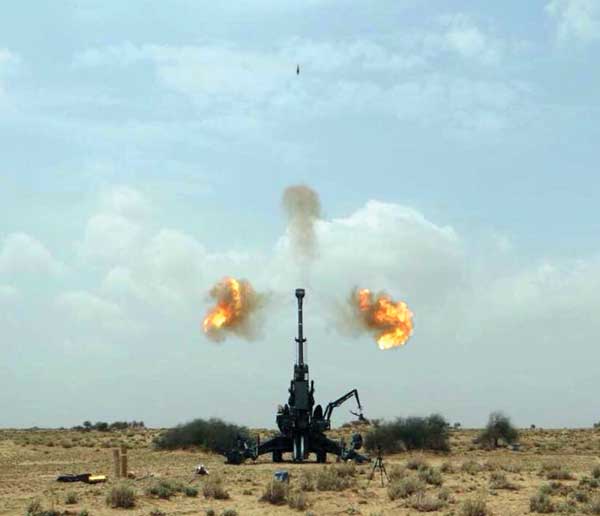
Dhanush 155mm Artillery Gun: A “Make in India” Marvel

21 May , 2015

Dhanush as an artillery system has proved to be one of the best amongst its class. A 45 Calibre towed gun system capable of targeting at long ranges incorporating autonomous laying features and having one of the most sophisticated suites of electronic and computing systems in the world.

A leading Indian daily “The Times of India” quoted the defence minister, Mr Manohar Parrikar when he addressed the parliamentary consultative committee on defence on April 21, that the 155mm/45-calibre Dhanush howitzers had “successfully met all technical parameters” during the winter and summer trials at Sikkim and Pokhran. He also stated that Dhanush incorporates “many improved features” over the Army’s existing artillery guns.

This revelation has created a buzz amongst the arms manufacturers and rightly so since Dhanush as an artillery system has proved to be one of the best amongst its class. A 45 Calibre towed gun system capable of targeting at long ranges incorporating autonomous laying features and having one of the most sophisticated suites of electronic and computing systems in the world.

The unreasonable fear of a coup


When Jawaharlal Nehru died there was an intelligence red alert of the possibility of a military coup. An artillery brigade had been moved from Ambala to Delhi for annual field firing at the Tughlakabad range, and this coincided with the death of Nehru. 

Though a military coup or a successful military invasion may result in a soldier capturing political power, there is a difference between the two. The former is directed against a government to which one owes loyalty and the latter against a government to which one does not. History abounds with examples of both. In the modern age military coups have been taking place while in the earlier days the other was more common.

Early examples of military coups are those of Julius Caesar, Oliver Cromwell and Napoleon Bonaparte. In modern times, several military coups have taken place, particularly in countries liberated from colonial rule in Asia and Africa. Modern India has a shining military coup-free record. There have been only two instances, both very long ago. The great Mauryan Empire founded by Chandragupta Maurya, comprising present-day India, Pakistan and Afghanistan, had shrunk considerably in 185 BC. The latter Greeks under Demetrius had come to the border, threatening invasion. Brihadratha, the last Mauryan ruler, was an imbecile. His commander-in-chief, Pushyamitra Sunga, assassinated him and became the ruler. The other instance was that of Hyder Ali, a successful military leader, removing the Wadiyar ruler of Mysore. Hyder Ali’s son Tipu Sultan succeeded him on his death.

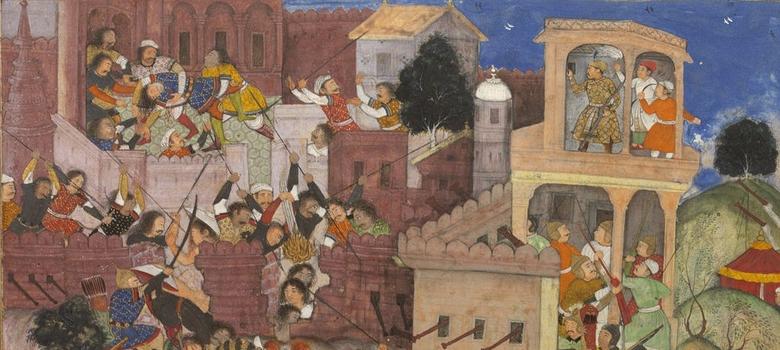
What our textbooks don't tell us: Why the Rajputs failed miserably in battle for centuries


They were defeated by Ghazni, Ghuri, Khilji, Babur, Akbar, the Marathas and the British.

The home minister, Rajnath Singh, wishes our school textbooks told us more about the Rajput king Rana Pratap, and less about the Mughal emperor Akbar. I, on the other hand, wish they explained why Rajputs fared so miserably on the battlefield.

A thousand years ago, Rajput kings ruled much of North India. Then they lost to Ghazni, lost to Ghuri, lost to Khilji, lost to Babur, lost to Akbar, lost to the Marathas, and keeled over before the British. The Marathas and Brits hardly count since the Rajputs were a spent force by the time Akbar was done with them. Having been confined to an arid part of the subcontinent by the early Sultans, they were reduced to vassals by the Mughals.

Decade of war, billions in U.S. aid fail to defeat Taliban


May 19, 2015 

KABUL — More than a decade of war and billions in U.S. funds to build up an Afghan military force have failed to defeat a Taliban insurgency that remains a threat across the country, according to interviews with U.S., NATO and Afghan military leaders.

Following the end of the U.S. military's combat mission last year, the Islamic radical insurgents have overrun dozens of checkpoints throughout the country and threatened entire districts. The army has rushed forces to take back terrain, but it doesn't have enough troops to defend every place under assault.

"The enemy is fighting in almost every province," said Gen. Sher Mohammad Karimi, the Afghan army chief of staff.

Karimi said the Taliban is unable to mass enough forces to take over key cities or threaten the central government here. "In some places they win for an hour and lose in the next hour," he said.

Barring a political settlement between the warring camps, Karimi's assessment points to unending fighting with neither side gaining the upper hand — so long as the United States and its allies continue to spend billions a year to prop up the Afghan forces.

Why do allies sometimes pretend to believe one another’s lies? The U.S.-Pakistani Relationship

Elizabeth Cobbs Hoffman
May 20, 2015

Why the U.S. chooses to believe Pakistan, despite doubts

Why do allies sometimes pretend to believe one another’s lies? There are good reasons and bad, as new evidence about the U.S. relationship with Pakistan demonstrates.

Throughout its “war on terrorism,” the United States has had to rely on Pakistan. Though Washington may occasionally have believed its trust was abused, the Pentagon’s need for overflight rights or landing bases, crucial for U.S. troops in Afghanistan and throughout the Middle East, trumped diplomatic niceties.

The American people may wonder if this trumped self-respect as well. Seasoned investigative reporter Seymour Hersh recently wrote about Pakistan’s possibly problematic role in the U.S. capture of Osama bin Laden for the London Review of Books. Hersh, who broke both the My Lai massacre story during the Vietnam War and the Abu Ghraib torture story during the war in Iraq, alleges that Islamabad kept bin Laden under lock and key in Abbottabad for six years — even as U.S. intelligence urgently tried to track him down. Combing treacherous mountains and ravines for the world’s most wanted man, Washington may have risked and lost lives unnecessarily.

Industry 4.0 and Energy 4.0 for Southeast Asia

By Yanfei Li
May 21, 2015

With a smart approach to energy and industry, the region has the opportunity to leapfrog ahead.

As the leading industrialized economies move to intelligent manufacturing – or industry 4.0 – it will be interesting to see whether the developing economies of Southeast Asia can take the opportunity to leapfrog ahead with economic development. Industry 4.0 goes hand-in-hand with smart production and energy use. The latter may be referred to as Energy 4.0, with the pre-oil era, the oil era, and the new and renewable energy era, as Energy 1.0, 2.0, and 3.0, respectively. This article proposes a vision to invite further discussions in the region’s policy-making and think-tank communities. The point is that Industry 4.0 and Energy 4.0 should be promoted and developed in juxtaposition with conventional industrialization and conventional energy infrastructure systems in the region.

India’s Missed Iran Opportunity

By Kabir Taneja
May 21, 2015

The Iranian port of Chabahar remains an elusive dream of Indian strategic policy.

On a recent trip to Tehran, India’s Minister for Road Transport, Highways and Shipping, Nitin Gadkari inked a memorandum of understanding (MoU) with his Iranian counterpart for the development of Chabahar port. The port, situated in southeastern Iran, is seen by India as a gateway to both Afghanistan and Central Asiaand a possible counter-balance to Gwadar port in Pakistan, which is now operated entirely by China.

“With the signing of this MoU, Indian and Iranian commercial entities would now be in a position to commence negotiations towards finalization of a commercial contract under which Indian firms will lease two existing berths at the Port and operationalize them as container and multi-purpose cargo terminals,” read a statement released by the Indian Ministry of External Affairs.