6 September 2015

The horrific results of Obama’s failure in Syria

By Michael Gerson 
September 3 2015
Source Link

One little boy in a red T-shirt, lying face down, drowned, on a Turkish beach, is a tragedy. More than 200,000 dead in Syria, 4 million fleeing refugees and 7.6 million displaced from their homes are statistics. But they represent a collective failure of massive proportions.

For four years, the Obama administration has engaged in what Frederic Hof, former special adviser for transition in Syria, calls a “pantomime of outrage.” Four years of strongly worded protests, and urgent meetings and calls for negotiation — the whole drama a sickening substitute for useful action. People talking and talking to drown out the voice of their own conscience. And blaming. In 2013, President Obama lectured the U.N. Security Council for having “demonstrated no inclination to act at all.” Psychological projection on a global stage.
Michael Gerson is a nationally syndicated columnist who appears twice weekly in The Post.View Archive

Always there is Obama’s weary realism. “It’s not the job of the president of the United States to solve every problem in the Middle East.” We must be “modest in our belief that we can remedy every evil.”

Neo-Nazi Arsonists: Officials Concerned by Growing Far-Right Networks

By SPIEGEL Staff
Source Link

This year has seen a sharply increased number of attacks on asylum hostels in Germany, many of them perpetrated by right-wing extremists. Officials are concerned that neo-Nazi networks may be spreading across the country. 

It was April 16 when around 100 right-wing extremists marched through the small town of Nauen in the eastern German state of Brandenburg. Their message: "Nein zum Heim!" or "No to the Hostel!" They carried posters and German flags along with them. "Nauen Will Stay White!" read one. "Take Action!" read another.

One day later, employees of Mikado, a local youth center, found that the tires of the center's minibus had been slashed. There was a note under the windshield wiper reading: "Dear asylum friends, Tröglitz is here too." The reference was to an arson attack on a refugee shelter not two weeks before in the town of Tröglitz in the eastern state of Saxony.

Feature: Saving Iran’s great salt lake


LAKE URMIA, IRAN—In a wetland dying of thirst, Hossein Akhani, a botanist at the University of Tehran, mourns a verdant past. “Fifteen years ago, the lake was here,” he says. “Every time I come back, the water is farther away.”

Lake Urmia, in Iran’s northwestern corner, was once the planet’s sixth largest salt lake, covering about 5200 square kilometers—a bit larger than the Great Salt Lake in Utah. Flamingos, egrets, and other waterfowl feasted on brine shrimp, and resorts catered to tourists who believed that bathing in the saline waters improves health. But after gradually receding for years, the water body that the local Azeri people once revered as their “turquoise solitaire” shriveled last year to a mere 10% of its maximum. Salt lakes pulse like lungs, swelling during wet periods and contracting during the dry season. But Urmia’s contraction at the end of 2014 was more like a death rattle.

Uzbekistan apparently just banned political science studies


Political science students in much of the world are gearing up for the new school year, but in one country, their peers had better scramble fast for a different major.

Uzbekistan, the former Soviet republic in Central Asia, apparently just banned poli-sci from universities across the country. 
There hasn't been a government announcement yet. But a prominent Uzbek political scientist recently posted a rare open letter on Facebook denouncing the move, and other Central Asia watchers have concurred. According to the political expert, Uzbekistan’s Ministry of Higher and Specialized Secondary Education ordered the ban last week.

He said the reasons include what officials believe to be the discipline’s lack of scientific rigor, as well as its “exclusively” Western body of literature, which apparently obscures the particular Uzbek nature of politics.

But critics see right through that.

Putin in Syria

September 2, 2015

Most Americans are aware of the aggressive Russian actions in recent years in Ukraine (seizing Crimea and participating in efforts to destabilize the rest of the country) and Eastern Europe. What is less well known is Putin’s effort in Syria.

A story by Michael Weiss in The Daily Beast tells us what is actually happening, as its title conveys: “Russia Puts Boots on the Ground in Syria.” Not only is Russia arming the Assad regime, but there is now evidence that Russians are on the ground with Assad’s forces actually operating the equipment. Weiss refers to “compelling evidence that Russians have embedded with the Syrian military.” Assadrecently told Hezbollah’s TV station that “We have strong confidence in the Russians, as they have proven throughout this crisis, for four years, that they are sincere and transparent in their relationship with us,” and he appears to be right.

Russia’s involvement is growing very fast. Alex Fishman, one of Israel’s best military correspondents, reported this on August 31:

Iran Is Already Gloating

September 2, 2015

Details of the nuclear talks between Iran and the five permanent members of the Security Council plus Germany have been made public thanks to Abbas Araghchi, an Iranian deputy nuclear negotiator - much to Araghchi's dismay. The website of the Islamic Republic of Iran Broadcasting, or IRIB, accidentally published the minutes of an off-the-record briefing with Araghchi on Aug. 5. The transcript was removed within hours after Araghchi voiced his anger, but the damage had been done.

Araghchi's briefing was meant exclusively for the senior management of the IRIB, the Islamic Republic's state television broadcaster and a major propaganda tool. The head of the IRIB is always appointed by the Supreme Leader, and its management is selected from senior employees of either the Islamic Revolutionary Guard Corps or the Ministry of Intelligence. Former IRIB heads have included high-ranking Revolutionary Guard officers such as Ali Larijani and Ezatollah Zarghami. IRIB management are culled from the exclusive club of ruling elite and from their underlings in the Islamic Republic. Members of this club do not generally change; they simply move from one position to another. Therefore, it is difficult to imagine that Araghchi would falsify facts to people ultimately responsible for implementing the terms of the Iran deal and its secret side agreements. 

ISIS Recaptures Part of Iraqi Oil Refinery City of Baiji

Agence France-Presse
September 3, 2015

IS retakes part of Iraqi town of Baiji: Pentagon

Islamic State fighters have regained territory in the contested city of Baiji, home to Iraq’s largest oil refinery, the Pentagon said Wednesday.

Fierce fighting has been taking place for months in and around Baiji, and Iraqi forces and militia fighters had in recent weeks pushed back IS fighters in the northern town.

But much of that progress has been undone, Pentagon spokesman Captain Jeff Davis told reporters.

“We had seen some recent progress in recent weeks where the ISF (Iraqi Security Forces) had been able to regain some territory inside the city,” he said.

“In the past several days, that’s been largely reversed … the trend has been downward there. A lot of the gains they had made were lost.”

Davis said the United States remained committed to helping Iraqi forces.

WALK WITH THE DEVIL: EVIL BARGAINS AND THE ISLAMIC STATE

SEPTEMBER 2, 2015

How to counter the Islamic State is an especially difficult problem for Western policymakers, but the issue of compromise, and which devil to dance with, cannot be dodged forever.

“My children,” President Franklin Roosevelt pronounced in his fatherly way in November 1942, “it is permitted you in time of grave danger to walk with the devil until you have crossed the bridge.” It was an old Balkan proverb. The bridge of his time was the war against Nazism — barbarism without limit — allied with imperial Japan, which was carrying out an Asian holocaust of its own. The devil, that day, was Vichy France. At the price of reaching an accord with collaborator Francois Darlan, Roosevelt purchased the cooperation of French forces in North Africa, an important shift in the ground campaign.

The principle is clear but painful. In a supreme emergency, when battling a force of exceptional barbarity, it is prudent to make the moral compromise of bargaining with the allies that are available. Even if the costs of trafficking with “the enemy of my enemy” are steep. Today, proverbs about lesser evils bear repeating as the luckless people of Syria and Iraq feel the Islamic State’s blade.

(W)ARCHIVES: COOKING THE BOOKS ON THE ISLAMIC STATE AND THE VIET CONG

SEPTEMBER 4, 2015

According to recent press reports, the Pentagon’s Inspector General isinvestigating whether officials from U.S. Central Command (CENTCOM) have skewed intelligence assessments to show more progress in the fight against the Islamic State than the facts would justify. Allegedly, these politicized assessments have made their way to senior officials right up to the president.

We do not yet know the full truth but these are serious allegations; politicization is one of the most profoundly unethical acts that intelligence officers can engage in. If the charges are substantiated, this will not be the first time that the U.S. military has cooked the books on a war. In 1967, the U.S. Intelligence Community produced Special National Intelligence Estimate 14.3-67, “Capabilities of the Vietnamese Communists for Fighting in South Vietnam,” which is available at the CIA’s Freedom of Information Act website. The sordid story of this estimate encourages us to take a hard line on politicization. It also reminds us, however, that intelligence is an inherently uncertain business.

Reviving America’s Nuclear Culture

MICHAEL AUSLIN
September 3, 2015

The bomb turns 70, and the world faces a new nuclear future.

Of all the exhibits of horror in Hiroshima’s Peace Memorial Museum—twisted bicycles, melted eyeglasses, burned rubble—one stopped me in my tracks. It was a small section of wall and steps. On it, a dark half-oval is burned into the stone, with vertical shading on the steps. It is the silhouette of a human being, vaporized by the atomic explosion on August 6, 1945.

At 8:15 A.M., most of downtown Hiroshima disappeared in a searing flash of light and a crushing blast of superheated air. At least 70,000 Japanese (including around 20,000 soldiers) were killed by the firestorm that incinerated the city’s wooden houses and buildings. Three days later, on August 9, the city of Nagasaki was similarly destroyed, this time with the immediate death of around 40,000 civilians. Tens of thousands more would die in coming weeks and years from burns and radiation sickness.

For 70 years since those August mornings, the world has been spared another nuclear bombing. Even as the United States and the Soviet Union built enormous stockpiles of nuclear warheads, reaching a maximum combined total of 64,500 in 1986, neither they nor the other official nuclear powers ever detonated a nuclear weapon during a conflict. Since the end of the Cold War, in particular, the threat of nuclear war has appeared to recede, and the massive nuclear arsenals relegated in importance to the backwaters of national strategy.

Obama’s Victory Is Iran’s Victory

SEP 14, 2015

Last week the White House puffed its feathers when Barbara Mikulski became the 34th Democratic senator to come out in favor of the nuclear deal with Iran. Mikulski’s support ensures enough votes in Obama’s pocket to sustain a presidential veto on a resolution of disapproval, but it’s still not clear why the administration is celebrating. A majority of senators and congressmen oppose Obama’s signature foreign policy initiative. So does most of the American public, by a two-to-one ratio according to a new poll released last week. In other words, the administration may have won this round, but the fight over the Iran deal isn’t over.

The other critical actor is the White House’s negotiating partner in Tehran. The clerical regime looks at the American political landscape and sees that it is operating in a protected environment that may change very quickly when a new administration comes to the White House in 16 months. Unlike the Obama White House, the Islamic Republic understands that the fight over its nuclear weapons program will continue.

MAKS: IS RUSSIA DEVELOPING AN F-35-HUNTING UAV?

BY: JAMES DREW 
MOSCOW

Russia could be working on a low-observable, F-35-hunting unmanned air vehicle that uses deeply-integrated electronic warfare systems to stay hidden from radars. The tip-off comes from electronic systems producer KRET, which has a curious UAV model on display at the MAKS air show in Moscow.

According to the company’s first deputy chief executive officer Vladimir Mikheev, this aircraft model is more than just a sleek promotional display – it is an advanced military UAV being developed by the United Aircraft Corporation (UAC).

Concern Radio-Electronic Technologies (KRET) is a subcontractor on the project, he says, providing the fundamental communications, radar, electronic warfare and self-protection systems, as well as the ground control station.

Speaking via a translator, Mikheev tells Flightglobal that the company is involved with two military UAV projects – one in development and one in the concept phase – but both ventures of UAC.

Why Europe should consider a US-style green card lottery for migrants

September 2, 2015

The UN High Commission for Refugees estimates that 300,000 people have crossed the Mediterranean into Europe this year and 2,500 migrants have lost their lives in the crossing attempt. With the current migration trend unlikely to reverse itself any time soon, politicians across Europe need to act fast to agree on new policies to stop the deaths and agree on a long-term solution to the migration crisis. The push factors behind migration to Europe – war, state persecution and poverty, as well as lack of economic opportunities in much of Africa and theMiddle East – will continue to persist in the decades to come.

The recent death of 70 migrants in the back of a lorry in Austria serves as a reminder that the misery and tragedy of the migrant issue is no longer contained on the periphery of the Europe on the islands of Lampedusa and Kos. It has arrived in the heart of the continent.

In the absence of a common EU migration policy, each country currently fends for itself. In light of the events so far this year and the projections for the years to come, politicians across Europe need to accept that an EU-wide migration management strategy is desperately needed: no country can solve the current and future migration challenge by itself. They also need to share the burden of migration fairly between countries – an idea strongly advocated by German chancellor Angela Merkel, and put on the table by a group of MEPs in July.

Terrorism never fails to take victim societies by surprise - Dr. Ajai Sahni

Dr. Ajai Sahni 

Terrorism in its modern form has been with us for decades and has continuously expanded its sphere of influence and operation, Dr. Ajai Sahni, founding member and executive director of the Institute for Conflict Management in New Delhi said.

He was speaking at the international Defence Seminar themed 'National Security in the context of Emerging Global Threats' on Tuesday.

Dr. Sahni said it yet never fails to take its victim societies by surprise when it is applied in a new theatre, however gradual or deliberate its march.

"Target states have, almost without exception, been shocked into an utter confusion of responses in the wake of each such expansion, and there is little evidence that the experience of other nations or communities has ever been absorbed into the policies and strategic perspectives of those nations that do not themselves have prior experience of terrorism," he said.

Europe’s New Walls


To be free to travel. That was the dream of the millions who had lived under the Communist regimes in Eastern and Central Europe. That dream came through in summer 1989 when theHungarian government cut the barbed wire fence that divided the country from Western Europe.

Thousands of East Germans who had made their way to Hungary crossed into Austria. It was the beginning of the end of a divided Europe. A few months later, the Berlin Wall, which symbolized the division of Europe into two ideological and physical blocs, was torn down. Europe was finally whole and united.

Then came the introduction of the EU’s Schengen system, which abolished border controls between most European Union countries. That gave Europeans from Eastern, Central, and Southeastern Europe a real sense of living in an open and seamless Europe.

But that open Europe is now in jeopardy as governments build walls against refugees, against Russia, and against the Roma. The more governments build such fences, the more they undermine the EU as an open, democratic, and free space—qualities and values that have made Europe attractive and a beacon to others.

Photo Evidence Indicates That Russian Air Force Warplanes and Drones Are Now Flying Combat Missions in Syria

David Cenciotti
September 3, 2015

Pictures allegedly shot over Idlib and posted on Twitter seem to suggest Sukhoi Su-27 (or derivative) Flanker, Mig-29 Fulcrum, Su-34 Fullback jets and Pchela-1T drone are operating in Syria.

Provided the pictures are genuine and taken in Syria in the last couple of days, they would really prove a Russian expeditionary force has already arrived in the country and started flying from an Assad-controlled airbase near Damascus as reported by some Israeli media outlets.

During the past days, Flightradar24.com has exposed several flights of a Russian Air Force (even though the registration shown by FR24 is Syrian – there has been a bit of confusion around this plane since if was first logged in Sept. 2014) Il-76 airlifter (caught by means of its Mode-S transponder) flying to and from Damascus using radio callsign “Manny 6”, most probably supporting thedeployment of a Russian expeditionary force.

Recent reports claimed Russia was in talks to sell Damascus some MiG-29s but the rumors were refuted by MiG CEO Sergei Korotkov.

If the pictures are real, the current makeup of the Russian detachment would include attack planes (Su-34), as well as some air-superiority ones (MiG-29 and Su-27) and UAVs (Pchela 1T – a drone with a of range 60 km).

Ukraine’s Close Ties to Russian Internet System Leaves It Vulnerable to Russian Spies

Antti Viktor Rauhala
September 3, 2015

Close ties to Russian Internet world leave Ukraine vulnerable to cyberattacks, espionage

Ukraine aspires to be part of the West, but remains firmly in the Russian Internet world, leaving the country exposed to Russia’s cyberattacks and espionage.

According to a report by PrivatBank, Ukraine’s largest commercial bank, a total of 64 percent of all email accounts in Ukraine are registered with Russian services like Mail.ru and Yandex.

Only in Lviv and Kyiv is the market share of Russian providers less than 50 percent. In many eastern regions, more than three quarters of all email accounts are on Russian websites. Furthermore, vKontakte remains as Ukraine’s most popular social media platform and as the most second visited website after Google, according to statistics from Alexa.

The Russian companies with their servers mostly in Russia are subject to what is called as the System for Operative Investigative Activities,’ or SORM.

SORM requires Russian Internet service providers, which connect Internet users to the servers of the websites they are visiting, to give Russian intelligence services direct access to monitor their data traffic.

Pierluigi Paganini, the founder of Security Affairs, told the Kyiv Post that, “In this way (the Federal Security Service) FSB is able to track every users’ transactions, email communications, and online browsing.”

New Law Requires Russian Telecoms and Other Companies to Store Personal Data on Russian Citizens

Sarah Steffen
September 3, 2015

Russia tightens Internet controls, makes it easier to spy on citizens, critics say

Russia’s new law, which requires companies processing personal data on Russian citizens to store this data on local servers, came into force on Tuesday. It’s just the latest in a string of measures aimed at increasing government control over the Internet since President Vladimir Putin was re-elected in 2012.

Russian authorities say the law is there to help secure data by Russian citizens in the wake of former NSA contractor Edward Snowden’s allegations of widespread spying. However, critics have said it raises serious privacy concerns, as the law makes it easier for the Russian government to spy on its own citizens.

“Nobody asked them to protect personal data of Russian citizens, it was always a government initiative,” said Andrei Soldatov, an investigative journalist who covers Russia’s intelligence agencies and who co-authored the book “The Red Web” on the Internet in Russia.

Backdoor access to citizens’ data?

New Book Tackles Sensitive Subject of the Kremlin’s Efforts to Control Information Inside Russia

Luke Harding
September 3, 2015

The Red Web by Andrei Soldatov and Irina Borogan review – Russia’s attack on internet freedoms

Two years have passed since Edward Snowden exited Moscow’s Sheremetyevo airport and began a new life in exile. His revelations of hitherto unknown US and UK programmes of mass surveillance initiated a global debate, and some minor reforms. President Obama vowed to stop spying on Angela Merkel and other friendly western leaders. But what happened in Russia, the host country where Snowden now appears to be indefinitely stuck?

The answer is a dispiriting one, at least according to Andrei Soldatov and Irina Borogan, two brave Moscow-based journalists who have followed the development of the Russian internet since its earliest days. The timing of Snowden’s arrival in Russia in summer 2013 was lousy, they write. The Kremlin was in the middle of a large-scale offensive against internet freedoms.

Russia’s spy agencies have the ability to snoop on emails via Sorm, a sophisticated system first developed by the KGB to eavesdrop on phone calls. The FSB’s (Federal Security Service) legal powers go well beyond those of the US National Security Agency or GCHQ. Russian internet service providers are obliged to install Sorm black boxes; they have no clue as to what Russian intelligence agents choose to intercept.

Iran: The Obamacare of Foreign Policy

SEPT. 3, 2015

A disaster has been averted. The nuclear deal concluded by six major powers with Iran is now unstoppable in Congress. The only question is whether President Obama will have to veto a Republican resolution of disapproval, or whether Democrats will have enough votes to spare him that obligation by filibustering the resolution and ensuring it never leaves the Senate.

The second outcome would be preferable. An override-proof presidential veto of a congressional resolution of disapproval is not the best path to a historic international accord. Major arms control treaties used to be bipartisan affairs. Those days are gone. Still, Republican maneuvering, backed by Prime Minister Benjamin Netanyahu of Israel, has not prevailed. That’s a victory for reason in a season of rage.

Why has a disaster been averted? Because if the deal had unraveled in Congress, so would America’s standing as a global power. Russia, China and the European Union would have concluded that the United States is unserious. To negotiate over years a tough compromise obliging Iran, among other measures, to slash its stockpile of enriched uranium by 98 percent and its operating centrifuges by two-thirds, and then walk away in a righteous and deluded funk — well, that’s not how America won the respect of the world. It did so by being consequential in hot wars and cold.

GLOMAR EXPLORER, Which CIA Used to Raise Sunken Soviet Sub, Headed for the Scrapyard

September 3, 2015

CIA Spy Ship Built to Raise Soviet Sub Becomes Victim of Oil Slump

ZURICH — A ship built by the CIA for a secret Cold War mission in 1974 to raise a sunken Soviet sub is heading to the scrap yard, a victim of the slide in oilprices.

Christened the Hughes Glomar Explorer, after billionaire Howard Hughes was brought in on the CIA’s deception, the 619-foot vessel eventually became part of the fleet of ships used by Swiss company Transocean to drill for oil.

But the oil price rout means the former spy ship now called GSF Explorer is just one of 40 such offshore drilling rigs that have been consigned to scrap since last year.

It’s the end of a story that began when a Soviet G-II sub called the K-129 sank in September 1968 “with all hands, 16,500 feet below the surface of the Pacific”, according to an official U.S. Central Intelligence Agency (CIA) history.

The sub sank with nuclear-armed ballistic missiles and nearly 100 sailors, according to declassified documents at George Washington University’s National Security Archive.

According to the CIA history of the mission, called “Project Azorian”, the Soviet Union failed to locate the sub in a massive two-month search, but the United States found it, 1,500 miles (2,400 km) northwest of Hawaii.

Still Signs of Launch Preparations at North Korea’s Missile and Space Launch Center

Jack Liu and Joseph Bermudez
September 3, 2015

Still No Sign of Launch Preparations at North Korea’s Sohae Launch Facility

While speculation that North Korea intends to launch a long-range space launch vehicle (SLV) on the 70th anniversary of the Korean Workers’ Party in October continues, it is still not possible to determine whether Pyongyang will conduct such a launch using commercial satellite imagery. Imagery from August 27 and September 1 show that a movable structure on the launch pad–intended to transfer SLV stages and components from the Stationary Preparation Building to the gantry tower–has shifted back and forth since observed in mid-August.

That movement may have occurred for a number of reasons ranging from testing the recently completed movable structure to launch preparations. Besides the fact that the general low level of activity throughout the facility suggests a launch is not going to occur over the next few weeks, in the case of a possible October launch, it is probably still too soon to move the SLV to the gantry.

Only 6 of 121 Guantanamo Bay Detainees Transferred to Other Countries Since 2009 Have Reengaged in Terrorist Activities, DNI Report

Office of the Director of National Intelligence (ODNI)
September 3, 2015

Summary of the Reengagement of Detainees Formerly Held at Guantanamo Bay, Cuba 

The DNI submits this summary consistent with direction in the FY2012 Intelligence Authorization Act, Section 307… The report can be accessed here.

Taiwan MND Says Prison Sentences Given to Ring of Chinese Spies Too Lenient

Joseph Yeh
September 3, 2015

MND says China spying sentences too lenient

TAIPEI, Taiwan – The Ministry of National Defense (MND) yesterday called on prosecutors to appeal the latest ruling after Taipei District Court on late Tuesday handed out relatively lenient sentences to several retired military personnel involved in a high profile Chinese espionage case.

Military spokesman Luo Shao-ho urged prosecutors to do so as lenient sentences levied upon Taiwanese who serve as Chinese spies could hardly serve as a deterrent to those who are willing to betray their country in exchange for money.

“Those ex-military personnel had long been under the nation’s care for decades and yet they have failed to keep a safe distance from the enemies and ultimately sold out the country,” Luo said.

Their illicit behaviors have inflicted major damage to national security and the operations of the Armed Forces and thus they deserve to be given harsher jail terms, he added.

McCain: Navy program wastes $700 million

The Navy's Remote Minehunting System made it into Sen. John McCain's "America's Most Wasted" report. (U.S. Navy)

A new report Thursday shows that the Pentagon wasted more than $700 million on a minehunting system that continues to perform poorly in tests after 16 years of development.

The finding is from "America's Most Wasted," a regular report released by Sen. John McCain, R-Ariz., that details some of the programs that waste taxpayer dollars.

The Navy's Remote Minehunting System is designed to help U.S. ships find and destroy sea mines, but "has consistently performed poorly in testing and yielded no results for the military," a release from the senator's office said.

"At a time when the defense budget continues to shrink while global threats emerge every day, it is absolutely critical for the Defense Department to stop throwing more taxpayer dollars after bad and start investing in programs that enhance the capability and readiness of our warfighters," McCain said in a statement.

NATO Opens Military Center in Lithuania amid Ukraine Crisis

By Liudas Dapkus & David Keyton
September 3, 2015

Fighter jets roaring overhead, NATO on Thursday inaugurated a military center in the Lithuanian capital amid growing concerns in the Baltic countries over Russia's military presence.

NATO Secretary-General Jens Stoltenberg, who joined Lithuanian President Dalia Grybauskaite for the opening ceremony, described the new unit as a "big step forward toward greater solidarity, greater strength and greater readiness."

The NATO force integration unit in Vilnius is one of six small headquarters — manned by some 40 staff each — that opened this month in Bulgaria, Estonia, Latvia, Poland and Romania, as part of the alliance's biggest reinforcement of collective defense since the end of the Cold War.

Grybauskaite welcomed the new units, saying they would ensure the quick and effective movement of troops. "And they help send a very clear message — no NATO ally stands alone," she said, pointing to Russian aggression in Ukraine as threatening the security of Europe. "This is why we have decided to bolster our security."

The Treaty of Paris: Negotiating from Weakness

September 3, 2015

September 3rd will mark 232 years since the end of the American Revolutionary War, with the signing of the Treaty of Paris. While this treaty was a monumental step for the new United States, it also laid the groundwork for future international strife and set the priorities for the new nation. As the U.S. continues to develop its relationship with the rest of the world, primarily in the Middle East, it is perhaps useful to look back on the negotiations that took place in 1782–1783, especially in light of the negotiations with Iran that took place this year.

The stage for the peace treaty had been set with the victory of combined American and French forces over the British garrison at Yorktown, Virginia, in October of 1781. Over 8,000 British soldiers and sailors had surrendered to George Washington and his French allies in the last major battle of the American Revolution. This was the major military blow that convinced the British government that the cost to fight the American colonies outweighed the benefits of keeping them.

What really brought the British to the negotiating table, however, was the four-front war that they were now fighting. France, the Netherlands, and Spain had all joined the war, on the American side, and were using the conflict as an excuse to grab land in the Caribbean, Africa, and India. Spain was gunning for Gibraltar, that British fortress that controlled the mouth of the Mediterranean just under Spain’s nose. Spain had France’s word that this time, Gibraltar would fall. In fact, there were a whole series of agreements governing the conduct of the war from the French, Spanish, and American sides. France had agreed to fight until the United States gained independence. Spain was convinced to join the fight on the condition that France continue the war until Spain had met its goals, namely, taking Gibraltar. Therefore, France and the United States could not make peace without the other, while France could not make peace without Spain.

Despite Protests, Collective Self-Defence and Abe Remain

September 3, 2015

There were huge protests over the weekend in Japan against legislation, approved in principle by the Abe cabinet in July, which will reinterpret the Japanese Constitution to permit the very limited exercise of collective self-defence.This fierce public opposition to the normalisation of Japan's Self Defence Forces highlights two connected problems for Prime Minister Abe. 

The size and cross-sectional nature of the protests highlight a serious policy communication problem for the Japanese Government in general, and a particular problem for the Abe administration. There is a strong bipartisan consensus, supported by Japanese public opinion, that Japan faces a very serious and growing security threat from China and North Korea. As shown by the 2010 National Defense Program Guidelines released under the Democratic Party of Japan (DPJ) administration, there also is strong bipartisan support for Japanese foreign and security policy to become much more focused on these neighbourhood threats, for a stronger US-Japan alliance and for Japan to play a more active alliance and regional security role.

U.S. Has Asked Malaysia to Host American Spy Planes Monitoring Chinese Military Activities

Josh Rogin
September 3, 2015

Malaysia and U.S. in Talks to Ramp Up China Spying

The U.S. and Malaysia have been secretly discussing expanded use of Malaysian territory for hosting U.S. spy planes to patrol the South China Sea, in response to increased Chinese activity in the disputed territory.

Following a series of incursions into Malaysian waters by Chinese vessels in recent months, talks between the U.S. government and the office of Malaysian Prime Minister Najib Razak have intensified, two senior U.S. defense officials said. The U.S. side has been pressing Najib’s government to allow the U.S. Navy to fly both P-8 Poseidon and P-3 Orion maritime surveillance planes from Malaysian airstrips over South China Sea areas where the Chinese government has been rapidly building artificial islands.

There has been no final agreement between the two governments, but the talks themselves represent a shift of Malaysia’s long effort to straddle the fence between the U.S. and China. 

On the U.S. side, negotiations are being led by officials from U.S. Pacific Command in Hawaii and David Shear, the assistant secretary of defense for Asian and Pacific security, one senior U.S. defense official said. While the Pentagon has pushed Malaysia for cooperation before, the talks were newly invigorated following incidents earlier this year when Chinese ships proudly entered the southernmost areas of the South China Sea, inside Malaysia’s exclusive economic zone.

WHAT THE 1952 REPUBLICAN PRIMARY TEACHES US ABOUT TODAY’S PRIMARY

SEPTEMBER 2, 2015

In 1952, the serious and important debate about America’s role in the world was conducted almost completely within the ranks of the GOP

Editor’s Note: This areticle is published in partnership with the Hoover Institution’sMilitary History in the News.
As we watch a ferocious contest play out in the Republican primaries, it is worth looking back to 1952 to see how foreign policy affected that election. What I found has striking similarities to today: a president mired in public dissatisfaction; one political party with a wide open and bitterly contested primary, while the other has an arranged coronation of a seemingly unbeatable candidate; a reckless Republican ideologue complicating the party’s efforts to remake its image; a public weary of the burdens of shaping the international order, frustrated the president didn’t seem to have a strategy for winning the war, but anxious about the spread of a foreign ideology threatening the American way of life.

EMPIRE OF CONFUSION

SEPTEMBER 3, 2015

Uneven power relationships do not an empire make. It's time for more clarity in the empire debate, from both scholars and policymakers.
Tyrone Groh and James Lockhart do a fine job laying out the history and current state of the American empire debate, lamenting the imprecise language and conceptualization of the debate in many academic disciplines. The origin of this problem, unfortunately, is as much tied to choices by policymakers as it is by those of academics. While current discussions are muddled and unclear, a look at the structure of relationships in imperial rule promises a bit more clarity. Definitional rigor regarding what an imperial structure entails can only serve to improve both our academic and policy discourses around modern empire and foreign rule.

Origins of Conceptual Clutter

South Korea's President and China's Military Parade

September 03, 2015

On September 3, while Chinese troops and military equipment paraded through Tiananmen Square and Xi Jinping delivered a ringing rebuke of Japanese military aggression, South Korean President Park Geun-hye watched from a position of honor on Tiananmen Gate. During the parade, Park sat to the left of Xi’s wife, Peng Liyuan, who was herself sitting to the left of Xi. Russian President Vladimir Putin was seated on Xi’s right.

Park’s attendance was watched with some concern in the United States. Those who believe Park’s administration is “tilting” toward China at the expense of the U.S. pointed to her presence at the parade as proof. The South Korea-China relationship has certainly been an active one — this was Park’s sixth summit meeting with Xi and third trip to China, all since Park assumed office in February 2013.

In their meeting on Wednesday, Xi praised Park for her efforts to improve the relationship, telling her that,thanks to their joint personal support, “the Korea-China relationship has become the best-ever national relationship in history.” As evidence, he pointed to the recently-concluded free trade agreement between China and South Korea, as well as Seoul’s decision to join the China-led Asian Infrastructure Investment Bank.

5 September 2015

Indo-Pak War 1965: Major Actions

By Brig K Kuldip Singh
04 Sep , 2015

The Chhamb Offensive

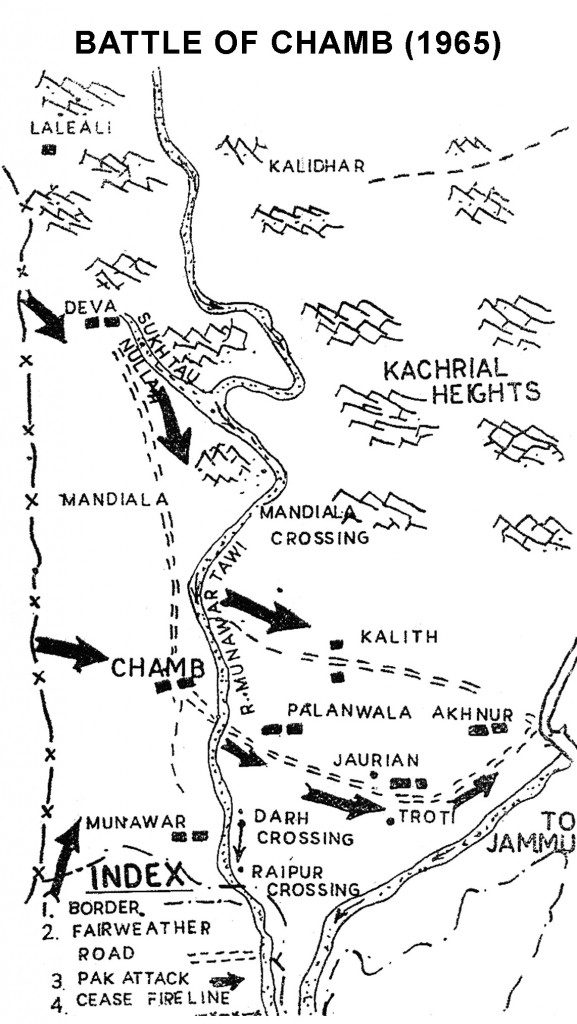
With Operation Gibraltar having miscarried, Pakistan undertook the bold Chhamb Offensive on September 01, 1965, by using a division-sized force of tanks and infantry, with the objective of capturing the strategic Akhnoor, thereby hoping to cut off the vital road link between Jammu and Poonch. Soon, it became clear that Pakistan’s objective in this sector was also to envelope Jammu through a subsidiary thrust from Sialkot. Another blitz was to be launched from the direction of Pasrur for the capture of Pathankot, the then railhead to Jammu and Kashmir. The Indian forces were fewer than brigade strength in the Chhamb Sector.

Pakistan’s Chhamb Offensive, across the international boundary, had added a new dimension to the Indo-Pak conflict. India now faced the dilemma whether to seek negotiations or to retaliate by a major counter-offensive at the place (s) of its choosing.

With surprise on its side, Pakistan’s Chhamb offensive did make initial gains, but the stubborn resistance put up by the Indian ground forces, supported by the air strikes, brought a temporary halt to the Pak offensive. By September 04, 1965, the assailants had crossed the shallow Munawar Tawi, and were inching towards Akhnoor, despite heavy casualties of tanks and assault troops. It was the decisive moment for India to undertake an immediate and telling counter measure.

India Retaliates

The Debilitating Politico-Military Disconnect

By Special Correspondent
04 Sep , 2015

The security imperatives for India are multiple and dynamic with a volatile neighbourhood including an aggressive China and an irrational Pakistan that refuses to stop following a state policy of terrorism. The last decade has been characterised with utter neglect of the defence sector and we need to take focused corrective actions. For this, a major reason has been the politico-military disconnect. Only time will tell if the Defence Minister can take the bull by the horns.

It didn’t matter a thing to the British that Partition along the Radcliffe Line ended in violence…

Much has been written about the politico-military disconnect in India. British India had no such qualms. To start with, in the British Indian Army, British officers were disconnected with the native rank and file even at the lowest echelons. And so, the rank of Junior Commissioned Officers (Indians) was introduced to bridge that disconnect. The question of politico-military disconnect did not arise. But then came the steadily increasing influx of King’s Commissioned Indian Officers. The British, who never trusted the Indians, therefore, termed the Services Headquarters as “Attached Offices” in the ‘Rules of Business’ of the Government. This was a masterstroke of the Indian Civil Service (ICS) that preceded the Indian Administrative (IAS) as they could keep the military on a tight leash while reaping all the benefits – power, pelf et al. It helped the British deprive India of its wealth and bring the industrial complex to nix while keeping the military aloof and do their bidding.

EXTREME MAKEOVER, JIHADIST EDITION: AL-QAEDA’S REBRANDING CAMPAIGN

SEPTEMBER 3, 2015

There is no love lost between al-Qaeda and the Islamic State. Al-Qaeda appears to be rolling out a very deliberate PR strategy against its erstwhile affiliate. Can the organization re-brand itself as the jihadi group the world can live with?

Since the Islamic State made its dramatic military advance from Syria into Iraq more than a year ago — capturing Mosul and other key cities, and declaring the caliphate’s re-establishment — analysts have reached a near-consensus that the group’s emergence has devastated its parent organization, al-Qaeda. Indeed, the Islamic State has undermined al-Qaeda’s once unrivaled position as the standard-bearer of the jihadist movement, outstripping al-Qaeda’s public messaging with its robust propaganda apparatus. The Islamic State has persuaded several groups that were previously in al-Qaeda’s orbit — includingAnsar Bayt al-Maqdis and Boko Haram — to break away and re-style themselves as provinces of the caliphate. Many analysts believe the Islamic State has become the preeminent global jihadist organization.