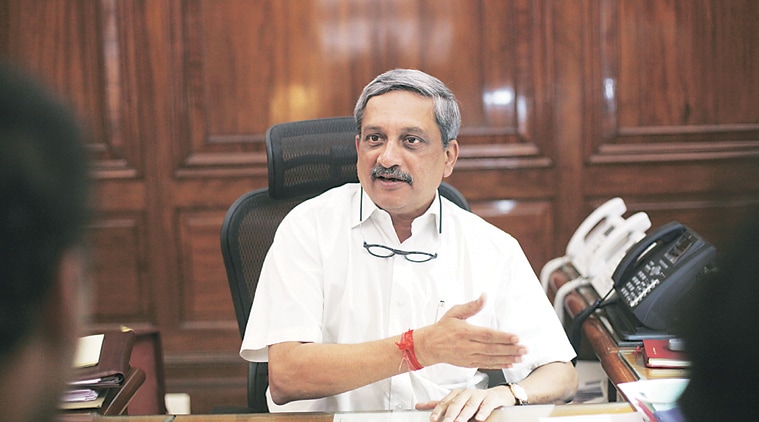
Manohar Parrikar will have to find a way to soothe frayed tempers sooner rather than later lest it snowballs into another OROP-like intractable issue.
Written by Sushant Singh, Published:Dec 28, 2015
Manohar Parrikar took over as the defence minister from Arun Jaitley in November 2014 and so 2015 has been the first full calendar year he has been in-charge. With his IIT education and record as the chief minister of Goa, Parrikar came to South Block with a heavy burden of expectations.
This year, the defence ministry was mostly in news for something which doesn’t directly concern the serving military personnel: the demand of One Rank One Pension (OROP) made by ex-servicemen. It’s been quite a drama: prolonged protests followed by a decision on OROP announced by the government, its rejection by the ex-servicemen and a renegotiation between the two sides — and finally, a government order while protests continue. With the recommendations of Seventh Pay Commission likely to be implemented in 2016, the OROP issue is likely to meld into the Pay Commission announcement.
However, the armed forces are dissatisfied with the recommendations of the Pay Commission and have conveyed their concerns to the defence minister. Parrikar will have to find a way to soothe frayed tempers sooner rather than later lest it snowballs into another OROP-like intractable issue.
To Parrikar’s credit, he has been able to finally announce the construction of a National War Memorial in Delhi. It was one of the election promises made by the BJP and one of the four announcements made in the President’s first inaugural address to Parliament in June 2014.
Last month, Parrikar also received the report of the committee of experts constituted to review service and pension matters including potential disputes, minimising litigation and strengthening institutional mechanisms related to redressal of grievances. Implementing its forward-looking recommendations will require a concerted political push from the defence minister to overcome the institutional inertia.
Parrikar has publicly committed himself to the creation of the post of a Chief of Defence Staff or a Permanent Chairman of Chiefs of Staff Committee. This is a recommendation of the Group of Ministers pending from the era of the earlier NDA government. In his address to the Combined Commanders Conference earlier this month, the Prime Minister spoke of the need for an integrated command. That is an ambitious call and if the post of CDS or Chairman COSC is linked to the creation of integrated commands, Parrikar will find it difficult to keep his commitment in the coming year.
Written by Sushant Singh, Published:Dec 28, 2015
Manohar Parrikar took over as the defence minister from Arun Jaitley in November 2014 and so 2015 has been the first full calendar year he has been in-charge. With his IIT education and record as the chief minister of Goa, Parrikar came to South Block with a heavy burden of expectations.
This year, the defence ministry was mostly in news for something which doesn’t directly concern the serving military personnel: the demand of One Rank One Pension (OROP) made by ex-servicemen. It’s been quite a drama: prolonged protests followed by a decision on OROP announced by the government, its rejection by the ex-servicemen and a renegotiation between the two sides — and finally, a government order while protests continue. With the recommendations of Seventh Pay Commission likely to be implemented in 2016, the OROP issue is likely to meld into the Pay Commission announcement.
However, the armed forces are dissatisfied with the recommendations of the Pay Commission and have conveyed their concerns to the defence minister. Parrikar will have to find a way to soothe frayed tempers sooner rather than later lest it snowballs into another OROP-like intractable issue.
To Parrikar’s credit, he has been able to finally announce the construction of a National War Memorial in Delhi. It was one of the election promises made by the BJP and one of the four announcements made in the President’s first inaugural address to Parliament in June 2014.
Last month, Parrikar also received the report of the committee of experts constituted to review service and pension matters including potential disputes, minimising litigation and strengthening institutional mechanisms related to redressal of grievances. Implementing its forward-looking recommendations will require a concerted political push from the defence minister to overcome the institutional inertia.
Parrikar has publicly committed himself to the creation of the post of a Chief of Defence Staff or a Permanent Chairman of Chiefs of Staff Committee. This is a recommendation of the Group of Ministers pending from the era of the earlier NDA government. In his address to the Combined Commanders Conference earlier this month, the Prime Minister spoke of the need for an integrated command. That is an ambitious call and if the post of CDS or Chairman COSC is linked to the creation of integrated commands, Parrikar will find it difficult to keep his commitment in the coming year.
 In the political and economic theatre of India, it is normally one step forward and several steps backwards. While we keep moaning about improving the ease of doing business and ensuring that India takes baby steps towards becoming a manufacturing hub through the Make In India programme, our bureaucracy refuses to unshackle itself from the licence raj mindset which was replete with a draconian inspector raj regime. As we know nothing has really changed and foreign investment continues to find impediments and imponderables strewn in its path as it ventures into India. Making them irascible and crabby, the fear of the unknown stalking them at all times. Beginning with the inability to repeal the swingeing land acquisition bill, the very tentpoles required for a Make In India scenario are not available in India.