http://www.thehindu.com/opinion/lead/save-national-security-from-the-establishment/article8082730.ece
January 9, 2016, Josy Joseph
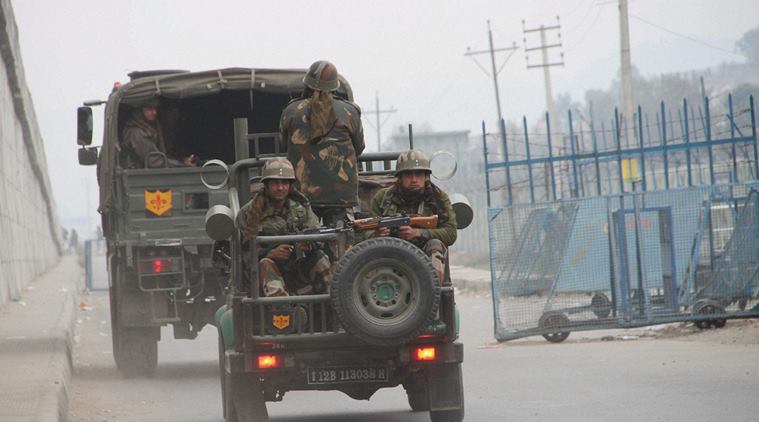
AP GAPS IN THE GRID: “Pathankot has shred to pieces the cycle of terror responses in India: from processing intelligence alerts, mobilising first responders, carrying out counterterror operations under a well-defined command-and-control system, minimising casualties and, finally, obtaining maximum intelligence to thwart possible future attacks.” Picture shows soldiers on watch at the perimeter fence of the Pathankot airbase.
The bungled response to the Pathankot attack underscores the need for a three-pronged revamp: parliamentary oversight, a well-defined national security doctrine and an independent federal commission of accountability.
Most terror attacks in India are characterised by three critical missteps: ignored intelligence inputs, inconsistent security response, and heavy casualties.
Consider, for instance, the Pathankot and the 26/11 Mumbai terrorist attacks. A few days before the boat with terrorists actually landed in Mumbai, the Intelligence Bureau had details of the specific location of a satellite phone used by terrorists on a boat moving towards the Mumbai coast. In the run-up to the attacks, there were at least two more specific alerts Indian agencies had about a possible attack on Mumbai.
After 166 people were killed, hundreds injured, and India held to ransom for days and humiliated on the global stage by 10 terrorists, no one was held accountable. Those who were supposed to act on the terror alerts, those who were supposed to guard the seas and those who were supposed to protect Mumbai, all carried on with their professional lives.
In Pathankot the story just got worse. The U.S. agencies had alerted their Indian counterparts around Christmas about a group of half-a-dozen terrorists planning to target the city. By early morning of January 1, a senior police officer reported his ordeal with the terrorists. Despite several hours available to intercept the terrorists in a limited space, New Delhi, in its wisdom, decided to waste time by flying in National Security Guard (NSG) commandos from the national capital, while thousands of trained army soldiers were already stationed all over Pathankot.
As with 26/11, the criminal neglect by those responsible for acting on the information would again be whitewashed. The Central government would again come to the conclusion that no one was responsible for the lapses that resulted in the humiliating attack and the mismanaged counterterror operation.
In all of its contemporary history, India has only been going around in a loop in its inability to tackle armed non-state actors. Jaish-e-Mohammad, the Pakistan-based terror group suspected to be behind the Pathankot attack, was founded by Masood Azhar, who was one of the three terrorists freed by India in yet another embarrassing episode of terrorism on another year-end: on December 31, 1999, the National Democratic Alliance (NDA) government of Atal Bihari Vajpayee decided to release three terrorists after Indian Airlines flight IC814 was hijacked to Kandahar, to secure the lives of the passengers.