6 April 2016

** Armenia, Azerbaijan and a Dangerous Conflict

By George Friedman 
April 4, 2016 

A daily explanation of what matters and what doesn't in the world of geopolitics. 

The dispute over territory has potential to draw in major powers. 

Summary The conflict over Nagorno-Karabakh has been simmering since 1994. The area may seem of limited importance, but the Caucasus has strategic value to surrounding powers like Russia, Turkey and Iran. 

Over the last few days, fighting broke out between Armenia and Azerbaijan along their ceasefire line in Nagorno-Karabakh. There has been a long-standing dispute between the two countries over an area that was part of Azerbaijan when the Soviet Union collapsed in 1991, but claimed by Armenia in a war that reached stalemate in 1994. It has since been one of numerous frozen conflicts in the area. The freeze thawed rapidly late last week as Armenian and Azerbaijani troops engaged in the heaviest fighting since 1994. There has been fighting along the line in the past. This time, it was reported that weapons such as multiple rocket launch systems firing Grad rockets were used along with helicopter gunships. This was obviously not an isolated incident because use of weapons of this sort would have to be authorized by much higher command echelons. With over a dozen dead and many wounded on each side, this is the most substantial breach of the ceasefire since 1994.

Wars in faraway places are of little interest to many, but it has to be remembered that all the wars the United States has been involved in since World War II have been in faraway places of little interest. Understanding Nagorno-Karabakh is important, not because the U.S. will become involved, but because the United States tends to become involved in just this kind of conflict.
Making of a General

By Col Bhaskar Sarkar
03 Apr , 2016

“The personality of the general is indispensable. He is the head, he is the all of an army. The Gaul’s were not conquered by the Roman Legions but by Caesar. It was not before the Carthaginian soldier that Rome was made to tremble, but before Hannibal. It was not the Macedonian phalanx which penetrated India but Alexander. Prussia was not defended for seven years against the three most formidable European powers by Prussian soldiers but by Frederick the Great”. - Napoleon

History has proved again and again that no matter how large and supposedly powerful any armed forces may be, they can accomplish little without accomplished leaders. Babar defeated the hordes of Ibrahim Lodi at Panipat. Frederick the Great repeatedly defeated forces having twice his strength. General O’Conner defeated numerically superior Italian forces in North Mrica in the First Libyan Campaign and General McArthur turned defeat into victory at Inchon.

The role of any commander in battle is to defeat his enemy.

General Omar Bradley said “Man for man, one division is as good as another, they vary on the skill and leadership of their commanders”. The same is true for any brigade or battalion. The essential traits and character qualities of senior commanders thus merit detailed study so that selection and development of potential commanders can be more effective.

Traditions and Customs of the Service

By Bharat Verma
04 Apr , 2016

Military Etiquette

The code of honour that the Army follows is fostered through various customs and traditions which are legally and morally binding on every officer and soldier. Respect for seniors and juniors even when off duty; courtesy to all women regardless of their status; total truthfulness, dauntless moral and physical courage at all times are some of the norms which have been well established through a code of social conduct laid down by traditions and customs of the service. To be a true soldier one has to learn to be a gentleman first. Here, we will describe some of the customs of service to highlight the code of honour which the army follows on and off parade and the institutions or practices which help in fostering this code of honour.

Officers’ Mess

An officers’ mess is a place where young officers and new entrants see and learn the basic courtesies and imbibe the noble traditions of the Indian Army. When an officer enters a mess he leaves his belt and baton outside, which symbolises the sword or other weapons carried in war.

What the Standing Committee on Defence can do to improve the state of defence preparedness

April 04, 2016

For the past several years, the Standing Committee on Defence (SCoD), responsible, among other things, for examining the detailed demands for grants presented by the Ministry of Defence (MoD) to Parliament, has been berating the ministry for providing inadequate funds to the armed forces, underutilising capital outlays, and mismanaging defence planning, all of which impinge on modernisation and, by implication, on the defence and security of the country.

Mounting voids in military capabilities, dithering on even high profile acquisition programmes such as the MMRCA, and an unprecedented underutilisation of the capital budget in 2015-16 indicate in no uncertain terms that the committee’s admonishments have had little impact. Even the recommendations made by the committee over the years have been of little help because they were either too generic or simply impractical.

Reorganisation of the defence budget this year provides an opportunity to change tack and concentrate on a few specific micro issues that do not require a long run up. Rather than continuing to harp on issues like inadequacy of defence outlays, the committee could actually bring about a tangible improvement in the state of defence preparedness by doing so. There are at least four areas the committee needs to focus on in this regard.

First, it is important to maximise the utility of defence outlays. This year’s demands for grant have been reorganised by the government with the objective of “effective outcome oriented monitoring of implementation of programmes and schemes/projects and to ensure optimum utilization of resources.” A budget document claims that “the existing programmes and schemes have been reorganized into outcome-based umbrella programmes and schemes.” 

Who Else Can Destabilise Pakistan?

By RSN Singh
04 Apr , 2016

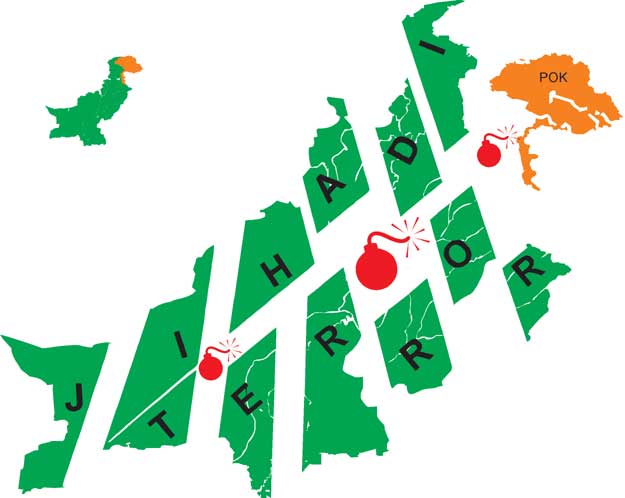
Who is destabilizing Pakistan? It is the jihadis and their suicide bombers. The same suicide bombers, who killed Benazir Bhutto, who killed children in APS, who killed students in Bacha Khan University, who attacked Marriott Hotel in Islamabad, who killed Ismaili Shias, who attacked the ISI headquarters, nuclear establishments, airbase and naval base and more recently who killed innocent people in Iqbal Park in Lahore even as the Joint Investigation Team was investigating the Pathankot attack. Most attacks in Pakistan and India have been by suicide jihadi teams. Is India and Iran producing these suicide bombers? They are incubating in various madrasas of Pakistan.

Since the abduction of the Indian national Commander(retd) KulbhushanJadhav,the officialdom and the media of Pakistan has been on an overdrive in peddling narratives like: “Indian spy admits RAW destabilising Pakistan”,“Jadhav’s confession is a solid proof of Indian state sponsored terror”. Pakistan’s script does not even spare Iran, in that it accuses Jadhav of carrying an Iranian visa and use its territory to destabilise Pakistan in the garb of business activities.

”Senge Hasnan added that the Jadhav affair was a way to ‘embarrass’ Iran and build pressure at a time when Pakistan ‘has to choose a side between Saudi Arabia and Iran.’

Pakistan’s Coziness With Non-State Actors Represents the Single Greatest Global Nuclear Security Threat

By Ibne Ali
March 30, 2016
Source Link

Pakistan’s willingness to use unpredictable and radical non-state actors puts its nuclear arsenal at risk.

Cold war history is a cautious testament to the deterrent capabilities of nuclear weapons. Times have changed, however. Today, in South Asia, Pakistan’s strategic manipulation of its nuclear capability to conduct a proxy war with India is pushing the region towards a catastrophic scenario.

Simply put, Pakistan is pushing the boundaries of what it can get away with. A country embodying contradictions since it came to existence last century, Pakistan has given more and more cause for worry over the years, particularly since 2007. As world leaders gather in Washington, DC, for the Nuclear Security Summit,they would do well to study the shortcomings of this nuclear U.S. ally. At the heart of the problem is not Pakistan’s nuclear arsenal, but its treacherous, self-destructive and parochial, alliance with extremist elements, whose machinations are inevitably corrosive to the country’s fragile democracy.

Pakistan’s perennial non-unitary behavior, as political scientist and nuclear strategy expert George Perkovich puts it, creates ambiguity in its strategic intentions for its nuclear-armed rival, India. The Islamic state’s use of extremist militants against India with little or no state control over them, he rightly warns, creates a deadly sense of ambiguity in the country’s strategic intentions.

Former CIA Case Officer Tells All in New Book About Wars in Pakistan, Afghanistan and Syria

Mark Mazzetti
April 2, 2016

Author’s Note: I posted this article yesterday. But I was so disgusted by the number of ads that the NY Times site inserted that I am going to redo it and post a clean, non-commercial version. Welcome to the new “Anything to make a buck” world of American journalism. God, I miss the “Good old days.” MMA

A C.I.A. Grunt’s Tale of the Fog of Secret War

WASHINGTON — In Douglas Laux’s final days as a C.I.A. officer, the futility of his mission prompted him to quote George Orwell to his boss.

Mr. Laux had spent months in 2012 working with various Middle Eastern nations that were trying to ship arms to Syria to help disparate rebel groups there. But it had become clear to him that the C.I.A had little ability to control the squabbling and backstabbing among the Saudis, Qataris and other Arabs.

He told a senior C.I.A. officer he felt like Winston Smith, the character in “1984” known for his fatalism, because he was carrying out his work without comprehending the politics and competing agendas thwarting progress in aiding the rebellion. “I understand the how,” Mr. Laux said, paraphrasing one of Smith’s famous lines. “I do not understand the why.”

It is a sentiment that might sum up much of Mr. Laux’s career at the C.I.A., an organization he served for eight years as an undercover case officer and soldier in the agency’s shadowy conflicts overseas. His career at the agency began with a tour at a remote firebase in southern Afghanistan and ended with a spot on the agency’s Syria Task Force — a life in war zones that is emblematic of the lives of a large cadre of American spies who joined the C.I.A. after the Sept. 11 terrorist attacks. He left the agency three years ago, but is speaking publicly about his experiences there for the first time in conjunction with the release of a memoir.

Still room for improving U.S.-China cyber relations

Tim Starks has written about cybersecurity since 2003, when he began at Congressional Quarterly as a homeland security reporter. While at CQ Roll Call, he mainly covered intelligence, but he also had stretches as a foreign policy reporter and defense reporter. In 2009, he won the National Press Club's Sandy Hume Memorial Award for Excellence in Political Journalism.

He left CQ Roll Call in March of 2015. Before coming to Politico he spent several months freelancing, writing for the Economist, the New Republic, Foreign Policy, Vice, Bloomberg and the Guardian.

He grew up in Evansville, Ind. and graduated from the University of Southern Indiana with a degree in print journalism. His first full-time reporting job was covering city hall for the Evansville Press, the former afternoon daily. He was a Pulliam Fellow at the Indianapolis Star, and participated in the Politics and Journalism Semester at the chain of newspapers anchored by the Las Vegas Review-Journal. He also was the Statehouse Bureau Chief at the Evansville Courier & Press and established the Washington bureau of the New York Sun. Some of his other freelance work has been for the Chicago Tribune, Glamour, Deutsche Welle, Ring and BookForum.

He is the founder of The Queensberry Rules, dubbed an "indispensable boxing blog" by the Wall Street Journal. He's also fond of fantasy basketball and real-life basketball — he is from Indiana, after all — and gets way too bent out of shape over people rooting against the home team or not walking on the right side of the sidewalk.

With help from Darren Goode and Joseph Marks

China courts Myanmar: A 'strategic asset' in Beijing's Indian Ocean connectivity

By Joshy M. Paul
05 Apr , 2016

China, of late, has been pitching to increase its influence in the Indian Ocean Region (IOR) through Myanmar. As an emerging maritime power in the Indo-Pacific, China is seeking a legitimate presence in the IOR. However, it faces connectivity dilemma in its approach to the India Ocean, as without a direct connectivity to the IOR, Beijing will not be able to exert its influence in the region. With the new democratic government coming to power in Myanmar under Htin Kyaw of National League for Democracy’s (NLD) which got thumping majority in the general elections held in November 2015, China wants to ensure that Myanamr becomes an important strategic partner for China in the 21st Century Maritime Silk Road strategy. 

China faces same kind of geographical disadvantage in the IOR much the way of US in the western Pacific. As a distant power, China cannot spare large numbers of its naval assets to the Indian Ocean because western Pacific accounts top strategic priority. Similarly, the geographical condition of the Southeast Asia, with narrow straits that connect the South China Sea with the Indian Ocean, also prohibits quick and fast deployment of Chinese navy in the Indian Ocean.

China initially sought to establish “bases and assets” in the IOR, but had to reduce its presence as it were openly touted as “string of pearls” to project power in the IOR, and also to contain India. However, China continued its strategic-cum economic engagement with ‘all-weather’ friend Pakistan especially in the case of Gwadar port, which Beijing received management control to operate the port for 40 years in 2015. Beijing further mooted China-Pakistan Economic Corridor (CPEC) with $46 billion investment in May 2013, when Chinese Premier Li Keqiang visited Islamabad.

To Grant or Not to Grant Chinese Muslims Their Rights China’s ‘Belt & Road Initiative’ dilemma.


China’s rise as a global power and leader of multinational initiatives is compelling the Communist Party of China (CPC) to find compromises between its domestic policies and international priorities. Among the compromises that the CPC has to make are issues related to ethnic identity and religious rights.

Domestically, the CPC wants to implement ethnic and religious policies that, particularly in the case of Chinese Muslims, are aimed at significantly weakening their religious and ethnic identities, while fomenting an increasingly homogenous and stable Chinese society. Internationally, however, the CPC has to communicate with governments and people who have strong Islamic heritages, making Chinese Muslims with a robust Islamic belief an irreplaceable and valuable resource. This is because Chinese Muslims can help Chinese representatives avoid misunderstandings resulting from intercultural exchanges and facilitate the people-to-people interactions needed to make multinational initiatives successful.

Solving Myanmar's Myitsone Dam Conundrum

By Joern Kristensen
April 02, 2016

The incoming National League for Democracy government will soon need to make important decisions about the Myitsone Dam. But it will also have to decide whether and how to harness the considerable opportunities for hydropower generation that exist in Myanmar, where fewer than one-third of the population has access to electricity.

On September 30, 2011, President U Thein Sein announced his decision to suspend the China-backed Myitsone until the end of his term, declaring the project was “against the will of the people.” Since that time there has been recurrent speculation over what will happen after the president’s term ends.

The Chinese developer, China Power Investment Corporation (CPI), has been lobbying for a restart of the project, while Myanmar’s civil society and the population at large, emboldened by the National League for Democracy victory in last November’s election, remain firmly against a resumption.

China’s Silk Road leaves India stranded in its region


The Chinese foreign ministry has announced that the Sri Lankan Prime Minister Ranil Wickremesinghe will pay an official visit to China starting April 6. The expectations in Colombo are that the four-day visit will advance the Sino-Lankan relations “to a new level”. 

President Xi Jinping will receive Wickremesinghe, who will be accompanied by six cabinet ministers – in charge of foreign affairs, transport and civil aviation, special projects, city planning and water supply,housing and construction, development strategies and international trade. 

The visit aims at charting out a new phase of economic partnership – especially in the infrastructure sector, which comes within the ambit of China’s Silk Road strategies. The two countries have also been negotiating a free trade agreement. 

Interestingly, Chinese Communist Party is set to establish formal ties with Sri Lanka’s ruling party, the right-wing United National Party. 

China plans more dams and mega infrastructure in Tibet


Beth Walker
March 21, 2016

China’s new Five Year Plan calls for a fresh wave of hydropower and major infrastructure projects on a Tibetan plateau already hit by desertification and climate change 

China’s just-released 13th Five Year Plan — which sets out the country’s economic and social blueprint — promises to be the greenest yet. It articulates the leadership’s aim to shift the vast economy away from fossil fuels and heavy industry and towards renewable energy and green growth. 

Defence Procurement Procedure 2016: Rebooting Defence Production and Procurement


March 30, 2016

An incomplete version of what would be the ninth version of the Defence Procurement Procedure (DPP) was released by the Ministry of Defence (MoD) on 28 March 2016 to coincide with the opening of DefExpo 2016 in Goa. The document is incomplete because the chapter containing the revised standard contract document as well as various annexures and appendices have not been released. These are to be notified shortly. In addition, a new chapter on ‘strategic partners’ will also be notified separately.

The new DPP will be applicable to all cases that come up for Acceptance of Necessity (AoN) on or after 01 April 2016. Further, the Defence Acquisition Council (DAC) may permit its application to past cases also.

The document starts with a brief explanation of how the DPP has evolved over the years and a preamble which is clearly intended to reflect the thrust of the changes made in the procurement policy and procedures.
Chapters in DPP 2016

The first chapter of DPP 2016 has been carved out of Chapter I of DPP 2013. The most notable feature of this chapter is the introduction of a new procurement category: ‘Buy (Indian Designed, Developed and Manufactured)’, or Buy (IDDM).

Nuclear Drones From The ‘Dark Web’: Islamic State Planning To Use Drones For Nuclear Attack On The West Britain’s Prime Minister Warns

April 2, 2016 · 

“Islamic State terrorists are planning on using drones to spray nuclear material over Western cities in a horrific “dirty bomb” attack,” Britain’s Prime Minister David Cameron warned during the Nuclear Summit meetings in Washington D.C. this week. Ben Riley-Smith, writes on the April 1, 2016 website of London’s The Telegraph, that “world leaders are concerned that jihadists want to buy basic drones that are widely available online — to transport radioactive material into the heart of major cities in a strike that could kill thousands. Prime Minister Cameron warned (Nuclear Summit attendees) that “the dangers of the Islamic State of Iraq and the Levant (ISIL) getting a hold of nuclear material was “only too real.”

Mr. Reily-Smith notes that “video footage has reportedly emerged showing ISIL using drones — and, the threat was deemed so serious that — in a highly unusual move — world leaders (gathered at the Nuclear Summit) were asked to take part in war games to plan on how they would respond,” to such an event. One scenario U.S. officials briefed to the summit attendees, “imagined radioactive material had been taken from a medical facility by “insiders,” and sold to (Islamic) extremists through the Internet’s secretive — “Dark Web.” Prime Minister Cameron warned the summit attendees that “we have already seen Daesh [also known as ISIL, & ISIS) trying to look at whether they can get their hands on low-level, crop-using [dusting]-type drones.” Bloomberg News reported on its April 1, 2016 website that “at least 130 countries have radiological material, stored at such places as universities, hospitals, companies, and research centers,” — that could be used to construct a dirty bomb.

ISIS' offline propaganda strategy

Charlie Winter
March 31, 2016

Editor's Note: The Islamic State produces potent propaganda, inspiring tens of thousands of Muslims to travel to Syria to fight and encouraging other Muslims to launch attacks in their home countries. The propagandists also try to brainwash those unfortunate enough to be under the group’s thumb, Charlie Winter writes. This post originally appeared on Lawfare.

In the last few years, the Islamic State has expended a staggering amount of energy in pursuit of a position at the top of the global jihadist food chain. Given its sustained control over of huge tracts of land in Iraq and Syria, declaration of a transnational caliphate, and wide-ranging assaults against civilians from Paris to Jakarta, some would say it has achieved this with remarkable efficiency. However, being at the top of the food chain comes with consequences and, in recent months at least, things have not been going the Islamic State’s way: its leaders are being killed, injured or captured at a rate of knots, its financial infrastructure is being decoded and undermined, and foreign fighters are facing more obstacles than ever before.

Though it is safe to say that the Islamic State is not going anywhere anytime soon, its future prospects are no longer burning so bright. 

Unless, that is, one looks at its propaganda. Indeed, according to its official media, life is good in the Islamic State’s caliphate: flowers are blooming, industry is booming, and the conquest of Rome is (still) looming. Yes, there may have been “tactical retreats” from areas that were once strongholds, but these were just to facilitate offensives elsewhere. And, yes, airstrikes have been destroying infrastructure and killing soldiers (and, it is claimed, civilians) on a daily basis, but the “security services” are on top of this, identifying and eradicating “spies” in droves, with typical gory fanfare. All this talk of lost territory and dwindling finances, the official line goes, is just “Crusader”-coalition agitprop—times are tough, but that is because the Islamic State is at war, not because it is losing.

WHAT’S BEHIND TIES BETWEEN ASSAD AND INDIA?

APRIL 4, 2016

Earlier this year, Syria’s deputy prime minister (and Foreign Minister) Walid Muallem paid a three-day visit to New Delhi. While Muallem was the highest-ranking Syrian official to travel to India since President Bashar al-Assad’s visit in 2008, a steady stream of Assad aides have paraded through New Delhi since the Syrian civil war erupted in 2011. These officials want New Delhi to more explicitly support the Assad regime and then to marshal additional support within the BRICS countries.

These meetings raise an interesting question: What exactly is India’s policy toward the civil war in Syria? And what role could and should India play in the ongoing effort to seek a diplomatic resolution to the conflict?

The answer to the first question is relatively straightforward: New Delhi maintains friendly ties with Damascus. While some Indian officials have hinted that regime change would be destabilizing, in general (and consistent with its philosophy of non-alignment), India has refrained from taking strong, public, or official positions on the Syrian conflict.

THE SYRIAN CIVIL WAR AND THE END OF TURKEY’S LIBERAL DREAM

APRIL 4, 2016

In the second of a two-part series, a Turkish analyst describes his country’s strategic character, and how it is changing through its contact with the Syrian Civil War.

Throughout recent history, Turkish foreign policy has habitually followed international norms and placed its faith in international organizations, especially in matters of defense. As a result, the country’s strategic character stood out among its neighbors. Yet the fallout from the Syrian Civil War has forced Ankara to move away from its rules-oriented liberal approach to foreign policy (which I discussed in more detail in my previous article for War on the Rocks), and begin adapting its institutional capabilities and strategic thinking to new threats in a new environment. This process is off to a rough start.

It is telling, in this regard, to observe how the region’s states have reacted to unrest on their borders in recent history. When Iran plunged into the chaos of revolution in 1979, Saddam Hussein saw an opportunity to invade his neighbor. When Ukraine stood up in protest against its pro-Russian leader, Putin sent in unmarked Russian forces to fan the flames of a rebellion and later annexed a part of the country. By contrast, when protests began to shake the Syrian regime in 2011, then-Foreign Minister Davutoglu flew to Damascus to talk to Assad. He warned the Syrian leader that a civil war would be disastrous and that he should refrain from using force against his own people. “I tried to explain this to him on that one Ramadan day, without any food, for seven hours,” he later said. None of the reporting of the visit suggests that Davutoglu exerted any leverage over Assad. He seems to have believed that he could change the course of events by the power of argument alone. Of course, Assad must have been thinking about his erstwhile Egyptian colleague Hosni Mubarak, who was in jail at the time, or perhaps he thought of Tunisia’s Zine El Abidine Ben Ali, who was forced into exile.

CULTURE Why Is Europe Finding It Difficult To Solve The Refugee Problem?


Subhash Kak
April 2, 2016
Source Link

The wrong but fashionable idea that all nations desire Western-style democracy was one motivation for the American invasion of Iraq that, in turn, created ISIS with its untold attendant horrors.

The West insists on using its categories and refuses to engage with the migrants on their own terms.

Interaction between cultures without mutual understanding can lead to disaster.

Ideas have consequences. The wrong but fashionable idea that all nations desire Western-style democracy was one motivation for the American invasion of Iraq that, in turn, created ISIS with its untold attendant horrors.

It is also a politically correct but wrong idea that all cultures see the world the same way and that is preventing Europe from finding a solution to the problem of refugees streaming into it. To interact creatively with another culture requires understanding of the other. But the West insists on using its categories and refuses to engage with the migrants on their own terms.

Europe -the West-has pretensions that its culture is in some ways universal since modern science emerged there and American pop culture holds the entire world in thrall. In fact it is just one particular window on reality that is primarily based on a materialistic and consumerist approach to life.

Specifically, the embrace of the post-industrial West is contingent on the rejection of traditional practices and beliefs and acceptance of individual freedom that is unfettered by social custom. Those who wish to destroy the West hate this freedom as well as the West’s values, art, and mores, although they may love its comforts.

* Neighbourhood First: Navigating Ties Under Modi

ARYAMAN BHATNAGAR
MAR 31 2016

Prime Minister Narendra Modi continues to stress greater cooperation and better ties with India’s neighbourhood almost two years into his tenure. While he made an impressive start in this direction from his very swearing-in ceremony in May 2014, his ‘neighbourhood first’ policy as yet has witnessed mixed results.

This publication brings to focus India’s policy towards its immediate and extended neighbourhood—SAARC members, Iran, China and Myanmar—under Modi thus far. Four catalysts seem to now, more than ever before, influence India’s outreach to its neighbours: the three-pronged impulses of geography, regional integration and geoeconomics; development imperatives; security concerns; and Modi’s prime-ministerialship. Each country-specific chapter describes bilateral ties, debates elements of continuity or change since the new government has come to power, and explores future prospects for ties under Modi given existing challenges and opportunities. Thematic chapters also intersperse this publication, which contextualise India’s neighbourhood policy and its bilateral ties in the region.

Contents:

India, India’s Neighbourhood and Modi: Setting the Stage – Ritika Passi and Aryaman Bhatnagar

BEYOND BRUSSELS: TURNING THE TIDE AGAINST ISIL IN EUROPE FRANK J. CILLUFFO AND SHARON L. CARDASHMARCH 31, 2016

FRANK J. CILLUFFO AND SHARON L. CARDASH
MARCH 31, 2016

In a tragic example of foreshadowing, French Minister of the Interior Bernard Cazeneuve stated in remarks at theGeorge Washington University earlier this month that the terrorist threat level had never been so high. Last week’s attacks in Brussels plainly reinforce the point while begging the question of how they were possible. The city is, after all, home to a throng of European Union entities and other international organizations such as NATO, which are not the softest possible targets. The latest attacks place at the top of the Belgian and European agendas the matter of how best to proceed. Clearly, the status quo isn’t working — and we say this with all due regard for the dedicated efforts of counterterrorism officials who have been applying themselves to an increasingly large and complex problem.

Consider the scale and scope of the challenge. From the French standpoint, according to the interior minister of that country, about 2,000 nationals are in Syria and Iraq. This represents an increase of more than 60 percent compared to 2015. About 300 of these individuals are back in France now, many with combat experience. As Clint Watts and others have noted, the phenomenon has manifested Europe-wide, with Western fighters returning to their countries of origin, “emboldened by the Islamic State’s well-rooted facilitation network.” Belgium, for its part, has the highest per capita number of foreign fighters of any country in Europe. And the Brussels bombings reflect the work of just one cell, yet there exist many others.

Why Belgium is not Europe’s jihadi base

THOMAS RENARD
3/31/16

An attack on Belgium was not a matter of “if” but “when,” experts and officials warned. And still, the tragic events of March 22 came as a shock to us all — the counter-terrorism community included. These were the first large-scale suicide bombings coordinated in our country.
Now the question on everyone’s mind is: How could this have happened? It is still too early to give an answer, but we know that we will inevitably discover mistakes were made.

In the meantime, international experts and journalists have resorted to Belgium-bashing and finger-pointing. They call Belgium a “failed state,” our police and intelligence services “incompetent.” But such accusations are overly simplistic, and essentially misplaced.

Brussels is not the jihadi base they claim, nor is Belgium’s counter-terrorism track record unsuccessful.

Belgium can hardly be accused of ignorance or inexperience when it comes to dealing with terrorism. The country has gone through a number of terror waves since the early 1970s, which notably involved far-left terrorist organizations like the Communist Combatant Cells, and nationalist ones like Kurdish groups. According to the Global Terrorism Database, two-thirds of attacks since 1970 took place in the 1970s and 80s, with 100 attacks and a total of 30 victims. In the mid-1980s, the attention of the intelligence services began to turn toward the threat of violent Islamism when political Islam movements started to crop up across Europe. A dedicated unit was set up in the former gendarmerie.

Djibouti Is Jumping

March 2016


Joseph Braude is a Senior Fellow in FPRI’s Program on the Middle East and Adviser to Al-Mesbar Studies and Research Center in Dubai.

Tyler Jiang, an International Studies major at Rowan University, is a Research Intern at FPRI.

China and Saudi Arabia are building military bases next door to US AFRICOM in Djibouti-and bringing the consequences of American withdrawal from the region into stark relief.

Djibouti, a resource-poor nation of 14,300 square miles and 875,000 people in the Horn of Africa, rarely makes international headlines. But between its relative stability and strategic location-20 miles across from war-consumed Yemen and in destroyer range of the pirate-infested western edge of the Indian Ocean-it is now one of the more important security beachheads in the developing world. Its location also matters greatly to global commerce and energy, due to its vicinity to the Mandeb Strait and the Suez-Aden canal, which sees ten percent of the world’s oil exports and 20 percent of its commercial exports annually.[1] Since November 2002, the country has been home to Camp Lemonnier, a U.S. Expeditionary base-the only American base on the African continent-along with other bases belonging to its French, Italian, Spanish, and Japanese allies.

Everything You Need To Know About Mini Nuclear Reactors

from The Conversation

-- this post authored by Stephen Monk, Lancaster University

Nuclear power can be a touchy subject, one that seems to divide opinion. Many people believe it is unclean, controversial and costly - and the 2011 Fukushima disaster showed the world just how unsafe nuclear can be; the meltdown of the power plant was the worst nuclear disaster since Chernobyl in Ukraine, 25 years earlier.


On the other hand we still need nuclear power. It has decreased the UK's dependence on fossil fuels such as gas, coal and oil, which are in limited supply. And nuclear is a much more reliable energy source - for the same amount of fuel, nuclear produces much more energy than its carbon-based counterparts. And, as well as being cost effective, it also produces little waste.

Facts About Your Heart

The human heart is an organ that pumps blood throughout the body via the circulatory system, supplying oxygen and nutrients to the tissues and removing carbon dioxide and other wastes.


Source: http://www.livescience.com/54124-the-telltale-heart-facts-about-your-blood-pump-infographic.html

Click here for Historical Infographic Post Listing

Is Bitcoin Really Frictionless?

from Liberty Street Economics

-- this post authored by Alexander Kroeger and Asani Sarkar

Bitcoin is the most popular virtual currency yet developed. Proponents assert that bitcoin can remove frictions involved in payment and settlement systems by eliminating the need for the financial intermediaries that exist in traditional currencies. In this blog post, we show that while bitcoin transfers themselves are relatively frictionless for the user, there are significant frictions when bitcoins trade in exchange markets resulting in meaningful and persistent price differences across bitcoin exchanges. These exchange-related frictions reduce the incentive of market participants to use bitcoin as a payments alternative.

The Case for Bitcoin

A virtual currency may be defined as "a type of unregulated, digital money, which is issued and usually controlled by its developers, and used and accepted among the members of a specific virtual community." Bitcoin is a virtual currency and online payment system that was launched in 2009. It operates without any central authority according to a mutually agreed upon set of code comprising the bitcoin protocol. Bitcoin contrasts with traditional fiat currencies, such as the dollar and euro, which are issued and regulated by a central authority (such as a governmental body) and constitute legal claims on their issuers. For example, bank deposits are claims on the assets of banks and Federal Reserve notes (such as dollar bills) are technically claims on the assets of the Federal Reserve System.

The European Union Security Challenges as Not a Security Union

Charlie Winter
March 31, 2016

Editor's Note: The Islamic State produces potent propaganda, inspiring tens of thousands of Muslims to travel to Syria to fight and encouraging other Muslims to launch attacks in their home countries. The propagandists also try to brainwash those unfortunate enough to be under the group’s thumb, Charlie Winter writes. This post originally appeared on Lawfare.

In the last few years, the Islamic State has expended a staggering amount of energy in pursuit of a position at the top of the global jihadist food chain. Given its sustained control over of huge tracts of land in Iraq and Syria, declaration of a transnational caliphate, and wide-ranging assaults against civilians from Paris to Jakarta, some would say it has achieved this with remarkable efficiency. However, being at the top of the food chain comes with consequences and, in recent months at least, things have not been going the Islamic State’s way: its leaders are being killed, injured or captured at a rate of knots, its financial infrastructure is being decoded and undermined, and foreign fighters are facing more obstacles than ever before.

Though it is safe to say that the Islamic State is not going anywhere anytime soon, its future prospects are no longer burning so bright. 

Unless, that is, one looks at its propaganda. Indeed, according to its official media, life is good in the Islamic State’s caliphate: flowers are blooming, industry is booming, and the conquest of Rome is (still) looming. Yes, there may have been “tactical retreats” from areas that were once strongholds, but these were just to facilitate offensives elsewhere. And, yes, airstrikes have been destroying infrastructure and killing soldiers (and, it is claimed, civilians) on a daily basis, but the “security services” are on top of this, identifying and eradicating “spies” in droves, with typical gory fanfare. All this talk of lost territory and dwindling finances, the official line goes, is just “Crusader”-coalition agitprop—times are tough, but that is because the Islamic State is at war, not because it is losing.

Moving Cyber from the Orbit to the Nucleus of the Nuclear Security Summit

By Munish Sharma
02 Apr , 2016

World leaders are gearing up to discuss pertinent issues at the final edition of the Nuclear Security Summit in Washington D.C from March 31 to April 2, 2016. Prime Minister Narendra Modi is attending the 2016 Nuclear Security Summit. Since the 2009 Prague speech of U.S. President Barack Obama, the summit has attracted global attention, deliberating on the security of vulnerable nuclear materials, black markets, and illicit trafficking of nuclear materials.
The first Nuclear Security Summit was held in Washington D.C. (April 2010). It was followed by the Summits in Seoul (March 2012) and The Hague (March 2014). Cybersecurity is rapidly garnering increased international attention; concerns about cyber attacks targeting the vulnerabilities in nuclear installations were initially highlighted at the 2012 Nuclear Security Summit in Seoul.

The SCARAB Subs and Underwater Fiber-Optic Cable Tapping

Kelsey D. Atherton
April 1, 2016

NSA Used Submarine Probes To Listen In On Undersea Cable Communications

LinkedIn is the stodgy, respectable sibling to the business-casual feel of Facebook or the teens-past-curfew chic of SnapChat. Filled with work-centric blogposts aimed at thinkfluencers and colleagues, the network is a soft, focus-grouped level of gray, as thrilling as a watercolor conversation about quarterly reports. That blandness is deceptive: sometimes people’s resumes reveal secret programs, like that time the NSA used submarines to splice into underwater cables. Minor, resume-building stuff. 

The program was first noticed by Christopher Soghoian, principal technologist at the ACLU, in the profile of James Atkinson, the CEO of Granite Island Group. Granite Island bills itself as “the internationally recognized leader in the field of Technical Surveillance Counter Measures (TSCM), Bug Sweeps, Wiretap Detection, Communications Security, Technical Counter-Intelligence, and Spy Hunting,” and Atkinson himself has a similarly elaborate profile description: “Student, Soldier, Spy Hunter, Scientist, Electronics Engineer, Computer Programmer, Cyberoperations, Computer and Digital Devices Forensics.” 

Atkinson lists “SCARAB Remotely Operated Vehicle Design Work” as his focus from 1992-1996. Here’s the part on thrilling submarine spycraft

Classified design work on the Semi-Autonomous underwater Remotely Operated Undersea Vehicles called SCARABs or AUV, or “Submersible Crafts Assisting Repair and Burial” used to locate undersea fiber optic cables, and then to splice into these cables in an essentially undetectable manner by way of fusion slices to intercept the multi-gig-bit traffic on the cables. Taking the 70’s and 80’s era systems and creating a new generation of splicing and tapping that could be deployed from military submarines. 

Moving Cyber from the Orbit to the Nucleus of the Nuclear Security Summit

March 30, 2016

World leaders are gearing up to discuss pertinent issues at the final edition of the Nuclear Security Summit in Washington D.C from March 31 to April 2, 2016. Prime Minister Narendra Modi is attending the 2016 Nuclear Security Summit. Since the 2009 Prague speech of U.S. President Barack Obama, the summit has attracted global attention, deliberating on the security of vulnerable nuclear materials, black markets, and illicit trafficking of nuclear materials. The first Nuclear Security Summit was held in Washington D.C. (April 2010). It was followed by the Summits in Seoul (March 2012) and The Hague (March 2014). Cybersecurity is rapidly garnering increased international attention; concerns about cyber attacks targeting the vulnerabilities in nuclear installations were initially highlighted at the 2012 Nuclear Security Summit in Seoul.

Three working group reports are lined up for discussion this week at the Nuclear Industry Summit – NIS (an official side event of the Nuclear Security Summit) – on issues critical to nuclear security, and cybersecurity is one of the key areas.1Information Protection was put on the NIS table in 2012 at Seoul and the focus was brought on Industrial Automation/Control Systems protection in the subsequent NIS at Amsterdam in 2014.

Industrial Control Systems (ICS) are the nervous system of a nuclear power plant, critical for its safe operations.2 They perform a host of monitoring, supervision and control functions such as reactor protection systems, safety features actuation systems (emergency core cooling), safe shutdown systems, emergency power supply and diesel generator control systems, reactor control systems and access control systems. Over the years, analog ICS in nuclear power plants have been replaced with digital ICS, based on computers, microprocessors and digital communication for reliability, improved performance and efficiency, regulatory compliance, and safety. Their components and functions at a nuclear plant include the following:3

To Modernize Military, Pentagon Turns to Hackers


April 1, 2016
Secretary Ash Carter visits Texas’ incubators of technology for tips on DOD reform.

Secretary of Defense Ash Carter tours Texas Advanced Computing Center and Visualization Lab on Thursday in Austin, Texas. 

AUSTIN, Texas – With bright purple hair and shock-red lipstick, Katie Moussouris says she has no problem drawing attention to herself when she visits the Pentagon.

But the professional hacker and former Microsoft employee represents a major shift in the Department of Defense, which has contracted her company HackerOne to find digital saboteurs to attack the Pentagon and root out vulnerabilities. By adopting more private industry standards like this one and focusing on attracting young computer engineers and developers, in addition to those who will physically fight America's wars, Defense Secretary Ash Carter hopes he can reinvigorate a cumbersome department at times resistant to change.

"This is a historic program in the U.S., and a historic program in the world," Moussouris told a group of reporters here at the tech start-up incubator Capital Factory on Thursday, when asked why hackers would want to participate. "The prestige of being part of the first 'bug bounty' program for the U.S. government is also a commodity in itself."

Meet the bughunters: the hackers in India protecting your Facebook profile


Vidhi Doshi
2 April 2016 

Tech wizards from some of India’s poorest towns are earning millions by helping uncover security flaws in Facebook and Google sites 

India’s ‘whitehat’ hackers are making millions from Facebook and Google by revealing vulnerabilities on the sites. Photograph: Pawel Kopczynski/Reuters

Nobody thought Anand Prakash would end up a multi-millionaire.

Raised in a small town of Bhadra in western India, Prakash preferred to spend his free time playing computer games in cybercafes rather than outdoors playing cricket with the other boys his age.

But when he was still struggling to find a job at college, Prakash discoveredFacebook’s bug bounty programme, which rewards ‘whitehat’ hackers, who test the website for bugs and help protect users’ data.

Now, he’s earned more than 10 million Indian rupees (£112,000) by testing websites like Facebook and Google for bugs, and helped protect millions of peoples’ personal data in the process.

UK builds £40m military cyber defence centre

April 4, 2016 

'State-of-the-art' facility to be opened to boost cyber defences, although details on personnel and capabilities remain vague. 

The MOD says CSOC will help the UK address growing threats in cybersecurity Image: Getty

The Ministry of Defence (MoD) is to spend £40m on a new Cyber Security Operations Centre(CSOC) in an effort to strengthen the UK's defences against cyber threats.

The new centre will be based at a the MoD facility in Corsham, Wiltshire and will be equipped with 'state-of-the-art' defensive cyber capabilities to defend defence infrastructure from malicious actors, such as cybercriminals, hackers and other nations attempting to engage in cyber espionage.

The investment in the CSOC forms part of a wider government plan to modernise and transform the MOD's operational cyber security capabilities, something which the government says it will invest a total of £1.9bn in over the next five years in order to protect the country from cyber attacks.