20 April 2016

The road not taken

April 19, 2016
http://www.thehindu.com/opinion/lead/nuclear-security-summits-the-road-not-taken/article8490498.ece?homepage=true
Nuclear Security Summits have yielded little by focussing on securing small amounts of nuclear material. Any real progress must entail the U.S. and Russia reducing stockpiles and India and Pakistan reining in competitive nuclearisation.
On March 31 and April 1, leaders of 52 countries including India came together in Washington DC for the fourth Nuclear Security Summit. Held every two years since 2010, these summits started with the recognition of the risks posed by plutonium and highly enriched uranium (HEU), the key ingredients for making nuclear weapons, and aimed to “secure all vulnerable nuclear material in four years”. Despite this high-level political attention, and fanfare, these summits have achieved little. To make matters worse, countries that in 2010 were producing plutonium and highly enriched uranium continue to do so, and the dangers from nuclear weapons have been neglected.
The main failings were of conception and a political willingness to settle for easy options. Despite the expansive declarations of the need “to maintain effective security of all nuclear materials, which includes nuclear materials used in nuclear weapons”, the summits narrowed their focus to civilian holdings in non-nuclear weapon states. This material is already being monitored by International Atomic Energy Agency (IAEA) inspectors and, more importantly, is but a tiny fraction of actual global stockpiles. Some numbers will help put this in perspective.

Nuclear haves and have-nots
Closing the 2016 Nuclear Security Summit, U.S. President Barack Obama summed up what has been achieved in the six years since this effort started: “We’ve now removed or secured all the highly enriched uranium and plutonium from more than 50 facilities in 30 countries — more than 3.8 tons, which is more than enough to create 150 nuclear weapons.” This may sound like a lot, until one looks at the scale of the actual problem.
Since 2006, the International Panel on Fissile Materials (IPFM), an independent group of arms-control and non-proliferation experts from 17 countries, has been keeping track of HEU and plutonium around the world. In Global Fissile Material Report 2015, IPFM’s most recent annual assessment of stockpiles, it was estimated that there is about 1,370 tons of HEU in the world, “enough for more than 76,000 simple, first-generation fission implosion weapons” with about 99 per cent of this material held by nuclear weapon states, mostly Russia and the United States. The IPFM estimated the global stockpile of separated plutonium as about 505 tons, enough for about 1,30,000 nuclear weapons. About 98 per cent of this material is stored in the nuclear weapon states. Taken together, this gives a total global stockpile of almost 1,900 tons of nuclear weapons-usable material.
* Toward a Global Realignment

http://www.the-american-interest.com/2016/04/17/toward-a-global-realignment/
Zbigniew Brzezinski
As its era of global dominance ends, the United States needs to take the lead in realigning the global power architecture.
Five basic verities regarding the emerging redistribution of global political power and the violent political awakening in the Middle East are signaling the coming of a new global realignment.The first of these verities is that the United States is still the world’s politically, economically, and militarily most powerful entity but, given complex geopolitical shifts in regional balances, it is no longer the globally imperial power. But neither is any other major power.The second verity is that Russia is experiencing the latest convulsive phase of its imperial devolution. A painful process, Russia is not fatally precluded – if it acts wisely – from becoming eventually a leading European nation-state. 

However, currently it is pointlessly alienating some of its former subjects in the Islamic southwest of its once extensive empire, as well as Ukraine, Belarus, and Georgia, not to mention the Baltic States.The third verity is that China is rising steadily, if more slowly as of late, as America’s eventual coequal and likely rival; but for the time being it is careful not to pose an outright challenge to America. Militarily, it seems to be seeking a breakthrough in a new generation of weapons while patiently enhancing its still very limited naval power.The fourth verity is that Europe is not now and is not likely to become a global power. But it can play a constructive role in taking the lead in regard to transnational threats to global wellbeing and even human survival. Additionally, Europe is politically and culturally aligned with and supportive of core U.S. interests in the Middle East, and European steadfastness within NATO is essential to an eventually constructive resolution of the Russia-Ukraine crisis.The fifth verity is that the currently violent political awakening among post-colonial Muslims is, in part, a belated reaction to their occasionally brutal suppression mostly by European powers. It fuses a delayed but deeply felt sense of injustice with a religious motivation that is unifying large numbers of Muslims against the outside world; but at the same time, because of historic sectarian schisms within Islam that have nothing to do with the West, the recent welling up of historical grievances is also divisive within Islam.Taken together as a unified framework, these five verities tell us that the United States must take the lead in realigning the global power architecture in such a way that the violence erupting within and occasionally projected beyond the Muslim world—and in the future possibly from other parts of what used to be called the Third World—can be contained without destroying the global order.

Raja-Mandala: India, OIC and the Kashmir charade

http://indianexpress.com/article/opinion/columns/india-oic-and-the-kashmir-charade-2759499/
Anyone familiar with the Organisation of Islamic Cooperation knows its prosaic routine on J&K.
Written by C. Raja Mohan | Published:April 19, 2016 
Pakistan’s diplomats go with a standard para on Kashmir to the OIC meetings and others simply approve it without any discussion. Islamabad claims a major diplomatic “triumph”; and Delhi rejects the OIC “intervention”.
The gulf between Pakistan’s obsession with mobilising support from the Muslim world on the Kashmir question and the unfolding geopolitical turmoil in the Middle East is back in view. Following only the South Asian media, you might be tempted to conclude that a summit of the Organisation of Islamic Cooperation (OIC) in Istanbul last week was devoting serious attention to the problem of Jammu and Kashmir.
As the summit concluded, Islamabad put out the word that the rulers of the Islamic world had called on India to implement the “pending UN Security Council resolutions” on Jammu and Kashmir, expressed concern at the “gross violation” of human rights there by the Indian security forces and affirmed support to the Kashmiri struggle for “self-determination”.
If that sounded menacing, Delhi was quick to express “utmost regret” at “factually incorrect and misleading references” to Kashmir in the statement issued by the OIC summit and declared that the organisation had no “locus standi” on matters internal to India.
Official Islamabad and Delhi had done their duty. But Jammu and Kashmir was probably the last thing on the mind of a deeply fractured OIC. Anyone familiar with the OIC knows the prosaic routine on Kashmir.
Pakistan’s diplomats go with a standard para on Kashmir to the OIC meetings and others simply approve it without any discussion. Islamabad claims a major diplomatic “triumph”; and Delhi rejects the OIC “intervention”.

No COIN Left In Afghanistan – Or The Elephant In The Room That No One Is Talking About

http://smallwarsjournal.com/jrnl/art/no-coin-left-in-afghanistan-%E2%80%93-or-the-elephant-in-the-room-that-no-one-is-talking-about
by Franz J. Marty
Journal Article | April 16, 2016
Although virtually all experts agree that the Taliban’s fight in Afghanistan is an insurgency and the key to success for the Afghan government and its international backers lies in counter-insurgency (COIN), not conventional warfare or solely counter-terrorism, Afghan forces apparently lack COIN training and understanding. While – probably for political reasons – Afghan officials outright deny the existence of an insurgency and, accordingly, the necessity of counter-insurgency without offering much of another strategy. The international coalition seems to simply look the other way, as erstwhile COIN training efforts in Afghanistan have disappeared.[i]

US Army/ US Marine Corps Field Manual/Warfighting Publication, Insurgencies and Countering Insurgencies, defines an insurgency as the organized use of subversion and violence to seize, nullify, or challenge political control of a region[ii]. Given the Taliban’s frequently stated main objectives to end the “occupation” of Afghanistan by international troops and to replace the current republican constitution, that they denounce as a “western copy” forced upon the Afghan nation by invaders with a, according to their view, truly Islamic order[iii] in an armed struggle, seemingly clearly designates it as an insurgency.
The war in Afghanistan after the international intervention in 2001 – together with the conflict in Iraq after the invasion of 2003 – can be seen as the resurgence of COIN into modern military doctrine[iv], as Western forces realized that they are not able to win the war by simply destroying enemy forces as they vanished within the civilian population only to reemerge to fight another day. The newly (re)found approach was to win the often-quoted hearts and minds[v] of the population or – maybe less poetically, but probably more realistically speaking – to deny the insurgents the population’s (voluntarily or involuntarily) support without which they would become isolated and unable to operate.

PAKISTAN: War without End - Ajit Kumar Singh

http://www.satp.org/satporgtp/sair/Archives/sair14/14_42.htm
SOUTH ASIA INTELLIGENCE REVIEW
Weekly Assessments & Briefings
Volume 14, No. 42, April 18, 2016


On April 13, 2016, at least seven policemen and four ‘criminals’ were killed in an exchange of fire in the Kacha (riverbed) area of the Indus River between Districts of Rajanpur and Rahim Yar Khan in Punjab Province. While eight ‘criminals’ who sustained injuries managed to escape, 22 policemen were taken hostage by the 'criminals'. On April 14 four injured policemen were released but the remaining 18 were still in captivity.
On April 7, 2016, unidentified militants shot dead at least three Shias at the Najaf Imambargah (Shia place of worship) in North Karachi Town, in the provincial capital of Sindh.
On April 4, 2016, Feroze Shah, the personal assistant to Muttahida Qaumi Movement (MQM) leader Mohammad Ateeq, his daughter Tasbiha (8), and a city warden, Abid, were killed in a targeted attack while they were travelling in a van that looked like a Police vehicle near Furniture Market in the North Karachi Town.
On March 31, 2016, at least five people were killed and several others were injured when a blast occurred inside a vehicle on Kashmir Road in the Jani Khel area of Lakki Marwat District in Khyber Pakhtunkhwa (KP).
In the worst attack of 2016 so far (till April 17), at least 74 people were killed and more than 300 were injured in a suicide blast inside the Gulshan-e-Iqbal Park in the Iqbal Town area of Lahore, the provincial capital of Punjab, on March 27, 2016. Significantly, a large number of people, mostly Christians were present in the park, celebrating Easter.

According to partial data compiled by the South Asia Terrorism Portal (SATP) database, 831 terrorism-linked fatalities have already occurred in Pakistan in 2016, including 222 civilians, 102 Security Force (SF) personnel and 507 terrorists/militants. The country has also recorded 82 major incidents (each involving three or more fatalities) resulting in 715 fatalities (183 civilians, 68 SF personnel and 464 terrorists). Further, 43 blasts accounting for 176 deaths and over 520 injuries in the current year.
During the corresponding period of 2015, Pakistan had seen 1,334 terrorism related fatalities, including 351 civilians, 107 SF personnel and 876 terrorists. The country witnessed 111 major incidents resulting in 1,021 fatalities (147 civilians, 59 SF personnel and 815 militants) in this period, as well as 83 blasts accounting for 214 deaths and over 398 injured.
Through 2015, Pakistan recorded a total of 3,682 fatalities, including 940 civilians, 339 SF personnel and 2,403 terrorists/militants as against 5,496 fatalities, including 1,781 civilians, 533 SF personnel and 3,182 terrorists/militants in 2014. The number of major incidents also declined from 402 (accounting for 4,173 deaths) to 322 (resulting in 2,923 fatalities) over this period. Similarly, 2015 recorded 216 incidents of bomb blasts resulting in 495 deaths, down from 388 incidents resulting in 840 deaths recorded in 2014. Moreover, as against 25 suicide bombings accounting for 336 deaths in 2014, year 2015 recorded 19 such incidents resulting in 161 deaths.

Framing a defense reform agenda for 2017

Mackenzie Eaglen @MEaglen
April 19, 2016 | American Enterprise Institute
http://www.aei.org/publication/framing-a-defense-reform-agenda-for-2017/

Key Points
The Pentagon’s two civilian workforces now outnumber the active duty military. Meanwhile, the military alone continues to shrink, but Pentagon management still lacks the requisite information and authorities to shape any workforce smartly.
Even though the Pentagon spends more on contractors for services than on weapons, previous defense reform efforts have overwhelming focused on how the department buys equipment, leaving the purchases of services and this contractor workforce grossly lacking in oversight and accountability.
Strategically right-sizing all the Pentagon’s civilian and military workforces will require better data collection, expanded modern management authorities, and sustained political support from the next secretary of defense and the 115th Congress.
Just as Congress updated military retirement options, the military health care system must be modernized to give the 80 percent of the force who do not serve a full career better lasting value, choice, and flexibility.
Read the PDF.

Defense reform has been a primary focus for Congress over the last two years, and 2016 is no different. The combination of sustained advocacy for change and a defense budget drawdown has driven higher interest in ongoing structural repair at the Pentagon. In Congress, the House and Senate Armed Services committees have embarked on a comprehensive agenda spearheaded by the most ambitious defense acquisition revamp since the late Clinton era, an unprecedented transformation of the military retirement system, and the first reconsideration of Goldwater-Nichols since its passage in 1986.

The latest efforts at reform, however, did not begin with Congress. In 2010, the Quadrennial Defense Review Independent Panel, a bipartisan, blue-ribbon commission, called for a comprehensive overhaul of the all-volunteer force, including a presidential commission to review the pay and benefits of US military personnel and revise the arcane career system for those in uniform. In 2011, then Secretary of Defense Robert Gates launched a limited set of “efficiency initiatives” aimed at reducing overhead in back-end offices and management.[1] Then in 2014, the National Defense Panel wholly endorsed structural defense reform, stating that “the Secretary [of Defense] cannot be expected to reform the Department without cooperation and support from the political authorities to whom he answers.”[2] Presidential candidates soon joined in. Former presidential candidate Jeb Bush penned op-eds in prominent defense outlets supporting robust defense reform,[3] and the plurality of the Republican field—including Donald Trump, Ted Cruz, John Kasich, Marco Rubio, and Carly Fiorina—has expressed a desire to rebuild the military while also changing the way the Pentagon does business.[4]

Given this frenzy of activity and the likelihood that defense reform will top the next secretary of defense’s agenda, it is important to take stock of current reform efforts and redirect policymakers’ attention to equally important but underappreciated areas in need of reform: (1) the two unchecked defense civilian workforces—one in-house and the other contracted out; (2) defense contracting for services (not weapons systems); and (3) the military health care system.

Inclusive cities are productive cities

April 2016
By Jonathan Woetzel 
http://www.mckinsey.com/industries/infrastructure/our-insights/Inclusive-cities-are-productive-cities?cid=other-eml-alt-mip-mck-oth-1604
Urbanization has the potential to drive global productivity, but it requires viewing immigration and population growth as positive—and acting accordingly.
Cities are productivity engines. They create productivity by enhancing the number and frequency of interactions. Higher population density equals higher frequency of interactions, and the more interactions there are, the more you can figure out what you’re good at and what you’re not. Then, we stop doing what’s not good, and we become better at the good. That’s specialization. That’s productivity. Doing that with as many people as you can creates the opportunity for growth.

The cities that are able to spread that interaction experience across their entire population are the ones that grow best and fastest. That’s because a city is not just a place to live. It’s a place to be employed and to experience having a new job and learning new skills. And if people aren’t able to do that—because they don’t have a home in the city, or they live too far from their work, or they have a sick parent for whom there’s no healthcare, or they have children for whom there’s no day care—those are people who are not experiencing as much productivity as they could. That’s a cost to the city. If they can’t be included, they will not be able to contribute.
That means that just being a city isn’t enough. There has to be a regulatory regime. There has to be an openness to absorb immigration. There has to be a willingness to provide for that kind of flow, whether it’s through public housing or transit or just giving people access to what they need in order to become more productive. As we know, two-thirds of the economic development and economic growth of cities is determined by their population flow. Migration is an incredibly important part of how a city develops. Cities that are not able to attract and retain talent or migrants shrink. People vote with their feet.

Terrorists on the Ocean: Sea Monsters in the 21st Century

http://cimsec.org/terrorists-oceansea-monsters-21st-century/24269
April 18, 2016
By CAPT Robert N. Hein, USN
The call of the ocean has enticed generations to explore, and at times exploit her domain. Ninety percent of world commerce transits the oceans. Cruise ships represent a $40 Billion industry, and 30% of the world’s oil originates offshore. It is no wonder criminals and terrorists also feel drawn to the sea. As these groups expand their reach, the question is: When will ISIS and other terrorist organizations bring their brand of mayhem to the oceans?
A senior NATO Admiral, VADM Clive Johnstone, recently expressed concern that ISIS desired its own maritime force to spread its nefarious activities into the Mediterranean. These activities could include launching attacks against a cruise liner, oil terminal, or container ship. Soon after VADM Johnstone’s comments, Former Supreme Allied Commander and retired Admiral James Stavridis weighed in with his own concerns about ISIS entering the maritime domain: “I’m surprised [Islamic State militants] have not, as yet, moved into the maritime world and gone after cruise ships, which I think are a logical and lucrative target for them.”
While ISIS’ maritime capabilities have been limited to date, this has not been true of all terrorist organizations. ISIS’ predecessor, Al Qaeda, launched a vicious and successful attack against the USS COLE in October 2000. Somali pirates experienced tremendous success at sea for years, but strong responses from the international community and force protection measures by the maritime industry have limited further successful attacks. ISIS’ limited attempts at sea have achieved some effects though, such as the shore-launched rocket attack on an Egyptian naval ship in August. Additionally, there was a recent attempt by ISIS to conduct an attack from the sea against a Libyan oil terminal, but it was thwarted by Libyan security forces.

How Real is the Threat?
The lure of expanding operations into the maritime domain is enticing to terrorist groups. The relative isolation is real, and external response is limited. Terrorist attacks on land receive a rapid government response, in large numbers, and with many assets to thwart an attack. Case in point is the Al Qaeda attack at a luxury hotel in Burkina Faso in January 2016. Three members of an Al Qaeda group took 126 hostages and killed two dozen more before security forces stormed the hotel, killing the terrorists and freeing the hostages. A logical extension of the attacks in Burkina Faso would be an assault on a large and remote or underdefended luxury hotel- such as an underway cruise ship. The narrative ISIS hopes to convey from attacking a cruise ship at sea is akin to many horror movies: a captive victim with nowhere to turn for help.

New report series--U.S. Grand Strategy: Destroying ISIS and al Qaeda

Mar 14, 2016 - John Lawrence
The Institute for the Study of War (ISW) and the Critical Threats Project (CTP) at the American Enterprise Institute conducted an intensive multi-week planning exercise to frame, design, and evaluate potential courses of action that the United States could pursue to destroy the Islamic State of Iraq and al Sham (ISIS) and al Qaeda in Iraq and Syria. ISW and CTP are publishing the findings of this exercise in multiple reports in a series titled U.S Grand Strategy: Destroying ISIS and al Qaeda. The first report – Al Qaeda and ISIS: Existential Threats to the U.S. and Europe -- describes America’s global grand strategic objectives as they relate to the threat from ISIS and al Qaeda. The second – Competing Visions for Syria and Iraq: The Myth of an Anti-ISIS Grand Coalition -- defines American strategic objectives in Iraq and Syria, identifies the minimum necessary conditions for ending the conflicts there, and compares U.S. objectives with those of Iran, Russia, Turkey, and Saudi Arabia in order to understand actual convergences and divergences. The third report -- Jabhat al Nusra and ISIS: Sources of Strength -- assesses the strengths and vulnerabilities of ISIS and al Qaeda affiliate Jabhat al Nusra to serve as the basis for developing a robust and comprehensive strategy to destroy them. Subsequent reports will provide a detailed assessment of the situation on the ground in Syria and present the planning group’s evaluation of several courses of action. The key points from each reports are below.

Al Qaeda and ISIS: Existential Threats to the U.S. and Europe
By Frederick W. Kagan, Kimberly Kagan, Jennifer Cafarella, Harleen Gambhir, and Katherine Zimmerman 

The complete list of names published in the Panama Papers so far

http://truepublica.org.uk/global/complete-list-names-published-panama-papers-far/
11th April 2016 /
Here is the complete list of names published so far in the “Panama Papers. As each name was published forming an idea of the scale it didn’t take long for heads to roll. First up was Iceland’s Prime Minister Sigmundur Davรญรฐ Gunnlaugsson who after some resistance stepped down in response to the controversy. Next up was the UK’s Prime Minister David Cameron, who admitted a stake in his father’s offshore company – questions continue to emerge as the debate over politicians and their tax affairs continues to spread like a virus. But one has to ask, where are all the Americans? Not one mentioned by mainstream media outlets. Does this start to smell a bit fishy?
Don’t forget that the United States is considered something of a tax haven in its own right. Flexible entity and corporate structures, tax breaks and tax-favoured vehicles for capital gains result in a relatively low tax burden compared to most countries. This makes the USA an attractive place to do business, just like in the UK.
Lastly, don’t forget that many named may not have actually done anything wrong either legally or otherwise. For instance, some named in the Panama Papers live and work in countries where no tax is chargeable in the first place.

A wikipedia page has already emerged with the complete list, which no doubt will be updated with each new revelation.
Heads of state

Argentina Mauricio Macri, President of Argentina
Saudi Arabia Salman, King of Saudi Arabia
Ukraine Petro Poroshenko, President of Ukraine

Former heads of state
Qatar Hamad bin Khalifa Al Thani, former Emir of Qatar
Sudan Ahmed al-Mirghani, former President of Sudan
Heads of government
Iceland Sigmundur Davรญรฐ Gunnlaugsson, Prime Minister of Iceland (resigned April 5, 2016)
Former heads of government

Georgia (country) Bidzina Ivanishvili, former Prime Minister of Georgia
Iraq Ayad Allawi, former Acting Prime Minister of Iraq
Jordan Ali Abu al-Ragheb, former Prime Minister of Jordan
Qatar Hamad bin Jassim bin Jaber Al Thani, former Prime Minister of Qatar
Ukraine Pavlo Lazarenko, former Prime Minister of Ukraine
Moldova Ion Sturza, former Prime Minister of Moldova
Other government officials

Counterterrorism or Repression? China Takes on Uighur Militants

http://warontherocks.com/2016/04/counterterrorism-or-repression-china-takes-on-uighur-militants/
Lauren Dickey , April 19, 2016
A 10,000-person manhunt for several dozen Uighurs-turned-terrorists led Chinese officials to a cliff-side cave in western Xinjiang province last fall. Flash grenades, tear gas, and flamethrowers were used to try to force the suspects out alive. Last month, in neighboring Indonesia, Chinese Uighur militants appeared on most-wanted lists for affiliations with the Eastern Indonesia Mujahidin terrorist group in Central Sulawesi. Officials in Beijing have been quick to link both seemingly disparate headlines of terrorist activity to “foreign-led” extremist groups like al-Qaeda and the Islamic State (ISIL). But the reality of such linkages is far more opaque. Despite the extent of known unknowns — ranging from the number of Chinese foreign fighters, to how and whether Uighurs are receiving training and support, to the possibility of future Uighur attacks on Chinese soil — Beijing has unleashed an aggressive counterterrorism strategy to check the growing threat of terrorism.

China’s terrorist problem
Understanding the specifics of China’s terrorist problem is no easy task given the uncertain extent of linkages between ethnic Uighur militants and terrorist groups including al-Qaeda and ISIL. For decades, the Uighurs — an ethnically Turkic people that once founded the first Turkic state and today comprise roughly six million of China’s 20 million-strong Muslims — have challenged Beijing through a low-level separatist insurgency attributed by the Chinese government to the catch-all organization of the East Turkistan Independence Movement (ETIM). In 2006, anti-Chinese Uighur militants formed the Turkistan Islamic Party (TIP), which largely consists of members from Afghanistan and Pakistan and operates alongside Jabhat al-Nusra as an affiliate of al-Qaeda. TIP, as a presumed splinter group of ETIM seeks to form both an independent state of East Turkistan stretching across central Asia and a caliphate.
Before September 11, anti-Chinese Uighur attacks were gaining momentum. Chinese officials point to kidnappings and attacks on Chinese businessmen, as well as the assassination of a senior diplomat. However, the specific links between these Uighur-led acts — and the support networks of external terrorist cells were unclear. A report published by the Chinese mission to the United Nations in November 2001 marked the first official step in retrospectively tying Uighur militancy under the auspices of ETIM to al-Qaeda. At China’s urging, Washington placed ETIM on a list of known terrorist organizations. Uighur actions were explicitly tied to terrorism, falling within the U.S.-led global war on terror narrative that emerged in the immediate aftermath of the September 11 tragedies.

Today, more than a decade after 9/11, what was once a separatist insurgency seems to have been given new life through the rise of ISIL. Beginning in 2015, the Islamic State began to look seriously to the Uighurs, allocating an increased role for Chinese fighters and promoting the Uighur plight. Jacob Zenn of the Jamestown Foundation said such a shift was due to the surge of Uighurs fighting in TIP and al-Nusra, a surge ISIL leaders presumably saw as potential to emulate in their own ranks of foreign fighters. The Islamic State is now locked in a competition with TIP to recruit Uighurs from the southeast Asian trafficking network, and has thus stepped up its Mandarin-language recruitment efforts. More recruits may weaken TIP, but also give greater traction to ISIL-led missions both within China and abroad — a worst-case scenario for which Beijing is currently trying to prepare.

A Revolutionary Discovery in China


http://www.nybooks.com/articles/2016/04/21/revolutionary-discovery-in-china/
Ian Johnson , April 21, 2016 Issue
by Sarah Allan
State University of New York Press, 372 pp., $95.00 
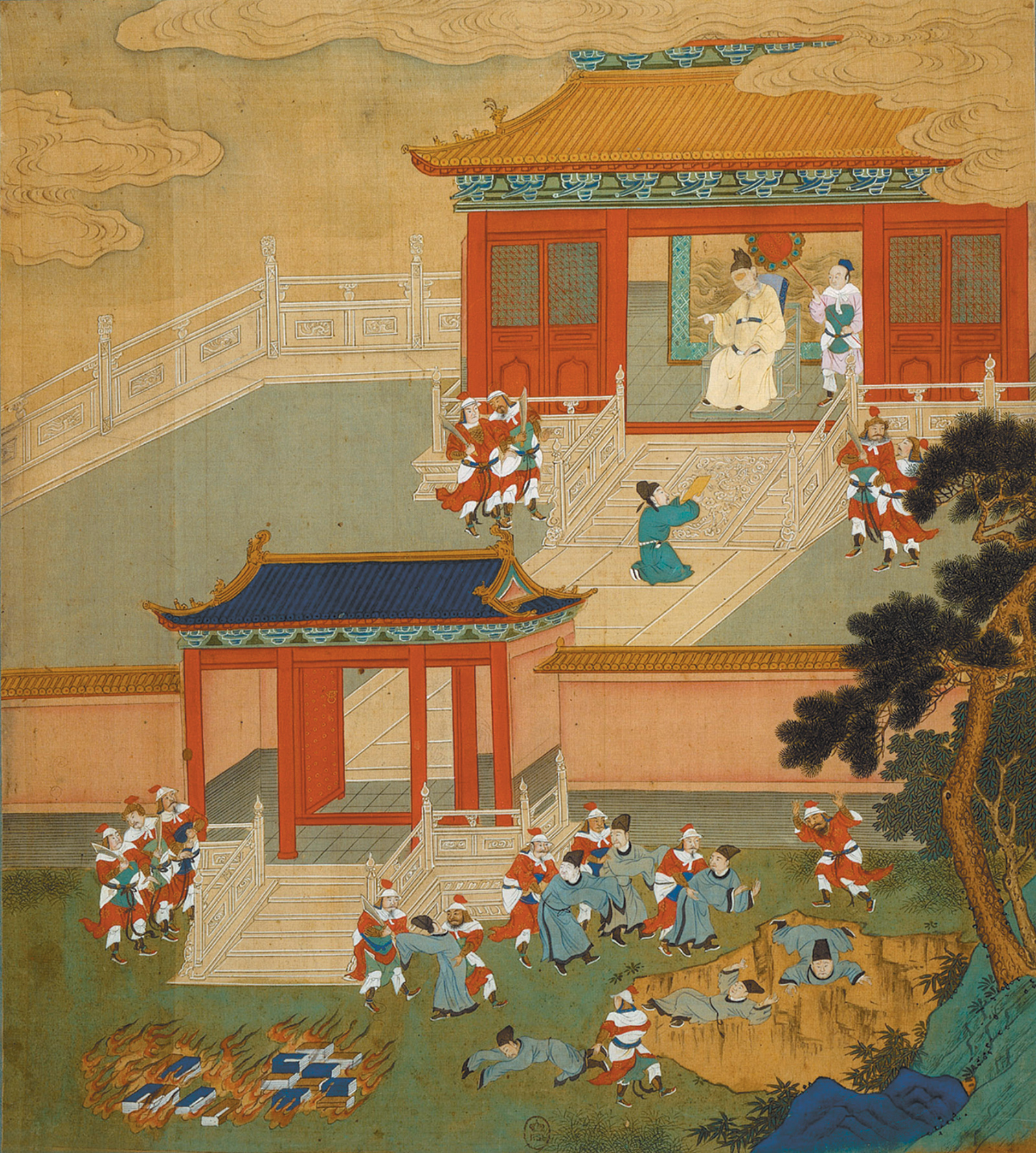
Bibliothรจque Nationale de France/RMN-Grand Palais/Art ResourceAn eighteenth-century painting showing Emperor Qin Shi Huang of the Qin dynasty ‘burning all the books and throwing scholars into a ravine’ in order to stamp out ideological nonconformity after the unification of China in 221 BCE. ‘For over two millennia,’ Ian Johnson writes, ‘all our knowledge of China’s great philosophical schools was limited to texts revised after the Qin unification.’ Now a trove of recently discovered ancient documents, written on strips of bamboo, ‘is helping to reshape our understanding of China’s contentious past.’ Illustration from Henri Bertin’s album The History of the Lives of the Chinese Emperors.
1. As Beijing prepared to host the 2008 Olympics, a small drama was unfolding in Hong Kong. Two years earlier, middlemen had come into possession of a batch of waterlogged manuscripts that had been unearthed by tomb robbers in south-central China. The documents had been smuggled to Hong Kong and were lying in a vault, waiting for a buyer.
Universities and museums around the Chinese world were interested but reluctant to buy. The documents were written on hundreds of strips of bamboo, about the size of chopsticks, that seemed to date from 2,500 years ago, a time of intense intellectual ferment that gave rise to China’s greatest schools of thought. But their authenticity was in doubt, as were the ethics of buying looted goods. Then, in July, an anonymous graduate of Tsinghua University stepped in, bought the soggy stack, and shipped it back to his alma mater in Beijing.
University administrators acted boldly. They appointed China’s most famous historian, seventy-five-year-old Li Xueqin, to head a team of experts to study the strips. On July 17, the researchers gingerly placed the slips in enamel basins filled with water, hoping to duplicate the environment that had allowed the fibrous material to survive so long.
The next day, disaster struck. Horrified team members noticed that the thin strips had already started developing black spots—fungus that within a day could eat a hole through the bamboo. Administrators convened a crisis meeting, and ordered the school’s top chemistry professors to save the slips.
Over the following weeks, the scientists worked nonstop through the eerily empty campus—the students were on vacation, and everyone else was focused on the Olympic Green just a few miles east. With the nation on high alert for the games, security officers blocked the scientists from bringing stabilizing chemicals into the locked-down capital. But the university again put its weight behind the project, convincing leaders that the strips were a national priority. By the end of the summer, Professor Li and his team had won their prize: a trove of documents that is helping to reshape our understanding of China’s contentious past.
Until now, this revolution has largely been confined to paleography—the deciphering of ancient texts. But its importance is slowly spilling into other disciplines, as a result of the deciphering of the Tsinghua bamboo slips now at Tsinghua University, and several other excavations made in the past two decades. Although their significance is not widely understood in the West, in China they have already aroused popular interest, with newspapers and television reporting as these texts are edited and published.1 And yet the implications of these unearthed texts are so profound that they will take decades to digest.
The manuscripts’ importance stems from their particular antiquity. Carbon dating places their burial at about 300 BCE. This was the height of the Warring States Period, an era of turmoil that ran from the fifth to the third centuries BCE. During this time, the Hundred Schools of Thought arose, including Confucianism, which concerns hierarchical relationships and obligations in society; Daoism (or Taoism), and its search to unify with the primordial force called Dao (or Tao); Legalism, which advocated strict adherence to laws; and Mohism, and its egalitarian ideas of impartiality. These ideas underpinned Chinese society and politics for two thousand years, and even now are touted by the government of Xi Jinping as pillars of the one-party state.2

How US covered up Saudi role in 9/11

By Paul Sperry
http://nypost.com/2016/04/17/how-us-covered-up-saudi-role-in-911/
April 17, 2016 |  Trigger
In its report on the still-censored “28 pages” implicating the Saudi government in 9/11, “60 Minutes” last weekend said the Saudi role in the attacks has been “soft-pedaled” to protect America’s delicate alliance with the oil-rich kingdom.

That’s quite an understatement.
Actually, the kingdom’s involvement was deliberately covered up at the highest levels of our government. And the coverup goes beyond locking up 28 pages of the Saudi report in a vault in the US Capitol basement. Investigations were throttled. Co-conspirators were let off the hook.
Case agents I’ve interviewed at the Joint Terrorism Task Forces in Washington and San Diego, the forward operating base for some of the Saudi hijackers, as well as detectives at the Fairfax County (Va.) Police Department who also investigated several 9/11 leads, say virtually every road led back to the Saudi Embassy in Washington, as well as the Saudi Consulate in Los Angeles.
Yet time and time again, they were called off from pursuing leads. A common excuse was “diplomatic immunity.”
Those sources say the pages missing from the 9/11 congressional inquiry report — which comprise the entire final chapter dealing with “foreign support for the September 11 hijackers” — details “incontrovertible evidence” gathered from both CIA and FBI case files of official Saudi assistance for at least two of the Saudi hijackers who settled in San Diego.
Some information has leaked from the redacted section, including a flurry of pre-9/11 phone calls between one of the hijackers’ Saudi handlers in San Diego and the Saudi Embassy, and the transfer of some $130,000 from then-Saudi Ambassador Prince Bandar’s family checking account to yet another of the hijackers’ Saudi handlers in San Diego.stigator who worked with the JTTF in Washington complained that instead of investigating Bandar, the US government protected him — literally. He said the State Department assigned a security detail to help guard Bandar not only at the embassy, but also at his McLean, Va., mansion.
The source added that the task force wanted to jail a number of embassy employees, “but the embassy complained to the US attorney” and their diplomatic visas were revoked as a compromise.
Former FBI agent John Guandolo, who worked 9/11 and related al Qaeda cases out of the bureau’s Washington field office, says Bandar should have been a key suspect in the 9/11 probe.
“The Saudi ambassador funded two of the 9/11 hijackers through a third party,” Guandolo said. “He should be treated as a terrorist suspect, as should other members of the Saudi elite class who the US government knows are currently funding the global jihad.”
But Bandar held sway over the FBI.

The Caliphate’s Global Workforce: An Inside Look at the Islamic State’s Foreign Fighter Paper Trail


Download PDF

April 18, 2016

Author(s): Brian Dodwell, Daniel Milton, Don Rassler

This report contains an analysis of over 4,600 unique Islamic State personnel records that were produced by the group primarily between early 2013 and late 2014. The importance of this data for understanding the Islamic State and, in particular, the foreign fighter flow, cannot be overstated. To put it simply, it is the largest cache of primary source documents produced by the Islamic State available in the open-source as of this date. These particular documents were acquired by NBC News from an Islamic State defector and subsequently provided to the CTC (and other entities). This report provides a window into the organization’s global workforce, revealing information about foreign fighters’ countries of origin, citizenship, points of entry into Syria, marital status, skills and previous occupations, education levels, religious knowledge, fighting role preferences in the group, and previous jihadist experience. In addition to analyzing the data at the macro-level, the report also highlights numerous anecdotes of individual fighters. Taken together, the analysis in this report reveals an organization that is attempting to vet new members, manage talent effectively within the organization, and deal with an incredibly diverse pool of recruits.

* On ISIS: The Reality of the 21st Century Battlefield

by Michael Petranick
Journal Article | April 18, 2016
Abstract
This paper discusses in varying detail the realities of the twenty-first-century battlefield environment. Unless practiced by large nation-states against each other, conventional warfare is a dying platform by which asymmetric warfare and terrorism have replaced the conventional warfare dynamic. Asymmetric warfare is defined as the blurring of the lines between politics, economics, combatants, civilians, and their context in the prosecution of war on an ever changing battlefield. Inclusive in this dynamic is cyber, communications, terrorism, the use of civilians as human shields and as both offensive and defensive weapons.
Fourth generation warfare, as asymmetrical warfare has come to be known, is not new. It has existed in every war since the dawn of man. What is different is the total application of asymmetric components on a battlefield as a means to fight. The population-centric model, as espoused by the United States Army and Marine Corps, has now made it into the lexicon of air operations in Iraq, a segment of war prosecution it was never designed for. As a result, the Air Force has been subjected to mission paralysis and ultimately, mission failure.[1]
David Galula gave future military commanders guidance, not hard and fast rules. Rules of engagement have come to favor the enemy, and if the reality of war does not return to those in command, the United States may never win another war.

On ISIS
History teaches, but the world ignores. In the 1930s, Adolf Hitler and the Nazi’s built their Third Reich in violation of the Versailles treaty. The world did nothing and paid for it with World War II. The Islamic State is on the ascension and the world ignores. Various reasons are given, as were given in the 1930s. World leaders have said, “It is someone else’s problem,” or, “the American people are war fatigued,” matching just two of the reasons given that allowed Hitler to build.
If it were possible to conduct diplomacy with the Islamic State of Iraq and al-Sham (ISIS), would the United States, the United Nations, and the Syrian and Iraqi people do so if it meant the possibility of a true, verifiable, and trusted peace? Or, are the transgressions and insults committed against both the Syrian and Iraqi people too extreme to consider the possibility of peace? Career diplomats would consider such a proposal for that paradigm, the construction and implementation of achieving peace, their life’s work.

Ukraine: A Counter Revolution Could Be Under Way In Kiev

from The Conversation
-- this post authored by Adam Swain, University of Nottingham
The Verkhovna Rada, Ukraine's unruly parliament, voted on April 14 to accept the resignation of Arseniy Yatsenyuk, leader of the People's Front party. The prime minister, who has been in post since the Euromaidan uprising in February 2014, reluctantly announced on April 10 that he intended to leave office.
President Petro Poroshenko's eponymous parliamentary bloc narrowly approved the appointment of the current speaker of the parliament, Volodymyr Groysman, who has long been closely associated with the president, as Yatsenyuk's successor. As horse trading took place in recent days over the ministerial line-up, it was unclear whether Groysman would garner the necessary 226 votes to be confirmed as prime minister, but he was finally approved with 257 votes to 50.
Why Yatsenyuk resigned
Yatsenyuk bitterly complained that he had been forced out of office by venal personal ambition which had generated what he termed an "artificial" political crisis. Yet, while Ukrainian politics is pathologically personalised and conducted with a large measure of cash-fuelled political trickery, the political crisis, as he surely knows, is very real.
For a time, the undeclared "war" to defend "European values" against Russian-supplied proxies in the Ukrainian Donbas in the east of the country animated the hawkish Yatsenyuk's People's Party. It became known as the "war party". But no amount of patriotic jingoism and cheerleading could disguise the reality that his armed forces had lost militarily on the battlefield, forcing the authorities to accept an unfavourable ceasefire. The pretence otherwise only made it harder to reach a lasting resolution to the conflict.

Journey to Europe: The Perspective of the Apprentice

April 18, 2016
By Jacob L. Shapiro
While attending a conference in Slovakia, our director of analysis reflects on the future.
I have worked at George’s side now for six years, and for the past six months as the director of analysis here at Geopolitical Futures. And yet, this week marks the first time that I have accompanied George on one of his geopolitical journeys. George’s reflections on this trip will resume tomorrow, but today’s Reality Check gives me a chance to step back, reflect and offer a slightly different perspective. The first stop for us was Bratislava, capital of Slovakia and home to a conference called Globsec. Now in its 11th year, Globsec has established itself as the leading political and security conference for Central and Eastern Europe.
The various panels and discussions have been interesting, but one gets the distinct impression walking around that the most important part of Globsec is not what people say on the panels. If that was all there was to it, we could have stayed in Austin and watched the live-stream of the various meetings from the comfort of our own homes. But besides that, people rarely say what they really mean – statements are political tools to manage perception. When politicians say what they really mean it is usually because they have nothing more at stake in that particular issue.

Globsec is really about meeting people. It is about the off-the-record conversations with people who are shaping the world through their decisions and actions. It is about forging relationships that, even in our globalized age of instant communication, would not exist without the ability to look the other person in the eye and discover that you share an interest. There is a sort of logic to a conference of this sort being held in Bratislava – a small, relatively unimportant (when compared to the larger and wealthier nearby cities of Vienna and Budapest) European capital and Cold War border city between the communist Eastern Bloc and the West. Bratislava is a crossroads, where many interests meet and then go in separate directions.
It is remarkable how many important people were simply walking around Globsec’s venue at the Grand Hotel River Park, located on the northern bank of the Danube River. On Saturday morning, my day began by listening to the deputy prime minister of Jordan describe how 21 percent of his country’s population is now made up of Syrian refugees (a startling fact that deserves a moment of parenthetical pause). Over lunch, I had an opportunity to watch George, trade arguments and stories with one of his old teachers and mentors from his days at Cornell University, an Israeli professor of political science who can speak about Hegel in one breath and tank maneuvers in the next. After a brief respite, I was shooed away from the elevator that opened up on the 10th floor to take me downstairs, and as the doors closed I realized it was because there was not enough room for me and for former U.S. Secretary of State Madeleine Albright and her various bodyguards.

The Future of Schengen

http://www.ecfr.eu/specials/scorecard/schengen_flash_scorecard
The seemingly endless queues at border crossings, immigration officials studying your documents, the restrictions to movement within Europe. These are all things which, for many Europeans, belong to either a distant memory of a pre-Schengen Europe, or travel to far off places.
But in the context of the refugee crisis, the terrorist attacks that the EU has suffered, and the Brexit debate, attitudes to the Schengen zone – previously one of the central pillars of the EU that member states were keen to protect at all costs – have changed. We are in a situation where member states have acted either unilaterally or in groups to alter the level of free movement in this borderless area. Factors such as the refugee crisis and terror attacks in Europe have led several member states to reinstate border controls – including between Sweden and Denmark whose border-free zone long pre-dates Schengen.


We have drifted so far away from the tenets of a border free Europe outlined in Schengen, that the European Commission has written a “Roadmap back to Schengen”. The document, penned in March 2016, would have been unthinkable even six months ago.
Listen: ECFR's Susi Dennison explores the findings of our research on the future of Schengen Your browser does not support the audio element.

To explore how this “Schengen crisis” is affecting different parts of the European Union, we asked our group of 28 associate researchers from across each EU member state, to look into the actions and perceptions around Schengen in their own country. This briefing is based on the research they have carried out, including interviews with policy makers and experts. Our researchers have aimed to look beyond official government statements to evaluate both public opinion as well as policy makers and the views of those in government in order to understand the realistic prospects for the future of Schengen.
European attitudes to Schengen
Despite the headlines, which do not make for pleasant reading, the suspension of Schengen in some countries has not caused member states to give up on its principles or become defeatist about the prospect of reinstating them. Our research has shown that 22 of the 28 member states are confident that the Schengen system will survive the summer. The six countries that are more doubtful about the future of Schengen admit that there is a very small chance of the system collapsing, even if the refugee crisis worsens considerably. In official statements, European governments have continuously stressed that fully reinstating Schengen is important to them. Even the four heads of state of the Visegrad Four (Czech Republic, Hungary, Poland and Slovakia), countries that have often resisted agreed European policy positions throughout the refugee crisis, stated that “Schengen remains a key practical and symbolic achievement of European integration. We reaffirm our determination to preserve Schengen so that European citizens and businesses continue to fully enjoy its benefits”.

Journey to Europe: Visiting Romania

April 19, 2016
By George Friedman
Despite a lack of fanfare, the United States’ relationship with Romania has become quite strong.
After Slovakia, the next stop on my European trip is Bucharest, the capital of Romania. It is a place I have visited many times in recent years, in large part because I saw Romania as a significant strategic part of coming events. I had expected Russia to at least attempt to return to great power status and to do that, it had to try to develop a degree of control over the borderlands it had dominated for most of the last three centuries.
In facing west toward the European Peninsula, Russia was invariably facing more developed and sophisticated military forces. Its national strategy was to force them to attack through vast space, arriving in Russia proper exhausted by distance and by weather. Except for the distance armies faced, Russia would have been defeated and occupied not only by those who attacked, but also those who would have attacked but didn’t because they were deterred by the distance.
There are two bands of buffer countries that were indispensable to Russia in defeating Napoleon and Hitler. The first band was Ukraine, Belarus and the Baltic countries. The second band was Poland, Czechoslovakia, Hungary, Bulgaria and Romania. Russian troops went as far west as central Germany. Whatever minor thoughts NATO had of attacking Russia were annihilated by the sheer space that had to be traversed.
The fall of the Soviet Union pushed Russia back to its own borders, which were pretty much its borders in the 18th century. During the 1990s, there was a fantasy that Russia could simply accept these borders. However, the chaos of the 1990s taught the Russians that while they had been poor in the Soviet Union, they were also powerful and respected. After the fall of the Soviet Union, they were poorer and treated with contempt. They had little incentive to continue as they were and it seemed to me inevitable that they would attempt to recover at least part of their buffers, regardless of the buffer states’ status as independent nations.

IO theory: Creating resonance

http://www.army.gov.au/Our-future/Blog/Articles/2016/04/IO-theory?platform=hootsuite
by Lieutenant Colonel Nick Bosio
14 April 2016
Our current conflicts require action across all domains: the physical, information and cognitive. However, one must ask if the idea of ‘messaging and narrative’ has been over-emphasised to the detriment of real actions. Is Information Operations (IO) the new ‘black’?
Clausewitz called war a clash of wills. Mao saw it as a people's struggle. Jomini – whose theory drives much of our planning process – highlighted the importance of will to fighting. These, and many other, theorists understood that actions and messages are intrinsically linked (p. 11-12) – forming a narrative. The physical action, aligned with a resonating narrative overall, shapes the enemy's thoughts – or the cognitive domain. Yet even with these theoretical giants, we struggle to plan integrated IO, leaving it often compartmented and ‘bolted on’ to manoeuvre. Is it any wonder we struggle to win the ‘narrative’?
Recent articles ($) and discussions (see ABC 7:30 Report and Lateline) have stated that we, as a nation, must develop and disseminate a narrative to counter extremism. This is a laudable statement, yet doomed to failure if we do not understand how to make a narrative resonate – and acknowledge that ‘messaging’ is only part of ‘narratives’. So, how do we ‘get our message out’? Let’s consider an analogy.
Broadly speaking, when two sine curves are in-phase, they reinforce each other. As they move out of phase, the final curve will change. However, two sine curves that are 180 degrees out-of-phase will cancel out – leading to nothing. It is the same with narratives. Only a narrative that resonates with an individual’s, group’s or community’s societal construct or societal frame makes sense. But what makes up this ‘societal frame’? Cristina Archetti provides extensive discussion on this in her book: Understanding Terrorism in the Age of Global Media. To summarise, it is the group’s world-view consisting of: their perception of themselves; their understanding of the wider world; and their ideology – the normative vision of their culture, beliefs and social system.

A New Generation of Unrestricted Warfare

http://warontherocks.com/2016/04/a-new-generation-of-unrestricted-warfare/
David Barno and Nora Bensahel
April 19, 2016
In 1999, two Chinese colonels wrote a book called Unrestricted Warfare, about warfare in the age of globalization. Their main argument: Warfare in the modern world will no longer be primarily a struggle defined by military means — or even involve the military at all.

They were about a decade and a half before their time.
Colonels Qiao Liang and Wang Xiangsui argued that war was no longer about “using armed forces to compel the enemy to submit to one’s will” in the classic Clausewitzian sense. Rather, they asserted that war had evolved to “using all means, including armed force or non-armed force, military and non-military, and lethal and non-lethal means to compel the enemy to accept one’s interests.” The barrier between soldiers and civilians would fundamentally be erased, because the battle would be everywhere. The number of new battlefields would be “virtually infinite,” and could include environmental warfare, financial warfare, trade warfare, cultural warfare, and legal warfare, to name just a few. They wrote of assassinating financial speculators to safeguard a nation’s financial security, setting up slush funds to influence opponents’ legislatures and governments, and buying controlling shares of stocks to convert an adversary’s major television and newspapers outlets into tools of media warfare. According to the editor’s note, Qiao argued in a subsequent interview that “the first rule of unrestricted warfare is that there are no rules, with nothing forbidden.” That vision clearly transcends any traditional notions of war.
Unrestricted Warfare was an explicit response to the reigning Western military orthodoxy of the time. The preface is dated January 17, 1999, which the authors note was the eighth anniversary of the outbreak of the 1991 Gulf War. In many ways, their argument refuted many of the Western lessons drawn from that conflict: that wars could be short, sharp, and dominated by high-technology weaponry used with stunning precision to shatter an enemy’s armed forces in hours or days. By 1999, U.S. military thinking was dominated by the revolution in military affairs and network centric-warfare, which relied on advanced technologies to give the United States total battlefield dominance.

Wargaming in the Classroom: An Odyssey

James Lacey
April 19, 2016
http://warontherocks.com/2016/04/wargaming-in-the-classroom-an-odyssey/
Several years ago, as a new professor at the Marine Corps War College, I spent a huge amount of time putting together the best presentation on Thucydides and the Peloponnesian War ever presented at any war college at any time. After accounting for the 125-page a night reading limit, I had selected the perfect set of readings. These were reinforced by an unbelievably entrancing and informative lecture, and a slideshow employing stunning period visuals. My plan even set aside copious amounts of time for critical thinking, and what I knew would be an intense Socratic dialogue. Finally, in preparation for the expected bombardment of thoughtful student questions, I prepared myself by re-reading Thucydides’ master work, as well as over a dozen other historical works on the period.

Then, the big day arrived … and I failed miserably.
The students had done the readings, listened to my lecture, stared at the slides, asked a few perfunctory questions, and, most of all, watched the clock. A day or two later, I knew that the overwhelming majority of them barely remembered any of my major points. The best I could hope for was that they at least knew that “attacking Syracuse was bad,” though I doubted any of them could explain why. In that regard, I find it amusing that at least three war colleges, in the “Questions to Ponder” they hand to the students, ask a variation of the same question: “Was the attack on Syracuse poor strategy, or good strategy marred by poor execution?” My rejoinder is: “How the #amp;#@ would the students know?”
The truth is that if one just reads selected passages from Thucydides’ work, it is impossible to comprehend the events and complexities of the multi-decade Peloponnesian War. Moreover, as students rarely have the background or context in which to mentally file the readings, they quickly get lost in a plethora of Greek names, locations, and events. War college professors who believe their graduates know anything about Thucydides besides reciting the mantra “fear, honor, interest” are fooling themselves.

What Happened
This year, I changed everything. First, I found some great audio lectures that allowed students to listen to a series of professionally produced talks on Thucydides at home or in the car. This little touch allowed me to “flip” the classroom, as I no longer had to use precious class time explaining the basics. By itself, this hugely increased the potential for a Socratic give and take with the students. To help further encourage such discussions I also broke each seminar into smaller groups that allowed me to mimic the intimacy of “Oxford tutorials.” This made for much longer days for me, but hugely increased student interaction. Moreover, as students had no place to hide, it made a vast difference in their level of preparation and participation. Discussion was further enhanced by the use of maps that showed the geography in terms that made it easy to understand various actions of the warring states.
I still had them read Pericles’ Oration, the Melian Dialogues, and the Mytilene Decrees directly from Thucydides. As for the rest of the war’s great events, the students were given a collection of readings that presented them within the war’s full context, and explained the strategic implications of each event.

*** Rediscovering the Art of Strategic Thinking: Developing 21st-Century Strategic Leaders

http://cimsec.org/rediscovering-art-strategic-thinking-developing-21st-century-strategic-leaders/24453
April 18, 2016
This publication originally featured on National Defense University’s Joint Forces Quarterly and is republished with permission. It may be read in its original form here.
By Dr. Daniel H. McCauley

At a time when global instability and uncertainty are undeniable, the demand for astute American global strategic leadership is greater than ever. Unfortunately, tactical superficiality and parochial policies of convenience are undermining joint strategic leader development and the ability to operate effectively around the world.1 Tactical supremacy and the lack of a peer competitor have contributed to strategic thinking becoming a lost art. This critical shortfall has been recognized for a number of years. General Anthony Zinni, USMC (Ret.), and Tony Koltz stated in their 2009 book Leading the Charge that leaders today have no vision and consequently have “lost the ability to look and plan ahead.”2 Trapped within rigid bureaucracies, today’s joint strategic leaders immerse themselves in current operations, reacting to, rather than shaping, future events.
 President Obama convenes meeting on Zika virus in Situation Room, January 2016 (The White House/Pete Souza)

This strategic leadership shortfall is not unique to the military establishment. A 2014 leadership study conducted by the Palladium Group surveyed more than 1,200 companies in 74 countries. In this study, although more than 96 percent of the “respondents identified strategic leadership as an organizational ‘must-have’ and a key to future success,” over 50 percent of the respondents “stated that the quality of their organization’s strategic leadership was unsatisfactory.”3 Fully two-thirds of the respondents serving in an organizational capacity as board member, chief executive officer, or managing director “did not believe that their current leadership development approach was providing the necessary skills to successfully execute their strategy.”4