14 May 2016

China Building Missiles to Strike Guam

China is building up intermediate-range ballistic and cruise missiles that pose a growing threat to Guam, the strategic Pacific island that is central to the U.S. military pivot to Asia, according to a congressional report made public Tuesday.

Six different missiles capable of reaching Guam from China are deployed or in late stages of development, says the report by the U.S.-China Economic and Security Review Commission.

They include the DF-26 intermediate-range missile that Beijing unveiled during a recent military parade, and dubbed the “Guam-killer,” that can be armed with both nuclear and conventional warheads.

“The DF-26 is China’s first conventionally-armed IRBM and first conventionally-armed ballistic missile capable of reaching Guam,” the report said, noting that its inclusion in a September 2015 military parade in Beijing “indicates it has likely been deployed as an operational weapon.”

The report put the risk of a Chinese attack on Guam as low.
It’s Iraq, not Isis, that’s on the way out

11 May 2016 
If today’s atrocity in Baghdad draws Shia militias into reprisals against Sunnis, it would kill off hopes for the democratic restoration of the Iraqi state and society

‘Today’s attack is a reminder that Isis is still able to commit atrocities across Iraq, and continue to operate as it has done for more than a decade.

“Isis is an idea, not the first of its kind and not the last of its kind,” said a powerful security official when I visited Iraq last month. Indeed, as the international community boasts of Isis’s demise, the jihadists struck a Shia district in Baghdad today, killing at least 63 people and wounding 80 in a series of devastating market bombings.

Officials say that Isis has lost almost half its territory in Iraq and more than 20% in Syria. It is true that Isis leaders are being eliminated and its infrastructure devastated. But while Isis may be losing the territories it governs, today’s attack (and others over the past months) is a reminder that it is still able to commit atrocities across Iraq, and continue to operate as it has done for more than a decade.

In other words, a world without Isis is unlikely to come any time soon. Isis thrives off the lack of institutions in weak or failed states. Remedying this requires good governance, institution-building and the reconciliation of divided communities. But rehabilitating Iraq’s cities and people will prove to be far more costly and challenging than defeating Isis itself. Sectarian tensions, dysfunctional governance and regional polarisation have worsened since Isis came on the scene, factors that precipitated the group’s rise in the first place.

The Middle East’s New Renaissance

MAY 10, 2016

Prince Saud al-Faisal of Saudi Arabia once defined civilization as “the collective effort of human genius built on cumulative contributions from many cultures.” The two key words here are “collective” and “cultures.” The crucial truth in that definition of civilization is the understanding that no single culture has a monopoly on human experience and that civilizations are not competing products in a marketplace of global ideas. The way civilizations evolve is through a collection of many contrapuntal voices that drive ever forward for the sake of common human progress. This is the first step toward understanding that humanity is currently embroiled in a struggle for civilization rather than a clash between civilizations.

Building a renaissance is characterized by the breaking down of walls and the free interchange of ideas. The most important light toward this path is to discover the contents of these many cultures. Meeting people face to face, reading their poetry, listening to their songs, and experiencing one another’s stories are prime reasons why both artists and diplomats alike will never be replaced by computers. As long as human beings remain human, personal interactions will remain irreplaceable. And that is why cultural diplomacy is so important and why it is damaging when it is underappreciated.

Whatever Happened to the ‘Turkish Model’?


MAY 5, 2016

ISTANBUL — About five years ago, everyone was talking about the “Turkish model.” People in the West and in the Muslim world held up Turkey as a shining example of the compatibility of Islam and democracy. Recep Tayyip Erdogan, who was then prime minister and is now president, was praised as a reformist who was making his country freer, wealthier and more peaceful.

These days, I think back on those times with nostalgia and regret. The rhetoric of liberal opening has given way to authoritarianism, the peace process with the Kurdish nationalists has fallen apart, press freedoms are diminishing and terrorist attacks are on the rise.

What went wrong? Erdoganists — yes, some of them call themselves that — have a simple answer: a conspiracy. When Mr. Erdogan made Turkey too powerful and independent, nefarious cabals in the West and their treacherous “agents” at home started a campaign to tarnish Turkey’s democracy. Little do they realize, of course, that this conspiracy-obsessed propaganda, the self-righteousness it reflects and the hatred it fuels are part of the problem.

To understand why the Turkish model has let us all down, we have to go back to the 2001 founding of Mr. Erdogan’s Justice and Development Party, or A.K.P. At that time, Turkey was under the thumb of secularist generals who would overthrow any government they couldn’t control. In 1997 they ousted the A.K.P.’s Islamist predecessor, so the founders of the new party put forward a post-Islamist vision. They had abandoned their old ideology, they declared. Their only priorities now were bringing Turkey into the European Union and moving the country toward liberal democracy.

Mosul: suspicion and hostility cloud fight to recapture Iraqi city from Isis

Martin Chulov 
11 May 2016

The stakes are high, but a power struggle between the Iraqi army and the Kurdish Peshmerga is hampering the battle against Islamic State

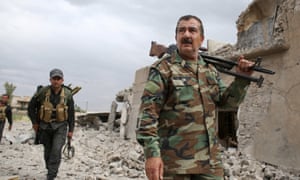
‘Our friends can’t do this by themselves, and they know that,’ says one Peshmerga soldier of his Iraqi army colleagues. Photograph: Goran Tomasevic/Reuters

At the bottom of a hill near the frontline with Islamic State fighters, the Iraqi army had been digging in. Their white tents stood near the brown earth gouged by the armoured trucks that had carried them there – the closest point to Mosul they had reached before an assault on Iraq’s second largest city.

For a few days early last month, the offensive looked like it already might be under way. But that soon changed when the Iraqis, trained by US forces, were quickly ousted from al-Nasr, the first town they had seized. There were about 25 more small towns and villages, all occupied by Isis, between them and Mosul. And 60 miles to go.

Analysis Green zone protests raise questions over viability of Iraq's government
Demonstrations in Baghdad’s fortified green zone shows fragility of the state in face of sectarian divisions

Behind the Iraqis, the Kurdish peshmerga remained dug into positions near the city of Makhmour that had marked the frontline since not long after Mosul was seized in June 2014. The war had been theirs until the national army arrived. The new partnership is not going well.

Scores Are Killed as a Wave of Bombings Bloodies Baghdad

By FALIH HASSAN and OMAR AL-JAWOSHY
MAY 11, 2016

Aftermath of Baghdad Car Bomb

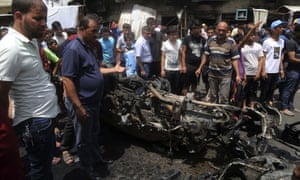
Dozens of people were killed by a car bomb in a crowded food market in the Sadr City section of Baghdad on Wednesday. By REUTERS and THE ASSOCIATED PRESS on Publish DateMay 11, 2016.Photo by Wissm Al-Okili/Reuters. 

BAGHDAD — In a burst of attacks recalling Iraq’s sectarian civil war, three bombings in three different neighborhoods of Baghdad killed more than 90 people on Wednesday and wounded scores more, the Iraqi authorities said.

The Islamic State claimed responsibility for the biggest attack, in a crowded food market in the Shiite neighborhood of Sadr City in northern Baghdad. Explosives hidden in a parked pickup truck loaded with fruit and vegetables detonated around 10 a.m., killing at least 66 people and wounding 87 others.

The other two bombings were reported at a police checkpoint in the Kadhmiya neighborhood in northwest Baghdad, where 17 were killed, and at another police checkpoint in the Jamiya neighborhood in central Baghdad, where nine died.

Blood covered the ground at the market in Sadr City, with clothing and slippers, apparently from the victims, scattered throughout the market. At least 30 shops were damaged and as many as 20 cars were burned or destroyed.

Iran's Oil Sector Returns to Form

May 11, 2016

Oil and geopolitics crossed paths repeatedly throughout the 20th century. And perhaps nowhere were the political effects of their intersection more pronounced than in Iran. For nearly five decades, the Anglo-Persian Oil Co., later renamed Anglo-Iranian Oil Co., the forebear of what would eventually become British Petroleum, enjoyed near total control over Iran's oil sector. When Iran nationalized the sector in 1951, the United States and United Kingdom responded by overthrowing its architect, Prime Minister Mohammad Mossadegh, just two years later. Those events heavily influenced the 1979 Iranian Revolution, a foundational element of which was resource nationalism.

And now it appears that BP is returning to its roots. During the week of May 2, the head of Iran's national oil company announced that BP will soon open an office in Tehran. Meanwhile, the country is opening up its energy sector and considering admitting foreign oil companies to set up joint ventures and operate oil fields there for the first time since 1979.

But Iran faces new challenges. To revive his country's economy after years of sanctions, President Hassan Rouhani is now driving an initiative to reinvigorate the oil sector. To do so, Rouhani will have to break what has become a steady cycle of backlash - aimed at foreign and domestic actors alike - over the distribution of oil revenue in Iran.

Iran's Paradox: Nationalism and Pragmatism

Back to Basics on Hybrid Warfare in Europe: A Lesson from the Balkans

By Christopher J. Lamb and Susan Stipanovich 
March 29, 2016 


Dr. Christopher J. Lamb is Director of the Center for Strategic Research, Institute for National Strategic Studies (INSS), at the National Defense University. Ms. Susan Stipanovich is Program Manager for the Program on Irregular Warfare and Special Operations Studies at INSS. For an in-depth explanation of the Bosnia Train and Equip task force and its performance, see The Bosnian Train and Equip Program: A Lesson in Interagency Integration of Hard and Soft Power, Strategic Perspectives 15 (NDU Press, March 2014).

The complex mix of aggressive behaviors Russia used in Georgia and Ukraine is commonly referred to as hybrid warfare, defined by one scholar as “a tailored mix of conventional weapons, irregular tactics, terrorism, and criminal behavior in the same time and battle space to obtain political objectives.”1 North Atlantic Treaty Organization (NATO) leaders fear Russia will use hybrid warfare to destabilize or occupy parts of Poland, the Baltic states, or other countries. They are trying to devise more effective responses to counter such a possibility. Secretary General Jens Stoltenberg asserts that NATO must adapt to meet the hybrid warfare threat.2 Speaking at the same event, U.S. Secretary of Defense Ash Carter agreed and suggested “part of the answer” was “increased readiness, special operation forces, and more intelligence.”3 Several months earlier, Carter’s deputy, Robert Work, declared the United States also needed “new operational concepts” to confront hybrid warfare.4 Meanwhile some NATO countries are establishing special units to counter hybrid warfare tactics,5 and the U.S. Congress has required the Pentagon to come up with a strategy to counter hybrid warfare.6

Intelligence and National Defense

David Shedd

Challenges the U.S. Intelligence community must overcome to enable effective military operations.


Every successful military plan and operation relies on intelligence. Whether it is a simple field report from a scout about an enemy position or the methodical development of the mosaic of intelligence gathered from myriad sources over years that resulted in the successful raid of Osama bin Laden’s Abbottabad compound, intelligence plays a vital role in our national defense. The diversity and rapidly changing nature of the threats we face as a nation underscore the need for sound intelligence in the hands of those who are charged with making decisions about our security.

This is not a new phenomenon. Intelligence has played a role in national defense since well before the United States was founded. Timely intelligence, however, is the beginning of the surprising and often difficult decisions that are made in war, where force is often critical.1

Since earliest recorded history, accounts of people using espionage to try to understand the intentions of the adversary abound. 

Early Egyptian pharaohs employed agents of espionage to ferret out disloyal subjects and to locate tribes that could be conquered and enslaved. From 1,000 B.C. onwards, Egyptian espionage operations focused on foreign intelligence about the political and military strength of rivals Greece and Rome.

Russia’s New Missile Means the Nuclear Arms Race Is Back On

05.11.16

Team Putin is talking up fearsome new hardware that could accelerate a nuclear contest not seen since the Cold War.

Russia has a new nuclear missile—one that Zvezda, a Russian government-owned TV network, claimed can wipe out an area “the size of Texas or France.”

Actually, no, a single SS-30 rocket with a standard payload of 12 independent warheads, most certainly could not destroy Texas or France. Not immediately. And not by itself.

Each of the SS-30’s multiple independently targetable reentry vehicle warheads, or MIRVs, could devastate a single city. But Texas alone has no fewer than 35 cities of 100,000 people or more.

Which is not to say the instantaneous destruction of a dozen cities and the deaths of millions of people in a single U.S. state wouldn’t mean the end of the world as we know it.

Nobody nukes just Texas. And if Russia is disintegrating Texan cities, that means Russia is also blasting cities all over the United States and allied countries—while America and its allies nuke Russia right back.

Putin’s hydra: Inside Russia’s intelligence services


Far from being an all-powerful “spookocracy” that controls the Kremlin, Russia’s intelligence services are internally divided, distracted by bureaucratic turf wars, and often produce poor quality intelligence – ultimately threatening the interests of Vladimir Putin himself.

Drawing on extensive interviews with former and current intelligence officials, “Putin’s hydra: Inside Russia’s intelligence services” explains how the spy agencies really work, and argues that Europe’s view of them is patchy and based on outdated caricatures.

The paper punctures the myth that the agencies are the power behind the throne in Russia. They are firmly subordinated to the Kremlin, and Putin plays them off against one another. They are not a united bloc but a disparate group, whose solidarity disappears as soon as there is an opportunity to make money or avoid blame.

The agencies often replicate each others’ work, engaging in bloody competition rather than sharing intelligence. The need to please the Kremlin and deliver quick results leads to shoddy information gathering and analysis. Intelligence chiefs must shape and sugarcoat the facts to suit the president – or risk their jobs.

The ‘tech bubble’ puzzle


By David Cogman and Alan Lau
May 2016

Public and private capital markets seem to value technology companies differently. Here's why.

Aggressive valuations among technology companies are hardly a new phenomenon. The widespread concerns over high pre-IPO valuations today recall debates over the technology bubble at the turn of the century—which also extended to the media and telecommunications sectors. A sharp decline in the venture-capital funding for US-based companies in the first quarter of the year feeds into that debate,1though the number of “unicorns”—start-up companies valued at more than a billion dollars—over that same period continued to rise.

The existence of these unicorns is just one significant difference between 2000 and 2016. Until seven years ago, no venture capital–backed company had ever achieved a billion-dollar valuation before going public, let alone the $10 billion valuation of 14 current “deca-corns.” Also noteworthy is the fact that high valuations predominate among private, pre-IPO companies, rather than public ones, as was the case at the turn of the millennium. And then there’s the global dimension: innovation and growth in the Chinese tech sector are much bigger forces today than they were in 2000.2

From the Bottom, Up: A Strategy for U.S. Military Support to Syria’s Armed Opposition

Nicholas Heras 

MAY 10, 2016 
Source Link


The report, “From the Bottom, Up: A Strategy for U.S. Military Support to Syria’s Armed Opposition,” examines the current state of U.S. support for opposition groups and makes a case for scaling up that support, including an in-depth look at the groups to support in each region.


The Post-Imperial Moment

April 22, 2016

IN 1935, the anti-Nazi writer and Austrian-Jewish intellectual Joseph Roth published a story, “The Bust of the Emperor,” about an elderly count at the chaotic fringe of the former Habsburg Empire who refused to think of himself as a Pole or an Italian, even though his ancestry encompassed both. In his mind, the only mark of “true nobility” was to be “a man above nationality,” in the Habsburg tradition. “My old home, the Monarchy, alone,” the count says, “was a great mansion with many doors and many chambers, for every condition of men.” Indeed, the horrors of twentieth-century Europe, Roth wrote presciently, had as their backdrop the collapse of empires and the rise of uniethnic states, with Fascist and Communist leaders replacing the power of traditional monarchs.

Empire had its evils, as Roth himself details in another great work, The Radetzky March, but one cannot deny empire’s historical function—to provide stability and order to vast tracts of land occupied by different peoples, particularly in Europe. If not empire, what then? In fact, as Michael Lind has intuited, the underpinnings of the global order today attempt to replace the functions of empire—from the rules-based international system to the raft of supranational and multinational groupings, such as the North Atlantic Treaty Organization, the European Union, the International Monetary Fund, the International Court of Justice and the World Economic Forum. Silently undergirding this process since World War II has been the undeniable fact of American power—military, diplomatic and economic—protecting sea lanes, maritime choke points, access to hydrocarbons and, in general, providing some measure of security to the world. These tasks are amoral to the extent that they do not involve lofty principles, but without them there is no possibility for moral action anywhere. This is not traditional imperialism, which is no longer an option, but it is a far more humane replacement for it.

How Steel City Became the Front Line in America’s Cyberwar

MAY 12, 2016 

Blending gumshoe investigations with high-tech research, Pittsburgh has become a hotbed of the Justice Department’s fight against international hackers. 

PITTSBURGH — The portraits of Chinese army officers mounted on poster board stare down from the walls of the FBI’s western Pennsylvania field office.

Though they will probably never see the inside of a courtroom, the five men represent the culmination of arguably the most significant cybercrime investigation to date carried out by federal agents based in Pittsburgh: the case against the People’s Liberation Army hackers who were indicted in 2014for stealing industry secrets from the computers of major American companies.

Over the last 15 years, Pittsburgh has emerged as a perhaps surprising center of high-profile cybercrime investigations. Down in Washington, FBI Director James Comey complains that encrypted communications and other data advances have resulted in investigations going “dark” as suspects evade the government’s efforts to nab them online.

But 250 miles away in the Steel City, prosecutors have blended gumshoe tactics, sophisticated digital tools, and the area’s high-tech research centers to unmask and charge hackers and organized crime bosses from China to Russia.

“Companies were being intruded upon, and they didn’t understand it,” said U.S. Attorney David Hickton, who took up the top prosecutor’s job in Pittsburgh in 2010 and stepped up the office’s crackdown on cybercrime.

Should We Feed the Trolls?

Sergei Karpukhin
APR 18, 2016 
Source Link


When it comes to reducing online harassment, deeper social change could have a bigger impact than fighting back one jerk at a time.

Let’s get this out of the way first: The Internet is the real world. 
What you say online is still you saying something—even if you’re shielded by an anonymous account; even if you’re saying it just to be provocative, or performative, or God only knows why else. You on the web is still you, just like you on the telephone is you. Technology doesn’t magically make a person’s behavior inauthentic, or pretend, or inconsequential.
In an essay last week, the writer Stephen Marche set out to explore a Reddit-hosted community that has a rputation for being one of the most misogynistic swamps on the Internet. Marche’s puzzling conclusion was that the participants in this group are pathetic and afraid, their fear fueled in part by a desire for cultural clarity, not by mere hatred of women. He dismissed them, implying they weren’t threatening in any substantial way, and, in the end, suggested they read more classic literature. All this, it seemed, stemmed from Marche’s central (and misguided) question: “Are we our real selves on the internet, or are we not?”

The answer, of course, is that we are our real selves online as much as we are our real selves anywhere else. The Internet is the real world! This stuff should be easy. But it gets harder from here.
* * *
Harassment has been a serious problem online since the dawn of the web. In 1984, scientists puzzled over the “surprising prevalence of rudeness, profanity, exultation, and other emotional outbursts,” that seemed to characterize computer-based communications, The New York Times reported that year.

Today, the majority of Internet users have witnessed name-calling and attempts at humiliating someone online, according to a 2014 Pew survey—and 40 percent of those surveyed said they’d experienced such treatment (or more severe forms of harassment) themselves. Among those who have been harassed, many episodes went beyond name calling to include physical threats, stalking, sexual harassment, or sustained attacks over time. Men (44 percent) were more likely than women (37 percent) to experience online harassment of any kind, but much of the worst harassment is disproportionately targeted at women—and young women, in particular.

A Cyber-Information Operations Offset Strategy for Countering the Surge of Chinese Power

By Jake Bebber 

The following is a two-part series on how the U.S. might better utilize cyberspace and information operations as a Third Offset. Part I will evaluate current offset proposals and explores the strategic context. Part II will provide specific cyber/IO operations and lines of effort.

“It is better by noble boldness to run the risk of being subject to half of the evils we anticipate than to remain in cowardly listlessness for fear of what might happen.”

-Herodotus, The Histories

Introduction

In 2014, then Secretary of Defense Hagel established the Defense Innovation Initiative, better known as the Third Offset, which is charged with recommending ways to sustain American military superiority in the face of growing capabilities fielded by powers such as Russia and China.[i] The purpose of the Third Offset is to “pursue innovative ways to sustain and advance our military superiority” and to “find new and creative ways to sustain, and in some cases expand, our advantages even as we deal with more limited resources.” He pointed to recent historical challenges posed by the Soviets in the 1970’s which led to the development of “networked precision strike, stealth and surveillance for conventional forces.” Centrally-controlled, inefficient Soviet industries could not match the U.S. technological advantage, and their efforts to do so weakened the Soviet economy, contributing to its collapse. 

Today, China represents the most significant long-term threat to America and will be the focus here. A number of leading organizations, both within and outside government, have put forward recommendations for a Third Offset. However, these strategies have sought to maintain or widen perceived U.S. advantages in military capabilities rather than target China’s critical vulnerabilities. More importantly, these strategies are predicated on merely affecting China’s decision calculus on whether to use force to achieve its strategic aims – i.e., centered around avoiding war between the U.S. and China. This misunderstands China’s approach and strategy. China seeks to win without fighting, so the real danger is not that America will find itself in a war with China, but that America will find itself the loser without a shot being fired. This paper proposes a Cyberspace-IO Offset strategy directly attacking China’s critical vulnerability: its domestic information control system. By challenging and ultimately holding at risk China’s information control infrastructure, the U.S. can effectively offset China’s advantages and preserve America’s status as the regional security guarantor in Asia.

Searching for Information Online Using Big Data to Identify the Concerns of Potential Army Recruits

Download Free Electronic Document
Full Document


0.5 MB 

Technical Details » 

Research Questions 
How have Army-related searches changed over time and across locations? 
What sorts of questions and concerns are prevalent in Army-related searches? 
How is the number of relevant searches related to the number of people who enlist? 

This report assesses empirical applications of web search data and discusses the prospective value such data can offer Army recruiting efforts. The authors examine three different tools — Google Trends, Google AdWords, and Google Correlate — that can be used to access and analyze readily available, anonymous data from Internet searches related to the Army and to Army service. They found that Google search queries can inform how interest in military careers has evolved over time and by geographic location and can identify the foremost Army-related concerns that potential recruits have. Moreover, by analyzing how search terms correlate across time, it is possible to predict with reasonable accuracy what non-Army related terms people are searching for in the months before or after an Army query. These queries serve as leading and lagging indicators of army-related searches and can offer a glimpse into the concerns of individuals near the time period when they are considering joining. The results suggest that search terms can serve as an indicator of propensity and can be incorporated into models to predict highly qualified Army accessions.

Key Findings

The Six Biggest Misconceptions About Drones


First of all, they aren’t actually very good for spying on your neighbors.

Civilian drones are a popular topic in 2016, providing inspiration for countless onlinemedia hot takes, TV news segments, and late-night discussions at the bar (though you should never drink and drone!). As with any new and novel technology that most people are unfamiliar with, a lot of confusion, misunderstanding, and outright BS surrounds drones. So as part of Slate’s Futurography package on the “creepiness” of drones, I’ve compiled some of the most common misunderstandings people have about this exciting (and excitingly controversial) technology.

1. Military drones and consumer drones are pretty much the same.

While consumer drones are becoming increasingly popular, many people still envision a General Atomics MQ-1 Predator when they hear the word drone. They assume that the camera-carrying quadrotors you can buy on Amazon or in pricy airport stores are simply smaller, less-sophisticated variants on military technology. Common sense as the military connection to consumer drones seems, it’s not actually accurate: While Predators and DJI Phantom 3s are both unmanned aerial vehicles with some autonomous capabilities, they have very different origins and exceedinglydifferent capabilities. To use an analogy, a Predator is like an aircraft carrier and a DJI Phantom 3 is like a rowboat: They’re both technically boats, but you wouldn’t assume they’re capable of the same things—or used for the same purposes.

Manvotional: General Douglas MacArthur’s Prayer for His Son


Editor’s note: While General Douglas MacArthur was stationed in Australia and acting as Supreme Commander of Allied Forces in the Southwest Pacific Area, he penned this prayer for his only son, Arthur.

Build me a son, O Lord, who will be strong enough to know when he is weak and brave enough to face himself when he is afraid; one who will be proud and unbending in honest defeat, and humble and gentle in victory.

Build me a son whose wishes will not take the place of deeds; a son who will know Thee—and that to know himself is the foundation stone of knowledge.

Lead him, I pray, not in the path of ease and comfort, but under the stress and spur of difficulties and challenge. Here let him learn to stand up in the storm; here let him learn compassion for those who fail.

Build me a son whose heart will be clear, whose goal will be high; a son who will master himself before he seeks to master other men; one who will reach into the future, yet never forget the past.

Under my Umbrella: The No-Fly Zone Fallacy

Lionel Beehner 
April 18, 2016

Be wary when the military says no to a policy, but candidates for president say yes. It invariably means the policy was either half-baked, politically expedient, or hatched by some millennial-age advisor who thinks Clausewitz is a brand of German beer.

The latest in a batch of a bad ideas, which makes a cameo in nearly all the presidential contenders’ foreign policy platforms, is the idea of installing a no-fly zone over Syria.

What’s there not to like? After all, a no-fly zone should appeal to a vast constituency of voters who seek a more aggressive and robust, yet humane and sensible, solution to the civil war in Syria — one that sends a signal of strength to Assad yet also simultaneously addresses the worsening refugee crisis. The concept refers vaguely to an area where enemy aircraft are not permitted to fly. Imposed over Bosnia, Iraq, and, most recently, in Libya; these zones are often invoked interchangeably with other phrases, such as “buffer zones,” “cordon sanitaires,” or “humanitarian corridors.” Donald Trump has promised a “beautiful safe zone” in Syria.

A no-fly zone is maybe the most under-theorized concept in international politics — we only have a sample of four or so for scholars to ponder over — and yet our candidates lining up to be the next commander in chief are mostly united behind such a policy (barring Senator Bernie Sanders of Vermont) as a way of, as Gustav Meibauer of the London School of Economics puts it, “doing something.” It is the gift that keeps on giving for politicians whose idea of war is informed not by any assessment of ways, ends, risks, and means, but by scoring votes in battleground states. If a no-fly zone polled unpopular in Miami-Dade County, it’d be jettisoned from candidates’ talking points tomorrow.

Marine Corps Approves First Two Women for Infantry Positions

by Hope Hodge Seck
May 10, 2016

Marines with the Lioness Program refill their rifle magazines during the live-fire portion of their training at Camp Korean Village, Iraq, July 31. (Photo By: Sgt. Jennifer Jones)

The U.S. Marine Corps is getting its first female rifleman and machine gunner later this year, service officials confirmed this week.

Marines with the Lioness Program refill their rifle magazines during the live-fire portion of their training at Camp Korean Village, Iraq, July 31. (Photo By: Sgt. Jennifer Jones)The two female enlisted Marines who have made lateral move requests to infantry jobs have been approved, Marine Corps spokesman Capt. Philip Kulczewski told Military.com. The news was first reported by Marine Corps Times.

The Marine who applied to be an 0311 rifleman was a lance corporal, an official confirmed. The rank of the Marine approved to be an 0331 machine gunner is not clear. Kulczewski said the Corps is now in the process of meeting staffing requirements at the units that will receive the Marines.

In keeping with a Defense Department mandate and the Corps' own plan for integrating female troops into ground combat jobs, any infantry battalion with female members must also have a leadership cadre of at least two female officers or noncommissioned officers who have been at the unit for at least 90 days. Kulczewski said it's likely the Marines will not join their new units until December of this year.

While the units that will get the first female grunts have been identified by the Marine Corps, Kulczewski said, they have not yet been publicly announced.

Special Operations Command Breaks Down Buying Barriers

Jen Judson
May 10, 2016
Source Link

AMMAN, Jordan — US Special Operations Command is trying to break down barriers in the acquisition process through a collaborative exchange it calls SOFWERX.

The program is in its infancy, having started just six months ago, but already the collaboration between SOCOM, industry and academia is taking off running, SOCOM’s acquisition chief James “Hondo” Geurts told Defense News at SOFEX, a special operations exhibition.

“I want everything,” Geurts said. “I think part of our challenge in special operations is we have such a wide-ranging and dynamic set of requirements.”

What special operations really needs, he said, is a broad network of suppliers, collaborators and users. SOFWERX is intended to break down barriers between the normally gnarly defense acquisition process and industry from the big kahunas to the small fish.

“My biggest fear is that there is an innovation or a technology or an idea out there that can’t get to me because of bureaucracy or because they don’t know how to get to us,” Geurts said. “A lot of what we are trying to do is create processes and venues to make it very easy for ideas, technologies, individuals to come collaborate with us.”

SOFWERX is not only a program, it’s a place near Tampa Bay, Florida, outside of military base walls to foster easier access.

This means any person with a piece of technology can walk straight through the front door, then “we can assess it, we’ve got operators from across all our different units that are out there continuously evaluating technology,” Geurts said.

Battlefield 2050: direct energy weapons meet the forcefield

10 May 2016

Death beams and ray guns may be science fiction staples, but the idea of directed energy weapons (DEWs) was around long before Captain Kirk boldly went anywhere, or anyone named Skywalker ever thought to pick up a lightsaber. Now, as DEWs look close to becoming reality, the next question on everyone’s lips is: If for every measure there is a countermeasure, what counters direct energy? Could it be the forcefield? Dr Gareth Evans reports.

Over two thousand years ago, during the Siege of Syracuse, Archimedes is said to have channelled the heat of the sun into a ray that set the invading Roman fleet on fire - or at least that's the way Lucian told the tale, writing nearly four hundred years later. Despite a number of tests having been conducted in modern times, whether or not such a heat ray would actually have been possible back in 214BC remains unclear - but either way the story virtually guaranteed that DEWs have been high on the military's future wish-lists almost ever since.

Research in this sector received a major boost during the Star Wars programme of the 1980s, President Regan's Strategic Defence Initiative (SDI) leading to advances being made in a number of potential weapons systems. Although the abandonment of SDI ultimately meant that R&D was scaled back, DEWs remained of significant interest for future military use, and now, after decades of work and a series of 'false dawns', energy weapons finally look close to becoming established on the battlefields of the future.
DEWs on the battlefield

13 May 2016

South Block in the shade

May 13, 2016

“While Mr. Modi has been rightly lauded for his out-of-the-box thinking, the kilometres clocked are no longer telling the whole story.” The Prime Minister at Madison Square Garden in New York

Foreign policy has been at the heart of Prime Minister Modi’s public profile. Two years on, he needs to reaffirm the Foreign Ministry’s role as India’s primary interlocutor

Within hours of being elected in May 2014, Narendra Modi had begun work on his first big project as Prime Minister: to invite leaders of all neighbouring countries to his swearing-in ceremony. The phone calls, made from a makeshift office space at a senior party leader’s home, sent a powerful message. To the outside world, it was that Mr. Modi was ready to be the reconciler, a magnanimous subcontinental leader. The domestic message was equally clear: he would steer the foreign policy ship, rather than paddle to Ministry of External Affairs (MEA) instruction.MEA in the driver’s seat

Within weeks, the shift in command structure was obvious within South Block. Prime Minister Modi would decide, often surprising his officers with his decisions, and the MEA had to scramble to keep pace with his distinctive style. When he decided to put off a visit to Japan in July 2014, the message reached the Japanese Prime Minister directly, minutes ahead of even the Indian Ambassador in Tokyo. A few months later, when he decided to cancel Foreign Secretary Sujatha Singh’s trip to Pakistan if the Pakistan High Commissioner wouldn’t call off meetings with the Hurriyat, Ms. Singh herself was caught unawares. Other visits were announced with an equally firm grip and planned outside the MEA: details of his U.S. itinerary were decided by the Prime Minister and his personal advisers. Soon, surprise became the routine, and when he tweeted his invitation to U.S. President Barack Obama to be the Republic Day chief guest, the MEA had settled down to the idea that it wouldn’t be in the driver’s seat. By the time Mr. Modi landed in Lahore in December last year, it didn’t surprise anyone that the Pakistan division of the MEA was not consulted, and the Indian High Commissioner couldn’t make it to the tarmac in time.

* Asia’s next major conflict will be over freshwater

 Brahma Chellaney
May 10, 2016
https://chellaney.net/

Nothing illustrates the emergence of freshwater as a key determinant of Asia’s future better than the drought that has parched lands from South East Asia to the Indian subcontinent. It has withered vast parcels of rice paddies and affected economic activity, including electricity generation at a time when power demand has peaked.

Droughts are deceptive disasters because they don’t knock down buildings but they do carry high socioeconomic costs. Tens of millions of people in Vietnam, Cambodia, Thailand, Myanmar and India are now reeling from the searing drought, precipitated by El Niño, the extra-heat-yielding climate pattern.

For China, the drought has created a public-relations challenge. Denying allegations that it is stealing from shared water sources or that its existing dams on the Mekong River are contributing to river depletion and recurrent drought downstream, China has released unspecified quantities of what it called “emergency water flows” to downriver states from one of its six giant dams, located just before the river flows out of Chinese territory.

US-India Defense Ties: How Far Can They Go – Analysis

By Pramod Jaiswal and Kimberley Anne Nazareth*
MAY 12, 2016

US Defense Secretary Ash Carter, left, shakes hands with Indian Prime Minister Narendra Modi as Carter arrives at the prime minister's residence to discuss matters of mutual importance in New Delhi, April 12, 2016. DoD photo by Air Force Senior Master Sgt. Adrian Cadiz
Ashton Carter, US Secretary of Defence’s visit to India this April was a call on his Indian counterpart, Manohar Parrikar among many other diplomatic parleys that came along with this Indian stoppage. This was Carter’s fourth visit to India as Secretary and his second one in less than a year, thus underscoring the importance of India as a strategic partner. It could also very well be his last visit on behalf of the Obama administration. In an attempt to end his Presidential tenure on a positive note with India, the outgoing President of the US, Barack Obama by sending members of his cabinet, is trying to make up for any damage that was done to the Indo-US bilateral relations during the course of his reign. Added to which, the Obama administration is trying to leave no stone unturned in the process of bringing much needed global closure on issues that had been lingering for long.