1 June 2016

*** Shanghai 1937: This Is China’s Forgotten Stalingrad

May 30, 2016 

In the summer of 1937, the “Pearl of the Orient” became a slaughterhouse. A million Chinese and Japanese soldiers engaged in savage urban combat in China’s coastal city of Shanghai.

Before the battle, Shanghai had been a thriving metropolis bustling with Western traders and missionaries, Chinese gangsters, workers and peasants and Japanese soldiers and businessmen.

As many as 300,000 people died in the epic three-month struggle that pitted China’s best divisions against Japanese marines, tank, naval gunfire and aircraft.

Yet even in China, few people remember the Battle of Shanghai, says Peter Harmsen, author of Shanghai 1937: Stalingrad on the Yangtze. The clash receded beneath another horrific memory: the Rape of Nanking.

Shanghai “was one of 22 major battles of the Sino-Japanese War that are listed in official Chinese historiography,” Harmsen told War is Boring in an email. “Many Chinese have heard about the individual battles, but it’s mainly just specialists and military history buffs who actually remember when exactly they took place—and how and why.”

It was an unfortunate confluence of forces that brought war to Shanghai in August 1937. China and Japan had been in limited conflict since 1931, when Japan invaded Manchuria in search of empire and raw materials. In 1937, Japan seized Beijing after the Marco Polo Bridge incident.
*** The remarkable rise of India’s think tanks

26/05/2016 

The Humayun Tomb in Delhi: Delhi is home to the majority of India's Think Tanks
The number of think tanks feeding into India’s public debates is expanding fast. Alexandra Katz explores the rapid advances and the growing pains of this emerging policy machine

The USA is famous for the burgeoning ecosystem of lobby groups, campaigning bodies and policy networks feeding off Washington DC’s Capitol Hill, so it’s no surprise that America houses more think tanks than any other country: some 1,835, according to research by the University of Pennsylvania. The second largest number are based in the world’s most populous country: China has 435, Pennsylvania’s researchers found. And third in this list is the UK, whose 288 think tanks sit alongside a robust media, highly active voluntary sector and powerful higher education institutes within a thriving and long-established public discourse.

The UK is set to be knocked off its third-place perch, however, as the country placed fourth has 280 think tanks – and that number has grown by 30% in just two years. Its identity may surprise European and American politicians, but it shouldn’t; for India is, of course, the world’s biggest democracy as well as its second most populous nation.

Pennsylvania’s Global Go To Think Tank Index Report 2015, published earlier this year, includes a list of the world’s top 175 think tanks – and here too the Indians make a respectable showing, with the Centre for Civil Society (CCS) ranked at 79; the Institute For Defence Studies and Analyses (IDSA) coming in 104th; the Indian Council for Research on International Economic Relations (ICRIER) ranking 109th; the Energy and Resources Institute (TERI) placed 111th; the Observer Research Foundation (ORF) at 118th and Development Alternatives at 136th. Others were also praised for strong track records on research, including the Vivekananda Institute of Technology, Gateway House, the Council on Energy, Environment and Water, and the Centre for Land Warfare Studies.

The role of think tanks

*** Stratfor: A Small Blow to the Taliban, a Big Blow to US-Pakistani Trust


Summary: The hit on Taliban leader Mullah Akhtar Mansoor was another short term tactical win in our long war, achieved (like so many others) at a high cost to our long-term strategic position. It’s why we’ve fought the long war since 9/11 with most bad results. Here Stratfor looks at the details of this successful assassination, and predicts its small fruits. This is a follow-up to Another assassination of a jihadist leader. Here’s what comes next…

The late John Boyd (Colonel, USAF) said that grand strategy focused a nation’s actions to increase its solidarity and internal cohesion, weaken opponents’ resolve and internal cohesion, strengthen relationships with allies’ and attract uncommitted states — to end conflicts on favorable terms without sowing seeds for future conflicts. (From “Patterns of Conflict”, slide 139).

A Blow to the Taliban and to U.S.-Pakistani Trust
Stratfor, 24 May 2016

The relationship between the United States and Pakistan has fluctuated between tenuous cooperation and rampant discord. During the Cold War, Washington strengthened ties with Islamabad, doling out more than $3 billion in aid to Pakistan to arm the mujahideen fighting the Soviets in Afghanistan. After a period of relative inactivity between the nations during the 1990s, the 9/11 attacks prompted Washington to reinvigorate ties with Islamabad once again. On Monday, the current state of the relationship between the two nations was put to the test when U.S. President Barack Obama announced that a drone strike in Pakistan’s Balochistan province killed the leader of the Taliban, Mullah Akhtar Mansoor.

*** The Changing Security Structure in the Middle East


A Speech to the International Symposium on International Relations and Security at the Turkish War College May 26, 2016

There is nothing new about change in the security structure of the Middle East and North Africa, nor is it new that many key changes seemingly come without warning. The challenge today, however, is not to examine the past but to focus on the future, and here I have been asked to give a keynote speech that addresses four different sets of future trends.

How changes to the global security system will affect the Middle East, 

How the changes taking place in terrorism affect security and the regional military balance, 
The nature of the changes taking place in the structure of terrorist organizations and behavior, 

And finally, how the impacts of terrorism and new forms of conflict have affected new forms of security problems like the flow of refugees. A keynote speech should both help set the framework for its conference and be at least mildly provocative. As a result, I am going to try to address these issues in ways that present a challenge to conventional wisdom. I also am going to talk about the Middle East as if Turkey was on its edge of it and not simply part of it. This is to some extent an artificial choice, but it allows me to avoid lecturing Turks on Turkey, and sometimes discretion is the better part of valor.

Changes to the Global Security System Let me begin with the changes to the global security system. There is a tendency to treat these changes in terms of the emergence of China and the reemergence of Russia, and as either a return to the geopolitics of the past or some new form of Cold War. I would suggest that the U.S., Europe, Russia, and China all have security interests in the region, and their respective levels of influence will change over time. These interests, however, are limited: no outside power can dominate the region, and the competing forces within the region will dominate its future – as they do its present.

** Saudi Oil Policy Is Set In Stone

from STRATFOR

-- this post authored by Matthew Bey

Next week, OPEC will hold its first meeting since talks on freezing production between the bloc's major producers and their non-OPEC peers fell apart in April. The June 2 convention will also mark the first time OPEC members have come together in Vienna since Saudi Oil Minister Ali al-Naimi stepped down, making way for Khalid al-Falih to take his place.

Both events have raised questions about what direction Riyadh's oil policies will take in the months ahead, and how they will affect the kingdom's relationships with its fellow producers.


By all accounts, Saudi Arabia seems prepared to move forward with its original plan to protect its share of the global oil market, allowing concerns about low oil prices to take a backseat. Deviation, at this point, is not really an option; Riyadh's strategy has firmly committed the kingdom to riding out fluctuations in the market over the next five years. Saudi Arabia will have no choice, then, but to redouble its efforts to dramatically restructure its economy away from excessive spending and an overreliance on energy revenues. But whether the House of Saud will be able to get the country's younger generations on board with what is likely to be a painful economic adjustment remains to be seen.
A Painful but Logical Strategy

** Future Missions Through the Lens of the US Army Operating Concept

May 29, 2016

Future Missions Through the Lens of the US Army Operating Concept

A Small Wars Journal discussion with Lieutenant General H. R. McMaster by Octavian Manea.

Lieutenant General H. R. McMaster is Director, Army Capabilities Integration Center and Deputy Commanding General, Futures, US Army Training and Doctrine Command. He served previously as Commanding General, Maneuver Center of Excellence and Fort Benning from June 2012 to July 2014. From 2010 to 2012, he commanded Combined Joint Inter-Agency Task Force Shafafiyat (Transparency) in Kabul, Afghanistan. He was commissioned as an officer in the United States Army upon graduation from the United States Military Academy in 1984. He holds a PhD in military history from the University of North Carolina at Chapel Hill. He is the author of “Dereliction of Duty: Johnson, McNamara, the Joint Chiefs of Staff, and the Lies that Led to Vietnam”.

We’ve seen recently the major strategic challenges (mainly high-end adversaries) driving the DoD 2017 budget. From the perspective of the US Army Operating Concept what are the most relevant trends we need to keep in mind that are most likely to contribute to shaping and changing the character of armed conflict?

As we try to understand the problem of future armed conflict we consider four main areas that exhibit both continuities in the nature of war and changes in the character of warfare. We make grounded projections into the future by first considering potential threats, enemies, and adversaries in future operating environments. We consider threats emerging from nation-states as well as non-state actors and so-called hybrid enemies that are non-state actors that enjoy state support.

** America’s Expectation versus India’s Expediency: India as a Regional Net Security Provider

This article was originally posted at India’s National Maritime Foundation. It is republished on CIMSEC with the author’s permission. Read the piece in its original form here.

During the ‘Raisina Dialogue’ held in March 2016 at New Delhi, Admiral Harry Harris, the Commander of United States (US) Pacific Command (USPACOM) referred to the first ever tri-lateral (Australia, Japan and India) [i] ministerial discussions held in September 2015. ADM Harris’ comments addressed “maritime security – including freedom of navigation patrols,” and proposed “expanding this tri-lateral to a quadrilateral venue” by involving the US.[ii] Later, while addressing questions, the crux of his message was that the high level of ‘inter-operability’ achieved during complex India-US Malabar exercises should not be an end into itself, but translated into “coordinated operations.”[iii] Admiral Harris’ answers suggested– albeit implicitly –that India undertake ‘coordinated freedom of navigation patrols’ in the South China Sea (SCS). Evidently, such patrols could be used to restrain China’s growing military assertiveness in the SCS, and its process of legal “norm-building” in the maritime-territorial disputes with the other littoral countries of the SCS.

* Why ISIS Remains a Threat

10 min read 

Challenging the Islamic State’s Powerful Appeal

Despite a net loss of territory in Iraq and Syria since January 2016, the Islamic State carried out complex attacks in Brusselsand the Philippines and inspired other attacks in Turkey andAsia during the same months. The successful attacks suggest that the Islamic State’s ability to threaten U.S. interests will likely outlast its control of significant swaths of territory. Mitigating the long-term threat of the Islamic State will thus require more than its military defeat on the battlefield in Syria and Iraq.

The United States must challenge the Islamic State’s powerful messages even as its territory recedes. Understanding how the Islamic State portrays its struggle for Syria can offer insights on how to challenge its survival by addressing its core appeal to constituents.

An analysis of 134 Twitter posts from January 1-31, 2016, all allegedly originating from within Syria, revealed four broad themes of the Islamic State’s information campaign. 
Strength of its military (victory, targeting, advanced weapons built in the caliphate, spoils gained) 

A prosperous place (pictures of nature, orderly streets, filled markets) 
Piety in the actions of the people of the caliphate (mercy, justice, prayer, distribution of literature, educating youth, dying for God) 

Battle against God’s enemies (Nusayris, a derogatory term for the regime’s Alawite sect; apostate Kurds; Awakening [Sunni] apostates; reports of watchmen on the frontiers of the caliphate-protecting the faith itself) 

Occurrence of Each Theme Across 134 Tweet

* Here's how the US military is beating hackers at their own game

May 24, 2016

There's an unseen world war that has been fought for years with no clear battle lines, few rules of engagement, and no end in sight.

But it's not a shooting war; not a war where combatants have been killed or wounded — at least not yet.

It's a war that pits nations against each other for dominance in cyberspace, and the United States, like other nations employing professional hackers as "cyber soldiers," sees it as a battlefield just like any other.

“It’s like an operational domain: Sea, land, air, space, and cyber," Charlie Stadtlander, chief spokesperson for US Army Cyber Command, told Tech Insider. "It’s a place where our presence exists. Cyber is a normal part of military operations and needs to be considered as such.”

As US military leaders warn of the growing progress of Russia, China, and North Korea in cyberspace, the Pentagon has ramped up its own efforts in what it calls the "cyber domain" after the release of a new cyber strategy in April 2015.

"This ephemeral space that's all around us, literally, is a space where operations can be performed against us," Frank Pound, a program manager who leads DARPA's "Plan X" cyber warfare platform, told Tech Insider. "And how do we defend against that? How do we detect that?"
Building a cyber army 

Rebalancing with India

By Sarosh Bana
31 May , 2016

In a demonstration of its operational reach and commitment to the ‘Look East-Act East’ policy, a formidable armada of the Indian Navy’s Eastern Fleet steamed out of its base at Visakhapatnam on 18 May for a two-and-a-half month-long deployment to the highly sensitive South China Sea and its littoral.

The South China Sea has emerged as a flashpoint in the Asia-Pacific, with China’s claims of sovereignty over almost the entire South China and East China seas, thus sparking disputes with its neighbours such as Japan, the Philippines, Vietnam, Taiwan, Malaysia and Brunei.

The Indian Navy affirms that, in addition to showing the Flag in this “region of vital strategic importance to India”, its Eastern Fleet squadron will participate in the trilateral maritime exercise of Malabar-16 with the US Navy and the Japan Maritime Self-Defence Force during its deployment. The squadron will also make port calls at Cam Rahn Bay in Vietnam, Subic Bay in the Philippines, Sasebo in Japan, Busan in South Korea, Port Klang in Malaysia, and Vladivostok in Russia. The deployment comprises the indigenously built guided missile stealth frigates, INS Satpura and INS Sahyadri, fleet support ship INS Shakti, and an indigenous guided missile corvette, INS Kirch. These ships will also conduct PASSEX (passing exercise) with each of the host navies, the aim being to strengthen bilateral ties and enhance naval inter-operability.

China’s military posturing challenges the United States, which has been a Pacific power for more than two centuries ever since its Corps of Discovery sailed down the Columbia River to the Pacific Northwest in 1805. Today, the US Pacific Command’s (USPACOM) area of responsibility (AOR) covers more of the globe than any of the other five geographic combatant commands of the US. Its AOR oversees US Forces Korea, US Forces Japan, US Special Operations Command Pacific, US Pacific Fleet, US Marine Forces Pacific, US Pacific Air Forces and US Army Pacific. USPACOM pronounces that with the US’s allies and partners, it stands “committed to enhancing stability in the Asia-Pacific region by promoting security cooperation, encouraging peaceful development, responding to contingencies, deterring aggression, and, when necessary, fighting to win.”

With connectivity comes growth


India’s neighbours are not waiting for it to take a leadership role in leveraging connectivity for influence 

A decade ago, voices from India spoke about how “one billion people can’t be ignored”. It was presumed that India’s demographic size, nuclear arsenal and role as a potential counterweight to China would translate into economic importance and a seat on the United Nations Security Council. But by and large, global strategic currents continued to bypass India until something more important than demographics and military arsenals happened: India got connected.

The paramount measure of power in the 21st century is connectivity, specifically to global infrastructure networks, trade flows, capital markets and the digital economy. India is now getting connected in each of these arenas and is thus taken much more seriously as a long-term pillar of the global system.

After decades of perpetual hostility with Pakistan, a window has emerged for bilateral relations to focus more on connectivity than the tortured historical pattern of division. India and Pakistan should move forward with the Most Favoured Nation trade agreement, Iran-Pakistan-India (IPI) gas pipeline from Iran, and even by revitalizing and upgrading the railway connections between Delhi and Lahore, and Karachi and Mumbai. The ancient Grand Trunk (GT) Road from Kabul to Kolkata should be actively resurrected as a Central to South-East Asian trade artery which will enable Indian commercial leadership across this high-growth region in ways traditional moribund groups such as South Asian Association for Regional Cooperation never could.

Adrift in the Valley

May 30, 2016

From the beginning of the year, Kashmir has been facing its gravest crisis since 2008 and 2010. Neither Delhi nor Srinagar appears to be equipped to effectively deal with it

News emanating out of Kashmir over the past few months should be a matter of utmost concern. Delhi and Srinagar, but for different reasons, seem to be unwilling to admit to the gravity of the situation that is developing in the Valley. However, if those in power at the Centre and in the State fail to heed the lessons of history, merely hoping against hope that things will settle down, it could be a costly mistake. 

Those familiar with Kashmir’s history would be aware that violence in Jammu and Kashmir generally tends to come in “waves”. Since the late 1980s, there have been at least four such distinct “waves”. Each wave had its own characteristics, but the common thread was opposition to “rule” from Delhi. The metaphors may change — sometimes the demand is for “azadi”, at other times it is for “greater autonomy”. The tactics might differ, but alienation has been a semi-permanent theme. The degree of alienation tends to vary, depending on the extent of the distance between Srinagar and Delhi. 

Viewed through the same prism

Accustomed to periodic outbursts of “anti-India sentiment” in the Valley, the tendency in Delhi has generally been to see all these agitations as similar in nature. This ignores both ground realities and the region’s history of violence and turbulence. There have been periods in Kashmir’s recent history when the State appeared to be on the brink, and only deft handling helped retrieve the situation. 

Indian railways website was hacked by a Pakistani: How do you fight a silent cyber war?

Indian railways website was hacked by a Pakistani: How do you fight a silent cyber war?
One minute a person could be solving algebraic equations as part of their homework, the other they could be hacking into a foreign government’s website.

Gone are the days when wars took place among armies, battalions and legions. Gone are the days when lives were lost in millions due to international conflict. Today, wars are instrumented using not guns and troops, but PCs.

The silent cyber wars of the 21st century are brewed inside homes, initiated by civilians and won by intellect, not instruments of destruction. This newfound method - through which victory is calculated using hacks - has given birth to a fresh range of soldiers - to be one all you need is an internet connection and a pinch of patriotism


In this brand new warfare, this is what an attack looks like. The Indian railways website was supposedly hacked by a Pakistani hacker, codename Faisal 1337. Although the page has since been taken down by the Indian Railways, a mirror can be found here.

Diplomatic Dimension of Maritime Challenges for India in the 21st Century

By G. Parthasarathy


While the present discourse in India is largely on its civilizational past and on the contemporary challenges across its land borders, very little attention has been paid to the crucial and indeed imperative role of seafaring trade and maritime security, and indeed the entire spectrum of maritime affairs. Until recently, there has been little realization of the importance of these issues in safeguarding the Indian way of life and ensuring that India emerges as an increasingly influential power, dedicated to peace and cooperation with all. Even school textbooks contain very little information about India’s maritime traditions or the decline of India’s role in maritime trade with the advent of European Power across the world, particularly since the 18th century.

India’s maritime history began in the 3rd millennium BCE when the Indus Valley established maritime contacts with Mesopotamia. Following the Roman occupation of Egypt, trade flourished with the Roman Empire, not only with India’s west coast, but also with Tamil Pandyan Kings. The Chola Dynasty reached out beyond the shores of what is now Tamil Nadu between the Third and Thirteenth Centuries, extending its domain from Sri Lanka to Srivijaya (Indonesia) in Southeast Asia. Similar trade and maritime contacts flourished between rulers of Kalinga (Orissa) and the kingdoms of South and Southeast Asia, including Myanmar, Indonesia, and Sri Lanka.

Isolated Indian Soldiers Invent New Saints to Maintain Their Sanity

By Shefali Anand and Joanna Sugden 
May 27, 2016

On one base, troops revere a serviceman who died in 1968; ‘How can I not believe?’ 

Soldiers and tourists believe that bottles of water kept near the likeness of Mr. Singh impart blessings upon drinkers. Photo: Shefali Anand/The Wall Street Journal 

NATHU LA, India—Indian army enlisted man Jitender Singh Sehrawat has had a few close calls.
When lightning tore through the roof of his bunker at a high-altitude post on the Chinese border one recent afternoon, it blasted a hole in a metal mess plate lying feet from where he was standing. Miraculously, Mr. Sehrawat says, he and his squad mates were unharmed.

He doesn’t think it was luck. Rather, he believes he was saved by Harbhajan Singh, a serviceman who died in 1968 and who is revered as a watchful spirit by soldiers.

Shrine of Harbhajan Singh. 

It is lonely and hostile in this remote mountainous base, and the threat of armed conflict is never far away. To get through the days, and to explain the inexplicable, troops have added a series of beloved figures to the traditional Hindu pantheon.

“Without Baba’s blessings, it’s impossible to live up there,” the 24-year-old Mr. Sehrawat says. “How can I not believe?” Baba is an honorific bestowed on Hindu saints.

The Hindus are a devout people, believing in millions of gods and numerous saints. Many believe in rebirth, and some in the afterlife. Few revere a dead person as if he is god.

Despite setback, Taliban will force greater violence on Afghanistan

By Chayanika Saxena
28 May , 2016

Taken down in a drone attack, the rehbar (leader) of Afghan Taliban, Mullah Akhtar Mansour is reported to have been eliminated on the evening of May 21, 2016. Confirming his death, official sources placed in both the US Oval office and the National Directorate of Security of Afghanistan are maintaining that Mansour was killed in the Pakistani town of Dalbandin while he was journeying back to Pakistan from Iran, ostensibly on a Pakistani passport in which he was recognized as Muhammad Wali. 

It is believed that the Amir of the Afghan Taliban was in talks with Iran; having been there for close to two months, purportedly with the intention of cooperating with the authorities in Tehran in what appears to be their common fight against the ISIS. As is evidentially known, the gruesomely militant outfit- Islamic State- has managed to make inroads into the eastern provinces of Afghanistan, especially in Nangarhar, challenging not only the authority of the Afghan government, but also that of the Afghan Taliban by claiming to be the ‘true’ representative of the ‘most fidel reflection of Islamic law and governance’ . In fact, if the establishment of the vilayet (district) Khorasan of the Islamic State is anything to go by, the Afghan Taliban, which has already been under stress owing to succession wars and a tightening Pakistani noose, has been staring at its potential displacement and a probable replacement on Afghanistan’s political scene.

Witnessing intense turf wars within, the Afghan Taliban, possibly with the intent of not aggravating its internal crisis, displayed no rush in vetting the reports about Mansour’s death that had begun doing rounds. Given both that similar reports about the death of the new rehbar had been proven to be unfounded in the past (the fight in Kuchlak, Pakistan), and that the Afghan Taliban has a proclivity to keep the dead alive for long and even resurrecting them to life, it was quite likely that reports on the death of Mansour too would have been dismissed. However, the Afghan Taliban has come around, surmising to the latest development and has, with ‘good authority’, verified that its leader is dead.

In Search of the Xi Doctrine

May 30, 2016

As President Obama sought to make his final mark in Asia, visiting Vietnam and Japan last week, he confronted the increasingly clear strategic goals of Chinese President Xi Jinping. Though Xi continues to focus on domestic issues, including a weakening economy, and cracks down on foreign non-governmental organizations with a new repressive law, he is also making clear that China intends to shape East Asia’s security environment. Although not formally articulated as such, put together, his statements form what could be called the Xi doctrine. This “doctrine” appears to reserve to China the right to use force to intervene in conflicts or crisis situations outside its borders, in order to preserve or create a balance of power favorable to its interests. As such, it poses a challenge to U.S. policymakers, who must uphold the regional rules-based order that has provided stability for over a half-century while at the same time ensuring that Beijing and Washington avoid conflict.

Xi has made dozens of foreign policy speeches since taking power in late-2012, most of them touting peaceful coexistence. In recent months, though, both Chinese actions and his statements have gelled into a more operationally coherent policy, one that directly influences China’s security actions abroad. Xi’s vision and aspiration encompass the whole of East Asia. As such these speeches give greater clarity to what he considers China’s core security interests. The Xi doctrine shapes the geopolitical environment surrounding these core interests, primarily preventing the Korean peninsula from tilting toward the United States, ensuring Chinese dominance in the region’s seas, and forestalling any moves by Taiwan toward independence.

REVISITING TRAIN-AND-EQUIP IN SYRIA TO CLEAR THE MANBIJ POCKET

MAY 30, 2016

The United States and its closest partner in Syria, the Kurdish Democratic Union Party (PYD), have worked closely together to take territory from the Islamic State. The PYD’s militia—the People’s Protection Units (YPG)—is the most dominant group in the Syrian Democratic Forces (SDF). This partnership relies on a small number of American special operations forces (SOF) to embed with the SDF to leverage the benefits of airpower to take territory. This approach is based on the United States’ recent experiences in Afghanistan, Iraq, and Libya, where a small number of ground forces allowed for local militias to rapidly take territory.

As the anti-ISIL coalition and its Kurdish majority partner begins the campaign to force ISIL from Raqqa, its capital, concurrent efforts to defeat the group in the Manbij pocket – the stretch of Islamic State controlled territory between the cities of Marea and Manbij near the Turkish-Syrian border – will gain in importance. The taking of Raqqa city will ultimately require four interlinked efforts. First, the continued SDF-led efforts to take territory in northern Raqqa province, beginning with a southward push from strongholds near Ain Issa and just north of Raqqa city. Second, the American and Jordanian supported “New Syrian Army” continue its move north towards the town of Al Bukamal, an ISIL controlled town in the Euphrates River Valley on the Iraqi-Syrian border. The SDF continues to push south from Markadah, outside of Ash Shaddadi. Finally, a force will also have to close the Manbij pocket to deny ISIL freedom of movement from strongholds on the western flank to reinforce positions in and around its capital city.

Retaking Raqqa From the Islamic State

May 24, 2016

Fighters belonging to the Syrian Democratic Forces sit on an armored personnel carrier in al-Hasaka province on Feb. 19. (DELIL SOULEIMAN/AFP/Getty Images) 
Summary

The battle for Raqqa, the Islamic State's self-declared capital in Syria, has begun. The Syrian Democratic Forces (SDF) are advancing toward the city, engaging the jihadist group in the villages of al-Hisha, Tal Samen and Mutamshirij along the way. Because of Raqqa's strategic importance, the Islamic State will do everything in its power to keep the city within its grasp. Driving the militants from their stronghold will not be easy or cheap, but if the SDF is successful, it will greatly accelerate the Islamic State's defeat in Syria.
Analysis

For months, the SDF, backed by the United States, has been positioned on the front lines roughly 40 kilometers (25 miles) north of Raqqa. Videos have emerged showing large convoys, including tank transporters carrying armored vehicles, moving throughout the area as the group prepared to retake the city from the Islamic State fighters who captured it in 2013. Over the past week, the United States began dropping leaflets on Raqqa urging its citizens to leave, proclaiming, "The time you have awaited has arrived. It's time to leave Raqqa." Then on May 21-22, U.S. Gen. Joseph Votel — the top U.S. Central Command general and the highest-ranking U.S. official to travel to Syria during the conflict — visited SDF fighters in the country's north. As the signs of impending battle mounted, the Islamic State began making preparations of its own, ramping up its defenses throughout Raqqa. And on May 24, the SDF made its move, announcing the start of its long-awaited advance.

But just how close the group is able to get to the heart of the city will be determined by one thing: its ethnic composition. Raqqa is a city with an Arab majority. Because the SDF and its backers want to not only retake the city but also to hold and govern it, they will need a sizable Arab force if they hope to achieve their objectives with local support. However, the SDF is currently dominated by the Kurdish People's Protection Units (YPG), which have been effective against the Islamic State in territory they are familiar with in the north and northeast but are less inclined to spearhead operations farther south toward Raqqa. Moreover, the deeper the Kurds push into overwhelmingly Arab territory, the more they risk cementing local populations' suspicions of the rebels and support for the Islamic State.

Dealing With Disasters. From Hurricanes To Asteroids, How Should We Determine What Steps To Take To Avert Catastrophe?

from the Richmond Fed

-- this post authored by Tim Sablik

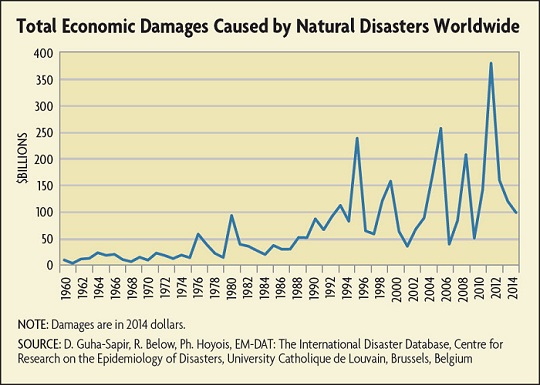
When Hurricane Hugo struck Charleston, S.C., in September 1989, it became the first natural disaster in the United States to cause more than $1 billion in insured losses. Today, after adjusting for inflation, it doesn't even make the top 10 costliest U.S. disasters eight of which have occurred since 2000 alone. Indeed, disaster costs have been trending up worldwide over the last three decades (see chart below).


This may partly be explained by growth in coastal areas, which are at greater risk of damage from recurring natural disasters like severe storms and flooding. Development of these areas is not necessarily a bad thing, as Stéphane Hallegatte, senior economist in the World Bank's Climate Change Group, explained in a 2011 paper. Coastal cities are popular tourist destinations and are natural hubs for industry and trade thanks to their access to waterways. As a result, greater development in those areas is to be expected as a country's GDP increases, despite the risks.

New Rules for the Monetary Gam

MAR 21, 2016 

Raghuram Rajan is Governor of the Reserve Bank of India. 

NEW DELHI – Our world is facing an increasingly dangerous situation. Both advanced and emerging economies need to grow in order to ease domestic political tensions. And yet few are. If governments respond by enacting policies that divert growth from other countries, this “beggar my neighbor” tactic will simply foster instability elsewhere. What we need, therefore, are new rules of the game. 

Why is it proving to be so hard to restore pre-Great Recession growth rates? The immediate answer is that the boom preceding the global financial crisis of 2008 left advanced economies with an overhang of growth-inhibiting debt. While the remedy may be to write down debt to revive demand, it is uncertain whether write-downs are politically feasible or the resulting demand sustainable. Moreover, structural factors like population aging and low productivity growth – which were previously masked by debt-fueled demand – may be hampering the recovery. 

Politicians know that structural reforms – to increase competition, foster innovation, and drive institutional change – are the way to tackle structural impediments to growth. But they know that, while the pain from reform is immediate, gains are typically delayed and their beneficiaries uncertain. As Jean-Claude Juncker, then Luxembourg’s prime minister, said at the height of the euro crisis, “We all know what to do; we just don't know how to get re-elected after we’ve done it!” 

Central bankers face a different problem: inflation that is flirting with the lower bound of their mandate. With interest rates already very low, advanced economies’ central bankers know that they must go beyond ordinary monetary policy – or lose credibility on inflation. They feel that they cannot claim to be out of tools. If all else fails, there is always the “helicopter drop,” whereby the central bank prints money and sprays it on the streets to create inflation (more prosaically, it sends a check to every citizen, perhaps more to the poor, who are likelier to spend it). But they can also employ a range of other unconventional tools more aggressively, from asset purchases (so-called quantitative easing) to negative interest rates. 

Is Syria Another Afghanistan for Russia?

05/26/16 

ISIS intends to force Russia into another costly quagmire like its miserable failure in Afghanistan (1979-1989).

An Afghan Mujahideen demonstrates positioning of a hand-held surface-to-air missile. Wikimedia.
ISIS attacked a Russian military base in Syria on May 14th. Four Mi-24 attack helicopters were burned, 20 trucks were destroyed, a storage depot was hit and a MIG-25 fighter jet was damaged. The base is known as T-4, sometimes also called Tiyas in Homs province.

ISIS is hitting Russia hard and the jihadists are proud of it. One day after the attack, on May 15th, ISIS went on one of their websites, called Amaq, and claimed credit for the destruction. Ten days later, on May 25th, the British press “broke” the story. The BBC, The Independent, The Daily Mail, the Guardian and various other news services ran articles about the attack—but only after an independent intelligence company named Stratfor headquartered in, of all places, Texas, published before and after satellite photos of the Russia base.

Satellite photos clearly showed the impact of the attack and the resulting fires. The pictures made it perfectly clear that the damage could not have been the result of a single, accidental, fire or a mere gas tank explosion.

Russia 2030: A Story of Great Power Dreams and Small Victorious Wars

23 May 2016

This paper considers how Russia and the six countries of the EU’s eastern neighbourhood could develop by 2030. More specifically, the text's authors set out five trends and their key drivers might shape Russia's future foreign policy: 1) Russia’s domestic problems, particularly economic, that create the temptation for diversionary wars; 2) Russia’s increased inclination to use military force; 3) its effort to dominate the eastern neighbourhood; 4) the prospects for Georgia, Ukraine and Moldova by 2030; and 5) those of Belarus, Azerbaijan and Armenia. In each section, they consider the disruptive forces that throw these trends off course; and conclude by setting out broad principles for what Europe should do to manage the risks ahead.

Download 


Fredrik Wesslau, Andrew Wilson 


Britain is at war in Libya and nobody thought to tell us

28 May 2016 

British SAS troops may be fighting in Yemen, Syria, Iraq, and Libya – but Parliament hasn’t been told about any of these deployments, let alone been given the chance to debate them 

Fighters loyal to Libya's GNA prepare to launch attacks against Isis as they continue their resistance on the outskirts of the western city of Sirte Getty Last week, Defence Secretary Michael Fallon tried to put to bed questions about whether Britain is planning to deploy the Army to Libya, where, just 200 miles from Europe, Isis has flourished amid a permanent state of chaos after the 2011 Nato-backed overthrow of Muammar Gaddafi.

Fallon said Britain is not planning a “combat role” for British troops in Libya; if the army were to be deployed in Libya, Parliament would discuss it first.

But just two days after his comments the Times reported that British Special Air Service troops are already in Libya and were seen earlier in May blowing up an Isis vehicle laden with explosives near Misrata.

DO NOT GIVE UP ON STEALTH TECHNOLOGY

MAY 30, 2016

If the U.S. Air Force’s biggest problem is that it is so good at its job that some Americans have come to question its relevance, stealth appears to be suffering a similar fate within the Air Force. In his recent series of articles for War on the Rocks, which challenge the utility of stealth technology for future generations of aircraft, Col. Mike “Starbaby” Pietrucha offers a number of thought-provoking ideas that deserve further discussion. Pietrucha has become an intellectual iconoclast within the U.S. Air Force — of which there are too few — by challenging the wisdom of the F-35 program and other sacred cows.

His three-part assault on stealth technology provides an elementary education on what stealth offers the warfighter. In the first article, Pietrucha argues that an all stealth force is unwise because of the capabilities given up in the name of stealth, as well as the expense associated with the technology. On this fundamental point we agree, because a look at the successes and failures of the Air Force demonstrates that platforms for dedicated missions are often a necessity. In other words, a one size fits all approach has led to high combat losses in the past, which makes a mix of capabilities and approaches the only wise way forward.

This is the tiny camera that might change the future of warfare

May 26 

Part of a Harris Integrated Soldier System at SOFIC 2016 in Tampa, Fla. (Thomas Gibbons-Neff/The Washington Post) TAMPA — To those trying to coordinate troop movements, communications and air support in the midst of a firefight, simple tasks can be almost impossible. Yet here at the 2016 Special Operations Forces Industry Conference, a number of companies are promoting technologies that may help cut some of that friction out of the chaos of ground combat.

Or add to it.

One technology, called Augmented Reality, basically takes a real-world image and layers it with a computer-generated one. For the soldier of the future, this means wearing a device that will show them a picture of the battlefield supplemented with digital information such as grid coordinates, the location of friendly troops and maybe in the near future, drone footage streamed from above.

The Augmented Reality system — developed by the communication company Harris and Applied Research Associates and showcased at this year’s industry conference — is only four ounces, but when coupled with the night vision goggles needed to overlay the imagery, the entire system can add roughly three pounds to an already six-pound helmet.
When worn, the user is presented with an interface that would be familiar to someone who had grown up playing video games. At the bottom of the display is a circle that moves as the user changes direction, simultaneously showing a compass heading and the user’s current grid coordinate, or location. Blue circles elsewhere on the screen can indicate current objectives, personnel or aircraft.

31 May 2016

‘India is India, comparisons are not always useful’

May 29, 2016

Stephen Cohen on studying India and Pakistan, and on the need for regional power cooperation in Afghanistan

For more than 50 years, Stephen Philip Cohen has played a leading role in shaping South Asian security studies, and mentoring generations of scholars in the field. He is credited particularly for landmark work on the Pakistani and Indian armies. His new book The South Asia Papers: A Critical Anthology of Writings has just been published by the Brookings Institution in Washington, D.C., where he is currently a senior fellow. Excerpts from a telephonic interview:

The South Asia Papers collects a lifetime of work and ideas.

It roughly follows the trajectory of my career. I began as a historian and scholar working on military sociology, interested in caste in the Indian Army. Later my interests shifted, and my articles reflect that. I looked at how the Indian Army faced outward, that is foreign and strategic policy in general. In 1978 I co-authored a book, India: Emerging Power, which was my first major piece on Indian foreign policy. There were several diversions, including a year in Tokyo, when I couldn’t get an Indian visa. In Tokyo I spent a lot of time with their China experts, and got a different perspective on India, as seen from both Japan and China. The Japanese often asked me: ‘Why are you bothering with India? It is not important.’ The Chinese had pretty much the same view.

*** Ten Fictions that Pakistani Defense Officials Love to Peddle

January 31, 2014

The U.S.-Pakistan “strategic dialogue” has restarted yet again. I would be remiss if I did not point that it has never been strategic and it has certainly not been a dialogue. No doubt the Pakistanis are worried that wary American taxpayers and their congressional representatives may close the checkbook for good when the last U.S. soldier departs from Afghanistan. In the spirit of perpetual rent-seeking, Pakistani defense officials have recently alighted upon Washington to offer the same tired and hackneyed narratives that are tailored to guilt the Americans into keeping the gravy train chugging along.

Here are the top ten ossified fictions that Pakistani defense officials are pedaling and what you need to know to call the “Bakvas Flag” on each of them.

1. “Our relationship should be strategic rather than transactional.”

Nonsense and here’s why. For the U.S.-Pakistan relationship to be “strategic,” there should be a modicum of convergence of interests in the region if not beyond. Yet, there is no evidence that this is the case. In fact, Pakistan seems most vested in undermining U.S. interests in the region. In the name of the conflict formerly known as the Global War on Terror (GWOT), the United States has given Pakistan some $27 billion in military and financial aid as well as lucrative reimbursements. However, during these same years, Pakistan has continued to aid and abet the Afghan Taliban and allied militant groups such as the Haqqani Network. These organizations are the very organizations that have killed American military and civilian personnel in Afghanistan along with those of our allies in the International Security Assistance Force (ISAF) and countless more Afghans, in and out of uniform. This is in addition to the flotilla of Islamist militant groups that Pakistan uses as tools of foreign policy in India. Foremost among them is the Lashkar-e-Taiba, which is proscribed by the United States and which is responsible for the most lethal terror operations in India and, since 2006, has openly operated against Americans in Afghanistan.

2. “The United States has been an unreliable ally.”