21 July 2016

** what ceos are reading


Leaders of some of the world’s biggest organizations reveal which books will keep them occupied in the coming months.

The slightly lazier days of summer are upon the northern hemisphere, with beach vacations beckoning. South of the equator, temperatures are dipping and cozy weekends lie ahead. So what books will corporate leaders be reading in the coming months? Here are recommendations from more than a dozen, including McKinsey’s Dominic Barton, JPMorgan Chase’s Jamie Dimon, LinkedIn’s Reid Hoffman, and Corning’s Wendell Weeks. It’s an eclectic list of fiction and nonfiction, spanning everything from classics to newcomers, business topics to biographies and folk tales.
Dominic Barton, McKinsey

In his three decades with the management-consulting firm, Dominic has worked with companies across a range of industries, including banking, consumer goods, and high tech. He led McKinsey’s Korea office from 2000 to 2004 and was the Shanghai-based Asia chairman from 2004 to 2009 before becoming global managing director.


The European Identity: Historical and Cultural Realities We Cannot Deny—Stephen Green (Haus Publishing, 2016; nonfiction)

** Cross-Domain Fires: US Military's Master Plan to Win the Wars of the Future

July 19, 2016 

“Imagine this. An F-18 Hornet acquires a target at sea, an enemy ship, and then passes the track data through Link-16 to any potential shooter with the right munitions and within range of the enemy ship. That information is passed through a gateway to several potential shooters on land such as the Paladin or High-Mobility Artillery Rocket System, or HIMARS.” -- Adm. Harry Harris, Pacific Commander. 

The emerging concept for warfighting is aimed at vigorously increasing “cross-domain” fires wherein air assets provide fires for ground attack weapons fire support of air forces in real time. This concept also includes Army rockets and artillery to destroy maritime targets such as ships off the coastline, just as sea and air force assets attack targets on land. 

The above quote, spoken by Adm. Harris, Commander of U.S. Pacific Command, refers to the fast-increasing emphasis upon using air, land and sea weapons and technology through faster, more lethal networking and coordination.

While posited at a theoretical prospect, Harris explained that this kind of “cross-domain” fires has already been demonstrated and is now gaining momentum within senior Pentagon circles.

A 6,000-personnel strong joint-training exercise last year called Northern Edge, hosted by Alaskan Command above mountain ranges and the Gulf of Alaska, used networking technology to quickly send targeting coordinates from a fighter jet to land-based weapons. 

Major participating units include U.S. Pacific Command, Alaskan Command, U.S. Pacific Fleet, Pacific Air Forces, Marine Corps Forces Pacific, U.S. Army Pacific, Air Combat Command, Air Mobility Command, Air Force Materiel Command, Air National Guard, Air Force Reserve Command and U.S. Naval Reserve.

When it comes to networking technology, one example involves the use of something called Joint Range Extension Applications Protocol, or "JREAP."

Politics On Terror: Making Both India And Bangladesh Lose The Battle

July 17, 2016

How the lack of a strong, political consensus against jihadi terror is causing serious damage to the counter-terror efforts of India and Bangladesh

Seven militants stormed an affluent restaurant complex in one of Dhaka’s diplomatic quarters. While the Bangladeshi government has attributed the attacks to a home-grown terror outfit, Jamaat-ul-Mujahideen Bangladesh (JMB), media reports showed the Islamic State (IS) claiming responsibility for the attacks.

One of the things that has become apparent in the aftermath of the attack was the lack of a strong, political consensus against Islamism in Bangladesh. The ruling Awami League and the opposition Bangladesh Nationalist Party (BNP) are at war with each other to the point where national security has lost priority, and events of growing radicalisation and extremism are either overlooked or exploited to score political points. Neglect of growing radicalisation for years has arguably facilitated the rise of transnational terrorist groups like the al-Qaeda in the Indian Subcontinent (AQIS) and the Islamic State (IS) in Bangladesh.

Lack Of Strong Political Consensus Against Terror

Terrorism and extremism grew in Bangladesh between 2001-2006 when the BNP was in power. The alliance between BNP and Jamaat-e-Islami provided a fertile ground for the growth of groups like Jamaat-ul-Mujahideen Bangladesh and Harkat-ul-Jihad-al Islami (HuJi). Since then Bangladesh has witnessed a growth in the number of madrassas. After the Shahbag movement in 2013, attacks on Hindus, Christians, liberals, secular writers, bloggers and other intellectuals have escalated.

It’s Jihad In Kashmir; Deal With It As Such

July 17, 2016

Hizbul Commander Burhani Wani’s encounter with security forces and the deaths in the subsequent violence have put Kashmir on centre stage once again

If secularism is indeed our core national value, Kashmir is its litmus test. Not only should this jihad be quelled with a heavy hand, but the insurgency should also be called out as such

Hizbul Commander Burhani Wani’s encounter with security forces and the deaths in the subsequent violence have put Kashmir on centre stage once again. The ferocity of the attacks on the security forces and the unfortunate loss of young lives was accompanied by an outpour of unprecedented media support for terrorist Burhan Wani, and sympathy for Kashmiri separatism. It is difficult to ascertain how much of this support fuelled further violence, but if the “secular” and “liberal” support for Kashmiri ‘right to self-determination’ was out of conviction, there were a few visible signs of it before May 2014.

One anchor compared Burhan Wani to Bhagat Singh— a clear insult to the legendary Indian freedom fighter. One wonders what Bhagat Singh or his friend Ashfaqullah Khan would have thought of being associated with sectarian and secessionist forces, out to wreck the nation in their own life time. Another journalist sighed as to whether India, as a nation, had a soul at all? One other tried to paint Burhan Wani as a poor headmaster’s son, employing social media as his medium of protest. Banner headlines are spread across photos on social media pages, and reports in a section of the media barely conceal their support for Kashmiri secessionism.

This support has been a gradual build up. At the core of the JNU controversy, which was largely construed as a ‘Freedom of Expression’ issue, also lies Kashmiri secessionism and its open advocacy. Leftist professors spoke of Kashmir being a military occupation, and anchors opined that sanctity of flags or national boundaries were nothing but retrograde ideas.

The real problem in addressing climate change is the relation between emissions and power of nation states: Amitav Ghosh Interview with the author of 'The Great Derangement: Climate Change and the Unthinkable'

Nitin Sethi 
July 18, 2016  
Source Link


Amitav Ghosh, the author of 'The Great Derangement: Climate Change and the Unthinkable' speaks to Nitin Sethi about the language of concealment in which theParis agreement was scripted

You make an argument that turning it into a moral issue will not work to resolve climate change. But that is the argument globally civil society deploys. Do you think it's the failure of civil society to use the moral argument better or the argument is inherently built to fail?

I think it is an approach that is very ill suited to this particular problem. This whole issue of presenting it as a moral issue to my mind that actually is a capitulation to a kind of neo-liberal ideology which tries to reduce all collective action to cases of individual choices. As I say in the book, I think that you can actually argue the morality of it very easily. What are the dominant parameters of morality, especially in the English-speaking world in neo-classical economics of one kind or another? Looking at a lot of literature on the justice literature on climate change, which was very striking to me. How many approach it from a Rawlsian perspective. Essentially within that perspective the results that you get in relation to morality are not at all what you and I would imagine.

It's been very interesting for me to especially think of it in terms of Gandhian approach to politics and morality. Part of our political priority is this whole idea that you have to be the change that you want to see. Actually, it is in some sense an embrace of complete neoliberal model that you reduce all collective action problems to individual action problems and let all collective institutions off the hook. That for me is really one of the major problems with the morality thing. Secondly, to approach this issue from moralistic perspective you shall always be weakened by the deniers. They are going to reduce it to a question of individual sacrifice: What have you sacrificed? Why are you wearing that shirt? Why are you sitting in an air-conditioned room? You are actually handing them the tool with which to bludgeon you. I have seen this so often, repeatedly. People have become accustomed to this neo-liberal individualising morality. What they want is to reduce the question of individual sacrifice. Not institutional and not collective.

Conversely, you enter this problem and you get caught up in it at so many levels. Many major climate scientists Kevin Anderson and several others, Michael Mann, they also have now started talking about this in terms of individual sacrifice.

Yes, they drive the conversation along these lines very often…

Kevin Anderson particularly. I really admire the man. I think he is great. But you can see he is filled with this kind of anger, at the same time you can see equally that this is a kind of protestant thing. He feels that he is in a church.

At a pulpit you mean…

Former Afghan Spy Chief Releases Documents Showing Pakistani Support for Taliban

July 15, 2016

Former Afghan spy chief says letters show Pakistan supports militants

KABUL (Reuters) - The former head of Afghanistan’s main intelligence agency released documents on Thursday which he said showed that Pakistani intelligence services helped leaders of the Taliban and the feared Haqqani network in 2014 and 2015.

Rahmatullah Nabil stepped down from the National Directorate of Security (NDS) in December last year after opposing Afghan President Ashraf Ghani’s efforts to improve relations with Pakistan and include Islamabad in peace talks with the Taliban.

Nabil told a group of journalists in Kabul that he had released the documents to provide concrete evidence of Pakistan’s collusion with the Taliban and the associated Haqqani group, which has been blamed for a series of kidnappings and high profile suicide bombings in the capital.

Pakistan’s foreign office and the army’s media wing did not respond to several written and telephoned requests for comment in which Reuters outlined the accusations levelled against Pakistan.

Neither the NDS nor the Afghan government was available for immediate comment on the letters.

The Afghan Taliban insurgency has in the past said it is fighting against the government and Western allies with the support of the Afghan people, and has no need of outside help.

Nabil did not say how the letters had been obtained. Reuters could not independently verify their authenticity.

Since retiring from the intelligence service, Nabil has been strongly critical of Pakistan, which is routinely accused by Afghanistan of sponsoring the Afghan Taliban, a charge it has consistently denied.

How Turkey Could Become the Next Pakistan

Jennifer Cafarella

July 19, 2016
Source Link

The U.S. must recognize the risk a NATO ally may become a safe haven for al Qaeda as Erdogan consolidates power.

The failed coup attempt by elements of the Turkish Armed Forces on July 15 will enable President Recep Tayyip Erdogan to establish himself as an authoritarian ruler in Turkey. His priorities in the next few months will be to solidify the loyalty of the Turkish military establishment and complete the constitutional reform necessary to replace Turkey’s parliamentary democracy with an executive presidency, his longstanding goal. A post-coup Erdogan is much less likely to submit to American pressure without major returns. Erdogan immediatelydemanded the extradition of political rival Fethullah Gulen from the U.S., accusing Gulen of plotting the coup and condemning the U.S. for harboring him. Erdogan will likely deprioritize the fight against ISIS, undermining the counter-ISIS mission in Syria, as he focuses on consolidating power. He may even revoke past concessions to the U.S., including permission to use Turkey’s Incirlik airbase for counter-ISIS operations.

Erdogan has more dangerous options now that his rule is secure, however. A partnership with al Qaeda could grant him a powerful proxy force to achieve national security objectives without relying on the Turkish Military. American policymakers must recognize the dangerous possibility Erdogan will knowingly transform Turkey into the next Pakistan in pursuit of his own interests. 

Erdogan’s purge will be severe. He declared that the coup attempt was “a gift from God … because this will be a reason to cleanse our army,” in a victory speech on July 17. Turkish security forces immediately arrested over 3,000 soldiers, dozens of colonels, and four high-ranking officers as they reestablished control starting July 16. The subsequent purge has removed approximately one third of all general officers. Erdogan will try the coup leaders and participating rank and file soldiers for treason and approve the reinstitution of the death penalty if passed by Turkish Parliament. He will eliminate political rivals and dissenters and consolidate social control. He is already using the allegation against Gulen to justify a broad crackdown against the judicial establishment and civil society elements allegedly linked to Gulen, including the dismissal and arrest of nearly 3,000 members of the judicial establishment. He has also dismissed at least 8,000 police. His consolidation phase will require significant time, attention and resources for the next few months. He must meanwhile balance national security concerns, including domestic threats from ISIS and the Kurdistan Workers Party (PKK), as well as a tenuous détente with Russia.

Ensuring defiant unilateralism is not cost-free

BY BRAHMA CHELLANEY, The Japan Times

China has been expanding its frontiers ever since it came under communist rule in 1949. Yet no country dared to haul it before an international tribunal till the Philippines in 2013 invoked the dispute-settlement mechanism of the United Nations Convention on the Law of the Sea (UNCLOS), thereby setting in motion the arbitration proceedings that this week resulted in the stinging rebuke of China’s expansive claims in the South China Sea.

The trigger for Manila approaching the International Tribunal for the Law of the Sea (ITLOS) was China’s capture in 2012 of Scarborough Shoal, located close to the Philippines but hundreds of miles from China’s coast. ITLOS then set up a five-member tribunal under The Hague-based Permanent Court of Arbitration (PCA) to hear the case.

Despite strenuous Chinese efforts to dismiss and discredit the proceedings from the start, Beijing tried unsuccessfully to persuade the tribunal that it had no jurisdiction to hear the case. Last October, the tribunal said that it was “properly constituted” under UNCLOS, that the Philippines was within its rights in filing the case, and that China’s non-participation in the proceedings was immaterial.

Now in its final verdict delivered unanimously, the tribunal has dismissed Beijing’s claim that it has historic rights to much of the South China Sea and ruled that China was in violation of international law on multiple counts, including damaging the marine environment through its island-building spree and interfering with the rights of others.

Shutting Down ISIS' Digital Platforms


JULY 19, 2016 

One day before Mohamed Lahouaiej Bouhlel, the 31-year-old Tunisian immigrant who killed 84 people by plowing a rented refrigerator truck into the Bastille Day crowd celebrating on Nice’s Promenade des Anglais, a State Department official told the House Foreign Affairs Committee that ISIS [the Islamic State] was “tapping into already existing market of grievance and unhappiness that is throughout the Arab and Muslim world…targeting young men and women who have mental illness and who are psychotic.”

On July 13, while testifying on programs to counter ISIS messaging on the Internet, Richard A. Stengel, Undersecretary of State for Public Diplomacy and Public Affairs, repeated a warning about coming terrorist acts that Obama administration officials have been voicing for weeks.

Stengel said, “I think now because the digital caliphate [ISIS’ videos of beheadings, of firing squads, of torture of men, women, and children designed to recruit fighters for Syria and Iraq] is shrinking, they [ISIS] are looking for people who have mental health issues, who are psychotic and they are trying to pinpoint those” to carry out so-called lone wolf attacks all over the world.

Two weeks ago in this column, I quoted Brett McGurk, President Barack Obama’s Special Envoy for the Global Coalition to Counter ISIS, predicting this type of thing would happen. He told the Senate Foreign Relations Committee that ISIS “will try to inspire, through the Internet, these lone wolf types of attacks. And any deranged individual that wants to commit a crime can suddenly raise the banner of ISIS and get an international headline. And they [ISIS] recognize this, and they’re trying to inspire it.”

“Hybrid Warfare” at Home

Darren E. Tromblay
July 14, 2016 

Russia’s actions in the Ukraine has brought new attention to the concept of “hybrid warfare”. The uptick of interest has been spurred by the waging of hostilities on multiple levels and specifically the seeming novelty of using irregular, political, and information operations in conjunction with more traditional coercion. Such tactics are meant to identify, exacerbate, and create divisions in societies that can then be exploited by an adversary seeking to advance an objective or at least constrain a state’s ability to act decisively.

While much of the scholarly discussion – when it is not focused on whether hybrid warfare is an actual development or simply a bundling of old ideas – has dealt with the implications for Eastern Europe, it is important to note that the United States has been targeted by foreign governments using aspects of “hybrid warfare” since the beginning of the Cold War and in some cases even prior to the commencement of that era. Not only the Soviet Union (by which Russia’s actions seem to remain so heavily influenced) but China and smaller states such as Cuba directed efforts at creating unfounded dissension and even violence within the United States.

Given the likelihood that foreign efforts to disrupt U.S. political discourse – in furtherance of stymying decisiveness about decisions regarding developments beyond its borders - will continue, it is worth examining the paradigms that a foreign government endeavoring to manipulate U.S. policy might attempt to create. First, a foreign power may seek to nullify voices which it perceives to be hostile to its interests and may use means as drastic as murder to do so. Reducing the impact of U.S. constituencies undercuts policymakers’ by giving them a seemingly diminished mandate to justify difficult decisions. While working to nullify certain voices, foreign governments attempt to unleash others that seek to undercut the legitimacy of the U.S. government. Of interest to foreign governments seeking to chip away at the U.S. government’s ability to act are voices which contribute to three broad categories of activity: lawlessness (i.e. those individuals and organizations that are an active affront to authorities); militant and extremist movements (e.g. Cuban collusion with leftist radicals during the 1960s and 1970s); fomenting distrust of the U.S. government (e.g. Soviet encouragement of conspiracy theories surrounding the assassination of John F. Kennedy); and portraying the U.S. government as indifferent and weak when it comes to the needs of its population – a theme usually accompanied by the token gesture of a foreign government, such as Venezuela in its subsidized heating oil program.

Defamation of Dissidents

WORLDWIDE THREATS TO THE HOMELAND: ISIS AND THE NEW WAVE OF TERROR

JULY 14, 2016

This hearing will examine current threats to the U.S. homeland, especially from radical Islamist terrorists, and will review the efforts of the federal government to counter other emerging threats. Witnesses will likely discuss the danger of foreign-inspired homegrown extremists, the role of global terrorist organizations in their radicalization, and efforts to prevent terrorist infiltration into the United States. The hearing will also examine continued and emerging threats to cybersecurity and our critical infrastructure.

Rep. Michael McCaul (R-TX), Chairman


The Honorable Jeh C. Johnson

Secretary

Department of Homeland Security


The Honorable Nicholas J. Rasmussen

Director

The National Counterterrorism Center

Office of the Director of National Intelligence


The Honorable James B. Comey

Director

Federal Bureau of Investigation

U.S. Department of Justice

Israel's Interests and Options in Syria


PDF file 0.3 MB 
Technical Details »

Research Questions
What are Israel's interests, objectives, and policy options in the Syrian conflict?
What can Israel do to affect the conflict in Syria?
How does Israel view the threat of Sunni extremists, including the Islamic State of Iraq and Syria, in Syria?
What can Israel do to affect outside countries, such as Russia and Iran, that are active in the Syria conflict?
How can Israel advance its interests in Syria if it has little ability to affect events there directly?


With little ability to affect the outcome of the Syrian civil war, and with limited interest in intervening in the conflict other than to pre-empt or respond to attacks on its territory, Israel seems to have been a passive actor in recent events shaping the Levant. But Israel does have critical security interests that it seeks to advance in Syria — principally, minimizing Iranian and Russian influence in Syria, blocking the transfer of advanced weapons to Hezbollah, preventing Syria from posing a credible military threat to Israel or permitting Iran to do so, undermining the legitimacy of Syria's claims to the Golan Heights, and preventing Sunni militants from establishing infrastructure or operational bases along Israel's border. Unless and until the Syrian conflict dramatically changes course, Israel's strategy will likely be to monitor events carefully, work with Moscow to minimize the chances of inadvertent conflict with Russia, and take as few direct actions as are necessary to protect Israel's territory and citizens. Given the unpalatability of the most-likely "resolutions" to the conflict, continued fighting in Syria — a situation in which these various parties continue to focus their fire on each other rather than on Israel — might be the most advantageous outcome for Israel.

Key Findings

Commentary July 2016 Five things Bill Gates gets right on energy By Scott Nyquist

By Scott Nyquist

And one I’m not so sure about.

There’s a saying that where you stand depends on where you sit. When it comes to energy, that holds true. For example, while I am an energy guy in general, I have spent much of my time in oil and gas. That colors how I see the future (and the present, for that matter). People who are deep into solar almost certainly have a different perspective. A mother in Africa cooking over a wood-burning stove might have a third. And a coal miner in West Virginia yet another.

Finding a consensus about what to do next and how, then, becomes difficult. And that is one reason why I find Bill Gates an interesting voice on energy issues. Having spent his life in IT and philanthropy, his views do not fit into a single box—and are all the more refreshing for that. He does have skin in the game. In 2015, he founded a $1 billion clean-energy fund, the Breakthrough Energy Coalition, which is devoted to research and developmenton clean energy. He also has been active on issues related to climate change and nuclear power.

If I were to sit down with Gates over a latte in Redmond, we probably wouldn’t agree on everything. But I think he asks the right questions, in the right way. Here are a few comments Gates has made over the years on energy that I found particularly interesting, and my responses to them.

So do I. In a sense, it’s not even a choice. The world has a huge investment in the current energy infrastructure, and it is simply not going to write it off. The idea that there could be a “moon shot” to go all renewable in ten years is not going to happen. I also agree with Gates that today’s technology needs to include nuclear. It is the only low-emissions, 24/7 technology now available, and its safety record is astonishingly good compared with conventional fuels (even without including pollution-related premature deaths). And yes, that includes Fukushima, which was poorly designed and sited. New nuclear plants are much better; Gates himself is an investor in a new nuclear technology.

Cashing in on a failed coup


“The attempted coup was nothing like the 1980 military coup in Turkey, nor like the covert coup of 1993 or the post-modern coup of 1997. Only Mr. Erdogan has gained from it.” People wave Turkish flags in front of an electronic billboard displaying the face of the President at a rally in Kizilay Square in Ankara. Photo: Getty Images

Turkish President Erdogan is using the botched bid to unseat him to further his authoritarian agenda.

As if from nowhere, a section of the Turkish armed forces attempted a coup d’etat on July 15. At 10 p.m., reports of gunfire near the General Staff headquarters in Ankara, Turkey’s capital, began the barrage that lasted till 2.30 a.m. on July 16, when the national intelligence agency (MIT) said that the coup had been “thwarted”. Chaos reigned in the intervening hours. The soldiers and their heavy armour held sections of Ankara and Istanbul, including some media stations and parts of the transportation network. Two hours into the coup, the security services had begun to tell reporters that the unrest had been inspired by the U.S.-based Islamic scholar Fethullah Gülen. Turkey’s President Recep Tayyip Erdogan took to FaceTime, a videotelephony app, to ask people to go onto the streets to defeat the coup. From the mosques, imams also called for public action. By 12.35 a.m., the Special Prosecutor had already begun to frame charges against the coup leadership. It was clear that this coup — the sixth in Turkey’s modern history — had failed before it could be consolidated.

Coup as opportunity

Did the Israeli-American Stuxnet virus launch a cyber world war?

By Neta Alexander 
Jul 15, 2016 


A new documentary tells the story of Stuxnet, a computer virus developed, it is claimed, by Israel and the U.S. to disrupt the Iranian nuclear project. In an interview, filmmaker Alex Gibney talks about Israel’s responsibility for the revelation of the operation and its eventual spread around the world. Are we already in the midst of what Gibney calls ‘World War 3.0’?

NEW YORK – The two following assertions sound like something out of a James Bond movie: 1. We are in the midst of a new global war on a scale of the world wars of the 20th century, and, 2. The countries that have declared and launched the war refuse, in effect, to acknowledge its existence – or being held accountable for its outcome.

These notions are not some Hollywood fantasy: They underlie “Zero Days,” the new film by the Oscar-winning American documentary filmmaker Alex Gibney.

The film is based on years of in-depth research, carried out with the help and cooperation of more than 100 journalists, information security experts, senior personnel at the U.S. National Security Agency and the Central Intelligence Agency, and Israeli figures including Yuval Steinitz, the national infrastructure minister who is also responsible for the Atomic Energy Commission, and the former director of Military Intelligence, Maj. Gen. (res.) Amos Yadlin.

“Zero Days” tells the constantly surprising story of the Stuxnet computer virus, which, according to Gibney and his sources, was developed by Israel and the United States during 2007-2008 in order to thwart the Iranian nuclear enterprise. Considerable information about the virus, including Israeli and U.S. involvement in its development, became public in September 2010, a few months after Stuxnet was first detected by information security firms.

DIGITAL ACTS OF WAR: EVOLVING THE CYBERSECURITY CONVERSATION Subcommittee on National Security

SUBCOMMITTEE ON NATIONAL SECURITYSubcommittee on Information Technology
JULY 13, 2016 

PURPOSE:

To examine the strategies and policies of the administration’s response to cybersecurity incidents.

To review the growing market for threat intelligence, the pros/cons of making attribution after cybersecurity incidents, and the benefits of clarifying international norms of cyber operations.

BACKGROUND:

Data breaches at the Office of Personnel Management and at private sector companies have validated a 2013 National Intelligence Estimate that the U.S. is “the target of a massive, sustained cyberespionage campaign that is threatening the country’s economic competitiveness.”

Hostile actors remain undeterred from conducting cyberattacks because of the relatively low costs of entry, the perceived payoff, and the lack of significant consequences.
Russia and China continue to view offensive cyber capabilities as an important geostrategic tool and will almost certainly continue developing them.

WITNESSES AND TESTIMONIES
NameTitleOrganizationPanelDocument
Mr. Aaron Hughes Deputy Assistant Secretary for Cyber Policy U.S. Department of Defense Document
Mr. Chris Painter Coordinator for Cyber Issues U.S. Department of State Document
Gen. (Ret.) Keith Alexander CEO and President IronNet Cybersecurity Document
Mr. Sean Kanuck Counsel Legal and Strategic Consulting Services Document
Mr. Peter Warren Singer Strategist and Senior Fellow New America Document


JOINT INFORMATION ENVIRONMENT: DOD Needs to Strengthen Governance and Management

GAO-16-593: Published: Jul 14, 2016


Additional Materials: 
Highlights Page: 
Full Report: 
Contact:

Carol C. Harris

(202) 512-4456

chac@gao.gov

Office of Public Affairs

(202) 512-4800

youngc1@gao.gov

What GAO Found

The Department of Defense (DOD) plans to spend almost $1 billion by the end of this fiscal year to implement one element of the Joint Information Environment (JIE); however, the department has not fully defined JIE's scope or expected cost. Officials reported that assessing the cost of JIE is complex because of the size and the complexity of the department's infrastructure and JIE's implementation approach. However, without information about expected JIE costs, the ability of officials to oversee and make effective resource decisions is limited.

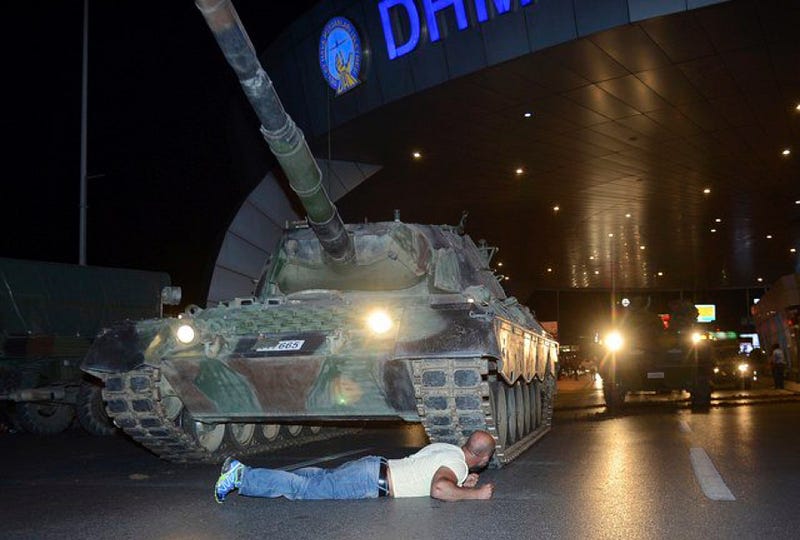
Cyberpower Crushes Coup Rewriting the rulebook on coups, time to add cyberpower


Turkish Tank Man is what a failing coup looks like.

Mere hours after the putsch in Turkey has failed, it is still too early to understand exactly what went on. Given those constraints, I still want to discuss something which has altered “the game” so much that the existing guidebook needs to be significantly revised.

I am not a military strategist, but I have lived through a couple coups in Thailand, so I have some first hand experience of what they look like. The guide book to running a coup is still Luttwak’s Coup d’État, but it needs to be revised to reflect the use of cyberpower. In the same vein, people who talk about cyberpower need to understand what it actually is (hint: it isn’t a stockpile of exploits, it’s the ability to create and maintain advantage.)
The Good Coup Guide

A coup is basically a sucker punch. The trick is to end the fight before it even begins. The members of the coup are in the minority and a long drawn out fight, even if they win, will not have the trappings of legitimacy or stability. The goal is to have a rapid attack against the existing leadership and replace them before anyone knows what happened. At the same time, the general population needs to be kept out of the way, because large groups of civilians complicate things to no end.

Essentially, the existing leaders need to be removed from positions of power and their ability to coordinate and organise a resistance must be blocked. This is easier when there are only a few means of mass communication (e.gthe TV station, or the radio station.)
Keys To A Successful Putsch

Commander: Iran to sue Western companies for selling faulty cyber war tools

July 18, 2016

TEHRAN - The commander of Iran’s Civil Defense Organization has said cases have been filed and submitted to the Foreign Ministry against faulty devices in cyber war tools that Iran has purchased from Western manufacturers.

According to Brigadier General Gholam Reza Jalali, this is while there is domestic capacity to manufacture such equipment.

Jalali also described the recent cyber-attacks on Iranian websites as “primitive.”

Learning from the Stuxnet virus that ravaged Iran’s Natanz nuclear facility, the country has been beefing up its cyber-attack infrastructure.

The Digital Underworld: What You Need to Know

Illustration by Meriel Waissman
June 24, 2016

Tens of millions of Americans will have their credit-card numbers, hospital records, or digital identities hacked or stolen this year, RAND research suggests—victims of a cybercrime industry that now rivals the illegal drug trade in reach and sophistication.

The numbers are more sobering than surprising. For years now, RAND researchers have documented the growing threat posed by a digital underworld where hackers sell their services like mercenaries and credit-card numbers can be had for pennies on the dollar.

Their research has helped define that threat from the perspective of attackers, defenders, and the everyday consumers caught in the middle. Taken together, it offers a rare glimpse inside the secret world of cyber hacks and counterattacks—and some hard lessons for anyone with a computer or a credit card.

The Hackers Are Winning

The numbers alone are damning. A RAND report released earlier this year estimated that 64 million American adults had been notified in the previous year alone that their personal data had been breached—more than a quarter of the adult population.

Illustration by Meriel Waissman

The Ethics of Artificial Intelligence in Intelligence Agencies

July 18, 2016 

Some of society’s brightest minds have warned that artificial intelligence (AI) may lead to dangerous unintended consequences, yet leaders of the U.S. intelligence community—with its vast budgets and profound capabilities—have yet to decide who within these organizations is responsible for the ethics of their AI creations.

When a new capability is conceived or developed, the intelligence community does not assign anyone responsibility for anticipating how a new AI algorithm may go awry. If scenario-based exercises were conducted, the intelligence community provides no guidelines for deciding when a risk is too great and a system should not be built and assigns no authority to make such decisions.

Intelligence agencies use advanced algorithms to interpret the meaning of intercepted communications, identify persons of interest and anticipate major events within troves of data too large for humans to analyze. If artificial intelligence is the ability of computers to create intelligence that humans alone could not have achieved, then the U.S. intelligence community invests in machines with such capabilities.

The 5 Most Powerful Armies in 2030

July 16, 2016 

The focus of ground combat operations has shifted dramatically since the end of the Cold War. Relatively few operations now involve the defeat of a technologically and doctrinally similar force, leading to the conquest or liberation of territory. Preparation for these operations remains important, but ground combat branches also have a host of other priorities, some (including counter-insurgency and policing) harkening back to the origins of the modern military organization.

What will the balance of ground combat power look like in 2030, presumably after the Wars on Terror and the Wars of Russian Reconsolidation (more to come on this idea below) shake out?

Predictions are hard, especially about the future, but a few relatively simple questions can help illuminate our analysis. In particular, three questions motivate this study:

• Does the army have access to national resources, including an innovative technological base?

• Does the army have sufficient support from political authorities, without compromising the organization’s independence?

• Does the army have access to experiential learning; does it have the opportunity to learn and innovate in real-world conditions?

Given these questions, most ground combat forces of 2030 will very much resemble the most lethal forces of today, with perhaps a couple of important changes.

India

Military Installation Public-to-Public Partnerships Lessons from Past and Current Experiences


DOWNLOAD EBOOK FOR FREE
Full Document
FormatFile SizeNotes
PDF file 1.6 MB 
Technical Details »

Research Synopsis
FormatFile SizeNotes
PDF file 0.2 MB 
Technical Details »

Research Questions
What are the different kinds of installation partnerships that have been successfully implemented and that are in development?
What functional areas are these installation partnerships in?
What kind of approaches, objectives, and authorities are used for installation public-to-public partnerships (PuPs)?
What are the benefits to installations and communities of successfully implementing installation PuPs?
What are the barriers to developing and implementing installation PuPs?
What are recommendations to help overcome such barriers?


U.S. military installations have a long history of partnering with municipalities and other government organizations. The purpose of this study was to clarify the appropriate use and potential value of public-to-public partnerships (PuPs) to Department of Defense (DoD) installations, identify barriers to their cost-effective application, and recommend ways to overcome these barriers. The objectives also included providing an overview of existing installation PuPs, including their purposes and approaches, and lessons learned from their development and implementation. The authors found that installation partnerships exist in a wide range of functional areas, including infrastructure and management partnerships (e.g., water, energy, environment, transportation, operations and maintenance, safety and security, and emergency services partnerships) and partnerships involving services and support for military personnel, their families, retirees, and DoD civilians (e.g., partnerships for recreation, children's services, adult education, libraries, social services, and medical and health issues). Installation partnerships also aid military missions, such as helping with testing, training, and research and development. The authors also found that partnerships yield many kinds of benefits to both installations and communities: economic value; enhanced missions, installation operations, and support services; access to additional expertise and resources; energy and environmental advantages; enhanced ability to address regional issues; improved military-community relations; and support for community values. Partnerships require resources and time to develop, and not all partnerships will succeed. Recommendations to address the diverse barriers in developing installation partnerships include committing and investing suitable time and resources, assigning clear lines of responsibilities within the partnership, developing a well-written agreement, facilitating partnership champions, and maintaining routine communications at multiple levels. The Office of the Secretary of Defense and the Service headquarters should continue with policy support, technical assistance, and education- and information-sharing; and should promote strategic regional collaboration.

Key Findings

STRATEGIC COMPETENCE HAS MORAL DIMENSION

July 13, 2016

Every soldier and leader knows that moral principles govern our behavior in war. In combat, we are responsible for attending to the difference between combatants and noncombatants, using proportional force even in the pursuit of legitimate targets and objectives, providing due care to the innocent even if doing so requires risk to ourselves, and assuring that we limit collateral damage as much as possible. Application in combat is part of our tactical competence.

But what about the moral dimension of strategic competence? This dimension is clearest at that intersection of a proper understanding of war and of moral agency.

The coin of war’s realm is life itself. Sometimes it is the life of a citizen who became a soldier, sailor, airman or Marine. Sometimes it is the life of an innocent caught amid a battle; perhaps it is of a family member far from the battlefield. And sometimes war ends, damages, destroys or changes the life of a political community itself. This is war’s norm; in war, the morally abhorrent and the morally justified can exist in the very same act. War can’t be otherwise.

Over 15 years of war has made this clear. War ends, damages, destroys and changes lives. That’s part of the hellishness of war. No matter how careful a soldier or leader is, no matter how well-planned the mission and how prepared a unit is, and regardless of how carefully rehearsed a battle is, fighting reveals war’s true coin.

It’s not a stretch to say that America’s national imagination equates war with fighting. Most public discussions of war concern tactics, weaponry, and effects or results of battle. Such an equation, however, leads one to miss an important aspect of war: that combat gains its meaning and worth in relationship to its operational and strategic contexts; that is, how a particular battle contributes to achieving a campaign objective and how, in turn, the campaign contributes to achieving a war’s ultimate political strategic aims.

Without this context, war can be fought well, but not waged well. Battles can be won, but not the war. Tactical, even operational, progress can be made, but not strategic progress. Lives can be used, but not used well. The coin of war’s realm is very much at work at the operational and strategic levels of war, even if less apparent than at the tactical level.

Thoughts on Mission Command


Officer and leader in the United States Army. Father, athlete, student, and amateur beer taster. Committed to education and expanding the Profession of Arms.

The ability to employ Mission Command is essential as our Army shifts towards future operating environments, yet it remains a highly debated topic within the profession. Individuals provide interpretations of the philosophy rooted in training and combat experiences. Younger officers understand mission command in the context of decentralized operations and latitude for initiative. They have scar tissue from micromanagement as some Brigade and Division level leaders believed their perspective through the lens of a UAV was better than the view from the ground. More seasoned (older) officers appreciate initiative, but also understand the complexity of combined-arms maneuver and inherent requirement for control. To further complicate the matter a new generation of Soldiers, the millenials, provide further diversity in interpretation. Exploiting the initiative is essential to success in any future model; tactical victory requires an understanding of the art of mission command and its relationship to the science of control. This article, based on my experience as a company grade officer in combat and a field grade officer in training, focuses on applied principles of mission command. These universal principles are the essence of an agile force proceeding into the unknown and unknowable of future conflict.

Defining Mission Command. Here is a short overview of mission command directly from Army Doctrine (ADRP 6–0) for any reader unfamiliar with the philosophy:
“The mission command philosophy helps commanders counter the uncertainty of operations by reducing the amount of certainty needed to act. Commanders understand that some decisions must be made quickly and are better made at the point of action. Mission command is based on mutual trust and a shared understanding and purpose between commanders, subordinates, staffs, and unified action partners. It requires every Soldier to be prepared to assume responsibility, maintain unity of effort, take prudent action, and act resourcefully within the commander’s intent.”

Why Military Spouses Can't Have it All

Jul 18, 2016

Last Friday, the Institute for Veterans and Military Families (IVMF) published the first in a three-part series regarding military spouse employment, titled The Force Behind the Force: A Business Case for Leveraging Military Spouse Talent. 

The purpose of the study was: “to outline some of the positive and potentially business enhancing characteristics of military spouses related to employment, the unique assets they bring to the workplace, and to describe the compelling business case to recruit and ultimately hire them.” 

Four key takeaways:

1.) Always a hot political topic, the gender wage gap is discussed each presidential election cycle (women earn between 79 and 94 cents for every dollar men make, depending on who you ask). For military spouses, it’s not a “wage gap”; it’s a“Wage Grand Canyon”.

Female military spouses earn significantly less than their civilian female peers, given their educational level, with the exception of those with less than a high school education:
Doctoral: 45 cents for every dollar their peer married to a civilian makes.
Professional Degree: 55 cents
Masters: 53 cents 
Bachelors: 60 cents
Associate: 65 cents
Some college: 64 cents
High School/GED: 69 cents
Less than HS/GED: $1.29

20 July 2016

*** Online Radicalisation: The Example of Burhan Wani

July 16, 2016
Burhan Muzaffar Wani, a Hizbul Mujahideen commander for South Kashmir, died in an encounter in Bundoora village of Kokernag on July 8, 2016, along with two other militants, Sartaj Ahmad Sheikh and Pervaiz Ahmad Lashkari. Wani’s death has generated unprecedented public hysteria, in keeping with his image as a glamourous, tech savvy, insurgent. The lessons to be drawn from this event go beyond the conventional understanding of violence in Kashmir.
A school dropout from the Shareefabad area of Tral, Pulwama district of Jammu and Kashmir, Burhan Wani effectively played the victimhood narrative by stating that he had joined the Hizbul Mujahideen (HM) at the age of 15 in reaction to the brutality of the Security Forces, which had beaten his brother, Khalid, unconscious in the summer of 2010 on the streets of Tral. Wani eschewed the traditional gun-toting route and innovatively used his social media skills, thus changing the public face of militancy in Kashmir by crowd sourcing support in a manner popularised by the agitators of the Arab Spring and the ISIS in Syria/Iraq.1
Wani’s Use of Social Media

Wani’s initial stint in the HM in 2011 was that of a courier/messenger; the differentiator came with his cyber outreach. He created a Twitter handle @Gazi_Burhan2 in October 2012, which he used to upload photographs of atrocities – overtly graphic pictures of violence – allegedly perpetrated by Security forces as well as virulently anti-India and anti-Modi content.2 His calls for joining the ‘Jihad’ were accompanied by qur’anic verses, emotive demands for “Azadi” and exhortations to establish the Nizam-e-Mustafa (God’s government) in Kashmir. In a first action of its kind, he started sending photographs of himself and other militants with faces uncovered, in identifiable locations around Srinagar, which gave disaffected youth a sense of identity and imparted the idea that militancy was a heroic, fairly risk-free, job. His message to join the ‘Jihad’, and not become informers of the Army or Police, gained traction. And in an obvious recruitment drive, he offered remunerations of Rs 35,000 to whomever was willing to join.3 His video and twitter messages highlighted his fight against the Indian establishment. And because of his tweets, Mohammad Ikhlaq, lynched in Dadri on suspicion of consuming beef, and Zahid Ahmed, a Kashmiri trucker who was attacked in Udhampur, have become household names across the Valley.4