27 October 2016

Don't Blame NATO for Libya

October 23, 2016

In mid-March 2011, as Libyan government troops were closing in on Benghazi, the de facto capital of the rebellion that had started the month before, NATO decided to act. Its bombardment, which followed votes of support in the Arab League and UN Security Council, turned the tide of war. Seven months later Muammar el-Qaddafi was dead and his regime in tatters. Once this initial intervention came to a close, outsiders seemed to lose interest in the future of Libya. Despite initial optimism, no successor government has been able to unify the country’s various ethnic groups, tribes and fundamentalists. Now, five years after the fall of the tyrant, Libya is one of four failed states in the Arab world, and no end to its suffering is in sight.

Criticism of the two NATO decisions – to intervene and then to leave – has been widespread, reaching from the campaign trail to the pages of elite policy journals. President Obama himself told Chris Wallace of Fox News that the worst mistake he made in office was “failing to plan for the day after” in Libya. Whether by commission or omission, therefore, critics contend that the disasters that followed are largely the fault of the United States and its allies.

A little more thought is warranted before these conclusions are allowed to become conventional wisdom. The low-cost NATO intervention was hardly the disaster that its critics portray; the decisive moments in the destabilization of Libya had already occurred, and the country was unlikely to return easily to the pre-rebellion status quo. More importantly, no amount of post-intervention activity on the part of the West could have produced a better outcome. Rebuilding the Libyan state was not something outsiders could do. 

TURKEY’S SYRIA INTERVENTION: NO GUARANTEE OF EASY VICTORY AT AL-BAB

OCTOBER 24, 2016

With all eyes on the Battle of Mosul, fewer observers of the war against ISIL are paying attention to a major anti-ISIL offensive underway in Syria that may soon reach a crescendo. With the capture of the town of Dabiq from ISIL in northern Aleppo, Turkish-backed Syrian rebels taking part in Turkey’s Operation Euphrates Shield have secured a 20-kilometer deep Syrian buffer zone along the Turkish border.

This is a major development in the wide-ranging Syrian war that offers Turkey two immediate benefits: ISIL won’t be able to lob rockets across the border towards the Turkish province of Kilis and ISIL fighters can no longer easily cross the border, making it harder for them to conduct attacks in Turkey and supply themselves from Turkish territory.

This buffer zone offers significant long-term benefits for Turkey as well. It provides ample territory for theresettlement of Syrian refugees and it prevents the Kurdish People’s Protection Units (YPG) — an affiliate of the Kurdistan Workers’ Party (PKK), a Turkish based designated foreign terrorist organization — from consolidating its territories along the Turkish border. All of this was accomplished with minimal casualties.

Ankara may be pleased with how this operation has gone so far, but problems are just around the corner. If ISIL chooses to offer serious resistance, Turkey will not have such an easy path to victory as it attempts to take al-Bab, an urban city south of their buffer zone. So far, ISIL has put up little effort in stopping advancing Turkish backed rebel forces, preferring to withdraw after placing mines and improvised explosive devices (IEDs). Satellite imagery and information from key rebel sources on the ground suggest that ISIL has prepared al-Bab for siege.

POLITICAL AIRPOWER, PART I: SAY NO TO THE NO-FLY ZONE

OCTOBER 21, 2016

There is an old adage about shortcuts: If they worked, they would simply be called “the way.” For military strategy, any shortcuts come with significant penalties. This is applicable across multiple domains, and it is the reason that operational flexibility is valued so highly in conflict. Since before World War II, advocates have trumpeted airpower as a strategic and tactical shortcut — the way to win battles and even wars without the messy complications inherent in the operations of other military arms. After the rise of airpower in World War II, it was invigorated by the lopsided victory in 1991’s Operation Desert Storm and propagated through repeated limited military air-centric actions. These conflicts reinforced the notion that airpower is the solution to all military challenges overseas. The problem with this view is that it is not supported by a century of evidence. Although airpower can prove decisive and has even been used as the primary method of settling conflicts, airpower is not the one-size-fits-all solution its most fervent proponentsmake it out to be. Air campaigns, just like naval and ground campaigns, must be carefully tailored to political and military objectives, the adversary, the environment, and the prevailing conditions. Over the last 25 years, there has been an evolving political infatuation with two pillars of “political airpower”: airstrikes and no-fly zones. While each can be effective, neither is a shortcut around a need for a comprehensive strategy — both are merely elements of one.

The Rise of Limited Intervention

In Korea, airpower played a valuable supporting role, particularly when ground forces were rocked back on their heels by major communist assaults. In Vietnam, airpower became a visible element of a strategy intended to apply gradually increasing force — the creeping incrementalism of Operation Rolling Thunder. Despite poor effectiveness when used this way, combat airpower evolved into the presidential choice of military force du jour, used in Cambodia, Libya, Panama, Lebanon, and Grenada in the 15 years after the fall of Saigon. Airpower application demonstrated political will while minimizing risk and masquerading as a strategy. In many ways, airpower changed the flavor of U.S. limited intervention from gunboats and marines to fighters and precision weapons.

Pentagon Expects Mosul Push to Unlock Trove of ISIS Intelligence

Eric Schmitt
October 23, 2016

Pentagon Expects Mosul Push to Unlock Trove of ISIS Intelligence

WASHINGTON — The Pentagon is sending dozens of additional intelligence analysts to Iraq to pore over a trove of information that is expected to be recovered in the offensive to recapture Mosul from the Islamic State, data that could offer new clues about possible terrorist attacks in Europe.

The analysts will have several immediate priorities: Share with the Iraqi military any information crucial to the unfolding fight in Mosul; pass along insights useful to American officials planning an attack on Raqqa, the Islamic State’s de facto capital in eastern Syria; hunt for clues about the location of the group’s shadowy leader, Abu Bakr al-Baghdadi; and search for any information about terrorist cells in Europe and any attacks they may be plotting.

Maj. Gen. Gary J. Volesky, the commander of American ground forces in Iraq, has called Mosul the Islamic State’s Iraqi “crown jewel.” Noting that the militants had been entrenched there for more than two years, he added on Wednesday, “Clearly, there’s going to be intelligence that will be able to be exploited.”

European intelligence and counterterrorism officials said they were eagerly awaiting data gleaned from computer hard drives, cellphones, recruiting files and other sources after Iraqi forces advance into the city in coming weeks. These officials fear an influx of foreign fighters fleeing the campaigns against Mosul and Raqqa.

To read the rest of this article, click here.

Iraqi forces advance near Mosul as ISIS attacks western town

October 23, 2016

Iraqi forces advance near Mosul as IS attacks western town

KHAZER, Iraq (AP) – Iraqi and Kurdish forces advanced on a town near Mosul on Sunday as part of an operation to retake the northern city from the Islamic State group, which staged an assault in western Iraq that appeared to be another diversionary attack.

The Kurdish forces, known as peshmerga, said they launched a dawn offensive on two fronts to the northeast of Mosul, near the town of Bashiqa.

Maj. Gen. Haider Fadhil, of Iraq’s special forces, said they had also launched an assault on Bashiqa, surrounding it and seizing parts of the town. He said the Kurds had captured two villages near Bashiqa and a small Shiite shrine in the area.

Over the last week, Iraqi and Kurdish forces have been battling IS in a belt of mostly uninhabited towns and villages around Mosul, contending with roadside bombs, snipers and suicide truck bombs.

In western Iraq, IS militants stormed into the town of Rutba, unleashing three suicide car bombs that were blown up before hitting their targets, according to the spokesman for the Joint Military Command, Brig. Gen. Yahya Rasool.

He said some militants were killed, without giving an exact figure, and declined to say whether any civilians or Iraqi forces were killed. He said the militants did not seize any government buildings and that the situation “is under control.”

IS carried out a large assault on the northern city of Kirkuk on Friday, in which more than 50 militants stormed government compounds and other targets, setting off more than 24 hours of heavy fighting and killing at least 80 people, mainly security forces.

The IS-run Aamaq news agency had earlier said militants stormed the town from several directions.

Iraqi Christians Narrowly Escape ISIS

10.24.16 

Erbil, Iraq — Monaly Najeeb and the other young women were hiding under their beds when they heard the ISIS fighters enter their house. Machine gun fire had woken them up around 4 a.m. that morning, and they had spent hours huddling in fear, trying to keep quiet and silently praying that the militants wouldn’t enter their house as firefights continued right outside their door.

Now, as the men entered the kitchen that shared a wall with the room where she hid, all Monaly could do was hope that her cell phone wouldn’t make noise. The fighters were rummaging through the kitchen, eating, she thought, based on the noises. Soon, though, the militants left the kitchen and entered the room where Monaly and six other young women were hiding. An ISIS fighter than sat down, directly on top of the bed she hid underneath.

On Friday, ISIS militants launched a daring raid in the city of Kirkuk, located 90 miles from Mosul where coalition and Iraqi forces had just this week launched the biggest operation yet in the fight against ISIS. As ISIS began losing wide swathes of territory, they deployed a familiar tactic: focusing their attention on a more vulnerable area far from the main battles. Kirkuk, a bit far from Mosul but close enough to a smaller ISIS stronghold in the nearby city of Hawija, had been a target before for spectacular attacks. 

ISIS fighters fanned out at different points across the city. Estimates put the number involved between 70 and 100, although Kirkuk governor Dr. Najmaldin Karim told local media that as of Sunday, 74 bodies of ISIS militants had been recovered.

The Islamic State After Mosul

By HASSAN HASSAN
OCT. 24, 2016
Source Link

An oil field was set on fire Friday by retreating Islamic State fighters in Qayyarah, Iraq. CreditCarl Court/Getty Images

WASHINGTON — As an alliance of Iraqi and Kurdish forces pushes to retake the city of Mosul from the Islamic State, there should be no doubt about what the group plans to do next. It will fight to the bitter end to defend its most populous and symbolic stronghold. After all, it was in Mosul that Abu Bakr al-Baghdadi — the city’s leader for two years before he became the Islamic State’s leader in 2010 — declared a caliphate from the pulpit of an iconic 12th-century mosque.

If the Islamic State loses Mosul, the group has a clearly articulated contingency plan, a strategy it has frequently broadcast on multiple platforms for the past five months: inhiyaz, or temporary retreat, into the desert.

The word “inhiyaz” appeared in May, in the last speech delivered by Abu Muhammad al-Adnani, the group’s spokesman who was killed by an American airstrike in August. Mr. Adnani explained that territorial losses did not mean defeat and that militants would fight until the end and then retreat to the desert, preparing for a comeback, just as they did between 2007 and 2013.

Various Islamic State outlets picked up the theme. Al-Naba, the group’s newsletter, ran an article about the subject in August, recalling how the militants of the Islamic State of Iraq, the Islamic State’s predecessor, survived after they were driven out of Iraqi cities following the 2007 American troop surge and the tribal insurrection known as the Awakening.

While most militants retreated, according to the article, dozens of operatives remained to fom

As Racism Spreads And Economic Woes Increase, Is Tide Turning Against Brexit? – OpEd

OCTOBER 25, 2016

On the face of it, only a little, but beneath the surface all is not right with the Brexit camp, as Britain — or perhaps, particularly, England — has settled into some horrible racist reality that ought to alarm all decent human beings. This week, as child refugees with relatives in the UK were finally allowed into the country after months languishing in the refugee camp in Calais (the so-called “Jungle”) because the government, up to that point, had done nothing, the response of our disgusting right-wing tabloid newspapers — the Mail, the Sun, the Express, the Star — was to claim that they were not children (I was reminded of Donald Rumsfeld and Chief of Staff Richard Myers claiming that the children held at Guantánamo were not children).

Then the disgusting ordinary racists of Britain got involved — the seemingly countless numbers of people empowered since the referendum result to be even more openly racist than previously, and, of course, those who, for many years now, have been exulting in their power to write whatever filth they want on social media, up to and including death threats, and mostly to get away with it.

Two particular targets of the online trolls were the singer Lily Allen, who had been reduced to tears after visiting the Calais refugee camp, and had apologised “on behalf of England”, and footballing hero and Match of the Day presenter Gary Lineker, who so appalled by the media witch hunt and support for it that he tweeted, “The treatment by some towards these young refugees is hideously racist and utterly heartless. What’s happening to our country?” and then faced calls for him be sacked, which he fought back against admirably, His best response, I thought, was, “Getting a bit of a spanking today, but things could be worse: Imagine, just for a second, being a refugee having to flee from your home.”

In another tweet, Ian Dunt of Politics.co.uk summed up the shameful racist position succinctly. “What we’re witnessing in coverage of Lily Allen and Gary Lineker,” he wrote, “is an attempt to make compassion towards refugees socially unacceptable.”

Does America Need Rodrigo Duterte?

October 24, 2016

America’s alliance structure in Europe and Asia dates back more than six decades. A few of the smaller, less viable organizations collapsed (CENTO, SEATO), but since the end of the Cold War, Washington has expanded rather than contracted its treaty obligations. That includes in the Philippines, which two years ago approved a new agreement providing the U.S. military with bases and joining in exercises.

Now this alliance might finally be coming to an end.

No one knows what Philippine president Rodrigo Duterte will do next. He makes Donald Trump look like a deep thinker of notable civility and stability. Nevertheless, after spending the last month trashing President Barack Obama, the United States and the U.S.-Philippine relationship, Duterte announced he’d joined the opposing team while visiting Beijing.

America’s relationship with the Philippines always has been complicated. Americans arrived claiming to be liberators, ready to free the archipelago from its Spanish masters. Then Washington used even greater violence to suppress an indigenous independence movement. Several hundred thousand Filipinos died in the ensuing conflict.

Nevertheless, Washington eventually released its colony, and the two peoples fought together in World War II. Although the Philippine government was a model of how not to operate, military ties remained close, reflecting the 1951 “mutual” defense treaty as well as ongoing U.S. troop presence. Eventually rising nationalism, along with an ill-timed volcanic eruption, resulted in the closure of Clark Air Base and Subic Bay naval station.

Was North Korea Ready to Invade the South in 1983?

October 24, 2016

The stand-off between the United States and the Republic of Korea (South Korea) versus the Democratic People’s Republic of Korea (North Korea) can be traced, in part, back to the events of 1993 to 1994, when concern over North Korea’s nuclear program became front and center. After North Korea refused to cooperate with international inspections and threatened to withdraw from the Non-Proliferation Treaty, the United States and South Korea answered with threats of military action. A confrontation ensued and both sides braced for a resumption of Korean War, which originally began in 1950.

It took an eleventh-hour visit to Pyongyang by former President Jimmy Carter in June 1994 to bring dictator Kim Il-sung back to the negotiating table and defuse what had suddenly become a very dangerous situation. Carter’s diplomacy set the stage for the Agreed Framework, which afforded the North economic aid and the construction of two nuclear power plants for civilian usage in exchange for the cessation of its nuclear weapons program. Despite some successful implementation of the commitment, the Agreed Framework eventually broke down in 2003.

1994 might have been the closest in recent times that the United States, South Korea and North Korea came to resuming the Korean War. But over a decade earlier, the three countries might have come as close – maybe closer – if not for a twist of fate that spared one man’s life.

On October 9, 1983, a bomb exploded at the Martyr’s Mausoleum in Rangoon, the capital of Burma. As part of an official visit to the country, then-Republic of Korea President Chun Doo-hwan had been scheduled to visit the mausoleum to pay respects to Aung San, one of the founders of Burma. The results were devastating – 21 dead, 46 injured. Among the dead were prominent members of the South Korean government, including the deputy prime minister and foreign minister. Fortunately, the South Korean president survived.

Syria Is Not Ukraine


October 24, 2016

Seen from the red-brick towers of the Kremlin, Syria and Ukraine look very different. But as the wars in both countries continue to drag on, some in the West have become accustomed to lumping Russia’s two interventions together. After all, Russia seeks a sphere of influence that includes both countries. However, its actions and motivations in Syria and Ukraine are vastly different, and confusing them runs the risk of derailing possible solutions.

Russia fueled a conflict in the Donbass and annexed Crimea as a matter of principle: the Kremlin believes that Ukraine rightly belongs within its sphere of influence. Ukraine, on the other hand, sees its European aspirations as part of its slow crawl out from under the yoke of its colonial oppressor. Russia has politically dominated Ukraine since the early 1700s, with only a brief break after World War I. For three hundred years, the two countries’ cultural and political leaders have operated in both spaces. Leonid Brezhnev was Ukrainian. In today’s Kiev, you’d be hard-pressed to find a TV or radio show on which the speakers don’t frequently switch languages between Ukrainian and Russian, sometimes mid-sentence. So President Vladimir Putin has difficulty imagining that a country so similar to his own might prefer a European future.

Crimea is particularly close to the hearts of many Russians. When it was still part of the Russian SSR, Joseph Stalin deported all 230,000 of the peninsula’s indigenous Sunni Muslims, the Crimean Tatars, in order to make room for Russian settlers. In commemoration of the three hundredth anniversary of Russia’s annexation of Ukraine, Nikita Khrushchev transferred the Crimean Peninsula from the Russian SSR to the Ukrainian SSR. After independence, many Crimean Tatars returned and were granted the right of self-government by Kiev. All that changed after Russia’s annexation of Crimea in March 2014. After two years of mounting persecution of Crimean Tatars, this past April the Russian authorities declared the Tatar Mejlis, or parliament, an extremist organization. Russians, however, feel that the annexation of Crimea corrects Khrushchev’s mistake, and “Crimea is Ours” has become an important rallying slogan from Novgorod to Vladivostok.

Evan McMullin: Why I'm Running For President

October 24, 2016

I am running for president because I believe that settling for the lesser of two evils is still evil. Just a few months ago, I was still one of millions of voters who refused to accept the depressing choice between Donald Trump and Hillary Clinton, neither of whom is fit to serve as commander-and-chief. Like all those others, I was waiting for a true leader to stand up and give Americans a better choice. No one did.

As the deadlines for ballot access approached, I said that I would stand up, even if I had no national reputation, no personal fortune, and no party behind me. Now voters in 43 states can cast their votes on my behalf. My name is on the ballot in eleven states and I am eligible as a write-in in the others. Now, in what little time remains before Election Day, I have to let voters know who I am and what I stand for.

The answer to those questions begins with my family, which came to America in search of greater freedom and economic opportunity

My family came to America in search of greater freedom and economic opportunity. On my father’s side, the McMullins left Ireland in the 1600s to settle in what would become Massachusetts. Later they would cross the Great Plains and the Rocky Mountains to seek a better life and the freedom to worship. The story of my family’s search for liberty is the prism through which I see America’s role in the world.

Of course, my family’s story is hardly unique. The same values of liberty and equality that brought my ancestors to America inspire billions—and not just those who immigrate here, but all those around the world who look toward to the United States as an example. Although far from perfect, we are a unique force for good in the world. That is why so many other countries welcome our protection rather than fearing our power.

POLITICS, POPULATION, AND HYDROCARBONS: PREPARING FOR MOSUL’S AFTERMATH

OCTOBER 25, 2016

“At once ride for Mosul. The Kurds are devouring one another like wolves. This must be stopped”

-Written order by Tahsin Pasha, Ottoman Principal Palace Secretary to Ebubekir Hazim Bey, the newly appointed Vali to Mosul, 1898.

By 1897, the feud between various Kurdish tribes of the Ottoman vilayet of Mosul had reached a troubling enough level that the palace decided replace the vali (governor) of the province. The Kurdish Artusiyah, Owramarah and Kahariyeh tribes were locked in a war over eminence. The chieftain of the Artusiyah tribe – Haji Agha – was a regimental commander within the Hamidiye cavalry irregulars, endorsed directly by Sultan Abdulhamid II to provide security in eastern Anatolia. In the sultan’s view, his own commanders were incompetent and not up to the task. While the logic of the Hamidiye regiments was to create a new source of rural power (mostly against Armenians), it destabilized the existing balance of power between Kurdish tribes themselves, deepening rifts between tthem. With the balance of power between Kurdish tribes — as well as Kurdish religious leaders (sheiks) and tribal leaders (agas) — disrupted, the Sublime Porte had to intervene.

Local Ottoman officials and military commanders watched warily as disorder spread even further. However, they had to be careful when intervening in tribal conflicts that involved Hamidiye regiment chieftains. If they punished these leaders, they could face the wrath of the sultan himself who was loathe to compromise a force he saw as necessary to counterbalance against the Armenians. The imperial administration’s inability to contain the feud of the Kurdish tribes around Mosul intensified and generated sufficient disdain against the empire that later on, British and Russian involvement in the region became strategically easier through playing these existing rivalries against the Ottoman state and against each other. The fact that the Ottomans had ruled the area for more than 400 years did not insulate them from the tribal troubles of Mosul and the wider regional-strategic problems brought by the city’s instability.

Perhaps predictably, the newly appointed governor Ebubekir Hazim bey would fail in bringing order to Mosul’s hinterland. He was replaced, and his successors were proved to be more ambitious or more heavy-handed. Under their leadership, the Ottoman administration became even more deeply entangled in tribal, sectarian and ethnic feuds and often conflicting administrative orders.

BRITAIN AND THE FATE OF THE EUROPE WE KNOW

OCTOBER 24, 2016

Theresa May’s announcement to formally invoke Brexit before March 2017 has set the table for what promises to be a long, protracted discussion between Britain and the European Union on the terms of their upcoming divorce and the foundations of their future relationship. Most continental European leaders insist on the need to dissociate those two questions and argue that the divorce must be formalized before any speculation on the future course of the relationship. May’s response is that an informal, exploratory conversation about the future could help smooth divorce settlement talks. Both positions seem to be driven by a negotiation logic in that the two parties want to exploit whatever leverage they feel they have and box the other into a corner. In other words, both Britain and its continental partners seem to think that this isn’t the time for musing about how much they need each other, but rather that it is the time to talk tough and appear uncompromising.

Any sort of analysis or prediction on the possible winners and losers of Brexit must be taken with a hefty pinch of salt. Everyone is in the dark. The upcoming negotiations will likely be mediated by domestic politics. Emotions may well end up clouding any inkling of a political vision or strategy on either side of the channel. As such, those same uncompromising but largely instrumental narratives and tactics could very well harden and develop a life of their own. That would make it seemingly difficult for the two parties to talk when the time comes — and come it will. David Cameron and his team experienced similar dynamics during their own Brexit gamble. The former prime minister’s public criticism of the European Union over the years, combined with his repeated assurances to the British public that he had yet to make up his own mind on a future in-or-out referendum, ended up undermining his case for remainwhen the chips fell down.

Plans to Send Heavy Weapons to CIA-Backed Syrian Rebels Stalled by White House

Greg Miller and Adam Entous
October 24, 2016

Plans to send heavier weapons to CIA-backed rebels in Syria stall amid White House skepticism

As rebel-held sections of Aleppo crumbled under Russian bombing this month, the Obama administration was secretly weighing plans to rush more firepower to CIA-backed units in ­Syria.

The proposal, which involved weapons that might help those forces defend themselves against Russian aircraft and artillery, made its way onto the agenda of a recent meeting President Obama held with his national security team.

And that’s as far as it got. Neither approved nor rejected, the plan was left in a state of ambiguity that U.S. officials said reflects growing administration skepticism about escalating a covert CIA program that has trained and armed thousands of Syrian fighters over the past three years.

The operation has served as the centerpiece of the U.S. strategy to press Syrian President Bashar al-Assad to step aside. But U.S. officials said there are growing doubts that even an expanded version could achieve that outcome because of Moscow’s intervention. Obama, officials said, now seems inclined to leave the fate of the CIA program up to the next occupant of the White House.

If so, Obama’s successor will inherit an array of unattractive options. Critics of the proposal to increase arms shipments warn that it would only worsen the violence in Syria without fundamentally changing the outcome. But inaction has its own risks — increasing the likelihood that Aleppo will fall, that tens of thousands of CIA-backed fighters will search for more-reliable allies, and that the United States will lose leverage over regional partners that until now have refrained from delivering more-dangerous arms to Assad’s opponents.

Russian Intelligence, Disinformation, and the Clinton Email Hacks

David Wise
October 24, 2016

Commentary: When does hacking become Russian disinformation?

During the Cold War, the Soviet KGB coined the term “desinformatsiya,” or disinformation, which the CIA defined as “false, incomplete or misleading information” fed to various targets. Both the Soviet Union and the United States engaged in the same game, though the Russians played it far more vigorously.

In the digital age, the players might not have to go to the trouble of altering information, or mixing true information with false. Simply hacking into sensitive emails or other data, even when the information is true, can have the same impact as disinformation.

Witness WikiLeaks’ release of a steady flow of emails the group asserts are from John Podesta, chairman of Hillary Clinton’s presidential campaign and former counselor to President Barack Obama. Though the Clinton campaign has not verified that the hacked material is authentic, much of it rings true as inside baseball, the kind of back and forth that political campaign staffers engage in as they plan strategy. 

So far at least, none of the Podesta leaks have produced a smoking gun or looks to have had much impact on the campaign. None of it would be too exciting in a normal presidential election cycle. 

But White House officials say the leaks have come from Russia, which makes it serious business. If true, at a minimum it means that Moscow may be trying toundermine the integrity of the U.S. electoral process by creating controversy and confusion. More sinister, the Russians may be attempting to embarrass Clinton or help her opponent, Republican presidential nominee Donald Trump. 

With President Aoun, Iran replaces Syria in Lebanon

24/10/2016

Aoun’s election marks a milestone in Damascus’ waning influence in Beirut, which has now been replaced by Tehran’s

The 1990s were a simpler time for Lebanese presidential elections. The headache of the past two-and-a-half years of vacuum, with its byzantine shuffling and reshuffling of alliances; deal-making and deal-breaking; ‘understandings’ and misunderstandings; and utter obscurity and uncertainty would never have been possible in the ‘90s. When a vacancy arose at the head of the republic back then, it was filled in an instant with a single phone call from one source: Damascus. If the Lebanese constitution presented obstacles to Brother Syria’s edicts – which it usually did; as in the extension of President Elias Hrawi’s term in 1995 and the nomination of army commander Emile Lahoud in 1998 despite a prohibition against military candidates – then the constitution was corrected. All very simple. As the late Ghazi Kanaan, Syria’s top official in Lebanon, was fond of telling the Lebanese: you focus on business, and leave politics to us.

By the time of the appointment (one could hardly call it an election) of Lahoud’s successor in 2008, this Pax Syriana had been somewhat disheveled by the withdrawal of Syrian troops from Lebanon three years previously, though few had any illusions that Syria’s influence in Beirut was seriously depleted. It’s true Michel Sleiman’s presidency was the result of a multilateral, rather than unilateral, decision reached by negotiations in Doha incorporating the views of several Gulf and other Arab capitals, but Damascus was still understood to be the indispensable primus inter pares; the axle without which the wheels would fall off.

US Army keeping wary eye on Russia

By Kristina Wong
10/24/16 11:09 

U.S. military leaders are increasingly leery of Russia, even as Republican presidential nomineeDonald Trump talks about improving relations with the nation on the campaign trail.

Russia appeared to be enemy No. 1 at a U.S. Army conference earlier this month, where military leaders spoke of potential war with near-peer competitors who are aggressively modernizing their militaries, at times explicitly mentioning Russia.

Army Chief of Staff Gen. Mark Milley, who has called Russia the top threat to the U.S., warned potential challengers: "You will lose to the American Army. Make no mistake about it."

He then quoted the Russian ambassador to the United Kingdom, Alexander Kramarenko, as recently saying the "established world order is undergoing a foundational shakeup," calling for the dismantling of NATO and the European Union. 

According to Milley, Kramarenko said: “Russia can now fight a conventional war in Europe and win. Russia is the only country that will remain relevant forever. Any other country is dispensable, and that includes the United States. We are an endgame now." 

”Bluster, hubris, bravado, or does he mean what he says? Does he believe it? More importantly, do the leaders in the Kremlin believe it? Well, history tells us to be careful,” Milley said. 

The Army chief also said war between different nation-states in the future is "almost guaranteed," which Russia's top diplomat saw as a prediction of a U.S.-Russia conflict.

"We read, of course, statements of the American military that the war is inevitable with Russia. I leave this on their conscience," Russian Foreign Minister Sergei Lavrov said in a recent CNN interview. 

Plans to send heavier weapons to CIA-backed rebels in Syria stall amid White House skepticism

By Greg Miller and Adam Entous 
October 23 2016
Source Link

New drone footage shows the extent of destruction in Aleppo 

Drone footage over the Syrian city of Aleppo shows the devastating impact of over five years of war on the city and its people. (Reuters)

As rebel-held sections of Aleppo crumbled under Russian bombing this month, the Obama administration was secretly weighing plans to rush more firepower to CIA-backed units in ­Syria.

The proposal, which involved weapons that might help those forces defend themselves against Russian aircraft and artillery, made its way onto the agenda of a recent meeting President Obama held with his national security team.

And that’s as far as it got. Neither approved nor rejected, the plan was left in a state of ambiguity that U.S. officials said reflects growing administration skepticism about escalating a covert CIA program that has trained and armed thousands of Syrian fighters over the past three years.

The operation has served as the centerpiece of the U.S. strategy to press Syrian President Bashar al-Assad to step aside. But U.S. officials said there are growing doubts that even an expanded version could achieve that outcome because of Moscow’s intervention. Obama, officials said, now seems inclined to leave the fate of the CIA program up to the next occupant of the White House.

If so, Obama’s successor will inherit an array of unattractive options. Critics of the proposal to increase arms shipments warn that it would only worsen the violence in Syria without fundamentally changing the outcome. But inaction has its own risks — increasing the likelihood that Aleppo will fall, that tens of thousands of CIA-backed fighters will search for more-reliable allies, and that the United States will lose leverage over regional partners that until now have refrained from delivering more-dangerous arms to Assad’s opponents.

THE NAVY LITORALLY HAS A DRONE PROBLEM

OCTOBER 25, 2016

The idea of non-state actors attacking from the sea is not new. We merely have to look at attacks by Somali pirates or Al Qaeda’s attack on USS Cole for historical precedent. Similarly, there are centuries of precedent for land-based attacks on ships. But, drone technological advances that are already on the horizon change the situation by diversifying both the types of threats and weaponry and also places them in the hands of non-state actors.

Defending ships worth hundreds of millions of dollars against thousand dollar drones creates a perilous economic game and changes the risk calculus of the Navy’s presence mission. We were recently given an early indication of how this might happen. Houthi rebels in Yemen reportedly fired missiles at the USS Mason multiple times in recent weeks. These conventional attacks by an unconventional force did not successfully hit their target but merit our attention as this scenario may repeat itself in the not-too distant future with unmanned aerial vehicles mounted with explosives.

As discussed by Ulrike Franke, the booby-trapped IED that recently wounded French special operators in Syria showed that low-cost, commercially available, payload-carrying drones are now being weaponized. T.X. Hammesgave a bracing assessment on the “democratization of airpower,” discussing how technologies available to non-state groups could change the character of warfare. Mark Jacobsen argued that the most dangerous insurgent operated drones will be custom-built rather than purchased “off of the shelf” and adapted from there. As 3D printing technologies advance and become more affordable, they explain, non-state actors will be capable of producing their own deadly drones. However, Hammes and Jacobson attacked the problem largely from the perspective of operations on or over land. The U.S. Navy must also face this challenge.

How might this threat to our maritime assets manifest itself? The littorals will become evermore dangerous.

Law Enforcement Use of Covert Electronic Surveillance Up 500% Since 2011

Spencer S. Hsu and Rachel Weiner
October 24, 2016

U.S. courts: Electronic surveillance up 500 percent in D.C.-area since 2011, almost all sealed cases

Secret law enforcement requests to conduct electronic surveillance in domestic criminal cases have surged in federal courts for Northern Virginia and the District, but only one in a thousand of the applications ever becomes public, newly released data show.

The bare-bones release by the courts leaves unanswered how long, in what ways and for what crimes federal investigators tracked individuals’ data and whether long-running investigations result in charges.

Yet the listings of how often law enforcement applied to judges to conduct covert electronic surveillance — a list that itself is usually sealed — underscore the exponential growth in the use of a 1986 law to collect data about users’ telephone, email and other Internet communications.

Unsealing basic docket information “is an important first step for courts to recognize that they have been enabling a kind of vast, secret system of surveillance that we now know to be so pervasive,” said Brett Max Kaufman, a staff attorney at the ACLU’s Center for Democracy.

The two federal courts are among the most active in the country, with investigations that can span the country — and are the only ones known to make even modest disclosures about their surveillance dockets.

NO EXCUSE: STOP SHAKING DOWN VETERANS

OCTOBER 25, 2016

When I read a report last week in The Los Angeles Times about the Pentagon demanding that California Army National Guard members repay reenlistment bonuses and student loan repayments earned as long as a decade ago, I wish I could say I was surprised. But as someone who has served in uniform and as a civilian in the Pentagon, I know that such injustices and betrayals of trust are far too common. These bonuses and loan repayments were given as part of retention and recruitment efforts during the height of the wars in Iraq and Afghanistan, when our nation needed more soldiers. Earlier investigations found that about $20 million was improperly dispersed to some California guard officers and enlisted personnel. Now, the Pentagon is not only demanding these guardsmen and women repay the bonuses (even though for most it was through no fault of their own) but they are insisting on ten years’ worth of interest charges as well. Those who cannot make these payments could face wage garnishments and tax liens. Having already battled insurgents in Iraq and Afghanistan, now these men and women are locked in a struggle against a callous Pentagon bureaucracy.

Yes, the Pentagon needs to do its best serve as a responsible steward of taxpayer dollars, but it also has obligations to do right by those who served their country in uniform. The current policy holds these men and women responsible for something that was not their fault. Eager to boost retention and recruiting numbers, the Pentagon paid soldiers up front without first checking their eligibility. In at least some of the current cases, criminal actions played a role, as in the case of retired Master Sergeant Toni Jaffe who, along with others, submitted false claims for pay bonuses for ineligible personnel. Jaffe was sentenced to 30 months for those crimes. It is clearly wrong, however, for the Pentagon to recoup these funds from those who took them in good faith.

26 October 2016

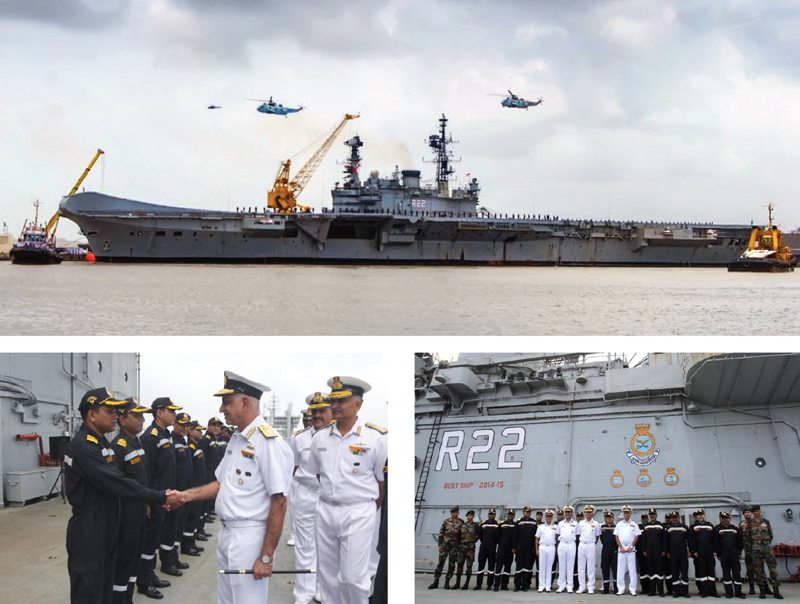
*** Decommissioning of INS Viraat

By Danvir Singh
25 Oct , 2016

As the glorious chapter in the Indian Navy’s history draws to a close, the decommissioning of INS Viraat is a symptom of metamorphism the Indian navy is undergoing.

INS Viraat, originally commissioned into Royal Navy as HMS Hermes in 1959, had served for 27 years before joining the Indian Navy on 12 May 1987. She served as the flag ship of Royal Navy’s task force during Falkland Island campaign in 1982. INS Viraat thus has a distinction of being the oldest serving aircraft carrier in the world spanning over 57 years.

INS Viraat arrived at Kochi on July 24, from Mumbai under its own propulsion: The Final Voyage. Here the warship will be stripped of its weaponry, radars and propulsion systems, before being towed back to Mumbai for the decommissioning ceremony in October, this year end.

Indian Navy aspires to be a three aircraft carrier based blue water navy by 2025. INS Vikrant, a 40,000 tonnes aircraft carrier is likely to join the Eastern Naval Command by 2018. And INS Vishal, a 65000 tonnes carrier likely to be a nuclear powered supercarrier that could join the force by 2025.

Till such time the Indian Navy will have to continue being a single carrier force. INS Vikramaditya that joined the navy in 2013 shall be its Flag Ship. She will carry out this arduous task of domination of Oceans, till the turn of the decade.

** Sharif Vs Sharif: Who Will Win In Pakistan? – Analysis

By Jai Kumar Verma* 
OCTOBER 25, 2016

Recently an article of Cyril Almeida published in Pakistan’s reputed English daily Dawn has exposed the bitterness between the political leadership and the army. Almeida, a fearless journalist, a rare commodity in Pakistan, wrote in the article that the civilian government has warned that Pakistan is being isolated in the world arena because of its position on terrorism. The article also revealed that Punjab Chief Minister Shahbaz Sharif, a younger brother of Prime Minister Nawaz Sharif, pointed out that whenever security agencies took actions against the terror groups or its leaders, security agencies (meaning Inter Services Intelligence-ISI) protected the terrorists. It was also reported that hot words were exchanged between ISI chief and Punjab Chief Minister.

Pakistani Foreign Secretary Aizaz Chaudhry reportedly revealed at the meeting (October 4) that several countries clearly have told Pakistan that action should be taken against Hafiz Saeed, Masood Azhar and terrorist outfits like Jaish-e-Mohammad, Lashkar-e-Taiba and Haqqani network and investigation about the attack on Pathankot Airbase must be completed. China also reportedly suggested to its “all-weather friend” that it should change its policies towards terrorism.

The Pakistan army, which claims itself as the savior of the country, directly ruled the nation for more than 33 years, with the remaining years witnessing a façade of democratic government but the Chief of Army Staff remained the most powerful individual in the state and the army remained the de-facto ruler. The dominant political leaders like Zulfiqar Ali Bhutto and Benazir Bhutto were killed while Nawaz Sharif in his first tenure was overthrown and evicted from the country.

General Raheel Sharif was selected as Chief of Army Staff by Nawaz Sharif and although he has not overthrown him so far but snatched all the powers pertaining to foreign policy towards important countries like India, Afghanistan, United States and also grabbed vital security related matters.