29 October 2016

Does America Know What It's Doing in the Middle East?

October 26, 2016
The United States has been heavily involved in the greater Middle East, including the Persian Gulf, parts of North Africa, the Horn of Africa and Afghanistan in Central Asia, for over forty-seven years. The U.S. foreign policy establishment seems determined to stay there for at least another half century, despite that fact that our strategic objectives are unclear at best, and our ability to achieve much beyond short-term military successes has proved wanting.

U.S. officials established an active military presence in the Persian Gulf in 1979 following the overthrow of the Shah of Iran, and the Soviet invasion of Afghanistan. Subsequently, the worst-case scenarios were averted—the collapse of the House of Saud, a Soviet victory in Afghanistan, and Saddam Hussein in possession of Kuwaiti oil fields. But Americans’ memories are also punctuated by tragedies and setbacks, from the Beirut bombing and the Mogadishu firefight, to the more recent disastrous war in Iraq and the ongoing fight against ISIS. These episodes often overshadow the day-to-day courage and sacrifice, as well as the individual acts of heroism, by the members of the U.S. military tasked with bringing order to a notoriously disordered part of the world.

Taken together, the missteps and follies evoke manager Casey Stengel’s question of the members of the 1962 Mets: “Can’t anybody here play this game?

The difference, among many, is that the Mets were an expansion club, cobbled together from the castoffs from other Major League Baseball teams. The U.S. national security state of 2016 is a well-established juggernaut, nearly seven decades in the making. A team built for both speed and power, and that is able to draw on the vast wealth and talent of the United States of America, shouldn’t strike out so often, or make so many errors in the field.

Pentagon Now Operating Secret Drone Base in Tunisia for Surveillance of Libya

Adam Entous and Missy Ryan
October 26, 2016

U.S. has secretly expanded its global network of drone bases to North Africa

The Pentagon has secretly expanded its global network of drone bases­ to North Africa, deploying unmanned aircraft and U.S. military personnel to a facility in Tunisia to conduct spy missions in neighboring Libya.

The Air Force Reaper drones began flying out of the Tunisian base in late June and have played a key role in an extended U.S. air offensive against an Islamic State stronghold in neighboring Libya.

The Obama administration pressed for access to the Tunisian base as part of a security strategy for the broader Middle East that calls for placing drones and small Special Operations teams at a number of facilities within striking distance of militants who could pose a threat to the West.

U.S. officials, speaking on the condition of anonymity to discuss an operation that has not been acknowledged, said the drones being flown out of Tunisia were unarmed and were principally being used to collect intelligence on Islamic State targets in Sirte, Libya, where the United States has conducted more than 300 airstrikes since August.

U.S. officials said they sought access to the air base in Tunisia to close a critical “blind spot” for U.S. and Western intelligence services­ in North Africa, which has become the Islamic State’s largest base of operations outside of Syria and Iraq. The region is also home to al-Qaeda-linked fighters.

Is US reconsidering its support for Saudi Arabia in Yemen war?

Author Maysaa Shuja al-Deen
October 25, 2016

Saudi Arabia’s missile attack on a funeral hall crowded with hundreds of people in Sanaa on Oct. 8 is seen as the deadliest rocket attack on civilian targets in Yemen, killing and wounding 700 people. Meanwhile, the death toll of the war on Yemen has risen to 10,000 victims.
Summary⎙ Print The recent missile attacks on US vessels off Yemen’s coast as well as the limited US response suggest that Washington may be disengaging from the war in Yemen and putting pressure on Saudi Arabia to follow suit.

TranslatorSahar Ghoussoub

This deadly attack led to international condemnation, returning attention to Yemen’s war, which has been raging for more than 1½ years. Initially, Saudi Arabia tried to deny its responsibility for the attack, claiming that it was a suicide bombing, but later admitted it bombed the funeral hall based on wrong information from its Yemeni allies.

The attack not only caused shocking human casualties, but has also reduced the chances of a political settlement, as the Saudi-led campaign targeted the funeral of the father of Jalal al-Rowaishan, the interior minister in the government formed by the Houthi-Ali Abdullah Saleh alliance in Sanaa two days earlier.

The funeral was attended by top security and military leaders in the Houthi-Saleh alliance. The attack led to the death of some moderate politicians. Three officials in the UN Pacification Commission were killed, in addition to a neutral military officer, head of the Yemeni Republican Guard Ali al-Jaifi, who was likely to play an important role in the postwar period as a military leader acceptable to all parties. Abdul Qader Hilal, the mayor of Sanaa, was another consensual figure in Yemen who was among those killed.

The inconvenient reality behind the long, messy battle for Mosul: a special report

By Anshel Pfeffer 
Oct 26, 2016
Iraqi soldiers in the Qayyarah area, some 60 km (35 miles) south of Mosul, October 19, 2016.

The mainly Shi'ite Iraqi Army and the ill-equipped Kurdish Peshmerga are fighting independently and on separate fronts in an effort to recapture the Sunni city from ISIS ■ Part 1

Dawn of ISIS: How the Islamic State took power in Iraq and Syria

BASHIQA, IRAQ – The campaign to capture Iraq’s second-largest city Mosul from the Islamic State is, at this stage, less a battle than a series of simultaneous skirmishes by relatively small units, at a distance from the city itself. And the force attempting to recapture the city, once the center of oil production in Iraq, is not a unified army but two separate formations – the mainly Shi'ite Iraqi Army and the Kurdish Peshmerga – divided by deep rivalry, if not enmity.

The two forces are watching each other closely, as they make slow – and separate – progress toward Mosul itself. The campaign is in its second week and so far they are still miles away from their target, on independent front lines.

The sophistication of the American Apache helicopter gunships hovering high over the frontlines – sighting targets kilometers away with advanced sensors and firing Hellfire guided missiles – belies the antiquated nature of the Peshmerga’s armaments. The Iraqi army may be armed by the United States, but the Kurds are reliant on Soviet-era weapons and hand-me-downs.

In addition to their old Kalashnikov rifles, the main firepower of the Kurds is provided by ancient Dushka machine guns mounted on Japanese pickups, small cannons dragged into position by civilian trucks and one Grad missile launcher. New American-supplied TOW anti-tank missiles and Barret heavy sniper rifles are among the few weapons to have trickled down from the Iraqi Army.

We go to war so you don’t have to

by ROBERT BECKHUSEN

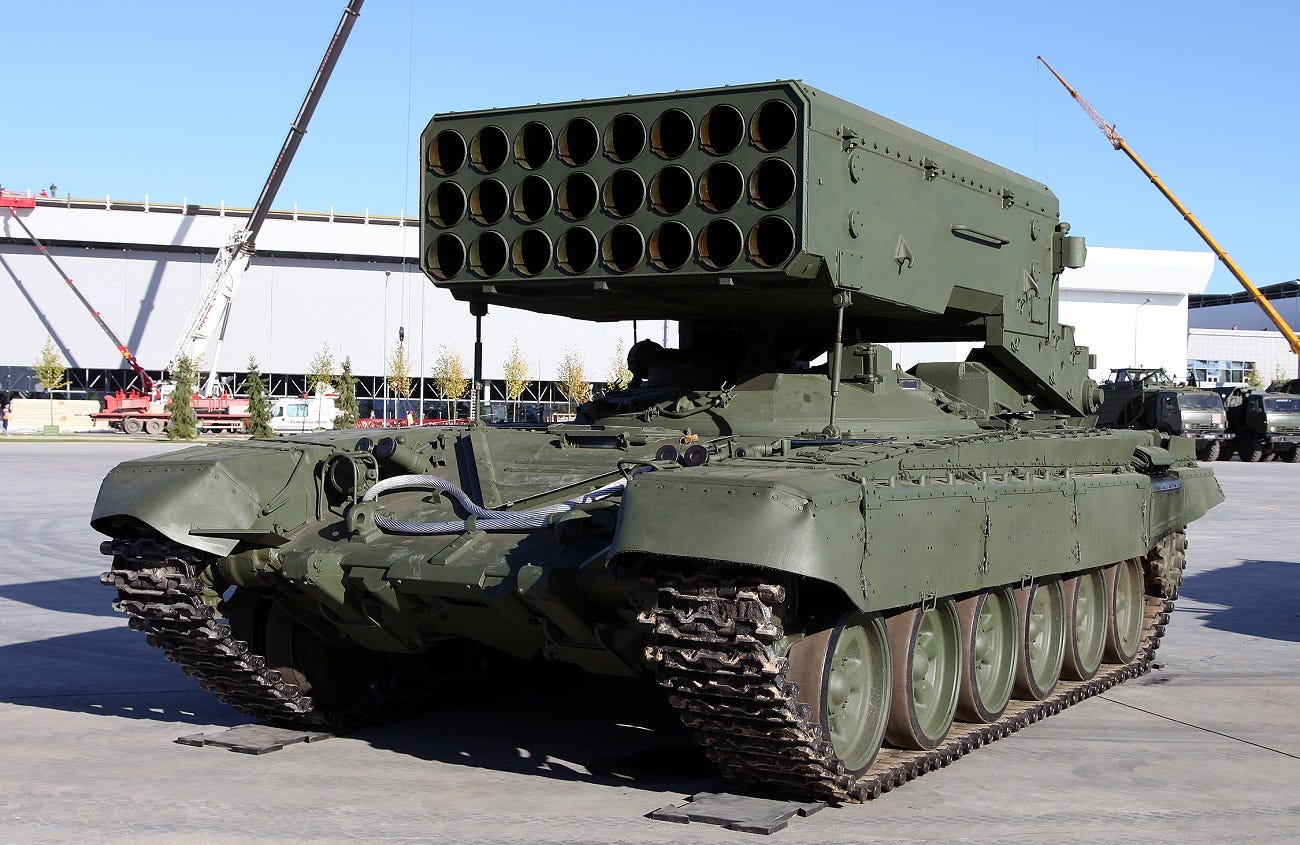
Iraqi troops fighting for Mosul’s outskirts have brought along one of their most fearsome weapons — the 60-ton, Russian-made TOS-1A Buratino.

A photograph and tweet from the Jerusalem Post’s Seth Frantzman shows Iraqi troops posing with the rocket launcher near Bartella, a battle-scarred Assyrian Christian town less than 10 miles from Mosul. Iraqi Counter-Terrorism Service troops took over the town on Oct. 20, one of dozens freed since the offensive began Oct. 16.

But Mosul is different as Iraq’s densely populated, second largest city. And the Islamic State has had more than two years to plan and prepare ambushes, tunnels and improvised explosive traps.

“They’ve had a long time to prepare for that fight, so all of that we’re going to contend with here very, very soon,” Gen. Joseph Votel, commander of U.S. forces in the Middle East, told NBC News during a visit to an American forward base.

Which might explain why Iraq brought along its TOS-1As. See, the Buratino — meaning Pinocchio — is unlike conventional artillery which lob high-explosive shells at long ranges. It’s more terrifying than that.

The TOS-1 is relatively shorter range and kills almost entirely with pressure.

US and allies prepare to take Raqqa from Isis as battle for Mosul continues

Spencer Ackerman 


26 October 2016 

Defense secretary says attack on Raqqa will begin ‘in the next few weeks’ as US seeks to deprive Isis of its capitals in Iraq and Syria almost simultaneously

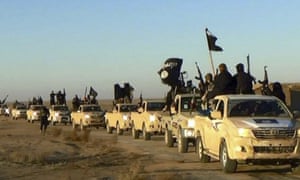
Isis militants hold up their weapons and wave flags on their vehicles in a convoy on a road leading to Iraq, in Raqqa, Syria.

Before Iraqi forces and their US backers have set foot in Mosul, the US and its allies have begun preparations to imminently wrest the Syrian city of Raqqa from the Islamic State, a momentous decision aimed at destroying what is left of Isis’s self-declared caliphate.

Although senior US defense officials and military officers insisted that “overlapping” operations to capture both cities from Isis had always been planned, preparations to take Raqqa are proceeding with “urgency”, the US commander in Iraq said on Wednesday, because of a credible threat of retaliatory Isis terrorism outside the Middle East.

Accordingly, US military officials planning the Raqqa fight have yet to resolve major geopolitical complications within their own coalition, particularly those involving the Kurdish force the US has relied upon in Syria and its enemy, Nato ally Turkey, which wants a substantial role in the operation.

The US defense chief, Ashton Carter, meeting in Paris with his counterparts in the anti-Isis coalition, vowed that Iraqi forces, Syrian Arab and Kurdish allies and US special operations troops and airpower could take away Isis’s Iraqi and Syrian capitals practically simultaneously.

NATO Boosts Eastern flank To Reassure Nervous Allies – Analysis

By Ana Maria Luca 
OCTOBER 28, 2016
The Western alliance has taken a significant step towards upping defensive capacities along its entire eastern flank amid growing concerns about Russia.

NATO member state officials meeting in Brussels agreed to boost the alliance’s military presence along its entire eastern flank from Bulgaria to the Baltics.

Romania and Bulgaria will both host an increased air force presence, designed to undertake surveillance missions over the Black Sea.

It is the biggest NATO deployment since the Cold War and comes as Russia pushes on with its biggest naval deployment since the Cold War, with the Admiral Kuznetsov, Russia’s only aircraft carrier, leading a convoy of eight ships towards the Eastern Mediterranean along the European coast.

This month, Russia also deployed nuclear-capable missiles in Kaliningrad on the Baltic, increasing nervousness in Poland and in the Baltic states. Last month, Russia suspended a weapons-grade plutonium agreement with the United States.

Tensions between the West and Russia have mounted since Russia annexed Ukraine’s Crimea region in 2014, as a result of which Western countries imposed sanctions on Moscow.

Obamacare Is Dying. House Republicans Have the Fix.

October 26, 2016

President Obama and his administration use every opportunity to boast about his flagship domestic legislation, the Affordable Care Act (ACA), also known as “Obamacare.” These near-weekly public relations efforts aim to convince the American public that the program has been a success. The administration frequently references the increased number of people with insurance in these efforts, despite the fact that enrollment numbers are not even half of the original projections, and still emanate primarily from the law’s Medicaid expansion. The number of people enrolled into a government program is not the right basis for judging success. Health care systems are intended to treat and heal people, so what fundamentally matters, and what the administration has said little about, is how the people who need health care are being treated. Access to care, medical outcomes, and cost are the metrics that matter, and on these fronts, although Obamacare is just a few years old, the administration has little to brag about.

The administration’s focus on insurance coverage is understandable, because this is essentially the only Obamacare metric that is improving. Yet, as coverage numbers rise, all major insurance companies have been forced to scale down participation in the individual market. As the relatively healthier young adult population fails to sign up for coverage at the rate the administration needs to help balance out costs, United Health Care, Humana, Aetna, and BlueCross BlueShield have had to pull out of many insurance markets due to heavy financial losses. Numbers released for the start of Open Enrollment next week, show an average of three insurers per county in 2017, down from five in 2016. HHS officials confirmed that one in five people living in states using HealthCare.gov will only have a single carrier to choose from next year. This is not what the president promised America.

Why Russia Should Not Be Feared in the Arctic

October 26, 2016

Anyone who’s paid any attention to media coverage of the Arctic, even just in passing, knows that there’s a battle brewing for the top of the world. Climate change is melting the region’s protective shield of ice and opening its vast lands, seas, and associated bountiful natural resources to human activity. But Arctic states don’t agree on how these prizes should be divided, with many proffering overlapping claims to the far north. As such, the dominant Arctic narrative presents the region as one to be scrambled to and claimed, and even fought for. Headlines touting a “Race for the Arctic” and a “New Cold War”—and yes, even a “Battle for the Arctic”—pervade Arctic discourse and are often how the public and policymakers are exposed to the region.

In this narrative, Russia and its robust Arctic presence are regularly trotted outto dramatize the situation and present as an ominous reason for other countries to more proactively turn their attention and investments northward. The frequent comparisons between Russia and the United States are good examples of this practice: Russia has over 40 icebreakers while the United States has only two; Russia is massively upgrading its Arctic military capabilities while the United States remains relatively stagnant; etc. If the United States doesn’t shift into high gear Arctic-wise, the implication is that Russia will follow its horde of icebreakers to conquest and riches while America simply looks on.

Russia Reveals Its New SATAN-2 ICBM

Mchael Nunez
October 26, 2016

Russia Reveals ‘Satan 2’ Nuclear Missile Capable of Destroying Texas in One Blow

Russia is flexing its military muscle as tensions with the US simmer in the wake of a heated third presidential debate, where Democratic candidate Hillary Clinton called Republican candidate Donald Trump a “puppet” for Russian President Vladimir Putin. Now, Russia has declassified the first image of its new thermonuclear intercontinental ballistic missile.

The RS-28 Sarmat missile—better known as the Satan 2 nuclear missile—has finally been revealed after years of being hyped by the Russian government. According to a Russian publication aligned with the Kremlin called Sputnik, the super-nuke has a payload capable of destroying an area “the size of Texas.”

The new weapon can deploy warheads of 40 megatons, or about 2,000 times as powerful as the bombs dropped on Hiroshima and Nagaski in 1945.

Former assistant secretary of the Treasury for Economic Policy Dr. Paul Craig Roberts called the atomic bombs that Washington dropped on Japan “popguns” compared to today’s thermo-nuclear weapons. “One Russian SS-18 wipes out three-fourths of New York state for thousands of years,” he said in a blog post. “Five or six of these ‘Satans’ as they are known by the US military, and the East Coast of the United States disappears.”

To make it even more frightening, the Satan 2 is also capable of evading radar defenses and could travel far enough to strike the US East and West Coast.

The Return of Containment

DOMINIQUE MOISI
OCT 26, 2016 

VENICE – “The main element of any US policy towards the Soviet Union must be that of a long-term, patient but firm and vigilant containment,” the US diplomat George Kennan wrote in 1947 in aForeign Affairs article, famously signed “X.” Replace “Soviet Union” with “Russia,” and Kennan’s “containment policy” makes perfect sense today. It is almost as if, in nearly 70 years, nothing has changed, even as everything has.

Of course, the Soviet Union has been, one might say, permanently contained. But Russia is showing the same “expansive tendencies” of which Kennan warned. In fact, today, the level of trust between Russia and the “West” is at its lowest point since at least the end of the Cold War. According to Vitaly I. Churkin, Russia’s ambassador to the United Nations, the current tensions “are probably the worstsince 1973,” when the Yom Kippur War brought the United States and the Soviet Union closer to a nuclear confrontation than at any time since the Cuban Missile Crisis.

Such pessimism is warranted. This year alone, the sources of discord with Russia have multiplied and deepened. Russia has withdrawn from a number of nuclear agreements, and the Kremlin recently placed Iskander missiles, which can transport medium-range nuclear devices, in Kaliningrad, near the Polish border.

Moreover, the Ukrainian crisis is far from resolved: the Minsk ceasefire agreements are not respected, and armed conflict may escalate at any moment. And it seems likely that Russia has been intervening directly in the internal politics of Western democracies, using leaks of sensitive documents and financing right-wing populists, from Marine Le Pen to Donald Trump, who would be supportive of the Kremlin.

A New Foreign Policy Strategy: U.S. the Meddler

October 25, 2016

They are so recent, and yet they seem so far away; those 20-odd years during which the United States happened to be the sole hegemon of global stature. Now, a new cold war between Moscow and Washington is taking shape at an alarming pace. Never, since the Cuban missile crisis in October 1962, has direct military confrontation between Russia and the United States -- and not only conflict through proxies -- appeared to be as plausible as it looks today.

Then you have China, whose sovereignty claims over the South China Sea pose a major challenge to U.S. allies in that region and, consequently, raise the specter of a military showdown involving the United States.

Given the profound readjustment of the international balance of power that has taken place during the past few years, the methods of dealing with crises and conflicts will have to be thought of afresh, and adjusted to the new circumstances.

Abandoning past pretense

We need to essentially abandon a basic postulate of U.S. foreign policy, namely that America’s involvement in world affairs can and should be geared toward the resolution of conflicts.

That postulate doesn’t work in the emerging multipolar order, for one simple reason: The priority of the contending powers -- Russia and China -- is to expand their weight and influence, and edge out as much as possible the leading hegemon, the United States. (Yes, the struggle for primacy is a zero-sum game.) Those powers are less interested, if at all, in preventing or solving conflicts than they are in playing the gadflies of the United States.

Russia Drops Bid to Dock Ships at Spanish Port as NATO Adds Pressure

By RAPHAEL MINDER and SEWELL CHAN

OCT. 26, 2016

The Russian aircraft carrier Admiral Kuznetsov near Norway last week. Moscow sent the carrier and several other vessels through the English Channel on Friday. CreditNorwegian Royal Airforce, via NTB Scanpix/Reuters

MADRID — Russia abruptly withdrew its application on Wednesday to dock three warships for refueling at a Spanish port, shortly after Spain’s partners in NATO urged Spain to turn away the vessels. The ships are heading to the eastern Mediterranean Sea to support Russian military operations in Syria.

Russia’s intention to dock the three warships, which were said to include its only aircraft carrier, the Soviet-era Admiral Kuznetsov, at Ceuta, a Spanish enclave on the north coast of Africa, was first reported in the Spanish news media on Tuesday evening.

The development set off alarm bells among the alliance defense ministers, who gathered in Brussels on Wednesday for a two-day meeting and warned Spain not to let the Russian ships dock.

“We’d be extremely concerned that any NATO member should consider assisting a Russian carrier group that might end up bombing Syrian civilians,” Britain’s defense secretary, Michael Fallon, told reporters. “On the contrary, NATO should be standing together.”

The Atlantic alliance’s secretary general, Jens Stoltenberg, told reporters that while Russia had the right to operate in international waters, the situation at Ceuta was different because of concerns that the aircraft carrier group would mount strikes on the Syrian city of Aleppo.

Philippine leader Duterte now wants U.S. troops out ‘in the next two years’

By Simon Denyer 
October 26 2016

Philippine President Rodrigo Duterte reiterated his desire to end military relations with the U.S. on Oct. 26, saying, "I want in the next two years my country free of the presence of foreign military troops, I want them out...This will be the last maneuver, war games between the United States and the Philippines military." (Reuters)

BEIJING — Philippine President Rodrigo Duterte said Wednesday he wanted U.S. troops out of his country, perhaps in the next two years, underlining his intention to press ahead with a major realignment of his country’s foreign and security policies.

It is not the first time Duterte has made this kind of threat, but his two-year timetable for a U.S. military exit appeared designed to reinforce his break-the-mold message to Washington and neighbors in Asia, particularly powerhouse China.

So far, however, his administration has failed to follow through on previous pledges to remove a small contingent of U.S. counterterrorism troops from the southern island of Mindanao or to notify Washington of an end to military exercises.

The United States “has received no formal communication from the government of the Philippines expressing a desire to make specific changes to our relationship or alliance,” White House press secretary Josh Earnest said Wednesday at a news briefing in Washington. “The United States remains committed to our pursuit of shared objectives” in keeping with the “seven-decade alliance between our two countries,” he said.

Earnest said Duterte’s comments appear to be “rhetoric at this point,” although they do “contribute to some uncertainty.” He said there were no plans yet for President Obama to meet with Duterte at an Asia-Pacific Economic Cooperation forum in Peru next month, but he did not rule it out.

Global Reactions to Clapper's "Lost Cause" Statement on North Korean Nuclear Weapons

October 26, 2016

Getting North Korea to give up its nuclear weapons program has long been the holy grail of multilateral diplomacy with Pyongyang. So, now that the U.S. intelligence director has publicly stated that he thinks it's probably a "lost cause," how are North Korea's neighbors responding?

National Intelligence director James Clapper said Tuesday that the U.S. goal of persuading North Korea to abandon its nuclear weapons is probably a lost cause and the best hope is to cap its capability.

Bold and surprising as Clapper's words may be for a senior U.S. official, even in a private forum, it's what many experts around Asia have assumed, or feared, for quite a long time. And some are welcoming the candor as a step toward a more effective — and coordinated — regional approach.

A sampling of initial reactions:

SOUTH KOREA

At first thought, it would seem Seoul might be the first to react strongly to Clapper's seemingly pessimistic position and the potentially far-reaching policy implications it could have.

But it barely got a yawn in South Korea.

Seoul, like Washington, officially says it will never accept North Korea as a nuclear power. An unidentified government official told the Yonhap news agency that Seoul and Washington remain strongly committed to ending the North's nuclear program.

Truth is, Seoul has other things on its mind right now.

Brian Regan: The Spy Who Could Not Spell

Yudhijit Bhattacharjee
October 26, 2016

The spy who couldn’t spell: how the biggest heist in the history of US espionage was foiled

The classrooms and hallways of Farmingdale High in Long Island were deserted on the morning of Saturday 19 August 2001, when a van pulled into the school’s parking lot. Turning off the engine, the driver – a tall man in his late 30s – stepped out into the warm summer sun. He cast a sweeping gaze upon the institution he had graduated from two decades earlier.

Whatever nostalgia he might have felt for his old school was tinged with bitterness. It was here that he had suffered some of life’s early humiliations: taunted by classmates for his apparent dimwittedness; held in low esteem by his teachers. If they remembered him at all, they would remember him as the boy who had difficulty reading. The boy who was so bad with spellings. His bearish frame may have protected him from physical bullying, but combined with his severe dyslexia and his social awkwardness, it had also cemented his image as a dolt. 

That image had stuck with him, despite a successful career in US intelligence, where he had been given access to some of the country’s most valued secrets. Being underestimated – by family, classmates and colleagues – had been the theme of his life, a curse he had borne silently since childhood. But for the mission he had now embarked upon, it was a blessing. None of his co-workers or managers in the intelligence community could have imagined that he of all people was capable of masterminding a complex espionage conspiracy.

From the parking lot, he walked to the edge of the school grounds. Squeezing through a hole in the barbed wire fence next to the handball courts, he stepped into a wooded area that separated the nearby highway from the school perimeter. Walking a few yards, he stopped by a tree and dug a hole in the ground. He took a laminated list of phone numbers out of his pocket and buried it there before walking back to his van, confident that nobody had seen him.

So Much for Transparency: Obama Administration Does Not Want to Release Yahoo Email Scanning Order

October 26, 2016

Yahoo scanning order unlikely to be made public: sources

WASHINGTON (Reuters) - Obama administration officials briefed key congressional staffers last week about a secret court order to Yahoo Inc YHOO.O that prompted it to search all users’ incoming emails for a still undisclosed digital signature, but they remain reluctant to discuss the unusual case with a broader audience.

Executive branch officials spoke to staff for members of the Senate and House of Representatives committees overseeing intelligence operations and the judiciary, according to people briefed on the events, which followed Reuters’ disclosure of the massive search.[nL2N1C601L]

But attempts by other members of Congress and civil society groups to learn more about the Yahoo order are unlikely to meet with success anytime soon, because its details remain a sensitive national security matter, U.S. officials told Reuters. Release of any declassified version of the order is unlikely in the foreseeable future, the officials said.

The decision to keep details of the order secret comes amid mounting pressure on the U.S. government to be more transparent about its data-collection activities ahead of a congressional deadline next year to reauthorize some foreign intelligence authorities.

On Tuesday, more than 30 advocacy groups will send a letter to Director of National Intelligence James Clapper asking for declassification of the Yahoo order that led to the search of emails last year in pursuit of data matching a specific digital symbol.

The Philippines Are Just a Symptom of America's Asia Pivot Problem

October 26, 2016

A Filipino economist living in Washington jokes ruefully he can no longer “escape from global craziness.” It’s 24/7, he explains. In the morning, “it’s Donald Trump’s latest antics, but when it’s nighttime here, it’s morning in Manila”—meaning more bad news about the Philippines’ Trump-like new president, Rodrigo Duterte.

Duterte’s recent antics in Beijing—declaring a still-vague “separation” from, and diatribes against, the United States, and in return coming home with an announced $13.5 billion goody bag of pledged loans and investments—form the most extreme segment of a downbeat narrative complicating Southeast Asian politics.

This trend is evident across Southeast Asia. In Malaysia, a major corruption crisis is paralyzing the government; to distract the populace, the ruling party flirts with hardline Islamist changes to the penal code. In neighboring Thailand, backroom maneuvering within the military junta after the long-serving monarch’s death has created more angst and uncertainty, and U.S. prodemocracy and human-rights concerns are set to drive the junta further into China’s arms.

But it doesn’t end there. In Myanmar, de facto prime minister Aung San Suu Kyi cannot steer a vital reform agenda past entrenched military and business interests. Prickly authoritarian regimes in neighboring Cambodia and Laos stifle dissent. In the region’s biggest country, Indonesia, the populist president, Joko Widodo, has lost vital reform momentum.

Unfortunately, America’s “rebalance” strategy has to garner support from within this unpromising regional environment. Duterte’s vulgarity (he recently called President Obama a “son of a whore”) may set new lows, but the tone and depth of other longstanding U.S. relationships in Asia are also at risk.

CLINTON-CARTWRIGHT COMPARISONS DON’T HOLD UP

OCTOBER 27, 2016

In the third and, thankfully, final presidential debate of the 2016 cycle, Republican nominee Donald Trump doubled down on his contention that his Democratic opponent, Hillary Clinton, “should never have been allowed to run for the presidency based on what she did with e-mails and so many other things.” He had some new ammunition: a former Vice Chairman of the Joint Chiefs of Staff, retired Marine General James “Hoss” Cartwright, had just been criminally charged in relation to leaking classified information. While there are surface similarities, however, the cases are quite different.

We have a great general, four-star general, today you read it in all the papers going to potentially serve five years in jail for lying to the FBI, one lie. She’s lied hundreds of times to the people, to Congress, and to the FBI. He’s going to probably go to jail. This is a four-star general, and she gets away with it and she can run for the presidency of the United States?

Josh Rogin of The Washington Post took a similar position in an article headlined “General Cartwright is paying the price for Hillary Clinton’s sins.” He contends, “The FBI’s handling of the case stands in stark contrast to its treatment of Hillary Clinton and retired General David Petraeus — and it reeks of political considerations.”

He cites Steven Aftergood, director of the Project on Government Secrecy at the Federation of American Scientists, who argues, “There is a lack of proportion just based on the facts that one figure, Cartwright, is getting severely punished and others so far have escaped the process,” adding, “He is being singled out for prosecution and public humiliation. It’s an implicit rebuttal to those who argued that other senior officials such as Clinton or Petraeus got off scott free or got too light of a sentence.”

Cartwright’s sentencing reportedly will not take place until January 17, making a full comparison difficult. Still, the cases are sufficiently different to make Trump and Aftergood wrong on the merits.

HOW CHURCHILL PAVED THE WAY FOR NATO’S STANDARD AMMUNITION

OCTOBER 27, 2016

At the beginning of World War II, the United States was the only nation that equipped its soldiers with semi-automatic rifles as their standard issue service rifle — in this case, the M1 Garand. These semi-automatic rifles provided greater firepower as they did not require the rifleman to manually cycle the weapon’s action as with earlier bolt action rifles. By the end of the war, the small arms capabilities of the major powers had rapidly evolved. Fire superiority and combined arms tactics had come to dominate the battlefield. Both the Soviet Union and Germanydeveloped their own semi-automatic rifles during the war. While this increased the average infantryman’s firepower dramatically, Germany also developed a new kind of infantry weapon: the assault rifle. This concept combined the high rate of fire and controllability of pistol-caliber submachine guns with the range and accuracy of a standard infantry rifle, creating a weapon which could be fired fully automatically like a submachine gun, but remained accurate to ranges up to 400 meters. This was well within the typical combat distances that fighting was found to take place at during World War II. This new type of rifle ushered in a revolution in infantry small arms, profoundly changing how future wars would be fought. The German MP43/StG44 assault rifle fired a new kind of smaller “intermediate” ammunition. In terms of stopping power, this was halfway between a full-power rifle round and a small-caliber pistol round. This compromise reduced recoil rendering assault rifles more controllable in full automatic mode.

Britain had initially considered the adoption of a semi-automatic rifle to replace the increasingly obsolete bolt action Lee-Enfield. However, learning from German and Soviet experiences on the eastern front, the British were determined to develop their own assault rifle, as revealed in a 1945 21st Army Group report entitled, Final Report of Small Arms Effectiveness for Western Campaign WW2 from D-Day to VE Day, that can be found today in the Royal Armouries Library. Influenced by the new German weapons, teams at the Armaments Design Establishment began work on their own intermediate ammunition and new assault rifle designs. By 1949 they had developed their own intermediate cartridge and an advanced new rifle to fire it.

Book Reveals New Details About the Spy War in Australia During the Cold War

Katie Burgess
October 26, 2016

Spies waged a secret war on the streets of Canberra, author of new book on ASIO says

It was a secret war waged in Canberra’s bars, parks and streets that makes today’s spy thrillers look “pale by comparison”.

The third and final volume of the explosive history on ASIO, The Secret Cold War has revealed the extent of the espionage in the nation’s capital in the late 1970s to mid-1980s in many places Canberrans will recognise.Dr John Blaxland co-wrote The Secret Cold War:The Official History of ASIO 1975-1989. Photo: Jamila Toderas

Australian National University academic John Blaxland co-wrote the official history of the spy agency from 1975 to 1989 with Australian War Memorial historian Rhys Crawley.

In a period punctuated by the Sydney Hilton Hotel bombing and the Combe-Ivanov affair, Dr Blaxland said there was enough espionage and counter espionage around the suburbs of Canberra “to make recent TV shows pale by comparison”.

“People don’t quite appreciate how much was going on in Canberra; in the restaurants, in the cafes, in the bars, in Manuka, in Kingston, in Deakin, in Yarralumla and Red Hill, in parks around near the Soviet Embassy, around the Chinese Embassy,” Dr Blaxland said.

“Russian spys waiting for a meet, a pre-arranged contact to turn up to drop something off or have a brush-past – this was the kind of thing that was happening in the Manuka shops, around the embassies and it was happening in front of our very eyes without us realising what was going on.”

What Happens to Guardsmen Who Repaid Bonuses?

by Brendan McGarry
Oct 25, 2016 

As the Pentagon's top civilian vowed to "resolve" a policy in which Guardsmen were ordered to pay back bonuses, questions swirled about what happens to the hundreds of troops who already returned the money.

An estimated 10,500 service members, mostly from the California National Guard, received enlistment bonuses of as much as $15,000 designed to address a personnel shortage in the ranks a decade ago during the peak of the U.S.-led wars in Iraq and Afghanistan.

But the money, which collectively totaled about $22 million, was improperly awarded and troops were ordered to pay it back or face such penalties as interest charges and tax liens, according to a story first reported by David Cloud, a reporter for The Los Angeles Times.

Now, as Pentagon officials and lawmakers consider waiving the debt, it remains unclear whether the fix will somehow accommodate the roughly 1,500 troops who either repaid the money or started the repayment process.

"How do you go back and address soldiers that have paid money back when we start alleviating debts of other soldiers? That's what makes this a very complex issue," Col. Peter Cross, director of public affairs for the California National Guard, said on Tuesday during a telephone interview with Military.com.

"I don't have an answer," he added. "It's going to take some very precise language and studying of the issue to make everybody whole again. Otherwise, you're going to have disparate treatment of soldiers."

Have you been ordered to pay back an enlistment bonus? We'd like to hear from you. Please contact us.

Navy outlines a path forward on unmanned systems

By: Mark Pomerleau, 

October 26, 2016 

The Navy's deputy assistant secretary for unmanned systems has outlined the service's eight goals for the technology on the first day of the Unmanned Systems Defense conference in Arlington, Virginia. 

Frank Kelley spoke at the forum Tuesday, where he emphasized that the Navy is not interested in unmanned systems for unmanned systems sake, but is seeking technology that can smoothly integrate with other programs and platforms. 

The service has signaled that it is all in when it comes to unmanned systems. Last year, the Navy announced Kelley's position to help guide the force toward realizing a future full of robots. The Navy has been at pains to stress it is looking to take a domain-agnostic approach to these systems. 

Kelley's goals, supplemented by other speakers at the event: 

Achieve air dominance:

Kelley said this will initially be done with manned platforms. They Navy has also announced its carrier-based, long-range unmanned platform — the MQ-25A Stingray — which will serve as a stealthy aerial refueler allowing penetrating manned platforms such as the F/A-18 to travel greater distances, as anti-access/area denial regions (despite the chief of naval operations issuing an outright ban on this term) will push carriers farther away from certain areas, forcing a need to extend range of aerial platforms. 

Achieve undersea superiority : 

IRGC to Expand Basij Special Forces

October 26, 2016

The Islamic Revolutionary Guard Corps (IRGC) held a commemoration ceremony in Tehran on Friday for members of the Fatehin (“Conquerors”) Special Unit of the Basij paramilitary killed in combat in Syria. IRGC chief commander Maj. Gen. Mohammad Ali Jafari praised the Fatehin battalion, reaffirming ongoing plans to establish these units beyond Tehran province and across the country. Jafari told the media that he had given a report to the supreme leader about the expansion of the Fatehin.

Earlier this year, the commander of the IRGC’s Mohammad Rasulollah unit (Greater Tehran) signaled plans to expand these units, making the announcement at a ceremony commemorating the Fatehin who have fallen in Syria. The Fatehin unit of Qom province held its first drill in September. The drill’s motto was “the path to Jerusalem goes through Karbala,” first proclaimed by Ayatollah Ruhollah Khomeini, founder of the Islamic Republic, during the Iran-Iraq war.

The IRGC commanders who delivered remarks at the ceremony on Friday in Tehran proclaimed that without the sacrifice of all Iranian-backed combatants in Syria, instability would spread to Iran.

“There’s not a day we do not hear about murder and explosion in neighboring countries and Europe,” Fatehin Commander Mahmoud Hashemi said on Friday.

The Basij, also known as the Organization for the Mobilization of the Oppressed, is an all-volunteer force that serves as auxiliary to the IRGC Ground Forces, as well as internal morality police and recruitment pool for the Guard. The IRGC Tehran unit established the Basij Fatehin some time in 2009 or 2010. The decision to establish the unit was likely made following the 2009 post-election protests, during which the IRGC and the Basij led a crackdown on protesters. The Fatehin has participated in IRGC drills held in Tehran, during which units practiced exercises to suppress mass protests and unrest. The Fatehin receive advanced training courses such as airborne and parachute, in addition to heavy ideological indoctrination. In Sept. 2015, the IRGC established a Fatehin sniper unit.