1 December 2017

Why the Next US Recession Could Be Worse Than the Last

BY JACOB SHAPIRO

Before we begin, I’d like to offer a hearty thanks to the thousands of you who responded to the survey we issued last week. If you haven’t responded yet, don’t worry – there’s still time. The goal of the survey is to figure out what you, the readers, want to read. At the end of the month, we’ll produce a video series addressing the top three topics you have chosen. You can access the survey and let us know what’s on your mind by clicking here. Thank you in advance for your time and your thoughtfulness, and to those of you celebrating in the US or in the world, Happy Thanksgiving.

RUSSIA JUST LOST A BRAND-NEW SATELLITE AFTER MYSTERY GLITCH DURING ROCKET LAUNCH

Damien Sharkov

The launch of Russia’s newest satellite—its second ever from a multibillion-dollar spaceport unveiled last year—has failed to reach target orbit, state news agency Itar-Tass reports. The exact fate of the satellite launched in the early hours of Tuesday morning is unclear, but the Russian space agency Roscosmos confirmed by noon local time that they are not receiving signal from Meteor-M 2-1. Mission control is investigating the reason for that, but reports from sources within the agency—speaking on the condition of anonymity—suggest the rocket went awry.

Russia's New Sukhoi Su-30SM1 Fighter: Could It Crush America's Best Fighters?

Dave Majumdar

The Russians have been modifying other aircraft including the Su-35 Flanker-E and Su-34 Fullback bomber to correct issues they have discovered operating in Syria. The Russians are expected to take delivery of some 17 Su-30SMs this year. Together with the Su-35S and the Su-34 Fullback bomber, the potent multirole fighter will form the backbone of the Russian Air Force even after advanced aircraft such as the Sukhoi T-50 PAK-FA enters service. 

Russia has developed a new modernized version of the Sukhoi Su-30SM Flanker-H that features upgraded avionics and weapons.

Negotiating the EU's Future on Even Ground

By Adriano Bosoni

From its very inception, the European Union has depended on the alliance between France and Germany. The bloc's predecessor, the European Economic Community, formed with the principal goal of binding the two countries together so closely that another war on the Continent would be impossible. And from the 1950s on, a tacit agreement underlay their partnership: France was the main political and military power in the bloc, and Germany was the main financial supporter (paying for, among other things, onerous subsidies for French farmers). After German reunification in 1990, France even pushed for the creation of the euro as another way to strengthen Paris’ links with Berlin.

Cyber and Space Weapons Are Making Nuclear Deterrence Trickier

BY JAMES MILLER RICHARD FONTAIN

Stability was an overriding concern at last week’s Senate Foreign Relations Committee hearing on nuclear command authority, the first in four decades. Senators wondered aloud whether one individual — the American president — should have the sole authority to direct a nuclear attack. The focus is understandable, but there are other challenges to nuclear stability that deserve more attention than they’re getting.

The Leap into Quantum Technology: A Primer for National Security Professionals

By Michael Biercuk and Richard Fontaine

China recently announced the launch of its Jinan Project, a quantum information effort billed as “the world’s first unhackable computer network.” Building on its launch last year of the world’s first quantum-enabled satellite, China has made significant strides in quantum technology, a field with rapidly increasing relevance to national security. Its satellite has been hailed as a major step toward “unbreakable” encrypted communications.

Are we at cyberwar?

By: Mark Pomerleau 

We hear a lot about the threat of cyberwar. But do recent cyber breaches perpetuated by Russia and other adversaries mean we’re already there? Given the scale and scope of cyber hacks in the last five years, many would argue that there is a global cyberwar afoot.  However, defining the problem is important in order to get to meaningful solutions. From a military perspective, the Air Force is at war all the time given that adversaries are trying to deliberately affect their missions, Frank Konieczny, the service’s chief technology officer, said at the CyberCon conference in Arlington hosted by Federal Times.

High-End Warfare Requires Changes to the Combat Logistics Force

By Michael Fitzgerald  Brendan Pigott

The views expressed in this article are those of the authors and do not necessarily represent the views, policy, or position of Military Sealift Command, the Department of the Navy, the Department of Defense or the U.S. Government. The U.S. Navy has a proud history of successful battle logistics at sea. As the key developer of underway replenishment technology, the Navy has benefited from its underway replenishment capabilities for more than a century. Essential to the history of underway replenishment is a group of vessels known as fast combatant support ships (designated T-AOEs). These ships are multiproduct replenishment vessels capable of providing the fuel, stores, and ammunition needed to sustain a carrier strike group at sea. Other auxiliary ships currently supporting naval logistics are the fleet replenishment oilers (T-AOs) and the dry cargo/ammunition ships (T-AKEs) that can carry an assortment of goods, but specialize in the carriage and delivery of a single product.

Data protection framework: Srikrishna Committee suggests 7 key principles, setting up of authority

by Krishn Kaushik 
Source Link

Finding a balance between the rights-based model of privacy and protecting the individual from State interference, listing out seven principles of a good data protection law, and setting up of a data protection authority, these are some of the key findings of a white paper published by a committee of experts on data protection on Monday. The Justice BN Srikrishna Committee, set up by the Ministry of Electronics & Information Technology on July 31, tasked with writing a draft data protection law, published a white paper on data protection framework in India, asking for stakeholders’ feedback by December 31.

THE MILITARY SHOULD TEACH AI TO WATCH DRONE FOOTAGE


NINOSLAV DOTLIC

WHEN THE US Air Force deployed Gorgon Stare, a drone video system that consists of 368 cameras covering nearly 40 square miles at a time, in 2011, an official declared, “we can see everything.” The technology, named after snake-haired mythological creatures whose gazes turn people to stone, can surveil an area for hours at a time, take composite images of 1.8 billion pixels each, and create several terabytes of data every minute.

Soldiers and Civilization

By Pauline Shanks Kaurin

“…the military profession, considered most comprehensively, might be viewed an as interdisciplinary branch of the humanities. In any profession, but perhaps most especially in the profession of arms, a soul as well as skills is required.” What do the ideas of narrative as doctrine, Stoicism, defeat, chivalry, and fighting for pay tell us about the development of military professionalism in the West? In his new volume, Soldiers and Civilization: How the Profession of Arms Thought and Fought the Modern World into Existence, Reed Robert Bonadonna addresses the role these and other developments in military history played in the development of military professionalism. His book is a fascinating and deep journey through military and intellectual history, which seeks to bring a historical and literary focus to a topic that tends to be dominated by social scientists such as Samuel Huntington or by ethicists rooted in the military practice such as Anthony Hartle.[2] This volume appears unique in its focus and brings an important voice to the debate over the sources and nature of military professionalism in the West.

Armed Forces denied extra funding as cash diverted to cyber warfare by adviser 'determined to screw over MoD'


But The Telegraph has learned that Mark Sedwill, the national security adviser, believed it was more important to increase funding to fight cyber-attacks than bolster the Armed Forces.
Amid growing public anger among Tory MPs and former senior officers at the scale of the possible cuts, Gavin Williamson, the new Defence Secretary, was set to have a showdown meeting this week with Philip Hammond. Mr Williamson, who is due to make his first appearance at the dispatch box since replacing Sir Michael Fallon three weeks ago, wants an extra £2 billion a year to prevent a fresh round of potentially devastating cuts. 


...


What Kills Inequality Redistribution’s Violent History

By Timur Kuran

World War II devastated the economic infrastructures of Germany and Japan. It flattened their factories, reduced their rail yards to rubble, and eviscerated their harbors. But in the decades that followed, something puzzling happened: the economies of Germany and Japan grew faster than those of the United States, the United Kingdom, and France. Why did the vanquished outperform the victorious? 

30 November 2017

A War Between India and Pakistan: Nuclear Weapons Could Fly (And Millions Die)

Sebastien Roblin

India possesses a smaller number of nuclear weapons, estimated in 2015 to range between ninety and 120. However, New Delhi recently acquired a full nuclear triad of air-, land- and sea-based nuclear platforms when it deployed its first home-produced nuclear-powered submarine, the INS Arihant. The Arihant is capable of launching a dozen K-15 Sagarika submarine-launched ballistic missiles. However, these are limited to a range of 750 kilometers, and are thus incapable of reaching the major inland cities of Pakistan or China, a shortcoming India is attempting to address with new K-4 missiles, derived form the land-based Agni-III. New Delhi intends to produce three more nuclear submarines over the years, while Pakistan is considering building one of their own.

Inside Pakistan’s Biggest Business Conglomerate: The Pakistani Military

BY LT. GENERAL KAMAL DAVAR

Retired military officers are profiting from private security contracts around some of Pakistan's most contested regions, stoking new fears of nepotism and corruption. 

In July 2016, the Pakistani senate was informed that the armed forces run over 50 commercial entities worth over $20 billion. Ranging from petrol pumps to huge industrial plants, banks, bakeries, schools and universities, hosiery factories, milk dairies, stud farms, and cement plants, the military has a finger in each pie and stands today as the biggest conglomerate of all business in Pakistan. 

CONGRESS ASKED FOR AN ASSESSMENT OF THE WAR ON AL-QAEDA. HERE’S WHAT WE TOLD THEM

JONATHAN SCHRODEN AND JULIA MCQUAID

In 2015, the U.S. Congress decided it was time to take a public accounting of the U.S. government’s war against al-Qaeda. In that year’s National Defense Authorization Act, Congress mandated: The Secretary of Defense, in coordination with the Secretary of State and the Director of National Intelligence, shall provide for the conduct of an independent assessment of the effectiveness of the United States’ efforts to disrupt, dismantle, and defeat Al-Qaeda … since September 11, 2001.

The End of the End of History

by Klaus Brinkbรคumer

The collapse of coalition talks in Berlin are far from a national crisis. But it is symptomatic. It is time for German politicians to realize what is at stake for their country and the rest of the Western world.

Sometimes we in the West forget that our view of the world is just one among many that are possible. And that neither our understanding of human rights nor our adherence to liberal democracy are attractive across the globe. Is the Western way of life morally superior? And even if it were, is it the most constructive or effective way of organizing human societies?

Why Does ISIS Kill Muslims?

by Raymond Ibrahim

At least 305 civilians were killed on November 24 when ISIS bombed a Sufi mosque in the Egyptian Sinai village of al-Rawdah and opened fire on the panicked crowd. On Friday, November 24, some 30 gunmen carrying the Islamic State flag bombed and stormed a Sufi mosque in Egypt's North Sinai, about 125 miles northeast of Cairo. They managed to massacre at least 305 people, 27 of whom were children. "The scene was horrific," said Ibrahim Sheteewi, an eyewitness. "The bodies were scattered on the ground outside the mosque. I hope God punishes them for this."

Putin Nukes Trump

By Mark B. Schneider

On October 27, 2017, the Kremlin announced that “Vladimir Putin took part in Strategic Nuclear Forces’ training.”[1] Kremlin spokesman Dmitry Peskov declared, “During the training, its participants practiced interaction between the RVSN [Russian Strategic Rocket Forces], nuclear submarines of the Northern and Pacific Fleets and long-range aviation of the Russian Aerospace Forces.”[2] He emphasized the fact that Putin personally gave the launch order.[3] The Russian Defense Ministry gave some details about the exercise. It stated:

Units of Strategic Missile Forces control centres, crews of nuclear missile submarines of the Northern and Pacific Fleets as well as long-range strategic bombers of the Russian Aerospace Forces carried out training missions.

NATO ‘not ready for FUTURE WAR’: Fears over rising threat from Russia and North Korea

By MARK CHANDLER

A group of experts warned the military alliance “risks falling behind the pace of political change and technological developments that could alter the character of warfare”. The panel, put together by security NGO Globsec, set out a raft of recommendations that leaders should adopt by the organisation’s 70th anniversary summit in 2019. They include enhancing security forces and building relationships with influential rising powers like the Chinese. It warned: “To maintain its credibility as a defensive alliance NATO must embark on a more far-reaching process of adaptation. “NATO must ensure it has the capacity to fight a future war if it is to deter and prevent such a war. 

Egypt mosque attack: New level of horror in decades-long struggle to control Sinai


The bomb-and-gun attack in Egypt’s north Sinai on Friday November 24 is now known to have killed more than 300 worshippers at a Sufi-affiliated mosque, making it the deadliest attack in modern Egyptian history. Carried out by terrorists claiming links with the so-called Islamic State (IS), the attack exposed just how weak a grip the Egyptian state has in Sinai – and by extension, just how dangerous this piece of pivotal territory is for the rest of the region.Though the scale of Friday’s attack is unprecedented, Sinai has been unmanageable for years, if not decades. Many security experts agree that large parts of it fit the definition of an “ungoverned space”: the monopoly of force that the Egyptian state should exercise there is weak or nonexistent, while government services to citizens are extremely poor. This makes Sinai ideal territory for violent jihadist militant groups.

Providing Access and Growth


Energy has played, and will continue to play, a pivotal role in the economic development of the world’s major emerging economies and other developing countries. Increasingly, these countries will serve as the centers of energy-demand growth and energy investments. As such, the decisions they make about how to develop their energy sectors will be important to not only their own development but also in determining future levels of energy consumption, fuel choices, patterns of trade, and other factors. These countries are influenced not only by their own domestic priorities, policies, and regulations, but also by the international investor and donor communities. Several major shifts are taking place in the energy and development landscapes that warrant increased attention from policymakers, academia, and the private sector.

Interview: Col. Kaupo Rosin, Estonia’s military intelligence chief

By: Aaron Mehta  

WASHINGTON — In September, Russia and Belarus ran the latest version of the biannual Zapad training exercise. While training against an incursion from the fictional nation of Veshnoriya, the exercise was widely viewed as practice against NATO allies, with particular concern from Poland, Latvia, Lithuania and Estonia. Among those closely watching Zapad was Col. Kaupo Rosin, Estonia’s chief of military intelligence. During a recent visit to Washington, Rosin sat down with Defense News to discuss lessons learned from Zapad and what Russia may do next.

Libya Is a Failed State (and It's America's Fault)

Ted Galen Carpenter

When the Obama administration led a 2011 NATO military intervention on behalf of rebels seeking to overthrow Libyan dictator Muammar el-Qaddafi, there was considerable optimism that the move would produce a much better country. Although U.S. officials and their media cheerleaders acknowledged that significant challenges remained for a post-Qaddafi Libya, they argued that the outcome could scarcely be worse than the oppressive status quo. Events over the past six years have proven their assumptions spectacularly wrong. Libya is now a cauldron of turmoil and Islamic radicalism.

Why NATO's European Members Can No Longer Expect America to Pick Up the Bill

Valbona Zeneli

For nearly seven decades, NATO has created and strengthened the bonds of the transatlantic relationship, generating a sense of shared identity of the West. It is the essential organization for defense and security for 66 percent of Europeans and 62 percent of Americans. Views of NATO have generally improved over the years. After the fall of communism in Europe, the objectives and priorities of NATO have changed and multiplied in many areas. However, one legacy from the Cold War era still remains, the imbalance in burden sharing among allies.

Is the US behind in cyber-enabled info operations?

By: Mark Pomerleau 

Information Systems Technician 3rd Class Jacquelyn Jose, left and Information Systems Technician 2nd Class Aubrey Diehl, assigned to the amphibious assault ship USS Boxer (LHD 4) set up administrator accounts on a virtual server during a network training course provided by Space and Naval Warfare Systems Command (SPAWAR). Within the broader realm of cyberwarfare, the prospect of data and information war is becoming much more prevalent.

Tech company alliance gives critical infrastructure cybersecurity a boost

By: Michael Peck 

Defense contractor Raytheon and digital communications company MetTel are teaming up to provide cybersecurity for government agencies and private companies. “The companies will provide a range of cybersecurity offerings and support the migration from legacy technologies to ensure cybersecurity is designed into the government’s telecom infrastructure,” said a Raytheon and MetTel news release. “This alliance is well-positioned to support the administration’s IT modernization and cybersecurity priorities, including the emerging security challenges posed by internet-connected devices, including computers, routers and security cameras.”

Venezuela and Russia Teamed Up to Push Pro-Catalan Fake


Here’s a chilling fact: At the height of the Catalan separatist crisis, analysis of more than 5 million messages about Catalonia posted on social networks between Sept. 29 and Oct. 5, shows that only 3 percent come from real profiles outside the Russian and Venezuelan cybernetworks. These are the conclusions of a report prepared by Javier Lesaca, visiting scholar at the School of Media and Public Affairs at George Washington University.

Net Neutrality and the Transatlantic Relationship in the Digital Age

Amy Studdart

WASHINGTON, DC — On Tuesday, the U.S. Federal Communications Commission (FCC) released its plans to revoke net neutrality — a series of policies that require Internet service providers (ISP) to treat all Internet traffic equally. Without those policies, an ISP like­ Comcast, Verizon, or AT&T will be able to charge consumers more for access to certain websites and charge websites for preferred access to consumers; make some sites faster or slower, potentially privileging, for example, their own streaming services over Netflix and YouTube; and block access to some sites altogether. It will also eliminate FCC authority over data privacy. In essence, it will give telecommunications companies the power to control how Americans use the Internet, undermining Washington's claim that its technology policies are geared toward protecting entrepreneurship, defending freedom of speech, and prioritizing consumer choice.

Inside The Wargame: The Challenges Facing Air Force’s MDC2

By COLIN CLARK

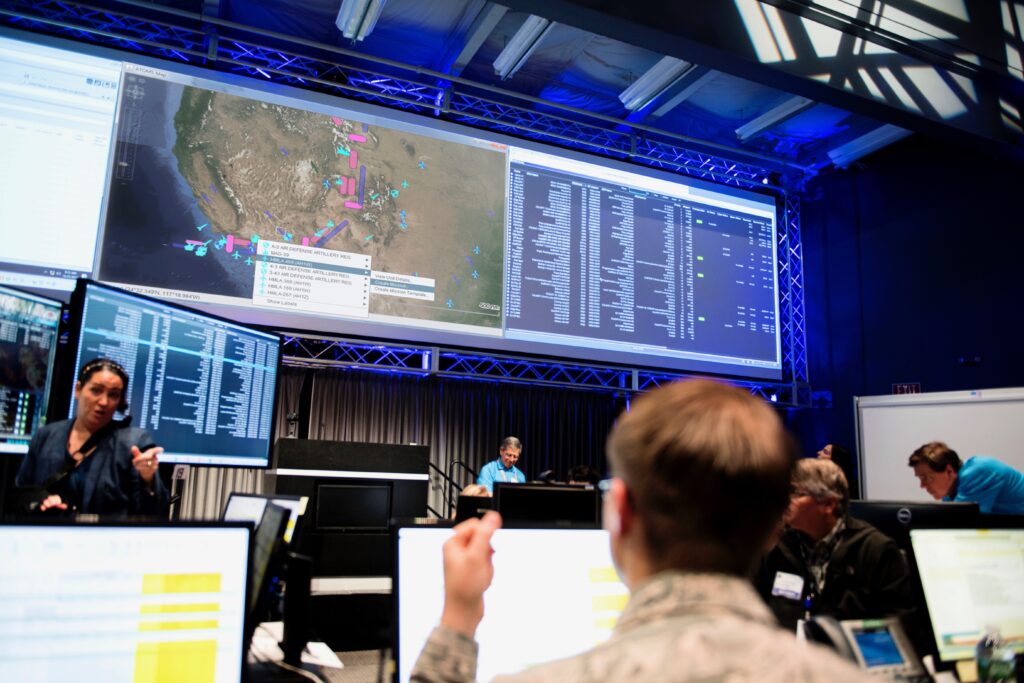
The Lockheed Martin MDC2 exercise was designed to look at the challenges facing the military as they try to create an “integrated tasking order” similar to a traditional Air Tasking Order. An ATO assigns missions and schedules sorties for every aircraft in a theater, the integrated tasking order would assign tasks to all space and cyber forces as well. Building a weapons system is complex but there can be even more daunting challenges when you’re in the early stages of designing and building a command and control system such as MDC2. Culture, training, language and even nationality can pose challenges as large as — or even bigger than — the technology.

ENOUGH WITH POLITICAL ENDORSEMENTS FROM RETIRED MILITARY OFFICERS

ML CAVANAUGH

Recently, Dan Helmer, a West Point graduate running for a U.S. House of Representatives seat in Virginia’s 10th Congressional District, released a list of eight retired generals and admirals he calls his “National Security Advisory Committee.” At the top is retired Lt. Gen. Dan Christman, who formerly served as superintendent at West Point (akin to a college president) while I was a cadet. I looked up to him then.

Is the U.S. Army on Verge of Creating 'Super Soldiers'?

Kris Osborn

Developed by Lockheed with internal research and development funds, FORTIS is designed to help soldiers run, maneuver, carry injured comrades and perform a wide range of combat tasks while preventing hyperextension of the knee.
Engineers report that FORTIS reduces the amount of energy required to perform a task by nine percent, using on-board AI to learn the gait of an individual soldier. The system integrates an actuator, motor and transmission all into one device, intended to provide 60 Newton Meters of additional torque, Maxwell explained.

Why Leaders Must Fail to Ultimately Succeed

Maj. Timothy Trimailo


Sgt. Gregory Padilla (second from left) gives a status report to 2nd Lt. Randy Jozwiak (left) during a live-fire exercise 20 July 2015 as part of Northern Strike 15 on Camp Grayling Joint Maneuver Training Center, Michigan. Padilla is a team leader and Jozwiak is a platoon leader assigned to the 1st Battalion, 126th Cavalry Regiment. (Photo by Sgt. Seth LaCount, U.S. Army)

When a reporter asked him how it felt to fail a thousand 

29 November 2017

Use of Technology in Counter Terrorism Operation Part II

I had the privilege of serving in OP - RAKSHAK in Punjab in 1990-1991, OP – RIHNO in Assam during 1991 – 1992 and three tenures in J&K. After my tenure as Chief Signals Officer, Chinar Corps at Srinagar I wrote a paper on Leveraging Technology In Counter Insurgency Operations which was published at in The PINNACLE, The ARTRAC Journal in its Jun 2008 issue. The same in available at :https://drive.google.com/file/d/0B7lCgXHBh1PaTlQ3VVZYbFRWbXM/edit?usp=sharing

After 10 years, on 26/11 I thought of revisiting the topic.

Here is my take on Use of Technology in Counter Terrorism Operations.
                                                                                                                   - PKM

Use of Technology in Counter Terrorism Operations
                                                                - Maj Gen P K Mallick, VSM (Retd)

Cyber Warfare

Dealing with terrorist groups, many experts fear their hacking capabilities, part of the security community considers the ISIS a serious menace to the security of Western critical infrastructure.

The availability of tool and exploits in the criminal underground makes it easy for terrorists to hit computer networks and infrastructure worldwide. The IS has the offensive capabilities to hit its adversaries; this is the opinion of many cyber security experts, including the popular Mikko Hypponen.

“The Islamic State is the first extremist group that has a credible offensive cyber capability,” said F-Secure Chief Research Officer Hyppรถnen, speaking last week at the Wall Street Journal’s WSJDLive conference in Laguna Beach, Calif. “Clearly, this situation isn’t getting better. It’s getting worse.”


A terrorist could attack a critical infrastructure to sabotage, or computer systems to steal sensitive data to use in other attacks.

The use of cyber weapons is a novelty in the terrorism landscape; it is a concrete risk with some advantages including

· The pre-attack phase is stealth, the organization of a cyber attack present low risks respect conventional terrorist attacks.

· The use of a zero-day vulnerability provides a real advantage to the attackers that minimize the risks of failure of operations and maximize the efficiency of the cyber weapon. Zero-day exploits could be acquired in the criminal underground and could be used in targeted attacks.

· The costs of a cyber weapon are very cheap compared to the one related a conventional weapon (explosive, weapons, vehicles for the commandos, etc.).

· The choice of cyber weapon allows the terrorists to remain under the radar until the attacks.

· Cyber weapon could have similar effects of a terrorist attack.

What are the objectives of cyber weapons?

The list is very long and includes almost every strategic infrastructure of a country such as Industrial control systems, communications networks, and defense systems. Despite groups of terrorists haven’t the time and the knowledge necessary for the design of a new cyber weapon, there is the concrete risk that threat actors in the wild can conduct a reverse engineering of the code of other nation-state malware circulating over the Internet. The ISIS is trying to recruit hackers and experts to involve them in the hacking campaigns.


Social Media 

Social media is not the cause of violent extremism, but a powerful amplifier and accelerant. Digital platforms and increased access to smart phones and internet connectivity help facilitate radicalization and recruitment. Violent extremists’ exploitation of digital platforms allows would-be terrorists to seek inspiration and information online—and rally around a terrorist group as a brand, an idea, or a methodology—without ever leaving their homes. The widespread use of social media has also made violent extremists’ plans more difficult to disrupt. Security agencies have to track a much larger number of potential plotters, giving terrorists more space to plan large, complex operations against a higher background level of activity.

A special report by the US Department of Homeland Security listed various terrorist uses of Facebook: 

• As a way to share operational and tactical information, such as bomb recipes, weapon maintenance and use, tactical shooting, etc.

• As a gateway to extremist sites and other online radical content by linking on Facebook group pages and in discussion forums. 

• As a media outlet for terrorist propaganda and extremist ideological messaging. 

• As a wealth of information for remote reconnaissance for targeting purposes

The technology firms have faced increasing pressure from governments across the globe to stop the spread of extremist propaganda. Last year, White House officials met with Apple, Facebook, Twitter and Microsoft to discuss the subject. The British prime minister, Theresa May, has recently renewed her campaign against the technology companies with a crackdown meant to punish platforms that fail to take sufficient action against terrorist propaganda. At a recent bilateral meeting in Paris, May and French president Emmanuel Macron said they would explore new legal liabilities for tech companies that don’t remove inflammatory content, including possible fines.

While governments have urged companies like Facebook to do more, the social network has also faced backlash for ethically questionable censorship of non-terrorist content under the guise of countering propaganda. 


The tech firms have long struggled to balance their missions of supporting free speech with the need to remove and prevent the spread of terrorist content. The companies have faced intense scrutiny over the way terrorist groups have used the site for recruitment and for spreading hateful and violent messages. On Jun 25, 2017 Facebook, Microsoft, YouTube and Twitter collectively announced a new partnership aimed at reducing the accessibility of internet services to terrorists. The new Global Internet Forum to Counter Terrorism adds structure to existing efforts by the companies to target and remove from major web platforms recruiting materials for terror groups. Together, the four tech leaders say they will collaborate on engineering solutions to the problem, sharing content classification techniques and effective reporting methods for users. Each company also will contribute to both technical and policy research and share best practices for counterspeech initiatives.

As part of the new forum, the companies said they would share best practices regarding content detection and classification techniques using machine learning” and “define standard transparency reporting methods for terrorist content removals”. Back in December of 2016, the same four companies announced the creation of a shared industry hash database. By sharing hashes with each other, the group was able to collectively identify terror accounts without each having to do the time- and resource-intensive legwork independently. This new organization creates more formal bureaucracy for improving that database. Facebook, Microsoft, YouTube and Twitter will be teaching smaller companies and organizations to follow in their footsteps to adopt their own proactive plans for combating terror. A portion of this training will cover key strategies for executing counterspeech programs like YouTube’s Creators for Change and Facebook’s P2P and OCCI.

Privacy vs Security. Law enforcement and security agencies have claimed that encrypted platforms built for commercial purposes to safeguard privacy—where only the sender and receiver hold the keys and devices to decipher the message—are a gift to terrorists and criminals to help them communicate in a way that puts them beyond the law’s reach. In January an ISIL follower provided would-be fighters with a list of what he determined were the safest encrypted communications systems. Soon after the list was published, ISIL started moving official communications from Twitter to Telegram.

Both in the US and in the UK there has been a push for technology companies to either ban encryption on the grounds that we’re paying too high a price in terms of security, or at the very least request that companies like Apple, Google and Facebook build ‘backdoors’ that allow law enforcement access into their encrypted tools.

Tech companies have resisted any push to hand over to law-enforcement the keys to their customers’ encrypted data. Privacy advocates have, post-Snowden, defended the technologies as a protection against government snooping. But tech companies, are arguing that there are real risks of going along with government requests to access encrypted messages. Apple CEO Tim Cook, for example, recently warned that ‘any back door is a back door for everyone. Everybody wants to crack down on terrorists. Everybody wants to be secure. The question is how. Opening a back door can have very dire consequences.’

When it comes to privacy and security, we need to find the right balance in not allowing new encryption technologies to obstruct our counterterrorism efforts. We need secure encrypted systems for commerce, government and the protection of personal information (our digital identity). Banks and telcos are using those products to safeguard our data. Deliberately weakening encryption solutions would arguably weaken key infrastructure, with the ultimate beneficiaries being criminals, cyber activists and rival nation states. A cooperative solution with our police and security agencies working with relevant companies to identify the problems would be better than trying to introduce laws to restrict encryption. Indeed, there’s no guarantee that by banning the use of encryption solutions, as recently proposed in the UK by David Cameron, can be effective. Users and companies might migrate to other countries, solutions, products or servers.

Latest Technologies in Counter Terrorism Operations 


Big data plays a vital role in the war on terror. In order to fight the enemy, it is critical to get an in depth understanding of that enemy, how they operate, what technology they use. Nothing gives us better insights than big data. The data can be used to get an understanding of backgrounds, motives, modus operandi, methods of communication. Once these elements are understood, the information can be leveraged to learn about terrorist networks; who finances them, who supplies them, who supports them and who are the informants. Big data can also be used to establish patterns and make predictions on which population groups or what type of person would be most likely to join a terrorist organisation.

In a project, big data was used to scrutinise and analyse social media such as Facebook and Twitter in order to locate the origins of supporters of terrorist organisation ISIS. Over a period of three months, researchers monitored and analysed three million tweets. They managed to pinpoint important characteristics and patterns among tweets that showed support for ISIS and terrorism, as well as those who opposed it. Using these findings, the researchers created algorithms that were able to group users as pro- or anti-ISIS with an accuracy of nearly 90 percent. It is clear to see the value of being able to identify which people would be most likely to join ISIS as this could help limit the proliferation of extremist groups.

Surveillance data from drones gathered in areas where suspicious activity is taking place can also provide valuable information, especially when this real-time information is combined with other data sources. Information like this can help establish connections between people and events and identify the location of terrorists and even make predictions of the where they may move to in the future. 

Toy-sized battle robots with grenades and assault rifles. At the World Robot Conference in Beijing, China recently unveiled toy-sized battle robots with grenades and assault rifles. These robots have been designed in three versions: an attacker robot – armed with grenade launchers and rifles that minimise recoil – a reconnaissance robot capable of detecting hazardous gases, and a bomb disposal robot. The reconnaissance robot is apparently designed to be able to fit into a soldier’s backpack. Another robot used in the war against terrorism is the PackBot – a machine that locates and diffuses bombs. The PackBot will eventually carry out complex tasks without any human interference and will be very effective in detecting terrorists and explosives. PackBot can gather information from devices such as streetlights, bus shelters and sensors and combine it with its own data to make decisions. Various countries are developing autonomous robots that are able to eliminate terrorists and free hostages. These bots will be outfitted with biometric recognition technology and connect with sources that supply image data and location information to help identify potential terrorists.

Dfuze and Predictify Me – predicting the unpredictable. The use of prediction software in the fight against terrorism is also referred to as ‘predictive policing’. This form of counterterrorism has been on the increase and the ISS (Intelligent Software Solutions) behavioural analysis tool Dfuze is already used in over forty countries. Dfuze was used at the 2012 Olympics in London to pinpoint high risk areas to enable police forces to increase security presence. The software was also used to investigate the Boston bombings in 2013. The Dfuze system is a database which holds information on all terrorist attacks that have ever taken place. Governments can access this data to analyse previous attacks and share information, leading to more efficient methods of communication between nations. With the Dfuze system, specialists are able to establish and analyse trends and patterns, future attack hotspots, the types of explosives, modus operandi and help them predict, prepare for or even prevent any future terrorist attacks. In the past, this type of work was done by analysts trawling through mountains of information, initially in paper files and later on computers.

Another predictive solution, launched in 2014, is Predictify Me. The technology is simple to deploy, can help predict an impending terrorist attack and secure areas against it. Predictify Me uses 200 indicators, such as public holidays, the weather, attacks in nearby countries, sports or other events and even video releases on social media to predict whether and when a terrorist attack is likely to happen. Predictify Me have indicated that it is able to predict an attack within three days with an accuracy of over 70 percent.

With the Internet of Things, every device has an IP address. With more and more devices connecting to not only the Internet but also to each other, the Internet of Things enables increased convenience, efficiency and energy conservation. With internet connectivity moving away from the traditional laptops, tablets and smartphones and migrating toward wearables and household devices such as fridges and washing machines, the IoT can also easily be used for monitoring, location tracking, identification, surveillance and gaining access to networks. Every device will have an IP address and security experts have indicated that surveillance services will able to intercept signals of networked devices in much the same way as they intercept cell phone signals. Information from speeches, satellites, videos and news is all collected and used to monitor and analyse activities, enabling intelligence services to close in on terrorists.

New colour-changing sensors can detect multiple explosives within seconds. In December 2015, scientists developed a new colour-changing sensor that is able to identify and quantify multiple explosives such as DNT, PETN, tetryl, RDX and TNT within ten seconds. The fluorescent sensor gives out information about the type of explosive and how much of it is present in a sample. PETN and RDX for example, have been used in terror plots because they are hard to detect by sniffer dogs. The colour-changing sensor is made from light-emitting nanomaterials or ‘quantum dots’ to which receptors that target the explosive are attached. Each explosive that binds to the quantum dot emits a different colour. These are then analysed in order to generate a unique ‘fingerprint’ for each compound. This makes it possible to detect multiple explosives with one single test.

Way of the Future

Could the internet eventually be used to cause physical attacks? So far, jihadists and others practicing "cyberterrorism" have mainly cracked the passwords for online accounts to collect information for target lists. These efforts have caused a great deal of fear, but not damage or death.But this is something that's coming. The United States and Israel reportedly caused actual damage to the Iranian nuclear program through malware such as Stuxnet. Russia has conducted cyberattacks against physical targets such as the Ukrainian power grid. With Stuxnet being reverse engineered by hackers, and other National Security Agency hacker tools made available through groups like Wikileaks, it won't be long before jihadist or other terrorist hackers are able to cause real world damage by simply accessing the internet.

Other technological tools that can be used for pre-operational surveillance, propaganda purposes and attacks have become prominent as well. For jihadist groups in Iraq and Syria, it's small commercially available drones. Much has been made of the threat of using drones to launch attacks, but to date, drone strikes by the Islamic State have used altered conventional munitions such as 40mm grenades or military-grade explosives placed in locally manufactured munitions. Hezbollah likewise has used drones in attacks, but they similarly have relied on military ordnance provided by Iran. Consequently, even if militants elsewhere attempt to use drones, it will be difficult for militants to reproduce these attacks outside of active war zones. They simply don't have the weaponry. Such drone strikes in domestic settings will remain limited in their capability for now.

As technology advances, terrorists and counterterrorism forces will continue to use it to their advantage. It just depends on who picks it up from the table first.

Challenges Ahead

Research and Development Trends. Most of the cutting-edge research in related areas, particularly with regard to information technology and biotechnology, is in the private sector where development pro­grams are largely driven by potential markets and the profits to be made in the security sector seem to pale in comparison with other commercial opportunities. This challenge can be addressed by mak­ing the counterterrorism community a more attrac­tive customer for the private sector. A significant next step would be initiating a serious dialogue to determine what a future inter­national counterterrorism security technology development regime might look like. 

Barriers to Innovation. Even if private research and development can be better teamed with gov­ernment efforts and focused on the terrorism chal­lenges of the 21st century, the traditional barriers to innovation in law enforcement technologies will remain. These challenges include four areas.

Cost. The expense of new technologies includes both the cost of procuring a technol­ogy and the opportunity cost of adopting that technology as compared to other uses to which resources might be put.

Technology Risk. This includes the ever-present risk that "big bets" will fail. The tech­nology may not perform as expected or ade­quately address the tasks for which it was adopted.

Human Factors. New counterterrorism tech­nologies can face a plethora of obstacles that have nothing to do with fiscal costs or technical specifications. For example, data mining and biometrics have raised an array of concerns about the protection of civil liberties and safe­guarding of proprietary commercial informa­tion. Non-lethal weapons face legal barriers. 

Unanticipated Costs. Any new technology will bring unintended consequences. The introduction of nanotechnologies, for example, has raised concerns about the potential conse­quences of unintentionally introducing new compounds into the environment. New tech­nologies can also bring unexpected liabilities and adverse public reactions.

Conclusion

The terrorists are proving more and more adept at using sophisticated technology. The terrorist threat against the free world is seri­ous and enduring. We need to stay one step ahead and keep developing new, improved technology. We need to jointly develop the means and the technologies needed to meet this threat. The obstacles to creating an arsenal of counter-terrorism technologies that are practical and afford­able and overmatch the threat of 21st century ter­rorism are daunting. Creating a vision of these future technologies, implementing initiatives that broaden the market and make it more predictable and dependable, and developing policies that will help to overcome the barriers to innovation are essential steps to harnessing technology to the future needs of law enforcement.

The Caliphate Is Destroyed, But the Islamic State Lives On

BY MICHAEL P. DEMPSEY
Source Link

The fall of the town of Abu Kamal in Syria and recent victories by Iraqi security forces in Qaim and Rawa in Iraq mark the collapse of the Islamic State caliphate. With the loss of these towns located along the Iraq-Syria border, the terrorist group no longer controls any major population center in either country. This represents quite a reversal for the Islamic State from its heady days of only three years ago, when it controlled vast swaths of territory, routinely extorted taxes from local businesses, exploited the region’s natural resources (especially oil), and governed a large percentage of the population of both countries. Those days are thankfully done — at least for now — and that’s a development worth celebrating.