8 February 2018

How Fake News May Lead Us to a Cyberwar


By Joe Carson

With the next generation moving to online and social media as their go-to news source, and a good chunk of what is put out on social media being fake, it’s left up to the reader to determine whether the information is true or not.

When people start to believe everything they read , it makes the world a very unpredictable place. With no indicators of the source or truth of the news on social media, many

Battle for Artificial Intelligence (AI) dominance heats up


The primary thrust among global commentators last week was on dissecting and analysing the State of the Union address delivered by President Donald Trump. He tried to reach out to an American public exhausted by divisive politics and a waning faith in the American dream. The general sense was that it was a half-hearted call for unity. The focus of this column is on a global disruption in technology that is having a major impact on national and international security thinking, the role of Artificial Intelligence (AI) in the 21st Century. 

The New Global Competitive Model Based on Cyber and Asymmetrical Hybrid Warfare

by T. Casey Fleming, Eric L. Qualkenbush 

Instroduction

Imagine if Pearl Harbor had been attacked and there had been no response from Washington.

This is the actual case today due to a highly sophisticated, mature, and stealth strategy perpetrated against the United States (US) by advanced nation-state military methods leveled at every sector and organization in our society. This includes private sector businesses, all government agencies, the military, and academia - every US

Hacking: Another Weapon in the Asymmetrical Arsenal


By Scott Stewart

Iran's Islamic Revolution could play out, in part, online. On Jan. 4, the Carnegie Endowment for International Peace published a report describing the country as a "third-tier cyberthreat." The report's authors note that despite Iran's success with cyberattacks

U-2 Versus Global Hawk: Why Drones Aren’t Always The Best Solution For Warfighters

By Loren Thompson

Unmanned aircraft (“drones”) have captured the popular imagination. Hardly a day goes by without a story appearing somewhere about how unmanned aircraft will revolutionize everything from commercial logistics to air combat.

It’s a seductive idea, and probably true to some extent. In the unforgiving world of military planners, though, what matters most is how the available options for conducting missions perform today, not what might unfold tomorrow. One such mission is intelligence, surveillance and reconnaissance – what the military calls ISR. Detailed, timely information

The World According to H.R. McMaster

by URI FRIEDMAN

Why is he so worried about North Korea? 

Why is H.R. McMaster so alarmed by North Korea? Why does Donald Trump’s national-security adviser insist—more vigorously than any administration official except the president himself—that Kim Jong Un must be denied the capability to place a nuclear warhead on a missile that can reach the

Strategic Insights: Challenges in Using Scenario Planning for Defense Strategy

By Dr. Michael Fitzsimmons

Lawrence Freedman and Colin Gray are two of the most famous contemporary scholars of military strategy. Within the past few years, each published a book addressing different aspects of the same practical problem of strategy: defense planning.1 Considered to be strategy’s mundane cousin, defense planning revolves around how a nation designs its military according to its views of the future. Freedman’s and Gray’s verdicts on the subject are very similar and simply put: we are usually wrong when we predict the future of war. This judgment is not new; indeed, it conforms with the observations of countless defense policymakers and analysts on the challenges of strategic planning in national security.2

How AI Is Transforming Defense and Intelligence Technologies

by Tobias Naegele

A Harvard Belfer Center study commissioned by the Intelligence Advanced Research Projects Agency (IARPA), Artificial Intelligence and National Security, predicted last May that AI will be as transformative to national defense as nuclear weapons, aircraft, computers and biotech.

Advances in AI will enable new capabilities and make others far more affordable – not

United Nations Peacekeeping Offensive Operations: Concepts and Command Centres

by Antonio Garcia

Introduction

The decision to strategically mandate offensive operations in the post-cold war peacekeeping era, is for the most part unchartered territory and will require forward thinking and some amount of trial and error. This article is a continuation of the research published in my previous paper, ‘United Nations Peacekeeping Offensive Operations: Theory and Doctrine’. Where theory provides a construct for the conduct of operations, doctrine should guide the execution of operations without being overly prescriptive (US, 2014: 70). Doctrine

7 February 2018

Nepal and India: Mending Fences

By Kamal Dev Bhattarai

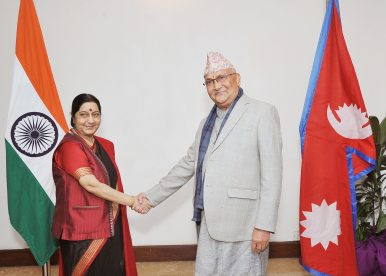
With Indian Minister for External Affair Sushma Swaraj’s sudden visit to Kathmandu on Februray 1-2, there are signs of a rapprochement between Nepal’s newly elected Left Alliance and New Delhi.

For the Communist Party of Nepal (Unifed Marxist-Leninist) (CPN-UML) leader (and presumptive prime minister in the new coalition government) K.P. Oli, a friendly relationship with India is must. Two-thirds of Nepal’s trade is with India; the country is heavily dependent on its larger neighbor to

Not made in India

by Arun Prakash 

The public is often bemused on hearing senior military leaders make gratuitous public pronouncements regarding India’s readiness to “fight a two-front war”. Bewilderment, however, turns into trepidation on reading media reports that the army is looking for eight lakh rifles, carbines and machine-guns, in the international market, to equip its 13-lakh jawans! Our

China, Russia delight as North Korea preoccupies US

BY THOMAS HENRIKSEN

In his State of the Union address, Donald Trump said that the United States is “waging a campaign of maximum pressure to prevent” North Korea from threatening “our homeland” by its “reckless pursuit of nuclear weapons.”

But the Trump administration’s goal of sanctioning North Korea back to the Stone Age has yet to bring the nuclear-arming

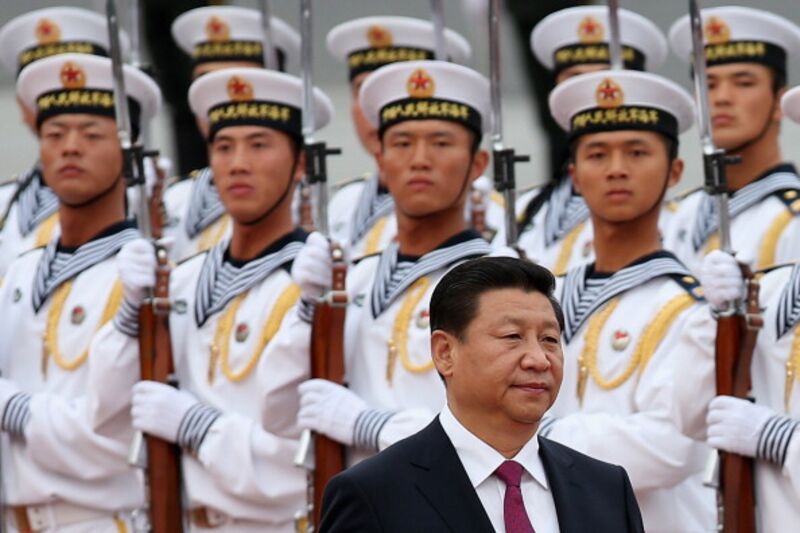
Tech, training key to upgrading China’s military forces: analysts

By Zhao Yusha 

Technological innovation and training are the most important factors for transforming China's forces "into a world-class military," experts noted.

The goal of building world-class forces matches the country's international status, and plays a leading role in building a strong army to consolidate our national security and interest, People's Daily said in an article on Sunday.

What Happens When China Eclipses the U.S. in Asia

By Tobin Harshaw And Daniel Moss 

Contrary to what you might read or hear, President Donald Trump alone hasn't surrendered U.S. strategic leadership in Asia to China. What he has done is accelerate long-term trends that have severely diminished America's position in the Western Pacific, an area where the U.S. had held sway largely unchallenged since World War II.

That era of primacy is close to an end. In

China’s terror dilemma in CPEC: A Xinjiang strategy?

DHANANJAY SAHAI 

This brief aims to examine one of China's possible responses to the various extremist and terrorist activities that plague the internal security of Pakistan, given the necessity of securing its USD 62 billion investment in the China-Pakistan Economic Corridor (CPEC). Given that Pakistan is failing to control this problem, China will have to take measures of its own to secure CPEC. The response of China could possibly be inspired by its strategy in Xinjiang, where it has successfully managed to keep the insurgency under control with a mix of hard military power and wide-ranging measures aimed at clamping down on the religious

The Case for Counter Insurgency ‘Light’ in Afghanistan

By Charles Barham

"One man seemed to speak for everyone when he made a brief, impassioned plea to the visiting officials. “Our homes are being destroyed, our youths are being killed, people are suffering every day and being forgotten,” he said. “If, God forbid, we lose Lashkar Gah, then Helmand will collapse and the whole region and Afghanistan will collapse. Please save us from this chaos.”

Situation

The Taliban was and remains an insurgency. It must be dealt with as an insurgency by

The New Global Competitive Model Based on Cyber and Asymmetrical Hybrid Warfare

by T. Casey Fleming

Instroduction

Imagine if Pearl Harbor had been attacked and there had been no response from Washington.

This is the actual case today due to a highly sophisticated, mature, and stealth strategy perpetrated against the United States (US) by advanced nation-state military methods leveled at every sector and organization in our society. This includes private sector businesses, all government agencies, the military, and academia - every US organization

THE INTELLIGENCE COMMUNITY IN THE GOLDEN AGE OF OPEN SOURCE INTELLIGENCE

By Danny Lam

Competition between public and controlled information is as old as life.

From the beginning of time, there were information hoarder / controllers and disseminators / distributors. Information science tells us that 99% of information is public and only a tiny portion is significantly restricted.

The Endless War: Taliban Reaping the Rewards From the Deteriorating Security Situation in Afghanistan

By Max Fisher

They were hardly the first Taliban attacks in the capital. Still, there was something particularly alarming in their scale and implication about the pair of episodes, just a week apart, that rocked Afghanistan: a hotel siege that killed 22, then a car bomb, loaded into an ambulance, that killed 103.

Attacks Reveal What U.S. Won’t: Victory Remains Elusive in Afghanistan

by Helene Cooper 

The Taliban are in retreat, the Afghan military is on the brink of assuming control of the country, and the government in Kabul is one step away from being able to provide security across the land. So three successive presidential administrations have said over 16 years about the war in Afghanistan.

Yet devastating attacks on villages, convoys, government offices and hotels continue.

Americans Are Rising to This Historic Moment

BY ELIOT A. COHEN

The commitment of ordinary citizens to democratic ideals is being tested each day—and its enduring strength is containing the damage of Trump’s presidency. 

A writer usually itches to rewrite any article that is more than a week old: I confess to no such temptation with my first article for The

France's Geographic Challenge


France's Geographic Challenge

France is a country in Western Europe bound in the south by the Alps, Pyrenees Mountains and the Mediterranean Sea. To the west and north is the Atlantic Ocean,

The Impact of Turkey’s Afrin Operation on U.S.-Kurdish Stability Operations

By: Patrick Hoover

On January 20, the Turkish army, with Free Syrian Army (FSA) proxies, launched Operation Olive Branch to clear the Kurdish enclave of Afrin in northwestern Syria. Ankara’s chief strategic objectives include eliminating the Syrian Kurdish militia’s People’s Protection Units (YPG) and their political partner, the Democratic Union Party (PYD), which are defending Afrin; ensuring

Taking Stock: An Analysis of Russia’s Military Campaign in Syria

William McHenry and Gabriel White

On December 11, 2017, Vladimir Putin announced the withdrawal of the majority of Russia’s military presence from Syria. Though he has made similar announcements in the past, there is mounting evidence that major military operations are nearing their end. Two years have passed since operations began – and it is time to take stock of Russia’s achievements.

The primary goal of the Russian intervention was to protect Bashar al-Assad from regime

Why Ukraine should become a Balkan country


Günther Fehlinger

Ukrainian politicians, diplomats, journalists and intellectuals should start paying more attention to how the countries of South-Eastern Europe (SEE) are currently preparing for their entry into the European Union. Kyiv can accelerate its own European integration by entering a number of SEE cooperation formats specifically designed to prepare the Western Balkan states for their future EU membership. 

Dealing with America – and the Deep State

BY ROBERT DAVID STEELE

Two important commentaries have appeared recently that reflect on how Russia should deal with the United States of America (USA).

The first, “Russian Approaches to the United States: Algorithm Change Is Overdue,” by Andrey Kortunov, Director General of the Russian International Affairs Council (RIAC)

WILL ROBOTS FIGHT THE NEXT WAR? U.S. AND RUSSIA BRING ARTIFICIAL INTELLIGENCE TO THE BATTLEFIELD


BY TOM O'CONNOR

Artificial intelligence has increasingly been integrated into the weapons systems of the world's leading militaries, and at least one expert has said the futuristic technology may soon be the subject of a new Cold War.

In a piece published Tuesday by The Conversation, North Dakota State University assistant professor Jeremy Straub argued that unlike the nuclear weapons that dominated much of the 21st century arms race between the U.S. and the Soviet Union, the use of

NATO’s Crossed Swords exercise preps cyber warriors

By Daniel Cebul

WASHINGTON ― NATO has concluded an exercise meant to prepare the alliance’s cyber warriors for future cyber-kinetic operations has concluded. Crossed Swords 18 hosted 80 participants from 15 countries.

NATO’s Cooperative Cyber Defense Centre of Excellence, or CCDCOE, coordinated the exercise in Latvia, which focused on “enhancing further cooperation and information sharing between civilian and military spheres, joining together Critical Information Infrastructure (CII) providers and military units.”

How do you solve a problem like Facebook?

By Oliver Wiseman

We're spending less time on Facebook. But only because Mark Zuckerberg says that's okay 

Regulating Facebook would only raise barriers to entry for its rivals 
Innovation is the ultimate weapon against monopolies 

For those worried about Facebook’s economic and political might, there

Identifying Promising Approaches to U.S. Army Institutional Change

by Lisa S. Meredith, Carra S. Sims

Which approaches would best help the U.S. Army commit to organizational change to meet challenges stemming from behavioral health issues, misconduct, and changing demographics? 

What are the drivers of cultural change in an organization, and how do these drivers apply to the specific culture of the U.S. Army? 

Yes, a cyberattack could spur the president to launch a nuclear attack

By: Aaron Mehta

The Nuclear Posture Review, officially revealed Friday, does not change when a president might order a nuclear strike in response to a non-nuclear attack. But it does provide more hypotheticals about the circumstances that might force the president’s hand.

Language in the NPR — a comprehensive look at America’s nuclear weapons and the doctrine behind it — does not differ from the

The Kremlin Subverts Media Abroad to Cement the Narrative at Home

by Gavin Wilde

Russian President Vladimir Putin established his standing early on by seizing the domestic media narrative. His assaults on foreign media should be viewed as a continuation of that process. Recognizing that Moscow lashes out from a defensive crouch will help the US avoid assuming one in response.

In the intervening year since the US intelligence community (IC) assessed Kremlin-orchestrated meddling in the 2016 US presidential election,[i] Washington and the general

The Russian Way of Warfare

by Scott Boston, Dara Massicot

How might Russia's military fight in the event of a major conflict against a peer or near-peer adversary? 

Russia has recently carried out substantial reforms to its military forces, increasing capability in several key areas. Russia's military has improved to the extent that it is now a reliable instrument of national power that can be used in a limited context to achieve vital national interests. Russian strategists, concerned about the capability of an advanced

The good, the bad and the ugly of H.R. McMaster’s national security advice


By Daniel W. Drezner

National security adviser H.R. McMaster sits behind President Trump during a Cabinet meeting at the White House in December. (AFP) 

A year ago, the name H.R. McMaster would have evoked near-unanimous praise from the national security community. He was a venerated tank commander and counterinsurgency warrior who earned a PhD in history. He wrote a widely praised book about the failure of military leaders to

6 February 2018

Pakistan's dangerous obsession with nuclear weapons

http://www.rediff.com/news/special/pakistans-dangerous-obsession-with-nukes/20180205.htm
February 05, 2018
Lieutenant General Kamal Davar (retd).
For the world and India, one of the most enduring challenges of the times is for Pakistan's nukes to be neutralised, before they are ever used by the State, their sponsored non-State actors or any rogue elements from the many terror tanzeems dotting Pakistan's unstable landscape, says 
Pakistan has a total of 15 nuclear sites, of which only three -- Karachi, Chashma and PINSTECH --are under IAEA safeguards.
Others are under the control of the army and remain unsafeguarded. Additional plutonium enrichment plants are coming up at PINSTECH.
Reportedly, Pakistan produces HEU at a rate of 100 kg per year. Its HEU-based warheads require between 15 and 20 kg of HEU each.
Pakistan is also producing plutonium for plutonium-based warheads to which they are changing over from HEU.
It is reported to have the fastest growing nuclear arsenal in the world with estimates of 120 to 140 warheads in its possession.

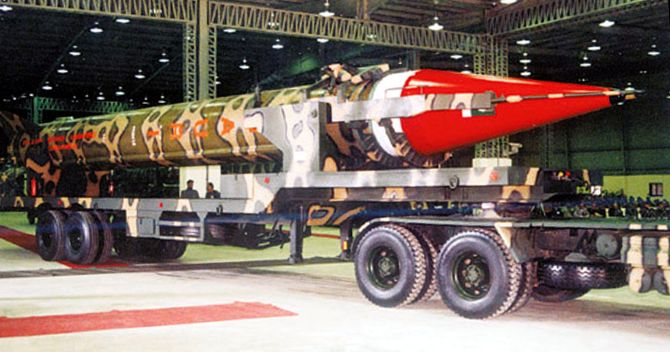
The development of Pakistan's nuclear delivery systems has been assisted mainly by China and North Korea, while some systems are indigenously produced.
Pakistan's delivery vehicles include modified F-16A/B aircraft and a few Mirage V and Chinese-built A-5 Fantans, under the control of the Pakistan air force and a variety of surface-to-surface missile systems under the control of the army.
The F-16s are likely based at the Sargodha air base, located 160 km northwest of Lahore.