14 April 2018

Marketing and the Delegitimization of Elections

By George Friedman

Last week, I wrote about the use of marketing in elections. This week, as Facebook CEO Mark Zuckerberg faces a congressional hearing on how Facebook data was used during the 2016 presidential election, I will address one of the critical consequences of marketing. It is a tool used on a global basis to delegitimize elections and, with it, democracy. As I argued last week, the use of marketing, particularly online marketing, has been growing. But this doesn’t necessarily mean it is becoming more effective. It has been claimed that the Russians interfered in the U.S. election by spreading fake news stories to help Donald Trump get elected. It has also been revealed that consulting firm Cambridge Analytica helped run the Trump campaign’s data operations and used social media user data to target certain voters with customized content. The connection between alleged Russian interference and Cambridge Analytica is murky, but they are both being used as examples of how the internet can sway election results. This assumes that such techniques are effective enough to change voters’ minds and influence the outcome of a presidential election.
THE NEXT COLD WAR IS HERE, AND IT'S ALL ABOUT DATA


THE HEADLINES ABOUT the trade wars being touched off by President Trump’s new tariffs may telegraph plenty of bombast and shots fired, but the most consequential war being waged today is a quieter sort of conflict: It’s the new Cold War over data protection. While the Facebook/Cambridge Analytica crisis currently burns as the latest, hottest flare-up in this simmering conflict, tensions may increase even more on May 25, 2018, when the European Union’s General Data Protection Regulation comes into effect.

Minister Reveals Cyber Attack On Iranian Data Centers, Blames Foreign Hackers


Iran’s Telecommunications minister has criticized the government’s cyber-attack monitoring center for failing to detect an attack that led to the hacking of several Iranian data centers on the evening of April 6, despite a warning about the attack ten days before it took place. Mohammad Javad Azari Jahromi first said in a tweet Friday evening “Several Iranian data centers came under cyber attacks tonight. Some of the smaller routers have been changed to factory setting.” Later, in another tweet, Jahromi claimed that MAHER, Persian acronym for the Computer-related Events Operation and Coordination Center, “Has monitored and controlled the attack and the data centers’ settings have been brought back to normal.”

Cyber Needs to Be Center Stage for Every World Leader

By Christopher Painter

It seems every day brings news of another high-profile cyberattack or intrusion affecting our personal data, national security or the very integrity and availability of the institutions and infrastructure on which we depend. These cyber threats come from a range of bad actors including ordinary criminals, transnational organised criminal groups and nation-states. Indeed, in mid-February, Australia, the United States, the United Kingdom and several other countries attributed the devastating NotPetya ransomware worm—that caused billions of dollars of damage across Europe, Asia and the Americas—to the Russian military as part of the Kremlin’s efforts to destabilise the Ukraine. At the same time, special counsel Robert Mueller in Washington unveiled a remarkably detailed criminal indictment charging a range of Russian individuals and organisations with a concerted effort to undermine the 2016 U.S. elections.

The Pentagon is asking for 3 times as many drones for 2019

By: Kelsey Atherton  

U.S. Marine Corps Lance Cpl. David Bobbie with 3rd Battalion, 7th Marine Regiment, 1st Marine Division, replaces the battery for an InstanEye quadcopter during a Quads for Squads training event on Marine Corps Air Ground Combat Center Twentynine Palms, Calif., Feb. 28, 2018. Quads for Squads is a program intended to train and equip individual squads with small unmanned aircraft systems. (Cpl. Miguel A. Rosales/U.S. Marine Corps)  The Pentagon’s enthusiasm for drones has never been greater. A new report published today by the Center for the Study of the Drone at Bard University found that in the president’s new budget request, the Department of Defense is asking for three times as many uncrewed vehicles for 2019 as it did in 2018.

The math of military modernization

Benjamin Schwartz

The Chinese are on track to dominate the security architecture of the Asia-Pacific. This is not to suggest that the People’s Liberation Army will set out to conquer the region. But it is to acknowledge the foreseeable outcome of the growing gap between China’s ability to project military power in Asia and the defence capabilities of other regional militaries. Obscuring this gap, and matching it in some sense, is the growing distance between political rhetoric and reality.

Gunboat Diplomacy and the Ghost of Captain Mahan

By Alfred W. McCoy

Amid the intense coverage of Russian cyber-maneuvering and North Korean missile threats, another kind of great-power rivalry has been playing out quietly in the Indian and Pacific oceans. The U.S. and Chinese navies have been repositioning warships and establishing naval bases as if they were so many pawns on a geopolitical chessboard. To some it might seem curious, even quaint, that gunboats and naval bastions, once emblematic of the Victorian age, remain even remotely relevant in our own era of cyber-threats and space warfare.

13 April 2018

The terrible price ordinary Pakistanis have paid for hating India

HUSAIN HAQQANI

Pakistan’s ideology has not really enhanced its functionality even if it helped its first generation get through the transition of seeing themselves as Pakistanis. A favourable international environment, specifically Pakistan’s cold war alliance with the West, enabled the country to sustain hostility towards India and to justify its Islamic orientation as a barrier to communism. The current dependence on China might pay for anti-Indianism for a few more years but is unlikely to help Pakistan overcome its fundamental contradictions.

How Fake News Spreads in India

By Alisha Sachdev 

When U.S. President Donald Trump began crying “fake news,” and prime time news slots in India began to hold debates on photoshopped WhatsApp forwards, we knew post-truth times had truly arrived. But as is the nature of governments, it took some time for the arrival of fake news to register with the government of India. On April 2, India’s Ministry of Information and Broadcasting (I&B) woke up to the “increasing instances of fake news in electronic and print media” in the country, and released a circular announcing amendments to guidelines that the Press Information Bureau (PIB) follows while granting accreditation to journalists.

Afghan-Pakistani Cross-Border Terrorism Cuts Both Ways

By Franz J. Marty

KABUL — Reports about Afghan Taliban safe havens on Pakistani soil are abundant and such refuges are seen as crucial for the militants’ ability to sustain their insurgency inside Afghanistan. What is often overlooked is that some extremist groups, like the Tehrik-e-Taliban Pakistan (TTP), do the same, but in reverse – seeking shelter on the Afghan side of the border (which Kabul does not officially recognize) to launch assaults on the Pakistani side. While Pakistani officials have been making such accusations for years, they – unlike the allegations from Afghan and U.S. officials regarding Afghan insurgents hiding out on Pakistani soil – never really gained much traction or attention.

Afghanistan’s Comparative Perceptions of Pakistan and India

By Dr Subhash Kapila

Afghanistan was posed with mighty challenges on the Partition of the Indian Subcontinent in 1947 wherein Pakistan despite its Islamic commonality with Afghanistan became interposed as a “Hostile Neighbour” between Afghanistan and India which for centuries had civilizational and friendly ties. Afghanistan’s geostrategic location on the Western flank of the Indian Subcontinent and with contiguity to Central Asia and the Middle East endows it with geopolitical significance far outweighing its size, population and resources. Afghanistan in 2018 is not only a crucial chess-piece in the global geopolitical chequer-board but has emerged since 1947 as the underlying defining adversarial strategic characteristic of Pakistan-India relations.

The Indo-Pacific? The Quad? Please explain …

Graeme Dobell

Australia’s embrace of the Indo-Pacific concept over the past five years drew mild interest from the region and curious discussion. The US adoption of the Indo-Pacific in both its national security strategy and national defence strategy means the construct/label/geographic vision suddenly matters big time. What does the Indo-Pacific frame portend or predict for the way business will get done around here? Understandings aren’t agreed. The meaning of the Indo-Pacific matters if it’s ‘an organising principle for US foreign policy’.

Why the South China Sea is critical to security

BY BRAHMA CHELLANEY

When the U.S. aircraft carrier, Carl Vinson, recently made a port call at Da Nang, Vietnam, it attracted international attention because this was the first time that a large contingent of U.S. military personnel landed on Vietnamese soil since the last of the American troops withdrew from that country in 1975. The symbolism of this port call, however, cannot obscure the fact that the United States, under two successive presidents, has had no coherent strategy for the South China Sea.

China eyes Vanuatu military base in plan with global ramifications

By David Wroe

China has approached Vanuatu about building a permanent military presence in the South Pacific in a globally significant move that could see the rising superpower sail warships on Australia’s doorstep. Fairfax Media can reveal there have been preliminary discussions between the Chinese and Vanuatu governments about a military build-up in the island nation. While no formal proposals have been put to Vanuatu's government, senior security officials believe Beijing’s plans could culminate in a full military base. The prospect of a Chinese military outpost so close to Australia has been discussed at the highest levels in Canberra and Washington.

China, Russia 'Show Americans' Their Close Relationship

By Shannon Tiezzi

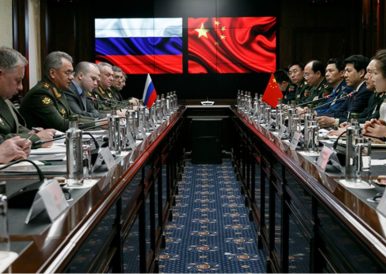
Chinese Foreign Minister and State Councilor Wang Yi visited Russia from April 4 to 5, making up for a previously scheduled visit that was postponed. Wang’s trip overlapped with that of Chinese Defense Minister and State Councilor Wei Fenghe. Wei was in Russia from April 1 to 5 both to attend the Moscow Conference on International Security and to conduct his first visit abroad since assuming his post. While in Russia, both Wang and Wei made it clear that their visits signaled increasingly tight China-Russia cooperation amid tensions on both sides with the United States.

South China Sea: China Deploys Jamming Equipment

By Ankit Panda

According to U.S. military officials, China has deployed communications and radar jamming equipment to Fiery Cross Reef in the Spratly group in the South China Sea. The deployment took place during the last 90 days, according to U.S. intelligence. First reported by the Wall Street Journal, the deployment marks a significant capability improvement for the Chinese military in the South China Sea. Fiery Cross Reef is the site of one of China’s seven artificial island facilities in the Spratlys. The U.S. military commissioned commercial satellite imagery from DigitalGlobe to point out the deployment to reporters with the Journal. “China has deployed military jamming equipment to its Spratly Island outposts,” one Pentagon official told the reporters.

How Do We Prevent ISIS 2.0? Withdrawing From Syria Is Not The Answer.

By Pavel Baev, Ryan Crocker and Michael O'Hanlon 

The international community also has some assets in Syria. Collectively they do provide raw materials out of which a plausible strategy can be built. American and international strategy towards the horrific conflict in Syria is at a crossroads. ISIS has been largely defeated militarily on the physical battlefield. The top goal of both President Obama and President Trump has been partially achieved, through a strategy they both helped develop and implement. The temptation for Americans in general, and the Trump administration specifically, may be to declare victory and go home — as in fact Trump has just signaled he would like to do, as soon as possible.

Stability in the Middle East: The Range of Short and Long-Term Causes

Anthony H. Cordesman

The Middle East has long been one of the most unstable regions in the world, and there are no present prospects for change in the near future. This instability is the result of ongoing conflicts and tensions, and a variety of political tensions and divisions. It also, however, is the result of a wide variety of long-term pressures growing out of poor governance, corruption, economic failures, demographic pressures and other forces within the civil sector. The Short and Long-Term Forces Shaping Stability and Instability The immediate sources of instability are clear. Most of the region has some form of internal conflict, faces rising external threats, or is dealing with violent extremism. The violence and wars that have resulted from the political upheavals in 2011 will at best leave lasting challenges for unity and development even if the fighting ends. All the major causes of violent extremism remain, and there are few prospects that the fight against ISIS will eliminate the extremist threat in even one MENA country. Tensions between Israel and the Palestinian persist, each side has seen rising internal political barriers to a compromise peace, and the tensions between Israel and Iran and Hezbollah are creating new military threats.

The potential futures of British power projection


Our allies and potential trading partners want to see that the UK is serious about its desire to play a leading role, both politically and economically, in all regions of the world. Especially once we leave the European Union, we will need to retain and build on the goodwill that already exists in many regions and maintain and sustain our capabilities in the future. This article was contributed to the UK Defence Journal by Geoffrey James Roach and is about the UK’s ability to carry out Amphibious Operations in the 21st Century and how suggested and so far theoretical defence cuts impact our capabilities, is there a better way forward?

U.S. Deficit to Surpass $1 Trillion Two Years Ahead of Estimates, CBO Says

By Erik Wasson and Sarah McGregor 

The U.S. budget deficit will surpass $1 trillion by 2020, two years sooner than previously estimated, as tax cuts and spending increases signed by President Donald Trump do little to boost long-term economic growth, according to the Congressional Budget Office. Spending will exceed revenue by $804 billion in the fiscal year through September, jumping from a projected $563 billion shortfall forecast in June, the non-partisan arm of Congress said in a report Monday. In fiscal 2019, the deficit will reach $981 billion, compared with an earlier projection of $689 billion. The nation’s budget gap was only set to surpass the trillion-dollar level in fiscal 2022 under CBO’s report last June.

Israel’s strike on Syria’s nuclear plant The compelling story behind Israel’s strike on Syria’s nuclear plant – and its ramifications.

By Yossi Melman

It wasn’t a real bombshell when Israel formally claimed responsibility on March 21, 2018 for the September 2007 raid that destroyed the Syrian nuclear reactor. Nevertheless, it created shock waves that lasted for a week – almost an eternity in terms of the shelf life of Israeli news stories. On that date, the Israeli military censor allowed the Israeli media and Israeli-based foreign journalists to publish stories about how the Israel Air Force (IAF) carried out the operation whose code names included “Outside the Box,” “Operation Orchard” and “Arizona.”

The West’s defeat in Syria is complete


The Syrian civil war is in its endgame, and the ‘political solution’ that the leaders of the Western democracy talk about is in sight. That is one meaning of the appalling images from the chemical weapons attack on Eastern Ghouta. In 2011, Western intelligence agencies unanimously declared that Bashar al-Assad was finished, and that it was only a matter of time before he fell. Today, Assad, with massive Russian and Iranian support, has regained control over most of Syria.

New Zealand military confirms spending millions on controversial spy software produced by secretive Silicon Valley firm Palantir Technologies

Matt Nippert

The New Zealand Defence Force has spent millions on controversial spy software produced by secretive Silicon Valley firm Palantir. After refusing for more than a year to reveal the extent of links to Peter Thiel’s big data analysis company, prompting a complaint by the Herald on Sunday to the Ombudsman, the NZDF were forced to disclose annual spending with Palantir averaged $1.2 million. The figures suggest since contracts were first signed in 2012 the defence force has spent $7.2m with the firm.

NZDF FINALLY DISCLOSES PALANTIR SPENDING (p. 1)

The strengths and weaknesses of Russia’s military

Deutsche Welle

The US, Russia, and China are considered the world’s strongest nations when it comes to military power, with the US the undisputed number one. Even so, Russia’s still has plenty of arrows in its quiver, most notably the massive nuclear arsenal of some 1,550 deployed nuclear warheads. Leaving the nuclear weapons aside, however, the US has an overwhelming advantage in conventional forces, including a much stronger navy and air force, Russian military analyst Aleksandr Golts told DW. China, according to Golts, would also have the advantage of numbers in any conventional showdown with Russia. In other areas, however, things are not as clear-cut. “Russia’s air force is much stronger than the Chinese for now,” he told DW. “It questionable about the navy, as the Chinese are now undertaking a very ambitious program of ship building and they are much more successful in building a [global] blue Navy fleet than Russia.”

Three Flashpoints in the Syrian Civil War


The Syrian civil war is heading in a new direction. As various operations in Afrin, Idlib and Damascus play out, the front lines of the Syrian civil war will become more static. Despite a decrease in major offensives, the presence of so many foreign powers with intersecting interests heightens the risk of violence. Since the start of the year, three prominent regions in the Syrian civil war have emerged as its current flashpoints: Afrin, Idlib and Damascus. These hotbeds of military activity represent the intersection of the various proxy battles underway in Syria. Turkey, Russia, Iran, the Syrian government, and the many loyalist and rebel militant groups active throughout the country all have unique goals. In the flashpoint regions, however, their objectives are overlapping to move the Syrian conflict into a new, more static phase. As these three remaining major offensives wane in the coming months, they will give way to constant deadly skirmishes and attacks along the front lines, with few significant changes in territorial control.

A Global Arms Race for Killer Robots Is Transforming the Battlefield

By BILLY PERRIGO

Over the weekend, experts on military artificial intelligence from more than 80 world governments converged on the U.N. offices in Geneva for the start of a week’s talks on autonomous weapons systems. Many of them fear that after gunpowder and nuclear weapons, we are now on the brink of a “third revolution in warfare,” heralded by killer robots — the fully autonomous weapons that could decide who to target and kill without human input. With autonomous technology already in development in several countries, the talks mark a crucial point for governments and activists who believe the U.N. should play a key role in regulating the technology.

Autonomous weapons and the law: the Yale and Brookings discussions

BY CHARLIE DUNLAP, J.D.

One of the hottest topics these days in the law of war is the increasing autonomy in weaponry. We are not yet seeing (and may never see) the emergence of a “Terminator” robot, but there are still plenty of complex issues to discuss. In anticipation of this week’s meeting at the UN of the Group of Governmental Experts (GGE) on Lethal Autonomous Weapons Systems (LAWS), events were held at Yale and Brookings last week. I was privileged to participate in them, and here are some observations about those discussions. At Yale Law School, the dialog was cast as a debate between my friend Professor Rebecca Crootof and myself entitled “Killer Robots: Is Existing Law Sufficient? A Debate on How Best to Regulate Autonomous Weapons.” Professor Crootof has a new paper, entitled “Autonomous Weapon Systems and the Limits of Analogy,” in which she argues that analogies often made to “weapons already in use” as well as “analogies based on unconventional entities that participate in armed conflict—namely, child soldiers and animal combatants” do not work for autonomous weapons.

Meet the scholar challenging the cyber deterrence paradigm

By: Brad D. William 

In recent years, U.S. thinking on a national cyber strategy has included, at least in part, a focus on the concept of cyber deterrence. The deterrence theme has been prevalent in civilian government and military leaders' speeches, as well as congressional hearings and scholarly literature. (See, for instance, Fifth Domain coverage While many agree on the need for a U.S. national cyber strategy, few have challenged the premise of a strategy built largely around cyber deterrence. But one scholar has recently published a series of academic papers that do exactly that — question the very premise for and the effectiveness of a deterrence strategy in cyberspace.

Forecasting the Future of Warfare

By Robert H. Scales

“No one in this room can accurately predict the future, least of all me. The nature of war is never gonna change. But the character of war is changing before our eyes — with the introduction of a lot of technology, a lot of societal changes with urbanization and a wide variety of other factors.” 


The Army’s decision to create a “Futures Command” is long overdue, well-intended, and absolutely necessary if the Army is to emerge from the malaise that has held modernization in its vice for all of this new century. But accelerating the pace of modernization without a rigorous understanding of how militaries anticipate the future of war might run the risk of creating an accelerating engine with greater thrust, but no vectors.

Modern Political Warfare Current Practices and Possible Responses

by Linda Robinson, Todd C. Helmus, Raphael S. Cohen, Alireza Nader, Andrew Radin, Madeline Magnuson, Katya Migacheva

Research Questions 
What is political warfare? 
How is it (or an appropriate analogous term) applied today? 
How might the U.S. government, along with its allies and partners, most effectively respond to or engage in this type of conflict to achieve its ends and protect its interests? 

IMPROVING THE UNDERSTANDING OF SPECIAL OPERATIONS: A CASE HISTORY ANALYSIS

by Linda Robinson, Austin Long, Kimberly Jackson and Rebeca Orrie - RAND Corporation

How has successful change previously occurred in the U.S. Army, Joint, and U.S. Department of Defense policy regarding SOF? How can these observations inform future development of options for policymakers and to articulate ways in which the varied Army Special Operations Forces capabilities can help to meet U.S. national security objectives? How can future planning and execution by the Army Special Operations Forces, the Army, and the joint operations community be informed by an analysis of past decisions? 

The Era of Urban Warfare is Already Here

By Margarita Konaev and John Spencer

Aleppo. Mosul. Sana’a. Mogadishu. Gaza. These war-ravaged cities are but a few examples of a growing trend in global conflict, where more and more of the world’s most violent conflicts are being fought in densely populated urban areas, at a tremendously high cost to the civilians living there. Despite their aversion to urban warfare, American and NATO military strategists increasingly acknowledge that the future of war is in cities. Concurrently, humanitarian agencies such as International Committee of the Red Cross (ICRC) and United Nations High Commissioner for Refugees (UNHCR) are adjusting their response to relief operations in urban centers in real time. This rise in urban violence and the resurgence of warfare in cities comes from three key factors: the global trend toward urbanization, increasingly volatile domestic political conditions in developing countries, and changes in the character of armed conflict.

12 April 2018

*** Gene Editing for Good How CRISPR Could Transform Global Development

By Bill Gates

Today, more people are living healthy, productive lives than ever before. This good news may come as a surprise, but there is plenty of evidence for it. Since the early 1990s, global child mortality has been cut in half. There have been massive reductions in cases of tuberculosis, malaria, and HIV/AIDS. The incidence of polio has decreased by 99 percent, bringing the world to the verge of eradicating a major infectious disease, a feat humanity has accomplished only once before, with smallpox. The proportion of the world’s population in extreme poverty, defined by the World Bank as living on less than $1.90 per day, has fallen from 35 percent to about 11 percent.

CAN INDIA'S NEW BANKS CONTINUE TO EXPAND?

By Simon Mundy

Clad in a bright red sari on the veranda of her home in rural eastern India, 34-year-old Sudha Yenigalla patiently works her way through a crowd of elderly villagers gathered to withdraw their monthly pension. Each payment is processed in a matter of seconds, thanks to the “micro-ATM” she carries: a lightweight device comprising a Chinese-made touch screen and a fingerprint scanner, which she uses to verify the pensioners’ identities through the government’s new biometric ID system. As a local agent for the recently established IDFC Bank, Yenigalla is part of a new generation of banks in India. Her micro-ATM is the closest thing to a bank branch that the 2,300 residents of Inapuru, in Andhra Pradesh state, have ever had — enabling them to set up and access bank accounts without a grueling journey to the nearest town.

The New Great Game: China And The Intense Maritime Contest In Indo-Pacific Region

by Abhijnan Rej

China’s growing naval force projection has sparked anintense maritime contest in the Indo-Pacific, where traditional notions of spheres of influence are being challenged. Over the past five years or so, China has adopted an increasingly assertive foreign policy that stands to upend, if unchecked, the political and security order in maritime Asia. This has included blatant disregard for international law, construction of artificial islands and other features to reclaim contested waters, weaponising capital and trade, and adoption of a military posture that seeks to keep other powers out from parts of the western Pacific. Coupled to growing authoritarianism at home — President Xi Jinping is now effectively president for life — as well as efforts to influence and shape domestic politics of other states, a super-powered China could very well spell the end of the liberal international order that the world has known since the end of the Second World War. China is well into becoming Middle Kingdom 2.0: the apex of a deeply hierarchical Asia, where all powers pay obeisance to the all-powerful Chinese state.