17 September 2020

Afghanistan peace talks begin – but will the Taliban hold up their end of the deal?

Sher Jan Ahmadzai

Six months after the United States signed an historic accord with the Taliban of Afghanistan, the Islamic militant group has entered into talks with the Afghan government in Doha, Qatar. Meeting with the Afghan government was a condition of the U.S.-Taliban deal.

That deal will end America’s deadly and costly 19-year war in Afghanistan. But it did not resolve the Taliban’s organized military campaign to unseat the Afghan government and rule the country under strict Islamic law. In Doha, the two sides are expected to debate a comprehensive ceasefire and discuss what the Taliban’s role in governing Afghanistan should be, among other topics.

Talks were supposed to begin in March. But the Taliban’s continued attacks on Afghan forces made that impossible. After a brief ceasefire and the release of 5,000 Taliban detainees from Afghan prisons, talks were rescheduled for Aug. 17. Then the Afghan government refused to release its last 320 Taliban prisoners unless the Taliban released more Afghan soldiers from its prisons, leading to another delay.

The commencement on Sept. 12 of the “intra-Afghan” talks represents a significant step forward in the effort to end decades of war in Afghanistan, but peace is far from guaranteed.

Public Support Surges for Trump-Backed Afghan Peace Plan

BY JACK DETSCH
Source Link

Public support for Trump administration-backed peace talks to end the 19-year U.S. war in Afghanistan is surging, according to a report provided to Foreign Policy, as Afghan and Taliban negotiators began talks in Qatar this weekend.

Though the talks remain mostly shrouded in secrecy from the U.S. Congress and the American public, the Eurasia Group Foundation, a New York-based nonprofit, found strong public support among both Republicans and Democrats for the planned withdrawal of all remaining U.S. troops over the next 14 months. Meanwhile, the portion of those calling for U.S. forces to stay in Afghanistan to ensure the defeat of the Taliban and al Qaeda has halved since last year, to just 15 percent of respondents.

The survey found that fatigue with the Afghan war is dovetailing with a broader public desire to see the U.S. Defense Department reduce its footprint overseas and for Congress to slash military spending while reasserting its authority over U.S. war-making authority.

Though the start of the talks has been delayed for months as the Taliban continued military offensives despite pledging to reduce violence, U.S. Defense Secretary Mark Esper touted the start of Afghan negotiations as a “historic moment” in a statement on Saturday. “It is crucial for both sides to take advantage of this opportunity to make a truly Afghan-led and Afghan-owned peace process a success,” he added.

For Real Peace, Afghanistan Needs a Plan B

By Nishank Motwani


In a recent op-ed in the Washington Post, Afghan President Ashraf Ghani outlined what he saw as the objective for his country: “a sovereign, united, democratic Afghanistan at peace with itself, the region and world, capable of preserving and expanding the gains of the past two decades”. For a nation that has seen so many years of conflict and suffering, it is a goal that can’t come soon enough. And his government’s efforts to make good on the U.S.-Taliban peace agreement signed earlier this year by releasing more than 5000 Taliban prisoners shows the lengths to which Ghani will go to prove his commitment.

The Taliban have made no comparable concessions. The Taliban’s consistent position has been to capture state power in Afghanistan. The patronage the group receives from Pakistan demonstrates their common end goal is in direct contrast to Kabul’s objectives. This kinship is unsurprising, given Pakistan’s desire for Islamist rather than nationalist rule to consolidate its influence over Afghanistan, and the Taliban’s aim to impose a puritanical Islamic state to outlaw all other forms of ideological or political competition.

If there is to be any chance of realising the vision Ghani describes, Afghanistan desperately needs a Plan B, a strategy to protect the fragile democracy the country has built over the last two decades. Otherwise, a regression to the dark days of the past is practically inevitable.

China’s Wolf-Warrior Tactics Are Here to Stay

By Peter Jennings

What is China trying to achieve by its sudden lurch to a bullying, ‘wolf warrior’ global stance? For all the billions of dollars of intelligence hardware and software pointed at Beijing right now, the reality is that Xi Jinping’s strategic thinking is a black box.

The leadership intent of the Chinese Communist Party must be glimpsed through opaque speeches, the coded signals of coercive behaviour and the increasingly unhinged statements of China’s diplomats and party-controlled media.

Whatever Xi thinks he’s doing, the outcome is, on the face of it, disastrous for China’s long-term strategic interests. China has never had many, or indeed any, close friends internationally, but in less than a year the wolf warriors have irretrievably trashed whatever trust Beijing may have had as a trading, investment and research partner around the world.

This is a remarkable achievement. In a divided America, opposition to China is the one policy uniting Republicans and Democrats. Beijing’s bad behaviour has produced a consensus in the European Union and Britain to push back, has given ASEAN a stronger common purpose and has ignited in Australia a determination to ‘step up’ in the Pacific and spend more on defence.

Here’s one measure of how quickly and dramatically things have changed: on 20 January this year, John Howard chaired the ‘sixth annual Australia–China High Level Dialogue’ sponsored by the Foreign Affairs Department, whose press release claimed that ‘the Dialogue will help strengthen partnerships and friendships, maintain trust, and develop deeper understanding between Australia and China’.

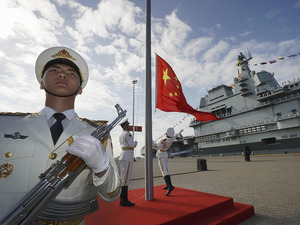
Chinese Military Calls U.S. Biggest Threat to World Peace


BEIJING (AP) — China’s Defense Ministry on Sunday blasted a critical U.S. report on the country’s military ambitions, saying it is the U.S. instead that poses the biggest threat to the international order and world peace.

The statement follows the Sept. 2 release of the annual Defense Department report to Congress on Chinese military developments and goals that it said would have “serious implications for U.S. national interests and the security of the international rules-based order.”

Defense Ministry spokesman Col. Wu Qian called the report a “wanton distortion” of China’s aims and the relationship between the People’s Liberation Army and China’s 1.4 billion people.

“Many years of evidence shows that it is the U.S. that is the fomenter of regional unrest, the violator of the international order and the destroyer of world peace,” he said.

U.S. actions in Iraq, Syria, Libya and other countries over the past two decades have resulted in the deaths of more than 800,000 people and displacement of millions, Qian said.

“Rather than reflecting on itself, the U.S. issued a so-called report that made false comments about China’s normal defense and military construction,” he said in the statement. “We call on the U.S. to view China’s national defense and military construction objectively and rationally, cease making false statements and related reports, and take concrete actions to safeguard the healthy development of bilateral military relations.”

China or USA: Who Is “The Biggest Threat To World Peace”?


According to the annual Defense Department report to the Congress on Chinese military developments and goals, the PLA is rapidly expanding its sphere of influence especially in space and cyber warfare capabilities, and that its current prime target is the USA.

The pentagon’s report, predictably, caught the backlash from the PRC’s Defense Ministry, whose spokesperson Col. Wu Qian called it a “wanton distortion” of China’s aims and the relationship between the People’s Liberation Army and China’s people.

Wu said, “Many years of evidence shows that it is the U.S. that is the fomenter of regional unrest, the violator of the international order and the destroyer of world peace,” thrashing America’s claims over its policies.

“Rather than reflecting on itself, the U.S. issued a so-called report that made false comments about China’s normal defense and military construction. We call on the U.S. to view China’s national defense and military construction objectively and rationally, cease making false statements and related reports, and take concrete actions to safeguard the healthy development of bilateral military relations,” he stated, pointing out to the American military interventions in the Middle East and Africa.

He added that the U.S. interventions have resulted in more than 800,000 deaths and displacement of millions.

Thunder Out of Congress on China

By Scott Kennedy 
The Trump administration has been rolling out new measures on China seemingly almost every day. All of them involve countering China in one way or another, often through expanded restrictions on some aspect of the relationship, from adding Chinese firms to the Entity List to expelling journalists and imposing penalties on Beijing for passage of its harsh national security law on Hong Kong. The institution at the other end of Pennsylvania Avenue has also ramped up its activity on China. By some measures the 116th Congress has been more outspoken on China than any of its predecessors.

Congress has played an important role on China policy for many decades, including the Taiwan Relations Act (1979), sanctions following Tiananmen Square, the annual most favored nation (MFN)-extension votes, and the decision to give China permanent normal trade relations (PNTR) in 1999. Some of the most important legislation is not China specific but still has a huge effect on bilateral relations. The two most obvious recent examples are the Foreign Investment Risk Review Modernization Act of 2018 (FIRRMA) and the Export Control Reform Act of 2018 (ECRA), both passed as part of the John S. McCain National Defense Authorization Act for Fiscal Year 2019, to update, respectively, rules related to investment screening and exports of sensitive technologies. China was not singled out in the legislation, but the framing and drafting of both were done with the People’s Republic of China (PRC) in mind.

Alarm grows at China's military trajectory as exemplified in the Pentagon report


HONG KONG: The India-China border has joined the South and East China Seas as the hottest points of tension for the Chinese military. These areas of dispute have caused a growing chorus of worldwide alarm at Beijing's ambitions and military capability, as exemplified in the Pentagon's latest annual report on military developments in China.

The country owns the largest ground force, navy, coast guard and maritime militia in the world, plus it has the largest air force in the Indo-Pacific region.

In many senses, the People's Liberation Army's (PLA) aggression along the Line of Actual Control (LAC) does not make strategic sense. Chairman Xi Jinping and the Chinese nation are facing multiple points of friction, so why would it add the Indian border to that list?

Yun Jiang and Adam Ni, the editors of the China Neican newsletter, assessed, "Neither China nor India wants a continued row over their border, given what they are dealing with at the moment. India's COVID caseload has been going through the roof (currently at 4.7 million total cases, second behind the US) and its economy is taking a massive hit (estimated to fall by 11.5 per cent this fiscal year). China, on the other hand, is embroiled in a growing list of domestic and international troubles, from its relationship with the US to Hong Kong and Xinjiang."

Opinion – The Chinese ‘New Left’ as Statist Apologists

Chris Man-kong Li

In April, on the occasion of commemoration of the 150th anniversary of Lenin’s birth, the leading Chinese ‘New Left’ scholar Wang Hui published an essay to praise what he sees as Lenin’s great ‘revolutionary personality’ (a useful translation can be found in the website Reading the China Dream, with introductions situating the contexts). Rong Jian, a liberal independent scholar, produced two pieces criticizing Wang, claiming that Wang’s essay signifies Wang’s ‘Heidegger Moment’ to rationalize an authoritarian regime. Rong’s pieces were soon censored, despite their rather abstract and scholarly tones. All the while Wang’s essay stands in the Chinese internet behind the Great Firewall. This is a microcosm of how the Chinese ‘New Left’ turned into statist apologists for the Chinese Communist Party.

It is not true that Wang’s essay is uncritical to the existing Chinese Communist regime. Amidst its praise of the so-called ‘People’s War’ strategy adopted by the Beijing government in fighting COVID-19, Wang did underscore the ‘the bad habits of bureaucratism and formalism’ that at times appeared in the ‘state system’, which led to many mistakes in the early phrase of the fight against the pandemic. Yet, citing widely from Machiavelli and Gramsci to Lu Xun and Mao Zedong, he argued that a revolutionary leader like Lenin is the cure: Wang praised Lenin’s character to ‘oppose his own party and its guiding line… only to achieve hegemony after protracted and sometimes bitter theoretical and political struggles’.

Israel’s Peace Deals Are a Strategic Nightmare for Iran

BY MAYSAM BEHRAVESH, HAMIDREZA AZIZI
Source Link

When U.S. President Donald Trump announced the Abraham Accord, which normalized relations between the United Arab Emirates and Israel, on Aug. 13, the world took note of it as a historic moment. In Iran, the agreement also registered as a grave threat. In a remarkable show of unanimity, diverse officials across the political establishment denounced the accord and warned about its consequences. It was a signal of a coming, and unavoidable, change of strategy by Iran.

The day after the agreement, the Iranian foreign ministry condemned the pact as “strategic idiocy” and “a stab by the UAE in the back of Palestinian people.” One day later, the Islamic Revolutionary Guard Corps (IRGC) issued a fiery statement, dubbing the normalization “historic idiocy” that will bring about a “dangerous future” for the UAE leadership. On the same day, Iranian President Hassan Rouhani also weighed in with his own opprobrium, describing the accord as “betrayal” and warning that if Emiratis “allow Israel a foothold in the region, they will be treated differently.” (In response, the UAE summoned Iran’s chargé dʼaffaires in Abu Dhabi to protest against Rouhani’s “threatening” and “tension-instigating” remarks.) On Aug. 16, Armed Forces Chief of Staff Mohammad Bagheri joined the chorus with a stark admonition that Iran’s policy toward the United Arab Emirates will “fundamentally change” and that “the Islamic Republic’s armed forces will view this country with a different calculus.” “If something happens in the Persian Gulf and the Islamic Republic of Iran’s national security suffers a breach, albeit minor, we will hold the UAE responsible and won’t tolerate it,” Iran’s top military commander asserted. The slew of high-profile condemnations was topped off by Supreme Leader Ali Khamenei’s diatribe on Sept. 1, which portrayed the pact as an Emirati attempt “not only to subject the Palestinian question to oblivion, but also to allow Israel a foothold in the region.”

Opinion – Civil War’s Splinters Indicate a Fractured Future for Yemen

Poornima Balasubramanian

Local sources, on 3 September, have claimed that the UAE-backed Southern Transitional Council (STC) has appointed a new governor for Socotra, the largest of the four islands in the Socotra Archipelago. Earlier that week, violent clashes erupted between the STC forces and the Saudi-backed government forces near the Socotra airport to drive the Yemeni troops away and reinstate STC, hence, UAE’s full control over the island. On 25 August 2020, the STC in Yemen dispatched a letter to Saudi Arabia to convey its intention of withdrawing from the Riyadh Agreement. In its official statement, the STC said that while it still adheres to the Riyadh Agreement, it questioned the Yemeni government’s commitments to the Agreement by citing many reasons for its claims.

First, the Yemeni government’s reported violation of the ceasefire that was arrived at in June and its military escalations in the Abyan governorate. Second, the attacks by extremist forces such as the Islamic State and Al Qaeda in Arabian Peninsula (AQAP) supposedly with the support of the government forces in the southern regions including the governorates of Abyan, Shabwa, Hadhramaut and Al-Mahrah. Third, President Abdrabbuh Mansur Hadi’s government’s continuing neglect of the welfare of the people of the southern region including their health and poor living standards, which has led to the failure of public services in the southern governorates. Fourth, mistreatment of the people of the region with false-arrests and torture in prisons. Lastly, the government’s neglect that has resulted in the collapse of the Yemeni currency, in turn causing inflation of goods and services in the southern governorates, leaving them in a deplorable situation.

Joint Force Quarterly (JFQ), 98 (3rd Quarter, July 2020 )


Structuring for Competition: Rethinking the Area of Responsibility Concept for Great Power Competition

Accelerating Military Innovation: Lessons from China and Israel

Disinformation and Disease: Operating in the Information Environment During Foreign Humanitarian Assistance Missions

Evaluating Strategies: Six Criteria for National Security Professionals

Operations Short of War and Operational Art

Preparing Senior Officers and Their Counterparts for Interagency National Security Decisionmaking

The "Politics" of Security Cooperation and Security Assistance

The Psychology of Jointness

Leveraging Return on Investment: A Model for Joint Force Campaign Plan Assessments

Balancing Competition with Cooperation: A Strategy to Prepare for the Chinese Dream

The Duke of Marlborough and the Paradox of Campaigning in Long Wars

JAIC Wants AI ‘Victory Gardens’ Across DoD

By SYDNEY J. FREEDBERG JR.

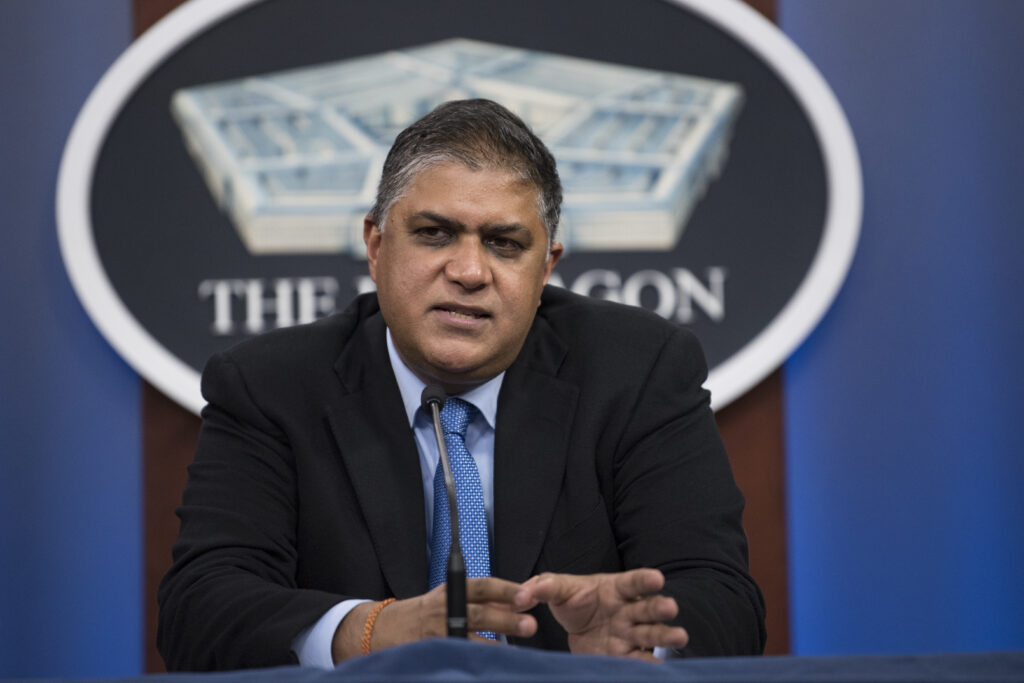
WASHINGTON: The Pentagon’s Joint Artificial Intelligence Center will issue a solicitation before November for a prototype contracting portal, called Tradewind, that JAIC hopes will revolutionize how the rest of the Defense Department does AI.

Despite its name, the JAIC doesn’t want to be the central factory that builds all AIs for the Defense Department. Instead, acting director Nand Mulchandani says, JAIC wants to build a one-stop-shop where everyone in DoD can find technical tools, cleaned-up datasets and contracting vehicles to do their own AI projects.

“Instead of a single [central] place where AI happens, everyone can and should both learn about AI but also start their own projects to implement AI in what they do,” Mulchandani said at a Pentagon press conference yesterday.

Take data, the raw material required to train machine learning algorithmsraw material which must be processed, organized, and formatted before an AI can actually use it. JAIC will provide curated datasets that the rest of DoD can use to train and test its algorithms, but “there isn’t going to be a single gigantic Fort Knox of data,” Mulchandani said. “I keep talking about the AI victory garden, this concept that each individual project or service or program needs to curate its own little data garden.”

Japan’s Suga Will Struggle to Pull off Abe’s Defense Transformation

BY JACK DETSCH
Source Link

Yoshihide Suga, the low-key son of a farmer who will be named Japan’s next prime minister on Wednesday, is in many ways a policy clone of recently resigned Prime Minister Shinzo Abe. But that doesn’t mean Suga will bring anything like the same effort Abe did to bolstering Japan’s defense capabilities—a transition in Japanese politics both Beijing and Washington will be watching.

Suga, who overcame two favored party rivals to unexpectedly grab the top of the greasy pole, lacks the political pedigree or hobnobbing skills that made Abe a fixture on the international political scene. But he also lacks Abe’s compulsion to break the constraints of Japan’s post-war defense posture, and is additionally hemmed in by the coronavirus pandemic and the economic damage it’s wrought, which will likely push Japan’s nascent security awakening to the back seat for now.

“He’s got to focus on economics,” said Michael Auslin, a distinguished research fellow at Stanford University’s Hoover Institution. “You don’t win elections on foreign policy. He’s got to prioritize reform, he’s got to deal with the COVID virus. He has enormous pressures on him which means those that want to push him into Japan taking a smaller role on the [world] stage are going to have a great opportunity.” 

Unlike the globe-trotting, glad-handing Abe, who grabbed the spotlight with controversial and conciliatory visits—touring Japanese war shrines as well as Pearl Harbor, then wooing U.S. President Donald Trump—Suga is likely to hew to the low-profile approach honed by seven years of scandal and intra-party rebellion as Abe’s right-hand man.

The UN at Seventy-Five: How to Make it Relevant Again


Council of Councils global perspectives roundups gather opinions from experts on major international developments. In this edition, members of six leading global think tanks reflect on what reforms are the most important for the United Nations as it looks toward its next seventy-five years.

The United Nations, founded in the aftermath of World War II’s devastation, is marking its seventy-fifth year in 2020. The anniversary comes at a time of unprecedented strain on the framework of international institutions created to peacefully manage conflict and foster global cooperation within multilateral forums. In this time of upheaval, amid a pandemic and facing the specter of climate change, the debate over how to reform and strengthen the United Nations is more relevant than ever. 

This group of international affairs experts, writing from China, India, Mexico, Nigeria, Poland, and South Africa, calls for a wide range of changes. Suggestions include expanding the UN Security Council to include a more diverse selection of countries; creating new UN bodies to address climate change, the pandemic, and nuclear nonproliferation; and launching a concerted effort to lower the temperature on U.S.-China tensions, which threaten to upend the rules-based international order.

The Coronavirus and U.S. National Security: An Opportunity for Strategic Reassessment?

By Jim Cook

In March 2020, President Trump declared the United States a nation “at war with an invisible enemy” that will have long-lasting economic, social, and security implications, even after the medical emergency is over.[1] His proclamation is reminiscent of the 9/11 terror attacks, where the nation was shocked by an unanticipated threat against the homeland. Those horrendous assaults transformed the country, and the U.S. soon embarked upon an almost two-decades-long Global War on Terrorism in response. Mr. Trump has lauded Americans as warriors and acknowledged their necessary sacrifices to overcome the health crisis and reopen the much-beleaguered economy. Meanwhile, critics argue that Washington should have been ready for the coronavirus given previous outbreaks including the 2009 swine flu, Severe Acute Respiratory Syndrome, and Ebola. Instead, a Wall Street Journal investigation found that the U.S. government “focused more on preparing for terrorism than for a pandemic.”[2]

The Trump administration initially struggled to provide a coordinated whole-of-government response in the face of rising infections and fatalities within the United States. Consequently, state governors have taken a lead role in addressing the health crisis across the country.[3] To be sure, the establishment of the Coronavirus Task Force better enabled the administration to monitor, contain, and mitigate the spread of the virus. Moreover, subject matter experts such as Doctors Anthony Fauci and Deborah Birx participated in White House briefings to add credibility and inform the American public.

A Grand Strategy of Resilience

By Ganesh Sitaraman
Source Link

Every so often in the history of the United States, there are moments of political realignment—times when the consensus that defined an era collapses and a new paradigm emerges. The liberal era ushered in by President Franklin Roosevelt defined U.S. politics for a generation. So did the neoliberal wave that followed in the 1980s. Today, that era, too, is coming to a close, its demise hastened by the election of President Donald Trump and the chaos of the coronavirus pandemic.

The coming era will be one of health crises, climate shocks, cyberattacks, and geoeconomic competition among great powers. What unites those seemingly disparate threats is that each is not so much a battle to be won as a challenge to be weathered. This year, a pandemic is forcing hundreds of millions of Americans to stay at home. Next year, it might be a 1,000-year drought that devastates agriculture and food production. The year after that, a cyberattack could take out the power grid or cut off critical supply chains. If the current pandemic is any indication, the United States is woefully underprepared for handling such disruptions. What it needs is an economy, a society, and a democracy that can prevent these challenges when possible and endure, bounce back, and adapt when necessary—and do so without suffering thousands of deaths and seeing millions unemployed. What the United States needs is a grand strategy of resilience.

Opinion – What the European Union Can Do for Belarus

Kareem Salem

This year saw Europe’s most authoritarian ruler grossly and repeatedly miscalculate. Belarusian leader Alexander Lukashenko, the country’s ruler since 1994, has downplayed the coronavirus pandemic and has deepened long-held frustrations about the country’s political system and stagnating economy. These events sparked an election campaign that saw overwhelming support for his opponent Svyatlana Tsikhanouskaya, exposing Lukashenko’s political vulnerability, leading the Belarussian President to patently falsify election results. Since then, the resilience of Lukashenko’s regime has been tested by an extraordinary wave of protests and worker strikes, which has swept across Belarus.

For much of the last 26 years, the European Union has viewed Belarus a mere Russian satellite, with a woeful record of political oppression and human right abuses. Indeed, Belarus is the most ‘Russianised’ of the post-Soviet countries, given that 70% of Belarusians speak Russian at home, and Russian outlets occupy two-thirds of the Belarusian media space. Belarus is also linked to Russia across five integration agreements, which allows Moscow to advance its economic and security objectives. To maintain his grip on power, Lukashenko has systematically sought to exclude, intimidate and repress political opposition. The Belarussian leader has also used referenda to amend laws and even the constitution to extend his authority. These developments have meant that Belarus has long remained on the margins of EU enlargement efforts.

Biden Has a Serious Credibility Problem in Asia

By James Crabtree

Bilahari Kausikan, a former high-ranking Singaporean diplomat, is known to be outspoken. But his recent comments about Susan Rice, a U.S. national security advisor during the Obama administration, were even blunter than usual. “Rice would be a disaster,” he wrote on Facebook in August, when Democratic presidential candidate Joe Biden was reportedly considering Rice as a running mate. Kausikan described Rice—a possible candidate for secretary of state or defense in a Biden adminstration—as weak-willed on Beijing: “She was amongst those who thought the United States should deemphasise competition to get China’s cooperation on climate change, which is a fundamental misunderstanding of the nature of international relations.” His prediction in case of a Biden victory: “We will look back on Trump with nostalgia.”

If Kausikan’s sharp views have often made him an intellectual outlier in Asia, this case is different. To a degree that will surprise many in Washington, the United States’ friends in the region are quietly anxious about a Biden victory, and that counts even more for vital partners such as Japan and India. In the United States, Trump’s critics on both the left and right find him offensive and despair of his politics—and assume that any right-minded foreigner would, too. That may be the case in much of Europe, but not so in much of Asia: Officials in Tokyo, Taipei, New Delhi, Singapore, and other capitals have grown relatively comfortable with Trump and his tough approach on China. The prospect of a Biden presidency, by contrast, brings back uncomfortable memories of an Obama era that many Asian movers and shakers recall as unfocused and soft toward Beijing. Whether or not that memory is correct is beside the point. Biden has an Asian credibility problem—and one that may prove tricky to solve.

COVID-19: Saving thousands of lives and trillions in livelihoods

By Sarun Charumilind, Ezra Greenberg, Jessica Lamb, and Shubham Singhal

On March 23, 2020, McKinsey introduced the twin imperatives of safeguarding our lives and our livelihoods and a nine-scenario framework to describe potential economic and COVID-19 outcomes (Exhibit 1). At the time, we wrote that the best combined outcomes depended on a rapid and effective public-health response that controlled the spread of the novel coronavirus within two to three months. Similarly, in May, we wrote that crushing uncertainty by reducing the virus spread to near zero was likely the big “unlock” for most economies.

Exhibit 1

Secretive Pentagon research program looks to replace human hackers with AI

Zachary Fryer-Biggs

The Joint Operations Center inside Fort Meade in Maryland is a cathedral to cyber warfare. Part of a 380,000-square-foot, $520 million complex opened in 2018, the office is the nerve center for both the U.S. Cyber Command and the National Security Agency as they do cyber battle. Clusters of civilians and military troops work behind dozens of computer monitors beneath a bank of small chiclet windows dousing the room in light.

Three 20-foot-tall screens are mounted on a wall below the windows. On most days, two of them are spitting out a constant feed from a secretive program known as “Project IKE.”

The room looks no different than a standard government auditorium, but IKE represents a radical leap forward.

If the Joint Operations Center is the physical embodiment of a new era in cyber warfare — the art of using computer code to attack and defend targets ranging from tanks to email servers — IKE is the brains. It tracks every keystroke made by the 200 fighters working on computers below the big screens and churns out predictions about the possibility of success on individual cyber missions. It can automatically run strings of programs and adjusts constantly as it absorbs information.

To Prevent Violent Extremism the Next Administration Should Think beyond the Military


I was lost in an episode of This American Life when my up-armored SUV was knocked sideways on the highway between Fallujah and Ramadi. It was 2010, and I had been in Iraq as a civilian for over a year, attempting to build a grassroots foundation for democracy post-Saddam Hussein. Though I will never know for sure, informal channels suggested to me afterward that the misfired improvised explosive device pointed in my direction that summer morning was triggered by violent extremists targeting what they believed to be an unlawful foreign military presence.

Myriad lists detail push and pull factors in violent extremist recruitment. Most experts agree the descent into violence results from a lack of access to opportunities afforded to youth, a desire for adventure, a need to feel part of something bigger than oneself, and/or mischanneled kinetic energy, especially among young men. Most also agree that misguided security and political actions are a bigger part of the problem than the solution.

Nonetheless, U.S. efforts to address violent extremism since 9/11 have disproportionately focused on “creating security space,” i.e., relying on responses by military forces, intelligence assets, drone strikes, and law enforcement. At best, these approaches eliminate tactical threats and secure people, places, and assets. At worst, they exacerbate grievances, are used to justify violence, and are tools of recruitment for bad actors who facilitate the radicalization of individuals and communities. In other words, creating security space can very well produce more violent extremism than it counters. Though the evidence varies in the details, one overarching theme is abundantly clear: preventing the sense of aggrievement that turns extremists violent requires tools not typically found among security actors.

A Better Approach

16 September 2020

India’s Path to the Big Leagues

Ashley J. Tellis

Even before the coronavirus pandemic swept through the country, India was at a crossroads. Its sustained economic expansion, accelerated by pathbreaking reforms in 1991, slowed significantly. Convulsions around religion and citizenship roiled domestic politics under Prime Minister Narendra Modi. Meanwhile, the aspirations of international leadership that India has harbored since independence remain unrealized.

For all its recent shortcomings, however, India should not be counted out. At a time when China’s myriad pathologies have left many countries thirsting for an alternative exemplar, India could again become the world’s fastest-growing free market democracy. But it will need a new approach to revive its hopes of joining the league of great powers.

India could again become the world’s fastest-growing free market democracy.

CAN INDIA GROW FAST ENOUGH?

India’s economic growth has contracted since 2018, alongside a larger global slowdown driven by falling commodity prices, declining international trade, intensifying U.S.-China tariff wars, and decreasing manufacturing output across the developed world. If these cyclical factors alone accounted for India’s weakening performance, New Delhi could get by on provisional remedies while waiting for global conditions to improve.

The unpalatable reality, however, is that the Indian economy’s structural weaknesses intensified these cyclical headwinds. Investments slowed because heavily indebted Indian companies left India’s major public sector banks saddled with huge nonperforming loans and other Indian financial intermediaries fell victim to bad investments, thus bringing credit expansion to a halt.

The Road to Peace In Afghanistan no Longer Runs Through Pakistan

BY FAHD HUMAYUN
Source Link

Toward the end of August, a delegation from the Afghan Taliban led by the group’s deputy, Mullah Abdul Ghani Baradar, travelled to Islamabad. There, they met with Pakistan’s foreign minister and head of its Inter-Services Intelligence, the military’s intelligence wing. The first gathering, held at Pakistan’s Foreign Office, was meant to give boost to an intra-Afghan negotiation process that has been racked by persistent delays, including over the release of Taliban inmates by Afghan authorities.

Baradar’s meetings seem to have been helpful. A Taliban negotiating team is now in Doha, Qatar, and is set to hold its first direct peace talks with representatives of the Afghan government. But in these talks, the Taliban will be led by Mullah Abdul Hakim, a hardline cleric and the Taliban’s de facto chief justice, and not Baradar, who was central to the Taliban signing a peace deal with the United States back in February. The change is part of a broader trend of Pakistan losing influence over a conflict it was once seen to script.

For years, Islamabad has maintained an uneasy relationship with Baradar, who, now in his fifties, leads the Taliban office—essentially its political arm—from Doha. Before 2018, Baradar spent eight years in Pakistani custody. His eventual release came at the behest of U.S. envoy Zalmay Khalilzad, who had been tasked with finding a way to get talks between the Taliban and Washington going. Deft maneuvering by both Islamabad and Washington subsequently paved the way for nine rounds of negotiations, culminating in the earlier February deal this year. That first Doha agreement provided for drawing down approximately 7,000 NATO forces in Afghanistan and the lifting of U.S. sanctions on the Taliban this August. But talks between the Taliban and the Afghan government, which were to follow in the summer, have taken longer than expected. The coronavirus—and the public airing of internal political disagreements between Afghanistan’s political powerbrokers—have led to worries that Kabul may not have what it takes to strike, let alone sustain, a provisional power-sharing deal with the Taliban.

Al Qaeda’s Leader Is Old, Bumbling—and a Terrorist Mastermind

BY COLIN P. CLARKE, ASFANDYAR MIR
Source Link

Nineteen years after 9/11, al Qaeda chief Ayman al-Zawahiri has yet to achieve the household notoriety evoked by his immediate predecessor, Osama bin Laden. In part that’s because the United States hasn’t cared enough to focus attention on him. Aside from massive financial overtures for intelligence on his whereabouts—there’s currently a $25 million bounty offered for his head, higher than the reward for any other terrorist in the world—the U.S. government has been relatively blasé about al Qaeda since Zawahiri took over in 2011. Some terrorism analysts even claim a living Zawahiri has done more harm to al Qaeda than a dead one ever could.

But that conclusion doesn’t square with the recent trajectory of the group. While al Qaeda has not been able to replicate an assault like 9/11, that’s also a naive metric of success. Al Qaeda maintains affiliates in regions across Africa, the Middle East, and South Asia. And though he’s conjured less of a personality cult, al Qaeda’s current leader is just as dangerous to the United States as its old one.

Al Qaeda’s current leader is just as dangerous to the United States as its old one.

The Hard Truths About 9/11’s Aftermath and America’s Legacy in Afghanistan

Candace Rondeaux 

In the 19 years that have passed since I watched the twin towers of the World Trade Center collapse, not a single moment of that day has faded from memory. It was my second day on the job as a cub reporter for the New York Daily News, and I am still a bit embarrassed to admit I was running a little late that morning. I had stopped at the elementary school polling station near my apartment in Queens to cast my vote in the mayoral primaries at around 9 a.m. A few minutes later, as I hustled to catch the Manhattan-bound F train, my favorite deli guy—the same one who gave me a free cup of coffee and a bagel, two years earlier, when I had excitedly told him I’d won a scholarship to go to journalism school—asked if I had heard about a plane crashing into one of the towers. “You better get a move on,” he said.

Dumbstruck, I remember running down the stairs to catch the next train—and then the eerie silence when it pulled up to Rockefeller Center in Midtown and the conductor told us all to get off. Upstairs, at the corner of 6th Avenue and 47th Street, the siren red Fox News ticker blared: “New York and Washington Under Attack!” All of Manhattan at that moment seemed to be looking up and south. A girl in a phone booth I ran past was crying. Tears streaking her cheeks, she screamed into the receiver, “Oh my God. I think mommy is in there! She’s working today.” ...

The Controversies and Security Concerns Surrounding TikTok

By: David Volodzko

Introduction

In July, the music and lip-syncing short-video app TikTok (蒂克托克, DikeTuoke)—popularly used by dancers, singers, magicians and fashion bloggers—became another point of tension in the growing conflict between the United States and the People’s Republic of China (PRC). On July 31, U.S. President Donald Trump told reporters that he planned to ban TikTok in the United States. Microsoft immediately suspended talks to buy TikTok’s U.S. operations, but resumed talks days later, after Microsoft CEO Satya Nadella reportedly spoke to the U.S. President and agreed to close a deal by September 15 (Microsoft, August 2).

The PRC Ministry of Foreign Affairs has accused the United States of threatening TikTok without evidence, and the Chinese government will no doubt retaliate. Beijing’s general response to such actions has been quid pro quo: for example, it closed the U.S. Consulate in Chengdu following the closure of the PRC Consulate in Houston, and it revoked press passes for journalists representing several U.S.-based news outlets after the U.S. State Department designated five Chinese state-run media outlets as units of the Chinese government (U.S. State Department, February 18; PRC Foreign Ministry, March 18; PRC Foreign Ministry, July 30).

On August 3, Hu Xijin (胡锡进), the editor-in-chief of the PRC state-run Global Times, called the potential purchase “open robbery” (Twitter, August 3). On the same day, the English-language press outlet China Daily, which is owned by the Chinese Communist Party’s Central Propaganda Department (中宣部, Zhongxuanbu), stated in an editorial that efforts to pressure TikTok into a purchase by Microsoft “were tantamount to inviting potential U.S. purchasers to participate in an officially sanctioned ‘steal’ of Chinese technology,” and vowed that “China will by no means accept the ‘theft’ of a Chinese technology company, and it has plenty of ways to respond if the administration carries out its planned smash and grab” (China Daily, August 3).

The climate risks of China’s Belt and Road Initiative

By Sagatom Saha

China’s Belt and Road Initiative (BRI) is not the green project that Beijing claims it is. Leading up to the first BRI forum in May 2017, the Chinese government published official documents declaring BRI would promote the Paris Agreement and UN Sustainable Development Goals (Chen 2019). At the forum itself, Chinese Communist Party General Secretary Xi Jinping advertised BRI as a “vision of green development and a way of life and work that is green, low-carbon, circular, and sustainable” (Xinhua 2017). BRI, which promises sustainable development for all participating countries, hinges on the truth of this premise. General Secretary Xi accrued significant international support and global participation for BRI with this claim. China established the International Green Development Coalition on the Belt and Road in partnership with the United Nations Environment Programme, increasing BRI’s international legitimacy (Liqiang 2019).

However, evidence abounds of the environmental harm the Chinese government wreaks beyond its borders. China has long been the world’s largest exporter of coal power equipment, exporting twice as much as Japan, its nearest competitor (United Nations 2020). Chinese banks are financing more than 70 percent of all coal plants outside of China, with Chinese firms constructing many of them, including in countries like Egypt and Pakistan that previously burned little to no coal (Quartz 2019). At current rates, Chinese coal equipment exports and financing make it virtually impossible to limit global warming to safe levels, which would require retiring one coal plant per day globally (Hilton 2019). BRI’s environmental damage is not limited to the energy sector. Transportation infrastructure, mining, and land reclamation for mega-cities carry their own environmental and climate risks that are harder to

China Is Hostage to a Rules-Based Multilateral System

YUKON HUANG

The broad campaign attacking China during a U.S. presidential contest, launched by the administration of President Donald Trump, has traction because of widespread popular support in the United States for disengaging with China. This has fostered a competition between Trump and Democratic nominee Joe Biden about who would be tougher in dealing with Beijing.

Disengagement, however, is not a realistic option—the costs are simply too great for both sides. But the path to better outcomes is exceptionally narrow, as the required compromises go against the instincts of both countries’ current leaders. The United States would have to concede that China’s rise necessitates a fundamental reset in great power relations, and China would need to moderate its behavior and ambitions.

From the U.S. side, any such reset will likely have to await the outcome of the elections, given the Trump administration’s reported intention “to leave a lasting legacy of ruptured ties between the two powers,” as the New York Times summarizes. Meanwhile, a change in Beijing’s trajectory would require Chinese President Xi Jinping to rethink whether he has overreached in his vision for China. If there is a basis for forging a more constructive relationship, it will likely come from China’s dependency on a rules-based multilateral system to become a more prosperous and innovative great power. By recognizing China’s needs, the United States can forge a new strategy of engagement that would benefit both nations.