21 September 2020

(The Other) Red Storm Rising: INDO-PACOM China Military Projection

by Hans M. Kristensen

U.S. Indo-Pacific Command recently gave a briefing about the challenges the command sees in the region. The briefing says China is the “Greatest Threat to Global Order and Stability” and presents a set of maps that portray a massive Chinese military buildup and very little U.S. capability (and no Allied capability at all) to counter it. With its weapons icons and a red haze spreading across much of the Pacific, the maps resemble a new version of the Cold War classic Red Storm Rising.

Unfortunately, the maps are highly misleading. They show all of China’s forces but only a fraction of U.S. forces operating or assigned missions in the Pacific.

There is no denying China is in the middle of a very significant military modernization that is increasing its forces and their capabilities. This is and will continue to challenge the military and political climate in the region. For decades, the United States enjoyed an almost unopposed – certainly unmatched – military superiority in the region and was able to project that capability against China as it saw fit. The Chinese leadership appears to have concluded that that is no longer acceptable and that the country needs to be able to defend itself.

In describing this development, however, the INDO-PACOM briefing slides make the usual mistake of overselling the threat and under-characterizing the defenses. Moreover, some of the Chinese missile forces listed in the briefing differ significantly from those listed in the recent DOD report on Chinese military developments. As military competition and defense posturing intensify, expect to see more of these maps in the future.

Apples, Oranges, and Cherry-Picking
The Abraham Accords: Who Benefits?

BY JEFFREY GOLDBERG

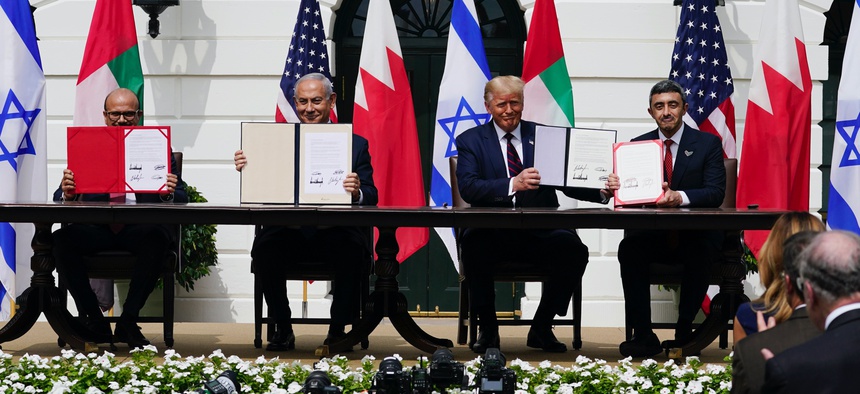
Israel and two Arab Gulf states, the United Arab Emirates and Bahrain, have formally and publicly established diplomatic relations. The White House is calling the agreements “The Abraham Accords,” and President Donald Trump, in typically understated fashion, announced that “there’s going to be peace in the Middle East.” (Spoiler alert: no.) The U.A.E. and Bahrain are the third and fourth Arab countries to open diplomatic relations with Israel; Egypt and Jordan were the first two. Here is a brief, tentative analysis of the winners and losers in this new arrangement. (I say “tentative” because this is the Middle East, and no one actually knows for sure what any of this could mean.)

THE WINNERS

The White House aides who named this agreement “The Abraham Accords”

A genius marketing move, though I would have preferred the “Isaac and Ishmael Summit,” or “The Treaty of Ghent,” for that matter. “The Abraham Accords” is grandiose for any number of reasons, including the fact that what was signed yesterday does not even constitute a peace treaty. Peace treaties are made between warring parties, and the United Arab Emirates and Bahrain have never been at war with Israel. My personal preference would have been to deploy the big gun himself, Abraham, the father of monotheism, for a peace treaty between Israelis and Palestinians, which would be the thing that actually ended that Middle East conflict.

Is Lebanon a Failed State? Here’s What the Numbers Say.

By Kali Robinson

The August explosions in Beirut were the latest in a series of man-made disasters that have led some experts to say Lebanon is becoming a failed state.

Beirut suffered devastating explosions in August that many have attributed to government negligence. The blasts—on top of Lebanon’s failing economy, rampant corruption, insufficient infrastructure, and increasing poverty—have fueled conversations about whether Lebanon is so dysfunctional that it should be considered a failed state.

The government’s inefficacy is tied to the sectarian political order enshrined in a 1943 agreement. To reflect the major religious groups among the population of nearly seven million, a Sunni Muslim serves as prime minister, a Maronite Christian as president, and a Shiite Muslim as the speaker of parliament. But by concentrating power among certain families and former warlords­—including the leaders of Hezbollah, the Future Movement, and the Free Patriotic Movement, which are primarily affiliated with Shiites, Sunnis, and Christians, respectively—the system promotes cronyism and parochial interests over vital reforms. As part of a protest movement spurred by a proposed tax on the use of the popular messaging service WhatsApp in October 2019, Lebanese have demanded the ruling elite cede power to a technocratic government.

Catalysts for the public’s anger include the failing economy and lack of public services. The Lebanese pound is pegged to the U.S. dollar, but when the central bank tried to maintain an exchange rate of 1,500 pounds to the dollar amid increased demand for the U.S. currency last year, the ensuing dollar shortage left many people unable to access their savings. More recently, the Beirut blasts sparked fears of food insecurity because the damaged port housed silos containing 85 percent of Lebanon’s cereals, leaving the country with less than a month’s worth of grain reserves. The port also received most of Lebanon’s fuel imports, a vital resource for a country that hasn’t had a complete electrical grid since its 1975–1990 civil war. The country’s waste management systems also suffer from poor infrastructure.

Israel-Gulf Normalization Sends Palestinians Back to the Drawing Board

Frida Ghitis

When officials from Israel, the United Arab Emirates and Bahrain joined President Donald Trump at the White House to sign landmark diplomatic agreements Tuesday, the event was loaded with domestic political ramifications for each country. But beyond that—and beyond the timing of the ceremony—the deals normalizing the UAE and Bahrain’s ties with Israel carry major regional implications. And, perhaps surprisingly, the presence of tiny Bahrain is a crucial element of their momentum.

It’s no coincidence that the only top leaders at the White House ceremony for the so-called Abraham Accords were Trump and Israeli Prime Minister Benjamin Netanyahu. Trump, facing a tough election in seven weeks, wants to wring as much political benefit out of the normalization agreements as he can. Then there’s Netanyahu, who faces such steep political troubles at home that the deals, significant as they are, may not be enough to save him. ...

Japan’s Geopolitical Balancing Act Just Got Harder

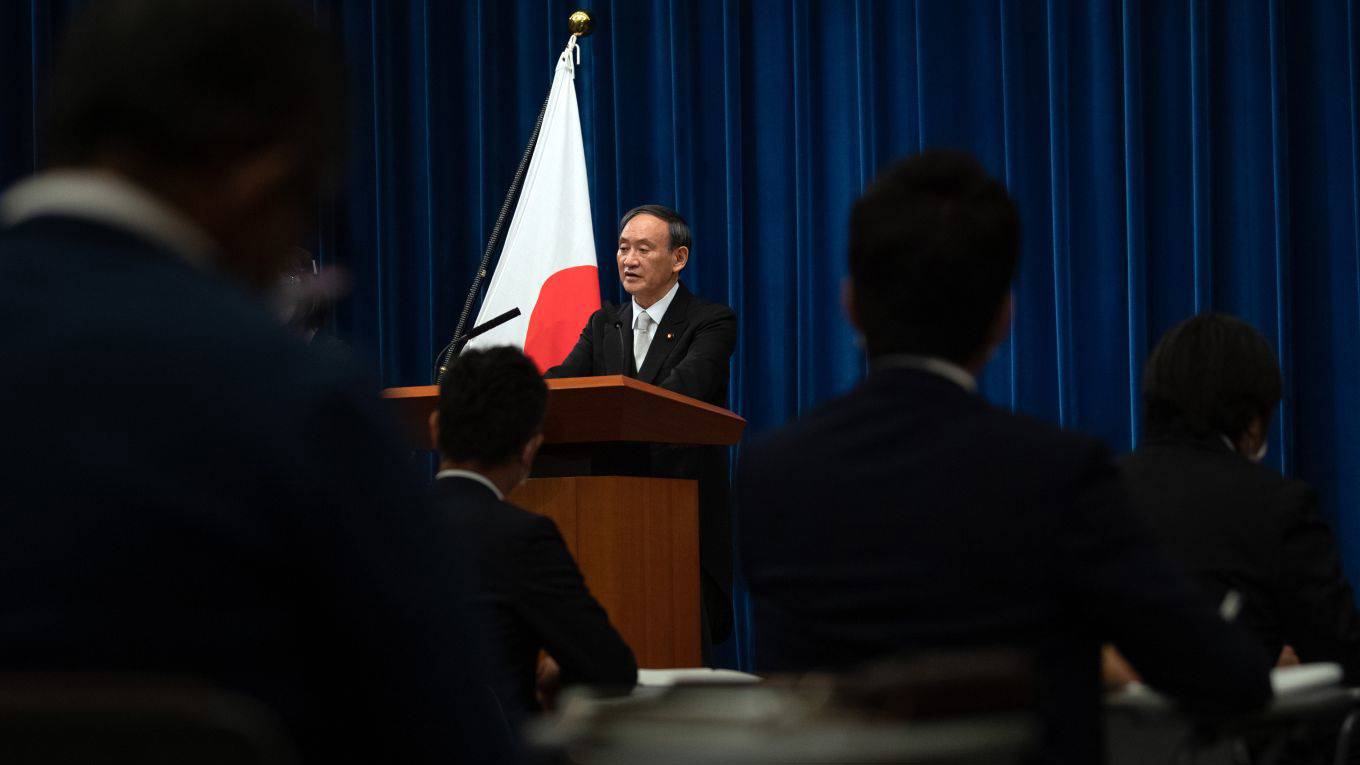
CLAREMONT, CALIFORNIA – Japanese Prime Minister Shinzo Abe’s unexpected resignation last month for health reasons has raised many questions about the legacy of the country’s longest-serving premier. One of them is whether his successor, Yoshihide Suga, will be able to continue Abe’s geopolitical balancing act as tensions between China and the United States are continuing to escalate dangerously.

The US and China are critical to Japan’s peace and prosperity. America is Japan’s security guarantor and second-largest trading partner, while China is its largest trading partner and a next-door neighbor. After Abe returned as prime minister in December 2012, he adroitly managed Japan’s relationships with both.

Abe went out of his way to befriend US President Donald Trump, even as Trump claimed that US-Japanese trade was “not fair and open,” and demanded that Japan quadruple its contribution to the cost of keeping American troops in the country. He further pleased the Trump administration by quietly banning the Chinese telecommunications giant Huawei from participating in building Japan’s 5G network.

At the same time, Abe also cultivated ties with Chinese President Xi Jinping, and made a diplomatic ice-breaking trip to Beijing in October 2018 for the first Sino-Japanese summit in seven years. With US-China relations in free fall, Xi seized Abe’s olive branch and planned a state visit to Japan in April 2020, which would have been the first by a Chinese leader since 2008. (The visit has been postponed indefinitely because of the COVID-19 pandemic.)

Trump, Ike and the myth of the military-industrial complex


It is hard to think of any U.S. president that Donald Trump resembles less than Dwight D. Eisenhower. Yet Trump managed to evoke the comparison this week, when he charged that senior American military officials are more interested in serving the interests of arms manufacturers than in serving the interests of the U.S. The military, he said, advocates war “so that all of those wonderful companies that make the bombs and make the planes and make everything else stay happy.”

For some observers, the allegation brought to mind Eisenhower’s farewell address in January 1961, in which he cautioned that a mighty “military-industrial complex” could “endanger our liberties” and strangle the American economy. Since then, Eisenhower’s speech has been cited by critics who warn that an expansive foreign policy will ruin the nation’s prosperity and freedom alike.

Yet just as Trump was wrong in arguing that Pentagon officials are motivated by greed rather than patriotism, Eisenhower — a far wiser leader — was more wrong than right about the military industrial-complex.

It helps to understand the context in which Ike delivered his warning. The Cold War was in its most intense and dangerous phase. U.S. defense spending had skyrocketed to nearly 14 percent of gross domestic product during the Korean War. During the 1950s, Ike had brought the total down to around 9 percent, mostly by relying on nuclear weapons for deterrence and defense. But the fears of the period, including the Sputnik shock of 1957, set off calls from Congress and the Pentagon for far higher outlays.

Four Scenarios for Geopolitical Order in 2025-2030: What Will Great Power Competition Look Like?


CSIS’s Risk and Foresight Group created four plausible, differentiated scenarios to explore the changing geopolitical landscape of 2025-2030, including the potential lasting first- and second-order effects of Covid-19. The scenarios center on the relative power and influence of the United States and China and the interaction between them, along with detailed consideration of other major U.S. allies and adversaries within each of four worlds.

Each scenario narrative was informed by deep trends analysis and subject-matter-expert interviews. CSIS’s Dracopoulos iDeas Lab brought to life the scenarios in four engaging videos designed to test policymakers’ preconceived notions about the defense and security challenges facing the United States and its allies in the second half of this decade. This research was sponsored by the Defense Threat Reduction Agency’s Strategic Trends Division.

Figure 1: Scenario Axes

Key Trends in the Global Economy through 2030


The CSIS Trade Commission on Affirming American Leadership was created in the summer of 2019 to develop a series of recommendations to cement U.S. global leadership in light of a multitude of twenty-first-century challenges, both at home and abroad. In a series of reports, the Commission lays out recommendations for the U.S. workforce, U.S. innovation policy, and U.S. engagement in the international trading system. This report, which is the first of four reports to be released from the Commission, sets the backdrop for those recommendations. For the U.S. to successfully lead in the next decade, we must first acknowledge the changes that are happening in the global economy and use that information to plan for U.S. leadership in a changing economic environment. This report outlines key trends in the global economy from now until 2030, including the rising importance of services and digital commerce, increased use of automation and AI in the workforce, a shift towards regional supply chains, and an aging workforce.

Assessing China and Russia’s Moves in the Middle East

By Ali Wyne, Colin P. Clarke

Recent news that China and Iran are close to finalizing an economic and security partnership, initially proposed by Beijing in January 2016, has renewed anxieties among some U.S. observers that Washington is gradually ceding the Middle East to its principal strategic competitor. Commenters raised similar concerns after the January 2020 assassination of Islamic Revolutionary Guard Corps-Quds Force commander Maj. Gen. Qassem Soleimani. Targeting Soleimani undermined relations not only with Iran, but also with Iraq, since the drone strike that killed him took place at Baghdad International Airport and also killed an Iraqi Shiite militia commander.

While the United States is concerned primarily about a resurgent China’s inroads in the Middle East, it is also nervous about the gambits of a revanchist Russia, which is perhaps now the most influential external actor in both Syria and Libya. The White House’s 2017 national security strategy and the Pentagon’s 2018 national defense strategy are concerned principally about the revival of great-power competition with Beijing and Moscow. While many discussions center on the Asia-Pacific and the Baltic regions, the Middle East is starting to figure more prominently. This June, the commander of U.S. Central Command, Gen. Kenneth McKenzie Jr., described the region as a “Wild West” arena of competition in which China is principally using its economic heft to establish a long-term strategic “beachhead,” and Russia is using limited but “pretty high-intensity” deployments of military assets “to throw sand in [America’s] gears” and “appear to be a player on the global stage when it comes to Middle Eastern issues.”

Climate math: What a 1.5-degree pathway would take


Amid the coronavirus pandemic, everyone is rightly focused on protecting lives and livelihoods. Can we simultaneously strive to avoid the next crisis? The answer is yes—if we make greater environmental resilience core to our planning for the recovery ahead, by focusing on the economic and employment opportunities associated with investing in both climate-resilient infrastructure and the transition to a lower-carbon future.

Adapting to climate change is critical because, as a recent McKinsey Global Institute report shows, with further warming unavoidable over the next decade, the risk of physical hazards and nonlinear, socioeconomic jolts is rising. Mitigating climate change through decarbonization represents the other half of the challenge. Scientists estimate that limiting warming to 1.5 degrees Celsius would reduce the odds of initiating the most dangerous and irreversible effects of climate change.

While a number of analytic perspectives explain how greenhouse-gas (GHG) emissions would need to evolve to achieve a 1.5-degree pathway, few paint a clear and comprehensive picture of the actions global business could take to get there. And little wonder: the range of variables and their complex interaction make any modeling difficult. As part of an ongoing research effort, we sought to cut through the complexity by examining, analytically, the degree of change that would be required in each sector of the global economy to reach a 1.5-degree pathway. What technically feasible carbon-mitigation opportunities—in what combinations and to what degree—could potentially get us there?

We also assessed, with the help of McKinsey experts in multiple industrial sectors, critical stress points—such as the pace of vehicle electrification and the speed with which the global power mix shifts to cleaner sources. We then built a set of scenarios intended to show the trade-offs: If one transition (such as the rise of renewables) lags, what compensating shifts (such as increased reforestation) would be necessary to get to a 1.5-degree pathway?

Who is Secretly Building the USAF’s New Fighter?

BY MARCUS WEISGERBER

Among the big questions surrounding the secret U.S. Air Force fighter-jet demonstrator revealed this week is: who built it?

Will Roper, the head of Air Force acquisition, declined to say much about the new plane, other than it has actually flown, that some of the plane’s systems have been flight-tested, and that it was designed and built using digital engineering. 

So let’s look at some clues, starting with a likely predecessor to the Next Generation Air Dominance project that produced the new demonstrator. 

In January 2015, Frank Kendall, then defense undersecretary for acquisition, technology and logistics, told the House Armed Services Committee about a DARPA-led project that was developing new planes and engine technology for the Air Force and Navy.

“The intent is to develop prototypes for the next generation of air-dominance platforms — X-plane programs, if you will," Kendall said.

Dubbed the Aerospace Innovation Initiative, the project aimed to “develop the technologies and address the risks associated with the air dominance platforms that will follow the F-35, as well as other advanced aeronautical challenges.”

The Genetic Engineering Genie Is Out of the Bottle

BY VIVEK WADHWA

Usually good for a conspiracy theory or two, U.S. President Donald Trump has suggested that the virus causing COVID-19 was either intentionally engineered or resulted from a lab accident at the Wuhan Institute of Virology in China. Its release could conceivably have involved an accident, but the pathogen isn’t the mishmash of known viruses that one would expect from something designed in a lab, as a research report in Nature Medicine conclusively lays out. “If someone were seeking to engineer a new coronavirus as a pathogen, they would have constructed it from the backbone of a virus known to cause illness,” the researchers said.

But if genetic engineering wasn’t behind this pandemic, it could very well unleash the next one. With COVID-19 bringing Western economies to their knees, all the world’s dictators now know that pathogens can be as destructive as nuclear missiles. What’s even more worrying is that it no longer takes a sprawling government lab to engineer a virus. Thanks to a technological revolution in genetic engineering, all the tools needed to create a virus have become so cheap, simple, and readily available that any rogue scientist or college-age biohacker can use them, creating an even greater threat. Experiments that could once only have been carried out behind the protected walls of government and corporate labs can now practically be done on the kitchen table with equipment found on Amazon. Genetic engineering—with all its potential for good and bad—has become democratized.

One technology in particular makes it almost as easy to engineer life forms as it is to edit Microsoft Word documents.

Suga Promises Continuity. But on Economics, He Can’t Possibly Deliver.

BY CHRIS MILLER

Japan’s chief cabinet secretary, Yoshihide Suga, reacts after he was elected as the new head of the Liberal Democratic Party in Tokyo on Sept. 14. STR/JIJI PRESS/AFP/GETTY IMAGES

When Shinzo Abe, Japan’s longest-serving prime minister, announced recently that he would resign, it seemed like the end of an era. Abe had dominated Japanese politics for nearly a decade, skillfully managing the ruling Liberal Democratic Party’s different factions and fending off pressure from opposition parties. He survived unscathed an array of corruption and influence-peddling scandals. Most impressively of all, Abe adroitly managed relations with U.S. President Donald Trump, no easy task given that Trump had spent much of his early career bashing Japan for supposedly taking advantage of the United States.

Abe’s successor as prime minister, Yoshihide Suga, has big shoes to fill, in other words. Like Abe, Suga spent his entire career in politics, serving for the last eight years as Abe’s chief cabinet secretary. Unlike the outgoing prime minister, however, he comes not from a political dynasty (Abe’s father was foreign minister) but from a humble farming background.

The fact that Abe and Suga have already spent years working together provides plenty of reason to expect policy continuity between the two leaders, not least because Suga played a role in devising the policies of the Abe years. And Japanese media have reported that many key ministers, including the finance minister and foreign minister, are likely to keep their jobs even after Suga takes charge.

Policy Roundtable: Cyber Conflict as an Intelligence Contest


1. Introduction: Is Cyber Conflict an Intelligence Contest?

Robert Chesney and Max Smeets

Cyber war is out. But what is in?

Scholars now generally recognize the limits of cyber war as a useful concept and/or framework for interpreting the strategic activity taking place in and through cyberspace. But what is an accurate way to describe the activity we have been observing over the past few decades, carried out by a broad array of actors? Should we bucket this activity in lots of different categories? Or is there a coherent logic at play which can be captured using an alternative framework?1

This roundtable fits within a more recent trend of scholarship — a new wave, one could say — that seeks to grasp the nature of strategic cyber activity. The purpose of this literature is not merely to explain the limits of the cyber war narrative and related concepts, such as deterrence.2 Instead, it aims to discern the value of alternative logics and frameworks to explain cyber behavior.3 We formulated the following question to guide the discussion: Is cyber conflict an intelligence contest?

We have five papers from six authors: Joshua Rovner, associate professor at American University; Michael Warner, former CIA historian and current NSA and U.S. Cyber Command historian; Jon Lindsay, assistant professor at the University of Toronto; Michael Fischerkeller, researcher at the Institute for Defense Analyses, writing together with Richard Harknett, professor at the University of Cincinnati; and Nina Kollars, associate professor at the Naval War College.

Cyber Attack Most Likely Space Threat: Maj. Gen. Whiting

By THERESA HITCHENS

WASHINGTON: Cyber defense is a top mission priority for the Space Force, says Maj. Gen. Stephen Whiting, deputy commander of the new service.

“We know that cyber attack is where we are most likely to face the enemy in space,” Whiting said, if for no other reason than the barriers to entry for cyber attack capabilities are lower than for other forms of satellite attack.

Therefore, he told the annual AMOS space conference in Hawaii today, cyber defense “will be a principal focus area of the United States Space Force as we move forward.”

Further, Whiting explained, Space Force has decided the centrality of the mission means that it needs its own cadre of cyber warriors. “So, we believe we have to have our own indigenous cyber experts; they initially will be focused almost exclusively on cyber defense.”

The Space Force’s new Spacepower Capstone Doctrine calls “Cyber Operations” one of the “spacepower disciplines” required for the new service to undertake is missions. The others are: “Orbital Warfare, Space Electromagnetic Warfare, Space Battle Management, Space Access and Sustainment, Military Intelligence, and Engineering/Acquisitions.”

Hype or Hypersonic?

By Jacob Parakilas


Last week I wrote about a specific application of machine learning – a way to make weapons smarter, to simplify somewhat. But adding intelligence is not the only way in which we are likely to see the tools of warfare evolve. There is a parallel arms race to make weapons much faster, but the extent to which one trend drives the other is complicated by their very different developmental challenges.

Last week also saw the Indian Defence Research and Development Organisation (DRDO) announce its first test of a new hypersonic vehicle. India joins a rowing race to build and deploy the fastest rockets and missiles; the US, China, Russia and Europe are already investing heavily.

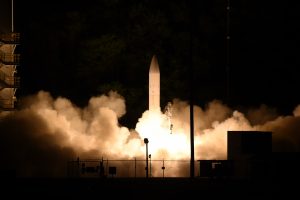
It’s important to note that “hypersonic” weapons (weapons with speed greater than five times that of sound) include two separate categories and exclude another. The excluded category are standard ballistic missiles, which vastly exceed “hypersonic” speeds as they plunge through the atmosphere towards their targets – but which follow a predictable and basically immutable trajectory as they do. There are hypersonic cruise missiles, which would fly through the atmosphere powered by scramjets, and there are hypersonic glide bodies, which are boosted up to immense speed on conventional rockets but instead of arcing through space ride on their own shockwave through the upper atmosphere. In both cases, the advantage is that a weapon could follow a lower trajectory (reducing its visibility to long-range radar) and potentially maneuver to obscure its target and avoid countermeasures.

Kill Chain In The Sky With Data: Army’s Project Convergence

SYDNEY J. FREEDBERG JR.

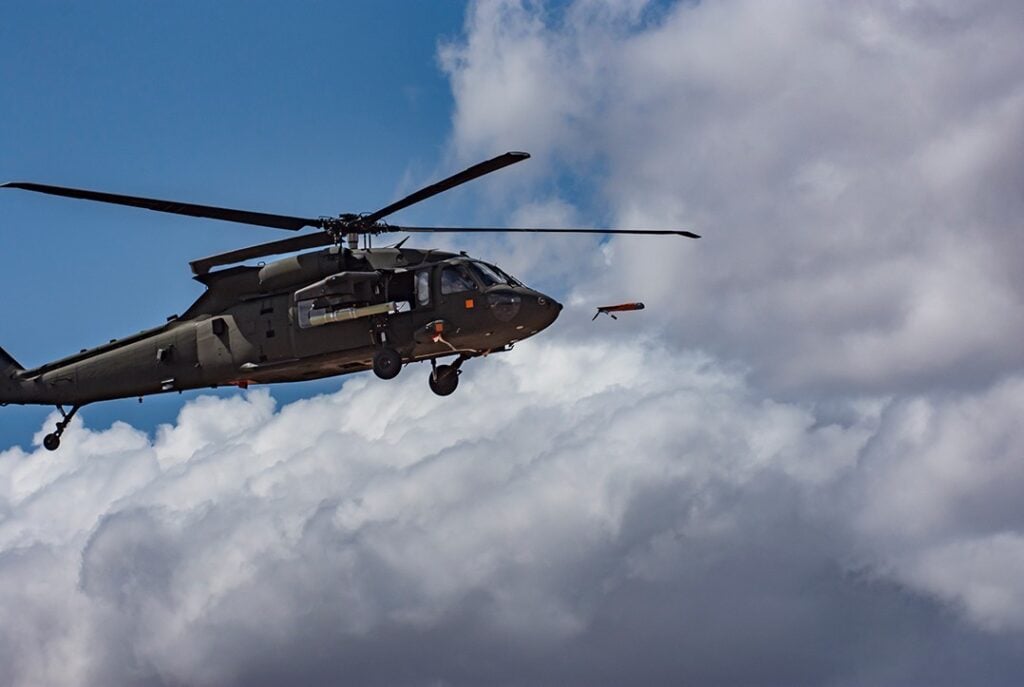
WASHINGTON: In the 100-degree heat of the Yuma desert, Army troops are getting glimpses of how artificial intelligence can help their future fight. Aerial reconnaissance data automatically fills handheld digital maps with threats and targets, while smartphone apps allow them to take temporary control of passing drones to look through their sensors and fire missiles – that is, when the networks work and the tires don’t blow.

“We’ve had Grey Eagle tires exploding on the ramp because it’s so darn hot,” Brig. Gen. Walter Rugen told me. “Some guys [are] working 20 hours a day” to get different Army systems to exchange data they were never designed to share.

But the whole point of the Army’s Project Convergence exercises at Yuma Proving Ground this fall is to take the service’s big ideas for future warfare and test them in the real world. The Army wants to figure out what works and what needs fixing – and figure that out as early on as possible, when it’s much cheaper to make changes. That’s what the service failed to do in its last attempt to link drones and ground troops this ambitiously, the Future Combat Systems program, cancelled in 2009.

20 September 2020

Judging the Impact of U.S. Force Reductions in Afghanistan, Iraq, and Syria

By Anthony H. Cordesman

The U.S. has said remarkably little about how conditional its future plans to withdraw all forces in Afghanistan are on the success of the peace process, whether it will provide adequate support for Afghan military forces if the peace effort fails, or whether the U.S. plans to provide any security guarantees and military aid if a peace agreement is reached. So far, all that is clear is that the official total of U.S. military personnel has dropped from around 12,000 at the start of 2020 to 8,600 in July 2020, will now drop to some 5,000 personnel, and all U.S. troops will leave by May 2021 if a successful peace agreement is reached.

The U.S. has said even less about the possible details of any new security agreement with Iraq. About all that the U.S. has announced is that it will now cut its present total military personnel in Iraq from some 5,200 to around 3,000 – which does not indicate any clear picture of what the U.S. plans to keep in Iraq or in Syria for the future.

There also is no indication of the size of U.S. forces that will remain elsewhere in the Gulf region or at sea, of any U.S. effort to preserve a redeployment capability in a crisis, of the level of U.S allied forces that will remain, or of the trends in hostile outside forces like those of Russia, Syria, Iran, the Hezbollah, or other outside non-state actors – as well as powers that have different goals from the U.S. like Turkey and Pakistan.

Numbers that May or May Not be Accurate

Reluctant player: China’s approach to international economic institutions

David Dollar

China has been an active participant in the international economic institutions, namely the World Trade Organization (WTO), the International Monetary Fund (IMF), the World Bank, and the Paris climate agreement. China has generally lived up to its commitments in these institutions, but has been reluctant to take on the stronger responsibilities that fall on developed countries. China’s insistence on being treated as a developing country is a main source of tension in its economic relations with the advanced economies. A further area of tension is that China’s bilateral economic relations with other developing countries do not always meet global standards and norms. From an institutional point of view, it is a problem that China is not a member of the Government Procurement Arrangement within the WTO, the Paris Club of official creditors, or the Development Assistance Committee. There is a chicken-and-egg problem here: the main reason China is not a member is that it has not been willing to take on the associated responsibilities; on the other hand, being outside of these institutions leaves China free to behave differently from the advanced economies.

Much of the American concern with China’s role in the global economy is related to this partial integration of the country into the global economic institutions. I argue that to change China’s behavior and bring its practices into line with advanced country norms would require: (1) recognition that China deserves greater say in the international economic institutions in return for greater responsibility; (2) a willingness to pursue deeper agreements such as the Trans-Pacific Partnership (TPP) without China if it is not willing to meet the associated standards; and (3) ongoing, intensive dialogue between China and the U.S. aimed at objectionable Chinese practices such as restrictions on imports and investment, weak intellectual property rights (IPR) protection, forced technology transfer, and subsidies to develop specific technologies.

The global energy trade’s new center of gravity


China has become the center of gravity for global energy markets. While energy demand growth has slowed or stopped in the Organisation for Economic Co-operation and Development (OECD) countries, China’s primary energy demand increased by more than 45% over the last decade.[1] Going forward, the question is whether such growth will continue and how China’s energy system will change in response to the dual challenges of climate change and local pollution.

China is highly dependent on fossil fuel imports. It is the world’s largest importer of oil and natural gas[2] and is an important coal importer as well. At the same time, China is striving to lead in new energy technologies, particularly wind and solar electricity generation and electric vehicles. To understand how China fits into energy markets and how energy shapes its policy, examining the electricity and oil and gas industries separately is illustrative. China is more in charge of its own fate in electricity, while it remains highly vulnerable to market conditions and supply shocks in oil and gas.

ELECTRICITY

Network power: China’s effort to reshape Asia’s regional security architecture

Lindsey W. Ford

EXECUTIVE SUMMARY

Chinese President Xi Jinping first laid out a new vision for Asian regional architecture in a 2014 speech to the Conference on Interaction and Confidence-Building Measures in Asia (CICA), a pan-Asian multilateral security organization. Xi argued, “it is for the people of Asia to run the affairs of Asia, solve the problems of Asia, and uphold the security of Asia.”[1] Xi’s speech was the first signal of Beijing’s more focused effort to alter the institutional scaffolding, or the security architecture, supporting the Asia-Pacific regional order. To achieve this goal, China is seeking to contest the “network power” that has enabled American leadership in the Asia-Pacific.[2]

This paper explores China’s bid to contest this network power by reorienting the Asia-Pacific security architecture. It argues that, in a sense, China is taking a page from America’s own playbook: It is seeking to build a multilayered network of security institutions, partnerships, and cooperative activities that enhance its regional influence.

China’s ambitions are to establish a security architecture that is more exclusively “Asian,” free of alliances, more attendant to its domestic security concerns, less liberal, and solidly rooted in Chinese economic power. These ambitions are not new, but under Xi, China is more actively focused on how to operationalize and institutionalize its vision.

China’s strategy to shape a new regional security network is nascent and has yielded mixed results thus far. This paper suggests Beijing faces a series of obstacles that stand in the way of its aims, including its inability to convince Asian partners that China can be a fair and trustworthy security guarantor, the institutional resilience of existing structures such as U.S. alliances and the Association of Southeast Asian Nations (ASEAN), and the backlash against China’s aggressive territorial ambitions. Nonetheless, Beijing is creating alternatives — security partnerships, institutions, and principles — that are generating a stronger sense of Asian integration, and that have particular appeal for authoritarian leaders less aligned with a liberal system. Additionally, China is increasingly spreading new tools and practices — selling conventional arms and dual-use technologies, as well as enhancing its focus on training and exercises to support these tools — that have the potential to reorient regional institutions and standards over time.

China’s influence on the global human rights system

Sophie Richardson

EXECUTIVE SUMMARY

Is the Chinese government’s greater engagement with international institutions a gain for the global human rights system? A close examination of its interactions with United Nations human rights mechanisms, pursuit of rights-free development, and threats to the freedom of expression worldwide suggests it is not. At the United Nations, Chinese authorities are trying to rewrite norms and manipulate existing procedures not only to minimize scrutiny of the Chinese government’s conduct, but also to achieve the same for all governments. Emerging norms on respecting human rights in development could have informed the Chinese government’s approach to the Belt and Road Initiative, the Asian Infrastructure Investment Bank, and national development banks, but they have not. Chinese authorities now extend domestic censorship to communities around the work, ranging from academia to diaspora communities to global businesses.

This paper details the ways Chinese authorities seek to shape norms and practices globally, and sets out steps governments and institutions can take to reverse these trends, including forming multilateral, multi-year coalitions to serve as a counterweight to Chinese government influence. Academic institutions should not just pursue better disclosure policies about interactions with Chinese government actors, they should also urgently prioritize the academic freedom of students and scholars from and of China. Companies have human rights obligations and should reject censorship.

Equally important, strategies to reject the Chinese government’s threats to human rights should not penalize people from across China or of Chinese descent around the world, and securing human rights gains inside China should be a priority. The paper argues that many actors’ failure to take these and other steps allows Chinese authorities to further erode the existing universal human rights system — and to enjoy a growing sense of impunity.

China’s expanding influence at the United Nations — and how the United States should react

Jeffrey Feltman

EXECUTIVE SUMMARY

China’s growing influence inside the United Nations is inevitable, stemming from President Xi Jinping’s more assertive foreign policy and the fact that China’s assessed contributions to the world body are now second only to those of the United States. Traditionally focused on the U.N.’s development activities, China now flexes its muscles in the heart of the U.N., its peace and security work. The Chinese-Russian tactical alignment in the U.N. Security Council challenges protection of human rights and humanitarian access, demonstrated in July 2020 when China and Russia vetoed two resolutions regarding Syria and both blocked the appointment of a French national as special envoy for Sudan.

Yet the fears that China is changing the United Nations from within seem if not overblown, at least premature. Whatever its ambitions, China has not replaced the United States as the U.N.’s most powerful member state. The U.N. can still be a force multiplier for the values and interests of the United States, but only if Washington now competes for influence rather than assume automatic U.N. deference. The U.N. can be characterized as “home turf” for the United States, but walking off the field will facilitate China moving in to fill the vacuum.

China’s pragmatic approach to UN peacekeeping

Richard Gowan

China’s involvement in United Nations peacekeeping is one of its better-known investments in the multilateral system.[1] But its contributions to blue helmet missions remain limited, and Beijing has taken a cautious approach to expanding its commitments. In 2015, Chinese President Xi Jinping impressed other leaders at the U.N. General Assembly with an offer of 8,000 troops to reinforce the organization’s operations.[2] As of June 30 of this year, there are 2,534 Chinese soldiers and police deployed with the U.N. This is 500 hundred fewer than when Xi made his pledge, and only just enough to secure its place among the top ten U.N. personnel contributors (Figure 1).[3]
Figure 1: Top ten UN troop and police contributors, June 30, 2020
Source: U.N. Peacekeeping[4]