8 January 2021

What AI Can and Cannot Do for the Intelligence Community

By ZIGFRIED HAMPEL-ARIAS and JOHN SPEED MEYERS

A seasoned intelligence professional can be forgiven for raising her eyebrows about artificial intelligence, a nascent and booming field in which it can be hard to sort real potential from hype. Addressing that raised eyebrow — and helping senior leaders understand how to invest precious time and money — will take more than vague generalities and myopic case studies. We therefore offer a hypothesis for debate: AI, specifically machine learning, can help with tasks related to collection, processing, and analysis — half of the Steps in the Intelligence Cycle — but will struggle with tasks related to intelligence planning, dissemination, and evaluation.

When we talk about AI’s prospective value in intelligence work, we are generally talking about the specific field of deep learning, a term that refers to multi-layer neural network machine learning techniques. Deep learning tools have made tremendous progress in fields such as image recognition, speech recognition, and language translation. But there are limits to its abilities. 

Deep learning excels at “tasks that consist of mapping an input vector to an output vector and that are easy for a person to do rapidly,” wrote three of the field’s leading lights — Apple’s Ian Goodfellow and University of Montreal professors Yoshua Bengio and Aaron Courville — in their 2016 textbook Deep Learning. “Other tasks, that cannot be described as associating one vector to another, or that are difficult enough that a person would require time to think and reflect in order to accomplish the task, remain beyond the scope of deep learning for now.”

Infographic Of The Day: The Best And Worst Performing Sectors Of 2020


Today's infographic uses an augmented screenshot of the FinViz treemap, showing the final numbers posted for major U.S.-listed companies, sorted by sector and industry. As you can see, the best and worst performing sectors generally fall into two categories: those that benefitted from COVID-19, and those that didn't.

7 January 2021

The Unending Saga of India’s Retrospective Tax Debacle

By Abhishek Dwivedi

Last week, Cairn Plc (now merged with Vedanta) announced its $1.2 billion win in damages against India in an international arbitration, in a case pertaining to the levy of retrospective tax by the Indian government in 2012. This comes just after the ruling in September 2020 pertaining to retrospective tax, in favor of Vodafone. These awards are a result of India retrospectively amending its taxation laws through the Finance Act of 2012, permitting tax authorities to reopen and/or investigate transactions from 2006 for evasion of capital gains tax. The amendment was made to give a go-by to the Indian Supreme Court’s ruling in favor of Vodafone wherein the tax demand raised by the tax authorities on Vodafone was expressly quashed for “not being backed by law.” The government of India, led by Prime Minister Narendra Modi, despite having multiple opportunities to settle the disputes, chose not to do so. In fact, the current government has decided to challenge the Vodafone award despite explicit assurances to the contrary made by then Finance Minister Arun Jaitley.

The Disputes

The Vodafone dispute traces its origin to the $10.9 billion acquisition of a 67 percent stake in Hutchison Essar by Vodafone in May 2007. The acquisition also included the telecommunication business of Hutchinson in India. Consequent to the acquisition, Vodafone received a demand of 79.9 billion Indian rupees in capital gains and withholding tax from Indian tax authorities. The tax authorities maintained that Vodafone was required, under law, to deduct tax at source prior to affecting the payment of consideration to Hutchinson. Vodafone contested the notice and the matter finally reached the Bombay High Court. The court ruled in favor of the tax authorities and directed Vodafone to clear the demand. Vodafone appealed the decision, and a three-judge bench of the Supreme Court led by the chief justice of India, ruled in Vodafone’s favor and quashed the demand notice.

The Future of US-India Digital Relations

By Justin Sherman

Outgoing U.S. President Donald Trump has prided himself on his deft handling of personal relationships, continuously touting during his administration the power of his negotiating tactics in a room, his win-at-any-cost mentality, and his “very large brain.”

“I’ve made a lot of deals,” he said in May 2018, when addressing the media alongside South Korean President Moon Jae-in. “I know deals, I think, better than anybody knows deals.”

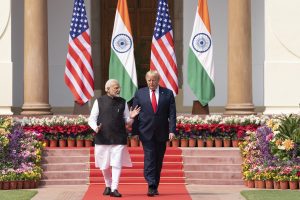
The bonhomie that marked his meetings with Indian Prime Minister Narendra Modi might superficially appear to support Trump’s self-view – the president’s February 2020 visit to New Delhi included, after all, a MAGA-style rally and the two leaders repeatedly hugging and shaking hands. If all one cared about in diplomacy was how politely two leaders addressed each other at press briefing podiums, then perhaps U.S.-India relations satisfied this definition of success.

Yet the reality is that U.S.-India relations during the Trump administration in the digital sphere, once an observer looked below the surface, plainly did not reflect the Trump façade of masterful statecraft (as with many of Washington’s global relationships in the last four years).

Pakistani Shiites Rally Against Murder of Coal Miners by Islamic State

By Abdul Sattar

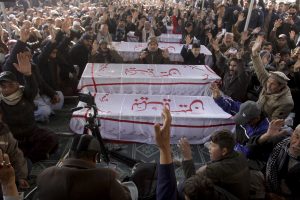
People from the Shiite Hazara community chant slogans beside caskets of coal mine workers who were killed by unknown gunmen near the Machh coal field, during a sit-in protest, in Quetta, Pakistan, Monday, Jan. 4, 2021.Credit: AP Photo/Arshad Butt

Hundreds of Pakistani minority Shiites blocked a key highway January 4 on the outskirts the southwestern Pakistani city of Quetta for a second straight day to protest the killing of 11 coal miners by the Islamic State group.

The miners, members of the country’s minority Shiite Hazara community, were abducted by IS militants in Balochistan province on January 3, taken to a nearby mountain and shot. Six died at the scene and five, critically wounded, died on the way to hospital.

Police video of the bodies revealed the miners were blindfolded and had their hands tied behind their backs before being shot. The attack took place near the Machh coal field, about 48 kilometers (30 miles) east of Quetta, the capital of Balochistan.

The Sunni militant group has repeatedly targeted Pakistan’s minority Shiites in recent years. IS claimed responsibility quickly after the abduction of the miners.

Third Chinese Aircraft Carrier Nears Completion Amid Shipyard Expansion

By Steven Stashwick

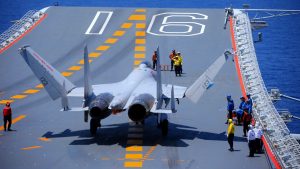
A J-15 fighter jet sits on the flight deck of the aircraft carrier Liaoning.Credit: Flickr/rhk111

A major Shanghai shipyard is being significantly expanded amid news that work has begun there on China’s fourth aircraft carrier.

The South China Morning Post (SCMP) reports that the Jiangnan shipyard is beginning a three-year expansion that will include a new ship design and research center, additional workshops, fabrication facilities, quays, and other shipbuilding infrastructure. Some of the new shipyard will support the yard’s commercial vessel work but much appears to be focused on the aircraft carrier building program of the People’s Liberation Army Navy (PLAN).

China’s first aircraft carrier, the Type 001 Liaoning, was rebuilt on a gutted, unfinished Ukrainian aircraft carrier hull and might be considered a modernized variant of the Soviet Kuznetsov-class carrier. China built an improved version of the Liaoning, designated the Type 001A, which it named the Shandong.

PLAN’s third and fourth carriers will be an entirely new design called the Type 002. They are expected to be much larger than the Liaoning and Shandong, and unlike those ships, which use ramps to assist planes in take-off, are reported to feature electromagnetic catapults.

Catapult-equipped ships can launch larger, heavier aircraft, and those aircraft use less fuel in take-off so they can carry more weapons and can fly longer and farther before needing to return. Most U.S. Navy aircraft carriers utilize steam-driven catapults. The new Ford-class carriers feature electromagnetic catapults, which are stronger and more efficient than steam.

China Is Getting Away with It

By MICHAEL BRENDAN DOUGHERTY

In the final week of 2020, China sentenced citizen journalist Zhang Zhan to four years in prison for the crime of being an early challenger to the government’s COVID-19 narrative. It also imprisoned most of the Hong Kong 12, a group of activists who tried to escape from Hong Kong to Taiwan on a speed boat.

China broke its treaty with the United Kingdom over Hong Kong this year and destroyed the system of common-law liberty that existed in that island redoubt. It engaged in a cover-up of the emerging coronavirus pandemic in Wuhan and, along the way, it suborned the World Health Organization, forbade foreign health investigators from doing on-the-ground work, lobbied against the inclusion of Taiwanese health authorities in discussions of the emergency, disappeared whistleblowers, and continued sending flights abroad from Wuhan when it had canceled them domestically.

Chinese diplomatic personnel threatened that the United States would be “plunged into the mighty sea of coronavirus,” while pondering whether to ban the export of essential pharmaceuticals. The Chinese ambassador to the United Kingdom appeared on one of the premier BBC political chat shows and shrugged at video footage of manacled Uyghurs being loaded like chattel onto train cars in Western China. He then promptly implied that Britain no longer wanted to be a serious nation because it decided to limit the involvement of Huawei, a Chinese-backed telecom, in the building of Britain’s 5G network. Huawei had recently been raided in Poland for spying.

Is Institutionalism Still Useful in Elite China Political Analyses?

By Tristan Kenderdine

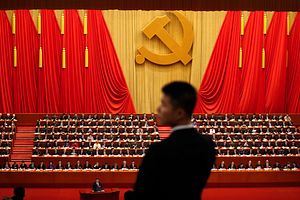
A soldier in an usher uniform stands watch as Chinese President Xi Jinping, bottom, delivers a speech at the opening ceremony of the 19th Party Congress at the Great Hall of the People in Beijing, Wednesday, Oct. 18, 2017.Credit: AP Photo/Andy Wong

Alice Miller was a pioneer in using institutional analysis of elite Chinese politics to predict institutional and personnel changes based on a combination of Chinese Communist Party (CCP) organs, party cadres, and historical party institutional analysis. Now in most cycles of CCP administration, analysts compete to offer insight into possible forms of institutional change. Ahead of the 2022 Party Congress, institutionalists have already begun personnel analysis as well as wider macro policy directional analysis. This work assumes that the past institutional forms are an indicator of future structures. But in the lead up to the 19th Party Congress in 2017, Jessica Batke was correct to note that much is written about Chinese politics assuming to know more than we really do.

If the state ideology does not change, then any changes to the institutional superstructure can only be superficial. While there have been important recent changes in political rhetoric and ideology, as well as macroeconomic policy and national system direction, they are not enough to expect wholesale institutional changes in the party cadre system or other internal party institutional changes.

Kazakhstan-China Border Delays as Rail Freight Hedge Wobbles

By Tristan Kenderdine and Péter Bucsky

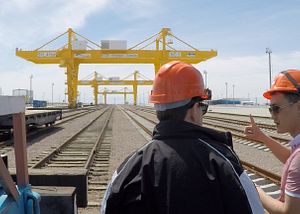
For China, the geoeconomic policy principles behind the Iron Silk Road rail link through Central Asia were to provide China a hedge against its reliance on Pacific Ocean economies in the event of trade tensions. However, 2020 demonstrated that the Central Asian states have no hedge against the geoeconomic risk of relying on China as a trade partner. On the China-Kazakhstan border, rail freight wagons and trucks have been backed up for over a month as China tightens import restrictions, leaving Kazakh goods destined for China sitting idle.

Rail freight backed up at the Dostyk and Altynkol border crossings reportedly totals more than 7,000 wagons, some of which have been waiting for up to 42 days. Freight delays started in October, with agricultural exporters hit hardest, as grain and oilseed products can spoil if not delivered on time. Freight forwarders are also exposed to losses as they fear fines from their Chinese-side buyers for failure to deliver, leading to calls for the Kazakhstan Ministry of Industry and Infrastructure Development to issue force majeure notices for Kazakh exporters. 

Could China Soon Deploy Drone Swarms Against America?

by Kris Osborn

The Chinese military is launching drones in an apparent effort to support an amphibious assault operation by overwhelming beachhead defenses with swarms of explosive attack drones launched from ships, vehicles and helicopters. 

Large drone swarms, intended for coordinated surveillance and attack, were launched from truck-based, forty-eight-unit launchers and helicopters in a recent test cited by the Chinese-government backed Global Times newspaper. 

“The drones were rapidly and simultaneously deployed while the transport platforms were on the move, and the system can launch as many as 200 drones in one go,” the story states. 

Some of the drones were described as “loitering munitions,” meaning they could function as explosives after first surveilling a target area. 

Drone swarms bring a number of new tactical possibilities, yet their effectiveness would likely depend in large measure upon the extent to which they were successfully networked together. Large numbers of coordinated drones could blanket an area with surveillance, build in redundancy by ensuring functionality if several of them were shot down, test enemy defenses and potentially function as precision-guided attack weapons. 

China’s Real Threat Is to America’s Ruling Ideology


Across the political spectrum, there is widespread agreement that America must get serious about the threat posed by China. As the Trump administration comes to a close, the State Department has just released a document called ‘The Elements of the China Challenge’. A distillation of conventional wisdom among national security experts and government officials, it argues that the U.S. needs a concerted effort to push back against Beijing. On its first page, the document tells us that “the Chinese Communist Party (CCP) has triggered a new era of great-power competition.” If there was a major intellectual thread running through Trump’s foreign policy, or at least that of the people he appointed, it was that confronting China was the national security issue of our time. America during the Trump era was single-minded in its focus on turning up the pressure on Beijing, including unprecedented support for Taiwan, sending ships more often through the South China Sea, and attempting to stop the spread of the telecom giant Huawei.

The idea of the China threat will not end with the Trump administration. Michèle Flournoy, once thought to be the frontrunner to become Biden’s Secretary of Defense, argued in Foreign Affairs that the U.S. has not been steadfast enough in its military commitments in East Asia. Sometimes, great power competition is presented as an imperative of history; in the formulation of Graham Allison, a former Pentagon official and the current professor at Harvard’s Kennedy School of Government, the two powers are involved in a “Thucydides Trap.” Looking at the last 500 years of world history, Allison believes that when the ambitions of a rising power conflict with those of an established power, war becomes likely.

With Concessions and Deals, China’s Leader Tries to Box Out Biden

By Steven Lee Myers

A trade pact with 14 other Asian nations. A pledge to join other countries in reducing carbon emissions to fight global warming. Now, an investment agreement with the European Union.

China’s leader, Xi Jinping, has in recent weeks made deals and pledges that he hopes will position his country as an indispensable global leader, even after its handling of the coronavirus and increased belligerence at home and abroad have damaged its international standing.

In doing so, he has underlined how difficult it will be for President-elect Joseph R. Biden Jr. to forge a united front with allies against China’s authoritarian policies and trade practices, a central focus of the new administration’s plan to compete with Beijing and check its rising power. The image of Mr. Xi joining Chancellor Angela Merkel of Germany, President Emmanuel Macron of France and other European leaders in a conference call on Wednesday to seal the deal with the European Union also amounted to a stinging rebuke of the Trump administration’s efforts to isolate China’s Communist Party state.

The deals show the leverage Mr. Xi has because of the strength of the Chinese economy, which is now the fastest-growing among major nations as the world continues to struggle with the pandemic.

Iran Flexes Muscle as Trump Seeks to Restore Deterrence — Again

By Abhijnan Rej

The United States has cancelled the redeployment of aircraft carrier USS Nimitz as the Trump administration, in its final days, seek to carry on with its quixotic Iran agenda, exactly a year after the United States assassinated top Iranian Revolutionary Guard Corps commander Qassem Soleimani through a drone strike at the Baghdad airport.

According to a statement by Acting Secretary of State Chris Miller on January 3, “due to the recent threats issued by Iranian leaders against President Trump and other U.S. government officials, I have ordered the USS Nimitz to halt its routine redeployment. The USS Nimitz will now remain on station in the U.S. Central Command area of operations.”

“No one should doubt the resolve of the United States of America,” Miller added.

Three days earlier, on December 31, Miller had directed the Nimitz Carrier Strike Group to return home after a 10-month deployment in the region. According to a Pentagon statement at that time, the strike group had “repeatedly demonstrated operational excellence in providing air support to combat operations against terrorists in Iraq and Afghanistan and ensuring maritime security in critical waterways.”

The exact operational urgency behind this volte face remains unknown, though two events on January 4 could lead to a dramatic increase in Iran-U.S. tensions, especially if the Trump administration seeks domestic political gains from it.

Iraq, Struggling to Pay Debts and Salaries, Plunges Into Economic Crisis

By Jane Arraf

BAGHDAD — In the wholesale market of Jamila, near Baghdad’s sprawling Sadr City neighborhood, a merchant, Hassan al-Mozani, was surrounded by towering piles of unsold 110-pound sacks of flour.

“Normally at a minimum I would sell 700 to 1,000 tons a month,” he said. “But since the crisis started we have only sold 170 to 200 tons.”

His troubles are a ground-level indicator of what economists say is the biggest financial threat to Iraq since Saddam Hussein’s time. Iraq is running out of money to pay its bills. That has created a financial crisis with the potential to destabilize the government — which was ousted a year ago after mass protests over corruption and unemployment — touch off fighting among armed groups, and empower Iraq’s neighbor and longtime rival, Iran.

Iran in the past has taken the opportunity posed by a weak Iraqi central government to strengthen its political power and the role of its paramilitaries within Iraq.

Last month, Iraq devalued its currency, the dinar, for the first time in decades, immediately raising prices on almost everything in a country that relies heavily on imports. And last week, Iran cut Iraq’s supply of electricity and natural gas, citing nonpayment, leaving large parts of the country in the dark for hours a day.

Turkey’s Frayed Ties With the West Are Unlikely to Improve Under Biden

Sinan Ciddi

As President-elect Joe Biden prepares to take office later this month, many U.S. allies and partners are eyeing an opportunity for better relations with Washington. But Turkey, under the leadership of President Recep Tayyip Erdogan, will face an uphill battle to settle its ongoing disputes with the United States, not to mention its other NATO allies.

There are three major impediments to a reset in Turkey’s ties with the West. First, the U.S. remains at loggerheads with Turkey over Erdogan’s decision to purchase an advanced missile defense system from Russia. Second, the European Union is considering tough sanctions against Ankara over its drilling activities in the Eastern Mediterranean, in waters that are also claimed by Greece and Cyprus. And third, even independent of those external pressures, Erdogan’s government will likely continue to undermine the U.S. and the EU as part of his domestic campaign to keep Turkish voters on his side by galvanizing nationalist sentiments.

Earlier this month, the Trump administration imposed narrowly targeted but nonetheless stinging sanctions against Turkey in response to its acquisition of the Russian-manufactured S-400 missile defense system in 2019. The sanctions, which targeted Turkey’s defense industry, were required by the 2017 Countering American Adversaries Through Sanctions Act, known as CAATSA. Congress, angered by the delay, included a provision requiring the sanctions be imposed within 30 days in the annual defense bill that it overwhelmingly passed last month.

Did Uzbekistan and Russia Just Have Their First (Limited) Food War?


By Umida Hashimova

In the last two months of 2020, Russia’s Rosselkhoznadzor (the Federal Service for Veterinary and Phytosanitary Supervision) imposed several bans on the import of several foodstuff and agriculture products from Uzbekistan, alleging the products were found to contain pests. The bans were short lived, lasting from several weeks to a month, but were enough to remind Uzbekistan of the significance of Russia’s market.

Rosselkhoznadzor’s bans of foodstuff imports are not unusual. There are numerous examples of Russia leveraging the food valve in response to a deterioration of geopolitical relations with one partner or another. Uzbekistan has mainly enjoyed stable relations with Russia and therefore, until recently, was kept out of the food wars. The latest incident was the first widespread ban, albeit a short one, according to a cursory review of Rosselkhoznadzor’s website

First came a ban on tomato and bell pepper imports from three regions in Uzbekistan. Then Rosselkhoznadzor announced it had detected pests in dried fruits from the Fergana region and after several days announced a full ban on all agriculture products from the same region. All of the bans were retracted after the cabinet of ministers of Uzbekistan, the second highest government body after the presidential administration, intervened and entered negotiations with Russia.

Turkey’s Crackdown on Kurdish Opposition is a Test for Biden

by Meghan Bodette

The basis for the charge was a 2018 speech Guven had made opposing Turkey’s invasion of Afrin—which displaced hundreds of thousands, empowered extremists, and subjected civilians to brutal militia rule.

One day later, the European Court of Human Rights ruled that Turkey must immediately release former HDP co-leader and presidential candidate Selahattin Demirtas, who has been jailed since 2016 on equally politicized charges.

Senior government officials immediately attacked the ruling, reiterating their farcical view that Demirtas—a human rights lawyer by training and lifelong advocate for a peaceful resolution to Turkey’s Kurdish question—is a terrorist. An application for his release was quickly denied, and new charges against him were filed for his criticism of Turkish inaction against ISIS at Kobane, a sentiment shared by the US-led anti-ISIS coalition at the time.

By launching new attacks on two popular elected officials who have faced more than their fair share of political repression for advocating for peace, democracy, and Kurdish rights, Erdogan is testing the incoming Biden administration’s commitment to democratic values and international norms. So far, it is failing that test.

Will the U.S. Army’s Project Convergence 2020 Revolutionize Warfare?

by Kris Osborn

Yuma Proving Grounds, Arizona-The Army’s Project Convergence 2020 sought to bring new, explosive “warfare at speed” dimensions to future combat as part of a broad transformational attempt to surge in front of competitors and near-peer rivals with accelerated networking and sensor-to-shooter times . . . Designed to enable an entirely new generation of warfare possibilities.

The network consists of many interwoven technical elements to include software-defined radio, high-bandwidth, radio-generated data links, satellite connectivity and course synchronized databases with high-powered computer processing.

These constituent elements need the proper interface to ensure both sustained connectivity and continued modernization possibilities. With the proper standards and technical infrastructure. Without these, disparate communications avenues can interoperate.

At one point during the exercise, satellite connections tied to Joint Base Lewis McChord in Washington state were accessed to locate enemy targets at Yuma Proving Grounds, Arizona.

“We are looking at how we can use satellites to enhance the speed of targeting,” Army Secretary Ryan McCarthy told reporters during the experiment.

Why is Russia's S-400 Air Defense System So Dangerous?

by Mark Episkopos

Here's What You Need To Remember: The S-400 is an excellent system; it's not horrifically expensive, versatile in its deployment, and accurate enough to take down any NATO fighter.

The S-400 Triumf surmounted a tortured development cycle to become one of the world’s leading missile defense systems and a pivotal Russian export product. 

The air defense system that eventually became the S-400 began as an advanced S-300 modernization project. The S-300PMU-3 was conceived in the early 1990s as a major iteration of the S-300 platform, replete with new missiles that improve the S-300’s performance and enable it to fill new roles. As with many 1990s military hardware projects, the S-300PMU-3 struggled for consistent funding in the wake of the Soviet collapse. The system ran into further technical troubles in the early 2000s, amid concerns that the S-300PMU-3’s performance was being throttled by aging holdover components from the 1970s S-300P. 

Nevertheless, the first S-400 units began to enter service in 2007. The S-400 is comprised of four core components: 1) the 30K6E battle management system, consisting of a command post and acquisition radar, 2) as many as six 98Zh6E Fire Units and twelve transporter-erector-launchers (TEL’s), 3) an assortment of surface-to-air missiles (SAM), and the 4) 30Ts6E logistical support system for missile storage and equipment maintenance. 

The 30K6E battle management system can control a diverse cast of earlier Soviet missile defense units, meaning that the S-400 can coordinate with several S-300 variants, numerous entries from the TOR family of anti-air systems, and Pantsir S-1 missile system. 

Gas Line, Q4 2020


Gas Line is a quarterly publication that looks at major news stories in global gas—ranging from project development to markets and geopolitics. My goal is not to cover every story but to draw connections between stories across time and space in order to shed light on the major themes that will drive global gas markets in the years ahead. My main takeaways from this quarter:

An Unprecedented Rally in Gas Prices

The bottom line: When prices hit record lows, they have nowhere to go but up. But the rebound in prices has been remarkable, helping to offset a year in which most prices reached low points for extended periods of time. This rally, however durable, will provide some support for companies looking to make investment decisions in long-term supply, muting some of the fears expressed in this piece that the spread between U.S. gas prices and those overseas might never return to their previous extreme levels. At a bare minimum, this is a reminder that volatility is ever present, and that a few “good” months of high prices can compensate for many months of low prices. More importantly, these prices might provide the signal needed that gas demand is still robust enough to justify a long-term investment.

The backstory: Gas prices have increased significantly in recent months. The Japan Korea Marker (JKM) went from $2 per million British thermal units (MMBtu) in late April to over $14/MMBtu at year-end, surpassing even the price for oil-linked contracts in Asia. The Title Transfer Facility (TTF) in the Netherlands rose by a factor of almost six since this summer, although it still traded at half the rate of JKM. And Henry Hub in the United States experienced a mini rally too, with prices more than doubling between June and October. Almost uniformly, these increases are due to restrictions in supply—unplanned outages at liquefied natural gas (LNG) facilities, a slow recovery in gas production in the United States, shipping bottlenecks, insufficient storage in Asia, and a transition to colder weather. And, especially for JKM, they could also signify insufficient liquidity, as the price moves on the back of a few transactions.

The State of Play in North Korea

By Phillip Orchard

In a White House meeting just weeks before Donald Trump’s inauguration, then-President Barack Obama warned the president-elect that the North Korean nuclear threat would be the thorniest national security challenge he would inherit. Kim Jong Un then welcomed Trump to office with nearly two dozen ballistic missile tests in 2017 alone, showing off increasingly sophisticated capabilities with each, including solid-fuel engines and a pair of intercontinental ballistic missiles. So Trump moved with gusto to abandon the more cautious and conventional but generally futile approaches of his predecessors. His administration tried “maximum pressure,” pairing crippling U.N. sanctions with an all-out effort to communicate that it was serious about going to war to end the North’s nuclear threat. It tried diplomacy by personal rapport, breaking precedent with a trio of historic summits between Trump and Kim. Then it tried basically ignoring the North for a couple of years.

But while Trump made a lot of history, the situation with North Korea is essentially the same as it was four years ago. The North’s nuclear and missile programs are still humming, and Pyongyang is under intense pressure to leverage these for economic and strategic gain. If anything, North Korea is at once stronger and more desperate – a dangerous combination.

No Small Thing

The Trump administration’s biggest success with North Korea was a tacit agreement involving a freeze on the North’s tests of intercontinental ballistic missiles (ICBMs) and nuclear weapons in exchange for reduced joint U.S.-South Korean drills, which, from Pyongyang’s point of view, are indistinguishable from preparations for an invasion. This was no small thing. It disrupted a dangerous spiral of escalation. It stopped the North’s attempts to master reentry technology, the most difficult part of ICBM development. And it created space for the two sides to begin a slow, painstaking process of establishing trust, implementing confidence-building measures and taking small steps toward a fundamentally new security relationship both could live with.

Britain Returns to Its Past

By George Friedman

As of Jan. 1, Britain has completed the process of leaving the European Union. The EU has assured all that dire consequences will haunt the British. Certainly, there will be economic consequences for the U.K., but it is hard to imagine that the departure of the second-largest economy in Europe will not have significant consequences for Europe as well. At minimum, the completion of Britain’s departure shatters a myth about the European Union. The name “European Union” had become synonymous with “Europe.” This was never a true equivalency, as there were European nations excluded from and uninterested in membership like Switzerland and Norway, which chose a non-member relationship. But with Britain on the outside, the sense that the EU speaks for Europe is gone. Britain is a foundational part of Europe, one of Europe’s liberators in World War II and, beginning with the Roman invasion of England, Europe’s occasional enemy and savior. Britain has been a defining force in Europe, and now it has left the European Union. This will challenge the bloc in many ways, the first being that the EU is no longer interchangeable with Europe. Now there is another Europe: Britain.

Since the referendum, there have been two issues. The first was whether British opponents of Brexit could overthrow the result of the referendum. The second was whether the EU could, without appearing excessively conciliatory to the rest of the European Union. At times these two forces seemed to work together to block Brexit. In the end they failed, although Brussels is likely to continue to seek to impose pain, until the British stop buying Mercedes cars in favor of Lexus. At that point the central power of Europe, Germany, will put an end to punitive measures, and the EU will move on.

COVID-19 Pandemic Sends National Debt to Highest Level Since World War II

BY SCOTT REEVES 

The coronavirus pandemic has roiled the markets, tossed most fiscal assumptions to the wind and driven the national debt to the highest level since World War II, as the government spent heavily to support the economy.

The U.S. Treasury Department's final report for fiscal year 2020 showed a record $3.1 trillion deficit for the year, with debt held by bondholders totaling $21 trillion.

The Congressional Budget Office (CBO) estimated that federal debt this year will total 102% of Gross Domestic Product (GDP)—the value of all goods and services produced in a year. But the CBO's estimate may be optimistic. Preliminary figures peg this year's federal debt at about 136% of GDP.

Even with spending cuts or higher taxes, debt is projected to rise as a share of the nation's economy, increasing to 109% of GDP by 2030 and 195% by 2050. That means that after the emergency spending and borrowing during the COVID-19 pandemic ends, the federal debt will likely continue to grow, and may be nearly twice as large as the nation's economy due to existing laws, programs and promises.

Few would argue that additional spending was not necessary to support the economy and help workers who lost their jobs during the pandemic. The Federal Reserve, the nation's central bank, slashed interest rates to nearly zero to stimulate consumer spending, which represents about two-thirds of the U.S. economy.

Can Biden Restore the Arms Control Treaties That Trump Tore Up?

Stephanie Liechtenstein

VIENNA—As the clock ticks down to U.S. President-elect Joe Biden’s inauguration this month, hopes are high that he will rejoin and preserve key arms control agreements that were abandoned or neglected by the outgoing president, Donald Trump. If Biden can successfully reverse course, it will go a long way to restoring America’s credibility, given that Trump has “bankrupted the United States’ word in the world,”
as Biden put it in Foreign Affairs last March. “On nonproliferation and nuclear security, the United States cannot be a credible voice while it is abandoning the deals it negotiated,” he wrote.

But how straightforward will it be for Biden to rejoin key pacts like the Iran nuclear deal or the Open Skies Treaty, which Trump withdrew from? And can Biden ensure a timely extension of the sole remaining U.S.-Russia nuclear arms control agreement—the New Strategic Arms Reduction Treaty, known as New START—before it expires in February? .

Marine Corps builds tactical cyber force to help with growing threats


Mark Pomerleau

WASHINGTON ― With limited resources and increasing threats, experts at U.S. Cyber Command cannot conduct operations for everyone and protect everything.

As a result, the Marine Corps is spreading expertise and resources from high-end cyber warriors to the fleet as it builds prowess in the domain, with new cyber-focused careers for Marines and first-time tactical cyber forces.

The shift is a big one because presidential rules permitted only remote operations from Cyber Command for many years.

Streamlined authorities have paved the way for more operations from Cyber Command. Maturing cyber operations, authorities and doctrine are giving way to expanding the aperture to the tactical space, to include adopting new ways to conduct cyber operations, such as using electronic warfare methods. But tactical unit commanders need planners who understand the ins and outs of the domain and how to plug into the larger Cyber Command enterprise.

On the offensive side, the Marine Corps Forces Cyberspace Command — the service cyber component to Cyber Command — is sharing its knowledge with Marines who work in the field, training them to use computer systems and access certain capabilities to achieve their missions.

Army’s Next Generation Squad Weapon Could Be Historic .

By Caleb Larson

Sometime this year, the U.S. Army’s Next Generation Squad Weapon (NGSW)competition will conclude, a contest that pits some of the world’s biggest defense heavyweights against each other: Textron, SIG Sauer, and General Dynamics.

Each company submitted two rifle designs, both a rifle that would serve as an M4 carbine replacement and an automatic rifle that would supplant the M249.

According to the U.S. Army, the NGSW program aims to “develop operationally relevant, squad-level lethality to combat proliferating threats” via several different program requirements. Chiefly among them: ammunition.

The Ammo

Though many of the NGSW program specifics are “competition sensitive” and therefore not known, all three NGSW contenders must be able to fire an Army-specified 6.8mm intermediate rifle cartridge. The 6.8mm projectile is dimensionally in between the 5.56mm and 7.62mm NATO-standard rifle cartridges but is expected to provide range and accuracy superiority, and therefore increase soldier lethality.

WHAT IT’S LIKE TO HIT THE AFTERBURNER IN AN F-16 FOR THE FIRST TIME

Justin Lee

I had made it through the attrition of pilot training and was now in the 9-month B-Course learning to fly the F-16. After several months of academics—going over every system on the jet and how to troubleshoot malfunctions, it was time to finally get in the air. 

The way the jet is configured makes a big difference in terms of its performance. Usually, there are several weapons, pods, and fuel tanks hanging off the jet, which makes it much more capable in combat. However, they add a significant amount of weight and drag to the airframe. 
It is not uncommon for F-16s to fly carrying two 2,000-pound bombs, two AIM-9, two AIM-120 and two 2400-pound external fuel tanks. (U.S. Air Force photo/Staff Sgt. Christopher Hubenthal)

The squadron leadership had decided to completely clean off the jets for our initial phase of flying—nothing external would be added, making it the stripped-down hot-rod that John Boyd famously envisioned back in the ’70s. It’s a rare configuration that I’ve only seen a handful of times during my career.

On the day of the flight, after I strapped in, I started the engine and could feel the F-16 coming to life: the slow groan of the engine transforming into a shrieking roar. 

6 January 2021

India-Bangladesh Relations: Time to Move Beyond Connectivity

By Sudha Ramachandran

India’s Prime Minister Narendra Modi and his Bangladeshi counterpart Sheikh Hasina recently launched a railway link between the two countries. The 10.5-kilometer-long rail line connects Haldibari in the eastern Indian state of West Bengal with Chilahati in Bangladesh.

The Haldibari-Chilahati railway line was among several overland trans-border connections that were snapped in the wake of the India-Pakistan war of 1965. Bangladesh was then East Pakistan.

But even after it broke away from Pakistan to emerge an independent country in 1971, trans-border links remained severed, a reflection of the deeply troubled bilateral ties between India and Bangladesh in the period between 1975 and 1996. It was only after the Awami League came to power in Bangladesh in 1996 that bilateral ties began improving and the Indian and Bangladeshi governments started to restore road and rail links.

In 1999, a bus service linking Kolkata with Dhaka was inaugurated. Another connecting Dhaka with Agartala in India’s northeast followed soon after.

India’s Quantum Dreams


Given the damage the pandemic has done to India’s economy, it is not clear whether the government will be able to stick to its quantum tech spending pledge.By Abhijnan Rej

In February 2020 – long before the COVID-19 pandemic ravaged economies, including India’s – the Indian government announced its decision to spend $1.12 billion over the next five years on the development of quantum technologies, a figure comparable to the United States’ 2018 financial commitment to quantum tech research. India has a long tradition of excellence in theoretical physics, including in quantum physics. So in many ways, the decision was logically sound as New Delhi looked to leverage that talent base for technological gains, cognizant of the spectacular advances neighbor and frenemy China has made in quantum information science. In recent years China has leapfrogged in quantum tech, including in developing new quantum encryption solutions that could – as the hope goes – someday lead to a “unhackable” internet and translate into a significant military edge for the country. 

Given the damage the pandemic has done to India’s economy, it is not clear whether the Indian government will be able to stick to its quantum tech spending pledge. The Indian economy is in an unprecedented recession. While the economy has shown modest signs of recovery in the past couple of months, India’s economic trajectory – and therefore, the fate of federal spending plans – remains unknown at the present. The prospects for non-essential spending are bleak. 

How the U.S. Can Rethink Growing China-Pakistan Ties

by Syed Mohammed Ali

The United States and China are locked in a new era of great power competition, the implications of which are being felt around the world, perhaps most acutely in Pakistan. With American strategic priorities undergoing a post-election transition, the cost of ignoring Pakistan runs the risk of compelling the economically struggling country more firmly into the Chinese camp, and in turn exacerbating regional instability. The most problematic outcomes of not paying adequate heed to this tenuous situation would include worsening prospects of stabilizing Afghanistan, increasing tensions between India and Pakistan, and escalating the chances of conflict in a heavily nuclearized region. 

The U.S. government can still salvage this evolving situation by using more flexibility in managing its strategic rivalry with China in South Asia. To do this, Washington should implement key policy prescriptions emerging from ongoing work focused on making the bilateral U.S.-Pakistan relationship more stable and from a recent Center for Global Policy webinar on the Pakistan-specific implications of unfolding U.S.-Chinese tensions. 

To prevent an already volatile South Asia from becoming a proxy arena for the U.S.-Chinese rivalry, a rethink of the growing American reliance on India to counterbalance China is needed, especially on issues that could damage America’s longstanding relationship with Pakistan. The United States must also continue its economic collaboration with Pakistan, which in turn will lessen Pakistan’s growing dependence on China. While the United States should continue pressuring Pakistan to dissuade use of militant proxies in neighboring states, it must also begin to hold Afghanistan and India to the same standards. Washington also needs to redouble its traditional mediation and conflict resolution role in South Asia, given the heightened cross-border volatility sparked by recent skirmishes between China, India, and Pakistan over their territorial disputes in the Himalayas. 

The Asia-Pacific in 2021: What to Expect


2020 taught us all a lesson about the dangers of prediction. The COVID-19 pandemic that emerged this time last year violently shoved nearly every forecast into the rubbish bin. But we’re trying again for 2021, with one big “known unknown” looming large for the Asia-Pacific: the continuing effects of COVID-19. How will governments keep their people safe while struggling to rebuild their economies?

Another big question mark that will impact nearly every sector and state is the ascension of the Biden administration in the United States. Governments throughout Asia are looking to see what new policies and priorities could be rolled out from Washington, especially with regard to China. And, of course, some things never change, pandemic or no: Climate change will continue to pose an existential crisis to us all.

Beyond those big shared questions, though, each country has its own concerns. From elections in Kyrgyzstan, India, and South Korea to the peace process in Afghanistan; from protest movements in Pakistan and Thailand to Olympic dreams in China and Japan; we offer suggestions of key markers to watch in the new year.

Should Vietnam Embrace Middle Power Status?

By Huynh Tam Sang

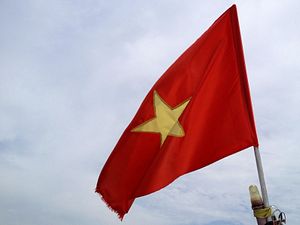
Scholars are calling for Vietnam to see itself as a middle power and to behave like a true middle power to accommodate its growing role in regional settings. But is Vietnam already a middle power or just one in the making?

While there remains a range of perspectives on defining the typical features a middle power should possess, I suggest looking into Cooper’s middle power notion, with positional, geographic, normative, and behavioral approaches. A comprehensive probe into Vietnam’s normative and pragmatic power would provide a critical answer to its current status.

Vietnam satisfies the status condition of being situated in between large developed and large developing countries. With more than 97 million people, Vietnam ranks 15th out of 251 countries and territories by population. The young and vibrant population — mostly living in bustling metropolises like Ho Chi Minh City, Hanoi, and the central coastal city Da Nang — has constituted the emergence of Vietnam as a “next top model of growth,” with a psyche of being hungry for success. Vietnam’s economic resiliency, with real GDP growth of 7 percent in 2019, has accounted for “its deep integration with the global economy.” Via embracing trade liberalization, domestic reforms, and heavy public investments, Vietnam has become one of the top five economic freedom gainers in the Asia-Pacific region, ranking 21st among 42 regional countries. The country’s economic rise as the fastest-growing digital economy in the Asia-Pacific has made it a prime alternative manufacturing hub in Asia. According to the 2020 Lowy Institute Asia Power Index, Vietnam ranked 12th of 26 regional nations for comprehensive power and 11th in military capability. It was hailed as “a middle power in Asia.”

4 Predictions for Defense, Strategy, and Technology in 2021

By Jacob Parakilas

If I had made predictions for the coming year in December 2019, I suspect most of them would have been wrong: 2020 confounded expectations and frustrated plans from the personal to the grand strategic. 2021 is likely to be a very different kind of year, and doubtless has more than a few surprises in store. Nevertheless, I think it’s worthwhile putting down a few brief markers for what I expect in the defense and strategic space over the coming 12 months.

1. Armed Robots Will Spread To Different Domains

2020 might reasonably be described as the year the armed drone went global, as a widespread weapon of war rather than a specialist tool operated only by the wealthiest states. But the overall robotization of warfare is an uneven process. If armed aerial drones have become commonplace, the same cannot be said for armed ground or naval robots. There are sound technical reasons for this – safe, autonomous navigation on land is much more difficult than in the air, and aerial platforms have obvious military applications in surveillance and strike.

But there are missions that aerial vehicles are poorly suited to or incapable of, and there has been steady but low-profile progress on ground and undersea robots. Given the lack of a legal framework to prohibit arming such units, and the proliferation of low-cost, high-precision compact weapons, their operational debut might well occur in some capacity in the next 12 months.

2. More Hacks, Less Attention

New Year Resolutions for Asia’s Biggest Economies

By Anthony Fensom

Asia’s Year of the Rat was plagued by the COVID-19 pandemic, a new “Cold War” between the United States and China and global recession. In hope of better times ahead, Pacific Money takes a look at some New Year resolutions for the region’s biggest economies for 2021, Asia’s Year of the Ox.

China: Keep the Champagne on Ice

China’s ruling Communist Party celebrates its 100th anniversary in July 2021, having grown from a group of around 50 revolutionaries to more than 90 million members. Yet will it be bouquets or brickbats for Chinese President Xi Jinping at this milestone event?

Economically, Xi can boast of a swift recovery from the coronavirus pandemic that first emerged a year ago in Wuhan. While China has not been immune – it is set for its slowest growth since the Mao era – it has been one of the only major economies to expand in 2020.

As a result, its share of global gross domestic product (GDP) has jumped to its highest on record at around 18 percent, according to Capital Economics. Yet the consultancy cautions against extrapolating this strength too far into the future, given China’s structural weaknesses including demographics, rising debt, and diminishing returns on investment, which are being “papered over” with stimulus.

What Does Vietnam Want from the US in the South China Sea?

By Derek Grossman

As the incoming Biden administration formulates its South China Sea strategy, one regional partner that looms large is Vietnam. Over the last few years, tensions between China and Vietnam in the South China Sea have remained high, impacting fishing and natural resource exploration in disputed waters. While the Biden administration is likely to continue the positive momentum in bilateral ties, it is less clear what specifically Hanoi seeks from Washington to help it effectively deter Beijing.

This is wholly understandable. As I have recently examined at length in a RAND research report, Vietnam is doubling-down on its delicate balancing act as U.S.-China competition throughout the Indo-Pacific dramatically heats up. Although Hanoi feels compelled to counter China’s bad behavior in the South China Sea, it also understands that its future is inextricably tied to peaceful relations with Beijing. Thus, Hanoi typically avoids publicly airing policy preferences, and even privately, the Vietnamese are notoriously subtle and difficult to read.

That leaves Washington in the dark most of the time. But through my research and discussions with Vietnamese interlocutors over the years, a few policy preferences have become apparent.