Artificial Intelligence (AI) has emerged as the main engine of growth of the Fourth Industrial Revolution, owing to its naturally cross-cutting, general-purpose nature. From a military perspective, the range of potential applications is at least as vast as the current range of tasks that require human cognition, e.g., analysing and classifying visual data, organising logistics, operating vehicles, or tracking and engaging hostile targets. How can Western nations – by which I mean those nations that are members of either NATO or the European Union (or both) – make the most out of the rise of AI, bearing in mind its potential defence applications?
28 January 2021
Recent Cyber Events and Possible Implications for Armed Forces #8
This is the eighth instalment of a series of reports by CCDCOE identifying potential implications of cyber events to armed forces. This issue highlights some of the topics that were at the forefront during 2020. The primary audience for this report includes military decision makers at different levels of command. The aim of this report is to provide better understanding of how developments in the cyber domain may affect military operations.
Please note that the report covers only a selection of many cyber events that happened during the year. Our selection of relevant news articles stems from the significance of the events from the perspective of the military, utilizing the CCDCOE´s multidisciplinary expertise and 360° approach to cyber defence. This is not a news report, the focus will be rather on the long term impact of the events, and lessons that can be learned from incidents that will help the armed forces to be better prepared for future events.
Smart partnerships amid great power competition
by Mathew Burrows, Julian Mueller-Kaler
Artificial intelligence (AI) and other emerging technologies are developing at an exponential pace, and the discussion about their use as well as their implications for society and international relations is shaped by uncertainty. Whether it is the future of work, the collection and application of data, or new means for surveillance and social manipulation—AI will most likely influence every aspect of modern life. Change is coming no matter whether people like it or not, and decision makers are under pressure to prepare for a new world in the digital age.
In order to establish forums, enable discussions about opportunities and challenges of modern technologies, and evaluate their implications for US-China relations, the Atlantic Council was awarded a Rockefeller Foundation grant that helped lay the groundwork for a new GeoTech Center, launched on March 11, 2020. Over the course of one year, we organized meetings in Paris, Brussels, and Berlin; traveled to Beijing and Shanghai; and held virtual conferences with India and Africa, all the while trying to answer one question: How can countries successfully collaborate on big data, AI, and other modern technologies amid the widening political gyre?
AI, China and the global quest for digital sovereignty
AI and International Stability: Risks and Confidence-Building Measures
By Michael Horowitz and Paul Scharre
Executive Summary
Militaries around the world believe that the integration of machine learning methods throughout their forces could improve their effectiveness. From algorithms to aid in recruiting and promotion, to those designed for surveillance and early warning, to those used directly on the battlefield, applications of artificial intelligence (AI) could shape the future character of warfare. These uses could also generate significant risks for international stability. These risks relate to broad facets of AI that could shape warfare, limits to machine learning methods that could increase the risks of inadvertent conflict, and specific mission areas, such as nuclear operations, where the use of AI could be dangerous. To reduce these risks and promote international stability, we explore the potential use of confidence-building measures (CBMs), constructed around the shared interests that all countries have in preventing inadvertent war. Though not a panacea, CBMs could create standards for information-sharing and notifications about AI-enabled systems that make inadvertent conflict less likely.
Introduction
In recent years, the machine learning revolution has sparked a wave of interest in artificial intelligence (AI) applications across a range of industries. Nations are also mobilizing to use AI for national security and military purposes.1 It is therefore vital to assess how the militarization of AI could affect international stability and how to encourage militaries to adopt AI in a responsible manner. Doing so requires understanding the features of AI, the ways it could shape warfare, and the risks to international stability resulting from the militarization of artificial intelligence.
The U.S. AI Workforce: Understanding the Supply of AI Talent
Diana Gehlhaus
As the United States seeks to maintain a competitive edge in artificial intelligence, the strength of its AI workforce will be of paramount importance. In order to understand the current state of the domestic AI workforce, Diana Gehlhaus and Santiago Mutis define the AI workforce and offer a preliminary assessment of its size, composition, and key characteristics. Among their findings: The domestic supply of AI talent consisted of an estimated 14 million workers (or about 9% of total U.S. employment) as of 2018.Download Full Report
Executive Summary
Having access to the right talent is critical to maintaining a competitive edge in artificial intelligence. In the United States, policymakers are actively discussing legislative proposals to grow and cultivate a globally competitive domestic AI workforce. However, little data is available on the U.S. AI workforce and associated talent pipelines outside of the PhD segment.
Yet having access to good workforce data is critical to actually “winning” the competition for AI talent. This brief provides two contributions to better understand the U.S. AI workforce: (1) a definition of the AI workforce based on the government occupational classification system, identifying 54 occupations that either participate or could participate in AI product and application development, and (2) a preliminary assessment and characterization of the supply of AI talent, which consisted of 14 million workers in 2018 (about 9% of total U.S. employment).
Guest Post: Dean Cheng on “Cyber Actions and Acts of War”
BY CHARLIE DUNLAP, J.D.

In today’s post popular LENS Conference speaker Mr. Dean Cheng wrestles with one of the toughest national security issues these days: at what point do–or should–cyber actions become a casus belli?
In addressing that question Dean unpacks the political term “act of war.” For the purposes of his essay, it means the kind of action that can trigger legal authority for acts in self-defense pursuant to Article 51 of the UN Charter (and its analog in Article 5 of the NATO charter).
When the attack is conducted with bombs or bullets, the legal determination is relatively easy to discern, but when it’s via electrons in cyberspace. not so much.
In short, to what extent has the nature and capabilites of cyber technology challenged traditional legal and political norms as to what warrants armed conflict? How great a breach of sovereignty must occur? Here are Dean’s views on those complicated questions:
Cyber Actions and Acts of War
CYBER GOVERNANCE & DIGITAL DEMOCRACY
By BARIŞ KIRDEMIR
INTRODUCTION
 Among many events of 2020, the 44-day war in Karabakh was one of the most significant. The decades-long conflict between Azerbaijan and Armenia entered a new phase in late September with the escalation of hostilities into a full-scale war. Given the regional geopolitics, ongoing strategic rivalries, and the protracted diplomatic background of the Nagorno-Karabakh dispute, the renewed hostilities attracted high levels of attention from international media. Social media and other cyber-mediated channels rapidly became a continuation of the battleground, especially after the tensions escalated in September 2020. Moreover, the confrontation between Azerbaijani and Armenian information actors, both enjoying others’ support internationally, has had many facets.
The recent war in Karabakh is significant and exemplary in terms of the dynamics of modern conflicts and the information environment. In particular, the bidirectional relationships between various aspects of modern wars, such as skillful war planning, political-military concept building, battlefield military effectiveness, and strategic communication practices exceed the limited and isolated achievements in each of these domains in determining the winners of wars. Besides, the general coverage and representation of the war, as well as the dynamics of influence on social media, would most probably provide significant lessons-learned, not only for the belligerents or regional countries but also for others who have to operate in the modern information environment.
Transatlantic Data Transfers
Kenneth Propp

U.S. surveillance activities have alarmed European partners, throwing the future of transatlantic digital trade into question. The United States should embrace collaboration and protections for personal data.
Cables run into the back of a server unit inside an Equinix data center outside Paris, on December 7, 2016. Benoit Tessier/Reuters
Introduction
Data transfers are at the heart of the robust transatlantic economy, but they have long been plagued by Europe’s doubts about privacy protections in the United States.
The economic stakes are high. Information and communications technology (ICT) services such as social networks and cloud service providers depend on cross-border data transfers, as do other services that can be delivered over ICT networks, including engineering, software, design, and finance. Although trade in digital services is hard to measure precisely, it has become one of the fastest-growing areas for the United States internationally. In 2017, digital services constituted 55 percent of U.S. services exports, yielding 68 percent of the U.S. global surplus in services trade, according to a transatlantic trade study [PDF]. U.S. exports of digital services to Europe that year amounted to $204.2 billion, generating a surplus of more than $80 billion. The transatlantic is the world’s largest area for digital trade.
In order to maintain and expand this trade, U.S. policymakers should develop a strategy to address the European Union (EU)’s concerns and promote cooperation with other democracies at a multilateral forum, such as the Organization for Economic Cooperation and Development, to develop a shared legal framework for government access to personal data.
Background
Evolving UAE Military and Foreign Security Cooperation: Path Toward Military Professionalism
MELISSA DALTON, HIJAB SHAH
After two decades of concerted investment and operational experience, the United Arab Emirates (UAE) armed forces, dubbed “Little Sparta,” are now one of the leading militaries in the region.1 With approximately 63,000 active uniformed personnel for a population of 9.9 million (only 1.2 million of which are Emirati), allegedly augmented by foreign auxiliary and mercenary forces, the UAE has gained global attention for its role in countering Iran and violent extremist networks and for interventions in Yemen and Libya.2 It is one of the United States’ closest military partners in the Middle East.3 American scholar Kenneth Pollack assesses that, taken as a whole, the UAE’s military is the most capable among the Arab states, while there may be variance across the force.4
The UAE has an opportunity to capitalize on these developments and become a professionalized military by building its strategic planning and force development capabilities, enabling it to set its regional priorities and force structure, and by committing to international principles of professional military conduct and greater transparency and accountability that will buttress its legitimacy at home, in the region, and with international partners. Military professionalism includes an understanding of leadership, strategy, history, tactics, warfighting domains, organization, technology, and capabilities. It also involves a commitment to moral conduct and to incorporating lessons learned to apply and move forward as part of an institution.
If developed, the UAE’s strategic planning capabilities would enable it to better match defense priorities with resourcing. For example, if the country envisions other counterinsurgency and proxy war campaigns in the future, does it need to create both capacity and capability within the UAE force to perform those missions in a more effective and integrated manner? Or will a continued reliance on mercenary forces be sufficient, but open the UAE to international scrutiny and erode its legitimacy in the eyes of key partners? Concretely, the UAE should undertake a review of its interventions in Yemen and Libya, which have tested the military’s force structure and capabilities and wherein the UAE reportedly has hired and mobilized mercenary groups and proxies to supplement its force. Gaps in the UAE’s strategic planning capabilities exacerbate the risks of overextension and reliance on less professional and less integrated forces.
27 January 2021
India’s Vaccine Diplomacy
BY HARSH V. PANT, AARSHI TIRKEY

Yet rhetoric aside, the predominant response to the disease has been to shut down and look inwards. As the global demand for medicines, medical supplies, and personal protection equipment increased, countries imposed export prohibitions and restrictions to stabilize domestic supplies. Vaccine nationalism was soon to follow, with the possibility that rich countries would attempt to hoard vaccines by striking pre-purchase deals with pharmaceutical companies.
Throughout it all, though, it was always clear that a global challenge of this magnitude would eventually require a global solution, based on international health cooperation between public and private-sector stakeholders. And Indian Prime Minister Narendra Modi recognized early on that his country could play a unique role in that process.
India-Japan Cyber Cooperation: From Strength to Strength
By Prakash Panneerselvam

Fifth generation internet technology – 5G – is emerging as an important tool of strategic cooperation. Many countries across the globe are in the middle of intense discussions in deciding vendors and ensuring cybersecurity in their 5G services. The Chinese telecommunication giants Huawei and ZTE are leading the 5G technology market. However, many have also raised severe concern over the security issues around their 5G service. Many countries including the United States, the United Kingdom, Australia, and some European countries have blacklisted Huawei and ZTE Network from participating in the 5G selection process. However, India and Japan remain unsure about whether to exclude the two Chinese firms from their 5G vendor selection process.
The two countries have also stepped up the cooperation on information and communications technology (ICT) and cybersecurity to enhance joint efforts around 5G technology, as well as security of information infrastructure. In the latest development in this direction, the two countries have reached an agreement on ICT cooperation and signed a Memorandum of Understanding (MoU) through a video conference on January 15. In the wake of increased tensions with China, India-Japan cooperation in the ICT sector is seen as a countermove to China’s growing influence in the telecommunications and digital infrastructure.
Sea Vigil: India’s Coastal Security Exercise
By Rajeswari Pillai Rajagopalan

Since the 2008 terrorist attack on Mumbai, coastal security has assumed particular importance among India’s national security concerns. Because that attack came through a sea route, the national government and state governments along India’s long coastline have taken several steps to address potential capacity issues of various intelligence and security forces. One such step is the biennial coastal security exercise called “Sea Vigil.” The second edition, “Sea Vigil-21,” was held on January 12-13, 2021.
India began this biennial pan-Indian exercise in January 2019. In addition to all the coastal security agencies from the different states and union territories, the exercise also pulled in other maritime stakeholders including fishing and coastal communities. The exercise is meant to assess India’s coastal security preparedness to prevent any “attempt by anti-national elements to carry out an attack on its territory or against its citizens by infiltrating through the sea route.”
The Indian Navy in its statement on the 2019 inaugural edition said that the exercise tested a number of contingency situations including attacks on vital installations and assets along the coast and studied the response mechanism in terms of coordination and information sharing among the different agencies involved in the exercise. The exercise has been used to validate the effectiveness of the response measures and address the gaps that may exist. Multi-agency teams were tasked to review the security practices at several vulnerable spots across the coast including fish landing centers; major, minor, and intermediate ports; lighthouses; coastal police stations; control rooms; and operation centers. The 2019 exercise was conducted under the lead of the commander-in-chief of coastal defense, Southern Naval Command, and observed by the Joint Operations Center at Kochi in southern India.
Terrorism in Pakistan has declined, but the underlying roots of extremism remain
Madiha Afzal
According to the South Asia Terrorism Portal, Pakistan saw 319 terrorism-related incidents in 2020, and 169 associated deaths of civilians. That represents a decline, from a high of nearly 4,000 such incidents in 2013, with over 2,700 civilian deaths (see figure below).
This fall is largely due to the Pakistani army’s kinetic operations against the Pakistani Taliban — also known as the Tehrik-e-Taliban Pakistan (TTP) — which had been responsible for the majority of deaths of civilians and security forces since 2007, the year it formed officially as an umbrella organization of various militant groups. Over the years, American drone strikes targeted and killed successive TTP leaders, including Baitullah Mehsud in 2009, Hakimullah Mehsud in 2013, and Mullah Fazlullah in 2018. The Pakistani military’s Zarb-e-Azb operation (named for the sword of the Prophet Muhammad) began in 2014 — after a TTP attack on the Karachi airport that June — and increased in intensity after the Peshawar Army Public School attack of December that year, which killed more than 130 schoolchildren. Since 2017, having largely routed the TTP (because of limited information access to the area, there are questions about how many terrorists were killed, versus simply displaced across the Pakistan-Afghanistan border), the military’s operation entered a new phase of “elimination” of militant groups. The operation is called Radd-ul-Fasaad, which literally means elimination of all strife.
The Global Reach of China’s Venture Capital
By Sophie Zinser
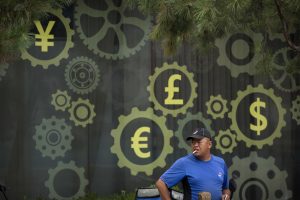
In this July 20, 2018, file photo, a deliveryman stands near a mural displaying Chinese yuan and other world currency symbols on the outside of a bank in Beijing.Credit: AP Photo/Mark Schiefelbein
Over the past few months, the Chinese government has made critical efforts to quash its $12.9 trillion shadow banking system and slowly break up its most influential business conglomerates. Last Wednesday, the China Banking and Insurance Regulatory Commission made public a notice ensuring that companies would become regulated on a trial ranking system. This regulation comes on the back of the last-minute block of Ant Group’s planned November IPO – set to be the largest IPO in world history – and Alibaba co-founder and tech giant Jack Ma’s subsequent unexplained disappearance from public life. The Chinese government is clearly encouraging the consolidation of smaller companies while breaking up bigger ones.
This push will impact how China’s corporate tech giants leverage their massive global influence abroad. Some of the first companies likely to see any changes work first are those who are receiving massive Chinese venture capital (VC) funding across South and Southeast Asia.
STILL ON THE BEAT: CHINA COAST GUARD PATROLS IN 2020
The Covid-19 pandemic has had no discernible effect on the presence of the China Coast Guard (CCG) in the South China Sea. An analysis of Automatic Identification System (AIS) data collected by MarineTraffic demonstrates that Beijing has continued to deploy its coastguard around symbolically important features at the edges of the nine-dash line on an almost daily basis, just as it did in 2019. That CCG vessels so frequently broadcast AIS from these reefs, which are not physically occupied by China, suggests that they want to be seen signaling China’s claims.
China Coast Guard Patrols in the South China Sea
In the 12 months from December 1, 2019, the CCG not only maintained a persistent presence at Second Thomas Shoal, Luconia Shoals, and Scarborough Shoal, but appears to have increased the frequency of patrols during the pandemic. There was at least one CCG vessel, and often two, broadcasting from Scarborough Shoal on 287 of the last 366 days—a substantial increase from last year’s 162 days. Luconia and Second Thomas Shoal saw more modest increases: at least one CCG ship was broadcasting from Luconia for 279 days and from Second Thomas Shoal for 232 days.
China authorises coast guard to fire on foreign vessels if needed
By Yew Lun Tian
BEIJING (Reuters) - China passed a law on Friday that for the first time explicitly allows its coast guard to fire on foreign vessels, a move that could make the contested waters around China more choppy.
China has maritime sovereignty disputes with Japan in the East China Sea and with several Southeast Asian countries in the South China Sea. It has sent its coast guard to chase away fishing vessels from other countries, sometimes resulting in the sinking of these vessels.
China’s top legislative body, the National People’s Congress standing committee, passed the Coast Guard Law on Friday, according to state media reports.
According to draft wording in the bill published earlier, the coast guard is allowed to use “all necessary means” to stop or prevent threats from foreign vessels.
The bill specifies the circumstances under which different kind of weapons - hand-held, ship borne or airborne - can be used.
The bill allows coast guard personnel to demolish other countries’ structures built on Chinese-claimed reefs and to board and inspect foreign vessels in waters claimed by China.
The bill also empowers the coastguard to create temporary exclusion zones “as needed” to stop other vessels and personnel from entering.
Responding to concerns, Chinese foreign ministry spokeswoman Hua Chunying said on Friday that the law is in line with international practices.
TO RULE THE INVISIBLE BATTLEFIELD: THE ELECTROMAGNETIC SPECTRUM AND CHINESE MILITARY POWER
MARCUS CLAY

The fight for electromagnetic spectrum superiority has been ongoing for over a century. The U.S. military’s domination of the spectrum has steadily declined over the past two decades. This is mainly because American defense planners and warfighters have been preoccupied with non-peer adversaries operating in a highly permissive spectrum environment. In the same timeframe, China has been making moves to strengthen its electromagnetic spectrum-enabled capabilities, and has brought itself to near parity with the United States. Five years ago, against the backdrop of broader structural reforms, the People’s Liberation Army took a major institutional step to fuse its previously disaggregated space, network, and electronic warfare elements by creating the Strategic Support Force. Washington views this as evidence of Chinese military leaders’ belief that “achieving information dominance and denying adversaries the use of the electromagnetic spectrum is necessary to seize and maintain the strategic initiative in a conflict.”
From radio waves to gamma rays, the electromagnetic spectrum covers the entire range of light that exists. Modern militaries use radars and other sensors to locate each other and the enemy, wireless computer networks to order supplies and coordinate operations, and jammers to degrade enemy radars or disrupt communications that are critical for effective command and control. The spectrum is what ties everything together. In the Department of Defense’s Electromagnetic Spectrum Superiority Strategy, released last year, the spectrum is identified as an enabler of military operations in other domains, not as an independent warfighting domain in its own right. China follows this development closely and likely shares this assessment at present. Circumstantial evidence suggests that the People’s Liberation Army is also likely crafting its own high-level spectrum strategy. Chinese military strategists increasingly prioritize the exploitation and domination of the electromagnetic spectrum in their evolving military doctrines. To deter China’s adversaries both militarily and psychologically, they advocate the deeper integration of computer networks into electronic warfare, with such capabilities to be used alongside precision kinetic strikes. Anticipating a fast-paced future battlefield, China also appears poised to apply advanced technology such as AI and machine learning to the task of strengthening its electronic warfare capabilities.
Speak the People’s Liberation Army’s Language
U.S. China Policy Must Confront the Genocide in Xinjiang First
BY RAYHAN ASAT, YONAH DIAMOND

But in April 2016, Asat was forcibly disappeared within weeks of returning from the United States on a premier exchange program, the International Visitor Leadership Program (IVLP), unlike the Han members of his IVLP cohort, who returned to their ordinary lives. He’s currently presumed to be held in one of the infamous internment camps in Xinjiang without access to anyone, including his family—one victim among millions of government atrocities that the United States have just designated a genocide.
For 80 years, IVLP has invited acclaimed professionals from around the world to visit the United States to engage in cultural and professional exchanges and cultivate future diplomatic ties with their counterparts. The program serves as a pillar of U.S. foreign policy in forming strong relationships with global partners. Participants draw on their experience in the United States to implement innovative practices back home, informed by fundamental U.S. values, including liberal democracy, human rights, the rule of law, diversity, civic diplomacy, and international cooperation. In disappearing Asat, the only Uighur member of the China delegation, China attacked these values at the heart of IVLP, U.S. foreign policy, and values of engagement.
Zimbabwe: Chinese and military owned diamond firm scores richest claim to diamonds under unclear circumstances
‘Army-Linked Anjin Grabs Richest Diamond Claim’ 15 January 2021
An army-linked miner, Anjin Investments (Pvt) Ltd, grabbed the most lucrative diamond claim in Marange from a firm owned by the government after being relicensed under unclear circumstances, it has emerged. Investigations carried out with support from Information for Development Trust, a non-profit organisation helping journalists to expose corruption and bad governance, established that Anjin has effectively taken over Portal B, a diamond-rich zone in Marange that was being mined by the Zimbabwe Consolidated Diamond Company (ZCDC), a government outfit set up in 2016. The ZCDC was established as a merger of DTZ-OZGEO, Marange Resources, Kusena Diamonds, Diamond Mining Company and Gye Nyame, when Anjin and several other diamond miners were de-licensed by the government and barred from operating in Marange, in Manicaland province, for alleged impropriety. The de-licensing occurred during the rule of the late Robert Mugabe, who was deposed through a military-assisted takeover in November 2017.
… In 2012, the US Office of Foreign Assets Control accused Anjin of "smuggling" 3,7 million carats of diamonds to Shanghai, but the company argued that the shipments to China were government-sanctioned. Anjin went back to the Marange fields in March 2019, three years after its special grants 4765 and 5247 were revoked, and its return has been seen as a flawed act meant to give an under-funded army the opportunity to finance its operations. "It's clear that there is a military hand behind the return of Anjin to Chiadzwa," said the Centre for Natural Resource Governance (CNRG) director, Farai Maguwu, whose organisation fights for transparency and accountability in the mining sector. Anjin remains a jointly owned company between Matt Bronze Enterprises, a special purpose vehicle owned by the Zimbabwean army, and the Chinese investor Anhui Foreign Economic Construction Company, which also owns Jinan Mining.
Interview: China's economic recovery "a blueprint" for others, WEF director says
by Martina Fuchs
GENEVA, Jan. 18 (Xinhua) -- China's faster than expected economic rebound after the COVID-19 shock is a bright spot and could serve as a roadmap for other countries, said Saadia Zahidi, a Managing Director at the World Economic Forum (WEF), in an interview with Xinhua on Monday.
"China is clearly one of the few large economies in the world that has seen that kind of recovery in the growth numbers," she said.
China's National Bureau of Statistics (NBS) said on Monday that the country's economy grew more than expected in 2020 by 2.3 percent year-on-year.
Accordingly, China is expected to be the only major economy to post growth in the pandemic-ravaged year.
The country's gross domestic product (GDP) exceeded the 100-trillion-yuan (15.42 trillion U.S. dollars) threshold in 2020, NBS said.
This marked a new economic milestone for the Chinese economy after the country's GDP per capita exceeded 10,000 U.S. dollars in 2019 for the first time in history.
Earlier this month, the World Bank Group said that it expected China's economy to expand by 7.9 percent in 2021, while the global economy is on track to grow by 4 percent.
Zahidi said that the recovery from the COVID-19 pandemic should be "green."
How Many Bridges Can Turkey’s Erdogan Burn?

Erdogan has simultaneously pursued an adventurous and bellicose foreign policy across the Mediterranean region, putting Ankara increasingly at odds with its NATO allies. After Turkey’s purchase of a Russian air-defense system in July 2019, Washington suspended Turkish involvement in the F-35 next-generation fighter plane program. In October 2019, the Turkish incursion into northeastern Syria targeting Syrian Kurdish militias highlighted the disconnect between the U.S. Congress—which fiercely defended the Syrian Kurds, America’s principal partner on the ground in the fight against the Islamic State—and U.S. President Donald Trump, who seemed oblivious to their plight and subsequently received Erdogan at the White House. More recently, Turkey’s repeated incursions into waters in the Eastern Mediterranean claimed by Cyprus, as well as its standoffs with Greek and French naval vessels in the region, have further raised tensions and alarmed observers.
Iraq’s Disappearance From Biden’s Agenda Is a Big Mistake
BY MINA AL-ORAIBI

The attack also serves as a reminder that Iraq needs to be on the Biden administration’s agenda, even though it does not appear to be a priority at all. Because of its strategic impact on Middle East politics and the implications Iraq’s success or failure has on the United States’ standing in the world, how Biden and his team handle Iraq will be watched closely in the Middle East and beyond.
Iraq is at a critical moment as it prepares for national elections in October that could help the country to finally emerge from the grip of corrupt, sectarian political parties—or reverse the gains it has made.
The Biden team is taking office 10 years after the Arab uprisings that the United States largely mishandled. In today’s Iraq, as elsewhere in the Middle East, there is a nascent but significant movement among young Iraqis to reject identity politics based on sectarianism, which has a bloody history of being exploited to divide Iraqi Sunnis, Shiites, Kurds, and other groups from one another. The worst thing that could happen is if the new U.S. administration reverted back to old proposals to deepen Iraq’s sectarian divisions as a way of ruling the country, as Biden has proposed in the past. Instead, Washington should support Iraqi sovereignty, stability, and good governance.
Facing a multitude of challenges of its own, Jordan welcomes Biden
Bruce Riedel
While many Middle Eastern leaders are apprehensive about the incoming American administration, Jordan’s King Abdullah is pleased to see the end of the Trump administration and welcome Joe Biden. The Trump team virtually ignored Jordan and its interests for four years. Biden is a well-known player in the Hashemite Kingdom, but the relationship will need mending.
The king tried courting Trump in 2017, meeting face-to-face four times that year — including in Riyadh, when Trump traveled to the region. But they have not met since June 2018, an unusually long period of absence for Jordanian kings and American presidents. Only the hiatus between King Hussein and President George H.W. Bush after their falling out over Iraq’s invasion of Kuwait 30 years ago was as lengthy as the current freeze.
Trump pursued a regional policy that stressed Saudi and Israeli interests. Washington supported the Saudi war and blockade in Yemen, which has killed tens of thousands and starved even more in a reckless quagmire. It is very unpopular in Jordan, which sympathizes with the Yemeni people, a sentiment that is sometimes expressed in the media. Jordan did not join the Saudi blockade of Qatar, despite Saudi pressure. The king has made little secret of his disdain for Crown Prince Muhammad bin Salman, who has been an inept leader and ordered the assassination of Jamal Khashoggi in Istanbul more than two years ago.
Trump’s other fan in the region is Israeli Prime Minister Benjamin Netanyahu, whom the Jordanians have despised since 1997 when he ordered a bungled assassination attempt against Hamas’ leader in Jordan, Khaled Mishal, in downtown Amman. I took King Hussein’s angry call to President Bill Clinton, demanding the antidote for the poison that had been used. Trump’s so-called “deal of the century” was a craven rehash of right-wing Israeli demands, including for the annexation of the Jordan River valley. King Abdullah has not met with Netanyahu in years.
Biden Orders Sweeping Assessment of Russian Hacking, Even While Renewing Nuclear Treaty
By David E. Sanger and Julian E. Barnes
 WASHINGTON — President Biden ordered a sweeping review on Thursday of American intelligence about Russia’s role in a highly sophisticated hacking of government and corporate computer networks, along with what his spokeswoman called Moscow’s “reckless and adversarial actions” globally and against dissidents inside the country.
At the same time, White House officials said the president would seek a clean, five-year extension of the last remaining nuclear arms treaty between the two countries, which expires in two weeks.
While Mr. Biden has long favored the extension, there was debate among his top aides about how long it should be. He chose the most time available under the treaty’s terms, in hopes, his aides said, of preventing a nuclear arms race at a time the new president expects to be in a state of near-constant, low-level competition and confrontation with Moscow around the world — and particularly in cyberspace.
“This extension makes even more sense when the relationship with Russia is adversarial as it is at this time,” said Jen Psaki, the White House press secretary.
Taken together, the paired announcements make clear the complexity of Mr. Biden’s two-step approach to contain the actions of President Vladimir V. Putin of Russia. Mr. Biden’s aides have said they have no interest in a “reset” in relations of the kind that President Barack Obama and his secretary of state at the time, Hillary Clinton, tried a dozen years ago.
UK Government Announces New National Cyber Force
by Antonia Gough

Recently, the UK government announced its plans to take more offensive steps in its approach to cybersecurity. The announcement is further evidence of a gradually emerging trend exhibited by nation states: an increasing openness about their offensive cyber operations. This behaviour is likely to become the norm as many of the motivators for such an offensive stance — hybrid warfare, cyber espionage, and disinformation campaigns –only continue to grow.
What Will the Force Entail?
On Thursday 19th November 2020, the UK Prime Minister announced a new partnership: the National Cyber Force (NCF). This new body is the result of cooperation between the Ministry of Defence and Government and Communications Headquarters (GCHQ). MI6 and the Defence, Science and Technology Laboratory will also contribute.
The four organisations will collaborate under one unified command for the first time. The Ministry of Defence’s official tagline for the NCF is, “A Defence and Intelligence Partnership”, to emphasize the fact that there is no other organization like it anywhere else on the globe, to date.
In development for over two years, with reports of its creation first surfacing in September 2018, this specialist cyber unit is set to multiply tenfold the number of government employees in offensive cyber and cyber-crime roles over the next ten years. These individuals are to be drawn from security services, the military, and industry.
The Guiding Objectives of the Taskforce
With Trump Gone, Taiwan Seeks Assurances From Biden Administration
BY JACK DETSCH, CHRISTINA LU

Taiwanese officials and lawmakers have been playing out the same worst-case scenario in their head for years now: China attacks the island across the Taiwan Strait, and officials in Taipei call for backup from the United States and other allies. With Joe Biden now sitting in the Oval Office, Taiwan wants to know: How would the United States respond?
Wang Ting-yu, who co-chairs the foreign affairs and defense committee in Taiwan’s parliament, told Foreign Policy that the island’s military would not be caught off guard if China prepped for an attack. Taiwanese satellite and radar systems would be able to spot a buildup of People’s Liberation Army forces in Guangdong or Fujian province, across the strait, and it could take as many as 60 days for China to mass enough troops for an amphibious assault, he said.
“Those 60 days will be a precious time for international society to stop a war or to send a clear signal. ‘This is a red line you cannot cross,’” he said. “The question is, Taiwan will be prepared to protect our home. What will the world, especially the United States, what will you do?” The message that Biden should send to Chinese President Xi Jinping is simple, Wang said: “‘Don’t even try it.’”
Lloyd Austin, who was confirmed Friday as Biden’s defense secretary, told lawmakers during his confirmation hearing this week that he would “make sure” the United States was living up to its commitments to help Taiwan defend itself.
America’s Promise Seems Distant Now, but It Will Be Back
Candace Rondeaux

We have arrived at this moment violently, as usual. With baseball bats and long guns cradled in our arms, some of us Americans pulled on battle fatigues, convinced that the war for the soul of a nation could be won with just a little more menace—not just on TV or on Facebook, but in Washington and other state capitols. When that outrage and other tricks didn’t work, Donald Trump’s supporters cast their mind’s eye backward through history, all the way to 1776. Hooked by the Big Lie, they wandered through the fog of American supremacy, dragging the whole country and democracy along with them. All the while, the death toll from the virus spreading through the land rapidly rose, hitting 250,000, then 300,000, then 350,000, and higher.
Out there, distant from each other and grieving, some of us Americans turned a blind eye to the collateral damage, choosing instead to whitewash our political fences. Even as the lines for food snaked down our streets, it became an urgent priority for some to paint over American history, including the evils of slavery and the memory of Crispus Attucks, a mixed-race slave who, after rising up against colonial tyranny in 1770, lay in state at the insistence of the man who would become our second president. In the mood of forgetting, it was made clear through banal repetition and petty bureaucratic fiat that references to 1619, when the first slave ship landed in the British colony of Virginia, would no longer be tolerated in a government by some of the people for some of the people. Imagine the shock when, after 81 million people had spoken on Nov. 3 in favor of a different vision for America, that manifesto fell flat.
America’s Promise Seems Distant Now, but It Will Be Back
Candace Rondeaux
America’s longest winter is not yet over. But the inauguration this week of President Joseph R. Biden Jr. and Vice President Kamala D. Harris should reassure the country and the world that though the promise of American reinvention seems distant, it will come again.We have arrived at this moment violently, as usual. With baseball bats and long guns cradled in our arms, some of us Americans pulled on battle fatigues, convinced that the war for the soul of a nation could be won with just a little more menace—not just on TV or on Facebook, but in Washington and other state capitols. When that outrage and other tricks didn’t work, Donald Trump’s supporters cast their mind’s eye backward through history, all the way to 1776. Hooked by the Big Lie, they wandered through the fog of American supremacy, dragging the whole country and democracy along with them. All the while, the death toll from the virus spreading through the land rapidly rose, hitting 250,000, then 300,000, then 350,000, and higher.
Out there, distant from each other and grieving, some of us Americans turned a blind eye to the collateral damage, choosing instead to whitewash our political fences. Even as the lines for food snaked down our streets, it became an urgent priority for some to paint over American history, including the evils of slavery and the memory of Crispus Attucks, a mixed-race slave who, after rising up against colonial tyranny in 1770, lay in state at the insistence of the man who would become our second president. In the mood of forgetting, it was made clear through banal repetition and petty bureaucratic fiat that references to 1619, when the first slave ship landed in the British colony of Virginia, would no longer be tolerated in a government by some of the people for some of the people. Imagine the shock when, after 81 million people had spoken on Nov. 3 in favor of a different vision for America, that manifesto fell flat.
Covid-19 is up-ending capitalism
BY PATRICK FOULIS
RECESSIONS ARE capitalism’s sorting mechanism. Weak businesses shrink or fail and stronger ones expand. But in 2020 the process of creative destruction did not take place in the typical manner. Because the downturn was the result of a health crisis rather than, say, a financial crash or inflation scare, there were some idiosyncratic corporate winners and losers: think of the boom in video streaming, or cruise-liner firms being wrecked. Meanwhile vast state handouts propped up companies around the world, masking the scale of the corporate carnage. In 2021 the toll will become clearer as stimulus tapers down and more firms fail. Healthy businesses will ramp up investment, giving them an enduring advantage. These top dogs will, however, face a new climate in which three tenets of modern business—the primacy of shareholders, globalisation and limited government—are in flux.
Downturns tend to be infrequent and swift: since the second world war America has been in recession only 14% of the time. But they have a profound impact on the structure of business. During the previous three slumps the share prices of American firms in the top quartile of each of ten sectors rose by 6% on average, while those in the bottom quartile fell by 44%.
This desalination breakthrough could make clean water cheaper
Making membranes uniform in density could vastly improve the efficiency of desalinisation, researchers have found.
The breakthrough could lead to increased access to clean water and lower water bills for individual homes and large users alike.
Researchers have solved a complex problem with water desalination that had baffled scientists for decades, until now.
The work could make it possible to produce clean water at a lower cost.
Desalination membranes remove salt and other chemicals from water, a process critical to the health of society, cleaning billions of gallons of water for agriculture, energy production, and drinking. The idea seems simple—push salty water through and clean water comes out the other side—but it contains complex intricacies that scientists are still trying to understand.
The research team, in partnership with DuPont Water Solutions, solved an important aspect of this mystery, opening the door to reduce costs of clean water production. The researchers determined desalination membranes are inconsistent in density and mass distribution, which can hold back their performance. Uniform density at the nanoscale is the key to increasing how much clean water these membranes can create.
Climate change will be sudden and cataclysmic. We need to act fast

Tipping points could fundamentally disrupt the planet and produce abrupt change in the climate.
A mass methane release could put us on an irreversible path to full land-ice melt, causing sea levels to rise by up to 30 metres.
We must take immediate action to reduce global warming and build resilience with these tipping points in mind.
The speed and scale of the response to COVID-19 by governments, businesses and individuals seems to provide hope that we can react to the climate change crisis in a similarly decisive manner - but history tells us that humans do not react to slow-moving and distant threats. Our evolution has selected the “fight or flight” instinct to deal with environmental change, so rather like the metaphor of the frog in boiling water, we tend to react too little and too late to gradual change.
Climate change is often described as global warming, with the implication of gradual changes caused by a steady increase in temperatures; from heatwaves to melting glaciers.
But we know from multidisciplinary scientific evidence - from geology, anthropology and archaeology - that climate change is not incremental. Even in pre-human times, it is episodic, when it isn’t forced by a human-induced acceleration of greenhouse gas emissions and warming.
Putin, Poison, and Self-Inflicted Wounds: Navalny’s Return to Russia
The dramatic arrest of Russian opposition activist Alexei Navalny at a Moscow airport on Sunday is the latest in a series of self-inflicted wounds by the Kremlin. The most egregious was the state-backed assassination attempt against Navalny using a military-grade nerve agent. Taken together, the Kremlin has indisputably propelled him to the leadership of Russia’s beleaguered opposition, and in the process undercut one of its long-running political strategies over the past two decades: strengthening President Vladimir Putin’s standing by ensuring that the political landscape remains free of any meaningful political challengers.
Most of the current media attention focuses on Navalny’s bravery in returning home to face almost certain arrest and confinement. That decision was fairly straightforward: had Navalny remained in Germany, he would simply have joined the ranks of Putin’s many critics living in exile.
The Kremlin’s hard-edged treatment of Navalny has backfired spectacularly. Having miraculously survived the poisoning, he has become something of a mythical hero, resurrected and given a second chance: not to live out his days peacefully abroad, but to conquer evil, defy death, and defeat his enemies.
The Russian authorities faced their own dilemma of how better to demonstrate the insignificance of their opponent: arrest him (for the Orwellian charge of allegedly breaking the terms of a 2014 suspended sentence for embezzlement), or pretend to ignore his return? The plot to kill Navalny demanded a secret operation that could be denied for all eternity. Arresting him is an open act by the state that cannot be denied: it must be explained and justified.
Will Angela Merkel’s Ambiguous Legacy Last?
JUDY DEMPSEY
Unless the coronavirus pandemic upends Germany’s federal elections in September 2021, Chancellor Angela Merkel will be political history.
This consummate politician—chancellor since 2005—will leave the center stage after winning four elections for her Christian Democratic Union party (CDU).
But before she does so, Merkel has to deal with some urgent matters. She must ensure that Germany and the EU can economically recover from the second wave of the coronavirus pandemic that is sweeping across Europe.
She has a few months to mend bilateral and transatlantic relations with the incoming U.S. administration of Joe Biden.
And she must give the EU the direction and strategy it needs to deal with China and Russia at a time when both countries are sowing divisions in Europe and exacerbating tensions in the transatlantic relationship.
MERKEL’S WOULD-BE SUCCESSOR
Army Needs ‘Unified Network’ Linking Tactical & Home-Base Systems: G-6
By KELSEY ATHERTON

ALBUQUERQUE: To win the fast-moving battles of the future, the Army must connect its separate networks for tactical units — which are designed to deploy abroad — and its enterprise networks, which is based at home, the service’s chief communications officer told an AFCEA NOVA conference today.
“If you buy into the notion of multi-domain, which the Army has, it is our operational concept of the future, you must have a unified network,” said Lt. Gen. Morrison, the Army’s deputy chief of staff for command, control, communications, and computers, aka staff section G-6. “Cyber effects almost always will be delivered from infrastructure that resides on the enterprise side, but may have tactical effects inside tactical formation. We must have that be seamless.”
In other words, the Army needs to employ cyber weapons on the battlefield — but its most powerful cyber weapons, both offensive and defensive, are based back in the United States. It needs to fire battlefield precision weapons over hundreds or thousands of miles — but the satellites to spot targets at such ranges are largely controlled by command centers in the US. Current networks aren’t adequate to coordinate US-based cyber and space operators with frontline tactical units.
This kind of network integration, between distant effects and local impacts, extends beyond launching packets of hostile code at enemy systems. It extends, too, to directing explosions on a battlefield.
Pentagon Suspends $2B Cybersecurity Project, Fails Classified Network Protections
by D. Howard Kass
The U.S. Defense Department (DoD) has reportedly suspended a $2 billion project to consolidate network security across hundreds of U.S. and global systems for repeatedly failing tests to protect classified material, a new Pentagon report said.
In test results conducted over the last four years, the “joint cyber war fighting” framework, known as the Joint Regional Security Stack (JRSS), has shown an inability to “help network defenders protect DoD components networks” against hackers, Robert Behler, the Pentagon’s Operational Test and Evaluation director, wrote in a report, Bloomberg reported. A classified February 2020 evaluation of the program “resulted in poor cybersecurity findings that contributed to” the decision not to extend it to classified systems, Behler said in the report. Installation of the JRSS to classified systems is now slated for 2023.
The JRSS security platform features network security capabilities, firewall protections, intrusion detection and prevention, enterprise management, and virtual routing and forwarding. It is still authorized to secure non-classified material. According to Bloomberg, a classified February 2020 report that called out the system’s cybersecurity failings prompted the DoD to freeze the project and cut funding until it was operationally secure.
The review was written before the massive malware attack on at least 10 U.S. government facilities allegedly masterminded by Russian-backed operatives who hijacked SolarWinds management software. At this point, the DoD has said none of its data was pilfered nor systems compromised in the attack.
Subscribe to:
Posts (Atom)