25 September 2021

‘Land Forces Are Hard To Kill’: Army Chief Unveils Pacific Strategy

SYDNEY J. FREEDBERG JR.

WASHINGTON: The future Army will fight as a tough, intractable “inside force” — a term usually associated with Marines — forward-deployed in adversaries’ backyards, says a new strategy paper from the service’s Chief of Staff. This approach, Gen. James McConville writes, has already shown promise in joint wargames.

In pop culture terms, the Army’s casting itself as Bruce Willis’s iconic action hero/survivor John McClane, in a new production you might call Die Hard In the Pacific.


Ranges of Chinese land-based missiles. (CSBA graphic; click to expand)

Can The US Army Transform Without A New Approach to Warfare?

DANIEL GOURE

When the US Army talks about transforming itself, it focuses primarily on new, advanced capabilities, and on streamlining the acquisition system. And there is a lot to be positive about in Army’s success in accelerating development of an array of new and hopefully significantly more capable weapons systems, platforms, and enablers.

But the Army’s effort to transform itself is, at best, an uneven success. While it may soon have a lot of new capabilities to deploy, and despite the optimism surrounding its Multi-Domain Operations (MDO) concept, it is still unclear how it intends to exploit this advantage to defeat adversaries who are technologically its equals and have the advantage of being close to where the conflicts will occur.

The Army is proceeding full speed ahead with its modernization efforts, the so-called 31+4 programs. Over the next few years, the Army claims it will achieve initial fielding of capabilities from at least 22 of the 35 programs. These include a hypersonic missile, several long-range precision strike weapons, enhanced soldier vision systems, tactical lasers, and artificial intelligence. By the end of the decade, the Army expects to begin deploying a rich array of land, air, space, and cyber capabilities from its 31+4 modernization programs.

MAINTAINING AN APOLITICAL ARMY


Apolitical means not interested in or connected with politics, or not connected to any political party.1 Lieutenant General James Dubik (2020) wishes to bring to light the need of maintaining an apolitical military in his essay, “Rebalancing Needed to Preserve Apolitical Military.”2 A politicized military exercises loyalty toward a single political party, creating the notion of a divided military. The military was created to protect and serve the country and its civilians in a democratic manner. However, if we were to view the military as a politicized organization, we would be throwing away any sense that they are here to serve and protect as loyal and selfless members of the nation. A politicized military would no longer be loyal to the country, but toward a political party. This would endanger their constitutional obligation: their oath to serve, protect and defend the Constitution of America.

An apolitical military is needed because, without it, the personal interest of politicians and the antics of war over peace would destroy the very foundation of the military; without an apolitical military, the division of political parties would cause the military to default in its constitutional obligation. No longer would it support and defend the Constitution against all enemies, foreign and domestic. Instead, it would serve politicians wanting to use it for their own personal gain.

FIRES FOR EFFECT: 10 QUESTIONS ABOUT ARMY LONG-RANGE PRECISION FIRES IN THE JOINT FIGHT


The United States is faced with peer competitors—China and Russia—seeking to alter the strategic landscape and supplant U.S. influence in key regions.1 Recognizing that they were outmatched militarily by the United States (although the gap is closing), China and Russia focused on developing capabilities to prevent the U.S. military from stopping their potential aggression through a strategy of anti-access/area-denial (A2/AD). Through a layered combination of long-range rockets and missiles, cyber attack, advanced air defense and other means, they seek the ability to delay U.S. military access to key regions until they have achieved their objectives in a fait accompli.

WHY IS THE ARMY PRIORITIZING LRPF?

The U.S. military response to the emergence of potential threats from revisionist powers spans many areas—modernization, operational concepts, doctrine and force posture. In October 2017, based on the demand signal from the combatant commanders (COCOMs) of both U.S. European Command (USEUCOM) and U.S. Pacific Command (renamed U.S. Indo-Pacific Command, i.e., USINDOPACOM, in 2018), the Army designated Long-Range Precision Fires (LRPF) as its number-one modernization priority.2

#Reviewing How to Think Like an Officer

Tod Strickland

The commissions given to new officers, almost regardless of nation or service, are similar. They make it abundantly clear that officership is about duty and responsibility. Accepting that the office and rank may change, officers are charged with meeting the demands of their station regardless of whether that station is well defined. This implies a need for continual education and personal development matching one’s progress through ever greater responsibilities. Acknowledging that how officers think affects the nation’s success or failure, it is imperative that their formal training and education, as well as self-development be shaped to meet a nation’s needs.

But, what should officers study to shape how prepared they will be for what may come? Perspectives on this topic vary. The reading lists from the various services demonstrate there is a definite canon of professional military thought that potential students can work through.[2] Examining the issue more broadly though, other questions quickly emerge—why do officers think like they do, do their patterns of thought meet contemporary needs, and how can we improve how officers think? Reed Bonadonna gives these questions book-length consideration in How to Think Like an Officer: Lessons in Learning and Leadership for Soldiers and Other Citizens.[3]

Bonadonna is eminently qualified to give the subject fair treatment. A former infantry officer and field historian with the United States Marine Corps, he possesses operational experiences that positively influence his perspective. A Ph.D. in English literature, he has devoted significant portions of his life to studying and teaching about leading within the profession of arms at the United States Marine Corps Command and Staff College and at the United States Merchant Marine Academy. Currently the senior fellow at the Carnegie Council for Ethics in International Affairs, his perspectives are well-informed and enlightening.

Bonadonna’s main position is that “thinking like an officer is the most defining aspect of military professionalism, more than values, character, or knowledge, and that it has been neglected in officer education.”[4] Secondarily, he asserts that the level of contemporary thinking in the officer corps is inadequate for current needs.[5] These ideas, largely treated as facts, are not strongly argued within the volume, but instead allow the author to expound on the topics that he believes should be foundational to educating officers in how to think and how to meet the demands of the profession of arms.

The author has essentially produced a syllabus for self-development, which can also be used as an effective tool for anyone concerned with formal professional military education. Structured in two distinct parts—Thinking and Learning is the first, and Thought and Action is the second—the book provides a ready reference for anyone seeking to target their own development based on their time within the profession or the specific roles they occupy. Moving beyond the military, the author concludes with a chapter aimed at civilian readers who may seek to emulate some or all of the qualities that make a military officer effective. This chapter should be read by all, as Bonadonna makes some good points about understanding how the military thinks and operates. It is useful for addressing current gaps in understanding the military and its place in the wider society.

The need for officers to be life-long learners, invested in their own self-development, is not new. Authors Richard Swain and Albert Pierce have asserted, in the most current version of The Armed Forces Officer, “Armed Forces officers have the…responsibility of…engaging in continuous personal learning by study and reflection so they themselves are fit to command when that day arrives….”[6] Similarly, Chairman of the U.S. Joint Chiefs of Staff General Mark Milley, in recent testimony to Congress, made specific mention of the need for all those in uniform to be “open minded and widely read.”[7] While headlines may have been more focused on the appropriateness of leaders within the U.S. military learning about Critical Race Theory, the concept of military leaders being lifelong learners was evident within the Chairman’s words:

I do think it’s important for those of us in uniform to be open-minded and be widely read…Our soldiers, sailors, airmen, Marines, and guardians—they come from the American people. It’s important that the leaders, now and in the future, understand it…It matters to the discipline and cohesion of this military.[8]

Most Western armies include the idea of self-development as part of either their expectations of officers or as part of their relevant training and educational frameworks. The Canadian Armed Forces (CAF) includes self-development as one of the four pillars—along with education, training, and experience—of its professional development framework.[9] The Australian military, in their recently published Defence Enterprise Learning Strategy 2035, has made the development of an “intellectual edge” a key strategic goal, which is in turn reliant on creating learners who “embrace a commitment to continuous learning and develop an inquisitiveness and curiosity that sees them pull content and learning to them.”[10] This fact gives Bonadonna’s work wider applicability than might first be anticipated.

This is a unique book, particularly in how it anticipates that its readers will want more information; it treats the reader as an active participant in the exercise of self-development. Each chapter is extensively sourced and researched, making use of a dizzying variety of sources and associated ideas. The text is permeated with recommendations for further reading, both fiction and non-fiction, that illustrate both the scope of the author’s grasp of the subject matter, and the reality that being widely read needs to encompass more than just the standard reading lists promulgated by the military institutions. The book's bibliography is a gold-mine for any reader interested in obtaining a more detailed understanding of the ideas that Bonadonna presents—if only it were the case that every non-fiction book offered its readership the same resource.

The person of General George C. Marshall is present throughout the book. Understanding the central role Marshall played in both the U.S. Army and later public service, Bonadonna’s references to him are in some ways unsurprising. Marshall remains a seminal figure as the quintessential American military professional—apolitical, dignified, intelligent, courageous, and duty bound. His influence on the author is clear, and it manifests as a consistent touchpoint to the past and an aimpoint for the future.

A salute to George Mashall (Encyclopedia Virginia)

The assumptions that underpin the volume do raise questions that could, and likely should, have been more fully addressed. In the first instance, arguing that how officers think is more important than either their character or their sense of ethics is debatable. One who has worked for an incredibly intelligent leader lacking in their moral framework might argue that character matters more than thought patterns or even intelligence. The point here is not to decide which takes precedence, however. It is simply that the topic warranted a broader discussion than it received. It is also a question that all officers need to consider and address.

Similarly, asserting contemporary methods of thinking are not sufficient for our current needs without fully arguing the case may leave readers wanting. There are simply too many possible causal alternatives that warrant discussion. While the author points towards military culture and the education process, these are but two possibilities. The social context in which officers must operate, legislative frameworks, and operating environments could all be seen as possible causes for perceived deficiencies in the state of officer thought as a whole. As an example, has any other generation of officers had to fight a multi-decade war, while pursuing Masters degrees, in a polarized political environment? Arguing it is the methods by which officers think without a more detailed examination of the context is problematic. In fairness to the author, however, he does highlight the specific ways that failure is manifesting itself within the American officer corps while being clear that he blames their education and contemporary military culture.

The linkage between military culture and how an officer might think is worth reflection. Military culture and how members of the profession, admittedly not necessarily solely the officer corps, think have a symbiotic relationship—feeding one another, informing the ideas and perspectives of the military community, and in turn shaping the mental models that get propagated.

It is reasonable to question whether how officers think has shaped the current problem set. If one accepts that the manner of thinking is a root cause of extant cultural issues, one needs to consider whether the self-development and the formal education we give our officers is sufficient. Reinforcing the linkage between wider society and the profession of arms, certain elements warrant a renewed emphasis—civic mindedness and politics, history, character, and ethics—as Bonadonna alludes to.

We may need to re-emphasize certain elements within an officer’s education—civic mindedness, politics, history, character, and ethics, to name but a few.

How to Think Like an Officer is an excellent resource and a thought-provoking read. The ideas that Bonadonna espouses for improving officer education and for widening the lenses that get used to examine problems have much to commend them. His arguments that there are elements of military culture that need to be re-examined and changed will certainly raise questions, but this is a good thing. As Albert Einstein once said, “We cannot solve our problems with the same thinking we used when we created them.”[11] Investing in the time to examine how officers think, and considering how we can improve upon the status quo, is an investment worth making. Arguably, doing so is a requirement of anyone belonging to the military profession.

Government data management for the digital age

Axel Domeyer, Solveigh Hieronimus, Julia Klier, and Thomas Weber

Digital society’s lifeblood is data—and governments have lots of data, representing a significant latent source of value for both the public and private sectors.1 If used effectively, and keeping in mind ever-increasing requirements with regard to data protection and data privacy, data can simplify delivery of public services, reduce fraud and human error, and catalyze massive operational efficiencies.

Despite these potential benefits, governments around the world remain largely unable to capture the opportunity. The key reason is that data are typically dispersed across a fragmented landscape of registers (datasets used by government entities for a specific purpose), which are often managed in organizational silos. Data are routinely stored in formats that are hard to process or in places where digital access is impossible. The consequence is that data are not available where needed, progress on digital government is inhibited, and citizens have little transparency on what data the government stores about them or how it is used.

Only a handful of countries have taken significant steps toward addressing these challenges. As other governments consider their options, the experiences of these countries may provide them with valuable guidance and also reveal five actions that can help governments unlock the value that is on their doorsteps.

24 September 2021

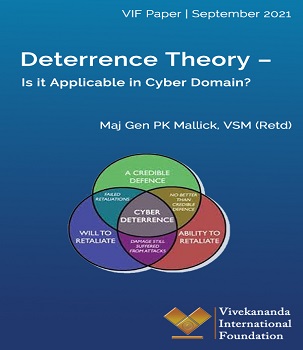
Deterrence Theory– Is it Applicable in Cyber Domain?

Maj Gen PK Mallick, VSM (Retd)

Introduction 

The Deterrence Theory was developed in the 1950s, mainly to address new strategic challenges posed by nuclear weapons from the Cold War nuclear scenario. During the Cold War, the U.S. and the Soviet Union adopted a survivable nuclear force to present a ‘credible’ deterrent that maintained the ‘uncertainty’ inherent in a strategic balance as understood through the accepted theories of major theorists like Bernard Brodie, Herman Kahn, and Thomas Schelling.1 Nuclear deterrence was the art of convincing the enemy not to take a specific action by threatening it with an extreme punishment or an unacceptable failure.

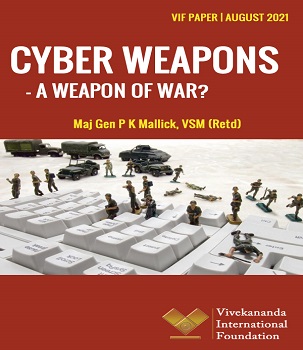
Cyber Weapons – A Weapon of War?

Maj Gen PK Mallick, VSM (Retd)

Introduction 
The character of warfare has changed fundamentally over the last decade. In the past, it was essential for an adversary nation or insurgent to physically bring weapons to bear during combat. That requirement is no longer a necessity. In cyber operations, the only weapons that need to be used are bits and bytes. In this new era of warfare, logistics issues that often restrict and limit conventional warfare and weaponry are not impediments. This new weaponry moves at the speed of light, is available to every human on the planet and can be as surgical as a scalpel or as devastating as a nuclear bomb.

Cyber attacks in various forms have become a global problem. Cyber weapons are low-cost, low-risk, highly effective and easily deployable globally. This new class of weapons is within reach of many countries, extremist or terrorist groups, non-state actors, and even individuals. Cyber crime organisations are developing cyber weapons effectively. The use of offensive Cyber operations by nation-states directly against another or by co-opting cyber criminals has blurred the line between spies and non-state malicious hackers. New entrants, both nation-states and non-state actors have unmatched espionage and surveillance capabilities with significant capabilities. They are often the forerunners for criminal financial gain, destruction and disruption operations. Progressively, we see non-state actors including commercial entities, developing capabilities that were solely held by a handful of state actors.

India’s Confused Approach to Afghanistan

Mohamed Zeeshan

Amidst the chaos of unfolding events in Afghanistan, India has floundered. Its approach to the crisis in Afghanistan has been characterized by incoherence and inconsistency.

There was reasonably long time-lag between former U.S. President Donald Trump’s deal with the Taliban, which paved the way for the exit of U.S troops from Afghanistan, and the eventual pullout of troops.

Yet, India was caught unprepared.

After having been shut out of early dialogue under Trump, India has been deeply unsure of how to approach the Taliban.

As late as the end of June, India seemed reluctant to recognize the reality on the ground. It took pains to contradict Qatari authorities, who claimed that India’s Minister for External Affairs, S. Jaishankar had met Taliban leaders in Doha. India’s position at the time was that the Taliban was not a legitimate stakeholder, even as the balance of power was tilting firmly in its favor.

But only two months later, when that policy became so obviously unsustainable, New Delhi had to change tack and publicly establish official dialogue with the group’s leadership.

Afghanistan’s Fate Will Be Shaped by Geoeconomics

Jose Miguel Alonso-Trabanco

Geoeconomics was originally defined by the strategic thinker Edward Luttwak as the logic of conflict expressed through the grammar of commerce. As such, it represents an analytical model that is appropriate to examine the involvement of geopolitical forces in the economic sphere of wealth, markets, trade, business, and money. The contemporary pertinence of this hybrid paradigm has been emphasized by structural game-changers like rising economic multipolarity, the weaponization of complex interdependence, the quest to control scarce raw materials, the recurrence of systemic financial crises that unleash disruptive consequences, the ongoing struggle to master advanced technologies, the growing role of the state in economic affairs, the proliferation of all manner of illicit flows, and the conformation of regional blocs to pursue shared interests through combined strength.

In the particular context of Afghanistan, the limited usefulness of sheer military might has been dramatically demonstrated in the withdrawal of Soviet and American forces, both of which were overwhelmingly superior ‒ in terms of weaponry, technology, and economic resources ‒ to the local insurgents they were trying to crush. The defeat of both superpowers means that hard power alone is not enough to shape the course of events there. In fact, the facts on the ground illustrate that trying to conquer Afghanistan with armies can be counterproductive for foreign invaders. Venturing into such a black hole can end up depleting their power, resources, vitality, and morale.

Afghanistan: Future Of Global Terrorism – Analysis

Dr. Shanthie Mariet D Souza and Dr. Bibhu Prasad Routray

One of the clauses of the February 2020 agreement between the Taliban and the United States (U.S.) made it obligatory on the insurgents to prevent the soil of Afghanistan from being used by global terror groups like the al Qaeda against the U.S. and its allies. Just like the Trump administration, the Biden administration too reiterated that decimating al Qaeda was the primary objective of the U.S. and NATO forces in Afghanistan. Votaries of the drawdown of troops, hence, argued that since al Qaeda has been weakened and the Taliban have promised to prevent the group from reviving, the U.S. troops can return home from the forever war. Ground level situation and recent developments in Afghanistan, however, underline that this logic is deeply flawed. Under the new Taliban government, global terrorism is all set to flourish, with a devastating impact on the region and beyond.

Complicity

Successive reports by the United Nations, since 2020, have pointed at the undisrupted ties between the al Qaeda and the Taliban. These reports have suggested, foot soldiers of both not only share bases, safe houses and training facilities, but also have jointly fought the security forces belonging to the erstwhile civilian government. The nexus further unveils a disturbing reality. As the Taliban marched into the Afghan capital on 15 August, among the group’s foot soldiers were hundreds of AQ cadres. Similar transgression has happened in each of Afghanistan’s provinces, thereby vastly expanding the operational areas of the AQ.

How the U.S. Helped, and Hampered, the Escape of Afghan Journalists

Ben Smith

As American news organizations scrambled to evacuate their Afghan journalists and their families last month, I reported that those working for The New York Times had found refuge not in New York or Washington, but in Mexico City.

The gist of that column was that even outlets like The Times and The Wall Street Journal had learned that the U.S. government would not be able to help at critical moments. In its place was a hodgepodge of other nations, led by tiny Qatar, along with relief groups, veterans associations and private companies.

Some State Department officials took umbrage at the idea that the U.S. government had abandoned Afghans who had worked alongside American journalists during the 20-year war. In telephone interviews last week, Secretary of State Antony J. Blinken and two other officials closely involved in the evacuation of journalists and many others from Afghanistan made the case to me that the U.S. exit should be seen as a success. They pointed to the scale of the operation — 124,000 people evacuated, in total — as the ultimate American commitment to Afghanistan’s civil society.

Our remote warfare counterterrorism strategy is more risk than reward

ETHAN BROWN

Afghanistan has begun its fade into the history of American foreign policy, yet the aftershocks of the war on terror remain entrenched in policy decisions, with implications that could very well threaten our future security and stability.

With the loss of permanent basing in Afghanistan, President Biden has touted an over-the-horizon counter terrorism strategy, a system built on sensors and remote systems: “We’ve developed an over-the-horizon capability that will allow us to keep our eyes firmly fixed on any direct threats to the U.S. in the region and to act quickly and decisively if needed.”

There is tremendous risk in reliance on disaggregate and remote technology, primarily not understanding the full situation on the ground resulting from the degrees of separation between target and analyst. No number of high-definition screens, signals intelligence, and delay-hampered tracking across disparate environs will advance American security or redress the failures of a poorly defined counter-terror strategy from previous decades.

WHAT WENT WRONG IN AFGHANISTAN: A PRIMER

Larry P. Goodson and Thomas H. Johnson

In 2001, the United States invaded and occupied Afghanistan, and eventually spent over a trillion dollars, as it and its allies killed some 170,000 Afghan citizens. Twenty years later, the United States withdrew from Afghanistan in defeat.

Why was America there? Thucydides reminded us in The Peloponnesian War some 2,500 years ago that, war’s “three…strongest motives [are] fear, honor, and interest.” The United States went to war in Afghanistan in the wake of the 9/11 attacks due to fear and to protect its honor, but inadequate understanding of Afghanistan and its geopolitical neighborhood as well as limited U.S. interests prompted mission creep, such that 20 years marched on. America’s youngest soldiers today were not even born when this war began, but their generation will suffer its consequences most. The U.S. withdrawal from Afghanistan will destroy American honor and undermine American interests. Further, the suicide bombing reportedly carried out by the terrorist group ISIS-Khorasan on August 26, 2021, suggests that even fear, the initial motive for intervention, still exists. Perhaps the United States and other major powers can win only when they are motivated by intense fear. And once Osama bin Laden scurried away to Pakistan, the fear receded—or more probably, humans simply cannot stay in a state of intense fear for very long.

After Afghanistan Pullout, US Seeks NATO Basing, Intel Pacts

LOLITA C. BALDOR

ATHENS, Greece (AP) — Against the backdrop of the troop withdrawal from Afghanistan, the top U.S. military officer is meeting in Greece with NATO counterparts this weekend, hoping to forge more basing, intelligence sharing and other agreements to prevent terrorist groups from regrouping and threatening America and the region.

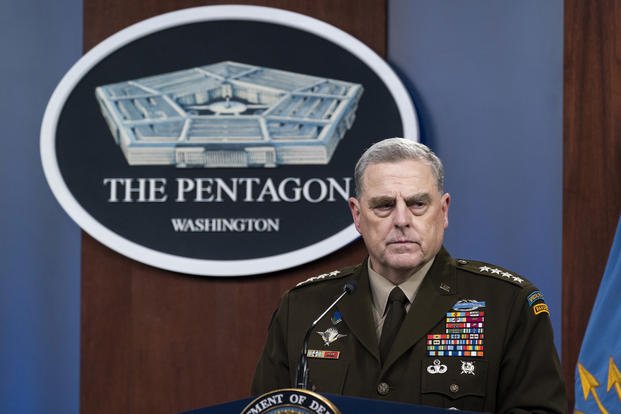
Army Gen. Mark Milley, chairman of the Joint Chiefs of Staff, said the meeting of NATO defense chiefs will focus in part on the way ahead now that all alliance troops have pulled out of Afghanistan and the Taliban are in control.

Milley, U.S. Defense Secretary Lloyd Austin and American intelligence officials have warned that al-Qaida or the Islamic State group could regenerate in Afghanistan and pose a threat to the United States in one year to two years.

Why do nations fail?

Lee Jong-wha

In the wee hours of Aug. 30, the last U.S. troops flew out of Kabul Airport, completing the U.S. military’s drawdown and leaving Afghanistan in frantic disarray in the hands of the ruthless Taliban. The Islamic fundamentalist regime has taken command over the country 20 years after a U.S.-led invasion toppled it for sheltering al-Qaeda and its leader Osama bin Laden responsible for the Sept. 11, 2001 terrorist attacks. The return of harsh Islamic fundamentalist rules has been seriously endangering the lives of women and ordinary citizens.

The chaotic scenes of Kabul were mirrored in the recent Korean film “Escape from Mogadishu,” an action drama based on real events in December 1990 depicting a perilous escape attempt by workers at the embassies of the two Koreas stranded in the middle of the Somali civil war. Somalia has been under opposition groups since January 1991, but conflict among various armed factions and terrorist attacks are never-ending. Only last month, a suicide bomber blew up a restaurant in Mogadishu. The American mission has been fighting against the extremist al-Shabab, but Somali people must go on living with terror.

Will Turkey’s Détente with Egypt and the Gulf Extend to the Horn of Africa?

Aykan Erdemir Varsha Koduvayur

Turkish president Recep Tayyip Erdogan announced a $30 million donation to Somalia last month. This gesture raised eyebrows among Turkish citizens, who protested that their cash-strapped government should have used the money on firefighting planes to battle raging blazes at home. But Erdogan’s interest in Somalia is not a passing fancy or humanitarian gesture. Over the last decade, Ankara’s aid to Mogadishu totaled more than a billion dollars as Erdogan and his Qatari allies competed against their Egyptian and Gulf rivals for influence in the Horn of Africa. Yet as Turkey and Qatar now pursue détente with Egypt, Saudi Arabia, and the United Arab Emirates (UAE), the Horn may get a respite from their rivalry.

The Gulf states’ involvement in the Horn has grown sharply in the last decade, becoming yet another flashpoint in a regional struggle over ideology and strategic terrain. The Horn is adjacent to the Red Sea, which lies between two key maritime chokepoints upon which global trade and traffic depend: the Bab el-Mandeb Strait in the south and the Suez Canal in the north. Somalia also opens out to the broader Indian Ocean basin, itself a key route for maritime security and trade. As the Indian Ocean base race heats up, the Gulf states have been keen to secure their own interests.

After 16 years of Angela Merkel, what’s next for Germany?


Constanze Stelzenmüller and Adrianna Pita

Related material:


Listen to Brookings podcasts here, on Apple or Google podcasts or on Spotify, send email feedback to bcp@brookings.edu, and follow us at @policypodcasts on Twitter.

Thanks to audio producer Gaston Reboredo, Chris McKenna, Fred Dews, and Marie Wilken for their support.

TRANSCRIPT

PITA: After 16 years as Germany’s chancellor, Angela Merkel is stepping down. On September 26, Germany will hold its first election since West Germany’s first elections in 1949 in which there is no incumbent seeking re-election.

RCEP Edges Closer to Ratification in an Indonesia Battered by COVID-19

Kyle Springer

On August 25, Indonesia’s Trade Minister Muhammad Lutfi presented his case for the lower house of Indonesia’s legislature, or DPR, to ratify the Regional Comprehensive Economic Partnership (RCEP) trade pact. In his statement to DPR Commission VI, which is responsible for the legislative oversight of trade agreements, Lutfi argued that RCEP will be beneficial to Indonesia, promising to strengthen its role in regional supply chains and improve its economic performance amid the COVID-19 pandemic.

For RCEP to enter into force, at least six ASEAN countries and three partner countries must ratify the agreement through their respective domestic processes. Singapore and Thailand have already ratified it, as have China and Japan, needing either Australia, New Zealand, or South Korea to ratify to hit the mark.

Making the ASEAN tally is more complex, but there are reasons to be optimistic. The Philippines aims to be among the ASEAN-6, having set its process in motion in May. Vietnam was a champion of the agreement, leading to its signing in November 2020. Brunei is chair of ASEAN this year and Cambodia in 2022, giving them an incentive to speed things up. RCEP’s progression toward ratification and entry-into-force under Cambodia’s stewardship would be a desirable outcome for the country.

China’s South China Sea Strategy Is All About Taiwan

Sorin Adam Matei, Matt Ellis

Is the occupation of the South China Sea by the People’s Republic of China (PRC) the equivalent of the German militarization of the Rhineland in 1934? Will there be a Taiwanese Anschluss like the annexation of Austria in 1938 which followed the Rhineland operation? Can world peace last if the world gives China a Munich-like deal? These questions are not idle historical speculation. Our new spatial analysis suggests that China is poised to move its strategic goalposts again and soon, reminding of the momentous events of the 1930s.

In 2016, the PRC effectively annexed the South China Sea. That year, China refused the findings of the Permanent Court of Arbitration in the Hague regarding the Chinese occupation of several reefs and islands and the extension of Chinese maritime borders over 1,000 miles away from the mainland. The court found China in violation of international law; The unilateral declaration of sovereignty over a portion of the high seas is not only contrary to the international laws as signed by China but an indication of hostility. Since then, China has maintained control over the islands and the surrounding areas by force, elbowing out or even sinking ships seen as a threat. In historical terms, it is equivalent to Germany’s occupation of the demilitarized Rheinland in 1934, in contradiction to the provisions of the Versailles Treaty. Is this a momentary crisis or a sign of future trouble? Our geostrategic investigation suggests that a crisis on par to that which preceded World War II could be expected.

Tactical Takeover: Germany’s Liberals Are Ready to Run the Country

Rainer Zitelmann

In Germany, the Free Democratic Party (FDP) is traditionally the party that is most closely aligned with the market economy. They call themselves “the liberals,” although it is important to remember that “liberal” has quite a different meaning in Germany than it does in the United States, where the term is often associated with left-wing politics. Make no mistake, the FDP is not left-wing. “Liberal” in Germany means pro-market and pro-civil rights.

At present, the FDP is still an opposition party. But, with elections to the German Bundestag coming up on September 26, the FDP could soon play an important role in forming a government. The FDP under its leader Christian Lindner is currently riding higher in the polls than ever before, and a double-digit result seems certain. The party is currently being courted by several parties that would need its support to form a coalition government:

First, the CDU, Angela Merkel’s current governing party, which is doing worse in the polls than at any point in the history of the Federal Republic, would like to form a coalition with the FDP. On a personal level, the heads of the CDU (Armin Laschet) and the FDP (Christian Lindner) understand and get along with each other. They have even governed together in Germany’s largest state, North Rhine-Westphalia. However, even combined, the two are not likely to secure enough votes for a majority. They will need a third partner, and it will have to be a left-wing party at that: either the Social Democrats (SPD) or The Greens.

China's military has an Achilles' heel: Low troop morale

TETSURO KOSAKA, Nikkei

TOKYO -- The Chinese Communist Party has unintentionally revealed weaknesses of the country's military.

One indication came with the building of facilities for launching new intercontinental ballistic missiles in an inland desert region. The other was a series of further attempts to increase childbirths, including measures to help reduce the costly burden of educating children. Behind these moves lurks evidence that the country is addressing concerns regarding troop morale and the military's ability to fight a sustained war.

For nearly a decade, China has been busy in the South China Sea, first building artificial islands, then deploying radar equipment and missiles to deter foreign military aircraft and vessels from approaching the area, and finally deploying strategic nuclear submarines capable of launching ballistic missiles in the now-protected sea.

Turkey faces gathering storm in Syria


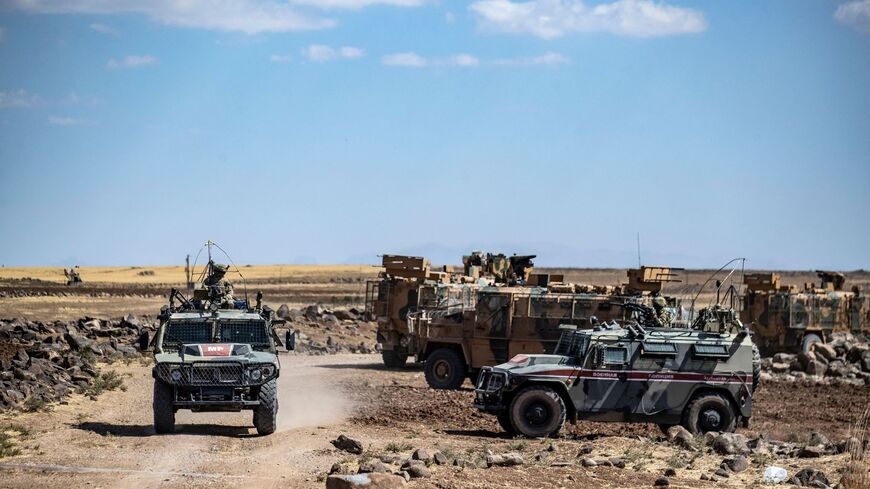
Three Turkish soldiers were killed Sept. 11 in a bomb attack in Idlib, the last stronghold of Turkish-backed and Islamist opposition in northwest Syria — and Turkey responded by hitting US-backed Kurdish groups in northeast Syria.

This latest episode "underscores Ankara’s growing predicament in Idlib, where jihadi forces target Turkish troops even as Turkey’s military presence shields them against the Syrian army," as Fehim Tastekin explains.

Think of it as a war within a war: While the decade-long conflict started as an effort to overthrow Syrian President Bashar Al-Assad, it has devolved into Turkey’s endless war with no seeming exit strategy, except one offered by Russia (see below).

US encircling China on multiple new Cold War fronts

BERTIL LINTNER

The Indo-Pacific’s Cold War is heating up as the region splits ever more decisively into opposed camps with a loose alliance of US-led democratic powers on one side and authoritarian China and its aligned satellites on the other.

And the first economic salvos of the contest launched by Donald Trump’s trade war are becoming more militarily provocative under Joe Biden.

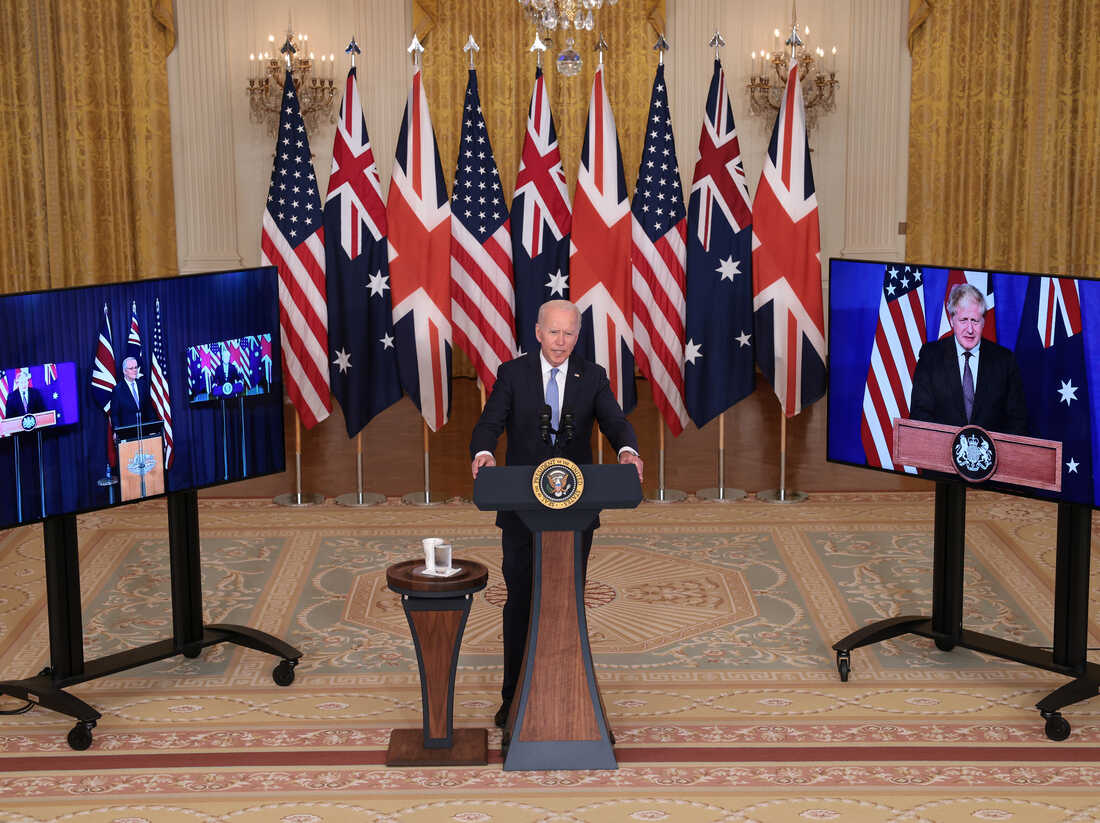
The escalating contest took a game-changing turn last week when the US and Britain announced they will provide Australia with the technology and capability to develop and deploy nuclear-powered submarines in a new trilateral security arrangement that will put more pressure on China’s contested claims in the South China Sea and other maritime theaters.

The nuclear submarines will tilt the region’s strategic balance and potentially cause China to concentrate more of its security energies closer to home and less so on far-flung theaters. From that perspective, the submarine deal is part of a coordinated encirclement strategy that Beijing will certainly view as a threat to its plans to increase and strengthen its presence in the Indian Ocean region.

After 20 years of waging religious guerrilla warfare, Taliban fighters in Kabul say they miss the battle

The Washington Post

“All of my men, they love jihad and fighting,” he said. “So when they came to Kabul they didn’t feel comfortable. There isn’t any fighting here anymore.”

Just months ago, the unit was staging attacks on government outposts and convoys. Now the fighters are standing at checkpoints, searching cars and inspecting vehicle registrations.

“Many of my fighters are worried that they missed their chance at martyrdom in the war,” Nifiz said. “I tell them they need to relax. They still have a chance to become martyrs. But this adjustment will take time.”

Taliban leaders claim the group has changed since it last controlled most of Afghanistan in the 1990s and have suggested it could be a more tolerant governing force. But interviews with more than two dozen Taliban fighters, commanders and leaders since the fall of Kabul reveal a movement open to some change but one that is dedicated to the harsh enforcement of rules — such as gender segregation — that date to the movement’s founding.

While most of the group’s political leadership has spent years meeting with foreign officials over a decade of peace talks with the United States, the Taliban rank-and-file has been fighting a war they believed was sanctioned by God, offering them a clear path to paradise in the afterlife.

Biden Says 'America's Back.' The World Has Some Questions


As President Biden prepared for his maiden speech to the U.N. General Assembly on Tuesday, his White House was reeling from a trifecta of bad news stories — headlines that underscored questions about U.S. leadership in the world.

"We are closing the chapter on 20 years of war and opening a chapter of intensive diplomacy by rallying allies and partners and institutions to deal with the major challenges of our time," a senior Biden administration official told reporters, describing the theme of the speech.

But it comes after the Pentagon acknowledged it had killed an aid worker, seven children and two other civilians in a drone strike in Kabul during the tumultuous withdrawal of U.S. troops last month from Afghanistan. One of America's oldest allies, France, pulled its ambassador from Washington, angry about being left out of a new defense partnership in the Indo-Pacific and about losing a valuable submarine contract with Australia.

And an important scientific advisory body failed to give a ringing endorsement to Biden's plans to give Americans COVID-19 vaccine booster shots — plans that the World Health Organization has criticized as people in many parts of the world have yet to receive a single dose.

The USA, China, and the “Whole of Society” approach


Still catching up on the backlog of podcasts. I listened to episode 34 of the Irregular Warfare podcast weeks ago – and jotted down a few notes. This episode was on “China’s Strategically Irregular Approach.”

Before I even listened to it, I opined that there would be a discussion or comment about how “good” China is at irregular warfare and how “bad” we are at it.

The discussion was more nuanced than that, thankfully. But there is one area in which I think we (the US) continue to get a bad rap.

And that’s on the topic of the “whole of society” approach.

In any discussion on China’s approach to competition, their ability to marshal their entire society in lockstep towards their political goals is touted as a huge advantage. A top-down approach, where the CCP dictates the direction, and often the pace and style.

US-Vietnam Relations: From Reconciliation to a Relationship of Substance

Le Hong Hiep

During U.S. Defense Secretary Lloyd Austin’s visit to Vietnam in late July, the two countries signed a memorandum of understanding under which America will assist Vietnam to locate, identify, and recover the remains of Vietnamese soldiers who were killed during the Vietnam War but are still listed as missing in action (MIA). The move shows that 46 years after the war ended, Washington is still working hard with Hanoi to promote reconciliation between the two former enemies. Such relentless efforts have been part and parcel of America’s Vietnam policy since the two countries normalized relations in 1995.

This long journey toward reconciliation is vividly recounted in “Nothing Is Impossible: America’s Reconciliation with Vietnam,” a new book by Ted Osius, who served as U.S. Ambassador to Vietnam from 2014 to 2017. Inspired by a statement of Pete Peterson, the first U.S. ambassador to postwar Vietnam, that “nothing is impossible in United States-Vietnam relations,” the book provides the most detailed and insightful account so far of developments in U.S.- Vietnam relations since normalization, as well as the many challenges that the two countries have overcome along the way.

The Seeds of Another Trade War over Clean Energy

Nikos Tsafos

The legislative text for the president’s Build Back Better Act has several provisions to incentivize domestic job creation and reshoring. This is no surprise given that President Biden has, from the start, framed climate action in terms of delivering quality jobs for Americans. But the provisions, as written, treat domestic manufacturers differently than foreign ones: they offer higher credits for renewable energy projects with domestically sourced inputs and for electric vehicles manufactured in the United States. In the past, such measures have been found to violate the rules of the World Trade Organization (WTO), which aims for consistent treatment between domestic and foreign suppliers. It is easy to see the seeds of another trade war over low-carbon energy being sewn in Congress today.

Domestic jobs and manufacturing have been a recurring theme for the Biden administration, as part of an agenda to “rebuild the middle class.” In its review of critical supply chains, the administration floated a proposal to offer higher rebates for electric vehicles produced with high labor standards in the United States (p. 137) and suggested a push for the Department of Energy to boost “domestic manufacturing requirements for grants, cooperative agreements and R&D contracts” (p. 145); it tasked the U.S. Export-Import Bank “to support the establishment and/or expansion of U.S. manufacturing facilities and infrastructure projects in the United States that would support U.S. exports” (p. 14); and it hinted at several other measures to support local jobs and domestic manufacturing.

Nuclear subs and a diplomatic blowup: The US-France clash, explained

Ellen Ioanes

France recalled its ambassadors to the United States and Australia on Friday in protest of Australia’s decision to cancel a major defense deal in favor of a new one with the US and Britain.

The dramatic move caps a week of indignation for France, which described the new US-UK-Australia deal as “a stab in the back” on Thursday, and represents a major diplomatic break between longtime allies.

It’s the first time France has recalled its ambassador to the US, and it comes after French officials canceled a Washington, DC, gala scheduled for Friday.

The new US-UK-Australia deal, which was announced on Wednesday by the leaders of the three countries, lays the groundwork for Australia to acquire at least eight nuclear submarines with support from the US and the UK. Australian Prime Minister Scott Morrison said it also marks the “first major initiative” of a tripartite new security agreement among the countries under the acronym AUKUS (pronounced AWK-us, according to the AP).

Exclusive: An American Company Fears Its Windows Hacks Helped India Spy On China And Pakistan

Thomas Brewster

Earlier this year, researchers at Russian cybersecurity firm Kaspersky witnessed a cyberespionage campaign targeting Microsoft Windows PCs at government and telecom entities in China and Pakistan. They began in June 2020 and continued through to April 2021. What piqued the researchers’ interest was the hacking software used by the digital spies, whom Kaspersky had dubbed Bitter APT, a pseudonym for an unspecified government agency. Aspects of the code looked like some the Moscow antivirus provider had previously seen and attributed to a company it gave the cryptonym “Moses.”

Moses, said Kaspersky, was a mysterious provider of hacking tech known as a “zero-day exploit broker.” Such companies operate in a niche market within the $130 billion overall cybersecurity industry, creating software—an “exploit”—that can hack into computers via unpatched vulnerabilities known as “zero days” (the term coming from the fact that developers have “zero days” to fix the problem before it’s publicly known). They act like super-powered lockpicks, finding loopholes in operating systems or apps to allow a hacker or spy to break into targets’ digital lives. So rare are such exploits, they can fetch upwards of $2 million each. Buyers wielding them have the power to either protect themselves from those who might have knowledge of the relevant zero day, or to inflict massive damage on others. For instance, attackers used at least one zero in an infamous 2020 attack on $2.5 billion market cap software provider SolarWinds and many of its customers—from U.S. government departments to tech giants like Cisco and Microsoft. The attacks cost SolarWinds at least $18 million, with warnings that the overall figure, counting the cost for SolarWinds customers who were also compromised, could get into the tens of billions.

Biden’s broken promise on Yemen

Annelle R. Sheline and Bruce Riedel

When Joe Biden included ending the war in Yemen as a key goal during his first foreign policy speech as president, he was breaking with his predecessors. Donald Trump had backed the Saudis and Emiratis, even using a presidential veto to stymie a congressional attempt to end U.S. involvement in the war. When Mohammed bin Salman, then Saudi defense minister, launched his military intervention in Yemen 2015, Barack Obama decided to provide assistance — a Faustian bargain aimed (unsuccessfully) at tempering Saudi criticism of the Iran nuclear deal. Biden’s decision to prioritize Yemen by appointing a special envoy — as well as reversing Trump’s designation just before leaving office of the Houthis as a foreign terrorist organization — raised hopes that a greater emphasis on diplomacy from the U.S. might finally move the devastating war towards resolution. Yet almost eight months later, little has changed.

Biden’s statement that “we’re stepping up our diplomacy to end the war in Yemen” may have betrayed naiveté about the impact the U.S. could realistically have. The war is likely to continue regardless of what Washington does: the lucrative war economy; inflows of resources from foreign sponsors; and the lack of incentives to negotiate spur the myriad combatants to keep fighting, regardless of civilian suffering. But while Biden may not be able to end the war, he can end America’s complicity in it.

The Post-Merkel Return of German Ideologies

Adam Tooze

In what may prove to be her last speech to the Bundestag, last week, German Chancellor Angela Merkel appealed to voters to give their vote to Armin Laschet to be her successor as leader of the Christian Democratic Union (CDU) party. For Merkel as chancellor to speak in such a partisan manner from the rostrum of the parliament was unusual. It is indicative of her party’s desperation, which has slumped to historic lows in opinion polls. In some ways, even more revealing than her belated support for Laschet was the dark fear Merkel conjured up. German voters should back Laschet, she urged, because the alternative would be a government of the left uniting the Social Democratic Party (SPD), the Greens, and Die Linke.

Laschet himself and Bavaria’s Markus Söder, his rival for national CDU leadership, have since doubled down, warning not just of Die Linke, a party formed out of remnants of Germany’s Socialist Unity Party and the West German left. They also have also called into question the SPD’s own post-war history, reminding voters of the SPD’s opposition back in the 1950s, its alliance with France that formed the European Union, West Germany’s original membership in NATO, and the SPD leadership’s hesitancy in 1989 when it came to German reunification.

Bolsonaro Needs Brazilians to Believe He’ll Stage a Coup

Eraldo Souza dos Santos

Following the coup that took place in Myanmar in early February, a video was posted online and quickly went viral. Filmed in the capital, Naypyidaw, it showed a fitness instructor performing aerobics to a bouncy dance tune as a military convoy passed behind her, on its way to parliament to oust the elected government. “As it isn’t uncommon for Nay Pyi Taw to have an official convoy, I thought it was normal so I continued,” the instructor, Khing Hnin Wai, wrote in a subsequent Facebook post.

More than six months later, on Aug. 10, a parody video spread widely on social networks in Brazil. This one showed a woman dancing to a similarly upbeat musical soundtrack outside the Presidential Palace in the capital, Brasilia, as tanks rolled by in the background as part of a military parade. The video’s message was not lost on anyone paying attention: President Jair Bolsonaro, a former army captain with an avowed nostalgia for Brazil’s two-decade military dictatorship, had been saying for months that he might not accept the results of next year’s presidential election.

Governments hold upper hand online

Scott Rosenberg

Governments around the world are finding it easier than ever to make the internet, and the companies that run it, knuckle under.

Driving the news: Russia Friday forced Apple and Google to remove an app that supporters of dissident leader Alexei Navalny had created to coordinate opposition votes in Russian elections.

Also last week, China's government removed nearly all online content connected with one of its top movie stars as part of a broader campaign against the power of celebrities, the Wall Street Journal reported.

Full shutdowns of internet access by governments seeking to cut off citizens' access to information for political reasons have become increasingly common, a study Axios reported earlier this month found.

The big picture: Governments are limiting or banning applications, content and connectivity itself — and Big Tech companies, rich and powerful as they are, can't or won't fight back.

From the Arab Spring to the Black Lives Matter protests, the internet has helped organizers build popular movements and even, on occasion, overthrow governments
.