30 September 2021

Interview with Merkel’s Former Foreign Policy Adviser

Christiane Hoffmann und Christoph Schult

DER SPIEGEL: Mr. Heusgen, you served as a foreign policy adviser to Angela Merkel from the time she took office in 2005 until 2017. Merkel is considered a major proponent of realpolitik, especially when it comes to foreign policy. What explanation can you offer regarding the degree to which Berlin was taken by surprise by the reality on the ground in Afghanistan?

Heusgen: It wasn’t just in German foreign policy circles – everyone was surprised by the dynamics that developed in Afghanistan.

DER SPIEGEL: Shouldn’t we have been able to predict that the Taliban was going to seize power in the country again?

Heusgen: Hindsight is always 20/20. As a matter of principle, it was right for us to be engaged in Afghanistan, both militarily and in terms of development policy. But we made the mistake of not forcing good governance on Afghan leaders. We should have attached much stricter conditions to our aid. Having seen how Afghan politicians thought first and foremost about themselves and their clans, it is not surprising in retrospect that this government had no standing with the population or with the security forces. When things got serious, everyone ran for the hills. This could have been foreseen with a little common sense.

DER SPIEGEL: Do you think the West could have succeeded in Afghanistan if things had been done differently?

Heusgen: Personally, I think we should have stayed longer in Afghanistan, just as the Americans did for decades in Japan, South Korea and Germany. The key difference was the that the governments there helped in building democracy and institutions, and they also had the backing of the people.

DER SPIEGEL: What bothered you more: the negotiations with the Taliban under former U.S. President Donald Trump or the unconditional withdrawal under Joe Biden?

Heusgen: Excuse me, but the Trump administration was an amateurish, diplomatic mess. It was a grave mistake to forge an agreement with the Taliban and sideline an Afghan government that had been receiving support for years. Biden’s decision was logical and consistent. He knows how incredibly expensive the deployment is and how unpopular it is in the U.S. But I still wish he would have decided differently.

DER SPIEGEL: What does the defeat in Afghanistan mean for current and future deployments? How, for example, can we prevent a similar situation from arising in Mali, where the German armed forces are also deployed?

Heusgen: The lesson is that we need to set clearer conditions. We cannot have a transitional president who refuses to move forward with the transition to civilian rule. We need to be clear: Either you implement good governance reforms, or we will end our support. If the government doesn’t look after the welfare of its people, the terrorists will continue to gain ground. Foreign troops can’t do anything to change that.

DER SPIEGEL: But you also then have to carry through with it.

Heusgen: Yes, then you have to get out.

DER SPIEGEL: Was Afghanistan a defeat for the West?

Heusgen: I have actually eliminated the term "the West" from my vocabulary.

DER SPIEGEL: Why?

Heusgen: From my point of view, it is no longer about a dispute between the West and the East today, but between states that adhere to a rules-based international order, to the United Nations Charter, to the Universal Declaration of Human Rights, and those that do not. These principles are not Western, but universal. The West has become a negative fighting word that the Russians and Chinese use against us, along the lines of: The West is yesterday’s news.

DER SPIEGEL: What’s your assessment of foreign policy in the Merkel era?

Heusgen: Over the past four years in New York (where Heusgen was Germany’s ambassador to the United Nations), I have seen that Germany has an excellent reputation, thanks in part to its chancellor. When I then return to Germany, I can only shake my head at my nagging compatriots, who complain about so many things here. People are always envious of us in New York, as an example of a country that works well and of a chancellor with foresight who, for 16 years, has ensured reliability, stability and balanced crisis management – in the euro and financial crises, the Ukraine crisis and the refugee crisis. When it comes to the refugee crisis, especially, perceptions in Germany and abroad diverge widely. My American colleague Susan Rice told me at the time that the refugee policy had permanently changed her view of Germany. Opening the border to Syrian refugees in 2015 was a great thing for our country’s reputation.

DER SPIEGEL: Crisis management is indeed considered to be Merkel’s legacy. But shouldn't the aim of successful foreign policy be to avoid crises, to pursue forward-looking policies? The refugee crisis, in particular, could have been avoided if the migrants in Syria’s neighboring countries had been dealt with at an early stage.

Heusgen: It is true that more could have been done. We have learned from that. Today, Germany is the second-largest financial contributor to the United Nations. We provide massive support to the World Food Program and UNICEF.

DER SPIEGEL: Could we not have predicted the Ukraine crisis? It was becoming clear, after all, that Russia was not going to accept the country’s orientation toward the West. Did Germany fail to prevent Ukraine from getting pushed into this conflict?

Heusgen: No, the chancellor had that in mind. We did not want to promote that conflict. That is why, against strong opposition from the United States, she prevented Ukraine from being granted the prospect of joining NATO; nor did the Association Agreement with the European Union open up any prospect of membership. She always kept in mind what was tolerable for Russia. But then, overnight, Ukrainian President Viktor Yanukovych said: No, I'm not going to do this thing with the EU.

Bild Chancellor Merkel, adviser Heusgen: "Germany has to do more." Foto: Markus Schreiber / AP

DER SPIEGEL: Because Russia had placed massive pressure on him.

Heusgen: But we could not have known that Russia was planning an invasion. U.S. Senator John McCain, however, felt it could have been foreseen. From the moment when President Obama stood by and watched as Assad cross his red line in Syria in 2013 and deployed poison gas against the civilian population. McCain felt Putin saw this as a sign of weakness and believed that the Americans would not intervene in Ukraine either. But we still couldn’t tell the Ukrainians: Sorry, because of your geographical position, there can be no Association Agreement.

DER SPIEGEL: In your opinion, is Germany having a particularly hard time coming up with a forward-looking, strategic foreign policy?

Heusgen: I believe that Germany is still in the process of taking the step from being a divided nation to a reunified country that also parlays its economic strength into political strength. We have to get away from always looking first at what others want and think. Leadership is expected from Germany. This, of course, includes crisis prevention. We do that, too – in the Balkans or in Libya, for example. When it came to military intervention in Libya in 2011, Germany had the foresight to recognize that there was no upside, and it abstained at the UN Security Council.

DER SPIEGEL: The decision was not considered far-sighted, but rather typical of the Germans' reticence when it comes to military missions.

Heusgen: In retrospect, the decision has given us great credibility in Libya and in the region; it provides the foundation for our mediation in the country. I see this as part of a forward-looking policy to try to keep the EU’s backyard stable. This also includes our engagement in Africa, which has been a central focus of the chancellor in recent years.

DER SPIEGEL: Is Germany properly positioned for a leadership role in foreign policy?

Heusgen: No one else seems interested. The U.S. is pulling back, and you can see it everywhere. China has developed in a very nationalistic manner. When the Chinese wake up in the morning, the first thing they are thinking about is not how to strengthen the international legal order. So, Germany has to do more.

DER SPIEGEL: The election platforms of the center-left Christian Democrats and the business-friendly Free Democrats call for Germany to establish a National Security council along the lines of the one in the U.S. The Greens have similar ambitions. Is this a good idea?

Heusgen: A National Security Council would be good for a unified foreign policy. So that, for example, the Chancellery and the Foreign Ministry aren’t working at cross purposes. But that is difficult in a country that has coalition governments. The Chancellery, where central decisions are made, must coordinate closely with the ministries in order to implement them.

DER SPIEGEL: Are there issues where you say today: I should have been more persistent, even with the chancellor. It is said that you have always had a more critical stance about, for example, the Nord Stream 2 pipeline under the Baltic Sea.

Heusgen: Let me answer that on principle. My role in the Chancellery was that of foreign policy adviser. However, decisions very often also have economic or domestic policy dimensions that the chancellor must take into account. If the chancellor then makes a decision, you have to accept it. She’s the politician, I am the civil servant. If you can’t deal with that, then you should find another job or go into politics yourself.

DER SPIEGEL: You were known for making some striking statements during your time on the UN Security Council. Did it feel good to drop the diplomatic restraint at times?

Heusgen: Those are two completely different roles. As adviser to the chancellor, it isn’t your job to be in the public eye, but when you sit on the Security Council, you speak for Germany. In a situation in which Russia, China and Trump’s America had trampled on the international order, I saw it as my duty to stand up for international law from morning until night – especially in light of Germany’s history. I have indeed often taken a very clear stand on this, and many other countries have thanked me for it. Even my Russian counterpart says that things are no longer as interesting without me there.

"The Trump administration was an amateurish, diplomatic mess." Foto: CHRISTIAN HARTMANN / AFP

DER SPIEGEL: You once asked China and Russia how their presidents could still look in the mirror after they cut off 500,000 children in Syria from humanitarian aid. Was that statement coordinated with Berlin?

Heusgen: I think about formulations like that while I am jogging. If something is crying out to the heavens, you need to consider how to express it in a way that it will be heard. On important issues, you have to seek polarization.

DER SPIEGEL: The chancellor has been accused of being too naive in her dealings with China.

Heusgen: The chancellor had China's growing strength on her radar from the very beginning. She knew early on that the country would be a world power. That’s why she has traveled to China every year since 2006 and started government consultations. This intensive attention paid to China was far-sighted and correct.

DER SPIEGEL: Many thought she was too optimistic about the potential for change created by trade.

Heusgen: I don't agree. I also think the EU's investment agreement with China, which Merkel pushed forward, is right. We must meet China at eye level. The chancellor has never been naive. She has raised human rights concerns with Chinese leaders, she has been critical of the situation of the Uighurs and Tibetans, and she has helped get dissidents out of the country. She has constantly addressed the difficult points, but in a way that kept the discussion going. Of course, we shouldn’t have any illusions. China has become a totalitarian state under Xi Jinping. This will not change in the foreseeable future. We have to remain in dialogue with China and also do business with the country, but in doing so, we must clearly defend our principles and prevent the world from being run according to Chinese rules in the future.

Heusgen on the eyebrow-raising statements he made as Germany's ambassador to the UN: "I think about formulations like that while I am jogging." Foto: Andreas Chudowski

DER SPIEGEL: The Chinese UN ambassador said goodbye to you by saying that he was glad to be rid of you. What was your experience with the Chinese at the UN?

Heusgen: My experience in New York was that you can work with the Chinese if you do it from a position of strength. It is very important that we do not turn a blind eye, because that won’t get us anywhere. The Chinese will interpret it as weakness. I was given such a "warm” farewell by the Chinese UN ambassador because I was a source of discomfort and clearly addressed the shortcomings: the military threats in the South China Sea, the suppression of democracy in Hong Kong and the treatment of the Uighurs. And we must act together with other countries. We should not breathe a sigh of relief when Beijing goes after other countries like Canada or Australia. We have to stand together – that impresses the Chinese.

DER SPIEGEL: Can you give an example of where that has worked?

Heusgen: I experienced that last year, when the annual declaration of the Human Rights Committee of the United Nations was discussed, in which the situation of the Uighurs in Xinyang was condemned. In previous years, Britain and the U.S. were in charge, but last year we Germans took over. Instead of 23, 39 countries joined the declaration. That was an earthquake from the perspective of the Chinese. According to reports, a department head in Beijing had to resign as a result.

DER SPIEGEL: Is that also the way to confront Putin?

Heusgen: In contrast to Russia, China actually does care about its reputation abroad. The Russians don’t care if a resolution is passed against them in the General Assembly by a vote of 120 to five. The Chinese do care – they don't want to lose, and they will try to prevent losing by all means. They blackmail countries. When it comes to an issue that China cares deeply about, you sometimes see African ambassadors reading from Chinese talking points. It’s pretty brutal.

DER SPIEGEL: On the one hand, you are pleading for toughness, but on the other, you are sticking firmly to dialogue. Can that work in the long run?

Heusgen: Name an alternative.

DER SPIEGEL: The U.S. no longer sees China as a partner and competitor, but exclusively as a systemic rival.

Heusgen: The Americans call this "decoupling," but the policy doesn’t work. America’s trade with China may stagnate, but it will not decrease significantly. The economies are far too intertwined for that, and the economic losses would be too high. Furthermore, the Americans are not decoupling entirely. They still want to cooperate with China on climate policy.

DER SPIEGEL: Before Merkel brought you into the Chancellery, you served as chief of staff to Javier Solana, the EU’s first high representative for common foreign and security policy. Are you disappointed by how little has happened in EU foreign policy over the past 20 years?

Heusgen: Those were the golden days of European foreign policy. Solana had previously served as NATO secretary general and could speak on equal footing with EU heads of state and government. No such heavyweight has been appointed to the post of high representative since. Most countries are not prepared to hand more competencies over to Brussels. A first step would be if a former head of state or government were finally appointed to this office.

DER SPIEGEL: What about Angela Merkel?

Heusgen: I don't think she will seek a task like that after the end of her term as chancellor.

DER SPIEGEL: You are a member of the Christian Democratic Union. What distinguishes a Christian Democratic foreign policy from that of the business-friendly Free Democrats, the environmentalist Greens or the center-left Social Democrats?

Heusgen: As a Catholic and a Christian Democrat, the focus for me is on people. Human rights have always very much driven my foreign policy thinking and actions. There is definitely overlap with other parties.

DER SPIEGEL: Is it your hope that Armin Laschet will become chancellor?

Heusgen: Yes.

DER SPIEGEL: What's next for you personally? Is it true that you are likely to succeed Wolfgang Ischinger as chair of the Munich Security Conference?

Heusgen: As chairman of the circle of benefactors of the Munich Security Conference, I will now play an even greater role there and work together with my long-time colleague Wolfgang Ischinger. Apart from that, I have taken on a teaching position at my old university in Sankt Gallen, and I am very pleased about that.

DER SPIEGEL: Mr. Heusgen, we thank you for this interview.

Qualitative, Quantitative and Mixed Methods Approaches


Though not confined, there are three main ‘categories’ (in a broad sense) that are commonly used for research designs when analysing data: Qualitative, Quantitative and Mixed Methods Approaches. In that broad sense, they incorporate all of the other methods available in some way or other. The resources below help to identify and understand when these broader categorisations are in effect, what sorts of methods they incorporate, and why. The multimedia resources below have been curated by the E-International Relations team. You can find more resources on our methods homepage.

Download PDF

Multimedia and Textual Analysis


Working with documents, in whatever form (multimedia, textual, digital/physical etc.) is the backbone of academic research and the bulk of how students conduct research. Any ‘artefact’ that has been created in the past is a document and therefore can be used for research. While traditionally this was limited to books, journal articles and government/public policy documents (essentially the things students and researchers find in libraries and archival repositories) – today it is a vast field that includes social media, podcasts, videos and much more besides.

Download PDF

NATO IS IN A CYBERWAR WITH RUSSIA AND MUST EXPAND ARTICLE 5 TO INCLUDE CYBERWARFARE OR RISK LOSING AND DIMINISHMENT

Brian E. Frydenborg

Introduction

Article 5 of NATO’s foundational 1949 North Atlantic Treaty demands that if an “armed attack” is carried out against even just one member state, all other member states “shall” consider that attack (and any armed attack) on a member state “an attack against them all” and “will assist,” up to and “including the use of armed force.” This bedrock is the centerpiece for over seven decades of the Pax Americana: the U.S.-led global system of military power, alliances, collective defense, and ability to project combined strength anywhere on the planet. For it to continue in these roles, NATO must adapt to current and future threats by adding cyberwarfare—including information warfare—to Article 5.

Cyberwarfare a Defining Part of Modern Warfare

Most cyberattacks against NATO states are carried out by Russia. A key element of these involve what is called “information warfare” (“a new face of war,” quoting a RAND Corporation report), heavily involving disinformation and that includes “warfare” to indicate these are hardly benign/normal influence operations but those that have always been part of any serious conventional war in modern times.

The ever-evolving concept of warfare in our digital age, then, does not have to include shots being fired from guns, and it is naรฏve to not consider cyberwarfare as simply another form of war in the twenty-first century that uses force in the digital realm to achieve results in some of the same spirit as traditional armies: attack, defense, deception, sabotage, destruction, and to pressure actors to change behavior. Clausewitz most famously wrote that “war is merely the continuation of policy [or politics] by other means” and would have well understood cyberwarfare to be war and well within that “other means” category.

Russia and China are the two countries that have led in cyberwarfare. Bolder but weaker Russia is NATO’s—and America’s—foremost enemy (even if unofficially but obviously in a de facto sense), while China is stronger but more reserved as the West’s clearest top rival. China has carried out and been a leader in non-weaponized hacking and espionage (admittedly common among all major states), but has not, say, publicly released disinformation or stolen information in a manner timed to seriously interfere with NATO countries’ elections (as Russia has). And though China has its own complex influence operations, Russia undoubtedly has led by far in cyberattacks more hostile than espionage (uniquely so among major powers) since its game-changing 2007 Estonia cybercampaign.

Figure 1. Where the political warfare fits within the implements of power. “All activities are illustrative, rather than an exhaustive list of possible actors.” From RAND's The Growing Need to Focus on Modern Political Warfare

Russia officially considers NATO a “threat,” and since that 2007 Estonia cybercampaign, has been far more aggressive and threatening towards NATO states, often stoking internal divisions and flooding them in cyberattacks, including election interference and boosting secessionism, with notable cybercampaigns being carried out against over twenty NATO member states (apart from campaigns against non-NATO states).

Furthermore, de facto, undeclared wars are the most common type of war in modern history even if the term “war” is not used. America, for example, has a long history of undeclared war going all the way back to the nation’s earliest days involving conflict with Native Americans and also the 1798-1800 Quasi-War, then popularly termed “The Undeclared War with France.” As one scholar notes, “the legal state of war is possible without actual fighting.”

The Nature of Russian Cyberwarfare Confronting NATO

Thus, it is hardly extreme to consider NATO and Russia in an undeclared cyberwar and, therefore, a state of undeclared war. NATO Review, NATO’s flagship journal, even in 2017 published analysis noting that Russia was waging “non-kinetic political war on the West,” as I have also maintained.

Russia’s weapons in its undeclared war on NATO are not tanks, bombs, bullets, or jets; rather, they are illicit financing, trolls, bots, and fake news, with the Kremlin often fomenting, funding, and promoting the rise of far-right ethno-nationalist extremists, all while disparaging those in the center and mainstream left. Putin’s party, the banally nationalist United Russia, has even formed formal and informal alliances with significant like-minded political parties in major NATO countries.

These campaigns, relying on hacking, disinformation, propaganda, and other cyber-methods, are coordinated through major components of the Russian government and close Putin allies in and out of the Kremlin, often using thousands of fake accounts to artificially boost their impact, which, in turn, are bolstered within the target states by agents and local allies along with unwitting true believers long dubbed “useful idiots.” In many NATO countries—including the U.S.—Putin is even liked by far-rightists. Domestic media, then, can become loud voices augmenting Russia’s propaganda, especially right-wing media outlets, but also some on the far-left. Repeated enough, top traditional outlets latch onto this disinformation, sometimes mainstreaming it, other times critiquing yet still propagating, as I have previously explained.

Reigning as the supreme disruptor on social media, Russia spews a “firehose of falsehoods” that has been massively effective, distorting and gaslighting public discussion to wildly amplify Russia’s preferred narratives beyond any natural organic reach, influencing many millions, thus helping to create an atmosphere where disinformation is sometimes consumed even more than actual news and doubt about even basic truths becomes widespread.

And once Putin’s favored are in office partly because of Russian disinformation, they in turn further spread Russian disinformation from the highest levels of their governments, even mimicking Kremlin tactics and adopting policies favorable to Russia, even covering up Russia’s trail (both America’s 2019 Mueller report and the British Parliament’s Intelligence & Security Committee’s exceptional Russia report released last year note damning examples of obstruction in their respective governments).

Most notably for NATO, the American presidential candidate Putin twice ordered Russian election interference on behalf of had expressed hostility to NATO repeatedly during the campaign, even contemplated leaving the Alliance as president, and may still have done so if reelected.

Cyberwarfare a Larger Threat Now to NATO than Terrorism

By far, the most damaging, destabilizing, and effective attacks NATO countries since 9/11 have been Russian cyberattacks, campaigns that have been able to affect political outcomes and internal dynamics in numerous NATO countries to suit Putin’s agenda.

Russian cyberwarfare efforts against the U.S. have included election interference—beginning with what I called back in December 2016 the First Russo-American Cyberwar—that has already caused damage to America, its democracy, and its reputation that is hard to exaggerate, with effects not only still being felt by the U.S. but guaranteed to still be felt for some time. Russia is also clearly and repeatedly promoting unrest and division, recently pushing both disinformation about the coronavirus and bogus conspiracy theories of fraud 2020 U.S. presidential election. In the run-up to that election, the Russians targeted the main political rival of their preferred incumbent, just as in 2016.

These efforts produced results: multiple respectable surveys and any casual look at social media show that vast numbers of Americans—even key leaders—are supporting this disinformation, even spreading nonsense about both the 2020 presidential election, damaging faith in the very foundations of democracy coronavirus (including millions doubting coronavirus vaccines, literally helping kill Americans). There are also global effects on opinion of America and the rest of the West along with international views on coronavirus and vaccines.

Most recently coming to light are the devastatingly far-reaching SolarWinds operation; a cyberattack against USAID that ensnared some 150 government agencies, non-profits, think tanks, and human rights groups globally that have criticized Russia; a recent attack on top U.S. cybersecurity firm FireEye; and the Colonial Pipeline and JBS meat plant ransomware attacks, with Russia playing a role with these ransomware groups similar to how the Taliban gave al-Qaeda safe harbor, resulting in the 9/11 attacks—incidentally, the only time NATO ever invoked Article 5.

In contrast, physical terrorist attacks in NATO countries since 9/11, while tragic, have still had comparatively limited effects. Even Russia’s own 2018 Novichok chemical weapon attack on British soil in Salisbury against Russian military intelligence officer turned spy for the UK Sergei Skripal had more symbolic an effect than anything else, dwarfed by the damage from Russian efforts to move the 2016 Brexit vote in the direction of Leave or the effect of Russia’s campaign to amplify Scottish secessionism (now increasingly likely and sooner rather than later, an outcome that would obviously dismember and damage a UK already acutely damaged by Brexit). To quote journalist George Packer, “antisocial media has us all in its grip.”

Falling Short

NATO currently has a Cooperative Cyber Defence Centre of Excellence (CCDCOE) in Tallinn, Estonia. Yet even presently, one-sixth of NATO— Albania, Canada, Iceland, Luxembourg, and North Macedonia—are not members of this Centre, though, encouragingly, Canada and Luxembourg are going to join, new states were recently added, and non-NATO states Austria, Finland, Sweden, and Switzerland are “Contributing Participants,” a status available to those outside of NATO; Australia, Ireland, Japan, South Korea, and—most recently—Ukraine will join that second group. There is also set to be a new military cyberdefense command center fully operational in 2023 at NATO’s military base in Belgium.

NATO considers “cyber defence…part of NATO’s core task of collective defence” and has since 2014, when the Alliance first specifically articulated the possibility of invoking Article 5 in reaction to cyberattacks (but only “on a case-by-case basis”). NATO has since “pledge[d] to ensure the Alliance keeps pace with the fast evolving cyber threat landscape and that our nations will be capable of defending themselves in cyberspace as in the air, on land and at sea,” repeatedly reiterating that Article 5 being invoked in response to a cyberattack is a possibility, including just this September 2020 and in June 2021.

Yet official working papers, conferences, interviews, statements, and raising possibilities are no substitute for a concrete, clear policy, and NATO simply does not have this.

The vague idea seems to be that if a cyberattack was “serious” enough, Article 5 could be activated, but this seems myopic: death by a thousand cuts is still death and has the same effect as decapitation, so tolerating many smaller attacks, thereby transmitting a clear indication that there will not be a collective Article 5 response to them, is just bad policy. It is also most decidedly not the case for armed attacks, in which any by a nation-state or sponsored by one would trigger Article 5. Years of unrelenting cyberwarfare has done more damage to NATO than any Soviet Army did during the Cold War, in part, because of Article 5: the USSR and then Russia did not dare use armed force to strike any NATO country for fear of Article 5’s unequivocal guarantee of a collective response, even in 2015 when NATO-member Turkey shot down a Russian military jet over Syria.

Yet when it comes to cyberwarfare, NATO is practically inviting Russia to attack and get away with it, with the Alliance quite consistently demonstrating an unwillingness, even inability under its existing framework to collectively respond to Russia’s cyberaggression. As the aforementioned UK Russia report noted, “Russia is not overly concerned about individual reprisal” against its aggressive acts, including its cyberattacks, with even the U.S. demonstrably inspiring little hesitation.

Clearly, pretending cyberwarfare is not war and allowing cyberwarfare in real-world practice to be kept out of NATO’s Article 5—leaving individual members states flailing independently and ineffectively against an organized, determined, and capable de facto enemy content to stand down its conventional military against NATO while unleashing its cyberunits upon it with impunity—has failed.

At the end of New York Times cybersecurity reporter Nicole Perlroth’s recent book This Is How They Tell Me the World Ends—the indispensable, terrifying, definitive account of the development of cyberwarfare and the mess in which we currently find ourselves—the author warns that “many will say” that “these…critical assignments of our time” to deter and defend ourselves from cyberwarfare “are impossible, but we have summoned the best of our scientific community, government, industry, and everyday people to overcome existential challenges before. Why can’t we do it again?…We don’t have to wait until the Big One to get going.”

As a main advantage of the West over Russia is that people like the West a lot more than Russia—materializing in close economic, diplomatic, and military ties Russia can only dream of—the easiest way for the West to face and fight this dire and metastasizing cyberthreat from Russia is by leveraging its alliances, and, most of all, this means involving NATO and doing so in a big way.

As there is no statute of limitations on cyberattacks and the just-proposed framework not precluded by the current NATO treaty, NATO would even be in its full rights (and is overdue) to now invoke Article 5 against Russia for its cyberwarfare so that this cyberwarfare will result in far more pain for Russia than any damage it inflicts.

How to Revise Article 5 and the NATO Treaty Overall

With Russia’s rampant cyberwarfare only intensifying and its obvious pattern as a hostile bad-faith actor, it is absolutely necessary for a paradigm shift in the international system for deterring cyberattacks. Because NATO is the premier Western defensive alliance, crystalizing cyberwarfare’s relationship to Article 5 is a must, the only way for NATO to maintain credible collective defense in the twenty-first century.

To this end, “or cyberattack” must be added after every occurrence of the words “armed attack” in Article 5 (e.g., “The Parties agree that an armed attack or cyberattack against one or more of them…”).

In a longform, earlier version of this proposal, I have proposed a new detailed Article 15 that defines cyberwarfare in the Article 5 context and who/what would be covered. Any attacks that cause damage and harm would be included, as would digital information warfare/disinformation campaigns. Yet fairly standard espionage operations will not be included (say, China’s hacking) unless either the scale is so exceptional (as was the case with Russia’s unprecedented SolarWinds hack) or if what is hacked is weaponized or threats to weaponize that information are made.

By “weaponized,” I mean any action that tries to coerce, influence, or target publicly. Targets that would trigger Article 5 include all NATO citizens, residents, or entities—public sector or private—or anyone operating on NATO member state territory, as NATO cannot tolerate its territory being used for any such attack. Any attacks targeting family, friends, or connections of these folks for the same purposes would also be covered. This would apply to all state or state-sponsored cyberattacks, while terrorist or non-state actors would also be covered under certain actions but other activities would default to being handled by normal counterterrorism and/or law enforcement agencies.

Conclusion

Expanding Article 5 is necessary and overdue. The early twenty-first century’s second decade has been something of a Wild West, with Russia using the lawlessness of the cyber domain to its devastating effect. The time for lawlessness is over, and revising NATO’s Article 5 as suggested herein will not only clarify the rules for NATO enemies and rivals, but also for the members of a NATO Alliance itself that is in desperate need of clarity and strength on this issue. It will also make NATO once again an alliance that instills fear in the minds of Russian leaders (as it did with Stalin and subsequent Soviet leadership) who would engage in reckless acts of aggression against NATO or its states, even if “just” through cyberwarfare.

The Adversary Gets a Vote

Rebecca Hersman and Reja Younis

Calls for information dominance and decision superiority, especially across U.S. homeland-defense and strategic-warning systems, have taken on renewed urgency as the security environment grows more complex and competitive. In April 2021, General Glen VanHerck, commander of the North American Aerospace Defense Command (NORAD) and the U.S. Northern Command (USNORTHCOM), stated to the House Armed Services Committee, “I believe our future success in USNORTHCOM, our fellow U.S. combatant commands, and NORAD requires all-domain awareness, information dominance, and decision superiority. Our competitors have invested heavily in weapons systems that can be launched against distant targets with little to no warning, as well as stealthy delivery platforms specifically designed to evade detection by existing sensors.” Undergirding this push is a growing confidence that new technologies—including advanced sensing, quantum computing, machine learning, and advanced data management, among others—can deliver the information dominance needed to outrun and outgun a conventional or strategic attack by providing a situational awareness picture that is far more useful than the warning systems of the past.

Seeking to prove the efficacy of this approach, in July 2021 USNORTHCOM conducted the Global Information Dominance Experiments (GIDE), which combined global sensor networks, artificial intelligence (AI) systems, and cloud computing resources to “achieve information dominance” and “decision-making superiority.” According to General VenHerck, using this AI-enabled platform for rapid data collection and integration could allow for more proactive forecasting and expand the decision time available to commanders in high-stress scenarios. Such predictive capabilities could be transformative, shifting the United States from a reactive footing to a far more preventive one.

29 September 2021

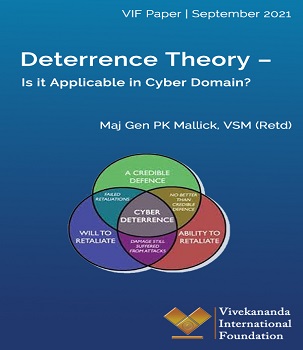
Deterrence Theory– Is it Applicable in Cyber Domain?

Maj Gen PK Mallick, VSM (Retd)

Introduction 

The Deterrence Theory was developed in the 1950s, mainly to address new strategic challenges posed by nuclear weapons from the Cold War nuclear scenario. During the Cold War, the U.S. and the Soviet Union adopted a survivable nuclear force to present a ‘credible’ deterrent that maintained the ‘uncertainty’ inherent in a strategic balance as understood through the accepted theories of major theorists like Bernard Brodie, Herman Kahn, and Thomas Schelling.1 Nuclear deterrence was the art of convincing the enemy not to take a specific action by threatening it with an extreme punishment or an unacceptable failure.