1 December 2021

Russia-Ukraine border: Why Moscow is stoking tensions

Sarah Rainsford

But whatever they agreed about Ukraine at their summit, something has since gone awry.

In recent weeks, Russian tanks have been moving west towards Ukraine once again, prompting fresh, even starker warnings from US intelligence circles that a cross-border offensive could be on the cards.
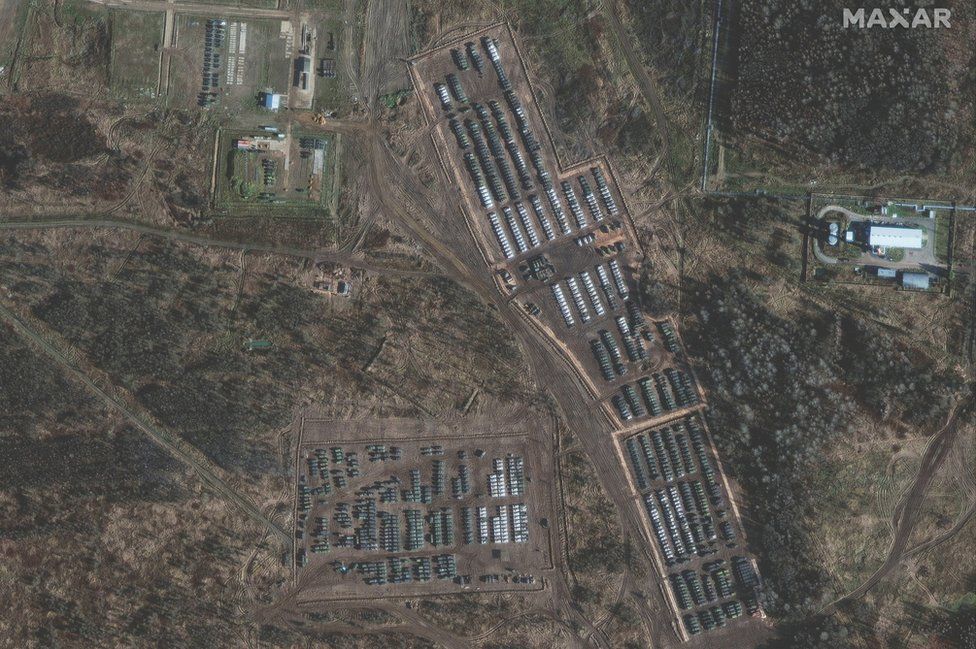
IMAGE SOURCE,MAXAR VIA REUTERSImage caption, This build-up of Russian forces was spotted some 300km (185 miles) from Ukraine

Moscow insists that's "anti-Russian" hysteria, and most analysts agree there's no rationale for Russia openly entering - and massively escalating - the conflict in Ukraine, where it backs separatist forces but always denies a direct role.

'Red rag to a bull'

Instead, they see the Kremlin sending a message that it's ready to defend its "red lines" on Ukraine: above all, that it must not join Nato.

"I think for Putin it's really important. He thinks the West has begun giving Ukraine's elite hope about joining Nato," political analyst Tatiana Stanovaya at R.Politik told the BBC.

"The training, the weapons and so on are like a red rag to a bull for Putin and he thinks if he doesn't act today, then tomorrow there will be Nato bases in Ukraine. He needs to put a stop to that."

Ukraine's desire to join the security bloc is nothing new, nor is Russia's insistence on vetoing that ambition in what it sees as its own "back yard".

But Moscow has been rattled recently by the Ukrainian military using Turkish drones against Russian-backed forces in eastern Ukraine; the flight near Crimea of two nuclear-capable US bombers was an extra irritant.
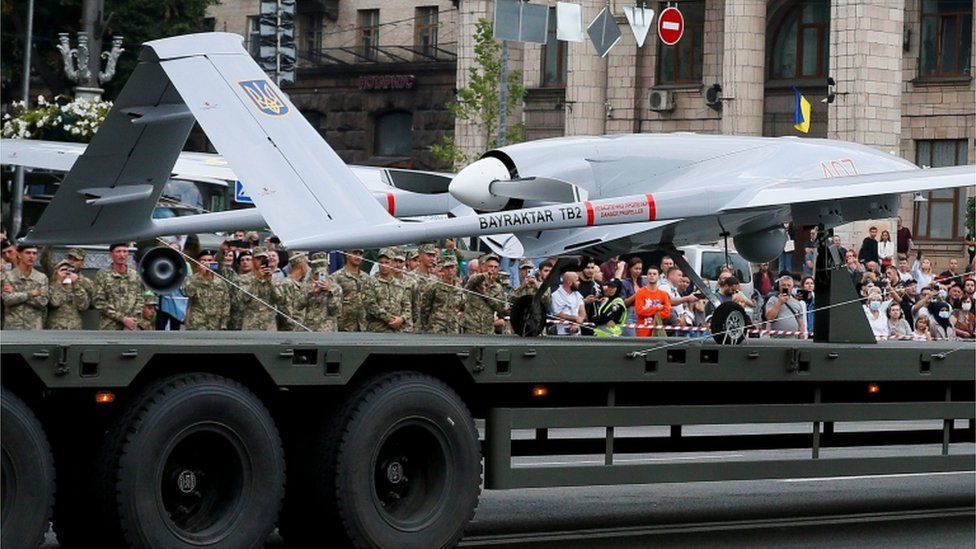
IMAGE SOURCE,REUTERSImage caption, Russia has been angered by Ukraine's use of Bayraktar drones

There's also concern that the so-called Minsk agreements, a framework for ending Ukraine's seven-year-old conflict that's too contentious to actually implement, could be jettisoned for something more favourable to Kyiv.
'Signal Putin wants to send'

In April, Russia found that demonstrative military deployment worked well so it's repeating the trick.

"Our recent warnings have indeed been heard and the effect is noticeable: tensions have risen," President Putin told Russian diplomats last week. He argued that tension needed sustaining to force the West to reckon with Russia, not ignore it.

"If the military movements [close to Ukraine] are explicit, then this is not about direct military action - it's about a signal Putin wants to send," Andrei Kortunov, head of the RIAC think-tank in Moscow, told the BBC.

The signal to Ukraine is not to try anything rash, he believes, like seizing back control of the Donbas.
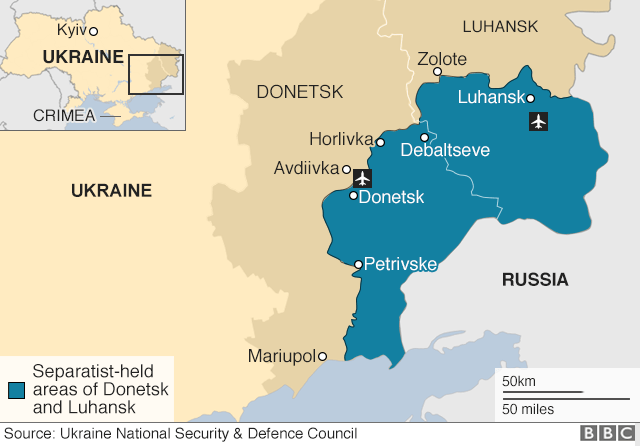

For the West, Mr Kortunov says Russia's message is to stop its "infiltration" of Ukraine with Nato infrastructure, including new kinds of weapons.

"That's definitely a matter of concern for Moscow," he argues.

This week, Russia's external intelligence agency, the SVR, evoked the 2008 Georgia war, in a statement on Ukraine.

It recalled the "high price" paid by then Georgian President Mikheil Saakashvili, who sparked all-out conflict with Russia by attempting to regain control of the separatist region of South Ossetia, which is backed by Moscow.
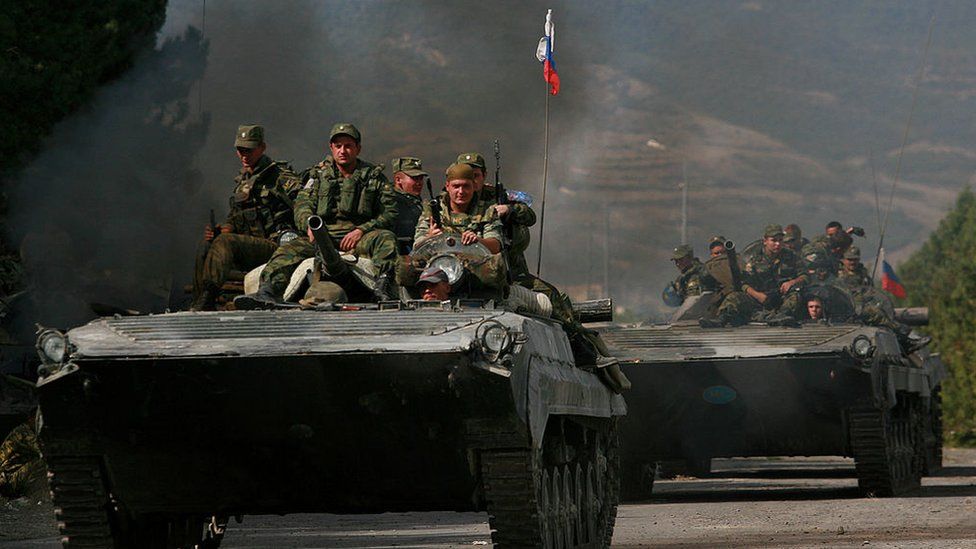
IMAGE SOURCE,GETTY IMAGESImage caption, Russian troops invaded Georgia in 2008 when it tried to recapture a breakaway region

"The Georgian scenario is on the table and could be used in Ukraine," Tatiana Stanovaya argues. "That doesn't mean Russia is preparing it; that there's no way back. I think it's just an option for now, not a decision," she says.

'We're not invading'

Ukraine itself at first dismissed US talk of an unusual troop build-up, though it has since joined the chorus of concern.

According to its head of military intelligence, Kyrylo Budanov, around 90,000 Russian troops are now deployed in the vicinity of Ukraine - fewer than during similar tensions last spring.

He believes they could launch an attack from several directions early next year.

On Friday, Ukraine's president made clear his country had no plans for an incursion into the Donbas.

EPA/PRESIDENTIAL PRESS SERVICE

Others are sceptical.

"Russia would definitely like to send the signal that if forced to fight, it will fight," Mr Kortunov reasons. "But I don't see what can be accomplished by a direct military offensive against Ukraine."

"No matter how it goes, the collateral damage will be much more significant than any possible gain."

So it's possible Mr Putin is hedging his bets.

"My suspicion is that this is contingency planning," was security expert Mark Galeotti's conclusion in his podcast In Moscow's Shadow.

He suggests the Kremlin is "creating all sorts of opportunities", and no firm decision has been taken.

But he too doubts that Moscow wants open conflict, bringing more sanctions and a total rupture in relations with the West.

"A vicious war in Ukraine could shatter the unity and legitimacy of the Russian regime," warns Mark Galeotti. "The good news is that I suspect the regime… understands that."

On balance, he believes the Kremlin will find reasons not to escalate the situation.

Tanks for talks

There are also signs that, once again, what Moscow really wants to achieve with its tanks are more talks with the US: another summit of the two presidents.

It's a risky way of conducting diplomacy, but for Mr Putin the stakes are high.
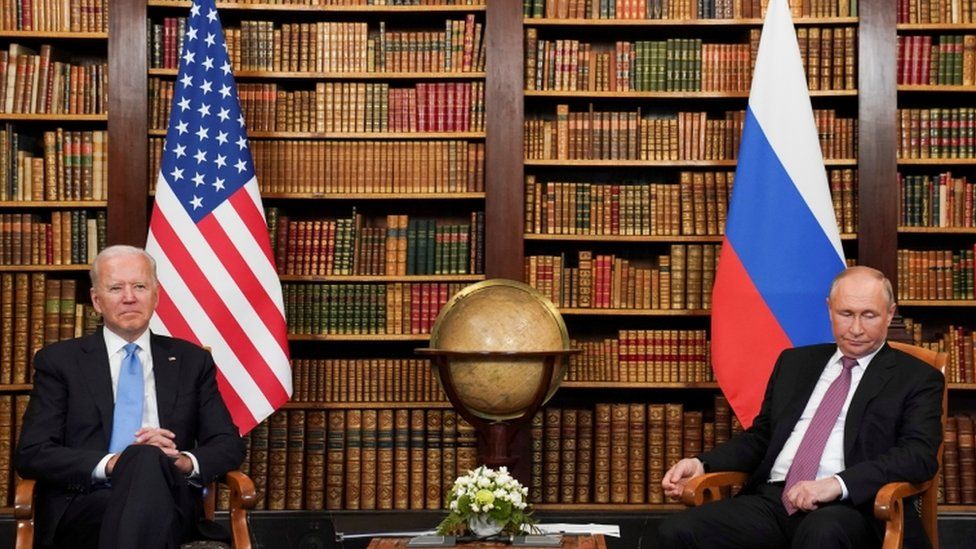
IMAGE SOURCE,REUTERSImage caption, The two leaders met in Geneva in June

"At a meeting between Putin and Biden, neither will give clear commitments but there may be some tacit understanding on how far the US is ready to go in increasing its military support to Ukraine," Mr Kortunov argues. "That's not impossible."

Russian sources say such talks could happen in the coming weeks, perhaps remotely at first. The White House hasn't yet confirmed that.

"Whilst Putin has a flicker of hope that he can do a deal with Biden, he won't take any rash steps. But if he thinks it's all doomed, he could do the worst things we can imagine," Tatiana Stanovaya warns.

As long as the Russian leader has that hope, then she believes "things won't be so awful".
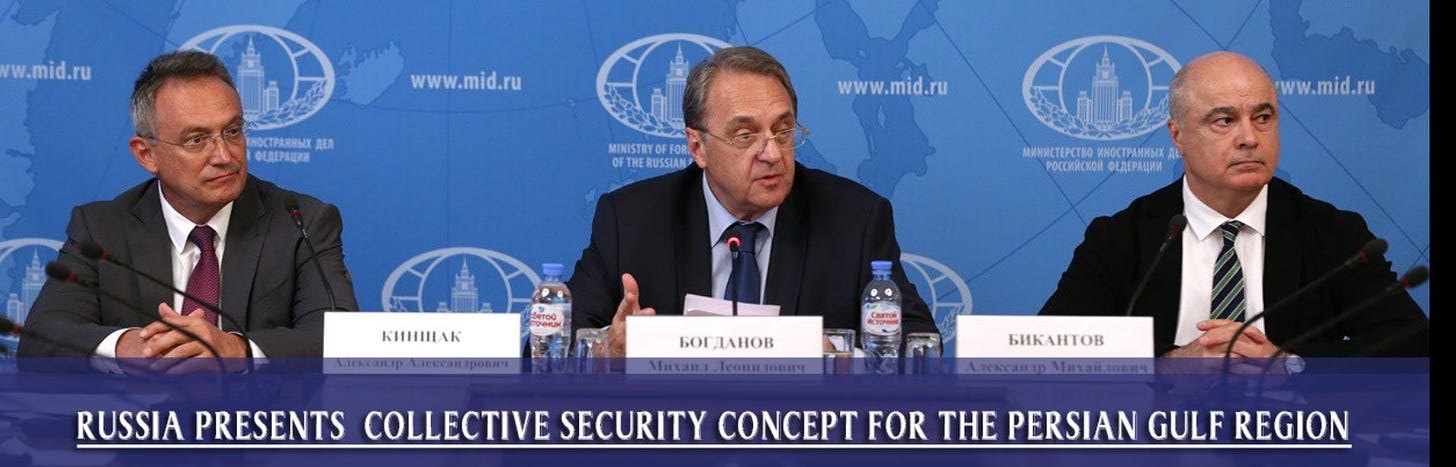
Testing the waters: Russia explores reconfiguring Gulf security

James M. Dorsey

Russia hopes to blow new life into a proposal for a multilateral security architecture in the Gulf, with the tacit approval of the Biden administration.

If successful, the initiative would help stabilise the region, cement regional efforts to reduce tensions, and potentially prevent war-wracked Yemen from emerging as an Afghanistan on the southern border of Saudi Arabia and the Gulf of Aden and at the mouth of the Red Sea.

For now, Vitaly Naumkin, a prominent scholar, academic advisor of the foreign and justice ministries, and head of the Institute of Oriental Studies at the Russian Academy of Sciences, is testing the waters, according to Newsweek, which first reported the move.

Last week, he invited former officials, scholars, and journalists from feuding Middle Eastern nations to a closed-door meeting in Moscow to discuss the region's multiple disputes and conflicts and ways of preventing them from spinning out of control.

China’s climate goals hinge on a US$440bn nuclear buildout

Dan Murtaugh and Krystal Chia / Bloomberg

Nuclear power once seemed like the world’s best hope for a carbon-neutral future. After decades of cost overruns, public protests and disasters elsewhere, China has emerged as the world’s last great believer, with plans to generate an eye-popping amount of nuclear energy, quickly and at relatively low cost.

China has over the course of the year revealed the extensive scope of its plans for nuclear, an ambition with new resonance given the global energy crisis and the calls for action coming out of the COP26 climate summit in Glasgow, Scotland.

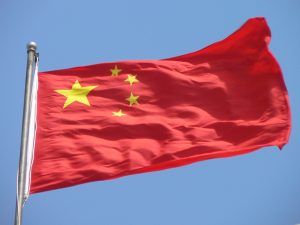
The world’s biggest emitter, China is planning at least 150 new reactors in the next 15 years, more than the rest of the world has built in the past 35. The effort could cost as much as US$440 billion; as early as the middle of this decade, the country would surpass the US as the world’s largest generator of nuclear power.

Why Do Governments Reveal Cyber Intrusions?

Gil Baram

On Sept. 26, Germany held federal elections to select the new members of the Bundestag, the country’s national parliament. Neither of the leading parties secured enough seats to govern alone, and it’s been estimated that it might be weeks before the public knows the political future of Europe’s largest economy. And while the three parties likely to constitute Germany’s next governing coalition announced on Nov. 16 that they are close to sealing a deal, concerns of election meddling and cyber intrusions against political institutions before and during the elections have made the political situation even more complex.

On Sept. 6, the German government publicly revealed it had been affected by “illegal cyber-activities,” such as direct phishing attacks on politicians, and attributed these to Moscow. According to Foreign Ministry spokeswoman Andrea Sasse, “the German government considers this unacceptable action a threat to the security of the Federal Republic of Germany and to the democratic decision-making process and a serious burden on bilateral relations.”

Germany publicly attributing the attack to Russia reflected a direct and specific approach. Sasse stated that there are “reliable findings” that the activities of the Ghostwriter hacking group—they’ve also been operating in Poland, Latvia and Lithuania since 2017—can be attributed to “cyber-actors of the Russian state” and specifically its military intelligence service (GRU). The hacking campaign focused on phishing attacks against politicians and decision-makers, impersonating government and diplomatic correspondence, and disseminating false information aimed at interfering with the internal affairs of European countries.

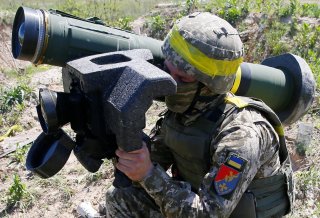
Ukraine’s Answer to Russia: Turkish Drones and American Javelins

Caleb Larson

The Ukrainian military is sounding alarm bells, warning of a potential Russian incursion deeper into the country amid a slow but steady build-up of military forces along the country’s eastern border.

Some estimates place the number of Russian troops placed around Ukraine’s borders as high as 92,000, with soldiers from Russia’s interior staging in Russia’s western military district, which abuts Ukraine, and troops stationed near the Balkans moved to Crimea.

Fear is high in both the West and Ukraine, with multiple American and Ukrainian officials ringing alarm bells at what has been dubbed a creeping stage-up ahead of military action.

In an interview with the Washington Post, the Ukrainian Minister of Defense Oleksiy Reznikov outlined his concerns about the threat from Russia on his country’s eastern border. Reznikov said Russian president Vladimir Putin is at a crossroads, “deciding whether to “go through the Ukrainian border and burn the bridges, or he is still bargaining and trying to find something interesting for him” Reznikov explained. “I hope he has not made his decision on this point.”

Does Solving the China Trade Problem Not Involve Beijing?

Frank Lavin

What are we to make of U.S. Trade Representative Katherine Tai’s October 4 speech on U.S.-China trade relations? Tai called for a “new approach” to the trade relationship but promises to continue key elements of Donald Trump’s policies, maintaining both the tariffs and the purchase requirements he imposed. Tai also brought attention to China’s industrial policy, a regular theme of Trump’s, and appeared to differ with Trump mainly in allowing for some tariff exclusions and in promising to work with other trading partners.

The approach Trump, and now Joe Biden, appear to be taking is that trade policy is primarily an exercise in which the U.S. focuses on the greatest impediments to trade. This is opposed to seeing trade as a focus on opportunities. We can see the difference in these two approaches if we consider trade as a restaurant management problem.

Think of a business exercise in which you are responsible for managing ten restaurants in a city, and each restaurant attains break-even if it can reach $1 million in annual sales. Let’s say nine of the ten restaurants you manage exceed that amount, but one is only generating $800,000 in sales. What do you do?

What we know so far about Omicron

THE CONVERSATION

Since early in the COVID pandemic, the Network for Genomics Surveillance in South Africa has been monitoring changes in SARS-CoV-2. This was a valuable tool to understand better how the virus spread. In late 2020, the network detected a new virus lineage, 501Y.V2, which later became known as the beta variant. Now a new SARS-CoV-2 variant has been identified, known as B.1.1.529. To help us understand more, The Conversation Africa’s Ozayr Patel asked scientists to share what they know.

What’s the science behind the search?

Hunting for variants requires a concerted effort. South Africa and the UK were the first big countries to implement nationwide genomic surveillance efforts for SARS-CoV-2 as early as April 2020.

Variant hunting, as exciting as that sounds, is performed through whole genome sequencing of samples that have tested positive for the virus. This process involves checking every sequence obtained for differences compared to what we know is circulating in South Africa and the world. When we see multiple differences, this immediately raises a red flag and we investigate further to confirm what we’ve noticed.

30 November 2021

CYBER, COMMUNICATIONS, EW & TECHNOLOGY (C2ET) DIGEST

Maj Gen P K Mallick, VSM (Retd)


Microsoft released its second annual Digital Defense Report, covering July 2020 to June 2021. This year s 134 pages report is quite detailed, with sections on cybercrime, nationstate threats, supply-chain attacks and Internet of Things attacks. The report includes security suggestions for organizations with remote workforces. It has a section describing the use of social media to spread disinformation. The report is a compilation of integrated data and actionable insights from across 


Social Media in Violent Conflicts – Recent Examples

Maj Gen PK Mallick, VSM (Retd)


Introduction

Alan Rusbridger, the then editor-in-chief of the Guardian in his 2010 Andrew Olle Media Lecture, stated, “News organisations still break lots of news. But, increasingly, news happens first on Twitter. If you’re a regular Twitter user, even if you’re in the news business and have access to wires, the chances are that you’ll check out many rumours of breaking news on Twitter first. There are millions of human monitors out there who will pick up on the smallest things and who have the same instincts as the agencies—to be the first with the news. As more people join, the better it will get. ”


The most important and unique feature of social media and its role in future conflicts is the speed at which it can disseminate information to audiences and the audiences to provide feedback.


Maldives: India first or India out?

DAVID BREWSTER

Recent protests in Maldives against India’s influence in the country calling for “Indian military out” has led the Maldives government to respond by reiterating its “India First” policy. This has highlighted the difficulties that both countries face in building a stable strategic partnership while also addressing popular sensitivities. It’s not something that India has been good at elsewhere in the neighbourhood.

Maldives is a small island state located right in the centre of the Indian Ocean. Despite a population of only 500,000, its location, astride the main sea lanes of the Indian Ocean, gives it considerable strategic significance. For centuries big powers have sought to build influence there and deny its use to rivals.

Maldives has come to international attention in recent years as part of growing rivalry between India and China. The former president Abdulla Yameen, who was seen by many as dangerously close to China, was ousted in an electoral landslide in 2018. The new government under President Ibrahim Mohamed Solih proclaimed an “India First” policy, which is now being tested as he seeks to reconcile India’s growing presence against a tradition in Maldives of fierce independence.

Is Pakistan heading down the same path as Afghanistan?

Mohammed Ayoob

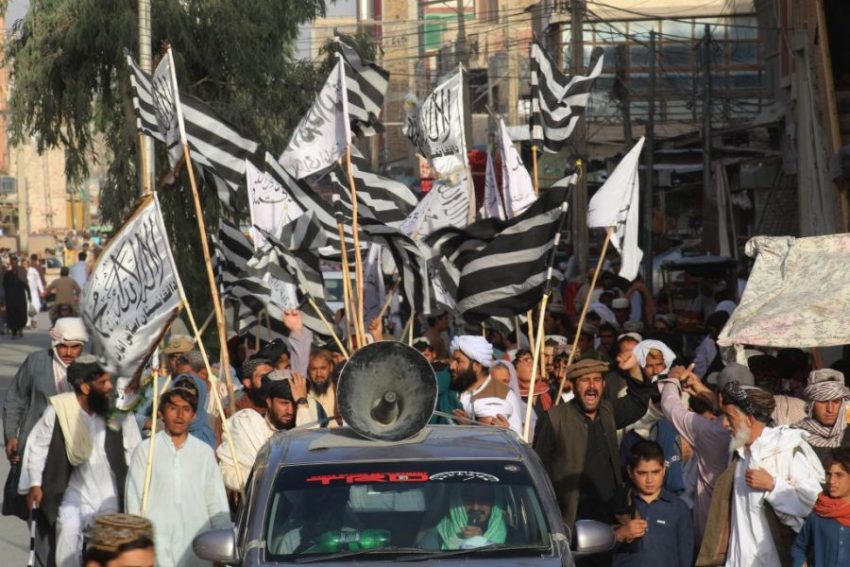
Recent events in Afghanistan and their fallout in Pakistan clearly demonstrate that the problems plaguing the two countries can’t be separated. That the trajectories of the two polities are closely intertwined has become very clear with the return of the Taliban to power in Kabul. Pakistan played a crucial role in the Taliban victory, among other things by providing the Taliban leadership refuge in Pakistan for the two decades they were fighting the US and the Kabul government. Islamabad’s influence in government formation in Afghanistan is evident in the sidelining of top Taliban leader Mullah Abdul Ghani Baradar and the allocation of important portfolios to the leaders of the Haqqani network, the favourite faction of Pakistan’s Inter-Services Intelligence (ISI) agency.

Equally important is the impact of the Taliban victory, with its professed aim of imposing strict sharia law in Afghanistan, on Pakistan’s domestic political scene. Extremist Islamist groups in Pakistan that had during the past few years been lying relatively low have been greatly encouraged by the Taliban’s success and have been re-energised to confront the government both in the streets of Pakistan’s major cities and in the tribal areas bordering Afghanistan.

US should strike terrorists in Pakistan


It has now been almost three months since President Joe Biden pronounced the War in Afghanistan over. He predicated the U.S. withdrawal on the fact that it would not undercut American security. “I also know that the threat from terrorism continues in its pernicious and evil nature. But it’s changed, expanded to other countries. Our strategy has to change too,” he declared , explaining “We have what’s called over-the-horizon capabilities, which means we can strike terrorists and targets without American boots on the ground — or very few, if needed.”

That was a lie. The Islamic State-Khorasan is now present in nearly every Afghan province. Just as the U.S. intelligence community underestimated the speed with which the Taliban would overrun Afghanistan, so too did they botch assessments of the degree to which terrorist groups would thrive after the U.S. withdrawal. Those like former envoy Zalmay Khalilzad, who argued that the United States could use the Taliban against the Islamic State, were foolish.

The terrorism problem emanating from Afghanistan, however, pales in comparison to that of Pakistan.

Afghanistan Post-Mortem

Peter R. Mansoor

The United States has lost its longest war. After twenty years of conflict and nation building in Afghanistan, the U.S.-backed Afghan regime collapsed like a house of cards in just a few weeks after the announced departure of American and NATO troops from the country. A final flurry of activity by the U.S. military managed to rescue 123,000 people from Kabul, but as Winston Churchill once said of Dunkirk, “Wars are not won by evacuations.” The United States now needs to reckon with the strategic, political, and military repercussions of defeat, while assessing what could have been done differently to prevent this tragic outcome at such a high cost in blood and treasure.

The most important strategic consequences of the defeat in Afghanistan include the impact on America’s alliances and the future of counterterrorism in the region. America’s partners are already reassessing the viability of their alliances with the United States in the wake of its abandonment of its Afghan partners. Europe, once enamored of President Joe’s Biden’s claim that America is back in the global arena, has discussed the need for more autonomy in its foreign and defense policies given the potential unreliability of the United States as an ally. Afghanistan was a NATO war as well as an American one, and the unwillingness of the Biden administration to discuss the impact of the withdrawal of foreign forces from the country has soured America’s NATO allies on the relationship, at least for the moment. Former UK Prime Minister Theresa May stated in the House of Commons, “What does it say about NATO if we are entirely dependent on a unilateral decision taken by the United States?” That statement came from a member of the “special relationship”; imagine what other NATO countries are thinking.

China’s Quest for Greater ‘Discourse Power’

Hugo Jones

Shifts in China’s economic and military power continue to produce dramatic headlines, but few recognize the changing nature and impact of China’s internationally oriented discourse as a form of power. Those that do tend to argue China still can’t do soft power and communicates poorly with the outside world. On closer inspection, however, 2021 seems to have charted a subtle increase in China’s “discourse power.”

COP26 is a prime example. Despite facing international criticism due to Xi Jinping’s physical absence and surging domestic coal consumption, China appears to have successfully employed discourse to set certain agendas at the conference. The concept of “Ecological Civilization,” a slogan closely linked to Xi’s leadership, found its way into many climate conversations. This followed the Kunming declaration, signed by over 100 nations on October 13, which enshrined Ecological Civilization as a “Shared Future for All Life on Earth.” And on November 1, the first day of COP26, the U.K. launched the Clean Green Initiative (CGI), which has clearly been informed by China’s Belt Road Initiative (BRI).

This is not to mention the Build Back Better World (B3W) announced at the G-7 summit in August. It is significant that that the CGI and B3W have adopted nomenclature that imitates the BRI – even though these projects are intended to counter or compete with China. In that sense, the CGI and B3W represent a shift in China’s ability to shape international discourse around development finance. Considering that the BRI is in reality just an umbrella term for China’s diverse global trade and investment relationships, it has been remarkably successful as a narrative capable of influencing foreign audiences and policymakers (its practical economic performance notwithstanding).

China’s Treatment of Peng Shuai Should Worry Us All

Howard W. French 

Late last week, I found myself at a university podium participating in an unusual event, invited by a conservative group to argue against the proposition that the United States should apply a greatly stepped-up boycott, divest and sanction—or BDS—approach in its relations with China.

The person arguing the other side in this debate began by stating that he supported going much further even than BDS. But after this emphatic opening sally, he offered scarce few details of what this might involve or how it would work.

Surprised at how little substance I was left to respond to, I began by speaking to the example of North Korea, a doggedly poor and extremely isolated country whose course has not been altered by some of the most stringent and persistent sanctions in recent history.

Why Ethiopia’s Fate Matters to China

Lukas Fiala

The unfolding humanitarian and political crisis in Ethiopia has left many observers pessimistic about the likelihood of an inclusive and peaceful solution to the protracted conflict. After months of fighting between Prime Minister Abiy Ahmed’s central government and the Tigray People’s Liberation Front (TPLF), the Ethiopian state is at real risk of collapse. As international observers call upon the US to prevent state failure, and diaspora groups unite in solidarity for Ethiopian unity, we should not disregard another player that has a strong interest in a stable and peaceful Ethiopia: China.

China’s (rhetorical) pragmatism

China usually adopts a pragmatic approach to insecurity abroad, centred on preserving Chinese interests which include the safety of Chinese citizens and investments on the ground. In accordance with the often proclaimed principle of non-interference in other countries’ internal affairs, a corner stone of China’s diplomatic rhetoric in the Global South that aims to frame China as a different external actor in comparison to interventionist Western counterparts, Beijing remained relatively quiet when fighting first started in Tigray in November 2020. Yet, though unsurprisingly, Chinese workers were evacuated from Tigray with the help of the central government in Addis Ababa.

Who decides China’s foreign policy?

Dr Yu Jie and Lucy Ridout

This briefing paper challenges the conventional wisdom that China functions as a unitary player in its foreign policymaking process. In reality, Beijing’s approach to external issues is a result of intense bargaining between numerous subnational authorities with a wide range of objectives.

The number of central government institutions, provincial-level authorities and major state-owned enterprises with influence over the country’s foreign policy has increased as China’s international relations have become more complex.

This shift in the decision-making process has opened up an opportunity for specialized government institutions – often with a domestic remit – that can provide specific expertise and knowledge. This paper presents three case studies that demonstrate the influence of these subnational actors.

Eyes Everywhere: Intelligence and Strategic Decisionmaking in the Gray Zone

Ian Williams
Source Link

The United States has come to recognize gray zone confrontation as among its most vexing strategic challenges. From Crimea to Syria to the South China Sea, the United States’ competitors have been pushing, probing, and testing U.S. resolve to enforce the international rules-based order it champions. And, in all these places, the world has watched long-established global norms—and U.S. interests—slowly erode due to steady and determined pressure from Beijing and Moscow. Better understanding how to think about and confront gray zone activity, both in policy and technology, is of the utmost importance to the United States and its allies.

Recently, CSIS held a tabletop exercise (TTX) that ran participants through several scenarios featuring adversaries employing aggressive gray zone and near-conflict tactics to achieve some goal or undermine U.S. operations. Our participants included a diverse group of national security professionals in intelligence, diplomacy, and military affairs. The players’ actions and insights during the exercise highlighted two critical facets of dealing with gray zone activity. First, intelligence on the situation must be penetrating and robust, including definitive insights into an adversary’s capabilities, intentions, and motivations. And second, time is of the essence.

Caveat Emptor: The Danger Of Using Commercial Technologies In Combat

Loren Thompson

In recent years, military planners have become enthused at the prospect of adapting new commercial technologies for the conduct of war.

Most of the breakthrough innovations driving commerce and culture originate in the private sector, so it is natural to look there for ideas that might help America maintain its edge on the battlefield.

However, the enthusiasm for commercial products emerged at a time when the Pentagon was focused on fighting ragtag, thinly resourced insurgents in Southwest Asia.

Once the emphasis shifted to great-power competition, as it did in the 2018 national defense strategy, problems arose with relying on commercial innovations.

Germany May Be Deploying Its First Armed Drones

Michael Peck

After years of opposition from those who fear that combat drones will involve Germany in a permanent U.S-style drone war, the German armed forces – known as the Bundeswehr — may get the green light to deploy armed UAVs.

This would “allow the Bundeswehr to arm drones for its own protection,” according to the German newspaper Suddeutsche Zeitung (English translation here). “However, their use is to be linked to strict requirements.”

However, the new drone policy is still up in the air. The September 2021 elections – in which Chancellor Angela Merkel chose not to run – left no party with a majority lead, and talks are still underway to form a coalition government that will probably include the Green Party, the center-left Social Democratic Party (SDP) and the libertarian Free Democratic Party (FDP). While the Greens aren’t quite so pacifistic anymore – they are no longer calling for Germany to leave NATO – drone warfare may a more controversial matter.

US, Russian military chiefs speak by phone amid concern over Ukraine

JORDAN WILLIAMS

Joint Chiefs of Staff Chairman Gen. Mark Milley spoke via telephone on Tuesday with Russia’s top military officer, Chief of the Russian General Staff Gen. Valery Gerasimov, amid the U.S.'s heightened concerns about Russia amassing troops near the Ukrainian border.

The military leaders discussed “several security-related issues of concern,” Col. Dave Butler, Joint Staff spokesperson, said in a readout of the call.

“The phone call is a continuation of communication between both leaders to ensure risk reduction and operational de-confliction,” Butler said.

In a separate statement, the Russian Defense Ministry said the military chiefs “discussed the ongoing issues of international security,” according to Russian news agency TASS.

Neither of the statements provided further detail into the conversations.

Milley’s call comes as the U.S. and NATO fear that Moscow is massing troops to prepare for a military operation over Ukraine’s eastern border like it did when it annexed the Crimean Peninsula in 2014.

US Flags 16 Chinese Entities for Helping Pakistan Nuclear Efforts

Charles Kim 

The United States Department of Commerce put 16 Chinese "entities" on a concern list for helping Pakistan with its nuclear ambitions, the agency announced Wednesday.

The agency’s Bureau of Industry and Security added a total of 27 entities that they said engaged "in activities that are contrary to the national security or foreign policy interests of the United States."

Sixteen of those included in the list were Chinese entities that the agency said were aiding Pakistan’s "unsafeguarded nuclear activities" and ballistic missile program efforts.

"Global trade and commerce should support peace, prosperity, and good-paying jobs, not national security risks," U.S. Secretary of Commerce Gina M. Raimondo said in a release.

How to Energize NATO’s Response to Russia’s Threats Against Ukraine

Max Boot

For the second time in a year, Russia is mounting a major military buildup near its border with Ukraine. The last time, in March and April, did not result in an invasion, but Russian leader Vladimir Putin arguably got what he wanted: the world’s attention. In June, U.S. President Joe Biden held a summit with Putin in Geneva that was reminiscent of the Cold War days when Russia was a superpower like the United States.

Putin, who has called the collapse of the Soviet Union “the greatest geopolitical catastrophe of the [twentieth] century,” is eager to restore the level of influence his country has enjoyed, and he has the mineral wealth and military capabilities to achieve his objective. Once again, his military buildup has riveted the world. Headlines proclaim concerns about a Russian invasion of Ukraine and the North Atlantic Treaty Organization (NATO) is warning Russia against further aggression.

The Specter of Invasion

The Pentagon’s New UFO Office Has a Specific Job


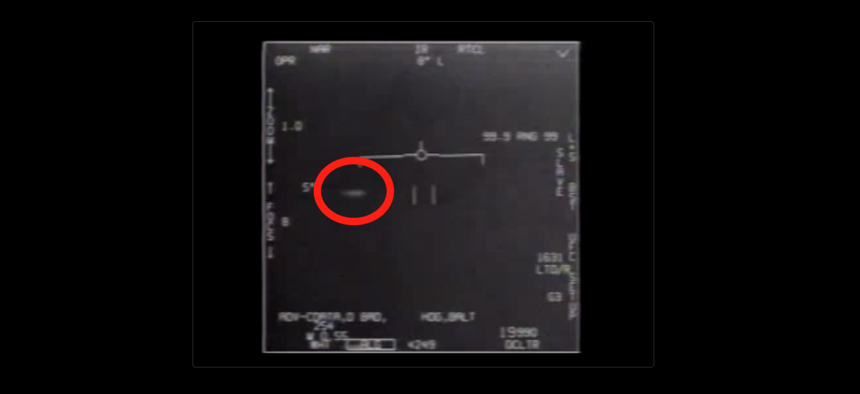
A new office will seek to track and assess unidentified aerial phenomena—the possibly-alien things formerly known as UFOs—that enter military training airspace, the Pentagon announced late Tuesday.

The Airborne Object Identification and Management Synchronization Group, or AOIMSG, will be tucked into the office of the defense undersecretary for intelligence and security and tasked with coordinating with other federal agencies to “detect, identify and attribute” unidentified objects of interest, and “to assess, and as appropriate, mitigate any associated threats to safety of flight and national security,” Deputy Secretary of Defense Kathleen Hicks directed in the Tuesday memo.

Earlier this year, the Director of National Intelligence released a report on more than 140 known sightings of unidentified aerial phenomena, or UAPs, that Navy pilots and others have reported for years. The report could neither prove nor disprove that extraterrestrial technology was behind the video and first-hand accounts of flying objects maneuvering in ways beyond known U.S. and competitor capabilities.

The establishment of the office is important; for years, reports by Navy pilots were dismissed and those aviators were reluctant to discuss the encounters. Bringing the office into the mainstream, where it will coordinate with ODNI and have high-level Joint Staff input, signals that amid new technologies being rapidly fielded by China and Russia, whatever it is that the pilots are seeing out there, the Pentagon wants to know about it.

The Implications of Climate Change for Military Intelligence

Shira Efron, Lieutenant Colonel (res.) T. B. David Siman-Tov

Global attention to the climate crisis has recently increased. As world leaders are exploring solutions for reducing greenhouse gas emissions, defense communities—primarily in the United States and Europe—are also stepping up efforts to contend with the challenges posed by climate change. These efforts focus on ensuring better preparedness for climate change, including by revising combat doctrines, altering training, adapting infrastructure, equipment, personnel, and procurement protocols, and designing climate scenarios.

Within the defense establishment, Western intelligence communities are also paying increased attention to climate change. Indeed, the US intelligence community (IC) began addressing the issue of climate change in the 1990s, yet recently intensified its efforts, including the resurrection of a specialized CIA department. For over a decade already, reports published by various intelligence agencies have been mentioning the effects of climate change as a “threat multiplier” to the stability of countries and regions. The Biden administration’s decision to put the climate crisis at the top of its national security priorities has sharpened the focus of the Pentagon and the intelligence agencies on the climate crisis and has guided strategic thinking in this sphere.

Promoting Energy for Development in a World Accelerating to Net-Zero: Roundtable Report

HON XING WONG, JONATHAN ELKIND, PHILIPPE BENOIT AND AASHNA AGGARWAL

On September 14, 2021, Sustainable Energy for All (SEforALL) and Columbia University’s Center on Global Energy Policy (CGEP) co-hosted a high-level virtual roundtable on energy for development and climate objectives, the first of a series of discussions focusing on the intersection between these two policy priorities. Among the roundtable participants were senior leaders representing major international organizations, development finance institutions, civil society, philanthropic foundations, academia, youth activists, and energy and finance industries.

Convened a week before the United Nations (UN) High-Level Dialogue on Energy—the first in 40 years—the virtual roundtable occurred at a time when the focus of many decision makers around the globe was on accelerating climate change mitigation to fulfill the goals of the Paris Agreement. Amid this sense of urgency to accelerate decarbonization, the roundtable served as a timely reminder of energy’s role in alleviating poverty and promoting growth. With 2.6 billion people (more than a third of the world’s population) lacking access to clean cooking and almost 760 million people (roughly 10 percent of the world’s population) lacking access to electricity, bridging the energy gap by 2030 should remain at the top of the global agenda.[1] Energy access is essential for economic development, especially for the 9.1–9.4 percent of the world that still lives in extreme poverty (defined as living on less than $1.90 per day).[2] Moreover, the role of energy extends beyond basic access: it is critical to generating broad-based economic growth to lift people out of poverty and enable quality healthcare, education, gender equity, food security, and other benefits enjoyed by middle-class populations worldwide.

Samsung will build a $17 billion chip plant in Texas.

David McCabe
 
Samsung will build a $17 billion semiconductor factory in Taylor, Texas, it said on Tuesday, giving a big boost to a bipartisan effort in Washington to persuade chip makers to build more of the components in the United States.

The company’s decision came after months of deliberation over possible locations in the United States and South Korea. The company, one of the world’s largest makers of computer chips, considered a site in Austin, which is about forty minutes from Taylor, as well as locations in Arizona and New York.

As Washington has urged chip makers to build more in the United States, cities have raced to get a piece of the potential boom. Taylor went to great lengths to lure the Samsung plant. The city, its independent school district and the surrounding county promised the company hundreds of millions of dollars in tax breaks. Semiconductor plants require abundant water and reliable power, so they reached a deal to transport water from the adjacent county for the facility.

Samsung’s decision comes during a major shortage of semiconductors, which are critical to products as diverse as Ford F-150s, medical devices and iPhones.

Lawmakers and the Biden administration have grown concerned that not enough of the vital components are made in America. China has invested heavily in incentivizing production of computer chips inside its borders, and Taiwan and South Korea both produce a major share of the semiconductors. Policymakers worry that leaves the United States at an economic and national security disadvantage.

Army adds Finnish satellite startup ICEYE to SAR research effort

THERESA HITCHENS

WASHINGTON: The Army has signed a new research and development agreement with Finnish startup ICEYE, broadening its efforts to suss out capabilities and use cases for synthetic aperture radar (SAR) satellite data.

This is the second Cooperative Research and Development Agreement (CRADA) the service has signed with a SAR-sat firm — the first, or at least the first announced, anyway, was with Capella Space — as part of its high priority initiative to speed intelligence, surveillance and reconnaissance (ISR) from Earth observation sats directly to soldiers on the battlefield. CRADAs work on a no-cost (or almost no cost) basis, where industry provides technology and the services provide people-power and testing facilities.

“This particular contract signifies an entry point into working very closely and collaborating with the Army to prove out our technology, as well as to work with them on potential use cases, including the integration with their ground station, TITAN,” Jerry Welsh, CEO of ICEYE’s US arm, told Breaking Defense.

DDGs, Lasers and ASCMs: An Analysis

Anthony Cowden

The United States Navy has decided to install a laser weapon system on some of its guided missile destroyers (DDGs).[i] These systems will replace the existing Phalanx Close-In Weapon System (CIWS). The laser system to be installed is the Optical Dazzler Interdictor, Navy (ODIN). The purpose of ODIN is to “dazzle” the sensors of any Unmanned Aircraft System (UAS, more commonly referred to as drones) flying nearby.

“Dazzle” is a technical term, meaning to blind, generally temporarily, a sensor, usually an optical sensor, by shining a high-powered energy stream into it – in this case, laser light. And what a fun term to use! Just say it – “dazzle” – wasn’t that fun?!? And effective, too, as successfully blinding a hostile sensor will render it useless…

…For a period of time. It is certainly possible, if the laser is strong enough and is focused on the sensor long enough, that it might permanently damage or destroy the optical sensor, but generally dazzling is a temporary effect, lasting only as long as the laser is trained on the sensor (and this seems to be true of ODIN[ii]). Of course, as a ship is only equipped with one ODIN, the operational effect is easily defeated by employing a second drone…

Robotic vehicles, drones coordinate recon at Army’s Project Convergence 21

ANDREW EVERSDEN

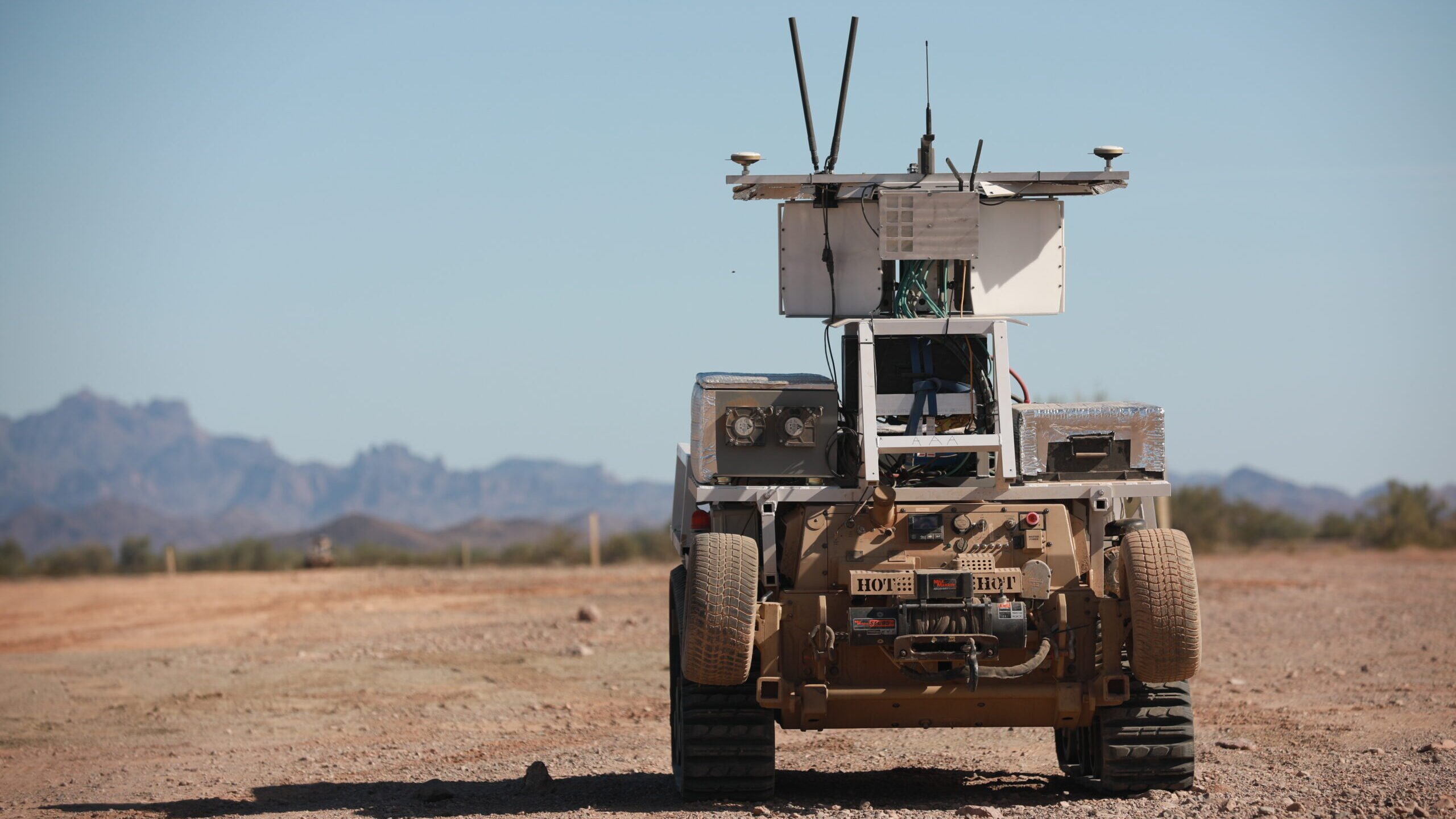
YUMA PROVING GROUND, Ariz.: Four small quadcopters equipped with ISR gear search the battlefield for the enemy. On the ground, four robotic combat vehicles drive across the terrain doing the same. During the mission, the pair are communicating and coordinating the unmanned recon mission.

“It’s this idea of collaborative sensing,” said Col. Andre’ Abadie, co-lead for the Project Convergence 2021 operational planning team. “It’s one thing to have one sensor do aided target recognition and say, ‘I see an enemy tank.’ It’s another thing when a sensor can say ‘I see an enemy tank. Hey, guy from the air, tell me, is that a tank? Hey, other guy from another angle tell me is that a tank?’”

On the future battlefield, the Army plans to use combinations of autonomous platforms from future land vehicles to high-endurance drones to provide situational awareness and to undertake missions often perilous to soldiers, including target identification, reconnaissance and resupply — hopefully talking together the whole time. The new methods were tested in seven broad scenarios at Project Convergence, the Army’s annual sensor to shooter experiment, meant to recreate specific challenges in future, complicated joint warfighting.

THE PAST AND FUTURE WARS OF FICTION

Hal Wilson

Bodies are strewn across the rolling, sunlit fields — each one clad in the scarlet tunics and bearskins of British Guardsmen — each one “marking the line of their victorious advance.”1 But their victory is a brief one. Hostile reinforcements are pouring in, quickly mounting a flank attack of their own. Chaos follows, and with it a desperate retreat. By morning, the corps commander is dead, the household cavalry is broken, and a battalion of 500 British soldiers is reduced to 180 men.2

But this military disaster is not in some far-flung corner of a foreign land; the British Army is retreating from the southern English town of Dorking, with the German Army hot on its heels. Having swept the Royal Navy aside with decisive new weaponry, the Germans have now also broken the back of Britain’s ill-prepared Army. Almost overnight, Britain loses its Empire and dignity alike.

At least, that is how Colonel Sir George Tomkyns Chesney thought events would occur.

Writing in 1871, Chesney serialized his thought experiments in Blackwood’s Magazine; the result was The Battle of Dorking: Reminiscences of a Volunteer. The story reflected Chesney’s abiding fear that “if serious military reform was not undertaken and the Germans ever got across the channel, England was doomed.”3 While overshadowed by a better-loved cousin — The War of the Worlds, for the writing of which H.G. Wells borrowed directly from Chesney’s earlier work4 — Dorking defined an entire genre: future-war fiction.5

The Battle of Dorking, by Colonel Sir George Tomkyns Chesney, originally published in 1871.

As for Blackwood’s? Chesney’s story “was the best business they had ever had.”6

And it is easy to understand why. “Humans connect over a story,”7 explain authors Peter Singer and August Cole, the writers of 2015’s Ghost Fleet: a Novel of the Next World War. Or, as explained by Max Brooks, author of the 2006 novel World War Z: An Oral History of the Zombie War: “The best way to educate is to entertain.”8 Fiction offers a direct line to the imagination and the interest of countless ordinary readers. Such was the scale of Chesney’s appeal that his work attracted the personal denunciation of then-Prime Minister William Gladstone, whose ministry was determined to avoid further defense spending.9 Now ask yourself, how many Prime Ministers have been compelled to denounce the House of Commons’ Defense Committee reports?

Singer and Cole’s Ghost Fleet — inspired partly by Brooks’ zombie epic10 — depicts Sino-U.S. warfare from the beaches of Hawaii to low-earth-orbit. Moreover, it illustrates the power of stories as a vehicle to educate and inspire. Ghost Fleet popularized a tidal-wave of what co-author Cole terms ‘FICINT,’ which is fiction writing grounded in reality.11 Military organizations from the U.S. Naval Institute12 to West Point’s Modern War Institute13 now host regular FICINT initiatives, while the French Defense Innovation Agency recently hired sci-fi authors to identify future threats.14 Ghost Fleet itself quickly landed on the reading lists of the Chief of the Air Staff of the Royal Air Force;15 the U.S. Navy’s Chief of Naval Operations,16 and the U.S. Marine Corps War College.17 Not to be outdone, Admiral James Stavridis, former NATO Supreme Allied Commander Europe, recently made his own contribution to the genre.18

So much for the appeal — but what use is science fiction in an age of flat or declining defense budgets? History offers some pertinent clues.

Writing in 1925, a former MI5 agent called Hector Bywater released The Great Pacific War: A History of the American-Japanese Campaign of 1931–33. Bywater not only predicted World War Two’s famous American island-hopping strategy, but directly shaped it by prompting a rewrite of War Plan ORANGE — the American inter-war plan for a possible Japanese conflict.19 Likewise, in 1978, General Sir John Hackett released The Third World War. Hackett, who jumped into Arnhem at the head of 4th Parachute Brigade, wrote for reasons that echoed Chesney’s from over a century before: namely, to warn that if “we wish to avoid a nuclear war we must be prepared for a conventional one.”20 And even if Tom Clancy’s later novel, Red Storm Rising, has since come to define the fictional vision of hard-bitten Cold War combat, it was The Third World War — with over three million copies sold — that helped to drive the substantial reforms for which Hackett had argued.21

The western militaries of yesteryear were no strangers to sweeping changes in technology, nor the daunting threat of war with advanced, capable opponents. And now that their successors grapple with mounting threats ranging from the Baltics22 to Taiwan,23 they too are leveraging the power of fiction to educate and inspire — to reveal risks and opportunities. Not long ago, in the nineties and early millennium, the results were often fanciful. Whether in visions of U.S. armored divisions rolling across Siberia to crush Chinese troops wholesale,24 or laser-armed B-52s picking off Russian nuclear bombers,25 it is all too easy to find the hallmarks of that heady, hubristic era — back when Fukuyama called time on history and President Bush declared Mission Accomplished. And while some recent fiction on future warfare is overtly pompous and politicized — consider Omar El Akkad’s American War — a body of far greater work is growing — see, for example, Captain Dale Rielage’s award-winning How We Lost the Great Pacific War,26 which captures a trend of material that is at once both engaging and often deeply sobering.

And so it should be. Just as Wells’ anonymous narrator recounts of the Martian aftermath — that it robbed the world “of that serene confidence in the future which is the most fruitful source of decadence”27 — it is not a moment too soon that we leave behind the comforting anachronisms of yesteryear.

But if Western defense communities accept this already, what about the rest of us? Whether British politicians defending ties to China,28 Disney executives dismissing the Uyghur genocide,29 or EU negotiators overlooking slave labor,30 many elites need a hard dose of fiction to find their way back to reality. Closing the Battle of Dorking with a portrait of a desolate, occupied Britain, Chesney leaves his readers with the observation that “a nation too selfish to defend its liberty could not have been fit to retain it.”31 150 years may have passed, but Chesney’s fictional warning remains as pertinent as ever.

Small-Scale Chemical and Biological Production: Current Threats and Future Trajectories

Dan Kaszeta

Recent years have seen brazen public assassinations using poisons. The general emphasis in arms control and non-proliferation debates has rightly focused on the threat of chemical and biological materials as weapons of warfare. However, the threat of such materials being used in situations other than war, such as terrorist attacks and assassinations, is clear. Chemical and biological weapons do not come out of nowhere. They are designed, developed and produced for specific purposes.

This paper analyses two central questions and makes policy recommendations to address the overall problem. First, it assesses what resources are required for small-scale chemical and biological weapons (CBW) production. The necessary inputs in terms of budget, facilities, labour, materials and other factors are small, meaning efforts can be easy to conceal.

Second, the paper considers scientific and technical trends, and their impact on potential small-scale CBW production efforts. There are a number of developments, such as microfluidics and automation, which make covert manufacturing of chemical and biological substances easier than in the past. Moreover, there are also a variety of specific technical advances, such as nano-encapsulation and improved dermal absorption of pharmaceuticals, that could make it easier to make or deliver chemical and biological materials as weapons. Developments in science and technology will simplify efforts by hostile actors to operate small-scale production of these materials for hostile use.