29 January 2023

Countering China’s Magic Weapon Of Grand Narratives – Analysis

By John Lee

The Chinese Communist Party (CCP) has developed a magic weapon that complements its accumulation of material power: its success in shaping grand narratives in the Indo-Pacific region about China and America. The genius is that these narratives condition countries to accept Chinese policies meekly even if those policies oppose their national interests.

The magic weapon is a narrative buttressed by five basic messages:

1. Chinese dominance is the historical norm and is inevitable.

2. The objectives of the CCP are permanent and unchanging.

3. A CCP-led China is fundamentally undeterrable.

4. Beijing is prepared to pay any price to achieve its core objectives.

5. The US is an increasingly weak and unreliable ally.

Accepting these propositions greatly diminishes the motivation for regional states to resist or counter even the most coercive policies, even if we profoundly disagree with China’s behavior. Striking an uneven bargain becomes seemingly preferable to foolishly balancing against the future inevitable dominant power.

The power of these narratives for Beijing is that once we accept the five basic messages as a given, then the only reasonable action is for regional states (including American allies) to compromise and alter their objectives to maximize gains, avoid instability, and ultimately prevent war. The onus is then placed on America to step back or accept blame for the resulting instability.

America needs to engage and prevail in this space of grand narratives rather than vacate the ground, as it has largely done. There are six counternarratives for which ample evidence exists and which America should relentlessly advance:
Diversification Isn’t Enough to Cure Europe’s Economic Dependence on China

Francesca Ghiretti and Hanns W. Maull

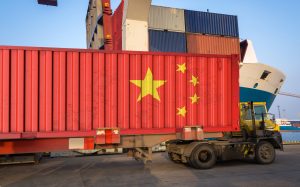
In the most recent European Commission document on EU strategic dependencies, the term “diversification” appears no less than 28 times. It represents a key pillar of the proposed policy responses to dependence on Chinese supplies. The whole world depends on China for rare earths minerals, metals, and the magnets produced with them: China accounts for 63 percent of global rare earth oxides, 85 percent of the refined minerals, and 93 percent of the world’s magnet production. As for Europe, the newly discovered deposit of rare earths in Sweden, the continent’s largest known mineral reserve, may help to improve Europe’s resilience for the supply of rare earths.

Yet the crux of the issue is not dependence but vulnerability – the pain inflicted by disruptions in commercial exchanges, measured in economic costs, social suffering, and, possibly, political upheaval.

Dependence is a rather crude yardstick for vulnerability. The European Union may depend almost completely on Madagascar for its supply of vanilla pods, yet even a complete loss of those supplies would hardly result in serious macroeconomic pain. On the other hand, vulnerability may exist even without dependence: Spain never relied on Russian natural gas supplies, but the shortfall to other European markets sharply increased the price of electricity throughout Europe, which affected Spain severely and thus revealed its vulnerability.

Vulnerability exists when three aspects combine. First, a major disruption of economic exchanges must be plausible. Second, the economic sectors affected must be constrained in their ability to adjust to disruptions by pivoting to alternative sources and/or endure reduced demand. Third, the consequences of the disruption must have a significant impact on the overall performance of the affected economy. The European Commission has conducted some of the necessary analysis of European vulnerabilities, but much remains to be done at the national level.

As a response to vulnerability, diversification has drawbacks. For corporate actors, diversification is a natural strategy for managing risks. It will happen anyway in response to market forces if the additional costs are small. Most companies are diversifying from the Chinese market – not because of a government diversification strategy on the part of their home country, but rather as a response to the market impact of China’s policies. As a geopolitical strategy, however, diversification will usually be expensive, and the costs will have to be shouldered either by economic actors (corporations, consumers) or by taxpayers, and thus should be adopted with care. In a crisis, security considerations may mobilize support for the extra expense incurred. Yet as time goes by, concerns about security of supply tend to fade into the background, and diversification becomes a high-cost alternative.

President Xi Jinping’s Middle East Visit: The Chinese Perspective


Are new winds blowing in China’s relations with Middle East states, or are they essentially more of the same? The visit by China’s President to Saudi Arabia was heralded as a “new era,” but what does this mean, and what can be understood from Beijing’s various statements about how it sees the region? Most important, how do these developments reflect China’s attitude toward Iran?

In December 2022 Chinese President Xi Jinping visited Saudi Arabia and held a series of summit meetings with leaders of Arab states in general and the Gulf states in particular. Before, during, and after the visit, various headlines trumpeted a “new era” of Chinese relations with the Middle East, while speculating in this context as to China’s Iran policy. Yet while there were some developments in these relations, in many respects, little is new – although sometimes, continuity itself can point to what is new. What are the new developments, what is not actually new, and how does this issue relate to Israel?

China at the Center

Prior to President Xi Jinping’s visit to Saudi Arabia, Chinese newspaper editorials declared that the visit would “strengthen cooperation between China and the Arab world further, promote peace and prosperity in the region, and pave the way for building a Chinese-Arab community with a shared future for a new era.” A document by the Chinese Foreign Ministry, which laid the basis for the visit several days before it occurred, was entitled “Report on Cooperation between China and Arab States in the New Era.” The President himself used the term “new era” to mark the progress in relations between China and Arab states, and especially Saudi Arabia. This term – “new era” – is not part of a spiritual, New Age-y lexicon, but reflects the worldview of the Chinese Communist Party in the last few years (particularly since 2017) and the vision of the President, known as Xi Jinping’s “Thought on Socialism with Chinese Characteristics for a New Era” – a vision that was also enshrined in the party’s constitution. The historic perspective of the party was presented in November 2021 in the “Resolution of the Central Committee of the Communist Party of China on the Major Achievements and Historical Experience of the Party over the Past Century.” This document has major significance in terms of the Party’s approach to history, not only for structuring the narrative of the Party’s past, but because the President and the Party see history as the most significant factor in thinking about the future. Similar resolutions have been presented only twice before: in 1946 by Mao Zedong, and in 1981 by Deng Xiaoping; in both instances China faced central historic junctures in its history. The first was the civil war, after which China established the People’s Republic of China; the second was when China embarked on a path of openness and reform after almost thirty years under Mao’s rule.

The New European Frontier

GIULIO BOCCALETTI

LONDON – For many Europeans, the summer of 2022 was one of the worst in living memory, and not only because of the cruel war on their eastern flank or the return of inflation. Even more important, from a long-term perspective, was the public’s realization that the continent is far more vulnerable than expected to changing environmental conditions. As Europe experiences the warmest winter on record, it must prepare for more climate upheaval, from substantially warmer temperatures to variable water resources, both of which pose a fundamental political challenge to the European project.

For decades, Europeans have concealed the deeply political nature of European integration behind an economic project focused on ensuring the free flow of goods, capital, services, and people between member states. It has worked because the single market can rely on a vast legacy of infrastructure and institutions to ensure its material security. Goods can travel safely across the continent because roads are, for the most part, free from floods. European farmers can produce food thanks to centuries of reclamation and benign rainfall. Financial centers can operate at the rhythm of capital markets because their workers do not have to wade through rivers on their way to work or carry buckets for hours to secure water for their families.

The infrastructure and institutions that convert the climate into such predictable operating conditions are an inheritance, financed, in Europe’s case, by colonial resources and, more recently, by the Marshall Plan, the International Bank for Reconstruction and Development, and member states’ own treasuries. All helped establish the legitimacy of modern European states.

But the past summer and the anomalous winter that has followed provide abundant evidence of the ongoing demise of Europe’s once-favorable human geography – and that the continent’s constructed landscape, finely tuned to earlier climate conditions, is no longer fit for purpose. In 2022, drought crippled Spain, Greece, and Italy. Central European rivers – centuries-old transport routes for goods reaching the heart of the continent – ran dry. Then, the continent was hit with monsoon-level quantities of rainfall, owing to above-average sea temperatures in the Mediterranean. October was the warmest on record, as was December. As more variable conditions set in, this is likely to be the new normal.

What would ‘winning’ in Ukraine mean?

Matthew Parris

Iawoke in the small hours last week and began worrying about the Ukraine war. A friend had earlier taken me to task over the airy way I’d introduced an argument with the words ‘Once we’ve won the war in Ukraine’ – as though this was a simple matter and just a question of ‘when’. But what does ‘win’ mean? Does the searchlight of our intelligence, backed by what we already know, really illuminate the landscape ahead? Might things come to pass that we just haven’t thought of?

Even people as old as me remember wars that, though bloody and protracted, were fairly straightforward as narratives, with clear and final objectives and, in story terms, a reasonably clear-cut ending. The second world war is an outstanding example; the Falklands a more minor but equally clear case. We knew what winning meant. Hitler and Galtieri knew what losing meant. Even after the Korean war there was a simple and permanent partition. These were proper endings, followed by a stable state.

We imagine, I suppose, that the present Ukraine business will turn out like one of those. Crudely, I thought at first that the Russians should just be pulverised, Putin humiliated into personal collapse and all the territory Moscow had stolen returned to Kyiv. After that, I thought, Europe would be at peace again: stabilised, sorted and ready to help rebuild Ukraine.

But will it be anything like this? Let me throw into the mix of your own thoughts some doubts among mine.

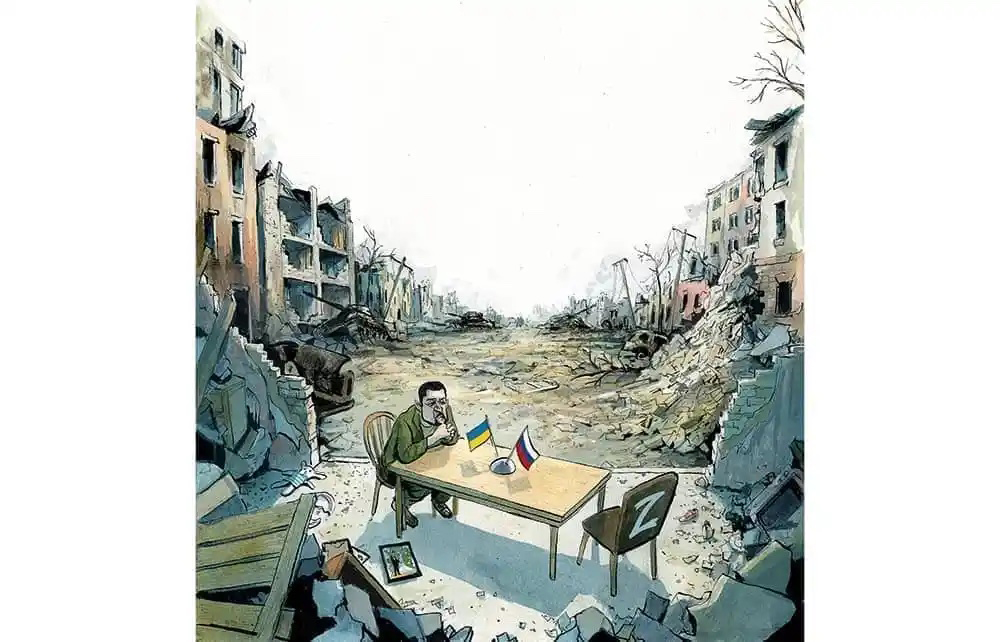
Everyone is speculating on Putin’s leadership – will he be overthrown? Is his presidency strong enough to survive a peace deal with Ukraine and the West? Might he be replaced by a yet fiercer militarist? Good questions, but there’s another we don’t seem to be addressing: is Volodymyr Zelensky secure? Admittedly, my time spent travelled in Ukraine was short, and it was about 15 years ago, but it left me with a more jaundiced view of that country than one hears in these blue-and-yellow-flag-waving days.

JUST IN: How Russia Is Using U.S. Electronics to Attack Ukraine

Sean Carberry

Vitaly V. Kuzmin photo via Wiki commonsWASHINGTON, D.C. — U.S. sanctions and export controls are intended to prevent rivals from obtaining semiconductors and other sensitive electronics, yet dozens of weapon systems Russia has deployed against Ukraine are loaded with — and can’t function without — U.S. and Western electronics, according to a U.K. think tank.

Radars, electronic warfare technology, missiles and guidance systems — even secure communications devices — are among the 27 different systems Russia has used in Ukraine found to contain western electronics, Jack Watling, a fellow with the Royal United Services Institute, or RUSI, said during a Jan. 26 presentation at the Wilson Center think tank in Washington, D.C.

In the early days of the war, Watling was on the ground in Ukraine and met with a Ukrainian general who presented a salvaged computer box from a Russian 9M727 missile. “And as he went through the layers of chipboards, he started pointing out all of the chips that were manufactured in the United States, which was a very significant proportion of them,” he said.

That began the process of cataloging the foreign components the think tank found in Russian systems.

One was the radar for a Russian air defense system, he said. “As a military analyst, I had spent weeks trying to work out how to defeat these systems, only to realize that actually the critical components in them were not just Western made, but in many cases, export control components — components that we have been trying to prevent getting into Russia.”

While many of the systems they analyzed were legacy systems, some electronics components were from 2021, he noted.

Over the years, Russia has developed a robust — if sometimes deceptively simple — system of evading sanctions and illegally obtaining technology, panelists said.

How many tanks does Russia have? Putin’s military power explained as Ukraine gets Leopard 2 and Abrams boost

Alex Finnis

The UK, United States and Germany are all sending tanks to Ukraine to aid in its ongoing war with Russia.

Germany agreed to send a batch of its Leopard 2 tanks on Wednesday in a significant development. Chancellor, Olaf Scholz, had previously been resistant due to concerns that it might escalate the war.

It came after the US confirmed on Tuesday it had signed a preliminary agreement to send its M1 Abram tanks to Ukraine.

Last week, the UK pledged its Challenger 2 battle tanks to Ukraine, with Rishi Sunak hoping it would encourage Nato allies to show similar support.

In response, Russia launched a fresh missile attack on Ukraine on Thursday morning. Odesa Oblast, Governor Maksym Marchenko, warned the Russian military was “preparing to launch a massive missile attack on Ukraine with the use of aircraft and ships”.

Here’s how Russia’s arsenal of tanks compares to what has been sent to Ukraine, and how many losses Vladimir Putin’s forces have experienced.
How many tanks does Russia have?

Russia’s modern tank fleet consists of three main vehicles – T-72s, T-80s and T-90s, with the T-90s the most up to date.

When Russia invaded Ukraine in February 2022, it had around 3,330 operational tanks – 2,840 with its army, 330 with its naval infantry, and 160 with its air force – according to the Military Balance 2021 database, as reported by the Kyiv Independent. The database says it also had more than 10,000 in storage.

Dutch warfare research group Oryx, which has been documenting losses throughout the war, records that Russia has lost at least 1,646 of these tanks to date. This includes 967 destroyed tanks, 75 damaged, 59 abandoned and 545 captured. Of these, 44 are believed to be T-90s, of which Russia is known to have around 200.

Russia plays down West's move on tanks, attacks Ukraine anew


But it insists the new armour won't stop Russia from achieving its goals in Ukraine.

"The potential it gives to the Ukrainian armed forces is clearly exaggerated," Kremlin spokesman Dmitry Peskov said. "Those tanks will burn just like any others."

Moscow played down the move right after the announcement in an apparent attempt to save face as the West raised the stakes in Ukraine. Some Russian experts also emphasized that the supply of the deadly armor will be relatively limited and could take months to reach the front.

On Thursday, Russia launched a new wave of missiles and self-exploding drones across Ukraine -- the latest in a series of strikes, many of which have targeted power plants and other key infrastructure.

Russian military bloggers and commentators say that such attacks involve meticulous preparation -- so the latest barrage was likely planned in advance and was not necessarily linked to the tank announcement.

Yohann Michel, of the International Institute for Strategic Studies think tank, observed that while Western arms supplies irk Russia, it can do nothing to stop them. "It's a problem that they can't necessarily address," he said, noting that earlier decisions by the U.S. and its allies to supply air-defence weapons to Ukraine could have been even more worrying for Moscow.

President Vladimir Putin, his diplomats and military leaders have repeatedly warned the West that supplying long-range weapons capable of striking deep inside Russia would mark a red line and trigger a massive retaliation.

While other weapons like tanks and certain air defense systems have drawn warnings from Russian officials, the wording has been deliberately vague, perhaps to allow the Kremlin to avoid getting cornered by making specific threats.

The Realist Case For Ukraine – Analysis

Jeffrey Mankoff*

(FPRI) — The scope of the Biden administration’s response to the invasion of Ukraine has already exceeded what many observers—not to mention Russia’s leadership—expected. From intelligence sharing with Kyiv ahead of the invasion to the imposition of unprecedented sanctions on the Russian economy to the provision of increasingly capable weaponry to Ukraine’s armed forces, the United States has been critical to the failure of Russia’s “special military operation” to achieve its objectives. Despite US support and Ukrainian valor, the war is now approaching a second year, and several observers in the United States and in Europe have become increasingly alarmed at the consequence of a longer war.

Amid these concerns, some of the most trenchant criticisms of the Biden administration’s Ukraine policy have come from self-described realists. The realist paradigm, widely taught in international relations courses, describes the international system as anarchic, with states ruthlessly pursuing their own interests. It is critical of states and leaders who allow wooly ideological commitments to get in the way of this pursuit of realpolitik. Realism and realists are by nature cautious, wary of grand crusades and cognizant of the fact that problems in international relations are rarely “solved,” but must be managed over time. While these considerations have led many realists to call for greater restraint in aiding Ukraine, a strong realist claim can be made that the United States should continue its forthright support of Ukraine’s effort to drive the Russian occupiers out of its territory.

While Europe has a long tradition of realpolitik, in the United States, realism has always had a stronger presence in the academy than in government. It has enjoyed something of a revival in recent years as a response to the ideological overstretch of the war on terror. Today, self-identified realists—both scholars like Stephen Walt and John Mearsheimer, and practitioners, notably Henry Kissinger—have warned of the potential risks posed by the administration’s sustained support for Kyiv. Realists have provided an important check on the riskier ideas emanating from supporters of more robust intervention, such as the idea of imposing a no-fly zone over Ukraine in the early stages of the war. Their critique centers on concern over some combination of the potential for US support to escalate the conflict into a direct clash between Moscow and NATO, divert resources from the higher priority “pacing challenge” of China, or spark a wider Russian collapse that makes integrating a defeated Russia into a new European security architecture impossible.

The Political Considerations Behind Russia’s Military Command Chaos


Pavel Luzin

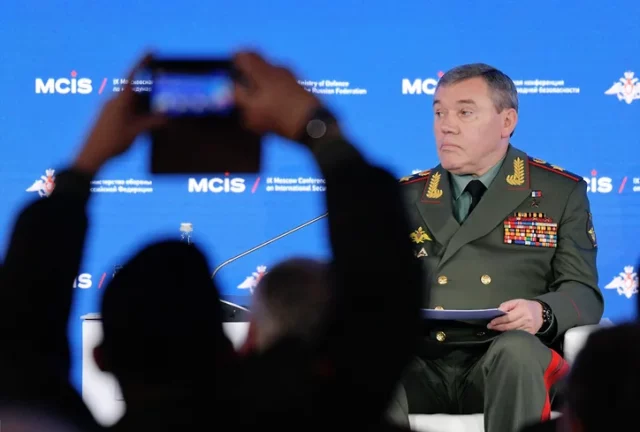
On January 11, the Russian Ministry of Defense once again changed the command structure of the Russian forces fighting against Ukraine. Army General Valery Gerasimov (born in 1955), former chief of the Russian General Staff, finally became the commander of Russia’s joint forces in Ukraine, replacing Army General Sergei Surovikin (1966), commander of the Russian Aerospace Forces (Meduza, January 11). Surovikin had been appointed as the commander of joint forces on October 8, 2022, after several attempts by the Kremlin to establish a working command structure there.

The official reasons for the change included the necessity of increasing coordination between different branches of the Russian Armed Forces and improving quality of logistics as well as overall command and control of military groupings (Kommersant, January 11, 2022). That means, Moscow considers that the previous efforts under Surovikin in these key aspects were largely unsuccessful. Besides Gerasimov, Army General Oleg Salyukov (1955), commander of ground forces, and Colonel General Alexei Kim (1958), former deputy commander of ground forces, who recently became a deputy chief of the General Staff, were also appointed, along with Surovikin, as Gerasimov’s deputies in his command position.

While Gerasimov’s appointment is the latest re-shuffle for the Russian military, it is not the only change that has been made to Russia’s top military brass over the past 11 months. For instance, two commanders of Russia’s airborne troops have already been dismissed: Colonel General Andrei Serdyukov (1962), who commanded the troops from October 2016 to June 2022, and Colonel General Mikhail Teplinsky (1969), who was Serdyukov’s successor until he was recently dismissed on January 23 (Zona.media, January 23, 2023).

The same situation is present in Russia’s military districts. In December 2022, the Western Military District received its fourth commander since the beginning of Russia’s all-out aggression against Ukraine: Lieutenant General Yevgeny Nikiforov (1970), former chief of staff of the Eastern Military District, replaced Colonel General Sergei Kuzovlev (1967), who was then appointed commander of the Southern Military District, after spending only a couple of weeks as the Western Military District commander (Chita.ru, December 30, 2022; RBC, January 23, 2023). Before Kuzovlev, Lieutenant General Roman Berdnikov (1974) had commanded the Western Military District from September to December 2022, when he replaced Colonel General Aleksandr Zhuravlev (1965), who was the district commander in 2018–2022. In the Southern Military District, Kuzovlev replaced Army General Aleksandr Dvornikov (1961), who had been favored by the Kremlin before he failed as a grouping force commander from April to May 2022 (BBC.com/russian, July 20, 2022).

Experts react: The US opens up Caribbean energy supplies with a sanctions exception for Venezuela. What does it mean for the region?

Atlantic Council experts

The United States announced Tuesday that it would allow Trinidad and Tobago to develop a gas field located in Venezuelan territorial waters. The agreement would boost Caribbean energy supply while creating an exception for some US sanctions on Caracas—though the United States says no cash payments will be allowed to go to President Nicolás Maduro’s government as part of Trinidad and Tobago’s deal with Venezuela’s state-run oil company PDVSA. What does this mean for the US stance toward Venezuela, and for energy resources in the Caribbean? Our experts are on the case.
A welcome and necessary act of energy pragmatism

The Caribbean is suffering from the current energy crisis. Still dependent on heavy fuel oil and kerosene, high product prices translate to high electricity prices which undermine the competitiveness of Caribbean tourism and industry. One critical part of decarbonizing Caribbean energy and restoring energy security is enabling better access to natural gas, which helps provide cleaner electricity and cleaner fuels such as methanol and supports food security by producing ammonia for fertilizer. The Biden-Harris administration’s grant of a license to help Trinidad get access to Venezuelan gas, without a dime going to the Maduro regime, is a welcome and necessary act of energy pragmatism. Trinidad needs access to more gas as quickly as possible to produce liquefied natural gas (LNG) and clean fuels. Gas from new exploration could be seven to eight years in the future. The region needs a more secure supply of products now. And with Venezuela reviving the Petrocaribe agreement to again provide cheap loans for the sale of crude oil to its neighborhood, the United States needs to show it cares and can be relevant. Much more needs to be done to provide energy security to the Caribbean, but this license is a deft and critical first step.

David Goldwyn is a nonresident senior fellow at the Atlantic Council’s Global Energy Center and co-chair of the Caribbean Energy Working Group at the Adrienne Arsht Latin America Center’s Caribbean Initiative. He is the president of Goldwyn Global Strategies, an international energy advisory consultancy.

A win for the Caribbean while continuing to isolate the Maduro regime

Experts react: The West finally sends in the tanks. What will they mean for Ukraine’s fight?

Atlantic Council experts

The armor is en route. After months of haggling and delay, both the United States and Germany are sending the battle tanks requested by Ukraine for its extended fight against Russia. German Chancellor Olaf Scholz announced Wednesday that Berlin will send Leopard 2 tanks—and allow other European nations to do so. Meanwhile, the United States will send its own M1 Abrams tanks. What difference will these weapons make on the battlefield? How will Russian President Vladimir Putin react? And is this a turning point for Germany’s participation in arming Ukraine? Our experts lay out what’s next.

These tanks could spearhead a Ukrainian counteroffensive

Germany’s decision, at last, to permit other European states to send Leopard 2 tanks to Ukraine, and to send its own Leopards as well, is a significant step forward in Western support for Ukraine. The concurrent decision by the United States to send Abrams tanks, which seems to have encouraged Berlin to do the right thing, also adds to the value of the weapons package the West is sending Kyiv. The timing is important as Moscow’s months-long offensive in the Donbas near Bakhmut and Soledar has made minor gains in recent days, and Moscow has begun small offensive operations in the Zaporizhzhia region. The tanks will help Ukraine defend its positions with fewer casualties in both locations. They will also prove invaluable if Moscow launches a major offensive from Belarus or elsewhere this year, something that Ukraine’s intelligence services expect. If the tanks reach Ukraine in the next few months—which cannot be taken for granted—they could also be deployed by Ukraine in its own planning for a new counteroffensive. On the flat terrain in Ukraine’s east and south, they could spearhead the counteroffensive.

The delay in sending tanks to Ukraine is part of the pattern of undue US and German caution in arming Ukraine. A well-conducted influence operation by Moscow to suggest that any Western provision of sophisticated arms could prompt Putin to escalate with nuclear weapons has kept the West from moving with dispatch to provide Ukraine the arms necessary to defeat Putin faster on the battlefield. And despite this welcome decision on tanks, this caution is still a factor. (Indeed, the US decision to send the Abrams tanks through the Ukraine Security Assistance Initiative means that delivery will be many months in the future—not in time for a Ukrainian offensive this year.)

When May a Robot Kill? New DOD Policy Tries to Clarify

PATRICK TUCKER

Did you think the Pentagon had a hard rule against using lethal autonomous weapons? It doesn’t. But it does have hoops to jump through before such a weapon might be deployed—and, as of Wednesday, a revised policy intended to clear up confusion.

The biggest change in the Defense Department’s new version of its 2012 doctrine on lethal autonomous weapons is a clearer statement that it is possible to build and deploy them safely and ethically but not without a lot of oversight.

That’s meant to clear up the popular perception that there’s some kind of a ban on such weapons. “No such requirement appears in [the 2012 policy] DODD 3000.09, nor any other DOD policy,” wrote Greg Allen, the director of the Artificial Intelligence Governance Project and a senior fellow in the Strategic Technologies Program at the Center for Strategic and International Studies.

What the 2012 doctrine actually says is that the military may make such weapons but only after a “senior level review process,” which no weapon has gone through yet, according to a 2019 Congressional Research Service report on the subject.

That’s led to a lot of confusion about the Defense Department’s policy on what it can and can’t build—confusion that has not been helped by military leaders and officers who insist that they are strictly prohibited from building lethal autonomous weapons. In April 2021, for example, then-Army Futures Command head Gen. John Murray said, “Where I draw the line—and this is, I think well within our current policies – if you’re talking about a lethal effect against another human, you have to have a human in that decision-making process.” But that’s not what the policy actually said.

Putin’s Miscalculation

Fred Kaplan

The most stunning geopolitical surprise of the past year is how poorly the Russian military has been fighting in Ukraine. When Vladimir Putin ordered the invasion in February 2022, everyone—including the US intelligence analysts who had predicted it—assumed that Volodymyr Zelensky’s government in Kyiv would fall within a few weeks or even days and be replaced by a Moscow-bred puppet regime. Some anticipated that a long insurgency war might then follow, but no one was impetuous enough to guess that nearly a year later the Ukrainians would be not only fighting the Russians to a standstill but pushing them back on nearly every front.

Has the Ukrainian army turned out to be much better than imagined, or has the Russian army turned out to be a lot worse, or both? In Putin’s Wars, Mark Galeotti, a British scholar and journalist highly regarded by experts on Russian military matters, attributes the unexpected battlefield outcome to Russian weaknesses as well as Ukrainian strengths (greatly abetted by NATO weapons and American intelligence resources), but he lays out a persuasive, detailed case that Russia’s deficiencies are more severe and more deeply rooted than many Western officials and pundits had detected.

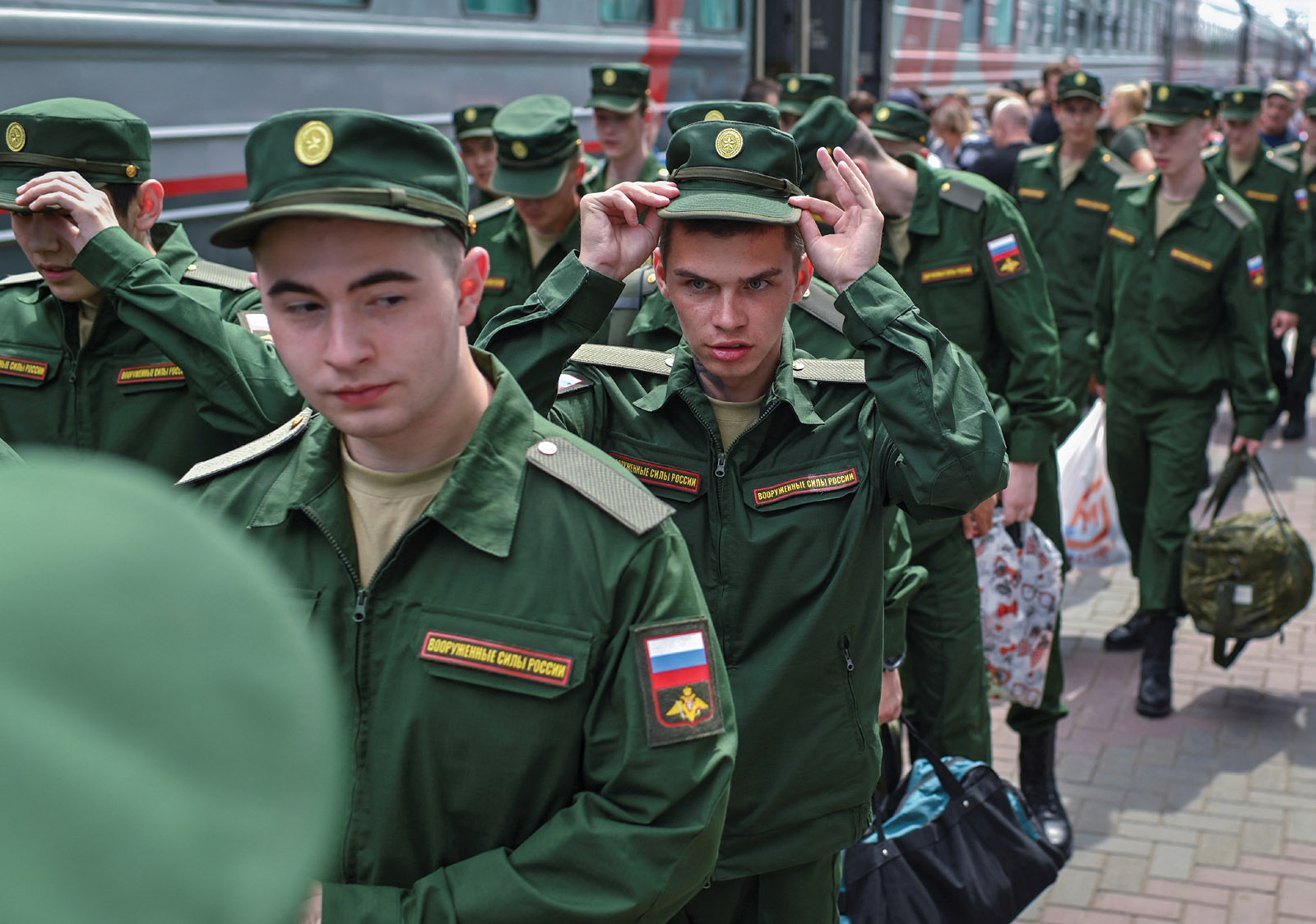
Galeotti notes that Moscow overloads its army with weapons but allots too little money and attention to the mundane stuff of logistics—spare parts, food, water, and the trucks to transport them—thus leaving supply lines vulnerable and making offensive operations unsustainable. Junior officers receive rote training, so they’re unprepared to take the initiative—a deliberate policy to keep them from rebelling against senior officers, though as a consequence, campaigns can plunge into chaos if they don’t go as planned. Combine all this with widespread hazing of enlisted men, ramshackle barracks, poor nutrition, and low pay, and it should have been foreseeable that while today’s Russian soldiers might be roused to defend the motherland, they’re lackluster at invading other countries.

What we learned at Davos: signs of hope emerge from the pessimism


Larry Elliott 

The world has become hard-wired for pessimism, and there was plenty of it on display in Davos last week.

Much has changed in the 52 years since the World Economic Forum was first held in the Swiss ski resort. At that original WEF summit the global economy was dominated by the rich nations of Europe and northern America, currencies were fixed under the Bretton Woods system, and oil was $2 a barrel.

The cold war between the US and the Soviet Union was still raging. It was a pre-digital age; personal computers and smartphones were things of the future. Artificial intelligence (AI) was the stuff of science fiction.

But the thing that has really changed is that a sense of things getting better has been replaced in the developed world by a feeling that things are getting worse.

The vision of the future is dystopian, one in which people get poorer not richer, robots steal all the jobs, and an addiction to fossil fuels leads to the extinction of the planet.

António Guterres, the UN secretary-general, made it clear he thought the battle against climate change was being lost; Volodymyr Zelenskiy’s call for Ukraine to be supplied with German-made heavy tanks was a reminder that a war has been fought in Europe for nigh-on a year.

Fears were raised about a new debt crisis affecting scores of the world’s poorest countries. A global pandemic and the return of double-digit inflation have deepened the sense of foreboding.

Russian Robot Maker Working On Bot to Target Abrams, Leopard Tanks

PATRICK TUCKER

A Russian manufacturer says it is adapting one of its ground robots to target Abrams and Leopard tanks—the types heading to Ukraine from the United States, Germany, Poland and other countries.

Dmitry Rogozin, a former head of of the Russian space corporation Roscosmos and current head of the “Royal Wolves” group, which advises the Russian government, took to Telegram on Wednesday to announce that his group was working with the Advanced Research Foundation and a company called Android Technology to develop a combat version of Android’s Marker ground reconnaissance robot.

“Everyone agrees that our strike [version] of the Marker, before the arrival of the Abrams and Leopards in Ukraine, should be prepared for their destruction,” Rogozin posted.

In an interview published by Russian news site RIA Novosti, Rogozin said the Marker would “be able to automatically detect and hit the ‘Abrams’, ‘Leopard’ and other vehicles due to the electronic catalog in the control system with images of enemy equipment.”

In 2018, Android made headlines with a claim that it would put a robotic cosmonaut named FEDOR onto the International Space Station. That hasn’t happened.

Russia is unlikely to field ground combat robots to Ukraine in large numbers, said Sam Bendett, an adjunct senior fellow at the Center for a New American Security and an adviser at the CNA Corporation.

“It appears that most of the existing Markers, 3 out of 5, will in fact be tested in Ukraine, and can be lost in combat,” Bendett said via email. “It also appears that Android Technology is actually ok with that, indicating a willingness to respond to the [Ministry of Defense] needs for improved weapons and tactics, and perhaps indicating that the company is working on other projects that can build on the Marker experience.”

How well would a Russian robot perform against a well-trained human tank crew? On Twitter, Bendett expressed skepticism, calling the announcement mostly a PR stunt.

The Most Important Foreign Policy Paper of the 20th Century

Francis P. Sempa

On the evening of January 25, 1904, at the Royal Geographical Society’s meeting at its building located on 1 Savile Row in London, Halford Mackinder delivered a paper titled “The Geographical Pivot of History.” It was arguably the most important foreign policy paper of the 20th century. Mackinder, who at the time was a Reader in Geography at Oxford University and the Director of the London School of Economics and Political Science, presented a geo-historical sketch of the globe that foresaw the struggles for power that dominated the 20th century. And as China strives for global preeminence in the 21st century, policymakers can still benefit from reading Mackinder’s paper.

Mackinder characterized the preceding 400 years of history as the “Columbian epoch,” which he said had come to an end shortly after the year 1900. “In 400 years,” he noted, “the outline of the map of the world has been completed with approximate accuracy,” and we were now able to “chronicle its virtually complete political appropriation.” And what that meant for international relations was that the entire globe was now a “closed political system.” “Every explosion of social forces,” he explained, “instead of being dissipated in a surrounding circuit of unknown space and barbaric chaos, will be sharply re-echoed from the far side of the globe, and weak elements in the political and economic organism of the world will be shattered in consequence.” It was now possible, he said, “to attempt, with some degree of completeness, a correlation between the larger geographical and the larger historical generalizations” to express “certain aspects . . . of geographical causation in universal history.”

Mackinder later recalled that the events which inspired what scholars have since called the “pivot paper” were Britain’s war in South Africa and the Russo-Japanese War, which triggered his study of the historical evolution of the expansion of British sea power and Russian land power in the preceding decades and centuries. In the pivot paper, Mackinder recounted the centuries of history from Roman times to the present which exposed the “Asiatic influences upon Europe.” He identified the Mongol invasions of the 15th century, when “all the settled margins of the Old World sooner or later felt the expansive force of mobile power originating in the [Eurasian] steppe,” as particularly revealing about the future of global geopolitics. Europe and Asia were one continent, not two, and Eurasia contained most of the world’s people and resources. And after the Mongol’s decline, British sea power expanded across the globe while, simultaneously, Russian land power expanded across Asia. These broad geopolitical developments eventually led to the “Great Game” of the 19th century when British sea power and Russian land power clashed in Central Asia.

Big Data and the Law of War

Paul Stephan 

Big data looms large in today’s world. Much of the tech sector regards the building up of large sets of searchable data as part (sometimes the greater part) of its business model. Surveillance-oriented states, of which China is the foremost example, use big data to guide and bolster monitoring of their own people as well as potential foreign threats. Many other states are not far behind in the surveillance arms race, notwithstanding the attempts of the European Union to put its metaphorical finger in the dike. Finally, ChatGPT has revived popular interest in artificial intelligence (AI), which uses big data as a means of optimizing the training and algorithm design on which it depends, as a cultural, economic, and social phenomenon.

If big data is growing in significance, might it join territory, people, and property as objects of international conflict, including armed conflict? So far it has not been front and center in Russia’s invasion of Ukraine, the war that currently consumes much of our attention. But future conflicts could certainly feature attacks on big data. China and Taiwan, for example, both have sophisticated technological infrastructures that encompass big data and AI capabilities. The risk that they might find themselves at war in the near future is larger than anyone would like. What, then, might the law of war have to say about big data? More generally, if existing law does not meet our needs, how might new international law address the issue?

In a recent essay, part of an edited volume on “The Future Law of Armed Conflict,” I argue that big data is a resource and therefore a potential target in an armed conflict. I address two issues: Under the law governing the legality of war (jus ad bellum), what kinds of attacks on big data might justify an armed response, touching off a bilateral (or multilateral) armed conflict (a war)? And within an existing armed conflict, what are the rules (jus in bello, also known as international humanitarian law, or IHL) governing such attacks?

DoD’s update to autonomous weapons policy accounts for AI’s ‘dramatic’ future role

JASPREET GILL

WASHINGTON — The Pentagon today updated its decade-old guidance on autonomous weapon systems to include advances made in artificial intelligence, a new senior-level oversight group and clarification about the roles different offices within the department will take.

“I think one of… the things we sought to accomplish in the course of the update is clarifying the language to ensure a common understanding both inside and outside the Pentagon of what the directive says,” Michael Horowitz, director of the Pentagon’s Emerging Capabilities Policy Office, told reporters today ahead of the revised directive’s release, calling it “not a major policy change.” “The directive does not prohibit the development of any particular weapon system. It lays out requirements for autonomous and semi autonomous weapon systems.”

DoD directive 3000.09, initially signed on Nov. 21, 2012 by then-Deputy Secretary of Defense Ash Carter, “establishes DoD policy and assigns responsibilities for the development and use of autonomous and semi-autonomous functions in weapon systems, including manned and unmanned platforms.”

Last May Breaking Defense was first to report some details of the coming revision. At the time, Horowitz said in an interview that the “fundamental approach in the directive remains sound, that the directive laid out a very responsible approach to the incorporation of autonomy and weapons systems.”

Still, one of the biggest things the revised directive [PDF] accounts for is the “dramatic, expanded vision” for the role of AI in future military operations, he added. The revisions reflect DoD’s work on its “responsible AI” and AI ethical principles initiatives.

AI Developers Release Open-Source Implementations of ChatGPT Training Algorithm

Anthony Alford

AI research groups LAION and CarperAI have released OpenAssistant and trlX, open-source implementations of reinforcement learning from human feedback (RLHF), the algorithm used to train ChatGPT. Independent AI developer Phil Wang has also open-sourced his own implementation of the algorithm.

LAION, the Large-scale Artificial Intelligence Open Network, is a non-profit machine learning research organization dedicated to making AI models, datasets, and code available to the public. In 2022, InfoQ covered LAION's release of LAION-5B, an AI training dataset containing over five billion image-text pairs. LAION's latest project is OpenAssistant, which is intended to "give everyone access to a great chat based large language model." The planned MVP implementation of OpenAssistant will be based on OpenAI's InstructGPT paper: a dataset of human-generated instructions, a dataset of machine-generated responses and their human rankings, and an implementation of RLHF. According to LAION:

We are not going to stop at replicating ChatGPT. We want to build the assistant of the future, able to not only write email and cover letters, but do meaningful work, use APIs, dynamically research information, and much more, with the ability to be personalized and extended by anyone. And we want to do this in a way that is open and accessible, which means we must not only build a great assistant, but also make it small and efficient enough to run on consumer hardware.

ChatGPT Is Coming for Classrooms. Don't Panic


WHEN HIGH SCHOOL English teacher Kelly Gibson first encountered ChatGPT in December, the existential anxiety kicked in fast. While the internet delighted in the chatbot’s superficially sophisticated answers to users’ prompts, many educators were less amused. If anyone could ask ChatGPT to “write 300 words on what the green light symbolizes in The Great Gatsby,” what would stop students from feeding their homework to the bot? Speculation swirled about a new era of rampant cheating and even a death knell for essays, or education itself. “I thought, ‘Oh my god, this is literally what I teach,’” Gibson says.

But amid the panic, some enterprising teachers see ChatGPT as an opportunity to redesign what learning looks like—and what they invent could shape the future of the classroom. Gibson is one of them. After her initial alarm subsided, she spent her winter vacation tinkering with ChatGPT and figuring out ways to incorporate it into her lessons. She might ask kids to generate text using the bot and then edit it themselves to find the chatbot’s errors or improve upon its writing style. Gibson, who has been teaching for 25 years, likened it to more familiar tech tools that enhance, not replace, learning and critical thinking. “I don’t know how to do it well yet, but I want AI chatbots to become like calculators for writing,” she says.

Gibson’s view of ChatGPT as a teaching tool, not the perfect cheat, brings up a crucial point: ChatGPT is not intelligent in the way people are, despite its ability to spew humanlike text. It is a statistical machine that can sometimes regurgitate or create falsehoods and often needs guidance and further edits to get things right.

Despite those limitations, Gibson also believes she has a responsibility to bring ChatGPT into the classroom. She teaches in a predominantly white, rural, low-income area of Oregon. If just the students who have ready access to internet-connected devices at home can gain experience with the bot, it could widen the digital divide and further disadvantage students who don’t have access. So Gibson figured she was in a position to turn ChatGPT into, to use educator-speak, a teachable moment for all of her students.

The risks of 5G security

Karl Greenberg

Unless you've been living under a rock for the past decade, you’ve probably heard of 5G telecommunications. But what is it?

Thanks to the advent of open radio access networks, or Open RAN, which adds a huge software ecosystem to the radios, cell towers and base stations converting wireless signals to data, 5G is a ginormous data onramp to the network of networks we call the internet. The latest generation of wireless promises to deliver, to filch from a Hollywood box-office title, “Everything Everywhere All At Once.”

What is 5G security?

5G security, operating outside the walled garden of dedicated equipment, servers and protocols that characterized 4G LTE, involves a software ecosystem as part of the “virtualization” of RAN and implicates containers, microservices and other cloud-forward services as a new core network.

As former FCC Chairman Tom Wheeler wrote in a recently released Brookings report on securing 5G systems, the 5G standard brings with it two synergistic cybersecurity challenges:The 5G standard “virtualization” means network functions that used to be performed by proprietary or single-vendor hardware are now being performed by software, and software is hackable — ergo, network infrastructure built on software code is vulnerable.
Network operators are supplementing or replacing traditional infrastructure vendors and closed proprietary systems with an expanded set of vendors bearing O RAN protocols. Wheeler wrote that this diversity of suppliers could become a per se invitation to a new diversity of unaddressed attack vectors

Robot adoption, worker-firm sorting, and wage inequality: Evidence from administrative panel data

Ester Faia, Gianmarco Ottaviano, Saverio Spinella

Technological progress has contributed to rising wage inequality in recent decades. This column argues that automation and digitalisation increasingly require workers with specialised knowledge for specific tasks. In this setting, automation can enhance complementarities between workers’ specialised skills and firms’ specific tasks. Using administrative data from Italy, the authors show that automation increases worker-firm sorting and increased sorting contributes to rising wage dispersion. The welfare consequences and growth prospects stemming from this mechanism remain open questions for study.

Wage inequality is on the rise as much as wealth inequality. There is consensus that part of this rise is due to technological progress. The exact mechanism by which modern technology adoption affects inequality, however, is still open to debate. Katz and Murphy (1982) have popularised the view that, by assigning large premia to education, ‘skill-biased technological change’ (SBTC) raises wage inequality via vertical skill acquisition. Previous waves of technology improvements, however, did not produce the same effects, prompting researchers to ask what is special about the most recent waves. Recent studies indicate that the premium is not so much related to skill per se, but to the task content of each occupation. Certain tasks, particularly non-routine ones, are in high demand and earn extra premia, a view that has been labelled routine-task-biased technological change. While with skill-biased technological change new technology complements workers with high skills, with ‘routine-biased technological change’ (RBTC) new technology decreases demand for workers in traditional routine tasks while creating additional demand for workers in new complex tasks.

We push those ideas a step further by arguing that modern technologies such as automation and digitalisation increasingly require human operators with specialised knowledge of automated systems involving specific algorithms, software, and machines. The associated growing demand for specialised knowledge is conducive to a form of workers’ specialisation that increasingly matters above and beyond what would be needed by the high skill content of tasks or their routine intensity. This view implies that wage differentiation is due not only to vertical specialisation (higher knowledge more generally), but to horizontal specialisation (knowledge specialised to the task, no matter whether the latter is routine or complex). The underlying mechanism relies on the concept of positive assortativity of workers and firms/tasks: match surplus is the highest when the firm adopting the technology hires the worker specialised in that technology. If so, specialised workers’ wage also rise due to rent sharing arguments and so will wage dispersion (see also Benzell and Yifan Ye 2021 for the impact of automation on wage inequality).

Will the Metaverse Live Up to the Hype? Game Developers Aren’t Impressed

MEGAN FAROKHMANESH

THE PERFECT VERSION of the metaverse, to hear tech heads like Mark Zuckerberg tell it, marries social media, entertainment, and—most exciting of all—meetings in one pristine virtual space. Long ago foretold in Neal Stephenson’s Snow Crash, it is a place where the online world offers more experiences than the flesh-and-bone one. But whereas Stephenson’s metaverse was part of an apocalyptic future, modern inventors have promised a digital utopia.

Unfortunately, the metaverse they’ve built has, so far, lived up to those expectations about as well as a Craigslist apartment rented based on photos alone. Zuckerberg’s Horizon Worlds, clunky and strange, may have been at its most thrilling when Meta informed users that legs for their avatars were “coming soon.” The hardware needed to visit such virtual worlds—often a headset like Meta’s Quest Pro—can be pricey and cumbersome, and once you get there, it’s no party.

None of this is lost on those who actually build digital worlds. In a survey released today by the organizers of the Game Developers Conference, a whopping 45 percent of them said “the metaverse concept will never deliver on its promise.” It was the most popular response to a question about which companies or platforms are “best placed to deliver on the promise of the metaverse concept,” and a telling sign of what kind of faith the industry is putting in the long-term potential of immersive virtual worlds. “The people trying to sell it have no idea what it is,” wrote one respondent, “and neither do the consumers.”

The survey, released by GDC ahead of its annual event in late March, comes after a rough 2022 for metaverse evangelists. Not only is there cynicism about who is building these worlds, and for what purpose, but many potential metaverse inhabitants aren’t convinced there’s any there there. Meta lost money and laid off workers last year, and even proto-metaverse worlds like Minecraft and Roblox now sit low on the game developers’ list for anticipated success.

It’s not for a lack of trying. Some developers are still interested in releasing AR/VR games on platforms like Meta Quest and PlayStation VR2. Of those polled, 36 percent listed Meta Quest as a platform they expect to release their next game on. For PS VR2, that number is 18 percent.

28 January 2023

Sri Lanka Says Debt-restructuring Talks Making Progress

Bharatha Mallawarachi

Debt-stricken Sri Lanka’s Central Bank chief said Wednesday that the country is making good progress in talks with its creditors to obtain financial assurances for debt restructuring, an important step toward finalizing an International Monetary Fund rescue plan.

Sri Lanka is bankrupt and has suspended repayment of its $51 billion foreign debt, of which $28 billion must be repaid by 2027.

It has reached a preliminary agreement with the IMF for a $2.9 billion rescue package over four years. Its completion hinges on assurances on debt restructuring from creditors that include China, India, and the Paris Club, a grouping of major creditor nations.

India announced last week that it has given its assurance to the IMF to facilitate the bailout plan. India has extended $4.4 billion in official credit to Sri Lanka, excluding other forms of lending.

“Other bilateral creditors, Paris Club, China and small bilateral creditors are in the process of issuing financial assurances,” Sri Lankan Central Bank Governor Nandalal Weerasinghe said.

The “process is making very good progress,” Weerasinghe told reporters at his office, saying the country hopes to receive “the necessary financial assurances from all our creditors in a very short period.”

Sri Lanka borrowed heavily from China over the past decade for infrastructure projects that include a seaport, airport, and a city being built on reclaimed land. The projects failed to earn enough revenue to pay for the loans, a factor in Sri Lanka’s economic woes.

China accounts for about 20 percent of Sri Lanka’s loans, making it the state’s largest bilateral creditor. That means Beijing’s cooperation in the debt restructuring process is critical. In general, however, China is often reluctant to provide debt relief, fearing that other debtor countries would demand similar treatment. Beijing prefers to suspend payments as a form of temporary relief.

Where Does South Asia Fit Now in US Security and Defense Strategies?

Monish Tourangbam and Vasu Sharma

The latest U.S. National Security Strategy (NSS) and National Defense Strategy (NDS) categorically highlight China’s assertive behavior in the Indo-Pacific and Russia’s invasion of Ukraine as threats to the U.S.-led liberal international order. South Asia in terms of regional priorities for the U.S. is largely subsumed under the Indo-Pacific strategy and is likely to remain so considering evolving geopolitics.

More than anything else, the long war in Afghanistan shaped the United States’ South Asia strategy for the last two decades. Therefore, the withdrawal of U.S. forces from Afghanistan in 2021 has regenerated the debate on what South Asia, and more particularly India, Afghanistan and Pakistan, fit into U.S. national security and defense strategies.

U.S. engagement in Afghanistan stands reduced to “over the horizon” counterterrorism capabilities and highly contingent upon the nature of its relationship with the Taliban. The Pakistan-U.S. relationship is highly circumscribed, and the India-U.S. partnership has assumed a broader strategic arc in the Indo-Pacific era.

Although both the NSS and NDS make no mention of South Asia as a region of strategic priority, the U.S. policy toward South Asia can be discerned via two lenses. First, through the India-U.S. partnership, which has been deemed vital for counterbalancing Beijing’s presence in the Indian Ocean Region. And second, in the focus on ensuring the security of the U.S. homeland, with no future attacks emanating from Afghanistan. Following the withdrawal from Afghanistan, U.S. dynamics with Pakistan seem highly transactional, depending on what Pakistan can offer for U.S. counterterrorism goals in the region, and what the U.S. can offer Islamabad in terms of military and non-military assistance.