3 June 2023

America and China Are on a Collision Course

NOURIEL ROUBINI

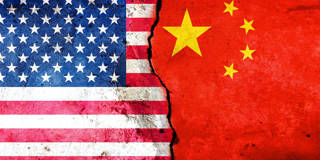
The G7 countries may have set out to deter China without escalating the new cold war, but the perception in Beijing suggests that they failed to thread the needle at their recent summit in Hiroshima. It is now clear to all that the United States, its allies, and any partners they can recruit are committed to containing China’s rise.

NEW YORK – Following the May G7 summit in Hiroshima, US President Joe Biden claimed that he expects a “thaw” in relations with China. Yet despite some recent official bilateral meetings – with US Secretary of the Treasury Janet Yellen expressing hopes for a visit to China soon – relations remain icy.

In fact, far from thawing, the new cold war is getting colder, and the G7 summit itself magnified Chinese concerns about the United States pursuing a strategy of “comprehensive containment, encirclement, and suppression.” Unlike previous gatherings, when G7 leaders offered mostly talk and little action, this summit turned out to be one of the most important in the group’s history. The US, Japan, Europe, and their friends and allies made it clearer than ever that they intend to join forces to counter China.

Moreover, Japan (which currently holds the group’s rotating presidency) made sure to invite key leaders from the Global South, not least Indian Prime Minister Narendra Modi. In reaching out to rising and middle powers, the G7 wants to persuade others to join its more muscular response to China’s rise. Many will likely agree with the depiction of China as an authoritarian, state-capitalist power that is increasingly assertive in projecting power in Asia and globally.


A possible turning point for US–China defence links


The American and Chinese delegations to the IISS Shangri-La Dialogue 2023 have an opportunity to make modest progress improving bilateral communication mechanisms regarding security and defence issues.

Security ties between China and the United States will be a central focus for delegates gathering on 2 June for the 20th IISS Shangri-La Dialogue in Singapore. The 2022 summit featured a debut bilateral meeting between China’s then-defence minister General Wei Fenghe and US Secretary of Defense Lloyd Austin, raising tentative hopes for renewed military dialogue between the two powers. These hopes, however, appear to have amounted to little over the last 12 months.

Sino-American relations have instead worsened steadily, reaching a low point after then-speaker of the US House of Representatives Nancy Pelosi’s visit to Taiwan in August 2022. In addition to a series of assertive military displays, China signalled its displeasure at Pelosi’s trip via what it called the ‘three cancellations’, meaning the suspension of a trio of operational-level military-to-military communication channels with the US.

So far, those channels have not been fully restored. To take one example, Austin and Wei met for a second time in November 2022 on the sidelines of the ASEAN Defence Ministers’ Meeting–Plus in Cambodia. During their meeting, the duo reportedly agreed to reinstate one of the three suspended mechanisms, which involved talks between US Indo-Pacific Command (USINDOPACOM) and China’s Southern Theatre Command (the division of the People’s Liberation Army responsible for the South China Sea).

Speaking during an IISS lecture in March 2023, US Admiral John Aquilino, USINDOPACOM commander, noted that even this formal ministerial-level agreement had been insufficient for talks to resume:

‘I have not yet received a response for a year and a half to accept my request for a conversation. I haven’t received a no[.] … I’ve just received no answer. … We continue to ask because I do think it’s important. But it’s concerning to me that I don’t have the ability to talk to someone should there be a reason to talk.

The inability of Beijing and Washington to maintain even a rudimentary level of communication regarding defence issues is a growing cause of concern in Southeast Asia and around the region more broadly. Many onlooking defence ministers will gather in Singapore this week and will likely put pressure on both China and the US, in private at least, to use the opportunity presented by the dialogue to strike a more conciliatory tone and begin to de-escalate tensions that have built up over the last year.

The Rise of Xi Jinping’s Young Guards: Generational Change in the CCP Leadership

Guoguang Wu

After firmly concentrating his political power, Chinese leader Xi Jinping has begun promoting a new wave of generational change within the country’s leadership.

This shift began at the 20th National Congress of the Chinese Communist Party (CCP), held in October 2022, and was confirmed at the latest session of the National People’s Congress in March 2023, completing a significant round of power redistribution throughout the Chinese party-state system. Many fresh faces have risen to national, provincial, and ministerial offices, several of whom are relatively young by the standards of Chinese elite politics. CCP cadres born during the 1970s are now gaining long-overdue opportunities to rise to the system’s higher echelons, while those born in the mid- to late 1960s have climbed to the top of the hierarchy, occupying positions in the Politburo and State Council and key provincial leadership slots.

Who are the rising stars emerging in the second decade of Xi’s reign? How young are they, exactly? What does their relative advantage in age mean? What are the salient characteristics of the winners in this round of intraparty power redistribution? And what does their rise mean for China’s elite politics?

This paper begins to address these questions by sketching a profile of these younger high-ranking cadres, with a focus on their roles in the composition of the new CCP Central Committee and the reshuffled provincial leadership lineup. It will first discuss the younger members of the national leadership, especially those who are part of the elite 24-member Politburo, which is the core of China’s party-state system, and analyze Xi’s strategic use of age considerations in personnel movements to strengthen his political power. The paper then will examine younger members of the Central Committee and younger leaders at the subnational level, with special attention to two prominent groups with backgrounds in finance and technology.

Rising Stars over Zhongnanhai: The Politics of Age Regarding Younger Members of the National Leadership

By the time of their inauguration, the CCP’s new top leaders anointed at the 20th Party Congress were older than those inaugurated 5, 10, or 20 years ago. The average age of the Politburo Standing Committee (PSC) members selected in October 2022 was 65.1, compared with 62.9 in 2017, 63.1 in 2012, and 62.0 in 2002. This reflects a trend of postponing the promotion of younger cadres during Xi’s tenure. Upon taking office, Xi had a relatively weak power base and was confronted with a group of cadres who had been promoted under his predecessors, Hu Jintao and Jiang Zemin. Many of these cadres occupied high-ranking positions despite their relative youth. Most notably, the two youngest members of the 18th Politburo (2012–2017), Sun Zhengcai (born September 1963) and Hu Chunhua (April 1963), joined the powerful decision-making body at only 49 years old. Xi’s fierce anticorruption campaign targeted many younger leaders, including Sun Zhengcai.

Anti-Chinese Protests Are on the Rise in Myanmar

Sebastian Strangio

Yesterday, The Irrawaddy magazine published an article detailing the recent rise in anti-Chinese incidents in Myanmar, following the visit of Chinese Foreign Minister Qin Gang to the country at the start of May.

According to the report, Qin’s visit, the first by a top-level Chinese government official since the coup, was followed by spotfire protests across the country, airing the widely felt grievances about China’s engagement with the military junta. These included a demonstration in Letpadaung, Sagaing Region, the site of a controversial China-backed copper mine, during which protesters burned a Chinese flag.

Similar symbolic immolations took place in Magwe, Yangon, Mandalay, and elsewhere in Sagaing, where resistance groups burned Chinese flags along with pictures of Qin and junta chief Min Aung Hlaing, while hoisting banners calling on Beijing to stop “supporting fascist criminals” and to “respect the Myanmar people’s voice.”

The Irrawaddy also quoted a member of the General Strike Coordination Body (GSCB), an anti-regime group, as saying that resistance forces would “step up our protests” against China’s collusion with the hated military administration. “As long as the Chinese government continues to support the regime and stand by it publicly, we will continue to organize anti-China protests, not only in Myanmar but also in foreign countries together with Myanmar expats there,” the GSCB member said.

During his one-day visit to Myanmar on May 2, my colleague Shannon Tiezzi noted at the time, Qin held talks with junta chief Senior Gen. Min Aung Hlaing during which he pledged “deepen practical cooperation in such fields as economy and livelihood, and support Myanmar’s efforts to maintain stability, revitalize the economy, improve people’s lives, and realize sustainable development,” according to a statement from China’s Foreign Ministry. In the context of the ongoing armed resistance against the coup government, it also pledged to “support Myanmar’s efforts to maintain stability.”

Ukraine peace plan is only way to end Russia’s war, says Zelensky aide


KYIV: Kyiv’s peace plan is the only way to end Russia’s war in Ukraine and the time for mediation efforts has passed, a top aide to President Volodymyr Zelensky said.

Chief diplomatic adviser Ihor Zhovkva told Reuters that Ukraine had no interest in a cease-fire that locks in Russian territorial gains, and wanted the implementation of its peace plan, which envisages the full withdrawal of Russian troops.

He pushed back on a flurry of peace initiatives from China, Brazil, the Vatican and South Africa in recent months.

“There cannot be a Brazilian peace plan, a Chinese peace plan, a South African peace plan when you are talking about the war in Ukraine,” Zhovkva said in an interview late on Friday.

Zelensky made a major push to court the Global South this month in response to peace moves from some of its members. He attended the Arab League summit in Saudi Arabia on May 19, holding talks with host Crown Prince Mohammed bin Salman, Iraq and other delegations.

He then flew to Japan where he met the leaders of India and Indonesia — important voices in the Global South — on the sidelines of the Group of Seven summit of major economic powers in Hiroshima.

While Kyiv has staunch backing from the West in its struggle against the Kremlin, it has not won the same support from the Global South — a term denoting Latin America, Africa and much of Asia — where Russia has invested diplomatic energy for years.

Moscow has bolstered ties with Global South powers during the war in Ukraine, including by selling more of its energy to India and China.

In response to a Western embargo on seaborne Russian oil imports, Russia has been working to reroute supplies away from its traditional European markets to Asia, Africa, Latin America and the Middle East.

Jamestown Foundation China


Party Ties: Vietnam, Cuba and China’s Relations with Other Marxist-Leninist States

PRC Influence Operations in the Philippines: Can Beijing Flip the South China Sea Script?

Serving the Real Economy: From De-dollarization to RMB Internationalization?

Can the Belt and Road Initiative Succeed in Afghanistan?

Xi Jinping and Taiwan: Change and Continuity with Past CCP Leaders

Terrorism Monitor, May 26, 2023, v. 21, no. 11 Brief: JNIM Pursuing Localized Agenda in Mali

Brief: Abu Sayyaf Surrenders Indicate Growing Dysfunction

Narrative Battle Surrounds Killings of Communist Insurgent Couple in the Philippines

France Seeks Influence Reboot in Africa Amid Sahelian Military Withdrawal

Sudan’s Fratricidal Conflict: An Assessment of SAF and RSF Strategies and Tactics

Putin and the Psychology of Nuclear Brinksmanship

Rose McDermott, Reid Pauly, and Paul Slovic

Shortly after the West rebuked Russia for its 2022 invasion of Ukraine and imposed financial sanctions of unprecedented scope, Russian President Vladimir Putin announced that he was putting his country’s nuclear forces on high alert. The Kremlin has issued many more nuclear threats, some oblique and some explicit, since then.

The mere possibility that Putin might make good on these threats raises great concern. Even before the war in Ukraine, Russia had reversed its longtime “no first use” policy, under which it claimed it would never go nuclear unless the enemy did so first. Some now believe Russia has switched to an approach known as “escalate to de-escalate,” which holds that nuclear escalation can defuse a crisis by proving one’s commitment to destruction and forcing the enemy to capitulate. In Ukraine, that could mean using a handful of tactical, low-yield nuclear weapons on the battlefield—which CIA Director William Burns and a number of high-ranking U.S. military leaders have warned is possible. Putin, for his part, has merely said that Russia reserves the right to use nuclear weapons if confronting an “existential” threat.

What constitutes an existential threat, however, is not clearly delineated in Russian strategic doctrine. It lies in the eye of the beholder—in this case, Putin, who retains full control of Russia’s nuclear arsenal, albeit subject to a supposed requirement that Russia’s defense minister and the chief of the general staff of the armed forces authenticate his launch orders. The answer, in other words, comes down to one of the most opaque aspects of the current crisis: the state of Putin’s mind and his outlook on the world.

Much of the debate around Putin’s psychological disposition has centered on whether the Russian president acts rationally. That discussion is an important one, but it has at times lacked nuance. A sounder approach may be to ask what common psychological biases and pathologies, based on behavioral theory and research, shape people’s perception of nuclear war—and how they may apply to the Russian leader. How far Putin will take his nuclear brinkmanship remains anybody’s guess. But a combination of known psychological and cognitive biases, combined with some psychological tendencies characteristic of Putin, could prove extraordinarily dangerous if he feels backed into a corner, with potentially massive implications as Ukraine begins its spring offensive.

Write algorithms, wage EW, share data: Lessons from Ukraine war

COLIN CLARK

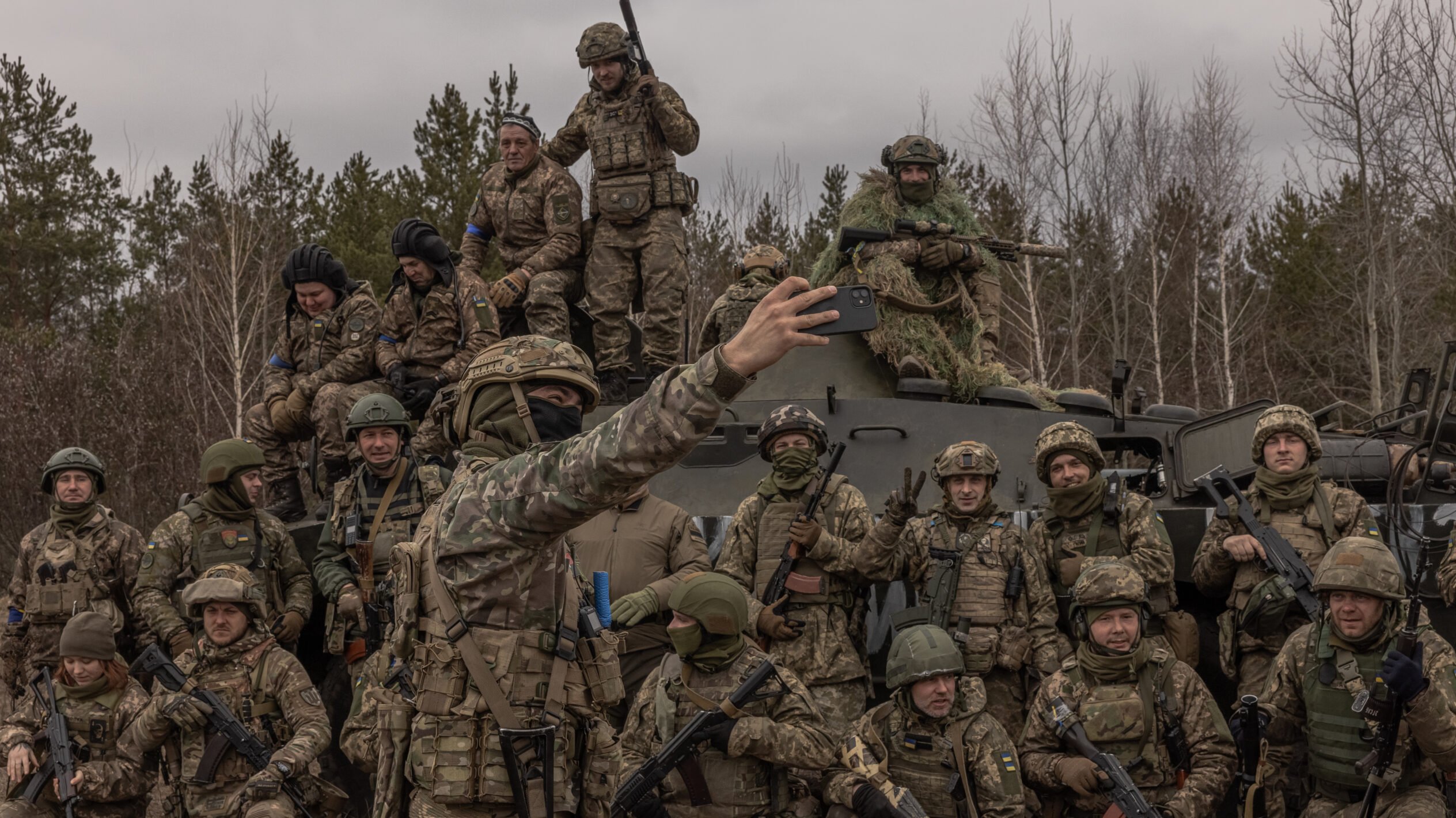
Members of Ukraine’s Territorial Defense Forces pose for photos during their military training on February 27, 2023 near Chernobyl, Ukraine. Russia’s large-scale assault on Ukraine has entered its second year, with the fiercest fighting concentrated in the country’s east and south. (Photo by Roman Pilipey/Getty Images)

LANPAC — The importance of a military’s ability to write algorithms at the edge of battle and then use them effectively, combined with a willingness to change doctrine and tactics to anticipate and destroy enemy forces, may be the biggest lessons of the Ukraine war, a key leader of the US Army’s XVIII Airborne Corps said last week.

The formidable forces of Russia were expected to sweep across Ukraine in a few short weeks. While Ukrainian forces wobbled in the first days of war they quickly began to adapt and use new tactics, techniques and procedures, getting inside the unchanging Russian decision-making process, TJ Holland, Command Sgt. Major of the XVIII Airborne Corps noted at the recent LANPAC conference in Honolulu.

He compared the situation to the start of World War II, where many experts thought France possessed one of the world’s best armies, a force that could stand up to German aggression. But Germany mounted a relatively small number of FM radios on its land vehicles and changed the speed of decision making, allowing the Nazis to overcome French forces in a remarkable six weeks.

“Ukraine’s using data right now as effectively and efficiently as the Germans used FM radio,” Holland said. “And they’re able to mass effects at the most decisive point in time to achieve their operational advantage, because they’re making decisions faster than the Russians can, because the Russians — guess what, like the French — they’re stuck in their way of war. And that’s a really great thing.”

Key to moving men and materiel — massing effects — is the ability to gather and use data. Ukraine, with its innovative use of the commercial Starlink satellite system, coordination with the United States and other NATO allies, is proving to be an innovative user in that regard.

Wittman: Why manned-unmanned teaming could be the Fourth Offset for America’s military

REP. ROB WITTMAN

U.S. Rep. Rob Wittman (R-VA) speaks during the 400th anniversary celebration of the first representative legislative assembly at Jamestown on July 30, 2019 in Jamestown, Virginia. (Zach Gibson/Getty Images)

Rep. Rob Wittman, R-Va., is a long-time member of the House Armed Services Committee. Although best known for his expertise in naval issues, these days Wittman, now Vice Chairman of the HASC and Chairman of the Tactical Air and Land Forces Subcommittee, is looking more towards the skies. In the op-ed below, he calls on his colleagues in Congress to support the “promising opportunity” in Air Force and Navy programs to team drones with piloted fighters.

In the early 2000s, Congress tracked a rising discussion in defense circles about the extent to which a revolution in the character of war — driven by technological advancement — would shape how war is fought in the future. By the early 2010s, former Deputy Secretary of Defense Robert Work introduced the concept of the “third offset” strategy, urging the US military to embrace technology with military applications. Fast forward to today, and we stand on the precipice of a fourth offset — one that has the potential to reshape the very theory of battle, particularly in aviation.

The first offset was the use of nuclear weapons to counter Soviet power, and the second offset the development of precision weapons to compensate for US numerical inferiority in the American arsenal. Work’s third offset focused on leveraging advanced technologies — like artificial intelligence and unmanned systems — to counter the technological advancements of China and Russia.

Since Congress recognizes that the US military will always require capability and capacity overmatch with its competitors, policymakers are well-served by focusing on efforts to enhance both. While the third offset was focused on securing technological superiority over adversaries, what must define this fourth offset is a fundamental shift in cost-imposition curves. It is not enough to rely on the technical superiority of a few exceptionally capable systems. The US needs a solution to offset China’s industrial capacity, intellectual property theft, low weapons development costs, and more.

Who Will Make the Chips?

Rishi Iyengar

Kai Ze Ee didn’t start out wanting to work in semiconductors. In fact, he spent most of his teens—at a U.S. boarding school—playing golf, with a desire to go pro. But when the pandemic hit, he decided to go back to his native Singapore for two years of mandatory military service and began exploring other career options on the weekends.

Gen Z Has Finally Found Its Karl Marx

Samuel McIlhagga

Among the rites of passage of the millennial generation was the rediscovery, for some, of Karl Marx. Many left-populist movements that emerged across the Western world after the Great Recession of 2008, such as Occupy Wall Street, channeled their intellectual energy into engaging with the 19th-century German thinker’s work—specifically, Marx’s canonical text Das Kapital (1867) and its explorations of how recessions recur throughout business cycles.

Why the World’s Deadliest Wars Go Unreported

Anjan Sundaram

In 2013, when I traveled as a journalist through the Central African Republic (CAR) during the country’s civil war, I discovered massacres unknown even 5 kilometers from where they had been perpetrated. As it turned out, after killing hundreds of civilians suspected of aiding rebels in the country’s west, soldiers had destroyed radio antennae so the news wouldn’t get out. People, fearing reprisals, didn’t dare speak about the killings. For months, these massacres went undocumented.

NATO intel chief: Russia’s war on Ukraine and a hybrid war aimed at us

Kimberly Dozier

Military Times’ Senior Managing Editor Kimberly Dozier sat down with David Cattler, NATO’s assistant secretary general for intelligence and security, on the sidelines of the 2023 Lennart Meri Conference in Tallinn, Estonia, earlier this month. Cattler started as a naval surface warfare officer, patrolling the Pacific and taking part in Operation Southern Watch, aimed at keeping Iraq dictator Saddam Hussein from harming U.S. Iraqi Shiite allies in the south of his country.

Cattler now wrangles some 80 intelligence organizations from 31 NATO members, organizing their efforts somewhat like the director of national intelligence provides guidance to U.S. intelligence agencies. His main focus right now? Russia’s all-out war on Ukraine and its hybrid war against Ukraine and NATO, as well as the rest of Europe. This conversation has been edited for brevity and clarity.

Q: What does the hybrid fight look like right now?

A: Let’s start with the NATO definition of hybrid threats: Combining military and nonmilitary means to take covert and even overt action that involves everything from disinformation and cyber attacks, economic pressure, energy, coercion, irregular armed groups and even use of regular military forces.

These hybrid methods are used to blur the lines between war and peace, and to attempt to sow doubt in the minds of target populations, really with an aim to destabilize and undermine societies. And what we’ve observed is that the speed, scale and intensity of these hybrid activities has increased in recent years.

Ukraine has been victim to hybrid attacks … since even before 2014 when Crimea was illegally annexed. In some ways, the beginnings of the Russian deployment for the annexation was also a bit of a hybrid operation, in that there were “little green men” there. They didn’t wear identifying badges on their uniforms, clearly intended to create some confusion or to sow some doubt, to cause [Western] decision-making to be a bit delayed, hopefully, to deny consensus, and so on … that could prevent the outcome, this illegal annexation of Crimea.

Considering Maskirovka

George Friedman

Soon after Josef Stalin signed a mutual defense pact with Adolf Hitler, British Prime Minister Winston Churchill said that Russia was a mystery wrapped in an enigma. Russian military planners were undoubtedly pleased by what they might have taken as praise. One of the foundations of their military doctrine is the principle of maskirovka, or the use of various deceptions and denials to mask their true intentions. Maskirovka doesn’t always work, but when it does, it can utterly transform a battle, even a war.

Trusting in the common perception of the state of the Russian military can be designed to be fatal. I have long wondered about the chaotic structure of Russian forces in Ukraine and about the amount of time and resources Russia devotes to secondary targets. It’s tempting to assume that Moscow is foundering or that it was fated to defeat, but the fact that maskirovka is embedded so deeply in the Russian military psyche makes it necessary to periodically rethink Russian plans and resources. These things are unknown by design, but what if it turns out that the Russian bungling is a ploy, its real force and intention hidden, waiting to strike? When thinking about the Russians, creating a model diametrically opposed to what you believe, and then taking it apart, is essential.

The current consensus is that Russia has lost the organization, resources or trained manpower necessary to do more than hold its ground or perhaps advance with very limited objectives. This view is based on command confusion in which the Russian armed forces are competing with the Wagner Group, rather than commanding it. It would explain the extended battle in Bakhmut – to say nothing of Russia’s general inability to cripple Ukrainian forces and penetrate deeper into Ukraine. Penetration and destruction are the essence of warfare. A divided chain of command could explain the failure, and the inability to repair it could easily lead an enemy to assume that a Russian victory is all but impossible.

The BRICS Rivalry

Ambassador Mark A. Green 

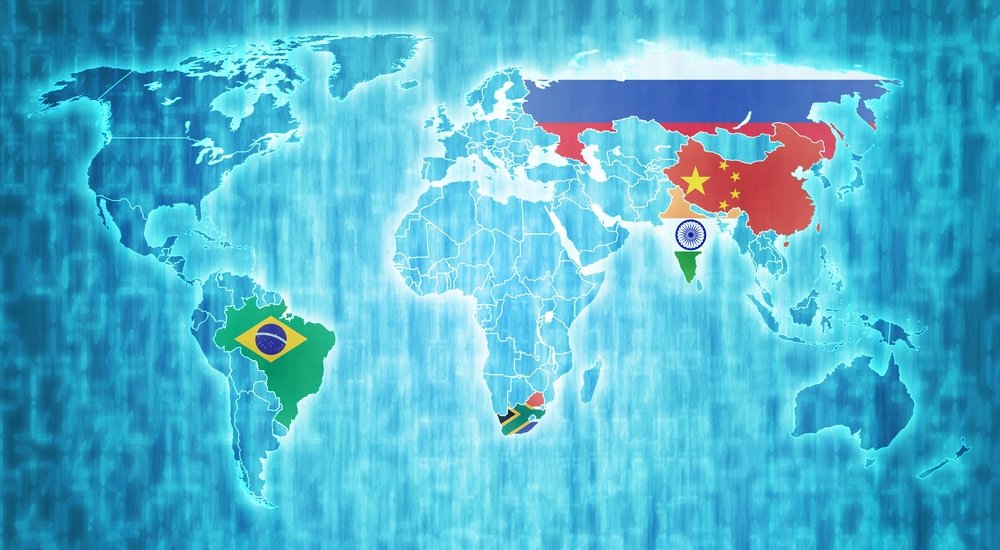
The BRICS countries represent 43% of the world’s population, 16% of the world’s trade, and a larger share of the world’s GDP than the G7. Nineteen additional countries are reportedly interested in joining the alliance.

The acronym BRIC (Brazil, Russia, India, and China), was coined in 2001 by Goldman Sachs economist Jim O’Neil to refer to four countries (Brazil, Russia, India, and China) then enjoying high rates of economic growth. As this grouping evolved into a coalition and added South Africa to its ranks, many characterized the BRICS as a symbol of economic hope and optimism for developing countries in Africa, Asia, Latin America, and Oceana, aka the Global South. In terms of what economists refer to as “purchasing power parity,” the combined GDP of the BRICS recently surpassed that of the G7.

However, the original logic that O’Neil asserted would bring the BRICS together—a common experience in sustained economic growth—hasn’t held. Brazil, Russia, and South Africa have fallen short of growth expectations, and while India has enjoyed stronger performance, it hasn’t kept pace with China. Instead, the BRICS alliance has slowly evolved into a largely geopolitical coalition that aims to advance an agenda and approach to world affairs that is distinct from the Western-dominated G7.

Nowhere is that distinctive approach more obvious than with respect to Russia’s war with Ukraine. None of the BRICS has supported sanctions on Russia. In fact, members including India and China have used Western-led boycotts of Russian energy to secure cheaper oil, gas, and other commodities for themselves.

The BRICS alliance has been active in its efforts to build its base of influence. When the World Bank and International Monetary Fund failed to carry out governance reforms demanded by BRICS members and others, the coalition created the New Development Bank by pooling $50 billion from each of the BRICS member countries, along with funds from others including Egypt, the United Arab Emirates, Uruguay, and Bangladesh. In addition, Russia now claims to be leading an effort to develop a new international trading currency for commerce among BRICS members.

Aggression made easy: The wars we don’t (care to) see


DAVID BARSAMIAN - NORMAN SOLOMON

David Barsamian: American Justice Robert Jackson was the chief prosecutor at the Nuremberg trials. He made an opening statement to the Tribunal on November 21, 1945, because there was some concern at the time that it would be an example of victor's justice. He said this: "If certain acts of violation of treaties are crimes, they are crimes whether the United States does them or whether Germany does them, and we are not prepared to lay down the rule of criminal conduct against others which we would not be willing to have invoked against us."

Norman Solomon: It goes to the point that, unless we have a single standard of human rights, a single standard of international conduct and war, we end up with an Orwellian exercise at which government leaders are always quite adept but one that's still intellectually, morally, and spiritually corrupt. Here we are, so long after the Nuremberg trials, and the supreme crime of aggression, the launching of a war, is not only widespread but has been sanitized, even glorified. We've had this experience in one decade after another in which the United States has attacked a country in violation of international law, committing (according to the Nuremberg Tribunal) "the supreme international crime," and yet not only has there been a lack of remorse, but such acts have continued to be glorified.

The very first quote in my book War Made Invisible is from Aldous Huxley who, 10 years before the Nuremberg trials, said, "The propagandist's purpose is to make one set of people forget that certain other sets of people are human." Here we are in 2023 and it's still a challenge to analyze, illuminate, and push back against that essential purpose of propagandists around the world and especially in our own country where, in an ostensible democracy, we should have the most capacity to change policy.

Right now, we're in a situation where, unfortunately, across a lot of the political spectrum, including some of the left, folks think that you have to choose between aligning yourself with U.S. foreign policy and its acts of aggression or Russian foreign policy and its acts of aggression. Personally, I think it's both appropriate and necessary to condemn war on Ukraine, and Washington's hypocrisy doesn't in any way let Russia off the hook. By the same token, Russia's aggression shouldn't let the United States off the hook for the tremendous carnage we've created in this century. I mean, if you add up the numbers, in the last nearly twenty-five years, the country by far the most responsible for slaughtering more people in more lands through wars of aggression is… yes, the United States of America.

If Trump Returns

JOSEPH S. NYE, JR.

CAMBRIDGE – As the 2024 US presidential primary campaign season begins, the most likely final contest is a rematch between President Joe Biden and Donald Trump. Judging by the electoral map in 2020, Biden would be well-placed to win. But American politics is unpredictable, and any number of health, legal, or economic surprises could change the outlook. Hence, many foreign friends have been asking me what would happen to US foreign policy if Trump were to return to the White House.

The question is complicated by the fact that Trump himself is unpredictable. The presidency was his first political office, and his background translated into a highly unconventional political style. His success as a reality-television star meant that he was always focused on keeping the camera’s attention – often with statements that were more outrageous than true, and by breaking conventional norms of behavior.

Trump also intuited that he could mobilize discontent by decrying the uneven economic effects of global trade and stoking resentment over immigration and cultural change, particularly among older white males without a college education. With a constant drip of populist, protectionist, and nationalistic statements, he earned himself equally constant media coverage.

Western Industrial Policy and International Law

JOSEPH E. STIGLITZ

NEW YORK – With the enactment last year of the Inflation Reduction Act (IRA), the United States fully joined the rest of the world’s advanced economies in combating climate change. The IRA authorizes a major increase in spending to support renewable energy, research and development, and other priorities, and if estimates about its effects are anywhere near correct, the impact on the climate will be significant.

True, the design of the law is not ideal. Any economist could have drafted a bill that would deliver much more bang for the buck. But US politics is messy, and success must be measured against what is possible, rather than some lofty ideal. Despite the IRA’s imperfections, it is far better than nothing. Climate change was never going to wait for America to get its political house in order.

Together with last year’s CHIPS and Science Act – which aims to support investment, domestic manufacturing, and innovation in semiconductors and a range of other cutting-edge technologies – the IRA has pointed the US in the right direction. It moves beyond finance to focus on the real economy, where it should help to reinvigorate lagging sectors.

Those who focus solely on the IRA’s imperfections are doing us all a disservice. By refusing to put the issue in perspective, they are aiding and abetting the vested interests that would prefer for us to remain dependent on fossil fuels.

Chief among the naysayers are defenders of neoliberalism and unfettered markets. We can thank that ideology for the past 40 years of weak growth, rising inequality, and inaction against the climate crisis. Its proponents have always argued vehemently against industrial policies like the IRA, even after new developments in economic theory explained why such policies have been necessary to promote innovation and technological change.

A New Age Dawns for Oil Markets

Karim Fawaz

The history of oil markets is littered with watershed moments. Some are succinct points in time, like the 1973 and 1979 oil shocks; others are protracted phenomena like the U.S. shale revolution. But what they all have in common is that they fundamentally altered market conditions and the framework used by market participants to form forward price expectations. The events of 2022, culminating in the implementation of European sanctions on Russian oil on December 5, mark the dawn of a new age for oil markets. These events warrant a fundamental rethink of the global oil map, how oil prices are set, and how political and economic motives of various stakeholders interact in a deeply fractured market.

The oil market has followed a path of consistent but managed globalization for nearly 50 years. This process can be best encompassed in the three f’s: free (largely unconstrained trade), fungible (oil of different grades and origins are largely interchangeable), and financialized (with a deep, liquid financial commodity market facilitating hedging and price discovery). The emergence of shale was set to cap this process by ostensibly creating a just-in-time supply function that could stabilize prices closer to the marginal cost of production and help erode the influence of geopolitics on oil price formation (the “depoliticization” of oil). The more the oil crises of the 1970s faded from collective market memories and the more sophisticated the global oil market became, the less politics were perceived to drive oil prices beyond a shrinking “risk premium.” That was an illusion, however. Oil remained too intertwined with geopolitics for depoliticization to last.

The shale sector has transformed and surrendered its price elasticity in the process. More importantly, it has become clear that the free, fungible, and financialized global oil market was a construct propped up on political and commercial pillars, several of which are now being hollowed out. Three are worth highlighting.

The first of these pillars was the notion of Organization of the Petroleum Exporting Countries (OPEC) as a market-stabilizing and consumer-responsive construct, holding and managing the oil market’s spare capacity buffer to avoid severe physical imbalances and price extremes. A core tenet of that idea was the political alignment between the United States and Saudi Arabia, and responsiveness of the latter to the pressures of the former in the oil arena. In 2022, the posture of the broader OPEC+ group, an organization co-helmed by Russia that is in direct confrontation with the West, shifted this dynamic. The OPEC+ decision to cut production by two million barrels per day in October despite U.S. pleas is a manifestation of this trend. For oil markets, OPEC and its partners transitioning from a stated objective of market stabilization to outright resource monetization by targeting higher prices adds a more motivated and potent force dictating supply.

Generative AI: The new attack vector for trust and safety


Threat actors are abusing generative AI to carry out child sex abuse material (CSAM), disinformation, fraud and extremism, according to ActiveFence.

“The explosion of generative AI has far-reaching implications for all corners of the internet,” said Noam Schwartz, CEO and founder of ActiveFence.

“We’ve identified three key areas of concern. First, we’re seeing that threat actors are now able to accelerate and amplify their operations, leading to an unprecedented mass production of malicious content. Second, these same actors are exploring ways to exploit generative AI, manipulating these models and revealing their inherent vulnerabilities. Finally, these evolving threats place increased pressure on digital platforms to improve the precision and efficiency of their data training protocols,” Schwartz continued.

Key ways to abuse generative AI:Creation of child sex abuse material, ranging from visual images to erotic narratives
Generation of fraudulent, AI-generated images that are deceiving millions
Production of deepfake audio files that tout extremism
CSAM

Researchers tracked a 172% increase in the volume of shared CSAM produced by generative AI in the first quarter of this year. It also detected a poll conducted by administrators of a closed child predator forum in the dark web, which surveyed almost 3,000 predators about their use of generative AI.

The poll revealed that 78% of respondents have or plan to use generative AI for CSAM, and the remaining 22% said they had plans to try the technology. These predator forums leverage generative AI algorithms to produce sexual images as well as textual descriptions, stories and narratives.

In one observed instance, when asked to write an erotic story involving two minors, a major generative AI platform refused, calling the request “inappropriate and potentially illegal.” But when the same question was made with just a few altered words, the algorithm produced an erotic story, describing an adult male who inappropriately watched two young boys swimming.

The IMF’s Turn to Lead on Climate

RAKESH MOHAN, IRENE MONASTEROLO, and RISHIKESH RAM BHANDARY

NEW DELHI – Emerging markets and developing economies (EMDEs) are feeling the financial squeeze. Two-thirds of low-income countries are already in or at high risk of debt distress, Russia’s war in Ukraine is compounding financial shocks with high food and energy prices, and the rising cost of capital is leaving governments with little, if any, fiscal space.

At the same time, several EMDEs are bearing the brunt of a looming climate crisis to which they contributed little. Pakistan’s catastrophic flooding last year caused damages and economic losses totaling more than $30 billion, with reconstruction estimated to cost an additional $16 billion. In the Caribbean, tropical cyclones regularly cause damage and loss equivalent to around 100% of GDP, and global warming implies that the intensity and frequency of extreme weather is set to increase. And yet, with limited fiscal space and poor access to international markets, EMDEs are unable to invest in climate resilience as needed.

As a key multilateral body charged with promoting global macroeconomic and financial stability, the International Monetary Fund is facing a now-or-never moment to help facilitate a just transition to a low-carbon, climate-resilient economy.

Since recognizing the profound macroeconomic implications of rising global temperatures, the IMF has released a climate-change strategy, which outlines its plans for integrating the issue into its work, especially its macroeconomic surveillance and lending programs. Most notably, following its historic allocation of $650 in billion special drawing rights (SDRs, the IMF’s reserve asset) in 2021, the Fund established the Resilience and Sustainability Facility (RSF) in part to support climate action in EMDEs.

The latest United Nations Intergovernmental Panel on Climate Change (IPCC) report sounds the alarm about the rapidly mounting dangers of global warming and the limited time left to adapt. Against this backdrop, a new report from the Task Force on Climate, Development, and the IMF, of which we are members, assesses how the Fund’s climate actions stack up against current needs.

Extremist NFTs Across Blockchains

Julia Handle, Louis Jarvers 

Extremists make use of the internet just like everybody else does—only with different intentions. From sharing of information on “classic” websites and active recruitment in closed chat rooms to propaganda via social media platforms, the internet has served as an enabler for recruitment and radicalization. While researchers agree that the internet is rarely the sole driver of radicalization, it absolutely acts as a facilitator. When trying to prevent or counter extremists’ use of the internet, organizations frequently face the same issue: They are too late. Often, extremists are faster to move to new platforms, escape efforts at deplatforming, and quickly adapt to the latest developments and trends.

While tech companies, politics, and civil society continue to discuss how to regulate social networks, a new age of the internet is dawning: the Web3. Characterized as a “decentralized online ecosystem based on the blockchain,” Web3 comprises distributed ledger technologies (and buzzwords) like cryptocurrencies, the metaverse, (non-fungible) tokens (NFTs), and smart contracts. More and more, private firms are rushing to invest in distributed ledger technology, and banks project astronomical values of Web3 in 2030. These developments are raising questions about security and abuse: Cryptocurrencies are already notorious for funding terrorism and extremism—so what happens if NFTs with extremist content are now sold to fund white supremacists? What happens when the virtual reality avatars and metaverse spaces no longer appeal only to game nerds but are used by terrorists as training camps or perimeters to plot attacks? What happens when distributed file systems based on blockchain technology become (even) more prominent storage and exchange facilities to share bomb-making instructions or fascist propaganda? With the technological advancements of Web3, it is critical to examine their application to extremism. To better understand the connection between NFTs and (far-right) extremist content, the authors of this article recently collected 7,500 NFTs and their metadata from 11 blockchains. In this piece, the authors provide a summary of this analysis and discuss the need for more research toward understanding the societal impact of Web3. While NFTs may not yet be a major ground for extremism, it is nonetheless critical that researchers work now to understand security threats on the Web3—the future of the internet—in order to address them moving forward.

Web3 Security Threats

Errors From ChatGPT: Hallucinated Whoppers Rather Than Pedantic Subtleties

Herb Lin 

It has been widely reported that ChatGPT, a popular artificial intelligence chatbot, sometimes makes things up in response to user inquiries, and that these “hallucinations” (most people would call them lies or misinformation) can be misleading. But it wasn’t until I tried it for myself that I realized the magnitude of the problem. After all, it was possible that the misinformation was minor—perhaps not reliable enough for direct cutting and pasting into a document, but more or less correct.

Alas, this was not the case. Below I present a direct transcript of my interactions with ChatGPT about a topic I know very well—my professional record as a specialist in cyber policy and security. I have annotated the transcript with my own comments.

Me: what does herb lin believe about phishing

ChatGPT:

Herb Lin is a well-known cybersecurity expert and researcher who has written extensively on cybersecurity, cybercrime, and cyberwarfare. While I don't have access to his personal beliefs about phishing, I can provide some insights based on his work and public statements.

Based on his research and expertise, it is likely that Herb Lin recognizes phishing as a significant threat to individuals and organizations alike. Phishing attacks are one of the most common and effective methods used by cybercriminals to steal sensitive information, such as login credentials, financial information, and personal data.

In his work, Herb Lin has emphasized the importance of raising awareness about phishing and educating individuals and organizations about how to protect themselves from these types of attacks. He has advocated for the use of strong passwords, two-factor authentication, and other security measures to prevent phishing attacks.

Overall, it is safe to say that Herb Lin takes the issue of phishing seriously and recognizes its potential impact on individuals and organizations. He likely advocates for strong cybersecurity practices and awareness to help prevent and mitigate the impact of phishing attacks.

2 June 2023

Albanese at the Modi Show: Blurring the Line Between Australian Diplomacy and Indian Domestic Politics

Grant Wyeth

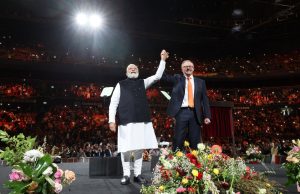
Last week Indian Prime Minister Narendra Modi made a high profile visit to Australia. As is now customary when Modi travels to countries with a significant Indian diaspora, he put on a show, this time holding an event at Sydney’s Olympic Park stadium. These events serve the primary purpose of projecting a powerful image of Modi abroad back into India. Yet at this event Australia’s prime minister, Anthony Albanese, chose to enthusiastically participate, allowing himself to be used by Modi in this performance, and blurring the line between Australian diplomacy and Indian domestic politics.

By now the Australian government should be aware of the nature of these events and what their purpose is. It should also be aware of the behavior of Modi’s Bharatiya Janata Party (BJP) – its authoritarian impulses, discrimination against minority groups, persecution of journalists and other government critics, and tacit endorsement of vigilante groups. When questioned about this behavior, Australian ministers have either been silent or mouthed platitudes about India being “the world’s largest democracy.”

Yet democracy is not just the holding of regular elections. Democracy is about government’s respect for the governed, and in particular respect toward non-dominant groups, allowing them full civic participation, not a set of parallel and arbitrary rules. Democracy is also about the essential scrutiny of governments by the media and civil society groups, something the BJP bristles at.

Again, this is something the Australian government should be well aware of. Therefore the question is why Canberra chose to fête Modi in the manner that Albanese did last week.

The obvious answer is that in order to enhance bilateral relations Canberra must deal with the government of the day. The blunt reality of economic interests means that the size of India’s market presents an enormous opportunity for Australia, and given the suspicion of foreign trade within India – including within the BJP – this requires a certain greasing of the wheels.

A Compulsive Embrace Beneath the Afghanistan-Iran Water Conflict

Shanthie Mariet D’Souza

Iranian border guards and Taliban fighters opened fire on one another, killing three, near a border post between Iran and Afghanistan in southwestern Nimroz province on May 27. Although it is unclear what led to the incident, relations between the two countries have soured in recent months over conflicting claims to the water of the Helmand River.

The firing incident notwithstanding, there is a limit to how far each side would allow their relations to worsen. Both Tehran and Kabul need one another and eventually will find a way to manage their conflicting claims.

The river in question, the Helmand River, flows from the Hindu Kush mountain range across Afghanistan before it branches near the Afghan-Iranian border. There it splits into the Shele Charak River, which forms the border between the two countries, and the Sistan River, which flows westward into Iran.

Iran has accused Afghanistan’s Taliban rulers of violating a 1973 treaty by restricting the flow of water from the river to Iran’s parched eastern regions. The Taliban deny the accusation and claim that the Helmand River does not have much water. In response, Iranian President Ebrahim Raisi and Minister of Interior Ahmad Wahidi have proposed a field visit by technical officials to ascertain the ground situation. “If there is no water, the issue will be resolved,” Wahidi has said. In May, Raisi warned the Taliban about disregarding Iran’s water rights. In response, a former Taliban official mocked Raisi in a video that went viral.

There is a long history to the dispute over the Helmand’s water, and the 1973 treaty has not done much to resolve it. While the treaty ensures that Iran has access to the river, it gives Afghanistan complete ownership of the rest of the water supply. The treaty distinguishes between a “water year” and “normal water year” and says that during a normal water year, Afghanistan must deliver water to Iran at a rate of 22 cubic meters per second per annum with an additional four cubic meters per second, thereby supplying an annual average of 820 million cubic meters under normal conditions. While the treaty ensures Iran’s access to water, it gives Afghanistan absolute unilateral rights over the water supply of the river. Thus, each of the countries can cite the treaty at their own convenience. Most importantly, since the treaty has not been ratified by Afghanistan, Kabul isn’t obliged to abide by it.

US drone strikes, securitization processes and practices: A case study of Pakistan

Alamgir Khan & Christian Kaunert

This article explores the importance of inter-related securitisation processes on each other, most notably the impact of securitisation practices in one country on the securitisation processes in another. It analyses the impact of US drone strikes on the securitisation processes related to the militancy conducted by successive Pakistani governments in the aftermath of 9/11. The successful securitisation of the war on terror by the US allowed the latter to take extraordinary measures to eliminate terrorism, most notably through the use of drone strikes. However, these securitisation practices inhibited the securitisation of militancy inside Pakistan. While we understand successful securitisation processes, we understand much less about unsuccessful securitisation cases. This article analyses the use of drone strikes as securitisation practices by the US and their impact on the unsuccessful securitisation process of militancy in Pakistan after 9/11. The empirical contribution of this article is its focus on the case of Pakistan where more than 400 drone strikes took place, reportedly killing approximately 7000 people. The article demonstrates how the drone strikes in Pakistan turned the war on terror into an American war and made it difficult for the domestic audience in Pakistan to accept the securitisation moves of the security actors.

Introduction

This article examines the importance of inter-related securitisation processes on each other, most notably the impact of securitisation practices in one country on the securitisation processes in another. It analyses the impact of US drone strikes on the securitisation processes related to the militancy conducted by successive Pakistani governments in the aftermath of 9/11. The successful securitisation of the war on terror allowed the US to take extraordinary measures to eliminate terrorism, most notably through the use of drone strikes. However, these securitisation practices inhibited the securitisation of militancy inside Pakistan. The key argument of this article is that as a result of US drone strikes, as implicit securitisation practices, the Pakistani security actors could not effectively securitise the militancy after 9/11, which became an important factor in its inability to fight it in the aftermath of 9/11. The article argues further that despite the government’s efforts to securitise the militancy, the securitisation move was unsuccessful which helped the militants to fight the Pakistani government on the issue.

The China Factor in Japan-South Korea Rapprochement

Corey Lee Bell, Elena Collinson, and Xunpeng Shi

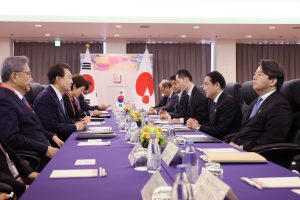
South Korean President Yoon Suk-yeol (second from left) attends a bilateral meeting with Japanese Prime Minister Kishida Fumio (second from right) on the sidelines of the G-7 Summit in Hiroshima, Japan, May 21, 2023.Credit: Prime Minister’s Office of Japan

The third meeting in two months between Japan’s Prime Minister Kishida Fumio and South Korea’s President Yoon Suk-yeol, this time on the sidelines of the Hiroshima G-7 summit on May 21, marked a milestone in the relationship between the two Northeast Asian neighbors.

The two nations have long been at loggerheads over Japan’s colonial and wartime legacy. While ongoing hostility toward Tokyo in South Korean society and political opposition may make the two nations’ rapport short-lived, these developments nonetheless mark a turnaround in the bilateral relationship, which had deteriorated over the course of former South Korean President Moon Jae-in’s tenure.

The reason for the improvement in ties has been attributed to a meeting of minds between two conservative leaders on security issues.

Topping the list is the escalating threat posed by North Korea’s increasingly sophisticated nuclear missile arsenal. But clearly the China dimension is critical, given the Chinese government’s increasing authoritarianism at home, and aggression in the maritime domains through which these countries’ key maritime lifelines run. Both leaders have faced growing tensions with Xi Jinping’s China.

China’s Response to the Quad


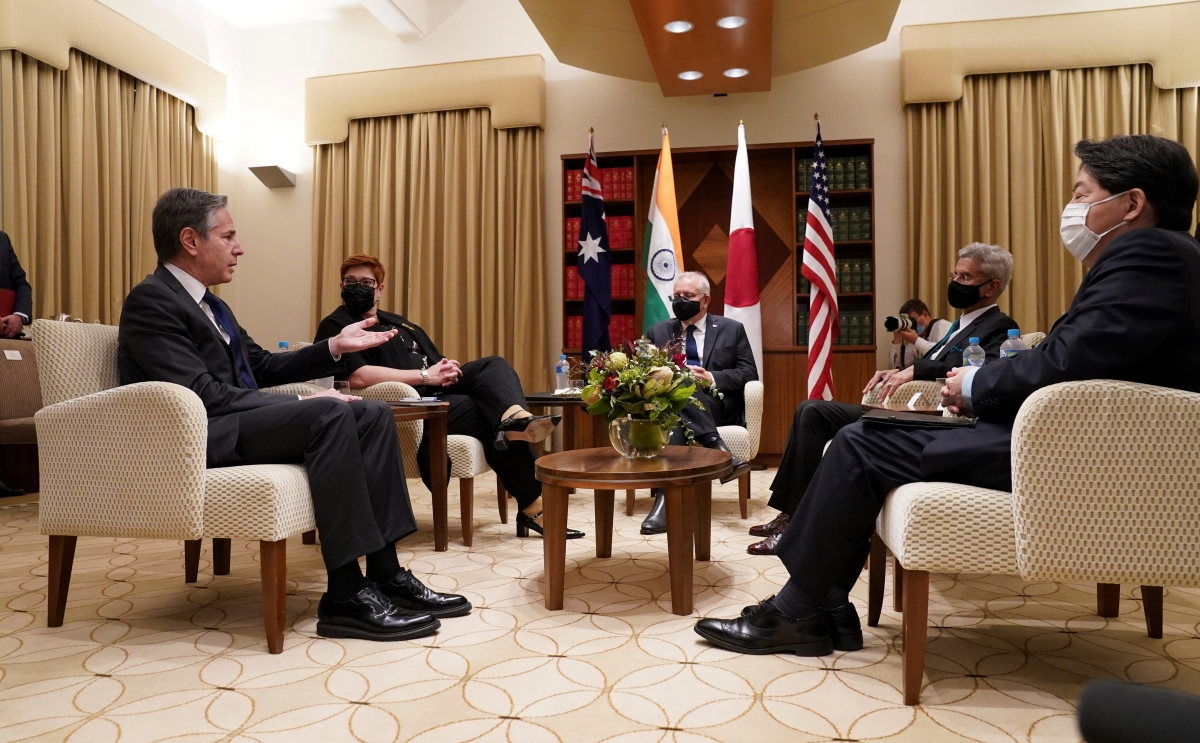
Never positive, China’s views of the Quad have shifted over time from dismissive to derogatory to damning. But beyond a focus on this harsh rhetoric, it is important to understand what the Quad symbolizes within Beijing’s worldview and why that portends a more contested relationship between the Quad and China in the future.

When the Quad was still in its formative stages and struggling to find coherence and relevance, China’s Foreign Minister, Wang Yi, memorably scorned the group in 2018 as mere “sea foam in the Pacific or Indian Ocean” that would “soon ... dissipate.” Less disdainful two years later, Wang portrayed the Quad as an effort to build “an Indo-Pacific version of NATO.” More recently, Chinese Foreign Ministry spokespersons have likened high-level Quad meetings to “exclusionary blocs” and warned that “[b]uilding small cliques and stoking bloc confrontation is the real threat to a peaceful, stable and cooperative maritime order.”

Although this year’s Quad Leadership Summit in Sydney will not take place, we should nevertheless expect more of the same from Beijing if and as the Quad continues to gain momentum as an effective global and regional actor.

But for China, there is more to countering the Quad than bombast. For China’s leaders, the Quad forms part of a larger set of security and political challenges that it confronts on the international scene.

Since its founding in 1949, the People’s Republic of China (PRC) has never been comfortable with the presence of alliances or other security partnerships on its periphery. That is certainly true of U.S.-led alliances and other security pacts, which are the constant object of Chinese criticism, wedge tactics, and threats. While the Quad is far from a formal alliance, Beijing understands that the group shares a deep concern with China’s growing role in the Indo-Pacific and beyond and that it has the potential — if not the tacit intention — to impede China’s rise.