17 October 2023

The death of the think-tanker

MATTHEW PETTI

Daniel Ellsberg, perhaps the most famous think-tanker of all time, passed away in June this year. But rather than any policy paper or legislative advocacy, he is remembered for an action then treated as treachery and now regarded as heroism. Following on from his work for the Rand Corporation, Ellsberg was hired by the US government in the Sixties to advise them in Vietnam. Eventually disgusted by what he saw, Ellsberg leaked the “Pentagon Papers”, the military’s secret internal history of the Vietnamese war. His actions led directly to the Watergate scandal, as President Richard Nixon began an obsessive campaign to root out internal enemies, eventually unravelling public support for the war and his own administration.

On 29 June 1971, in the midst of the uproar, the FBI sat General Edward Lansdale down for an “interview”. Lansdale was the godfather of US counterinsurgency warfare, often (falsely) believed to be the inspiration for The Quiet American by Graham Greene. He had supervised Ellsberg during their time in Vietnam and, asked about their relationship, Lansdale began to philosophise about the relationship between intellectuals and the leaders they advise. “Intellectuals are sometimes strange people,” he mused, adding that Ellsberg worked in a “cloistered atmosphere”. The FBI agents concluded that, in Lansdale’s view, Ellsberg “failed to realise the life and death of United States troops were involved” in the questions he dealt with. That last accusation might have come as a shock to Ellsberg, who had carried a rifle and walked into many life-and-death situations himself.

Lansdale’s interrogation notes formed part of Ellsberg’s FBI dossier, released after Ellsberg’s death under the Freedom of Information Act. And, read today, the files shed considerable light on the changing relationship between academia and power in the West. Ellsberg was one of the first generation of “think tankers”, originally freewheeling intellectuals drafted by the government to solve difficult problems. His line of inquiry would ultimately lead him to break the law and publicly oppose the government.

It’s Not Just America in Decline. Culture Wars Threaten Western Civilization

William Moloney

When in 1787 Benjamin Franklin emerged from the final day of the Constitutional Convention in Philadelphia, a woman in the waiting crowd asked, “What do we have, doctor, a monarchy or a republic?” He famously replied, “A republic, madam, if you can keep it.” Implicit in Franklin’s admonitory response was the recognition that to create a novel polity perched precariously on the edge of a continent-size wilderness was one thing; to nurture and preserve it was a different — and daunting — kind of challenge altogether.

Yet from those tentative and fragile beginnings, our fledgling republic would grow to become in less than two centuries a globe-girdling military and economic colossus and the principal architect of a rules-based international order that provided a stable framework for an era that would witness unprecedented advances in the material well-being of peoples around the world.

However, today that global order faces a growing series of interlocking crises so grave in nature as to potentially threaten its existence.

Indicative of this danger is a recent column in the Wall Street Journal by Walter Russell Mead, entitled “The Rules-Based International Order is Quietly Disintegrating,” in which he states that “the core institutions and initiatives of the American-led world order and the governments that back them are growing progressively weaker and less relevant.” By way of illustration, Mead describes tottering pillars of world order, including an increasingly paralyzed United Nations, an irrelevant World Court, a largely toothless World Trade Organization, disappearing arms control efforts, an apparent stalemate in the Ukraine war, and rapidly spreading chaos in sub-Saharan Africa.

Ukraine's 'free-spirited use' of anti-tank missiles is wrecking Russian armor, but it doesn't mean the tank's days are over

Michael Peck

Ukrainian troops with anti-tank missile launchers at a ceremony in Kyiv.

Anti-tank missiles have wreaked havoc against Russian tanks in Ukraine.

But the lessons of Ukraine aren't that straightforward. Military experts have argued the tank's poor showing in recent conflicts across Eurasia stems more from decisions about how to employ those tanks rather than from the failings of the tank itself.

"Ukraine mostly confirms that tanks remain survivable, and other conflicts confirm that some are more survivable than others," Sam Cranny-Evans wrote in European Security and Defence in January.

A question raised from the war in Ukraine is whether the ratio of anti-tank guided missiles, known as ATGMs, to tanks has been so extreme it would distort any conclusions. "One element of the war in Ukraine that is perhaps unique, however, is the sheer mass of ATGMs," added Cranny-Evans, who was previously a land-warfare researcher at the Royal United Services Institute, a British think tank.

"They are present in such numbers that units feel comfortable using them to engage bunkers, trucks, light armored vehicles, personnel, and any other target that can be justified," Cranny-Evans wrote in reference to Ukrainian forces, noting that such "free-spirited use" of anti-tank missiles had been seen in previous wars, including by US forces in Afghanistan.

What Could Happen if America Stops Supporting Ukraine

Michael “Mick” Patrick Mulroy and Chris Hyslop

There has been much debate on whether the United States should continue aid to Ukraine. That debate sharpened after Hamas attacked Israel last Saturday, with Sen. Josh Hawley (R-Mo.) posting on X (formerly known as Twitter), “Israel is facing existential threat. Any funding for Ukraine should be redirected to Israel immediately.”

Support for additional aid to Ukraine among regular Americans has been softening. While 76% of Americans hope for a Ukrainian victory, only 59% are willing to provide the arms and resources necessary for that victory.

Such a position is untenable not only because it ignores the centrality of American equipment to Ukraine’s battlefield successes but also because it fails to reconcile itself with the reality of what would happen if American aid stopped.

What would the world look like if America gradually turns off the taps of military, economic, diplomatic, and humanitarian aid to Ukraine?

Without American support, Europe would try to fill the gap but ultimately fail. Although European aid to Ukraine is currently twice that of America’s, without American leadership, European resolve and support would weaken. In which case, overwhelming Russian force would eventually bow Ukraine by brute force and mass war crimes against civilians. A peace deal favorable to Russia would be struck, a Russia-friendly government installed, a sham referendum launched and 99.8% of “voters” in Russian-occupied land “deciding” to become Russia proper.

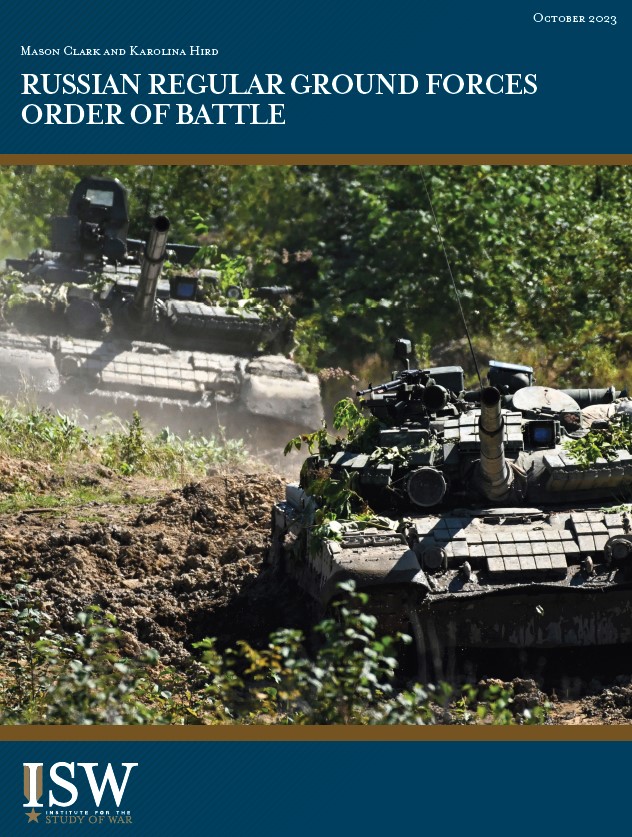
RUSSIAN REGULAR GROUND FORCES ORDER OF BATTLE: RUSSIAN MILITARY 101

Mason Clark and Karolina Hird

This report contains two sections: an introductory essay on the regular Russian ground forces; and a fully sourced order of battle (ORBAT) of Russia’s regular ground forces down to the brigade and regiment echelon (with select independent battalions), including the army, ground forces controlled by the the navy, Airborne (VDV) units, and GRU Spetsnaz formations.

The following essay is intended as an introduction to the regular Russian ground forces for security studies professionals, policymakers, and journalists who are not necessarily Russia specialists. This report covers the federal-level structure of Russia’s armed services and General Staff; Russia’s personnel system; general characteristics of Russian ground capabilities; Russian organizational structure from the Military District to the brigade/regiment level; and a brief discussion of the Battalion Tactical Group (BTG). This report draws on the sources in the accompanying annotated bibliography and the authors’ study of the Russian armed forces, supplemented where necessary with footnotes exploring exceptions and adding further context.

This order of battle of the Russian regular ground forces is ISW’s assessment of the on-paper structure of the regular Russian ground forces as of January 2023. It covers the Army, ground forces of the Navy, VDV, and GRU Spetsnaz down to the regiment and brigade level. It does not cover the Aerospace (VKS) forces (including air and air defense armies); Navy surface warfare and submarine assets; or the strategic rocket forces. We have excluded the 1st and 2nd Army Corps (the armed forces of the Donetsk People’s Republic [DNR] and Luhansk People’s Republic [LNR],

Russia’s Bloodied Navy Remains a Threat

Gonzalo Vázquez

Since the outbreak of the war in Ukraine, the Russian navy has suffered major naval losses in the Black Sea — including several of its large surface vessels. This failure to retain control against Ukraine´s Unmanned Surface Vehicle (USV) and cruise missile attacks highlights the difficulties that Russian naval forces face in the quest to meet the Kremlin’s ambitions.

But it would be wrong to assume that the Russian navy will no longer be a serious threat to NATO; particularly in the Pacific, the Mediterranean, and High North.

Since the outbreak of full-scale war early in 2022, the Russian Navy’s Back Sea Fleet has had a difficult time supporting its forces deployed on land. Through the effective employment of USVs to conduct surprise attacks and kamikaze strikes, Ukraine has managed to inflict a significant degree of material damage on its opponent. The loss of the cruiser Moskva to Neptune missiles in April 2022 was a watershed moment for the Russian navy and another milestone in its gradual decline into a green water force (that’s to say a force largely operating in its littoral areas) over the coming years.

Indeed, as indicated by the recent withdrawal of vessels from the Sevastopol naval base and their subsequent relocation to Novorossiysk, 350km (200-plus miles) to the east, the consequences of the conflict for the Black Sea Fleet have prompted a decline of Russian naval power both in the region and in the number of large surface combatants more generally.

RUSSIAN OFFENSIVE CAMPAIGN ASSESSMENT, OCTOBER 13, 2023

Nicole Wolkov, Christina Harward, Grace Mappes, Angelica Evans, Kateryna Stepanenko, and Mason Clark

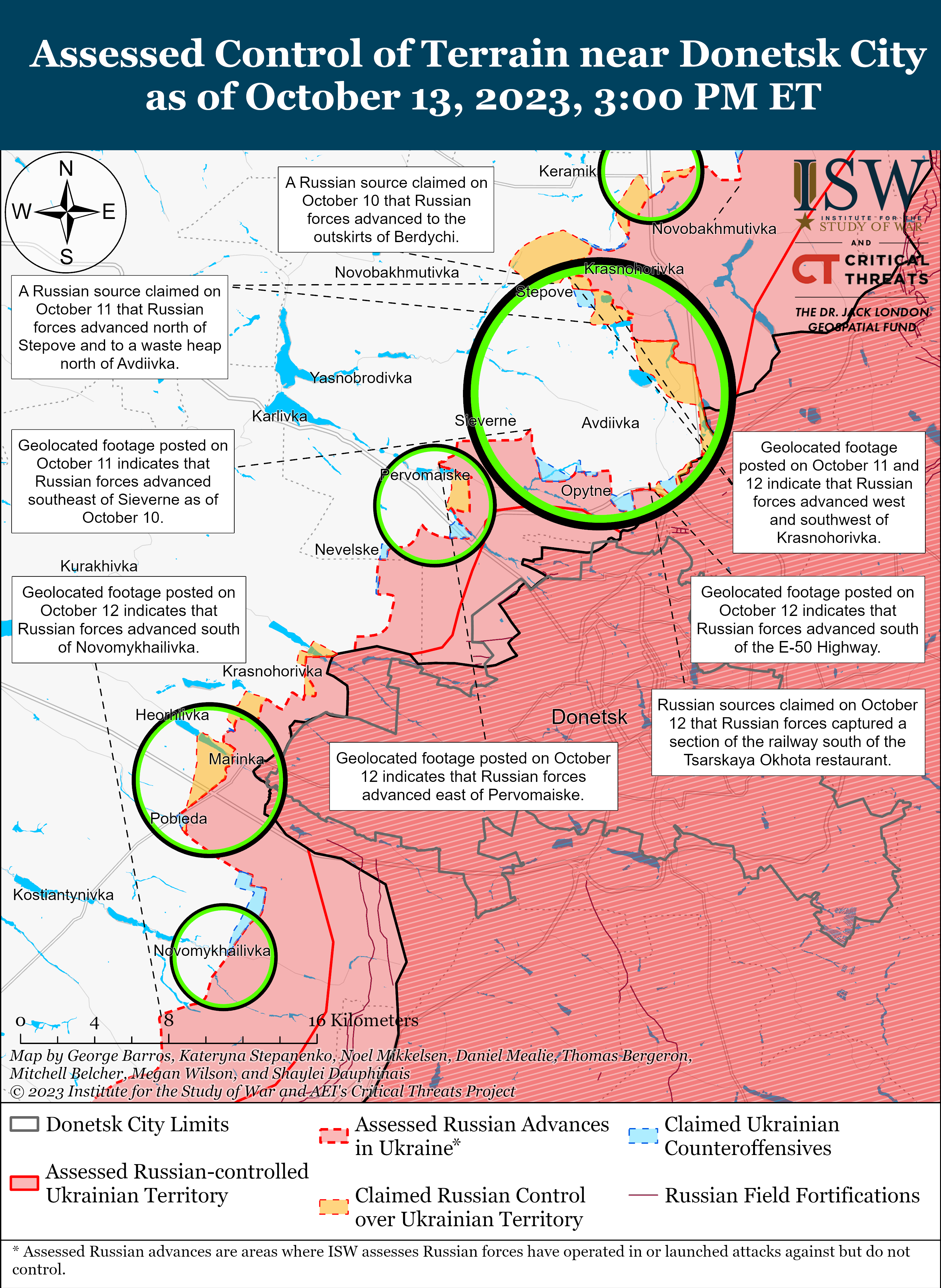
Ongoing Russian offensive operations throughout the Avdiivka, Donetsk Oblast area on October 13 reportedly faced setbacks around the city. Russian sources claimed that Russian forces continued to attack areas north and south of Avdiivka, and geolocated footage published on October 12 and 13 indicates that Russian forces advanced south of Krasnohorivka (5km north of Avdiivka) and southeast of Pervomaiske (11km southwest of Avdiivka).[1] Russian sources also published conflicting reports about previous claims by Russian sources of Russian control of the Avdiivka Coke Plant, and ISW has not observed any evidence to confirm that Russian forces control the plant as of publication.[2] Ukrainian military officials reported that Ukrainian forces continue to repel Russian attacks around Avdiivka.[3] A Russian milblogger noted that Ukrainian forces are using minefields to slow down Russian advances in the Avdiivka direction.[4] A Russian volunteer in the 4th Luhansk People’s Republic (LNR) Brigade (2nd Army Corps, Southern Military District) claimed that worn out barrels are reducing the accuracy of Russian artillery near Avdiivka, a complaint about Russian artillery that ISW has previously observed from Russian sources.[5] The volunteer assessed that Russian forces can ”compress the [Ukrainian] perimeter” by capturing less fortified Ukrainian-held territory near Avdiivka, but expressed concern that Russian generals will misinterpret these limited advances and try to speed up offensive efforts towards Avdiivka. The volunteer noted that such a misinterpretation may lead Russian forces to “beat on concrete” fortifications until these forces run out.


The Russian military command appears to be restricting discussion of the Russian offensive operations around Avdiivka in the Russian information space, likely in an attempt to adapt to previous information shocks and control any narratives that emerge in the Russian information space around these operations. A prominent Russian milblogger claimed on October 12 that the Russian military command was “dispensing information [about Russian offensive operations] in doses,” but then claimed on October 13 that the Russian military command was ”minimizing the release of information into the public domain” as the Russian military does not want “media hype” surrounding operations near Avdiivka.[6] Another Russian milblogger also claimed on October 13 that unspecified actors, likely Russian military leadership, instructed milbloggers to not discuss the details of the fighting near Avdiivka.[7]

The Geopolitics of EU Enlargement

MARK LEONARD

The debate surrounding the European Union’s potential expansion is no longer really about Ukraine and the western Balkans. Enlargement is now an existential question with far-reaching implications for the EU and its ability to remain a prominent player in a rapidly changing global environment.

BERLIN – Where will Europe’s borders end? On October 6, EU leaders convened in Granada, Spain, to discuss a question that has captivated Eurocrats, think tanks, and journalists throughout the bloc since the start of the war in Ukraine.

While the European Union already granted Ukraine candidate status in June 2022, the European Council is expected to vote on beginning formal accession talks on December 15. But the debate in Spain shows that the question is no longer really about Ukraine and the western Balkans; it is now an existential question with far-reaching implications for the EU and its role in a fast-changing global environment.

The EU appears to be moving toward radical reinvention, a “refoundation” built on three pillars, each of which is the subject of fierce debate. It is looking for a grand bargain between geopolitical imperatives and liberal values.

The first pillar is security. As the EU shifts from a peace project to a war project, it is forced to reconsider some of its core assumptions. Most obviously, European leaders must give up their aversion to hard power. But it is still unclear how this process will play out: Can European governments unite and develop their own military capabilities, or will they squander their money on ready-made equipment from the United States and South Korea?

Upcoming Air Force demos aim to connect commercial satcom with military platforms

MIKAYLA EASLEY

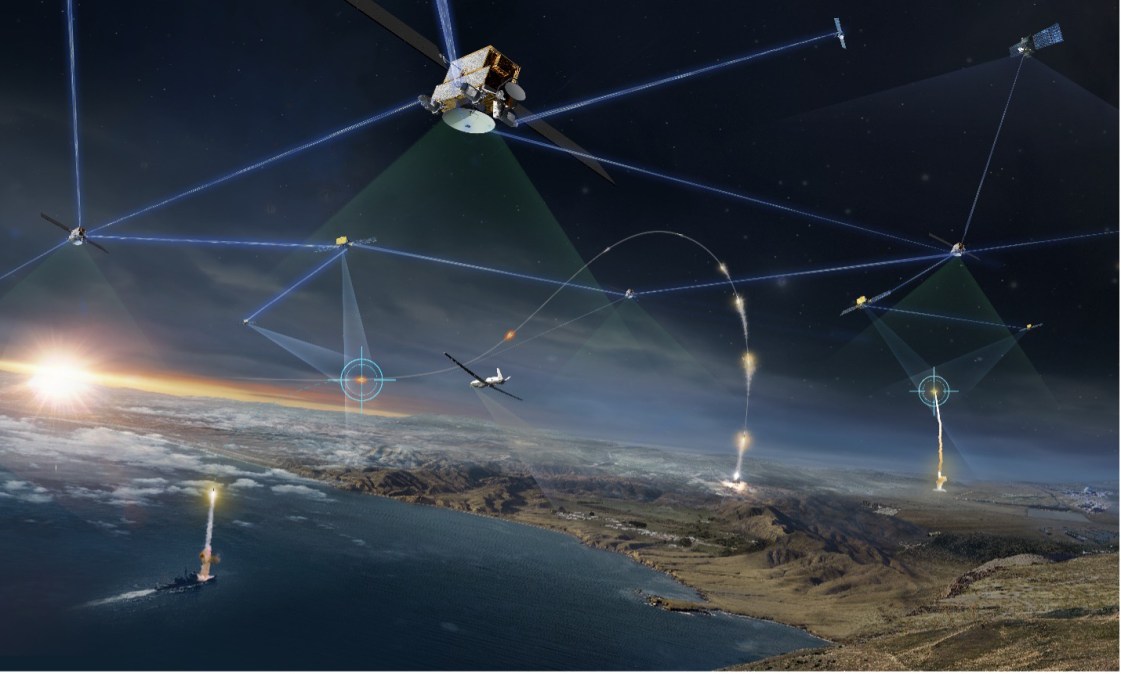
The Air Force Research Laboratory will conduct a set of demonstrations over the next few years that will seek to provide air- and ground-based military systems with ubiquitous connectivity using commercial satellite constellations.

The demonstrations are part of AFRL’s Defense Experimentation Using Commercial Space Internet (DEUSCI) program, which aims to leverage burgeoning commercial space internet services in order to establish resilient communications and data-sharing capabilities for warfighters. A notice on Sam.gov states the end goal is to establish “path agnostic communications” — or the ability to “reliably communicate to any location on the globe without explicitly specifying which nodes of a communication network to use.”

The program’s mission ties directly into the Pentagon’s vision for its new warfighting concept known as Joint All Domain Command and Control (JADC2). The effort seeks to connect systems that are currently siloed across the battlespace under a single network, enabling warfighters to quickly send and receive critical decision-making data.

The lab initially began DEUSCI in 2017 and has since given awards to several defense contractors and commercial satcom providers to work on the effort. Earlier this year, AFRL awarded Northrop Grumman and L3Harris individual contracts for upcoming experiments that will focus on connecting military platforms with different commercial satcom constellations located in low-Earth, medium-Earth and geosynchronous orbits.

16 October 2023

Elon Musk Is Shitposting His Way Through the Israel-Hamas War

DAVID GILBERT

YESTERDAY NIGHT, WHAT’S left of the Trust and Safety team at X (formerly Twitter) announced the measures it was taking to try and curb the virulent spread of disinformation around the Israel-Hamas war on its platform.

The statement, issued three days after the conflict began, reads: “As the events continue to unfold rapidly, a cross-company leadership group has assessed this moment as a crisis requiring the highest level of response.”

One person who does not appear to be part of this crisis team is X owner Elon Musk.

Instead of tackling the dangerous disinformation problem on his platform, Musk instead spent yeterday night into this morning continuing to spread disinformation about the conflict, conversing with a known QAnon promoter, boosting anti-Muslim conspiracy theories, and laughing at a video detailing how transphobic content on X can get you new followers.

Musk also promoted a new feature that allows X Premium subscribers to see only replies from other people willing to pay $8 a month, which Musk said would “help a lot with spam bots” on the platform—an issue Musk previously claimed he had already all but eradicated.

How does Hamas get its weapons? A mix of improvisation, resourcefulness and a key overseas benefactor

Brad Lendon

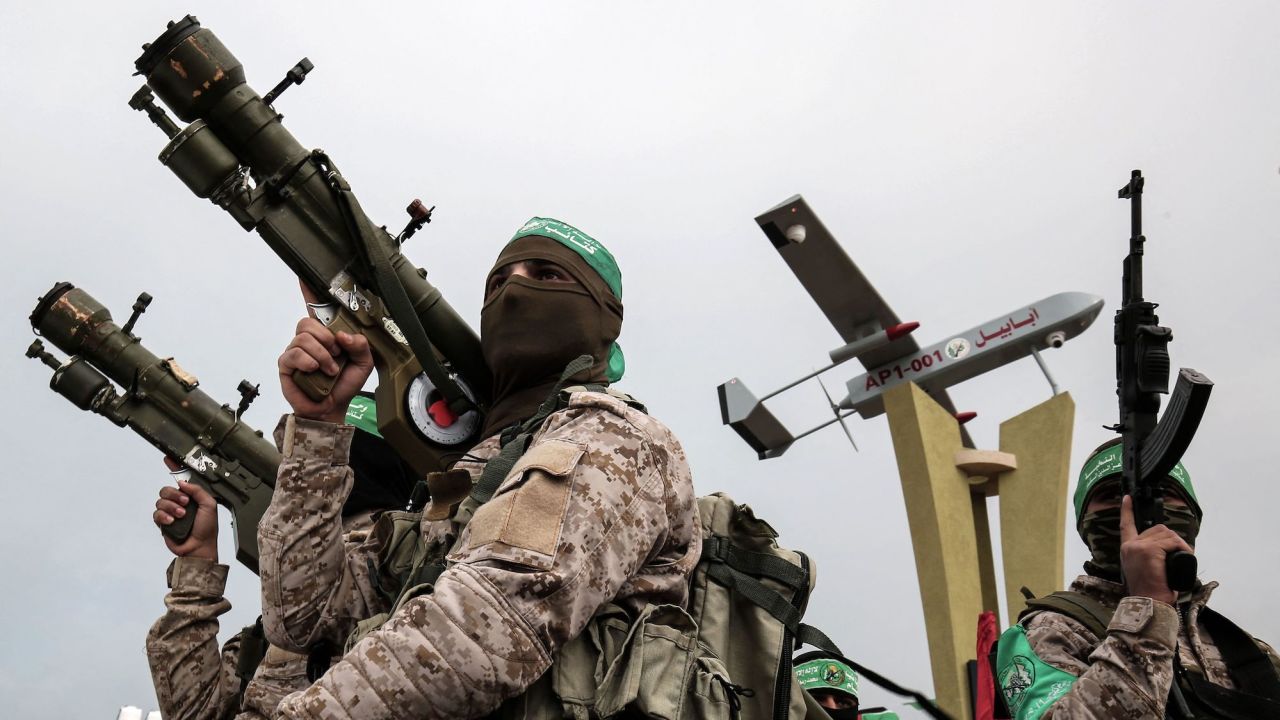
The brutal rampage by Islamist militant group Hamas on Israel last weekend involved thousands of rockets and missiles, drones dropping explosives, and untold numbers of small arms and ammunition.

But the attack was launched from the Hamas-ruled enclave of Gaza, a 140-square-mile (360-square-kilometer) strip of Mediterranean coastal land bordered on two sides by Israel and one by Egypt.

It’s a poor, densely populated area, with few resources.

And it has been almost completely cut off from the rest of the world for nearly 17 years, when Hamas seized control, prompting Israel and Egypt to impose a strict siege on the territory, which is ongoing.

Israel also maintains an air and naval blockade on Gaza as well as a vast array of surveillance.

Which begs the question: How did Hamas amass the sheer amount of weaponry that enabled the group to pull off coordinated attacks that have left more than 1,200 people dead in Israel and thousands more injured – while continuing to rain rocket fire down on Israel?

Zelensky Reportedly Plans Solidarity Visit to Israel


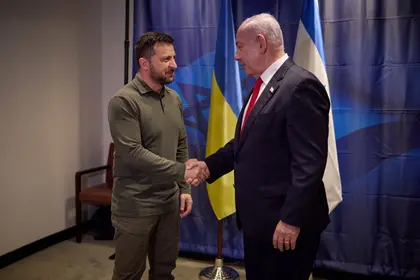
President Volodymyr Zelensky is understood to be preparing for a visit to Israel in a gesture of solidarity. The planned trip comes amidst the ongoing escalation of the Palestinian-Israeli conflict, Axios media outlet reported citing sources within Ukrainian and Israeli government circles.

Sources familiar with the matter have indicated that Zelensky's office has formally requested to coordinate his visit with Israeli Prime Minister Benjamin Netanyahu. The negotiations, they stress, are still in the preliminary stages, and no specific date for the visit has been confirmed.

US Secretary of State Antony Blinken set off for Israel on Oct. 11. The same day, prior to commencing meetings at NATO headquarters in Brussels, President Zelensky urged the West to rally around the Israeli people as it had for Ukraine in response to Russia’s invasion last year, and to show them they are not “alone”.

“I remember the first days of the full-scale war. It started with terrorist attacks from Belarus, then the Russian army advanced. It was a profound tragedy for us, with countless lives lost. Being alone during such times can be devastating. Solidarity can make a real difference, preserving nations, lives, and, above all, human dignity,” Zelensky said.

IRAN UPDATE, OCTOBER 11, 2023

Andie Parry, Ashka Jhaveri, Johanna Moore, Annika Ganzeveld, and Amin Soltani

Key Takeaways
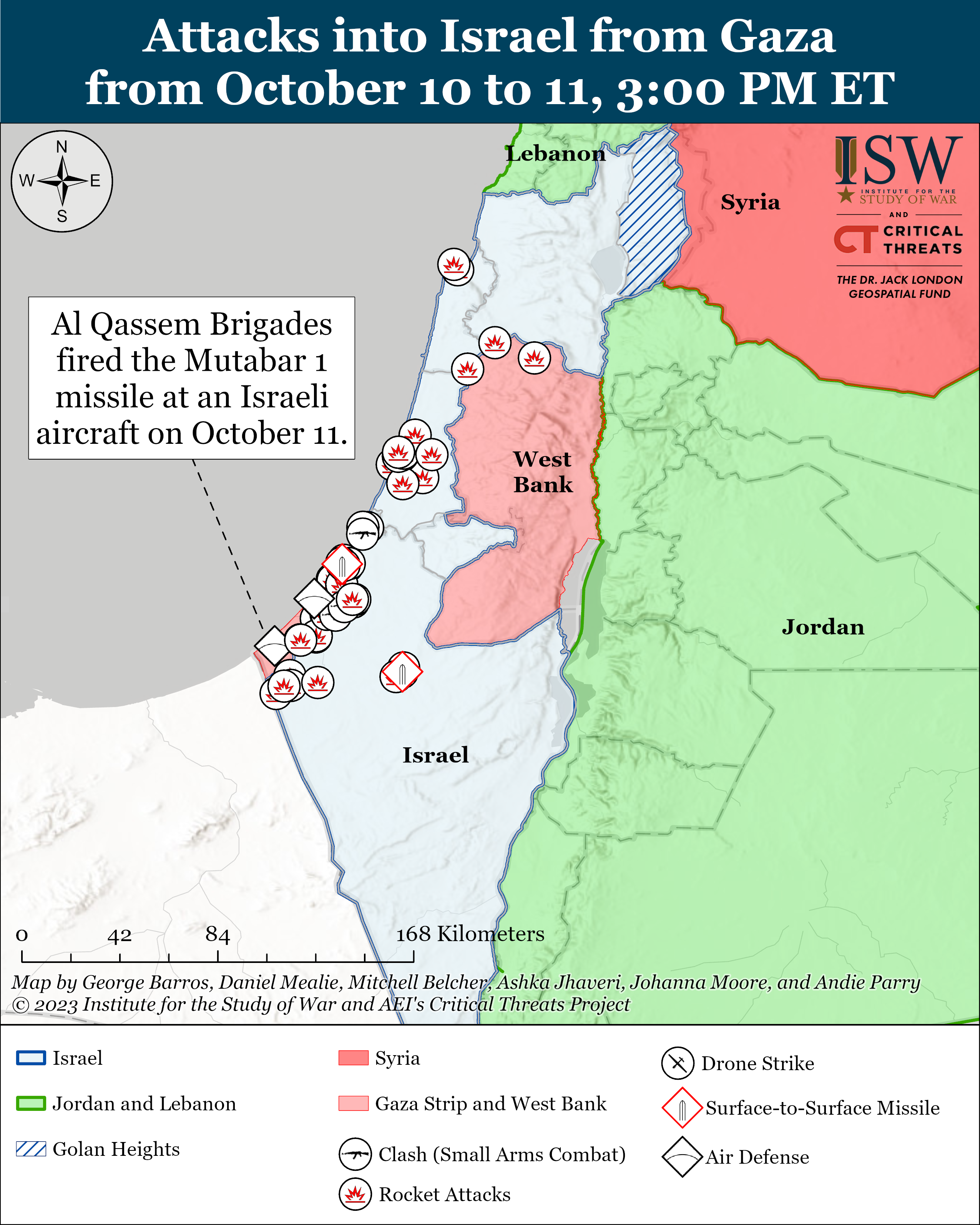
  • Incursions by Hamas into southern Israel have slowed since October 9. Palestinian militias in Gaza are using drones and rockets to strike towns in northern and southern Israel.
  • The Lions’ Den—a West Bank-based Palestinian militia—mobilized supporters to hold marches and engage in small arms clashes with Israeli security forces. Hamas is calling on its supporters in the West Bank to storm Jerusalem on October 13.
  • Lebanese Hezbollah fired missiles, including anti-tank munitions, at Israeli security forces in northern Israel.
  • Members of Iran’s Axis of Resistance have articulated the thresholds at which they would intervene in the war against Israel. These threats highlight the risk of the war expanding throughout the region.

Gaza Strip

Hamas incursions into southern Israel by land and sea have slowed since October 9.[1] Palestinian militant groups are now relying on rocket barrages and attack drones to hit towns in northern and southern Israel.[2] Rocket fire from Gaza extended north to Haifa and multiple barrages have hit Tel Aviv.[3] The Hamas spokesperson warned Israeli civilians to evacuate Ashkelon near the Gaza border before the group launched hundreds of rockets on October 10, claiming the attack was retribution for Israeli airstrikes on Gaza.[4] Hamas warnings have not preceded such rocket barrages previously. Israel conducted strikes in over 1,270 locations in Gaza and killed at least three Hamas leaders over the two-day period.[5] The Israel Defense Forces (IDF) spokesperson stated early on October 10 that its forces regained control of the Gaza border.[6] Clashes continued in isolated pockets immediately north and east of the Gaza Strip on October 10 and 11, however.[7]

The Regional and Geopolitical Implications of the Hamas Attack


Bottom Line Up Front
  • The October 7 Hamas cross-border assault on Israel will upend the geopolitics of the region and prompt a reconsideration of many of the assumptions underpinning U.S. and allied policy toward the Middle East.
  • Although Iran’s role in the attack is contested, its role as orchestrator of an “axis of resistance” will further alienate Tehran in the region, and could cause broader conflict if Iran’s ally, Hezbollah, fully enters the battle against Israel in what would be a second, deadlier phase of the conflict.
  • The attack demonstrates that U.S., Israeli, and Arab assumptions that the region was headed toward peace and security through normalization agreements and broader de-escalation have proven flawed.
  • U.S. leaders are likely to return their focus on the Middle East and counterterrorism that characterized U.S. global policy for a decade after the September 11, 2001, attacks on the United States.
The October 7 attack on Israel by Hamas militia fighters, accompanied by allied forces from Palestine Islamic Jihad (PIJ), will upend regional and international geopolitics for many years, regardless of whether Israel’s counter-offensive succeeds in removing Hamas from power in the Gaza Strip. The attack has undermined a multitude of assumptions, including the forecast that the Middle East was headed for a new era of stability and peace as more Arab states normalize relations with Israel. This view was reflected in a statement on September 29 by U.S. National Security Adviser Jake Sullivan, who listed off a string of achievements in the Middle East and asserted that the region is "quieter today than it has been in two decades." The widespread assessment that regional “spoilers” such as Hamas, Hezbollah, Iran, and other Iran-backed actors could be deterred - and regional conflicts kept limited - in turn, undergirded U.S. efforts to “pivot” toward countering the “pacing threat” from China’s burgeoning strategic power and from Russian aggression in Ukraine.

Hamas Invasion Rewrites Rules in Middle East

Yaroslav Trofimov

DUBAI—Saturday’s attack on Israel by Hamas militants, who killed more than 1,200 people and kidnapped many others back to the Gaza Strip, has upended fundamental assumptions about the Middle East.

Now, as Israel, its enemies and its main partner, the U.S., respond to these shocking events, the new—and untested—rules of the game risk turning the bloody confrontation between Israel and Hamas into a much wider war.

Israel’s expected land operation against Hamas in Gaza, and the reaction to it by Iran and its group of allied Islamist militias around the region, could determine the new balance of power in the Middle East and the new set of understandings about the region’s future.

“Hamas inflicted this surprise, devastating attack because it wanted to change the equation, not just between Hamas and Israel, but also between Israel and the axis of Iranian supporters and Iranian proxies,” said reserve Brig. Gen. Yossi Kuperwasser, a former head of research for Israeli military intelligence. “Israel now wants to change the equation, too, but in the other direction—if we kick Hamas out of Gaza.”

Should Israel manage to eliminate Hamas as Gaza’s dominant force, it would reverse one critical aspect of the fallout from Saturday’s events: the crumbling of the long-cultivated perception of Israel’s superior military and intelligence prowess. After swiftly breaching costly Israeli border fortifications and overrunning military bases, Hamas gunmen went on a killing spree—causing the worst loss of Jewish lives since the Holocaust.

Al-Aqsa Storm: Lessons for South Asia

Nilanthan Niruthan

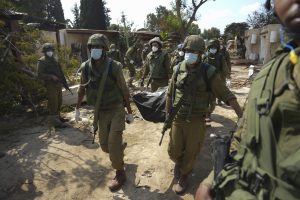
Israeli soldiers lcarry a body of a person killed in Hamas attack in kibbutz Kfar Azza on Oct. 10, 2023.

Most readers need no introduction to the Israel-Palestine issue, one of the most widely discussed and passionately debated conflicts in the world. However, much has changed over the last week from a security standpoint. A number of military assumptions and theories have been proven wrong by the audacious attack of Hamas, named “Al-Aqsa Storm,” on Israeli territory, forcing defense analysts to re-evaluate their position.

Regardless of how successful or comprehensive Israel’s response is, the attack will always be remembered as one of the most brutally successful low-tech, cross-border assaults on a legitimate military power. For South Asia in particular – a region plagued with insurgency and cross-border tension for several decades – the attack presents numerous lessons in warfare that need to be learned sooner rather than later.

The Limits of High-Tech Solutions

For years, Hamas has bombarded Israel with rockets to determine the “saturation point” of the Iron Dome, meaning the point at which it can be overwhelmed with sheer numbers. As recently as 2021, Hamas fired over 1,500 rockets into Israel in the space of three days, but most of them were successfully repelled.

What Israel Must Do

Dennis Ross

In launching its unprovoked, heinous attack on Israelis on October 7, Hamas created the bloodiest day that Israel has seen in more than five decades. The vast majority of the more than 900 killed were civilians—gunned down in their homes or burned to death as their houses were set on fire. Scores of hostages were taken, including grandmothers and mothers with young children, in an act of deliberate terror and brutality. This unprecedented assault has left Israel in a state of shock but also with the resolve to end Hamas’s ability to threaten Israel again, and it will inevitably produce an extraordinary response. In setting off what will by necessity be an overwhelming onslaught on the Gaza Strip, Hamas has brought to a new level the punishment of Palestinians that it has inflicted over and over for nearly two decades.

This situation could have been different. In September 2005, Israeli Prime Minister Ariel Sharon ordered the withdrawal of all Israeli soldiers and settlers from the Gaza Strip. The historic decision to leave meant that Palestinians could finally determine the fate of Gaza. It was a hopeful moment. For decades, Gaza’s destiny had been shaped by others; now Gazans themselves were in charge. It seemed possible to imagine a future in which Gazan leaders transformed the strip from an incubator of terrorism into a prototype for a peaceful, modernizing, and stable Palestinian state.

But Hamas rejected that path. Despite the departure of Israeli troops and settlers, Hamas kept up its attacks on Israel, hitting the Gaza-Israel crossing points multiple times in the first six months after withdrawal. These crossing points were vital for the flow of goods and people into and out of Gaza, and they benefited Palestinians, not Israelis. Yet Hamas’s attacks led Israel to reduce the number of crossing points from six to two. The Palestinians of Gaza were paying the price for Hamas’s actions.

What will Israel’s invasion of Gaza achieve?

EDWARD LUTTWAK

The last major news item about Gaza before the first news of Hamas’s surprise attack was the September 22 announcement that 17,000 Gazans would immediately receive permits to work in Israel, with that number set to rise to 20,000. All understood the likelihood of a permit-holder smuggling in a bomb, or perhaps stabbing an Israeli fellow worker, but that seemed a risk worth taking.

Hamas, after all, had stopped launching rockets against Israel, and appeared to be focused on containing the influence of Islamic Jihad — Hamas’s only remaining competitor after its suppression of the PLO, and one which is financed by Iran to propagate Shi’ism in Gaza. This obvious rivalry was skilfully exploited by Hamas to deceive the Israelis into thinking that it was no longer launching rockets because, as an emphatically Sunni organisation, it wanted to join the Sunni reconciliation with Israel that was already a fait accompli from Morocco to Bahrain.

Once again, as so many times before, Israel’s leaders were deluded into thinking that a Palestinian leadership had some concern for the welfare of its own people, as opposed to its ideological aim: “Palestine” for the nationalist PLO (which always included Christians), and Islamic supremacy for Hamas. The latter’s leaders have frequently explained that Islamic rule must be imposed not just on Israel but on the entire world, and that Palestinian nationalism is un-Islamic twice over — because it includes Christians, and because any nationalism intrinsically subverts Islamic unity.

The Age of Great-Power Distraction

Michael Kimmage and Hanna Notte

Today’s great powers—China, Europe, Russia, and the United States—will undoubtedly have a role to play in the conflict between Israel and Hamas. Whether any of these powers will be able to resolve or contain that conflict is far less certain. The notion that great-power competition defines geopolitics has come back into vogue after it fell into obscurity at the close of the Cold War. Unspoken Cold-War-era assumptions, however, still shadow many contemporary claims about the nature of this competition. Great powers, analysts assume, will marshal immense resources to shape the international order. What they do will shape global affairs. Using their financial and military might for proxy wars, they will remain intensely focused on each other. Wherever one acts, the others will respond in kind.

For all four current great powers, the sense that this competition orients them has become foundational, integrating lines of military, economic, technological, and diplomatic effort. Russia’s war against Ukraine, for instance, can easily be interpreted as a traditional example of great-power competition. According to Russian President Vladimir Putin, his invasion was an act of resistance to American primacy in Europe. Both Russia and Western states are drumming up global support for what they regard as an existential struggle between values and regime type. The Ukraine war has, indeed, deepened tensions between Russia, the United States, and Europe. And as with the Berlin crises in the early years of the Cold War, the war in Ukraine has radiated outward, generating waves of new migrants and sparking inflation.

It Is Time to Talk Seriously About Iran

Danielle Pletka

In the early morning of October 7, Hamas terrorists attacked the State of Israel with thousands of rockets, hundreds of armed aggressors, and a civilian-focused campaign of murder and kidnapping. The attack was well planned, a surprise. As of this writing, at least 500 Israelis have been killed, and unknown numbers—including women and small children—kidnapped into Gaza.

Why now? Because the leadership in Iran that has been closely coordinating the timing of this attack with Hamas believes that both Israel and its most potent backer are weak. The United States is riven by politics, led by compromised and elderly men with little tolerance for danger. And Israel, too, has been in the throes of one its greatest internal rows—a fight over judicial reform so corrosive that military reservists threatened to boycott any call up. Add to the mix the ongoing talks with Saudi Arabia and Israel’s growing acceptance in the Arab world, and the timing feels almost inevitable.

More importantly: There are a few things that should be clear in what are certain to be the early days of an extended conflict. This is not about Palestinian lives or the liberation of territory; this is not about a military-military operation to establish dominance. This is about killing Jews.

Hamas is not an independent organization. It is armed, financed, advised, and led by Iran, and, in part, subsidized by Qatar. That doesn’t mean that the group has no agency, but attacks of this magnitude are not independent actions.

Sri Lanka Reaches Agreement With China’s EXIM Bank on Debt

Krishan Francis

Sri Lanka says it has reached an agreement with the Exim Bank of China on key terms and principles for restructuring its debt, a key step toward unlocking a second installment of a $2.9 billion package from the International Monetary Fund aimed at rescuing the island nation from a dire economic crisis.

The finance ministry said in a statement issued Wednesday that the agreement covers $4.2 billion in outstanding debt and is an important step toward Sri Lanka’s economic recovery.

The statement said the deal provides the necessary fiscal space for Sri Lanka to implement its economic reform agenda.

“The Sri Lankan authorities hope that this landmark achievement will provide an anchor to their ongoing engagement with the official creditor committee and commercial creditors, including the bondholders,” it said.

Authorities hope this will anchor their debt restructuring program and facilitate approval of the next tranche of IMF financing of about $334 million.

An IMF team reviewing Sri Lanka’s reform program delayed releasing a second tranche of IMF financing last month, saying it lacked oversight on whether adequate progress was being made on debt restructuring.

US-China Chip War: New Trends In Global Semiconductor Industry

Aishwarya Sanjukta Roy Proma

The recent decision by the United States government to grant permission for Samsung Electronics and SK Hynix, both based in South Korea, to acquire advanced manufacturing equipment for their semiconductor plants in mainland China is anticipated to pose challenges for domestic memory chip manufacturers in China, such as Yangtze Memory Technologies Co. (YMTC). In a significant compromise with Seoul, the United States has provided Samsung and Hynix with an unrestricted exemption from imposing limitations on the sale of sophisticated chip manufacturing equipment to the mainland.

The aforementioned measure is expected to provide significant benefits to the two firms operating in the biggest semiconductor market globally. It is anticipated that this step will contribute to the stabilization of their market share and enable them to sustain their competitive edge inside China’s semiconductor supply chain.

Presently, China holds about one-third of the worldwide market share for NAND flash memory and DRAM. The waiver is anticipated to provide advantages for suppliers of sophisticated chip manufacturing equipment and materials while simultaneously placing Chinese memory chip manufacturers such as YMTC, who are subject to US blacklisting, at a disadvantage. During the second quarter, Samsung saw a significant decline of 95 percent in its profits due to the presence of a subdued worldwide market for memory chips. Hynix had an operating loss of 2.88 trillion Korean won (equivalent to US$2.13 billion) for the same period.

The End of America’s Exit Strategy in the Middle East

Suzanne Maloney

The shocking Hamas assault on Israel has precipitated a beginning and an end for the Middle East. What has begun, almost inexorably, is the next war—one that will be bloody, costly, and agonizingly unpredictable in its course and outcome. What has ended, for anyone who cares to admit it, is the illusion that the United States can extricate itself from a region that has dominated the American national security agenda for the past half century.

One can hardly blame the Biden administration for trying to do just that. Twenty years of fighting terrorists, along with failed nation building in Afghanistan and Iraq, took a terrible toll on American society and politics and drained the U.S. budget. Having inherited the messy fallout from the Trump administration’s erratic approach to the region, President Joe Biden recognized that U.S. entanglements in the Middle East distracted from more urgent challenges posed by the rising great power of China and the recalcitrant fading power of Russia.

The White House devised a creative exit strategy, attempting to broker a new balance of power in the Middle East that would allow Washington to downsize its presence and attention while also ensuring that Beijing did not fill the void. A historic bid to normalize relations between Israel and Saudi Arabia promised to formally align Washington’s two most important regional partners against their common foe, Iran, and anchor the Saudis beyond the perimeter of China’s strategic orbit.

Rebuilding Ukraine’s Economy Starts Now

Ralph Clem, Erik Herron, and Matthew Lantzy

The debate over the proper extent of U.S. support for Ukraine in its ongoing war against Russian invaders has now spread in spectacular fashion into American congressional and presidential politics. Most of this coverage focuses on military assistance, not unreasonably given the scale and scope of the fighting. But, as we argue here, it is increasingly evident that Ukraine’s ability to sustain that fight is also in large measure a function of its capacity to begin rebuilding and reorienting its economy in the midst of this war. This means that more support for Ukraine’s defense industrial sector and wider business activities is required to ensure its survival, long-term prosperity, and ability to arm itself.

Indeed, Ukrainians view rebuilding now as a national cause, part and parcel of their desire to liberate their country’s territory. Urgent priorities, such as repairing and upgrading damaged metallurgical plants and housing stock, simply cannot wait for the cessation of hostilities. The problem will only get worse unless action is taken now.

Assessing the Problem

The price Ukraine has already paid since Russia first invaded in 2014 is immense in both human and material terms. Following the much larger attacks commencing in February 2022, the country’s gross domestic product dropped by almost 30 percent in what the World Bank characterized as a “staggering contraction.” In a recent article, we showed that this is primarily because six of Ukraine’s 10 most economically important regions are in the eastern and southern parts of the country where the heaviest fighting has taken place. This is confirmed by our analysis of numbers from the Violent Incident Information from Newspaper Articles project that compiles multi-source incident data in near-real time.

New Shores - From the Mine to the Battery


Jay Turner: We are tracking 62 newly-announced projects since last August. That adds up to about $53 billion in new investments and the potential for more than 37,000 jobs.

Allegra Dawes: That's Jay Turner, a professor of environmental studies at Wellesley College. He's been tracking investments made in the battery supply chain since the passage of the IRA in August of 2022. And if we want to assess the successes and challenges of onshoring supply chains, batteries are a good place to start. This is because batteries are critical for the energy transition. Decarbonizing transportation will require electric vehicles, which require batteries. Adding renewable resources to the power grid will require more electrical storage, adding more demand for larger battery storage systems. Batteries also exhibit some of the domestic and international goals and tensions of onshoring supply chains that we talked about in the previous episode.

From the Energy Security and Climate Change team at CSIS, I'm Allegra Dawes. And this is News Shores, a podcast series on green industrial policy and the U.S.' effort to onshore and friendshore clean energy supply chains. On today's episode, we're continuing our discussion of the U.S.' on- and friendshoring experiment by looking at supply chain for batteries. We will look at each segment of the battery supply chain and explore some of the geopolitical and business considerations that are impacting this sector. Building a resilient and domestic supply chain for batteries has been a priority for EV manufacturers and the U.S. government. Let's take a closer look at this effort.

With new intel doctrine, Army turning its sights to ISR modernization

THERESA HITCHENS

AUSA 2023 — Having just published an updated intelligence doctrine to reflect its focus on future multi-domain operations, the Army is now working on plans to modernization its intelligence, surveillance and reconnaissance (ISR) architecture — pursuing everything from commercial satellite data to quantum computing for speeding analysis, according to senior officials.

Lt. Gen. Laura Potter, Army deputy chief of staff for intelligence, said the new “Army Field Manual FM 2.0, Intelligence” [PDF] published today “is nested” in its multi-domain operations doctrine, FM 3.0, published last October.

“It is where we’re headed for 2030, and then [Army] Futures Command is already looking at what must the Army do out to 2040. You’ll see that we’re doing joint and multinational operations, and we’re fighting at every echelon of combat power,” she told the annual Association of the United States Army (AUSA) conference today. “So delivering an intel enterprise that can support warfighters at echelon is what you’re going to read about in 2.0.”

As for ISR modernization efforts, Potter explained that the Army’s intelligence corps is working across “three layers: the space layer, taking advantage of government and commercial space based resources; an aerial layer that’s a mix of manned HADES [High Accuracy Detection and Exploitation System] aircraft and unmanned platforms; and then a terrestrial layer that has terrestrial layer sensing at the brigade level and echelons above brigade.”

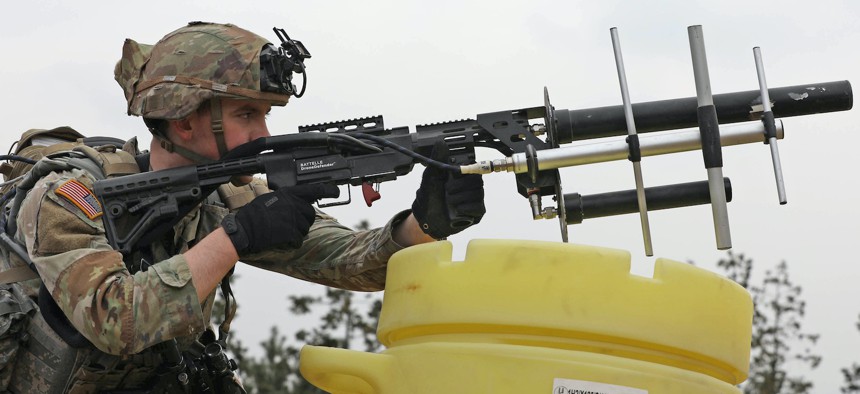
Platoons to get counter-drone gear in two US Army divisions

SAM SKOVE

“Look up,” Sgt. Maj. Demetrius Johnson, a leader in the Army’s anti-drone effort, told a crowd at the AUSA trade show. “You’ve just had the first step of training for counter-UAS.”

A ripple of laughter went through his audience, but the lesson grows more pertinent by the day as the Army works to bolster its counter-drone forces against a growing threat. The service’s effort now extends from basic soldier education to the dispatch of drone-killing trucks to Ukraine.

They also include equipping individual platoons with handheld and electronic-warfare anti-drone systems, according to leaders in the Army’s Joint Counter-small Unmanned Aircraft Systems Office (JCO), which develops the military’s response to class-one, -two, and -three drones ranging from 250 grams to over 1,000 pounds.

“We've just fielded two divisions with counter-UAS capability,” said Maj. Gen. Sean Gainey, director of the JCO. “The intent is to go down to the platoon level with handheld capability and [electronic warfare] capability.”

Gainey said it will be up to the divisions—the 82nd Airborne and 1st Cavalry—to decide how to assign soldiers to operate the weapons. But he said they are not meant to be restricted to specific Army specialties, such as indirect fire specialists or infantry.

The Army is also looking into ways to make sure anti-drone soldiers are able to deconflict within sometimes crowded airspaces, said Lt. Col. Johnathan Hester, a JCO requirements officer.

Steve Scalise Withdraws From Speaker Bid Amid Republican Infighting

JON JACKSON 

Republican Representative Steve Scalise of Louisiana on Thursday withdrew from consideration for the speakership of the U.S. House of Representatives.

Scalise was nominated on Wednesday in a closed-door ballot among House Republicans, but many GOP House members supported his challenger, Representative Jim Jordan of Ohio. Also favoring Jordan was former President Donald Trump. In a Truth Social message posted before Scalise was nominated, Trump said the Ohio congressman "will be a GREAT Speaker of the House, & has my Complete & Total Endorsement!"

The previous House speaker, Representative Kevin McCarthy of California, was voted out of the position on October 3 after Republican Representative Matt Gaetz of Florida spearheaded an effort to remove him.

Scalise has represented Louisiana in the House since 2008. This summer, he was diagnosed with blood cancer. Representative Marjorie Taylor Greene, a Georgia Republican, on Wednesday said she was supporting Jordan over Scalise because she preferred the latter focus his energy on fighting his cancer diagnosis.

Trump also expressed concern about Scalise's health in relation to taking over as speaker during a Thursday interview with Fox News Radio.

Africa Isn’t Ready For A Withdrawal Of Peacekeepers

Dawit Yohannes, Meressa Kahsu, and Andrews Atta-Asamoah

Peacekeeping operations have played a crucial role in stabilising fragile situations across Africa for over 60 years. More than 13 United Nations (UN)-led missions in Africa and about 27 African-led peace support operations since 2000 have incurred billions of dollars annually and cost thousands of peacekeepers’ lives.

While these missions haven’t met all their host countries’ expectations, they have helped prevent state collapse, notably in Somalia, Mali and the Democratic Republic of the Congo (DRC).

But are peacekeeping missions fulfilling their mandates? In Mali, persistent insecurity and the demands of the 2020 coup leaders led to the withdrawal of UN peacekeepers. Continuing violence in eastern DRC, despite the UN Organization Stabilization Mission in the Democratic Republic of the Congo (MONUSCO) being in the country for over 20 years, fuelled similar calls. Funding challenges and a political standoff informed the push to end the African Union (AU) Transition Mission in Somalia (ATMIS).

In all three countries, calls for withdrawals have been driven by local and international political pressures, unmet domestic expectations for improved security and donor funding fatigue. This raises questions not only about peacekeeping in Africa, but the effectiveness of the global peacekeeping architecture and how public perceptions regarding its role are managed.

Europe’s Moment of Powerlessness in the Middle East

PIERRE VIMONT

With the horrendous attacks of its terrorist groups on Israeli territory on the morning of October 7, the Hamas movement has stunned the world and brought an unprecedented sense of humiliation and anger over Israel. Understandably, the country is calling for revenge and a moment of national unity is prevailing as Israel’s military forces prepare to strike back in Gaza with all their might after Hamas’s murderous crimes against Israeli civilians.

Yet this moment of terror and utter astonishment that many Israeli observers compare to the shock of the terrorist attacks on 9/11 against America is also giving way to a rare feeling of vulnerability within Israeli society. Israel’s traditional military deterrence seems to have lost its clout as Tsahal (Israeli defense forces) and the intelligence services have been missing during the first hours of these attacks. More significantly, the whole geopolitical strategy displayed by the Israeli government to sideline the Palestinian issue and shore up its relations with its Arab neighbors has backfired.

Indeed, the Palestinian question, which seemed irreversibly sent into oblivion, is moving back to center stage, albeit with the risk of confusion between the legitimate rights of the Palestinian people and the use of violence by the Hamas, and with the additional risk of placing on an equal footing the Palestinian Authority in the Occupied Territories and Hamas in Gaza.

Towards a functional global order

Ngaire Woods

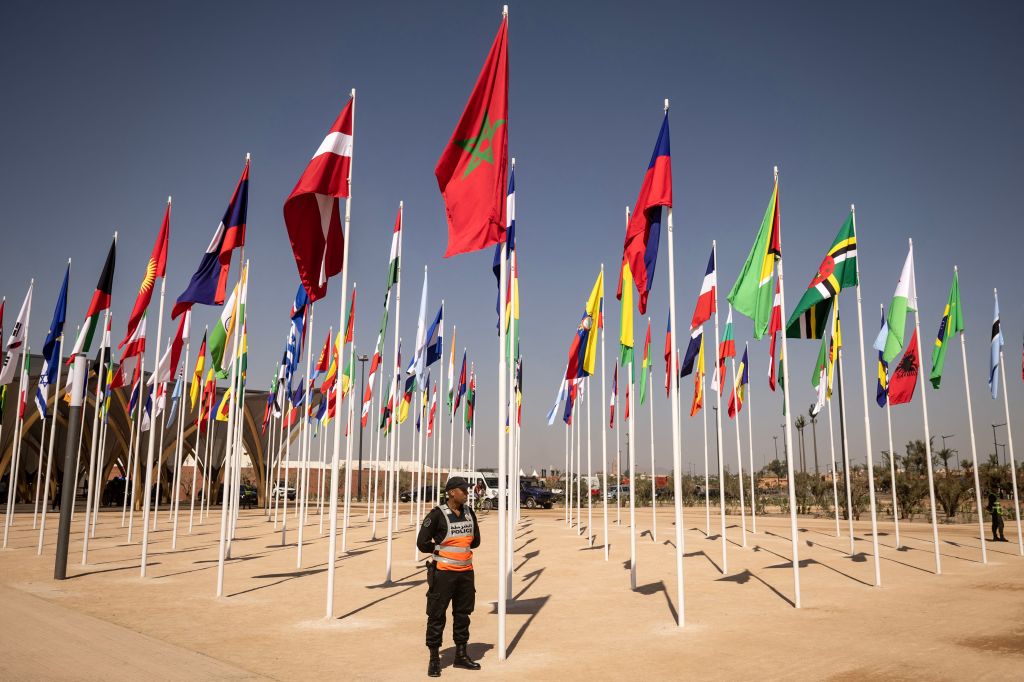
World leaders attending the International Monetary Fund and World Bank annual meetings in Marrakesh this week have some difficult decisions to make.

For starters, numerous developing economies—including Egypt, Ethiopia, Ghana, Kenya, Pakistan, Sri Lanka, Tunisia, Ukraine and Zambia—are teetering on the edge of default or have already defaulted. Meanwhile, the United Nations’ recent ‘global stocktake’ climate report shows that we are far from staying under the 1.5°C ceiling for global warming.

While robust economic growth could provide the necessary resources to tackle these challenges, the IMF foresees global sluggishness and a prolonged fight against inflation. Without international cooperation, countries may become ensnared in a slow, messy and expensive effort to manage their debts, combat climate change and stimulate growth.

This isn’t the first time the world has faced such a crisis. As economic historian Martin Daunton notes in his forthcoming book, The economic government of the world: 1933–2023, policymakers from 66 countries convened at the 1933 London Economic Conference to address challenges eerily similar to the ones we face today: debt, protectionism, financial instability and polarisation. With the world economy in freefall and commodity prices crashing, demand for industrial goods evaporated. As unemployment surged, so too did the tensions between domestic political agendas and international economic concerns.

Forget PowerPoint and move faster on planning, Army 2-star says

Todd South

WASHINGTON, D.C. — The days of units organizing their operations around a 24-hour cycle, with a short list of targets and procedures, and walking through each at a comfortable pace are over.

“Right now, the way we organize ourselves is in a 24-hour battle rhythm, and that has to change,” said Maj. Gen. Charles Costanza, special assistant to the commanding general of Army Forces Command.

“[Large-Scale Combat Operations] are not going to let you do that,” he said.

The two-star explained this during an Oct. 11 panel on intelligence modernization here at the annual Association of the U.S. Army Meeting and Exposition.

The former commander of the 3rd Infantry Division, who conducted four Division Warfighter exercises while leading the unit has seen a lot of how the Army will fight in 2030. His team ran through an entire exercise in which his force simulated such a battle with all the tools and formations the Army expects to have in its arsenal in the next decade.

The rapid pace of battle and enemy movement in those scenarios meant that a division intelligence officer could come into the command center, which radically changed the day’s plan and targeting list.

RUSSIAN OFFENSIVE CAMPAIGN ASSESSMENT, OCTOBER 11, 2023

Karolina Hird, Angelica Evans, Christina Harward, Nicole Wolkov, and Mason Clark

Russian sources celebrated Russian advances in this area and outlined several adaptations that suggest that Russian forces are applying lessons learned from operations in southern Ukraine to other sectors of the front.[4] A Russian artillery battalion commander who is reportedly fighting in the area claimed that Russian forces are paying significant attention to counterbattery combat.[5] Another source who also claimed to be fighting in the area reported that Russian forces are using electronic warfare (EW) systems, conducting sound artillery preparation of the battlefield, and are demonstrating “clear interaction” between command headquarters, assault groups, aerial reconnaissance, and artillery elements.[6] The milblogger noted that Russian forces are not employing human wave-style “meat” assaults, and several Russian sources amplified footage of Russian armored vehicles leading a breakthrough along roadways towards Ukrainian positions, followed by infantry columns.[7]

The suggestion that Russian forces are effectively employing EW, counterbattery, artillery preparation, aerial reconnaissance, and inter/intra-unit communication is noteworthy, as Russian sources previously emphasized these tactical adaptations as the strengths of Russia’s defense against Ukrainian counteroffensive operations in southern Ukraine, particularly in June and July.[8] Furthermore, the majority of Russian forces currently fighting in the Avdiivka area are likely elements of the Donetsk People’s Republic (DNR) 1st Army Corps, which the Russian 8th Combined Arms Army predominantly controls.[9] ISW has not observed any 8th Combined Arms Army elements not from DNR formations involved in ongoing attacks, and ISW assesses current Russian offensive efforts in the Avdiivka area are likely primarily comprised of DNR forces. DNR elements have suffered from pervasive issues with abusive command culture, poor discipline, and minimal training; all of which have been exacerbated by wider issues with the integration of the DNR’s more irregular force structure into Russia’s regular military, as ISW has previously reported.[10] Reports by Russian milbloggers that units in this area are displaying effective communication may suggest that DNR forces have somewhat eased their integration into regular Russian forces and have learned lessons from previous ineffective and failed attacks in the Avdiivka area.

Army will get ‘pounded’ by adversaries if network doesn’t improve, new chief of staff warns

JON HARPER

Modernizing the Army’s network and command-and-control capabilities is leadership’s top “transformation” priority as they try to prepare the force for future battlefields, newly sworn-in chief of staff Gen. Randy George said Tuesday.

George, who previously served as the vice chief, was confirmed for his new role last month. He and other senior officers want to adapt how the service fights, organizes, trains and equips. That includes developing new human-machine integrated formations. Related concepts and technologies are being tested through exercises and experimentation venues like Project Convergence.

When Army Futures Command was established a few years ago to help drive modernization with cross-functional teams, the network was fourth on the list of priorities. Since then, it’s been getting even more attention.

“Our number one priority when it comes to transformation is the network. Command and control is foundational to how we fight. Frankly, a lot of the systems that we have today just don’t support effective C2,” George noted during a keynote address at the annual AUSA conference.

15 October 2023

How Israel's War Could Become a Nightmare for President Biden

DANIEL BUSH 

Hamas's devastating attack on Israel has forced the White House to face the prospect of a potential regional war that would consume the administration for weeks or months to come, a worst-case foreign policy crisis for President Biden as he ramps up his reelection campaign.

And as the death toll rises, other factors beyond a broader escalation -- from a developing hostage situation to oil price rises that would increase inflation and cause economic harm -- may present Biden with challenges that would have significant political ripple effects in the United States.

A broader war in the Middle East may not come to pass. But as details of the planning behind the attack start to emerge, and as Israel prepares a full-scale assault on Hamas in the Gaza Strip, officials in Washington are bracing for the possibility that the violence might escalate.

"The nightmare scenario for the Biden administration is that before this is contained it metastasizes and Israel has a multifront war on its hands," Lucy Kurtzer-Ellenbogen, the director of the Israeli-Palestinian Conflict Program at the United States Institute for Peace, told Newsweek.

Whether the war expands will depend in part on any role Iran may have played in helping Hamas plan the attack, former U.S. intelligence and defense officials and others told Newsweek. Iran and allies such as Hezbollah could also escalate the conflict as the Israeli army steps up what it has promised will be a massive operation in Gaza.