26 October 2023

RUSSIAN OFFENSIVE CAMPAIGN ASSESSMENT, OCTOBER 23, 2023

Karolina Hird, Christina Harward, Angelica Evans, Nicole Wolkov, and Mason Clark

Russia's domestic production of artillery shells, supplemented by increased ammunition imports from North Korea, will likely allow Russian forces to sustain sufficient rates of artillery fire in Ukraine in 2024, albeit at a relatively lower level than during 2022. Estonian Defense Forces Intelligence Center Head Colonel Ants Kiviselg stated on October 20 that Russia still has around four million artillery shells remaining, which Russian forces can use for "low intensity" warfare for an additional year.[1] Kiviselg noted that there are reports that North Korea has shipped up to 1,000 containers of ammunition to Russia, each containing between 300-500 pieces of artillery ammunition.[2] Kiviselg estimated that North Korea may have therefore provided between 300,000-500,000 pieces of ammunition to Russia, which can last up to one month at the current daily rate of consumption of around 10,000 shells a day.[3] Ukrainian military analyst Colonel Petro Chernyk reported on October 23 that Russian forces are currently firing between 10,000-15,000 shells a day, significantly lower than rates of fire in summer 2022 of 45,000-80,000 shells per day.[4] However, Western sources and satellite imagery have confirmed that North Korean deliveries, likely mostly comprised of artillery shells, have drastically increased since Russian and North Korean authorities likely began more official military-technical cooperation in September, as ISW previously reported, and North Korea is likely to provide further deliveries.[5] Based on Western estimates of Russian artillery production capacity and continued North Korean artillery exports, Russia will likely be able to maintain generally sufficient rates of fire in the foreseeable future. While an overall decrease in Russian fire rates could impede the ability of Russian forces to conduct large scale offensive operations, Russian forces are unlikely to face widespread shortages which would chronically undermine defensive operations, and the drop in the rate of fire will not inherently provide Ukrainian forces an advantage. The degree to which Ukraine’s international partners sustain Ukraine’s ability to sustain an effective weight of fire relative to Russian forces will be a key determiner of respective capabilities in 2024.

Russian forces conducted another series of missile and drone strikes against Ukraine on the night of October 22 to 23. The Ukrainian Air Force reported that Russian forces launched 13 Shahed-131/136 drones, one unspecified drone, and one Kh-59 cruise missile and that Ukrainian forces destroyed all targets.[6]

A price cap on Russian oil aims to starve Putin of cash. But it's largely been untested. Until now

DAVID McHUGH 

FILE - An oil tanker is moored at the Sheskharis complex, part of Chernomortransneft JSC, a subsidiary of Transneft PJSC, in Novorossiysk, Russia, on Oct. 11, 2022, one of the largest facilities for oil and petroleum products in southern Russia. For months after Ukraine's Western allies limited sales of Russian oil to $60 per barrel, the price cap was still largely symbolic. Most of Moscow's crude — its main moneymaker — cost less than that.

Uncredited - stringer, ASSOCIATED PRESS

FILE - Russian President Vladimir Putin gestures while speaking at a news conference following a meeting of the State Council at the Kremlin in Moscow, Russia on Dec. 22, 2022. Prices for Russian oil have risen well above a price cap imposed by Western allies as part of sanctions over the invasion of Ukraine.
Sergey Guneyev - pool, ASSOCIATED PRESS

FILE - An oil tanker is moored at the Sheskharis complex, part of Chernomortransneft JSC, a subsidiary of Transneft PJSC, in Novorossiysk, Russia, on Oct. 11, 2022. Prices for Russian oil have risen well above a price cap imposed by Western allies as part of sanctions over the invasion of Ukraine.

Missiles and Momentum in Ukraine

CATHY YOUNG

Two Ukrainian soldiers walk at dawn through a forest clouded by smoke after artillery fire during combat maneuvers on September 24, 2023 near Kreminna, Luhansk, Ukraine. (Photo by Libkos/Getty Images)

FOLLOWING THE HORRIFIC OCTOBER 7 ATTACKS on Israel by Hamas, the war in Ukraine was understandably pushed to the sidelines of the news, inevitably prompting right-wing trolls like former Hercules actor Kevin Sorbo to tout its alleged invisibility as implied evidence that it was always fake news:

This reduced visibility, moreover, came on the heels of weeks of claims that the Ukrainian counteroffensive was a bust and had reached the “pointless meat grinder” stage. On October 13, Russia’s ambassador to the United Nations, Vasily Nebenzya, said that “the so-called Ukrainian counteroffensive can be considered finished” with nothing to show for it but tens of thousands of dead recruits and that Russia had “launched active combat operations along the entire frontline.” (Nebenzya also accused the West of feeding more weapons to Ukraine “like drugs to a drug addict, thus prolonging his agony.”) Two days later, Nebenzya’s boss Vladimir Putin weighed in with his own assertion that the Ukrainian counteroffensive had “failed completely” but, confusingly, added that “the opposing side” was planning new offensive operations in some areas and described the Russian troops’ operations as “active defense,” without explaining how that differs from plain and simple defense.

Biden’s Israel Policy Gets Put to the Test

João Fazenda

In Barack Obama’s White House, there were two schools of thought about managing the United States’ bedrock alliance with Israel. Defense Secretary Robert Gates privately called the relationship “all give and no get,” and was among those who thought that Obama should approach Jerusalem with skeptical caution, according to Dennis Ross, a Middle East hand who advised Obama and later wrote an eyewitness history of U.S.-Israeli relations. On the other side, as Ross summarized it, then Vice-President Joe Biden argued for “drawing the Israelis close to us,” in part to gain greater influence, even amid bitter disputes with Prime Minister Benjamin Netanyahu over the expansion of Jewish settlements in the occupied West Bank.

Last week, arriving for a one-day visit to Tel Aviv, President Biden descended from Air Force One and bear-hugged Netanyahu before a phalanx of cameras. “You are not alone,” he said later, in a speech to Israelis about the Hamas-led terror attacks of October 7th, when militants broke out of Gaza and murdered more than fourteen hundred Israelis and seized hostages. Since then, Biden has denounced the “bloodthirstiness” of Hamas and spoken evocatively of Israeli victims: “infants in their mother’s arms, grandparents in wheelchairs, Holocaust survivors abducted.” As the Israeli Air Force unleashed an unbridled counterattack in Gaza, the President also pledged aid to besieged Palestinian civilians; according to Gaza’s health ministry, more than twenty-five hundred women and children died in the enclave during the war’s first two weeks.

RUSSIAN OFFENSIVE CAMPAIGN ASSESSMENT, OCTOBER 22, 2023

Karolina Hird, Angelica Evans, Christina Harward, Riley Bailey, and Mason Clark

Russian forces are funneling additional forces to the Avdiivka front despite ongoing challenges with frontal mechanized assaults and the failure of a renewed push on October 19-20. Several Russian milbloggers claimed that there were no significant changes along the front in the Avdiivka direction on October 22.[1] Russian forces are likely once again pausing following a failed major push which suffered heavy losses. A prominent Russian milblogger claimed that Ukrainian forces “unexpectedly” counterattacked in the direction of Pisky (8km southwest of Donetsk City) and pushed Russian forces from positions in the area. Another milblogger stated that claims of Ukrainian advances near Pisky and Opytne (4km south of Avdiivka) are false.[2] Another Russian source allegedly serving in the Avdiivka direction claimed that Ukrainian forces did not conduct counterattacks in his unspecified sector of the front.[3] Geolocated footage published on October 21 indicates that Russian forces recently made marginal advances southeast of Pervomaiske (11km southwest of Avdiivka).[4] A Russian milblogger claimed that Russian forces have not completely cleared the Avdiivka waste heap area and that the area is currently a contested “gray zone.”[5]

A Kremlin-affiliated milblogger discussed difficulties that may be contributing to a “positional deadlock” for Russian offensive operations in the Avdiivka direction as of October 22.[6] The milblogger claimed that it is difficult to conduct maneuver warfare on a static front line with a large number of personnel and fortified areas on both sides. The milblogger noted that Ukrainian drones and other precision weapons have made armored vehicles increasingly vulnerable and have made ground attacks increasingly difficult. The milblogger also noted that Russian forces are facing difficulties in overcoming Ukrainian minefields near Avdiivka and are unable to completely destroy Ukrainian logistics, allowing the Ukrainian command to quickly transfer personnel to critical areas. Russian sources have previously claimed that Ukrainian defensive fortifications pose a significant challenge to Russian advances around Avdiivka.[7] These challenges are highly similar to those faced by Ukrainian forces in southern Ukraine in the initial weeks of the ongoing Ukrainian counteroffensive in June 2023. However, it remains to be seen if Russian forces have the capabilities and flexibility to adapt in some manner, as Ukrainian forces did following early setbacks in June 2023.

Into the Cyber Abyss: Check Point’s Riveting 2024 Predictions Reveal a Storm of AI, Hacktivism, and Weaponized Deepfakes


Criminal activities surged in the first half of the year, with Check Point Research (CPR) reporting an 8% increase in global weekly cyberattacks in the second quarter, marking the highest volume in two years. Familiar threats such as ransomware and hacktivism have evolved, with criminal gangs modifying their methods and tools to infect and affect organizations worldwide. Even legacy technology such as USB storage devices regained popularity as a vehicle to spread malware.

One of the most significant developments this year was the evolution of the ransomware landscape. Data derived from over 120 ransomware “shame-sites” revealed that in the first half of 2023, a total of 48 ransomware groups reported breaching and publicly extorting more than 2,200 victims. There have been several high-profile cases this year including the attack against MGM Resorts, which shutdown major Las Vegas sites for several days and is likely to cost millions in remediation.

Check Point’s cybersecurity predictions for 2024 broadly fall into seven categories: Artificial Intelligence and Machine Learning; GPU farming; Supply chain and critical infrastructure attacks; cyber insurance; nation state; weaponized deepfake technology and phishing attacks.

Artificial Intelligence and Machine Learning:
  • Rise of AI-directed cyberattacks: Artificial intelligence and machine learning have dominated the conversation in cybersecurity. Next year will see more threat actors adopt AI to accelerate and expand every aspect of their toolkit. Whether that is for more cost-efficient rapid development of new malware and ransomware variants or using deepfake technologies to take phishing and impersonation attacks to the next level.
  • Fighting fire with fire: Just as we have seen cybercriminals tap into the potential of AI and ML, so too will cyber defenders. We have already seen significant investment in AI for cybersecurity, and that will continue as more companies look to guard against advanced threats.
  • Impact of regulation: There have been significant steps in Europe and the US in regulating the use of AI. As these plans develop, we will see changes in the way these technologies are used, both for offensive and defensive activities.

25 October 2023

Biden hitches Israel aid to less popular Ukraine war support

DANIEL WILLIAMS

US President Joe Biden gave a televised speech Thursday night, providing a verbal tour of his thoughts on both the Hamas-Israel war and Russia’s attack on Ukraine.

His speech vividly described the horrors visited on civilian victims of both conflicts when Hamas invaded Israel from the Gaza Strip and Russian President Vladimir Putin made war on Ukraine 22 months ago.

Biden offered sympathy to Palestinian civilians not associated with Hamas and mentioned conversations with leaders of Egypt and the Palestinian Authority, which runs parts of the West Bank. He proclaimed it America’s duty to help Israel and Ukraine in their fights because the US is the “beacon to the world.”

He backed the Ukrainian goal of ousting the Russians from their country. He did the same for Israel, but there was a difference between Ukraine, which is defending its own sovereign territory, and Israel, which is ousting an armed group from land it has agreed is not its own and which it does not want to occupy.

In short, what happens after the war’s end? Biden made only fleeting reference to his own desire once the Israel-Hamas war, now entering its third week, is over. He devoted one sentence to his preferred outcome: adherence to what is known as the two-state solution—i.e. the creation of a Palestinian state encompassing the Gaza Strip and the West Bank alongside Israel.

‘There Are Options for Israel That Do Not Involve Killing Thousands of Civilians’

NAHAL TOOSI

Until this week, Josh Paul was a figure little-known beyond diplomatic and military circles. He had spent more than 11 years at the State Department as a civil servant, focusing heavily on the issue of arms transfers from the United States to other countries. He’d watched as the United States sent weapons to many troublesome regimes, but he thought his input had helped keep the system from thoughtless overreach.

The U.S. rush to arm Israel in its battle against Hamas militants proved a breaking point for Paul. The 45-year-old, an American who grew up in London and speaks with a distinctive British accent, quit his position in the Bureau of Political-Military Affairs. He posted a resignation letter that he said resonated with many inside the State Department. In it, he condemned the Hamas attack as a “monstrosity” but wrote that he believes the military response Israel is taking will only lead to more and greater suffering.

The Israeli-Palestinian conflict is an issue Paul has studied academically, writing a master’s thesis on Israeli counterterrorism and civil rights, and he has also lived in the West Bank. In a conversation with POLITICO Magazine, Paul laid out why he thinks the U.S. approach to this war is wrongheaded and why Israel should pursue options beyond an invasion of the Gaza Strip. He even read some excerpts of the emails he sent to his former superiors.

Implications Of Impending Israeli Military Operation Against Hamas In Gaza

Suminda Jayasundera

The October 7 attack by Hamas on Israel created shockwaves in Israel and escalated the security situation to a new level. In response to this terror attack, Israel declared war against Hamas with a massive mobilization of troops to eradicate terrorism emanating from the Gaza Strip and to destroy the Hamas organization entirely. Israel considers this attack as its September 11th moment. The attack’s aftermath brought the Israelis together as a nation, and they received unconditional support from the West to fight against terrorism. Now, Israel Defense Forces is setting the stage to conduct one of the most significant operations in modern history against Hamas in one of the most densely populated areas in the region.

In contrast, Hamas’s fighters are determined to defend Gaza. Unequivocally, Israel has superiority in every military aspect. However, Hamas will use every available asymmetric warfare strategy against the technologically superior Israel military and hinder military operations as previously. Also, Hamas has a history of operating within a civilian population, seeking to exploit Israel’s concern for minimizing civilian casualties, making it challenging for Israel to employ its full military capabilities without risking international condemnation.

Meanwhile, the international community sent mixed messages to both parties, and many considered Israel’s impending military operation an invasion like the one carried out by Russia in invading Ukraine. In the latest move, with over 4,000 civilian deaths in the region, some 800 European Union officials have written to the head of the European Union criticizing her uncontrolled support of Israel. Even though there is a legitimate reason to conduct military operations against Hamas, the Israeli narration portrayed this operation as revenge. As such, President Biden also warned Israel not to make the same mistake committed by the United States after the terror attack in 2001.

After Hamas, Then What? Israel’s Undefined Endgame in Gaza

ERIC CORTELLESSA

For years, Israel assiduously avoided an all-out military confrontation with Hamas, estimating that it was safer to have a contained Palestinian power controlling Gaza than no power at all. To that end, Prime Minister Benjamin Netanyahu and the nation’s security establishment sought to limit the threat posed by the group via periodic strikes in a cycle that became so routine the Israelis simply called it “mowing the grass.”

Now, in the wake of the Oct. 7 massacre by Hamas that killed more than 1,500 people and upended that strategy, Israel is looking to tear Hamas out of Gaza root and branch in what most expect will be a long and bloody ground invasion. Over the last week, the Israel Defense Forces (IDF) have called up more than 300,000 reservists, amassed troops along the border, launched an air campaign, and conducted localized raids that have killed at least three Hamas leaders. On Thursday, Netanyahu met with troops in southern Israel. “At the end of this,” says Mark Regev, a former senior adviser to Netanyahu, Hamas' "military machine will be dismantled and its political structure will be smashed.”

Israel’s declaration of total war against Hamas is understandable after the worst slaughter of Jewish civilians since the Holocaust. Israel’s leaders reason that if Hamas is not defeated decisively, the message to hostile powers in the Middle East will be that terror tactics work. But war breeds chaos and chaos breeds unforeseen consequences. The hard question now being quietly raised by officials in Israel, the region, and the U.S. is: After Hamas, then what?

Reflecting on International Terrorism after the Hamas Attacks on Israel

Sylvain Keller

On 7th October, Israel endured a multi-pronged attack conducted by Hamas, causing the killing of more than 1400 civilians and the abductions of approximately 200 people, including children, who were taken as hostages. Benjamin Netanyahu, Israeli’s prime minister, described those acts as terrorism and Israeli authorities characterized them as “Israeli’s 9/11”. A major part of the international community, including Western countries such as the United States, provided their support to Israel and also designated this attack as terrorism. Israel then launched an unprecedented counter-offensive, targeting several Hamas positions in Gaza. By October 16th, authorities indicated that at least 2,670 people had been killed by Israel’s retaliatory strikes in Gaza.

The extent of the crimes committed by Hamas, in terms of victims and strategy, recalled acts carried out by Islamic State/ISIS or those of al Qaeda on 9/11 2001. Israel’s authorities have also tried to establish a direct link between Hamas and ISIS in recent years. Netanyahu stated that ‘Hamas bound, burned and executed children. They are savages. Hamas is ISIS. And just as the forces of civilizations united to defeat ISIS, the forces of civilization must support Israel in defeating Hamas’. From this standpoint, the main purpose of this article will be to demonstrate the consideration of Hamas as a terrorist actor and its links with internationally recognized terrorist groups as well as the potential impact of this attack on international terrorism.

According to the most recent analyses, the main purpose of Hamas’ multi-pronged attack was to prevent the current soft diplomacy policy between Israel and other Gulf States like Saudi Arabia. The founding charter of Hamas, issued in 1998, aims to the destruction of Israel and the use of jihad (articles 9 to 15), presenting similarities with the strategies of al Qaeda or ISIS.

Israeli ‘Cyber War Room’ Uses Amazon Facial Recognition To Find Missing And Dead After Hamas Attack

Thomas Brewster

After the deadly terrorist attacks on Israel by Hamas two weeks ago, leaving 1,300 people dead and hundreds more unaccounted for, a group of cyber experts began a volunteer project to try to identify the missing. They wrote code that trawled social media sites including Telegram, Twitter and TikTok to gather images and video from the deadly assault. Then, using Amazon’s facial recognition algorithm, Rekognition, they compared those images to a database of photos provided by official Israeli government sources and the families of the missing.

Over the course of two weeks, the project, which was led by former deputy director of the Israeli government’s National Cyber Directorate, Refael Franco, was able to identify some 60 missing people and provide new leads on the whereabouts and status of five others. It hasn’t yet resulted in an actual rescue, but the project is promising enough that it has been handed over to the Israeli Defense Forces (IDF) and deployed as part of its rescue operations.

Franco, now cofounder of security startup Code Blue Cyber, told Forbes the project was handed off to the Israeli government because it had gathered “a lot of sensitive data that you don't want to share with civilians.” According to the IDF, as many as 200 Israelis are either missing or are known to have been kidnapped by Hamas.

Cairo Needs Cash and Gazans Need Shelter. Can a Deal Be Brokered?

Adam Tooze

It was inevitable that Egypt would be dragged into the war between Israel and Hamas. As a border state of both the Gaza Strip and Israel, Egypt is now at the center of diplomacy over humanitarian aid, the possible movement of Palestinian refugees, and potentially, the negotiation of a cease-fire. Yet prior to the war, to the extent that Egypt was in the news at all, it was for very different reasons: Financial experts had been observing its mounting debt problems with growing concern. This past summer, Egyptian Finance Minister Mohamed Maait announced that the debt-to-GDP ratio was expected to reach 97 percent during the summer, a colossal 16.8 percent increase from June 2022.

The Israeli Gaza campaign: High expectations, big risks and bleak outcomes

RIAD KAHWAJI

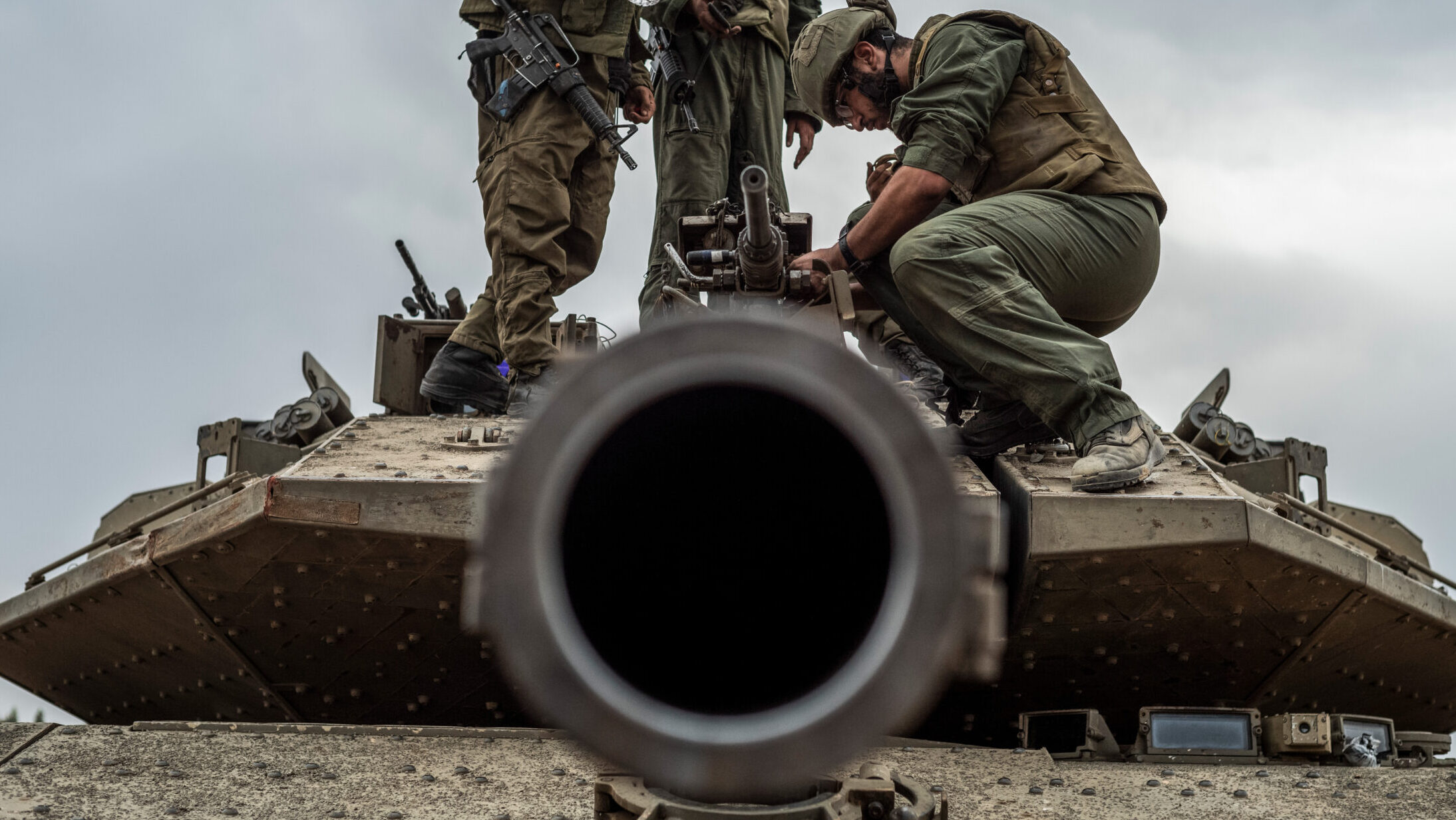
Israeli soldier work on a tank at the Israel-Gaza border. Fighting between Israeli soldiers and Islamist Hamas militants continues in the border area with Gaza. 

Two weeks after the surprise attack by Hamas on Israel, the return onslaught against the Gaza strip continues. The Hamas attacks resulted in the killing of 1,300 Israelis and capturing over 200 others, leading the Israeli government to declare all-out war on the Palestinian guerrilla group in Gaza — a goal that could prove hard to attain due to the difficult terrain of the highly populated enclave and political pressure from all sides over humanitarian deaths.

But analysts warn that as Israel attempts to emerge victorious in its war with Hamas, the fallout from the destruction in Gaza could destabilize the region with unforeseeable consequences.

“Israel cannot possibly end all terror attacks against Israelis; those have been going on for many decades. Israel can kill many prominent Hamas leaders and destroy the group’s ability to do large attacks like those on Oct 7,” Patrick Clawson, director for research at the Washington Institute for Near East Policy, told Breaking Defense. “And achieving even those goals could take a six-month war with massive destruction in Gaza and many hundreds of Israelis killed — will such a war be seen as an Israeli victory?”

The reality, said Gamal Sultan, senior fellow at the Cairo-based Al Ahram Center for Political and Strategic Studies, is that “the way things are going now in Gaza, there are more reasons to be a pessimist than an optimist for the future of the Middle East.”

How drone warfare in Israel could dramatically change if Hezbollah joins the fight

AGNES HELOU

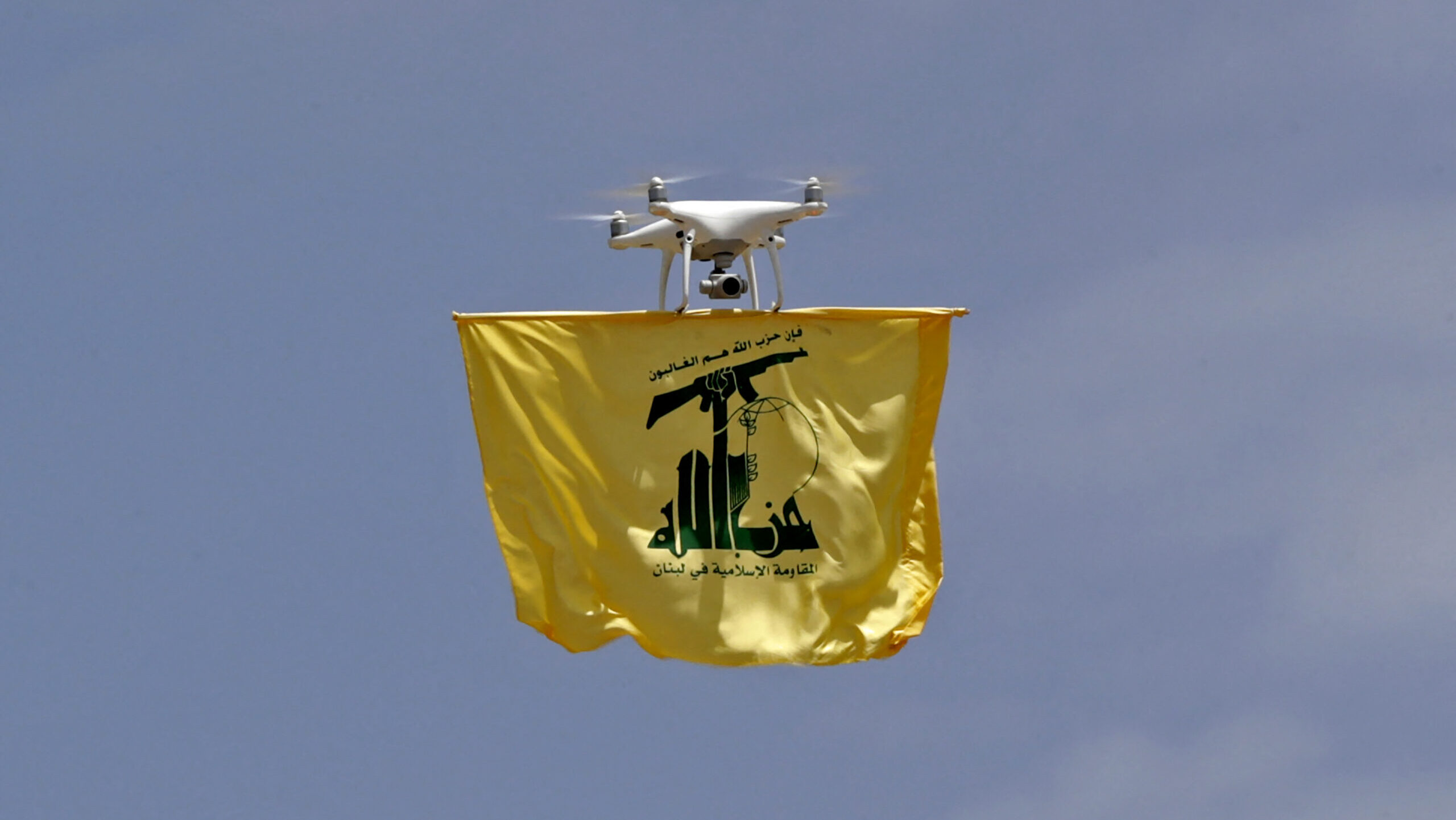
As the war in Gaza reaches the two-week mark, the conflict between Hamas and Isreali forces so far has been characterized by rocket barrages, missile and artillery strikes and bombing raids. It has not, perhaps surprisingly, featured an outsized role for unmanned aerial vehicles. But that could change quickly, analysts said, should Lebanese Hezbollah enter the fight in force and present Jerusalem with a difficult aerial challenge.

As part of its initial assault on Israel on Oct. 7, Palestinian Hamas did employ a novel use of drones, including using at least one quadcopter to help take out Israeli surveillance and communications installations, and used other drones in concert with rocket salvos. And Israeli forces have used what are likely larger, more expensive armed UAVs for some strikes.

But unlike the war in Ukraine, in which the extensive use of scores of drones prompted much spilled ink about revolutions in warfare, since the initial Oct. 7 assault, unmanned systems in Gaza have so far taken a back seat, according to public reporting. That may be because the local drone power, Hezbollah, has so far engaged in relatively small-scale actions and appears reluctant to open a second front from the south — a strategy that could change any moment.

“With regards to Hezbollah, the game changer is the quantity of its arsenal (which could easily overwhelm Israel’s air defense) but also its quality and diversity, be it drones and short-range ballistic missiles that Hamas does not have,” Jean Loup Samaan, senior research fellow at the Middle East Institute of the National University of Singapore, told Breaking Defense.

Documents found on fighters reveal Hamas capabilities, bloody plans

Loveday Morris and Steve Hendrix

ASHKELON, Israel — A Hamas field manual obtained by The Washington Post and other documents found in the wake of the group’s brutal attack on Israel two weeks ago illustrate some of its military capabilities and preparations for close-in, bloody killing.

The manual, dated last year and found on the body of a Hamas fighter, lists instructions on operating certain weapons, identifies vulnerabilities in Israeli military equipment and offers tips on killing with a knife. The document appears to have been prepared for different units of Hamas’s elite Izzedine al-Qassam Brigades, including anti-armor, engineering, sniper, infantry and tunnel specialists as well as what the booklet describes as “shock troops.”

“This is a secret military document,” the first page begins. “It should be kept in a safe place. It is forbidden to move with it except when there are orders.”

On its back cover is a picture of the Palestinian sheikh Abdullah Azzam, a mentor of Osama bin Laden. “If this is their source of inspiration, and this is the figure, the symbol, they are looking at, I understand something more about their behavior on Oct. 7,” said Michael Milshtein, a former head of the Palestinian department in Israeli military intelligence, referring to the date of the attack that left 1,400 Israelis dead. Milshtein examined the field manual at the request of The Post.

Experts, including Milshtein, said the manual appeared to be genuine and matches a cache of other documents gathered by Israeli forces and first responders following the attack. The Israeli prime minister’s office has verified 17 pages of documents for The Post. Some documents, including the field manual, were not provided for verification because of identifying marks that could identify who first found them and gave them to The Post.

Why China And India’s Populism Threatens The World Order

HAIYUN MA

Haiyun Ma is an associate professor of history at Frostburg State University specializing in Islam, the Muslims of China and China-Muslim world relations.

At the G-20 meeting in September, participants and observers were surprised by a particular dinner invitation sent on behalf of India’s president that referred to her as the “President of Bharat” — a racially tinged callback to the Indian king, Bharata, who is featured in Hindu mythology as an ancestor of the Hindu race. That same day, a tweet by a senior spokesman of the ruling Bharatiya Janata Party (BJP) referred to India’s Narendra Modi, who was attending a summit of the Association of Southeast Asian Nations in Indonesia, as the “prime minister of Bharat.”

Meanwhile, on the global stage, India’s foreign minister S. Jaishankar mentioned “Bharat” twice during the 78th session of the U.N. General Assembly the same month. These name changes have sparked rumors that Modi’s BJP may change the country’s name to Bharat. A BJP leader, T. Raja Singh, recently prophesized that India will declare itself a Hindu nation by 2025. The process of Hindunizing India — and further marginalizing Muslims, Christians, Buddhists and Sikhs — is clearly underway in the BJP-led country.

A parallel cultural movement is being carried out in China. As scholars on China have long noticed, Chinese President Xi Jinping has initiated a Sinicization campaign. In addition to well-known, well-documented assimilationist policies in Xinjiang, Sinicization also targets other non-Chinese (non-Han) peoples including the Mongolians, the Hui and the Tibetans. Non-Chinese (Non-Han) ideologies and religions — including Buddhism from India, Christianity from the West, Islam from Arab states, and Marxism from Germany — have all been subject to forceful Sinicization programs such as removal of foreign-style architecture and obeisance to the governmental interpretation of religious texts or ideological doctrine in traditional Han Chinese cultural terms.

A Year on, Billions in Afghan Assets Linger in Switzerland

Catherine Cartier

Billions of frozen assets from Afghanistan’s Central Bank, Da Afghanistan Bank (DAB), face an uncertain future in Switzerland, over a year after a fund was established to disburse them. In September 2022, the Fund for the Afghan People was created with a mandate to disburse $3.5 billion in DAB’s assets in support of Afghanistan’s macroeconomic stability. But since then, no disbursements have been made.

The future of the assets will be decided by two Afghan economists and a pair of representatives from the U.S. and Swiss governments. The U.S. government maintains that DAB has not met the conditions for disbursements, but has not shared the results of a U.S.-funded audit of the bank with the Fund’s board. “We should be able to see that,” said Dr. Shah Mehrabi, a board member of the Fund and member of the Supreme Council of the Central Bank of Afghanistan, in an interview with The Diplomat.

On August 15, 2021, the day the Taliban seized power, the Biden administration froze over $7 billion in Afghan government funds held in U.S. bank accounts. In February 2022, the administration issued Executive Order 14064, which blocked the reserves and consolidated them into a single account.

The order set aside half of the funds for the families of 9/11 victims, a decision later rejected by a federal judge in New York. The other half was designated “for the benefit of the Afghan people,” the White House stated. The Fund for the Afghan People was subsequently established in September 2022 to undertake this mission.

US-China relations have stabilized, but in permafrost

DENNY ROY

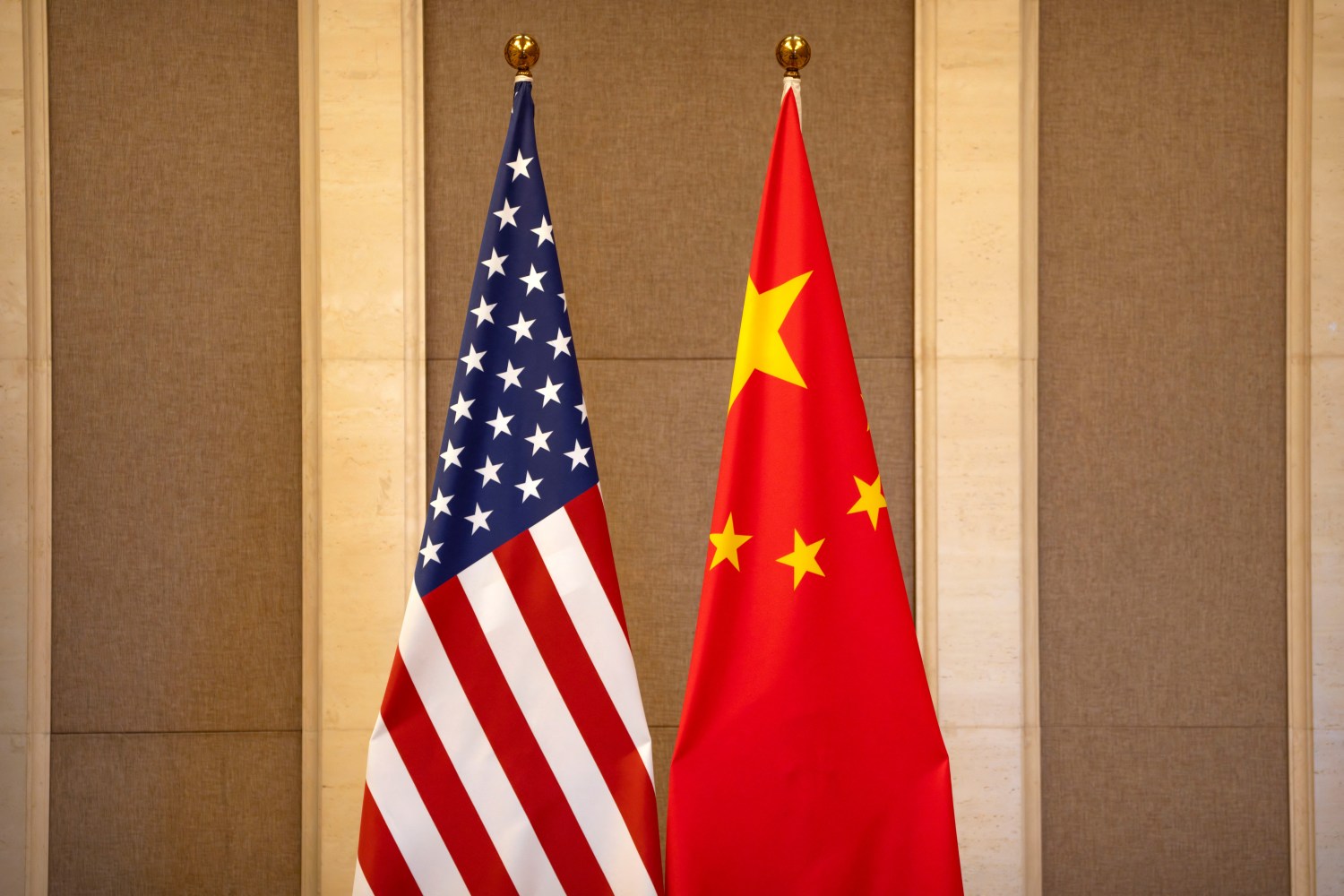
The likely meeting between Chinese Communist Party General Secretary Xi Jinping and US President Joe Biden on the sidelines of the APEC summit in San Francisco in November supports hopes of a “thaw” in US-China relations this year. Biden predicted such a thaw earlier this year and some observers believe they see an upturn.

The outlook is less optimistic, however, if we assess the current state of the relationship from a longer historical perspective. For several decades, US relations with the People’s Republic of China (PRC) followed long cycles featuring high climbs and deep descents.

During the Korean War in the 1950s, the relationship reached a nadir with Chinese and American soldiers killing each other in battle. For years afterward, Washington remained deeply hostile toward China, viewing Mao’s regime as aggressive and irrational.

The 1970s, however, saw US President Richard Nixon’s visit to China, PRC paramount leader Deng Xiaoping’s visit to the US and the establishment of normal diplomatic relations.

Another serious downturn followed in 1989 with the Tiananmen Massacre. But in 1994 the relationship had recovered to the point where US President Bill Clinton de-linked the renewal of China’s Most Favored Nation trade status from the PRC government’s human rights record.

The US and its allies should engage with China on AI law and policy

Mark MacCarthy

For all the energy and excitement surrounding new AI regulation in the U.S., the United Kingdom, and the European Union, China is first out of the box with a regulatory structure for AI, including for the new generative AI services that burst onto the scene less than a year ago with the release of ChatGPT to the public. Engagement with China’s regulators and experts on their experience developing and implementing AI law and policy would be in the best interests of Western regulators as they work to set their own policies. As China expert Matt Sheehan said in a recent Foreign Policy comment, the United States and its allies “can actually learn a lot from China’s approach to governing AI.”

China’s internet regulator, the Cyberspace Administration of China (CAC) has established a series of regulatory measures for advanced algorithms. In March 2022, it promulgated rules for recommendation algorithms that included a requirement for filing information with a government registry and a user right to opt out of personalization. In November 2022, it adopted deep synthesis rules for synthetically generated images, video, audio, and text. This was just before the release of ChatGPT in December, but the agency quickly reacted to the new issues raised by ChatGPT. In April 2023, it proposed new rules for developers and deployers of generative AI.

Many measures in this proposal are familiar from discussions of AI ethics, including requirements for labeling of AI content, non-discrimination, and the protection of privacy and intellectual property. The new AI proposal also required those providing generative AI services to file information with the previously established algorithm registry.

Behind the Curtain: Rattled U.S. government fears wars could spre

Jim VandeHei & Mike Allen

This is a new column by Axios CEO Jim VandeHei and co-founder Mike Allen, based on regular conversations with White House and congressional leaders, CEOs, and top technologists.

Never before have we talked to so many top government officials who, in private, are so worried about so many overseas conflicts at once.

Why it matters: We don't like to sound dire. But to sound a siren of clinical, clear-eyed realism: U.S. officials say this confluence of crises poses epic concern and historic danger.

Behind the scenes: Officials tell us that inside the White House, this was the heaviest, most chilling week since President Biden took office just over 1,000 days ago.
  • Former Defense Secretary Bob Gates — who ran the Pentagon under presidents of both parties, George W. Bush and Barack Obama — tells us America is facing the most crises since World War II ended 78 years ago.
  • He explains the White House's system overload like this: "There's this gigantic funnel that sits over the table in the Situation Room. And all the problems in the world end up coming through that funnel to the same eight or 10 people. There's a limit to the bandwidth those eight or 10 people can have."
Not one of the crises can be solved and checked off. All five could spiral into something much bigger:

Norma downgraded to a tropical storm in Mexico as Hurricane Tammy leaves Barbuda

IGNACIO MARTÍNEZ AND FERNANDO LLANO

Norma strengthened slightly and dumped heavy rain after being downgraded to a tropical storm Sunday as it moved into mainland Mexico, while Hurricane Tammy left the Caribbean island of Barbuda with minor damage.

Once a Category 4 hurricane, Norma came ashore Saturday as a Category 1 near the Pacific resort of Los Cabos at the southern tip of Mexico’s Baja California Peninsula. Tens of thousands were left without power.

Norma’s gusts continued to cause damage as the storm moved northeast, crossing the Gulf of California toward the Mexico mainland’s Sinaloa state, where schools were ordered closed Monday. Shelters were set up in Sinaloa and neighboring Sonora with capacity for nearly 13,000 people.

The U.S. National Hurricane Center in Miami said Sunday evening that Norma was about 120 miles (195 kilometers) west of Culiacan, and about 65 miles (105 kilometers) south-southwest of Los Mochis. The storm regained a bit of strength as it moved northeastward across the Gulf of California with maximum sustained winds of 65 mph (100 kph).

Up to 18 inches (45 centimeters) of rain could fall in some areas Monday, forecasters warned. “These rains will produce flash and urban flooding, along with mudslides in areas of higher terrain,” the hurricane center said.

In Los Cabos, fallen trees blocked some streets. But with no major damage, tourists began to emerge, some with the intention of leaving.

Pentagon’s first industrial base strategy meant to ‘catalyze generational change’

JASPREET GILL

The Defense Department’s first-ever national defence industrial strategy, slated for release in December, will create a roadmap for the department on how it plans to prioritize and modernize its industrial base as it learns from Russia’s invasion of Ukraine, an official said this week.

“We’ve seen in the response to COVID and the conflicts in Ukraine…that our industrial ecosystem needs to be ready to provide the capabilities at speed, at scale and at cost that the department needs,” Laura Taylor-Kale, assistant secretary of defense for industrial base policy, said on Thursday at the Professional Services Council’s defense conference. “Decades of policy decisions really can’t be undone overnight.”

The strategy — the first of its kind for DoD — was directed by the secretary of defense and deputy secretary of defense earlier this year to create a roadmap for how the department will modernize its industrial base, she added. The strategy is “meant to catalyze a generational change” that will guide DoD’s policies, programs and investments in the industrial base for the next three years.

There are four key areas the strategy focuses on: having resilient supply chains, workforce readiness, flexible acquisitions and a focus on economic deterrence and economic security.

Is Elon Musk’s SpaceX the rocket company to rule them all?

MARK R. WHITTINGTON

Recently, there has been musing that SpaceX has become an “accidental monopoly” in the space launch business. Elon Musk has dominated the launching of things and even people into space, and some people think it’s a problem. But the situation may be temporary.

SpaceX has become the go-to rocket company for a variety of services, With Boeing’s Starliner still faltering, unable to get off the launch pad, the SpaceX Crew Dragon is the sole commercial American ride for astronauts to low Earth orbit. The Falcon 9 is the cheapest and most reliable way any customer has to put anything into Earth orbit. With the launch of the Psyche mission, the Falcon Heavy has become a choice launcher for interplanetary missions. The heavy lift rocket will loft the Europa Clipper to Jupiter space in 2024.

SpaceX is also deploying the Starlink communications system, designed to provide voice, text and internet directly from space throughout the world, even those parts that hitherto have had trouble getting the service. Starlink has the potential to break through the efforts of totalitarian regimes to deny their people access to free and uncensored information. The latest customer may be Israel, currently engaged in a war with Hamas terrorists.

Let’s not forget Starship, the monster rocket now under development at the SpaceX Star Base facility in Boca Chica, Texas. When the Starship is operational, it will be able to launch immense payloads into low Earth orbit, land people and cargo on the moon and fulfill Elon Musk’s dream of establishing a settlement on Mars. These things will happen, provided that government regulators authorize more test flights. Government paperwork seems to be a bigger impediment to getting Starship off the ground than the technical challenges.

America needs a grand strategy for outer space

TYLER D. BATES

The United States is neglecting the long game. We can’t afford to be bogged down by annual budget fights or distracted by the drama of election cycles. Instead, we must consider the bigger picture. In an era of enduring strategic competition with China, remaining shortsighted and reactive will lead to failure.

Of all the areas that demand our attention in U.S.-China competition, outer space is uniquely important. Space has tremendous untapped economic potential and is becoming increasingly accessible. In the next five years, the global space economy is projected to grow to $800 billion.

Over the long term, the space economy is estimated to grow to $4 trillion during the 2040s and reach $10 trillion by 2050. Space may one day even host entire communities of people who permanently live and work outside of Earth’s atmosphere.

Many countries, companies and other stakeholders understand the importance of space. They also recognize the need to move quickly. The global shift to reusable launch vehicles, the on-going Moon rush and the surge of venture capital investments in space technology startups are all part of a global space expansion effort.

The Chinese Communist Party is already strategizing ways to influence and control future space activity. In 2017, China revealed its ambitions to become the dominant spacepower economically, militarily and politically by 2045. But China’s ambitions for space reach even further.

Inside the Commando Raids Unnerving Russia in Crimea

Carlotta Gall and Oleksandr Chubko

Late one evening this month, two Ukrainian commandos eased into a side street in Kyiv in a battered SUV. Back from a dangerous nighttime assault on Russian positions in the Crimean peninsula, they slipped into a sparsely furnished apartment where they sat at desks, weary and a little disheveled, and described their latest operation in matter-of-fact fashion.

“Very tough,” said Askold, 38. “It was our most difficult operation yet,” added Kukhar, 23. Members of a unit in the special operations forces of G.U.R., Ukraine’s military intelligence service, the men gave only their call signs in accordance with military protocol.

The two men had joined more than 30 others racing more than 100 miles across the western Black Sea on jet skis to attack critical Russian defense installations before making their getaway, the second Ukrainian amphibious raid in six weeks.

The raids were part of a series of punishing attacks on Crimea by Ukrainian forces since midsummer that have succeeded in disabling some Russian air-defense systems and damaging naval repair yards at Sevastopol. Russia later moved 10 warships from Sevastopol on the west coast of Crimea to the port of Novorossisk on the Russian mainland, though U.S. officials say it remains unclear whether the withdrawals were tied to security concerns or just a regular rotation.

But there is no denying that attacks within Crimea are increasing, and may rise even further with the new ATACMS long-range missiles just delivered from the United States. “A dynamic, deep strike battle is underway,” British military intelligence said in a statement.

What Do We Know about Alliances and Military Spending?

Joshua Alley and Brian Blankenship

How do military alliances impact defense spending? A common criticism of alliances is that they encourage members to reduce military spending. By doing so, allies pass the buck of preparing for and fighting wars with their partners. Observers think that this tendency is especially pronounced in U.S. alliances such as the North Atlantic Treaty Organization (NATO). Critics of U.S. alliances often assert that allies rely on the U.S. for security and invest too little in their own military capabilities. Among U.S. leaders, former President Donald Trump was unusually strident in insisting that allies increase defense spending, but similar complaints go back to the Eisenhower administration. The relationship between alliances and defense spending is more puzzling than these examples suggest, however. Scholars have disputed whether alliances increase or decrease defense spending. Prior research finds positive, negative and null relationships between military alliances and defense spending.

In this article we want to convince you that bargaining between allies is essential to understanding the connection between military alliances and defense spending. Any association between alliances and defense spending is not an inevitable result of alliances generating security for their members and thus substituting for military spending. Rather, alliance characteristics, context and associated bargaining determine whether and when alliances increase or decrease defense spending.

The reasons why alliances might lead their members to decrease military spending are clear in theory. Alliances can substitute for military arming, allowing members to pool their resources and rely on each other rather than having to fend for themselves. In practice, however, the link between alliances and defense spending is not so simple. Some scholars find no such relationship. Indeed, alliances and defense investments are not perfect substitutes.

Ukraine’s Counteroffensive Is More Successful Than You Think

Oz Katerji and Vladislav Davidzon 

Recent coverage of the war in Ukraine in the Western media has focused heavily on Kyiv’s land offensive, especially attempts to push toward the Black Sea coast. Much of the scrutiny, rightly or wrongly, has been on Kyiv’s lack of significant progress so far this year, with nothing comparable to last year’s breakthrough offensives in Kharkiv and Kherson.

While some of this criticism may be justified, the almost singular Western focus on territorial breakthroughs has distracted from the fact that Ukraine is fighting a medium- to long-term war on multiple fronts against a significantly larger and heavily entrenched foe. What’s more, the lack of a major Ukrainian land advance obscures the very real battlefield successes Ukraine has had in other theaters of the conflict—most notably in Russian-occupied Crimea and the Black Sea.

A crucial part of Kyiv’s long-term plan for the war is to push Russia out of the Crimean Peninsula and the rest of the Russian-occupied parts of Ukraine’s coastline. Since the start of the full-scale invasion, Russia’s Black Sea Fleet, headquartered at the Crimean port of Sevastopol, has been a critical component of Moscow’s war effort. Russian warships operating out of Sevastopol have enforced a blockade of Ukraine’s coastline and launched cruise missiles to rain hell onto Ukrainian cities and infrastructure.

But over the last several months, Ukraine has achieved a series of startling victories in and around Crimea, including missile strikes against the Kerch Strait bridge and multiple daring attacks on the Black Sea Fleet itself—with major impacts on the Russians’ ability to operate on the peninsula and in the western Black Sea.

RUSSIAN OFFENSIVE CAMPAIGN ASSESSMENT, OCTOBER 21, 2023

Angelica Evans, Riley Bailey, Grace Mappes, Karolina Hird, and Mason Clark

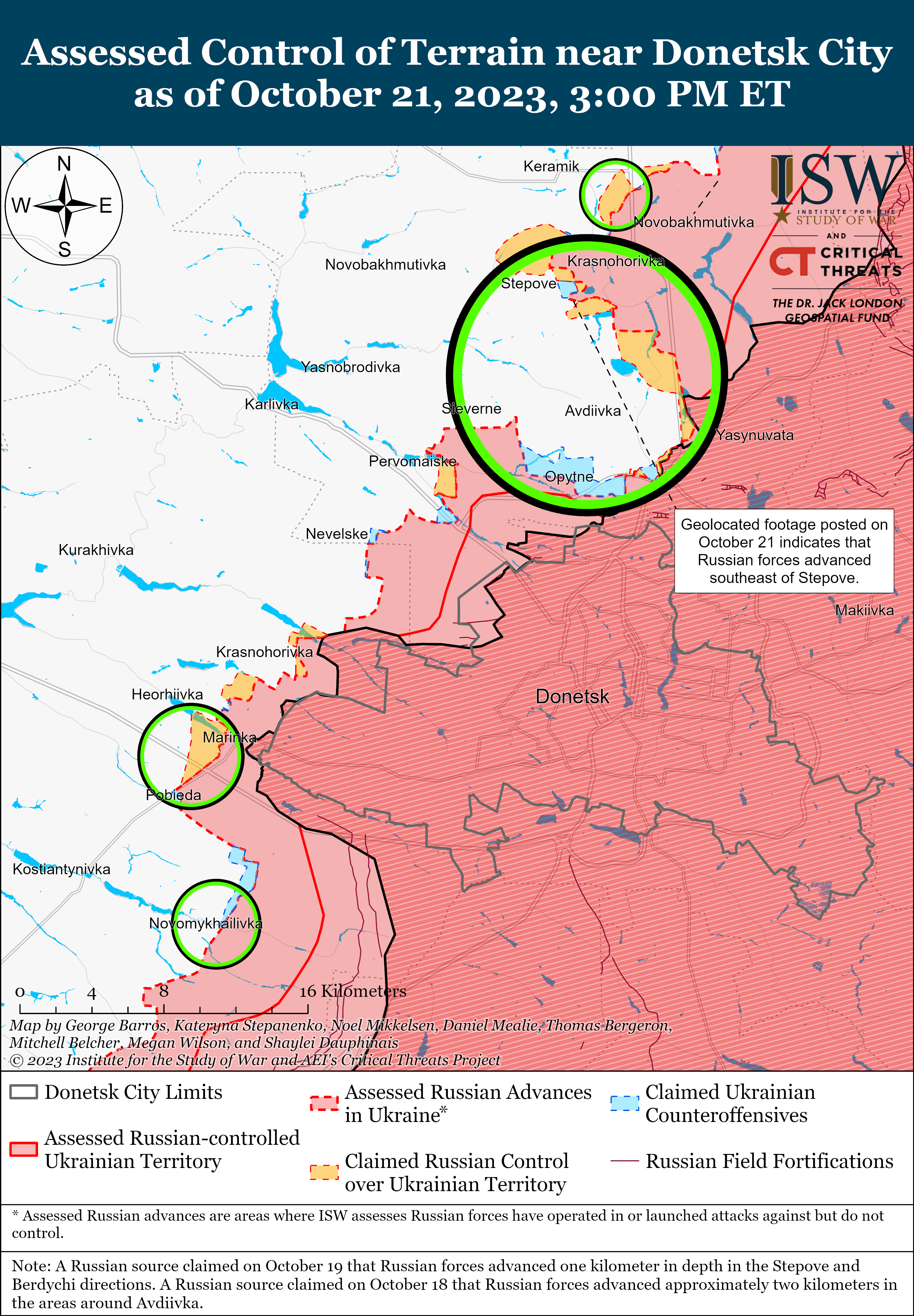
Ukrainian forces have likely repelled another intensified Russian offensive effort towards Avdiivka in the past several days and inflicted further heavy personnel and equipment losses on Russian troops in the area. Ukrainian and Russian sources indicated that Russian forces mounted another offensive push on Avdiivka between October 19 and 20, and geolocated footage posted on October 21 confirms that Russian forces did make marginal gains northwest of Avdiivka in the waste heap area.[1] Russian milbloggers claimed that Russian forces are gradually advancing north of Avdiivka near the waste heap towards Berdychi (5km northwest of Avdiivka).[2] A Ukrainian military observer noted that Russian forces are attacking towards Stepove (3km northwest of Avdiivka), towards Novokalynove (7km north of Avdiivka), and towards the waste heap from the Krasnohorivka-Vesele area.[3] However, Ukrainian military officials noted that Russian forces have somewhat decreased the pace of offensive operations near Avdiivka on October 21, and reiterated earlier Ukrainian reporting that Russian forces lost 50 tanks, 100 armored vehicles, and 900 personnel during attacks on Avdiivka on October 19.[4] Estonian Defense Forces Intelligence Center Head Ants Kiviselg notably identified the Avdiivka push as a potential avenue for a new Russian offensive alongside offensive operations along the Kharkiv-Luhansk Oblast border.[5] The fact that Russian forces continue to recommit waves of personnel and equipment to offensive efforts in the Avdiivka area suggests that Russian command will continue to prioritize this axis, despite high losses and the general low quality of Russian forces on the offensive.[6] A Ukrainian military official noted that Russia's regular infantry and tactics writ large are "consistently bad" and that Russian forces are relying instead on unmanned aerial systems (such as Lancet drones), artillery, and aviation.[7] It appears that Russian forces are continuing to use ineffective and costly tactics in offensive efforts near Avdiivka leading to high personnel and vehicle losses, and that they have continuously done so in several waves of attacks over the past week suggests that the Russian military command is prioritizing this axis, despite continued and growing losses.

The Old B-52 Bomber Could Fly for 100 Years

Maya Carlin

The B-52 Stratofortress is old, but it remains the mainstay of the U.S. Air Force’s bomber fleet.

In fact, the classic bomber could well fly for 100 years. The service is sure working hard to make that a reality, constantly upgrading the hulking “bomb truck” so that it retains an edge over enemy airframes.

Just recently, manufacturer Boeing accepted the first B-52 active electronically scanned array radar (AESA) from Raytheon.

The Air Force bombers will use this advanced radar for system integration, testing and verification.

According to the vice president of Agile Radar Solutions at RDX “Outfitting the B-52 with an AESA radar replaces its current 1960s radar technology. With an AESA radar on board, the B-52 will gain improved navigation and targeting capabilities in higher threat areas.”

Introducing the B-52: Stratofortress

Following the Second World War, U.S. officials recognized the need for a strategic bomber capable of carrying out missions without relying on bases controlled by other nations.

As outlined by the Air Material Command, the new airframe would be designed to fulfill specific cruise, altitude, and combat radius requirements.

Operation Dragonfly: Ukraine Is Using ATACMS to Pummel Russia

Stavros Atlamazoglou

After months of asking and nudging the United States, Ukraine has received MGM-140 Army Tactical Missile Systems, or ATACMS, after being promised the weapons during Ukrainian President Zelensky’s visit to Washington DC in September.

Without waiting long after the White House’s approval to give the munitions, Kyiv introduced the ATACMS to the war in an impressive way.

Overnight, the Ukrainians targeted and destroyed two Russian tactical airfields, in what they dubbed Operation Dragonfly, inflicting heavy casualties on the Russian Air Force and further shifting the scales of power towards Kyiv’s side.

OPERATION DRAGONFLY: THE ATACMS IS HERE

At around 0300 AM, Ukrainian special operations forces used ATACMS munitions to attack the Russian tactical airfields in Berdyansk and Luhansk in Russian-occupied Ukraine.

According to the Ukrainian Ministry of Defense, the ATACMS munitions destroyed nine attack and transport helicopters, one air defense system, several special vehicles for supporting air and air-defense operations, and ammunition depots. In addition, the attack damaged the airfields’ airstrip. These are the worst losses the Russian Air Force has ever suffered in a single day.

24 October 2023

Evidence Shows Hamas Militants Likely Used Some North Korean Weapons in Attack on Israel

Hyung-jin Kim, Kim Tong-hyung and Jon Gambrell

Suspected North Korean-made F-7 rocket-propelled grenades, many with a distinctive red stripe on their warhead, are seen at an Israeli military base in southern Israel.

Hamas fighters likely fired North Korean weapons during their October 7 assault on Israel, a militant video and weapons seized by Israel show, despite Pyongyang’s denials that it arms the militant group.

South Korean officials, two experts on North Korean arms, and an Associated Press analysis of weapons captured on the battlefield by Israel point toward Hamas using Pyongyang’s F-7 rocket-propelled grenade, a shoulder-fired weapon that fighters typically use against armored vehicles.

The evidence shines a light on the murky world of the illicit arms shipments that sanction-battered North Korea uses as a way to fund its own conventional and nuclear weapons programs.

Rocket-propelled grenade launchers fire a single warhead and can be quickly reloaded, making them valuable weapons for guerrilla forces in running skirmishes with heavy vehicles. The F-7 has been documented in Syria, Iraq, Lebanon, and the Gaza Strip, said N.R. Jenzen-Jones, a weapons expert who works as the director of the consultancy Armament Research Services.