30 December 2023

The West Must Face Reality in Ukraine

NINA L. KHRUSHCHEVA

Harvard’s Graham Allison recently commented that, while China “is and will be the fiercest rival a ruling power has ever faced,” the current “demonization” of the country “confuses more than it clarifies.” To “create and sustain a strategy for meeting the China challenge,” Allison insists, the United States “must understand China for what it is” – neither “ten feet tall” nor “on the brink of collapse.” Post-Soviet Russia has never received such consideration.

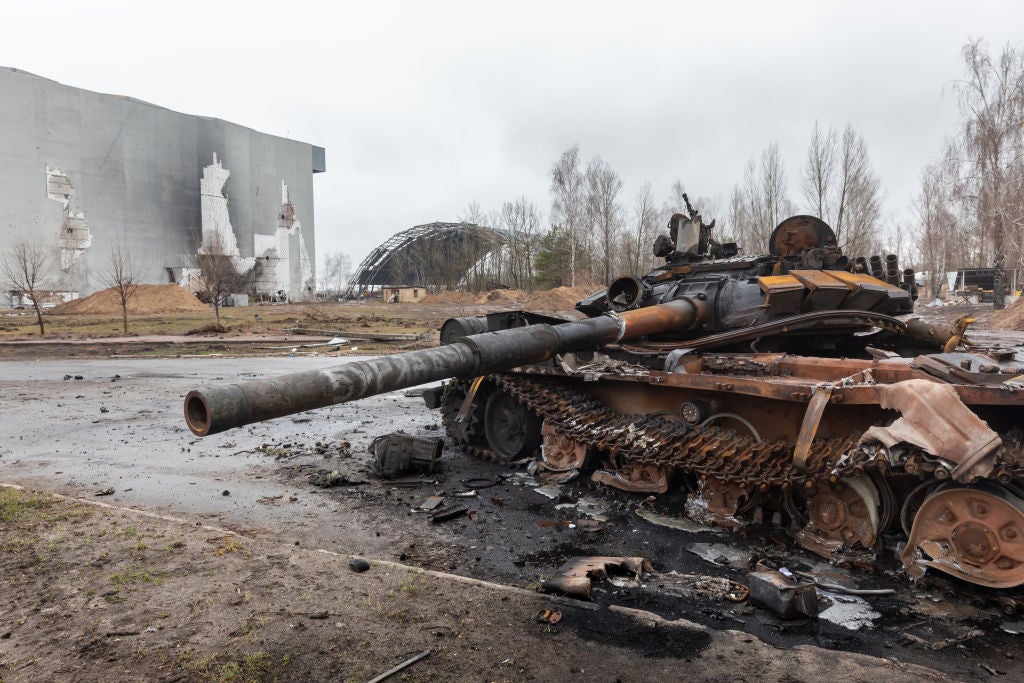
On the contrary, the US has spent decades caricaturing Russia as both a quintessential villain and a fragile has-been. After Russia’s 2014 annexation of Crimea, then-President Barack Obama dismissed it as a “regional power” displaying its own weakness. And following the full-scale invasion of Ukraine last year, the apparent assumption was that Russia – and Vladimir Putin’s regime – would quickly crumble under the weight of Western sanctions.

Putin’s decision to invade Ukraine was fueled by delusion. But that does not mean that the West’s assessment of the situation was sensible. On the contrary, most Western observers seemed to be able to imagine just two scenarios: either Putin takes Kyiv in a matter of days, turning Ukraine into a Kremlin puppet, or Russia is quickly defeated, forcing Putin to withdraw his troops and recognize Ukraine’s territorial integrity.

This helps to explain why, when Russia’s initial offensive stalled, then-British Prime Minister Boris Johnson, visiting Kyiv, reportedly recommended that Ukraine should “just fight,” rather than negotiating a peace deal. Better to let Russia lose – weakening the country’s economy, depleting its military, and damaging Putin’s position, possibly beyond repair – than to reward it for its invasion.

A new study reports 309 lab acquired infections and 16 pathogen lab escapes between 2000 and 2021

Matt Field

In the fall of 2019, workers at a veterinary research center in the northwestern Chinese city of Lanzhou began to fall ill with a disease that caused fever, muscle aches, and other symptoms. Workers at a nearby plant that made brucellosis vaccines had been using expired disinfectant to treat waste gas; the gas was contaminated with aerosolized Brucella bacteria and wafted on southeast winds to the research facility. Eventually over 10,000 people were infected with the disease, which can cause long-term illness. This was just one of 16 times a pathogen escaped from a laboratory setting between 2000 and 2021, according to a new study in The Lancet Microbe.

An international team of researchers looked for all the cases of infections acquired in a laboratory or times a pathogen accidentally “escaped” from a laboratory setting. They found 309 laboratory-acquired or -associated infections from 51 pathogens; eight of these cases were fatal, including one of “mad cow” disease. The 16 incidents they found of a pathogen escaping a lab setting included well-publicized accidents such as the time where a West Nile researcher became infected with the first SARS virus in 2003 after handling contaminated samples in Singapore. He went on to expose 84 contacts and risked re-igniting the 2002-2004 SARS epidemic, by then quiet in Singapore. In another case, US government workers taking inventory in preparation for a move at the National Institutes of Health found old vials labeled “variola,” a reference to the virus that causes smallpox, in an unsecured refrigerator in 2014.

The study comes at a time when the US government and other groups are re-assessing biosecurity protocols for studies involving potentially pandemic agents. Many experts have called for a strengthening of global oversight over pathogen research. The new study on accidents points to one area, where the risks associated with research and biotechnology remain murky: “[Without] globalised formal reporting requirements, the data summarised here could only represent the tip of the iceberg,” the authors wrote.

China Wants to Move Ahead, but Xi Jinping Is Looking to the Past

Lingling Wei

A song called “Tomorrow Will Be Better” became a sensation in mainland China in the 1980s, when the nation was emerging from the poverty and turmoil of Mao Zedong’s rule.

Its inspirational lyrics, which exhorted listeners to “look upward for the wings in the sky,” came to represent a generation that was starting to believe in a brighter future.

Now people in China are listening to the song again—but for a very different reason. Videos of the song are circulating on
WeChat and other communications apps, often with taglines expressing sadness about the end of that era.

“The 1980s are gone forever,” wrote one listener. “So long, those years of burning passion,” wrote another.

For many Chinese, especially those who came of age during the past 40 years of reform and opening, China appeared to be on an irreversible path forward toward more growth, openness and opportunity.

But now China’s leader, Xi Jinping, is restoring aspects of Mao’s rule, forcing people to confront a more uncertain future rooted in China’s past.

Xi’s predecessors, beginning with Deng Xiaoping, embraced market forces, growth and limited freedoms. Xi, by contrast, is placing national security over the economy, tightening government control, and putting the Communist Party—and himself—at the center of Chinese society.

A Dec. 16 article published by the party’s influential journal, Qiushi, elevated Xi to the same historical status as Mao, calling Xi “the People’s leader”—a title previously reserved for China’s Great Helmsman.

Overcoming external challenges for Chinese modernization


The 2024 Global Times Annual Conference, themed "Following the Path of Chinese Modernization, Coping with Changes Unseen in a Century" was held in Beijing on Saturday. To understand the implications of Chinese modernization in this turbulent world and analyze what China can do to stay on this path and overcome various challenges in 2024, the Conference invited over 100 representatives from all walks of life as well as experts and scholars to share their views on four major themes. The following contains excerpts from the third theme - "Conflict, competition and cooperation: the external environment of Chinese modernization"

Enhancing China's ability to shape the peripheral environment

Liu Jiangyong, professor at the Institute of Modern International Relations, Tsinghua University:

The year of 2023 marks the 51st anniversary of the normalization of diplomatic relations between China and Japan, as well as the 45th anniversary of the signing of the Treaty of Peace and Friendship Between China and Japan. When leaders of the two sides met in San Francisco in November, the two sides reaffirmed the positioning of comprehensively advancing the strategic and mutually beneficial relations between China and Japan. In fact, the continuous progress of China's economy and technology has benefited the people of Northeast Asian countries, including Japan.

Yet in general, China-Japan ties are still relatively fragile. The Chinese and US leaders met in San Francisco in November, pointing out the direction for China-US relations to return to the right track. This has objectively forced Japan to make certain adjustments, but instead of making strategic adjustments, Japan only made tactical tunings.

China's Military-Civil Fusion Strategy: A Blueprint for Technological Superiority

Nicholas R. Licata

In an effort to transform the People’s Liberation Army (PLA) into the most technologically advanced military in the world, the Chinese Communist Party (CCP) is systematically reorganizing its science and technology sectors to ensure that new innovations simultaneously advance the growth of its military capabilities. This “Military-Civil Fusion” (MCF, ๅ†›ๆฐ‘่žๅˆ) strategy targets technologies such as quantum computing, semiconductors, 5G, nuclear technology, aerospace technology, gene editing and artificial intelligence to achieve military dominance. While other nations have tried this strategy before, China’s MCF is expansive and institutionalized in a way that exceeds previous efforts. China is likely to produce a variety of new weapons of mass destruction using this policy in the next decade and threaten the United States’ regional interests more than it already has. MCF is still in its early stages but if the United States does not catch up with China’s strategy soon, it risks being technologically outpaced.

MCF applications in China date back to the 1980s and 1990s, but the concept of MCF as a core national policy is a relatively new phenomena under the Xi presidency, tailored to a globalized commercial ecosystem. In pursuing MCF, the CCP has gone as far as to establish the Central Commission for Integrated Military and Civilian Development in 2017 to oversee its integration, and shows little signs of slowing down. Recent documents and initiatives such as the 13th Five-Year Plan and 19th National Congress of the CCP describe a MCF framework that is early in its actualization, but capable of posing significant security challenges for the United States and its Indo-Pacific allies.

Despite how recently China enshrined MCF in its national agenda, the United States already recognizes it as a major concern for its interests in the Indo-Pacific. While China has been seeking avenues to potentially develop key technologies via MCF, the United States has been vocal in accusing China of corporate espionage and undermining American companies. Among the sectors targeted by MCF, artificial intelligence (AI), nuclear energy, and gene editing are at particular risk of these practices, and have the most substantial implications for PLA strategic dominance over the United States. Left unchecked, these could lead to the manufacture of weapons that shift how wars operate in the future. AI may lead to advances in defense equipment such as missiles, command decision making, and military simulation. Nuclear energy can be repurposed to increase the number of nuclear warheads China already has or improve the destructive potential of its arsenal. Strides in gene editing such as CRISPR-Cas9 could result in genetic weapons of mass destruction. Considering the existential threats MCF poses for its security, the United States must respond quickly before it is surpassed by China’s military.

US allies reluctant on Red Sea task force

Phil Stewart, David Latona and Angelo Amante

U.S. President Joe Biden hoped to present a firm international response to Yemen's Houthi attacks on Red Sea shipping by launching a new maritime force, but a week after its launch many allies don't want to be associated with it, publicly, or at all.

Two of America's European allies who were listed as contributors to Operation Prosperity Guardian - Italy and Spain - issued statements appearing to distance themselves from the maritime force.

The Pentagon says the force is a defensive coalition of more than 20 nations to ensure billions of dollars' worth of commerce can flow freely through a vital shipping chokepoint in Red Sea waters off Yemen.

But nearly half of those countries have so far not come forward to acknowledge their contributions or allowed the U.S. to do so. Those contributions can range from dispatching warships to merely sending a staff officer.

The reluctance of some U.S. allies to link themselves to the effort partly reflects the fissures created by the conflict in Gaza, which has seen Biden maintain firm support for Israel even as international criticism rises over its offensive, which Gaza's health ministry says has killed more than 21,000 Palestinians.

"European governments are very worried that part of their potential electorate will turn against them," said David Hernandez, a professor of international relations at the Complutense University of Madrid, noting that the European public is increasingly critical of Israel and wary of being drawn into a conflict.

Biden needs to strike back hard against Houthis to protect Red Sea

Mark Dubowitz 

On the day after Christmas, in the space of just 10 hours, US forces in the Red Sea had to shoot down 12 suicide drones, three anti-ship ballistic missiles and two land-attack cruise missiles, all of them launched by the Iran-backed Houthi terrorist group in Yemen.

The Houthis are torturers whose official motto is “Death to America, death to Israel, curse the Jews, and victory to Islam.”

Subtle they aren’t.

Yet one of President Biden’s first decisions after taking office was to remove the Houthis from the official US list of Foreign Terrorist Organizations.

You can draw a straight line from there to the threat in the Red Sea today.

Reward the bad guys for bad behavior and you get more of it.

The White House insisted it was taking the Houthis off the terror list for humanitarian reasons, but the real story is it was one of many concessions to the Houthis’ patrons in Tehran from an administration desperate to avoid trouble in the Middle East.

The predictable result was more trouble, not less.

Yemeni men carrying a model of the Houthi-hijacked ship Galaxy Leader at a protest in Sana’a, Yemen on Dec. 22, 2023. Photo by Mohammed Hamoud/Getty Images

If Biden wants to protect US and allied naval forces in the Red Sea while keeping its shipping lanes open, he needs to show the Houthis they will pay a heavy price for attacking the United States and its friends.

How many Russian generals have been killed in Ukraine?

JEFF SCHOGOL 

The war in Ukraine has been particularly lethal for Russian general officers, several of whom have died since February 2022.

The fog of war has made it difficult to keep track of Russian generals who have been killed. At the start of the war, the Ukrainians claimed to have killed 12 Russian general officers, but indications emerged afterward that some of those generals are still alive including Maj. Gen. Vitaly Gerasimov and Lt Gen Andrey Mordvichev, according to the BBC. Ukraine also claimed in September that it had killed Russian Adm. Viktor Sokolov, commander of the Black Sea fleet, in a missile strike, but video emerged afterward showing that Sokolov was still alive.

Task & Purpose has attempted to provide a tally of the Russian generals who have been killed since February 2022. This list is far from comprehensive because it does not include Russian losses due to mysterious circumstances, such as when Lt. Gen. Vladimir Sviridov was found dead along with his wife at their home in November.

Russia is a place where people who have crossed the Kremlin often die by falling from high-rise buildings – in all fairness, those open windows can come out of nowhere.

Open sources indicate that at least seven Russian general officers have been killed in Ukraine:

Where Did the Military Go Wrong With Gen Z?


As a grandfather and veteran, I thank Rep. Mike Gallagher and Prof. Kevin Wallsten for their op-ed “Why Doesn’t Gen Z Want to Be All It Can Be?” (Dec. 14). If the next generation is largely unwilling to serve in the armed forces, then the nation’s future is at best uncertain.

The armed forces have in the past drawn from families and regions that emphasize traditional values, including patriotism. But when those families observe a defense establishment that appears to be absorbed by DEI and woke ideology, is it any surprise that many young, potential soldiers will turn away?

Beyond the Osprey: DARPA wants high-speed vertical takeoff X-plane

Stephen Losey

The Defense Advanced Research Projects Agency is working with four companies to design an experimental vertical-takeoff-and-landing aircraft that can fly at speeds far faster than the V-22 Osprey.

The collaboration comes as the U.S. military considers how it might operate aircraft in areas that lack traditional runways.

DARPA calls its program SPRINT, for Speed and Runway Independent Technologies. In November, the agency awarded contracts to Aurora Flight Sciences, Bell Textron, Northrop Grumman and Piasecki Aircraft Corp. to start honing their ideas. The total value for these four deals, which cover the initial phase, could be worth $15 million to $20 million, depending on what options the agency exercises.

By spring of 2027, DARPA wants one of those companies to have finished designing and prototyping their aircraft, built it, and carried out its first flight.

Navy Cmdr. Ian Higgins, SPRINT’s program manager, said in a Dec. 15 interview that speed is one of the key requirements for this aircraft. When the SPRINT aircraft flies forward, DARPA wants it to reach speeds between 400 and 450 knots, or about 460 to 520 mph. The V-22 Osprey has a maximum speed of 270 knots.

“What we ... want to be able to achieve is higher-end speeds,” Higgins said. “We’re going another 100-plus knots beyond [the Osprey], which itself challenges physics if you were just to use the propulsion system that’s in the Osprey.”

Higgins said the SPRINT aircraft also must be able to hover and be stable, transition between hovering and forward flight, and have a distributed power system during that transition that effectively powers all the propulsion systems. Higgins said SPRINT is not focusing on the survivability or potential payload of these concepts.

Constitutional Violations: Julian Assange, Privacy And The CIA

Binoy Kampmark

As a private citizen, the options for suing an intelligence agency are few and far between. The US Central Intelligence Agency, as with other members of the secret club, pour scorn on such efforts. To a degree, such a dismissive sentiment is understandable: Why sue an agency for its bread-and-butter task, which is surveillance?

This matter has cropped up in the US courts in what has become an international affair, namely, the case of WikiLeaks founder and publisher, Julian Assange. While the US Department of Justice battles to sink its fangs into the Australian national for absurd espionage charges, various offshoots of his case have begun to grow. The issue of CIA sponsored surveillance during his stint in the Ecuadorian embassy in London has been of particular interest, since it violated both general principles of privacy and more specific ones regarding attorney-client privilege. Of particular interest to US Constitution watchers was whether such actions violated the reasonable expectation of privacy protected by the Fourth Amendment.

Four US citizens took issue with such surveillance, which was executed by the Spanish security firm Undercover (UC) Global and its starry-eyed, impressionable director David Morales under instruction from the CIA. Civil rights attorney Margaret Ratner Kunstler and media lawyer Deborah Hrbek, and journalists John Goetz and Charles Glass, took the matter to the US District Court of the Southern District of New York in August last year. They had four targets of litigation: the CIA itself, its former director, Michael R. Pompeo, Morales and his company, UC Global SL.

All four alleged that the US Government had conducted surveillance on them and copied their information during visits to Assange in the embassy, thereby violating the Fourth Amendment. In doing so, the plaintiffs argued they were entitled to money damages and injunctive relief. The government moved to dismiss the complaint as amended.

Overcoming A Clausewitz-Centric Mindset In Nontraditional Wars

G.L. Lamborn

Standing in the heat at Gia Lam airfield in Spring 1975, respected author and military theorist Colonel Harry Summers was puzzled. Despite ten years of US support, the deployment of nearly 500,000 US soldiers and Marines, the provision of heavy weaponry and helicopters, and the expenditure of an estimated one trillion dollars, the Saigon government had collapsed in defeat. Summers turned to his North Vietnamese counterpart, Colonel Tu, and stated “You know, you never defeated us on the battlefield.” Colonel Tu thought about that for a minute, then replied: “That may be so. But it is also irrelevant.”

Colonel Summers might have phrased his bewilderment in this way: “How is it that you won the war when we consistently defeated you on the battlefield?” The thoughtful Colonel Tu probably would have replied: “You fought only the enemy you could see, but not the enemy that you could not see. You fought the wrong war.”

Lessons Not Learned

Following Prussia’s crushing defeat at Jena-Auerstedt in October 1806, Carl von Clausewitz became a prisoner of the French at the Chateau de Coppet. There he had ample time to reflect on Napoleon’s political and military victories. Clausewitz studied the factors contributing to Napoleon’s triumphs, such as strategic surprise, rapid forward movement, flanking of enemy forces, and speed of concentration. He also noted the connection between battle and political results, perhaps his most profound observation.

Upon his release from captivity after the Peace of Tilsit, Clausewitz returned to Prussia and worked with King Friedrich Wilhelm and others to reform the Prussian army and state.

Months later in July 1808 at Baylen, Spanish insurgents, including thousands of angry civilians, wiped out a French regular force of 20,000 under General Pierre Dupont. France’s invasion of Spain unleashed powerful political forces—early signs of nationalism and ethno-centrism, which were to flower later in the nineteenth century and shape a new form of war, popular insurgency—the “war of the people.”

Is US military power reaching its limit?

PHILIP PILKINGTON

During the Christmas period, America’s role as global policeman has been coming under scrutiny.

The origins of the story go back weeks, with Iran-backed Houthi rebels in Yemen attacking commercial ships in the Red Sea in response to Israel’s war in Gaza. These attacks culminated in the decision by global shipping companies to avoid transit through the region due to the heightened risk.

As a result, the Houthis have now enacted a de facto naval blockade — without possessing a navy. In response, on 18 December, the Pentagon announced Operation Prosperity Guardian, but many allies — such as Spain, Italy and France — declined US command over their navies in the region.

For a country whose global dominance rests on control over the high seas, this was bad optics. Shipping companies, however, were willing to return to the region now that they were under a naval umbrella. “With the Operation Prosperity Guardian initiative in operation, we are preparing to allow for vessels to resume transit through the Red Sea both eastbound and westbound,” the Danish shipping giant Maersk said in a statement.

But it does not appear as though the attacks have stopped. US Central Command reported that on 23 December the Houthis fired two anti-ship ballistic missiles and four unmanned aerial drones. Two container ships were attacked but neither were damaged, with the US Navy shooting down the drones. While this may seem like a victory, it shows that the Houthis are not deterred. Eventually, one strike is bound to get through.

That is because the weapons that the Houthis are using, most of which are of Iranian origin but some of which are domestically produced, are extremely cheap and quick to build. The air defence that the US Navy is using is neither cheap nor quick to build — much less to transport to the Red Sea for resupply.

Don’t Give Up on a Better Russia

Aleksei Miniailo

February 24, 2022, was the worst day of my life. When I woke up to news that Russia was invading Ukraine, it felt impossible to believe. I knew that Russian President Vladimir Putin had been massing troops along Ukraine’s borders, and I had read that Western intelligence agencies believed war was imminent. A couple of days before the invasion began, I had even submitted an application to hold an antiwar rally in Moscow. And yet the idea that Putin would try conquering Europe’s largest country—one with so many cultural and familial ties to Russia—still felt unfathomable. I hoped the headlines were wrong, and that journalists had mistaken another provocation for a full-blown attack.

Alas, they had not. As I read more, it quickly became evident that the assault was real. In photos and videos, I saw explosions on the streets where I once walked with my friends. My relatives in Zaporizhzhia were writing to me from a missile shelter. As a Russian opposition activist, I am no stranger to horrible Kremlin behavior: I have protested against rigged elections, seen my colleagues get arrested, and spent two months in jail myself—barely avoiding charges that carried a prison term of up to 15 years. But watching the invasion begin was more terrible than anything I had experienced before.

After it became clear the invasion was real, I gathered with friends and allies to brainstorm what we could do. It would have been easy, in that moment, for us to fall into despair. But as activists and researchers, we knew that Putin’s regime was less steadfast than it seems. We had seen Putin use polls and elections to create an impression, both within Russia and outside the country, that he has overwhelming support—an impression that helps him both control Russians and influence foreign politicians. And we worried that many Russian pollsters would struggle to adjust their methods to a wartime environment.

Will Ukraine War End in 2024? Experts Weigh In

Brendan Cole

Vladimir Putin's confirmation that he would run again for president in 2024 was predictable but could there be any surprises next year in the war he started in Ukraine?

Russians go to the polls from March 15, less than a month after the full-scale invasion marks its second anniversary. Both sides seem resigned to a long conflict, with the high numbers of casualties, equipment losses and economic damage since it started on February 24, 2022 set to escalate.

Putin and his Ukrainian counterpart, Volodymr Zelensky maintain maximalist goals that preclude talks to end the war imminently and experts have told Newsweek the fighting is likely to continue into 2025.

Outlier events cannot be ruled out, such as the brazen challenge to Putin's authority by Wagner chief Yevgeny Prigozhin, whose death in a plane crash followed his seizure of military facilities in Rostov-on-Don and a march on Moscow. Also, the Kremlin has repeatedly dismissed rumors about Putin's health.

"The only way I can foresee the Ukraine war possibly ending in 2024 is if Vladimir Putin dies," Beth Knobel, professor of communications and media studies at Fordham University, and former CBS News Moscow bureau chief, told Newsweek.

"It is theoretically possible that Russia could take advantage of a change in leadership to try to declare victory and just hold onto the land it grabbed since February of 2022," she said. "But even if Putin dies, I think there's only a miniscule chance that Russia would back off from the war, because it has already invested so much of its national image in winning."

A widely anticipated Ukrainian counteroffensive that started in June aimed at recapturing Russian-occupied territory, has not made the progress Kyiv's allies wanted.

What 2023 Taught Us in the Russia-Ukraine War

Stefan Theil

As Russia’s war against Ukraine enters its third winter, the scenarios for its outcome are still unclear. With neither side making substantial territorial gains in more than a year, there is much debate about whether the conflict has entered a stalemate—and who is to blame for Ukraine not advancing more quickly. At the same time, the fighting remains highly volatile in other ways, as Ukraine’s effective defeat of the Russian Black Sea Fleet in 2023 has shown.


Self-assessment: setting expectations on the Russo-Ukraine War

LAWRENCE FREEDMAN

Sam has already published his annual self-assessment and this is mine. Although I have written about the Gaza War, and will return to that early in the new year, this piece focuses on the Russo-Ukraine War. This is not only because of the amount I wrote on the topic but also because the question of the expectations surrounding this war has become an issue in itself. Has an optimism bias pervaded the commentariat? Did pro-Ukrainian sympathies lead to playing down Russia’s inherent strengths and failing to appreciate Ukraine’s vulnerabilities?

There was certainly more optimism surrounding the Ukrainian position at the start of the year than there was at the end. This is partly because of the uncertainties surrounding the level of US and European support, a matter to which I will return in my conclusion. But it was largely because of the meagre returns from Ukraine’s intensive efforts to liberate more territory.

Commenting on an ongoing war is difficult, especially for someone not close to the front lines. This is why, as I noted in last year’s assessment, my preference is ‘to talk about trends, possibilities, and developments coming into view.’ Wars pass through stages, as fortunes shift, and the challenges of supply and reinforcement change. Over time some possibilities become impossible, some quite likely, and new ones emerge. Of these the most unlikely, such as peace negotiations, can be worth discussing to understand why they are unlikely or what would need to change to make them likely. So my self-assessment question is not whether my predictions are right, because I made few that were firm, but did much happen that would surprise a regular reader of these posts.

And strategies make a difference. Few outcomes in war are inevitable. Armies can be caught out by sudden changes in the weather, spectacular acts of incompetence (a large force being conspicuously gathered in a way that can be easily targeted), or just the push and pull of competing military and political priorities. Perhaps the Ukrainian army could have achieved more with better choices, including by its international supporters, although the alternatives always seem much clearer in retrospect. Perhaps what they were trying to do was just too difficult. The Russian Army put even more effort into their offensives and achieved even more meagre results in their efforts to occupy more territory. Both sides have struggled to mount offensives against well-defended positions. In which case how does this war end?

Meet Joe Biden’s Favorite Hacker

Eric Geller

When Jeff Moss got a phone call from the White House in the early months of Barack Obama’s presidency, he thought the new administration was trying to get one of its officials on the speaker lineup for the world-famous Black Hat security conference that he had created and still helped run.

Instead, the staffer on the other end of the line asked Moss, one of the country’s most respected hackers, if he would be interested in occasionally reviewing and commenting on government reports in his area of expertise.

Moss agreed, figuring it wouldn’t take too much of his time. Two months later, when he started receiving paperwork to apply for a security clearance, he learned what he’d actually signed up for: a spot on the Department of Homeland Security’s Homeland Security Advisory Council, a role usually given to big-name corporate executives, who covet the position as a sign of credibility and prestige. The group of outside experts help steer the department’s work on everything from immigration to aviation security to Moss’s domain of cybersecurity.

“That was my big introduction into the big tent, into the government space,” Moss said in a recent interview.

Fourteen years later, Moss — who still helps organize the corporate-owned Black Hat conference and also runs its more freewheeling sister event, DEF CON — has become one of the government’s most trusted advisers on cybersecurity issues. With the ear of President Joe Biden’s top cyber aides, Moss tries to help the feds harness the energy and talents of independent security experts to better defend the U.S. from digital attacks — and, in the process, overcome decades of mutual suspicion and hostility between Washington’s stodgy bureaucrats and the country’s nonconformist techies.

Moss no longer serves on the Homeland Security Advisory Council after failing “the political vetting that the Trump administration introduced,” he said, but two years ago, he joined the Cybersecurity and Infrastructure Security Agency (CISA)’s Cybersecurity Advisory Committee, where he leads a group that delivers policy advice from independent researchers, cyber threat analysts and security professionals.

The Year Policymakers Woke Up to AI

Rishi Iyengar

To get a sense of the capabilities, contradictions, and chaos that have defined artificial intelligence in the past year, one only needs to look to the technology’s most high-profile champion.


Space Force hosts inaugural ‘orbital warfare’ training exercise

MIKAYLA EASLEY

The Space Force recently held its first-ever Red Skies exercise focused on training guardians how to respond to potential adversary attacks against U.S. space-based assets, the service announced Dec. 22.

Space Training and Readiness Command (STARCOM) hosted the inaugural event Dec. 11-15. Red Skies is envisioned as an annual training experience that emphasizes “orbital warfare” disciplines, according to the Space Force. The simulation-based exercise enabled guardians from Space Operations Command (SPoC) to hone skills in orbital mechanics and satellite flight relevant for Space Force operations.

“Realistic simulation like this allows us to refine tactical skills that drive us towards tactically relevant thinking … more towards what it means to ensure space superiority,” STARCOM Deputy Commander Brig. Gen. Todd Moore said in a statement.

During the exercise, guardians trained for tactical command-and-control operations and how to operate multiple satellites, all while engaging opposing forces in a simulated environment, according to a Space Force press release.

While the first event was held entirely through simulations, the service plans to eventually incorporate real-world satellites — similar to the “live-fire” training demonstrated during Black Skies.

29 December 2023

A Future Look Back at Israel’s War on Hamas

Daniel Byman

Let’s conduct a mental exercise. It’s Oct. 7, 2025, two years after Hamas’s devastating terrorist attack that killed around 1,200 people, and Israel’s Gaza Strip policy is in ruins. Hamas emerged from the rubble of the war in 2023 and again controls Gaza, with its prestige in the West Bank and elsewhere greatly enhanced. Israel’s international standing, including in Washington, is in tatters. At home, Israel’s political and social divisions are even more pronounced than before the war, effectively paralyzing the country. Perhaps most troublingly, Iranian proxies are more aggressive than ever before, with regular rocket attacks into northern Israel by Hezbollah and with Houthi fighters in Yemen menacing Israeli shipping.


The Shrinking Cost of War Threatens Western Militaries

Philip Pilkington

In business, the term “commodification” describes the transition of something previously a luxury good into a day-to-day commodity that is bought and sold cheaply. When smartphones first went to market, they were expensive luxury items. Today, while high-end smartphones are not cheap, commodified models are available for as low as under $100.

Commodification is not limited to commercial affairs. War also experiences the process in its own way. The battlefield of the medieval era, for example, was dominated by the noble knight, an extremely well-equipped man trained since birth in the arts of war. In fifteenth-century England, a top-class suit of armor cost £20 or more, the equivalent of 800 days of wages for a simple archer. There were practical considerations behind buying a suit of armor. In addition to the protection it granted from blows and the fear it inspired, knightly armor granted the wearer prestige in a culture that placed a premium on such. Moreover, since armor was used for such a long period in the medieval era, we can surmise that its long-term value was, in some sense, worth the expense.

All this changed, however, when new bow technology came into being.

The first was the English longbow. The longbow itself was not particularly expensive, but using it required lifelong training due to its high draw weight. This meant that training and using longbowmen was expensive. Next came the crossbow, which further called into question the cost-benefit of knightly armor. While more costly to produce than the longbow, it required little training. As the crossbow proliferated—eventually accompanied by similar technologies like the hand cannon and the arquebus—knights disappeared from the battlefield, surviving only in parades and chivalric tournaments.

A Growing Butcher’s Bill: Israel’s War Spending

Binoy Kampmark

The Bank of Israel Governor Amir Yaron is worried. He is keeping an eye on the ballooning costs of his country’s war against Gaza and the Palestinians. Initially, the Netanyahu government promised to increase its defence budget by NIS 20 billion (US$5.48 billion) per annum in the aftermath of the war. But a document from the Finance Ministry presented to the Knesset Finance Committee on December 25 suggests that the number is NIS 10 billion greater.

The Finance Ministry is also projecting that the war against Hamas will cost the country’s budget somewhere in the order of NIS 50 billion (US$13.8 billion). NIS 9.6 billion will go towards such expenses as evacuating residents close to the borders of the country’s north and south, buttressing emergency forces and rehabilitation purposes.

The increased military budget is predictable and in keeping with the proclivities of the Israeli state. What is striking is that Prime Minister Benjamin Netanyahu has regarded Israeli defence expenditure as generally inadequate when looked at as a percentage of gross domestic product (GDP). Between 2012 and 2022, military expenditure as a percentage of GDP fell from 5.64% to 4.51%. Doing so enables him to have two bites at the same rotten cherry: to claim he was blameless for that very decline in military expenditure, and to show that he intends to rectify a problem he was hardly blameless for.

Even in war time, Netanyahu is proving oleaginous in his policy making. The mid-December supplementary budget for 2023, coming in at NIS 28.9 billion, was intended to cover the ongoing conflict with Hamas and Hezbollah. But its approval was hardly universal. Opponents of the budget noted the allocation of hundreds of millions of shekels towards “coalition funds” intended for non-war related projects relevant to parliamentarians and ministers. Benny Gantz’s National Unity party, a coalition partner, would have nothing to do with it. Intelligence minister Gila Gamliel was absent from the vote, while Yuli Edelstein of Netanyahu’s own Likud Party abstained. Opposition leader Yair Lapid pointed the finger at the rising budget deficit.

India’s Space Program in 2023: Taking Stock

Namrata Goswami

India’s space program has dominated the news cycle since its Chandrayaan 3 lunar landing on the Southern hemisphere of the Moon on August 23, 2023. The ability to build an end-to-end space logistics capability, with a low-key budget of $75 million — that included the rocket launch, propulsion system, lunar lander and rover — caught the imagination of the world, specifically emerging nations in space, looking to build their own space programs in a sustainable manner.

Since then, India has announced its Chandrayaan 4 mission, which aims to land on the far side of the Moon and bring back lunar samples. India’s Aditya 1 mission, aimed at understanding the Sun’s corona is on its way to park on the halo orbit, at Earth-Sun Lagrange point 1. India announced an official space policy in 2023, identifying the key institutions that will regulate its private space sector and made its position on the utilization and ownership of space resources clear. The Indian Air Force (IAF) has submitted a proposal to rename the IAF as the “Indian Air and Space Forces,” highlighting a shift in strategic thinking within India about the importance of space for national security purposes. This effort is part of Space Vision 2047, the centennial year celebration of India’s independence (1947) from British colonial rule.

This article offers an analysis across four different factors that highlight the current and future focus of India’s space program. These include policy and institutions — both civil and military — space capabilities and missions, international partnerships, and the future space policy vision.

Policy and Institutions, Civil and Military

In 2023, India announced its official space policy. As per that space policy document, the focus of India’s space program is to develop and support its commercial space sector. Toward this end, India has clarified that the Department of Space, under the Prime Minister’s Office, is the main policymaking and implementation body, while the Indian Space Research Organization (ISRO) is going to focus on research and development. The New Space India Ltd (NSIL), established in 2019, is responsible for “commercialising space technologies and platforms created through public expenditure.” The Indian National Space Promotion and Authorisation Center (IN-SPACe) will function as the single-window authorization center for both public and private sector space activities.

Are India and Armenia Moving Toward a Strategic Partnership?

Abhinav Pandya

When it comes to Indian geopolitical maneuvers, the global strategic community feels that India punches much below its weight, mostly confined to South Asia. Until recently, India’s strategic calculus was primarily limited to Pakistan, followed by China. Its outreach to the Western world was largely economic and cultural, barring a minor strategic component dwelling upon defense deals. However, after the Chinese incursions in Doklam and Galwan worsened the India-China relationship and the involvement of extra-regional actors like Turkey in the Kashmir conflict, India’s foreign policy vision, approach, and strategic calculus are expanding beyond South Asia. Some of its manifestations include India’s interest in the Indo-Pacific, global strategic connectivity projects like IMEC, an upsurge in India-Greece bilateral ties, and New Delhi’s enthusiastic showmanship during its G20 presidency.

India’s outreach to Armenia, a faraway country in the South Caucasus, is part of this new change. The October 2021 visit of Dr. S. Jaishankar, India’s External Affairs Minister, to Yerevan is historic because it’s the first such visit of the Indian foreign minister to Armenia in the last thirty years. Before this, Prime Minister Modi met his Armenian counterpart, Nikol Pashinyan, on the sidelines of the UN General Assembly in New York, seeking Yerevan’s support in finalizing a trade arrangement with the Eurasian Economic Union (EaEU).

In the last three years, India has emerged as a major weapons supplier to Armenia. These big-ticket defense deals include the sale of Pinaka multi-barrel rocket launchers, a $40 million contract of SWATHI weapon-locating radars, ammunition anti-tank missiles, and 155 mm artillery guns. The author’s interlocutors in India’s Ministry of External Affairs informed that Armenia is interested in more defense deals, including drones and counter-drone systems, loitering munitions, and mid-range surface-to-air missiles. In October 2022, Armenia’s defense minister, Suren Papikyan, visited the New Delhi defense expo and met his Indian counterpart, Rajnath Singh.

Indian Envoy Meets With Putin, Bypassing Western Pressure

Sameer Yasir

President Vladimir V. Putin on Wednesday met with the Indian foreign minister at the Kremlin, highlighting Russia’s attempts to break through its isolation from the West by pivoting to an increasingly powerful Asian nation.

From the start of Russia’s war with Ukraine, India has taken a neutral stance, citing its longtime ties with Moscow and insisting on its right to navigate a multipolar world its own way.

Russia has long been the most important military supplier for India, and as international sanctions in response to the war began constricting Russian oil sales, India rapidly expanded its purchases to become one of the chief buyers of discounted Russian petroleum. In doing so, India has frustrated American efforts to isolate Russia since the Ukraine war began in 2022, providing a much-needed financial boost to Moscow’s coffers.

“Everything is in your hands,” Mr. Putin said, “and I can say that we are successful because of your direct support.”

Mr. Putin added that he intended to discuss the situation with the war in Ukraine and invited India’s prime minister, Narendra Modi, to visit Russia.

The Indian foreign minister, Subrahmanyam Jaishankar, said that he had brought a written letter to Mr. Putin from Mr. Modi in which the Indian leader conveyed his thoughts on the state of Russia-India relations.

Earlier on Wednesday, Mr. Jaishankar conducted a separate meeting with his Russian counterpart. He said that his discussions would include “the state of multilateralism and the building of a multipolar world order.”

The Delimitation of Pakistan’s Democracy

Kunwar Khuldune Shahid

On December 23, the Election Commission of Pakistan (ECP) decided that it would address all formal complaints regarding the constituency delimitation after the general elections scheduled for February 8. The ECP’s decision comes after the Supreme Court ruled the previous week that holding timely elections needed to “be given primacy” to ensure “continuity of democratic governance” leaving the dispute of delimitations for later. The contention is rooted in the ECP’s November 30 notification, which announced the delimitation of constituencies that would make up the 266 general seats in the National Assembly and 593 general seats for the four provincial assemblies of Punjab, Sindh, Khyber Pakhtunkhwa, and Balochistan. The ECP had already “disposed” disputes in 88 districts, and settled 1,324 objections in the lead-up to its final delimitation notification last month.

Many of the objections raised by candidates in the delimitation process criticize the breaching of the population allocation mechanism. According to the ECP regulations, the maximum allowed variation in populations in relation to the average voter per seat in an assembly is 10 percent, a margin exceeded in over one-fifth of the constituencies, as per the Free and Fair Election Network (FAFEN). However, the final constituency boundaries unveiled sizeable divergence from the 10 percent rule with the largest constituencies in an assembly seen to be almost twice the size of the smallest; for example, with an almost three-time disparity in Khyber Pakhtunkhwa between NA-39 Bannu and NA-1 Chitral.

An ECP official privy to the delimitation process told The Diplomat that the entire exercise was carried out as per regulations, and that the issue has been politicized by various parties “as is customary.”

“As per the Elections Act, we have to keep the provincial and district integrity in mind. There are geographical considerations as well,” the official said.

Why Australia Isn’t Sending a Ship to the Red Sea

Grant Wyeth

Australia takes its international responsibilities seriously, yet as a middle power, it is limited in its resources to contribute to every aspect of insecurity. It needs to make choices based on its own interests and where it can be most helpful. This is the calculation the Australian government has made in refusing a request to send vessels to join Operation Prosperity Guardian – the mission to prevent further attacks by Houthi militia in Yemen on shipping lanes in the Red Sea and the Gulf of Aden.

It doesn’t help that insecurity is on the rise. The Houthi attacks are symbolic of a more chaotic world emerging. Instead of major shocks to the international system, a series of smaller system failures are occurring. These compound and eat away at previously reliable structures. For Australia, this means making often difficult choices about what issues are of greatest importance.

Australia’s Defence Strategic Review released earlier this year reaffirmed that the northeast Indian Ocean was considered part of Australia’s “immediate region,” which may be where Australia has decided to focus its attention. The country’s participation in the invasion of Iraq two decades ago may have chastened Canberra to be wary of straying too far from home.

Yet when it comes to threats to trade, there are different calculations that need to be made. Rather than being divided up into sectors, the Indian Ocean and its connecting waterways should be understood as a single strategic zone. One that transports a number of goods vital to Australia’s normal functioning, in particular oil. While over half of Australia’s oil imports are refined in Singapore, a large percentage of this oil is sourced from the Middle East.

In rejecting the request to join Operation Prosperity Guardian, Canberra has made the calculation that its focus needs to be on China’s changing of conditions in the South China Sea. This may seem like a rational calculation to make. This is clearly Canberra’s most pressing concern, and there are enough other countries invested in the attacks in the Red Sea and Gulf of Aden to provide the hardware necessary to address the problem. Australia’s contribution would be welcome, but not a decisive factor.

Increased US partnership with the Philippines coming in 2024

Geoff Ziezulewicz

In 2023, the U.S. and the Philippines announced a historic pact that would open up several bases on the island archipelago nation to American forces for the first time in decades.

While the agreement does not allow the U.S. to permanently station troops in Philippine territory, several of the newly accessible bases abut the South China Sea to the north.

Plans are already underway to fortify the newly accessible bases.

The coming year will likely see Washington and Manila expand their cooperation and ready their respective navies to counter China’s assertions of ownership over parts of the South China Sea.

Old salts shouldn’t expect anything similar to the Navy’s former and massive presence at Subic Bay, which ended in 1992, but the new agreement marks a significant change forged largely out of maritime interests.

China and the Philippines, along with Vietnam, Malaysia, Brunei and Taiwan, have been locked in increasingly tense territorial disputes over the busy and resource-rich South China Sea. Washington lays no territorial claims to the strategically important waters but has deployed its warships and aircraft for patrols that it says promote freedom of navigation and the rule of law. In turn, that military presence has infuriated Beijing.

At the announcement of the new deal in February, Austin thanked Philippine President Ferdinand Marcos Jr., whom he briefly met in Manila, for allowing the U.S. military to broaden its presence in the Philippines — Washington’s oldest treaty ally in Asia.

“I have always said that it seems to me that the future of the Philippines and, for that matter, the Asia-Pacific will always have to involve the United States, simply because those partnerships are so strong,” Marcos told Austin.

Corruption Scandal in Xi's China Leads to Dozens of Arrests

Micah McCartney

Scores of officials have been snagged in Chinese leader Xi Jinping's campaign to cleanse vulnerable sections of the military of corruption, a China-focused consulting firm says.

The ongoing reshuffling "will have extensive ramifications for the chain of command, as well as the combat readiness/ability to function normally of critical [People's Liberation Army] infrastructure," Canada-based Cercius Group said.

Over the summer, Xi suddenly replaced top generals in the PLA Rocket Force, which oversees China's nuclear and conventional arsenals. Li Shangfu and Qin Gang, who were then China's defense minister and its top diplomat, disappeared within weeks of them, just months after being appointed to office.

The ousters led to questions in the global security space over the stability of Beijing's security apparatus at a time when military-to-military lines of communication with the United States were frozen.

"So far, we have been able to track down around 70 individuals who have been taken away within the larger frame of the Rocket Force investigation," the Asia Sentinel website quoted Cercius as saying earlier this month.

The investigation has two targets: political and financial corruption, the firm told Newsweek.

The goal of investigations in the first category is to ensure "everyone dances to Xi's tune when it comes to a potential Taiwan campaign," Cercius said. Xi also seeks to oust potentially disloyal PLA officials who are "forming cliques."

China has vowed to unify self-ruled Taiwan, through force if necessary, although the current Chinese government has never governed there. Xi has instructed his military to be ready for a potential war over Taiwan by 2027.