17 April 2024

A Digital Threat To Dollar Dominance – Analysis

Derek Pew

Fear and lack of knowledge of cryptocurrency at the highest levels of the US government pose a major threat to national security.

The emergence of the technological solution provided by the Bitcoin protocol in 2008 (and the myriad of blockchain-based protocols that arose thereafter) and related payment channel networks (PCNs) (global peer-to-peer wealth transfer networks) has opened a Pandora’s Box that forever changes global peer-to-peer wealth storage and transfer. Add to that the rapid advancement of artificial intelligence capable of nearly any solution creation in PCNs and the global monetary system is about to change dramatically.

Yet politicians on both sides of the aisle, as well as much of the national security establishment, do not understand how digital currencies work and are reluctant to take the proactive means to ensure the continued use of the US dollar as the de facto global currency in the context of these new technologies.

The current resistance to exploring the development of a US Central Bank Digital Currency including legislative efforts to prohibit the US Treasury from taking steps to explore its feasibility, is based on misinformation about how digital currencies function and fears about a loss of privacy rights or a government’s ability to control people’s ability to purchase goods and services. The attitude seems to be that the US government has the ability to single-handedly stop global technological development and freeze a pre-digital international monetary landscape in place in perpetuity.

Such efforts are short-sighted and could threaten the position of the US Dollar in the global financial ecosystem. Since the Second World War, a key instrument of US national power has been the global demand for a stable currency in which long-term trade and investment transactions can be denominated and wealth can be stored. The United States benefits from this global demand for its currency—with up to 80 percent of transactions denominated in the dollar—for it maintains the dollar’s stability. 
A Strategy Of Courage: The Next Phase Of The Russia-Ukraine War – Analysis April 15, 2024 0 Comments

Luke Coffey and Peter Rough

Introduction

As Russia’s large-scale invasion of Ukraine enters its third year, now is a propitious moment to take stock of the United States’ approach to the war. After Ukraine’s staunch defense of Kyiv in spring 2022 and its successful Kharkiv and Kherson offensives later that year, the West had high expectations for Ukraine’s 2023 counteroffensive in the south and east. That Ukraine did not achieve all its objectives in that campaign says less about Ukraine’s military than it does about Kyiv’s Western supporters. Regrettably, the West did not provide Ukraine what it needed in a timely fashion to liberate its territory.

Ukraine neither needs nor wants US boots on the ground. Unlike in Iraq or Afghanistan, there are no American soldiers fighting in Ukraine, and the leadership in Kyiv has not asked for American soldiers to join the fight. All that Ukrainians have requested are the weapons, munitions, and equipment that they need to fight off the Russian invasion themselves.

In the early months of the conflict, the US led the way in providing Ukraine with crucial supplies. However, US support has fallen off dramatically. By almost any measure of aid—military, economic, or humanitarian—Europe now significantly outpaces the US in support to Ukraine.

With Russian momentum building, the US needs to adjust its approach to match the new reality. As one of us, Luke Coffey, wrote last spring before Ukraine’s counteroffensive, “If Ukraine’s counteroffensive stalls, or even fails, it’s no excuse to end support. On the contrary, it would be a time to learn from mistakes, keep the weapons flowing and the training going and prepare Ukraine for the war’s next phase.” That next phase begins now.

Israel is quiet on next steps against Iran — and on which partners helped shoot down missiles

TIA GOLDENBERG AND JOSEF FEDERMAN

Israeli leaders on Sunday credited an international military coalition with helping thwart a direct Iranian attack involving hundreds of drones and missiles, calling the coordinated response a starting point for a “strategic alliance” of regional opposition to Tehran.

But Israel’s War Cabinet met without making a decision on next steps, an official said, as a nervous world waited for any sign of further escalation of the former shadow war.

The military coalition, led by the United States, Britain and France and appearing to include a number of Middle Eastern countries, gave Israel support at a time when it finds itself isolated over its war against Hamas in Gaza. The coalition also could serve as a model for regional relations when that war ends.

“This was the first time that such a coalition worked together against the threat of Iran and its proxies in the Middle East,” said the Israeli military spokesman, Rear Adm. Daniel Hagari.

One unknown is which of Israel’s neighbors participated in the shooting down of the vast majority of about 350 drones and missiles Iran launched. Israeli military officials and a key War Cabinet member noted additional “partners” without naming them. When pressed, White House national security spokesman John Kirby would not name them either.

But one appeared to be Jordan, which described its action as self-defense.

“There was an assessment that there was a real danger of Iranian marches and missiles falling on Jordan, and the armed forces dealt with this danger. And if this danger came from Israel, Jordan would take the same action,” Jordanian Foreign Minister Ayman al-Safadi said in an interview on Al-Mamlaka state television. U.S. President Joe Biden spoke with Jordan’s King Abdullah on Sunday.

The U.S. has long tried to forge a regionwide alliance against Iran as a way of integrating Israel and boosting ties with the Arab world. The effort has included the 2020 Abraham Accords, which established diplomatic relations between Israel and four Arab countries, and having Israel in the U.S. military’s Central Command, which oversees operations in the Middle East and works closely with the armies of moderate Arab states.

Israel’s multilayered air-defense system protected it from Iran’s drone and missile strike


An incoming attack by more than 300 Iranian drones and ballistic missiles was the latest challenge to Israel’s air defense system, which already has been working overtime to cope with incoming rocket, drone and missile attacks throughout the six-month war against Hamas.

Israel’s defense system with assistance from the U.S. and Britain is credited with preventing serious damage or casualties.

Here’s a closer look at Israel’s multilayered air-defense system:

The Arrow

This system developed with the U.S. is designed to intercept long-range missiles, including the types of ballistic missiles Iran said it launched on Saturday. The Arrow, which operates outside the atmosphere, has been used in the current war to intercept long-range missiles launched by Houthi militants in Yemen.

David’s Sling

Also developed with the U.S., the David’s Sling is meant to intercept medium-range missiles, such as those possessed by Hezbollah in Lebanon.

Iran Attacks on Israel Spur Escalation Concerns

Ray Takeyh

Was the scope of Iranian attacks—drone swarms and missiles involving multiple Iranian proxies—surprising?

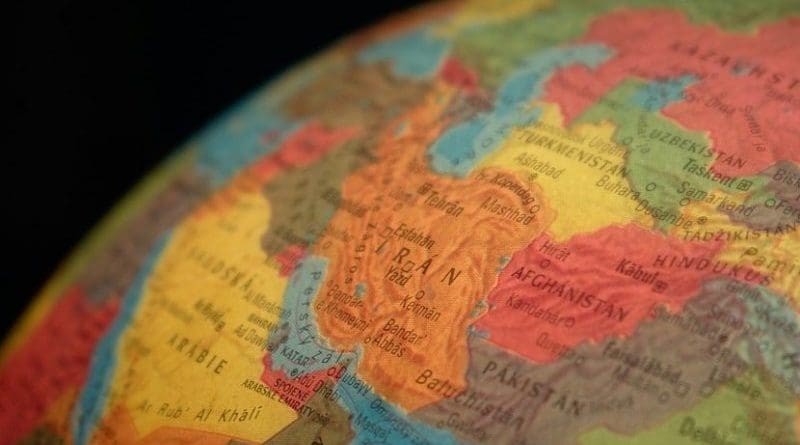
The attack appears to have consisted of more than three hundred drones and some cruise and ballistic missiles, according to Israeli defense officials. It must be noted that this is the first time since coming to power in 1979 that Iran's Islamic regime has directly attacked Israeli territory. Even though the vast majority of drones and missiles were shot down by Israeli defenses, along with reported help from U.S. and Jordanian forces, this is a new and alarming situation.

How serious is the risk of escalation to more direct attacks between Iran and Israel? Could this trigger an Israeli attack on Iranian nuclear facilities, for instance?

Neither side wants this conflict, but it is upon them. And it is hard to see how they can de-escalate. Israel will mostly likely retaliate. Its deterrence posture mandates a response to such an attack on its territory, even if there are no casualties. And then Iran has to respond.

Iran’s Islamic Revolutionary Guard Corps said they would retaliate against any country that assists Israel in responding to Iran’s attack. How serious is such a threat?

Environmental impacts of underground nuclear weapons testing

Sulgiye Park, Rodney C. Ewing

Since Trinity—the first atomic bomb test on the morning of July 16, 1945, near Alamogordo, New Mexico—the nuclear-armed states have conducted 2,056 nuclear tests (Kimball 2023). The United States led the way with 1,030 nuclear tests, or almost half of the total, between 1945 and 1992. Second is the former Soviet Union, with 715 tests between 1949 and 1990, and then France, with 210 tests between 1960 and 1996. Globally, nuclear tests culminated in a cumulative yield of over 500 megatons, which is equivalent to 500 million tons of TNT (Pravalie 2014). This surpasses by over 30,000 times the yield of the first atomic bomb dropped on Hiroshima on August 6, 1945.

Atmospheric nuclear tests prevailed until the early 1960s, with bombs tested by various means: aircraft drops, rocket launches, suspension from balloons, and detonation atop towers above ground. Between 1945 and 1963, the Soviet Union conducted 219 atmospheric tests, followed by the United States (215), the United Kingdom (21), and France (3) (Kimball 2023).

In the early days of the nuclear age, little was known about the impacts of radioactive “fallout —the residual and activated radioactive material that falls to the ground after a nuclear explosion. The impacts became clearer in the 1950s, when the Kodak chemical company detected radioactive contamination on their film, which was linked to radiation resulting from the atmospheric nuclear tests (Sato et al. 2022). American scientists, like Barry Commoner, also discovered the presence of strontium 90 in children’s teeth originating from nuclear fallout thousands of kilometers from the original test site (Commoner 1959; Commoner 1958; Reiss 1961). These discoveries alerted scientists and the public to the consequences of radioactive fallout from underwater and atmospheric nuclear tests, particularly tests of powerful thermonuclear weapons that had single event yields of one megaton or greater.

Public concerns for the effects of radioactive contamination led to the Limited (or Partial) Test Ban Treaty, signed on August 5, 1963. The treaty restricted nuclear tests from air, space, and underwater (Atomic Heritage Foundation 2016; Loeb 1991; Rubinson 2011). And while the treaty was imperfect with only three signatories at the beginning (the United States, the United Kingdom, and the Soviet Union), the ban succeeded in significantly curbing atmospheric release of radioactive isotopes.

Trump Has a Plan for Ukraine: It’s Biden’s

Holman W. Jenkins, Jr.

Like a slim majority of Americans and strong majority of pundits, I disagree with the House GOP rump seeking to stop aid to Ukraine. But America has a two-party, adversarial political system. It isn’t a polity of enforced unanimity. Nothing is ever unopposed (48 House Democrats voted against the creation of Medicare).

We have one president at a time and Joe Biden has been pro-Ukraine only in comparison to the GOP renegades. He has consistently withheld requested weapons, fearing escalation as if Vladimir Putin might commit global suicide because a war outside his borders is going badly (did the U.S resort to nukes in Iraq?).

This column thought Mr. Biden should be more enterprising in the early days, when Mr. Putin was flummoxed by failure, before sunk costs and thousands of deaths had to be justified. But Biden policy has been suspiciously unnimble, with perhaps the main instruction to national security adviser Jake Sullivan being: Keep the war of low salience to the American voter.

A frozen, Korea-style outcome may have been the lightly spoken Biden aim all along. Now comes a Washington Post report detailing a “secret” Donald Trump plan that strikes fundamentally the same note.

Last time I wrote about this subject a reader taxed me with Hungarian Prime Minister Viktor Orbán, who claimed Mr. Trump in private vowed to cut off Ukraine. My response: “Orbán speaks for Orbán. He was speaking to a Hungarian audience. I wasn’t there to question him about exactly what Trump said or what he thought he heard Trump say but if Trump wanted to say something intelligible on Ukraine, he would.”

Not surprisingly, the Post now tells us Mr. Orbán’s claim was categorically “false.”

Why Israel is losing the war of global public opinion over its tactics in Gaza

Michel Martin

LEILA FADEL, HOST:

More than 33,000 Palestinians have been killed, the majority women and children, since Israel's war in Gaza began, according to health authorities there. Ami Ayalon is a former director of Israel's internal security service, the Shin Bet. In an essay published by Foreign Affairs this week, he argues that global opinion is turning against Israel, but he still believes the war is justified.

AMI AYALON: It's a war of defense, and it is a response to the horror, violence. Hamas do not recognize our right to a state, a Jewish state, on the land of Israel.

FADEL: Speaking to our co-host, Michel Martin, Ayalon says Israel is currently winning on the battlefield but will ultimately lose the war if they don't maintain the support of the international community and lay out a plan for peace.

AYALON: The major mistake that our leaders did is that on the second or the third day after the 7 of October, our Cabinet ministers decided not to discuss the day after. Once we do not know to describe the day after, we do not have any concept of victory, we do not have any political goal. We tend to forget that, you know, war is only a means to achieve a better political reality. This is the definition of victory. Our leaders do not understand that when we fight a war against a terror - ideological, theological, radical terror organization, we are fighting in two dimensions. One is a battlefield, but in order to defeat Hamas, we have to win the war of ideas. And we cannot do it by the use of military power. The only way to do it is to create or to present a better idea.

MICHEL MARTIN, HOST:

Can that still happen?

AYALON: Of course. The first question that we have to ask is why - why Palestinians are fighting. My answer is very, very simple. They see themselves as a people. We do not recognize them as a people who deserve a self-determination and a state alongside of Israel, but what Biden is telling us now - and I believe that he is totally right - that we have to launch again the negotiation, in order to create hope among Palestinians.

Now it’s up to Israel: De-escalate or retaliate against Iran? - Opinion

Max Boot

Disaster was narrowly averted on Saturday night in the long-standing conflict between Israel and Iran. Israel, aided by the United States and other allies, successfully repelled a massive Iranian drone and missile strike. But the reprieve might be short-lived.

The latest round of hostilities began Oct. 7, when Hamas, a terrorist organization funded and armed by Iran, launched a barbaric attack on Israel. Israel responded by first bombing and then invading the Gaza Strip. Six months later, Israeli forces continue to battle Hamas in Gaza, with Palestinian civilians suffering devastating damage as Hamas hides among them.

Iran did not launch a full-scale war of its own after Oct. 7, despite what must have been Hamas leaders’ hopes, but Iran’s proxies in Hezbollah opened steady rocket and missile fire from southern Lebanon into northern Israel, forcing roughly 60,000 Israelis from their homes. The Houthis, another Iranian-backed militia, began attacking international shipping in the Red Sea and the Gulf of Aden. Other Iranian-backed militia opened fire on U.S. bases in Iraq and Syria. While U.S. forces retaliated against Iranian proxies for attacks on U.S. bases, Israel has kept up a series of strikes against Hezbollah targets in Lebanon while also continuing to target Hezbollah’s Iranian supply lines in Syria.

On April 1, Israel upped the ante by bombing the Iranian consulate in Damascus. The dead included two senior Islamic Revolutionary Guard Corps (IRGC) generals and several other officers. This airstrike was no doubt intended to put pressure on Iran to end the Hezbollah attacks on Israel, but this public humiliation — which included the destruction of a diplomatic facility that is technically sovereign Iranian territory — backed the mullahs into a corner. From Tehran’s perspective, retaliation became necessary to save face both with its own public and with its regional allies.

In the past two weeks, there was a public debate in Tehran about how to calibrate a response that would show strength against the “Zionist entity” but not drag Iran into a broader war with Israel and its allies. Israel had plenty of warning and so did the United States; President Biden even returned to the White House on Saturday afternoon from his home in Delaware to be ready to address the assault he had warned Iran not to launch.

Drones are crowding Ukraine’s skies, largely paralyzing battlefield

Siobhán O'Grady

So many drones patrol the skies over Ukraine’s front lines — hunting for any signs of movement — that Ukrainian and Russian troops have little ability to move on the battlefield without being spotted, and blown up.

Instead, on missions, they rush from one foxhole to another, hoping the pilots manning the enemy drones overhead are not skilled enough to find them inside. Expert drone operators, their abilities honed on the front, can stalk just a single foot soldier to their death, diving after them into hideouts and trenches.

The surge in small drones in Ukraine has turned the area beyond either side of the zero line — normally known as “the gray zone” — into “the death zone,” said Oleksandr Nastenko, commander of Code 9.2, a drone unit in Ukraine’s 92nd brigade. Those who dare to move day or night under the prying eyes of enemy drones “are dead immediately,” he said.

Cheap drones deployed in Ukraine have transformed modern warfare — and initially gave Ukrainian troops an advantage on a battlefield where they are perpetually outnumbered and outgunned. “This is the evolution of our survival,” Nastenko said.

But the Russians quickly caught on and began mass producing their own drones.

What followed was an overabundance of disposable, deadly drones and electronic warfare devices known as jammers that disrupt their flights. Most common are first-person-view, or FPV drones, typically controlled by a pilot wearing a headset and holding a remote controller.

“What we’re witnessing right now is blitzkrieg drone warfare,” said Andrew Coté, chief of staff at BRINC Drones, a Seattle-based drone company sending equipment to Ukraine. Coté said that drones in Ukraine are as game changing as tanks were in World War I. “It is pretty stalemate,” he said, “because if you are out in the open, you will be hunted.”

Ukraine’s attacks on Russian oil refineries show the growing threat AI drones pose to energy markets

Spencer Kimball

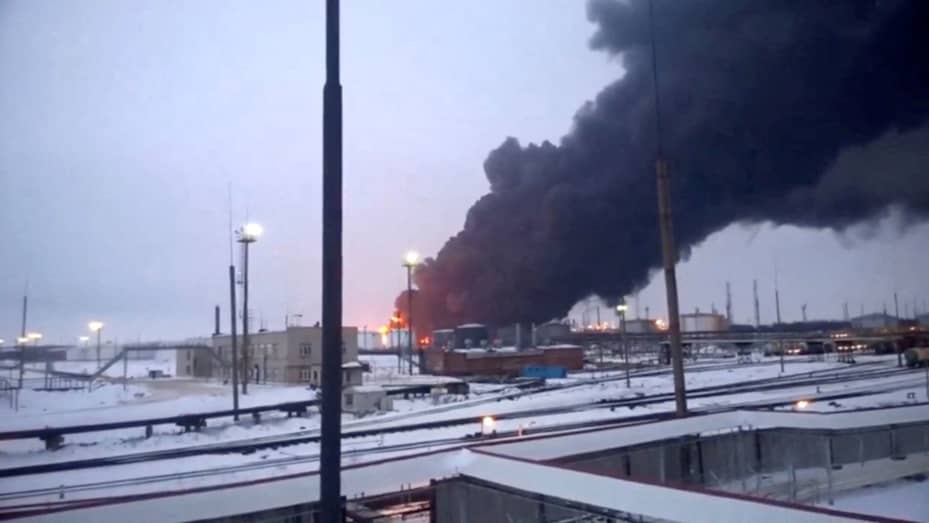
Ukraine’s campaign of attacks against Russian oil refineries is demonstrating how relatively cheap drones that utilize artificial intelligence could pose a major threat to global energy markets.

Ukraine-launched drones have hit 18 Russian oil refineries this year with a combined capacity of 3.9 million barrels per day, according to report published by JPMorgan earlier this month. Some 670,000 bpd of Russian refining capacity is currently offline due to the strikes, according to the bank.

Ukraine’s capabilities are growing with its drones now demonstrating a substantially longer range. Earlier this month, Kyiv hit Russia’s third-largest oil refinery, Taneco, which is located up to 1,300 kilometers — roughly 800 miles — from the frontlines, according to JPMorgan.

Ukraine is increasingly using drones that are enabled with AI, which helps the weapons navigate and avoid jamming, according to the bank.

“The AI guidance also delivers strike precision, maximizing the impact of the strikes by targeting specific areas like distillation towers, repairs of which requires Western technology,” Natasha Kaneva, head of global commodities strategy at JPMorgan, told clients in the April report. “This makes the repairs costly and often require equipment that the country is not able to produce.”

U.S. Defense Secretary Lloyd Austin made clear Tuesday that the Biden administration is worried about the strikes in a rare airing of public disagreement with U.S. allies in Kyiv.

“Certainly, those attacks could have a knock-on effect in terms of the global energy situation,” Austin told the Senate Armed Services Committee. “Quite frankly, I think Ukraine is better served in going after tactical and operational targets that can directly influence the current fight.”

MIRACLE OR MIRAGE? LITHIUM GOVERNANCE AND PROSPECTS IN BOLIVIA

DIEGO VON VACANO

High atop the Bolivian Andes, 12,000 feet above sea level, lies one of the hidden wonders of the world: the Uyuni Salt Lake. At first glance, its luminescence, which expands as far as the eye can see until it becomes one with the sky, makes for a unique tourist destination. But beneath it, thousands of years of geological processes have produced what is now a potential solution to the world’s climate change crisis.

The Altiplano, an expansive, high-altitude plateau that surrounds Uyuni, is a desert with few populated areas. There, Bolivia possesses 21 million metric tonnes of lithium, not just in Uyuni, but in surrounding deposits such as Pastos Grandes and Coipasa. It is the world’s largest resource of the mineral that is crucial for the world’s energy transition. After almost twenty years of failed attempts at developing an industrial production of the lightest of metals, the country seems finally poised to take a major leap forward. Various windows of opportunity have opened up in the last two years that seem to suggest a real take-off of the sector and, with it, of the Bolivian economy. However, the windows could close at any time.

Bolivia exported a modest amount of about 600 tonnes of lithium carbonate equivalent (LCE) in 2022, for close to USD$40 million in revenue. That is about four times more than the previous year. (La Razón 2022). Still, Bolivia lags far behind lithium exports by neighboring Chile or Argentina, the other two members of the so-called Lithium Triangle, a vast expanse of land across the Andes that holds dozens of lithium-rich salt flats.

In the 1990s, Bolivia became the region’s natural gas hub, with exports to Argentina and Brazil. National oil company YPFB (Yacimientos Petrolíferos Fiscales Bolivianos) implemented a well thought out strategy towards the end of the 2000s decade, that succeeded in fueling public spending and in generating jobs in the oil and gas sector.

Will the latest attempts at developing the country’s lithium industry mirror its natural gas success, and generate a miracle for Bolivia? Or is lithium merely a mirage that will delude observers?

Kennan Cable No. 90: Ten Years of Successful US Support in Ukraine is at Risk

Michael Flaherty

In February 2022, many experts in academia and government predicted a quick Russian military victory in its expanded war in Ukraine. Instead, Russia quickly lost the initiative and its elite forces and regular army suffered heavy losses. The Armed Forces of Ukraine (AFU) has recaptured approximately half of the territory Russia held at the apex of its campaign. Russia has lost more than territory. As it stands now, it will likely take more than a decade for the Russian military to recover its elite special operations capabilities. As members in the House debate the future of US support for Ukraine, they should consider the decade of unequivocal success the United States and its allies achieved in preparing and supporting Ukraine.

American and allied support combined with Ukrainian will to fight have proven a near-lethal combination for Russian troops over the past two years. The AFU was able to hold fast against the air and ground assault by Russia’s most elite forces in the opening weeks of the war for one key reason: the capabilities of the AFU had dramatically increased since 2014 with US and NATO member assistance.

Bipartisan Policy Initiative

Few foreign policy initiatives offer as clear a correlation between implementation and outcome as US support to AFU has. There is a clear before and after picture. In 2014, Russia used its special purpose forces to easily capture territory from Ukraine with minimal casualties in Crimea. They also successfully started and sustained separatist conflicts in two more Ukrainian regions in the east. But in 2022, Russia’s “little green men” and regular army were decimated. The improved supply of weapons to the AFU was important, but it pales in comparison with the impact of eight years of training for dedicated Ukrainian troops.

In 2014, the Ukrainian military was not capable of defending its sovereignty. It had a small, corrupt, poorly equipped military, according to its own leadership.[1] Russia’s 2014 land grabs proved to be a critical juncture for both Ukraine and its NATO partners. Volunteers within Ukraine mobilized quickly to hold the line in the east. Longer term, the Obama administration authorized a new policy approach that provided training and equipment to the AFU.

Biden And Hamas Tie Israeli Prime Minister Netanyahu Up In Knots – Analysis

James M. Dorsey

Israeli Prime Minister Binyamin Netanyahu is tying himself up in knots as he grudgingly, and only to a limited degree, bows to US President Joe Biden’s demands.

In doing so, Mr. Netanyahu is puncturing Swiss-cheese size holes into Israel’s Gaza narrative, making it easier for Mr. Biden to take him publicly to task.

Mr. Biden has demanded that Israel allow the unfettered flow of desperately needed humanitarian aid into Gaza, an immediate ceasefire linked to an exchange of Hamas-held hostages for Palestinians incarcerated in Israel, and the dropping of Israeli plans for a ground offensive in the southern Gazan city of Rafah, home to more than a million Palestinians displaced by the six-month-long war.

In recent days, Mr. Netanyahu has granted entry into Gaza to more than 1,200 aid trucks, significantly reduced Israel’s on-the-ground military presence in the Strip, and raised to 150,000 the number of displaced Palestinians that would be allowed to return without Israeli security checks to their often destroyed homes in the north of the territory.

In addition, Mr. Netanyahu has played games with Rafah by claiming that he has set an undisclosed date for a ground offensive, even though Israeli officials are still discussing his plans with their US counterparts, and his defence minister, Yoav Gallant, insists that there is no date for the operation.

Even so, Mr. Gallant said the withdrawal of Israeli forces was to prepare for an offensive in Rafah. Israel asserts that Hamas’ remaining four armed brigades are in Rafah. It also suspects that Hamas’ top leadership, including Yahya Sinwar, Israel’s most wanted man, is hiding in tunnels under Rafah, shielded by many of the Hamas-held hostages still alive.

Iran’s Retaliation Against Israel: Four Possible Scenarios – OpEd

Altaf Moti

As the Middle East braces for another wave of instability, the question on everyone’s mind is: how will Iran retaliate against Israel’s latest strike? The attack, which targeted Iranian-backed militias in Syria, has already elicited a series of threats from Tehran, but the question remains: what form will this retaliation take? There are four possible ways Iran may retaliate against Israel, each with potential consequences and implications.

1. Cyberattacks

Iran has long been known for its sophisticated cyber capabilities, which it has used to target critical infrastructure and financial institutions in the past. Given the history of cyberattacks between the two countries, it is likely that Iran will consider using this tactic again. Israel’s critical infrastructure, including its power grid, water supply, and transportation systems are all potential targets. A successful cyberattack could cause widespread disruption and damage, potentially even leading to loss of life.

However, Israel is also well-prepared for such attacks, with a robust cyber defense system in place. In addition, Israel has been accused of launching its own cyberattacks against Iran in the past, including the infamous Stuxnet attack. As such, any cyberattack from Iran is likely to be met with a strong response from Israel.

It is important to note that the cyber conflict between Iran and Israel has intensified in recent years, with both countries becoming more public about these attacks. The objectives of these cyberattacks have shifted from mostly defense targets to disruptions of critical infrastructure. The greater the public exposure to these cyberattacks, the greater the risk that they could extend beyond cyberspace and influence other areas of this conflict too.

Iran’s approach to cyberspace is inherently bound to its domestic authoritarian policies and its international confrontations. The country has become a determined cyber actor against US, Gulf Arab, and Israeli interests. Iran regards itself as being in an intelligence and cyber war with its enemies.

What an open war between Israel and Iran could look like

Source Link

The US and its European allies fear that an April 1 attack in Syria that killed several Iranian officers could push Israel and Iran to the verge of something they have avoided for decades: Open war.

Until now, Iran, with one exception, has used proxies to attack Israel, while Israel has avoided air strikes on Iranian soil. Now, Israel is bracing itself for retaliation for the strike in Damascus, a prospect provoking fears of a regional conflict.

How might a war between them be fought?

At this point, the two likeliest scenarios appear to be a missile barrage into Israeli territory, either from proxies in Lebanon or from Iran itself, or a swarming drone assault. A more remote possibility is that Iran could direct proxies to deploy militants on the ground from Syria or Lebanon.

The one precedent for Iran attacking Israeli territory came in 2018, when Teheran fired rockets from Syria on positions in the Golan Heights.

The details of Iran’s current capabilities contained in a US Defence Intelligence Agency assessment released with little fanfare on April 11 suggested that any Iranian attack on Israel would likely be a combination of missiles and unmanned aerial vehicles (UAVs), or drones.

“Teheran’s missile force is increasingly augmented by Iran’s UAVs and serves as the regime’s primary conventional deterrent against attacks on its personnel and territory,” the agency said. It added that Iran has a “substantial inventory” of ballistic and cruise missiles capable of striking targets 2,000km away – putting Israel well within range.

Cyber Sector Takes Center Stage: Israel Bolsters Defenses in Response to Surge of Attacks

VERONICA NEIFAKH

Israel has seen a 2.5x rise in cyberattacks since October 7, primarily from Iran and Hizbullah. Despite challenges, its cybersecurity remains resilient, showcased at Tel Aviv's Global Cybertech conference

Israel has experienced a surge in cyberattacks since the Hamas-led massacre on October 7, with the National Cyber Directorate reporting a 2.5 times increase in incidents, 800 of them having significant potential for damage. Despite this, Israel’s cybersecurity industry has shown resilience, adapting to increased hacking threats from Iran and Hizbullah.

At the Global Cybertech conference this week in Tel Aviv, Israeli and international experts addressed the growing cyber threats, innovations, and start-ups. Refael Franco, co-founder of Code Blue, a cyber crisis and disaster management company, told The Media Line, “We are running a crisis all over the globe. There is no 100% prevention of the attacks, so our philosophy is to make a plan B for bad days.”

Franco—a former deputy head of the national cyber directorate, head of the Israeli national cyber defense branch, and recipient of the Israeli National Security Award—said that the attack of Hamas on Israel on October 7 raises issues of cyber security.

“There were rumors that Hamas also attacked with cyber tools, but this is not true. However, they collect information from the cameras and the open source intelligence, and they get a lot of data from the open platforms,” Franco said.

He also shared with The Media Line that all Israeli neighborhoods are equipped with tools for cyber attacks, emphasizing Iran. “Iran is a strong player with good cyber capabilities. They also have the motivation to attack the Israeli civilian market, critical infrastructure, and water manufacturing.”

Ukraine's Three-Front War: Advancing Russians, Depleted Artillery, Exhausted Troops

Mike Eckel

The column of Russian armored vehicles carefully approached Chasiv Yar from the east, threading its way along dirt roads, skirting patches of forest, and avoiding Ukrainian-laid minefields while dodging incoming drones and artillery.

The April 4 assault on the Donetsk region city was repelled, according to Ukrainian commanders, open-source intelligence, and reports from soldiers on the ground. But more troublingly for Ukraine’s beleaguered frontline troops was what the grainy black-and-white drone video released by Ukraine’s 67th Separate Mechanized Brigade showed: a potential weakness in Ukraine's defense, hastily built in some cases, and smarter tactics by Russian forces than earlier in the invasion.

Chasiv Yar is slowly being wiped from the map as Russian jets drop heavy guided bombs that flatten apartment blocks and elite airborne assault units edge into the city's eastern outskirts.

Ukrainian forces are exhausted, starved for artillery shells, desperate for reinforcements and rotations, struggling to hold back Russia’s offensive in several locations across the 1,200-kilometer front line. After the loss of the bigger city of Avdiyivka in February, Chasiv Yar is the next crucible, for Ukraine's troops and for the West's will to arm and support them.

"The battle for Chasiv Yar...is a litmus test for both sides," according to Frontelligence Insight, a Ukrainian open-source research organization run by a Ukrainian reserve officer that analyzed the 64th Brigade drone video. "If Ukraine were to lose control of Chasiv Yar, it could have dire consequences as it would provide a direct route for the Russian Army to advance towards key cities in the Donbas, such as Kostyantynivka and Kramatorsk."

Chasiv Yar "is one of the hottest spots on the front line," said Oleksiy Melnyk, a retired Ukrainian Air Force officer and former pilot, as Russia moves closer to the goal of occupying the entirety of the two eastern Ukrainian regions that make up the Donbas: Donetsk and Luhansk.

Iran’s attack on Israel raises fears of a wider war, but all sides have also scored gains

TIA GOLDENBERG

The unprecedented attack by Iran on Israel early Sunday ratcheted up regional tensions, confirming long-held fears about the Israel-Hamas war spiraling into a broader conflagration. But Iran, Israel, the United States and Hamas also walked away with some gains.

Here’s a look at the fallout.

As the more than 300 drones and missiles headed toward Israel in the early hours of Sunday, the country was able to successfully put to the test its aerial defense array, which, along with help from allies, blocked 99% of the projectiles and prevented any major damage.

By contrast, Israel’s military had suffered a bruising defeat at the hands of a far less equipped enemy when Hamas stormed from Gaza into Israel on Oct. 7. That was a major blow to Israel’s image as a regional military powerhouse and shattered any sense of invincibility. The response to Iran’s attack could be what restores faith in the country’s military, even as its forces are bogged down in Gaza, more than six months after Israel declared war on Hamas there.

Israel has also boasted about the coalition of forces that helped it repel the Iranian assault. It’s a much-needed show of support at a time when Israel is at its most isolated because of concerns surrounding its conduct during the war against Hamas, including a worsening humanitarian crisis and a staggering death toll in Gaza.

Misinformation Undermines Life In The Age Of Digital Revolution – OpEd

Bhabani Shankar Nayak

In this era of an Artificial Intelligence-fuelled digital revolution, misinformation has emerged as a potent weapon wielded by both ruling and non-ruling elites. Their aim is often to undermine truth, dismantle democracy, sow division among people, and exert control over various aspects of life and resources on the planet. The reach of Deep Fakes extends far beyond celebrities, politicians, and industrialists; they now infiltrate everyday services and commodities that are consumed by the masses. This pervasive spread of deceptive information threatens not only public figures but also the trust and reliability of the information we rely on in our daily lives. As technology continues to advance, the challenge lies in distinguishing fact from fiction and ensuring that our digital landscape and society remains a trustworthy source of information for everyone.

Misinformation is not merely an accidental mistake; it is a meticulously crafted strategy designed to exploit the masses. This deliberate dissemination of false information serves to divert attention from the harsh material realities of capitalism, steering people towards a culture fuelled by emotion and falsehoods. In such an environment, it becomes increasingly challenging to engage with fact-based information that has a tangible impact on everyday human lives. This shift towards an emotional and misleading narrative undermines the foundation of informed decision-making, making it crucial for individuals to be vigilant and discerning in their consumption of information. As we navigate this complex landscape, the importance of promoting critical thinking and media literacy cannot be overstated, empowering individuals to distinguish between reliable information and deliberate deception.

Misinformation is disseminated widely across all mediums of communication, intentionally blurring the lines between fact and fraud. This strategy serves to amplify deception, foster misgovernance, and create a climate where accountability is side-lined. The pervasive nature of this misinformation campaign contributes to shaping a narrative where individuals are constantly confronted with false challenges and distorted realities. By muddying the waters of truth, those behind these campaigns aim to sow confusion, manipulate public opinion, and undermine the foundations of a well-informed society. 

16 April 2024

What to Know About India’s 2024 Election

ASTHA RAJVANSHI

The world’s biggest election will take place next week when 960 million eligible voters from a population of 1.4 billion Indians cast their ballot to decide who will fill the 543 seats of the Lok Sabha, the more powerful lower house of Parliament—and who will become India’s next prime minister.

The ruling Bharatiya Janata Party (BJP) is competing against a coalition of more than a dozen opposition parties, including the Indian National Congress, which once ruled over the nation for more than 50 years. At the center of the contest is incumbent Prime Minister Narendra Modi, who first rose to power in 2014 on the promise of economic reform and a Hindu nationalist mandate. If he wins again, Modi will match the record of India’s first prime minister, the Congress leader Jawaharlal Nehru, by staying in power for three consecutive terms.

The election is a long and costly exercise: Voting begins on April 19, staggered in seven sequential phases over the course of six weeks, with the results announced on June 4. Similar to 2019, when India last held an election, this year’s election will see over a million polling booths set up across the country, with nearly 15 million polling personnel helping to administer the vote through electronic voting machines. All this is carefully planned and executed by the Election Commission of India. While the 2019 election, which cost $8.5 billion, was seen to be the world’s most expensive election by some estimates, this year’s vote is expected to exceed even that number.

Below, everything you need to know about India’s next election.

How does India’s election work?

Following the British parliamentary system that was in place in India until the country’s independence in 1947, India’s democracy is a multiparty parliamentary system with a bicameral legislature. That means that the party or coalition of parties that wins a majority will form a government and nominate a candidate for prime minister. To secure a majority, a party or coalition must get 272 seats.

The Moscow Terrorist Attack: Pro-Islamic State Narratives and their Wider Implications

Meili Criezis

Introduction

On 22 March 2024, four gunmen entered Crocus City Hall in Moscow, Russia and carried out an attack killing 139 people. Later that same evening, Amaq News Agency released a short announcement stating that “Islamic State fighters attacked a large gathering of Christians in the city of ‘Krasnogorsk’…and they killed and wounded hundreds and inflicted great damage on the place before safety withdrawing to their bases.” On 23 March, Amaq produced a more detailed follow-up statement (along with a blurred image of the terrorists) saying the concert venue location had been surveilled prior to the attack and that four “Islamic State fighters” carried out the operation with “machine guns, pistols, knives and incendiary bombs” among other details. The Moscow attack also received a mentioning in Islamic State spokesman Abu Hudhaifa al-Ansari’s recent Al Furqan audio speech release. [Translations provided by Aymenn Al-Tamimi]

IS central media also released an official claim repeating the information shared from the Amaq releases, and as Aaron Zelin emphasised, the claim itself did not attribute the attack to Islamic State Khorasan Province (ISKP/IS-K) or indeed any IS province. However, Zelin additionally states that the lack of a more specified claim at the province level “doesn’t mean ISKP networks weren’t involved,” suggesting that “the way IS does its external operations claims are a bit more nuanced than its regional attack claims.” A US official shared with the Associated Press that “US agencies said that IS-K was responsible for the attack.” The Kremlin, on the other hand, accused Ukraine, the United States, and Britain of being behind the attack. Two weeks before the attack, the US abided by its ‘duty to warn’ tenet and tried to warn Russia of an imminent attack. Central Asian migrants in Russia, especially Tajik nationals, have also faced further heightened xenophobia, discrimination, and violence following the 22 March attack.

Following the terrorist attack and IS’s official claim, pro-IS supporters expressed excitement and circulated propaganda. This Insight examines some prominent responses expressed across their public social media channels and analyses their wider implications.

Virtual Battlegrounds: Understanding the Online Campaign of Baloch Separatist Groups in Pakistan

Sajid Aziz

Background

Heavy breathing fills the audio as the head-mounted camera captures a gun, apparently an M203 Under-Barrel Grenade Launcher, its focus fixed on a distant security outpost. As the camera moves, a couple of other fighters with their heads and faces wrapped in chadors can be seen as they slowly climb up a rugged mountain. The fighter aims and launches a grenade attack upon the target. The explosion reverberates through the air, followed by a background song in Brahvi, one of the two main languages Baloch people speak. Various angles capture the impact of the attack, including a drone shot. As the grenade hits the target and a plume of dust and smoke rises in the sky, one of the fighters cries for victory. The video ends with a militant planting the flag of ‘an independent Balochistan’ on the debris of the bombed-out security outpost.

This was a trailer video released last year by the Baloch Liberation Army (BLA), one of the separatist militant organisations fighting for an independent Balochistan – Pakistan’s largest but least populated province. Grievances in Balochistan have emanated from a lack of political rights, the exploitation of its rich mineral and energy resources, and perceived inequities in development initiatives, such as the China-Pakistan Economic Corridor (CPEC).

This Insight contends that the escalation of the separatist insurgency in Balochistan has been accompanied by an increased utilisation of cyberspace, facilitated by widespread internet and phone access. This has complicated counterterrorism efforts for governmental authorities and technology firms, necessitating greater cooperation to address this evolving threat.

The Evolution of Baloch Insurgency

Gwadar, the hub of the CPEC, has become a microcosm of the strained relationship between ethnic Baloch people and the state of Pakistan. The state has seen the development of the port city as central to its vision of economic transformation, a source of nation-building, a hub for regional connectivity, and thrusting Balochistan into a new era of development and modernity. For local communities, Gwadar has become a “site of anxiety and fear”

Vietnam Paints Billionaire’s Death Sentence as a Victory for Clean Governance. It’s Not

CHARLIE CAMPBELL

It’s Southeast Asia’s biggest ever fraud, amounting to $12.5 billion and embroiling some of Vietnam’s top bankers and officials. And on Thursday, a Ho Chi Minh City court reached its verdict: a death sentence for Truong My Lan, a highflying 67-year-old businesswoman who began life hawking cosmetics from a market stall in the southern city before in 1992 founding Van Thinh Phat, a sprawling company which developed luxury apartments, offices, hotels, and shopping malls.

In 2011, Lan was enlisted to shepherd the merger of the troubled Saigon Joint Commercial Bank, or SCB, with two other lenders in a plan overseen by the Vietnam Central Bank. But until her arrest in 2022, she stands accused of using SCB as her personal piggybank, embezzling billions via illegal loans to herself and confederates through thousands of shell companies at home and overseas. The verdict is the first death sentence for a private businessperson for financial crime.

The case has sent shockwaves through Vietnam’s business community and is the highest profile collar of Communist Party General Secretary Nguyen Phu Trong’s sweeping “Blazing Furnace” anti-corruption campaign. The full impact of Lan’s sentence—a family member told Reuters she intends to appeal—is not yet known though there are clear implications for international firms looking to Vietnam as they diversify supply chains away from China.

“This trial is probably the exemplar of Vietnam’s effort to crack down on corruption not only in the state sector but also in private spaces,” says Nguyen Khác Giang, a visiting fellow at the Vietnam Studies Program of the ISEAS-Yusof Ishak Institute in Singapore.

That Vietnam sought to make an example of Lan was clear. A guilty verdict in the trial that began just weeks ago may never have been in doubt, as befits a one-party autocracy, but this was no shadowy judgment far from public view. Lan was tried alongside 84 defendants, including her husband (who was sentenced to nine years in prison), close relatives, 45 SCB staff (including three executives given life prison sentences), 15 former officers from the Vietnam State Bank, three officials from the Government Inspectorate and one from the State Audit Office. Proceedings involved 10 state prosecutors, some 200 lawyers, and 2,700 witnesses. Evidence filled 104 boxes and weighed six tons. Local media were provided detailed briefings by party cadres typically schooled in deep secrecy.

PRC Support Underpins Russia’s War Against Ukraine


Executive Summary:
  • PRC aid to Russia is multidomain and underpins much of Moscow’s ability to continue to wage war in Ukraine.
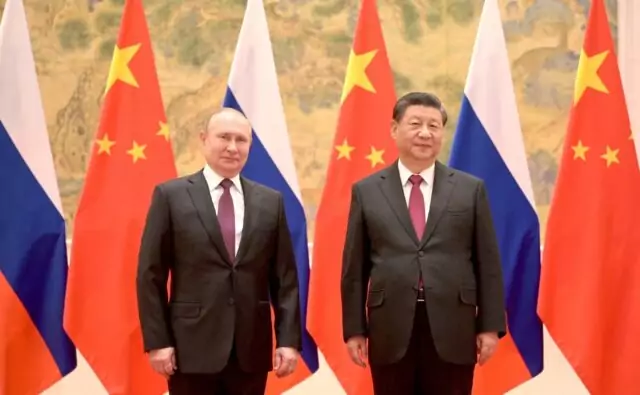
  • Attempts have been made to institutionalize the Sino-Russian relationship, deepening the military aspect in particular. The relationship between Xi Jinping and Vladimir Putin nevertheless remains its driving force.
  • Readouts from Sino-Russian and Sino-Ukrainian meetings suggest that Beijing is not wholly aligned with Moscow’s, and there is clear opposition to the war within sections of the PRC elite. This may mean little if Xi Jinping cannot be persuaded to signal a change in approach.
Toward the end of March, Li Hui (李辉), Special Representative of the Government for Eurasian Affairs, held a briefing on his second round of shuttle diplomacy in Ukraine (MFA, March 22). According to the Ministry of Foreign Affairs readout from his meetings in Ukraine, he “held frank and friendly talks on Sino-Ukrainian relations and the Ukrainian crisis” (MFA, March 8). The Ukrainian side provides more detail on the meetings, noting that they informed their interlocutor of “cases of Russia’s gross violation of the Geneva Convention Relative to the Treatment of Prisoners of War” and of their efforts to “return Ukrainian citizens illegally detained by the Russian Federation and abducted children” (President of Ukraine, March 7).

Deputy Permanent Representative to the UN Geng Shuang (耿爽) announced this week that the PRC “has always maintained an objective and impartial position” on the war in Ukraine and “advocated that the sovereignty and territorial integrity of all countries should be respected” (Xinhua, April 11). To many observers, this rhetoric appears out of step with the reality of the PRC’s position. Deputy Head of the Office of the President of Ukraine Roman Mashovets emphasized to Li that “components from third countries” are “becoming part of the weapons used against Ukrainian civilians.” Reading between the lines of the readout, Ukraine wants Beijing to do more to pressure Moscow and to restrict the ways in which it is assisting in the destruction of Ukraine, however indirectly.

Chinese Purchases Of U.S. Land Come Under Spotlight

Ben Solis

One of the most important under-the-radar issues in the 2024 election could be the practice of Chinese nationals and companies buying up vast swaths of American land.

In recent months, a number of states, mostly led by conservatives, have taken action to halt the practice of Chinese entities buying large tracts of farmland, ranchland, and timber claims. However, without strong federal action, which President Joe Biden and Senate Democrats have been unwilling to pursue, the practice could continue to imperil America’s physical and economic security.

South Dakota Governor Kristi Noem, who in March signed a law that bars China and five other countries from purchasing farmland in her state, has warned that China is “buying up our entire food supply chain and when America can’t feed itself and we rely on another country to feed us it becomes a national security issue.” Montana, Virginia, North Dakota, and Florida are among other states that have passed similar bans.

But those efforts haven’t been enough to stop the growth in Chinese land acquisitions.

According to “The Land Report 100,” an annual ranking of the largest landowners in the United States that has been cited by The Wall Street Journal and The Washington Post, this year a Chinese national made an appearance on the list for the first time. Tianqiao Chen, who moved to San Francisco in 2017 and is worth an estimated $4 billion, recently purchased nearly 200,000 acres of timber land in Oregon, putting him at number 82 on the list.

While the “official” narrative on Chen is that he made his fortune from founding online gaming company Shanda Interactive, sources with whom I spoke said that may not be the whole story.

How Will Israel Respond to the Iranian Attack?

Daniel Byman

The latest Iranian salvo against Israel is raising fears that a regional war will engulf the Middle East. On Saturday, Iran launched a large drone and missile attack against Israel and seized an Israeli-linked container ship in the Strait of Hormuz. These attacks followed the Israeli assassination of several senior Islamic Revolutionary Guard Corps (IRGC) leaders in Syria.

How Did Russia Use Anti-Western Narratives To Justify Intervening In Syria?

Eleni Anagnostopoulou

The Syrian unrest is one of the manifestations of the Arab Spring, a series of pro-democracy uprisings that spread across the Middle East and North Africa (MENA) in 2011. On March 15 of the same year, protests demanding regime change and democratisation were initiated in Syria. The government responded by using repression and excessive violence. The opposition soon took arms and began to form militias, escalating the situation into a violent civil conflict in 2012 and then into a complicated internationalised conflict as multiple warring parties started receiving support from foreign actors. The armed conflict triggered the most severe refugee crisis since the Second World War, evolving into a regional crisis (UCDP, 2022a; Cengiz, 2020). A number of anti-government insurgent groups have participated in the conflict, including Jabhat al-Nusra and the Free Syrian Army (UCDP, 2022b).

The G8 summit in June 2013 arguably reaffirmed the alignment between the Russian government and the Assad regime. Moscow’s support for Syria’s President Bashar al-Assad has taken many forms. Russia vetoed resolutions and sanctions against the Syrian regime relating to violence against civilians, including but not limited to sieges and aerial bombardment as collective punishment tactics, constrained Western intervention by invoking Chapter VII of the United Nations (UN) Charter on the authorisation of military action for humanitarian purposes, and provided Assad with material support (Allison, 2013a; Charap, 2013; Council on Foreign Relations, 2021). My work focuses on Russia’s overt and large-scale military intervention in the Syrian hostilities, which ensued in September 2015. The Syrian conflict is the first case of Russian military engagement outside the post-Soviet space (Rezvani, 2020).

The literature on the subject of Russia’s longstanding military involvement in Syria is extensive. From a geostrategic standpoint, for example, the arms trade between Russia and Syria, Syria’s energy production, and the Russian naval base on Tartus are presented as causal mechanisms for Russia’s decision to defend the Assad regime militarily (Bellamy, 2014; Rezvani, 2020; Marten, 2015). 

A Million Dollar Middle East Peace Plan

KAI BIRD

One night at the dinner table in the American Colony—the lovely boutique watering hole in East Jerusalem—I overheard an elderly American heiress proclaiming that she would give a million dollars to anyone who could solve the Arab-Israeli conflict. It was 1956, and I was just five-years-old, but I tugged my father’s sleeve, and said, “Daddy, we have to win this prize.”

I spent my entire childhood in the Middle East, the son of an American diplomat. It was nothing exceptional—except that Zelig-like, I lived through all the wars of the Arab-Israeli conflict. And then as a young man I married the only daughter of two survivors of the Shoah. I have always worked hard to see both sides of this tragic, seemingly intractable conflict. But I am now fed up with these bad actors and their tribal bloodbaths.

All these many years later, the ‘troubles’ in the ‘dangerous neighborhood persist. Indeed, things have gotten worse. Just look at the horrifying atrocities of October 7, 2023 when some 1,200 Israelis were butchered. And just look at the indiscriminate killing of over 30,000 Palestinians, mostly civilians in Gaza in the current war. Alarming incidents of blatant anti-Semitism and Islamaphobia fuel a toxic atmosphere across much of the globe. The tide of extremism on all sides has risen, and civil society voices of moderation are largely deemed irrelevant.

Short-sighted leaders on both sides are fueling a new generation of violence and hatred. Hamas’s bloody terrorism is bad enough, but I wouldn’t be surprised if tomorrow the current war expands to Lebanon or Iran—or if a radiation ‘dirty’ bomb explodes in Tel Aviv, making parts of the city uninhabitable. The only good news is that the political careers of both Bibi Netanyahu and Mahmoud Abbas are clearly coming to an end. Both of these deplorable leaders have led their peoples to a dead end.

This conflict is so dangerous that the time has come for the international community to impose a solution. Here is what needs to be done.