9 August 2025

After Xi


For more than a decade, Chinese politics has been defined by one man: Xi Jinping. Since Xi assumed leadership of the Chinese Communist Party in 2012, he has made himself into a strongman ruler. He has remade the CCP elite through a wide-ranging purge and corruption crackdown. He has curbed civil society and suppressed dissent. He has reorganized and modernized the military. And he has reinvigorated the role of the state in the economy.

Xi’s rise has also redefined China’s relationship with the rest of the world. He has pursued a more muscular foreign policy, including by increasing the tempo of military drills in the Taiwan Strait and overseeing a growing military presence in the South China Sea. He has encouraged (and then later reined in) a battalion of “wolf warrior” diplomats who engaged in a harsh war of words with foreign critics. And he has pushed China closer to Russia, even after Russian President Vladimir Putin launched a war in Ukraine. In short, it has been a new era for China. It has been Xi’s era.

Soon, however, everything will start to change. As the CCP elite begins the search for a leader to replace the 72-year-old Xi, China is transitioning from a phase defined by power consolidation to one defined by the question of succession. For any authoritarian regime, political succession is a moment of peril, and for all its strengths, the CCP is no exception. The last time the party dealt with the problem of political succession—when Xi took over from Hu Jintao—rumors swirled in Beijing of coup attempts, failed assassinations, and tanks on the streets. The rumors may have been unfounded, but the political drama at the top was real.

Xi probably has years, perhaps even more than a decade, before he steps down. But the reality is that succession shapes political choices well before leaders finally relinquish control. Chinese rulers, sensitive to their legacies, jostle to install people who will carry on their political agendas. Mao Zedong’s fixation with maintaining China’s revolutionary spirit after his death led to the Cultural Revolution, a mass political campaign that reshuffled the CCP leadership repeatedly during the last decade of Mao’s life.

Leashing Chinese AI Needs Smart Chip Controls

Kyle Chan

China’s stunning achievements in AI have one glaring weak spot: access to compute—the raw processing power that fuels AI and relies on large volumes of advanced semiconductors. The U.S. currently has a tenfold advantage over China in total compute capacity, a gap that may only widen over time. U.S. tech firms are pouring billions of dollars into new data centers and can reap the benefits of the latest chip advancements from Nvidia and AMD or their own self-developed AI chips.

Meanwhile, the performance and volume of foreign AI chips that Chinese firms can obtain have gone down over time due to increasingly stringent U.S. export controls. Chinese tech leaders such as Tencent, Baidu, and DeepSeek have called out compute constraints as a key bottleneck to faster AI development. Kyle Chan is a postdoctoral researcher in the Sociology Department at Princeton University and an adjunct researcher at the Rand Corporation.Ray Wang is research director of semiconductors, supply chain, and emerging technology at Futurum Group.

Myanmar’s Dangerous Drift: Conflict, Elections and Looming Regional Détente


What’s new? Changing global and regional conditions are giving Myanmar’s military regime greater room for manoeuvre. Growing diplomatic fatigue in Western capitals, China’s moves to prevent regime collapse, shifts in U.S. policy and other geopolitical realignments are hastening normalisation of relations with Naypyitaw’s rulers, despite worsening conflict. Why does it matter? As geopolitical shifts give neighbouring countries more latitude to engage Naypyitaw, Myanmar’s conflict and humanitarian crisis could face ever greater neglect. 

Planned elections will lack credibility and may lead to further violence, even as they could encourage some governments to normalise ties with a future military-backed administration. What should be done? Diplomats should preserve multilateral coordination on Myanmar, above all at the UN Security Council and Association of Southeast Asian Nations, and be ready to seize any opening for a peaceful settlement. They should avoid conferring legitimacy on the regime’s elections, while donors should sustain humanitarian and other vital programming.

Myanmar’s military regime is discovering new diplomatic opportunities as global and regional politics shift. China’s recent moves to prevent the junta’s collapse, diminishing Western interest, chaotic U.S. foreign policy and regional fatigue with a protracted conflict are reshaping the international environment. These trends have led to a gradual thaw in relations between many Asian countries and Naypyitaw, even as the regime continues to lose ground in the post-2021 coup conflict and humanitarian conditions worsen. 

Elections planned for late in the year will not resolve the political impasse and will likely be violent, but they may offer a convenient pretext for some governments to deepen engagement with the junta. Instead of rushing to recognise the country’s military rulers, foreign powers should preserve what limited space remains for coordinated diplomacy on Myanmar, particularly at the UN Security Council and Association of Southeast Asian Nations (ASEAN), standing ready to seek a peaceful settlement if the opening arises but not conferring unwarranted legitimacy on the forthcoming polls.

A New Strategic Review for a New Age


Contemporary U.S. plans for the modernization of nuclear forces are an approximately 15-year-old legacy of the Obama Administration. They were not established in anticipation of the dramatic changes in the security environment since 2010—when it was assumed that a one-for-one replacement for the legacy nuclear delivery systems and the New START Treaty limit on nuclear weapon numbers would be more than adequate. Rather, the existing nuclear modernization program was established at a time when many U.S. officials continued to believe that U.S. 

relations with Russia and China were relatively benign and would remain so, or improve further. How the contemporary nuclear program, largely inherited from the Obama Administration, fares over the next few years, and how the new presidential administration entering office in 2025 decides to adapt the U.S. nuclear posture for the much more dynamic and dangerous contemporary threat environment will affect the US strategic and non-strategic nuclear posture for decades, and, correspondingly, U.S. deterrence strategies and options.

This study examines several key issues: developments in the international threat environment; U.S. deterrence goals in that contemporary threat environment; needed adjustments in U.S. deterrence strategies and force posture, and for the assurance of allies; and, near-term initiatives and decisions needed to enable the United States to move toward a force posture that is fit to address contemporary threats. Unfortunately, given the past four decades of deep U.S. strategic and non-strategic force reductions and the atrophying of the U.S. nuclear production infrastructure, the United States has a limited near-term capacity to strengthen its nuclear force posture in response to an unprecedentedly threatening security environment.

Given contemporary threats, whatever may be the preferred future U.S. nuclear force posture and characteristics for deterrence and allied assurance purposes, the reality is that U.S. options for adjustment are largely limited through the early 2030s to available nuclear systems and warheads. Uploading the existing Triad of nuclear forces is the only near-term option to strengthen U.S. deterrence force numbers to meet looming threats, pending the deployment of new U.S. strategic systems in the 2030s.

Challenging US dominance: China's DeepSeek model and the pluralisation of AI development


The release of a new AI model by the Chinese startup DeepSeek in January 2025, known as R1, captured global attention. The company claimed to have developed a model that performs on par with those of leading American tech firms such as OpenAI, xAI or Anthropic, but at significantly lower cost and requiring far less computing power. This announcement sent shockwaves across the globe, signalling a potential reshaping of the global AI race between the US and the People’s Republic of China (PRC).

China’s restricted access to cutting-edge chips due to American export controls had led many to doubt its ability to develop a frontier AI model. The release of DeepSeek’s model has challenged those assumptions, calling into question the effectiveness of the US’s ‘small yard, high fence’ strategy. Crucially, the Chinese firm’s breakthrough relies primarily on the model’s algorithmic efficiency, dealing a serious blow to the technical and business model long championed by US tech giants. 

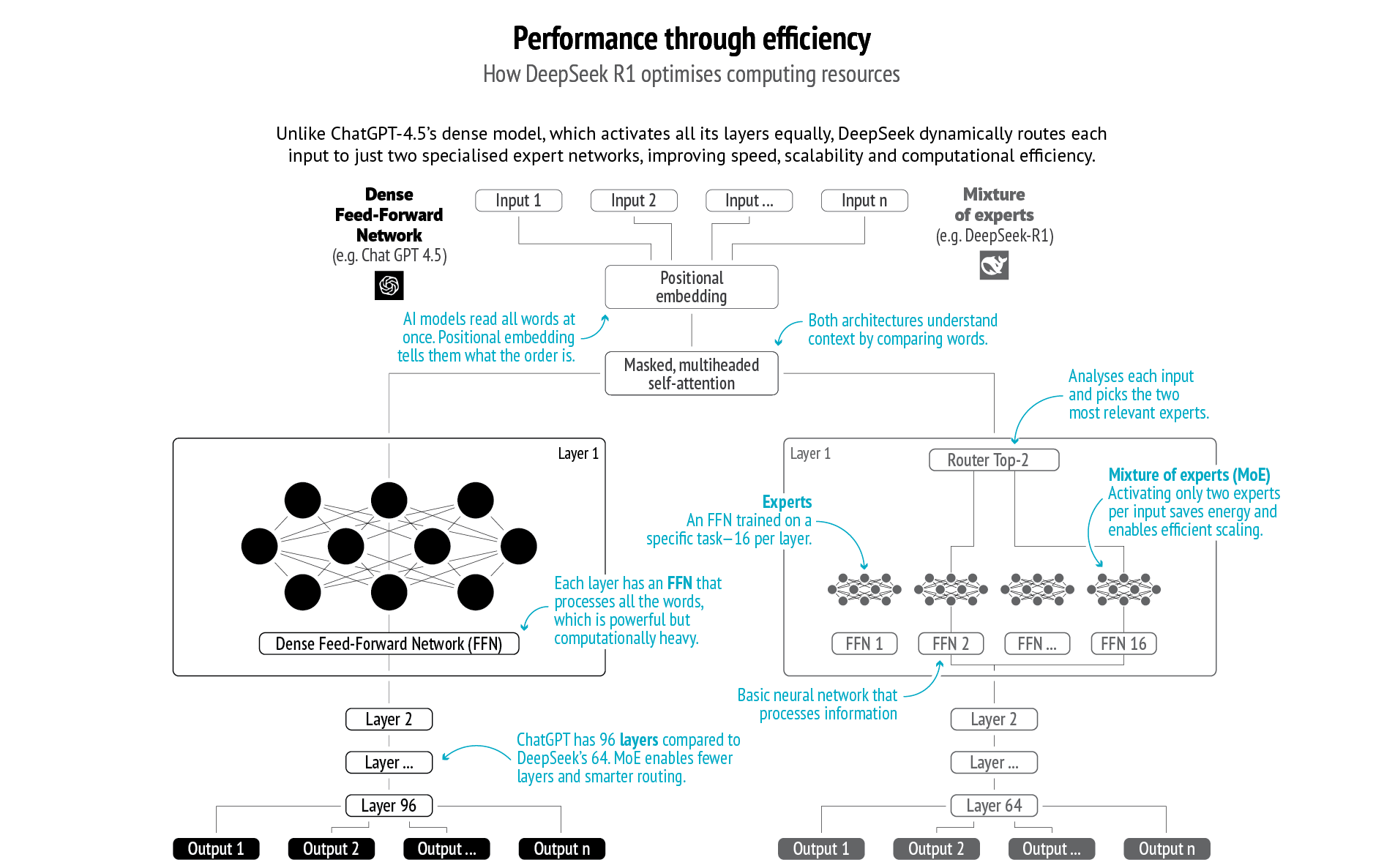
In reaction to US export controls, DeepSeek compensated for the computing power shortcomings it faced by improving its model’s efficiency. In particular, it focused on inference enhancement, generating text faster, at lower cost, and with higher quality, once the model is trained. Techniques such as mixture-of-experts (MoE), selective activation, and transfer learning allow for the optimisation of computational resources(1). In particular, the MoE architecture activates only a few relevant subnetworks of the model during the inference, which significantly reduces computational overhead.  

Even so, Chinese AI development is not fully autonomous. DeepSeek’s techniques build on foundational research developed by other firms, notably Meta’s LLaMA series. DeepSeek has also acknowledged using US-manufactured Nvidia chips instead of Chinese semiconductors. Without access to US research and hardware, DeepSeek would thus have not achieved what it did. In addition, despite notable progress by Chinese chipmakers, competing with the technological sophistication of American AI chipsets, especially for compute-intensive pre-training, will remain a significant challenge in the coming years.


Data: Zhang, S. et al., ‘A survey on mixture of experts in large language models’, 2024; DeepSeek, ‘DeepSeek-VL: Scaling Vision-Language Models with Mixture of Experts’, 2024; Daily Dose of DS, ‘Transformer vs. Mixture of Experts in LLMs’, 2025
Room for alternative models

R1 is not a fully open-source model as DeepSeek did not release its complete training data or codebase; but it is an open-weight model, meaning its trained parameters – the weights – are publicly available, allowing others to use, fine-tune and deploy the model. It thus makes AI accessible and usable to a broader range of actors with limited technical expertise or computing resources. DeepSeek R1 is also released under the MIT License, making it freely available for commercial use. This lowers the barrier to entry for actors lacking capital or infrastructure and facilitates the development of AI applications across sectors like finance, manufacturing or healthcare. Additionally, by focusing on algorithmic innovation and cost reduction, DeepSeek establishes efficiency as a new key parameter for future frontier AI innovation. As computing power is becoming a critical asset, resource optimisation could be a decisive factor in the AI race.

DeepSeek thus embodies a shift from the prevailing business and technical model based on closed-source, proprietary and scale-first AI development towards more flexible and resource-conscious approaches. It not only challenges the widespread ‘winner-takes-all’ assumption in the digital sector, but also raises the question of whether smaller-scale companies, including European ones, could make significant progress with ‘good enough’ AI models. Such models, while not necessarily state-of-the-art, can perform specific tasks effectively within a given context, prioritising practical utility, affordability and accessibility. They are particularly useful for edge models (especially the Internet of Things), chatbots, transcriptions or machinery monitoring.
Amplifying risks

The release of R1 has also raised several security-related concerns. The first issue is data security and privacy. DeepSeek’s terms of service indicate that user data may be stored in China and used for training purposes, raising serious questions about compliance with international data protection standards, including the EU General Data Protection Regulation (GDPR). The Personal Information Protection Commission (PIPC), South Korea’s national data protection authority, has reported that personal information from over a million South Koreans was transferred to China without consent(2). Suspicions about potential backdoors enabling government access have deepened mistrust, especially given China’s recently amended Intelligence Law, as it includes a blanket requirement for Chinese entities and individuals to cooperate with Chinese security services(3). This has led countries such as Australia, India, Italy and Taiwan to ban DeepSeek from government devices. Nonetheless, such concerns are neither new nor unique to China. The DeepSeek controversy has reignited broader debates about data surveillance and the role of intelligence agencies, particularly given the close ties between the US government and major American tech firms.

DeepSeek has also faced criticism for adhering to Beijing’s content regulations on politically sensitive issues such as the Tiananmen Massacre, Taiwan and the repression against Uyghurs, leading to accusations of restricting data access and embedding ideological bias. While censorship only applies to the online version, the model is likely to reflect the authoritarian context in which it was developed, as any AI model is shaped by its training data and the political values it embeds. DeepSeek has also fallen short in protecting sensitive user data, including chat histories and authentication keys(4), raising concerns about both free speech and cybersecurity.

Beyond these immediate normative and security issues, DeepSeek’s ambition to develop AI models approaching or exceeding human cognitive abilities, known as artificial general intelligence (AGI), is the most concerning. Advancements in this field would not only exacerbate tensions in the US-China AI race leading to the development of unsafe models, but could even lead to the development of AI systems escaping human control. Robust multilateral frameworks for AI governance are urgently needed.
Five pillars for deterring strategic attacks

Mark J. Massa and Alyxandra Marine

To achieve the likely objectives of the National Defense Strategy—defending the US homeland and deterring China—the United States must address the risk of strategic attacks on the homeland. This imperative includes preventing such attacks and ensuring that the Department of Defense has both the strategy and capabilities to restore deterrence at the lowest possible level of damage if prevention fails.

This is essential because a strategic attack could coerce the United States into halting its support for allies and partners, or cause military disruption severe enough to prevent such support altogether—thus undermining the objective of deterring China. Moreover, adversaries could inflict damage on US society that far outweighs the benefits the United States seeks through its foreign policy, further weakening homeland defense.

An effective strategy to address the risk of strategic attack on the US homeland must rest on several overlapping pillars. These include deterring a large-scale nuclear attack on the United States; preventing nuclear escalation during conventional regional conflicts; fielding US and allied forces sufficient to deter the outbreak of major-power conventional war; maintaining a flexible declaratory policy and adaptable strategic forces; and enhancing the nation’s ability to sustain warfighting capacity—even while under strategic attack.

The Militarization of Silicon Valley

Sheera Frenkel

In a ceremony in June at Joint Base Myer-Henderson Hall in Arlington, Va., four current and former executives from Meta, OpenAI and Palantir lined up onstage to swear an oath to support and defend the United States. The U.S. Army had just created a technical innovation unit for the executives, who were dressed in combat gear and boots. At the event, they were pronounced lieutenant colonels in the new unit, Detachment 201, which will advise the Army on new technologies for potential combat.

“We desperately need what they are good at,” Secretary of the Army Daniel Driscoll said of the tech executives, who have since undergone basic training. “It’s an understatement how grateful we are that they are taking this risk to come and try to build this out with us.” Andrew Bosworth, Meta’s chief technology officer; Bob McGrew, an adviser at Thinking Machines Lab and OpenAI’s former chief research officer; Shyam Sankar, Palantir’s chief technology officer; and Kevin Weil, OpenAI’s chief product officer at a military ceremony in June.Credit...Staff Sgt. Leroy Council/United States Army

The military is not just courting Silicon Valley tech companies. In the age of President Trump, it has successfully recruited them. Over the past two years, Silicon Valley’s leaders and investors — many of whom had once forsworn involvement in weapons and war — have plunged headfirst into the military-industrial complex. Meta, Google and OpenAI, which once had language in their corporate policies banning the use of artificial intelligence in weapons, have removed such wording. OpenAI is creating anti-drone technology, while Meta is making virtual reality glasses to train soldiers for battle.

At the same time, weapons and defense start-ups are taking off. Andreessen Horowitz, a venture capital firm, said in 2023 that it would invest $500 million in defense technology and other companies that would help America “move forward.” Y Combinator, the start-up incubator known for hatching companies like Airbnb and DoorDash, funded its first defense start-up in August 2024. Venture capital investment in defense-related companies surged 33 percent last year to $31 billion, according to McKinsey.


Netanyahu Squanders His Moment to Halt the War

Patrick Kingsley

When Benjamin Netanyahu, the Israeli prime minister, led the country to a military victory over Iran in June, both his allies and rivals portrayed it as his finest achievement. Flush with newfound confidence and authority, Mr. Netanyahu seemed finally to have gained the political capital he needed to override opposition from his far-right government allies to reach a truce in Gaza. Six weeks later, the prime minister has squandered that moment. The talks between Hamas and Israel are, yet again, stuck. Israel is now pushing for a deal to end the war in one go, instead of in phases.

Now as then, both Hamas and Mr. Netanyahu are refusing to make the compromises needed for such a comprehensive deal to work. As long as this is the government — and assuming it doesn’t fundamentally change its course — there will be no comprehensive agreement, and the hostages will not return,” wrote Oren Setter, a former member of Israel’s negotiation team, in a column on Monday in the Israeli newspaper Yediot Ahronot. “The opposition needs to understand this, the public needs to understand this, and the media needs to understand this,” Mr. Setter added.

In short, the credit that Mr. Netanyahu accrued following the war with Iran in June has evaporated, both domestically and overseas.International condemnation of the growing starvation in Gaza — which aid agencies and many foreign government have largely blamed on Israel’s 11-week blockade on the territory between March and May — is at its peak. Partly to protest Israel’s responsibility for that situation, several of the country’s longstanding allies have recognized a Palestinian state, or pledged to do so in the near future. 

In the United States, most Democratic senators voted last week to block some arms sales to Israel. A Republican lawmaker, Marjorie Taylor Greene, has accused Israel of genocide, an accusation it strongly denies. Palestinians at a charity kitchen in Gaza. A growing hunger crisis in the territory after Israel imposed a blockade has been widely condemned, including by many of Israel’s allies.Credit...Saher Alghorra for The New York Times Domestic opposition to the Gaza war is at an all-time high, and calls are growing for the remaining hostages held by Hamas to be returned through a diplomatic deal. 

The Art of Trump’s Trade Deals


This week, Walter and Jeremy discuss transatlantic pressure on Israel, Arab pressure on Hamas, Xi Jinping’s new infrastructure play in Tibet, Trump’s criticism of India’s relationship with Russia, the significance of Trump’s trade deals with Japan and the European Union, and tips for haggling in bazaars, souks, and night markets.

Each week on What Really Matters, Walter Russell Mead and Jeremy Stern help you understand the news, decide what matters and what doesn’t, and enjoy following the story of America and the world more than you do now. For more, check out tabletmag.com/whatreallymatters. You can read Mead’s Tablet columns here and check out more from Tablet here.

Opinion | Europe’s Future Depends on Confrontation, Not Compromise


Much has been made of Mark Rutte recently calling President Donald Trump “daddy” at the recent NATO summit. Certainly, the slip indicates how impotent Europe has shown itself to be in the face of geopolitical threats. But dependence on American support for its defense is not the only problem. The European Union, a bold experiment in international governance envisioned in the follow-up to World War II, has reached its limits. What we are witnessing is a sunset of Europe, the decline of a union founded on principles of peace and diplomacy that can no longer effectively respond to the moment. 

Today’s crisis requires decisive action — not the cooperation and incrementalism designed to prevent war, but the admission that war is already here, and that now it is time to fight. In the 1950s, after the calamity of World War II, European countries, understandably, were desperate to find an arrangement that would safeguard the peace and security of the continent going forward. The uniting of European nations began with only six countries as its founding members (France, Germany, Italy, the Netherlands, Belgium, and Luxembourg), comprising an institution radically different in size and scope from the one we know today. 

France and Germany were constant sources of tension for the continent, and leaders were eager to find a way to prevent these conflicts from spiralling into another war. The simple idea on which the European project was founded was that economic integration would liquidate the threat of war. Countries financially and politically intertwined with one another would have more at stake in ensuring continued peace. Cooperation would increase the economic pie for all, and that would in turn create incentives against military escalation. As the European experiment grew, it changed not only in scope but in its fundamental nature. 

It began its radical transformation with the Maastricht Treaty in 1991, which established the European Union. A few years later came monetary union, the adoption of the euro, and subsequently the Schengen Agreement which opened borders inside Europe. All these changes paved the way for further growth: In 1995, three countries, Austria, Finland and Sweden, joined the Union; in 2004, in one big-bang enlargement, Europe invited 10 additional members. The formerly subjugated countries of the East were accepted into the fold, given a chance at stability, prosperity and a peaceful European future. It was also a geopolitical promise: Those who adhere to Western values and accept the rules can become members of the European family. 

Tech manufacturing has powered Asia - now it's a casualty of Trump's tariffs


When he began his trade war, President Donald Trump said his goal was to bring American jobs and manufacturing back to the US, reduce trade deficits and create a more level playing field for American companies competing globally. But after months of negotiations and many countries' refusal to meet America's demands, his strategy has taken a more punitive turn. Under Trump's first administration, when he imposed tariffs on Chinese exports, they scrambled to limit their exposure to Beijing, with many shifting production to Vietnam, Thailand and India to avoid higher levies.

But his battery of new tariffs does not spare any of these economies. Stocks saw a sell-off, with benchmark indexes in Taiwan and South Korea in the red on Friday. Both countries are central to Asia's sprawling electronics production. The details are still hazy, but US firms from Apple to Nvidia will likely be paying more for their supply chains - they source critical components from several Asian countries and assemble devices in the region.

Now they are on the hook - for iPhones, chips, batteries, and scores of other tiny components that power modern lives. It's not good news for Asian economies that have grown and become richer because of exports and foreign investment - from Japanese cars to South Korean electronics to Taiwanese chips. Soaring demand for all these goods fuelled trade surpluses with Washington over the years - and has driven President Trump's charge that Asian manufacturing has been taking American jobs away.

In May, Trump told Apple CEO Tim Cook: "We put up with all the plants you built in China for years... we are not interested in you building in India, India can take care of themselves." Apple earns roughly half its revenue by selling iPhones that are manufactured in China, Vietnam and India. The tech giant reported bumper earnings for the three months to June, hours before Trump's tariff announcement on Thursday night, but now the future looks more uncertain.

What the Next Round of Sanctions Against Russia Should Look Like

Nicholas Fenton

Recent news reports suggest U.S. President Donald Trump may finally have overcome his seeming unwillingness to level additional economic sanctions on Russia. Faced with the reality that at the current level of pressure Russian President Vladimir Putin feels no imperative to seriously engage in negotiations with Kyiv, Trump said Monday he would give Russia 10 or 12 days to make progress toward ending the war before imposing “sanctions and maybe tariffs, secondary tariffs.” If Trump wants to end the war anytime soon, additional sanctions will likely be necessary. 

Our latest research concludes that at the current level of sanctions and battlefield intensity, Russia is likely able to maintain its war effort for at least the next three years. Over the three and a half years since its invasion of Ukraine, analysts have consistently underestimated Russia’s economic resilience. Moscow has not only maintained economic growth but also successfully restructured its economy on an impressive war footing. It is inaccurate to claim that sanctions don’t work, as Trump mused later this week, but there are ways to make them more effective. First, we need to examine the reasons for Russia’s economic sustainability, of which there are several.

Russia Issues Nuclear Warning Directed at US and NATO


Russia said Monday it is no longer bound by a self‑imposed moratorium on deploying land‑based intermediate‑range nuclear missiles, blaming United States and NATO plans to station similar weapons in Europe and the Asia‑Pacific. Newsweek reached out to the White House for comment via email on Monday. The U.S. and Russia signed the Intermediate-Range Nuclear Forces treaty (INF) in 1987, but the U.S. withdrew from it in 2019, during President Donald Trump's first term, while accusing Russia of repeatedly violating the agreement.

Moscow signaled that it, too, would withdraw from the agreement last December, with Russian Foreign Minister Sergey Lavrov telling the state news agency Ria Novosti that the agreement was no longer viable while accusing the U.S. of deploying the weapons globally. Later Monday, Russian former President Dmitry Medvedev blamed NATO countries for the abandonment of a moratorium on short- and medium-range nuclear missiles and said Moscow would take further steps in response.

"The Russian Foreign Ministry's statement on the withdrawal of the moratorium on the deployment of medium- and short-range missiles is the result of NATO countries' anti-Russian policy," Medvedev posted in English on X. "This is a new reality all our opponents will have to reckon with. Expect further steps." Tensions between Washington and Moscow have reached a boiling point in recent months, particularly related to the Trump administration's efforts to negotiate a ceasefire in Russia's war against neighbouring Ukraine.

Russian President Vladimir Putin (L) and Foreign Minister Sergey Lavrov at the Kremlin in Moscow, Russia. Associated Press What To Know The Russian Foreign Ministry accused Washington of escalating tensions by testing, producing and moving systems once banned under the defunct Intermediate‑Range Nuclear Forces (INF) Treaty. Moscow said the deployments, including recent U.S. missile activity in Denmark, the Philippines and Australia, pose a "direct threat" to Russian security. The Kremlin warned it will take "military‑technical" steps in response to restore what it calls a strategic balance.

Netanyahu Has Decided on Full Occupation of Gaza Strip: Reports


Israeli Prime Minister Benjamin Netanyahu has decided that Israel Defense Forces (IDF) should push to fully occupy the besieged Gaza Strip, including operating in areas where hostages are being held, according to multiple media reportsThe prime minister's office also conveyed a message to Lieutenant General Eyal Zamir, the army's chief of staff, saying, "If this does not suit him, you should resign," according to EuroNews and i24's diplomatic correspondent, Amichai SteinNewsweek reached out to Netanyahu's office for comment via email on Monday.

Israeli media reported that the Cabinet will meet on Tuesday to come to a formal decision on the matter.The Israeli prime minister's reported decision comes after months of ceasefire talks between his government and Hamas, with both sides accusing each other of repeated violations. Israel has also faced increased international pressure to reach a ceasefire deal as Hamas released videos showing emaciated Israeli hostages being held in Gaza, which the group said was the result of Israel's blockade of humanitarian aid to the war-torn territory.

The videos had a significant impact on the Israeli public and sparked protests by thousands on Saturday night and calls for a ceasefire deal. It was one of the largest turnouts for the weekly protests in recent months. Johann Wadephul (CDU), Federal Foreign Minister, with Benjamin Netanyahu, Prime Minister of Israel, for a meeting in Jerusalem Netanyahu said after the videos were released that he would convene a Cabinet meeting to discuss how Israel can meet the three main goals he set out for the war.

defeating Hamas, returning the hostages and ensuring Gaza doesn't pose a threat to Israel. But the prime minister has faced opposition, including from within his own country, to increasing the IDF's operations in the Gaza Strip. Tens of thousands of Palestinians have been killed since Israel launched its counteroffensive in the territory following Hamas' devastating October 7, 2023, attack that claimed the lives of as many as 1,200 Israelis, most of whom were civilians. The Times of Israel, citing Israeli media, reported that Netanyahu told ministers in the last day that he will seek the Cabinet's backing of a plan to fully occupy Gaza.

AI on the Frontline: Evaluating Large Language Models in Real-World Conflict Resolution

Nathalie Bussemaker and Mark Freeman / IFIT Founder & Executive Director

This groundbreaking study by the Institute for Integrated Transitions (IFIT) reveals that all major large language models (LLMs) are providing dangerous conflict resolution advice without conducting basic due diligence that any human mediator would consider essential. IFIT tested six leading AI models, including ChatGPT, Deepseek, Grok, and others, on three real-world prompt scenarios from Syria, Sudan, and Mexico. Each LLM response, generated on June 26, 2025. was evaluated by two independent five-person teams of IFIT researchers across ten key dimensions. 

based on well-established conflict resolution principles such as due diligence and risk disclosure. Scores were assigned on a 0 to 10 scale for each dimension to assess the quality of each LLM’s advice. A senior expert sounding board of IFIT conflict resolution experts from Afghanistan, Colombia, Mexico, Northern Ireland, Sudan, Syria, the United States, Uganda, Venezuela, and Zimbabwe then reviewed the findings to assess implications for real-world practice.

From a total possible point value of 100/100, the average score across all six models was only 27 points. The maximum score was obtained by Google Gemini with 37.8/100, followed by Grok with 32.1/100, ChatGPT with 24.8/100, Mistral with 23.3/100, Claude with 22.3/100, and DeepSeek last with 20.7/100. All scores represent a failure to abide by minimal professional conflict resolution standards and best practices.

“In a world where LLMs are increasingly penetrating our daily lives, it’s crucial to identify where these models provide dangerous advice, and to encourage LLM providers to upgrade their system prompts,” IFIT founder and executive director Mark Freeman notes. “The reality is that LLMs are already being used for actionable advice in conflict zones and crisis situations, making it urgent to identify and fix key blind spots.”

Silicon Valley Is in Its ‘Hard Tech’ Era

Mike Isaac

In a scene in HBO’s “Silicon Valley” in 2014, a character who had just sold his idea to a fictional tech company that was a thinly veiled analogue to Google encountered some of his new colleagues day drinking on the roof in folding lawn chairs. They were, they said tipsily, essentially being paid to do nothing while earning out — or “vesting” — their stock grants.

The tongue-in-cheek sendup wasn’t far from Silicon Valley’s reality. At the time, young engineers at Facebook, Apple, Netflix and Google made the most of what was known as the “Web 2.0” era. Much of their work was building the consumer internet — things like streaming music services and photo-sharing sites. It was a time of mobile apps and Mark Zuckerberg, Facebook’s founder, wanting to give everyone a Facebook email address.

It was also the antithesis of corporate America’s stuffy culture. Engineers held morning meetings sitting in rainbow-colored beanbags, took lunch gratis at the corporate sushi bar and unwound in the afternoon with craft brews from the office keg (nitrogen chilled, natch). And if they got sweaty after a heated office table-tennis tournament, no matter — dry cleaning service was free.

That Silicon Valley is now mostly ancient history. Today, the tech has become harder, the perks are fewer and the mood has turned more serious. The nation’s tech capital has shifted into its artificial intelligence age — some call it the “hard tech” era — and the signs are everywhere. In office conference rooms, hacker houses, third-wave coffee houses or over Zoom meetings, knowledge of terms like neural network, large language model and graphical processing unit has become mandatory. 


Military AI Challenges Human Accountability


Artificial intelligence is no longer confined to code-stained labs or military contractors’ slideshows: it has become a regular presence on modern battlefields. In 2024, as Israeli analysts relied on tools like Gospel and Lavender to generate targeting lists, the Pentagon set out to deploy swarms of autonomous drones through its Replicator Initiative. Targeting algorithms (AI systems analyzing data to identify and prioritize military targets) now compress the decision cycle from days to minutes, sometimes seconds, fundamentally challenging the way law, ethics, and accountability operate in armed conflict. 

It was in response to these realities that, on December 24, 2024, the UN General Assembly adopted Resolution 79/239, affirming that international humanitarian law (IHL) applies “throughout all stages of the life-cycle of artificial intelligence in the military domain” and calling for appropriate safeguards to keep human judgment and control at the heart of military decision-making. But resolutions and declarations, while necessary, do not themselves restrain machines. The responsibility for lawful conduct must remain anchored in human actors: commanders, engineers, and political authorities. 

Algorithms, after all, have no legal personality; they cannot form intent, stand before a court, or bear the weight of tragedy or blame. This is why the real task for military commanders, policymakers, and legal advisers is about translating the timeless obligations of the laws of war into practices and workflows that keep the chain of accountability intact, even as machines accelerate the tempo of armed conflict beyond anything imagined by those who first wrote those rules.

The question, then, is whether states are willing and able to build safeguards so that, even as decisions speed up and control becomes diffuse, a human being remains at the end of every algorithmic chain of action.Ask three officers to describe what counts as AI in uniform, and you will likely hear three different answers. One will mention software that sorts satellite imagery, another will point to a drone that selects its flight path, and a third may describe a logistics program that determines which convoy moves first. All of them are correct because military AI is a broad spectrum of software-enabled capabilities that touch nearly every corner of modern operations.

The Greene revolution: How politicians benefit from conspiracies about cloud seeding and weather control

Justin Key Canfil

On summer nights as a child at my grandmother’s house in rural west Texas, I’d sometimes stay up, in defiance of my bedtime, for Art Bell’s Coast to Coast AM, the radio show that made “chemtrails” a household word. So-called “chemtrails”—actually contrails—are the long white plumes of ice crystals that form behind passenger jetliners when hot engine exhaust meets sub-zero air in the upper atmosphere, a well-understood physical process. But “chemtrail” conspiracists believe they are chemicals dispersed as part of a secret government weather-control program. Back then, the idea felt fringe; by 2016, polls found nearly one in six Americans buy into it.

Conspiracy theories are on the rise everywhere, and last month’s Texas Hill Country floods, which caused more than 130 deaths, were no exception. On July 4, heavy precipitation caused the Guadalupe River to rise more than 25 feet in less than an hour. In addition to the death toll, the storm is estimated to have caused at least $18 billion in damages. Even before the water had stopped rising, rumors about the storm’s origins began swirling online. Many conspiracy theorists blamed a small California-based startup called Rainmaker Technology, which acknowledged having conducting cloud-seeding operations in Texas two days prior.

Congresswoman Marjorie Taylor Greene (R-GA), a longtime promulgator of weather control conspiracy theories, was quick to latch onto the allegations. As fatalities continued to climb on July 5, Greene posted a photo of Rainmaker’s CEO, Augustus Dorick, and called for national legislation to make weather modification a felony offense. Anticipating blowback, the Texas Department of Agriculture quickly released a statement disclaiming any government involvement, and the Environmental Protection Agency launched two websites to counter weather control disinformation

However, in a public address on July 10, EPA head Lee Zeldin implied that Greene’s suspicions were “legitimate,” stating that the EPA “shares the significant reservations many Americans have [about] geoengineering activities.” While tragic, the floods were hardly suspicious. For outsiders, Texas often conjures images of cacti and tumbleweeds. But Texas is no stranger to flooding. Often called “Flash Flood Alley,” Central Texas has had more flood fatalities since 1959 than any other US state. The July 2025 floods were caused by the remnants of Tropical Storm Barry off southeastern Mexico, as was conclusively shown by radar imagery. 

8 August 2025

India’s Pragmatic Pivot Toward China

Harsh V. Pant

On July 30, U.S. President Donald Trump announced that he was imposing 25 percent tariffs on goods from India. This trade war escalation comes amid New Delhi’s efforts to improve its economic ties with China as well as accusations that such moves reflect India’s “submission” to Beijing. There have indeed been striking shifts in the triangular dynamic between the United States, China, and India. Trump has given some signals of moving closer to China, prompting New Delhi to find its own balance between Washington and Beijing. But it would be a mistake to see the recent Indian outreach to China as an Indian concession driven by strategic frailty.

Rather, it is a form of tactical accommodation to evolving geopolitical realities. New Delhi’s engagement with Beijing is aimed at achieving concrete economic benefits without compromising core security interests. ndia’s economic ties with China have been frozen since the 2020 border clashes in Galwan and the military standoff that ensued. At that time, India responded to Beijing’s bid to unilaterally change the status quo on the Line of Actual Control (LAC) by declaring that business as usual between the two countries was over. 

More than 300 Chinese apps, including TikTok, were banned, and Chinese telecoms were restricted from the rollout of 5G services in India. Additionally, the government mandated that companies based in nations that shared a land border with India could only invest after obtaining official government permission. In October 2024, however, the two countries decided to defuse the situation, and Indian Prime Minister Narendra Modi and Chinese President Xi Jinping met for the first time in five years on the sidelines of that year’s BRICS leaders’ summit. India interpreted the resulting understanding between the two countries as a win. 

The Indian Army secured the ability to patrol key points along the border, and Indian herders were able to resume grazing. By accepting renewed Indian patrol, the Chinese side stepped back from its efforts to impose new facts on ground. Furthermore, after five years, China has again allowed pilgrims from India to resume visiting Mount Kailash and the Mansarovar and Rakshastal lakes. India, in return, has resumed issuing tourist visas to Chinese nationals. Beyond this, media and civil society exchanges are taking place regularly again, and talks are underway to restore direct flights between Indian and Chinese cities.

Donald Trump Issues New Threat to India

Jenna Sundel and Gabe Whisnant

Trump wrote on Truth Social: "India is not only buying massive amounts of Russian Oil, they are then, for much of the Oil purchased, selling it on the Open Market for big profits. They don't care how many people in Ukraine are being killed by the Russian War Machine. Because of this, I will be substantially raising the Tariff paid by India to the USA. Thank you for your attention to this matter!!! President DJT"

Last week, Trump imposed a 25 percent tariff on all Indian goods coming into the United States from August 1, as well as an unspecified extra penalty for India's continued purchase of Russian oil amid the war in Ukraine According to United States Census Bureau data from May of this year, India is one of the United States' top trading partners. The nation had a year-to-date deficit of -28.9 billion dollars at the time.

Trump met with India's Prime Minister Narendra Modi in February to discuss multiple topics, including trade and investment. The leaders set a goal for trade entitled "Mission 500," which aims to more than double total bilateral trade to $500 billion by 2030. Indian Prime Minister Narendra Modi (L) and U.S. President Donald Trump hold a press conference at the White House on February 13, 2025. Associated Press

Following Modi's visit to the U.S. in February, the White House said the U.S. and India would work toward increasing market access and reducing tariff and non-tariff barriers. Products imported into the U.S. from India include pharmaceuticals and electrical components. What People Are Saying President Donald Trump, on Truth Social on Thursday: "I don't care what India does with Russia. They can take their dead economies down together, for all I care. We have done very little business with India, their Tariffs are too high, among the highest in the World."

U.S.-India Relationship Appears to Fray Over Russian Oil Purchases

Miranda Jeyaretnam

“India is not only buying massive amounts of Russian oil, they are then, for much of the oil purchased, selling it on the open market for big profits. They don’t care how many people in Ukraine are being killed by the Russian war machine,” Trump said via Truth Social on Monday, referring to Russia’s war with Ukraine. The President warned that he would “substantially” raise the tariff rate on Indian products entering the U.S. as a result. India’s foreign ministry said in a statement that “the targeting of India is unjustified and unreasonable.” The ministry stated that India was “actively encouraged” by the U.S. 

to buy Russian oil, which American officials said at the time was meant to keep Russian oil in the global supply so that oil prices would not surge. He wants a tremendous relationship and has had always a tremendous relationship with India and the Prime Minister [Narendra Modi],” White House deputy chief of staff Stephen Miller said on Fox News over the weekend. “But we need to get real about dealing with the financing of this war.” The Trump Administration has recently shifted from the President’s earlier friendly tone towards Russian President Vladimir Putin. 

Trump, who said repeatedly during his presidential campaign that he would end the war “in 24 hours,” has apparently grown fed up with Putin, issuing sharp criticisms of the Russian President as well as of former Russian President Dmitri Medvedev. Last month, Trump announced that the U.S. would continue to supply Ukraine militarily (after earlier announcing a pause), and he threatened tariffs and other measures on Russia if it does not reach a peace deal with Ukraine by Aug. 8. But Trump is also shifting his approach toward India, which has long served as a regional buffer against China and whose leader has had a close relationship with Trump

“I don’t care what India does with Russia.They can take their dead economies down together, for all I care,” Trump posted on Truth Social on July 31.India portrays itself as being one of our closest friends in the world, but they don’t accept our products, they impose massive tariffs on us, … and of course we see again the purchasing of [Russian] oil.” Miller said on Fox News, adding that “all options are on the table” for Trump to end the Russia-Ukraine war.
India’s ties to Russia

Toward a Mutually Beneficial Partnership with India to Improve U.S. Strategy in the U.S. Indo-Pacific Command


“The distribution of power across the world is changing, creating new threats.”1 From a U.S. national perspective, there has been a recognized change in the strategic environment with the weakening of the post-World War II world order.2 The two reasons for this shift that stand out the most are a rising China and a disruptive Russia. To address this change, it would be prudent to form alliances and partnerships with other democratic and like-minded nations, aiming to tilt the competitive balance and rebalance the distribution of power.3 To achieve this, it is crucial to avoid repeating past mistakes, such as those made in Iraq and Afghanistan.

where the United States created alliances based on pressure instead of on the willingness of the parties involved.4 While these changes present new threats, they also present opportunities, including the possibility of forming an enduring and equitable partnership between India and the United States. This window of geopolitical opportunity exists because both nations currently seek a common solution to contain China’s influence. For India, this common interest is primarily regional, while for the United States, China is considered a pacing threat and the “most consequential strategic competitor” at the global level.5 These interests intersect in the U.S. 

Indo-Pacific Command (INDOPACOM) region, providing an opportunity for a mutually beneficial partnership. Despite the obstacles that have existed for decades, the perceived threat from China now makes such a partnership seem more attainable than at any point in recent history. This potential partnership between India and the United States could be seen as a win-win for both nations. Collective action, not just pontification, is required to address the changing distribution of power worldwide. The 2022 National Security Strategy (NSS), signed by President Joseph Biden.

proclaims, “We must proactively shape the international order in line with our interests and values.”6 The NSS goes on to explain how the Nation’s most important strategic assets are alliances and partnerships worldwide.One strategy developed by the Department of Defense that will be used for proactive shaping is integrated deterrence.7 “Deterrence remains an essential pillar of U.S. defense posture.”8 The concept of integrated deterrence means it is integrated across domains, across the whole of government, and across allies and partners.

People's war principle drives PLA development


This year marks the 80th anniversary of the victory in the Chinese People's War of Resistance Against Japanese Aggression (1931-45) and the World Anti-Fascist War. The year also marks the final phase of the journey toward achieving the centenary goals of the People's Liberation Army in 2027, making it necessary to stay on track, harness the core strengths of a "people's war" and mobilize the people for just causes. Marxism holds that what is called history is nothing but the creation of man by human labor. In other words, people are the decisive force behind progress. 

The theory of people's war is rooted in this principle, and emphasizes that people, not weapons, ultimately determine the outcome of war.The legacy of people's war has been evolving over the past 80 years. In today's era of multi-domain competition, victory depends on maintaining a strong bond with the people, adapting to technological and tactical changes, and mobilizing the people. During the Chinese People's War of Resistance Against Japanese Aggression, the Communist Party of China mobilized the people, established base areas behind enemy lines.

and gained support from a cross-section of society. By organizing guerrilla forces and militias, the Party developed a combat system integrating trained troops, armed civilians and local forces to counter the enemy. The Party-led people's war is the foundation of the PLA's combat effectiveness and its key strategic advantage. At its core lies the truth that people are the real source of military strength. Guided by this principle, the people's armed forces have, from their modest beginnings, transformed into a major military force. 

As Chairman Mao Zedong emphasized in On Protracted War, mobilizing the people compensates for inferior equipment and brings victory despite adverse conditions.On the open plains of North China, where natural cover was limited, the Party-led troops and civilians built hidden tunnels, planted landmines, and used "sparrow warfare" (hit-and-run) tactics to immobilize the Japanese forces, thwarting the enemy's "mopping-up" operations. The campaign demonstrated the creativity and decisive role of the people in the war.

Beyond the Second Island Chain: It’s Time to Mitigate Strategic Risk in Oceania

George Fust

The lens of US-China strategic competition is most typically focused on geographic areas of friction like the South China Sea and potential flashpoints like Taiwan, locations inside the first island chain. Occasionally, it zooms out to the second island chain. Too rarely, however, does the aperture widen even further to the Pacific Islands. But these islands are not a backwater. They are the front line. Oceania spans more than three hundred thousand square miles and sits astride some of the world’s most important sea lanes and beneath vital air corridors.

From the second through the third island chains, the region plays a pivotal role in Indo-Pacific security and would certainly do so in any future military contingency involving China. Though these island nations are often small and remote, their strategic value is undeniable. Geography remains destiny, and in the case of Oceania, whoever controls access to the region holds a powerful advantage. China understands this. The United States must act accordingly and urgently.

China has spent the last two decades executing a comprehensive strategy of influence across Oceania. This campaign reflects a model of unrestricted warfare: economic enticement, diplomatic charm offensives, elite capture, media manipulation, and the deployment of state-owned enterprises that serve both commercial and military functions. Beijing-backed companies now operate critical infrastructure including ports, airports, undersea cables, and telecommunications networks across the region. In many cases, these services are monopolistic by necessity; most Pacific island countries are too small to support multiple competitors. 

This creates single points of failure and vulnerability. Chinese infrastructure is not just dual-use in theory. In a future conflict, these assets will support early warning operations or integrate into a kill chain for the People’s Liberation Army targeting US and allied forces. Even in peacetime, their presence enables surveillance, coercion, and disinformation, all of which align with Beijing’s larger effort to reshape the regional order and cast the United States as an unreliable or even malign actor. Mitigating strategic risk in Oceania requires a nuanced understanding of several interlocking dynamics. 

Hiroshima and the End We Refuse to Imagine

Jason Farago

It comes two hours into “Drive My Car,” Ryusuke Hamaguchi’s Oscar-winning 2021 masterpiece of bereavement and artistic inspiration, when a troupe of actors steps outside the theater to rehearse in the fresh air. It is autumn. Leaves crunch beneath the feet of two actresses as they play one of the tenderest scenes of “Uncle Vanya.” They’d been struggling, up to now, as they recited Chekhov’s lines about sorrow and stagnation: lives not lived, dreams squelched and dreams maintained. But here in the park something clicks. We must live. The show must go on.

It’s never made explicit why this outdoor rehearsal unlocks the core of Chekhov — how this park, for these actors, opens a whole universe of grief and endurance. For a Japanese audience, at least, there was no need.Beginning in 1958, Kikuji Kawada photographed Hiroshima, capturing images of its A-Bomb Dome and objects reflecting the American postwar occupation. The park is the Hiroshima Peace Memorial Park, designed in 1954 by the great modernist architect Kenzo Tange. On Aug. 6, 1945 — 80 years ago this week — a new kind of bomb detonated, almost silently, some 1,900 feet overhead. 

The scene from “Drive My Car” came back to me when I stood, in a pouring rain, on the spot where it was filmed. Anyone standing there in 1945 was killed immediately; then came the fires, and the fallout. It started raining in the first days after Aug. 6 as well: viscous black drops, heavy with soot and debris. The survivors drank it desperately in the ruins of Hiroshima. The raindrops were radioactive. A scientific event,” wrote the painter Wassily Kandinsky in 1913, “removed one of the most important obstacles from my path. This was the further division of the atom. 

The collapse of the atom was equated, in my soul, with the collapse of the whole world.” At the start of the last century, after Ernest Rutherford, Pierre and Marie Curie, and Albert Einstein began to unravel the mysteries of nuclear physics, a periodic table of artists, authors and philosophers grew fixated on this new science’s cultural repercussions. Suddenly, the permanence of matter (the permanence of history, perhaps) appeared like an industrial relic. Objects that seemed stable actually vibrated with energy. Nuclear physics was confirming a suspicion, one at the core of modern art and literature, that the things we see are less solid than they look.