3 January 2014

Breakdown in South Sudan What Went Wrong -- and How to Fix It


JANUARY 1, 2014
A soldier in Malakal, 308 miles northeast of Juba, December 30, 2013. (James Akena / Courtesy Reuters)


The South Sudanese people made extraordinary sacrifices to achieve independence two and a half years ago. That makes their leaders’ abject failure to build a viable South Sudan since then all the more galling. Now, a political crisis imperils the nation. But there is a silver lining: The turmoil could give South Sudan the opportunity to reset the national agenda. The country’s leaders cannot afford to squander this moment, and their first task is a sober appraisal of what has gone so disastrously wrong. 

PARTY TIME

The current conflict has three main dimensions -- a political dispute within the ruling party, the Sudan People’s Liberation Movement (SPLM); a regional and ethnic war; and a crisis within the army itself.

The political dispute is long-standing: Since before independence in July 2011, the SPLM leadership has been split several ways, including over whether to confront the government of Sudan in Khartoum or cooperate with it, as well as over the distribution of power and wealth within South Sudan. South Sudanese President Salva Kiir preferred good relations with Khartoum as a way to secure oil revenue; South Sudan’s oil exports depend on a pipeline through Sudan to the Red Sea. But other party leaders took the opposite view, arguing that South Sudan should take the opportunity for regime change in Khartoum by supporting northern rebels and seizing disputed areas by force. If that were not enough, Kiir and Riek Machar, South Sudan’s vice president, differed on domestic policies and on who should lead the party into the next election in 2015. 

With the government paralyzed by infighting, Kiir dismissed Machar and most of his cabinet in July. The dismissed politicians counterpunched through internal SPLM decision-making bodies such as the political bureau, in which they were confident they could command majority votes. In turn, Kiir froze those institutions. When he belatedly called a meeting of the National Liberation Council, the party’s highest decision-making body, on December 14, the dispute erupted into the open. The meeting closed in fractious division, and units of the presidential guard exchanged blows, then shots. A dispute that had been nonviolent drew first blood.

Kiir has accused the dissenters of attempting a coup. They have accused him of abrogating the national constitution and the SPLM’s rules and procedures. But these arguments obscure a deeper point: The SPLM never functioned as a real party -- or even as a liberation movement.

Nations vie for clout in Arctic; US far from lead

By Deb Riechmann, The Associated Press 
Published: January 1, 2014


This Aug. 6, 2007 file photo shows the U.S. Coast Guard icebreaker Healy leaving Seattle for a scientific mission in the Arctic. The U.S. is racing to keep pace with stepped-up activity in the once sleepy Arctic frontier, but it is far from being in the lead. 

This June 6, 2013 file photo shows Sen. Lisa Murkowski, R-Alaska, the Senate Energy and Natural Resources Committee ranking Republican, left, talking with committee member Sen. John Barrasso, R-Wyo., on Capitol Hill in Washington.

WASHINGTON -- The U.S. is racing to keep pace with stepped-up activity in the once sleepy Arctic frontier, but it is far from being in the lead.

Nations across the world are hurrying to stake claims to the Arctic's resources, which might be home to 13 percent of the world's undiscovered oil and 30 percent of its untapped natural gas. There are emerging fisheries and hidden minerals. Cruise liners filled with tourists are sailing the Arctic's frigid waters in increasing numbers. Cargo traffic along the Northern Sea Route, one of two shortcuts across the top of the Earth in summer, is on the rise.

The U.S., which takes over the two-year rotating chairmanship of the eight-nation Arctic Council in 2015, has not ignored the Arctic, but critics say the U.S. is lagging behind the other seven: Russia, Norway, Sweden, Finland, Iceland, Canada and Denmark, through the semiautonomous territory of Greenland.

"On par with the other Arctic nations, we are behind - behind in our thinking, behind in our vision," Sen. Lisa Murkowski, R-Alaska, said. "We lack basic infrastructure, basic funding commitments to be prepared for the level of activity expected in the Arctic."

At a meeting before Thanksgiving with Secretary of State John Kerry, Murkowski suggested he name a U.S. ambassador or envoy to the Arctic - someone who could coordinate work on the Arctic being done by more than 20 federal agencies and take the lead on increasing U.S. activities in the region.

Murkowski is trying to get Americans to stop thinking that the Arctic is just Alaska's problem. "People in Iowa and New Hampshire need to view the U.S. as an Arctic nation. Otherwise when you talk about funding, you're never going to get there," Murkowski said. She added that even non-Arctic nations are deeply engaged: "India and China are investing in icebreakers."

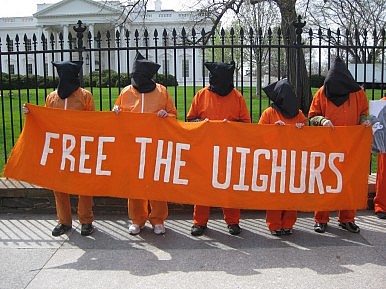
US Releases Last Uyghur Chinese Prisoners From Guantanamo Bay


The U.S. just released its last Uyghur prisoners. Is this the end of U.S.-China anti-terrorism cooperation?
January 03, 2014

The U.S. Department of Defense announced Tuesday the transfer of three Uyghur Chinese prisoners to Slovakia. According to Pentagon Press Secretary Rear Adm. John Kirby’s statement, the three men “are the last ethnic Uighur Chinese nationals to be transferred.” Kirby further noted that “the United States is grateful to the government of Slovakia for this humanitarian gesture and its willingness to support U.S. efforts to close the Guantanamo Bay detention facility.” Previously released Uyghur prisoners have gone to countries around the world, including Palau, Bermuda, Albania, and Switzerland.

China, meanwhile, was not so pleased with Slovakia or the United States. Foreign Ministry Spokesman Qin Gang said that the three former prisoners are members of the East Turkestan Islamic Movement — “they are terrorists without any doubt.” Qin added that the men “will not only pose [a] severe threat to China’s national security, but also to that of the recipient country.” He called on the “relevant countries” to “not provide those who commit terrorist crimes with safe haven and send those suspects back to China.” The Slovakian Interior Ministry, however, has said that none of the men are terrorist suspects. Slovakia currently has no plans to repatriate the Uyghurs to China. 

According to files posted by WikiLeaks, the three men released this week, Yusef Abbas, Saidullah Khalik and Hajiakbar Abdul Ghuper, were all captured in Pakistan with other Uyghurs in 2001. The U.S. government’s assessment in 2004 was that each man “has had some level of terrorist training … and is highly vulnerable to future recruitment by terrorist groups.” However, in 2008 a U.S. Federal District Court judge ruled that the men were not a security threat. The judge ordered the U.S. government to release the Uyghurs and allow them to settle in America.

Despite the judge’s order that the Uyghurs be released within a week, the final three detainees had to wait over five years for their freedom. An appeals court ruled that the federal government did not have to resettle the prisoners in the U.S. — and none of the men were given that option. The U.S. didn’t want the prisoners remaining on American soil, but also refused to send them back to China, due to concerns that the men would be mistreated by the Chinese government. This made it difficult to find the Uyghurs a home. A U.S. senior military official told the Washington Post that Beijing was pressuring other countries not to accept the Uyghur prisoners. The official said that a possible deal to settle the final three men in Costa Rica fell through because of Chinese opposition.

I wrote earlier that the United States’ war on terror has also benefitted China, with U.S. drone strikes presumed to have killed several leaders of the East Turkestan Islamic Movement. Suspected Uyghur terrorists were also among the detainees at Guantanamo Bay — according to files released on WikiLeaks, there were 22 Chinese nationals in Guantanamo, all considered to be “probable members” of the ETIM. The U.S. fight against Al Qaeda had netted this group of men, who were suspected to have attended terrorist training camps. In later years, however, the U.S. government began to back away from these accusations. With the release of the final Uyghur prisoners from Guantanamo, it seems that the golden age of U.S.-China cooperation on anti-terrorism may be at an end.

Be Wary of Information Detractors ***

December 31, 2013 by Team SAISA
Filed under Analysis

The army deserves to be complimented on its ability to see through the lengthy procedure of military justice with a sense of balance and ensure that the alleged perpetrators are brought to justice, but like in any such system patience has to be exercised so that justice is meted out and seen to be correctly executed.

Lt Gen Syed Ata Hasnain (Retd)

Add caption
IN April 2010, the third year of street protests in Kashmir was warming when brief media reports indicated that an army unit de-inducting after spending 24 months on the Line of Control (LoC) allegedly eliminated three young innocent persons in a fake encounter in the Machil area of the North Shamshabari, pass of their bodies as those of foreign terrorists and garner the credit in the “numbers’ game”. Post this incident, a brief inquiry by the Jammu and Kashmir Police indicated that there had been a conspiracy. Identifications were done after exhumation of the bodies and news of the incident went viral, leading to a spurt in the street protests. An alleged isolated incident slurred the army’s reputation and provided an impetus for the 2010 separatist campaign which would paralyze not only Kashmir but almost the entire nation. Machil thus became a byword in the Valley and the latest symbol of alleged human rights violations by the army.

Army jawans on anti-terrorist operations in Kashmir. The public at large is unaware of the military justice system and it is now up to the army to ensure that while imparting justice the perception game is not lost because of the lack of information

For all the alleged dastardly nature of the incident, the army had to first take stock of the situation. It had been manipulated many times in the past to put it on the back foot, although admittedly it had a history of mistakes, as is wont to happen when any army thanklessly battles a sponsored militancy where the information/disinformation struggle becomes a part of the adversarial campaign. It correctly followed the legal procedure to arrive at the current juncture but the skeptics continue to doubt its credentials towards justice.

On December 26, 2013, the nation woke to headlines stating that the perpetrators of the incident were to be tried by a general court martial (GCM). The perceived delay in justice (three and a half years), the apparent lack of knowledge about the military justice system and the emotions connected to the recall of the incident created enough of a potpourri to send the social media into a tizzy. Some perceived that the verdict was about to be announced as also the sentence, while others worked overtime to denigrate the army for the delay, painting it as the typical response of denial of justice by the army. A few explanations on social media put the procedural aspects and facts in the right perspective and better informed people started to change their ideas and in fact appreciate the army’s actions.

REBOOTING COUNTRY STUDIES


December 31, 2013 ·

For all the talk about “big data,” what about deep understanding? Surely in the wake of Iraq and Afghanistan—and faced with other conflicts burbling all over the place—some enterprising office in the Department of Defense or Department of State is busy re-conceptualizing the nature of what constitutes a good country study for those deploying abroad in the 21st century. And surely that office is being run by individuals with ample experience both in non-Western countries and with the U.S. military. Right?

I ask because the field grade officers I know and teach at the Naval Postgraduate School need more than just data (facts), information (assemblages of facts), and knowledge (cumulative information). Until the pendulum swings back and Congress proves willing to issue declarations of war in circumstances that permit no-holds-barred fighting, the military will continue to be asked to act with finesse. Yet, one problem with finesse is that it requires more than just being able to populate databases with names, dates, and information about who’s connected to whom. Data, information, and knowledge certainly matter. But, what they can’t do—ever—is make what others do make sense. They can’t explain how others perceive events, conditions, their predicament, or you.

Meanwhile, there are two ways to gain a sense of what makes others tick. You can either acquire understanding experientially, which is sometimes hard to come by. Alternatively, you can acquire understanding second-hand. In a perfect world, both methods should be iterative. Arguably, great drama—and television series, like The Wire—can help convey a “sense of” and “appreciation for.” Maybe, too, someone will be able to convince me someday that simulations can likewise build understanding. But, for now I want to extol books.

The kinds of books I have in mind are narratives, non-fiction accounts that tell a literal story (with a beginning, a middle, and an end)—books that are just long enough that they can’t be read in a single sitting, and books that can’t effectively be skimmed. The kinds of books I have in mind impel the reader to want to come back to them for more. They are also books that educate, in the sense that they rearrange their readers’ point(s) of view.

CULPABLE COMPLACENCY & U.S. NATIONAL SECURITY STRATEGY

http://warontherocks.com/2013/12/culpable-complacency-u-s-national-security-strategy/
December 31, 2013 

The rhyme of human events is once again cycling from arrogance in overstretch to studied complacency. George Santayana’s famous warning that “Those who cannot remember the past are condemned to repeat it” is once again being ignored. Advocates of defense budget reductions, including my friend Gordon Adams of the Stimson Center, continue to claim that we live in an “unusually secure” world. Not only does Adams claim that we do not face existential threats, he also mistakenly asserts that the rate of civil and international wars is the lowest in measured history. But such statements lack context and historical perspective. When history does inform such arguments, it does so only in caricature, assuming a linear version of history that marches uninterrupted toward Progress. We can wish it were so, but that does not make it so.

I fear too many of my Beltway colleagues assert as fact what they want as desirable policy goals – namely, a peaceful world – and then reason backwards into an interpretation of benign global security to justify a reduced defense budget. They dismiss all the messy complexities of predicting the future, assuming that history’s march toward Progress mitigates the risk of being dead wrong. Being a true realist makes me wary of being complacent about the future or embracing hope as insurance against a Hobbesian world.

To be sure, we should not be apologists for Pentagon budget levels that are not sustainable. We can agree with those informed critics (including Dr. Adams) who rightly call for more efficiency and less overhead at the Defense Department, including in the areas of compensation and health care reform. The same reforms should be applied to the real drivers of our currently stifling national debt: our projected dramatic growth in entitlements. Critics of Defense spending should spend half as much time uncovering poorly performing non-defense government programs and unchecked medical spending. As a nation, we spend 12 times more on health care than security, but with far less scrutiny or demonstrable evidence of added value.

What concerns me is not that advocates of reform exist, but, rather, that they create confections about the current and projected security environment. This misreading of history and ignoring of potential risk is used to back our way around any reasoned analysis of risks in a rush to shrink the military, especially ground forces. I have posted my take on thisdangerous illusion a while back in these pages.

ROSY ASSUMPTIONS: U.S. STRATEGY IN AFGHANISTAN POST-2014


January 1, 2014

Last year, Ambassador Cunningham and General Dunford signed theU.S. Civil-Military Strategic Framework for Afghanistan, which claims to “articulate the strategic vision guiding United States Government (USG) efforts to achieve U.S. national goals in Afghanistan” up until and including the so-called “Transformation Decade” of 2015-2024. It states:

U.S. national goals during the Transformation Decade are to support GIRoA [the Government of the Islamic Republic of Afghanistan] so that together we can defeat al-Qa’ida and prevent Afghanistan from slipping into chaos. To best meet these goals, the USG will focus on governance and socio-economic development; training, advising, and assisting the ASI [Afghan Security Institutions] and ANSF [Afghan National Security Forces]; and strategically posturing to continue counterterrorism efforts.

A handy rule of strategy-making is to first list the assumptions that undergird the strategy’s logic and to identify any risks that might interfere with those assumptions. And this document attempts to do just that. With violence in Afghanistan just as high as it was before the “surge” (if not higher – the Department of Defense decided to stop releasing information on enemy-initiated attacks), the American taxpayer could reasonably expect a candid re-assessment of the assumptions that have guided American strategy in the Hindu Kush in recent years. The analyst could hope for at least a partial departure from the narrative, now resembling Swiss cheese, that we are leaving Afghanistan a more stable and secure place. Both the taxpayer and the analyst in me are disappointed.

Some of the ten assumptions listed are highly problematic – dangerous even – which undermines the entire strategy. As whole, the list reveals that American official strategic thought has not yet come to terms with the shortcomings of our venture in Afghanistan, particularly as they relate to the viability of the Afghan state and its security institutions. I address the three most problematic assumptions here and will offer an alternative list of assumptions in a another article, with the perhaps naรฏve hope that 2014 becomes the year the United States adopts a more realistic outlook in Afghanistan.

How to Lead with the Strength of Nelson


SWJ Blog Post | December 30, 2013 

Joe Byerly

Typically the Services study historic leaders from their own particular domain of expertise (air, sea, land), and rarely do they venture beyond this. The Navy has figures like Mahan and Halsey. The Army: Grant and Patton. The Marine Corps: Lejeune and Puller. The Air Force: Mitchell and Boyd. This past year I came across a hero worthy of study by all the services. 

A few months ago I read 21st Century Mahan: Sound Military Conclusions for the Modern Era by Benjamin Armstrong, a collection of Alfred Thayer Mahan’s essays, and became particularly intrigued by one of the essays entitled Strength of Nelson. The short chapter introduced me to a military figure whom, in my opinion, exemplified the leadership traits and characteristics required to successfully implement the philosophy of mission command today: Admiral Lord Viscount Horatio Nelson. 

Immediately after finishing Armstrong’s book I wanted to know more, so I read Nelson: Britannia’s God of War by Andrew Lambert. From that wonderfully written biography and Mahan’s essay I observed five lessons that every military leader should consider in order to excel at mission command.

Reward success and take the blame for failure. Nelson’s subordinates enjoyed working for him because they knew they would be able to contribute to the plan, as well as exercise initiative, aggression, and personal skill. They also found comfort in knowing that if things went wrong, Nelson would take the blame. However, if the mission was a success, Nelson ensured that his leaders received their proper reward and acknowledgment. Lambert wrote that “[Nelson] never overrode the judgment of those whom he had ordered to execute well-defined tasks. He always worked through the proper chain of command to avoid giving offense, or undermine the confidence of promising officers. If things went wrong, he was the first to leap to the defense of a bold and decisive subordinate.”

Remember that political courage is as important as battle courage. Throughout his career he witnessed several of his commanders get bogged down in orders and rules, resulting in the loss of initiative or sailors in battle. He felt that leaders needed the “political courage” to sometimes disobey superiors to accomplish what was in the general interest of the cause. He once said to the Duke of Clarence: “To serve my king, and to destroy the French, I consider as the great order of all, from which little ones[subsequent orders] spring; and if one of these little ones militate against it…I go back and obey the great order and the object.” His disobedience, or putting the mission before his career, avoided disaster or accomplished the overall intent on more than one occasion.

2014: Good Year for a Great War?


January 1, 2014

Precisely a hundred years ago today, the richest man in the world sent New Year’s greetings to a thousand of the most influential leaders in the U.S. and Europe announcing: mission accomplished. “International Peace,” he proclaimed, “is to prevail through the Great Powers agreeing to settle their disputes by International Law, the pen thus proving mightier than the sword.”

Having immigrated to the US penniless, created the steel industry as a pillar of America's rise to preeminence, and become fabulously wealthy in the process, Andrew Carnegie had the confidence of a man who had achieved the impossible. When he turned from making money to spending it for public purposes, his goals were universal literacy at home (funding public libraries in cities and towns across America), and perpetual peace abroad, starting with the great powers of Europe and the US.

Events in the year that had just ended convinced Carnegie that 1914 would be the decisive turning point towards peace. Just six months earlier, his decade-long campaign culminated in the inauguration of the Peace Palace at the Hague, which he believed would become the Supreme Court of nations. The Palace was built to house the new International Court of Arbitration that would now arbitrate disputes among nations that had historically been settled by war. As theEconomist noted, “the Palace of Peace embodies the great idea that gradually law will take the place of war."

Carnegie's Peace Palace captured the zeitgeist of the era. The most celebrated book of the decade, The Great Illusion, published in 1910, sold over two million copies. In it, Norman Angell exposed the long-held belief that nations could advance their interests by war as an "illusion." His analysis showed that conquest was "futile" because "the war-like do not inherit the earth."

However inspiring his hopes, Carnegie’s vision proved the illusion. Six months after his New Year’s greeting, a Serbian terrorist assassinated the Austro-Hungarian Archduke. Nine months on, the guns of August began a slaughter on a scale that demanded a new category: "World War.” By 1918, Europe lay devastated, and a millennium in which it had been the creative center of the world was over.

2 January 2014

Guarding the India-Myanmar Border

01/01/2014

Recent press reports indicate that guarding of the India- Myanmar border is being handed over to the Border Security Force (BSF), which in turn will raise 46 new battalions to carry out the assigned border-guarding role. The issue of guarding borders with friendly countries is once again on centre stage, but the solutions offered appear hackneyed and stereotyped. Border guarding is not just about placing an ever-increasing quantum of troops on the border. It also relates to capability development to deliver on set parameters so that the envisaged threat is minimised if not eliminated in its entirety.

The complicated nature of the terrain and human geography of the border region makes it vulnerable to a plethora of security challenges. The 1,643 km-long international boundary between India and Myanmar, formally delimited and demarcated on 10 March 1967, following the boundary agreement between the two countries, remains an artificial line, dividing tribes such as the Singphos, Nagas, Kukis, Mizos etc. These tribes however, continue to maintain strong linkages with their kith and kin across the international divide. To enable them to maintain their age-old ties, a unique arrangement called the Free Movement Regime (FMR) is in place, which permits the tribes residing along the border to travel 16 km across the boundary without visa restrictions.

Raging insurgencies on either side of the border have given rise to a host of insurgent groups. In India, multiple ethnic communities have participated in armed movements, with demands ranging from greater autonomy within India to outright secession. In Myanmar too, armed ethnic groups have been fighting against their government, with demands mirroring those of Indian armed groups. The transverse mountains, inhospitable terrain, surging rivers and dense forest canopy astride the border offer safe havens to the ethnic militias, which ipso facto control the region. Terrain difficulties enable anti-India rebel groups such as the NSCN-K, NSCN-IM, ULFA, PLA, (UNLF-M) and the like, to operate from the remote hills of western Burma. Their base camps are exceptionally mobile and their information networks remain very reliable, thus facilitating their continued resistance. The Burmese military (Tatmadaw) lacks the ability to disarm such groups in Myanmar, resulting in New Delhi’s expectations remaining unfulfilled. Money laundering, fake Indian currency notes (FICN), drug dealing, and illegal sales of light military equipment are commonplace along the Indo-Burmese border because of the region’s flourishing underground economy and the poor living conditions of Tatmadaw soldiers and low-ranking officers. Indian insurgents take advantage of the FMR to cross over to Myanmar to receive training in arms, establish safe havens and re-enter India to carry out subversive attacks. The FMR provisions allowing tribal people to carry head loads, also facilitates smuggling of arms and narcotics from across the border.

Challenges Facing Civil Aviation in India

IssueVol. 28.4 Oct-Dec 2013| Date : 01 Jan , 2014

Indigo Airlines

Civil aviation in India may be taken as a study in contrasts. Despite extraordinary growth in traffic, most of India’s airlines are in a precarious condition. Despite forecasts that India will add more than a thousand transport aircraft to civil fleets in the two next decades, India has too few airports and today lacks the aviation safety infrastructure required to handle the growth.

Indian carriers operate with some of the highest fuel costs in the world…

India has experienced extraordinary growth in civil aviation over the past decade and is forecast to be one of the world’s largest aviation markets in just a few years. To achieve and afford the promise of civil aviation, India faces challenges posed by national and state policies, law, regulation and practice. Crucial questions are presented to policy makers, regulators, business leaders and legal advisers.

Civil aviation in India may be taken as a study in contrasts. Despite extraordinary growth in traffic, most of India’s airlines are in a precarious condition. Despite forecasts that India will add more than a thousand transport aircraft to its civil fleet in the two next decades, India has too few airports and today lacks the aviation safety infrastructure required to handle the growth.

India’s Airline Industry

A 2012 KPMG report cited a 15.6 per cent increase in the Compound Annual Growth Rate (CAGR) in domestic passenger throughput over the five-year period concluding in FY 2011. KPMG also forecast domestic throughput of 293 million passengers by FY 2020, up from 106 million (actual) in FY 2011 and 51 million (actual) in FY 2006. Late in 2012, the International Air Transport Association (IATA) predicted that India’s domestic air traffic would experience double-digit growth between 2012 and 2016. For air cargo, India was forecast by IATA to be among the five fastest growing international freight markets.

The Indian domestic air travel market is clearly sensitive to pricing…

For a variety of reasons, however, growth has slowed. IATA reported that domestic air traffic had dropped 9.1 per cent in February 2013 versus February 2012. The growth rate of India’s Gross Domestic Product (GDP) has eased and disposable incomes have been pressured by inflation and the declining value of the rupee. Airline costs have been rising in part because of the reduced currency valuation, very high charges for aviation fuel levied by Government Public Sector Undertakings (PSUs) and high sales taxes imposed by state governments. A recent report asserts that the overall cost of airline operations increased by 20 per cent in just three months in 2013 because of jet fuel prices and rupee devaluation. The Indian domestic air travel market is clearly sensitive to pricing. Some of the growth in air travel has been fueled by a ‘middle class’ willing and financially able to fly. There also may be price elasticity given the availability of travel by rail, as India enjoys one of the world’s largest rail networks.

Irrespective of the recent dip, Boeing’s 2013 commercial aviation forecast covering the period 2013 to 2032, estimates that Asia Pacific airlines will need 12,820 new airplanes valued at $1.9 trillion over the next 20 years. Late in 2012, Boeing forecast that India would have the highest passenger traffic growth in the world, higher than China’s and predicted the Indian market would require 1,450 new aircraft worth $175 billion by 2031.

Stabilising volatile borders


Hopefully, recent moves by India and Pakistan will preserve the sanctity of LoC
G. Parthasarathy

A BSF soldier patrols along the border fence at an outpost in Suchit-Garh, near Jammu. Photo: 

THE return of Nawaz Sharif to power in Pakistan was marked by pious statements by him on peace and stability on the one hand and by inflammatory rhetoric describing Kashmir as Pakistan’s “jugular vein” on the other. Whether it was at the UN in New York or at the White House, Sharif chose to return to his stale rhetoric of Kashmir being the “core issue” between India and Pakistan, implicitly asserting that there could be a nuclear holocaust unless Pakistan reached a satisfactory solution to the issue with India. This rhetoric was accompanied by the unleashing of an old Sharif family retainer Hafiz Mohammed Saeed to spew venom, threatening conflict against India not only on Kashmir, but also for allegedly diverting and depriving Pakistan’s people of their vital water resources. The Pakistan army has augmented this diplomatic effort, by claiming that it will use tactical nuclear weapons in the event of Indian retribution to future 26/11 Mumbai-style terrorist attacks.

Sharif’s apologists in South Block, of course, claimed that he cherished nothing more than peace and harmony with India. Yet, Sharif’s return to power was marked by 195 cease-fire violations, with the Lashkar-e-Toiba even choosing to attack an Army officers’ mess in the Jammu sector and with Indian jawans being beheaded elsewhere, by infiltrators crossing the LoC. South Block did not do its credibility any good by misleading the Defence Minister A.K. Anthony to first claim and then retract from a statement he made, absolving the Pakistan army of its sins. It was against this background that it was agreed at the New York summit that the Directors General of Military Operations (DGMOs), would meet and devise measures to deescalate tensions across the LoC.

Given their desire for a civilian shield, behind which they like to avoid responsibility for their actions on the LoC, the Pakistan army stalled on the proposal, by insisting that delegations should by headed by civilian officials. But, they ultimately had to yield when India insisted that the talks should be between DGMOs as agreed to in New York. Firmness pays and the DGMO talks held on the Wagah border yielded some positive results. The most important part of the Joint Statement issued at Wagah on December 24 was agreement between the DGMOs to “maintain the sanctity (of) and ceasefire on the Line of Control”. They also agreed to make the existing hotline between them more effective. Two flag meetings between Brigade Commanders on the LoC were also agreed to, for maintaining peace and tranquillity across the LoC. The successful meeting of the DGMOs was followed by a meeting between Commanders of the Border Security Force and the Pakistan Rangers in which there was forward movement on issues like effective use of existing communications and on illegal constructions close to the border. Most importantly, people who cross the border inadvertently, do not, hopefully, have to spend months incarcerated.

Embrace global liberalism

By editor
1 Jan 2014

In practical terms, India must step forward to support the cause of democracy promotion, international human rights and the protection of hapless populations from the cruelty of tyrannical rulers

In practical terms, India must step forward to support the cause of democracy promotion, international human rights and the protection of hapless populations from the cruelty of tyrannical rulers

Unlike the vast majority of postcolonial states which failed to enshrine democratic institutions and norms, India stands out as a striking anomaly. Warts and all, democracy has become the only game in town in the country. The debates within the land are really about particular democratic principles and their realisation in a complex, plural, poly-ethnic society. The country’s citizenry and its leadership can be justifiably proud of this achievement.

Though the question of democracy has been largely settled, India remains deeply ambivalent about its relationship with the West. At one level, such uncertainty is hardly surprising. The country was under a colonial yoke for the better part of two centuries, was subjected to imperial plunder and for much of that period its own cultural and intellectual heritage disparaged. Indeed, it is a testament to India’s post-Independence rulers that they chose not to adopt a wholly nativistic outlook but instead maintained a cosmopolitan perspective.

Despite their willingness and ability to embrace democratic institutions and avoid a form of crude jingoism, the leadership, most notably Jawaharlal Nehru, remained sceptical of aligning the country with the West during the Cold War. His role in the genesis of nonalignment is obviously well known. This is clearly not the place or the moment to assess the success or failure of his strategy. That is the subject of a more extensive and weighty discussion and has been undertaken elsewhere.

The task that now confronts India’s policymakers well over two decades after the end of the Cold War is to design a grand strategy that best meets the country’s needs and aspirations. Unfortunately, this endeavour has not been properly addressed. Instead both public intellectuals and policymakers alike have taken refuge in such hoary shibboleths as “enlightened self-interest” and “strategic autonomy” as their new lodestars. Neither of these two concepts, though seemingly appealing, really proffer much practical policy guidance. At best they can serve as deft rationalisations for any idiosyncratic policy choices.

The redline on fiscal deficit

Published: January 2, 2014

The latest data on the fiscal situation released by the Controller General of Accounts (CGA) on Tuesday does not portend well for the government’s stated objective of holding the fiscal deficit within reasonable limits. For most of the past two years the macroeconomy has been beset with twin deficits — the fiscal deficit and the current account deficit. During the first half of the year the current account deficit (CAD) appeared to be spinning out of control with all projections going awry. The deleterious consequences were felt across the macroeconomy. The rupee declined and inflation remained persistently high. However, a surprisingly strong rebound in exports and some innovative government measures to shore up the external account, along with tariff and non-tariff measures to restrict gold imports, have helped narrow down the CAD within reasonable limits, The expectation is that by March 31 the CAD will be well below 3 per cent of GDP, a figure which even the most optimistic forecasters would not have imagined just a few months ago. While the threat from a burgeoning CAD might have receded — though by no means has it been eliminated — the government’s fiscal problems have come to the fore.

The challenge of containing the fiscal deficit has persisted with successive governments. No Finance Minister, however, has articulated the problems arising from runaway fiscal deficit as strongly as P. Chidambaram. He has often said that the “red line” for the fiscal deficit, which he set at containing it within 4.8 per cent of GDP, will not be breached. That is going to be a particularly daunting task in the light of the latest CGA data, according to which the fiscal deficit in the first eight months of the current fiscal year (April-November) at 94 per cent was already close to breaching the full year’s target. Total expenditure during the first eight months was at 61.3 per cent of the whole year’s budget, higher than the 58.2 per cent in the previous year. Revenue collections have remained constant at a little over 47 per cent. The urgent task therefore is to prune expenditure while trying to boost government revenues, especially tax revenues. Expenditure control, always a tough task, is even tougher in an election year. The axe is bound to fall on Plan expenditure and that in turn will have a negative impact on the growth momentum. Tax revenues are directly dependent on GDP growth. There again, with the economy unlikely to grow much above 5 per cent during the current year, the outlook for higher tax collections and hence a lower deficit is by no means positive.

Gun-making unit of Maoists unearthed in Jharkhand

VijaitaSingh 
Jan 02 2014

New Delhi : In what is being considered as a prize catch, security forces have for the first time unearthed a full-fledged gun-manufacturing unit run by the Maoists deep in the forests of Simdega district in Jharkhand.

The factory is believed to have been set up two months ago and had lathe machines, which were procured from Kolkata — about 500 km away — and transported. The forces also found that the factory was being run on electricity from generator sets snatched from BSNL towers in the vicinity.

The discovery of this gun-manufacturing unit followed a sustained operation against the Maoists over the past one week by the security forces led by the CRPF in all the seven Maoist-affected states of Andhra Pradesh, Bihar, Jharkhand, West Bengal, Chhattisgarh, Maharashtra and Orissa.

During this drive, security forces for the first time managed to comb new areas in Niyamgiri hills of Orissa that were always dominated by Maoists.

The forces conducted 49 operations simultaneously in the affected states from December 26 to January 1, with the aim to destabilise the Maoist movement ahead of the Lok Sabha elections scheduled to be held in the next few months.

“We had never planned such an operation before and this was also done to bring all the forces involved in anti-Maoist operations on a common table. It was a concerted drive against the Maoist groups who take advantage of gaps in the inter-state boundaries. We also recovered a lot of literature, the attempt is to analyse each and every document,” said CRPF DG Dilip Trivedi.

Intelligence agencies had come to know of the gun-manufacturing units being run by the Maoists for the first time in 2012, after the arrest of senior Maoist leader Sadanala Ramakrishna from Kolkata. The rebels used to procure raw materials in parts and assemble them in the unit.

During the operations last week, the forces recovered 1,900 gun-making items, machines and other equipment to make .303 pistols, rifles, IEDs and 900 grenades. Seventy-two IEDs were recovered from Khunti in Jharkhand. In Chhattisgarh, the drive saw eight encounters, in which two Maoists are said to have been killed.

“Of the 49 operations we conducted, at least 27 were planned on inter-state borders. The Maoists could not do much during the Assembly elections and their aim now is to disrupt the Lok Sabha elections. We want to puncture their efforts by conducting a series of operations so that they do not get the time to re-group. Earlier there were state-specific operations, this time we involved all the stakeholders,” said IG (operations), CRPF, Zulfiquar Hasan.

India scraps VVIP chopper deal with AgustaWestland

Published: January 1, 2014
Gaurav Vivek Bhatnagar

The HinduIndia on Wednesday cancelled its Rs. 3,600 crore deal with Anglo-Italian firm AgustaWestland for supply of 12 VVIP choppers to the Air Force. AgustaWestland has already delivered three choppers to India. File photo: K. Ramesh Babu

PTIIndia on Wednesday cancelled its Rs. 3,600 crore deal with Anglo-Italian firm AgustaWestland for supply of 12 VVIP choppers to the Air Force. AgustaWestland has already delivered three choppers to India. File photo

AgustaWestland breached ‘pre-contract integrity pact’

India on Wednesday terminated the Rs. 3,726-crore, scam-ridden VVIP chopper deal with AgustaWestland International Limited (AWIL) on the grounds of breach of pre-contract integrity pact (PCIP). The deal for supply of 12 choppers, of which three have already been delivered, came under the scanner following allegations of kickbacks to senior Indian Air Force officers and others to the tune of nearly Rs. 360 crore.

While reports about the government scrapping the deal surfaced soon after Defence Minister A.K. Antony met Prime Minister Manmohan Singh in the morning, the Defence Ministry confirmed the cancellation only around 5.30 p.m; it added that the arbitration route would be taken. Justice B.P. Jeevan Reddy will be the arbitrator for the Ministry.

Earlier, the government had maintained ,on the basis of the opinion of the Attorney-General, that “integrity-related issues are not subject to arbitration”. However, with AWIL pressing for arbitration, the Defence Ministry followed suit after getting a fresh opinion from the AG.

In December, Mr. Antony told the Rajya Sabha that the Central Bureau of Investigation was probing the scam and that it had registered a case against six firms — Finmeccanica, Italy; AgustaWestland, U.K.; IDS Tunisia; Infotech Design System (IDS Mauritius); IDS infotech Ltd., Chandigarh; and AeromatrixInfotech Solution, India. The CBI, he said, had not filed a charge sheet.

A senior CBI official said investigations into the payoff allegations were still under way. Soon after the arrest of Finmeccanica chief Giuseppe Orsi — accused in the VVIP chopper scam — by the Italian police in February 2013, the agency instituted a preliminary enquiry. Within a fortnight, a regular case was registered against the former IAF chief, S.P. Tyagi, and 12 others, including his three cousins.“We have examined all the India-based suspects. The probe is still under way,” said the official.

In February 2013, the Ministry of Defence decided to scrap the contract for supply of 12 AW101 three-engine helicopters for VVIP use and freeze all payments.

An attempt to constitute a JPC to probe the chopper scam was aborted as a resolution adopted in the Rajya Sabha, after the BJP walked out, was not pursued in the Lok Sabha.

The government passed the motion in the Rajya Sabha in February to constitute a 30-member JPC to show that it was keen on a parallel probe into the chopper scam and wanted to assure the House, Mr. Antony said, that there was “no cover-up”.

(With inputs from Devesh K. Pandey)

THE MAN WHO LIVED A LIFE OF AGELESS DIGNITY

Nelson Mandela was, above all, a great statesman and an enduring symbol of justice and liberty, writes Bikash Sinha


So many, of late, have spoken so eloquently about one of the most unique men in the history of mankind. Now is the time to introspect and reflect on the phenomenon called Nelson Mandela. I must go down memory lane to the days I spent in Cambridge and in London, and then to the year 1995, when I had my first real life encounter with the legend himself in Cape Town.

In 1964, when I arrived at Cambridge, the academic and intellectual ambience of the place was both eclectic and electric. It was imbued with the flavour of a left wing philosophy infatuated with communism. The famous economists at that time were almost invariably left wing, with the likes of Joan Robinson and Amartya Sen leading the force. Naturally, I was very taken with it, and turned almost dizzy with the romantic appeal of communism. In those days, the narrow lane connecting my college to the market square, called Petty Cury, was occasionally adorned with straight red flags, and even more occasionally the red marchers shouted slogans that were hardly relevant to the Beatlemania overwhelming the contemporary cultural milieu of Cambridge. It was a carnival all the way. Along with the joys of learning the natural sciences, my subject, we danced, we dreamt and lived with Marxism.

In one of the debates at the Cambridge Union, some of us proposed the topic, “Who cares for apartheid?” Among the speakers, most of whom were quite well known, there was the famous James Baldwin. The atmosphere at the house was charged. The historic struggle against apartheid came alive with a battlefield’s drama through the work and struggle of Nelson Mandela, who was relatively unknown to the world at that time. Baldwin, in his characteristic way, declared “Mandela is invincible; he will deliver, I tell you, Mr Speaker”.

That loud, yet convincing, statement charged me up and changed me. At that impressionable age, Nelson Mandela became my hero, my role model, the saviour of mankind, the solution to the unfathomable torture and agony of apartheid in South Africa.

Later, at the King’s College in London, I joined a group which was not as vociferous as the one in Cambridge, but with very certain left-off-the-centre leanings. They were of the view that just shouting against apartheid in London clubs or even in the House of Commons would not help the cause beyond a certain point — one would have to join the movement to bring about real change.

Let’s not wait for a saviour

Jan 02 2014
Ashoka Mody and Michael Walton

In the long run, it is democracy that must be leveraged for social and economic progress.

As a despondent year ends, there appear rays of hope. A healing world economy should help economic growth pick up. At home, a new Central government can only be better than the current one. And in Delhi, the democratic revolt against the daily humiliation of corruption could be the harbinger of more sweeping change.

But the challenges — economic and political — are great. GDP growth has slipped below 5 per cent a year — a critical threshold. Harvard economists Lant Pritchett and Larry Summers report that countries rarely grow much faster than the world economy for extended periods. They suggest that India could enter a phase with GDP growth stuck in the 3 to 5 per cent a year range. Maintaining prolonged high growth rates is unusual because it requires uninterrupted forward-looking investment in infrastructure, education, and economic and social governance. The few countries that have broken free from regular relapses into low growth, mostly in East Asia, have worked hard to ensure such investment.

China, which Pritchett and Summers say faces the same risk as India, has bucked this tendency by continually investing in its future. Its world-class infrastructure is much admired. Today, China is staking a claim to the 21st century based on the quality of its human capital. Shanghai, a city of over 20 million, was at the top of the OECD’s 2012 Programme of International Student Assessment of 15-year-olds (PISA) in maths, science and reading, giving its students a two-and-a-half year educational lead over American peers. Recent studies show that the cognitive skills being imparted by Chinese schools are robust predictors of GDP growth. China is racing ahead in R&D investment and the number of patents that the Chinese register in the US has increased from virtually nothing 20 years ago to almost on par with France.

Meanwhile, India has transitioned from promise to hubris and now to dejection. The logjam in infrastructure development has turned endemic. Even more serious is the dismal quality of education. While political parties see some value in providing better and cheaper infrastructure services, the rhetoric on education has only rarely been followed by effective action. Two of India’s better states, Himachal Pradesh and Tamil Nadu, participated in the same PISA test in 2009; they competed for last place with Kyrgyzstan. Despite progress, there remain formidable gaps in the quality of primary education, the essential base for all subsequent learning.

Thus, notwithstanding heartwarming anecdotes of Indian educational and scientific success, the cold macro reality is that India is competing itself out of the global marketplace. At the low-tech end, Indian products are unable to compete with other low-wage countries; at the high end, our human capital and infrastructure fall short. At home, many Indian producers have ceded ground to Chinese manufactured imports.

Afghanistan-Pakistan: The Covert War

By Umar Farooq
January 01, 2014

With the impending drawdown of U.S. forces, a largely overlooked conflict has the potential to explode.

When American special forces plucked the second in command of the Pakistani Taliban from the hands of Afghan officials this October, they laid bare the extent of a largely covert war between Afghanistan and Pakistan that has been going on for several years. With a drawdown – perhaps even to zero – of U.S. troops from Afghanistan next year, the secret war might just become an open one.

The capture of Latif Mehsud proved to be an embarrassment for the Afghans, and a vindication for Pakistan, which has long complained that the Pakistani Taliban – called the Tehrik -e-Taliban (TTP) – receives support from Karzai’s government. Afghanistan and the United States, for their part, have laid the blame for a 12-year insurgency at Pakistan’s feet, saying its intelligence agencies support the most effective insurgency group, led by Jalaluddin Haqqani.

Latif Mehsud was a close confidant of Qari Hussain, who was one of the candidates to take over the TTP after the killing of its leader, Baitullah Mehsud, by an American drone strike in 2009. When Hussain was similarly eliminated in October 2010, Latif took over as the TTP’s second in command, operating under its leader, Hakimullah Mehsud. (The two Mehsuds are from the same tribe, but not closely related.) Latif’s capture provided the intelligence the U.S. needed to kill Hakimullah, in a drone strike just a few weeks later.

Latif spent much of his time since 2010 between Afghanistan and Pakistan, and it is believed he was a conduit for funding to the TTP. It now appears some of that funding might have come from Afghanistan’s intelligence agency, the National Directorate of Security (NDS).

On October 5, Latif was being taken by Afghan officials to a meeting with agents from the NDS when American special forces stopped his convoy, taking Latif to Bagram, where the U.S. runs a prison of its own.

The TTP has been blamed for tens of thousands of deaths in Pakistan, in brazen attacks on government and civilian targets alike that began in 2007. The group has also claimed responsibility for an attempted car bombing in New York City in 2010.

It’s not the kind of group Karzai’s government would ostensibly want to be associated with.

Yet, the president’s spokesperson, Aimal Faizi, openly told reporters the NDS had been working with Latif “for a long period of time.” Latif, Faizi said, “was part of an NDS project like every other intelligence agency is doing.”

The Afghans evidently decided it was time to cultivate their own proxies for leverage with Pakistan.

Pakistan’s leadership deficit

Published: December 31, 2013

The writer is a retired lieutenant general of the Pakistan Army and served as chairman of the Pakistan Ordnance Factories Board

It is clear that Pakistan’s two major political parties, the PPP and the PML-N, have already revealed their future leaders from among the family clan — Bilawal Bhutto Zardari by the PPP, and Hamza Shahbaz and Mariam Nawaz by the PML-N. All these young members of the family, brought up with a silver spoon in their mouths, are educated and energetic individuals, and may well have the potential to be national leaders in their own right. But there is a deep flaw in the way they are being foisted upon the nation.

No doubt, it has been part of the South Asian ethos to show reverence to certain political families. Nehru in India, Bhutto in Pakistan and Bandranaike in Sri Lanka were great leaders who rendered enormous sacrifices for their countries, and their sons and daughters had to be politically rewarded. Dynastic politics in Pakistan also served a useful purpose of holding the party together during periods of high stress, when unscrupulous military rulers were ruthlessly trying to eliminate them. But with passage of time and evolution of democratic institutions, exclusive reliance on hereditary politics and arbitrary choice of political leaders has become a self-defeating and unsustainable proposition. This approach only further entrenches the tribal and feudal mindset where promotion of family interest and personal loyalty takes precedence over national considerations.

In the contemporary world, any system where political leaders are not selected through a genuine, transparent and competitive process is bound to fail sooner rather than later. If political parties fail to practise democracy and fairness within their parties, how are they expected to conduct affairs of the state in a principled manner?

Moreover, family-based politics breeds mediocrity and the party eventually suffers from rapid erosion of public support. This is what we witnessed after the judicial murder of ZAB and the tragic assassination of Benazir Bhutto, when the PPP went on a downhill curve and has been reduced from a national to a rural party of Sindh.

Now, if we could just make the parties themselves internally democratic (as opposed to essentially feudal or dynastic structures), this country’s democracy would be making real progress. If the parties change their culture and start choosing their leaders on the basis of merit and policy platforms rather than parentage and patronage, it would be a quantum leap for democracy.

For that, fundamental reforms would be necessary to transform the philosophy and practices of political parties. Dynastic politics, based on personality cults, must yield to meritocracy and equality of opportunity if political parties are to survive. In the 20th century, countries that were coming out from colonial rule required charismatic leadership that could play on the emotions of the masses and galvanise them to fight for their independence. In the present day, Pakistan needs leaders who play less on emotion and focus more on substance and delivery.