4 February 2014

Iran: Rethinking the Endgame

Published on The National Interest (http://nationalinterest.org)
February 3, 2014

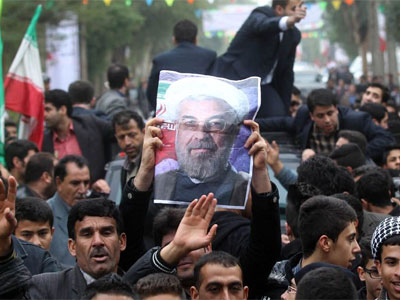
It is with no small amount of trepidation that US and EU negotiators gear up for new talks on a final nuclear deal with Iran later this month. Fierce US congressional criticism of the “5+1” nuclear deal with Iran is missing the point, and promise, of an accord. One need not buy President Rouhani’s self-serving assertion in Davos recently of Iran’s “priority to constructively engage the world” to see that there is more at play than implementation of the nuclear accord.
All would be well advised to take a wider angle view of Iran. Consider this: Even with an acceptable final nuclear deal, if Iran’s regional behavior remains otherwise unaltered (as in the Syria chemical-weapons disposal deal), the core problem of Iran’s Persian/Shia imperial quest to dominate the region by any means necessary remains unmitigated. How much of the strategic problem is really solved? Yet a rabid segment in Congress seeks still more sanctions, aiming at complete abolition of Iran’s enrichment program—a desirable but highly implausible objective. Having spent billions for the program, and endured many multiples of that sum in lost revenue due to sanctions crippling its economy, Iran is unlikely to give up enrichment entirely. None of that trumps national pride.

The outcome which Iran can swallow probably resembles the “Japan option,” i.e., permissible fuel-cycle activity providing a latent nuclear capability but putting in place a status quo falling well short of nuclear-weapons development. That would mean no more than 5 percent enrichment and a limited amount of centrifuges, shutting down the Fordo plant, shutting down the Arak heavy-water plant (or at least converting to a light-water reactor), and shipping out to a third country or neutralizing all of its 20 percent enriched uranium. An outcome in which Tehran genuinely implements the IAEA additional protocol, and provides ample transparency enabling early warning of a breakout push towards nuclear weaponization—that will be about as good as it gets.

To be sure, the only explanation for Iran’s nuclear behavior and cat-and-mouse games with the IAEA (well-documented in IAEA reports) is a desire for more than just civil nuclear capabilities. And while Iran’s claim of an inherent “right to enrich” is contrived, the NPT does says that parties have an “inalienable right” to develop “research, production and use of nuclear energy for peaceful purposes without discrimination.” Indeed, not only Japan, but Argentina, Brazil and several European nations—fourteen in all—engage in fuel-cycle activities. So Iran has a point. But it is their intentions that are suspect—a long track record of dubious behavior documented in a decade’s worth of IAEA reports underscores that point. Fully transparency is part of the answer.

Syria Today: Is Regime Change the Answer?

3 February 2014
SPOTLIGHT WEST ASIA
Ranjit Gupta
Distinguished Fellow, IPCS and Former Indian Ambassador to Yemen and Oman

There are three aspects of the Syrian imbroglio: First, what was originally a political struggle has become a progressively more devastating civil war. Second, those fighting against the Assad regime have fragmented into several distinct and contending elements - the Western and Gulf countries’ backed Syrian National Coalition, now the weakest of the opposition groups in terms of fighting ability; a large array of Islamist groups, many armed and funded by Qatar, Saudi Arabia and Turkey, significant numbers of whom have come together under two different Islamist fronts; the Nabhat Al Nusrah, an effective fighting unit largely composed of Syrians but an affiliate of Al Qaeda; and, the Islamic State of Iraq and the Levant (ISIL), an Al Qaeda outfit, consisting mainly of Iraqis, the most extremist, brutal and effective fighting unit, whose agenda goes much beyond the mere removal of Assad and is the establishment of a fundamentalist Islamist Emirate. The involvement of so many different groups makes the possibility of any solution very difficult. Third, the active involvement of foreign countries – France, Iran, Qatar, Russia, Saudi Arabia, Turkey, UK and the US; this has led directly to Syria getting to the point where it is now. The enormous complexity of the situation should be self evident.

Those advocating regime change need to seriously ponder over the fact that that the internal situation today in both Iraq and Libya is far worse than it was when Saddam and Gaddhafi were in power. Intrusive military interventions by foreign countries in Libya and Iraq are not examples to be emulated but shunned. Indeed, externally encouraged efforts towards regime change in Arab countries must stop forthwith. Given the current ground realities in Syria and its diverse ethnic and sectarian makeup, regime change in Syria could lead to a much worse outcome than in those two countries, even the breakup of the country with deeply destabilizing consequences for the Levant as a whole. 

In the past year Assad has regained a lot of lost ground. All other opposition rebels are now spending greater effort fighting the ISIL considering it a more detestable and dangerous enemy than the Assad regime. The very recent Turkish air strike on a convoy of the ISIL and Premier Erdogan’s visit to Iran suggest that Turkey is rethinking its policy in Syria. There is increasing reluctance of Western countries’ to aid rebels fearing that arms will fall into the hands of extremist groups. Thus, Assad is much stronger today vis-a-vis both his domestic and international adversaries than in June 2012 when the first Geneva conference “agreed on guidelines and principles for a political transition that meets the legitimate aspirations of the Syrian people”. It is now increasingly highly unlikely that Assad can be defeated on the battleground. Therefore, he is hardly likely to agree to his handing over power in a conference room. Pursuing regime change now is a no brainer. 

Ukraine stands on the brink – and Europe must bring it back

This is no velvet revolution, but nor is it an uprising of fascist Cossacks or a zero-sum game with Russia. Europe must intervene on the side of democracy and human rights


The Guardian, Sunday 2 February 2014
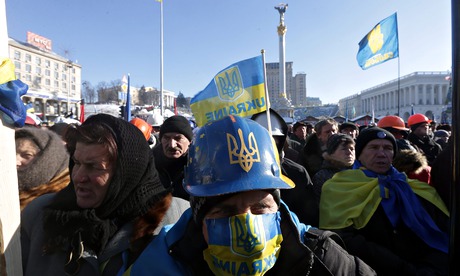
Ukrainian protesters stand in Kiev's Independence Square. ‘Putin’s Russia has been intervening for years, overtly and covertly, while insisting that no “outsiders” should interfere. Photograph: Maxim Shipenkov/EPA

Ukraine has not yet died – as the country's anthem observes. But the face of Ukraine today is that of the bloodied, scarred opposition activist Dmytro Bulatov. Comparisons with Bosnia are still far-fetched, but think of this as a political Chernobyl.

I have no idea what will happen in Ukraine tomorrow, let alone next week. But I know what all Europeans should want to happen over the next year and the next decades. In February 2015, on the 70th anniversary of the Yalta agreement, Ukraine should again be a halfway functioning state. A corrupt and rackety one, but still the kind of state that, in the long run, forges a nation. It should have signed an association agreement with the EU, but also have close ties with Russia. In February 2045, on the 100th anniversary of the Yalta agreement, it should be a liberal democratic, rule-of-law state that is a member of the EU, but has a special relationship with a democratic Russia. "Pie in the sky!" you may say. But if you don't know where you want to go, all roads are equally good. This is where we should want to go.

That outcome would obviously be good for Ukraine. Less obviously, it would be good for Europe. Look at the shifting balance of world power, and look at the demographic projections for western Europe's ageing population. We'll need those young Ukrainians sooner than you think, if we are to pay our pensions, maintain economic growth and defend our way of life in a post-western world. Less obviously still, it would good for Russia. Russia has lost an empire but not yet found a role. Its uncertain sense of itself is inextricably bound up with its deep-seated confusion about Ukraine, a cradle of Russian history that many Russians still regard as belonging back in Russia's nursery.

Once upon a time, young Conservatives like David Cameron shared such a vision of a wider Europe of freedom. Inspired by the velvet revolutions of 1989, and by Margaret Thatcher, they loathed the statist, federalist and socialist Little Europe of Brussels, but loved that far horizon of liberty. Yet where is the British prime minister's voice on Ukraine today?

Back in his idealistic youth, Germans were the mealy-mouthed stability-huggers, and Brits spoke out for human rights in eastern Europe. Now,Angela Merkel tells her parliament – to applause – that the Ukrainian authorities must not ignore "many people who have shown in courageous demonstrations that they are not willing to turn away from Europe. They must be heard", while the Conservative benches of the British parliament resound with appeals to turn away from Europe, and to keep out those numberless hordes of eastern European welfare scroungers. Among the few Ukrainians welcome here are the oligarchs, who get Britain's special visas for the very rich, and buy the fanciest places in London. One of them, Rinat Akhmetov, paid £136m for a 25,000 sq ft pied-a-terre in the luxurious One Hyde Park apartment complex.

Australia-India roundtable begins in Sydney

03 February 2014

The Australia-India Roundtable, the leading informal dialogue between the two countries, began in Sydney on Monday, 3 February. 

A high-level delegation of Indian officials, think tank experts and media commentators are in Australia for the talks, led by the Secretary (East) of the Indian Ministry of External Affairs, Mr. Anil Wadhwa.

The dialogue is convened by the Lowy Institute in partnership with the Australia India Institute and with prominent Indian think tank Observer Research Foundation. It is supported by the Public Diplomacy Division of the Indian Ministry of External Affairs and the Australia India Council of the Department of Foreign Affairs and Trade.

The talks began today at the Lowy Institute for International Policy in Sydney, and continue on Thursday, 6 February, at the Australia India Institute in Melbourne.

The Indian team, besides Mr Wadhwa and Mr Sanjay Bhattarcharya, JS (South), MEA, include Dr. C. Raja Mohan, Head of Strategic Affairs Studies, ORF, Mr Samir Saran, Vice President, ORF, Dr Rajeswari Pillai Rajagopalan, Senior Fellow, ORF, Mr Ashok Malik, AII-ORF Chair, Dr Rajeev Kumar and Prof. Rakesh Basant, IIM (Ahmedabad).

Dr C. Raja Mohan, the Indian co-Chair of the dialogue, said ’The engagement with Australia is one of India’s fastest growing and most significant bilateral partnerships and has the potential to contribute to stability and prosperity in the Indo-Pacific at a time of great uncertainty in the relations among China, Japan and the United States’.

Dr. Rory Medcalf, the Australian chair of the dialogue and the director of the international security program at the Lowy Institute, said ’These frank and creative discussions will be a chance to consolidate one of Australia’s key strategic relationships in the Indo-Pacific region’.

While in Sydney, the Indian delegation will also visit the University of New South Wales for discussions on scientific research partnerships and meet NSW Premier Barry O’Farrell. The delegation will hold talks with senior Australian officials in Canberra as well as meeting Commonwealth Government Ministers.

About 40 Australian officials, scholars, parliamentarians, journalists and business representatives will share views with the Indian delegation during the roundtable discussions.

The talks are aimed at producing practical recommendations to advance Australia-India relations in trade and investment, education, people-to-people ties, defence and diplomatic cooperation in such frameworks as the G20 and the Indian Ocean Naval Symposium, both being chaired by Australia this year.

In 2013, the dialogue was held in New Delhi.

China: Could a Western “Gravity Machine” Prevent War?

Published on The National Interest (http://nationalinterest.org)
February 2, 2014

Tensions in the Asia-Pacific have escalated sharply in the past three months. China announced its air defense identification zone (ADIZ) on November 23; on December 5, a U.S. Navy warship had to maneuver to avoid colliding with a Chinese vessel in the South China Sea; three days later, South Korea announced that it was expanding its own ADIZ; and, most recently, China has begun giving warnings to foreign military planes that breach its ADIZ. The immediate source of concern in the region is the escalating war of words (and actions) between China and Japan. At this month’s World Economic Forum, Japanese prime minister Shinzo Abe[3]warned [3] that “with China we don’t have a clearly explicit roadmap” for reducing bilateral tensions. Even more ominously, he acknowledged that there “may be some conflict or dispute arising out of the blue or on an ad hoc level or inadvertently.”

That the prospect of a military confrontation between the two countries has gone from nearly inconceivable to “merely” improbable is distressing when one considers the potential impact of such a clash on the international system. It is also sobering that an area with such limited assets (mostly fishing grounds) could be become grounds for war. A recent[4]letter [4] to the editor of the Financial Times summarizes the bewilderment of many observers: “One might very well ask how the world’s second and third largest economies have come to the brink of war over two and a half square miles of uninhabited islets and rocks.” Some have suggested that China and Japan might fight to preserve their national honor or to gain greater access to the prodigious reserves of energy that are believed to lie beneath the Senkakus/Diaoyus. In no considered analysis, however, do any such gains begin to approach the costs.

There was greater optimism about the Asia-Pacific’s trajectory a decade earlier, some of which was premised on the presumption (or hope) that China’s economic development would lead to greater peace regionally and globally. In an influential September 2005 [5]essay [5], Chinese grand strategist Zheng Bijian explained that “China [would]…strive for peace, development, and cooperation with all countries of the world.” He went on to argue that “China’s development depends on world peace—a peace that its development will in turn reinforce.” America’s posture was expressed in a [6]speech [6] that Robert Zoellick gave the same month, in which he “urge[d] China to become a responsible stakeholder.” “[T]he international system sustains their [responsible stakeholders’] peaceful prosperity,” Zoellick explained, “so they work to sustain that system.”

Running the Pentagon Right

How to Get the Troops What They Need
Ashton B. Carter


War inevitably presents unexpected challenges. From Germany’s use of mustard gas during World War I to North Vietnam’s surprisingly effective use of its air defense system during the Vietnam War, the United States has always faced unanticipated threats in combat that have required agile responses. U.S. troops on the ground continually adjust to changing enemy tactics with the capabilities they have at hand. Yet the part of the Defense Department that trains and equips those troops has rarely been as flexible.

This is a paradox that would surprise most people outside its walls: the Pentagon is ill equipped to address urgent needs that arise during wartime. The Department of Defense has a fairly good track record of making smart and deliberate long-term acquisitions, as evidenced by the substantial qualitative advantage the United States holds over any potential adversary. Although the department still struggles to contain the costs of military systems, it has come a long way in providing better buying power for the taxpayer. The Pentagon has also, by sad necessity, pioneered advances in medical technology, particularly in such areas as prosthetic limbs and the treatment of traumatic brain injuries and posttraumatic stress disorder.


But the same system that excels at anticipating future needs has proved less capable of quickly providing technology and equipment to troops on the battlefield. I have spent much of the past five years, first as undersecretary of defense for acquisition, technology, and logistics and then as deputy secretary of defense, trying to address this shortfall. With the Iraq war over and the war in Afghanistan coming to a close, it is important to understand what prevented the Pentagon from rapidly meeting immediate demands during those wars, what enduring lessons can be learned from its efforts to become more responsive, and how to put in place the right institutions to ensure success against future threats when agility is crucial.

The end of the tank? The Army says it doesn’t need it, but industry wants to keep building it.


YORK, PA. — When an armored vehicle pulled down the statue of Saddam Hussein in an iconic moment of the Iraq War, it triggered a wave of pride here at the BAE Systems plant where that rig was built. The Marines who rolled to glory in it even showed up to pay their regards to the factory workers.

That bond between the machinists and tradesmen supporting the war effort at home and those fighting on the front lines has held tight for generations — as long as the tank has served as a symbol of military might.

Now that representation of U.S. power is rolling into another sort of morass: the emotional debates playing out as Congress, the military and the defense industry adapt to stark new realities in modern warfare and in the nation’s finances.

As its orders dwindle, the BAE Systems plant is shrinking, too. The company is slowly trimming workers and closing buildings.

In York, there’s “sadness that somebody that has worked here 35 years and is close to retirement is getting laid off,” said Alice Conner, a manufacturing executive at the factory. “There’s also some frustration from management and my engineering staff as we see the skills erode, because we know one day we’re going to be asked to bring these back, and it’s going to be very difficult.”

The manufacturing of tanks — powerful but cumbersome — is no longer essential, the military says. In modern warfare, forces must deploy quickly and “project power over great distances.” Submarines and long-range bombers are needed. Weapons such as drones — nimble and tactical — are the future.

Tanks are something of a relic.

The Army has about 5,000 of them sitting idle or awaiting an upgrade. For the BAE Systems employees in York, keeping the armored vehicle in service means keeping a job. And jobs, after all, are what their representatives in Congress are working to protect in their home districts.

The Army is just one party to this decision. While the military sets its strategic priorities, it’s Congress that allocates money for any purchases. And the defense industry, which ultimately produces the weapons, seeks to influence both the military and Congress.

“The Army’s responsibility is to do what’s best for the taxpayer,” said Heidi Shyu, the top Army buying official. “The CEO of the corporation[’s responsibility] is to do what’s best in terms of shareholders.”

The Army is pushing ahead on a path that could result in at least partial closure of the two U.S. facilities producing these vehicles — buoyed by a new study on the state of the combat vehicle industry due for release next month.

What's Going on with Military Officers?

Published on The National Interest (http://nationalinterest.org)
February 2, 2014

Lately it seems that we have been reading many stories of misconduct among U.S. military officers. The most recent collective infraction concerned cheating on a proficiency test [4]and involved a substantial proportion of the Air Force officers who control nuclear-armed ballistic missiles. We continue to hear about the alleged bribery of Navy officers [5] who awarded logistical support contracts to the payer of the bribes. Other ethical lapses [6] among officers of all the military services are enough to fill a catalog that the Department of Defense itself compiled. Senior Marine Corps commanders are alleged to have covered up misconduct [7] by lower ranking members of their service in Afghanistan. General officers in more than one service are described as being abusive leaders [8] who have created poisonous atmospheres in units they have led. Other generals and colonels are identified with seedy behavior [9] ranging from sexual abuse and alcohol abuse to making lecherous comments about members of Congress.

Before we jump to conclusions about what all this says about any broad patterns of bad conduct or bad character in the officer corps, we should note that a concatenation of such stories in the news does not by itself prove the existence of broad, ingrained problems in a service. Perhaps we are seeing part of random fluctuations in the press's output on this or any other subject, or partly the efforts of some particularly enterprising and energetic jounalists who cover the military. Bearing in mind that there are upwards of 200,000 U.S. military officers on active duty, maybe the bad apples we read about are no more numerous than we should expect to find in other professional populations of comparable size. And maybe most of the problems are best described in terms of individual cases and individual circumstances and do not lend themselves to valid and insightful generalization.

Under the where-there's-smoke-there-might-be-fire principle, however, it is appropriate to ask whether there may be some overall reasons, applicable to this national military at this time in the nation's history, for a surge in bad behavior. The U.S. armed forces are coming off more than a decade of continuous involvement in overseas warfare, with the particular wars in question not having gone especially well, or at least ending for the United States in ways well short of what could be called victory. Stresses that this recent history places on the military as a whole are shared by the officer corps. One thinks, by way of comparison, of the years immediately after the Vietnam War, another overseas war that did not go well and a time when aberrant conduct in the military such as drug abuse was high.

The American public is treating service members returning from the more recent wars, however, much differently from how it treated Vietnam veterans. Today's uniformed military is routinely applauded at sporting events and otherwise lauded for the service that the other 99 percent of the population is not performing. Maybe herein lies a different sort of explanation for some of the bad conduct. Maybe being placed on a public pedestal leads some in uniform to feel that they are being given more latitude than others are, and that there is more room for ignoble behavior since it has already been offset by the noble behavior that the public applauds. But that is only a hypothesis, and like any hypothesis it has to deal with the fact that most members of the service, officers as well as enlisted, behave well.

How to remember a war

February 03, 2014

As commander of the British army in the Boer War, Kitchener had been responsible for the atrocities of the concentration camps in which Afrikaners were imprisoned. (Reuters)

SUMMARY
Britain’s new Kitchener coin evokes unpleasant associations.

Robert Vadra reportedly advised his brother-in-law to grant the interview to Times Now.

It’s only February 2014 and already Britain seems to be mired in controversy about how best to commemorate the start of the First World War, which has its centenary on August 4 this year. Should we celebrate it as a heroic fight for British democracy against German despotism? Should we commemorate the British decision to defend brave little Belgium against German aggression? Or should we take our cue from war poets like Robert Graves and Wilfred Owen, who wrote so movingly about what they saw as the senseless suffering of the troops on the western front, from the critics like the late Alan Clark, who described those men, thrown heedlessly into battles in which they were slaughtered in hundreds of thousands without any tangible military result, as “lions led by donkeys”?

While the secretary of state for education has condemned those who criticise a patriotic, celebratory approach as leftwingers out to denigrate the memory of brave soldiers who sacrificed their lives to preserve British freedom, others have pointed out that Alan Clark was a Tory member of parliament, and that former editor of the conservative newspaper, the Daily Telegraph, Sir Max Hastings, is among the generals’ fiercest critics.

Some have gone further and pointed out that “brave little Belgium” was the perpetrator of some of colonialism’s most grisly atrocities in the Congo, while Britain, where 40 per cent of adult males did not possess the right to vote in 1914, could hardly be described as a democracy. As for liberal values, these were notably absent from Britain’s rule of its own vast colonial possessions in 1914, while one of the country’s two main allies, tsarist Russia, was a despotism almost entirely lacking in civil freedoms or human rights.

What, then, should we be commemorating? The row has recently spread to what at first sight would appear to be an entirely innocuous topic: the issue of commemorative coins to mark the anniversary. The Royal Mint has issued a coin for 2 pounds sterling featuring one of the most iconic images of the war, indeed of the 20th century: Field Marshal Horatio Herbert Kitchener, who was appointed secretary of state for war when the conflict broke out in 1914.

Cambodia: Echoes of Fascism

Published on The National Interest (http://nationalinterest.org)
February 3, 2014

Those who had hoped that Prime Minister Hun Sen's surprise near-loss in the flawed elections last July would lead to a more accommodating stance have been sadly disappointed. The man who has dominated Cambodia and her people for almost three decades still holds an iron grip. The United Nations Transitional Authority in Cambodia (UNTAC)’s mandate to conduct “free and fair general elections” in 1993 has proved largely irrelevant over time to the politics on the ground. Cambodian human rights bloggers have even recently raised the specter of a sinister “Third Hand” formed to maintain that iron grip.

Last year’s midsummer night’s dream of a possible political evolution was finally buried for good on January 2–3, when the grounds outside of the Canadia Industrial Park were turned into Cambodia's latest killing field. There, a combination of security forces and plainclothes thugs reportedly harassed and beat demonstrating garment workers before opening fire on the crowd. They left a scene of bloody carnage, with five dead and over thirty injured. In addition, twenty-three labor activists and workers were taken into police custody and have been held since, without access to families, lawyers or adequate medical treatment. A January 31 opposition Cambodia National Rescue Party (CNRP) press release indicated that a delegation of CNRP MPs-elect and family members will be able to visit these detainees at the maximum-security prison where they are being held on February 4. However, the decision by the Hun Sen regime to largely ignore the international outcry following this bloodshed and to continue its policy of cracking down on the political opposition and on workers still bodes ill for a peaceful conclusion to the present impasse.

An estimated ninety percent of Cambodia's seven hundred thousand garment workers, who help provide trendy clothing for such big brand names as the Gap, Nike, Adidas and Levi Strauss, as well as for discount giant Walmart, are young women from the countryside. They toil long hours making clothing and footwear for a monthly minimum wage of less than one hundred dollars. Some fifty thousand of them had begun striking to raise that wage to $160.

(Representatives of some of these brand name companies signed a letter dated January 17 from the international garment industry to Prime Minister Hun Sen expressing concern over the January 2-3 killings, the rights of the detainees, and the need to uphold trade union law, including ILO Conventions 87 and 98.)

A particularly ominous development in the current battle in the streets for the soul of Cambodia is the appearance of young males without any official designation who reportedly join in using violence to quell dissent. Hun Sen himself, according to Voice of America, was quoted in December as warning of the emergence of this shadowy “Third Hand” if demonstrations continued.

3 February 2014

"The U.S. Created the Taliban" And Other Myths & Legends From the Pakistani Generals

February 1, 2014 
Ten Fictions that Pakistani Defense Officials Love to Peddle 
C. Christine Fair 
War on the Rocks 
January 31, 2014 

The U.S.-Pakistan “strategic dialogue” has restarted yet again. I would be remiss if I did not point that it has never been strategic and it has certainly not been a dialogue. No doubt the Pakistanis are worried that wary American taxpayers and their congressional representatives may close the checkbook for good when the last U.S. soldier departs from Afghanistan. In the spirit of perpetual rent-seeking, Pakistani defense officials have recently alighted upon Washington to offer the same tired and hackneyed narratives that are tailored to guilt the Americans into keeping the gravy train chugging along.

Here are the top ten ossified fictions that Pakistani defense officials are pedaling and what you need to know to call the “Bakvas Flag” on each of them.

1. “Our relationship should be strategic rather than transactional.”

Nonsense and here’s why. For the U.S.-Pakistan relationship to be “strategic,” there should be a modicum of convergence of interests in the region if not beyond. Yet, there is no evidence that this is the case. In fact, Pakistan seems most vested in undermining U.S. interests in the region. In the name of the conflict formerly known as the Global War on Terror (GWOT), the United States has given Pakistan some $27 billion in military and financial aid as well as lucrative reimbursements. However, during these same years, Pakistan has continued to aid and abet the Afghan Taliban and allied militant groups such as the Haqqani Network. These organizations are the very organizations that havekilled American military and civilian personnel in Afghanistan along with those of our allies in the International Security Assistance Force (ISAF) and countless more Afghans, in and out of uniform. This is in addition to the flotilla of Islamist militant groups that Pakistan uses as tools of foreign policy in India. Foremost among them is the Lashkar-e-Taiba, which is proscribed by the United States and which is responsible for the most lethal terror operations in India and, since 2006, has openly operated against Americans in Afghanistan.

2. “The United States has been an unreliable ally.”

Rubbish. Pakistani officials enjoy invoking the two treaties, the Central Treaty Organization (CENTO) and the Southeast Treaty Organization (SEATO) through which the United States and Pakistan ostensibly were allies. They lament that despite these partnerships and commitments, the United States did not help Pakistan in its wars with India (1965 and 1971) and even aided non-aligned India in its 1962 war with Communist China. It should be noted that Americans were never party to CENTO; rather, they maintained an observer status, and Americans were leery of letting the Pakistanis join SEATO, fearing that it was a ruse to suck the alliance into the intractable Indo-Pakistan dispute. In point of fact, Pakistani officials beginning with Muhammad Ali Jinnah, Liaquat Ali Khan, and General Ayub Khan repeatedly sought to join American military alliances in exchange for money and war materiel.

While Pakistan professed a commitment to America’s anti-Communist agenda, it sought these partnerships to build its military capabilities to continue challenging India. Until the 1950s, the United States had no such interest in Pakistan.

When the United States finally embraced such partnerships, the treaties were specifically designed to combat Communist aggression ensuring that the United States had no obligation to support Pakistan in its wars with India. The United States certainly had no obligation to support Pakistan in the 1965 war with India, which it started. Pakistan’s grouses about the American position during the 1971 war is particularly disingenuous. As Gary Bass has detailed, President Nixon violated numerous American laws to continue providing military support to the abusive West Pakistani regime as it prosecuted a genocidal campaign against the Bengalis in East Pakistan.

3. “The United States used Pakistan for its anti-Soviet jihad.”

More fiction. Pakistan and Afghanistan came into conflict immediately after Pakistan’s independence because Afghanistan rejected Pakistan’s membership in the United Nations and laid claim to large swaths of Pakistani territory in Balochistan, the tribal areas, and in the then-Northwest Frontier Province. As such, Pakistan began instrumentalizing Islamists in Afghanistan as early as the 1950s. Following the ouster of King Zahir Shah by Mohammed Daoud Khan in 1973, Daoud began prosecuting Afghanistan’s Islamists who opposed his modernizing policies. Shia Islamists fled to Iran and Sunni Islamists generally fled to Pakistan. In 1974, then-civilian Prime Minister Zulfiqar Ali Bhutto established a cell within Pakistan’s Interservices Intelligence Directorate (ISI) to mobilize these exiled dissidents for anti-regime operations in Afghanistan. Muhammad Zia-ul-Haq continued the nascent “Afghan jihad” after seizing power from Bhutto in 1977.

ENABLE THE WARRIOR-DIPLOMAT

January 30, 2014 

The mission in Afghanistan is either going to change into something much smaller—about 10,000 troops—or it will end. After two long foreign occupations in Iraq and Afghanistan, the appetite of the American public for lengthy stabilization operations is gone. Cries for “returning to our roots” and “getting back to the basics” will echo through the corridors of the Pentagon. Top line fiscal cuts will cause the bottom lines of “nonessential” training and education programs to dwindle. We’ll lean out our personnel numbers, stick to the basics of offensive and defensive land, amphibious, maritime and airborne operations, and forget the “softer side” of basic combat operations. Never mind training for what happens after initial combat ends—nongovernmental organizations, intergovernmental organizations, and other governmental organizations will take care of that, right?

Such outspoken advocates of “returning to the basics” should keep in mind the timeless observation of former Speaker of the House Tip O’Neill, who was more right than he knew when he said “All politics is local.” This is true in Afghanistan, and will continue to be so wherever Washington tells the military to deploy, even in wars that we may initially view as “conventional,” like Iraq in 2003. And even as Washington spurns any operation with a whiff of counterinsurgency, U.S. forces remain involved in missions that require partnering with and assisting allied militaries and community leaders. Evan Munsing’s recent article does well to highlight the harsh reality that locally brokered solutions in Afghanistan will be the product of a weak central government. However, given the failed imposition of a centralized counterinsurgency approach to a decentralized problem in Afghanistan, this author would argue that the need for well-trained “warrior-diplomats” is key for future deployments in resource-constrained environments. COIN doctrine itself was not the problem. The strategy was the problem. The lack of a clearly defined political endstate gave rise to interagency parochialism and regional interpretations of “progress” and “stability.” Some units improvised local solutions, in anticipation of those inevitable locally brokered post-withdrawal deals of which Munsing speaks. This was certainly the case with the U.S. Marines in Sangin District of Helmand Province in Afghanistan in 2010 and 2011 when they were given the nebulous mission to “conduct full-spectrum counterinsurgency operations in order to extend the governance and economic development of the Government of the Islamic Republic of Afghanistan.” And as the mission in Afghanistan draws down, it is worth looking back on some lessons learned. For even when dealt a strategy that lacks clearly defined political objectives, units at the operational level can adapt and counter instability using a locally ascertained solution.

The centralized government solution that the International Security Assistance Force (ISAF) was tasked to realize was ignorant of cold hard facts on Afghan society, economy, and history; namely, the feudal traits of Afghan society, a piddling economy, and a history of being the proverbial doormat of invading forces heading into and out of Southwest Asia. Consequently, the operational objectives that the Marines in Sangin and all other allied forces in Afghanistan were ordered to pursue conflicted egregiously with the political realities of individual districts to the point of being tactically ineffective. So, like good Marines, they adapted to the local version of stability in the final months of 2010. Was the result the “picture of success” envisioned in ISAF headquarters and Washington? Only time and commitment would tell.

Military Plans Reflect Afghanistan Uncertainty


JAN. 29, 2014 

WASHINGTON — American and NATO military planners, facing continued political uncertainty about whether foreign troops will remain in Afghanistan after December, have drawn up plans to deploy a force this summer that is tailored to assume a training mission in 2015 but is also small enough to withdraw if no deal for an enduring presence is reached, alliance officials said.

With President Hamid Karzai of Afghanistan refusing to sign security agreements approving a presence for American and NATO troops after 2014, allied military planners have been forced to prepare for both sudden success and abject failure of proposals for a continuing mission to train, advise and assist Afghan forces after combat operations officially end this year.

The decision on whether to extend the foreign military presence is a political one, and it will be decided first by Mr. Karzai and then by President Obama and the elected leaders from NATO nations. The process has brought vitriol in Kabul, the Afghan capital, and deep concern in Washington and allied capitals.


Launch media viewer Soldiers in Kandahar, Afghanistan, last week. Allied officials have drawn up plans for a force small enough for a quick exit. I. Sameem/European Pressphoto Agency

The delays have complicated military planning, since the governments of nations that contribute troops must approve any sustained deployments — and the required financing — months in advance, with a number of notional deadlines for finishing an agreement already long passed.

The Epidemic the White House Does Not Want to Talk About: Endemic Corruption in the Afghan Government

January 31, 2014
Afghanistan: Why The Karzais Support The Taliban
strategypage.com
January 31, 2014

January 31, 2014: In places like Afghanistan, which was one of the major recipients of foreign aid in the last decade, donors have gone to extraordinary lengths to get the aid to the people, and not into the secret foreign bank accounts of their leaders. The local officials consider the anti-corruption measures of the donor nations a challenge and often manage to get around these pesky rules. In short, if you want to know where the next war will break out just follow the money, especially the cash that is not going where it is supposed to.

Afghans will steal money even when it is not in their interest to do so. Consider something as basic as road maintenance. U.S. aid enabled Afghanistan to build $4 billion worth of roads since 2001 and that was a major boost to the economy. As hard as it was to monitor the spending for road building, it was even more difficult to do so for road maintenance. So in 2012 the U.S. halted aid for road maintenance and told the Afghans to scrounge up the money and resources to do it themselves if they really wanted the roads to remain passable. As a result only some of the roads are maintained, in areas where the locals organize road repairs out of self-interest. But this still leaves many parts of the country cut off because you need continuous roads for some economic opportunities (exporting local produce.) The lack of road maintenance is discouraging foreign investment in mining, for example, because without roads there is no way to get construction equipment and materials in and no way to get the extracted minerals out.

A recently released report (which the U.S. government wanted to keep secret) showed how auditors found no part of the Afghan government able to handle foreign aid without most of the money being stolen. Corruption and poor government continue to be a major problem which the drug trade is simply part of.The only battle that counts in Afghanistan is the struggle against corruption, but controlling the drug trade is part of that fight. It is the general dishonesty, larceny and use of violent threats instead of consensus and persuasion that make Afghanistan such a hellish place and allow the drug gangs to thrive. The Islamic conservatives promise that submission to Islam in all things (as during the religious dictatorship of the Taliban in the late 1990s) will solve all these problems. The Taliban approach did not work and too many Afghans know it (many from personal experience). The failure of the Taliban to run the country effectively put the spotlight on another problem; a lack of enough people trained to actually operate a large government (or any other kind of organization). Efficiently running a large organization takes a lot of people with specific skills. Low education levels, and a general lack of large organizations, means Afghanistan simply doesn’t have enough people to effectively operate a national government and all the large bureaucracies that includes. This is a problem that is not quickly overcome since you cannot govern Afghanistan with a lot of foreign bureaucrats (even if you just call them “advisors”). Afghans are very touchy about that sort of thing. Afghans may be poor and ill-educated, but they are also proud, heavily armed and short-tempered. So all that foreign aid is easier to steal (for your family and tribe) than to spend efficiently for the common good. 

China in the Indian Ocean: Deep Sea Forays

3 February 2014
MARITIME MATTERS

Vijay Sakhuja
Director (Research), Indian Council of World Affairs (ICWA), New Delhi
http://www.ipcs.org/article/china/china-in-the-indian-ocean-deep-sea-forays-4280.html

China’s maritime ambitions are expanding and it is making forays into the deep seas beyond its waters. The State Oceanic Administration (SOA) has drawn plans to build scientific research vessels and mother ships for submersibles. Further, the scientific agenda for 2014 includes the 30th scientific expedition to Antarctica and 6th expedition to the Arctic. China will also dispatch its research vessels to the northwest Pacific to monitor radioactivity in international waters and its foray into the Indian Ocean would involve seabed resource assessment including the deployment of the 22-ton Jiaolong, China's first indigenously built manned deep-sea submersible. 

China’s scientific urge had driven its attention to seabed exploration. In the 1970s, it actively participated in the UN led discussions on seabed resource exploitation regime. At that time it did not possess technological capability to exploit seabed resources. In the 1980s, it dispatched ships to undertake hydrographic surveys of the seabed. On 5 March 1991, China registered with the UN as a Pioneer Investor of deep seabed exploitation and was awarded 300,000 square kilometers in the Clarion–Clipperton area in the Pacific Ocean. Soon thereafter, China Ocean Mineral Resources R & D Association (COMRA), the nodal agency for seabed exploration and exploitation of resources was established. In 2001, China obtained mining rights for poly-metallic nodule and in 2002, poly-metallic sulfide deposits in the Southwestern Indian Ocean. In 2011, COMRA signed a 15-year exploration contract with the International Seabed Authority (ISA) that entrusted it with rights to develop ore deposit in future. 

Although the Jiaolong has been built indigenously, it is useful to mention that the hull, advanced lights, cameras and manipulator arms of Jiaolong were imported and acquanauts had received training overseas. In August 2010, Jiaolong successfully positioned the Chinese flag at 3,700 meters under the sea in South China Sea and displayed China’s technological prowess in deep sea operations. China also possesses an unmanned deep-sea submarine Qianlong 1 (without cable) which can dive to 6,000 meters and an unmanned submersible Hailong (with cable) that can take samples from the seabed. As early as 2005, six Chinese acquanauts (five pilots and one scientist) had undergone deep sea dive training in the US. Currently, China has eight deep-sea submersible operators including six trainees (four men and two women) being trained at State Deep Sea Base in Qingdao on a 2-year course. 

CHINA’S STADIUM DIPLOMACY IN AFRICA


In Maputo, the “Garden for Sculptors” behind the Museu Nacional de Arte on Avenida Ho Chi Minh has become a kind of prison yard for Mozambique’s various Ozymandiases, a semi-public dumping ground where colonial monuments now crumble quietly away. A marble European baroness reclines in thick robes, the grasses growing up around her base. Both of her arms have been lopped off, but her amputated left hand still touches the midriff of a black male slave crouched in a loincloth by her side. Nearby, a decapitated Lady Justice presides over a small patch of weeds and bare earth. No longer public art, but not quite garbage, these are the monuments which were extracted like rotten teeth from the city’s squares and public buildings when Portuguese colonial rule finally ended, but which nobody could quite bring themselves to destroy.


One August afternoon I chanced upon the newest addition to this miserable collection. Facedown in the dirt lies an enormous bronze angel, wings stretched high over its head like some kind of massive avian Academy Award. Walking around it to its jagged base, ripped from wherever it had once been rooted, I found that the figure was completely hollow. Inside there was a small plaque whose Chinese characters I could not read. Intrigued, I went back into the museum, and asked the receptionist there where this gigantic statue had come from and why it had been dumped here. He answered with the air of someone patiently explaining something very obvious to someone very dull. The angel had been erected in 2011 by the Chinese government in front of the new national soccer stadium, to give the place some character and serve as a kind of focal point. But when Mozambican officials saw that the statue had “a Chinese face”, they decided it wouldn’t do to have a Chinese angel in front of their national stadium, tore it down, and trucked it into town to join the rest of Maputo’s unwanted colonial trappings in the Garden for Sculptors.

Mozambique’s new national stadium, Estรกdio Nacional do Zimpeto, is on the outskirts of Maputo, not far from the Chinese-built international airport. The Chinese have also overseen the construction of the new parliament building and a new “Palace of Justice” in the last few years. The main institutions through which a sense of Mozambican national life is constructed—the laws of the nation, international departures and arrivals, and its most spectacular public moments of heroism—now take place in Chinese-built structures.

Syria: Iran Is The Key To Victory

Latest Developments on the Battlefield in the Syrian Civil War 
January 28, 2014
Strategypage.com 

ISIL (the Islamic State in Iraq and the Levant, also called ISIS) is taking a beating in Syria and Iraq. For all of January the Iraqi branch has been trying to seize cities in Western Iraq (Anbar province) while the Syrian ISIL has been fighting the Syrian rebels (moderates and Islamic terrorists) who finally united against the ISIL and sought to destroy this Iraqi led organization, at least in Syria. So far this fighting has killed over a 1,500 people and put Iraqi Islamic terrorists on the defensive on both sides of the border. About half of the dead are ISIL and another 10-15 percent are civilians. The Syrian Army took advantage of the rebel civil war for a while and made some advances. But those advances soon stalled and the rebels pushed back. ISIL only has a few thousand fighters left in the north, around Aleppo and along the Turkish border and in the east (across the border from Anbar). Within the rebel movement ISIL is now outnumbered more than 20 to 1, although in the areas where it is strongest the odds are much lower (often four or five to one) and their fanatic fighting spirit is no longer sufficient to make up for their low numbers. ISIL has suffered heavily in the last four weeks, probably as much from desertions as from combat losses. Many ISIL fighters are dismayed at having to fight fellow rebels and have gone over to more moderate rebel groups or left Syria in disgust. At the end of January the al Qaeda branch in Iraq is on the defensive while the one in Syria is fighting for survival. The defeat of ISIL does not mean the end of al Qaeda in Syria because even more al Qaeda men are fighting against ISIL. The losers here are the Iraqi radicals who dominate the ISIL. Despite the attention paid to the war with ISIL the rebels still control most of the country, or at least dispute control with the security forces. One thing that’s hurting ISIL in Syria and the West is their savagery. In addition to slaughtering Moslems who don’t agree with them, they have also been particularly brutal against Syrian Christians.

In 2013 57 percent of the Christians killed for religious reasons worldwide died in Syria, mostly because of ISIL. Some 90 percent of the worldwide deaths were at the hands of Islamic terrorists and ISIL was the worst offender. In the last six months the Syrian rebels have gone through some serious changes. In late 2013 there was a major reorganization within the SMC (Supreme Military Command, formerly FSA/Free Syrian Army). This was the original coalition and was largely moderate, democratic and not very effective in combat. Many of the rebel fighters noted that the Islamic terrorists groups were more successful in combat and many rebels became radicalized and joined the Islamic groups. Not all these Islamic groups were terrorist in outlook. Many of the groups within the SMC became more Islamic and last November most rebels abandoned the SMC and formed a loose coalition of Islamic (including Islamic terrorist) combat organizations. It is believed that 20-30 percent of the rebels consider themselves al Qaeda. This left the SMC with the allegiance of only about 30,000 armed rebels. The FSA had earlier evolved into the SMC in an attempt to become more relevant. Based outside Syria the SMC does not control any fighting forces in the traditional sense. It is more a conduit for a lot of foreign aid, including some weapons. Efforts by the FSA and SMC to get all, or even most of the rebels to coordinate their efforts failed. Many active rebel groups inside Syria pledge allegiance to SMC just for the supplies. A lot of rebel groups will actually listen to the SMC military experts (who are generally professionals who know what they are talking about) but will not dependably follow-through. Most of the remaining SMC fighters are opposed to Islamic terrorists, especially the ISIL. 

Does Israeli Intelligence Have What It Takes for a Successful Airstrike Against Iran’s Nuclear Facilities?

January 30, 2014
Bombing Iran: Tough Tasks for Israeli Intelligence
Thomas Saether
The National Interest
January 30, 2014

Historically, Israel’s intelligence services have played a vital role—both direct and indirect—in making decisions of war and peace. In 1954, Israeli intelligence persuaded then Defense Minister Pinhas Lavon to approve of an attempt to sabotage the Anglo-Egyptian agreement concerning British withdrawal from the Suez Canal. And there would have been no air strikes on the Iraqi nuclear reactor in 1981 and the Syrian reactor in 2007 if not for the information collected by Israel’s intelligence services. Not only are the three current intelligence chiefs (Aviv Kochavi of military intelligence [Aman], Tamir Pardo of Mossad, and Yoram Cohen of Shin Bet) among the key individuals tasked with collecting and presenting information related to an Israeli military operation against Iran’s nuclear program, they are also part of the inner circle of advisors to Prime Minister Benjamin Netanyahu. Moreover, they would be responsible for assessing the civil and political consequences of attacking Iran’s nuclear facilities.

Although there are several forms of military operations that could be undertaken, with Israel’s capabilities and preparations in mind most analysts focus primarily on air strikes directed against Iran’s key nuclear sites. There are five main operational tasks related to destroying an underground facility: detecting the facility; characterizing the site’s features; planning the attack; neutralizing the site; and assessing the success of the operation.

A critical question for Israeli decision-makers and the intelligence apparatus is whether they have sufficient qualitative and accurate intelligence on the Iranian nuclear sites. There is no simple solution to locating and characterizing an underground facility. Possible options include imagery intelligence (photographs from satellites), signature intelligence (detecting heat, sound, or vibration), signals intelligence (radio and radar signals), and the use of human intelligence (agents or informants). Usually, one source is not enough to characterize a facility and determine whether it is for leadership protection, weapons production, weapons storage, or something else. In order to integrate all the methods in an efficient and cost-effective endeavor, one must first obtain the approximate location of a site. This is usually done with either human intelligence or satellites imagery. Israel has some tools to detect underground and excavated facilities. The Ofeq series of reconnaissance satellites provides some photographic coverage of Iran. Furthermore, the Eros-B satellite provides it with a camera that improves the assessment capabilities regarding sites of interest. The satellites’ images can help answer questions regarding whether construction is taking place under the surface, what kind of materials are used in the construction process, and how deep the Iranians are digging. However, given the large size of Iran, and Israel’s somewhat limited satellite assets, searching for clandestine facilities is a challenging task. Moreover, the hide-and-seek game played between Iran and Israeli intelligence allows for the use of deception, which further complicates the search. In order to reduce the risk of deception, intelligence needs to draw its information from multiple sources. Human intelligence would provide added value in this regard and may be the most effective mean to detect clandestine facilities.

Needed: A new NATO for the 21st century

Jan. 29, 2014

WASHINGTON, Jan. 29 (UPI) -- This weekend marks the 50th anniversary of the annual Munich Security Conference. First focused on Europe, the North Atlantic Treaty Organization and the Cold War, several years ago the conference broadened its agenda to cover global security.

That said, the future of NATO must remain among the West's highest security priorities. For a number of reasons, that isn't happening.

The dissolution of the Soviet Union a quarter of a century ago removed the threat for which NATO was uniquely created. The alliance manfully began the transformation to a post-Cold War world. Since major threats now lay beyond NATO's borders, the alliance expanded its reach. "Out of area or out of business" became the new mantra.

Sept. 11, 2001, tested the alliance. The day following the attacks, NATO invoked the centerpiece of its security guarantee -- Article V -- for the first time in its 52-year history to support the United States. Article V specifies that an attack against one is an attack against all. NATO would shortly join the United States in the Afghan mission.

Against the background of the 2008 financial crisis and struggling economies that mandated defense cuts, the 2010 biannual NATO heads of government and state summit in Lisbon agreed on a new strategic concept. Three core tasks were approved: collective defense; crisis management; and cooperative security. Since then NATO expanded its partnerships with non-alliance members and intervened in Libya precipitating the end of the Gadhafi regime.

The Obama administration would shortly announce a "strategic pivot" to Asia. That pivot distressed, frightened and perplexed NATO allies, worried Asian allies and angered China. Along with the pivot, the United States reduced its ground forces in Europe, augmenting its naval forces and arguing that this rebalancing wouldn't alter the U.S. commitment to the continent.

The Afghan mission is about to end. Before it does, the next biannual summit convenes in Wales this September to discuss NATO's future post-Afghanistan.

As important, but less likely, the summit should address rejuvenating the alliance at a time of both diminished public support and defense spending. That rejuvenation requires re-examining and asking what the three core tasks in the strategic concept now mean and restating the case for the alliance in plain terms readily understood by publics and politicians alike.

Four years after Lisbon, the questions are "collective defense" against whom or what; "crisis management" under what circumstances; and "cooperative security" with whom and for what purposes?

Obviously, the newer and eastern-most member states remain concerned about Russia and its intentions. Russia's decision to increase its defenses is unsettling. Moscow's creation of an economic partnership to counter the European Union; its use of its energy resources as a lever with the West; and its influence in Ukraine don't ease these concerns.

The immediate dangers come from the south -- the Maghreb and the Middle East. Syria is the largest crisis where possibly thousands of jihadis are flocking for training. Egypt and Libya are wracked with violence and uncertainty. And possible spillover to the very substantial Muslim populations in Europe is serious.

Similarly, the alliance must redefine what it means by crisis management. It has given lip service to cyber, infrastructure protection and energy security. It must be more specific. Likewise, NATO must determine how to manage cooperative security given that it has set in place global partnerships.

Given economic realities, NATO cannot count on increased defense spending over the short- to mid-term. But it already spends quite a lot and U.S. demands for greater expenditures won't work. NATO shouldn't worry too much about its total military capability and concentrate on ensuring interoperability so that when called upon the forces will successfully execute missions.

Greater staff exchanges and command post exercises can offset the decrease in large scale military maneuvers if done appropriately. Strengthening education and training using advanced simulators and war games to compensate for reductions in operations can also reduce the impact on readiness.

Last, NATO doesn't do a good job in making the case for its importance. More than 60 years ago, NATO's first secretary-general, British Gen. Lord Ismay, quipped that the alliance's purpose was to keep the United States. in, Germany down and the Russians out. Ismay's quip was more than jest. Today, it can be expanded to advance the reasons why NATO is the centerpiece of western and global security.

NATO's purposes in the 21st century are to keep Europe safe, danger out, Russia with and the United States in. But then the alliance must broadcast this message widely and persistently to skeptical publics and politicians of its 28 members. Unfortunately, the alliance seems to prefer the status quo.

If that attitude continues, the summit will be a lost opportunity. And NATO cannot tolerate many more losses.

(Harlan Ullman is chairman of the Killowen Group, which advises leaders of government and business, and senior adviser at Washington's Atlantic Council.)

(United Press International's "Outside View" commentaries are written by outside contributors who specialize in a variety of important issues. The views expressed do not necessarily reflect those of United Press International. In the interests of creating an open forum, original submissions are invited.)