10 April 2014

THE AUTONOMY QUESTION AND THE FUTURE BATTLEFIELD

April 7, 2014 · by Fortuna's Corner
The Autonomy Question: Where Humans Should Step Aside And Let Machines Take Over?


Rebecca Grant has an online article in the April 2014 Air Force Magazine, with the title above. She writes that “remotely piloted aircraft such as the MQ-9 Reaper, and the RQ-4 Global Hawk are manned by squadrons of pilots and sensor operators on the ground.” “Five or ten years from now however,” she writes, “that may no longer be the case, as full autonomy for air vehicles is well within the Air Force’s reach. According to USAF officials, artificial intelligence and other technology advances will enable unmanned systems to make and execute complex decisions required for full autonomy — sometime in the decade after 2015.”

“Advances in information management, vehicles, and weapons have opened the door to highly complex applications of autonomy — with far less human intervention in the mission timeline. Threat is a driver too: Technical advances in autonomy can improve reaction time and chances for mission success in a contested or denied airspace,” she adds. “The Pentagon says full speed ahead. In November 2012, Deputy Secretary of Defense Ashton Carton issued new guidelines on autonomous weapons development. The guidelines authorized Combatant Commanders to incorporate more weapons systems with autonomy — into operational missions.”

“The intent,” she writes, “was to pursue operational advantages and “allow commanders and operators to exercise appropriate levels of human judgment in the use of force,” according to the policy directive. “Two more thumbs up came,” she writes, “came from the Under Secretary of Defense for Acquisition, Technology, and Logistics, Frank Kendall III, and the Vice Chairman of the Joint Chiefs, ADM James Winnfield, when they released an updated, unmanned systems roadmap in 2013.”

“Autonomy,” she notes, “in unmanned systems will be critical to future conflicts that will be fought and won with technology,” the roadmap said. Autonomy refers to what the machine can do by itself. The concept started out as a way to reduce the workload of human operators — by transferring partial operations to a machine process-e.g., an airplanes autopilot mode.”

ARMED AND DANGEROUS: UAVS AND U.S. SECURITY/RAND CORP.

April 7, 2014 · by Fortuna's Corner
The 34 page report can be downloaded at this link: http://www.rand.org/ content/dam/rand/pubs/ research_reports/RR400/RR449/ RAND_RR449.pdf

Armed and Dangerous?
UAVs and U.S. Security

http://www.rand.org/pubs/ research_reports/RR449.html

by Lynn E. Davis, Michael J. McNerney, James S. Chow, Thomas Hamilton, Sarah Harting, Daniel Byman

Are armed drones transformative weapons?
Will armed drones proliferate and create global security dangers?
Are new arms control agreements needed to cover armed drones?
Can the United States influence future use of armed drones by others?

Abstract

Armed drones are making the headlines, especially in their role in targeted killings. In this report, RAND researchers stepped back and asked whether these weapons are transformative. The answer is no, though they offer significant capabilities to their users, especially in counterterrorism operations as has been the case for the United States. Will they proliferate? Yes, but upon a closer look at the types of systems, only a few rich countries will be in a position to develop the higher technology and longer range systems. U.S. adversaries and others will likely find weapons such as aircraft and air defenses more cost and militarily effective. Their proliferation will not create the kinds of global dangers that call for new arms control efforts, but the risks to regional stability cannot be dismissed entirely, as is the case of any conventional weapon. How the United States will use these weapons today and into the future will be important in shaping a broader set of international norms that discourage their misuse by others.

Key Findings

Longer-Range Armed Drones Are Unlikely to Spread Broadly

•The complexity and expense of long-range armed unmanned aerial vehicles (UAVs) are quite different from short-range systems, which make them difficult to develop and even to operate.

Armed and Dangerous? UAVs and U.S. Security


DOWNLOAD EBOOK FOR FREE
PDF file1.2 MB 

Technical Details 
Research Questions 
Are armed drones transformative weapons? 
Will armed drones proliferate and create global security dangers? 
Are new arms control agreements needed to cover armed drones? 
Can the United States influence future use of armed drones by others? 

Abstract

Armed drones are making the headlines, especially in their role in targeted killings. In this report, RAND researchers stepped back and asked whether these weapons are transformative. The answer is no, though they offer significant capabilities to their users, especially in counterterrorism operations as has been the case for the United States. Will they proliferate? Yes, but upon a closer look at the types of systems, only a few rich countries will be in a position to develop the higher technology and longer range systems. U.S. adversaries and others will likely find weapons such as aircraft and air defenses more cost and militarily effective. Their proliferation will not create the kinds of global dangers that call for new arms control efforts, but the risks to regional stability cannot be dismissed entirely, as is the case of any conventional weapon. How the United States will use these weapons today and into the future will be important in shaping a broader set of international norms that discourage their misuse by others.

Key Findings

Longer-Range Armed Drones Are Unlikely to Spread Broadly 

The complexity and expense of long-range armed unmanned aerial vehicles (UAVs) are quite different from short-range systems, which make them difficult to develop and even to operate. 
Many countries are developing and acquiring drones. Short-range drones are going to spread, because they have attractive civilian uses. Only a few rich and technologically advanced countries will be in a position to develop the higher-technology and longer-range armed systems. 

El Nino Could Grow Into a Monster, New Data Show


The odds are increasing that an El Nio is in the works for 2014—and recent forecasts show it might be a big one.

As we learned from Chris Farley, El Niños can boost the odds of extreme weather (droughts, typhoons, heat waves) across much of the planet. But the most important thing about El Niño is that it is predictable, sometimes six months to a year in advance.

That’s an incredibly powerful tool, especially if you are one of the billions who live where El Niño tends to hit hardest—Asia and the Americas. If current forecasts stay on track, El Niño might end up being the biggest global weather story of 2014.

The most commonly accepted definition of an El Niño is a persistent warming of the so-called “Niño3.4” region of the tropical Pacific Ocean south of Hawaii, lasting for at least five consecutive three-month “seasons.” A recent reversal in the direction of the Pacific trade winds appears to have kicked off a warming trend during the last month or two. That was enough to prompt U.S. government forecasters to issue an El Niño watch last month.

Forecasters are increasingly confident in a particularly big El Niño this time around because, deep below the Pacific Ocean’s surface, off-the-charts warm water is lurking:

Lessons from the Post 9/11 Campaigns


by Octavian Manea

Journal Article | April 8, 2014

Lessons from the Post 9/11 Campaigns: Small Wars Journal Discussion with General John R. Allen

General John R. Allen, U.S. Marine Corps (Ret.) is a distinguished fellow in the Foreign Policyprogram at Brookings, working within the Center on 21st Century Security and Intelligence. Prior to joining Brookings, Allen commanded the NATO International Security Assistance Force and United States Forces in Afghanistan from July 2011 to February 2013.

“The outcome in Afghanistan was not going to be decided by military operations alone. It was to create the security platform operating in the hard end of the hard-power spectrum that then permitted us to leverage those outcomes in governance, economic development and civil society, which was going to deliver the knockout blow to the Taliban.”

SWJ: In the past, the US military trained for high-end maneuver warfare and intensive firepower - historical key ingredients of the American way of war. Since 9/11 we’ve seen a totally different approach. What has changed, in your experience, in the nature and the character of war, in how you wage war?

General John R. Allen: War is fundamentally a human endeavor; the character of war may change, but not its nature. Conflict may be characterized by high intensity firepower and maneuver dominated operations and campaigns or we may find that the character of war is dominated by counterinsurgency operations, or even cyber operations. But the nature of war still continues to remain the same, a human endeavor. What was unique about Iraq and Afghanistan was what we undertook after the decisive phase of the campaign, because both of them were seen as part of a paradigm that emphasized the traditional application of the American way of war. In the aftermath of those campaigns we ultimately undertook the kind of capacity building and nation-building that would be necessary for that state to endure. We wanted to make sure that what emerged after the destruction of both central governments is something that we could live with. That required and caused us fundamentally to change the manner in which we conduct operations in both theaters.

SWJ: What are the core questions a military commander needs to answer and guide his decisions in a counterinsurgency battlefield?

General John R. Allen: I think there are three very large questions.

The first question when you are involved in any counterinsurgency is how do we marshal the right combination of our forces necessary to limit and shape the insurgency? Being involved in a counterinsurgency campaign would seem to indicate that the host nation at its core has limited or no capacity ultimately to address fundamental issues. So the foreign intervention has to be one that shapes the insurgency while you are doing the next thing which is extraordinarily important, building the capabilities and capacities of the indigenous force to take over from the foreign expeditionary force. Frankly, recognizing when this moment has come and orchestrating the rebalancing of the foreign forces, with moving the indigenous forces into the lead to take over operations is critically important. The commander needs to recognize that moment and be prepared to reshape and rebalance the foreign force from an essentially conventional unit into a force with strong advisory and support capabilities. This is a very significant undertaking.

NINE QUESTIONS ABOUT THE TRANS SAHARA COUNTER TERRORISM PARTNERSHIP YOU WERE TOO EMBARRASSED TO ASK


April 8, 2014 ·


The past three years have seen drastic change sweep across the Sahel and Maghreb. The Arab Awakening in 2011 and the subsequent collapse of the Ben Ali, Mubarak, and Qadhafi regimes in Tunisia, Egypt, and Libya, respectively, left a security vacuum across a region whose police states had provided a bulwark against the spread of terrorism and violent extremism. The Tuareg uprising in Mali and the subsequent coup that disrupted the country’s 20-year-old democracy in 2012 created a permissive environment for the jihadist occupation of northern Mali. Exacerbated by the government’s heavy-handed tactics, the bubbling Boko Haram insurgency in northern Nigeria surged in 2012, with militants attacking police stations and army barracks, as well as soft targets like schools, mosques, and churches.

As the terrorist threat continues to evolve in North and West Africa, the Trans Sahara Counter Terrorism Partnership (TSCTP) has been, and continues to be one of the United States’ primary tools of engagement in these regions. However, because TSCTP is a rather opaque program, its scope, and indeed, its limitations are not very well understood. Last week, I published The Trans Sahara Counter Terrorism Partnership: Building Partner Capacity to Counter Terrorism and Violent Extremism—a study that is the outcome of extensive interviews across the interagency and fieldwork in the Sahel and Maghreb. This study offers clarity and insight on TSCTP, dissecting the “anatomy” of the program—interagency stakeholders, partner nation counterparts, categories of TSCTP engagement—and derives planning and implementation challenges from the strategic to the tactical level, as well as offers recommendations to strengthen the program.

In order to entice you to read said paper, I’ve compiled answers to the nine questions about TSCTP you were too embarrassed to ask, a play on aseries of articles by former Washington Post columnist (and friend of War on the Rocks) Max Fisher.

1. What is the Trans Sahara Counter Terrorism Partnership?

The Trans Sahara Counter Terrorism Partnership is the U.S. government’s multi-year, interagency program to counter violent extremism and terrorism across ten countries in the Sahel and Maghreb: Algeria, Burkina Faso, Chad, Mauritania, Mali, Morocco, Niger, Nigeria, Senegal, and Tunisia. In order to understand the program outside of traditional agency-specific stovepipes and illuminate areas in which the roles and missions of interagency stakeholders overlap, the study derived six broad functional categories of TSCTP engagement: military capacity-building, law enforcement anti-terrorism capacity-building, justice sector counterterrorism capacity-building, public diplomacy and information operations, community engagement, and vocational training.

9 April 2014

Bharat Ratna Manekshaw


Apr 09, 2014

S.K. Sinha

Manekshaw bequeathed to his nation an unprecedented victory in which 92,000 enemy soldiers surrendered and a new nation was born. Bharat Ratna was instituted as ‘the highest award for national service’. Does he not more than richly meet that requirement?


April 3, 2014, was the 100th birth anniversary of Field Marshal S.H.F.J. Manekshaw. A life-size statue of the Field Marshal was unveiled at Manekshaw Centre, Delhi Cantt.

An excellent coffee table book on him written by Brigadier Penthaki and his wife Zenoba, was also released. Army Chief General Bikram Singh unveiled the statue and released the book in the presence of five former Army Chiefs and a very large number of serving and retired Army officers.
Neither the defence minister nor the defence secretary attended this function. The government and the defence minister had ignored the military funeral of India’s first Field Marshal in 2008. The funeral of Britain’s first Field Marshal, the Duke of Wellington, was attended by all the heads of state and heads of government in Europe.

Like Krishna Menon’s tenure, A.K. Antony’s tenure has been bad for military preparedness. Civil-military relations in the ministry have nosedived. Sidelining the military from the process of decision making and denying its legitimate due started in 1947. This has been because of the politicians’ fear of the man on horseback and the civil bureaucracy’s stranglehold over our defence mechanism — exercising authority without accountability. Sidelining military from the process of decision making was one of the reasons for the 1962 disaster. Yet this continues unabated. This is unlike in any democracy. From time to time cosmetic changes have been made but they have meant little. In 1955, the Services Chiefs were designated Chiefs of Staff as in other democracies, but they continued to function as Service Chiefs of attached offices subordinate to the ministry. After the Kargil War, a Kargil Review Committee was constituted. Its Defence Working Group under Arun Singh, a former minister of state, made far-reaching recommendations to reform the higher defence organisation. The Group of Ministers under L.K. Advani in the National Democratic Alliance government approved the recommendations for a Chief of Defence Staff and integration of the ministry of defence. Soon the United Progressive Alliance government came to power. These recommendations were subverted. A headless integrated Defence Staff was established with no Chief of Defence Staff and a bogus integrated ministry without integration on issues of consequence. Naresh Chandra Committee under a former defence secretary during UPA-II regime skirted the issue of Chief of Defence Staff and recommended a toothless chairman Chiefs of Staff. Thus the stranglehold of bureaucracy continues with the defence secretary functioning as a virtual Chief of Defence Staff. On the centenary of India’s greatest soldier not even a postage stamp was issued to mark the occasion.

Crony capitalism or plain corruption?

Published: April 8, 2014
Arvind Virmani

The HinduMURKY POLITICS: In 1981, the Maharashtra Chief Minister A.R. Antulay had to resign following a media expose alleging that he extorted millions of dollars from businesses independent on state resources and put in a private trust named after Indira Gandhi. Photo: The Hindu Archives

Ideological labels are likely to mislead by channelling the debate into issues of capitalism and socialism and detract from the real problem

George Santayana said: “Those who cannot remember the past are condemned to repeat it.” Having forgotten the license-permit-quota-raj that enveloped us from 1950 to 1980 and its ‘crony socialism,’ many intellectuals, mediapersons and politicians have now discovered ‘crony capitalism.’ The license raj consisted of stifling controls imposed on prices, production, capacity, investment, imports and exports, capital markets, banking and finance, land, labour. This provided ample opportunities for collusion between a corrupt government (politicians and bureaucrats), initially used to generate money to run parties and fight elections, but gradually became a means of generating personal income and wealth. Controls on pricing, production, investment and foreign trade in manufactured goods were reduced in the 1980s and lifted in the 1990s. There was also a reduction in controls on banking and finance and some simplification of taxes. This reduced the scope for corruption in reformed areas.

Incentive for corruption

But controls remained in other areas, of which the most important (from the corruption perspective) are government ownership of and/or control of land, minerals, energy and infrastructure. With acceleration in the growth of demand for natural resources, generated by the faster growth of the economy, rents inhering in these natural resources have risen, providing greater incentive for corruption. This is particularly true of tradable natural resources in which global prices have shot up (oil, coal, iron ore) and non-tradables (urban land, electricity, transport networks) in which the gap between domestic demand and supply has widened. Rising growth rates have similarly raised the rents implicit in public monopolies and the returns to those who control these monopolies.

As noted by Thakurta (2003), during the socialist era, “... Indian politicians were known to curry favour with businessmen — licences and permits would be farmed out in return for handsome donations during election campaigns. Indira Gandhi returned to power in 1980 and Dhirubhai [Ambani] shared a platform with the then Prime Minister at a victory rally. He had also become very close to the then Finance Minister Pranab Mukherjee and the Prime Minister’s principal aide, R.K. Dhawan.” For instance, in 1981, the then Maharashtra Chief Minister A.R. Antulay had to resign following a media exposé alleging that he extorted millions of dollars from businesses dependent on state resources and put in a private trust named after Indira Gandhi. “The Indian Express detailed a host of ways in which the government had gone out of its way to assist the Ambanis.” (Thakurta 2003) “In 1987, a customs show cause notice to Reliance Industries alleged that: “Reliance appears to have unauthorizedly imported four additional spinning machines (valued at Rs. 53.02 crore)...in a clandestine manner and without payment of customs duty (Rs. 119.64 crore) on these machines.” (Ninan 1987) No industrialist in India could dare to undertake such activity in the heydays of Indian socialism, without making ‘campaign contributions’ to cronies in the self-labelled “socialist” government.

More harm than good

A paper presented at the Rajiv Gandhi Institute for Contemporary Studies, New Delhi (Economic and Political Weekly, 2002), argued that the “government’s power to do harm has increased, while its power to do good has reduced.” It detailed through examples and experiences how pervasive and systemic corruption had become at all levels of government. Systemic corruption has been on a worsening trend over the past four decades. The Commonwealth Games scam was exceptional only in that money was spent in a short time to produce shoddy work under the nose of the national media. It was merely a tip of the corruption iceberg that imposes a cut of one-fifth to half on all payments for goods and services purchased by Central and State governments, the Department of Public Enterprises (DPE) and Public Sector Undertakings (PSU) from suppliers. The 2G scam was in contrast an example of the use of government policy controls over resources to create and extract rents. An Economic and Political Weekly (2000) paper on telecom reform had argued that the only way to determine the correct market price for the spectrum over any geographical area was through a competitive auction, which would allow any “natural resource rents” inhering in the spectrum to be captured by the government. The 2G scam would have been very difficult to execute if these policy recommendations had been adopted by the government earlier. The manipulation of policy by the political executive to extract rents obviously requires business partners (cronies) who will share the “resource rents” with the minister (thus jointly cheating the national exchequer). But this has nothing to do with ‘crony capitalism’ and everything to do with ‘corruption.’ Regulatory systems

A new opportunity for corruption in public contracting has arisen in the form of Public-Private Partnership (PPP) contracts. Given the limited experience in this area, initial contracts had flaws that could create opportunities for corruption. There is now sufficient experience of PPP in ‘natural monopoly’ infrastructure, to modify these contracts and build corrective mechanisms into them. Governments have also failed to build independent professional regulatory systems. Ministers who treat regulatory appointments as sinecures for favoured officials need to be exposed as indulging in (non-monetary) corruption. 

Ideological labels like ‘crony capitalism’ are likely to mislead by channelling the debate into philosophical-ideological issues of capitalism and socialism and detract from finding and addressing the real problems. The real problem is the unprecedented and unique system of government controls built under the Indian version of socialism. This has resulted in pervasive and deep-rooted corruption. We need policy reforms that reduce the incentive for corruption and institutional reforms that catch, try and punish the corrupt. 

(Arvind Virmani heads ChintanLive.org) 


EXITING EXCELLENCIES - What made two US ambassadors in Delhi resign successively?

http://www.telegraphindia.com/1140409/jsp/opinion/story_18168075.jsp#.U0SavPmSycU
When two successive ambassadors throw in the towel before completion of their tenures, it is obvious that the relationship between their country and the host government is in trouble. With pundits in New Delhi spinning out theories that range from the bizarre to the ridiculous about Nancy Powell’s resignation, it has not registered adequately among the public that she is not the first ambassador of the United States of America to leave New Delhi prematurely in very recent times. Her predecessor, Timothy Roemer, who was chosen amidst great fanfare, because he is a former Democratic Congressman from Indiana, also resigned before the end of his tenure. Roemer was appointed by Barack Obama soon after becoming president for the first time in 2009, when there were hopes that Washington would pursue relations with New Delhi with the same vigour that characterized the George W. Bush administration’s interest in India.

Such an expectation was not entirely misplaced because Obama showed enough interest in India to visit the country within a year. The order of priorities in a first presidential term is weighed with great care in Washington because they determine a president’s re-election. Obviously, Obama concluded then that India would play a role, howsoever small, in getting him a second term in the White House. Such a conclusion had its basis in a sense of entitlement in dealings with India that was pervasive in Washington ever since the Americans helped end India’s long nuclear winter with the nuclear deal crafted in 2005. Roemer paid the price with his resignation when he failed to encash that sense of entitlement and bring new jobs for Americans with a massive order from the Indian Air Force for 126 medium multi-role combat aircraft (MMRCA) in favour of American companies that had bid for the biggest military aviation deal in history.

He quit the day the ministry of defence decided that the Americans were out of the MMRCA race for the IAF’s modernization. Yet, hopes of thriving Indo-US relations were not belied on account of the Indian decision on fighter planes at that time. Although Roemer took personal responsibility for his country’s failure to bag the lucrative contract, he made it clear that the US was not giving up on its pursuit of economic interests in India, especially its efforts to create more jobs in America out of those interests. His departure statement emphasized this point: “The sale of C130J aircraft and the pending sale of C-17s strengthen the strategic partnership between our two countries and demonstrate our enduring commitment to sharing the world’s best technology with India. Our defence partnership offers economic benefits for both India and the US, and significant job creation in both countries.”

*** U.S. Defense Policy in the Wake of the Ukrainian Affair

By George Friedman

Geopolitical Weekly

Tuesday, April 8, 2014
Ever since the end of the Cold War, there has been an assumption that conventional warfare between reasonably developed nation-states had been abolished. During the 1990s, it was expected that the primary purpose of the military would be operations other than war, such as peacekeeping, disaster relief and the change of oppressive regimes. After 9/11, many began speaking of asymmetric warfare and "the long war." Under this model, the United States would be engaged in counterterrorism activities in a broad area of the Islamic world for a very long time. Peer-to-peer conflict seemed obsolete.

There was a profoundly radical idea embedded in this line of thought. Wars between nations or dynastic powers had been a constant condition in Europe, and the rest of the world had been no less violent. Every century had had systemic wars in which the entire international system (increasingly dominated by Europe since the 16th century) had participated. In the 20th century, there were the two World Wars, in the 19th century the Napoleonic Wars, in the 18th century the Seven Years' War, and in the 17th century the Thirty Years' War.

Those who argued that U.S. defense policy had to shift its focus away from peer-to-peer and systemic conflict were in effect arguing that the world had entered a new era in which what had been previously commonplace would now be rare or nonexistent. What warfare there was would not involve nations but subnational groups and would not be systemic. The radical nature of this argument was rarely recognized by those who made it, and the evolving American defense policy that followed this reasoning was rarely seen as inappropriate. If the United States was going to be involved primarily in counterterrorism operations in the Islamic world for the next 50 years, we obviously needed a very different military than the one we had.

There were two reasons for this argument. Military planners are always obsessed with the war they are fighting. It is only human to see the immediate task as a permanent task. During the Cold War, it was impossible for anyone to imagine how it would end. During World War I, it was obvious that static warfare dominated by the defense was the new permanent model. That generals always fight the last war must be amended to say that generals always believe the war they are fighting is the permanent war. It is, after all, the war that was the culmination of their careers, and imagining other wars when they are fighting this one, and indeed will not be fighting future ones, appeared frivolous.

The second reason was that no nation-state was in a position to challenge the United States militarily. After the Cold War ended, the United States was in a singularly powerful position. The United States remains in a powerful position, but over time, other nations will increase their power, form alliances and coalitions and challenge the United States. No matter how benign a leading power is -- and the United States is not uniquely benign -- other nations will fear it, resent it or want to shame it for its behavior. The idea that other nation-states will not challenge the United States seemed plausible for the past 20 years, but the fact is that nations will pursue interests that are opposed to American interest and by definition, pose a peer-to-peer challenge. The United States is potentially overwhelmingly powerful, but that does not make it omnipotent.

Systemic vs. Asymmetric War

Pakistani Taliban Launch Website, Then Almost Immediately Lose It

April 7, 2014
Pakistani Taliban launch website, which is promptly taken down 
Bill Roggio
The Long War Journal

A screen shot of Umar Media’s home page before it was taken down.

The Movement of the Taliban in Pakistan, or Tehreek-e-Taliban Pakistan, launched an official website. Within 24 hours of the website’s launch, the URL is no longer valid.

The website, called Umar Media, is designed to serve as the official media outlet of the Pakistani group, just as Voice of Jihad does for the Afghan Taliban. The Umar Media website has the same the look and feel as the Pakistani Taliban’s sister organization in Afghanistan.

"All the latest videos, magazines, statements, announcements, statements of the chief spokesman, and poems" will be posted on Umar Media, according to an email sent to The Long War Journal on April 5 that announced the launch of the website.

"Any news and video attributed to [the Pakistani Taliban] should not be considered valid" unless it is published on the website, the email stated.

The Movement of the Taliban in Pakistan frequently complains about unofficial statements attributed to its leaders. The al Qaeda-linked group has even issued fatwas, or religious rulings, that attack the media for publishing such statements.

The Taliban also provided emails for its official spokesman, Shahidullah Shahid, as well as for Umar Media.

The Umar Media website was taken down almost immediately; it is unclear who is responsible for shutting it down. An email sent by The Long War Journal to Shahidullah and Umar Media on the status of the website has not yet been answered.

According to the WhoIs information associated with the URL, Umar Media was registered by Malik Faraz, who is based in Karachi, Pakistan.

Strategy by Audit The Cost of Accountability in Afghanistan

This post was provided by Robert Mihara, a US Army strategist currently serving in Afghanistan. The views expressed here are the author’s alone and do not reflect those of the US Army, Department of Defense, or any other organization of the US Government.

“[A]llowing corruption to continue unabated will likely jeopardize every gain we have made over the last 12 years.” - John Sopko, Special Inspector General for Afghanistan Reconstruction (20 March 2014)

Established by the US Congress in 2008, the Office of the Special Inspector General for Afghanistan Reconstruction (SIGAR) has drawn attention over the past couple of years for its aggressive pursuit of development project mismanagement by US and Afghan organizations. John Sopko, who became the SIGAR in 2012, struck the drum again this past month. Speaking at the Atlantic Council, a Washington-based think tank, Sopko reminded his audience that Afghan corruption could undo all that has been accomplished in Afghanistan since the fall of the Taliban unless the US implemented a comprehensive anti-corruption strategy. The prognosis from his office remains a compelling indictment of what has not been accomplished in that country over the past twelve years.[i]

Afghanistan after the Drawdown

U.S. Civilian Engagement in Afghanistan Post-2014
APR 7, 2014

Three primary factors will define post-2014 Afghanistan: security, governance, and the economy. Security is uncertain at best, notwithstanding the optimistic public projections of the U.S. military leaders. Reasonably decent governance will depend on the security environment, and Afghanistan has had a miserable record of governance with poor performance and rampant corruption. Similarly, economic growth will depend on the security environment and on governance performance.

After the military drawdown, the United States is still committed to a $4 billion per year assistance program in Afghanistan. What should that program look like? What objectives should it have? What strategy should inform it? What obstacles will impede its success?

El Nino Could Grow Into a Monster, New Data Show


The odds are increasing that an El Nino is in the works for 2014—and recent forecasts show it might be a big one.

As we learned from Chris Farley, El Niños can boost the odds of extreme weather (droughts, typhoons, heat waves) across much of the planet. But the most important thing about El Niño is that it is predictable, sometimes six months to a year in advance.

That’s an incredibly powerful tool, especially if you are one of the billions who live where El Niño tends to hit hardest—Asia and the Americas. If current forecasts stay on track, El Niño might end up being the biggest global weather story of 2014.

The most commonly accepted definition of an El Niño is a persistent warming of the so-called “Niño3.4” region of the tropical Pacific Ocean south of Hawaii, lasting for at least five consecutive three-month “seasons.” A recent reversal in the direction of the Pacific trade winds appears to have kicked off a warming trend during the last month or two. That was enough to prompt U.S. government forecasters to issue an El Niño watch last month.

Forecasters are increasingly confident in a particularly big El Niño this time around because, deep below the Pacific Ocean’s surface, off-the-charts warm water is lurking:

Can China Rise Peacefully?

Published on The National Interest (http://nationalinterest.org)
April 8, 2014

(Editor’s Note: The following is the new concluding chapter of Dr. John J. Mearsheimer’s book The Tragedy of the Great Power Politics. A new, updated edition was released on April 7 and is available via Amazon [3].)

With the end of the Cold War in 1989 and the subsequent collapse of the Soviet Union two years later, the United States emerged as the most powerful state on the planet. Many commentators said we are living in a unipolar world for the first time in history, which is another way of saying America is the only great power in the international system. If that statement is true, it makes little sense to talk about great-power politics, since there is just one great power.

But even if one believes, as I do, that China and Russia are great powers, they are still far weaker than the United States and in no position to challenge it in any meaningful way. Therefore, interactions among the great powers are not going to be nearly as prominent a feature of international politics as they were before 1989, when there were always two or more formidable great powers competing with each other.

To highlight this point, contrast the post–Cold War world with the first ninety years of the twentieth century, when the United States was deeply committed to containing potential peer competitors such as Wilhelmine Germany, imperial Japan, Nazi Germany, and the Soviet Union. During that period, the United States fought two world wars and engaged with the Soviet Union in an intense security competition that spanned the globe.

After 1989, however, American policymakers hardly had to worry about fighting against rival great powers, and thus the United States was free to wage wars against minor powers without having to worry much about the actions of the other great powers. Indeed, it has fought six wars since the Cold War ended: Iraq (1991), Bosnia (1995), Kosovo (1999), Afghanistan (2001–present), Iraq again (2003–11), and Libya (2011). It has also been consumed with fighting terrorists across the globe since September 11, 2001. Not surprisingly, there has been little interest in great-power politics since the Soviet threat withered away.

The Global Origins of China’s Domestic Conflicts


Increasing domestic conflicts are an unintended consequence of the rapid globalization behind China’s rise. 
By Zheng Wand and Vance Crowe
April 07, 2014

There is an interesting phenomenon regarding how the world views China. One day we see China as an enormous global factory, recognizing its global interconnectedness, and the next we view China’s domestic problems, such as the recent terrorist attack in Kunming and tensions in Xinjiang and Tibet, as purely domestic conflicts between one group and another—distinctly separate from the rest of the world. Blaming the ruling party for everything is easy. However, the impact of globalization on China is frequently overlooked, even though it is often more powerful than the force of the Party to some extent. It is true that China has been the greatest beneficiary of globalization, which brought unprecedented wealth and power. However, many people also overlook the high price China paid with its society, environment, and morality for its development.

Globalization divided China into two unequal parts: the successful, aligned and satisfied people on the top, versus the poor, frustrated and marginalized on the bottom. The large-scale outbreaks of social tensions in recent years, including the tensions in Xinjiang and Tibet, should not just be seen as isolated cultural or political battles, but rather should be heard as both the battle cry of China’s new class struggle and as a conflict of globalization. Based on the recent public opinion surveys, Chinese citizens have frequently ranked corruption, pollution, and social tension as their top concerns. In fact, all these issues are directly related to the factors of globalization that have helped China rise. The opportunities brought by globalization have hidden costs.

South China Sea: Regional States Push Back Against China

South China Sea claimant states have begun pushing back against China’s assertiveness. 

April 07, 2014

On March 18, officials from China and the Association of Southeast Asian Nations (ASEAN) met in Singapore to resume consultations on a Code of Conduct in the South China Sea that began last September. This meeting should have created an atmosphere for the lowering of tensions in the South China Sea. At the least, China and the ASEAN claimant states could have been expected to avoid provocations while the consultations were progressing.

Just the opposite occurred. Nine days before the ASEAN-China discussions commenced, Chinese Coast Guard vessels stationed at Second Thomas Shoal took the unprecedented action of blocking routine resupply for Philippine Marines stationed at the shoal.

At the end of March, as the deadline approached for the Philippines to submit its memorial to the United Nations Arbitral Tribunal set up to hear Philippine claims regarding its maritime entitlements under the UN Convention of the Law of the Sea (UNCLOS), China unleashed a shrill diplomatic attack on the Philippines.

In the midst of these developments, South China Sea claimant states began to push back against China’s assertiveness.

Indonesia and the Philippines both took steps to shore up their maritime defense forces against future contingencies in the South China Sea. Vietnam pressed China for compensation for harassing its fishermen in disputed waters around the Paracel Islands while quietly taking delivery of its second Kilo-class submarine.

Resupplying Second Thomas Shoal

On March 9, two Chinese Coast Guard ships stationed at Second Thomas Shoal (known as Ayungin shoal in the Philippines and Ren’ai Reef in China) intercepted two Philippine-flagged civilian vessels making a routine resupply run to the shoal and ordered them to return to port. The vessels were carrying supplies to Philippine Marines deployed at the shoal on the BRP Sierra Madre, a beached LST still in commission in the Philippine Navy.

This was first time Chinese ships had physically interfered in this manner.

The Philippines responded by summoning a senior Chinese diplomat to the Department of Foreign Affairs to deliver a protest. The Chinese official was told that the actions by the Coast Guard ships were “a clear and urgent threat to the rights and interests of the Philippines.”

Ukrainian Air Force Prepares for Battle Kiev restores old planes, boosts training

David Axe in War is Boring

On March 22, a Russian armored vehicle smashed through the gate of the Belbek air base in Crimea. Swarming into the Ukrainian air force facility, Russian troops quickly seized as many as 45 MiG-29 fighter jets, representing around half of the MiG-29s in Ukrainian service—and nearly 10 percent of Kiev’s entire aerial arsenal.

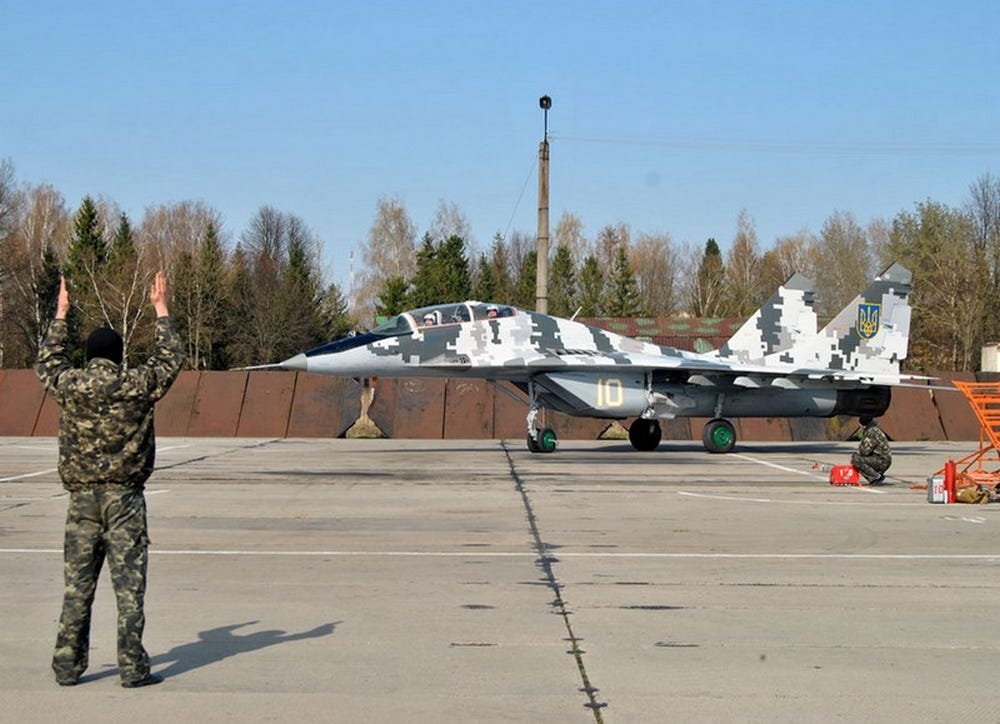
But losing so many of its warplanes has helped motivate Ukraine to repair the jets it still has. On April 4, the Ukrainian Defense Ministry announced that its technicians had restored “several” mothballed MiG-29s at an air base near Kiev. “Soon, we’ll put into operation some more aircraft which were stored,” an air force officer vowed.

It’s possible that the Russian invasion could have the surprising effect of actually saving Kiev’s air force. Absent a clear threat, the once-mighty air arm was rusting away. Now Kiev’s state factories are restoring grounded planes—and could restart suspended upgrade programs that promise to transform Soviet-era equipment.

Ukrainian MiG-29 in April. Ukrainian Defense Ministry photo
Grounded

Ukraine suffered a devastating blow in late February and March when tens of thousands of Russian troops swept across the strategic Crimean peninsula, seizing military bases and equipment and evicting thousands of Ukrainian personnel. Thousands more Ukrainian troops defected to the Russian side.

Impoverished and mismanaged during the rule of pro-Russian president Viktor Yanukovych—whose February ouster following a popular uprising motivated Moscow to invade—the Ukrainian armed forces were in no condition to mount a determined defense.

On paper, Kiev’s air force possessed an impressive line-up of 507 Soviet-designed warplanes and 121 armed helicopters, including 42 Su-27 and 80 MiG-29 fighters, 143 Su-24 and 46 Su-25 ground-attack aircraft and 48 Mi-24 gunship helicopters.

But in reality, most of the aircraft were in terrible material condition, having been idle for months, years or even decades. Just 16 Su-27s, 24 MiG-29s, 35 Su-24s and 24 Su-25s were flightworthy at the time of the Russian annexation. It’s unclear how many of the MiG-29s the Russian seized at Belbek were flyable.

A post-invasion survey found that, overall, just 15 percent of the air force’s planes were combat-ready—a figure that former defense minister Ihor Tenyukh, who resigned in March, declared “unsatisfactory.” While Russians were still on the move in Crimea, modernized Ukrainian Su-27s began flying heavily-armed combat air patrols in the central part of the country.

Unintended Consequences of US Alliances in Asia

The benefits of US alliances in Asia are often touted, but what about the costs? 
By Robert E. Kelly
April 07, 2014 

The conventional wisdom on U.S. alliances in Asia, at least in the West, Japan, and Taiwan (but not necessarily in South Korea), is that they are broadly a good thing. One hears this pretty regularly from U.S. officials and the vast network of U.S. think tanks and foundations, such as the Center for Strategic and International Studies and the American Enterprise Institute, and their many doubles in Asia. U.S. alliances, we are told, provide stability. They keep China from dominating the region. They hem in North Korea and defend the powerfully symbolic South Korean experiment in liberal democracy and capitalism. They prevent the nuclearization of South Korea and Japan and a spiraling regional arms race. In short, they re-assure.

The Chinese would almost certainly disagree with these attributions. I have argued in The Diplomat before that Chinese hegemony is less likely than U.S. and especially Japanese alarmism would have one think. Nor is it really clear that China intends to bully Asia like the Kaiser tried to in Europe (although it is looking ever more likely). But it is also true that U.S. alliances are rarely questioned on their own terms. We tend to assume these benefits – perhaps out of widespread strategic distrust of China – rather than prove them. And we also tend to overlook or downplay any negatives, unintended consequences and second order effects.

So what are the second-order effects of U.S. alliances (in Asia), and if they are costs, do they outweigh the first-order benefits? Measuring the possible negatives would be quite difficult, but then the positives listed above are also rarely measured. We just assume, for example, that the U.S. presence halts a spiraling nuclear arms race in East Asia, even though that has not happened between India and Pakistan after they both went nuclear in the 1990s. Neither India nor Pakistan has a strong U.S. alliance, nor are they governed as competently as most East Asian states are, but that has not led to the widely feared nuclear spiral between them, suggesting that U.S. reassurance might not actually be necessary for nuclear responsibility in Asia after all.

Geopolitics and the New World Order Robert D. Kaplan

ROILO GOLEZ Reads & Googles
Saturday, March 22, 2014
Geopolitics and the New World Order

This isn’t what the 21st century was supposed to look like. The visceral reaction of many pundits, academics and Obama Administration officials to Russian President Vladimir Putin’s virtual annexation of Crimea has been disbelief bordering on disorientation. As Secretary of State John Kerry said, “It’s really 19th century behavior in the 21st century.” Well, the “19th century,” as Kerry calls it, lives on and always will. Forget about the world being flat. Forget technology as the great democratizer. Forget the niceties of international law. Territory and the bonds of blood that go with it are central to what makes us human.

Geography hasn’t gone away. The global elite–leading academics, intellectuals, foreign policy analysts, foundation heads and corporate power brokers, as well as many Western leaders–may largely have forgotten about it. But what we’re witnessing now is geography’s revenge: in the East-West struggle for control of the buffer state of Ukraine, in the post–Arab Spring fracturing of artificial Middle Eastern states into ethnic and sectarian fiefs and in the unprecedented arms race being undertaken by East Asian states as they dispute potentially resource-rich waters. Technology hasn’t negated geography; it has only made it more precious and claustrophobic.

Whereas the West has come to think about international relations in terms of laws and multinational agreements, most of the rest of the world still thinks in terms of deserts, mountain ranges, all-weather ports and tracts of land and water. The world is back to the maps of elementary school as a starting point for an understanding of history, culture, religion and ethnicity–not to mention power struggles over trade routes and natural resources.

The post–Cold War era was supposed to be about economics, interdependence and universal values trumping the instincts of nationalism and nationalism’s related obsession with the domination of geographic space. But Putin’s actions betray a singular truth, one that the U.S. should remember as it looks outward and around the globe: international relations are still about who can do what to whom.

RUSSIA, CRIMEA AND LEVERAGE: AN IMPACT ON AFGHAN WITHDRAWAL?


2014-04-07 Clearly, Putin made his move in Crimea due to circumstances in Ukraine as a whole. The upheaval in Ukraine provided an opportunity to ensure that the Russian base in Ukraine could be secured within Russian national territory.

And with a play in Cyprus and Syria consolidating their position in the Mediterranean, the Black Sea port can be a springboard to broader influence and capabilities in the region. 

And naval modernization is a key part of the Russian upgrade for their military. Last year, the Russians announced their intention to modernize the fleet, but the Ukraine was hovering over its legal right to veto or attenuate the modernization.

According to a Novosti piece published on February 23, 2013:

Russia has announced plans to rearm its Black Sea Fleet and has asked Ukraine to settle the issues regarding the planned deliveries of new weapons to the naval force, Ukraine’s defense minister said on Saturday.

“Russia’s desire is understandable – technology is moving ahead, and the desire to rearm its fleet is fair. That is why it is necessary to solve all the issues at the legislative level, taking the interests of Ukraine as a non-aligned country into account,” Pavlo Lebedev was quoted by the ministry’s press service as saying.

However, Lebedev said customs formalities are not within his ministry’s jurisdiction and therefore the documents concerning the planned arms deliveries will be sent to the Tax and Income Ministry and the Finance Ministry.

The bulk of the Russian Black Sea Fleet is stationed at the port of Sevastopol in Crimea under a lease agreement with Ukraine. Moscow and Kiev signed the so-called Kharkiv Agreements on April 21, 2010, extending the fleet’s lease on the base for another 25 years after the current lease expires in 2017.

The sides have yet to agree on the fleet rearmament, taxable supply and the usage of Sevastopol’s docks.

Now there are not two sides; but it is up to Russia with regard to modernization of their own fleet in their own port on their own territory.

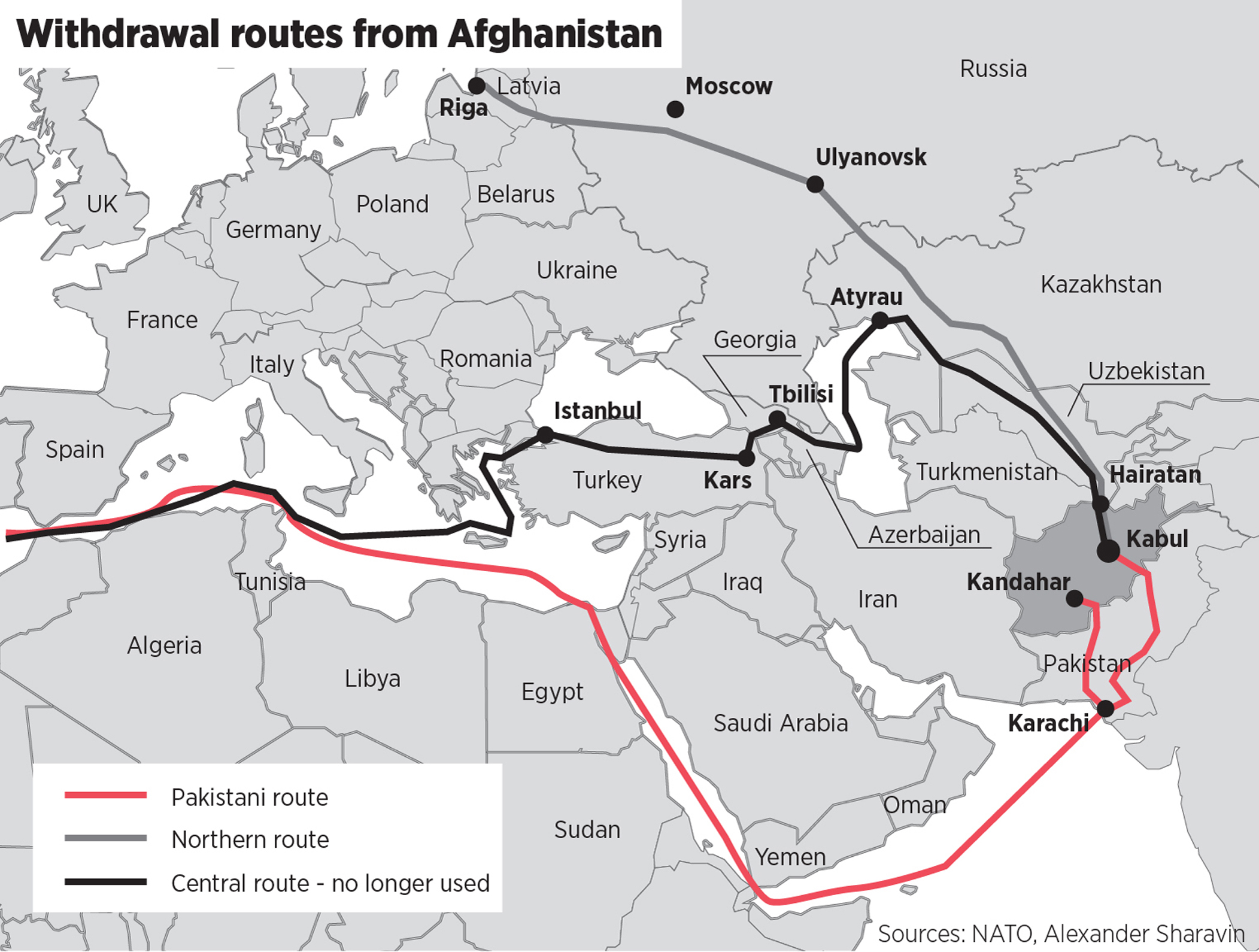
Afghan Withdrawal Routes. Credit: Russia Direct 

This is an important launch point into the Mediterranean and as such modernization of the fleet will be part of the dynamics of change in the region.

Another consideration is the possible counter-reaction of the Russians to Western sanctions.

As Alexey Feneko commented in a recentRussia Direct piece, the Russians clearly have options to respond, and to do so with an impact.

None more so than directly impacting on the US Administration’s planned exit strategy from Afghanistan. With the Afghan government in the throes of pressuring the US out, the challenge will be get the vast amount of military equipment OUT of Afghanistan.

If the Russians wish to put the hammer down, this could become more difficult, more costly, and has the potential to see a stockpile of US war materiel to remain behind in Afghanistan.

According to Feneko:

The first victim of serious Russian sanctions will be the transit of NATO supplies to Afghanistan — not only by land, but by air, too.

The Russian route is extremely important for the alliance as an alternative to the vulnerable Pakistani corridor.

The northern transit route is becoming increasingly critical ahead of the forthcoming withdrawal of NATO troops from Afghanistan this year.

Russia may denounce the 2008-09 agreements with NATO, closing off its air and land space to Brussels.

In addition, Moscow may begin to exert stronger influence over the countries of the Collective Security Treaty Organization (CSTO), which, in addition to Russia, includes Armenia, Kazakhstan, Kyrgyzstan, Tajikistan, and Belarus, encouraging them to reduce cooperation with NATO on Afghanistan.

The problem facing the US is well laid out in the map which was included in the article as well.

This is not the Cold War, but clearly part of a 21st century process of redefining the global power balance.