13 April 2014

How Western Is Germany? Russia Crisis Spurs Identity Conflict

An Essay 
By Christiane Hoffmann

Many Germans feel a special bond to Russia. This makes the Ukraine crisis particularly dangerous for Berlin because it raises important questions about the very nature of German identity. Are we as deeply rooted in the West as most believe?

The only reason my German grandfather survived as a Russian prisoner of war was that he had a beautiful singing voice. He had been drafted into the Volkssturm militia in 1944, during the final phase of the war in which the Nazi party recruited most able-bodied males into the armed forces, regardless of their age. The Russians captured him during the Siege of Breslau and he was taken to a labor camp, where he was forced to work as a logger.

There was barely anything to eat and he said the men died like flies. Every now and then, the camp cook would serve my grandfather an extra portion of the water gruel or an additional bit of bread because he had such a nice voice. At night, when he would sing his songs by the fire, the Russians would sit there as well, passing round the vodka bottle, and his voice would literally bring tears to their eyes -- or at least that's the version of events passed down in the family.

Right up to this day, Germans and Russians maintain a special relationship. There is no other country and no other people with which Germans' relations are as emotional and as contradictory. The connection reaches deep into German family history, shaped by two world wars and the 40-year existence of East Germany. German families still share stories of cruel, but also kindhearted and soulful Russians. We disdain the Russians' primitiveness, while treasuring their culture and the Russian soul.

'Tug-of-War' of Emotions

Our relationship to the Russians is as ambivalent as our perception of their character. "When it comes to the relations between the Germans and Russians, there is a tug-of-war between profound affection and total aversion," says German novelist Ingo Schulze, author of the critically acclaimed "Simple Stories," a novel that deals with East German identity and German reunification. Russians are sometimes perceived as Ivan the Terrible, as foreign entities, as Asians. Russians scare us, but we also see them as hospitable people. They have an enormous territory, a deep soul and culture -- their country is the country of Tchaikovsky and Tolstoy.

The West’s Financial Arsenal


Harold James is Professor of History and International Affairs at Princeton University, Professor of History at the European University Institute, Florence, and a senior fellow at the Center for International Governance Innovation. A specialist on German economic history and on globalization, he is … read more

APR 10, 2014

PRINCETON – The revolution in Ukraine and Russia’s illegal annexation of Crimea have generated a serious security crisis in Europe. But, with Western leaders testing a new kind of financial warfare, the situation could become even more dangerous.

A democratic, stable, and prosperous Ukraine would be a constant irritant – and rebuke – to President Vladimir Putin’s autocratic and economically sclerotic Russian Federation. In order to prevent such an outcome, Putin is trying to destabilize Ukraine, by seizing Crimea and fomenting ethnic conflict in the eastern part of the country.

At the same time, Putin is attempting to boost Russia’s appeal by doubling Crimeans’ pensions, boosting the salaries of the region’s 200,000 civil servants, and constructing large, Sochi-style infrastructure, including a $3 billion bridge across the Kerch Strait. This strategy’s long-term sustainability is dubious, owing to the strain that it will put on Russia’s public finances. But it will nonetheless serve Putin’s goal of projecting Russia’s influence.

For their part, the European Union and the United States have no desire for military intervention to defend Ukraine’s sovereignty and territorial integrity. But verbal protests alone would make the West look ridiculous and ineffective to the rest of the international community, ultimately giving rise to further – and increasingly far-ranging – security challenges. This leaves Western powers with one option: to launch a financial war against Russia.

As the former US Treasury official Juan Zarate revealed in his recent memoir Treasury’s War, the US spent the decade after the September 11, 2001, terrorist attacks developing a new set of financial weapons to use against America’s enemies – first Al Qaeda, then North Korea and Iran, and now Russia. These weapons included asset freezes and blocking rogue banks’ access to international finance.

The White House's Faulty Math on Gas Exports

APRIL 3, 2014 

The U.S. will soon be an energy exporter. But administration officials are overselling that potential. 

The Obama administration has a simple message for European countries fearful that Russia might use its energy might as a weapon: Don't worry, because the United States can export as much natural gas in a day as the entire continent uses every 24 hours. It's a comforting message for allies wondering whether to alienate Moscow by backing Ukraine's fragile government. Unfortunately, it's also wrong. 

The confusion began with President Obama. On March 26, after a meeting with European leaders, the president said that future overseas sales of American natural gas could reduce Europe's dependence on fickle energy suppliers like Russia. 

"The United States is blessed with some additional energy sources that have been developed in part because of new technologies, and we've already licensed, authorized the export of as much natural gas each day as Europe uses each day," Obama said

Secretary of State John Kerry made a similar claim in Brussels on Wednesday after a summit with European Union officials that was specifically dedicated to energy issues. 

"Our new capacities as a gas producer and the approval of seven export licenses is going to help supply gas to global markets, and we look forward to doing that starting in 2015. And we will supply more gas than all of Europe consumes today," he said

Neither statement, as expressed, is correct. For the moment, the U.S. is a net importer of natural gas, which means America consumes more gas than it produces. Down the road, the U.S. will produce enough natural gas to begin selling significant amounts to foreign countries. That could meet some of Europe's gas demand, but not all of it. 

Math is always fun, so here are the numbers in question. In 2013, the 28 countries of the European Union consumed about 44.7 billion cubic feet per day. In 2013, Europe imported about 4.6 billion cubic feet per day of liquefied natural gas aboard massive tankers, which is the way U.S. firms would send natural gas to the continent. They get the remaining 38.7 billion cubic feet per day from other sources, including local production and by pipelines. 

Dangerous Neighborhoods: U.S.-Japan Naval Cooperation

References to U.S. retrenchment are a wake-up call for increased strategic engagement.
By M. Elizabeth Guran
April 11, 2014

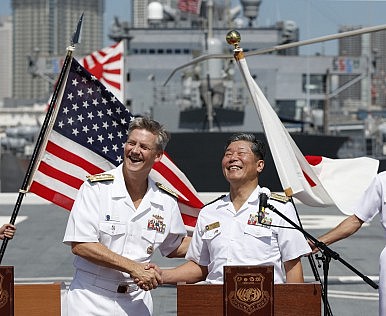
U.S.-Japan naval cooperation has long been recognized as the critical core of the U.S.-Japan security relationship; the navies’ success in rebuffing the Soviet naval threat in the 1980s is legendary. The successful cooperation between the U.S. Navy and the Japan Maritime Self-Defense Force (JMSDF) even helped to buoy the broader alliance relationship, which was suffering at the time from trade-related and other economic challenges. The key elements that were so important to the naval relationship—strategic clarity, definitive roles and missions, and operational engagement—emanated from a strong and committed security alliance.

As preparations are finalized for U.S. President Barack Obama’s upcoming trip to Japan, a reminder of what made these two navies so successful during a strategically challenging period of history can provide useful lessons. Today, the two navies once again find themselves on the front lines in the Asia-Pacific region as maritime challenges increase. Yet the U.S.-Japan security alliance is facing its own set of challenges as Washington and Tokyo come to terms with what the new environment means for them and their interests. Some analysts are calling into question the U.S. commitment to the alliance relationship. Others say that Japan is moving towards greater independence from the alliance and that it is hedging its bets to ensure that it has the ability to defend itself.

This reality is not lost on the two navies. Navies first and foremost do their countries’ bidding in support of national interests. The JMSDF, in particular, has stepped up its strategic reflection and analysis, particularly concerning the role it should play in the rapidly changing global environment and the corresponding capabilities and functions it should be developing. One such analysis that stands out over the past year is an article written by four senior JMSDF officers and published in the JMSDF Staff College Review. As part of their assessment of the current and future security environment, the authors state that the U.S. presence in the region will change in accordance with its “off-shore balancing strategy” and as such, Japan needs to be prepared to take over some of the roles and burdens previously assumed by the United States. This assumption is based on the authors’ understanding that U.S. budgetary constraints and other potential conflicts in the world will affect the U.S. ability to maintain its presence in the region.

Australia’s Search for MH370: Regional Leadership through HADR and Search and Rescue

By Gregory B. Poling, Benjamin Schaare
APR 10, 2014
http://csis.org/publication/australias-search-mh370-regional-leadership-through-hadr-and-search-and-rescue

Malaysia Airlines flight 370 (MH370) is presumed to have crashed into the southern Indian Ocean, “about as close to nowhere as it’s possible to be, but . . . closer to Australia than anywhere else,” according to Australian prime minister Tony Abbott. In response, Australia’s formidable humanitarian assistance and disaster relief/search and rescue (HADR/SAR) machine has sprung into action. While Kuala Lumpur is formally leading the investigation into what went awry with MH370, Australia has assumed responsibility for the search efforts at Malaysia’s request.

Australia’s response to the MH370 tragedy has bolstered its standing in the region and underscores why HADR/SAR should be a cornerstone of Canberra’s foreign policy and military posture. In contrast to Malaysia, which earned criticism for its early handling of the search for MH370, Australia has been seen as a capable coordinator. On April 7, Australia confirmed that its ships, using U.S. equipment, had detected signals consistent with the flight’s black box. Two days later authorities announced they were narrowing the search area considerably after detecting further signals.

Former Defense Force chief Angus Houston has been appointed head of the Joint Agency Coordination Center overseeing the search. He is responsible for coordinating the efforts of seven countries, with up to 12 planes, 14 ships, and a submarine scouring the area daily. The center provides daily updates to families and media and, more importantly, has served to stabilize and organize the search amid considerable confusion.

Australia’s prominent role in HADR/SAR operations—likely second only to the United States in the Asia Pacific—is an unqualified good for the country. It highlights Australian hard power, offers valuable experience for its military, and garners valuable goodwill in the region, all while making a real difference and helping to promote a safer, more stable Asia Pacific. But the search for the missing plane should not only remind Australia that HADR/SAR is an effective arrow in its foreign policy quiver; it should serve as a wake-up call that such efforts must be elevated above regional politics.

New Major Vulnerability Discovered in HTTPS Means Secure Data Vulnerable to Hackers

April 8, 2014
Flaw Found in Key Method for Protecting Data on the Internet
Nicole Perlroth
New York Times

The tiny padlock next to web addresses that promised to protect our most sensitive information — passwords, stored files, bank details, even Social Security numbers — is broken.

A flaw has been discovered in one of the Internet’s key encryption methods, potentially forcing a wide swath of websites to swap out the virtual keys that generate private connections between the sites and their customers.

On Tuesday afternoon, many organizations were heeding the warning. Companies like Lastpass, the password manager, and Tumblr, the social network owned by Yahoo, said they had issued fixes and warned users to immediately swap out their usernames and passwords.

The vulnerability involves a serious bug in OpenSSL, the technology that powers encryption for two-thirds of web servers. It was revealed Monday by a team of Finnish security researchers who work for Codenomicon, a security company in Saratoga, Calif., and two security engineers at Google.

Researchers are calling the bug “Heartbleed” because it affects the “heartbeat” portion of the OpenSSL protocol, which pings messages back and forth. It can and has been exploited by attackers.

The bug allows attackers to access the memory on any web server running OpenSSL and take all sorts of information: customer usernames and passwords, sensitive banking details, trade secrets and the private encryption keys that organizations use to communicate privately with their customers.

What makes the Heartbleed bug particularly severe is that it can be used by an attacker without leaving any digital crumbs behind.

Two Chief Petty Officers Walk Into a Bar...

America used to love laughing at the military. When did it become so taboo? 
APRIL 7, 2014 

War is not a funny topic, but military life used to be a bountiful source of comic inspiration. The grim reality of the battlefield prompts plenty of black humor and the rigid orthodoxies of modern military organizations have been ripe fodder for satire in the past. Given that the United States has been at war for two out of every three years since the end of the Cold War, you'd think there would be lots of dark comedy and irreverent commentary on military topics, and not just when some randy commander gets caught with his pants down. 

Yet Americans no longer see the military as a worthy target for political satire. Instead, we treat the armed services in almost reverential terms: Politicians rarely say anything remotely critical of the troops or their bemedaled commanders and it is hard to think of any important plays, movies, or television shows that poke serious fun at the Pentagon. Congress, organized religion, Wall Street, Hollywood, doctors, lawyers, teachers, sports teams, and just about every other institution in America is ripe for ridicule these days, but not the American military. 

It wasn't always this way. At the height of the Cold War, books, films, and TV shows frequently made fun of military institutions and used the horror of war as a backdrop for comedy. Think of Sgt. Bilko (with Phil Silvers as a larcenous NCO), McHale's Navy, No Time for Sergeants, or Gomer Pyle, USMC -- all popular plays or TV shows that exposed the foibles of military life to merciless scrutiny. Or consider Mister Roberts, the 1946 novel by Thomas Heggen that became a 1955 film starring Henry Fonda as the eponymous hero, James Cagney as a tyrannical ship's captain with a palm tree fetish, and Jack Lemmon as a randy and sophomoric ensign. Patriotism and sacrifice are central themes in Mister Roberts, but it also takes dead comic aim at the frustrations and follies of military life. (A 1964 sequel, Ensign Pulver, is even more farcical). You could add Hogan's Heroes (where the Nazis receive most of the comic treatment), F Troop (a sitcom about the U.S. cavalry, of all things) and especially the original book and movie version of M.A.S.H (1970). The heroes of M.A.S.H. (Hawkeye, Trapper John, and Duke) are all oddballs rebelling against the rigid idiocies of the regular Army (exemplified by Frank Burns, "Hot Lips" Houlihan, and other stuffy authority figures). You could also toss in Kelly's Heroes (1970), an amusing caper film set in World War II starring Clint Eastwood as the leader of a band of military renegades setting out to steal some hidden gold. 

Drone Battle Over Syria

Loyalists and rebels spying on each other with off-the-shelf robots
Jassem Al Salami in War is Boring

It appears the Syrian army is spying on rebel forces using the same drones that consumers can buy for just a couple thousand dollars. And the rebels might be using similar flying robots to spy right back.

It’s a do-it-yourself robot battle over war-ravaged Syria.

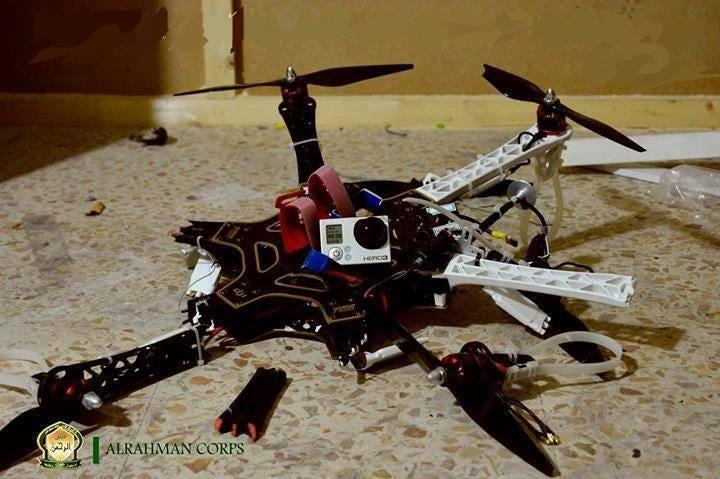
Al Rahman Corps, a Syrian rebel group in Eastern Ghouta near Damascus have displayed a six-rotor drone—a.k.a., a “hexacopter”—they claim to have shot down the over the town of Meliha during the current flare-up in fighting.

The rebels say they have shot down two of the hexacopters in recent weeks.

One of the captured hexacopters. Al Rahman Corps photo

In early April, forces loyal to Syrian president Bashar Al Assad launched an offensive to retake Meliha, an area the regime has also subjected to deliberate starvation by blocking food convoys.

America's Greatest Living President: George H.W. Bush?

Published on The National Interest (http://nationalinterest.org)


April 11, 2014

More than two decades removed from the White House, George H.W. Bush’s old friend James Baker seemingly damns him with faint praise. “Twenty-five years later, history is beginning to recognize that George Bush was the best one-term president in American history,” the former secretary of state [3]told [3] the New York Times.

The Times piece is about Bush’s improved image on the twenty-fifth anniversary of his presidency, but it’s also a reminder of why conservatives were never taken with the man. Dick Gephart praises the forty-first president. So does Dave Obey. Tom Harkin chimes in that he was better than Ronald Reagan, “much more integral to the development of American government and the process of democracy.”

If raising taxes and growing the regulatory state are your measures of greatness, than yes, Bush 41 outstrips Reagan. Not many conservatives this side of David Brooks grade on such a curve, however.

It’s also worth noting that much of Bush’s rehabilitation has been a result of his pleasant personality and personal decency. He is the nice old man who jumps out of airplanes, wears funny socks, and shaves his head in support of a young boy suffering from cancer.

Yet Bush was a temperamental conservative in the way that his more ideologically minded successors, ranging from Newt Gingrich to his own son, were not. The old Dana Carvey sketches about Bush featured the president saying, “Not gonna do it. Wouldn’t be prudent.”

“Prudence” was once a hallmark of conservatism. Indeed, one of Russell Kirk’s seminal works was titled The Politics of Prudence: Ten Conservative Principles. “Being neither a religion nor an ideology, the body of opinion termed conservatism possesses no Holy Writ and no Das Kapital to provide dogmata,” Kirk [4]wrote [4].

Kirk supported Pat Buchanan over Bush in 1992, serving as Buchanan’s Michigan state chairman. Prudence could only carry a president so far.

The perilous situation unfolding in Ukraine under President Obama and the debacle in Iraq unleashed by the younger George Bush should nevertheless remind us that prudent statesmanship is easy to take for granted. Bush 41 skillfully presided over the collapse of Soviet communism and apartheid in South Africa. Does anything the U.S. has done in response to, say, the Arab spring really compare?

Hard as it is to believe, we once had a President Bush who was capable of winning a war in Iraq.

Perhaps because it wasn’t a war of choice, Saddam was the aggressor, and there was a genuine international coalition.

12 April 2014

Dancing with the nuclear djinn


April 12, 2014
Praveen Swami

The Bharatiya Janata Party’s election manifesto promises to review India’s nuclear doctrine. What does this portend?

He saw the signs of the approaching doomsday all around him: in moral degradation, in casual sex, in the rise of western power, in space travel, in our high-tech age. God, wrote Pakistan’s nuclear-weapons guru Sultan Bashiruddin Mahmood in Mechanics of the Doomsday..., had not privileged man to know when it would come, but “the promised Hour is not a far off event now.” It would come as a “great blast,” perhaps “initiated by some catastrophic man-made devices, such as sudden detonation of a large number of nuclear bombs.”

Long mocked by his colleagues for his crazed beliefs — the physicist Pervez Hoodbhoy records him as saying, “djinns, being fiery creatures, ought to be tapped as a free source of energy” — and condemned to obscurity after his arrest on charges of aiding the Taliban, Mr. Mahmood may yet be remembered as a prophet.The doctrine debate

India’s next government will, without dispute, find itself dancing with the nuclear djinn Mr. Mahmood helped unleash. In its election manifesto, the Bharatiya Janata Party has promised to “study in detail India’s nuclear doctrine, and revise and update it to make it relevant to [the] challenges of current times.” Mr. Seshadri Chari, a member of the group that formulated this section of the party’s manifesto said: “why should we tie our hands into accepting a global no-first-use policy, as has been proposed by the Prime Minister recently?”

The debate will come in dangerous times. Pakistan has been growing its arsenal low-yield plutonium nuclear weapons, also called tactical or theatre nuclear weapons. Estimates suggest some 10-12 new nuclear warheads are being added to the country’s 90-110 strong arsenal, and new reactors going critical at Khushab will likely boost that number even further. New Delhi must respond — but the seeds of a nuclear apocalypse could sprout if it gets that response wrong.

Mr. Chari’s grasp of fact doesn’t give much reason to hope for much else: India’s no-first-use commitment was made by a government his party led, not Prime Minister Manmohan Singh. In 1998, battling to contain the international fallout from the Pokhran II nuclear tests, Prime Minister Atal Bihari Vajpayee promised Parliament that “India would not be the first to use nuclear weapons.” Later, in August 1999, the National Security Advisory Board’s draft nuclear doctrine stated that India would only “retaliate with sufficient nuclear weapons to inflict destruction and punishment that the aggressor will find unacceptable if nuclear weapons are used against India and its forces.”

The future of Indo-US ties now lies squarely on America's shoulders

By KANWAL SIBAL

PUBLISHED: 7 April 2014 |

After entering a green light mode, India-US relations have slipped into an amber mode.

How soon we can get back into smooth circulation will depend largely on the US, as the responsibility for the malaise affecting our ties rests mainly on its shoulders.

Misjudgment

It is irrelevant whether the current US ambassador to India has resigned or has chosen retirement. The ambassador would have done two years by the time she leaves, not an abnormal tenure by any means. With a new government in New Delhi in the offing, a change in ambassadors would not be inopportune even in the normal course of things.

That the present ambassador has contributed to driving the relationship into a corner despite a pro-US government in New Delhi makes the change even more advisable.

From our perspective, the present ambassador has outlived her utility. With regard to the State Department role in Khobragade's arrest and the evacuation of the maid's family, either the ambassador misjudged our reaction and therefore gave faulty advice, or she gave the right counsel but it was disregarded, which would suggest that her clout in Washington is limited.

In either case her usefulness, in any serious attempt to put the relationship back on track, is questionable. A more serious political misjudgment by the US, for which the ambassador cannot escape blame, is the failure to mend political fences with Narendra Modi in a timely manner following the European example.

Worse for her credibility, the day she met Modi, the State Department declared that the visa policy towards him remained unchanged. The ambassador would have undoubtedly been consulted beforehand about how her overture to Modi would be "balanced" at the Washington end, which further underscores the inept political handling of the US relationship with the BJP's prime ministerial candidate.

To lift the morose mood in India-US ties, the US has to decide whether its strategic interest in India has wider geopolitical objectives, or depends on the redressal of shortcomings in our current trade, investment and IPR polices that affect the interests of US corporations in select sectors.

If US interest has flagged because the promised opening of the Indian market has not occurred and our growth rate has fallen, can one conclude that the US-India "strategic partnership" is largely a function of board room strategies of US corporations? If so, is the US hyping up its strategic partnership with India to essentially gain wider access to our expanding market?

The coming era of water wars

http://chellaney.net/2014/04/10/the-coming-era-of-water-wars/

Posted on April 10, 2014

Upstream hydro-hegemony threatens to trigger downstream upheaval

By Brahma Chellaney, The Washington Times

There is a tongue-in-cheek saying in America — attributed to Mark Twain, who lived through the early phase of the California water wars — that “whiskey is for drinking and water is for fighting over.”

It highlights the consequences, even if somewhat apocryphally, as ever-scarcer water resources create a parched world. California currently is suffering under its worst drought of the modern era.

Adequate availability of water, food and energy is critical to global security. Water, the sustainer of life and livelihoods, is already the world’s most exploited natural resource.

With nature’s freshwater renewable capacity lagging behind humanity’s current rate of utilization, tomorrow’s water is being used to meet today’s need.

Consequently, the resources of shared rivers, aquifers and lakes have become the target of rival appropriation plans. Securing a larger portion of the shared water has fostered increasing competition between countries and provinces.

Efforts by some countries to turn transnational water resources into an instrument of power has encouraged a dam-building race and prompted growing calls for the United Nations to make water a key security concern.

More ominously, the struggle for water is exacerbating impacts on the earth’s ecosystems. Humanity is altering freshwater and other ecosystems more rapidly than its own scientific understanding of the implications of such change.

Degradation of water resources has resulted in aquatic ecosystems losing half of their biodiversity since just the mid-1970s. Groundwater depletion, for its part, is affecting natural streamflows, groundwater-fed wetlands and lakes, and related ecosystems.

The future of human civilization hinges on sustainable development. If resources like water are degraded and depleted, environmental refugees will follow.

Sanaa in Yemen risks becoming the first capital city to run out of water. If Bangladesh bears the main impact of China’s damming of River Brahmaputra, the resulting exodus of thirsty refugees will compound India’s security challenges.

International law only applies when it suits the strong

http://chellaney.net/2014/04/07/international-law-only-applies-when-it-suits-the-strong/

Posted on April 7, 2014

Brahma Chellaney, The National 
 
The looming cold war triggered by the US-supported putsch in Kiev that deposed Ukraine’s constitutional order and by Russia’s muscular riposte, including annexing Crimea, underscores the major powers’ unilateralist approach to international law.

A just, rules-based global order has long been touted by powerful states as essential for international peace and security. Yet there is a long history of world powers flouting international law while using it against other states.

Russian president Vladimir Putin’s action in annexing Crimea violated Ukraine’s territorial integrity, even though it followed a referendum in that historically Russian region, where the majority of residents indisputably lean toward Russia. The annexation represents a flagrant breach of international law.

This, however, cannot obscure the fact that the US and Nato have repeatedly shown contempt for international law. There’s a long list just for the past 15 years – the bombing of Serbia, the separation of Kosovo from Serbia, the invasions of Afghanistan and Iraq without UN Security Council mandates, the overthrow of Muammar Qaddafi’s regime through aerial bombardment, the aiding of a still-raging bloody insurrection in Syria, and renditions and torture of terror suspects. The US has refused to join a host of critical international treaties – ranging from the 1982 UN Convention on the Law of the Sea to the 1998 International Criminal Court Statute. Even its National Security Agency’s Orwellian surveillance policy mocks international law.

In this light, is it any surprise that the US’s moral authority and international standing have eroded?

A DREAM OF MODERNITY - EU membership is not Turkey’s only problem

 http://www.telegraphindia.com/1140412/jsp/opinion/story_18175989.jsp#.U0iOjvmSycU

Hordes of mosquitoes were battening on a fox caught in a thicket when a tiger offered to clear them all. “No,” replied the fox. “These mosquitoes are already almost satiated with my blood. If you drive them away, there’ll be a fresh lot with hungry stomachs thirsting for more blood!” That ingenious explanation for Turkey’s ruling Justice and Development Party sweeping the recent municipal polls was given to me in the ancient town of Selçuk near the classical ruins of Ephesus and a house where some believe the Virgin Mary lived and died.

Turkey is unique. No other imperial power has with such conscious ostentation abjured imperialism. No other nation has tried to deny its sustaining faith with similar flamboyance. No other country so determinedly seeks the benediction of its former colonies in the European Union. I asked the Turk in Selçuk who told me of the fox and mosquitoes why they sought EU membership and he answered simply, “Because we want to be modern.” It’s the same reason that prompted Sultan Abdülmecid I to abandon the sprawling oriental grandeur of Topkapi Palace and engage a French-Armenian architect in 1843 to create the copycat Europeanization of Dolmabahçe Palace on the Bosphorus.

Rampant Euroscepticism in some countries and crippling financial crises in others are brushed aside. Many Turks believe EU membership will transform them as miraculously as Mustafa Kemal Ataturk, the great modernizer, thought banning the fez and the veil and abolishing the caliphate would turn Muslim Turks into secular Europeans. “The EU will only create a slump to lower wages because it can’t compete with China and India,” a Portuguese visitor warns. He is ignored.

McKinsey’s Vikram Malhotra: ‘India Has to Evolve’

Mar 28, 2014 

A few years ago, with a 9% plus GDP growth rate, India seemed set to become an economic powerhouse. Growth has now slipped to below 5%, and the country has been likened to a fallen angel. “What went wrong? Most of us have found ourselves asking the question, especially this past year.” With those words, the organizers of the 18th Wharton India Economic Forum, held recently in Philadelphia, introduced the theme of the conference: “Time to Reboot.” Vikram Malhotra, McKinsey & Company’s chairman of the Americas, provided his diagnosis of the challenges, and offered his prescriptions for re-imagining India as a land that fully delivers on its great potential.

What are India’s strengths — and challenges — in the battle to achieve greater prominence in the global economy? Malhotra began with a brief history lesson: Until the 19th century, India and China enjoyed a combined share of almost 50% of global GDP. But their share dropped precipitously after the newly industrialized nations of Europe and the U.S. expanded rapidly. In recent years, noted Malhotra, both China and India have been growing rapidly. Yet it remains to be seen whether India’s rate of growth will rival that of China over the long term.

In this race, natural resources aren’t India’s most significant advantage; rather, it’s the enormous scale and skills of its human capital. As Malhotra noted, one out of every six people in the world lives in India. Even more impressively, one out of every four of the approximately three billion people under the age of 25 today is Indian. “We turn out some 1.5 million college graduates a year. If you think about the power of those demographics and what it might do to the world in 15-20-25 years, it is quite remarkable. That gives us an enormous advantage. It is obvious that this young demographic is a growing market, and that you also have great entrepreneurs.”

Why Facebook Is So Interested In India’s Elections


Inside the social network’s quest to reach voters in the biggest election ever.
April 9, 2014
BuzzFeed Staff


India’s general election this year will be the largest democratic election that has ever been conducted in the world — and also one of Facebook’s most ambitious pushes into electoral politics.

As Indians head to the polls over the next month to elect a new ruling party and prime minister, Facebook has launched a multifaceted campaign in the country, exploring what people want from Facebook on a political level and introducing new features, as likes have surged for candidates.

The scale of the elections, estimated to cost $600 million, is staggering. Ballots will be cast at 930,000 polling booths and 1.4 million electronic voting machines, with 11 million people — both civilians and government officials — helping facilitate. More than 100 million Indians are newly eligible to vote, bringing the total Indian electorate up to 815 million people.

Half of India’s total population is younger than 24, and about 150 million people in India’s total electoral pool are first-time voters. According to some estimates, more than 40% of India’s eligible voters are between 18 and 35 years old. Surveys have found that 70% of all Indian students own smartphones. This is all to say: For the first time in Indian history, there is a significant overlap between the urban, educated, tech-savvy India and the India that lines up to cast its vote.

“Our mission is to make the world more open and connected,” Facebook’s Public Policy Manager Katie Harbath told BuzzFeed in a phone interview. “Part of that is helping to connect citizens with the people who represent them in government. Elections are the first way that citizens have that opportunity to voice their opinions.”

The scale of the Indian elections is also an enormous opportunity for Facebook, which recently announced its ambitions to reach 1 billion users in India. Already, India is the only country aside from the United States where Facebook’s consumer base exceeds 100 million, and it’s certainly the only country in the world where Facebook can hope to corral 1 billion new users.

“Of the 800+ million people eligible to vote in India, 170 million of them are on the Internet and well over half of Internet users in India are using Facebook,” Facebook spokesperson Andrew Stone told BuzzFeed in an email. “In fact, you may have seen that just this morning we made the announcement about having reached 100 million active Facebook users in India.”

Elections serve as an excellent recruiting tool for Facebook and similar initiatives have been deployed in other nations holding elections in recent years. This year, that includes Brazil, Indonesia, and Colombia, as well as the European parliament elections. Last year, Facebook launched similar initiatives in Germany and Australia, when those countries were hosting elections.

And Facebook, in turn, is emerging as an increasingly central medium for electoral politics, with both paid ads and widely shared content within its networks emerging as key ways for politicians to communicate with voters.

So far, the Facebook India campaign has been both exploratory but also assertive, gradually introducing new features into the feeds of users.

On March 26, a week and a half before voting first opened, Facebook India put out an open call to ask users how they were using Facebook in the elections.

In early March when the elections were first announced, Facebook India launched an election tracker that tracks mentions of the leading candidates and parties, ranking them from most mentioned to least. This is modeled after a similar appFacebook launched in the United States during the 2012 presidential elections.


As of Wednesday, the top of the Facebook India homepage now features an “I’m a Voter” button, which will remain visible for the duration of the Indian elections. Clicking it allows users to share with all of their friends that they voted. The visibility of this button is contingent on voting eligibility; it is only visible to Facebook users over the age of 18, and only on days when voting is taking place in the region they are in.

The idea is to drive Indians to the polling stations. A UC San Diego study during the 2012 U.S. presidential elections found that social pressures, specifically on social networks and specifically from close connections, are a major influence on whether individuals vote or not. Although 4% of Facebook users who clicked the “I voted” button on Facebook admitted to not actually having voted, rates of voting were highest among those who had seen a message seeing that their friends had voted — particularly close friends.

In an election already historic for its scale, this Facebook initiative might — this is the hope — increase voter turnout by acting as a multiplier.


According to data provided by Facebook, mentions of the word “election” increased by 561% among Facebook users in India within the first 24 hours following the announcement of this year’s elections, and mentions of the “Lok Sabha” (India’s lower house of parliament, in which parties are competing for seats) increased by 150%.

Narendra Modi, one of of India’s two front-running prime ministerial candidates, has more than 12 million likes on his Facebook page (having gained 48,555 in the last day alone, at the time of writing). Among global politicians’ Facebook popularity, that number ranks him second only to President Barack Obama. In the last week, Facebook pages for Indian politicians and parties have garnered likes faster than any other political pages worldwide.

HISTORIC AFGHAN POLLS: PEOPLE’S REBUFF TO THE TALIBAN – ANALYSIS


By C Uday Bhaskar

Afghanistan went to the polls on a rainy Saturday, April 5 , amidst considerable uncertainty, visible enthusiasm and deep anxiety about the violence and disruption that the Taliban had threatened. Yet the stoic determination of the Afghan electorate prevailed, and notwithstanding pockets of violence and reports of many voters being turned away, more than seven million voters exercised their franchise – which is more than 50 percent of the estimated 12 million eligible voters. This by itself is a strong rebuff to the Taliban who have described the election as a fraud engineered by the hated US and its Western allies.

Yes, there was violence and bloodshed despite the robust security arrangements that saw as many as 350,000 Afghan security and police personnel deployed to oversee the election. Prior to the polls, a German photojournalist was killed, ironically by a police official, and on the actual polling day some areas reported violent disruption and attacks. Afghan Interior Minister Omar Daudzai stated that four civilians, nine police and seven soldiers had been killed in violence during election day but also added that many attacks had been thwarted.

The elections were a long-drawn process with a total of eight candidates in the fray to replace President Hamid Karzai. However, among them only three are seen as serious contenders for the hot seat in Kabul. They include Abdullah Abdullah – a Tajik leader and former foreign minister and the second best known name in Afghan politics; Zalmai Rassoul – a former foreign minister and national security adviser and perceived to be Karzai’s candidate; and Ashraf Ghani Ahmadzai – a former finance minister and a respected technocrat but with a limited political base.

As per the election schedule, counting of votes will be completed by April 20 and preliminary results are expected by the 24th. However, none of the three top aspirants are expected to obtain more than the required 50 percent of vote to declare a clear winner, and as in the last 2009 election many complaints are expected about booth capturing and invalid votes. The review period will go on till April 27 and final results are expected only on May 14. And if the predicted result occurs, meaning that no candidate receives more than 50 percent, then a run-off will be held on May 28 and the final result can go into June-July.Thus, this will be a very long process and the Saturday election is only the first step.

Afghan Stability: New Equations

With the NATO drawdown, Afghanistan’s neighbors will have a growing role to play in the country’s stability. 
By SK Chatterji
April 09, 2014


With Afghanistan’s presidential election likely heading for a second round, it may be some time before the result is known. One issue the new president will need to address, though, is the Bilateral Security Agreement with the U.S., which incumbent Hamid Karzai has resolutely refused to sign, despite considerable pressure from the U.S. and the looming pullout of the International Security Assistance Force (ISAF). Karzai’s stance may seem baffling, especially since the BSA was endorsed by a Loya Jirga last November. But he may be making a pragmatic judgment as to Washington’s long-term ability to keep the peace in Afghanistan.

The “zero option” that Washington has enunciated, if executed, will create a power vacuum in Afghanistan. Even if that option were avoided and a limited American force of approximately 3,000 were maintained, there would still be a steep drop in area dominance capabilities, with Afghan National Security Forces left almost entirely in charge. The Taliban would doubtless attempt to fill the vacuum.

Equally certain, Afghanistan’s neighbours would not be comfortable with a radical Taliban exporting terror to their countries across porous borders. Even those that do not share borders with Afghanistan would be concerned. What role might these countries play in the wake of the NATO drawdown?

Among Afghanistan’s more powerful neighbors is Iran. A Shia-majority nation, it feels a sense of responsibility for the considerable Shia population in Afghanistan. The two countries also share ethnic and linguistic overlaps. Iran’s concern for the Shia of Afghanistan is evidenced in its past responses. Following the 1979 Russian takeover and Afghan resistance, Iran provided support for the Persian-speaking Shia groups. When the Taliban came to power, Iranians supported the Northern Alliance partners. In 1998, when the Taliban overran Majar-e-Sharif and massacred thousands of Hazaras and 10 Iranians with diplomatic papers, Iran deployed its Army along its borders with Afghanistan.

Civilian Government Outwits Pakistan Army

By Karamatullah K Ghori
Published: 10th April 2014

As India enters the home stretch of a crucial electoral battle in its decades-old seasoned democracy, next-door Pakistan’s civilian government seems well poised on the threshold of its still-wobbly democracy to challenge the decades-old military supremacy in the country.

Ironically, the turf to Nawaz Sharif’s civilian government to challenge, if not yet assault, the ramparts of military power in Pakistan has been furnished by the shenanigans and antics of its last Bonaparte, General Pervez Musharraf.

Musharraf’s indictment, finally, on March 31 by the special court trying him for treason under Article 6 of the Constitution—for having trampled and subverted it not once but twice—is arguably a huge leap forward by the civilian government to assert its democratic power, something taken for granted in any normal democratic set-up. But Pakistan all through its years and decades has been anything but a normal country.

Why Musharraf’s indictment is being interpreted by pundits and pollsters alike as a game-changer is because of the uniquely privileged status that generals in Pakistan have had up until this watershed. Generals—soldiers-of-fortune sans sophistry—seized political power with impunity and literally got away with the murder of democracy. A Pakistani Bonaparte could rest assured that he’d readily get from an obliging and accommodating judiciary a cachet of legality without much ado. The erstwhile judicial mandarins and satraps had coined this one-size-fits-all formulation that went by the sobriquet of “law of necessity”.

Military takeovers were condoned with munificence as a necessary evil to save the nation and its much-flaunted “ideology”. The generals had assumed the mantle of saviours of its frontiers and guardians of its ideological bequest.

The Challenges to Transition in Afghanistan: 2014-2015

Alliance Between Afghan and Pakistan Taliban Getting Closer, Afghan Commander

April 10, 2014
Afghan commander: cross-border Taliban alliance growing stronger
Reuters

Taliban militants in Pakistan have established an increasingly close relationship with insurgents from across the border in Afghanistan, supplying them with explosives and well-trained fighters, a senior Afghan army commander said on Wednesday.

The Taliban in Pakistan have always operated separately from their Afghan namesakes, fighting to topple the democratically elected government in Islamabad and establish a strict Islamic sharia state in the nuclear-armed nation of 180 million people.

But in recent weeks the two groups have secretly agreed to work together, with Pakistani militants announcing a ceasefire with their government in order to preserve militant bases used to stage cross-border attacks.

Major General Muhammad Shareef Yaftali, in charge of several eastern provinces on or near the Afghan border with Pakistan, said this relationship was growing stronger.

"They are working together now. They are going to hold this relationship. It helps them," Yaftali, commander of the 203rd Corps, said at a military base in Afghanistan’s Paktia province.

"The Afghan and Pakistani Taliban have the same ideology. They are the same people. They are of the same school."

The alliance complicates the picture for Yaftali’s troops as they try to bring law and order to some of the most violent and inaccessible areas of Afghanistanwhere militants linked to al Qaeda are believed to be holed up in remote mountain lairs.

But some are sceptical about the Taliban’s current ability to inflict heavy losses, pointing to the fact that there were no major attacks during last weekend’s presidential election in Afghanistan which the insurgents had vowed to disrupt.

Afghanistan has a notoriously bad relationship with Pakistan and often accuses its neighbour, as well as its ISI intelligence agency, of supporting militants and helping stage attacks on Afghan soil - a charge furiously denied by Pakistan.

Militant commanders have told Reuters the recent ceasefire was mainly imposed on the Taliban by the shadowy Pakistani Haqqani network which fears that an offensive by the Pakistani military in their North Waziristan stronghold could hamper their own push to carry out attacks in Afghanistan.

The changing nature of the war is a concern to commanders on the ground, particularly those like Yaftali who are deployed near Afghanistan’s porous and lawless border with Pakistan where Taliban attacks on security forces and civilians occur daily.

It also comes at a worrying time when U.S.-led forces are preparing to pull out by the end of the year, leaving Afghan troops to tackle the insurgency largely on their own.

Operations are winding down across the country. At Camp Thunder, a sprawling base near the city of Gardez where Yaftali spoke to reporters, U.S. army officers are working with his men only as advisers and leave front-line fighting to Afghan forces.

Yaftali said many students brainwashed in strict Islamic religious schools, or madrassas, in Pakistan had crossed the border to join forces with the Taliban. He said some 30,000 madrassas were shut in Pakistan last year, prompting an exodus of radically minded fighters.

"If one group is defeated they bring new fighters and it is easy for them to do that," said Yaftali, whose command extends over an area of about 83,000 square kllometers with a population of five million people.

He said most of the explosive devices also came from Pakistan. “There are no explosives-making factories in Afghanistan,” Yaftali said. “All the explosives enter Afghanistan from Pakistan. We are close to North Waziristan and there are Taliban training ground and funding sources.”