7 June 2014

Nigeria: Pride and Prejudice


June 4, 2014: The government revealed that it is prosecuting fifteen officers (at least four of them generals) for aiding Boko Haram. It’s unclear if this was done just for money or because of intimidation or sympathy for the Islamic radical cause was also involved. Some Moslem officers have made no secret of their sympathy for Boko Haram and radical solutions to the many problems that plague the country. The accused officers are said to have supplied Boko Haram with weapons, ammo and equipment as well as information on planned military operations. This was said to have explained the large number of army units ambushed by Boko Haram or raids that found Boko Haram personnel already gone. 

Such corruption is not unknown in the military and is quite common throughout Africa. Some of the accused have already been found guilty. The investigations that uncovered all this was part of a growing anti-corruption effort. Often such investigations of military personnel are suppressed if the officers are working for powerful politicians. But working for widely hated Islamic terrorists like Boko Haram made these offenders easy targets and other military personnel had no hesitation in providing information and testimony. Such treasonous actions had been rumored for months, as soldiers noted suspicious activity by some of their superiors and spoke to civilians and even journalists about it. 

These corruption prosecutions have made many senior politicians and their mass media supporters wary of accepting foreign assistance to deal with the mass kidnapping. The fear is that more attention from foreigners will simply uncover and publicize more of the corruption in Nigeria. All this misbehavior is not news to most Nigerians, but the senior people like to pretend it doesn’t exist when they travel abroad to enjoy all their stolen wealth. With the international media doing more stories on how widespread corruption is in Nigeria the most corrupt (and wealthiest) officials won’t be able to pretend to just be “successful businessmen” while outside the country. This sort of thing could escalate into UN “crimes against humanity” investigations and all sort of unpleasantness. Best to keep the foreigners at arm’s length and justify that with appeals to nationalism and self-reliance. So foreigners sent to help are told to work quietly and with little or no media contact. The foreigners have largely complied, rather than risk being told to leave. Western nations have sent several surveillance aircraft to assist Nigeria in finding and recovering over 200 kidnapped girls. Britain has sent an ASTOR radar aircraft to Ghana while the U.S. has an MC-12W operating from Niger, a Global Hawk UAV from Sicily and three UAVs from Chad. Nigeria is reluctant to allow foreign aircraft to operate from inside Nigeria. 

How Terrorists Win


http://kingsofwar.org.uk/ 

Today the UK government is beginning a full court press to legitimise secret trials for people suspected of terrorist offences. Chris Grayling MP, the justice secretary, went on Radio 4 to defend the need for secret trials in ‘very, very rare’ circumstances. We can trust the government in this matter, because ‘very, very rare’ circumstances are likely to stay ‘very, very rare’ when political circumstances change. Take, for example, depriving UK citizens of their British citizenship. As recent reporting by the Bureau of Investigative Journalism demonstrates, we have nothing to worry about. Between the 2002 Immigration, Asylum and Nationality Act, and 2010, when the Labour Government was kicked out of office, the extraordinary step of stripping a dual national of British citizenship was used at least three times: once against Abu Hamza, once to strip David Hicks of his UK citizenship after he had already been to court to get it, and lastly Hilal al-Jedda, a man made stateless by then Home Secretary Jacqui Smith. Since the ascent of Cameron and Clegg, the UK Government has stripped at least fifty people of British citizenship. Law designed with Hamza in mind now allows the Home Secretary to wash the UK’s hands of anyone the government deems undesirable, and in doing so, frees the government from pesky human rights obligations owed to British citizens. Some of those citizens end up dead, by American hands, shortly after such citizenship-stripping has taken place.

Let’s not kid ourselves: some of the people deprived of UK citizenship are (or were) probably very dangerous individuals, as are many people taken to court on terrorism-related offences. But are these measures to ‘combat’ terrorism worth the damage that they do to British society? I can see the need for changing particular laws to take account of new threats to society (people willing to blow themselves up, people willing to conduct mass casualty attacks), but I can’t, for the life of me, see how two men warrant the sacrifice of a basic principle of English law. Secret trials make sense when one views the legal system in terms of ‘output’ and ‘efficiency’ and ‘performance’, but make no sense at all when one considers the values of accountability and democracy that are meant to underpin them. In war time, most states adopt some form of emergency measures for security, but the British government is studious in stating that ‘we’ are not at war with terrorists, no matter how much they consider themselves to be at war with us. That makes the introduction of secret trials for terrorist suspects all the more dangerous, because it will become the new ‘normal’ in short order. After all, if this is done on the government’s say-so, and there is no-one else allowed to observe the case or proceedings, then who will be able to argue against it? This, I think, is how the terrorists win: they make British society so afraid of two people that we’re willing to sacrifice the basic principles of justice in the UK in order to lock them away for a while. These men are so scary, in fact, that the government can’t tell us anything about them, for our own good.

America's Energy Edge

The Geopolitical Consequences of the Shale Revolution
A pumpjack brings oil to the surface in the Monterey Shale, California, April 29, 2013.

Only five years ago, the world’s supply of oil appeared to be peaking, and as conventional gas production declined in the United States, it seemed that the country would become dependent on costly natural gas imports. But in the years since, those predictions have proved spectacularly wrong. Global energy production has begun to shift away from traditional suppliers in Eurasia and the Middle East, as producers tap unconventional gas and oil resources around the world, from the waters of Australia, Brazil, Africa, and the Mediterranean to the oil sands of Alberta. The greatest revolution, however, has taken place in the United States, where producers have taken advantage of two newly viable technologies to unlock resources once deemed commercially infeasible: horizontal drilling, which allows wells to penetrate bands of shale deep underground, and hydraulic fracturing, or fracking, which uses the injection of high-pressure fluid to release gas and oil from rock formations.

The resulting uptick in energy production has been dramatic. Between 2007 and 2012, U.S. shale gas production rose by over 50 percent each year, and its share of total U.S. gas production jumped from five percent to 39 percent. Terminals once intended to bring foreign liquefied natural gas (LNG) to U.S. consumers are being reconfigured to export U.S. LNG abroad. Between 2007 and 2012, fracking also generated an 18-fold increase in U.S. production of what is known as light tight oil, high-quality petroleum found in shale or sandstone that can be released by fracking. This boom has succeeded in reversing the long decline in U.S. crude oil production, which grew by 50 percent between 2008 and 2013. Thanks to these developments, the United States is now poised to become an energy superpower. Last year, it surpassed Russia as the world’s leading energy producer, and by next year, according to projections by the International Energy Agency, it will overtake Saudi Arabia as the top producer of crude oil.

Much has been written lately about the discovery of new oil and gas deposits around the world, but other countries will not find it easy to replicate the United States’ success. The fracking revolution required more than just favorable geology; it also took financiers with a tolerance for risk, a property-rights regime that let landowners claim underground resources, a network of service providers and delivery infrastructure, and an industry structure characterized by thousands of entrepreneurs rather than a single national oil company. Although many countries possess the right rock, none, with the exception of Canada, boasts an industrial environment as favorable as that of the United States.

The American energy revolution does not just have commercial implications; it also has wide-reaching geopolitical consequences. Global energy trade maps are already being redrawn as U.S. imports continue to decline and exporters find new markets. Most West African oil, for example, now flows to Asia rather than to the United States. And as U.S. production continues to increase, it will put downward pressure on global oil and gas prices, thereby diminishing the geopolitical leverage that some energy suppliers have wielded for decades. Most energy-producing states that lack diversified economies, such as Russia and the Gulf monarchies, will lose out, whereas energy consumers, such as China, India, and other Asian states, stand to gain.

CYBER SECURITY RESEARCHERS SPOT 1ST EVER ANDROID SMARTPHONE RANSOM ATTACK – ENCRYPTS DATA FILES


June 5, 2014 · by Fortuna's Corner

Researchers Spot First Ever Android Ransom Attack – ENCRYPTS Data Files


John Dunn writes in the June 4, 2014 online edition of Techworld.com, that “cyber security researchers working for the firm ESET have discovered the first ever malware capable of encrypting data files on an Android smartphone — as part of a ‘Cryptolocker-style’ ransom attack.”

“Called ‘Simplocker,’ the Russian-language Trojan — scan’s the device’s SD card, or internal storage, encrypting data files it finds there with a range of extensions, including obvious ones such as .jpg, .doc, .avi, and mp4. The encryption used is strong,” writes Mr. Dunn, — “256-bit AES. The splash screen then states [translated from Russian]: “WARNING: Your phone is locked! The device is locked for viewing and distribution [of] child pornography, zoophilia, and other perversions,” before demanding 260 Ukrainian Hryvnia (about $9) payable via MoneXy in return, — for the return of data.” “Probably the first such attack of this kind,” says Mr. Dunn, “was ‘Android Defender’ last June — which demanded payment for cleaning the device of non-existent malware.”

Mr. Dunn notes that “an unusual feature is that the malware’s command and control (C and C) operates using the ToR anonymity service. It also doesn’t appear to supply a conventional unlock key, working out which victims have paid through this encrypted channel — after relating money transfers to the smartphone’s IMEI number. “ESET suspects the malware’s prevalence is currently ‘very low,’ notes Mr. Dunn. “So far,” he adds, “the malware appears to be targeting Android users in Russian=speaking countries – who contract it after downloading an app called ‘Sex xionix’.’ from a third-party app store.”

“If the threat is low, the intent is not,” contends Mr. Dunn. “What starts on Russian malware sites has a habit of eventually spreading to more complex attacks — in other markers.” “There is no doubt,” cyber security researchers say, “that [this] encryption malware — in its most severe [form] — is coming to the wider population of Android devices at some point.” ESET added that their “analysis of the Android/Simplock.a revealed that we were most likely dealing with a proof-of-concept; or, a work in progress.” But, the company also acknowledged that “it is at pains to distinguish Simplocker from other types of mobile malware that use the ransom in annoying — but, less serious ways. A recent example, the company noted, was the Reveton-linked lockscreen attack, that demanded a ransom after pestering the user with pop ups that make the smartphone hard to operate.” Furthermore, ESET said that “the malware is fully capable of encrypting the users files, which may be lost if the encryption key is not retrieved.”

The End of IR Theory as we Know it, Again

June 4, 2014
Randall Schweller, Maxwell’s Demon and the Golden Apple: Global Discord in the New Millennium (Johns Hopkins University Press, 2014)

The study of international relations (IR) has produced a heavy body count. From formal rational choice theory to the “Golden Arches Theory of Conflict Prevention,” nearly every theory that has been utilized to explain international outcomes has also been declared dead, fatally flawed, or otherwise in danger of impending demise. The life of an IR theory is truly nasty, brutish, and short. Scholars periodically check even well-established theories for a pulse. More recently, however, some political scientists have advanced a broader claim: traditional IR theory itself is dead.

The end of traditional IR theory does not mean that IR scholars will cease to theorize. On the contrary, new theories will be necessary to replace old ones that have been rendered irrelevant by a changing international system. According to proponents of this argument, traditional IR theories—often divided into three broad classes of realism, liberalism, and constructivism—have yielded much internecine fighting and little theoretical progress. The field made war, but war did not make the field much better. IR theory thus failed to keep up with a rapidly evolving international system. So say the heralds of traditional IR theory’s death.

In Maxwell’s Demon and the Golden Apple: Global Disorder in the New Millennium, Randall Schweller makes his entry into this debate, arguing in support of the thesis that IR theory as we know it is finished. While acknowledging that previous declarations to this effect have proven premature, he warns that, “The sky may indeed be falling this time.” An extension of a 2010 article, the argument is couched in terms familiar to students of IR. Anarchy, polarity, and other such fixations of IR scholars are well represented here, and given Schweller’s contributions to the realist tradition, his sympathy for that school of thought will come as no surprise. More central to the argument than any particular concept from IR theory, however, is a novel scientific metaphor.

Schweller utilizes the second law of thermodynamics, which states that closed systems tend toward maximum entropy, to contend that the international system is now heading in that direction. Though entropy has been defined differently in various fields, Schweller delineates two principal conceptions of entropy. Thermodynamic entropy is defined as the tendency of energy to be “converted into irrecoverable forms” as work is performed; as information entropy increases, a system “can be composed of a greater number of specific configurations, and accordingly it reveals less information” about the units within that system. Schweller relates thermodynamic entropy to the structure of the international system and information entropy to international processes. Rising structural entropy thus lowers structural constraints, and rising process-level entropy makes unit interactions less predictable.

Understanding the Marine Corps’ Special Operators

June 5, 2014

On a bright day in February 2006, I stood alongside my fellow Marines and Sailors as then-Secretary of Defense Donald Rumsfeld presided over the activation ceremony for Marine Corps Forces, Special Operations Command (MARSOC). Virtually all of us had recently fought in Iraq or Afghanistan, were immersed in counterinsurgency theory (neither had the military’s controversial FM 3-24 been written nor had the Iraq surge begun), and we were full of hope that our admission into the special operations community would allow us to contribute to the defense of our great nation in a way that was commensurate with our potential.

Eight years later, in, Always Faithful, Always Forward: The Forging of a Special Operations Marine, Dick Couch, a former Navy SEAL and CIA operations officer, describes the journey of a group of Marines through MARSOC’s training program. The book is an easy read and achieves the author’s objective of giving us an overview of MARSOC’s assessment and selection process (A&S) along with its initial training course (ITC), which is the Marine Corps equivalent of Navy SEAL and Army Special Forces training (on which Couch has written other books). The chapters are structured around the training phases. In each, Couch describes various events and selection methodologies while simultaneously providing profiles on a few of the students and their instructors. While various technical errors in the book (mostly related to equipment) can be forgiven, the expansion of a training schedule to 228 pages at the expense of meaningful context and accurate history cannot. With such special access, it is disappointing that Couch did not write a book as deep as the courage of those whose efforts he chronicled.

People are by nature political and quite often, new organizations collide with existing corporate cultures. As such, all large organizations — be they commercial or government enterprises — struggle with creating new units. Everyday, US. Special Operations Forces are deployed to some 75 countries where they live with and train indigenous forces in order to help other nations solve their own security issues. Commonly known as Foreign Internal Defense (FID), these operations are a critical component of the U.S. National Security Strategy and National Strategy for Counter Terrorism. In 2005, the wars in Iraq and Afghanistan put enormous pressure on the special operations community to meet their global objectives because FID takes a lot of time and there are not many people within the Defense Department who can deploy to remote parts of the world in small teams and engage with indigenous forces across language and culture barriers. Subsequently, the need for more FID experts was the primary impetus for the creation of MARSOC. There were however, other ways to expand the U.S. military’s FID capability without creating MARSOC, which the Commandant of the Marine Corps was against. Unfortunately, the reader will not read much about these early debates and a series of working groups that struggled with how to make up for this FID capabilities shortage as two wars were underway. If Couch had spent more time on this crucial part of the story, he could have provided depth to our understanding of MARSOC, Special Operations Command (SOCOM), and how our senior leaders approached America’s longest conflict.

Bombs Away: Study the Battleship to Save the Aircraft Carrier


Why looking to the past could prolong the relevance of America's big-deck aircraft carriers amid increasingly menacing surroundings.

June 4, 2014
How can the U.S. Navy prolong the relevance of its big-deck aircraft carriers amid increasingly menacing surroundings? In part, through hindsight. The Japanese raid on Pearl Harbor rudely evicted dreadnought battleships from their perch atop the navy's pecking order. The day of the aircraft carrier had arrived. And yet battleships found new life for a time, pressed into service for secondary but vital functions. That could be the flattop's eventual fate as well. Naval-aviation proponents may find insights from battleship history discomfiting. They should study them nonetheless.

Amphibious operations, not sea fights against enemy surface fleets, gave battleships renewed purpose after Pearl Harbor. Dreadnoughts took station off the Solomon Islands scant months later, pummeling Japanese Army positions to support U.S. Marines embattled on Guadalcanal. The opposed landing is among the most grueling missions amphibian forces can undertake. Debarking from amphibious transports, making the transit from ship to shore in fragile landing craft, and clawing their way onto the beach under fire constitute the most delicate part of the endeavor.

Carl von Clausewitz pronounces defense the stronger form of war. Never is this more true than in amphibious combat. Defenders strew obstacles along the beaches, position gun emplacements to rake landing craft approaching through the surf and make things hellish while soldiers and marines are at their most vulnerable. Nor is island warfare any cakewalk, even after the force is ashore. Softening entrenched enemy defenses, then, is imperative both before sea-to-shore movement commences and after the fighting moves inland.

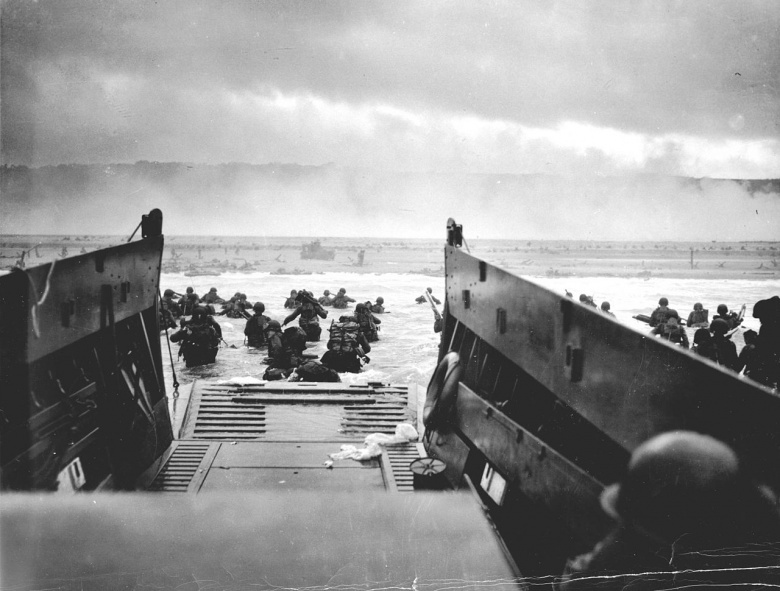
Battlewagons rendered yeoman service as shore-bombardment platforms throughout World War II. Reactivated Iowa-class battleships, moreover, saw action during the Korean War, the Vietnam War and the first Gulf War. Nor is this purely an Asian enterprise. Indeed, this Friday marks seventy years since swarms of Allied ships descended on the French coast. Troops stormed the Normandy beaches in history's most epic opposed landing. Some 10,800 Allied combat aircraft dominated the skies, flying from airfields in nearby Britain. Battlewagons, cruisers, and destroyers cruising offshore rained gunfire on German strongpoints.

To deadly effect. Battleship gun rounds are comparable in weight to a Volkswagen Bug. Imagine flying economy cars exploding in your midst and you get the idea. So lethal was Allied naval gunfire that Desert Fox Erwin Rommel informed his Fรผhrer that "no operation of any kind is possible in the area commanded by this rapid-fire artillery." Quite a testament coming from one of history's great commanders.

The Tanks and the People

A Chinese citizen now known as Tank Man, blocking a line of tanks heading east on Cangan Boulevard, Tiananmen Square, Beijing, June 5, 1989

Twenty-five years ago, before the Tiananmen massacre, my father told me: “Son, be good and stay at home, never provoke the Communist Party.”

My father knew what he was talking about. His courage had been broken, by countless political campaigns. Right after the 1949 “liberation,” in his hometown Yanting [in Sichuan] they executed dozens of “despotic landowners” in a few minutes. That wasn’t enough fun for some people. They came with swords, severed those broken skulls, and kicked them down the river bank. And so the heads were floating away two or three at a time, just like time, or like the setting sun always waiting for fresh heads at the next ferry point. My father left my grandfather, who had made money through hard work, and fled in the night.

Afterward he never said a bad word about the Communist Party. Even at the time of the Great Leap famine, when almost forty million people starved to death, and when I, his little son, almost died. He did not say anything. It was hell on earth. People ate grass and bark. They ate some kind of stinking clay; it was called Guanyin Soil [after the Buddhist Goddess of Mercy]. If they were very lucky, they would catch an earthworm; that was a rare delicacy. Many people died bloated from Guanyin Soil.

My grandmother also died; she was just skin and bones. Grandfather carried her under his arm to the next slope, dug a small pit, and buried her. But Mao Zedong, the great deliverer of the Chinese people, would never admit a mistake. He just said it was the fault of the Soviet Union. And so the wretched people all hated the Soviet Union. Just because of their goddamned Revisionism [the label Chinese Communists used for Soviet ideology after the Sino-Soviet split in the early 1960s], the Soviets had called back their experts and their aid for China!

Mao’s second-in-command Liu Shaoqi couldn’t stand it any longer and mumbled, “So many people have starved to death. History will record this.” For this slip he paid dearly. During the Cultural Revolution they let him starve to death in a secret prison. We have a saying: “Illness enters at the mouth, peril comes out at the mouth.”

But twenty-five years later, Mao had died long ago. I was barely thirty and didn’t heed my father’s warning. I admired the American Beat Generation, their spirit and their actions. I was “on the road.” All through China, in dozens of cities, dozens of millions of protesters marched on the roads. Most of them were younger than I was, they would never heed their parents’ warnings. Especially the “Pride of Heaven,” as they were called, the university students in the capital, who had occupied Tiananmen square for weeks, under the eyes of the world, heady with drugs—freedom and democracy!

But my father’s words came true, the Communist Party opened fire. When the tanks bore down, in a thousand terrors, I recited and recorded my poem “Massacre,” in a small town in Sichuan:

Five Ways D-Day Could Have Been a Disaster

With hindsight, it is easy to assume that by 1944, the Third Reich was doomed. It could have all gone very wrong.
June 5, 2014

General Dwight D. Eisenhower's face was grim but composed as he read a short message to the assembled group of reporters on the morning of June 7, 1944.

"Our landings in the Cherbourg-Havre area have failed to gain a satisfactory foothold and I have withdrawn the troops. My decision to attack at this time and place was based upon the best information available. The troops, the air and the navy did all that bravery and devotion to duty could do. If any blame or fault attaches to the attempt, it is mine alone."

Eisenhower never actually uttered these words. But he did scribble them down in the tense days before the Normandy invasion. Despite the years of planning for D-Day, and the awesome armada of men, ships and planes that he commanded, Eisenhower knew how risky it was to storm ashore into the heart of Hitler's Atlantic Wall.

With seventy years of hindsight, it is easy to assume that by June 1944, the Third Reich was doomed. Russian armies were relentlessly advancing from the East; Anglo-American armies were invading from the West, while German cities and factories burned under around-the-clock attacks by American and British bombers.

But those who fought the Germans knew better than to underestimate them.

As Eisenhower contemplated the assault on Hitler's Fortress Europe in the hours before D-Day, he knew how dangerous the operation was.

D-Day was a success. But here are five ways that D-Day could have ended in disaster:

The Germans could have learned the location of the invasion. By early 1944, everyone knew the invasion would soon be coming. British civilians knew, as they watched their island practically sink under the weight of division after division of American troops. Hitler also knew, which is why he transferred his elite panzer divisions from the Eastern Front to the West.

The big question wasn't if the Allies would come, but where. Control of the seas gave the Allies immense flexibility in picking an invasion site, which meant the Germans had to be prepared for landings anywhere from France, to Belgium, to the Netherlands (Hitler was even convinced there would be a landing in Norway).

Nonetheless, the Germans could make some educated guesses. The ideal invasion site would be within range of fighter cover from English airfields. It would also be as close as possible to ports in southern England, to minimize sailing time for invasion convoys.

The Normandy peninsula was a possibility. But the obvious candidate was the Pas-de-Calais region, just twenty miles across the English Channel from the cliffs of Dover. The Germans kept many of their troops around Calais, and the Allies happily encouraged them to do so. They even created a fake army—commanded by George Patton—that appeared poised for a Calais invasion. The result was that the Germans maintained substantial forces in Pas-de-Calais for months, convinced that Normandy was just a decoy landing. Meanwhile, their armies in Normandy were relentlessly chewed up until the Allies achieved a breakthrough in August that took them all the way to Germany.

From Small Unit Leaders to Rugged Diplomats

June 3, 2014

On the one hand I am heartened to read a former Armor officer calling for Foreign Internal Defense. Had this logic been applied years ago we might never had to kill so many trees developing the nearly redundant mission of Security Force Assistance.

The model that American policy makers should look to for appropriate engagement of foreign governments in conflict zones is the Foreign Internal Defense and irregular warfare conducted by American special operations forces. The ability to gain the trust of local leaders, build their capability and capacity, and provide them with the tools to govern their own spaces with a modicum of justice is the hallmark of American Special Forces. Unfortunately, SOF operates on a limited scope and scale. And American policymakers too often assume that once American conventional forces are deployed en masse, the arrival Jeffersonian democracy is simply a matter of time. Rather, it requires living day-to-day under conditions of significant hardship to forge relationships of trust in order to influence the governance and development models of war-torn nations. This is the kind of mission small unit leaders from Afghanistan and Iraq are well-suited to carry out.

On the other hand I am discouraged in the belief that any US military force, SOF or conventional forces, can bring Jeffersonian democracy to another country. This is our fundamental problem in that we think we can impose our way of life or values or system of government on another country. If we truly understand our ideals we would realize that a fundamental American value is respect for self determination of government and we should support that rather than trying to create another country in our image. This is why the FID mission is a good model: US government (military and civilian) provide advice and assistance to friends, partners, or allies in support of their internal defense and development programs so they can defend themselves against lawlessness, subversion, insurgency, and terrorism. We have to cease believing that we can build nations and instead provide support (perhaps stability operations which is one of the five activities of US irregular warfare operations in accordance with DODI 3000.07) to allow indigenous people to build their own nation.

But I do like the Elvis Presley theory of foreign policy: 

As former Army Sergeant Elvis Presley once said: “We’re caught in a trap. I can’t walk out, because I love you too much baby.” Strategic thinkers and tactical implementers need each other in order to successfully address thorny American foreign policy issues with feasible recommendations from a holistic perspective.


6 June 2014

In need of stimulus

Yoginder K Alagh | June 6, 2014

The decline in the investment rate in India started two years ago. (Source: Reuters)
SUMMARY

We need to aim to get to a high growth path again. To use an expression made famous by Queen Elizabeth, the last two years were both anni horribili. The average annual growth rate of the economy was 7.49 per cent between 2004 and 2012-13 — the UPA years. But it fell from 7.9 per cent between 2004 and 2008 to 6.8 per cent between 2009 and 2014. The last two years were really bad at 4.65 per cent. The manufacturing sector grew 8.34 per cent annually in the period 2004 to 2012-13, but 9.28 per cent in the period 2004 to 2008. This dropped to 7.18 per cent between 2008-09 and 2012-13. Again, the last two years were terrible at around 4 per cent and then below zero per cent. The official line was that we are now a globalised economy and can’t do much about the rest of the world. But many other countries have done well — not just China but also countries like Indonesia, Turkey and Nigeria. The decline in the investment rate in India started two years ago. Public investment fell first, and as infrastructure spending went down, private investment also fell.

The UPA’s economists kept giving lectures about raising efficiency. They wondered, if the investment rate is 32 per cent, why was the growth rate so low? (C. Rangarajan ). They conjectured that the growth rate would go up next month/ quarter (Montek Singh Ahluwalia). Raghuram Rajan had another tack. According to his economics, the growth rate is given and all that you can do is determine prices by changing the interest rate. Whenever some green shoots of recovery were visible, the monetary policy killed them.

In August last year, China effected a stimulus package by investing in infrastructure. There were howls of protest from international financial institutions. But China politely stuck to its policy and clocked 7 per cent growth. I have been arguing for an investment stimulus along with a resource-raising effort. It would not have determined aggregate demand but would have diverted demand to sectors linked to infrastructure, like capital goods, cement and steel. The private sector would have taken care of consumer demand, thanks to the good crop in the offing. But nothing happened.

The new government must focus on infrastructure investment and give the economy a stimulus. It must simultaneously raise resources and cut government consumption expenditure to finance this stimulus.

What the forces are up against

- Permutations and combinations of militant outfits hamper operations
http://www.telegraphindia.com/1140606/jsp/frontpage/story_18484311.jsp#.U5E-S3KSwfg
OUR BUREAU


Tura, June 5: Twenty kilometers off Paikan, the tri-junction where the road forks off to Tura, the army camp on National Highway 51 has an improvised operations room — a sort of a summer house within the compound of Kukurkata police station.

The small board on the wall next to a large operations map provides figures of the Dogra regiment unit stationed there: kills two; one of Ulfa and one of GNLA. Apprehends three of Rabha Viper Army, three of Rabha National Liberation Front, two of United Achik Liberation Army and three Ulfa.

Ask the personnel there what UALA is and pat comes the reply: they are a breakaway faction of the ANVC and are now a combination of Garo and Ulfa militants. These permutation and combinations of militant outfits are what the security forces are up against.

Two kilometres away is Berubari, the Assam-Meghalaya border, Paikan being 140km from Guwahati. Beyond Berubari, the state police, CRPF and BSF patrol Meghalaya, the state’s chief minister Mukul Sangma still quite certain that the army —and by the default the Armed Forces (Special Powers) Act — isn’t still required to contain the insurgency that has come to plague his state.

Eighty kilometres uphill, at Tura, members of the Mothers’ Union have gathered at the deputy commissioner’s office to discuss a protest against the Chokpot incident. They are in agreement with Sangma but reject outright any suggestion that the ‘movement’ led by the Garo National Liberation Army (GNLA) may have any patriotic motives whatsoever. “It is all about money. This is trouble that has been borrowed from militants in neighbouring states. Militants of Ulfa and NSCM (I-M) who for decades used the Garo hills as a corridor have now got Garo boys into this,” says a senior member of the union.

INDIA AND CHINA: KEEPING THE SWORDS RECESSED AND PLOWSHARES WORKING – ANALYSIS

By Mohan Guruswamy

The rise of China as the world’s greatest exporter, as largest manufacturing nation and its great economic appetite poses a new set of challenges. At a meeting of Southeast Asian nations in 2010, China’s then foreign minister Yang Jiechi, facing a barrage of complaints about his country’s behaviour in the region, blurted out the sort of thing polite leaders usually prefer to leave unsaid. “China is a big country,” he pointed out, “and other countries are small countries, and that is just a fact.”

Indeed it is; and China is big not merely in terms of territory and population, but also military might. Its Communist Party is presiding over the world’s largest military build-up. And that is a fact too — one that the rest of the world has to come to terms with.

China’s defence budget has almost certainly experienced double digit growth for two decades. According to Stockholm International Peace Research Institute (SIPRI), Beijing’s annual defence spending rose from over $30 billion in 2000 to over $135 billion in 2014. SIPRI usually adds about 50% to the official figure that China gives for its defence spending, because even basic military items such as research and development are kept off budget. Including those items would imply total military spending in 2014, based on the latest announcement from Beijing, would be around $200 billion.

This is not a sum India can match, and the last thing we need to get caught in is a numbers game. A one-party dictatorship will always be able to outspend us, even if our GDPs get closer.

That said, the threat from China should not be exaggerated. There are three limiting factors. First, unlike the former Soviet Union, China has a vital national interest in the stability of the global economic system. Its military leaders constantly stress that the development of what is still only a middle-income country with a lot of very poor people takes precedence over military ambition.

The increase in its military spending reflects the growth of the economy, rather than an expanding share of national income. For many years China has spent the same proportion of GDP on defence (a bit over 2%, whereas America spends about 4.7%).

The real test of China’s willingness to keep military spending constant will come when its headlong economic growth starts to slow further. But on past form, China’s leaders will continue to worry more about internal threats to their control than external ones. Last year, spending on internal security outstripped military spending for the first time. With a rapidly ageing population, it is also a good bet that meeting the demand for better health care will become a higher priority than maintaining military spending.

India on the other hand will keep growing long after China has stopped growing. Its youthful population and present growth trends indicate the accumulation of the world’s largest middle class in India. This growth is projected to begin in 2015 and continue well past 2050.

In fact so big will this become that India during this period will increasingly power world economic growth, and not China. In 2050, India is projected to have a population of 1.6 billion, and of this 1.3 billion will belong to the middle and upper classes. The lower classes will be constant at around 300 million, as it is now.

India: Recognizing Pakistan’s Paradigm Shift

India’s new government must acknowledge the change in internal Pakistani politics, and be innovative.
By Shairee Malhotra
June 04, 2014

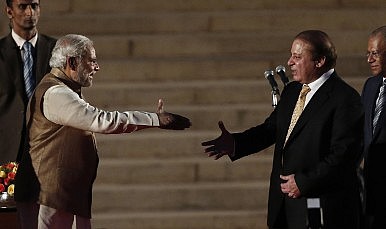
Prime Minister Narendra Modi’s invitation to leaders of South Asian Association for Regional Cooperation countries to attend his swearing-in ceremony has been termed a “foreign policy masterstroke.” The highlight was arguably Pakistani Prime Minister Nawaz Sharif’s attendance, despite a delay in accepting the invitation.

Modi’s BJP party has in the past criticized the ex-UPA government’s Pakistan policy as too soft, and had vowed in the run-up to elections to take a tough stance against Pakistan. However, Indian leaders must recognize the psychological underpinnings of the Pakistani state, which is central to taming the famously fractious relationship.

Pakistan’s military has built the identity of the Pakistani state in opposition to India, and this perpetuation and sustainment of the Indian threat is what has made the Pakistan Army the most powerful and omnipresent institution in its polity. This siege mentality has legitimized its rule in the eyes of ordinary Pakistanis and enabled it to extract the exorbitant funding and revenues that it does, consequently derailing pro-democracy forces and civil society. The military’s unprecedented monopoly over Pakistani politics, and the inflated revenue that the myth of the Indian threat derives explains the lack of incentive for the army to better relations with India.

While a tough line on Pakistan may have been appropriate for New Delhi a few years ago, in recent years the state of affairs seems to have somewhat altered. There is a growing realization in Pakistan that India no longer poses the largest threat to the country, and in this realization lies Pakistan’s greatest hope of becoming a “normal” country, and not the dysfunctional security state that it currently is. The biggest security risks are those stemming from within the country, and not from external sources like India, a realization that frames the military as part of the problem, rather than the solution. Perhaps nothing can better capture Pakistan’s miscalculations and militancy culture than Mohsin Hamid’s catchphrase, “To fight India, we fought ourselves.”

The Army itself is starting to see the light; evident in its new doctrine’s shift in threat assessment, as militant groups they once propelled turn against the state and attack its security apparatuses. According to acclaimed Pakistani author Ahmed Rashid, “The anti-India rhetoric that has been part of Pakistan’s entire make-up for over 50 years has now dramatically altered even within the army, which recognizes that we have to deal with the Taliban threat.” Indeed, even Pakistan’s feared Inter-Services Intelligence has acknowledged that homegrown militants have surpassed India as Pakistan’s greatest threat.

WILL INDIA’S NORTHEASTERN CONFLICTS FINALLY MOVE TOWARDS SETTLEMENT? – ANALYSIS

By Subir Bhaumik

Before the 2014 polling, Indian Prime Minister Narendra Modi had predicted “unusually good results” for his party in the northeast. Usually considered a Congress bastion, with some challenge from regional parties, the northeast has been a region where the Bharatiya Janata Party (BJP) had failed to make much of a dent despite their full-throated support to the campaign against illegal immigration that strikes a sympathetic chord with the indigenous populace in the region. But Modi was right in saying it would be different this time.

The BJP won seven of the 14 parliament seats in Assam and one of the two seats in neighbouring Arunachal Pradesh. With their allies winning a seat each in Nagaland and Meghalaya, the tables have been turned well and true. The Congress could hold out only in Manipur and Mizoram and the Communists in Tripura, especially because of strong local leaders.

Modi has already emphasized the importance of India’s ‘Look East’ policy to develop close relations with China and Southeast Asian countries, which he sees as crucial for the country’s economic turnaround. He has also prioritized development of border infrastructure, both for defence and trade-transport connectivity with the immediate neighbourhood.

No wonder, he has put a former army chief, General V.K. Singh, in charge of the ministry for northeast, called Development of North Eastern Region (DONER). The idea is to give a huge push to the development of transport connectivity and infrastructure for trade and defence (both are equally important). Singh’s knowledge of the region as a former Eastern Army commander and of defence issues makes him the right man who can turn the ‘Look East’ into ‘Push East’ for India.

India’s eastward thrust is qualitatively different from Germany’s pre-War Drang Nach Osten (Push East), with emphasis on trade and economy rather than on military conquest for population transfers. But Modi is not wrong to reckon the need for military zeal to take this forward.

Closer economic integration with China and Association of Southeast Asian Nations (ASEAN) would mean the rise of a huge economic block accounting for almost half of the world’s population – something many see as the future hotspot of global economy. But for India, this would also require resolution of the festering border dispute with China and playing an important role in fostering peace between China and ASEAN nations with all the tensions rising in the South China Sea. Military conflicts can derail this process of economic integration.

For close to two decades, India has tried to place its own long troubled northeast at the heart of its ‘Look East’ policy, assuming that would end the region’s isolation and help it develop through trade and investment from the neighbourhood. The tortoise pace of the initiative cannot make someone like Modi happy.

The new prime minister has done well to keep out a ‘local minister’ for DONER, because ministers hailing from a northeastern state may just resort to some tokenism to keep their local constituents happy and also stand accused by other states in the region for being partial their own states. V.K. Singh would surely go about executing Modi’s ‘Look East’ vision and India’s strategic interests in northeast – not limit himself to stunts to please local power-brokers.

But Look East through northeast can only be meaningful if Delhi can resolve – or at least firmly contain – the myriad conflicts that have bedeviled the region for 60 years. How can one foresee a successful Kolkata-Kunming highway through the northeast – let alone a Bangladesh–China–India–Myanmar (BCIM) economic corridor that Chinese Premier Li Keqiang has proposed along the highway – if areas along it are perpetually riddled with local conflicts.

Crisis in Siachen: Two crashes in nine months, army troops face transport crisis


SUMMARY

While the Army has been unsuccessfully trying to procure replacement choppers for over five years, an emergency alternative being planned has also not worked out.

Both the crashes involved the indigenous Advanced Light Helicopters (ALH) that had been inducted by Army Aviation to work well beyond their design capacity to supply troops at high altitudes.

The Army is staring at a transport crisis in supplying and maintaining troops at the Siachen Glacier, the world’s highest battlefield, with the main lifeline of soldiers at the extreme heights — light, high-altitude choppers — facing a shortage crisis due to stalled procurement by the last government and two crashes in the last nine months that have raised serious safety questions on the available fleet.

Such is the crisis that the emergency alternative Cheetal choppers — orders for which were placed by both the Army and Air Force — have been tested by manufacturer Hindustan Aeronautical Limited (HAL) in the past month but have failed high-altitude tests in Leh due to a lack of high-performance rotor blades.

The Indian Express spoke to a number of top Army, Air Force and industry officials who acknowledged the seriousness of the situation and expressed helplessness, given that successive crisis management plans were nixed over the past few years.

While the crisis was developing for a while, with the UPA-II government not clearing the Army’s five-year-old proposal to purchase 197 light helicopters at the final stage of procurement due to a CBI inquiry into competitor AgustaWestland that lost during the technical trials, the last nine months have seen at least two “category one” crashes at the glacier that have gone unreported and have raised serious concerns.

Both the crashes involved the indigenous Advanced Light Helicopters (ALH) that had been inducted by Army Aviation to work well beyond their design capacity to supply troops at high altitudes. In August, a chopper crashed while landing close to the Amar helipad on the Siachen Glacier and went down a crevasse. Similarly in March this year, another ALH went down on the northern glacier while landing at a narrow helipad.

“The two accidents occurred at a time when the choppers were taking off or landing at extremely narrow airfields where even a freak wind can cause havoc. Thankfully, in both cases, the pilots managed to jump out in time and only got injured. Both aircraft are damaged beyond repair and one cannot even be recovered,” said an Army official on condition of anonymity.

TALIBAN AFTER AFGHAN ELECTIONS: SPRING OFFENSIVE OR THE LAST STAND? – ANALYSIS

By IPCS
By D Suba Chandran

A series of attacks by the Taliban in Afghanistan during May 2014 resulted in a few media-persons calling it a Spring Offensive. Is it really a calculated and well planned offensive by the Taliban? Or is it merely the Last Stand of a terrorist organisation arising out of desperation and conceived over a fear of losing relevance in any future Afghan political framework?
Neither Spring, Nor Offensive; Mere Desperation

After failing to disrupt the first round of the successful presidential elections in Afghanistan – that were held all over the country on 5 April – a section reported the Taliban’s plans to launch a massive surge. True, there were few attacks during the last month; for example, according to news reports, 18 people were killed in three attacks in Jalalabad, Ghazni and Helmand provinces. Later, on 23 May, there was a high profile attack on the Indian Consulate in Herat.

Except for those three coordinated assaults in the provinces and the attack on Indian Consulate in Herat, there have been no serious threats from the Taliban that challenge the Afghan security forces. A closer look into those three assaults would even reveal them as regular guerrilla attacks, using the classic sneaking in and opening fire strategy, than an open challenge or a military duel. Many in India suspect that the attack on its Consulate in Herat was in fact carried out by the proxies of Pakistan with an objective to scuttle Nawaz Sharif’s proposed visit to India to partake in the recently-elected Indian Prime Minister Narendra Modi’s swearing-in ceremony.

It is entirely possible that the two sets of attacks in May were carried out by two different factions of the Afghan Taliban for two different objectives – the first set of attacks on the three provinces by the Afghan Taliban led by Mullah Omar to prove their relevance, and the attack on the Indian Consulate in Herat by the Haqqani Network, having been instigated by their masters from elsewhere in Pakistan.

Perhaps, what one sees in Afghanistan is not a surge by the Taliban but a desperate last attempt to make themselves relevant in Afghanistan’s post-election political framework, using violence as a strategy.
Post-election Political Setup: Predicting the Taliban’s Roadmap

Two significant developments might have rubbished the Taliban’s calculations for a role for themselves in the future government in Kabul following the withdrawal of Western troops: the successful elections of 5 April, and the widespread popular participation.

By any standard of evaluation, the election was a huge success and an ultimate insult to the Taliban. Barring few provinces in southern regions of the country, Afghans turned out in substantial numbers, waited patiently in long, serpentine queues and cast their votes despite bad weather and shortage of ballot papers. Never in the history of Afghanistan has there been a political change of regime, supported by its people such as this.

BHUTAN: AN UPDATE ON RECENT DEVELOPMENTS

By SAAG
By Dr. S. Chandrasekharan.

There are only three issues that need to be highlighted on the recent developments. The first relates to an over pessimistic assessment of the World Bank on Bhutan’s economy- 2014. The second relates to a very impressive account of Bhutan’s way of life and its cherished goal of Gross National Happiness and the third relates to the refugee issue as one of the expatriates has given a religious twist to the whole refugee issue which in my view is very unfortunate.
The World Bank Report on Economic Developments in Bhutan- 2014.

In what is routinely issued by World Bank on the economic situation in the country, the update on Bhutan’s economy of 2014 appears to be unjustifiably pessimistic though in reality the economy of Bhutan but for the “Rupee crunch” is fairly robust and stable. In my view, with a little tightening in construction sector and judicious use of imports from India and completion of the ongoing Hydro electric projects in time would go a long way in overcoming this problem. The points raised in the World Bank Report and other related issues were:

China’s Air Force Modernization: ‘Unprecedented in History’


The Pentagon’s annual report on China says that the scale of the PLAAF’s modernization is “unprecedented in history.”
June 06, 2014

The People Liberation Army Air Force’s (PLAAF) ongoing modernization is taking place at a rate unprecedented in history, the U.S. Department of Defense said on Thursday.

“The PLAAF is pursuing modernization on a scale unprecedented in its history and is rapidly closing the gap with Western air forces across a broad spectrum of capabilities including aircraft, command and control (C2), jammers, electronic warfare (EW), and data links,” the Pentagon said in its annual report on China’s military modernization, which was released on Thursday. This claim is new this year and was not included in the annual report in 2013.

Indeed, the report’s section on the PLAAF was one of the most expanded parts of the report and seemed to indicate growing concern in Washington over China’s air capabilities. After stating that the PLAAF is the largest Air Force in Asia and third largest in the world, the report noted that it is made up of “approximately 330,000 personnel and more than 2,800 total aircraft, not including unmanned aerial vehicles (UAV).” Of these 2,800 total aircraft, around 1,900 are combat aircraft, 600 of which are modern.

The increasingly modern PLAAF aircraft seemed to be the top concern of the Pentagon in the new report. Last year, for instance, the report noted that, although China is fielding more and more 4th generation aircraft, “the force still consists mostly of older 2nd and 3rd generation aircraft, or upgraded variants of those aircraft.” By contrast, the report this year stated that although the PLAAF continues to operate 2nd and 3rd generation aircraft, it will likely become a majority 4th generation Air Force within the next several years.

The report also noted for the first time China’s efforts to procure Su-35 aircraft from Russia, along with its “advanced IRBIS-E passive electronically scanned array radar system.” If Beijing is successful in purchasing these aircraft, the Pentagon assesses that they will likely enter service between 2016 and 2018. As Peter Woodwrote in The Diplomat back in November, the Su-35 should significantly enhance China’s ability to project air power in the South China Sea.

The section on China’s bomber fleet was also updated this year, although this seemed to reflect Washington having acquired greater information on the H-6 bomber fleet. For instance, last year’s report noted that China continued to upgrade its H-6 bomber fleet, “with a new variant that possesses greater range and will be armed with a long-range cruise missile.”