10 July 2014

Ukraine Presses Offensive In East As Rebels Regroup


By Richard Balmforth
07/08/2014

KIEV, July 8 (Reuters) - Ukraine's government signaled its intention to press on with its campaign against pro-Russian rebels on Tuesday and the militants, regrouping after losing their stronghold, said they were preparing to fight back.

President Petro Poroshenko, drawing confidence from the fall of the rebel bastion of Slaviansk at the weekend, named a new chief of military operations in the east following his appointment of an aggressive new defense minister who ruled out negotiations until the separatists lay down their arms.

One rebel leader played down the loss of Slaviansk as a military expedient and said the hundreds of fighters who were able to move from the town to the regional capital Donetsk were preparing a command structure to defend that city and hit back:

"We're not preparing ourselves for a siege. We are preparing ourselves for action," Alexander Borodai, prime minister of the self-proclaimed Donetsk People's Republic, told a Russian online newspaper during a visit to the Russian capital.

Sporadic shooting was heard from various parts of Donetsk overnight though no specific incidents were reported. But in Luhansk, a city on the border with Russia where rebels also control key buildings, two people in a minibus were killed by a shell that exploded nearby, a municipal official said.

"There is an exchange of fire among the separatists. They are shooting at each other," Iryna Verigina told a Ukrainian television station by telephone from Luhansk.

Poroshenko, installed in office just a month ago, named Vasyl Grytsak to head the "anti-terrorist center", making him operational chief in the drive to crush the rebels.

The move continued his shake-up of the military and security leadership in which he has appointed a hardline defense minister to bring fresh vigor to the fight against the insurgency.

Grytsak, a 53-year-old police lieutenant-general and 20-year veteran of the state security apparatus, replaces Vasyl Krutov, who had headed the "anti-terrorist center" since mid-April.

Despite some successes against the rebels, Krutov and other security officials have come under criticism for the patchy performance of the armed forces and big military losses including the downing by the rebels of an Ilyushin Il-76 plane in June with the deaths of more than 49 crew and servicemen.

Ukraine, Having Seized Rebel-Held Cities, Now Must Govern Them

BY JAMES RUPERT
JULY 07, 2014


Stabilizing a Recaptured Conflict Zone Will Test Kyiv's Skills at Reconciliation

Ukrainian soldiers in the eastern Ukrainian town of Slaviansk on July 5, 2014. Ukrainian forces recaptured towns in eastern Ukraine from pro-Russian rebels on Saturday and raised the country's blue and yellow flag again over what had been the separatist redoubt of Slaviansk. PHOTO: REUTERS/Maria Tsvetkova

While Ukraine’s weekend victory in seizing back two cities in Donetsk province is its biggest in the three-month war with Russian proxy forces, it immediately poses some tough new tests for the government in Kyiv.

And, at a critical moment in Ukraine’s fight against separatist militias backed by the Russian government, it is unclear what real support is being offered to Ukraine by governments in the transatlantic community.

Ukraine’s Military Gains

The scope of the military gains is still emerging. Ukrainian troops dislodged perhaps the biggest military center of the Russian-backed rebellion, in the city of Slaviansk, where the rebellion’s overall commander, Russian Army Col. Igor Girkin, had maintained his headquarters. Girkin and many of his fighters escaped to Donetsk, the largest city in southeastern Ukraine’s Donbas region.

Photos posted by Ukraine’s Defense Ministry showed that the separatists’ retreat from Slaviansk was unplanned, disorganized and perhaps even a rout. The ministry displayed large stocks of captured weapons and ammunition, including shoulder-fired rockets or recoilless rifles, land mines, and machine guns. Mangled or burned armored vehicles littered local roads. Anti-aircraft weapons also were seized, noted Atlantic Council Senior Fellow Adrian Karatnycky.

While pockets of damage to roads and buildings are evident in photos and video shot throughout Slaviansk, the city appears to have survived widespread destruction, Karatnycky and other analysts say. While much of Slaviansk had been emptied as city residents fled the fighting and the rebel occupation of the past months, Ukrainian officials immediately began bringing essentials “to the local population, including medications, potable water and food” as well as delayed pension payments, according to the daily report issued by Ukraine’s National Security Council. Troops and engineers were working to restore television transmissions, rail lines and utilities in the area, the council said.

Have We Gone From a Post-War to a Pre-War World?

07/07/2014 


On June 28, 1914, a chauffeur panicked after a failed bomb attack on his boss, took a wrong turn and came to a complete stop in front of a café in Sarajevo where Gavrilo Princip was sitting. Princip, discouraged at the apparent failure of the planned murder, seized the unexpected opportunity and fired the shots that began the First World War, a cataclysm which claimed over nine million lives, ended four empires and set in motion events from the Communist Revolution in Russia to the rise of Nazi Germany.

One hundred years later, the world is nervously keeping its eyes peeled for misguided chauffeurs and asking itself whether history could repeat. The great powers are at peace, and trade and cultural ties between nations seem closer than ever before, yet the international scene is in many ways surprisingly brittle. In particular, a rising naval power is challenging an established hegemon, and a "powder keg" region replete with ethnic and religious quarrels looks less stable by the day.

In 1914, Germany was the rising power, the U.K. the weary hegemon and the Balkans was the powder keg. In 2014, China is rising, the United States is staggering under the burden of world leadership and the Middle East is the powder keg.

Only a few years ago, most western observers believed that the age of geopolitical rivalry and great power war was over. Today, with Russian forces in Ukraine, religious wars exploding across the Middle East, and territorial disputes leading to one crisis after another in the East and South China seas, the outlook is darker. Serious people now ask whether we have moved from a post-war into a pre-war world. Could some incident somewhere in the world spark another global war?

MIDDLE EAST POWDER KEG

Let's start with the powder keg. The immediate cause of the fighting in World War I was the set of ethnic and religious conflicts in the Balkans. In the second half of the 19th century, economic development and modernization led to heightened competition among the region's peoples. The drive for self-determination set Croats, Serbs, Magyars, Kosovars, Bosniaks, Macedonians, Bulgarians, Greeks and others at one another's throats. The death toll mounted and the hatred grew as massacres and ethnic cleansing spread -- and the ability of the outside powers to control the region's dynamics shrank as the imperial powers were themselves undermined by rising social and nationalist tensions.

Counter-Terrorism: The Swarm


July 8, 2014: Dutch counter-terrorism experts fear that Islamic terrorism in Holland, and elsewhere, is becoming more difficult to deal with because of what they call the “swarm effect”. This is partly the result of intelligence being able to quickly identify Islamic terrorist groups that are organized and take them down before they can make attacks. That has forced Islamic terrorists to develop other forms of organization. Thus a growing number of attacks are the result of individuals or casually created groups getting orders via Internet based social networks about what kinds of attacks to make and how to do it. Social networks make it possible for many active terrorists to stay in touch with new information on targets and techniques and, when a general call for “action” goes out it is very difficult for intelligence organizations to detect exactly who will act. But increasingly radicalized Moslems do act. 

Fortunately these attacks are small scale, often involving one attacker often using improvised weapons (like a knife) against individuals. Nevertheless there are a growing number of individuals who have training and experience in building or obtaining more powerful weapons (firearms and explosives) and carrying out deadlier attacks. This is particularly true in the aftermath of the 2011 Arab Spring uprising. The Syrian fighting, which has been the most intense and long-lasting has already attracted over 3,000 European Moslems (mostly young men, many of them teenagers). These men have gone to Syria to fight and most of them return with newly acquired terrorist skills, including advice from more experienced terrorists on how to obtain firearms and explosives on the black market. 

Dutch police believe that only 120 Dutch Moslems have gone to Syria to fight and 10-15 percent of whose have been killed. Most will make it back and based on the evidence so far many of the returnees will serve as effective recruiters to get more young men to go. Some five percent of Dutch are now Moslem, most of them migrants who arrived in the last few decades and their children. Cable news networks and the Islamic terrorists enable these migrants to stay in touch with their old lives more than at any time in the past and this makes it more difficult to leave harmful things, like Islamic radicalism and Islamic terrorism behind. Especially for young Moslems the appeal of “jihad” in defense of Moslem is strong and increasingly that turns into acts of terrorism in their new homes.

The Inevitability of Foreign Entanglements

July 8, 2014

The Fourth of July weekend gave me time to consider events in Iraq and Ukraine, U.S.-German relations and the Mexican borderland and immigration. I did so in the context of the founding of the United States, asking myself if America has strayed from the founders' intent with regard to foreign policy. Many people note Thomas Jefferson's warning that the United States should pursue "peace, commerce, and honest friendship with all nations -- entangling alliances with none," taking that as the defining strategy of the founders. I think it is better to say that was the defining wish of the founders but not one that they practiced to extremes.

As we know, U.S. President Barack Obama has said he wants to decrease U.S. entanglements in the world. Ironically, many on the right want to do the same. There is a common longing for an America that takes advantage of its distance from the rest of the world to avoid excessive involvement in the outside world. Whether Jefferson's wish can constitute a strategy for the United States today is a worthy question for a July 4, but there is a profounder issue: Did his wish ever constitute American strategy?
Entangled in Foreign Affairs at Birth

The United States was born out of a deep entanglement in international affairs, extracting its independence via the founders' astute exploitation of the tensions between Britain and France. Britain had recently won the Seven Years' War with France, known as the French and Indian War in the colonies, where then-Col. George Washington led forces from Virginia. The British victory didn't end hostilities with France, which provided weapons, ammunition and other supplies to the American Revolutionaries, on occasion landed troops in support of American forces and whose navy served a decisive role in securing the final U.S. victory at Yorktown.

America's geopolitical position required that it continue to position itself in terms of this European struggle. The United States depended on trade with Europe, and particularly Britain. Revolution did not change the mutual dependence of the United States and Britain. The French Revolution of 1789, however, posed a deep dilemma for the United States. That later revolution was anti-monarchist and republican, appearing to share the values of the United States.

This forced the United States into a dilemma it has continued to face ever since. Morally, the United States appeared obligated to support France and its revolution. But as mentioned, economically, it depended on trade with the British. The Jeffersonian Democrats wanted to support the French. The Federalist Party, cautious of British naval power and aware of American dependence on trade, supported an alignment with Britain. Amid much tension, vituperation and intrigue, the United States ultimately aligned with its previous enemy, Britain.

When Jefferson was elected president in 1800, he did not reverse U.S. policy. By then, the French Revolution had grown vicious, and Napoleon had come to power in 1799. Besides, Jefferson knew as well as Washington had that the United States required trade relations with Britain. At the same time, Jefferson was more aware than others that the United States was a narrow strip of land between the Atlantic and Appalachians. With minimal north-south transportation and dependence on the sea, the United States needed strategic depth.

Fear, not ambition, is what fuels Moscow in Ukraine

7 July 2014 

The west has misread Russia's motivations in Ukraine, and in doing so risks provoking Putin 


'If Vladimir Putin was so intent on re-establishing Moscow’s influence over Ukraine, why has he not rushed to the aid of those fighting in Donetsk and Sloviansk?' Photograph: Yuri Kadobnov/AP


The contest for eastern Ukraine may not be over, but when Ukraine's president, Petro Poroshenko, described the recapture of Sloviansk at the weekend as of "huge symbolic importance", he was not exaggerating. Other towns and cities remain in rebel hands, including the million-strong conurbation of Donetsk, but Sloviansk was the rebels' military headquarters. The hoisting of Ukraine's flag over the city hall marks a decisive advance for the government in the government in Kiev.

Which should raise a question: where are the Russians? If President Vladimir Putin was so intent on re-establishing Moscow's influence over Ukraine, if he was so determined to preserve Russia's fraternal ties with these fellow Slavs, if his ultimate objective was the reconstitution of empire, then why has he not rushed to the aid of those fighting, and dying, in Donetsk and Sloviansk?

Why have we heard nothing from Nato about Russian troops threateningly close to Ukraine's eastern border? Why no satellite pictures on our news bulletins of "clearly" Russian tanks rolling into east Ukrainian towns? Why no warnings recently from Washington or London about the dire consequences, should Moscow follow its annexation of Crimea by occupying eastern Ukraine?

9 July 2014

U.S. job far from done in Afghanistan

June 27th, 2014
By Stephen J. Hadley and Kristin M. Lord, Special to CNN

Editor’s note: Stephen J. Hadley is chairman of the board of the United States Institute of Peace and a former White House National Security Adviser. Kristin Lord is acting president of the United States Institute of Peace. The views expressed are their own.

As the United States draws down its forces in Afghanistan and shifts from direct combat to the narrower mission of countering terrorism and training Afghan forces, some might think this is the time to declare “job done” and focus U.S. attention elsewhere. That would be a mistake. As the current violence in Iraq illustrates, the gains won by our military are fragile. Peace, once won, must be sustained.

Afghanistan is now in the delicate process of laying the foundation for a democratic political transition – the first since President Hamid Karzai assumed the presidency. As many as 7 million Afghans, or around 60 percent of eligible voters, have twice defied the Taliban and cast ballots to select the country’s next president, first in the general election and again in this month’s runoff.

The high turnout and lower level of violence than many had expected are a testament to how non-violent conflict resolution and peacebuilding can multiply and solidify the investments of the United States and the sacrifices made by American troops. The potential for international assistance to help resolve electoral disputes that have cropped up in the past week illustrates the need for continuing engagement.

Organizations like the United States Institute of Peace, which we both serve, have been helping create the conditions for a peaceful transition that will make Afghanistan more stable and less violent, while improving the lives of the Afghan people. A stable and prosperous Afghanistan can be a vital ally of the United States in a troubled region, and will help ensure that al Qaeda and its associates never again gain a foothold in the region’s mountains and valleys.

Investing in the powerful tools of peacebuilding is both effective and cost-effective, but peacebuilding takes time. Some of the best-spent dollars are those used to prevent or reduce conflicts that can engulf regions and threaten American interests, investments that foster strong allies and partners. We should heed the lessons of our experience in Germany and South Korea, where our unflagging, long-term commitments in the aftermath of war have established thriving partnerships with now-critical allies.

For the past several years, U.S. and other international organizations in Afghanistan have been supporting local institutions and civil society groups, working hand-in-hand to develop and employ innovative approaches that would help ensure a credible, inclusive and transparent election.

Gone: sea larger than Bengal UN tribunal awards Dhaka marine chunk

CHARU SUDAN KASTURI 


New Delhi, July 8: India has lost to Bangladesh a swathe of sea larger than the area of Bengal in a landmark ruling by a UN tribunal after decades of tug-of-war rooted in the Partition of 1947.

The UN’s Permanent Court of Arbitration has awarded Bangladesh 106,613sqkm of a total of 172, 220sqkm that according to New Delhi was under dispute but should belong to India. The award prompted a dissenting signature from New Delhi’s representative on the tribunal but the emissary was outvoted.

The ruling at The Hague settles a maritime boundary India has haggled over with Pakistan from 1947 to 1971, and then with Bangladesh.

Officially, both nations welcomed the settlement.

“We respect the verdict of the tribunal and are in the process of studying the award and its full implications,” Indian foreign ministry spokesperson Syed Akbaruddin said today. He addedd that the settlement would “enhance mutual understanding and goodwill” by bringing to a closure “a long-pending issue.”

The verdict denies Indian fishermen access to the part of the sea lost to Bangladesh. It also means India cannot tap natural gas and oil reserves predicted in that region by the Oil and Natural Gas Corporation.

The contentions used by the five-member bench that heard the case have also upset Indian negotiators, apart from leaving sections of the foreign policy establishment worried about opposition from state governments on the eastern coast.

When, exactly, did India get a nuclear weapon?

Posted on July 7, 2014 |

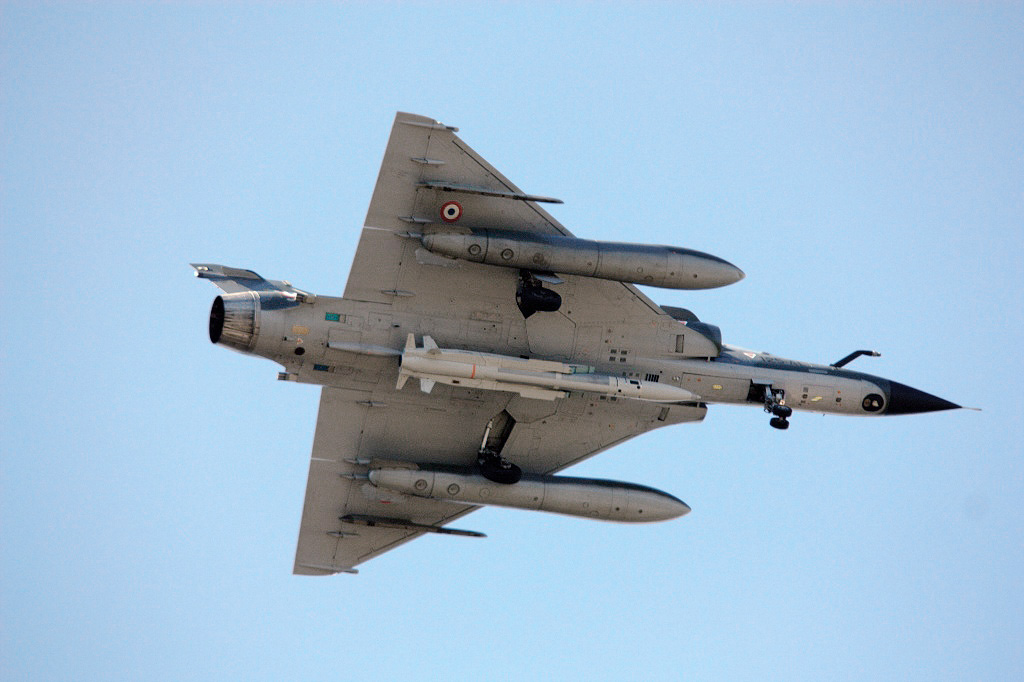
French Mirage 2000N carrying a nuclear-capable missile (India operates the Mirage 2000H variant). Photo from The Aviationist

According to one senior air force official, “In the early 1990s, the air force was thinking of one-way missions. . . . [I]t was unlikely that the pilot deployed on a nuclear attack mission would have made it back.”

A senior Indian defense official privy to this effort disclosed to the author that, until [Kargil in 1999], the air force had no idea (1) what types of weapons were available; (2) in how many numbers; and (3) what it was expected to do with the weapons.

In the latest IS (the journal, not the jihadist group!), Gaurav Kampani has a fascinating article on India’s nuclear weapons [1].

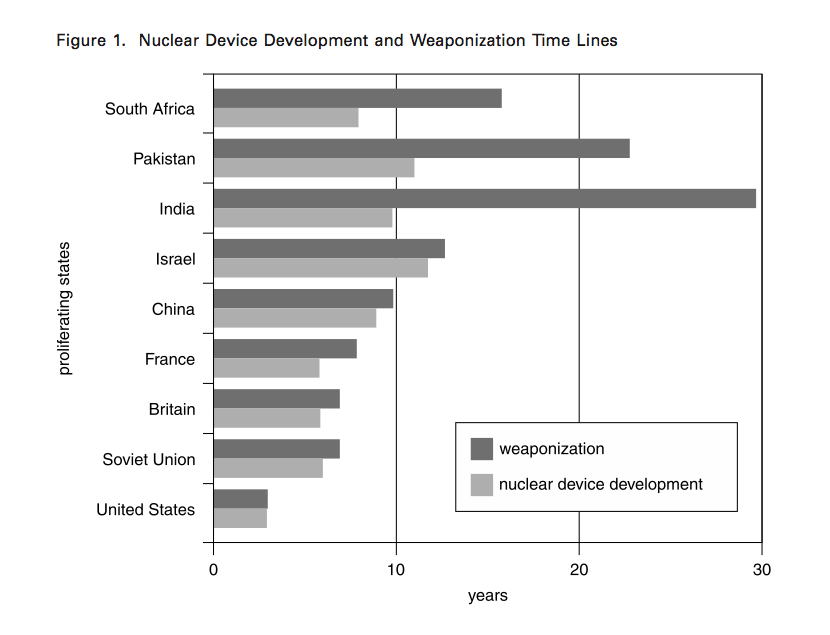
He makes a conceptual distinction (p79-80) between a nuclear device (“an apparatus that presents proof of scientific principle that a nuclear explosion will occur”) and actual weaponization (“building compact reliable rugged weapons and mating them with delivery vehicles”), and then asks why the “process of weaponization in South Africa, India, and Pakistan took eight, fifteen and ten years, a nearly twenty-eight-fold increase on average” when compared to the P5 states. India conducted its first nuclear test in 1974, but only developed a weapon much later.


Timeline for producing a nuclear device versus a weapon proper (from Kampani, “New Delhi’s Long Nuclear Journey”, IS, p87)

His answer is secrecy (p81-2):

Indian political leaders feared pressures for nuclear rollback from the United States. These pressures pushed the weaponization process underground, deep into the bowels of the state. To safeguard secrecy, policy planning was weakly institutionalized. Sensitive nuclear weapons–related information was tightly compartmentalized and hived off within an informal social network consisting of a small number of scientists and civilian bureaucrats. Secrecy concerns prevented decision-makers and policy planners from decomposing problem sets and parceling them out simultaneously for resolution to multiple bureaucratic actors, including the military …

In the absence of holistic planning stretching back to the 1980s, many technical problems, particularly those related to the integration of weapons with combat aircraft, were only partially anticipated. In other instances, policy planners remained unaware of the technical challenges until they demanded resolution. All of these factors became roadblocks on the path to weaponization. Secrecy concerns similarly prevented policy planners from institutionalizing the soft organizational and training routines between the scientific and military agencies necessary to move weapons from the stockpile to the target, in effect attenuating the state’s capacity to make good on its insinuated threat to punish a nuclear aggressor via a retaliatory response.

Battling for Islamic space, imagination


Published: July 9, 2014

Talmiz Ahmad

ISIS is not a monolithic jihadi entity. Not surprisingly, its dramatic proclamation of a ‘Caliphate’ in the territories of Iraq and Syria has hardly evoked much enthusiasm outside ISIS’ immediate jihadi circle.

On June 29, the night before the commencement of Ramadan, the spokesman of the Islamic State of Iraq and Syria(ISIS) announced the establishment of the “Caliphate” in the territories of Iraq and Syria occupied by it. This, he said, was “a dream that lives in the depths of every Muslim believer.” He declared that the leader of ISIS, Abu Bakr al-Baghdadi, would be the caliph and called upon all Muslims to pledge their allegiance to him. The territory controlled by ISIS would now simply be called the “Islamic State.” This event marks the high point of endeavours by jihadists to capture the Islamic space and imagination that began in modern times with the global jihad in Afghanistan and reached its apogee with the assault on American targets on September 11, 2001.

Early history

The predecessor of ISIS is the ferocious jihadi zealot, Abu Musab al-Zarqawi who met Osama bin Laden in Afghanistan in 1999. Following 9/11, Zarqawi moved to Iraq and, after the United States occupation in 2003, gained notoriety for his violence — including beheadings, kidnappings and suicide bombings — against U.S. forces but more often against Shia targets and even Sunni civilians. In October 2004, he pledged his formal allegiance to bin Laden and named his group Al-Qaeda in Iraq (AQI). Zarqawi was killed by the Americans in June 2006. Soon after, in October 2006, AQI renamed itself the Islamic State of Iraq (ISI), emphasising its links to Iraq and its focus on setting up an Islamic state.

The jihadi outlook and violence of the ISI alienated large sections of the Sunni population in Iraq’s Anbar province, including tribal chiefs, professionals and Baathists, who then organised themselves into militia to fight the jihadis. In major confrontations in 2006-09, this movement, known as Sahwa (Awakening), succeeded in defeating the ISI and forcing it to go underground.

The civil conflict in Syria from 2011 provided the opportunity for the ISI to revive itself by sending fighters into Syria who set up a new jihadi organisation, Jabhat Nusra, which formally came into being in January 2012 under the leadership of Abu Mohammed al-Jolani. By the end of 2012, Jabhat Nusra had become the most effective fighting force in Syria. This success encouraged the ISI leader in Iraq, Abu Bakr al-Baghdadi, who had taken over in 2010, to extend ISI’s role into Syria by renaming his organisation the Islamic State of Iraq and Syria (ISIS), and announcing the merger of ISIS with Jabhat Nusra. This was rejected by Jolani, who had the support of Ayman Zawahiri, now head of Al-Qaeda.

Chinese takeaway: Beijing’s Diaspora

C. Raja Mohan | July 9, 2014

The number of citizens travelling beyond China’s shores is expected to cross 100 million this year.

India is not the only country coming to terms with the mounting challenge of protecting its citizens abroad. New Delhi has Beijing for company. The Indians and Chinese have, for centuries, migrated to distant corners of the world. The overseas Chinese population, estimated to be around 50 million, is nearly double that of India. If we include Pakistanis, Bangladeshis, Nepalese and Sri Lankans, the size of the subcontinental diaspora is indeed comparable with China’s. As ancient and highly populated regions, China and the Indian subcontinent have for long shaped global migration patterns. Unlike Delhi, which has had to deal with diaspora issues ever since Independence, Beijing’s problems have just begun. After the formation of revolutionary China, Beijing had to deal with issues relating to large minority populations for a brief while, especially in neighbouring Asian countries.

Given its closed socialist economy, there was little new Chinese migration after the People’s Republic was proclaimed in 1949. At least until recently. After Deng Xiaoping opened up China at the end of 1970s, there has been a steady increase in its citizens travelling abroad for study, work, business and pleasure. Chinese passport holders living abroad are estimated to number around 6 million, nearly half that of India. As three and a half decades of rapid economic growth tightens China’s integration with the world, these numbers are bound to grow faster in coming decades.

For example, the number of citizens travelling beyond China’s shores is expected to cross 100 million this year. The number of Chinese youth from the PRC studying abroad has risen from virtually nothing in the late 1970s to about half a million now. After the Chinese leadership decided in 1999 to encourage its state-owned enterprises to invest abroad under the “Go Out” policy, there has been a rapid increase in the number of Chinese workers, skilled and unskilled, working on overseas projects across the world.

THE PLA’S ROLE

As in Delhi so in Beijing, the political leadership is under tremendous pressure from public opinion to respond vigorously to foreign crises involving nationals. If it is the electronic media that pushes Delhi, the large mass of Chinese netizens quickly build up the pressure on Beijing.

In the last few years, China has sought to strengthen its mechanisms for consular protection. It has increased the number of consular officers in Beijing and its field missions. China is making an extra effort to educate migrant labour, encourage employers to register workers being taken abroad and provide timely information on potential threats to their safety and security. Evacuation of citizens trapped in civil wars, disasters or other crisies has become a new focus for China in the last few years. According to a recent study by the Stockholm Institute of Peace Research, Beijing launched 13 operations to evacuate civilians from crises in different parts of the world during the years 2006-13.

The Iraq crisis puts India's 'strategic partnership' with America into question

http://www.dailymail.co.uk/indiahome/indianews/article-2683722/The-Iraq-crisis-puts-Indias-strategic-partnership-America-question.html

By KANWAL SIBAL

PUBLISHED: 8 July 2014 |

Current developments in Iraq expose further the failure of US policies in West Asia.

With all the resources at its command, of information, analysis and technical expertise, and the sense of responsibility that must accompany the overwhelming power it possesses, the US should not be committing egregious mistakes in dealing with an unstable region like West Asia, riven with historical enmities, issues of nationhood, religious extremism, sectarian conflict and terrorism.

Instead of stabilising the region and releasing forces that would bring about real improvements in governance, participatory politics, institution building and social modernisation, US policies have largely done the opposite.


Conflict: The US's unwillingness to confront extremist ideologies has led to the growth in confidence of fundamentalist groups like the Taliban, who have made people flee their homes in Pakistan

This becomes glaring as the declared reasons for interventions are the promotion of democracy, pluralism, human rights and western values.

Terrorism

The Arab Spring, supposedly the harbinger of democracy in West Asia and evidence that Islam and democracy are not antithetical, has degenerated into an ouster by the military of a democratically-elected regime in Egypt that seemed determined to Islamise the polity, contrary to majority opinion.

After endorsing the toppled Muslim Brotherhood as a moderate force, the US now backs a military regime that is determined to decimate it in the name of democracy and human rights.
Libya's Gaddafi was eliminated in a brutal manner to general glee, and now lawlessness and political anarchy reign in the country.

The killing of the US Ambassador in Benghazi illustrated the folly of assuming self-imposed burdens to end tyranny in third countries and gift western freedoms to their peoples.
Pursuing ill-thought-out regime change policies, a peaceful street protest in Syria suppressed by force by the Syrian government became the peg for the West to hound President Assad, peremptorily summoning him to step down, threatening military reprisals, supporting a motley of violent opposition groups to force his eviction, all unmindful of the religious and ethnic diversity of the country and the danger of sectarian forces destroying its secular fabric.

With the country torn by a raging civil war worsened by external meddling, the cause of democracy and human freedoms in Syria has been buried under the debris of destruction there.
If military interventions in the region were intended to eliminate international terrorism, that objective has not been achieved either.

The US had wrongly accused Saddam Hussain of Al Qaida links. Afghanistan was attacked and the Taliban regime evicted for harbouring Al Qaida.
Although remnants of the Osama-led Al Qaida leadership remain in Pakistan, the overall success in vanquishing Al Qaida was cited as reason for US withdrawal from Afghanistan.

*** The Islamic State Tries to Ward Off U.S. Intervention in Iraq

AnalysisJULY 2, 2014

Islamic State militants at a parade in Tal Abyad, Syria. (Reuters)

Summary

The Islamic State has grown and thrived due to the largesse of the Sunni sheikhs and the absence of U.S. pressure on the group. As the United States began to offer measured support to the Iraqi government, the group formerly known as the Islamic State in Iraq and the Levant launched a propaganda campaign threatening the United States with violence if it intervened. While the group's ability to back up its threat is limited, a terrorist attack on the U.S. homeland by the group or a grassroots sympathizer could bring the full wrath of the United States down upon the militants, shattering any slim hope of re-establishing the caliphate. 

Analysis

Anticipating the deepening involvement of the United States in Iraq, the Islamic State and its supporters launched a substantial social media campaign last week threatening the United States with terrorist attacks if it intervenes in the present crisis. Incidentally, the Twitter campaign used the awkward hashtag #CalamityWillBefallUS, wording that, if one does not understand that the "US" in the hashtag refers to the United States, makes it appear as if the group is prophesying its own destruction. Rather than analyze the Islamic State's use of social media -- a topic already well-covered by J.M. Berger and others -- Stratfor is interested in what the threat says about the group's susceptibility to foreign intervention and the viability of its threat. 

Much of the focus has been on the group's audacious claim of founding a new caliphate and the seeming impunity with which it operates in the Sunni areas of Iraq. But the intensity of the organization's anti-U.S. public relations effort demonstrates how much it fears U.S. intervention. 

Past U.S. Responses to Insurgents

To date, the U.S. response to the Islamic State's offensive in Iraq has been modest. The United States established a joint operations center in Baghdad on June 25 to coordinate intelligence gathering efforts. It then delivered 75 Hellfire missiles to bolster the Iraqi army's offensive to take back Tikrit. Most recently, U.S. President Barack Obama on June 30 ordered 200 more troops, in addition to some 300 already deployed, to Iraq to reinforce the U.S. Embassy and to provide additional security at the Baghdad airport. Deliberations on whether to conduct airstrikes -- and the scale and scope of such operations -- are ongoing.

India's China Syndrome


India's China Syndrome

The first major test of the Indian armed forces came in 1962 when India was involved in a border conflict with China. In 1914, an Englishman, Sir Arthur Haney McMahon tried to define the border between India and Tibet (China) on the highest watershed principle. The effort was only partially successful, as the central Chinese government of that time did not ratify the agreement. In the late 1950s, the border dispute between India and China (who had incorporated Tibet) started simmering. Some border posts were set up by the Chinese; India considered it as incursions in Indian territory.

Around October 1962, Jawaharlal Nehru gave a public statement that he had asked the armed forces to get the offensive posts vacated. In the event, it appears that China took the initiative. Before the Indians could act, the Chinese attacked over the Eastern border. Skirmishes also occurred in the Western (Ladakh) region, where the Indian troops gave an extremely good account of themselves.

The actual reasons for the 1962 debacle were: Failure of higher direction and control at Army HQs and Ministry of Defense, almost total failure of generalship at the field level, and failure of the troops to do what they are trained and expected to do, i.e. stand up and fight.

But in the East, the Indian army, for some inexplicable reason, failed to offer any credible resistance. There were unconfirmed reports of battalions and even perhaps a brigade, giving up their positions (hard facts are difficult to come by). The Chinese forces advanced with extra-ordinary ease. It was not the defeat, but the manner of defeat which was most humiliating. Matters were made worst by the Chinese declaring a unilateral ceasefire on 21 November 1962; the Chinese withdrew to their original positions.

The Indian nation was staggered beyond belief; no one had imagined that such a situation could develop. The great visionary Nehru himself was forced to declare that they had been living in a dream world of their own making. Nehru could not survive the shock, suffered a stroke and died in 1964.

After the great debacle, the market was awash with books mostly written by (defeated) generals and Intelligence top brass, whose failures in the first instance had resulted in the disastrous situation. Their first (in fact only) priority was to blame everyone else, except themselves. There was a liberal use of words like ‘if’ and ‘but‘. Over the centuries, Indian (read Hindu) commanders never learnt the basic lesson that ‘victory’ speaks for itself and does not have to rely on ‘ifs’ and ‘buts’.

Is the Planning Commission, our super policy wonk, running out of a plan?

JITENDER GUPTA
ECONOMY: PLANNING COMMISSION
The Long March
Is the Planning Commission, our super policy wonk, running out of a plan?


Many members and consultants, with their domain knowledge, help to chart the long-term target of goals in various sectors for a balanced and sustainable growth 

It’s the bridge between central ministries and departments and even states when framing policies and balancing conflicting demands 

By opening communications channels with civil societies/young professionals, it’s strived to take on board views across party lines 

Seen lately as a major irritant by ministries/states. Propensity to micromanage reaching beyond its mandate of policy formulation. 

Many experts feel it needs to be restructured to have more domain knowledge experts on board for ushering in more systemic reforms 

Has not risen to the challenge of helping formulate strategy to capitalise on the demographic dividend with focus on higher levels of manpower development 

On the surface, everything seems to be normal at Yojana Bhavan, which, as the building that houses the Planning Commission, is a symbol of the old command economy. As a regular wryly remarked, its inf­am­ous Rs 35-lakh toilets are certainly being frequently used. As always, government officials reach out to its members for “expert advice” on various issues, from poverty numbers to infrastructure dev­elopment to social sector spending.

But it’s difficult to hide the air of une­ase. For most of the 1,100-odd people working with the Planning Com­m­is­s­ion —including officers and consultants, many on deputation or contract—the ong­oing debate on its restructuring is a taboo subject. “There is a great deal of disquiet, despondency,” agrees a senior official reluctantly, refusing to be named.

It’s not surprising, actually, given the uncertainty over the future of the plann­ing body (set up in 1950), as being debated in the media. The fact that no one has been named to take over as deputy chairman and the process of appointing members is yet to begin (even though the new NDA regime had been in power for over a month) has added weight to fears that the com­m­ission’s days are numbered. MoS for planning, statistics and programme implemen­ta­tion, Rao Ind­erjit Singh, seemed as much in the dark as everyone else, telling PTI, “I too heard it through the media. I don’t know whether there is anything of substance in it really.” B.D Virdi, advisor, multi-level planning, is one of the few who’s still upbeat. He feels “there is curiosity, not anxiety, to know what changes are in store...whether it’ll improve delivery”.

A Planning Commission veteran poi­nts out that even in ’04 when the UPA came to power, the appointment of Montek S. Ahluwalia as deputy chairman was fin­a­lised only on July 4. Another senior official points out that as in ’04, this year too in the run-up to the general budget there is not as much active consultation on gross budgetary support as the main discussions with the states, central ministries and finance ministry had already taken place ahead of the interim budget.

Afghan Army Having Trouble Retaking Portions of Helmand Province Captured by the Taliban

July 7, 2014
Afghan Troops Struggle to Retake Parts of Key Province from Taliban
Nathan Hodge and Habib Khan Totakhil
Wall Street Journal

A gunner on an Afghan air force helicopter keeps watch on a mission over Helmand province on Saturday. Habib Khan Totakhil/The Wall Street Journal

SANGIN, Afghanistan—Government forces are stepping up a counterattack against the Taliban after stumbling in their efforts to retake territory seen as critical to preserving Kabul’s hold in the country’s south.

A resurgent Taliban last month amassed hundreds of fighters in northern parts of Helmand province—a hotbed in the long-standing insurgency against Afghanistan’s central government and the focus of President Barack Obama’s troop surge in 2009 and 2010.

After making little headway in an initial bid to wrest back control, the Afghan government is preparing for a broader offensive in some of the most contested parts of the southwest province.

If the central government succeeds, its control in the broader region would likely stay in place. If the operation fails, a defeat would bode ill for the political stability of southern Afghanistan.

Much of the intensified counterattack is expected to focus on Sangin district, on the northeastern edge of Helmand province, where Taliban fighters have overrun police outposts and seeded highways with roadside bombs. Sangin was a key battleground for U.S. Marines and British troops over the past several years, but most of the international forces left Helmand province last year.

"The situation is bad," said Suliman Shah, Sangin’s district governor. "The territory seized by the Taliban hasn’t been retaken, and the government hasn’t made any steps forward. The Taliban will take control of more territory."

In Sangin, lightly equipped Afghan police, including village militia outfits known as Afghan Local Police, say they have borne the brunt of the insurgent onslaught.

"Our dead were left on the battlefield for a week—nobody could retrieve them," said Haji Wali Mohammad, a local police commander in Sarwan Kala, one of the most populous parts of Sangin. "The road is closed. Nobody could cross into Sarwan Kala. The area is surrounded."

Mr. Mohammad met on Saturday with Afghan Defense Minister Bismillah Khan Mohammadi, who held a war council with a top army commander, local officials and tribal elders to discuss retaking parts of Sangin and other districts of Helmand from insurgent control. In the meeting, Mr. Mohammad said his men had been running out of food and ammunition.

Afghan border police stand guard during a clash between the country’s army forces and the Taliban in Sangin last week. Agence France-Presse/Getty Images

"For God’s sake, if you can’t help us fight, just take us out of Sarwan Kala and we will go somewhere else," he said. "I would rather die rather than live in this situation."

After Karzai


Afghanistan’s outgoing president helped heal a shattered country. He also winked at corruption and ruled like a tribal chief. His successor will inherit a nation that’s in better shape than you might think—and a government with little power to keep it that way. Mujib Mashal

Photographs by Lorenzo Tugnoli JUNE 23, 2014

In the shadow of the Kandahar City mausoleum of Ahmad Shah Durrani, the warrior-king who founded the modern state of Afghanistan, sits a small shrine, the blue plaster of its dome peeling off. “Here rests the martyred champion Azimullah,” reads the headstone inside the shrine, black calligraphy on white marble whose once-brilliant color is fading to gray.

An 18-year-old shopkeeper with dark almond eyes, Azimullah Khaksar gave his life on September 5, 2002, so that Hamid Karzai, the recently appointed interim leader of Afghanistan, could live. He wrestled a gunman who had opened fire on Karzai as the president waved through a car window at a crowd outside the governor’s compound in Kandahar. In the free-for-all shooting that followed, as Karzai’s motorcade made a clumsy effort to flee, Azimullah caught bullets in his chin, stomach, and legs. Which of the bullets came from the assassin and which from Karzai’s bodyguards, no one knows.

The arrival of Hamid Karzai, on the heels of the U.S. invasion in 2001, promised Afghans a break from the recent bloody past. Karzai’s lack of involvement in the long, brutal civil war that followed the Soviet retreat in 1989 raised the possibility of a unified country after a decade of battling fiefs. His international backing promised reconnection to the world after years of isolation. While not all Afghans welcomed Karzai—several circles within the Northern Alliance, for instance, wanted power for themselves—many ordinary people looked upon him with hope.
I remember hearing Karzai’s name on the radio for the first time, when I was a teenager in Kabul, as fires caused by American bombs burned throughout the city. The name had a ring to it, a lightness that itself seemed to promise new possibilities. For more than a decade, we had been ruled by men whose names and titles were a mouthful; the last was the one-eyed self-proclaimed “Leader of the Faithful, Emir of the Islamic Emirate of Afghanistan Mullah Mohammed Omar Mujahed.” He had been more myth than man—most Afghans did not hear his voice or see his image until after he was toppled. The simplicity of Hamid Karzai’s name, without a credential affixed to it, seemed to suggest humility and an unpretentious nature.

The name struck a chord with Azimullah, too, and sparked his curiosity. “Karzai,” Azimullah had said at home on many occasions in the days after he first heard it. “I wonder what he is like.” As Karzai and the forces around him pressed closer to Kandahar City, Azimullah found a photo of him at the buzzing Charso bazaar. He brought the photo home and showed it to his family. “This, they say, is Karzai,” he explained, pointing at the bald, mustachioed man in a suit.

*** THE PAKISTAN ARMY’S FORAY INTO NORTH WAZIRISTAN: GET USED TO DISAPPOINTMENT


July 7, 2014

Amidst much fanfare and after months of advanced warning, the Pakistan army recently launched Operation Zarb-e-Azb (“Great Strike,” named after a sword used by the prophet Muhammad) in North Waziristan. After about two weeks of air operations, the army has announced that it is launching ground operations, and has stated with striking certitude that 376 militants and 19 soldiers have died since the launch of Zarb-e-Azb. The army also claims that no civilians have perished, despite evidence to the contrary. Hoping to dispel the usual dubiety about Pakistan’s military operations, which have focused upon the bad “terrorists” while safekeeping their “strategic assets,” the army’s spin doctors have claimed boldly that “terrorists of various hue and colour”, including the Haqqani Network, will be targeted. Nearly half a million people have been internally displaced as they have fled the fighting.

While Pakistanis rally around their army, those of us who have observed them over the years are less impressed. We’ve seen this show before. Even Shuja Nawaz—once a stalwart optimist about the Pakistan army, its intentions, and its capabilities—has been guarded in explaining this operation to the media. In a recent article, he even warned that it will most certainly “fall short.”

What can we really expect from this operation?

Cirque de So Lame?

If the current operation sounds familiar: it should. The Pakistan army conducted a similar operation in South Waziristan in 2009. After sustaining criticism for the civilian losses and unmanageable crisis of internally displaced persons that resulted from its May 2009 Swat offensive, the army gave months of notice in advance of its South Waziristan operation. While the civilians fled, so did the militants. The army launched operations in nearly vacated terrain of the Makin Valley. Then the army conducted tours of the area for scholars and journalists. (I was included in one such show.) The army knew that as soon as the civilians returned, so would the militants, an outcome that it sought to avoid. But in the meantime, the United States muted its ceaseless demands to do more because, it seemed, the army was.

For years now, the United States and Afghanistan have demanded that Pakistan conduct an operation in North Waziristan. North Waziristan is the ostensible home to the Haqqani Network and to slews of foreign fighters tied to al Qaeda, the Afghan Taliban, the Pakistani Taliban and various other militant groups operating throughout the region.

While Pakistan seems to finally be acting, don’t expect this operation to yield any big catches. The army, as it did in 2010, gave plenty of warning. Any terrorist worth his Chinese knock-off Air Jordans has long fled the scenes. Key members of the Haqqani Network have long been ensconced in Rawalpindi and Islamabad.