2 September 2014

Ukraine crisis: US senators urge arms 'to fight Russia'

1 September 2014


Some people in Mariupol are already leaving because they fear an attack by pro-Russian separatists, as Richard Galpin reports from the city

Leading American senators have called for the US to send weapons to help Ukraine fight what they say is "a Russian invasion".
The head of the Senate Foreign Relations Committee said Russia must face a cost for its "aggression".Earlier, Russian leader Vladimir Putin called for talks to discuss the issue of "statehood" for eastern Ukraine.

Some 2,600 people have died since fighting erupted between pro-Russian rebels and Ukrainian troops in April.
He (Putin) is an old KGB colonel that wants to restore the Russian empire”John McCainRepublican US senator

The conflict broke out after Russia's annexation of Ukraine's southern Crimea peninsula in March.
The separatists have been gaining ground on Ukrainian forces in recent days, in both the Luhansk and Donetsk regions, and further south around the port of Mariupol.

Last week's first direct talks between Mr Putin and Ukrainian President Petro Porosh


Some people in Mariupol are already leaving because they fear an attack by pro-Russian separatists, as Richard Galpin reports from the city
Leading American senators have called for the US to send weapons to help Ukraine fight what they say is "a Russian invasion".

The head of the Senate Foreign Relations Committee said Russia must face a cost for its "aggression".Earlier, Russian leader Vladimir Putin called for talks to discuss the issue of "statehood" for eastern Ukraine.

Some 2,600 people have died since fighting erupted between pro-Russian rebels and Ukrainian troops in April.He (Putin) is an old KGB colonel that wants to restore the Russian empire”John McCainRepublican US senator

The conflict broke out after Russia's annexation of Ukraine's southern Crimea peninsula in March.
The separatists have been gaining ground on Ukrainian forces in recent days, in both the Luhansk and Donetsk regions, and further south around the port of Mariupol.

Last week's first direct talks between Mr Putin and Ukrainian President Petro Poroshenko in Minsk did not lead to any major breakthrough.
A meeting of the so-called Contact Group on Ukraine is expected to start later on Monday in Minsk, Belarus.

Representatives of Ukraine, Russia and the Organization for Security and Co-operation in Europe will attend the talks. The participation of pro-Russian rebels from eastern Ukraine remains unclear.'On the table'

Robert Mendez, a Democrat who runs the Senate Foreign Relations Committee told CNN: "We should provide the Ukrainians with the type of defensive weapons that will impose a cost upon Putin for further aggression.
Pro-Russian rebels have been gaining ground in recent days
Residents of Mariupol form a human chain in protest against Russia's actions
John McCain called for "strong sanctions" on Russia
Ukrainian Troops Waiting for Expected Rebel Attack on Port City of Mariupol

Ukraine’s soldiers defend city of Mariupol amid fears of pro-Russian rebels

Annie Gowen

Washington Post , August 31, 2014

MARIUPOL, Ukraine — Soldiers fortified trenches and protesters formed a human chain Saturday to try to defend this strategic port city in southeastern Ukraine as fear spread that Russia would expand its incursion into its neighbor.

Military analysts think Mariupol could be a next target because it has access to the sea and also would provide a valuable land bridge to Crimea, the former autonomous Ukrainian territory annexed by Russia in March. Rebels supported by Russian soldiers, tanks and armored personnel vehicles seized control of the town of Novoazovsk — just 30 miles east of here — Thursday, according to Ukrainian military officials.

On Sunday morning, residents said the town had quieted, although it remains under insurgent control.
The West has grown increasingly alarmed by what it considers Russia’s brazen push into Ukraine. On Saturday, European Commission President José Manuel Barroso said the crisis in eastern Ukraine could soon near “a point of no return” and that Europe might impose new sanctions on Russia. Ukraine’s president, Petro Poroshenko, warned that the conflict could spread further into Europe. Russia denies it is sending military forces into Ukraine.

On Capitol Hill, Republican Sens. John McCain (Ariz.) and Lindsey O. Graham (S.C.) urged the administration to immediately supply weapons to Ukraine and to increase economic sanctions on Russia.
The capture of Novoazovsk could open a new front in the five-month-long Ukraine conflict, which until now has centered on the Donetsk and Luhansk regions, farther to the north. The small border town appears to be firmly in the hands of Russian-backed separatists, who flew flags of a new territory they are calling Novorussia. A spokesman for the rebels told the Associated Press on Friday that their plan was to push onward to Mariupol.

Fighting continued Saturday in other parts of eastern Ukraine. In Ilovaysk, a southeastern town that has been besieged by pro-Russian separatists, 28 of more than 200 Ukrainian soldiers trapped in the town managed to escape.
Although Mariupol was quiet Saturday, a Ukrainian military spokesman in Kiev showed reporters leaflets he said were being handed out in Novoazovsk offering money for information on Ukrainian troop movements and instructing locals on how to prepare for the arrival of “peacekeeping troops of the Russian Federation.” There was no confirmation of who had printed up the leaflets.

Ukrainian Forces Battling for Control of Airport in Eastern Ukraine; Ukrainian Coast Guard Ship Sunk by Rebels

Fighting Goes on Near Big Ukrainian City, Poroshenko Slams Russia

Reuters , September 1, 2014

KIEV — Ukraine’s military said on Monday its forces were battling a Russian tank battalion for control of a vital airport in the east of the country as President Petro Poroshenko accused Moscow of “direct and open aggression” against his country.

Ukrainian coastguards meanwhile searched for two seamen missing after one of their patrol boats was sunk in the Sea of Azov by artillery fire from pro-Russian separatists on the shore.
Eight other seamen survived Sunday’s attack and were being treated for wounds and burns, a border guard official said.
Several hundred Ukrainian forces are bogged down near Ilovaysk, east of the region’s main city of Donetsk, and have been trying to break out of encirclement by Russian-backed separatists for several days.

Poroshenko, speaking at a military academy in Kiev, said Russia’s direct involvement in the war against the separatists in eastern Ukraine had tipped the balance on the battlefield and was the main reason for recent reversals.
"Direct and open aggression has been launched against Ukraine from a neighboring state. This has changed the situation in the zone of conflict in a radical way," he said.
Poroshenko said there would be changes in the military top brass because of the events of last week.

Last week separatists who Kiev says were backed by a Russian armored column took the town of Novoazovsk in the southeast and are now threatening the strategic port city of Mariupol.
Despite growing concerns, Kiev’s military has imposed an information clampdown on what is happening in Ilovaysk until its forces have been successfully withdrawn.
But Anton Gerashchenko, an interior ministry adviser, told Ukraine TV’s 112 channel: “The tragedy near Ilovaysk became possible after (Russian President Vladimir) Putin brought regular troops into Ukraine.”

The U.S. Army Is Sending More Tanks to Europe Troops haul heavy armor all the way from Texas


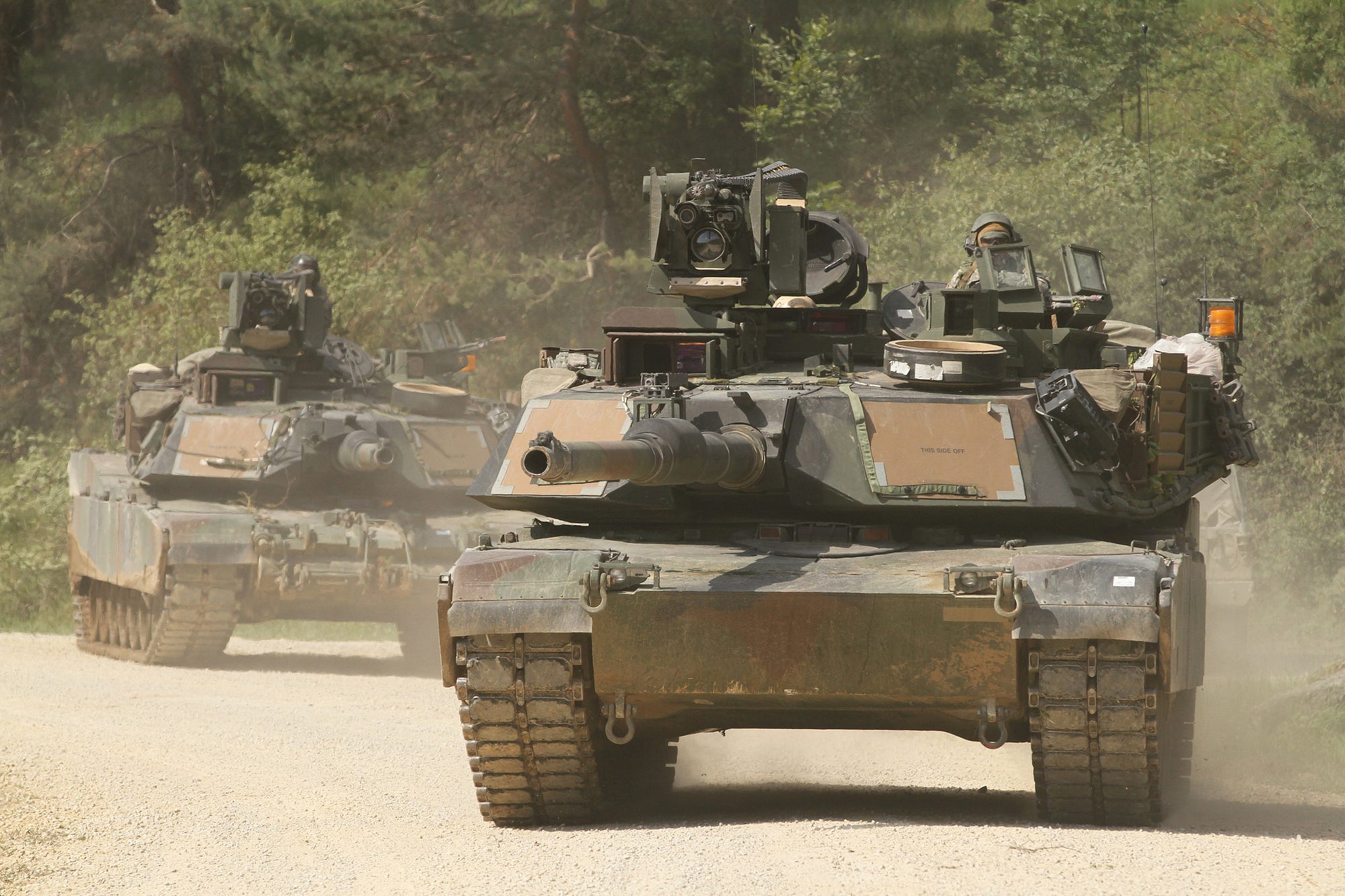
U.S. Army troops from the 1st Cavalry Division are headed for NATO’s eastern border as the Ukraine crisis keeps churning. And these soldiers are bringing Abrams tanks and Bradley fighting vehicles all the way from Fort Hood in Texas.

Detachments from 2nd Battalion, 8th Cavalry will spend the next few months training with America’s friends and allies in the region. This unit is a so-called “combined arms battalion” with tanks and fighting vehicles.

The force will also take over from American paratroopers who have been in Eastern Europe since April. The Pentagon has been rotating troops through the region since Russia forcibly annexed Ukraine’s Crimea region earlier this year.

But the M-1 tanks and M-2 fighting vehicles are a new twist. Previous troops from the 173rd Infantry Brigade Combat Team have no heavy armor.

Of course, tanks and other armored vehicles were already major features at recent NATO gatherings. Back in May, American soldiers trotted out their Abrams and Bradleys during major war game in Germany called Combined Resolve II.

M-1A2 tanks from the EAS stockpile train in Germany during Combined Resolve II. Army photo

But the ground combat branch pulled out the last permanent tank units in Europe last year. A pool of Abrams and Bradleys—the European Activity Set—in storage in Germany are the only such vehicles on the continent at present.

Troops drove vehicles from the EAS stockpile during Combined Resolve II. In October, another battalion of soldiers from the 1st Cav will pull these tracks out of storage again for the third iteration of that exercise.

In the end, this relatively small shipment of heavy gear from the States to Europe is probably a first in over 20 years. Until 1993, the Pentagon prepared to blunt a Russian-led invasion by rushing thousands of troops across the Atlantic.

The C2 System of the IDF GHQ "Pit"

23/7/2014

The IDF use many C3 systems, but only one provides IDF GHQ with a status picture of the war. It is called "Tirat Ha’Agam". The Matzpen Unit is responsible for the development and maintenance of the system. Exclusive interview

If you ever wondered how IDF GHQ commands the military during a war or some other operational activity, meet "Tirat Ha’Agam" ("Castle of the Lake") – a communication system for the decision-making echelon at the "Pit" (Underground GQH Operations Center), designed to provide a current battle picture of the entire IDF. System development had begun sometime in the late 1990s and the first operational employment was in 2004. That first trial employment involved a major training exercise that should have relied on the system, and it failed. The next operational trial was attempted in 2005, during the pullout from the Gaza Strip, using a more stable version – and this time it was successful. In 2006, the system was handed over to the Ness Company for further development with the IDF remaining in a supervisory position, until recently.

In the last months the IDF decided to have the development of the C2 system brought back home. Pursuant to this decision, the bulk of the system development and maintenance activity will be transferred from the Ness Company to the "Matzpen" Unit of the IDF C4I Branch. "We take advantage of this move to initiate a major system upgrade (NG version). The return process is expected to take two and a half years, at the conclusion of which, namely – in July 2016, everything will be reassigned to IDF responsibility. The first version will be issued by the end of this year, with support provided for about 40% of the operational processes specified in advance and the rest will be completed by 2016," explains Lt. Col. Omer, Head of the "Otzma" Branch, in charge of C3 systems for the regional command and GHQ levels at the Matzpen Unit of the C4I Branch. 

According to the new plan, about 80% of the activity will be handled by the IDF and the remaining 20% will still be handled by the Ness Company. IDF fully owns the rights (IP) for the system. The people of the Matzpen Unit say that the system is highly complex, and that the change has been made as the IDF had realized that such a critical system should be fully controlled by the military. It is easy to imagine what will happen if such a system malfunctions during wartime. At the same time, it is difficult to ignore the timing of this decision – precisely at a time when the IDF commits to budget cuts, the Chief of Staff decides to entrust the development of the system to compulsory service programmers rather than to the programmers of a specialist company. Without a doubt, this will lead to significant cost savings. 

App Store for GHQ 

Another aspect they note at the Matzpen Unit is the user's experience. "The current system has two primary deficiencies: it is not easy to operate, and its performance is not good enough," explains Omer. "Compared to the services the user is accustomed to on the Internet, it is a significantly less pleasant experience, and we want to improve that. The new version will be similar to the Google Maps service, with alerts similar to Facebook. We would like the user to be able to learn how to use the system in a few hours." 

Tirat Ha’Agam is the primary C3 system of the IDF for the supreme command and GHQ level. It supports operational processes, from the launching of a rocket in the direction of Israel to a total war, hence its importance. For clarification purposes – IDF GHQ does not have any other C3 system. "We refer here to hundreds of man-years (invested) in a development effort which consists primarily of adding operational processes to the system. Namely – someone will characterize the processes and they would then be loaded into the system. The occupational specialty that is the most difficult to produce and preserve at the unit is the system analyst specialty – the people who provide a bridge between the operational side and the technical side. Some of them hail from different places within the military, and they understand the field very profoundly," says Omer. 

The Units of Combat: The "Flyers" of the IDF C4I Directorate

10/8/2014

The people operating the IDF C4I Directorate's airborne relays are regarded as the special operations unit of the military communication world. They accompany the IDF’s elite units, from the air, in every corner of the globe. A rare glimpse

The airborne relay unit of the IDF C4I Directorate was established during the War of Attrition and is still regarded as one of the Directorate's most confidential units. The unit has two primary objectives. The first objective is to enable command of operations in mountainous terrain where the mountains mask and disrupt communication between IDF elements. In such scenarios, a wireless communication operator mans a mission aircraft, where he receives messages from the forces on the ground and relays them to the command echelon. The second objective is to enable IDF GHQ to command special operations at particularly long ranges. 

Special Measures for Special Operations 

In effect, the operators of the airborne relays are C4I specialists who "live" with the IAF, which provides the platform and the pilots. The cooperation between the C4I Directorate and IAF is one of the most important points stressed by Lt. Col. Itzik, commander of the Tzameret battalion of the C4I Directorate – the element in charge of employing the airborne relay unit. “It is a specialized, small and highly operational organization, measured by its ability to respond promptly. The battalion provides services to IDF GHQ. The airborne relay unit is engaged in operational activity – parts of which are covert while other parts are overt. We are subordinated, administratively and professionally, to the IDF C4I Directorate, but receive our mission orders from the IDF Operations Division. This is also the reason why the battalion is located at the Quirya compound in Tel-Aviv – to be close to IDF GHQ,” explains Lt. Col. Itzik. 

It is important to note that the C4I Directorate is not the only element within IDF that operates airborne communication relays. Owing to the importance of this capability, the IDF provided redundancy and similar units operate under IAF and the Intelligence Directorate as well. “The difference stems from the different requirements. The aircraft of IAF and the Military Intelligence Directorate are fitted with certain capabilities that these branches require. We have to serve everyone. At the same time, the platform is interchangeable, namely – the equipment of the C4I Directorate may be removed and replaced by the equipment of the IAF or the Intelligence Directorate,” says Lt. Col. Itzik. 

Do you provide your services to the IDF exclusively? 

“I have never encountered a request for our services from another agency (ISA or Mossad, A. R-D), but it is possible. We have the ability.” 

As stated, the unit was established pursuant to a need that had emerged during the War of Attrition (March 1969 – August 1970). In those days, the Egyptian Army launched numerous offensive operations against the IDF elements deployed in the Sinai. In response, the IDF executed special operations deep inside Egyptian territory as reprisals. These operations gave rise to the need for a communication relay in the sky that would enable the forces operating on the ground to communicate with rear-area command elements. 

Along with Lt. Col. Itzik, Sgt. Maj. Denis serves as the acting commander of the airborne relay unit. He has been manning that position for almost a decade and was responsible for the rehabilitation and rebuilding of the unit. “At some point, the unit was abolished owing to budget cuts, and was subsequently re-established on the basis of a different aircraft type. We had to rebuild everything – the reserve personnel of the unit, the training system and the recruitment process,” explains Denis. 

“The unit has a very special combination of reservists and regulars. Every one of our reservists keeps a flight suit in their cars. When we summon them, they report for duty immediately. Every reservist signs a special document that authorizes us to alert him or her directly to the aircraft at short notice. These people have a very strong sense of mission. It is not easy to maintain a normal lifestyle as a civilian (and some of them are parents) knowing that you may be alerted to the aircraft at any minute. Some of our people are in their 40s and 50s, and possess many years of experience.” The people of the unit are also proud of the fact that their wireless operator personnel includes both male and female operators. 

Don’t you think that the satellites and UAVs have made the need for a manned communication relaying aircraft redundant? 

Manipulating the Web Surfer’s Opinion

26/6/2014

After Stuxnet, DDoS attacks, viruses and ransomware, it is the time of social malware. The objective: manipulating public opinion for the purpose of accomplishing political and economic goals

One of the questions being asked with regard to cyber attack tools is: where are these tools heading? Mass distribution viruses have evolved into Advanced Persistent Threats (APTs) and attack tools originally developed for sabotage purposes have gone from the virtual dimension to the physical dimension with the exposure of Stuxnet. Well, a new trend has been signaling a new direction – switching from direct attacks against web surfers to attacks intended to persuade. In other words – attack tools intended to achieve a social change by manipulating public opinion, perceptions, concepts, emotions, et al.

From Direct Attacks to PersuasionWhy steal or blackmail if you can cause someone to do something legitimately? Well, this question has driven organized crime, espionage agencies and activist groups to seek more elegant solutions than software used to attack the victim directly. One should bear in mind that today, all Internet defensive mechanisms are based on the assumption that the attacker will actually attack. 

There aren’t any mechanisms capable of coping with legitimate activities intended to motivate audiences or individuals to perform specific acts.The fact that the world of information security shifted from rule-based defenses to defenses based on machine learning (identifying irregular activities and anomalies) has not solved the problem. The solutions are based on a philosophy of searching for attacks through various vectors, rather than on tools or methods capable of detecting attempts to influence users psychologically/cognitively. 

So what if the attacker does not actually attack and still gets what he wants? What then? In such cases, the world of information security does not offer any solutions.Let us assume that a criminal organization wants to prevent web surfers from accessing a certain website – a form of attack known as Distributed Denial of Service (DDoS). At present, that organization will have to maintain networks of hundreds or thousands of botnets it can control remotely and activate according to its needs. It can also employ amplification attacks utilizing such protocols as NTP. Regardless of the attack method the attacker chooses, he will still be required to attack a user or a system directly in order to accomplish his objective – a form of attack that may activate defensive mechanisms.As opposed to the direct attack methods, what will happen if the same organization stages an indirect attack by legitimately manipulating a specific audience? For example, it may lead a large audience to believe that at a certain time on a certain date a special sale will be conducted through a website it wishes to shut down. 

An actual incident that demonstrates this concept occurred last December when the ticketing system of Delta Airlines started selling New York – Los Angeles return flight tickets for a price of US$ 47.00. A single tweet on Twitter would have been sufficient to shut down the website. In another scenario, the attackers managed to convince a large audience that the White House was under attack and that President Obama had been injured. 

This actually happened last October. In that case, the US stock exchange sustained a loss of US$ 136 billion. Once again – this attack involved the changing of web surfers’ perception regarding a specific event that caused them to act in a certain way in the real world.But these are the more simple cases. What would happen is someone wanted to topple a serving government and appoint a new government in a certain country? The events of the Arab Spring are the most current example of how the social media on the web can motivate masses in the physical dimension without attacking even a single server.

 Admittedly, there is no proof (except, possibly, some conspiracy theories) that a specific guiding party had stood behind the events of the Arab Spring, but some recent evidence pertaining to several similar cases suggests that the US government (allegedly the CIA) has been responsible for all of them. In early April of this year, Associated Press unveiled a CIA plot that came to be known as “Cuban Twitter”. This project was under way for two years, through US government funding, and was intended to accomplish two objectives: draw thousands of Cuban youngsters into the project network and cause them to resist the Communist regime overtly.In another case, the US State Department attempted to manipulate the mood on the street in Afghanistan through an SMS-based social network, known as Paywast. This US-funded cellular social network for Afghans began to operate in January 2011. 

The formal objective of the network was to provide a convenient environment that would lead to positive social and economic changes for the local population. The investment of the USA in the project is estimated at US$ 5 million. In addition to Cuba and Afghanistan, the New York Times revealed, in April of this year, the establishment of an independent communication network in Tunisia. This network runs independently of the Tunisian communication infrastructure, so it may not be monitored by the government. The objective, in this case, is to enable dissidents to communicate freely among themselves and access information otherwise kept inaccessible by the government. 

Inter-Arm Tactical Communication


The IDF C4I Branch, in cooperation with various service branches, are developing communication capabilities that would enable tactical echelons in all various sectors to communicate with one another directly

One of the goals of the IDF C4I Branch is to prepare the IDF for the era of network-centric warfare. Smart platforms, wearable computer systems, real-time decentralized status picture and intelligence data fusion in seconds – all of these capabilities require high-speed communication and mainly inter-arm tactical communication. The voices that once encouraged each arm to operate apart from the others are being replaced by other voices that encourage cooperation. This is based on the understanding that on the crucial day, the trooper, the tank, the helicopter and the naval vessel will all share the same fire cycle, and if we want to win – we must be able to communicate with one another. 

For Maj. Dorit, Head of the Tactical Connectivity Section at the IDF C4I Branch, it is a day-to-day mission. “This is a major project that can bring about a change on the battlefield,” explains Dorit, who has recently been selected for the Chief of Staff’s outstanding serviceperson award for her contribution to the project. “The program bundles together 12 different development projects. The objective is to provide the ability to exchange voice and data communication between air, sea and ground elements at the tactical level, within a time constant that is close to real time. When the program is completed, the information will be communicated directly between the various arms and enable a common combat realm. When the program is completed, the Ground Arm, for example, will be able to view the aerial status picture and vice versa.” 

At present, the IDF enable inter-arm communication, albeit indirectly. A system designated "Kelim Shluvim" (Connected Vessels) serves as an inter-arm information mediator of sorts. Admittedly, this is a fairly advanced capability, but at the IDF C4I Branch they strive for direct communication, without mediators. In this way, the data conveyance rate may be improved. “If you launch an operation, all of the participants should see the same status picture. Let us assume that a ground force wants to call in an air strike. It will mark a map reference on the map and within seconds, that information will be translated into a strike mission for the air force. This capability does not exist yet,” explains Dorit. “Our objective is to create direct connectivity, all through encrypted communication.” 

One should bear in mind that in the context of asymmetrical warfare situations, the life cycle of a target is about 30 seconds and sometimes even less. During that time, a Hamas missile launching detachment breaks cover, launches its missile and goes back into hiding. Alternately, the same scenario may be imagined in Lebanon for a Hezbollah antitank detachment. During this time, the sensor-to-shooter cycle must be closed and target destruction must be ensured. This leaves just a few seconds for target acquisition, the actual firing and the attainment of feedback. “The IDF C4I Branch has positioned itself as a regulator. It recognizes the independence of each arm and the tactical interoperability effort is made cooperatively. Everyone understands that the need exists, and everyone has transcended above the organizational politics in order to accomplish this goal.” 

Layered Connectivity 

How Will NATO Adapt to Cyber Threats?


25 AUGUST 2014

With increasing cyber attacks on government organizations, NATO (North Atlantic Treaty Organization) needs to wake up to the possibility of cyber warfare, said Boston Globe columnists James G. Stavridis and Dave Weinstein, and this would need clearly defined protocols and a standardized policy.

Fortunately, NATO has acknowledged the rising demands of cyber awareness and announced that it would include defense strategies to cyber attacks in the Washington Treaty. The Washington Treaty, or the North Atlantic Treaty, was signed in April 1949 and acts as the foundation of NATO.

So while NATO prepares for its September summit in Wales, it is coming to grips with the latest type of threat that would put Article 5 of the treaty to test. Article 5 says that an assault on one NATO state means an assault on all of them. It justifies collective defense, and has been invoked just once in September 2001, defending the US after the 9/11 attack.
Evolving Cyberspace

Cyberspace has become an attractive and easy way for nations to carry oout espionage and military campaigns. The inherent anonymity offered by this domain is what makes it so attractive and feasible. NATO countries face significant cyber threats from several countries, especially Russia.

Recognizing cyber attacks as acts of war is just halfway to the development of a reasonable policy. The objective of NATO should be to prevent any acts of cyber warfare. The treaty needs a practical clause that should define cyber aggression and how it can be prevented – whether by individual NATO states or all of them collectively.

The clause should also list the cases that could invoke the Article. For example, without solid proof that Russia was behind a particular cyber attack, it would be difficult to invoke Article 5.

Janine Davidson, a senior fellow for Defense Policy at the Council on Foreign Relations, expressed her views.

“This is new territory but it’s something that is going to have to be discussed. It is very difficult to know how to react to it. It will have to be very much on a case-by-case basis.”

However, ‘we’ll see what to do when it happens’ is not a sound strategy.
Facing the Challenges

In 2007, there were a series of cyber attacks that paralyzed a large part of Estonia. These attacks were seemingly in response to a clash over the relocation of a war memorial. While most cyber experts believed that the Kremlin was behind the attacks, there was no solid proof. Russia denied the involvement and said that the attacks were by independent hackers. Nevertheless, the incident left NATO wondering what to do.

A good starting point for Article 5 would be responding to a cyber attack that causes damage to the infrastructure or results in a loss of life. These clauses should be added cumulatively over time, and not after a case has happened.

Also, NATO policy makers should consider cyber attacks that might be physically harmless but can cause loss of critical information.

For now, NATO and the member states have three main challenges.

"The Intelligence Revolution is an Opportunity for the Industry"

13/4/2014

From cyber defense products to cutting-edge intelligence gathering and data fusion: Adi Dar, head of the new Electro-Optics, Cyber & Intelligence Division established at Elbit Systems, reveals another angle of the new era

"Intelligence has really changed and the industries that fail to adapt themselves will become irrelevant," says Adi Dar, CEO of Elop, a member of the Elbit Systems group and head of the group's new Electro-Optics, Cyber & Intelligence Division. 

In fact, even Dar's title is new: the Electro-Optics, Cyber & Intelligence Division was established at Elbit only recently, in early 2014. Until the beginning of that year, Dar had focused on his duties as CEO of Elop, which deals primarily with electro-optical technologies (last March the company successfully completed a conclusive trial of the Music system – a system designed to protect passenger aircraft against man-portable surface-to-air missiles). 

But, Dar is no stranger to the world of intelligence, too: he rose through the ranks as an officer in the IDF Corps of Intelligence until he left the military at a relatively young age in favor of a civilian career. Dar was appointed as the head of Elbit Systems' new division at the age of 44. The new division has assumed responsibility for intelligence and cyber technologies developed by the Land Systems Division of the Elbit Systems group. This particular field has gained momentum in the last few years, after Brig. Gen. (res.) Yair Cohen, formerly the commander of Unit 8200, the primary intelligence gathering unit of the IDF Corps of Intelligence, had been appointed to head it. 

Why, in fact, have you established an Electro-Optics, Cyber & Intelligence Division? 

"Over the last year we conducted an in-depth examination of the question of where the intelligence world is going," says Adi Dar. "There is no doubt that the intelligence issue is gaining momentum on strategic as well as tactical levels. Operational intelligence, national intelligence as well as intelligence used to safeguard regimes and intelligence for coping with organized crime and the like – everything is changing very rapidly. 

"At this time it is already clear to us that if you look 10 years ahead – you will find the intelligence element on each one of those levels. Intelligence on the battlefield and in worlds that are half civilian, half government is becoming critical. Accordingly, and in view of the fact that Elbit has always been a significant factor in intelligence (except that the technologies were dispersed among numerous divisions and intended mainly for the tactical world), we decided we wanted to substantially empower our intelligence-related capabilities. We decided to concentrate our efforts through a single division – transfer the element in charge of cyber and intelligence (at the Land Systems Division) to the element in charge of visual intelligence (Elop). The objective was to fuse the two elements and create a new intelligence element capable of coping with intelligence and with the future strategic goals. 

"We are already positioned in a place that is not half bad, and expect to make an additional and very substantial quantum leap. We will see that in the near future." 

According to Adi Dar, the new division intends to develop intelligence and cyber systems for governments and giant organizations in the defense sector and in the paramilitary worlds. "We have no intention of operating in the financial sector or in any other civilian sector," he stresses. Their activities involving intelligence for the battlefield and for border security, for example, will continue to exist in the other divisions of the Elbit Systems group. The new division will focus on WIT (Wise Intelligence Technology) solutions and cyber applications that evolve into products that may be purchased "off the shelf". 

"This is about a lot of software and analysis systems that integrate the entire intelligence input and process it," says Adi Dar. "High quality intelligence is ultimately an integral that crosses numerous disciplines. You cannot produce high quality intelligence just by observing the territory (VisInt) or just through signals intelligence (SigInt) or just by operating human agents (HumInt). The second layer, involving the extraction of maximum information by putting together millions of bits of information – that is the whole point about intelligence today." 

Who, for example, can be the clients of your WIT solutions? 

"The solutions are relevant to organizations that produce strategic intelligence, like the CIA or FBI or similar agencies, organizations that integrate a massive amount of bits of information, most of which are not in the geographic world." 

Where is the technological breakthrough which constitutes an opportunity for Elbit Systems: more in the ability to store the massive information or more in data fusion? 

Automating Warfare: MonsterMind and Cloudy Diplomacy in Cyberspace

AUGUST 25, 2014


More than a year has passed since the revelation of the NSA’s surveillance programs surfaced to civilian levels, and in honor of the anniversary, Edward Snowden issued his newest installment of the National Security Agency’s technological advances in cyberspace. The program, known only as MonsterMind, has automated the process of hunting down cyber threats and then retaliating against those systems, all, according to Snowden, without much user participation.

Using a bot as sophisticated as MonsterMind is yet another example of the NSA’s desire to maintain the United States’ position as a leader in “all things warfare,” and this Snowden interview with Wired has yet to gain the same level of public traction and outcry as the PRISM program, which launched the whistleblower to stardom. The reason behind the limited backlash isn’t so much due to the fact that the general public doesn’t understand the implications of such a program. Instead it most likely stems from the fact that the NSA’s decision to build a program capable of defending America’s cyber infrastructure is the job of the agency.

The rise of cyber crime, espionage, terrorism, and warfare has become increasingly more prevalent in the information systems of every organization from US retail giant Target’s breach, which compromised the credit and debit card information of well over 100 million customers, to the more recent revelation of a group discreetly described in the media as a “Russian cyber gang,” which managed to accumulate the usernames and passwords of an estimated 1.2 Billion accounts from various websites. As the frequency of research reports citing the Internet’s vulnerability has increased, the need for user-friendly systems and optimized efficiency in consumer technology and secrecy and complicity in classified technology has led to the growth of what may become the most diplomatically complicated terrain of warfare: cyberspace.

As the newest theatre of war, cyberspace has evolved from a military history that has a past that isn’t so well-known. Toward the tail end of the Yugoslav War, the Pentagon analyzed the possible use of cyber weapons against Serbia, to disrupt communication networks, yet nothing seemed to be put into use. Flash forward more than a decade later and attacks like the US-Israel joint worm Stuxnet have managed to infiltrate the most sensitive of government agencies, and successfully allow nations to carry out attacks with anonymity and ease, curbing international condemnation and removing the need to use more controversial weapons, like drones.

Casualties of Cyber Warfare

By Cameron Stevens
August 25, 2014

American and Chinese companies are getting caught in the crossfire of the brewing cyber war. 

That the United States and China have engaged in skirmishes in the cyber domain is no secret. Since the beginning of the 21st century, targeted cyberattacks, often with signs of Chinese origin, have attempted to penetrate the computer networks of U.S. corporations and government agencies in search of potentially valuable information. In response to this new strategic threat, the U.S. Military’s Strategic Command commissioned the creation of a sub-unified Cyber Command in 2009, with one of its stated objectives being the “defense of specified Department of Defense information networks.”

U.S. President Barack Obama very clearly defined the threat that cyberattacks pose to the economy, in both the public and private sectors, when he said that the “cyber threat is one of the most serious economic and national security challenges we face as a nation.” Indeed, conflict in the cyber domain is still having some serious repercussions for the business world.

Civilian Involvement in Cyber Warfare

The characteristic of cyber warfare that makes it so uniquely dangerous to the corporate sector is that military power in the cyber domain must be extended through computer networks provided and maintained by non-governmental bodies. The use of these networks for cyberattacks or defense requires the conscription or cooperation of civilian resources. This creates extreme liabilities for the corporations that provide these networks, as they will quickly become the targets of suspicion and possible retaliation from the enemy state. In recent years, both Chinese and American companies have been caught in just this situation.

On October 8, 2012, the U.S. House of Representatives’ intelligence committee released a report that warned of potential national security threats posed by Chinese telecommunication giants Huawei and ZTE. After conducting a year-long investigation of the suspect companies, the intelligence committee found serious vulnerabilities caused by hidden “backdoors” worked into the companies’ technologies that would allow access to U.S. government and business networks. The report advised against the purchase of products manufactured by Huawei or ZTE, and suggested that policymakers block any mergers between either of the two companies and U.S. telecommunication corporations. These accusations have seriously hurt consumer confidence in the two companies, to the extent that in December of 2013, Huawei’s executive vice president dramatically declared“we are not interested in the U.S. market anymore.” While Huawei has managed to hold on to a small market share in America, the company’s association with Chinese state-sponsored cyberattacks has devastated its ability to operate in the United States.

It became clear last year, though, that the United States was a perpetrator of cyberattacks as well as a victim. In June 2013, former U.S. National Security Agency contractor Edward Snowden provided the world with a look into the intelligence apparatus of the NSA, releasing thousands of classified documents to the media. The released documents revealed that the U.S., like China, was using domestic tech firms (in many cases without their knowledge or consent) as conduits for intelligence gathering cyberattacks. In May 2014, the Chinese government announced that it would no longer purchase or use two of Microsoft’s main products, the Windows 8 operating system and the Microsoft Office 365 Suite. Then, in late July and early August, Chinese officials from the State Administration for Industry and Commerce (SAIC) raided multiple offices owned by Microsoft and its contractors in China. While vague statements about an anti-monopoly probe were made, the company’s decision to end support for the Windows XP operating system – a move that would expose the many Chinese computers that use the operating system to security risks – was also cited as a factor in the raids. While it is likely that the ban and subsequent raids were also intended to pave the way for new operating system technologies created in China, the Snowden revelations allowed potential U.S. espionage activities to be cited as a justification. Just as Huawei and ZTE suffered for their association with espionage activities of the Chinese government, Microsoft took a major hit because of the provocative actions of its government.

An Undefined Battlefield

US cyber-warriors battling Islamic State

31 AUG 2014

US officials see social media as a crucial battlefield as they aim to turn young minds in the Muslim world against groups like IS and al-Qaeda.

The United States has launched a social media offensive against the Islamic State and al-Qaeda, setting out to win the war of ideas by ridiculing the militants with a mixture of blunt language and sarcasm.

Diplomats and experts are the first to admit that the digital blitz being waged on Twitter, Facebook and Youtube will never be a panacea to combat the jihadists.

But US officials see social media as an increasingly crucial battlefield as they aim to turn young minds in the Muslim world against groups like IS and al-Qaeda.

For the past 18 months, US officials have targeted dozens of social network accounts linked to Islamic radicals, posting comments, photos and videos and often engaging in tit-fot-tat exchanges with those which challenge America.

At the US State Department, employees at the Centre for Strategic Counterterrorism Communications (CSCC), created in 2011, manage an Arabic-language Twitter account set up in 2012 (https://twitter.com/DSDOTAR), an English-language equivalent (https://twitter.com/ThinkAgain_DOS) and a Facebook page, launched this week, (https://www.facebook.com/ThinkAgainTurnAway).

A senior US State Department official described the strategy as a kind of cyber guerilla campaign.

"It is not a panacea, it is not a silver bullet," the official explained.

"People exaggerate, people think this is worthless or they think it a magic thing that will make the extremists surrender. It is neither one of those. It is slow, steady, daily engagement pushing back on a daily basis.

"It is a war of thousands of skirmishes, but no big battles. America likes big battles but it is not - it is like guerilla warfare," said the official.

The murder of US journalist James Foley, whose execution by Islamic State militants on August 19 was released in a video on the internet, jolted the new breed of US cyber-warriors into a frenzy.

Air power to the fore in the Middle East

27 August 2014

As a former Army officer, my service bias has always made me a believer that only events on the ground matter. The air force is a great enabler but rarely the decisive factor. But my experience of the Middle East has also taught me the value that many governments place in air power.

In the Gulf in particular, technically advanced aircraft symbolise modernity and make up for the limited manpower available to staff their militaries. And it is a service that can be both a path to, or symbol of, political authority. Both Syria's Hafiz al Assad and Egypt's Hosni Mubarak were air force pilots (and later commanders), while King Abdullah of Jordan (like his late father King Hussein) and the Crown Prince of Abu Dhabi are both qualified military pilots.

But as the region reels from multiple security crises, it is interesting to note the degree to which air power is being used by regional forces for a multiplicity of purposes. A student of air power would do well to focus closely on the Middle East at the moment for the rich field of research it is proving to be.

Libya

Days of unverified reports of an aerial bombing by Egyptian and Emirati aircraft on a Libyan weapons storage area and Tripoli's international airport have now been verified by American officials (the officials claim they were not informed of the strikes beforehand, which is not to say they did not know about them beforehand). If true, the strike says much about UAE and Egyptian concerns regarding the need to contain the influence of the Muslim Brotherhood and its affiliates, as well as to stymie Qatari efforts in Libya to do the opposite. It is also further evidence that the UAE is adopting a more muscular and independent approach to regional security issues.
Gaza

Up until two weeks ago, the Israeli air force had already conducted 4900 sorties against Gaza since the most recent conflict began. And yet, just as was the case in the 2006 Lebanon war, even the Israeli air force admits it cannot completely extinguish the threat of indirect-fire weapons from Gaza. 
Iraq

As politicians mull the possibility of air strikes against Islamic State, and the US increases surveillance of possible targets in preparation for future strikes, it is interesting to note that America has already flown 1500 sorties since 8 August (about 600 of these were combat sorties, which included 96 attacks against Islamic State targets). This shows again just how resource-intensive even a 'low intensity' air campaign can be, and why regional states will need plenty of enabling support if they are to take on Islamic State.
Iran

In the east, Iran triumphantly announced the destruction of an Israeli drone spying on its Natanz nuclear facility. The truth is that the drone was more likely flown from Azerbaijan, as this detailed report outlines. Secular Shi'a Azerbaijan and religiously Shi'a Iran have a rather testy relationship and Baku's cosiness with Israel has been an irritant to Tehran for years. Whether the drone was actually shot down near the nuclear facility or somewhere much closer to the Azeri border is perhaps something we'll never know, but it reinforces the type of surveillance technology available to a wide range of states. 
Syria

To all of this we could also add the fall of Tabqa airbase, the last military base held by the Syrian Government in Raqqa province, now under the complete control of Islamic State. Syrian Government efforts at targeting the militants from the air ultimately proved futile, again showing that effective aerial campaigns against ground forces require a concentration of effort and duration that few states can manage. 

Over the next few weeks it is increasingly likely that air power will be on display in the region in a significant way. For students of air power, the Middle East is certainly the place to watch.

PLUCKING AND PROMOTION: MILITARY TALENT MANAGEMENT LESSONS FROM THE PAST

August 26, 2014

In the past few months the challenges of talent management and the prospect of reforming the promotion and personnel systems of the U.S. armed forces have begun to percolate to the top tier of defense discussion. This has been sparked by a number of developments. In the Army, the separation boards and the anxiety surrounding them have driven suggestions to shake up the decades-old methodology of selection and promotion. In the Navy, recent concerns over the results of a lieutenant commander selection board and the prospect of the voluntary departure of talented officers have contributed toproposals for changes to the system. Defense analysts outside the uniformed ranks have also made a compelling case for reform in order to ensure that the future force has the right people.

There is a tendency in our modern military to consider the challenges we face as unique to our time. However, the American military has a long history of disaffected junior officers, concerns over the quality of our forces, and bureaucratic struggle over personnel management. As we address the complexity of bringing an industrial age personnel policy into the twenty-first century, the experience of the U.S. Navy in the nineteenth century might guide how we approach the issues.

Dead Men’s Shoes

For the first half of the U.S. Navy’s history, promotion was based on simple seniority. The date that you entered service dictated your rank. Promotion opportunity occurred each time an officer retired, a slot opened, and everyone moved up one place on the seniority list. Sometimes this hapened when an officer died, since there was no mandatory retirement and some senior officers hung on well after their operational or administrative usefulness. It was all about timing. The only way for an officer to be promoted outside of waiting for his turn was direct Congressional action, as when Lieutenant Stephen Decatur was promoted to Captain after his raid on Tripoli Harbor during the Barbary War.

Junior officers thought this system was a mess. As the Navy grew in size, the maintenance of the seniority list became an administrative burden, and more and more talented officers felt like they were slipping through the cracks. In some cases, lieutenants weren’t promoted out of the junior ranks until they were in their fifties, and some officers didn’t become captains until their seventies. This remained the foundation of the personnel system that was in place through the dawn of the twentieth century. For more than 100 years seniority and timing were the only things that mattered.

In the 1840s and 1850s a political awakening sprang up across America known as the “Young America” movement. Rolled up with the ideals of manifest destiny, accelerating technological change, and growing calls for social reform, it was stoked by the rise of the post-revolutionary generation in American politics. Writing at the start of the movement, the editor and political writer John L. O’Sullivan said that, “all history is to be re-written…all old subjects of thought and all new questions arising, connected more or less directly with human existence, have to be taken up again and re-examined.” Political leaders like future Presidents James Polk and Franklin Pierce embraced the movement and used it to reform parts of the Democratic Party.

Throughout the U.S. Navy’s first century there were a number of attempts to change how the promotion system worked. They all failed, until the burgeoning Young America movement sailed up alongside a group of naval reformers in the 1850s. Commander Samuel Du Pont became a central figure. Although he would become one of the Navy’s first admirals and a Civil War squadron commander, he was frustrated by the system. He had demonstrated hiscombat skill and leadership during the Mexican War, but despite his obvious fitness for senior command, he could not be promoted to captain simply because of timing.

Reform from the Inside

NEW MEMOIR CAPTURES WHAT SOLDIERS NEVER SAY

At times it seems like every junior officer in the British army has written his or her Afghan War memoirs. Where Leo Docherty (Desert of Death) and Patrick Hennessy (The Junior Officer’s Reading Club) set the benchmarks and gained critical acclaim, many mediocre offerings followed with an often-clichéd, paint-by-numbers narrative; “I was at Sandhurst and it was really hard, I only caught the end of Iraq/I missed Iraq and it was rubbish, I went to Afghanistan” … ad nauseum. Thus, it is with some trepidation and skepticism that I began reading Capt. Davis Wiseman’s Helmand to Himalayas, which, as it happens, opens with a chapter about Sandhurst, just catching the end of an Iraq tour and then deploying to Afghanistan.

Truth be told, I didn’t get on well with the book at the beginning. The “memoirs” seemed fairly mundane and I wasn’t warming to the author much either. Remarks such as “I like to think of myself as a soldier’s Officer” and “I can adopt my command and leadership style depending on the situation” had this former Officer false retching. What came next at about 100 pages in, however, changed my view of the book entirely.

The middle chapters floored me. Wiseman finally drops his infanteer’s guard and begins to pour out his soul to the reader as he dares to recall the details of two extremely traumatic events in Helmand Province. The first is the shocking atrocity that occurred on Nov. 3, 2009, when three Grenadier Guards and two Royal Military Police were shot dead by two rogue Afghan National Police officers that they had been mentoring at Shin Kalay police station. It was an event so appalling that it forever cast a haunting shadow over the working relationship between Afghan and U.K. forces thereafter. On that tragic day, Wiseman was the first man on the scene and in his book he guides us back to the bloody aftermath and his unit’s attempts to cope with the carnage before them. It is a raw, heart-breaking and very emotive read.

The second event is when Wiseman sustains his own tour-ending injury: a gunshot wound to the chest just two weeks after the Shin Kalay shooting. Once again, the prose is harrowing. Face down in sewage sodden ditch, Wiseman is revived by his team medic and helped onto a MERT helicopter. Suffocating, hallucinating and coming to terms with his own death, Wiseman narrates through snippets of recalled information and provides the reader with an unforgettable insight into his nightmarish experience.

What I find really refreshing (if “refreshing” is really the right word) about Wiseman’s accounts of the horrors of war is they’re not loaded with an anti-Ministry of Defence agenda and nor are they being exploited for self publicity. This sets his book apart from many, if not most, military memoirs about wars in Iraq and Afghanistan. In fact, one of the real triumphs ofHelmand to Himalayas is that its honesty ends up highlighting several issues that can silently eat away at combat veterans, like Wiseman, for years. For example, there is an open discussion about the author’s post-Afghan identity crisis. The early chapters portray him as the stereotypical line infantry officer — intolerant of anyone in a different part of the Army, anyone overweight, or anyone who has ever had an injury — and yet suddenly, flat on his back and in a ward full of broken soldiers, he finds himself struggling define who he is.Earlier in the book, there is a surprisingly honest moment again where Wiseman sums up a morally-challenging few days in Afghanistan with a telling line: “And I am not proud.” It’s an admission that many of us with service in Iraq and Afghanistan will share, but never allow ourselves to utter out loud. And, for that alone, he should be commended.

This book is being billed as the story of a wounded officer’s “agonising battle with physical injuries and psychological demons and his life affirming recovery as part of a pioneering mountaineering team.” The truth is that the mountaineering portion of the book is relatively short and, in my opinion, it adds little value to the memoir. That might sound harsh and I don’t wish to disrespect Wiseman or his team, Walking With The Wounded, and their attempt to summit Everest but this is not a great fairytale book about redemption on the sacred peaks of the Himalayas; it is about war’s hangover and what’s left of you once you’ve left the battlefield. Everything that will be remembered about this book is contained within 88 gut-wrenching pages in the middle, none of which have anything to do with mountains.

George Vlachonikolis is an economics tutor at d’Overbroeck’s College, Oxford. A retired British Army officer, Vlachonikolis served two front-line operational tours in Afghanistan during a six-year career from 2005 through 2011.