16 September 2014

Obama Rejected "Best Military Advice"

September 12, 2014
CENTCOM Chief Urged Modest Combat Contingent

As he laid out his strategy to combat the Islamic State in both Iraq and Syria, President Obama rejected the “best military advice” of his top military commander in the Middle East.

Quoting two U.S. military officials, the Washington Post reported on Wednesday that Army Gen. Lloyd Austin, commander of U.S. Central Command (CENTCOM), said “that his best military advice was to send a modest contingent of American troops, principally Special Operations forces, to advise and assist Iraqi army units in fighting the militants.”

Austin’s recommendation was taken to the White House by the chairman of the Joint Chiefs of Staff, Gen. Martin Dempsey. The White House rejected CENTCOM’s “advise and assist” contingent due to concerns about placing U.S. ground forces in a frontline role.

In a press briefing Thursday, White House press secretary Josh Earnest said that the president had rejected Austin’s recommendation because he believes “it is not in the best interest of American national security to send American combat troops in a combat operation to act on the ground in Iraq.”

In a nationally-televised speech on Wednesday evening, President Obama repeatedly emphasized that U.S. forces will not have a combat role in Iraq. “We will not get dragged into another ground war in Iraq,” the president said. He specifically underscored that “this effort will be different from the wars in Iraq and Afghanistan,” and will resemble U.S. counterterrorism campaigns in Yemen and Somalia. 

Instead, President Obama opted for a more modest course, sending an additional 475 troops to assist Iraqi and ethnic Kurdish forces; 150 of those forces will form more than a dozen teams and embed with Iraqi Security Forces at the brigade level and above, according to the Pentagon. In other words, U.S. advisers are likely to remain inside bases assisting with issues like training, intelligence, and equipment. The remainder will be assigned to conduct intelligence, surveillance, and reconnaissance missions and oversee U.S. military activities at headquarters in Baghdad and Erbil.

Austin’s predecessor, Marine Gen. James Mattis, told the Washington Post that the president’s decision may place the mission at risk. “The American people will once again see us in a war that doesn’t seem to be making progress,” Mattis told the paper. “You’re giving the enemy the initiative for a longer period.”

ISIS Force Remains Low-Tech: DoD Data

September 10, 2014

Just hours before President Barack Obama goes on the air to explain his strategy to destroy the Islamic State in Iraq and Syria (ISIS), the US military released revealing figures on the airstrikes against them so far.

The new data further demolishes the idea that this is a “humanitarian” war. It also shows the self-proclaimed Islamic State remains a relatively low-tech and lightly armed irregular force, as well financed as it may be. True, the terrorists have captured lots of US-made Iraqi Army equipment and at least some Russian-made Syrian military gear. But ISIS, aka ISIL, still relies overwhelmingly on civilian pickup trucks jury-rigged to carry machineguns, the so-called “technicals” that have become emblematic of Third World warfare.

Of the 212 targets “destroyed or damaged” by US airstrikes, according to Central Command data, 88 of them — 40 percent — are technicals. (CENTCOM calls them, vaguely, “armed vehicles,” but a spokesperson confirmed what that meant). Only two are identified as tanks. Even adding in various armored personnel carriers and a single US-made MRAP (Mine-Resistant Ambush Protected) truck, only 15 targets, 7 percent, could be considered armored military vehicles. The most prominent war booty pressed into ISIS service is the Humvee — 37 destroyed, 17 percent of targets — which, while better protected than a technical, remains by military standards a light-weight vehicle.

Data on static targets tells a similar story. Just 21 targets, 10 percent, are what one might charitably consider “heavy weapons”: anti-aircraft guns, mortars, machineguns, and roadside bombs/IEDs (improvised explosive devices). The rest are vaguely identified as “fighting positions” (e.g. trenches), foxholes, and the like, apparently without such heavier weapons present. Actual artillery — howitzers and the like — is remarkable by its absence.

Of course, what the US reports destroyed is not a representative sample of everything the Islamic State possesses. It is possible, indeed logical, that ISIS has pulled back captured tanks and artillery to defend its core territories in Syria and to train its irregular troops on how to use such military-grade equipment: It takes time to learn how to wage an armored blitzkrieg. But what the US is destroying indicates what ISIS is using along the front lines.

The incredible lightness of being ISIS is a double-edged sword. On the upside, it dramatically limits their ability to attack resolutely defended positions. Technical trucks are fast-moving firepower, but they can’t take a hit like a tank and they can’t take cover like an infantryman, so they don’t last long under fire. US forces annihilated waves of technicals in the 2003 invasion of Iraq, and even Muammar Gaddafi’s troops managed to fend off technical-riding rebels for months during the Libyan revolution in 2010.

On the downside, a lightly equipped force is easy to train and keep supplied. Technical trucks can refuel and repair at any gas station, not hard to find in oil-rich countries like Syria and Iraq. I’ve seen one report that suggests ISIS has centralized the supply of ammunition, but in Iraq, where every male seems to own an AK-47, small arms ammo is hardly hard to come by.

So far, the Islamic State does not muster enough firepower and armor protection to overcome determined resistance by Shia militias, Kurdish peshmerga, and the better Iraqi government troops. It does have enough to keep the war going for a long, long time.

And that is the fundamental problem with which President Obama must grapple: how do we “degrade and destroy” and discredit a force that is flexible and whose center of gravity is not a place or a military unit but an ideology. Jim Phillips, an expert on the Middle East at the conservative Heritage Foundation, said this morning that the struggle will last decades and and, dauntingly, maybe for a century or more.

One of the great problems the United States and the many other opponents around the globe of these nihilists who claim Islam as their religion is how to discourage those who are attracted to following the black flags they fly.

Sugata Mitra: What the Slumdog Guru Did Next

Posted by Martin Veitch

Sugata Mitra is the Indian academic and polymath who became known for his Hole in the Wall computer-based education scheme where he left internet-connected PCs in rural Indian villages and observed the amazing ways in which children with no English skills or previous exposure to computers teamed up to find information and solve puzzles.

Recently, he spoke at Dynamo 14, an event to promote the city of Newcastle-Upon-Tyne and the north-east of England as a technology hub. He has spent eight years at Newcastle University where he is currently Professor of Educational Technology. At the event he gave an enthralling account of his subsequent efforts to understand the role ICT can play in collaborative learning with minimal intervention by teachers.

Professor Mitra has now spent 15 years researching the field and before providing an update he recounted the first Hole in the Wall schemes, dating back to 1999.

“A lot of parents would come to us and say ‘You know what, I think my little girl is gifted. I was looking for a file on my computer and she found it’,” he recalled.

“I thought it unlikely that all these children are gifted so [I wondered] could it be at all possible that children can do things faster on a computer than adults can? This was when computers were taught: ‘This is a monitor, this is how you use a mouse…’ and so on.

“I had a nice office in Delhi but there was a slum on the other side. I asked myself: ‘Is there any reason to think that these children would not be as adept as these children of rich employees?’ So I did an experiment and I used the model the banks used. The banks put ATMs everywhere so I built myself a DIY [kiosk] in the wall of the slum with a glass pane and a touchpad running Microsoft Windows and it had a broadband internet connection and I left it there. It was three feet off the ground and the first people who came there were children and they said ‘What is this?’

“Any intervention would not be sustainable. So when people said ‘Can I touch it?’ I said ‘Well, it’s on your side of the wall.’”

What happened next was remarkable: children showing each other how to browse the web, interacting and learning, despite not knowing any English. How did this occur? Mitra didn’t know and when he tried using video cameras the children would stand back and not participate.

“So we repeated the experiment in a primary school 200 miles away. The children came back and they said ‘We need a better processor and mouse’,” he laughed.

From the Cold War to the code war

September 03, 2014 

Government agencies are being attacked up to 33,000 times a month by cyber terrorist networks 

The recent reports and official warnings by the UK government about the intensifying threat of cyber terrorism in the print and electronic media prompted torment and cheerlessness in investment and business firms across the country. Cyber security organisations are desperately seeking ways to counter it effectively while private business firms are looking towards the most trusted intelligence agency, the Government Communication Headquarters (GCHQ) for a precursor action against the clandestine networks of hackers and cyber jihadists. As we are being told about the sensitivity of this violent security threat, our intelligence agencies are also restive and anxious about the day-to-day changing mechanism of cyber terrorist groups. The recent violent attacks on the Home Office, Foreign Office, private industry and market economy forced the GCHQ to request cyber technology experts for help in preventing these exacerbating attacks.

The country’s Emergency Response Team (ERT) is in hot water as it failed to respond positively. As part of a £ 650 million government investment in countering cyber terrorism, the unit has the core responsibility to respond to the looming threat of economic jihadists more effectively. Government officials in their statements warned government and private firms time and again that Russian, Chinese, Indian and North Korean cyber armies use modern technologies to steal important data. The Cameron government is in deep water and is unable to challenge the hidden enemy with a strong resolve. His government has spent billions of pounds to counter cyber armies in a professional way but no specific achievement has been made so for. The reaction of law enforcement agencies, private cyber firms and the GCHQ is confined to circumventive narratives and are unable to satisfy business communities.

Government agencies are being attacked up to 33,000 times a month by cyber terrorist networks. For public gratification, the GCHQ told the media that the agency was struggling to recruit more people into the cyber security field while the country is at risk of being “left behind and at a disadvantage globally”. The UK asks that, being a member state of the Eye-Five intelligence alliance, which has developed the strongest surveillance mechanism, why has it failed to respond to this violent threat effectively? Every year, the Cameron government highlights cyber terrorism as one of its priorities alongside international terrorism but its forces still need to be adorned with modern technology. When the crises deepened, Prime Minister David Cameron announced a £ 1.1 billion investment in a military programme to tackle these modern threats posed by global terrorism and economic jihadists.

Prevailing in 21st Century Warfare: The Ukrainian Case

By Robbin Laird and Ed Timperlake

Rather than looking into Putin’s soul and figuring out our next step in the Ukrainian crisis, it would be better to look carefully at the emergence of the next phase of 21st century warfare.

War is always with us; but it mutates over time.

In an age of globalization, total war is not a strategic objective of any major global power.

Having said that, what kind of warfare do the adversaries of the United States see as sensible to roll back American power and to reshape the globe in their image?

At the end of 20th century we learned that bringing down the World Trade Center was a desirable objective seen as part of the broader picture of the Middle East regional conflict. A similar effort was tried in France several years earlier, but was not recognized as such by analysts and policy makers. The World Trade Center attack was simply a copy cat plan of the aborted effort to strike the Eiffel Tower.

What we have seen recently in Ukraine with the Malaysian airliner is the next strike in this decade’s reinvention of warfare. 

gor Girkin, aka Strelko, a Russian separatist leader in the Ukraine. Credit Photo: Reuters

One could interpret this as an aberration requiring legal action, but this would miss the point of how it all started – the Russian seizure of Ukraine and the triggering the potential collapse of the Kiev government.

In a globally interconnected world, moves on one regional chessboard have consequences elsewhere, difficult to see at the time, but clearly happening nonetheless. 21st century warfare is about the use of hard power to gain advantage wrapped in the candy wrap of soft power. The best moves are those that can allow one to move ones pieces on the global chessboard without losing your pieces nor providing an excuse to your adversary to up the ante dramatically.

The isolation of world events as factually separate based on the variable of time or t is how the media and policy makers and many analysts interpret a particular event. The reality is that an event is always contextual, and that different actors operating in an event are working to shape an outcome to their advantage, the nature of which carries with it both past and future history.

When Putin seized Ukraine it was deliberate and seen as a relatively risk free opportunity to expand his energy empire and his place in the Mediterranean and the Middle East as well. It has been risk free from the standpoint of what the West has done in reaction, for this event has been isolated and almost forgotten prior to the jetliner being shot down over Ukraine.

This is what cybercrime looks like


That 123456 password simply doesn't cut it. Personal and business accounts are constantly under attack. That's what cyber security firms--and SmartPlanet--keeps saying, at least. And yet, folks continue to use the same bad, hackable passwords to protect their accounts.

U.S. computer security company Norse, which specializes in live dark intelligence and monitors malware and spyware, has a real-time map that shows just how pervasive cyber attacks are. The animated map show hacks in real time. But keep in mind that this shows just a sliver of the number of attacks happening at any one time.

The attacks shown are the map are just a portion of live flows against Norse's "honeypot" infrastructure, a network designed to detect attacks and provide a snapshot of what's happening globally. 

The first screenshot was taken about five minutes after opening the live map. 

This next shot was taken an hour later. You can see the concentration of attacks in the U.S., China and Europe. 

China and the U.S. are the most active. By the first hour of opening the map, China had attacked the U.S. more than 3,500 times. 

But China isn't the only one attacking. Here's a screenshot of attacks originating from the U.S. around the same time as the China attacks screenshot was taken. the U.S. originated attacks nearly mirrored China's.

Photo: Screenshot of Norse animated map

Mystery du Jour: All of the ISIS Twitter Accounts Have Been Silent for Several Days

September 12, 2014

Islamic State’s Twitter Silence Raises Questions

SAN FRANCISCO/WASHINGTON — Islamic State’s Twitter users, which have trumpeted the group’s violent acts and world view on the social media service, have gone abruptly quiet in past days.

Several accounts affiliated with the militant group appear to have gone dormant, according to U.S. government sources, raising questions about whether the government has pressured Twitter to clamp down more aggressively or whether the group has moved to other social media channels.

When contacted, several U.S. officials said on condition of anonymity they were unaware of attempts to quash those Twitter accounts. The sudden silence also came days after reports about Islamic State-linked accounts threatening action against Twitter employees, though there was no evidence to link the two episodes.

Twitter Inc declined to comment on actions the company has taken related to accounts affiliated with the group, which is also known as the Islamic State in Iraq and Syria and as the Islamic State of Iraq and the Levant.

But it has suspended several accounts affiliated with the group in recent months, including one user who threatened retaliation against Twitter’s employees.

A U.S. official who spoke on condition of anonymity said that as government officials identify people on social media whom they believe to be “terrorists” or “extremists,” they draw them to the attention of companies such as Twitter and Facebook Inc, which act at their own discretion.

"People (in government), but also people outside, are constantly referring these companies to identified terrorists," the official said. "I wouldn’t say there is a systematic policy that the U.S. government is going around asking (companies like) Twitter to shut these people down. They sprout very fast. They change their handles."

A second government source familiar with the situation said there was a clear change of social media tactics by Islamic State in the days leading up to President Barack Obama’s Wednesday speech. Obama said then that he had authorized air strikes in Syria and Iraq, in a broad escalation of a campaign against the organization.

Some experts say the militants may have increasingly taken to other online services such as Russia’s VKontakte and Diaspora, a four-year-old social network that relies on a decentralized network of independent computer servers.

Such a tactic is sometimes employed when militants want to evade tracking, the source added.

CAT AND MOUSE

Israeli security agencies in turf battle over cyber war; Netanyahu to decide

Sep. 14, 2014

Israeli security agencies in turf battle over cyber war; Netanyahu to decide
The prime minister is expected to make a determination on the issue this week after dithering for months.

The Shin Bet security service and National Cyber Bureau have been waging a months-long battle over authority for protecting Israel’s economy and civilian institutions against cyber attacks.

Prime Minister Benjamin Netanyahu has taken on the cyber issue as a personal project — the bureau is part of the Prime Minister’s Office, and he has defined cyber attacks as one of the four main threats to Israel. But he has held up the final decision over responsibilities for nearly a year.

This week, after receiving five different opinion papers on the topic, he is expected to issue a decision.

Five people very involved in the issue, all of them former and current senior government officials, characterize the turf war as a war filled with passion, mudslinging, interests and politicking, all of under the radar of defense officials. In the balance is not only prestige and influence on such an important security issue, but also fat budgets.

The seeds of this battle were sown when in May 2011 Netanyahu announced the agency’s establishment. Three months later the cabinet passed a resolution accepting the recommendations of a team appointed by Netanyahu and headed by Prof. Yitzhak Ben-Israel, a former general considered one of Israel’s top experts in the field.

According to the cabinet resolution, which Ben-Israel wrote, the bureau will be an advisory body, without intelligence or operational capabilities, that will deal with issues of legislation, regulation and police. It will coordinate joint activities among academia, industry, the defense establishment and other public organizations, in order to turn Israel into one of the world’s top five centers in cyber-doings.

Since its establishment, the organization has made significant progress toward these goals.

The Current State of CyberWar in the World


Sep 13, 2014 

Drama. Drama is the touchstone for reporting. We have to look well around this particular stone in order to catch a realistic impression of the virtual. We have to look around it even to understand what CyberWar is or how it is defined. 

When talking about cyberwar, hyperbole & metaphor are the rule rather than the exception. Cyberthis, cyberthat – you may have noticed that the virtual world is inhabited by nouns and verbs taken from the material world, and that images of cyberthings in the news tend to have dramatic pictures of physical things rather than the electrons that make up the cyberworld. Images of coins inhabit stories of purely virtual cryptocurrency, such as BitCoin. Perhaps Physics journals, where readers actually are interested in the electrons and the math of the cyberrealm, are the exception to this rule. 

But when we read stories of cyberwar, we see pictures of soldiers, firearms and materiel accompanying the story. When we read of the people sitting at desks and computers to figure out how to hack and not be hacked, we call them CyberWarriors and pictures of men in flak jackets and helmets accompany these stories. I wonder what CyberItem will be accompanied by pictures of tanks and bombers. 

Aside from the dramatic illustrations and photos, what is CyberWar? In 2010, Richard Clarke, former Special Advisor to the President on cybersecurity defined cyberwarfare as “actions by a nation-state to penetrate another nation’s computers or networks for the purposes of causing damage or disruption.” The salient point being that a nation-state must be identified as the offender. If this is true, then we have apparently been already involved in years-long cyberwars, with attacks both from and to/on China, Russia, the USA, Israel, Georgia, Ukraine, the Koreas, Syria, Iran, Estonia and more. And though countries always deny it, there have been clear indicators, tantamount to proof, that these countries have set their digital attackers on one another’s networks, computers, and data. Damage to said networks, computers, and data has ensued. 

So certainly, there have been cyberattacks on and by states. But is it CyberWar? Dr. Thomas Rid, Professor of Security Studies at King’s College says that there is no Cyberwar. He tends to define cyberwar in terms of physical infrastructure catastrophes – scenarios where water stops “flowing, the lights go out, trains derail, banks lose our financial records, the roads descend into chaos, elevators fail, and planes fall from the sky.” And he says it not going to happen. In fact, he has a 2013 book named, “Cyber War Will Not Take Place.”. 

Others are not so sanguine about the subject and possibilities. In the United States, amidst falling government spending in most areas, the Cyber Command budget is skyrocketing. It has nearly doubled year-over-year: $118 Million in 2012, $212 Million in 2013 and $447 million in 2014. That buys a lot of electrons, a lot of code, and a lot of cyberwarriors (sans flak jackets). These increases are leading to similar, albeit not as dramatic inflation of cyberbudgets in other countries. 

Cyber security pro: Finland under hybrid warfare attack

13.9.2014 

Cyber security professor Jarno Limnรฉll says that hybrid warfare – wherein traditional and unconventional warfare methods are combined – is affecting Finns on a daily basis. The “attacks” are executed on the threshold of war and peace, and Limnรฉll says the most insidious form of hybrid war is the kind that operates undetected. 

Professor Jarno Limnรฉll. Image: Yle

”We have to get our heads around the fact that we are targets for a constant and intentional campaign of information influencing,” says Limnรฉll, a professor at the Aalto University and cyber security chief at Intel Security. “This isn’t something that should be shushed or waved aside.”

Broadly speaking, hybrid warfare refers to a combination of both traditional conflict and newer, innovative approaches to influencing citizens and countries where the lines between war and peacetime are blurred.

“This is the uncertain area between peace, crisis and war that we currently inhabit,” Limnรฉll says.

Some methods of hybrid warfare, according to the professor, are the continuous and strategic conveying of information (also known as propagation) and electronic or cyber attacks. Information that affects the receiver’s thinking and opinions is the type of warfare Finns are subjected to, Limnรฉll says, and many other Western countries are also subject to this type of aggression.

Limnรฉll hastens to remind us that Russia is not the only country in the world to utilise hybrid warfare. Western states also use the same techniques.
Nato raises term over Ukraine

Anders Fogh Rasmussen, Secretary-General for the military alliance Nato, was the first to indicate that Russia has been using hybrid warfare in its actions in Ukraine.

McMaster busts myths of future warfare


Lt. Gen. Herbert McMaster Jr. dispels myths as he speaks at an Association of the U.S. Army Institute of Land Warfare Forum, Sept. 10, 2014. McMaster is deputy TRADOC commander for Futures and director of the Army Capabilities Center.

WASHINGTON (Army News Service, Sept. 10, 2014) -- Americans and their leaders all too often wear rose-tinted glasses when it comes to assessing future warfare, said the deputy commander of U.S. Army Training and Doctrine Command for Futures and director, Army Capabilities Center.

Too often, people think battles can be won through engineering and technological advances: cyber, advanced weapons systems, robotics and so on, said Lt. Gen. Herbert R. McMaster Jr.

Big defense firms sell big-ticket systems that are supposed to win wars, he said. The firms use subtle and not-so-subtle advertising that you need this system for the sake of your children and grandchildren and if you don't purchase it, "you're heartless." Congress usually obliges.

The truth is that while overmatch is important, people win wars, he said.

McMaster spoke at the Association of the United States Army's Institute of Land Warfare Medical Forum, Sept. 10. His topic was the Human Dimension.

Although the Army has dominated the battlefield technologically in the recent past, that's no guarantee against an increasingly agile, adaptive foe. The enemy is becoming more adept at eluding firepower through dispersion into civilian areas, disrupting communications and adopting new technologies, he explained. And, non-state actors like the Islamic State of Iraq and the Levant are already fielding capabilities once the sole domain of states.

The "zero dark-thirty" myth is another, he said. This idea uses systems theory to explain warfare as a series of linked nodes. The idea is to selectively take out nodes that are critical to the enemy's network.

Who Is Fighting America's Battles?


Sept. 11, 2014
Author Ann Hagedorn breaks down America's private security industry. 

Since the Iraq War, America has drastically increased its dependence on private companies to handle many security tasks in conflict zones around the world. In “The Invisible Soldiers: How America Outsourced Our Security,” author and former Wall Street Journal reporter Ann Hagedorn explains how companies that began as weapons manufacturers have evolved to assist U.S. military personnel with everything from police training, intelligence analysis and logistics support to border patrol, drone operations and weapons procurement and maintenance. Hagedorn recently spoke with U.S. News about why the American public should care about this trend. Excerpts: 

When did the U.S. begin to outsource its security to private companies? 

The privatization of defense and security has grown over the course of maybe 35 years, [moving] beyond weapons to defense and security services. That happened slowly [following] the end of World War II. Companies now assist U.S. forces in [tasks like] contingency operations and remain long after the military withdraws from combat zones. It has gone from a few companies and a few subsidiaries to a bona fide industry. 

Is using private contractors more efficient than using a military force? 

It depends on who you ask. The companies promote themselves as on-call businesses, which effectively fill the gap between what the government can do and what is needed. But, that said, the issue of efficiency versus effectiveness is huge within the military. Just because these companies are on call and hired temporarily for a particular job doesn’t mean necessarily that’s always the smartest thing to do. If you talk to anyone in the military, they’ll say there’s a major difference between effectiveness of defense strategy and efficiency. Sometimes the most effective strategy in terms of winning a war or ending a conflict won’t necessarily be the most efficient. And that’s where the flaw is. 

Are there unique challenges involved in regulating private companies that have global clients? 

Every industry is regulated to a certain degree. This is an international industry that really shows the shift into the borderless business environment. There are challenges in terms of legal control and monitoring. When you have an industry that has markets on every continent, companies on every continent and employees from many countries, how do you monitor that? 

What are the risks of the U.S. relying on private contractors to fill its defense and security needs? 

Next on Army’s agenda, its own relief and rescue

September 15, 2014
A girl sitting at a relief camp in Srinagar. (Source: IE photo by Tashi Tobgyal)
Besides the local population, the Army too has been hit by the floods in Jammu and Kashmir. With the Badami Bagh Cantonment, the headquarters of Srinagar-based 15 Corps, submerged, the ordnance depots, family quarters, vehicles and offices have been damaged. Moreover, landslides on the Jammu-Srinagar-Leh highway and other arterial roads have affected the Army’s crucial winter stocking exercise at the forward posts.

“The stocking exercise involves gathering stocks for three-six months as the forward posts get cut off during the winter months. This has been obstructed as in the first few days, before the relief material reached us, the Army distributed its own rations, even as the flow of supplies have been affected due to blockage of roads,” said an officer.

“Along Jammu-Ramsu-Benihal NH-44, there are three breaches… Work is going on at full pace… Thirty-seven trucks came across the Sinthan Pass yesterday, and 60 from Banihal side. If successful, we will have good convergence at Anantnag,” said Lt General Subrata Saha, GOC, HQ 15 Corps, Srinagar.

The opening of these roads, which has been undertaken by the Border Roads Organisation (BRO) along with the Army, is likely to restore flow of vehicular traffic in the next 48 hours.

The floods have affected the connectivity between Srinagar and Anantnag, along the Jammu-Srinagar NH-44 and the Jammu-Sinthan-Srinagar highway NH 244. Efforts are on to restore the connectivity between Srinagar and Ganderbal, which further ensures a link to Kargil and Leh.

The Jammu-Srinagar-Leh road is strategically important as it the Army’s major formations under its Udhampur-based Northern Command headquarters, which collectively ensure defences along the Line of Control and Line of Actual Control. It is crucial for ensuring flow of rations, fuel and military supplies to these major formations and units/ sub units under them along the LoC in Uri, Machchal, Gurez, Tangdhar sectors.

“The Jammu-Srinagar highway is clogged at Pampore and Sempura and it will open in a few days. We have to now make up for the supplies that we have lost,” said Colonel Brijesh Pandey, Colonel GS (IW), HQ, 15 Corps.

While the Army has not had a chance to assess its lossess yet, over 100 of its heavy vehicles were submerged under water for almost five days. It also lost over 300 livestock at its military farm.

15 September 2014

Arab states mull air strikes on ISIS

Michael R Gordon,NYT News Service 
Sep 15, 2014

US secretary of state John Kerry is on a weeklong trip to mobilize international support for the campaign against ISIS.
PARIS: Several Arab countries have offered to carry out airstrikes against militants from the Islamic State in Iraq and Syria, senior US state department officials said on Sunday. 

The offer was disclosed by American officials traveling with US secretary of state John Kerry, who is approaching the end of a weeklong trip that was intended to mobilize international support for the campaign against ISIS. 

"There have been offers both to Centcom and to the Iraqis of Arab countries taking more aggressive kinetic action," said one of the officials, who used the acronym for the United States Central Command, which oversees military operations in the Middle East. 

Kerry, who is in Paris to attend an international conference the French are hosting on Monday on providing aid to the new Iraqi government, has already visited Baghdad; Amman, Jordan; Jidda, Saudi Arabia; Ankara, Turkey; and Cairo. 

During Kerry's stop in Jidda on Thursday, 10 Arab countries joined the United States in issuing a communique that endorsed efforts to confront and ultimately "destroy" ISIS, including military action to which nations would contribute "as appropriate." 

American officials said that the communique should be interpreted as meaning that some, but not all, of the 10 Arab countries would play a role in the military effort. 

The United States has a broad definition of what it would mean to contribute to the military campaign. 

"Providing arms could be contributing to the military campaign," said a second State Department official. "Any sort of training activity would be contributing to the military campaign." 

Still, while the United States would clearly have the dominant role in an air campaign to roll back ISIS's gains in Iraq, it is clear that other nations may also participate. 

President Francois Hollande of France told Iraqi officials that his country would be willing to carry out airstrikes against ISIS in Iraq, senior Iraqi officials said. 

"We need aerial support from our allies," Prime Minister Haider al-Abadi of Iraq said during a joint news conference with Hollande on Friday. "The French president promised me today that France will participate in this effort, hitting the positions of the terrorists in Iraq." 

Prime Minister Tony Abbott of Australia has also said that his country will join the air campaign and is sending as many as eight FA-18 attack planes, as well as an early warning aircraft and a refueling plane. 

***** It’s Not Airpower Vs. Boots On Ground Any More

September 12, 2014

As the Air Force Association girds for its annual conference, which starts Monday here in Washington, I was struck by several comments from several experts that the traditional dichotomy between air power and ground forces — often the focus of internecine budget battles between the Army and Air Force — isn’t that relevant any more. Aircraft have begun to generate their own targeting grids using sensors. The model of Special Forces troops working closely with strike aircraft, as in the early days of Afghanistan, has moved further along as Intelligence, Surveillance and Reconnaissance (ISR) sensors and processing power have improved. As Dave Deptula argued in our pages recently: “Today, virtually every combat aircraft brings some degree of precision intelligence, surveillance, and reconnaissance (ISR) to the fight, allowing airmen the ability to find, fix, and finish a target without ground assistance.” Robbin Laird argues below that the debate between boots and planes just isn’t that relevant anymore. The Editor.

As the Ukrainian and Middle Eastern crises roil our world, the debate quickly turns on which path will work best to deal with the evolving threats: boots on the ground, or planes in the air operating without boots on the ground. The specter of responses to the 9/11 attack and the various engagements in Afghanistan and Iraq naturally shade everyone’s perspectives.

But changing capabilities and concepts of operations are obliterating the classic distinction. The Marines have become the only tiltrotor enabled force in the world; the Air Force and Navy have shaped highly integrated air grids, and advances in both the lethality and effectiveness of manned and unmanned aviation have grown.

The past decade’s experience of the need to shape a very large and expensive ground grid from which to feed Special Forces and ground operations is not one the US is going to repeat anytime soon.

At the same time, conflict is evolving as well. The evolving pattern of 21st century conflict is emerging. It is a pattern in which state and non-state actors are working to reshape the global order in their favor by generating conflicts against the interests of the democracies but which the democracies are slow to react.

The assumption of ISIS terrorists, Putin as he invades Ukraine, and the Chinese leadership expanding their sovereignty beyond the limits recognized by international law is that the slow decision-making cycles of democracies can be exploited. Their diplomatic, policy and territorial gains are being achieved on a piecemeal basis, rather than going for the big grab because that might allow democratic leaders to rapidly mobilize public opinion, respond and generate resources.

**** Reflections on the Modern Battlefield: A Discussion with General Anthony Zinni

September 12, 2014

Reflections on the Modern Battlefield: A Discussion with General Anthony Zinni

Together with Tony Koltz General Zinni co-authored the just released book “Before the First Shots are Fired. How America Can Win or Lose Off the Battlefield”, published by Palgrave Macmillan, September 2014.

Anthony Zinni is a retired United States Marine Corps general and a former Commander in Chief of the United States Central Command (CENTCOM). In 2002, he was selected to be a special envoy for the United States to Israel and the Palestinian Authority.

The modern general must not only be expert in his military profession of arms, he must also be part anthropologist, part economist, part sociologist, part political scientist, part everything else that brings expertise to the structuring of a stable and viable society capable of thriving in the twenty-first century. When he exits the battlefield, he is now expected not only to leave behind a vanquished enemy, but a functioning, stable society. A president can no longer just look for a good fighter to plot the operational scheme that leads to victory in arms. He must also find a person who can reconstruct a society.

SWJ: You open your book with a blunt statement: “that wars are not always decided entirely on the battlefield”. Having in mind the post 9/11 decade, what are the other variables, the off the battlefield components that must be in sync in order to wage war successfully?

General Zinni: I think that one of the things that are important off battlefield is the political context. Clausewitz said that a war is basically just an instrument of politics so you have to be clear why the decision has been made, what interests are being protected or promoted, what threats you are dealing with, and how significant are those threats to require the use of military force. The way you decide to approach it is also very important. In Iraq, Afghanistan and Vietnam we went in there to try to rebuild nations - remodel governance systems, social programs and economic systems. Is this feasible, what is the cost? Do you have the support of the American people, of the international community for what you do? And how do you correlate the strategic and political goals? What do you want to achieve? Before that first soldier puts his boots on the ground you may have already created through all these decisions I mentioned the environment that helps him succeed or handicaps to a point failure. People, especially the Americans, when they look at these interventions look only on the battlefield to determine whether we succeed or fail by the performance of the military on the ground when there are so many other conditions and variables that go on off the battlefield - mainly at the level of political leadership, civilian and military leadership that could shape whether we are going to win or lose.

SWJ: What does it take for the US to produce good civilian strategic leadership schooled in the Clausewitzian art of understanding that war is a political instrument and a political responsibility? What does it take to produce good civilian strategic leadership, more Marshalls, more Kennans?

General Zinni: You hit the problem right on the head. We don’t put enough emphasis on the need for a strong and viable strategy. Often times we launch these interventions without an understanding of what the strategic goals are, what the approaches we are going to use are. Just look at what happened in Iraq and Afghanistan. Part way through we declared mission accomplished, than it’s not, than we add more troops and the surge, we never understood how this is going to pan out in terms of the governance of Iraq, our future relationships and our sustained military presence. We were making it up as we went along. I would say the same thing happened in Afghanistan as happened in Vietnam. Without a clear strategy you have this problem. In our system every 4 years we turn over an administration. And we are fascinated with bringing in people outside Washington that desire to change Washington. The problem is that they come with no experience on the international scene or in understanding the implications in using the military. We don’t talk in terms of strategy, we talk in terms of military programs, we put budgets together, and provide funding. It is almost as if our political leadership sees no relationship between their political responsibilities and their military responsibilities. They miss Clausewitz’s most important point. War is a political act from start to finish. The political leadership, the policy developers and the operational commanders must be in sync. We should never fail to align policy, politics, strategy, operational design and the tactics in the field.

PM gives clarity to security, writes Anil Chait

Anil Chait | Mail Today | New Delhi

September 11, 2014

As the NDA government completes a hundred days in office, it has set an affirmative pace and tone in several areas of policy formulation and actions. Significantly, these include peeling off many layers of ambiguity and complexity to bring clarity to our national security perspective.

Some of the responses of the government to security related developments provide a clear glimpse of how it seeks to secure India and Indians and the message it conveys to our nation's adversaries. Prime Minister Narendra Modi's address to military personnel at Ladakh on August 12 was the occasion he used to spell out the first, notable policy shift. This was followed by the Government's support to the 'tough' posturing in dealing with ceasefire violations and later, the decision to put off the Foreign Secretary talks, after the Pakistan High Commissioner arranged meetings with Kashmiri separatist leaders, changed the status quo in quick time. While departing for Japan on Aug 31 he cautioned Islamabad, to keep the environment free of terrorism and violence and assured Japan, that there will be no change to India's nuclear doctrine, while he seeks to build security and trade pacts with them.

Finally recommending 'vichar' instead of 'vistar' to those possessing the 18th Century expansionist mindset, he decided to sit with Japan as he stands up to China's President Mr Xi Jinping.

Tolerance

Indian soldiers patrolling the LoC.The contours of the new approach towards national security should emerge from an examination of the measured words and actions in each case. Take first, the address to troops. Delivered at Kargil, a militarily significant location, the Prime Minister spelled out his assessment that Pakistan now had no strength to fight an open conventional war, which is why it has taken recourse to a proxy (terror) war against India. In strategic terms, this meant the 'conventional' warfare route by a belligerent neighbour has been abandoned in favour of the 'sub conventional', and 'asymmetrical' warfare route to deal with India. Coming from the Prime Minister, this is an observation of immense significance.

The lowering of the tolerance threshold for indiscriminate firing across the IB and LoC was another index of change. Message out to Pakistan is clear, that India is no more a soft state and that the costs of bleeding it, would have to be borne by blood. The Forces have also been asked to give a befitting reply. While Pakistan daily, Jung, reports heavy losses on the Pakistani side, cautionary messages in content are unambiguous - "escalating tension is not good; Pakistan should mend its ways because if it does not then it will not be good for them; environment is not conducive for talks", etc. The decision to call off Secretary level talks with Pakistan follows the caveat 'either talk to us or to separatists'. Reversing Pakistan's perception of India being defensive, soft and conceding, political parties in J&K such as National Conference and PDP stood isolated on the eve of state elections whatever be their stand for the political remedy of the Kashmir dispute.

Service before self: Army camps submerged as soldiers save Kashmir


Army men repair fence along the border damaged by floods in Jammu and Kashmir. Photograph: PTI

When calamity strikes, it does not discriminate. This was on ample display when floods ravaged Kashmir.

Along with civilian population, security forces deployed in Srinagar from various parts of the country were also hit badly. They lost their belongings and their weapons were damaged or left useless after water entered their camps across the Kashmir Valley.

Hundreds of AK rifles, INSAS rifles and SLR rifles, along with their ammunition, are still submerged at various places across the Kashmir Valley, so are bombs, hand grenades etc.

Some reports said 26 AK rifles from an army camps have been washed away in the floods. In the area of Gogji Bagh in uptown Srinagar, one of the worst hit parts of the Valley, about 400 personnel of a central paramilitary force had to leave their camp after gushing waters engulfed it last Sunday night.

“We got orders to leave everything and save our lives," said one of them, explaining how weapons remained in the submerged building complex.

A view of army vehicles damaged by floods at Bonyar in Baramulla. 

Whatever You Do, Don’t Buy Your Aircraft Carrier From Russia India learned the hard way with INS ‘Vikramaditya’


Like a lot of countries, India wants the best weapons it can afford. But ideological and financial concerns mean there are a lot of things it won’t buy from the United States or Europe. That pretty much leaves, well, Russia.

India has been a big buyer of Russian weapons for 50 years. Those haven’t been easy years for New Delhi. India’s defense contracts with Russia have consistently suffered delays and cost overruns. And the resulting hardware doesn’t always work.

Of all India’s Russian procurement woes, none speak more to the dysfunctional relationship between the two countries than the saga of INS Vikramaditya. In the early 2000s, India went shopping for a new aircraft carrier. What followed was a military-industrial nightmare. 

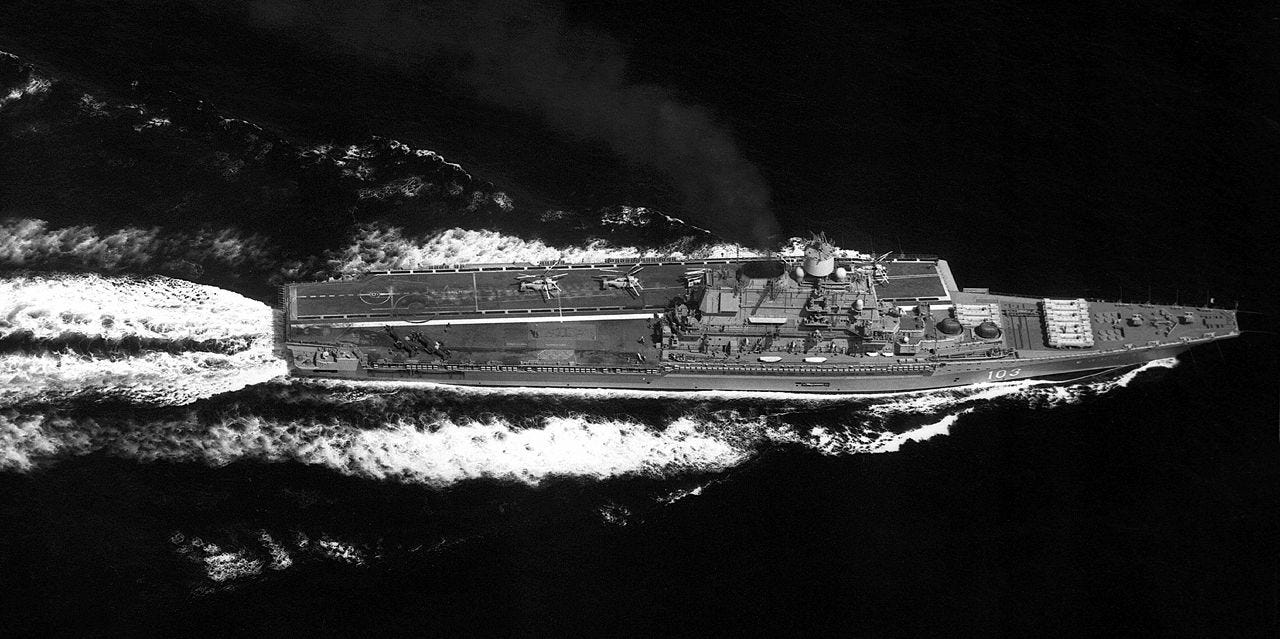
Soviet helicopter carrier Baku, pre-makeover. Note missile armament, guns. Photo via Wikipedia

In 1988, the Soviet Union commissioned the aircraft carrier Baku. She and her four sisters of the Kiev class represented a unique Soviet design. The front third resembled a heavy cruiser, with 12 giant SS-N-12 anti-ship missiles, up to 192 surface-to-air missiles and two 100-millimeter deck guns. The remaining two-thirds of the ship was basically an aircraft carrier, with an angled flight deck and a hangar.

Baku briefly served in the Soviet navy until the USSR dissolved in 1991. Russia inherited the vessel, renamed her Admiral Gorshkov and kept her on the rolls of the new Russian navy until 1996. After a boiler room explosion, likely due to a lack of maintenance, Admiral Gorshkov went into mothballs.