1 October 2014

BOMBING JIHADIS IS FUTILE – SAYS TOP BRITISH GENERAL – “AIR ATTACKS ALONE WILL NEVER DEFEAT THEM”

September 28, 2014 
Bombing Jihadis Is Futile – Says Top British General – “Air Attacks Alone Will Never Defeat Them”

In sentiment echoed here across the pond, today’s London Sunday Times is reporting that “the former head of the U.K. military warned this weekend that ISIS, also known as the Islamic State, — will never be defeated by air attacks alone; and, Western governments are wrong to rule out ground troops.” Christina Lamb, Mark Hookham, and Tim Shipman write that “General Lord Richards, who stepped down as the head of U.K.’s military last year, said “a conventional military campaign on the scale of the attack on Saddam Hussein in 2003 — is needed to crush the Islamist extremist group.”

Criticizing the U.S.-led coalition’s reliance on airstrikes, Gen. Richards said, “Ultimately you need a land army to achieve the objectives we’ve set for ourselves — all air [strikes] will do is destroy elements of ISIS — it won’t achieve our strategic goal.” “The only way to defeat ISIS,” he said, “is to take back land they are occupying — which means a conventional military operation. You can’t possibly defeat ISIS by only attacking them from Iraq. How the hell can you win a war, when most of your enemy can end up in a country you can’t get involved in?,” Lord Richards told The London Sunday Times.

“Even if you are successful in Iraq, which I doubt,” he said, “they will just go into Syria; and, what will you have achieved? They will just have tighter lines of communication.” Lord Richards added, “ISIS is not a terrorist organization. It might commit acts of terror; but, it has tanks, artillery, huge wealth, courts, and justice of its own kind, — and, it is administering large areas, so the idea that this can be seen as a counterterrorism campaign is a key error. We have to view it as a conventional campaign, which means you [ultimately] have to have boots on the ground.

Why Is the U.S. Yielding to Iran Now?

SEP 26 2014

The administration does not need to make nuclear concessions to Tehran to gain its support against ISIS.

Iran's Supreme Leader Ayatollah Ali Khamenei (Reuters)

If there has been one consistent theme to the Obama administration’s foreign policy, it has been the yearning for some kind of deal with the ruling Iranian regime.

President Obama reportedly sent a sequence of messages to Iran’s supreme ruler, the Ayatollah Ali Khamenei, in the early months of 2009. The U.S. president held his tongue during the first 10 days of violently repressed protests against the falsified Iranian presidential election of 2009. Obama resisted the tough Kirk-Menendez sanctions against Iran’s central bank until the Senateapproved them on a vote of 100-0. When nuclear negotiations with the rulers of Iran failed to yield results by the declared deadline, the administration extendedthe deadline—and the sanctions relief Iran receives for as long as negotiations continue.

Little has come of all these attempts, for the uncomplicated reason that the rulers of Iran are not much interested in them. Or, to put it a little more complexly, the rulers of Iran value other priorities more highly than they value any benefit that might come from improving relations with the United States.

The rulers of Iran value other priorities more highly than they value any benefit that might come from improving relations with the United States.There’s a line of argument among certain foreign-policy types that imagines Iran as an “Open Sesame” kind of problem: Just intone the right verbal formula, and the obstructions will all roll away. Its proponents claim that the rulers of Iran and the United States might have reached a rapprochement after 9/11 if only the Bush administration had not labeled the ruling Iranian regime as part of the “axis of evil” in the 2002 State of the Union speech. This fantasy is built on the assumption that the rulers of Iran have no intentions or agency of their own. It assumes that the United States dictates the terms of the relationship, and that Iran merely reacts.

That’s not how it looked at the time, however. The United States governmentbelieved that Iran had offered the Taliban military assistance against coalition forces as early as November 2001. In January 2002, Israel intercepted a ship, the Karine A., loaded with advanced Iranian weaponry to be used against Israel in the murderous terror campaign then entering its bloodiest phase. The list of similar infractions could be extended to tedious length, but maybe the single most alarming at the time was the discovery in 2000 and 2001 that Hezbollah was operating smuggling operations in the Western hemisphere, most notably on the border between Brazil, Paraguay, and Argentina. Hezbollah was regarded as a vastly more sophisticated operation than al-Qaeda. In 2001, memories were still fresh of the Iranian-sponsored Hezbollah terror rampage of 1992-1996, which had taken hundreds of lives from Berlin to Buenos Aires, including 17 U.S. service personnel blown up at the Khobar Towers in Saudi Arabia.

The Intellectual Battle Against ISIS


SEP 27, 2014 

DUBAI – The global financial crisis taught the world how profoundly interdependent our economies have become. In today’s crisis of extremism, we must recognize that we are just as interdependent for our security, as is clear in the current struggle to defeat ISIS.

If we are to prevent ISIS from teaching us this lesson the hard way, we must acknowledge that we cannot extinguish the fires of fanaticism by force alone. The world must unite behind a holistic drive to discredit the ideology that gives extremists their power, and to restore hope and dignity to those whom they would recruit.

ISIS certainly can – and will – be defeated militarily by the international coalition that is now assembling and which the UAE is actively supporting. But military containment is only a partial solution. Lasting peace requires three other ingredients: winning the battle of ideas; upgrading weak governance; and supporting grassroots human development.

Such a solution must begin with concerted international political will. Not a single politician in North America, Europe, Africa, or Asia can afford to ignore events in the Middle East. A globalized threat requires a globalized response. Everyone will feel the heat, because such flames know no borders; indeed, ISIS has recruited members of at least 80 nationalities.

ISIS is a barbaric and brutal organization. It represents neither Islam nor humanity’s most basic values. Nonetheless, it has emerged, spread, and resisted those who oppose it. What we are fighting is not just a terrorist organization, but the embodiment of a malicious ideology that must be defeated intellectually.

Fort Carson commander Maj. Gen. Paul LaCamera talks Afghanistan, changing face of war

September 22, 2014

Uncertainty is the norm for Fort Carson soldiers, their boss, Maj. Gen. Paul LaCamera told The Gazette.

The general, fresh home from Afghanistan, said dealing with uncertainty will mean lots of rigorous training to prepare for a world that could be as difficult as anything soldiers have seen in 13 years of war.

Maj. Gen Paul LaCamera recently returned from a yearlong tour in Afghanistan, where he commanded American forces in a region centered on Kandahar.

The 29-year Army veteran commands Fort Caron and its 4th Infantry Division. Before that, LaCamera spent much of his career in special operations, including fighting in Panama, Afghanistan and Iraq.

The 51-year-old Westwood, Mass., native is a master parachutist who has been awarded the Silver Star and the Bronze Star.

LaCamera on the end of the war in Afghanistan: "Success won't be defined militarily."

"There is no peace dividend at Fort Carson," LaCamera, who commands the post and its 4th Infantry Division, said in an interview last week.

Preparing for peace is a major shift for LaCamera and his soldiers. The general was among the first American combat troops into Afghanistan in 2001. In the years since, he and Fort Carson's nearly 25,000 other troops have been commuting to war, with all-too-brief stops at home between fighting in Iraq or Afghanistan.

Now, as the war in Afghanistan winds down and the last Fort Carson combat troops head home this fall, LaCamera is preparing his soldiers for whatever will come next. The only certainty, he said, is that it will be different from what soldiers have experienced.

"If you go in fighting yesterday's fight you are swinging behind the pitch," LaCamera said.

The general and hundreds of other Fort Carson soldiers have recently come home from the final stages of yesterday's fight.

Jihadist friends and foes


by M.R., K.N.C. and P.K.
Sep 15th 2014


A "mosaic chart" of Middle Eastern relationships

THE rise of Islamic State has upended geopolitics in the Middle East and drawn America's military back to the region. Though IS is popular among militants, the group has no allies on the political stage, making it even more isolated than the official al-Qaeda affiliate, Jabhat al-Nusra. Our "relationship mosaic" above visualises the rapports among countries, political groups and militant organisations in the Middle East. It provides a quick glimpse of who is friends with whom (albeit a simplified depiction of relationships; the "neutral" category, for instance, embraces a large number of possibilities). The Syrian government is disliked by many countries but supported by Iran and Russia. The Iraqi Kurds count numerous friends and no sworn enemies among the entities listed. And the chart shows the degree to which America needs to play a delicate diplomatic game in holding together allies that may not always be friends with each other.

What do these 24 big brains have in common?: Answer at the bottom

SEPTEMBER 4, 2014 

Brad Allenby, President's Professor of Civil, Environmental and Sustainable Engineering, and Law at Arizona State University and founding chair of the Consortium for Emerging Technologies, Military Operations, and National Security

Peter Bergen, Co-Director of the Future of War project, Vice President at New America and Professor of Practice at Arizona State University, the author of best-selling books about al-Qaeda, including Manhunt: The Ten Year Search for Bin Laden from 9/11 to Abbottabad

Rosa Brooks, Professor at Georgetown University School of Law, former Counselor to the Under Secretary of Defense for Policy

Sharon Burke, former Assistant Secretary of Defense for Operational Energy and former Vice President and Senior Fellow at the Center for a New American Security

Linell Cady, Professor of Religious Studies and founding Director of the Center for the Study of Religion and Conflict at Arizona State University

Sue Clark Johnson, Professor of Practice, Walter Cronkite School of Journalism and Mass Communication and former director of the Morrison Institute for Public Policy at Arizona State University

Alan Davidson, New America's Vice President for Technology Policy and Strategy and Director of the Open Technology Institute, former Director of Public Policy for Google in the Americas

Werner J.A. Dahm, Foundation Professor of Aerospace and Mechanical Engineering, Founding Director and Chief Scientist, Security and Defense Systems Initiative at Arizona State University, former Chief Scientist of the U.S. Air Force

Lt. Gen. (ret.) Benjamin C. Freakley, Professor of Practice of Leadership at Arizona State University, senior advisor at the McCain Institute for International Leadership

Shane Harris, Senior Writer at Foreign Policy magazine and the author of the forthcoming @War: The Rise of the Military-Internet Complex and The Watchers: The Rise of America's Surveillance State

David Kilcullen, Senior Fellow at New America and former Special Advisor to the Secretary of State from 2007-2009, Senior Advisor to General David Petraeus in Iraq in 2007, the author of Accidental Guerrilla, Counterinsurgency, and Out of the Mountains: The Coming Age of the Urban Guerrilla

Mossad’s Online Recruiting Campaign

September 29, 2014
Israel’s Shadowy Mossad Looks to Recruit Online

TEL AVIV, Israel — It used to be that if you wanted to join one of the world’s most secretive espionage organizations you had to sneak into a foreign embassy, answer a cryptic newspaper ad or show up in a nondescript building in Tel Aviv to meet a shadowy recruiter. Now all it takes to apply for a job at Israel’s Mossad spy agency is a click of the mouse.

The typically shadowy Mossad revamped its website last week to include a snazzy recruiting video and an online application option for those seeking employment. With versions in Hebrew, English, French, Russian, Arabic and Persian, the sleek site looks to revolutionize the way Israel’s legendary agency seeks out potential agents after generations of backdoor, cloak-and-dagger antics.

"We must continue to recruit the best people into our ranks so that the Mossad might continue to lead, defend and allow for the continued existence of the state of Israel," Mossad Chief Tamir Pardo said in a statement announcing the launch. "The Mossad’s qualitative human capital is the secret of our success."

The Mossad, Hebrew for “The Institute,” is short for the “Institute for Intelligence and Special Operations.” It is the global arm of Israel’s vaunted intelligence community and believed to be behind some of the most daring counterterrorism covert operations of the past century. Only a few have come to light, such as the killing of the leaders of Black September — the Palestinian group behind the massacre of Israeli athletes at the 1972 Munich Olympic Games — and Israeli assassinations across Africa, Europe and the Middle East.

There’s more to the Mossad than its James Bond aura, however, and you are more likely to land a job in its technology, cyber or administration departments than you are to become an international man — or woman — of mystery. But the site alludes to its secretive nature with a video showing satellites and drones hovering as well as men and women dressed in suits hacking into computers and carrying out surveillance operations.

The manual that chillingly foreshadows the Islamic State

By David Ignatius Opinion writer 
September 25 

A fluttering Islamic State flag, is flown over a hill in Tel Abyad town on the Syrian-Turkish border. (Stringer/Reuters) 

It may not be as revealing as “Mein Kampf” or “The Communist Manifesto.” But people looking for insight into the extremist strategy that inflames the fighters of the Islamic State might begin with a book chillingly titled “The Management of Savagery.” 

David Ignatius writes a twice-a-week foreign affairs column and contributes to the PostPartisan blog. 

Published in 2004 by a jihadist who called himself Abu Bakr Naji, the book posits a world in which the superpower halo of the United States has disappeared and the Muslim world within the colonial boundaries known as the 1916 Sykes-Picot agreement has descended into chaos — “savagery,” as the author bluntly puts it.

Sound familiar? Read on. The book, translated in 2006 from Arabic by William McCants, is a frightening guide to the ultra-violent tactics today embraced by the Islamic State and its leader, who calls himself Abu Bakr al-Baghdadi. 

The book makes for horrifying reading. But the one thing I found positive is that, in gruesome practice, this jihadist war plan is burning so hot — and creating so much brutality and bloodshed — that it appears to be alienating Muslims. One sign of this is the broad coalition of Muslim nations that have joined the fight against the Islamic State.

The “Savagery” manual, thankfully, isn’t a bestseller among Muslims. A U.S. counterterrorism expert says it appears to be “too esoteric” to have a wide following among the masses.

The manifesto proposes that the jihadists draw an overstretched America into a war in which it will eventually become “exhausted” and give up. This strategy requires polarizing the Muslim world and convincing those moderates who had hoped for U.S. protection that it’s futile. 

Naji argues that if the United States overextends itself militarily, this will lead to its demise. “The overwhelming military power (weapons, technology, fighters) has no value without . . . the cohesion of (society’s) institutions and sectors.” Loss of America’s media reputation as an all-dominating superpower “removes the aura of invincibility which this power projects, [and reveals] that nothing at all stands in front of it.” 

Digital War Takes Shape on Websites Over ISIS

By BRIAN KNOWLTON
SEPTEMBER 26, 2014

Digital War Takes Shape on Websites Over ISIS

WASHINGTON – Along with its surprising military success, the Islamic State group has demonstrated a skill and sophistication with social media previously unseen in extremist groups.

And just as the United States has begun an aggressive air campaign against the militants, Richard A. Stengel, the under secretary of state for public diplomacy, believes the United States has no choice but to counter their propaganda with a forceful online response.

“Sending a jazz trio to Budapest is not really what we want to do in 2014,” said Mr. Stengel, referring to the soft-edged cultural diplomacy that sent musicians like Dave Brubeck on tours of Eastern-bloc capitals to counter communism during the Cold War. “We have to be tougher, we have to be harder, particularly in the information space, and we have to hit back.”

The State Department division that Mr. Stengel heads has tried a range of approaches for engaging with the Middle East since 9/11, from slick, Madison Avenue-style ads to traditional international-visitors and exchange programs.

But now, digital operators at the State Department are directly engaging young people – and sometimes jihadists – on websites popular in Arab countries, publishing a stream of anti-Islamic State messages, and one somewhat shocking video, on Facebook or YouTube or Twitter, using the hashtag #Think Again Turn Away.

Critics have questioned whether this effort is large, nimble or credible enough. The United States’ image in the Middle East – which seemed perched on the verge of hopefulness when President Obama delivered a closely watched speech in Cairo in 2009 – is now at “the bottom of a sliding scale,” said Lina Khatib, director of the Carnegie Middle East Center, in Beirut.

Mr. Stengel, who joined the Obama administration in February after seven years as managing editor of Time magazine, is focusing his efforts on an approach that reflects Mr. Obama’s insistence that countries like Iraq must take responsibility for their own defense.

While Secretary of State John Kerry was assembling a military coalition against the Islamic State on his most recent trip to the Mideast, Mr. Stengel met with Arab officials to create what he called in an interview “a communications coalition, a messaging coalition, to complement what’s going on the ground.”

The Center for Strategic Counterterrorism Communication is the State Department’s spearhead in this fight and potentially defines the kind of pushback it would like to see friendly countries in the region engage in.

Formed in 2010 to counter messaging from Al Qaeda and its affiliated groups, the interagency unit engages in online forums in Arabic, Urdu, Punjabi and Somali. It recently added English, making itself more transparent – and more open to critical scrutiny.

Posting on Twitter, Tumblr, YouTube and Facebook, members of the unit question claims made by the Islamic State, trumpet the militants’ setbacks and underscore the human cost of the militants’ brutality. Terror groups in Somalia and Nigeria are also targeted.

Recent Twitter posts quoted Muslim scholars as saying “#ISIS murder of aid worker a violation of Islamic law” and described a Turkish nurse as “tired of treating #ISIS fighters so they can go behead people.” The Twitter posts go out under the seal of the State Department.

Video | Stopping Homebound ISIS Fighters A look at how governments around the world have been dealing with citizens turning jihadists.

Army Takes On Requirements: ‘Everybody’s Got To Change’

September 26, 2014

Gen. David Perkins, TRADOC commander.

WASHINGTON: “Everybody’s got to change.” That’s the message from Army Gen. David Perkins, about everything from concepts to training to weapons programs. “A couple of weeks ago, we had a meeting with the Secretary of the Army and the Chief of Staff,” he said. “They said, ‘look, this is not business as usual.”

“Everybody is going to have to change something about what they’re doing, otherwise you’re probably not doing it right. The senior leadership has made that very clear,” Perkins emphasized, speaking yesterday just after a morning talk at the Stimson Center and just before an afternoon of high-level Pentagon meetings. Their agenda, he said: “how do we not get bogged down by the bureaucracy, getting the lowest common denominator, but really trying to innovate and drive change?”

The largest — and often slowest to change — of the armed services now faces a fast-paced and unpredictable world where its bureaucracy just can’t keep up, said Perkins. In particular, he said, “the acquisition-requirements process…is not going to be able to deliver what we need when we need it in the future.”

Indeed, though Perkins didn’t say so, when you consider the Army’s 12-year streak of canceled programs from Comanche to the Crusader to the Ground Combat Vehicle, neither the service nor the process has delivered for decades. Making it deliver requires reforming not just the acquisition side of the Army but also the organization Perkins took over in March, the military priesthood known as the Training and Doctrine Command.

The cancelled Crusader howitzer in testing.

Chairman’s Forum With TRADOC Commander, General David G. Perkins

September 25th 

The Stimson Center 1111 19th Street NW 12th Floor Washington, DC 20036 

General David G. Perkins, the Commander of US Army Training and Doctrine Command, joined Stimson Chairman Amb. Lincoln P. Bloomfield Jr., for the latest installment of Stimson's Chairman's Forum series. General Perkins, who in March became the Commander of TRADOC, will share his vision and plans for shaping the Army of the future and its evolving roles in the defense of US national security. This informal, strategic conversation took place at The Stimson Center and was open to the press and public.

WHAT: TRADOC Commander, General David G. Perkins, USA discusses the future of the U.S. Army with Amb. Lincoln P. Bloomfield Jr. The conversation is on the record.

WHERE: The Stimson Center, 1111 19th Street, NW, 12th Floor, Washington DC, 20036.

WHEN: Thursday September 25, 9:30-10:30 AM ET

FOLLOW: @StimsonCenter on Twitter for event news and use #StimsonToday to join in our events.

Featuring:

Gen. David G. Perkins, Commanding General, U.S. Army Training and Doctrine Command

General David G. Perkins assumed duties as Commander, United States Army Training and Doctrine Command on March 14, 2014 after serving as Commander, United States Army Combined Arms Center, Fort Leavenworth, Kansas. General Perkins was the 21st Commander of the United States Army Combined Arms Center from November 2011 to February 2014, where he was the lead for synchronizing leader development across the Army, the management of the Army's training support and training development enterprises, and the development and integration of the doctrine the Army uses to fight and win our Nation's wars. General Perkins also served as the Brigade Commander for the 2nd Brigade, 3rd Infantry Division (Mechanized) during the invasion of Iraq, where he earned the Silver Star, the nation's third highest award for valor.

Amb. Lincoln P. Bloomfield Jr., Chairman of the Board of Directors, The Stimson Center

Ambassador Lincoln P. Bloomfield, Jr. is founder and president of Palmer Coates; senior adviser at Akin Gump Strauss Hauer & Feld; operating partner at Pegasus Capital Advisors; senior adviser at ZeroBase Energy. He was US special envoy for man-portable air defense systems threat reduction from 2008-2009 and assistant secretary of state for political-military affairs from 2001-2005. Bloomfield previously served as: deputy assistant secretary of state for Near Eastern affairs (1992-1993); deputy assistant to the vice president for national security affairs (1991-1992); and principal deputy assistant secretary of defense for international security affairs (1988-1989), among other policy positions in the Defense Department dating to 1981. He is a graduate of Harvard College and the Fletcher School of Law and Diplomacy.

Army Contemplates Future Amid Today's Crises

By Sandra I. Erwin 

The nation's military is fighting the Islamic State in the Middle East, helping to contain an Ebola outbreak in West Africa, and warily watching other flashpoints around the world.

But that didn't stop the Army from bringing together every general officer above the two-star rank this week to Washington, D.C., to discuss a topic of utmost concern to the service: the Army's future.

About 200 general officers — including many division and corps commanders — spent an entire day discussing how the Army should reshape itself for tomorrow's conflicts, especially those after 2025. "Was that more important than working the inbox items such as the unfolding ISIL operation?" Stimson Center Chairman Lincoln P. Bloomfield Jr. asked Gen. David G. Perkins.

In short, yes, said Perkins, the commander of Army Training and Doctrine Command, or TRADOC.

Perkins is overseeing the latest rewrite of the Army's "operational concept" that will guide how the service is organized and equipped by 2025. The concept is still in the draft phase and will be unveiled next month in Washington at the annual convention of the Association of the U.S. Army.

While the world might be engulfed in war, the Army cannot let its long-term plans veer off course, Perkins said Sept. 25 during a talk at the Stimson Center.

With the world's volatility rising, the tendency is to turn every crisis into a soccer game of seven-year-olds where they are all chasing the ball and nobody is on defense, Perkins said. "Left to their own devices, everyone runs to the ball." Officials are paying proper attention to today's issues, but "we have to think about the future and start now to think about the brigade commanders of 2025."

At the top of the agenda is having a solid strategy for grooming future leaders to cope with unpredictable challenges, Perkins said. "Gen. Ray Odierno [the Army's chief of staff] said the key to our success in the future is leader development."

Is it time for General Dempsey to resign?

SEPTEMBER 26, 2014

By Col. Gary Anderson, USMC (Ret.)

Best Defense guest columnist

General Martin Dempsey, the chairman of the Joint Chiefs of Staff, knows that the Obama strategy for dealing with the self-proclaimed Islamic State is doomed to fail as currently structured; he has done as much to speculate in public that it will have to be altered. Without American combat troops on the ground to physically clear the cities and towns that the forces of Abu Bakr al-Baghdadi have occupied, we are in for a long and frustrating open-ended conflict that the American people will quickly tire of. Dempsey is too good a tactician not to know differently; having served with him briefly on a fact-finding tour for the deputy secretary of defense in Iraq in 2003, I found him to be one of the best commanders in the field. If he slaps his four stars on the table and tells the president to find somebody else to pitch the next inning, it will make a real difference. 

In a telling study of the Vietnam War, H.R. McMaster, now an Army general officer himself, castigates the military general-officer class of that era for quietly carrying out orders that they knew to be wrong. In 2003, many generals strongly disagreed with President George W. Bush's decision to go to war with Iraq, but none resigned in protest. How does this happen?

General officers have offered a number of rationalizations for lack of moral courage over the years. The most often heard is that they feel they feel compelled to stay on because only they can do the job and mitigate the worst of the senior leader's decision. This is tripe; no one is irreplaceable. I would bet that 80 percent of the serving military cannot remember who the last JCS chairman was. 

Taliban Insurgents in Afghanistan Becoming Increasingly Ambitious As US Troop Withdrawal Enters Final Phase

Declan Walsh and Fazl Muzhary
September 29, 2014
Taliban Press for Advantage as Politicians Work on Maneuvers in Kabul

KABUL, Afghanistan — Afghan security forces managed to defeat a weeklong Taliban assault on a strategic district in central Afghanistan, provincial officials said over the weekend, though the victory was tenuous and the toll was high. At least 64 people were killed, including some civilians who were beheaded by the insurgents, and a number of homes were torched.

The battle in Ghazni Province, 150 miles southwest of Kabul, ended on a brutal note, with the hanging of four Taliban fighters by angry villagers. But it marked the latest brash gambit from an increasingly ambitious insurgency that constitutes the central challenge to the country’s president-elect, Ashraf Ghani, who was scheduled to be inaugurated on Monday.

While a bitter electoral dispute consumed the attention of Afghanistan’s political leadership over the summer, the Taliban took advantage by pressing hard into vulnerable districts, often in areas that had been vacated by foreign troops.

Where the insurgents once attacked in small groups, now they massed in larger numbers, sometimes hundreds strong, in southern districts such as Sangin, a key node of the lucrative opium trade.

The assault in Ghazni occurred in the remote Ajristan district. Taliban fighters, reinforced from neighboring Oruzgan Province, swept into four villages, destroying police check posts and burning the houses of villagers suspected of sympathizing with the government, according to Mohammad Ali Ahmadi, the deputy governor of Ghazni.

The insurgents killed at least 40 police officers and members of the Afghan Local Police, a militia set up by American special forces officers, Mr. Ahmadi said. Then they torched the homes of militiamen and beheaded at least 12 of their relatives. Abdul Wahab, a resident speaking by satellite telephone, said the victims included a man in his 80s and three boys between the ages of 5 and 7.

By Friday morning, provincial officials in Ghazni city said they were afraid the district would fall into Taliban hands. Later in the day, though, a contingent of Afghan Army troops, backed by NATO air support, arrived and drove the insurgents out, Mr. Ahmadi said.

As the Taliban retreated, local villagers caught four fleeing insurgents and hanged them from a tree.

Clausewitz Turned On His Head


This post is provided by Martin Skold, who is currently pursuing his PhD in international relations at the University of St. Andrews, with a thesis focusing on the strategy of long-term international security competition. He is a contributor to the Center for International Maritime Security’s NextWar blog.

War, we are told by a wise elder, is the “pursuit of policy by other means.” In fact, this famous statement was perhaps more an aspiration on Carl Von Clausewitz’ part than a statement of metaphysical truth. It is often observed that German generals in the succeeding generations completely forgot this famous dictum, which demoted them relative to civilian leaders they often held in contempt. But American generals do not seem to be immune, either.

In any discussion of strategy for any war a democracy might fight, public support should be seen as a constraint on resources – it is not always unlimited, and it shapes what options are available.

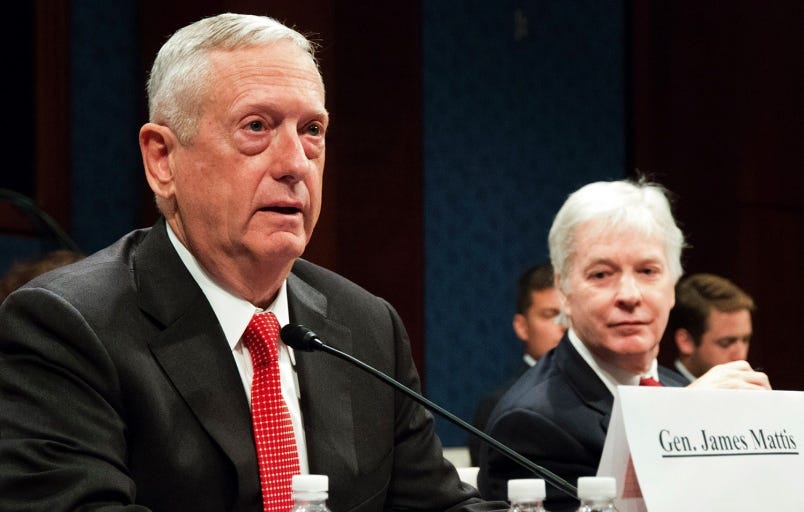
Retired Marine Corps Gen. James Mattis (Rick Vasquez, Stars and Stripes)
As retired U.S. Marine General James’ Mattis’ comments regarding the advisability of ruling out ground troops to combat ISIS demonstrate, there is a disconnect growing between America’s military and political leadership over how to respond to ISIS. This disconnect is actually less one of ends than of means: the disagreement regarding ISIS is not one regarding the desirability of defeating ISIS, but rather of what tools are available and worthwhile to use to do it. In any discussion of strategy for any war a democracy might fight, public support should be seen as a constraint on resources – it is not always unlimited, and it shapes what options are available. To fail to account for politics is to fail strategically.

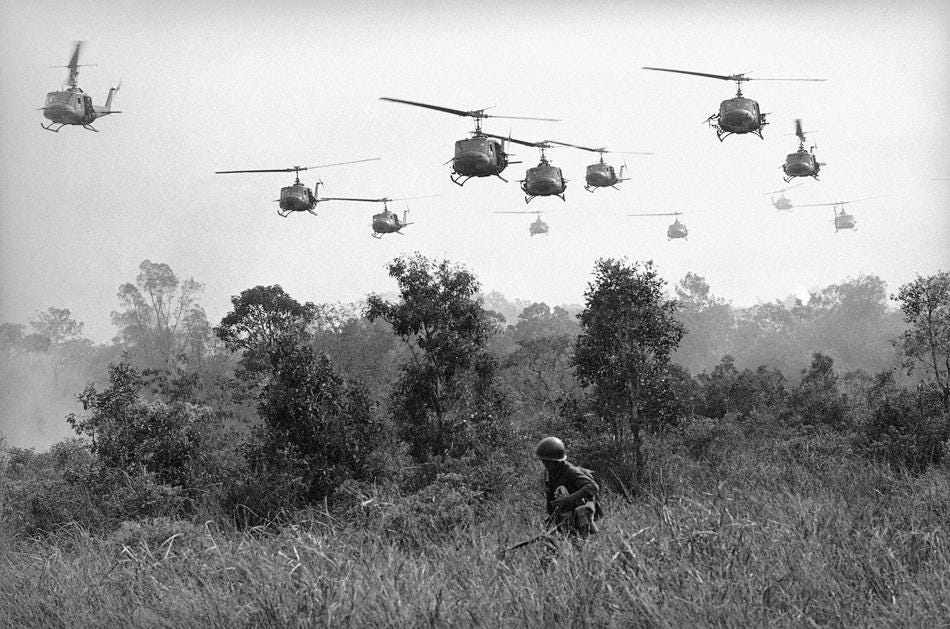
Hovering U.S. Army helicopters pour machine gun fire into tree line to cover the advance of Vietnamese ground troops in an attack on a Viet Cong camp 18 miles north of Tay Ninh on March 29, 1965, which is northwest of Saigon near the Cambodian border. Combined assault routed Viet Cong guerrilla force. (AP Photo/Horst Faas)

Obama Landmine Ban Goes Against Best Military Advice; Unilateral Decision Could Endanger Deployed U.S. Military Forces In Outposts, Ungoverned Areas; Increases Chances Of Technological/Capability Surprise

September 27, 2014 
Obama Landmine Ban Goes Against Best Military Advice; Unilateral Decision Could Endanger Deployed U.S. Military Forces In Outposts, Ungoverned Areas; Increases Chances Of Technological/Capability Surprise

Adam Kredo, writing in the September 25, 2014 edition of the Washington Free Beacon, reports that POTUS Obama went against the Pentagon and the best military advice –“banning the use of anti-personnel landmines,” except on the Korean peninsula. POTUS Obama’s unilateral decision not only went against the Pentagon; but, also against many in Congress. 

“In a series of statements this week,” the Obama administration said “that landmines will no longer be used and ordered DoD to begin destroying stockpiles of the devices — which have historically been used to protect U.S. forces from enemies in the warzone.” “The United States will not use anti-personnel landmines,” the POTUS said, while at the United Nations in New York earlier this week.

Mr. Kredo adds that “this controversial, and unilateral decision, comes as America steps up [military] strikes against the Islamic State (IS) — and, has been in the works for some time — despite protests from the top Pentagon leadership, including Joint Chiefs of Staff Chairman (CHCS), Gen. Martin Dempsey, who argued that “landmines were an important tool,” in the kitbag of options that are used to protect deployed and vulnerable military outposts. Gen. Curtis Scaparottii, Commander of the United Nations Command, and U.S. Forces in Korea — when asked by Congress earlier this year — said, “I have provided my best military advice on this issue; and, it is my assessment that landmines are a critical element in the defense of the Republic of Korea; and, our interests there. And, they are a critical element of our contingency plans as well,” he said. 

The POTUS’s announcement was met with alarm by U.S. lawmakers who “warned that the decision is not backed by U.S. military commanders,” — who view the use of landmines as a key tool in the protection of U.S. forces deployed in a war zone or ungoverned area. “It is disappointing once again to see that the White House has overruled the advice of out military commanders,” said Rep. Howard “Buck” McKeon, (R. – CA.) Chairman of the House Armed Services Committee (HASC). “With the security situation around the world deteriorating, the last thing we should be doing is unilaterally jettisoning sound defense options. We’re all in this together, and we all share the risk when the best advice of our military experts is ignored.” 

Modern Airpower Vs. Tribal Warriors: Inside America’s Asymmetrical War With The Islamic State

By James Kitfield
September 28, 2014 

Modern Airpower Versus Tribal Warriors: Inside America’s Asymmetrical War With The Islamic State

In the annals of warfare there have been few conflicts as asymmetric as the United States against the Islamic State, which pits a global superpower at the head of an international coalition against a brutally ambitious terrorist group.

That dynamic of the strong against the seemingly weak was underscored in recent days, when President Obama used the pomp and ceremony of the annual United Nations General Assembly to rally the international community against an ideologically driven movement of extremists.

After chairing a rare U.N. Security Council meeting on the Islamic State (IS, also known as ISIL or ISIS), Obama was uncharacteristically blunt in describing the nature of the challenge ahead. “The only language understood by killers like this is the language of force,” Obama said in his address. “So the United States of America will work with a broad coalition to dismantle this network of death.”

As if to reinforce Obama’s point, the Islamic State engaged in a display of coalition warfare of its own: Islamist militants in Algeria with sworn allegiance to IS released a video depicting the beheading of a French hostage in apparent retaliation for France’s participation in the U.S.-led air campaign.

While a war pitting a global superpower against a terrorist group may seem lopsided, recent U.S. history and the “global war on terrorism” aimed at al-Qaida offer cautionary lessons. The first is to not lash out before understanding the true nature of your enemy.

When Islamic State leader Abu Bakr al-Baghdadi launched the offensive last summer that rolled over four Iraqi army divisions and bought his army of black-clad extremists to the outskirts of Baghdad, for instance, he took the U.S. intelligence community by surprise. Terrorist groups, even ones incubated in sectarian civil war and boasting the pedigree of the Islamic State (formerly al-Qaida in Iraq), are not supposed to prevail in frontal assaults on major military formations, nor capture large swaths of territory in blitzkrieg-type offenses.

Yet since that summer offensive IS fighters have continued in their attempts to expand the borders of their fundamentalist caliphate in Sunni-majority territory on both sides of the Syrian-Iraq border. They’ve lost some ground in northern Iraq to Kurdish peshmerga forces, but just in the past week have achieved tactical victories in western Iraq and northern Syria.

30 September 2014

Is the World at the Cusp of a New Dark Age?

September 29, 2014

We appear to have reached one of those extraordinary moments in history when people everywhere, communities and even entire nations, feel increasingly stressed and vulnerable. The same may be said of the planet as a whole.

Whether intellectually or intuitively, many are asking the same question: Where are we heading? How do we explain the long list of financial, environmental and humanitarian emergencies, epidemics, small and larger conflicts, genocides, war crimes, terrorist attacks and military interventions? Why does the international community seem powerless to prevent any of this?

There is no simple or single answer to this conundrum, but two factors can shed much light.

The first involves a global power shift and the prospect of a new Cold War. The second relates to globalisation and the crises generated by the sheer scale of cross-border flows.
Is a new Cold War in the making?

The geopolitical shift has resulted in a dangerous souring of America’s relations with Russia and China.

The dispute over Ukraine is the latest chapter in the rapidly deteriorating relationship between Washington and Moscow. In what is essentially a civil war in which over 3,000 people have been killed, the two great powers have chosen to support opposing sides in the conflict by all means short of outright intervention.

The incorporation of Crimea into Russia, Moscow’s decision to use force in Georgia in 2008 and its support for the independence of the two breakaway regions of Abkhazia and South Ossetia are part of the same dynamic.

The conduct of Russian governments in the Putin era has been at times coercive and often clumsy at home and abroad. But the United States has also much to answer for. For the last 25 years its foreign policy has been unashamedly triumphalist.

In his 1992 State of the Union address, President George Bush senior declared:

By the grace of God, America won the Cold War.

Since then we have seen the bombing of Serbia without UN Security Council approval, US withdrawal from the Anti-Ballistic Missile Treaty, the US invasion of Iraq in defiance of UN opposition, overt support for the colour revolutions on Russia’s doorstep (Ukraine, Georgia, Kyrgyzstan), and the Magnitsky Act singling out Russia for human rights violations. Western military intervention in Libya, which contrary to assurances brought about regime change, dealt a further blow to the relationship.

And now the Ukraine crisis has led to steadily expanding US and European sanctions against Russia and renewed efforts to ramp up NATO deployments and joint exercises in Eastern Europe.

UKRAINE IS AT THE MERCY OF MOSCOW NOW, THE WEST IS WATCHING HELPLESSLY

September 29, 2014 
The End of Deterrence?

Ukraine Is At The Mercy of Moscow Now, The West Is Watching Helplessly

With two agreements about the future of eastern Ukraine now in place – one official brokered by the OSCE, one still secret between Ukrainian President Petro Poroshenko and Putin-aide Vladislav Surkov – the country’s fate seems sealed. Western-anchored near-neighbors “feel vulnerable.”


Deals struck over the weekend after Washington rejected Kiev’s plea for delivery of modern weapons to resist Russian dismemberment of Ukraine confirm Western acquiescence in the victory of Russia’s direct invasion of Ukraine on August 27 and subsequent truce. The Minsk pact brokered on Saturday by the Organization for Security and Cooperation in Europe between the Ukrainian government and secessionists in eastern Ukraine freezes in place Russian and pro-Russian control of Ukraine’s two easternmost oblasts, Luhansk and Donetsk, with a 30-kilometer buffer zone free of heavy weapons between the Ukrainian army and Russian-led forces. Adherence to truce terms is monitored only by unarmed OSCE observers, who have understandably refrained from inspecting areas on the Russian-Ukrainian border whenever pro-Russian forces have said they could not guarantee the inspectors’ safety.

A further, still secret agreement between Ukrainian President Petro Poroshenko and Vladislav Surkov, a senior aide to Russian President Vladimir Putin, is said by a knowledgeable Western source to contain harsher terms for Kiev than the public Minsk truce. Surkov ranks high on Western lists of sanctions imposed on Russian officials involved in Russia’s land grab of Crimea and parts of eastern Ukraine this year. Former Ukrainian Deputy Foreign Minister Oleksandr Chalyi, in Oslo for the annual meeting of the London-based Institute for Strategic Studies, confirmed that Surkov was in Kiev over the weekend and also that the Ukrainian government had not, as of Sunday, published the text of the Minsk agreement that may quickly be superceded by the alleged Poroshenko-Surkov deal.

Chalyi further acknowledged that Ukraine has very little choice – after the Obama administration and American lawmakers gave Poroshenko a rapturous welcome in Washington last week but turned down his urgent appeal for weapons – other than to accede to Russian demands for cooperation with Moscow. He did not confirm the existence of any new pact between Surkov and Poroshenko, however.

As the belligerents on both sides of the ceasefire line now begin pulling back armored vehicles and artillery with a caliber greater than 100mm from the buffer zone, the situation seems to be that for an interim period Kiev can still formally call the Donetsk and Luhansk provinces part of Ukraine. However, Ukraine has already lost control of this region. In the area bordering Russia technicians are ripping out electrical connections with the rest of Ukraine and installing new connections with Russian grids. And in an operation reminiscent of the Soviet stripping of East German industry after World War II, Russians are dismantling Ukrainian weapons plants in the region – which have supplied the Russian army for decades – and hauling them away to Russia in truck convoys.

The Mysterious Disappearance of the Graves of 39 Russian Paratroopers Killed in the Ukraine

Anna Dolgov
September 30, 2014
Defense Ministry Dismisses Reports of Russian Paratroopers Killed in Ukraine

Marko Djurica / ReutersRebels stand in front of what they say is a mass grave with five bodies, in the town of Nizhnaya Krinka, eastern Ukraine.

An opposition lawmaker who inquired about the reported deaths of Russian paratroopers in Ukraine has been told by the Defense Ministry that the accounts are “rumors” and that releasing information about military casualties would violate privacy laws.

State Duma lawmaker Dmitry Gudkov — one of the few critics of President Vladimir Putin’s administration to remain in parliament — asked the Defense Ministry last month for information on whether Russian troops were fighting in Ukraine, the number active or past servicemen who had been killed in the conflict, and the military affiliation of three dozen men whom he identified by name.

The names on Gudkov’s list — 39 of them in all — included soldiers who were buried last month in the western Russian city of Pskov and which disappeared from grave markings after a local lawmaker and journalists started asking questions.

The ministry’s response, which Gudkov published on his LiveJournal social network page Monday, gave little information on any of those issues.

"Your request regarding rumors concerning the activities of Russian servicemen on the territory of Ukraine … has been reviewed," the letter signed by Deputy Defense Minister Nikolai Pankov said.

"Despite repeated accusations by a range of Ukrainian and Western politicians, quoted by foreign media, the Russian Federation is not a party in the conflict between the government forces of Ukraine and the residents of the Donetsk and Luhansk regions who disagree with the policies of the country’s leadership."

9 Ukrainian Soldiers Killed in New Round of Bloody Fighting Around Donetsk Airport in the Eastern Ukraine

Andrew Roth
September 30, 2014

Renewed Fighting Around Donetsk Airport Tests Ukraine Cease-Fire

Ukrainian soldiers patrolled near Debaltseve, Ukraine, on Monday. Credit Anatolii Boiko/Agence France-Presse — Getty Images

DONETSK, Ukraine — Deadly fighting has broken out again between the government and rebels around the strategically important airport outside Donetsk, a continuing source of friction that is testing the resilience of a recent cease-fire agreement.

Nine Ukrainian soldiers and three civilians were killed during heavy shelling on Sunday, government officials announced. Andriy Lysenko, an army spokesman, said seven soldiers died when a tank shell hit their troop transport. It was the deadliest attack since the cease-fire was announced on Sept. 5.

President Petro O. Poroshenko has called the cease-fire the keystone to his peace plan for the country, and in a nationally televised news conference on Thursday said he had “no doubt that the biggest, most dangerous part of the war is already behind us.”

But at important positions held by Ukrainian forces, like the airport and the city of Debaltseve, a crucial junction between the largest rebel cities of Donetsk and Luhansk, shelling has only intensified in recent days.

The upsurge in violence comes at a particularly critical moment, as Russian, Ukrainian and rebel military officials are meeting to work out the boundaries of a buffer zone of 30 kilometers, about 19 miles, that, when finalized, could mark a neutral area in a new, frozen conflict.

“The line drawn on paper does not correspond to the current positions,” said Andrei Purgin, the deputy prime minister of the rebel Donetsk People’s Republic, who participated in the talks in Minsk, Belarus, that led to the cease-fire.

Terrorism & semantics

Sunanda K. Datta-Ray

Sep 30, 2014

No one can or will spell out what distinguishes a ‘terrorist organisation’ from a ‘liberation movement’. There are other complications. Chhattisgarh has demonstrated how gory internal terrorism can be.

It was a cliché of the 1960s, the great age of decolonisation, that one man’s freedom fighter was another man’s terrorist. That duality had earlier produced the possibly apocryphal story of Franklin Delano Roosevelt declaring in 1939 that Nicaragua’s dictator Anastasio Somoza “may be a son of a bitch, but he’s our son of a bitch!”

All that came to mind listening to Prime Minister Narendra Modi’s spirited demand at the United Nations for the Comprehensive Convention on International Terrorism drafted in 2002 to be finalised. As the victim of repeated attacks, India is understandably anxious for a global arrangement to criminalise all forms of international terrorism and deny terrorists, their financiers and supporters access to funds, arms, safe havens and political patronage. But Nawaz Sharif’s speech also recalled that 1960s contradiction. Despite claiming to suffer terrorist attacks, Pakistan’s Prime Minister left no one in doubt that he regards people who kill, bomb, maim and destroy in Jammu and Kashmir as freedom fighters.

Hyperbole enjoys a hallowed tradition. This year marks the 100th anniversary of the outbreak of World War I during which Britain exalted terrorism to an instrument of state policy, thereby setting a global precedent. The British foreign office’s Arab Bureau employed T.E. Lawrence to instigate and lead a secessionist revolt against the Ottoman Empire under cover of archaeological excavations. Lawrence’s guerrillas harried the Turkish Army, sabotaged the strategic Hejaz railway Ottoman troops used to control rebellious Arabs, captured Aqaba port and attacked Damascus and other Turkish garrisons.

Whatever pieties politicians of many hues might mouth in many tongues in New York, no government will surrender the right to mount similar campaigns against perceived adversaries. Indian allegations of Chinese abetment of Naga rebels were matched by China’s charges of Indian complicity in American-sponsored operations in Tibet. If Pakistanis suspect India’s Research and Analysis Wing is active in Balochistan, Indians are convinced the troubles in Jammu and Kashmir are the handiwork of Pakistan’s Inter-Services Intelligence.

Finally, a new govt in Afghanistan An impressive transition to democracy, made against great odds


Anita Inder Singh
http://www.tribuneindia.com/2014/20140930/edit.htm#5

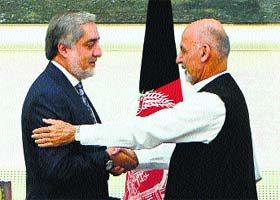
AFTER six uncertain months, which saw two constitutionally mandated rounds of voting, much wrangling over fraud which necessitated an audit by the UN of ballot-papers, and mediation by the US, Afghanistan finally has a new government of national unity. Ashraf Ghani, a former Finance Minister, will be Afghanistan’s new President, and Abdullah Abdullah, a former Foreign Minister, will hold a newly created post of CEO — or nominate someone to implement the decisions taken by the President. This power-sharing outcome of the electoral process that started with last April's voting does not look entirely democratic, but the two men must now put aside their differences and meet the expectations of their compatriots.

For Afghanistan’s third presidential election since 2004 demonstrated that war and poverty are not barriers to the wish of people to determine their destiny. And the world should congratulate the Afghan voters who defied Taliban violence and took part in the two rounds of polling on April 5 and June 14. The high poll turnout — nearly 60 per cent in each round — in itself marks the continuation of a decade-old troubled, strife-riven yet impressive transition to democracy, made against great odds.

Hamid Karzai, the mercurial twice-elected President, also deserves credit for steering his country to a peaceful transfer of power. He completed two terms in office, making war-torn Afghanistan a pleasing contrast to neighbouring Pakistan — where only one president — Asif Ali Zadora — completed his constitutional tenure — since independence in 1947. And the leaders of China, Afghanistan's other, more prosperous neighbour, will have no truck with democracy and the elected rulers.

The good news is that both Ghani and Abdullah, who won the first round, are political moderates who seek to bridge ethnic divides, keep Afghanistan on democratic rails and sign a security deal with the US, whose diplomatic intervention facilitated a way out of the electoral impasse.