4 November 2014

Better Intel: Making Sense of the U.S. Intelligence Community's Creativity Dilemma

November 3, 2014
Source Link

There are potential ways to expand the opportunities for more creative approaches to intelligence analysis. 

Most writing on how to improve the intelligence process makes a fundamental flaw in its reasoning: intelligence cannot be more successful than policy. No matter how insightful, no matter how accurate, no matter how creative, the U.S. Intelligence Community’s performance is bounded and defined by the success of the policy-making apparatus. The more energy the Intelligence Community puts into policy support, the more policy making defines the limits of intelligence. Any effort to improve analytic performance requires looking beyond intelligence analysts themselves and the logic they employ.

Josh Kerbel has written often and eloquently about raising the standard of intelligence analysis across the community, and his recent piece on analytic creativity in these pages is no different. Kerbel admonishes the Intelligence Community for not embracing a fundamentally different model of understanding how the world works.

The world has changed in substantial ways; however, a great many issues that directly concern the Intelligence Community have changed less than commerce, society and technology, as well as the speed of information. The veiled shroud of secrecy and disinformation surrounding Chinese-leadership politics is one. The status of Iran’s nuclear program is another. Traditional analysis of foreign policy and foreign military affairs remain important subjects of U.S. intelligence work. However much the world has changed, these traditional targets and others like them are not the subjects of some fundamentally different world, governed by any greater complexity than the world of yesteryear.

As much as observers might want to say that nongovernmental actors have eclipsed the nation-state in importance, the reality is that most U.S. government work revolves around interactions with other states. Terrorist groups, epidemics and climate change are only a small part of day-to-day policy work.

PROFITING FROM FAILURE: THE ARMY’S TROUBLED $5B INTELLIGENCE FUSION NETWORK (DCGS)


This undated image obtained by The Associated Press shows the cover sheet of a slide presentation… Read more

WASHINGTON (AP) – The Army’s troubled $5 billion intelligence fusion network has been a source of lucrative contracts for companies whose employees once worked for the Army, but it has failed on its promise to make data seamlessly accessible to soldiers in the field, according to records and interviews.

The Distributed Common Ground System, or DCGS-A, was supposed to integrate information from a network of sensors and databases into a common intelligence picture as readily available at the Pentagon as in the farthest reaches of Afghanistan.

But the program has so far been a bust, with one memorable Army testing report finding it “not operationally effective, not operationally suitable and not survivable.”

The performance failures of the DCGS-A network have been well-documented, but less scrutiny has been devoted to the revolving door between defense companies that profit from the troubled intelligence system and the military commands that continue to fund it, records show.

Several people who worked in key roles in Army intelligence left for top jobs at those companies. In the world of government contracting, that’s not illegal or entirely uncommon, but critics say it perpetuates a culture of failure.

“The Defense Department and the Army are not going with companies that have proven solutions,” said Rep. Duncan Hunter, R-Calif., a critic of DCGS-A who serves on the House Armed Services subcommittee on intelligence. “What they are going with are people who know government and the government acquisition process.”

In one case, someone from the private sector ended up in government.

VIRTUAL NETWORKS, REAL-LIFE ENEMIES

October 27, 2014 

Virtual Networks, Real-Life Enemies

The Internet was not built for security, and now nations everywhere are exploiting that flaw

Washington Post, Oct. 26, Pg. A19 | Joel Brenner

U.S. military and security officials can blow things up with a keyboard and a mouse. They’ve done it. Some even say they were behind the Stuxnet cyber attack that destroyed thousands of centrifuges in an Iranian nuclear enrichment facility. Likewise, two years ago, an attack originating in Iran ruined 30,000 computers at the Saudi Aramco oil giant, and the Iranians are not as good at this kind of warfare as the Russians and Chinese. The message is clear: Weapons, along with espionage tools, can now be expressed in ones and zeros.

When a device is connected to an electronic network, it can be disabled or destroyed through commands issued on that network. This applies to missile launchers, railway switches, manufacturing tools and any other machine. If you can penetrate a network remotely to suck data out of it, you can penetrate it to corrupt it or shut it down. Information security, which is the protection of data, has converged with operational security, which is making sure things work.

Companies cannot adequately protect their own networks, and neither can the government. The Internet was not built for security, yet we have made it the backbone of virtually all private-sector and government operations, as well as personal communications. Pervasive connectivity has brought dramatic gains in productivity and pleasure but has created equally dramatic vulnerabilities. Huge heists of personal information are common, and cyber theft of intellectual property and infrastructure penetrations continue at a frightening pace.

Chinese penetrations of networks at the U.S. military’s Transportation Command have been widely reported, for example, and every expert I know believes our electricity grid has been penetrated by Russia and China. Our military correctly assumes these penetrations would enable future attacks and disruptions. This is why the Pentagon announced this week that it’s pushing the construction of its own power grids at bases around the country. It knows that in times of conflict and stress, faith in the grid would be misplaced.

MURDER BY INTERNET: MAJOR CYBER ATTACK WILL CAUSE SIGNIFICANT LOSS OF LIFE BETWEEN NOW AND 2025

October 30, 2014 

Murder By Internet: Major Cyber Attack Will Cause Significant Loss Of Life Between Now And 2025

The above title should come as no surprise to those of you who have been reading the numerous articles I have written and posted on this subject. Indeed, what might be surprising is that these experts think that a black swan-type cyber event that could kill millions is still perhaps a decade away. It could come sooner. More on that later.

Patrick Tucker, writing on the October 29. 2014 website, DefenseOne.com, begins by noting that leading cyber security experts believe that “between now and 2025,” a black swan type cyber attack “will be large enough to cause significant loss of life; or, property losses/damage, theft at levels of tens of billions of dollars,” according to more than 60 percent of technology experts interviewed by the Pew Internet And American Life Project. “But other experts interviewed for the project, “Digital Life In 2015,” released yesterday (Wed./October 29), “said the current preoccupation with cyber conflict is a product of software merchants looking to hype public anxiety against an eternally unconquerable threat.” Maybe. Hopefully.

“It’s the old phantom of the “Cyber Pearl Harbor,” a concept commonly credited to former Defense Secretary Leon Panetta (actually I think it was his Deputy, William Lynn who was sounding the alarm on this before Mr. Panetta); but, this concern is actually as old as the world wide web,” Mr. Tucker writes. “It dates back to security expert Winn Schwartau’s testimony in Congress in 1991, when he warned of “an electronic Pearl Harbor,” and said “it was waiting to occur.” “More than two decades later, we’re still waiting,” Mr. Tucker observes. “The Pew Report offers, if nothing else,” he adds, “an opportunity to look at how the cyber landscape has changed [since that warning over two decades ago]; and, how it will continue to evolve between now and 2025.”

Potential Infrastructure Vulnerabilities

“A key concern for many of the experts Pew interviewed is infrastructure, where very real cyber vulnerabilities do exist; and, are growing,” Mr. Tucker contends. Stewart Baker, former General Counsel for the National Security Agency; and, a Partner at the Washington D.C.-based law firm Steptoe and Johnson told Pew, “Cyber war just plain makes sense. Attacking the power grid, or other industrial control systems is asymmetrical and deniable…and devilishly effective. Plus, it gets easier every year. We used to worry about Russia and China taking down our infrastructure. Now, we have to worry about Iran and North Korea. Next up, Hizballah and Anonymous,” Mr. Baker said.

Jeremy Epstein, a senior computer scientist working with the National Science Foundation as the Program Director for Secure and Trustworthy Cyber Space, said, “Damages in the billions will occur to manufacturing and/or utilities — but, because it ramps up slowly, it will be accepted as just another cost (probably passed on to taxpayers through government rebuilding subsidies and/or environmental damage), and there will be little information to motivation for the public sector to defend itself.”

WAR WITHOUT STRATEGY BY BING WEST

October 31, 2014

A fiercer war lies ahead. The public will be supportive if-and only if-our political and military leadership explain the stakes and display the warrior-resolve to destroy the Islamist army. When you go to war, kill the opponent. Crush his body and spirit until he is destroyed.

Forty-three percent of voters ranked the economy as the top issue in the 2014 midterm election, versus 15% who cited foreign policy.1 Yet 62% said they were very concerned about terrorism, the largest percentage polled since 2007, before the war turned around in Iraq.2 So why is the public both concerned and yet not concerned?

The answer is that America’s leaders are providing no direction. Our soldiers and pilots have been in combat every day since 9/11-13 years and counting, with no end in sight. But the current rate of casualties is tiny and the dollar costs are hidden. It is as though the public has been placed on a sturdy raft without a rudder, so far safely floating down a river without knowing if a waterfall lies ahead.

We lost our sense of war-fighting purpose long ago. A decade has passed since President George W. Bush declared the goal was to build two stable democratic nations. “Write this down,” he said, “Afghanistan and Iraq will lead that part of the world to democracy. They are going to be the catalyst to change the Middle East and the world.”3

Mr. Bush failed in both attempts. When President Barack Obama took office, he pledged, “You [sc. the Taliban in Afghanistan] cannot outlast us, and we will defeat you.”4 He subsequently changed his mind, withdrawing most U.S. forces in 2014 and promised that the small remainder would be out in 2016, before he left office.

Mr. Obama also pulled all our forces out of Iraq, partially causing its violent collapse. But several weeks ago, two American journalists were beheaded by Islamist terrorists from the group identified as ISIL (Islamic State of Iraq and the Levant). “ISIL is not Islamic,” Mr. Obama declared. “We will degrade, and ultimately destroy, ISIL… American forces will not have a combat mission [on the ground].”

Secretary of State John Kerry declared that America was at war with ISIL, whose soldiers numbered in the thousands and controlled a third of Syria and Iraq. In place of ground forces, Mr. Obama ordered a bombing campaign, thus fighting a war while expecting no American casualties.

HAPPY HALLOWEEN; 3 CHILLING SCENARIOS THAT WILL KEEP EVEN THE MOST HARDENED INFOSEC WARRIOR AWAKE AT NIGHT

October 31, 2014 

Happy Halloween; 3 Chilling Scenarios That Will Keep Even The Most Hardened InfoSec Warrior Awake At Night

TK Keanini, writing on the October 30, 2014 website, DarkReading.com, appropriately on the eve of Halloween, describes three scary, but realistic cyber threat scenarios that he says, “will keep even the most hardened InfoSec warrior up at night.” Since Halloween is almost here,” Mr. Keanini writes, “I decided to share some [cyber] scenarios that keep me up at night.”

Legion Of Citizen Botnet Armies

“Most of the resources cyber criminals use to carry out their objectives are acquired through some method that results in compromised computers on the Internet. The resources remain available until the user, or organization detects and remediates the incident. But what if the user participated willingly?” Mr. Keanini asks. Instead of bad guys having to compromise hosts, what if they instead cut other people cut corporate insiders in on the profits? Given crypto currency, [Bitcoin for example] the TOR Network, and a few other factors, this could be a nightmare scenario, as we are not ready for this type of [cyber] surge in distributed networks.”

“The recruitment for this could be something like the “work from home” signs you see around your town. The work could be as easy as downloading and installing a package and could earn the host user as much as $10.00 a day. That’s $300 a month for simply someone to simply leave his computer running and connected. The average citizen is not likely to know what type of activity his computer is involved in on a daily basis.” Charles Finch, writing in the October 24, 2014 edition of

“The end result,” Mr. Keanini writes, “would be a massive number of networked computers available for distributed, denial-of-service, cryptographic brute forcing, or remote network sniffing. With the cooperation of the host, the capability list is endless, and because he’s making money, the host will be motivated to help the cyber criminals persist. Service providers and law enforcement are not ready for this type of attack. This could lead to botnet armies with the size and capabilities we have never seen before,” Mr. Keanini warns.

Crime And The Sharing Economy

CJCS DEMPSEY DISCUSSES ‘STRATEGY IN THE OPEN’ AT SYRACUSE EVENT

November 2, 2014

Dempsey Discusses ‘Strategy in the Open’ at Syracuse Event

WASHINGTON, Nov. 1, 2014 – The world has always faced challenges, but the difference today is many strategy and policy decisions are made in public, the chairman of the Joint Chiefs of Staff said yesterday at Syracuse University in Central New York.

Army Gen. Martin E. Dempsey told the University’s Institute for National Security and Counterterrorism and the Institute for Veterans and Military Families that the shift to public decision-making for him has been evolutionary. But, “in your lifetime in public service … you will find increasingly that you are constantly under scrutiny for the decisions you make.”

Because of that scrutiny, decision-makers often find that they change decisions almost as soon as they have made them, he said. Policymakers make decisions under the observation of 330 million fellow citizens.

Complicated v. Complex

Ever the wordsmith, Dempsey also took policy makers to task for confusing the words complicated and complex. “Think of complicated as something you can disaggregate, deal with its component parts, put it back together and the problem is largely solved,” he said.

Complex issues have at the starting point the fact that as soon as they are touched they change things. “It’s the Heisenberg principle there is no such thing as a pure experiment because when you … touch it, you change it,” he said. “That’s what we’re facing today across the globe.”

The chairman used his favorite mnemonic device 222 and 1 to talk about the state of the world.

The device means two heavyweights, two middleweights, two networks and a domain.

China, Russia

Alternative Futures for Syria

Regional Implications and Challenges for the United States

DOWNLOAD FREE ELECTRONIC DOCUMENT
FormatFile SizeNotes
PDF file 0.4 MB
Technical Details »

Research Questions


How have developments in the Syrian civil war through August 2014 and changing dynamics in the insurgencies in Syria and Iraq affected U.S. interests in the outcome of the conflict?
What implications does the survival of the Assad regime in Syria and the dominance of the Islamic State of Iraq and al-Sham in the conflict have for the region?

The civil war in Syria poses a thorny problem for U.S. policymakers. The conflict has morphed from a popular uprising against an autocratic regime into a multi-sided battle involving government forces, pro-government militias, Hezbollah, Iraqi Shi'ite militias, secular/moderate rebels, Kurdish separatists, traditional Islamist rebels, nationalist Salafi-jihadist rebels, and the transnational Salafi-jihadist Islamic State of Iraq and al-Sham (ISIS) movement. Most neighboring states and several Persian Gulf states have sent arms and money to one or more of the factions in this war. Iran and Russia have consistently supported the Assad regime, including providing advanced weaponry, since the onset of the conflict. The outcome of the conflict will affect Middle East stability and regional political dynamics for years — perhaps decades — and could exacerbate a wider Shi'a-versus-Sunni sectarian conflict in the region.

ERA OF EFFECTIVE DETERRENCE

31 October 2014

Ajit Doval's clarity of vision on the problems of 4th generation warfare that combines winning hearts and minds, amorphous sub-state actors and the near end of state-to-state warfare, was unusual

Slowly but surely signs are emerging of a paradigm shift in the way security is understood in the country. The issue is that while the disastrous tender for the light aircraft replacement and the recent clearance of Rs80,000 crore worth of equipment are getting the spotlight, the far deeper subterranean movements that are happening are going virtually unnoticed, unreported or under-reported.

Perhaps the clearest sign of this was the National Security Advisor Ajit Doval’s speech at the Munich Security Conference Core Group Meeting in Delhi. What stood out most obviously was the clarity with which this Government articulates its vision of security, avoiding the airy-fairy “nothing specific” approach of previous Governments. India’s strategic planning has been the butt of international jokes for decades. High on slogans and low on specifics, George Tanham quite harshly (and quite correctly) came to the conclusion that India has no strategic culture. Mr Doval’s speech then signalled the end to this fuzzy logic.

The speech was big on ideas and, for those familiar with the nuance of Indian security and foreign policy, it was also rich in detail if you looked hard enough. The three major specific takeaways of the speech were: First, that India is shifting its posture from credible minimum deterrence to credible deterrence; second, that India will for the first time actively seek to promote democracy in the region; and, third that a serious, holistic and long-term counter-terrorism, counter-insurgency policy is on the anvil and some very intelligent thinking is happening. 

The shift of nuclear posture from emphasising credible deterrence over credible minimum deterrence is important for several reasons. The ‘minimum’ is a hangover of a bygone era — of an economically weak India devastated by decades of socialism, that was vulnerable to sanctions, not ‘plugged into’ the world and virtually friendless. At that point keeping numbers to a minimum made both financial sense and helped ameliorate manufactured international rage. India today has no need to be defensive and coy. Far from it, India can positively afford to exude self-confidence. This is exactly the message the NSA conveyed, unapologetically. To be fair, he did not say that India was shifting from its position of a minimal arsenal. He merely emphasised credibility with no reference to minimality. This does not mean that India will not take economics into account or plunge headlong into a suicidal weaponisation. Rather, it was reaffirming that the primary function of the deterrent was to deter credibly and keep India safe, not to deter minimally and keep the Ministry of External Affairs happy.

Experts: Major cyberattack will hit in next 11 years


SAN FRANCISCO – Almost two-third of technology experts expect a "major" cyber attack somewhere in the world that will cause significant loss of life or property losses in the tens of billions of dollars by 2025.

A survey released Wednesday by the Pew Research Center found that many of analysts expect disruption of online systems like banking, energy and health care to become a pillar of warfare and terrorism.

The survey asked over 1,600 technology experts whether a major attack that would cause "widespread harm to a nation's security and capacity to defend itself" would be launched within the next 11 years.

Sixty-one percent said yes.

White House hack just the beginning: experts say major cyberattack coming soon


Breach: A computer network used by senior staff at the White House was recently attacked. 

Hackers recently breached an unclassified computer network used by President Barack Obama's senior staff, a White House official said on Wednesday, as experts predict we're around a decade away from an attack that causes "widespread harm to a nation's security".

US officials said the attack did not appear to be aimed at destruction of either data or hardware, or to take over other systems at the White House. That strongly suggests that the hackers' intention was either to probe and map the unclassified White House system or find entry points where they connect to other systems.

That means it would be different from the kind of attack that Iran launched two years against the computer systems of Saudi Aramco and would be more in the style of the kind of attacks that Russia and China have used over the years against US government targets.

Some White House staff members lost their connections to the system "as a result of measures we have taken to defend our networks," the official said.

Nuclear Weapons in the 21st Century

Rose Gottemoeller

Under Secretary for Arms Control and International Security 

Thank you so much for the introduction, Ryan and Jennifer. Thanks also to the Utah Council for Citizen Diplomacy and Heal Utah for hosting this event and a special thanks to Senator Jake Garn for being here tonight. I am so pleased to be here. It is a perfect time to be visiting the beautiful state of Utah. I spent yesterday in Saint George and today I have been to Ogden. Tomorrow I will make it down to Provo. It’s like a one-woman whistle-stop tour for nuclear policy.

I am very pleased to see so many people here tonight – it is heartening to see the interest that I have seen in this issue throughout the state.

While we are gathered here today in Salt Lake, the world is facing serious challenges: the threats to Ukraine’s sovereignty and Russia’s flagrant disregard for international law, the continuing conflicts in the Middle East, a dangerous Ebola outbreak in West Africa that has now travelled to our shores. It is not surprising that most people are not focused on nuclear weapons or nuclear deterrence.

When the Cold War ended, the looming threat of nuclear war seemed to drift away for the average American. When was the last time you even heard of someone doing a duck-and-cover drill or building a bomb shelter in their backyard? Unfortunately, there are still thousands and thousands of nuclear weapons in the world. The threat from these weapons is real and in fact, it may have increased due to the threat from nuclear weapons in the hands of terrorists.

Let me say more about that.

It was 31 years ago that President Ronald Reagan pronounced clearly and with conviction that “there can be only one policy for preserving our precious civilization in this modern age. A nuclear war can never be won and must never be fought.”

President Reagan's belief became the basis for pursuing serious nuclear arms reductions on a bilateral basis between the United States and the Soviet Union and later with Russia.

But how do President Reagan’s policies apply in today’s world, since the long standing principle of nuclear deterrence - the idea that a country would not initiate a nuclear war for fear of nuclear retaliation - does not apply to terrorists.

This idea — the idea that we cannot assume that we can forever hold accidents, madness and miscalculation at bay — was certainly a factor that drove Henry Kissinger, Sam Nunn, Bill Perry and George Shultz to endorse the goal of seeking a world free of nuclear weapons. They saw that the world had changed. They saw that terrorists would not be deterred by a concept like mutually-assured destruction. These four giants of the U.S. national security establishment warned that the very weapons that had provided stability during the Cold War could become liabilities in our current environment.

The goal was not new — many leaders and presidents, including President Reagan, had endorsed a world without nuclear weapons. The difference was that Kissinger, Nunn, Perry and Shultz, not only endorsed the goal, they outlined an Action Plan to help reach the goal. “Without the bold vision,” the four said in 2007, “the actions will not be perceived as fair or urgent. Without the actions, the vision will not be perceived as realistic or possible.”

President Obama laid out his own long-term vision for the peace and security of a world without nuclear weapons through practical, responsible steps in his speech in Prague five years ago. In the years that have followed, the United States has been working to limit and reduce the nuclear threat, while at the same time maintaining a safe, secure and effective nuclear arsenal for as long as nuclear weapons exist.

One part of this effort was to negotiate a new strategic arms treaty with Russia – the New Strategic Arms Reduction Treaty, or New START. I led these negotiations for the United States and we and the Russians reached agreement on the Treaty in early 2010. In December of that year, the U.S. Senate gave its advice and consent for ratification.

New START is important because the United States and Russia possess more than 90 percent of the world’s nuclear weapons. When the New START Treaty is fully implemented, it will result in the lowest number of deployed nuclear warheads since the 1950s.

The U.S. Military Is Working on Nuclear Batteries


The U.S. Military Is Working on Nuclear Batteries

But atomic power packs could be a toxic problem 

For most of us, recharging a phone is simply a matter of finding a standard electrical outlet.

But war zones aren’t so conveniently wired. As the military learned during more than a decade at war, supplying immense quantities of diesel fuel for generators at forward operating bases proved costly in money and lives.

To keep their radios and sensors powered up, some soldiers in Afghanistan lug almost 30 pounds of batteries during long patrols. During the summer heat, the added weight can contribute to potentially lethal heat exhaustion.

Faced with its staggering power demands, the Pentagon is turning to the most potent and portable energy source there is—nuclear energy—to keep its soldiers supplied with juice.

A 2013 report by the Defense Science Board identified “nuclear batteries” as an essential technology for the U.S. military in the 21st century. Though the technology sounds like science fiction, nuclear batteries have long served space exploration and medicine.

The technology exists. The problem is how to dispose of the batteries without contaminating the environment.

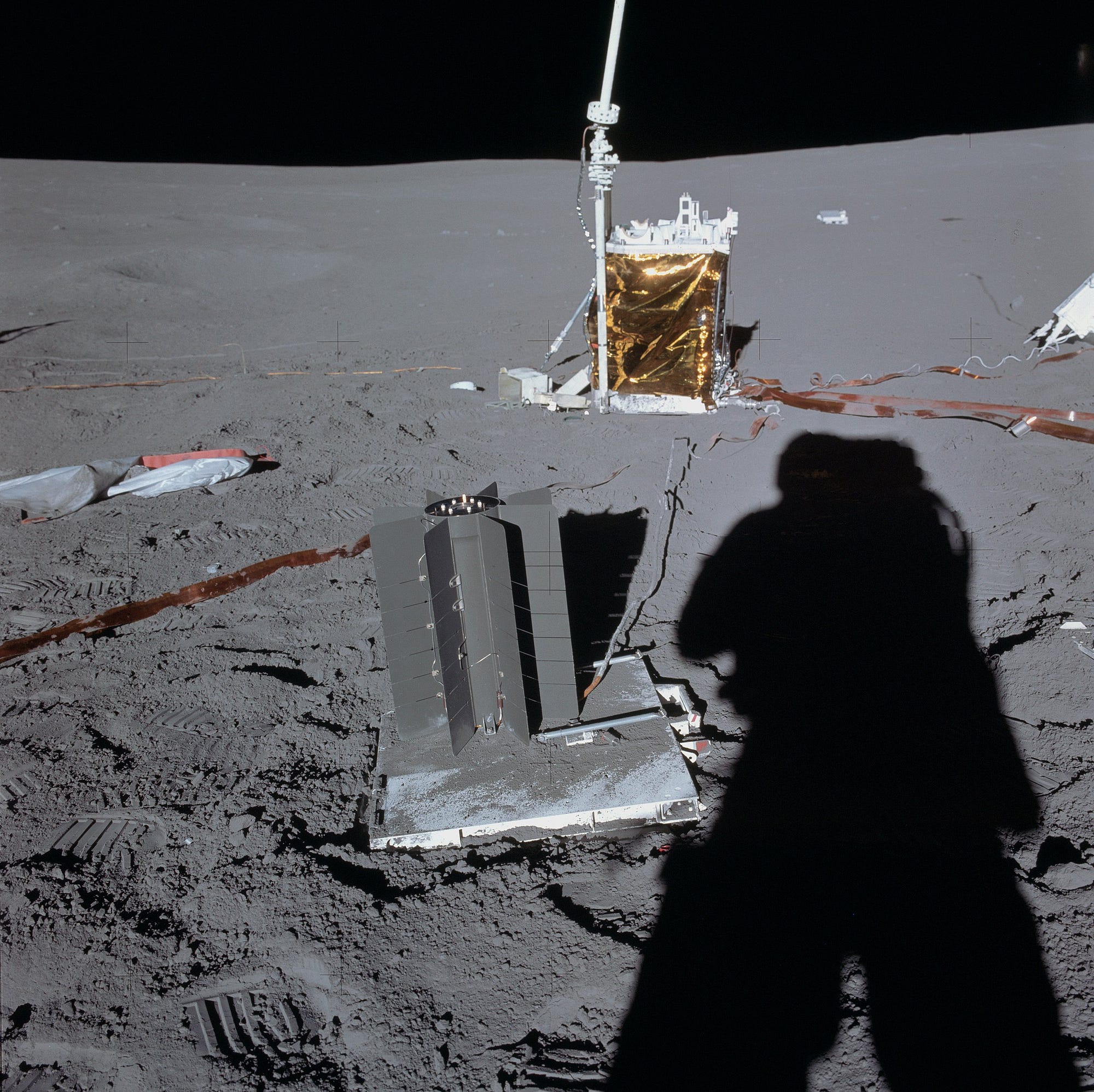
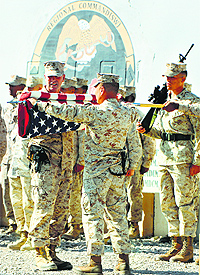
Above—the radioisotope thermoelectric generator from the Apollo 14 mission. NASA photo. At top—a radio check in Afghanistan in March 2014. Army photo
America's Secret Weapon for Battlefield Dominance: Build the Swarm

November 3, 2014

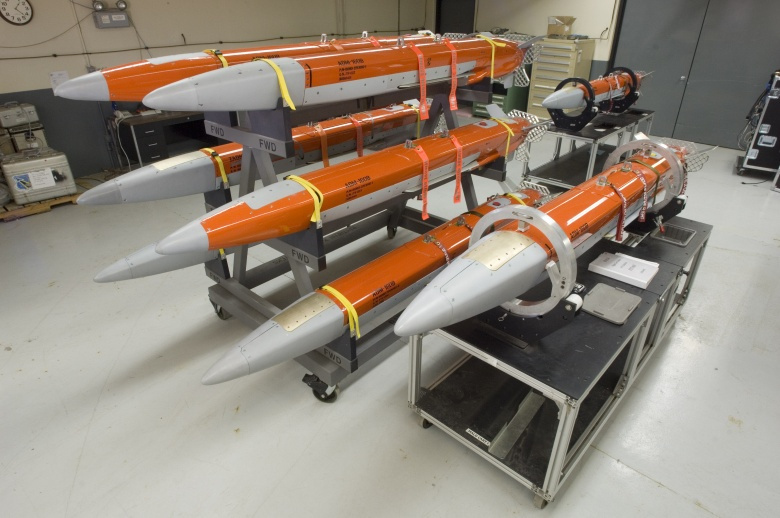
"If the U.S. military is to maintain its technological edge, it will need to harness the advantages of the robotics revolution and build the swarm."
The U.S. military is at a crisis point. We are staring down the barrel of a future where U.S. military technological superiority may no longer be a given wherethe military strength that has undergirded global security since World War II may be in question. The technologies that have given the U.S. military its edge stealth, long-range sensors, communications networks and precision-guided weapons are proliferating to other actors. As a result, so-called “anti-access” challenges threaten traditional modes of power projection. While individual U.S. ships, planes and tanks remain more capable one-on-one, the pernicious “death spiral” of rising costs and shrinking procurement quantities means that the United States has increasingly fewer and fewer assets to bring to the fight. The U.S. military will have to fight significantly outnumbered, and even the qualitative advantages U.S. assets have will not be sufficient. Quality matters, but numbers matter too. At a certain point, U.S. aircraft and ships will simply run out of missiles.

In the face of this waning military advantage, Secretary Hagel has called for a renewed investment in military technological superiority. Deputy Secretary Bob Work has launched a long-range research and development planning programto identify new, potentially game-changing technologies. As the Department of Defense (DoD) begins to craft a new technology dominance strategy, a key component should be harnessing the advantages of the unfolding robotics revolution to field large numbers of low-cost systems.

Swarms of low-cost robotic systems can overwhelm enemies, saturating their defenses. Cooperatively, they can operate with greater coordination, intelligence and speed on the battlefield than manned systems. Perhaps most significantly, they can help to bend the cost curve downward, allowing the United States to field large quantities of systems that, in aggregate, retain qualitative superiority. Disaggregating complex, multimission systems into larger numbers of lower-cost systems is a potential way to increase resiliency, diversity and impose costs on adversaries—and to do so affordably. But harnessing the advantages of this approach will require a new paradigm for how we build next-generation military systems.

“Imposing Costs” on the Enemy, or on Us?

What DoD leaders are looking for is a technology dominance strategy that “imposes costs” on adversaries. If we put our minds to it, this shouldn’t be hard to do. The current U.S. defense system is excellent at imposing costs on ourselves. We have been steadily pricing ourselves out of the business of defense.

In 1984, Norm Augustine observed as one of “Augustine’s Laws” that the cost of military aircraft was growing exponentially, while the defense budget was only growing linearly. He humorously noted:

In the year 2054, the entire defense budget will purchase just one tactical aircraft. This aircraft will have to be shared by the Air Force and Navy 3½ days each per week except for leap year, when it will be made available to the Marines for the extra day.

Follow These Steps to Reform the Way We Buy Weapons

Keep it simple, read a lot of books

The Internet loves listicles, those ubiquitous numbered lists masquerading as thoughtful articles on some topic that is essential to your health and happiness and just might change your life! I figure it’s about time somebody finally wrote a listicle about defense acquisition reform, which I’m pretty sure has never been done before.

Stop looking for one big fix

There are many sides to the problem of Pentagon overspending on delayed projects that are ill-suited to the military’s operational needs. There are lots of reasons weapon systems cost more, take longer and do less than promised.

The profound complexity of the problem means no single solution will once-and-for-all ensure the complete rainbow-unicornification of the military-industrial complex.

So let’s abandon the idea that today’s flavor of the month will succeed where all past attempts have failed.

The flip side of this means we should stop discounting and dismissing every reform approach that isn’t a cure-all. Let’s not criticize partial improvement concepts for leaving some portions of the problem unaddressed.

Once more time—there is no cure-all. If we’re lucky, we might find a cure-some. Even fractional improvement might be a step in the right direction.

Focus on delivering capabilities

In The Book of Five Rings, 16th-century ronin Miyamoto Musashi describes many postures, principles and techniques of swordsmanship, all of which he commends to the student with variations on the phrase “one must study hard.”

However, his most important piece of advice is as follows. “Even if one blocks, strikes, hits or touches the long sword of the opponent when he attacks, these are all opportunities for cutting the opponent … It is important to think of all things as a means for cutting.”

The acquisition community could learn something here. To paraphrase Musashi—“Even when one does paperwork, design reviews, funding drills or PowerPoint presentations, these are all opportunities for delivering operationally relevant capabilities.”

We can see hints of this wisdom in Under Secretary of Defense for Acquisition, Technology and Logistics Frank Kendall’s recent memo about the updated DoD 5000.02 instruction, when he warns against producing “compliance documentation” that is not actually useful “for planning and managing the program.”

His point is the documents we write should be helpful, not simply produced for the sake of passing an inspection.

Whether we’re talking swordplay or defense acquisitions, it is easy to get distracted by peripherals. One must study hard indeed to ensure our actions are focused on achieving the real goal.

Focus on the near term

#TALENT AND ASSIGNMENTS: THE ARMY’S PENTAGON PROBLEM

November 1, 2014 

People complain that the Army uses acronyms too often, is too obsessed with its own jargon, and doggedly refuses to incorporate political realities in its planning. While this may be true, it is unsurprising. All senior leaders are a product of their upbringing, and in many cases the only world Army senior officers know is the tactical world in which they served. Many are ill-prepared and ill-suited to navigate the complicated and political corridors of the Pentagon. As the Defense Department’s budget woes get worse, the Army will suffer as a result.

#Talent and Assignments

The Army’s Pentagon Problem

https://medium.com/the-bridge/ talent-and-assignments- 8c0882175d2a

This post is another in the #Talent: Thoughts on Talent Management in the Military series and was provided by Erol Munir, a Joint Chiefs of Staff Intern and U.S. Army space operations officer. The views expressed here are the author’s alone and do not reflect those of the U.S. Army or the Department of Defense.

In case you haven’t heard, the Army has a “narrative problem”. According to many, the Army “can’t tell its story” and is therefore losing a battle of wills with the budget appropriators on Capitol Hill. Those who work in and around Capitol Hill are quick to ask: “Why can’t the Army read between the lines?” (i.e. there will not be any more money and, therefore, the Army needs to get smaller). Those in the Army are quick to respond with: “Why aren’t they hearing what we have to say? We need to build more arguments that support our positions and win the argument”.

With this in mind, it might be beneficial to start at the beginning: Who is the argument with? Is it with the Office of the Secretary of Defense (OSD)? The Joint Staff? The National Security Council Staff? Congress? Or maybe it’s with everyone…

AIRPOWER’S IMPOSSIBLE DREAM

November 02, 2014 

A pair of U.S. Air Force F-15E Strike Eagles fly over northern Iraq in September after conducting air strikes in Syria.

President Obama’s refusal to consider committing U.S. ground forces to the fight against the Islamic State, or ISIS, has revived a debate about the effectiveness of airpower that is as old as military aviation itself. The question involves the degree to which airpower alone can win wars.

In response to the horrors of trench warfare in World War I, airpower theorists such as Italy’s Giulio Douhet and America’s Billy Mitchell conceived the idea of bombing targets in the enemy’s heartland, destroying both its capability and will to make war, a concept now known as strategic bombing.

Strategic bombing has been conducted in a limited way against ISIS, mainly to destroy ammunition dumps, high-level headquarters, and the oil facilities that fund the terrorist organization. Most coalition air strikes have involved tactical operations in the form of either interdiction or close air support.

Interdiction involves attacking enemy forces close to an ongoing battle, but not so close as to require direct coordination with the ground forces. At times, such as during the World War II battle for Normandy, interdiction has been successful in delaying or even preventing enemy forces from reaching the scene of the fighting.

By failing to employ airpower against ISIS forces as soon as they moved out of Syria and were easy targets, the U.S. lost a significant opportunity to deal a decisive blow to the enemy.

What remains is close air support (CAS), in which airpower is used in direct support of troops in combat where close coordination between air and ground forces is required to make sure the right targets are hit while avoiding friendly casualties.

Of the many air strikes I called in during my two tours in Vietnam, one particular strike comes to mind in this respect. The South Vietnamese Marine battalion to which I was an advisor was in a particularly tough fight against a North Vietnamese unit in bunkers that could withstand anything but a direct hit from a heavy bomb. I called for CAS, and two attack aircraft arrived along with an airborne forward air controller (FAC).

3 November 2014

Time to bury Article 370

Nov 03, 2014

If at any stage now or later the BJP attains its 44-plus target in the Assembly, Article 370 could be given a fitting burial by a suitable resolution passed by the state Assembly

Prime Minister Narendra Modi has called for public debate on Article 370 and not for it being struck down as such. A decision on this controversial issue should be taken through a democratic process.

We need to discuss the origin and history of Article 370. All the 555 Princely States in India and the seven in Pakistan joined their respective Dominion after Partition. They, word by word, signed the same Instrument of Accession drafted before Independence. Kashmir was the only state in which accession became conditional. The state’s accession was limited to only defence, foreign relations, communications and currency. The rulers of Princely States were required to decide to which Dominion their state would accede. The Indian Independence Act of 1947 did not stipulate for the people of the state to have any say in the matter. Muhammad Ali Jinnah supported this. His hidden agenda was to acquire Hyderabad, the richest and the largest Princely State of the size of France, and some other Princely States with Muslim rulers, like Bhopal. The Indian National Congress before Independence wanted the people of the state rather than the ruler to decide the future status of the state. Jinnah hoped Pakistan would get both Hyderabad and Kashmir, the former on legal grounds, and Kashmir, due to geographical compulsions, would fall like a ripe plum into his lap.

Maharaja Hari Singh had a Hobson’s choice. He realised that being a Hindu, he would have no future in Pakistan. He also realised that if he acceded to India, his future would be no different. He had detained Jawaharlal Nehru at the border, preventing him from entering the state to defend his friend, Sheikh Mohammed Abdullah, facing trial in a court of law. He vacillated and toyed with the idea of becoming an independent ruler. Impatient at the delay in the maharaja taking a decision, Jinnah ordered an invasion of Kashmir on October 22, 1947, led by Maj. Gen. Akbar Khan of the Pakistan Army. The invading force comprised thousands of tribal Lashkars and Pakistan Army personnel in civvies. Overcoming brave resistance of meagre state forces, the enemy reached Baramulla on October 25. Srinagar was now defenceless. Maharaja Hari Singh fled to Jammu. It was in these circumstances that the maharaja signed the Instrument of Accession, on the afternoon of October 26, 1947. He was like a drowning man needing immediate succour and in no position to lay down conditions for his accession of the state. No other ruler had signed the Instrument of Accession when he was in such a desperate position. Yet in his letter to Lord Mountbatten he stated that his accession would be confined to defence, foreign affairs, communications and currency only. He also stated that he would immediately hand over power to Sheikh Abdullah, his bitter opponent who had launched the Quit Kashmir movement against him. He knew that unless he did so Nehru would not accept his accession. As for making the accession conditional, he had no axe to grind.

During that critical period Sheikh Abdullah was staying with Nehru in Delhi. Possibly the Sheikh exploited his close friendship with a trusting, visionary and idealistic friend. Jawaharlal and the Congress had lost the war for secularism when undivided India was partitioned. Nehru now hoped to win the battle for secularism in Kashmir. Sheikh Abdullah came out in his true colours in 1953 when he was found negotiating with the US ambassador in India to have an independent Kashmir. He had to be dismissed and held in detention for several years.

Dr B.R. Ambedkar, the principal drafter of our Constitution, refused to draft any special concessions for Kashmir without the latter fully reciprocating. He told Sheikh Abdullah, “I, as the law minister of India, will never do it.” Nehru then commissioned N. Gopalaswami Ayyangar to draft a special Article for Kashmir. He said there were ongoing military operations in Kashmir and the issue had been referred to the United Nations and, hence, special provisions were necessary for Kashmir. Accordingly Ayyangar drafted Article 370 and persuaded Ambedkar and Sardar Patel not to raise any objection. Sheikh Abdullah took full advantage of Article 370 to impose various conditions. Indians visiting Kashmir had to take a permit from their district magistrate. This was almost like getting a visa to go to a foreign country. The Indian national flag was not to be flown in Kashmir and no Indian could buy immovable property in Kashmir although Kashmiris could do so in the rest of India. Even the 30,000 Hindu and Sikh refugees coming out of West Pakistan to Jammu area were not given full citizenship. They cannot vote in state elections, acquire immovable property or get government service in the state or their children admission in state government technical colleges.

India and the state of Palestine

Nov 03, 2014

India has a representative mission but not a formal embassy in Ramallah. It should now raise the status of the office to an embassy. Such a move would be entirely in keeping with the country’s long-standing support for the Palestinian cause.

Last week, the Swedish government chose to grant formal recognition to a Palestinian state. Such a move was not entirely surprising. In the wake of the Gaza war, the stalled peace process and steady Israeli expansion of settlements in Jerusalem and not to mention the intransigence of certain members of the current Israeli Cabinet, the possibility of a two-state solution to this enduring conflict seems increasingly remote. The Swedish decision came not long after a non-binding resolution passed in the British House of Commons calling for the recognition of a Palestinian state. Both these moves indicate a growing international concern about the near moribund state of the peace process.

Given the recent vote in the House of Commons and the Swedish decision India may now wish to accord full diplomatic recognition to the Palestinians. Currently, India has a representative mission but not a formal embassy in Ramallah. It should now raise the status of the office to an embassy. Such a move would be entirely in keeping with the country’s long-standing support for the Palestinian cause. It would also signal that India is willing and able to bear some costs as it seeks to play a wider global role.

What could be the possible arguments against such a move? Two immediately come to mind and need to be addressed forthrightly. First, it would obviously cause some strain in Indo-Israeli relations. However, since India’s rather belated decision to grant full diplomatic status to Israel in 1992, the relationship, with some inevitable hiccups, has flourished. Today it is a genuinely multi-faceted relationship extending from substantial people-to-people contacts to extensive defence cooperation. Consequently, even if there is some immediate heartburn in Tel Aviv with this decision, it is unlikely to sour India’s long-term ties with Israel.

Second, it could be argued that such a move is entirely premature. Some may well argue that at this juncture it is far from clear what will constitute the geographic boundaries of the Palestinian state. This argument, though superficially appealing, is not with much merit. The final status of the Palestinian state and its exact territorial contours, it is hoped, could be arrived at after the conclusion of bilateral talks. However, given the distressing state of the negotiations granting full diplomatic recognition to Palestine may contribute to a renewed momentum to the talks. This is especially the case because India, unlike a host of other states, does matter to Israel. After an initial pique, even hardline elements within the current government in Israel would pay heed to India’s decision. It may not spur them to take prompt action but could at least have the effect of forcing a reconsideration of their present stance of stonewalling any meaningful discussions with the Palestinians. It could also be noted

that if Palestine does not have defined international boundaries, of necessity neither does Israel, yet that fact does not prevent it from being recognised as a state in the international community.

The road to ultra-populism

KANAK MANI DIXIT
November 3, 2014 

In each South Asian country, the no-go areas of discourse are proliferating rather than decreasing as the state establishments deploy ultra-populism. In response, the intelligentsia cowers and ‘opinion-makers’ are dehumanised as they take to weighing what to say and what to leave unsaid

The making and the public screening of “Haider” as a mainstream film was unexpected for observers of the contemporary Indian polity, at this time of a surge in Hindutva-spiked nationalism. Top-line cinematographers, stars, lyricists and promoters participated in a production that questioned New Delhi’s record in the Kashmir Valley, with onscreen characters even challenging the infamous Armed Forces (Special Powers) Act (AFSPA). The film was not alternative cinema and has had a full run in multiplexes all over despite denouncements from some quarters.

Yet, with all other indicators pointing to a political constriction of cultural space, it would be misplaced to read “Haider” as representing a trend towards openness. Long before Narendra Modi turned up on the national radar screen, jingoism was already on the rise and it seems set to escalate. By and large, littérateurs, academics and media commentators have gone silent on critical issues rather than trying to maintain elbow room.

India is the largest and most anchored democracy around, and its shift towards a closed society portends a perilous journey for South Asia as a whole. It also has global implications.

Mono-nationalisms

New countries tend to be more nationalistic than older ones, and South Asia is bubbling with the incipient patriotisms of its newborn nation-states, all less than seven decades old (other than Nepal, which goes back a couple of centuries). Rather than evolve through the historical push-and-pull of power and politics, the countries were defined amid the hurried manipulations of the departing colonial. They were then required to construct their separate nationalisms, and the capital elites of India, Pakistan and Ceylon were more than happy to fill the shoes of Mountbatten.

There was and is the contradiction of trying to force-fit a demographically layered and syncretistic subcontinent into the Westphalian nation-state, rather than devise workable formulae within that format. The new nationalisms of South Asia tended towards xenophobic and “ultra,” with a need to build external enemies and “foreign hands” in order to manage schisms. The more diverse the country, the more the need for centralised mono-nationalism.

“As the largest and most anchored democracy around, India’s shift towards a closed society portends a perilous journey for South Asia as a whole”

India and Pakistan, as the two largest, are curious nation-states for the many large nations they subsume. Because of this, both Islamabad and New Delhi are riding the tiger, with no politician daring to tinker with the given superstructure. But the choice is stark, to turn autocratic or to devolve federally, the latter presenting a viable path for the people to achieve their genius within the nation-state.

Mr. Modi, arriving in New Delhi as the outsider from Gujarat, should understand the need to allow the play of sub-nationalism. However, the new Prime Minister’s instinct seems to tilt towards centralised command-and-control, which can hardly inspire the diverse, populous, extra-large India we know.

It’s now easier for citizens to sue China government

Nov 3, 2014

This will lead to a major change in the ground situation as many people do not dare to take government departments to court even if they have serious grouses over official decisions concerning their life and property.

BEIJING: China is making it easier for people to sue the government. The Standing Committee of the National People's Congress accepted an amendment to the Administrative Procedure Law on Saturday, allowing courts to launch proceedings whenever government departments are sued for violating agreements on land, housing compensation or commercial operations franchised by the government. 

This will lead to a major change in the ground situation as many people do not dare to take government departments to court even if they have serious grouses over official decisions concerning their life and property. 

Cases involving rights infringement will also be accepted by courts, it said. Actionable cases will no longer be confined to "specific administrative acts," which in practice is an excuse for courts to throw out cases. 

The courts threw out 65% of the cases filed against government agencies in 2012, according to a survey conducted by Xiu Fujin, a member of the Standing Committee of the NPC. 

Officials are now expected to appear in court in person whenever their actions are challenged instead of hiding behind a public prosecutor. They might face additional punishment if they fail to appear in court without providing legitimate reason. 

Government officials may also be fined or detained if they "force" a plaintiff to withdraw the suit through illegal means such as threats or fraud. Members of the Standing Committee of the NPC said the amendment is in line with the reality of present situation in the area of administrative litigation. 

"Having them appear in court will also promote officials' awareness of the rule of law," the local media quoted Jiang Ming'an, a professor in Peking University, as saying. 

Bai Zhijian, an NPC Standing Committee member, told Xinhua news agency that the revised law will help protect the rights and interests of citizens.

Afghanistan before and after the exit

After the last of the troops leave, the population left behind will be hoping that the West, facing a new conflict in Syria and Iraq, keeps its promises to Afghanistan

Kim Sengupta

PLEASE don't call it our Dien Bien Phu,” Lieutenant Colonel Simon Winkworth, of the Royal Engineers, requested as we gazed out onto a desolate expanse of scrub and sand on which he was going to build Camp Bastion. There were reasons for optimism on that February day, eight years ago, that Britain's Helmand force would not suffer the same fate as the French in Vietnam when a prolonged siege of that base effectively brought their occupation of Vietnam to an end.

The British would not underestimate the enemy as the French had done, we were assured. And John Reid, the then Defence Secretary, stated, when the mission was announced by Tony Blair's government, that it would last no more than two years and end, he hoped, “without a shot being fired” in anger.

End to Britain’s Afghan war
US Marines lower their flag at the handover ceremony. On October 26, the control of the last base was handed over to Afghan forces.

On October 26, 2014, the Union flag was lowered for the last time in Camp Bastion, bringing an end to Britain’s Afghan war after 13 years, three weeks and five days. Although the invasion following 9/11 was in 2001, for the UK the war really started in 2006. Until then, five members of the forces had been killed in total, three from suicide, accidental firearms discharge and a homicide respectively. The death toll today is 453; meanwhile around eight million rounds had been fired in combat; and the financial cost of the mission is over £40bn. The US has supplanted the UK as the main combat force in Helmand over the past few years, and the main handover ceremony to the Afghan army's 215 corps was very much an American and Afghan affair. It was held at Camp Leatherneck, the US camp adjoining Bastion; the speech by Lieutenant-General Joseph Anderson, commander of Regional Command South West made only a passing reference to the UK's contribution in the conflict, focusing instead on those of the Afghan forces and the US Marines.

The senior British officer present, Brigadier Rob Thompson, spoke of the allies helping “Afghanistan get itself back on its feet” and the creation of the “opportunity now for the Afghan leadership to get into the fast lane and move ahead”. He stressed that “we need to get the story into 2014 space and not 2006 space. Don't see Helmand in a lens shaped by 2006. In Lashkar Gar today, you could easily go down the street. I have seen children playing chicken in the street. I have seen policemen at checkpoints.”

In reality all those things could be done and seen in Lashkar Gar, the Helmand capital, in 2006 — before the arrival of the UK task force. At the time, my colleagues and I stayed in a guest house in the city, shopped and drank chai in the bazaar: I accompanied the British commander running a small team, Lieutenant Colonel Henry Worsley, as he went in "soft-skin" Land-Rovers to meet imams and elders in village shuras without body armour and helmets.

The suicide attack

Then came the first suicide attack in Lashkar Gar. The American private security company, DynCorp, had started carrying out poppy eradication in Helmand, and their contractors took to visiting their former colleagues in the US military at the Lashkar Gar base. A car packed with explosives followed them and drove into the main gate.

One of the reasons for making Helmand the location of the UK force, the Government said, was to tackle the poppy harvest: 90 per cent of the heroin on the streets of Britain came from the province, which was responsible for 25 per cent of Afghanistan's opium crop. Sher Mohammed Akhundzada, the governor, was one of the main druglords; the British insisted on his removal, much to President Hamid Karzai's chagrin. Helmand now produces 52 per cent of the Afghan crop. The British military were extremely wary about getting involved in creating another tier of enemy among farmers whose livelihood depended on the crop. As I was leaving Lashkar Gar to fly up to Kabul that February, Lt Col Worsley asked: “Are you going to the British embassy in Kabul? If you are, can you ask them what exactly is the HMG policy on poppy eradication? No one has told us.”

By the summer of 2006, the British had more than poppies to worry about. Helmand was aflame, pitted with lots of mini Dien Bien Phus where small UK units were besieged in their bases by the Taliban.