10 November 2014

USAF Worrieed About China’s New Stealth Fighter

Dave Majumdar
November 6, 2014

U.S. Pilots Say New Chinese Stealth Fighter Could Become Equal of F-22, F-35

An undated photo of the Shenyang-J-31

China’s new Shenyang J-31 stealth fighter — making its debut next week at theZhuhai international airshow — could eventually become more than a match for American stealth fighters in battle, several U.S. military and industry officials told USNI News.

The J-31 is China’s latest crack at developing a modern so-called fifth-generation stealth fighter — equivalent in ability to Lockheed Martin’s F-22 Raptor or F-35 Lighting II Joint Strike Fighter.

“They’re still in the glossy brochure phase of development, so they still look ten feet tall and bulletproof,” one senior U.S. fighter pilot familiar with the F-35 program told USNI News.

“I think they’ll eventually be on par with our fifth gen jets — as they should be, because industrial espionage is alive and well.”

An undated photo of the Shenyang-J-31

A Glimpse Into Chinese Nationalism

By Eric Fish
November 07, 2014

A new survey gauges popular support for actions on China’s maritime disputes, with some surprising results. 

Sino-Japanese ties have for years been strained on territorial and historical issues, reaching a low point in 2012 when Tokyo’s decision to nationalize the disputed Senkaku/Diaoyu Islands in the East China Sea threw fuel on long simmering Chinese animosity rooted in Japan’s World War II aggression. China’s Internet overflowed with jingoistic sentiment while tens of thousands across the country hit the streets to decry perceived imperialism. The protests soon gave way to vandalism, looting and assault directed at anything or anyone appearing to be associated with Japan.

These extreme protests and general anti-Japan sentiment have been linked to China’s education system. In the wake of the 1989 student-led Tiananmen Square uprising, the Chinese Communist Party (CCP) launched its “Patriotic Education Campaign.” It shifted from emphasis on the triumphs of socialism and class struggle, to focusing attention on the atrocities inflicted by foreign enemies during the “Century of Humiliation” spanning from the 1839 Opium War through the particularly bloody Japanese invasion of WWII. The 2012 protests suggested Chinese leaders had perhaps too successfully molded their citizens into rabid nationalists, which could potentially force their hand in escalating to war.

A new study to be published this month by the University of Western Australia’s Perth USAsia Centre offers evidence that can be used to test this assumption. The study sought to examine Chinese public opinion on theSenkaku/Diaoyu Island dispute, as well as conflicts over islands in the South China Sea. It surveyed more than 1,400 respondents in five major Chinese cities during March 2013.

Helicopters in Military Aviation in China


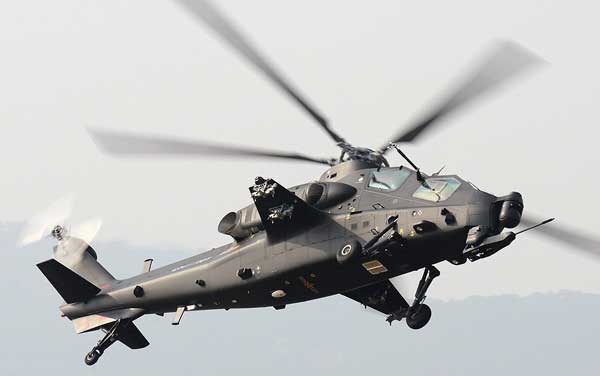
Z-10 Chinese Helicopter (© www.en.wikipedia.org)

China has the world’s second largest defence budget next only to the US and with the future looking upbeat for China’s economy and for its military spending, defence manufacturers and contractors the world over are eyeing the Chinese military helicopter market. Meanwhile, the types being produced as “indigenous” lag behind the leading edge of helicopter technology as extant in the Western world. If the US relents over the arms embargo, there could be a significant change in the tenor and texture of China’s military helicopter fleet, with implications for a possible future Sino-Indian armed conflict.

China is now the world’s fifth largest exporter of arms…

In May 2011, US Navy Seals aboard three Black Hawk helicopters carried out Special Operations, landing in the compound of a building near Abbottabad in Pakistan where Osama Bin Laden had been hiding. Osama was killed in the operation but not before one of the helicopters impacted a compound wall and crashed. Before leaving, the Seals smashed up the instrument panel and blew up the helicopter with the blast throwing the largely intact tail section outside the compound wall. In August, news hit headlines that Pakistan had allowed Chinese military engineers to inspect, photograph and take samples from the remnants of the helicopter. While the Pakistani action of allowing the Chinese to study the wreckage may have been a petulant and defiant reaction to US trespass into Pakistani territory, the Chinese deed conforms to a pattern of “Beg, Borrow or Steal” in the regime of military technology.

Uighur refugees in Southeast Asia stoke Chinese worries 6 November 2014 11:43AM


In recent years, growing domestic Uighur unrest has led to a rising threat to China's national security and internal stability.

For Beijing, the foreign policy dimension of the Uighur issue has manifested in two areas: the handling of the Uighur diaspora and refugees, and the convergence of the Uighur diaspora with religious extremism and terrorism. On the former, Beijing has consistently pursued a policy of repatriation of Uighurs back to China. As for the latter, although the real capabilities of radical Uighur groups are unknown, Beijing's concern for their potential is unsurprisingly high. Both dimensions play an interesting role in China's relations with Southeast Asian countries.


Due to its geographical proximity, Southeast Asia has been a common destination for Uighurs seeking to leave China. The long and porous border between China and countries such as Myanmar, Laos and Thailand has made illegal exit and entry relatively easy and cheap. The ethnic diversity and the Muslim populations in some Southeast Asian countries have made it possible for Uighur refugees to blend in. Furthermore, some Uighurs hoped that Muslim countries in Southeast Asia would be more friendly and lenient towards Uighur Muslims.

There have been abundant cases of illegal Uighur immigration into Southeast Asia since the 5 July 2009 riot in China's Xinjiang Uighur Autonomous Region. In Cambodia, a group of 20 Uighurs was forcibly returned to China in December 2009, followed by similar deportation cases by Laos in 2010 and by Malaysia in 2011 and 2012. The trend intensified after violent attacks by Uighurs in China such as the Tiananmen explosion in October 2013 and the Kunming railway station knife attack in March 2014. 

In spring 2014, Thai authorities detained two groups of illegal immigrants in Songkhla and Sakaew provinces. It has been reported that some were Uighurs and Beijing demanded access to the group. In a more extreme case in Vietnam in April, a group of Chinese civilians, allegedly Uighur asylum seekers, clashed with Vietnamese border guards when the guards detained them with the intention to return them to Chinese authorities. The confrontation left seven dead, including two Vietnamese border guards.

Profile of Abu Bakr al-Baghdadi, The mysterious leader of ISIS

Abu Bakr al-Baghdadi profile: The mysterious leader of Isis – and why he is called the ‘invisible sheikh’

Lamiat Sabin

The Independent, November 9, 2014
Sheik Abu Bakr Al-Baghdadi has been declared the “supreme leader” of Isis

The elusive Isis leader Abu Bakr al-Baghdadi is reported to have been injured as the target of US airstrikes in the Iraqi town Mosul.
But who is one of the world’s most-wanted men, and what is known about him?

Of the attacks on Friday which caused the destruction of a 10-truck Isis convoy, the US Central Command said: “We cannot confirm if Isis leader Abu Bakr al-Baghdadi was among those present.

"This strike demonstrates the pressure we continue to place on the Isis terrorist network and the group’s increasingly limited freedom to manoeuvre, communicate and command."

Before the bearded and black-robed al-Baghdadi appeared in a video delivering a sermon in July, there were only two confirmed photos of him and even his own fighters reportedly do not speak to him without the leader wearing a mask to hide himself, which gave him the nickname “the invisible sheikh”.

His predecessor Abu Musab Al-Zarqawi was killed in a US bombing raid in 2006 after his secret location was tracked down and, in 2011, the US declared a £5.8 million bounty for anyone with information leading to al-Baghdadi’s death or arrest.

The self-appointed caliph was born as Ibrahim Awad Ibrahim al-Badri to a family of religious preachers in 1971 and he grew up in the town of Samarra north of capital city Baghdad before being dubbed "the new bin Laden" by French newspaper Le Monde.

He moved to the city to complete his PhD at the Islamic University after gaining undergraduate and masters degrees and for more than 10 years until 2004 he lived in a basic small room attached to a mosque in the poor Baghdad outskirts of Tobchi.

Abu Bakr al-Baghdadi, who has declared himself Caliph of the Islamic State (AP) However, despite leading prayers and keeping a low-profile, the owner of the mosque ordered him to leave after a dispute one year after American allies invaded Iraq to topple Saddam Hussein in 2003, and al-Baghdadi found himself no longer welcome in the neighbourhood.

Shia Islam, Imam Ali, Najaf, Karbala and Moharrum

Gajendra singh

Islam and its influence, for good or bad is not going to go away any time soon.

The arid deserts of Arabia might have been 'Jahiliya' before the revelations of Islam but the people right up to Morocco on the Atlantic coast in North Africa and Iraq, Persia, Khorasan and Central Asia up to the border of China had long religious and cultural streams and very well developed and complex religious traditions and beliefs.

Therefore Islam became varied, complex and evolved as have other religions. The pristine austere Arab Islam of the first four Caliphs, to which the Jihadis and others hark back to, has been changed ,uplifted ,evolved ,enriched and made more beautiful and humanistic through interaction with cultural and religious base of various lands conquered by Islam, most of them had highly cultured civilizations.

The Byzantine civilisation in Syria and Damascus ( which also introduced the desert Arabs to veils, used by the high society Byzantine ladies), Persian civilisation in North Iraq , Persia and Central Asia, with their religions like Nestorian Christianity, Zoroastrianism, Buddhism, Shamanism etc contributed to the evolution and flowering of Islam in its various sects and forms.

Both Persia and Central Asia had resisted Islamisation by force and accepted a version akin to their own culture and civilization. Most of Central Asia, the subcontinent, certainly South East Asia was won over for Islam by humanistic Sufi saints with beliefs similar to that of the Absolute Reality of Brahman i.e. union of self with God (in South Asia) and Buddhist Nirvana (in Central Asia and elsewhere) and traders and not so much by military victories or Jihad and sword .This perception is sold and enhanced by militaristic Muslim and western historians. Wahabis and other orthodox Muslims have been strongly opposed to Sufi Islam throughout history.

Unfortunately, in spite of a millennia and half of Jihads and Crusades, Christian West and others take Islam as monolithic and Muslims as barbarians, especially because of some of the medieval customs and barbaric punishments in Saudi Arabia and other Muslim countries. (As if starving half a million Iraqi children by Western embargo is not barbaric. US Presidents always talk of action against Iraq to protect their children and future generations! ) Muslims are equally ill informed about Christianity. Even Sunnis about Shias, Twelvers, Ismailis, Alevis, Alawites, Druzes and others. Qadianis and Ahmediyas are persecuted in Pakistan. Each has misperceptions about the other. As have various Christians sects about each other and Muslims. These misperceptions are exaggerated and exploited by politicians who use religion to acquire power and then to hold on to it.

In Saudi Arabia, home and focal point of Islam, behind the oil financed glitter, its polity remains medieval with its barbaric punishments against all contemporary human norms. In Iran, the focal point of Shia Islam, Iranians are more creative and constructive and barring some incongruities like Chador etc give education to its women and freedom to work and drive cars etc . Sooner than later, after the end of stranglehold of Mullahs, who had ensconced themselves by force into positions of power in spite of Ayatollah Khomeini, Iran could be an example to other Muslims. On the other hand, ruling oligarchy of Saudi princes' life style, which according to Wahabi believers, who even took over the Mecca mosque in 1979, is at variance with the Wahabi percepts of Islam. This is a curious amalgam of two opposites united for sheer power sharing. But how long will it last!

Counter-Terrorism: When A Home Is Not A Home


November 5, 2014: Saudi Arabia continues to catch and prosecute Islamic terrorists found operating in the kingdom. In October one group of 13 men (11 Saudis, one Qatari and an Afghan) were sentenced to from 1.5 to 30 years for terrorist acts. Specifically this group, who were arrested in 2011, were planning attacks on American troops stationed in Qatar and Kuwait. In a separate case two men were sentenced to death and one to 12 years in prison for attacking a police station. Three Shia were also sentenced, one to death and two to prison, for instigating religious strife among Saudi Shia in eastern Saudi Arabia (where most of the oil is.) The court described all these sentences as a deterrent to others. 

The Saudis have been imposing these deterrent sentences regularly since 2003. The names change, but the objectives remain the same. Thus in April 2014 Saudi Arabia broke up an ISIL (al Qaeda in Iraq and the Levant) operation inside Saudi Arabia. This group had 62 members (59 Saudis, a Yemeni, a Pakistani and a Palestinian) who were planning several attacks and assassinations in Saudi Arabia. Prosecutions of this group may take several years, but all the accused know they won’t be able to bully or bribe their way out of jail, or a death sentence. Saudi Arabia executes via beheading. 

ISIL is one of two Islamic terrorist organizations that have it in for Saudi Arabia, the other is AQAP (Al Qaeda in the Arabian Peninsula). Both are affiliated with al Qaeda which, since the 1990s, has been dedicated to overthrowing the Saudi monarchy. AQAP was formed in 2009 after the remnants of the Saudi al Qaeda organization (several thousand full and part time members at its peak) fled to Yemen and merged with the Yemeni al Qaeda branch. AQAP also benefitted from hundreds of Iraqi al Qaeda members who arrived after the defeat of al Qaeda in Iraq in 2007-8. Growing unrest in Yemen (against the long-standing Saleh dictatorship) enabled AQAP to recruit locally and take over several towns in southern Yemen by 2011. Then the new post-Saleh government launched a counteroffensive in 2012 and AQAP got hurt very badly. That offensive continued, along with the growing use of American UAVs in Yemen. In April 2014 another major offensive was launched against AQAP by the U.S. and Yemen and this succeeded in capturing all the new bases AQAP had established in remote mountain areas after the 2012 defeat. That was followed by Shia rebels moving south and going after the Sunni Islamic terrorists there. While the al Qaeda situation is desperate in Yemen, AQAP is still al Qaeda’s most capable branch and the only one that has shown any ability to support attacks (few successful so far) in the West. Now that capability is in doubt, for a while at least. All this has been good news for Saudi Arabia which has always been the primary foreign target for AQAP attacks. 

The risk in targeting the head of the Islamic State

By Clint Hinote 

A man purported to be the reclusive leader of the militant Islamic State Abu Bakr al-Baghdadi has made what would be his first public appearance at a mosque in the centre of Iraq's second city, Mosul, according to a video recording posted on the Internet . (Reuters Tv/Reuters)

Clint Hinote, a colonel in the U.S. Air Force, is a 2014-15 Military Fellow at the Council on Foreign Relations. The views expressed here are his own. 

The Islamic State has been wounded. While the video of the execution ofreporter James Foley displayed the group’s depravity, its timing also suggests that recent counterattacks are having a significant effect on its leadership. The group’s expansion has been slowed, and some of its territorial gains have been rolled back. Iraqi and Kurdish forces, aided by U.S. airstrikes, secured a much-needed strategic “win” in retaking the Mosul Dam. Are there other ways to use this force mix to weaken the Islamic State and buy time for the Iraqis to regroup? 

In 2006, the United States leveraged a similar set of capabilities and alliances to eliminate Abu Musab al-Zarqawi, the leader of al-Qaeda in Iraq. Using a combination of human intelligence and airborne surveillance, the United States found Zarqawi and killed him. At the time, this was thought to be a major blow to al-Qaeda in Iraq that would do much to reduce the violence being inflicted upon Iraq’s Shiite population. 

Broken and Unreadable


Everything boils down to perceptions. A recent Pew poll revealed that nearly 60% of Americans believe the U.S.-led airstrikes against the Islamic State are failing. Even more would give the operation a negative review overall. An even higher majority don’t believe we have a clearly defined goal.

The air campaign, now in its third month in the skies over Iraq and Syria, averages just seven sorties a day, but is delivering ordnance at a significant rate, estimated to cost between $200 to $300 million a month. Even with limited effectiveness, the airstrikes should be gradually degrading ISIS capability. This week’s strikes in Kobani have reportedly killed more than 600 ISIS militants, allowing Kurdish fighters to rally in defense of the city.

But in the eyes of the public, we’re losing. Why?

Because we don’t have a narrative. And it’s not that ISIS is beating us to the microphone, we’re not even trying. When we do get to the microphone, the result is often broken and unreadable. The administration that blazed a trail to the White House in 2008 with an unprecedented social media campaign now struggles to define a consistent – and convincing – narrative for what we’ve dubbed “Operation Inherent Resolve.”

The public needs to understand what we’re doing and why. They need a voice of calm reason. What we’ve offered instead is incoherent resolve.

In the past generation, we’ve made great inroads toward cementing the link between tactics and strategy. From AirLand Battle doctrine to the recent publication of the Army Operating Concept, the services have applied an incredible amount of intellectual capital toward translating “tactical victories into strategic success.” But still we flounder. Why?

“We don’t have a link between strategy and policy,” according to retired Marine Lt. Gen Paul Van Riper, speaking recently on a panel addressing war termination at the Dole Institute of Politics at the University of Kansas. “I don’t think we’ve defined our national interests.” Where NSC-68 defined our national security objectives through several administrations, we now publish a new National Security Strategy every four years, Van Riper added. That singular lack of focus prevents us from linking strategy to policy and, in turn, from building a coherent narrative that supports our national security objectives.

Awkward.

Islamic State of Iraq and Syria (ISIS) and its South Asian Connection: An Indian Perspective


A Brief Background to the Evolution of ISIS:

Today, one of the most serious threats that have engulfed a large portion of the Middle East is the emergence of the Sunni Muslim extremist group, infamously known as the Islamic State of Iraq and Syria (ISIS), or Islamic State of Iraq and Levant (ISIL). After capturing a sizeable territory in Iraq and Syria, the group changed its name to Islamic State (IS).


847.58 KB 

ISIS vs. the Taliban: The Battle for Hearts and Minds


Posted: 11/05/14 07:22 EST

As America and the West continue their fight against ISIS in Iraq and Syria, the Taliban is trying to prevent its rank and file from joining the jihadi group

The letter sounds like run-of-the-mill trash talk—until you consider who allegedly wrote it: Abu Bakr al-Baghdadi, the most notorious jihadi alive.

This past summer, shortly after declaring himself “caliph” of the self-styled Islamic State (ISIS), Baghdadi sent a message to his former overlord, Al Qaeda head Ayman al-Zawahiri. Nearly six months had passed since Zawahiri booted Baghdadi and his foot soldiers out of the terror network for their brutality and refusal to follow orders. Now the ISIS leader was on the rise and getting his revenge.

According to multiple sources—including a senior Taliban intelligence officer and an Afghan Islamist with ties to ISIS—Baghdadi urged the Al Qaeda leader to renounce his longstanding allegiance to Mullah Mohammed Omar, the founder and spiritual leader of the Afghan Taliban. In the letter, Baghdadi allegedly called the Taliban’s “commander of the faithful” an ignorant, illiterate warlord, unworthy of spiritual or political respect. He then advised Zawahiri to swear allegiance to him in return for a subordinate position in his makeshift state.

Ayman al-Zawahri, the leader of Al Qaeda.

Zawahiri never replied, the same sources say. Instead he assured his Taliban allies that he remains committed to Mullah Omar. But he wasn’t the first—and certainly not the last—ally of the Afghan insurgency targeted by ISIS as a possible convert.

How Obama Took the Brakes Off the War Machine

NOV 7 2014

Three precedents that make it even easier to use lethal force abroad without congressional approval


Barack Obama has "dramatically expanded" the notion of when presidents can use force without permission. He has left "an extraordinary legacy of war powers." History will assign far more importance to these precedents than we do. They make it significantly easier for future presidents to wage war unilaterally.

Those may sound like the concerns of an anti-war activist. In fact, they're the conclusions of Jack Goldsmith, who led the Office of Legal Counsel for part of the George W. Bush administration. He isn't someone with a narrow understanding of executive power. But in a recent speech, he cited three specific ways that Obama expanded the war power beyond anything attempted by the Bush administration. 

The three precedents are as follows:

1) Article II, Section 2 of the Constitution declares, "The President shall be commander in chief of the Army and Navy of the United States, and of the militia of the several states, when called into the actual service of the United States." Almost everyone agrees that this gives the president the power to repel an attack on America. President Bush argued it empowered him to preempt imminent threats.

Obama has gone a step farther.

DoD Wants New Technologies To Fight Drones – The Future Of Drone Warfare Is Indeed Scary, Massive Swarms, WMD ‘Suicide’ Drones

November 7, 2014 · 

The future of drone warfare could truly resemble something out of Star Wars.– stealth drones, dog-fighting drones, autonomous drones that interact with other drones — without human intervention — swarms of killer drones and/or suicide drones — miniature and micro drones [targeted killing machines] with DNA signature-enabled warheads; and, the list goes on limited only by the imagination and further technological advances. Adam Clark Estes, writing in the February 9, 2014 edition of The Atlantic’s – The Wire, “The Future Of Drone Warfare Is Scary,” says “the future of drone warfare is mind-bending. For example, the Defense Advanced Research Projects Agency (DARPA) “has been developing an unmanned submarine that can shoot out of the water and turn into an Unmanned Aerial Vehicle (UAV) — just like Batman’s gadgets do,” Mr. Estes wrote. “And, a number of armies [around the world] have developed tiny drones, some as small as insects, that can conduct reconnaissance [and intelligence] missions without the risk of detection,” he adds.

Sharon Weinberger, writing in the May 17, 2014 New York Post, says that “a new generation of drones are under development that will be able to penetrate the air defenses of even the most sophisticated nations, spotting [clandestine] nuclear facilities; and, track down and possibly kill a terrorist leader silently — from high altitudes,” or, with a miniature/micro drone dropped from a series of mother-ships — with a DNA-signature enabled warhead. “These drones,” Ms. Weinberger notes, “will be fast, stealthy, and survivable, and designed to sneak in and out of a county,” ungoverned area, or location — “without ever being spotted.”

So, it comes as no surprise that the Department of Defense (DoD) is devoting a fair amount of research and development funds, and experimentation to figuring out how to — both use these new technologies to our advantage on the battlefield, as well as how to defend the homeland and the deployed warfighter.

Patrick Tucker, writing on the November 6, 2014 website, DefenseOne.com, notes that “at the end of last month (Oct.), DoD put out a request for information, or RFI, for new technologies “countering” commercial drones that are armed with chemical, biological, or massively destructive weapons.” “Specifically” Mr. Tucker writes, the request asks for ideas on “emerging technologies, technical applications, and their potential to counter a low/cost, man-portable, commercial-off-the-shelf unmanned aerial system (UAS) — carrying a chemical and/or biological WMD payload.” “And, that includes electronic systems that can interdict, deny, or defeat, hostile use of UAS,’ and “systems providing the capability to intercept and neutralize the UAS.” The DoD RFI also “encourages both kinetic, and non-kinetic solutions,” — and, the technologies should have global reach. The project called Thunderstorm, will feature a technology demonstration in the second fiscal quarter of 2015 — at Mississippi’s Camp Shelby.”

Intelligence: Things SOCOM Cannot Do In Public


November 6, 2014: U.S. SOCOM (Special Operations Command) is again trying to establish the capability to quickly scour the Internet for publically available information (OSINT or Open Source Intelligence) on an area or people SOCOM operators will be working with (or against.) SOCOM has sought to obtain this capability in the past but has been thwarted by special interest groups accusing them, and other government organizations, of violating the privacy of Americans. This is politically explosive as the media loves to use this sort of thing to grab attention. Yet SOCOM is only trying to do what marketing firms, intelligence agencies and election consultants do regularly, and legally. SOCOM needs this capability because they are being asked to send their operators, on short notice, to lots more places and more frequently. On short notice, and for only a small group of operatives, SOCOM usually cannot get the information they need from the intel agencies. At the same time SOCOM knows they do not need classified data, which the intel organizations prefer to deal with. The open source data available on the Internet often gets the job done, if only they could get past political grandstanding, special interest groups and headline hungry media. 

While the U.S. intelligence community long resisted recognizing the importance and usefulness of OSINT over the last few decades, the enthusiastic acceptance of Internet-based OSINT by so many individual military personnel and commercial information gatherers has led to growing official government acceptance of what many intelligence professionals now consider a crucial tool and one that can only grow in usefulness. 

The Internet has made OSINT a really, really huge source of useful intelligence. It's not just the millions of gigabytes of information that is placed on the net but the even more voluminous masses of message board postings, blogs, emails, and IMs (instant messaging) that reveal what the culture is currently thinking. It was corporate intelligence practitioners who alerted the government intel people to the growing usefulness of Internet based data. Corporations have developed, over the last few decades, a keen interest in gathering intel on competitors, new markets, and all manner of things that might affect them. The Internet has made this a much more useful and affordable exercise, especially since corporations are less likely to break the law when gathering intel, or have access to the powerful legal tools available to government investigators and analysts. 

For years corporate intel specialists were concerned that government agencies, especially the CIA, were not taking sufficient advantage of OSINT. Part of the problem was cultural. The intelligence agencies have always been proud of their special intel tools, like spy satellites, electronic listening stations, and spy networks. Most of these things are unique to government intelligence operations. People who use this stuff tend to look down on a bunch of geeks who simply troll the web. Even when the geeks keep coming up with valuable stuff, they don't get any respect. Of at least they didn’t for a long time. That began to change after September 11, 2001, when many intelligence specialists, who were reservists, were called to active duty. Many of these men and women worked in BI (Business Intelligence, sometimes called corporate spying) and brought with them a respectful attitude towards OSINT and spectacular (to the government intel people) ability to use it. 

Counter Terrorism in Cyberspace

By Prakash Katoch 
November 07, 2014 

American writer-intellectual Gore Vidal once said, “The 'war on terrorism' is a war of ideas; and ideas cannot be bombed out of existence. The Bush-Blair partnership changed the word to 'terror', which made it sound a lot simpler, but actually made it more ambiguous - so vague that it could include anyone in the 'Axis of Evil': North Korea, Afghanistan, Iraq, Iran, Syria, Libya, anyone.” But the fact is that terrorism is the greatest threat to the world. Significantly, a study conducted at the University of Haifa, a public Research university in Israel in 2012 found that nearly 90 percent of organized terrorism on the internet takes place via social media. The study revealed that terror groups use social media platforms like Twitter, Facebook, YouTube and internet forums to spread their messages and recruit members and that social media was enabling the terror organizations to take initiatives by making 'Friend' requests, uploading video clips, and the like. Concurrently, a UN report titled “The Use of Internet for terrorist purposes’’ revealed terrorist groups using Internet to recruit, finance, train and incite followers to commit acts of terrorism, as well as to spread propaganda and gather and disseminate information for terrorism. Like most social networking sites, Twitter prohibits activity if users publish or post direct, specific threats of violence against others but the problem is that doesn't actively monitor the content in search of the above threats. Instead, it relies on users to report in case they notice violations to the rules. Terrorists can take advantage of social networking sites because they have applications like games that are normally developed by third parties and whenever you add an application, you are granting it access to your account.

While the world watches the growing US led coalition against the ISIS, the marginal effect of airstrikes is evident, as was the case during the US led GWOT against Al Qaeda and Taliban. In the case of the ISIS, we have a situation where some 31,500 plus ISIS cadres are mingled with a civil population of about eight million. The very first wave of air strikes taught the ISIS cadres to melt into the civilian population. In addition to the ‘no boots on ground’ policy US would also be inhibited from putting CIA operatives on ground because of the chain of public beheadings of westerners being showcased by the ISIS. To this end, the degree of destruction and degradation of ISIS is debatable. Establishing a new anti-Syrian army would take months, possibly years. No doubt the Peshmerga and Iraqi Kurds as witnessed are putting up tough resistance to the ISIS as witnessed in Idlib, Kobane etc but look at the multiplying figures of the ISIS. CIA had estimated their strength at 10,000 when Mosul fell. Now the estimates have gone up to 31,500, mostly courtesy recruitment through social media.

What has gone comparatively unnoticed is the private sector mobilization that has been affected in the US to fight the ISIS. While top-level meetings were underway in the US and under aegis of the UN how best to work out a plan to battle the ISIS, a significant non-governmental initiative was launched in New York to confront the growing threat from ‘extremist ideology’. Termed the Counter Extremism Project (CEP), it seeks to refute social media messaging, compile world’s biggest database of extremist networks. This is in sharp departure from the erstwhile US policy where the GWOT was launched against primarily Al Qaeda and later the Taliban. In current instance, while the new GWOT has been launched against the ISIS, concurrently the need to target exploitation of the internet and social media by ‘all’ terrorist organizations has been addressed. The non-governmental initiative has perhaps been taken because of the US NSA already heavily committed and more importantly its recent criticism for snooping globally under the ‘Prism’ program. Participation of the private sector is also essential because of the magnitude of the issues involved. CEP has been launched as a private sector organization that describes itself nonpartisan in its efforts to combat extremism. Its goals include compilation of the world’s most exhaustive database on extremist groups and their networks, and places unmasking the funding sources for ISIS high on its list of immediate priorities.

US Special Operations Command Quietly Building Up Its OSINT Capabilities

Things SOCOM Cannot Do In Public
November 6, 2014

U.S. SOCOM (Special Operations Command) is again trying to establish the capability to quickly scour the Internet for publically available information (OSINT or Open Source Intelligence) on an area or people SOCOM operators will be working with (or against.) SOCOM has sought to obtain this capability in the past but has been thwarted by special interest groups accusing them, and other government organizations, of violating the privacy of Americans. This is politically explosive as the media loves to use this sort of thing to grab attention. Yet SOCOM is only trying to do what marketing firms, intelligence agencies and election consultants do regularly, and legally. SOCOM needs this capability because they are being asked to send their operators, on short notice, to lots more places and more frequently. On short notice, and for only a small group of operatives, SOCOM usually cannot get the information they need from the intel agencies. At the same time SOCOM knows they do not need classified data, which the intel organizations prefer to deal with. The open source data available on the Internet often gets the job done, if only they could get past political grandstanding, special interest groups and headline hungry media.

While the U.S. intelligence community long resisted recognizing the importance and usefulness of OSINT over the last few decades, the enthusiastic acceptance of Internet-based OSINT by so many individual military personnel and commercial information gatherers has led to growing official government acceptance of what many intelligence professionals now consider a crucial tool and one that can only grow in usefulness.

The Internet has made OSINT a really, really huge source of useful intelligence. It’s not just the millions of gigabytes of information that is placed on the net but the even more voluminous masses of message board postings, blogs, emails, and IMs (instant messaging) that reveal what the culture is currently thinking. It was corporate intelligence practitioners who alerted the government intel people to the growing usefulness of Internet based data. Corporations have developed, over the last few decades, a keen interest in gathering intel on competitors, new markets, and all manner of things that might affect them. The Internet has made this a much more useful and affordable exercise, especially since corporations are less likely to break the law when gathering intel, or have access to the powerful legal tools available to government investigators and analysts.

For years corporate intel specialists were concerned that government agencies, especially the CIA, were not taking sufficient advantage of OSINT. Part of the problem was cultural. The intelligence agencies have always been proud of their special intel tools, like spy satellites, electronic listening stations, and spy networks. Most of these things are unique to government intelligence operations. People who use this stuff tend to look down on a bunch of geeks who simply troll the web. Even when the geeks keep coming up with valuable stuff, they don’t get any respect. Of at least they didn’t for a long time. That began to change after September 11, 2001, when many intelligence specialists, who were reservists, were called to active duty. Many of these men and women worked in BI (Business Intelligence, sometimes called corporate spying) and brought with them a respectful attitude towards OSINT and spectacular (to the government intel people) ability to use it.

Peacekeeping: Enemies Of Islam Not Welcome


November 5, 2014: Since World War II the UN peacekeeping operations have become more numerous and more useful in bringing peace (at least more peace than usual) to many unruly parts of the world. But now the UN peacekeepers are increasingly under attack by Islamic terrorists. The Islamic radicals have no interest in peace as they are on a Mission From God and the UN is considered an enemy of Islam, even if the peacekeepers under fire are Moslem. 

As a result of this growing use of Islamic terrorism against UN personnel it has become more dangerous to be a peacekeeper. Despite the increasing Islamic terror attacks the UN's peacekeeping army of 110,000-140,000 troops still suffers less than a hundred combat deaths a year. More than ten times that number are wounded, injured in accidents, or disabled by disease. The peacekeeper combat fatalities come out to 90-110 per 100,000 troops per year. In Afghanistan foreign troops lost about 350-450 in 2012. At the peak of the fighting (2005-7) in Iraq, the losses were 500-600 per 100,000. The rate for U.S. troops in Vietnam and World War II was about 1,500 per 100,000 troops. So the UN peacekeepers are often seeing some considerable violence but at less than a third of the rate of troops in actual contemporary wars and much less than in 20th century conflicts. 

But it’s not the casualties that are causing the biggest problem but the increase in deliberate attacks and, to put it bluntly, the use of terror against the peacekeepers. This has made more countries reluctant to supply peacekeepers, especially Moslem countries, whose troops are accused of being heretics (and not just “enemies of Islam”) by Islamic terrorists and their many supporters among the Moslem population being protected. Most of the peacekeepers have come from South Asia (Pakistan, India, Bangladesh, Nepal) and many of these are Moslem. Pakistan has been one of the most frequent contributors, sending 144,711 troops to 41 UN peacekeeping operations in 23 countries over the last half century. They suffered a death rate of 92 per 100,000. That’s lower than usual for peacekeepers, in large part because the South Asian troops tend to be among the best trained and most professional in the UN force. 

It’s not just the growing terrorism that is causing difficulty in getting more troops for peacekeeping duty. While the casualties have something to do with this, corruption and lack of success are more often discouraging countries from contributing. The corruption angle is interesting, as it pertains both to the corruption within the UN bureaucracy and the corrupt atmosphere the peacekeepers operate in and often succumb to. Then there is the criticism of how the UN manages these missions. Casualties are expected but the contributing countries feel a lot of their troop losses are the result of restrictive UN rules that limit what peacekeepers can do. This, in turn, is believed most responsible for a lack of success for the peacekeeping missions. 

Interview With a USAF Drone Pilot

Daniel Rothenberg
November 6, 2014

Interview with a U.S. Air Force drone pilot: It is, oddly, war at a very intimate level

"There’s an insatiable appetite for RPAs (remotely piloted aircraft) right now. When RPAs were first deployed they were so new that the leadership didn’t realize how popular and successful they would become. Initially, RPAs didn’t draw in a cadre of fighter pilots. But then, things began to change and you saw fighter pilots, bomber pilots, and others who brought with them a lot of experience flying RPAs. Now, we’re at the point where RPA pilots are getting the most combat experience of anyone. In my opinion, a lot of the most significant work is being done in the RPA community and that’s drawing in the top-tier guys. There’s pride associated with flying RPAs.

"The important thing for me is the twenty-year-old with the rifle on the ground, sleeping in a ditch. That’s why we do this job. If I can be more successful supporting that soldier, then that’s what I want to do, day in and day out. Would I like to be flying an F-22 around and doing loops and rolls and things? Sure, absolutely. But I find what I do now to be more meaningful than anything else I could think of.

"The RPA is remotely operated, but it’s very much a manned aircraft. There are a lot of people involved in the operation of an RPA, in fact, more than for a regular airplane. You need classic pilot training to fly an RPA. Absolutely. We have a stick, we have a rudder; you’re flying an airplane, you’re just doing it remotely. All the same skills are necessary. You have to worry about the traditional things that concern pilots like altitude de-confliction and airspace de-confliction. In addition, you need the ability to manage and disseminate information and to deal with different scenarios with other individuals and other aircraft. You also need know who needs information ‘X’ and who needs information ‘Y’ and how do I get it to them? How do I make sure they understand what they need to know? And, how do I give it to them in the simplest form?

"Flying an RPA is more like being a manager than flying a traditional manned aircraft, where a lot of times your focus is on keeping the shiny side up; keeping the wings level, putting the aircraft where it needs to be to accomplish the mission. In the RPA world, you’re managing multiple assets and you’re involved with the other platforms using the information coming off of your aircraft.

"You could use the term ‘orchestrating’; you are helping to orchestrate an operation.

9 November 2014

NSA Ajit Doval's new status effectively dwarfs many in Cabinet

By BHAVNA VIJ AURORA, ET Bureau | 8 Nov, 2014, 

NEW DELHI: He is omnipresent in New Delhi, but you may not recognise him if you run into him in Lutyen's power corridors. Over the past months, National Security Adviser Ajit Doval has quietly cut through political and bureaucratic blockages to become an overarching presence in decisionmaking. For Prime Minister Narendra Modi, he is the go-to-man, much to the chagr in of many in the administration who complain that he is overriding .. 

Read more at:

Doval's Deceptive Demeanour

Doval was also the representative to hold talks with the US about cooperation on terrorism and with Israel on strengthening defence ties. The NSA is advising the Prime Minister on the black money issue, too, say sources. "It is not a mere coincidence that the Defence Acquisition Committee of the government cleared purchases worth over $525 million from Israel on October 25, three days after Doval met .. 

Read more at:

Bhutan: The Indian Army’s Front Line

By Victor Robert Lee
November 06, 2014

Strategically located, the tiny Himalayan country is at the center of growing tensions between two great powers. 

In late October, on the dirt road that winds north from the Bhutanese town of Paro in the direction of the border with Chinese-controlled Tibet, I pass an Indian army base of more than 600 soldiers. They are packing up to return to India for the duration of Bhutan’s harsh winter months. On the same road just after sunrise, I encounter an Indian Army squad of special forces soldiers with Himalayan features running in formation, sandbags roped to their backs, with the squad’s commander shouting “No photos, sir!”

Adjoining the Indian Army base is a camp for approximately 120 Bhutanese soldiers who train with the Indians on joint exercises in the rugged mountains that rise up from the Paro Valley. Just another kilometer or so further up the road is a Bhutanese army camp of 24 soldiers and their families. The camp’s sole purpose is to maintain 80 horses to cart supplies to military units higher still on the trail to the Bhutan-Tibet border region.


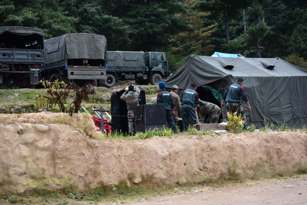
Indian Army unit stationed in Bhutan, upper Paro Valley. Photo by Victor Robert Lee.

One of the horses’ former destinations, the Bhutanese army base at Gunitsawa, 14 kilometers further up the valley, was accessible only by mountain trail until a crude road was carved out in 2012, the year the base first received reliable electric power. Gunitsawa’s regiment of approximately 90 soldiers sends 15-man units on one-month rotations to three checkpoint huts higher in the mountains; supplying these forward checkpoints gives continuing employment to the army’s stable of horses.

The three checkpoint camps, Gyatsa, Soi Thangthangkha and Lingshi, are Bhutan’s only means of keeping an eye on its northwest border with China’s Tibet region. (Bhutan, a Switzerland-sized country of 740,000 inhabitants, famous for its emphasis on “Gross National Happiness,” has no air force; it relies on neighboring India and Nepal even for helicopter support in the event of emergencies in remote districts). The checkpoints are near a region of Bhutan that Beijing says is its territory, in addition to the claims it has made on Bhutan’s northern border. Bhutanese soldiers report that their usual task on the frontier is to intercept smugglers, but that the Chinese military sometimes crosses into Bhutanese territory via roads China has recently built all the way to the western Bhutanese border. “When they come in, it’s with 15 trucks or nothing,” says one Royal Bhutan Army officer.

Putin’s created an economic crisis and left Moscow no easy way out

By William E. Pomeranz
November 4, 2014


Western sanctions have left Russia in dire financial circumstances — stuck somewhere between recession and stagnation. Though proven solutions exist for what now ails Russia, President Vladimir Putin’s geo-strategic and political choices have rendered these traditional economic approaches unworkable.

Under normal market conditions, for example, the recent collapse of the Russian ruble should have spurred exports, domestic manufacturing and foreign investment because a weaker currency makes Russian business more competitive both domestically and internationally. Yet a dramatic rebound in any of those economic arenas remains unlikely not just due to sanctions but also because of the entrenched structural weaknesses of Putin’s system.

In particular, Russia lacks a diversified economy, a vibrant entrepreneurial class, the rule of law and a stable business environment that can support a fast economic turnaround. In addition, this crisis has sparked Russian anti-Western and isolationist rhetoric that makes Moscow’s road to recovery significantly more difficult.

Putin’s pursuit of greater imperial glory has brought an unrelenting stream of bad economic news. The dramatic collapse of the price of oil means a decline in state revenues and less money for Putin’s ambitious military and social spending projects. Along with the ruble sinking, inflation is rising and capital flight has soared to record highs.


The only good news is that the Russian budget is in balance. That only occurred, however, because the government is paying its bills with cheaper rubles. It is never a good sign when the finance minister announces that he needs a backup budget since the proposed 2015-17 budget is already obsolete. (It is based on an oil price of $100 per barrel.)

Why the US Will Welcome Chinese Influence in Afghanistan

November 07, 2014

Does the United States care if Beijing ramps up its influence in Afghanistan? Probably not. 

One of the hallmarks of the Cold War, especially its later stages, was bitter competition between the superpowers over areas of dubious strategic significance. More than one African dictator lined his pockets with the proceeds of bribes from both the U.S. and the USSR, as each struggled for influence and markets. In places like Somalia, this competition had enduring disastrous effects on both state and society.

One way we know that we haven’t quite arrived at a new Cold War is that this sort of competition has not yet begun between the United States and China. The U.S. and China both have interests in Africa, Latin America, and Central Asia, but in few or no cases can we say that a government has drifted into Beijing’s “column.”

Over the past few weeks we’ve seen several vaguely cautious articles about Chinese influence in Afghanistan. In the Cold War, the prospect of the Soviet Union gaining influence anywhere in the world would set off alarms in Washington. This makes me wonder: would anyone, anywhere in the national security bureaucracy of the United States, begrudge Beijing the opportunity to take on Afghanistan as a client state?

The U.S. government clearly doesn’t have a firm grasp on what it should do with Afghanistan, a situation which has persisted since 2002. The achievement of a modicum of stability has come at significant cost, and remainsunder threat from the Taliban. The overwhelming U.S. interests in Afghanistan are as follows: 
Maintenance of a reasonably stable central state that can prevent the use of Afghan territory for terrorist attacks against the United States. 
Preservation of a portion of the social, political, and economic gains made by Afghanistan in the last decade. 

Beyond that, there’s not much. Supporting the Afghan rebels in the 1980s was a strategically viable way of threatening the soft Central Asian underbelly of the Soviet Union, as well as making Moscow pay a severe price for its aspirations to global relevance. Today, Afghanistan isn’t much use as a client state for pressuring Pakistan or Iran (perhaps the latter more than the former), and doesn’t really open a door to use influence deeper in Central Asia (getting to Afghanistan is a bigger pain than getting anywhere from Afghanistan).

The point of this argument is not to suggest that “giving” Afghanistan to China is a viable option; Beijing probably doesn’t want it, and Afghanistan is not America’s to give. Rather, the question of Chinese influence in Afghanistan should serve as a reminder that a zero-sum, Cold War mindset has yet to take hold between China and the United States. Even with respect to Russia, Afghanistan remains the great “dog that hasn’t barked.” Russia and the United States have continued to quietly cooperate on support of the Afghan government, with the United States facilitating the purchase of Russian helicopters and Russia continuing to allow the supply of U.S. operations.

Indeed, the one reassuring takeaway from this thought experiment is that, apart from Pakistan, virtually no one anywhere in the region benefits from an implosion of the Afghan government, or a return of the Taliban to power. Collective action problems are real, but there’s a good chance that Afghanistan can be spared yet another round of great power competition.

Pentagon: Pakistan Uses 'Proxy Forces' in India and Afghanistan

November 06, 2014

An October 2014 Pentagon report calls out Pakistan for its use of terrorist proxies in India and Afghanistan. 

The Pentagon released a report earlier this week that directly condemns Pakistan for its use of terrorist proxies against India. The report, titled “Progress Toward Security and Stability in Afghanistan,” is atypically candid and is intended for consumption by U.S. legislators. While a growing chorus of experts and former officials in the United States has remarked that the U.S.-Pakistan bilateral relationship is sliding into dysfunction and delusion, the U.S. government has generally kept things civil, refraining from overtly condemning Pakistan. U.S. officials, however, have long privately acknowledged Pakistan’s support of anti-India militant groups. Most notably, the United States’ former Chairman of the Joint Chiefs of Staff, Admiral Michael Mullen, testified that Pakistan’s Inter-Services Intelligence had links to the Haqqani Network.

India, naturally, applauded the release of the report. The Indian Ministry of External Affairs remarked, “If the international community is saying Pakistan is using terrorists as proxies to counter Indian army then its welcoming [sic]. Issue of terrorism should not be segmented.” As one report in The Hindu noted, the release of this report following Narendra Modi’s visit to the United States could signal a coming rapprochement between the United States and India. Historically, Indian officials have remained skeptical of the United States given its long term support — both rhetorically and materially — for Pakistan. By acknowledging Pakistan’s use of terrorist proxies, U.S. officials are saying what Indians have long waited to hear. Amid worsening relations between India and Pakistan in recent weeks, the report will likely reverberate in both India and Pakistan.