19 November 2014

Obama has Ordered a ‘Comprehensive Review’ of U.S. Policy Concerning American Hostages Held by Militants Overseas

November 18, 2014
White House reviewing policy toward U.S. hostages held by militants

Abdul-Rahman (Peter) Kassig is pictured making a food delivery to refugees in Lebanon’s Bekaa Valley in this May 2013 handout photo released by his family November 16, 2014.

(Reuters) - President Barack Obama has ordered a comprehensive review of U.S. policy governing efforts to free Americans being held by militant groups overseas, the White House said on Monday.

In recent months, Islamic State militants have beheaded three Americans, including Peter Kassig, an aid worker and former U.S. Army Ranger, whose death was announced in a video released by the group on Sunday.

"The administration’s goal has always been to use every appropriate resource within the bounds of the law to assist families to bring their loved ones home," White House National Security Council spokesman Alistair Baskey said in a statement.

"In light of the increasing number of U.S. citizens taken hostage by terrorist groups overseas and the extraordinary nature of recent hostage cases," added Baskey, "this summer President Obama directed relevant departments and agencies, including the Departments of Defense and State, the FBI, and the Intelligence Community, to conduct a comprehensive review of how the U.S. government addresses these matters.”

The administration could not detail all the steps it was taking to free U.S. hostages, but Baskey said “we will continue to bring all appropriate military, intelligence, law enforcement, and diplomatic capabilities to bear to recover American hostages. Those efforts continue every day.”

Europe's Next Energy Crisis Is Now Assured

Chris Martenson BUSINESS 
Sat, Nov 15

China continues to siphon cheap Russian gas that once went to Europe. Without a plentiful supply of affordable natural gas, Europe faces a looming crisis 

Russia only has so much gas to sell -- and it won't be going to Europe

This is a slightly abridged version of an article thatoriginally appeared at Peak Prosperity

Russia inked a second blockbuster deal with China that will starve Europe for natural gas in just a few short years. It's now increasingly clear that 2018 will mark the beginning of the end for any hopes Europe had of returning to robust economic growth.

It was by far the biggest news of the day. While it did make headlines, you might have missed it because not much was made of the affair beyond the announcement. The story came and went as if Russia has oodles of natural gas (NG) to send to China.

It doesn't. And the supplies it has now contracted to send to China will be pulled from supplies that currently go to Europe.

For the people who understand global energy markets -- that energy is the one non-negotiable substance required for economic stability and growth -- this announcement was a huge deal.

Here's what was announced:

Can Europe Save Itself from Economic Disaster?

November 17, 2014 

Europe is talking about fundamental reform, again. But will it actually happen? 

Europe is talking about fundamental reform, again. French president François Hollande has promised cuts in his country’s business taxes and a more streamlined approach to its labor-market regulation, both liberalizing moves that stand in stark contrast to the rhetoric on which he campaigned for office not too long ago. French prime minister Manuel Valls has travelled across the continent, even to Britain, reinforcing his president’s message. Italian prime minister Matteo Renzi recently won a no-confidence vote preliminary for the introduction of legislation on tax, product and labor-market reform. Spain, Greece and Portugal report economic progress as a consequence of liberalizing measures of their own.

All this should encourage those in Germany, Brussels and at the European Central Bank (ECB) who have pushed for such action. But the picture is far from clear and much speculation remains about whether this new reform commitment will go far enough or remain durable enough to lift the economic malaise that has settled on Europe’s periphery. Especially in the case of France, there is reason for suspicion about the government’s intentions.

Such a mélange of needs, efforts, motivations and doubts has understandably confused a lot of media coverage. Much commentary incorrectly couches Europe’s choices as a simple decision between austerity and growth, often characterizing austerity as if it were simply an ideological preference and missing the severe constraints imposed by the situation, as well as the subtle tradeoffs at work in Europe’s internal negotiations.

Eastern Ukraine Braces for ‘Full-Scale War’


11.17.14 

Ukrainian soldiers are on edge and artillery barrages continue. With Russian troops and tanks crossing the border, how long can this ‘ceasefire’ hold? 

DONETSK, Ukraine—There was a deep growl of artillery and Grad rocket bombardment in the distance, but it didn’t have any heads turning in the center of Donetsk. People here are used to the rumble of a fight that has raged since the summer around the city’s airport on the outskirts and their swift steps homeward seemed more to escape the freezing cold than dictated by fear. 

On the outskirts of the city, though, the guards were nervous at the four Ukrainian government checkpoints we had to navigate to enter Donetsk from the west. In the dark, the soldiers and volunteers shifted their weapons uneasily as they peered into cars and trucks to scan faces and documents. Vehicles that failed to switch off headlights rapidly enough as they approached in the darkness incurred a single warning shot and then a string of curses. 

“You are a foreigner!” a peeved checkpoint guard blurted at me after letting off a round in anxious protest at my laggardness. And then he angrily waved me through. 

While documents were checked laboriously at the government checkpoints, on the pro-Russian separatists’ side there was a wave-through policy from guards sporting “New Russia” flashes on their uniforms. They weren’t as jittery. Nor was there any jumpiness among separatists dressed in camouflage or casual black clothing as they drank in the downstairs bar of the Ramada hotel surrounded by heavily made up young women with snake-like eyes perched at nearby tables. 

Few doubt here that something is afoot. There is an air of anticipation about the Russian military build-up in recent days and the sending of reinforcements by the Kiev government to bolster defenses against a possible redoubled offensive. “They are preparing and we are preparing,” says a young government soldier from the nearby city of Dnipropetrovsk. 

Dealing with Putin


The stage is being set for an even more dramatic confrontation between the West and Russia over Ukraine. Obama must recognize the danger to U.S. national interests that the crisis may create and act accordingly.

With Russia and Ukraine trading blame for the apparent breakdown in their tenuous September 5 cease-fire agreement, the stage is being set for an even more dramatic confrontation between the West and Russia. Ukraine and NATO are accusing Russia of dispatching fresh weaponry and troops into disputed eastern territories as a possible precursor to a fresh offensive. Meanwhile, Russia has announced that it will expand its long-range bomber missions to include the Gulf of Mexico. Before the situation deteriorates any further, President Obama should push for a diplomatic settlement that preserves Kiev’s independence but avoids a lasting geopolitical confrontation with Moscow that is detrimental to vital U.S. national interests.

Russia’s behavior in Ukraine is a direct challenge to the post-Cold War order in Europe. On top of this, Russian officials have exacerbated a pre-existing breakdown in mutual trust by denying involvement in Ukraine even as leaders in the governing United Russia Party claim credit for providing heavy weapons and other aid on Russian television. When rebel leaders simultaneously acknowledge the presence of active-duty but “vacationing” Russian military personnel in Ukraine, it is hard to take Moscow’s pronouncements seriously. The fact that many of the original rebel leaders in Donetsk and Lugansk were not locals and had Russian nationalist backgrounds adds to the sense that Russia was behind their actions. 

Washington Is Watching: The 5 Deadliest Terrorist Groups on the Planet

November 16, 2014 

"Like it or not, terrorism will continue to be a problem for the United States, its allies, and the rest of the international community. "

You are more likely to be struck by lightning than killed or injured in a terrorist attack.

This is the type of rhetoric that is often used to calm the public when the national threat level is increased. Although the days of the color-coded ranking system from the Department of Homeland Security are long gone, the U.S. government is still quick to warn the public when there are credible reports of an upcoming terrorist plot against Americans.

Public concerns over terrorism have certainly declined precipitously since September 11, 2001 and have remained far behind the economy, job creation and political polarization on the list of voters’ worries. Yet it only takes one mass casualty attack or a single, publicized beheading of an American citizen to regain the attention of the American public. The fact that 71 percent of American voters in the 2014 midterms were worried about a terrorist attack on the U.S. homeland is an indication that violent groups like Al Qaeda, the Islamic State and Al Qaeda in the Arabian Peninsula are still hovering in the minds of many Americans.

Like it or not, terrorism will continue to be a problem for the United States, its allies and the rest of the international community. Like narcotics or petty crime, terrorism cannot be eliminated—it can only be degraded and managed to a point that allows everyone to live their lives in relative peace.

Here is a list of the five deadliest terrorist groups that are operating today, and the five that are no doubt at the top of Washington’s radar:

1. The Islamic State of Iraq and the Levant:

Ukraine Needs U.S. Arms to Play Defense

Bernard Gwertzman, Consulting Editor
November 14, 2014

The Obama administration should ramp up military aid to Ukraine, including the provision of defensive weapons, such as anti-tank systems, says former U.S. Ambassador to UkraineSteven Pifer. He says this equipment would help Ukraine's relatively modest force deter a renewal of Russian aggression in the east, where a cease-fire with Moscow-backed separatists is fraying. Pifer says the conflict will continue to simmer until Russia decides it's time to settle and, in the meantime, recommends that the United States and its allies keep up the economic pressure. "That means keeping sanctions on [Russia for] months or years if necessary," he says. 

A Ukrainian serviceman watches pro-Russian rebel positions at a checkpoint near Luhansk, October 7, 2014. (Photo: David Mdzinarishvili/Courtesy Reuters) 

It's been almost a year since the outset of street demonstrations in Kiev that led to the ouster of President Viktor Yanukovych and Russia's seizing of Crimea. How do you see Ukraine unfolding in coming months? 

There's been a cease-fire in place since September 5—the so-called Minsk agreement—but it's very frayed. [There has been] constant fighting around the Donetsk airport for the last four or five weeks. The Russians have not withdrawn their forces or equipment, and in fact we've seen reports suggesting that more Russian equipment is going into eastern Ukraine. So the evidence suggests that the Russians are not prepared for a settlement that would be on terms remotely acceptable to Kiev. 

Some people think we are at the beginning of a new Cold War. How serious is this in big power terms? 

OFFSET 3.0, OR: HOW I LEARNED TO STOP WORRYING AND LOVE COMMERCIAL TECHNOLOGY

November 17, 201

Editor’s note: This article is part of the Beyond Offset series, a collaborative project between War on the Rocks and theCenter for a New American Security that aims to build a community-of-interest that will address the challenges of maintaining America’s competitive edge in military technology and advance solutions.

America loves technology. As a nation, our cultural predilection for technical ingenuity has created the conditions for economic prosperity, scientific discovery, and military superiority. However, the worldwide proliferation of American free market ideas and liberalism (not to mention technology) has led to the emergence of an increasingly competitive global innovation landscape. According to the World Intellectual Property Organization, the U.S. represented just 26% of world total patents in 2012, down from 40% in 1999. During the same period, the number of patents filed in China increased by some 3,200 percent, growing to roughly 10% of world total patents today.

In a related trend, the technological state of the art is shifting from the advanced militaries of the world to the commercial marketplace. An October 2014 update by the Defense Business Board makes the startling claim that “commercial technology…is more advanced in most areas critical to military capabilities.” To the extent that the commercial marketplace is predicated (more or less) on the free flow of goods and ideas, it is not hard to imagine a world where America’s peer competitors and non-state adversaries achieve technological parity with the U.S. military in many important areas.

During the Cold War, the U.S. relied on qualitatively superior weaponssystems to “offset” Soviet military mass. This imperative led to the emergence of a captive industry servicing the U.S. military’s warfighting needs. The migration from a dual-use defense industrial base in World War II to a defense-specific industrial base created a dependency between public financing and military-relevant technologies. This connection has been an important factor in ensuring America’s military-technology edge; however, there are forces at work that threaten to undermine such a model. The “democratization” and proliferation of advanced technology, the shift in research and development spending to the private sector, and the convergence of commercial, consumer, and defense applications allow nations, organizations, and individuals alike to capitalize on military-grade technologies more quickly and cost effectively than ever before.

Big Data - A Big Bet: Applicability in the Defence Forces

By Haridas M 
November 17, 2014 


Beyond the immediate, we are facing a future where security challenges will be less predictable; situations will evolve and change swiftly; and technological changes will make response more difficult to keep pace with. Threats may be known, but the enemy may be invisible. 

- Prime Minister Narendra Modi in his first address to military commanders

Introduction

In the last decade the growth of data across the world has been unprecedented. Roughly 2.65 Billion Gigabytes (1Gigabyte = 109 Bytes) of data is created each day around the world. If you burned all of this data created in just one day onto CDs you could stack them on top of each other and reach the moon – twice! A Single MQ-9 Reaper drone mission collects “the equivalent of 20 laptops” worth of data. The US ARGUS ground surveillance system collects more than 40 Gigabytes of information per second. Google processes roughly 22 Petabytes (1Petabyte = 1012 KB) of data a day. Every minute we send 204 million e-mails, generate 1.8 million Facebook likes, send 278000 Tweets and upload 200000 photos to Facebook. Since it is huge, many challenges are faced about the management of such extensive data. Guess

what companies like Facebook, Twitter and LinkedIn do with your social media footprints, likes, comments etc? Do they engage it in any way to add subscribers? How does Google give you the shortest route and information you are searching even before you have finished typing? How is that you are flooded with mail from different product companies after you searched for it in the Internet? Facebook is about to use an algorithm, a mathematical formula that predicts what users might want to read. These are few examples of Big Data in use to enhance productivity. Countries like USA, Britain, Canada, Australia and Germany have ventured into defence initiatives with Big Data. Defence and security forces are also going to face information deluge once the various automation projects, Operational Information Systems (OIS) and Logistic Information Systems (LIS) become operational and starts generating data as per IT Road Maps of the organisations. Big Data is arguably going to be one of the most important Revolution in Military Affairs (RMA) in the time to come.

What is BIG DATA

Big Data generally refers to data sets that cannot be analysed by the normal relational database tools since they were not designed to deal with vast data problems. Instead, it requires special software running on special machines. For the purpose of this article “Data” becomes “Big Data” when it outgrows current ability to process, store and cope with it efficiently. Another important characteristics associated with Big Data is its Volume (massive),Variety (structured, semi

structured or unstructured) and Velocity (the speed at which it is generated, gets refreshed and disseminated). The dynamic nature of the data demands large amount of computing power, specific design features and fast networking.

What is Big Data Analytics

THE BIG CHILL: TENSIONS IN THE ARCTIC – ANALYSIS

By Conn Hallinan

The Kara-Winter-2014 Ice Expedition in the Arctic Ocean. Photo by Rosneft.

One hundred and sixty-eight years ago this past July, two British warships—HMS Erebus and HMS Terror—sailed north into Baffin Bay, bound on a mission to navigate the fabled Northwest Passage between the Atlantic and the Pacific oceans. It would be the last that the 19th-century world would see of Sir John Franklin and his 128 crew members.

But the Arctic that swallowed the 1845 Franklin expedition is disappearing, its vast ice sheets thinning, its frozen straits thawing. And once again, ships are headed north, not on voyages of discovery—the northern passages across Canada and Russia are well known today—but to stake a claim in the globe’s last great race for resources and trade routes.

How that contest plays out has much to do with the flawed legacies of World War II, which may go a long way toward determining whether the Arctic will become a theater of cooperation or—in the words of former NATO commander and U.S. Admiral James G. Stavridis—an “icy slope toward a zone of competition, or worse, a zone of conflict.”
Opening the Northern Passage

There is a great deal at stake.

The U.S. Geological Survey estimates that the Arctic holds 13 percent of the world’s oil reserves and 30 percent of its natural gas. There are also significant coal and iron ore deposits. As the ice retreats, new fishing zones are opening up, and—most importantly—so are shipping routes that trim thousands of miles off voyages, saving enormous amounts of time and money. Expanding trade will stimulate shipbuilding, the opening of new ports, and economic growth, especially in East Asia.

WORLD OIL TRANSIT CHOKEPOINTS – ANALYSIS


Ship approaches the Suez Canal Bridge. Photo by Aashay Baindur, Wikipedia Commons.

World chokepoints for maritime transit of oil are a critical part of global energy security. About 63% of the world’s oil production moves on maritime routes. The Strait of Hormuz and the Strait of Malacca are the world’s most important strategic chokepoints by volume of oil transit.

The U.S. Energy Information Administration (EIA) defines world oil chokepoints as narrow channels along widely-used global sea routes, some so narrow that restrictions are placed on the size of the vessel that can navigate through them. Chokepoints are a critical part of global energy security because of the high volume of petroleum and other liquids transported through their narrow straits.

In 2013, total world petroleum and other liquids production was about 90.1 million barrels per day (bbl/d).1 EIA estimates that about 63% of this amount (56.5 million bbl/d) traveled via seaborne trade.2 Oil tankers accounted for 30% of the world’s shipping by deadweight tonnage in 2013, according to data from the United Nations Conference on Trade and Development (UNCTAD).3

International energy markets depend on reliable transport routes. Blocking a chokepoint, even temporarily, can lead to substantial increases in total energy costs and world energy prices. Chokepoints also leave oil tankers vulnerable to theft from pirates, terrorist attacks, shipping accidents that can lead to disastrous oil spills, and political unrest in the form of wars or hostilities.

The seven chokepoints highlighted in this report are part of major trade routes for global seaborne oil transportation. Disruptions to these routes could affect oil prices and add thousands of miles of transit in alternative routes. By volume of oil transit, the Strait of Hormuz, leading out of the Persian Gulf, and the Strait of Malacca, linking the Indian and Pacific Oceans, are the world’s most important strategic chokepoints. This report also discusses the role of the Cape of Good Hope, which is not a chokepoint but is a major trade route and potential alternate route to certain chokepoints.
Oil tanker sizes

Achieving Disaster Resilience in U.S. Communities

By Stephanie Sanok Kostro, Garrett Riba 
NOV 17, 2014 
http://csis.org/publication/achieving-disaster-resilience-us-communities

This report examines the disaster resilience efforts of the executive and legislative branches of government and public-private partnerships. Its recommendations are the product of a series of dialogues hosted by the CSIS Homeland Security and Counterterrorism Program and the Irene W. and C.B. Pennington Foundation. Reflecting thoughts, findings, and viewpoints gleaned from the series, the authors provide guidance for officials who want to make progress in bolstering planning, partnerships, and capabilities to address the real, localized, and oftentimes devastating effects of natural disasters. 


God Save the Queen: Great Britain’s Five Biggest Military Defeats

November 17, 2014 

The UK's biggest military blunders. 

For centuries, the sun never set on the British Empire. But eclipses there were, and more than a few that stained British arms.

Like the Romans, the British fought a variety of enemies. They also had the distinction of being defeated by a variety of enemies, including Americans, Russians, French, Native Americans, Africans, Afghans, Japanese and Germans. Even in defeat, there is something glorious in losing to so many different foes.

As the saying goes, victory has many fathers, but defeat is an orphan. Yet in Britain's case, defeat has multiple sires, from overconfidence to racism. Those Americans who would sneer at the Limeys should be mindful that the same reasons have also resulted in U.S. defeats.

Here are the five greatest British military failures:

Saratoga:

A GAME-CHANGING THIRD OFFSET STRATEGY

November 17, 2014 ·

Editor’s note: The following is the text of remarks made by Secretary of Defense Chuck Hagel at the Reagan National Defense Forum in Simi Valley, CA. The speech is featured here as part of the Beyond Offset series, a collaborative project between War on the Rocks and the Center for a New American Security that aims to build a community-of-interest that will address the challenges of maintaining America’s competitive edge in military technology and advance solutions.

Fred [Ryan], thank you very much for a generous introduction. I am not only happy to be out of Washington – but to be in California. And I’m particularly happy about being with a group of people who really understand this business as well as any group of people in America today – from our industrial base to our current leadership in the Defense Department, to our members of Congress, those who have had the responsibility of leading the Defense Department. Two of those distinguished leaders are here.

I’m well aware of your panels today. From some of what I heard, they were engaging, and I know everyone always appreciates that. So this opportunity for me to be here to share some thoughts about the enterprise that I lead along with many of the other leaders from the Department of Defense who are here with you today and you have heard from. We all appreciate this forum.

And I want to also again thank Fred Ryan for his many years of leadership and how he has shepherded the Reagan legacy and assured the continuation of an important library that represents an important leader, that represents an important time and expanding on that. He’s going to a new job, as you all know. I’m not sure it’s legitimate – but it’s a new opportunity, and he’ll do a tremendous job there.

THE GRAY LINE: THE VERY MODEL OF A POSTMODERN MILITARY

November 17, 2014

When Kristine Potter’s collection of photographs titled The Gray Line were posted to Buzzfeed last week, the military and veteran community generally greeted it with derision. The pictures were deemed weird or gay or effeminate or really just not that good. This reaction led Potter to ask Buzzfeed, successfully, to remove the photos from their site. The photos do remain on the website Women in Photography, and I suggest our readers visit it and reconsider them.

Post-modernism has only aggravated the already fraught relationship between contemporary art and contemporary publics. It replaces the beautiful – traditionally nice or powerful pictures with vibrant colors – with a new type of sublime that values disharmony between our reason and our imagination. Subjects comfortable with art that pleases them are less comfortable with art that intends to unsettle them. This is compounded when it is difficult to understand the art readily or why artists should want to discomfort us. This last phenomenon creates its own cycle of complexity as post-modern art appeals to a continuously shrinking circle, compartmentalizing knowledge of the subject only to those that comprehend and appreciate it.

In reconsidering Potter’s work, we must keep in mind these post-modern ideas of disharmony, of the loss of narrative coherence. Let us begin with how we conceive of the military generally and the Military Academy specifically. We live in an age when gay soldiers are allowed to serve openly and when the military’s leadership is considering how to allow women into any job they can do. And yet the reaction to these photos, even from people I know to be mostly socially progressive, shows that many people still hold on to the soldierly ideal of the age of Don’t Ask, Don’t Tell and strict gender segregation in combat arms. It is an ideal that holds that soldiers should be strong, masculine, and exceptional and one that shuns weakness, femininity, and banality.

The Risk of Nation-State Conflict

http://www.the-american-interest.com/2014/11/16/the-risk-of-nation-state-conflict/

While it is difficult to see into the future at all and impossible to make detailed predictions, everything we know about history and human development suggests that the 21st century is unlikely to be a quiet time in international relations.

This testimony was delivered to the House Permanent Select Committee on Intelligence on Thursday, November 13th, 2014.

Iwant to thank the honorable Chair and distinguished Members of this important Committee for inviting me to speak and for affording me an opportunity to offer what help I can contribute to your important work. In my testimony this morning I will offer first a quick overview of the world situation as we look forward into the new century and then present an analysis of current and likely future developments in three regions of particular interest to the United States as they reflect on the question of the nature of the future conflicts for which the United States ought to prepare.

While my testimony will deal largely with the possibilities for conflict, it is important to note here that the permanent and overriding goal of American policy is and should remain the promotion of peace. This country does not prepare for war because we are warlike and welcome war; Americans have learned over the centuries that in order to preserve peace it is necessary to inform ourselves about the dangers we face and, in consultation with likeminded states, to make the necessary preparations for defense.

Introduction and Overview

While it is difficult to see into the future at all and impossible to make detailed predictions, everything we know about history and human development suggests that the 21st century is unlikely to be a quiet time in international relations. As the preeminent world power, one with global interests and concerns, the United States is going to have to navigate the next stage in world history deftly. While our goal is and will remain to avoid major wars by working with our allies and partners to build economic, political, legal and institutional frameworks for lasting peace among the world’s peoples, it would be dangerous to underestimate the challenges this strategy will encounter. For the foreseeable future, the United States must work for peace without neglecting the necessary preparations to be ready if our efforts for peace do not succeed.

18 November 2014

In order to create a new momentum

India should be more proactive in engaging Indonesia, which, as the largest nation in the Asean region, ought to form the core of its Look East policy, writes Pinak Ranjan Chakravarty

On October 20, Joko "Jokowi" Widodo was sworn in as Indonesia's seventh president. The presidential election on July 9 took place 16 years after Indonesia's transition to democracy following the overthrow of President Suharto's regime.Widodo came to power after having defeated his opponent, Prabowo Subianto, a former army general, former son-in-law of Suharto and the son of Sumitro Djojohadikusumo, a former minister.

Widodo had Jusuf Kalla, former vice-president of Indonesia, as his running mate in order to secure the necessary percentage of seats and votes in the legislative elections of April 2014. In the final tally, the Widodo-Kalla combination won 53.16 per cent of the votes while the Prabowo-Hatta Rajasa combination won 46.48 per cent of the votes. Choosing Kalla was crucial for the electoral triumph because Kalla is a former chairman of the Golkar party that came second in the legislative election. The tie-up with Kalla split the Golkar votes. Subianto's controversial views on Indonesian nationalism and his association with the human rights violations of the Suharto regime also helped swing votes away from the former general. Widodo also survived the legal challenge thrown by his opponent in the constitutional court that ruled against any electoral malpractice and upheld Widodo's electoral victory.

Widodo's election marks a clear break from the older leadership that has often been associated with political families and the military leadership. Jokowi, as Widodo is popularly known, is a self-made businessman and does not belong to the traditional ruling elite of Indonesia. The former furniture businessman rose from humble origins to become the governor of Jakarta. He is a new symbol for the common people in a region dominated by political dynasties. From democracies to authoritarian states, several of the region's nations are run by children of political dynasties. 

NO SMOKE WITHOUT CLIMATE FIRE

18 November 2014

Other developing nations have challenged India's leadership role in climate negotiations, where India and China were ostensibly negotiating together. But the fact remains that China has already achieved industrial prowess far in excess of India

The recent announcement by President Barack Obama and President Xi Jinping that US-China will target to cut their nations’ carbon emissions is not only fantastic news for the world; it also highlights how India might get left out in the cold when it comes to climate negotiations.

Recently, when the world’s two largest economies and largest polluting countries shook hands after signing a deal that promised that both of them would curb carbon emissions significantly over the next decade and a half, the entire world noticed. It was, until humanity managed to land a space probe on a comet whizzing through space, the leading news story of the day.

As others have pointed out, there was nothing spectacular about China’s promise; it has been facing incredible public pressure to combat pollution, almost all of it generated from industrialisation, the country had committed to cut emissions for quite some time now. The Chinese have publicly stated that they would move away from a coal-based power strategy to one that involves cleaner fuels; and that the carbon emissions would peak by 2030. The Chinese, for example, have already set ambitious fuel-economy targets for road vehicles by the end of the decade.

Yet, despite the will of the Chinese leadership to impose these lofty goals, it remains to be seen whether the country can sustain the kind of growth if it cuts back on emissions. The world is still far from finding a sustainable power solution that can replace coal. While China, with its incredible demand, can drive a solution such as thorium-based power, feasibility could be an issue. But with over 15 years to go to meet the targets and technology’s incredible pace today, a solution could well be found.

End of strategic autonomy

Written by David Brewster
November 18, 2014 

Many Indian decision-makers argue that defence cooperation with other countries endangers India’s sovereignty. (Source: PTI)

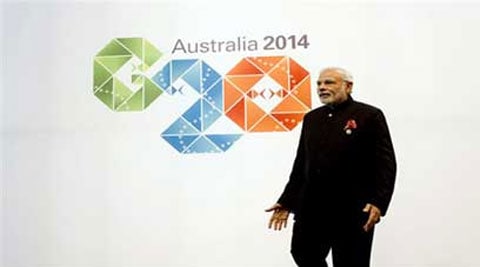
Prime Minister Narendra Modi’s attendance at the Asean and G-20 summits caps a busy few months of travel that have included bilateral summits with Japan, the US and now Australia. Modi is the face of a newly confident India that is not afraid of doing deals — sometimes tough deals — with new partners across the economic, political and military spectrum.

Since the end of the Cold War, we have seen big changes in the way India looks at the world. For one thing, India realised that its quest for economic autarchy had been a mistake. In the decades after Independence, India discouraged foreign trade and investment in an attempt to become self-reliant. But policies that sounded desirable only led to economic stagnation and caused India to be less powerful, not more. In contrast, many countries in East Asia connected themselves deeply into the global system, which helped them develop their economies and strengthen their national power.

It is now broadly accepted that the path to a strong India lies through globalisation and economic interconnectedness. Modi was elected on a platform of strengthening India’s economy through more trade and more foreign investment. But even though economic autarchy has been thrown into the dustbin of history, many Indian decision-makers still cling fast to old ideas of strategic autonomy as an excuse to keep other countries at arm’s length. They argue that defence cooperation with other countries somehow endangers India’s sovereignty and that India should try to act alone on the international stage. To them, sovereignty is a sacred object that must be kept in a box.

This view of the world contrasts with the way most countries now promote strategic interconnectedness to enhance their power and influence, and indeed their sovereignty. Of course, the United States came to this understanding some 75 years ago and it is now skilled at using interconnectedness to enhance its influence.

But many other nations, large and small, now use strategic interconnectedness to leverage their power and punch above their weight. This reflects a world in which few countries — even the US — can achieve much by themselves in the international arena. The new norm is of ad hoc coalitions of states that come together to address a particular problem or achieve a specific objective. And in these coalitions, the countries that will wield the greatest influence are those that have the fewest inhibitions in working with others.

More youth in India than rest of the world: UN report

Rukmini S.
November 18, 2014

The HinduThe emergence of a large youth population of unprecedented size can have a profound effect on any country, a UN report says. File Photo: S. James

“Employers, education providers, and youth live in parallel universes”

India has a larger proportion of youth population than the rest of the world, according to the United Nations Population Fund’s (UNFPA) State of the World’s Population Report, released on Tuesday said.

“Today’s record 1.8 billion young people present an enormous opportunity to transform the future,” UNFPA Executive Director, Dr. Babatunde Osotimehim, said in a statement. “Young people are the innovators, creators, builders and leaders of the future. But they can transform the future only if they have skills, health, decision-making, and real choices in life,” he added.

“The emergence of a large youth population of unprecedented size can have a profound effect on any country. Whether that effect is positive or negative depends largely on how well governments respond to young people’s needs and enable them to engage fully and meaningfully in civic and economic affairs,” the report says.

Whether in politics, economics or the military, India must be ready to meet China's challenges

11 November 2014

China President Xi Jinping's recent Sri Lanka visit is a cause for concern

The docking of a Chinese submarine at the Colombo port twice in recent weeks highlights the challenges we face in handling China, as well as our neighbours. 

Both challenges are interlinked. China is active in our neighbourhood, politically, economically and militarily. Notwithstanding the argument that China too has the right to establish close ties with countries that are also its neighbours, and that India cannot object to this as encroachment on its sensitive periphery, our concerns about China intruding into our neighbourhood are legitimate for several salient reasons. 

Our border with China is not only unsettled, it remains the source of periodic tensions. That we have in recent years avoided an actual military clash despite competing claims and patrolling may be a diplomatic accomplishment, but it is no guarantee that a crisis can be permanently avoided in an inherently fraught situation. 

China has strengthened its military infrastructure in Tibet enormously. This gives it the means to sustain pressure on India on the border and induce us to more cautious in challenging its moves on our northern periphery, under cover of which it continues to deepen its engagement with Pakistan and Nepal in particular, while also subtly propping its overtures to Bhutan. 

China is keeping territorial issues with India aggressively alive, with the PLA and the Chinese foreign office objecting most recently to our decision to establish additional posts on our northern border and build an east-west highway across it, even though China itself continues to incessantly improve the military infrastructure on its side.

It has also cautioned India to ensure that its off-shore oil exploration agreements with Vietnam do not include territory China disputes, unmindful of its past projects in POK as well as ambitious new ones which fall squarely within the territory that Pakistan claims is “disputed”. 

These objections have come after President Xi Jinping’s visit to India, and the expectations raised that China may be less assertive on border issues with India in the interest of expanding economic ties between the two countries. 

China’s strategic investment in Pakistan has been almost unprecedented, with no country giving nuclear weapon and missile technologies to another to the extent that China has given to Pakistan. China is now an active political player in Nepal, seeking parity with India there. 

China has long tried to tempt Bhutan into a territorial bargain that would involve exchange of its claims in the north with concessions in the Chumbi valley that would outflank India’s defences there. 

The grand design is to gain a strong strategic hand vis-a-vis India across our land frontiers, even as it begins to establish its strategic presence in the Indian Ocean aimed at eroding our dominant position there. 

Initiatives

‘20th hijacker’ from 9/11 seeks role in civil terror cases

Nov 18, 2014

Offers details about inner workings of Al Qaeda, but most view deal as suspicious

The man who became known as the “20th hijacker” from the Sept. 11, 2001 attacks wants to testify in lawsuits filed by victims of terrorism. The imprisoned Zacarias Moussaoui rece-ntly wrote to federal courts in New York and Oklahoma, claiming he can offer inside information about the inner workings of Al Qaeda to boost legal claims that the government of Saudi Arabia and financial institutions supported terrorism.

Some lawyers have taken him seriously enough to interview him at the Supermax federal prison in Colorado, where he is serving a life sentence. But other observers are sceptical, saying it could be a desperate grab for leniency or relevancy. “Even if he somehow got to the point where he could testify, there would be a credibility issue,” said Carl Tobias, a professor at the University of Richmond School of Law. “Would his testimony be valuable? That’s doubtful.”

The offers are also clouded by his record of changing his account of his involvement in the Sept. 11 plot and his erratic behaviour in court. In court papers filed in Manhattan in September, lawyers for Saudi Arabia said flatly: “The Kingdom of Saudi Arabia had no role in the attacks of September 11, 2001.” They also noted that the United States “has said often and vigorously that Saudi Arabia is an important ally in the fight against terrorism.”

Moussaoui’s attempts to cooperate in the civil cases stand in contrast to the defiant attitudes of other Al Qaeda defendants who have endured after years of confinement without volunteering information except for claims they were tortured.

Moussaoui (46), a French citizen of Moroccan descent who refers to himself in writing as “Slave of Allah,” was arrested on immigration charges in August 2001 after employees of a Minnesota flight school became alarmed that he wanted to learn to fly a Boeing 747 even though he had no pilot’s licence.

He was in custody on Sept. 11 and pleaded guilty in April 2005 to conspiring with the hijackers to kill Americans.

The plea initially seemed to subdue the mercurial Moussaoui, who during a three-year legal fight repeatedly insulted the judge and tried to fire his lawyers. But his combustible side re-emerged at his death penalty proceedings, when he surprised everyone by testifying that he had planned to pilot a plane into the White House on Sept. 11.

Missouri governor declares state of emergency ahead of grand jury decision

Nov 18, 2014

Demonstrators march through the streets during a protest over the shooting death of Michael Brown in Clayton, Missouri. (Reuters Photo)

Missouri's governor declared a state of emergency on Monday and authorized the state's National Guard to support police in case of violence after a grand jury decides whether to indict a white police officer who fatally shot an unarmed black teenager.

"As part of our ongoing efforts to plan and be prepared for any contingency, it is necessary to have these resources in place in advance of any announcement of the grand jury's decision," Governor Jay Nixon said in a statement. The order also puts the St. Louis County Police Department, rather than police in Ferguson, Missouri, in charge of policing protests.

Residents of Ferguson, which saw weeks of sometimes violent protests following the Aug. 9 shooting death of 18-year-old Michael Brown, are braced for the possibility of more unrest, particularly if the grand jury decides not to criminally charge Ferguson police officer Darren Wilson.

The past two days have seen protests around the area in anticipation of the grand jury's report. Several dozen demonstrators took to the streets on Monday in Clayton, Missouri, where a grand jury is meeting.

"We want an indictment. The cops don't like it," the protesters chanted as they marched in freezing temperatures.

"Something about the way Mike Brown was killed started a fire in me that I can't ignore," said one of the demonstration's organizers, Dhorbua Shakur, 24.

He said he had little sympathy for area residents who are tired of the demonstrations, which left some businesses in Ferguson burned out.

"They can turn this off and on with a TV screen. But this is my reality. This is my life," Shakur said.

Decision expected this month

IS 'executes nearly 1,500 people in Syria in 5 months'

 Nov 17, 2014

This still image taken from an undated video published on the Internet by the Islamic State group militants and made available on Sunday, November 16, 2014, purports to show extremists marching Syrian soldiers before beheading them. (AP photo)

BEIRUT: The jihadist Islamic State group (IS) has executed nearly 1,500 people in Syria in the five months since it declared the establishment of a "caliphate", a monitoring group said on Monday. 

"The Syrian Observatory for Human Rights has documented the execution of 1,429 people since the IS announced its 'caliphate' in June," the group's director, Rami Abdel Rahman, said. 

The majority of IS's victims in Syria have been civilians, he said. 

"Of the total number of people beheaded or shot dead in mass killings by IS, 879 have been civilians, some 700 of them members of the Shaitat tribe." 

The Sunni Muslim Shaitat tribe, from the eastern province of Deir Ezzor, rose up against the jihadist group in mid-2014. 

Another 63 of the dead were members of other rebel groups or the rival jihadist Al-Nusra Front, which has fought IS in the north and east, Abdel Rahman said. 

"Another 483 were regime soldiers, while four others were IS members" accused of corruption or other alleged offences, Abdel Rahman said. 

IS has executed large numbers of troops loyal to President Bashar al-Assad in recent months, after capturing government positions in central and northern Syria. 

Many have been beheaded and their bodies put on display in public squares, "in order to strike terror into civilians and into any group that might decide to fight it", Abdel Rahman said. 

Pakistan test-fires nuclear capable ballistic missile

Nov 17, 2014

ISLAMABAD: Pakistan successfully test-fired a nuclear capable ballistic missile with a range of 900 kilometers, days after testing a similar missile capable of hitting targets as far as 1,500 kilometers, bringing many Indian cities under its range. 

The launch of Shaheen 1A or Hatf IV ballistic missile was aimed at re-validating various design and technical parameters of the weapon system. 

The military said that the impact point of the launch was in the Arabian Sea in the south. 

Chief of Naval Staff Admiral Muhammad Zakaullah, Director General Strategic Plans Division, Lt Gen Zubair Mahmood Hayat, Commander Army Strategic Forces Command and senior officers from the strategic forces, scientists and engineers of strategic organiszations witnessed the launch. 

Last week Pakistan successfully test fired Shaheen-II, also called Hatf VI, capable of carrying nuclear and conventional warheads to targets as far as 1,500 kilometers. 

Admiral Zakaullah said Shaheen-1A with its highly accurate and indigenously developed guidance system is amongst the most accurate Missile System. 

The admiral reiterated Pakistan's desire for peaceful co-existence in the region. 

President Mamnoon Hussain and Prime Minister Nawaz Sharif appreciated the successful test launch.