26 November 2014

Unidentified Country Reportedly Behind Newly Discovered REGIN Spyware System

Author’s Note: Be advised that wired.com and Glenn Greenwald’s The Intercept, citing highly circumstantial evidence, are alleging that REGIN was created by the National Security Agency (NSA) and/or Britain’s SIGINT agency, GCHQ, and used to spy on Belgium’s telecommunications conglomerate BELGACOM. But both publications provided no documentary evidence to back up their claims other than to note a commonality of dates involved and a vague technical similarity between the STUXNET virus reportedly used by the U.S. against Iran and the REGIN system.

Unidentified country likely behind spying software

Associated Press, November 24, 2014

SAN FRANCISCO (AP) — Cyber-security researchers say they’ve identified a highly sophisticated computer hacking program that appears to have been used by an as-yet unidentified government to spy on banks, telecommunications companies, official agencies and other organizations around the world.

The malicious software known as “Regin” is designed to collect data from its targets for periods of months or years, penetrating deep into computer networks while covering its tracks to avoid detection, according to analysts at Symantec, the Silicon Valley security firm that disclosed the program’s existence in a report this week.

Citing factors including its complexity and the likelihood it took years to develop, Symantec security manager Vikram Thakur said Monday, “we think it could not have come from anybody except an extremely well-funded, organized nation state.”

Unlike malware that’s been used to hack into retailers’ payment-processing systems, the Regin program isn’t focused on collecting large volumes of credit card numbers or other financial account information, he added. Instead, it’s more precisely targeted and can be used to collect screenshots, copy deleted files, steal passwords and monitor digital communications - including mobile phone calls.

Evidence from contaminated computers shows the malware has been used since at least 2008, with half the known cases discovered in Russia and Saudi Arabia, Symantec said. Based on its design and behavior, experts at Symantec and other firms said they don’t believe it was developed in Russia or China, two countries that are often blamed for cyberattacks around the world.

For Once, a Positive Crisis

November 21, 2014

The original meaning of crisis is a turning point, decisive or crucial in time, whether good or bad. The overused negative interpretation is that of a time of danger or threat. The United States is now living a real crisis - one that relates directly to the old meaning of the word.

The change in the global energy landscape - primarily due to America's fracking industry as well as advances in energy conservation - is decisively altering the American economy and America's role in the world.

Domestically, over a year's time, the drop in energy prices will allow every American household to save on average over $500. This beats any middle class tax cut. And these savings do not take into account diminished inflation as cheaper energy whether from manufacturing, farming, or shipping work their way through the economy.

Globally, the United States is now in a unique competitive position. It spends significantly less money abroad to import oil, giving its balance of payments a huge boost, and the oil it does import (America cannot produce certain grades) is on the whole cheaper than the oil other countries import.

Because the U.S. dollar is the reserve currency, most of the world's oil is traded in dollars. Thus when America imports oil, it is not affected by the change in value of the dollar versus other currencies.

With the recent rise in the dollar, Europe, just as one example, pays comparatively more for oil than does the United States. This does not mean that Europe, China, and Japan are not benefiting from lower oil prices. They are just benefiting less.

Revolutions in energy production

America is also now the largest producer of natural gas in the world. Natural gas is crucial in competitive heavy industrial manufacturing, and it is now substantially cheaper to purchase natural gas in America than in Europe or Asia. American gas sells for about $4 per million BTU, compared with about $10 in Europe and $18 in Asia. According to the IMF, this has led to a 6 percent average increase in America's manufactured exports, all thanks to sharpened competitiveness.

The International Energy Agency has warned that Europe will lose a third of its share of global energy-intensive exports over the next two decades, because its energy prices will remain higher than those in the United States.

The agency did not mention China, but obviously the situation there should be similar to Europe as concerns non labor-intensive, energy-intensive manufacturing.

Without the new energy savings, the American economy could well be either standing still or slowing. Europe is America's largest trading partner, and the fracking revolution has essentially vaccinated the American economy against Europe's economic malaise.

How low can oil go?

Can Putin Turn the ISIS Mess to Russia’s Advantage?


A man holds pictures of Russian President Vladimir Putin and Syrian President Bashar al-Assad during a rally in support of Syrian regime in front of the U.S. Embassy in Moscow, on Oct. 19, 2012.

Sputnik News, the slick new-media rebranding of the venerable Russian news wire RIA-Novosti, reports that Russia has called on the U.N. Security Council to ban purchases of oil from terrorist-controlled regions, including the territory held by ISIS. This isn’t a surprising position, but it does draw some attention to Russia’s interesting outsider role in the international anti-ISIS effort.

Joshua Keating is a staff writer at Slate focusing on international affairs and writes the World blog. 

While the U.S. and Russia have pledged to share intelligence on the group, Russia—one of the main international backers of Bashar al-Assad’s Syrian government—is not a member of the U.S.-led “broad coalition” against ISIS announced last month. As one Russian foreign ministry official recently put it, “We do not expect any invitations and we are not going to buy entry tickets.”

Russia has taken the position that airstrikes against ISIS in Syria ought to have been debated in the U.N. Security Council, where Moscow enjoys veto power. Russia has also relished the opportunity to say I told you so, with Foreign Minister Sergei Lavrov arguing that ISIS is made up of the same rebels that the U.S. and other Western countries were supporting against Assad. Prime Minister Dmitry Medvedev also made much of his umbrage at President Obama’s speech to the U.N. General Assembly in September, which listed Russian aggression in Ukraine (along with ISIS and the Ebola virus) as major international threats. Discussing the diplomatic puzzle presented by Syria, a senior U.S. administration official recently told CNN, “The Russians are not our friend here.” 

Russia A wounded economy


It is closer to crisis than the West or Vladimir Putin realise Nov 22nd 2014 

VLADIMIR PUTIN is not short of problems, many of his own creation. There is the carnage in eastern Ukraine, where he is continuing to stir things up. There are his fraught relations with the West, with even Germany turning against him now. There is an Islamist insurgency on his borders and at home there is grumbling among the growing numbers who doubt the wisdom of his Ukraine policy. But one problem could yet eclipse all these: Russia’s wounded economy could fall into a crisis (see article).

Some of Russia’s ailments are well known. Its oil-fired economy surged upward on rising energy prices; now that oil has tumbled, from an average of almost $110 a barrel in the first half of the year to below $80, Russia is hurting. More than two-thirds of exports come from energy. The rouble has fallen by 23% in three months. Western sanctions have also caused pain, as bankers have applied the restrictions not just to Mr Putin’s cronies, but to a much longer tally of Russian businesses. More generally, years of kleptocracy have had a corrosive effect on the place. Much of the country’s wealth has been divided among Mr Putin’s friends.

Everybody expects continued stagnation, but the conventional wisdom is that Mr Putin is strong enough to withstand this. The falling rouble has made some export industries like farming more competitive. These exports combined with Mr Putin’s import-blocking counter-sanctions mean Russia still has a small trade surplus. It has a stash of foreign-exchange reserves, some $370 billion according to the central bank’s figures. Add in the resilience of the Russian people, who are also inclined to blame deprivation on foreigners, and the view from Moscow is that Mr Putin has time to manoeuvre. People talk loosely about two years or so.

Should the U.S. Arm Ukraine’s Militias?


In an exclusive interview, one of the top pro-Kiev militia commanders talks about the cowardice of some of Ukraine’s regular army officers and his need for U.S. weapons. 

DNIPROPETROVSK, Ukraine—When skirmishes began in this corner of eastern Ukraine earlier this year, Yuriy Bereza decided to use “direct action” (read fists and clubs), threats, and incentives to ensure this fourth largest city—and a mainly Russian-speaking one—didn’t slide into rebel hands as Donetsk and Luhansk had done. Bereza, a veteran of the Orange Revolution of mass protests against Russian-backed governments, joined forces with a group of local businessmen, including billionaire oligarch Igor Kolomoisky, to make sure this city stayed on the Ukrainian side of the political divide. 

The strategy seems to have worked. In the Dnipropetrovsk’s regional administration building on a frigid Sunday morning, I waited for him along with members of Bereza’s Dnipro Battalion, a motley militia that has been in the forefront of a weeks-long battle three hours away at Donetsk airport. They wanted to welcome Bereza back from a 10-day trip to Washington, D.C. 

This stocky 44-year-old grandfather with a neatly cropped beard arrived in an ebullient mood, laughing often and easily as, behind closed doors with some of his lieutenants, he narrated his adventures in America to a chorus of loud guffaws. But make no mistake, this former officer in the Soviet and Ukrainian armies is a man on a mission—to take back the Donbass region from the separatists and to exorcise Russian political influence on Ukraine. 

IS A NATIONAL-SECURITY SHAKEUP COMING? BY MAX BOOT

November 24, 2014 
Is a National-Security Shakeup Coming?

So Defense Secretary Chuck Hagel is gone but the nuclear talks with Iran seemingly go on and on and on. Tell me: How much has changed?

It is easy to see why Hagel has been jettisoned: the administration needs a scapegoat for the most disastrous U.S. foreign policy since the Carter administration. With ISIS and Putin on the march, while U.S. military capabilities deteriorate due to budget cuts, it has been pretty obvious for some time that the national-security team needed a dramatic overhaul. But firing Hagel is not going to fix the problems-not by a longshot. In fact the very reason he was so expendable was because he had so little influence: Unlike Susan Rice, Ben Rhodes, or Valerie Jarrett, he was not a White House insider.

Instead Hagel (like General Martin Dempsey, the chairman of the Joint Chiefs of Staff) was the good soldier, plodding ahead to carry out the president’s orders without question-no matter how little sense those orders made. As the New York Times noted: Hagel “spent his time on the job largely carrying out Mr. Obama’s stated wishes on matters like bringing back American troops from Afghanistan and trimming the Pentagon budget, with little pushback.”

Indeed one of the few times that Hagel dared in public (or probably in private) to talk back to the president, he earned the ire of Obama and his loyalists for telling the truth. While Obama earlier this year was denigrating ISIS as the “JV team,” Hagel was calling them an “imminent threat to every interest we have” and saying “This is beyond anything we’ve seen.” As the Times drily notes, “White House officials later said they viewed those comments as unhelpful”-Washington code words for the fact that Obama’s top aides were infuriated by Hagel’s truth-telling.

The immediate question is whether Obama will be able to stomach a stronger personality in the secretary of defense job-someone like Bob Gates or Leon Panetta. If so, Michele Flournoy or Ash Carter, both of whom served at the Pentagon earlier in the Obama administration, could fill the job description. But if Obama were truly intent on a radical break with some of his failed policies he would opt for a true outsider like Joe Lieberman or David Petraeus or John Lehman.

Regardless of who fills the job at the Pentagon-or for that matter at State-the reality remains that in this administration all critical decisions are made in the White House by the president with a handful of loyalists who have little independent standing, knowledge, or credibility in national-security affairs. This has been a problem ever since the raid to kill Osama bin Laden, the point at which Obama stopped listening to independent advice and started acting on his own ideological worldview predicated on downsizing the American armed forces and retreating from the world.

If this were a parliamentary system, Obama would long ago have lost a vote of “no confidence” and been forced to step down. But because it’s a presidential system he will remain in power two more years. The firing of Hagel will be a positive step forward only if it signals a complete rethink of the president’s foreign policy a la Carter’s conversion to become a born-again hawk after the Soviet invasion of Afghanistan and the Iranian hostage crisis.

The test of that will be to see how Obama deals with Iran now that nuclear talks have reached an impasse after a year. Will Obama allow the mullahs to drag out negotiations indefinitely while continuing to enjoy sanctions relief? Or will he clamp down with extra-tough sanctions and implement a plan to roll back Iran’s power grab in Iraq, Syria, Lebanon, and Yemen? My bet is that not much has changed in the president’s thinking beyond his desire to see a new, more credible face at the Pentagon, but I’m happy to be proved wrong.

Share this:

Podcast Episode 1: The Future of Warfare

November 13, 2014 

Wikistrat is proud to announce the launch of our new “Geostrategy Radio” podcast.

What is the future of warfare? Which aspects of war are immutable and which are likely to evolve? How will the nature and character of warfare change over the coming century?

The past three decades have seen the rapid adoption of new technologies in all domains of warfare. The advent of unmanned systems, precision strike, persistent and expanded sensors and cyberwarfare — to name but a few of the dramatic changes — seems to indicate a Revolution in Military Affairs (RMA).

To answer these and other questions about the changing nature of warfare, Wikistrat ran a several-weeks-long discussion forum that involved the participation of dozens of analysts on our network.

Supervisor Russ Glenn administered the forum and sat down with Geostrategy Radio host Steve Keller to discuss some of the insights therein. Topics covered included the role of drones, artificial intelligence, tanks, individual soldiers and much, much more.

The podcast was developed by Social Media Coordinator Steve Keller and Podcast Producer Mike Best.

Russ Glenn has a PhD in Asian and Middle Eastern Studies from the University of Cambridge and has worked extensively on Chinese and U.S. international relations, energy security and security issues. He has been a contributor to Wikistrat since 2011 and currently works as a researcher in Palo Alto.

This entry was posted in Geostrategy Radio. Bookmark the permalink.

Symantec Report on the Newly Discovered REGIN Spyware System

November 24, 2014


An advanced piece of malware, known as Regin, has been used in systematic spying campaigns against a range of international targets since at least 2008. A back door-type Trojan, Regin is a complex piece of malware whose structure displays a degree of technical competence rarely seen. Customizable with an extensive range of capabilities depending on the target, it provides its controllers with a powerful framework for mass surveillance and has been used in spying operations against government organizations, infrastructure operators, businesses, researchers, and private individuals.

It is likely that its development took months, if not years, to complete and its authors have gone to great lengths to cover its tracks. Its capabilities and the level of resources behind Regin indicate that it is one of the main cyberespionage tools used by a nation state.

As outlined in a new technical whitepaper from Symantec, Backdoor.Regin is a multi-staged threat and each stage is hidden and encrypted, with the exception of the first stage. Executing the first stage starts a domino chain of decryption and loading of each subsequent stage for a total of five stages. Each individual stage provides little information on the complete package. Only by acquiring all five stages is it possible to analyze and understand the threat.

Regin also uses a modular approach, allowing it to load custom features tailored to the target. This modular approach has been seen in other sophisticated malware families such as Flamer and Weevil (The Mask), while the multi-stage loading architecture is similar to that seen in the Duqu/Stuxnet family of threats. 

National Geospatial-Intelligence Agency Providing Imagery and Mapping Support in Fight Against Ebola

By Cheryl Pellerin
November 24, 2014

DoD Agency Offers Public Geospatial Intel to Help Ebola Fight

WASHINGTON, Nov. 24, 2014 - In a contribution to the Defense Department’s fight against West Africa’s deadly Ebola virus disease outbreak, the National Geospatial-Intelligence Agency has launched its first public website of unclassified geospatial intelligence data.

Army Chief Warrant Officer 2 Angel Mitre, right, the Joint Forces Command United Assistance liaison officer to the National Ebola Crisis Center in Monrovia, Liberia, explains to personnel from the Liberian Institute of Statistics Geo-Information Services how an exchange of geospatial data between the JFC-UA and LISGIS created a more robust, useful product for organizations supporting Operation United Assistance, Oct. 29, 2014. Also pictured, from left to right, are Kayloe R. Frank, LISGIS technician; Cpl. Christopher Byers, geospatial information services mentor for JFC-UA; James Z. Barzon, LISGIS technician; Andy Tugbah, LISGIS technician; and Barry Miller, a geospatial intelligence analyst from the National Geospatial-Intelligence Agency. DoD photo

NGA’s mission in support of national security is to visually depict and assess situations on the ground using satellite imagery and other geographically referenced information.

The public website, covering the West African countries affected by the Ebola outbreak, is a new venture for the necessarily secretive intelligence organization. Still, NGA has for years provided geographical intelligence to first responders during most major natural disasters.

"My group regularly supports humanitarian assistance and disaster relief efforts, as well as special security events that are driven by the FBI," Timothy J. Peplaw, director of the NGA Readiness, Response and Recovery Office, told DoD News during a recent interview.

Supporting the Disaster Supporters

"NGA is not necessarily in the business of providing unclassified data," he added, "but my customer set is very open, so my group is the one exception where we have to provide unclassified data and products to people who support these disasters."

The office always works through a lead federal agency, Peplaw explained.

Stress-testing the world economy for pandemics, cyber-attacks and war

By Marion Dakers, Financial Services Editor
24 Nov 2014

Cambridge University's business school has worked out the financial effects of several disaster scenarios to help firms plan ahead

The London riots of 2011 were used to help calculate the cost of global social unrest Photo: AFP/Getty Images

Imagine a social uprising, spawned from growing unease about inequality and fuelled by social media, which has sparked protests in 1,100 cities around the world. Pockets of violence are threatening to spill over into mob rule, and the global headquarters of a London bank have just been set ablaze. What does it mean for stock prices?

The Judge Business School at Cambridge University has run this nightmare scenario and three other stress tests in an attempt to quantify the economic cost of a global disaster and help prepare companies for unlikely but emerging threats.

Academics and private sector experts have constructed scenarios with a one-in-100 chance of happening in any given year, including a flu pandemic, a military conflict between China and Japan, and a cyber attack named Logic Bomb.

Insurance firms Catlin and Munich Re have been involved alongside industry giants BP and Lockheed Martin. The UK Research Councils are also providing funding for the stress tests, dubbed “catastronomics” by Cambridge.

Like the stress tests carried out in the banking sector, these scenarios are not predictions but worst-case hypothetical cases to ensure companies can withstand large shocks.

“Insurance companies like Lloyd’s of London already have realistic disaster scenarios. We were requested to develop some stress tests for emerging risks, that they don’t model for already,” said Dr Andrew Coburn, director of the advisory board at the university’s Centre for Risk Studies.

Zero to Clausewitz in 60 Minutes: Your Complete 300 Word Strategic Education


BY MAJOR MATT CAVANAUGH

Can we educate a strategist in an hour? Some would argue this task is impossible, that it takes a lifetime, or at least 10,000 hours

But what if we had to? Imagine it were possible – how would you do it? How would you accelerate learning to strategic competency? Note: I define competency as someone that would know, understand, and be able to apply a core set of strategic concepts to analyze and appraise modern war (see also “strategic understanding”).

One scientifically validated path would be the Pareto Principle, which holds, across many systems, that 80% of output comes from 20% of input. How does this help us rapidly educate strategic practitioners? We would first identify the critical 20% knowledge base that produces these outsize gains. We would then leverage this 20% (or “minimum effective dose”) by proving a simple framework for use in any war.


Following the logic above, I’ve created a document that identifies what I consider the 50 most essential strategic concepts and whittled each to six words apiece (hence, 300 words, not including the actual term itself). I’ve also presented Clausewitzian Critical Analysis as simply as possible in the header to present this all-weather framework. Lastly, I included an abbreviated footnotes section for those with further interest (and here’s the draft and outtakes).

My claim is that using the “WarCouncil.org 300 Word Strategic Education,” you could educate a competent strategic practitioner in 60 minutes. 

Consider this War Council’s gift to you over this holiday season – enjoy! All I ask in return is that you follow@TheWarCouncil on Twitter! Oh, and please consider following @TheWarCouncil on the blue bird thingy. Lastly, before clicking away to another entertaining post - please click here to support @TheWarCouncil!

U.S. SPECIAL FORCES TRAIN FOR NORTH KOREA MISSION


Soldiers of 1st Special Forces Group (Airborne) and the Republic of Korea 11th Special Forces Brigade provide security for their fellow members during training near Gwangyang, South Korea, April 1, 2009. The two forces trained together during the annual springtime exercises Key Resolve and Foal Eagle. (Photo: U.S. Army)

Another famine grips North Korea. Morale is low. Elite U.S. Special Forces, having trained for years for this archetype scenario, enter North Korea from South Korea, via submarines off the coast and from mainland China.

They have deployed with a singular mission – that being to lead the North Korean people in a popular revolt against their oppressive, multigenerational Stalinist hereditary cult.

Several North Korean slave labor camps are liberated. North Korea’s elite intelligentsia advising dictator Kim Jong-un is whisked away, leaving him isolated.

China stands down and announces it won’t step in to save the regime in Pyongyang.

‘The Interview’ is a new Hollywood film about two journalists recruited by the CIA to assassinate the leader of North Korea

The race is on to secure North Korea’s vast stockpile of biological and chemical weapons, while America prepares to use tactical nuclear weapons in the Korean theater in a fight to the finish.

While the aforementioned scenario sounds like fiction, it’s not as far-fetched as many might believe.

More specifically, various news reports state U.S. Special Forces have been training alongside Republic of (South) Korea Special Forces in mock scenarios in which they would be inserted into North Korea (also known as the Democratic People’s Republic of Korea, or “DPRK”). Their mission would involve launching, growing and leading a partisan movement, or “indigenous resistance organization,” of North Korean citizens against the ruling regime.

December 1, 2014 Conference on Operation RYAN and KGB/STASI Forecasting of Nuclear War

November 24, 2014

Forecasting Nuclear War: Stasi/KGB Intelligence Cooperation under Project RYaN

Between 1981 and 1989 the foreign intelligence branches of the Soviet KGB and the East German Ministry of State Security launched a combined effort to develop a system for detecting signs of an impending western nuclear first strike. Codenamed “Project RYaN”, this early-warning system constituted one part of the Soviet response to the perceived threat of a surprise “decapitation” strike by NATO nuclear forces.

Join us on December 1st as Bernd Schaefer, Nate Jones, and Benjamin Fischer discuss these newly translated sources and give unprecedented insight into the capabilities and fears of the Eastern Bloc intelligence services from the Able Archer ’83 War Scare to the end of the Cold War.

Professional Lecturer, The George Washington University

Nate Jones

Freedom of Information Act Coordinator for the National Security Archive

Benjamin Fischer 

Former Chief Historian of the Central Intelligence Agency

CWIHP is a part of the Wilson Center’s History and Public Policy Program


Wilson Center

Ronald Reagan Building and

International Trade Center

One Woodrow Wilson Plaza

1300 Pennsylvania, Ave., NW

Washington, D.C. 20004

ACHIEVING STRATEGIC EXCELLENCE IN ARMY UNIVERSITY

November 24, 2014

A few months ago, I visited the Army’s Command and Staff College at Ft. Leavenworth at their invitation to offer some ideas a new effort: Army University (AU). This is an attempt by the Army leadership to build an education enterprise that brings all schools from basic training to the staff college under single management.

But the establishment of Army University opens the door to many questions. First and foremost is a simple one: what is the problem with Army professional education that AU seeks to solve? As I learned during my visit, the answers are complex.

Let’s begin with a bit of history: Great advances on the intellectual side of war occur as wars end. Elihu Root’s founding of the war college was a direct outcome of America’s failings in the Spanish American War. The Reichswehr transformation and the rewriting of German doctrine were started by von Seeckt in 1919. The Army school system was reformed during the interwar period and again in 1947. The founding of Training and Doctrine Command (TRADOC) in 1973 was a direct consequence of our perceived failings in Vietnam. But history also suggests that this is a window of opportunity rather than an open door. An institution as complex and inherently conservative as the Army has about five years after a war to make change. After that, armies tend to turn inward, become overly bureaucratic, fiscally ossified, and lose political support for intellectual change. The failures of the French Army during the inter-war years serve a good example of how this can go terribly wrong.

The Army, chief among all the services, does a superb job of matching performance to the process of selecting lieutenant colonels for battalion command and colonels for brigade command. The Army’s personnel bureaucracy, Human Resources Command (HRC), and the Army’s selection board system makes very few mistakes when it picks new tactical commanders. These boards rely on Officer Efficiency Reports to gain a clear picture of the officer’s “manner of performance.” These documents tell the senior leadership how well the officer can get things done and exercise tactical command.

The Realist Creed

November 20, 2014
http://www.realclearworld.com/articles/2014/11/20/the_realist_creed_110813-2.html

All people in foreign policy circles consider themselves realists, since all people consider themselves realistic about every issue they ever talk about. At the same time, very few consider themselves realists, since realism signifies, in too many minds, cynicism and failure to intervene abroad when human rights are being violated on a mass scale. Though everyone and no one is a realist, it is also true that realism never goes away -- at least not since Thucydides wrote The Peloponnesian War in the fifth century B.C., in which he defined human nature as driven by fear (phobos), self-interest (kerdos) and honor (doxa). And realism, as defined by perhaps the pre-eminent thinker in the field in the last century, the late Hans Morgenthau of the University of Chicago, is about working with the basest forces of human nature, not against them.

Why is realism timeless and yet reviled at the same time? Because realism tells the bitterest truths that not everyone wants to hear. For in foreign policy circles, as in other fields of human endeavor, people often prefer to deceive themselves. Let me define what realism means to me.

First of all, realism is a sensibility, a set of values, not a specific guide as to what to do in each and every crisis. Realism is a way of thinking, not a set of instructions as to what to think. It doesn't prevent you from making mistakes. This makes realism more an art than a science. That's why some of the best practitioners of realism in recent memory -- former U.S. National Security Adviser Brent Scowcroft and former U.S. Secretary of State James Baker III -- never distinguished themselves as writers or philosophers. They were just practical men who had a knack for what made sense in foreign policy and what did not. And even they made mistakes. You can be an intellectual who has read all the books on realism and be an utter disaster in government, just as you could be a lawyer who has never read one book on realism and be a good secretary of state. Former U.S. Secretary of State Henry Kissinger was unique because he was both: an intellectual realist and a successful statesman. But successful statesmen, intellectual or not, must inculcate a set of beliefs that can be defined by what may be called the Realist Creed:

What the War Classics Teach Us about Fighting Terrorists


Posted on November 16, 2014

Clausewitz has taken a beating in the War on Terror. His theories on warfare initially came about coincident with the development of the modern idea of the nation state. Clausewitz regarded war as being between nations. Asymmetric warfare between transnational entities, such as Al Qaeda, has not lent itself to this analysis. Sun Tzu has been the winner as he largely thinks about battles and tactics and is not devoted to strategy.

Clausewitz has been the major shaper of the American military mind since WWII. If he were alive today and expressed himself in a tweet, it would be, “War is the extension of diplomacy by the use of violence to achieve goals of the state.” Thirteen years after 9/11, we can now see the involvement of nation states in these events and their aftermath, though they are often portrayed as solely the work of non-state actors.

The majority of the 9/11 terrorists were Saudis. Saudi Arabia has funded the extremist Salafist madrasas in Pakistan. The Saudis’ deal with their Wahhabist base is NIMBY—not in my backyard. They have given them freedom to operate everywhere in the Islamic world—except Saudi Arabia. There is a strong case that some states Washington calls friends are actually enemies. Saudi Arabia, which runs the “oil brothel” most world leaders frequent, is one of them. The recent preference for Sun Tzu ends up being a “win the battle, lose the war” blueprint. One of Osama bin Laden’s goals in drawing the United States into a war was to eventually topple the Saudi government he loathed. It was the allowance of infidel troops on holy Saudi soil in 1991 that bin Laden claimed was the sin that begat al Qaeda.

No failure goes unrewarded. We have an entire general staff of leaders who have lost two wars and were clueless on the way to defeat.

Now, thirteen years later, ISIS is furthering bin Laden’s strategy by pulling reluctant America into another war and growing the radical Islamist movement like fertilizer to a weed. Both al Qaeda and ISIS have been masterful at pushing the U.S. into a reactionary mode, first through the 9/11 attacks and now with the beheading of Western captives. The medieval nature of the beheadings elicits more response than if ISIS had just shot their prisoners. ISIS has the U.S. just where they want it— responding militarily without any foreign policy or defined national interest. Our reactionary policy looks like the game “Whack-a-mole.”

The Land of the Blind

INS Vikrant's Hull Is Torn Open


For Vice Admiral Shekhar Sinha, one abiding memory of INS Vikrant is from almost a quarter century ago. 

In 1989, Sinha, who recently took premature retirement as Flag Officer Commander in Chief (FOC-in-C) of India's Western Naval Command, was the top gun in the 300 squadron that flew Sea Hawk aircraft from on-board INS Vikrant - India's, indeed Asia's, first aircraft carrier. 

Around that time, INS Virat, India's second aircraft carrier had also entered service, but the Indian navy was short of aircraft.

"We had two aircraft carriers but not enough aircraft so we used to transfer aircraft from INS Vikrant to Virat. Two outstanding officers used to command the two aircraft carriers that time. One of them, Madhvendra Singh, went on to become India's navy chief. The other, Ravi Ganesh, is perhaps the only naval officer to have commanded a nuclear submarine and an aircraft carrier. That was a period of great transition. Soon after we started flying Sea Harriers from Virat," Vice Admiral Sinha remembers.

As India's first aircraft carrier turned into scrap on Friday, Sinha, perhaps the last of the naval aviators who had the distinction of flying both Sea Hawks and Sea Harriers, says Vikrant gave India the confidence to operate an aircraft carrier. 

Vikrant joined the Indian Navy in 1961 but it had an older lineage. It was built in 1943 and joined the Royal British Navy in 1945 as HMS Hercules. A Majestic Class 20,000 tonnes displacement aircraft carrier, the refurbished Hercules, now known as Vikrant, was received at the Bombay harbour by India's first Prime Minister Jawaharlal Nehru in 1961.

Its finest moment was to come a decade later in the 1971 war with Pakistan. Although most military enthusiasts remember the Indian Navy's daring attack on the Karachi port in 1971, INS Vikrant perhaps played the most crucial part in shortening the war since it cut off reinforcement sent from West Pakistan to what was then East Pakistan, and is now Bangladesh, by policing the Bay of Bengal and bombing towns and cities like Cox's Bazar, Chittagong, Khulna, Chalna, Mongla, Barisal, Do Hazari, Chiringa and Bakarganj.

How Clausewitz Invented Modern War


11.24.14 
http://www.thedailybeast.com/articles/2014/11/24/how-clausewitz-invented-modern-war.html 

Inspired by his combat experience in the Napoleonic wars, Carl von Clausewitz developed theories of warfare so effective that he is still the most quoted man on the battlefield. 

It’s very hard indeed to think of a single thinker or writer who looms as large over their chosen field of study as Carl von Clausewitz. Clausewitz, on the odd chance you haven’t heard of him in this age of wars and rumors of wars, was a Prussian scholar-general. His field of study was warfare—or more precisely, the theory and practice of war, and the vexed, chronically misunderstood relation between the two. 

Clausewitz’s magnum opus was begun in 1816 after he’d survived the rigors of more than 30 combat engagements in the revolutionary and Napoleonic wars of Europe, more or less physically intact. The manuscript for On War was left unfinished at the time of his death from a cholera epidemic in 1831, and first published in German in three volumes a few years later by his wife, the former Countess Marie von Bruhl, who possessed a fine, discriminating intelligence, and a passionate devotion to her husband and his life’s work. 

What makes Clausewitz’s now longstanding domination of his subject so remarkable is that since his death in 1831, warfare as a field of study has continuously occupied the professional attention of thousands of very smart, thoughtful human beings. A fair number of these men, and a few women, soldiers and civilians alike, have made important contributions to a steadily growing canon of classic works on warfare that began some 2,500 years with Thucydides and Sun Tzu. Yet, when it comes to understanding the nature of war and strategy today, none of the works in that canon is spoken of so often, or with such reverence and respect, as Clausewitz’s On War. 

KNUCKLE-DRAGGERS NEED TO READ TOO: The Case for Reading History in Basic Training


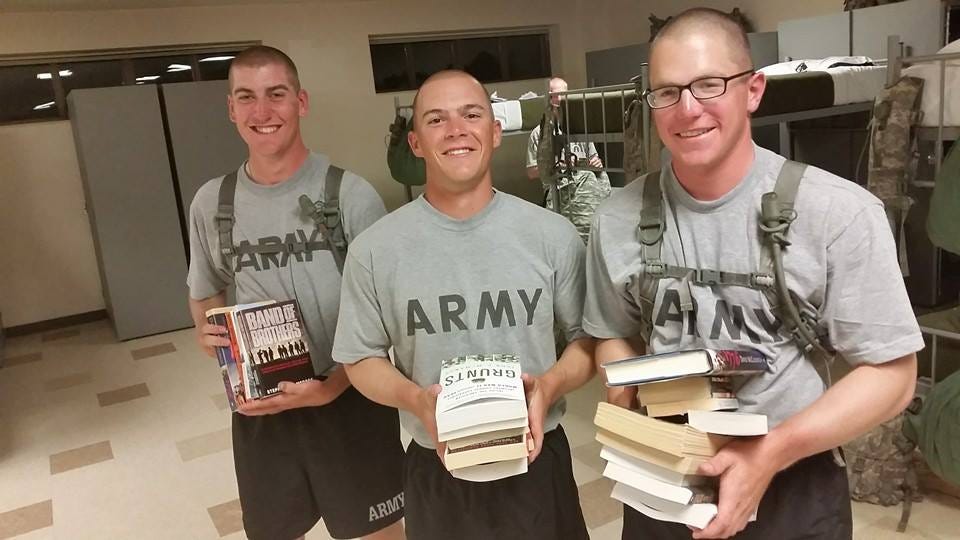
When you walk through the these barracks on a chilly November evening on Fort Benning, it’s “Personal Time” as trainees do laundry and write letters home to mom or a young fiancé. But sitting on the floor, you’ll also find a trainee starting Gates of Fire, while two rows down his Battle Buddy is half way through Starship Troopers. Two of the guys are just touching down in the Ia Drang, three are lost in the Bakara Market, while one is reliving that cold December of 1776. This isn’t Officer Candidate School, it is Sand Hill: birthplace of the Infantryman. These are the nation’s soon-to-be grunts: the knuckle-dragging, dirt-dwelling, trigger-pulling sons of America that are known for their discipline, motivation, and willingness to meet our enemies face-to-face. Sadly, the young Infantryman is not known for his desire to read books without pictures; but they do.

These young Infantrymen-to-be are in Basic Combat Training. It’s not a new, softer, gentler Basic Training. In fact, their company has an Army Physical Fitness Test average well above the brigade’s average, over half of them qualified “Expert” with their rifle, and not a single one of them scored below “Sharpshooter” (not bad for new Privates). They are reading, because they want to, because they were permitted to, and because they were encouraged to; but not because it is required. The only required reading in Basic Training is a map and a Skill Level 1 Tasks book. Religious reading materials are authorized, by regulation, but most Drill Sergeants prohibit anything else. (The Ranger Handbook doesn't count, because to most Infantrymen it equates to religious reading material.)

These young Basic Trainees are reading books off a reading list I developed for Infantry Basic Trainees. It’s outside the graduation requirements or the lesson plan, and therefore it’s not funded. I made the list anyhow, in hopes that these Trainees would leave Sand Hill just a little bit smarter than the rest of their peers. Because history books are not in the training requirements it was a challenge to find money; so I crowd-sourced it. After posting the reading list on our Attack Company Facebook page, I was pleasantly surprised by the outcome. Parents, girlfriends, and other supporters sent in books almost overnight. Every evening since, walking through the barracks, I've found Trainees sitting quietly by their bunks reading history(it helps that we take away their “smart” phones).


Why History?

Here's The Army's Plan For Adapting To Future Threats

NOV 20, 2014


Paratroopers of the 173rd Airborne Brigade of the U.S. Army in Europe take part in the "Black Arrow" military exercise in Rukla, May 14, 2014

The US Army is seeking to reinvent itself in the face of a host of unprecedented challenges. Between tightening budgets, a shrinking military force, and a world of smaller and asymmetrical threats, the Army has released a new global strategy.

The new strategy, encapsulated in the US Army Operating Concept manual "Win in a Complex World," describes how the Army of the future will shape the world's security situation through conflict prevention and the ability to conduct expeditionary maneuvers and combined arms operations.

A significant part of this new strategy comes down to investing in new technology that should aid the Army in the number of new uncertain roles it may play in the future.

"The world is changing all around us, so we have to adapt and change," General Ray Odierno, the Army chief of staff, told The Wall Street Journal. "We are facing one threat in Korea, we are facing another threat with Russia, and another with ISIS. So we have to mold our response."

Below are the main technologies that the Army indicated will become a central focus of their new operating strategy.

"Mobile Protected Precision Firepower"

25 November 2014

Protecting biodiversity with rigour

Neha Sinha
November 25, 2014 

A PRIORITY: “Keeping biodiversity and nature protection at the centre of climate action and growth strategy is a pressing requirement.” Picture shows a tiger in the Western Ghats. Photo: Kalyan Varma

To protect biodiversity, India must take hard decisions and set thresholds for environmental regulation and pollution

The Prime Minister recently reorganised his National Council on Climate Change and called on an indigenous answer, yoga, to alter consciousness and tackle climate change. The Ministry of Environment and Forests (MoEF) is currently working on the National Democratic Alliance’s position on climate change, with two major United Nations Framework Convention on Climate Change meetings coming up. While some say that these recent developments have rightly raised the profile of climate change in the new government, others believe that India needs to do more, particularly in the face of a new U.S.-China agreement on mitigating climate change. 

Voluntary action on climate change in India has centered around economic decisions, such as cutting down on carbon intensity and increasing renewable sources of energy. But what is lacking in the discourse is an understanding of keeping the natural natural, or conserving biodiversity. Two important events have taken place in the past few months in the country, which are tied to climate change and the pressing issue of how we deal with it. First, the Convention on Biological Diversity, a Convention under the United Nations which seeks to regulate our use of the natural world, has reached important funding decisions. Second, a high-level committee set up to propose amendments in environmental laws in India has submitted its recommendations to the MoEF. Both developments set the tone for changing the character of growth.Biodiversity and climate change

Biodiversity and wildlife protection is often termed as a ‘co-benefit’ of mitigating climate change. Other co-benefits, usually understood as secondary to economic decision-making, are clean air, potable water, ecosystem services and a stable microclimate. Conservationists have argued that biodiversity has become a low second fiddle to climate change in international negotiations, and decisions related to biodiversity are not yet part of the ‘mainstream’ decisions related to growth, trade and carbon emissions. At the just-concluded conference of parties of the Convention on Biological Diversity held in Pyeongchang, Korea, many stressed that biodiversity targets cannot just be ‘stand alone’ targets. “In order to move the biodiversity agenda forward, approaches and tactics must evolve. 

A case for SAARC reforms

Subramanian Swamy
November 25, 2014

SAARC, regrettably, has yet to develop into a conflict-mediating or resolving institution on multilateral and bilateral issues. While it has succeeded in evolving as a forum, it does not have the capacity to devise instruments for consultations on bilateral and multilateral political and security problems

The organisation of eight South Asian nations, namely Afghanistan, Bangladesh, Bhutan, India, the Maldives, Nepal, Pakistan and Sri Lanka, with observer nations, Myanmar, China, Iran, the European Union (EU) and the United States, to name a few, is known as the South Asian Association for Regional Cooperation (SAARC). It was established at the first summit in Dhaka on December 7-8, 1985. The last summit, the 17th, was held in Addu, in the Maldives, in November 2011. After a gap of three years, the 18th Summit Meeting is to be held in Nepal on November 26-27, 2014.

These eight nations of South Asia constitute 3 per cent of the world’s area, but house 21 per cent of the global population. India, significantly, constitutes 70 per cent or more of SAARC’s area and population.

Seven of them have common borders with India but not each other. All have a shared culture, ethnicity and experienced long interactive historical events including British imperialism and its consequences.

South Asian nations together also make an integrated “condominium” of common rivers, a mountain system, an ocean and a conjoint ecological system. The region’s endowment for economic production is also more or less the same.Limitations

Since India constitutes 70 per cent or more of SAARC’s area and population, and has political conflicts with all its neighbours, India has to redefine its role, from seeking reciprocity in bilateral relations, to being prepared to go the extra mile in meeting the aspirations of all other SAARC nations.

SAARC, regrettably, has yet to develop into a conflict-mediating or conflict-resolving institution both on multilateral and bilateral issues. It has succeeded however in evolving as a forum and a framework but which does not have the capacity to devise instruments and techniques for consultations on bilateral and multilateral political and security problems.

This is because the SAARC Charter mandates that decisions, at all levels in SAARC, are only of multilateral issues, and only those issues are for inclusion in the agenda in a SAARC summit meeting on the basis of unanimity. Article X(2) of the Charter, thus excludes “bilateral and contentious issues” from the ambit of SAARC deliberations.

A shortcoming in the current situation is that unlike Europe, SAARC is not an association of nearly equally sized countries. India, as stated earlier, is about 70 per cent of the size of South Asia, and the other SAARC member-nations have a common border bilaterally only with India, and not with each other. The economic and quality of life disparities among South Asian nations are also quite wide.Sri Lankan policy

During the period of 10 years since May 2004, the United Progressive Alliance (UPA) was pathetically hamstrung by the sectarian, former secessionist and pro-LTTE parties such as the Dravida Munnetra Kazhagam (DMK) for its survival in Parliament and majority.

Hence, India’s policy towards Sri Lanka was driven both bilaterally and in U.N. organisations by the hyperbole of the parties of the Dravidian Movement, in speech and dramatics, and which was bolstered by the threat of these parties to withdraw support to the Manmohan Singh government. These sectarian parties thus exercised a veto over the UPA government’s Sri Lanka policy.

As a consequence, China, which is not a member of SAARC, gained a strategic advantage in Sri Lanka by moving into the policy space vacated by India. Hambantota port is an example of how China filled the vacuum when India decided, based on the DMK’s threat, to decline Sri Lanka’s offer first to India to assist building the port.

Where the challenge is scarcity, not competition

Written by Mahesh Uppal
November 25, 2014

On November 10, US President Barack Obama came out strongly in support of network neutrality, a principle that requires equal treatment of all internet traffic. He called upon — he cannot legally order — the US regulator, the Federal Communications Commission to “create a new set of rules protecting net neutrality and ensuring that neither the cable company nor the phone company will be able to act as a gatekeeper, restricting what you can do or see online.” Most internet users would share Obama’s opposition to arbitrary blocking or slowing down of any content, especially if a commercial entity attempts to do so. However, it is risky for India to follow Obama’s lead on net neutrality.

The main reason is that the Indian and the US broadband markets are qualitatively different. American companies Comcast and AT&T derive their near-monopoly power from their ownership and control of underground fixed infrastructure. Bharat Sanchar Nigam Limited, their Indian counterpart, has no such advantage. With its dominant share in fixed lines, it has barely 17 per cent of the 60 million broadband customers. Indian users can choose among nearly 10 operators in most service areas — unthinkable in most countries. Thus, Obama’s main argument — the need to prevent abuse of broadband markets by monopolies in control of fixed lines — does not apply.
In India, the challenge is scarcity, not competition, as the broadband market suffers from small size, not from dominance by any player or technology. Fixed lines constitute barely a third of India’s limited broadband connections. Roughly 90 per cent of the 251 million users of the internet access it on mobile phones. Optical fibre will, of course, play an important role when the proposed but much-delayed National Optical Fibre Network is in place. It will take years before fibre can challenge wireless for broadband access.

Wireless networks pose unique challenges for ensuring net neutrality. It is more complicated to expand their capacity to accommodate increasing amounts of data. For fixed line networks, the challenge is mainly the finance needed for upgrade. However, for wireless networks, increasing capacity requires adequate spectrum — a scarce natural resource. The right frequency bands are critical, too. For a telecom operator, acquiring spectrum is not trivial, even if it is willing to pay. In India, the government auctions the spectrum in quantities and a timeframe it decides. There is a detailed regulatory process to determine reserve prices and other features of the auction. Expanding or upgrading the predominantly narrowband wireless network is a financial, technical and regulatory challenge.