5 December 2014

Abbott's rudderless ship won't scrape by

November 29, 2014 


Boat load of barnacles

What is a Captain to do with a ship full of barnacles? By Rocco Fazzari and Denis Carnahan with apologies to drunken sailors everywhere. 

Tony Abbott chose the word "barnacles" very deliberately. He told his party-room meeting this week that "there are one or two barnacles still on the ship but by Christmas they will have been dealt with".

It was a metaphor John Howard liked to use when it was fixing time for his government. 

The supporters of Labor and the Greens may dislike the Abbott government, but it is among the Coalition’s own hinterland of support that despair runs deepest. 

But the people who were central to Howard's success do not see the resemblance. "Howard used to talk about knocking off barnacles when 80 per cent of things were good and the 20 per cent needed fixing. This government has 80 per cent wrong," says one.

U.S. Intelligence Community R&D Agency Has Awarded a Big Contract to Develop New Superconducting Computer

December 3, 2014
U.S. intelligence agency aims to develop superconducting computer

A member of the media films the room with the IBM Blue Gene Q Supercomputer on the launch day for the HBP at the Swiss Federal Institute of Technology (EPFL) in Ecublens, near Lausanne October 7, 2013.

(Reuters) - The U.S. intelligence community has launched a multi-year research project to develop a superconducting computer, awarding its first contracts to three major technology companies.

International Business Machines Corp, Raytheon BBN Technologies and Northrop Grumman Corp won the contracts, the Intelligence Advanced Research Projects Activity said Wednesday, without disclosing financial details.

The Cryogenic Computer Complexity (C3) program could lead to a new generation of superconducting supercomputers, said the unit of the Office of the Director of National Intelligence.

"The energy demands of today’s high-performance computers have become a critical challenge for the Intelligence Community that the C3 program aims to address,” IARPA said in a statement. Such computers use massive amounts of energy.

FROM DOTCOM TO DOTMIL: A MATTER OF HEARTS AND MINDS

December 3, 2014 

National security analysts frequently lament that the United States is losing the innovation race and forfeiting its technical edge. While there are many dimensions to this problem, a prominent facet of the national security technology challenge lies in personnel. A common theme observed in articles about defense innovations is the need to lure people away from Silicon Valley to the DC area so that they will put their big brains to work innovating for the Department of Defense and the Intelligence Community. Given that the government will never compete with the private sector in terms of pay, defense analysts seek to appeal to softer motivations. The pitch: working for the government is a unique and exciting adventure that benefits the public good.

First, it is important to note that the frame the defense community has chosen — luring the Silicon Valley hacker to the Pentagon — is not the only way to develop a workforce to support technical excellence and disruptive innovation. There are alternative mechanisms that the defense community should explore. Regardless, grabbing the tech world’s best and brightest at least could be one component of a more comprehensive solution.

To crib from a well-known recruiting slogan, the security world’s pitch might be summarized as “The Few. The Proud. The United States Geek Corps.” But prospective recruits are likely to ask two inconvenient questions: does the national security enterprise value my expertise, and is taking on the military-industrial complex’s mission really the best way to make a positive impact? In other words, the government cannot just think about technologists as equivalent to the machines they build. It has to fight for their hearts and minds

Specifically, security organizations need to consider whether the people they are trying to attract feel like the military-industrial complex will value their efforts, appreciate their skills, and take their concerns seriously. Additionally, security and defense organizations looking to siphon off tech talent should also think very carefully about what their desired employees see or don’t see as the purpose and meaning of working for Uncle Sam. They should not assume that it is the only or best way to do public good, or that the people they seek to attract share their ideological and political commitments.

CNAS Releases Report on China's Cyber Strategy


Report Reveals the Political, Economic, and Military Objectives
of China’s Cybersecurity Strategy

Washington, December 3 – Center for a New American Security (CNAS) Technology and National Security Program Research Associate Amy Chang has written a new report, “Warring State: China’s Cybersecurity Strategy.” The report explores the political, economic, and military objectives of China’s cybersecurity apparatus; reveals drivers and intentions of Chinese activity in cyberspace; and analyzes the development of Beijing’s cybersecurity infrastructure over the last three decades.

Please find an executive summary of the report by Ms. Chang below:

The United States-China cyber relationship has rarely been more fraught than it is today. Despite high levels of attention to cybersecurity issues in both countries over the past several years, the two nations continue to face substantial obstacles in developing cooperative efforts and improving mutual understanding on the issue. In the cyber context, relations have devolved to near-complete distrust of each other’s motives, actions, and agendas, affecting other facets of the bilateral relationship.

What can be done to improve this situation?

Devising an optimal strategy to address the challenges in the U.S.-China cyber relationship first requires an understanding of motives, agendas, and stakeholders embedded in the process. In this light, this report uses interdisciplinary methods and analysis and Chinese language research to provide unique insight on China’s cybersecurity strategy, including its development since the 1990s, its infrastructure and influencers, and its objectives and incentives in the cyber realm – especially as it pertains to China’s foreign policy and its interactions with the United States.

China’s foreign policy behavior, including its cyber activity, is driven primarily by the domestic political imperative to protect the longevity of the Chinese Communist Party. Ensuring domestic stability, territorial integrity, modernization, and economic growth, while simultaneously preparing for the possibility of militarized cyber conflict in the future, are all objectives that directly or indirectly support the continuation of CCP rule. China espouses laws, norms, standards, and agreements in bi- and multilateral fora that allow for sufficient flexibility of interpretation to serve domestic needs and interests.

Wanted: An Enemy for America's Third Offset Strategy

December 4, 2014

The Pentagon's Third Offset Strategy can't solve all the country's national security challenges, and it will fail if it tries.

In a widely publicized speech at the Reagan National Defense Forum last month, Defense Secretary Chuck Hagel announced a new Pentagon initiative aimed at fostering a third “game-changing” Offset Strategy. Modeled off of Eisenhower’s New Look doctrine in the 1950s, and the Offset Strategy of the 1970s and 1980s, the Third Offset Strategy seeks to harness technological innovations to preserve America’s military primacy in the future.

Despite the grand rollout, much of the details of the Third Offset Strategy remains to be fleshed out. With this in mind, the House Armed Services’ Subcommittee on Seapower and Projection Forces held the first of what its chairman, Rep. Randy Forbes (R-VA), promised would be many hearings on the new strategy. Entitled “The Role of Maritime and Air Power in the Third Offset Strategy,” the hearing featured testimony from four prominent defense think tankers with previous Pentagon experience.

One of the more important debates that emerged among the witnesses concerned whether the Third Offset Strategy should focus on all the challenges the Pentagon deals with, or else more narrowly on a few of the most important threats it faces-- such as anti-access/area-denial (A2/AD).

On one side of this debate was Andrew Hunter, who is now at the Center for Strategic and International Studies after recently leaving Pentagon where he served as Ash Carter's chief of staff, among other positions. Hunter argued that the Third Offset Strategy “must be integrated in a broader national strategy” and focused on all the issue areas outlined in key defense strategy documents like the QDR and Defense Strategic Guidance.

“To address a mission set this diverse,” Hunter said, “the next offset strategy will have to focus on capabilities with a broad array of applications, from the high end to the low end of conflict. I believe there is a real danger of over specifying the problem particularly if you are specifying it at one end of the spectrum solely.”

How Do You Answer The Question, ‘Did You Ever Kill Anyone?’

Don Gomez
December 2, 2014


If someone asks you if you ever killed someone in combat, you are supposed to be offended. But, are you really?

Editor’s Note: This post has been modified from its original version on Don Gomez’ blog, Carrying the Gun.

There are a number of tropes involved with being a veteran. One of them says that if someone asks you if you ever killed someone, you are supposed to be offended. Like most veterans, when I was inevitably asked this question by some unsuspecting civilian, I indeed found myself offended, mostly because I thought I was supposed to be. As time has gone on, however, I’ve found that I’m less and less offended by the question and actually think it’s a pretty relevant one. The fact that we (veterans) berate others for asking says more about our own self righteousness than it does about the civilian population’s insensitivity or poor understanding of the military.

If you had to boil down what it is that makes the military unique, I think you would get past marching and rank and uniforms, and eventually arrive at the fact that the military enjoys society’s most generous monopoly on violence. The fact that you can join the military and potentially be given carte blanche to kill is fascinating, considering that under most other circumstances, killing will likely see you killed in return or thrown in jail. It is not strange, therefore, that someone who upon learning that you served in the military — especially in the combat arms — would be curious to know if you ever killed someone. In my experience, that question usually comes after a couple of cursory questions like “Where did you serve” and “Were you overseas.” Then, in whispered tones, that person will ask if you ever killed someone. Sometimes he’ll even obscure the question a bit, saying something to the effect of “Did you ever, you know, have to use your rifle?”

The military is trying to make soldiers stronger, smarter, and more amphibious

by Susannah Locke 
December 2, 2014

By signing up, you agree to our terms.

In the past, much of military research has focused on building tools to make soldiers more effective on the battlefield: more powerful guns, better communications, stronger armor. But there is also research underway to improve the human body itself. The US military, academic researchers, and private companies are working together to maximize the capabilities of soldiers' bodies and brains.

Here are four of the most intriguing research projects:
1) Soldiers with superhuman focus

Operating a drone, like from this Nevada control station in 2007, can be very mentally fatiguing. How can people stay sharp? (Ethan Miller/Getty Images)

Running the Pentagon Right How to Get the Troops What They Need


(Thomas Cieslak / U.S. Military)

War inevitably presents unexpected challenges. From Germany’s use of mustard gas during World War I to North Vietnam’s surprisingly effective use of its air defense system during the Vietnam War, the United States has always faced unanticipated threats in combat that have required agile responses. U.S. troops on the ground continually adjust to changing enemy tactics with the capabilities they have at hand. Yet the part of the Defense Department that trains and equips those troops has rarely been as flexible.

This is a paradox that would surprise most people outside its walls: the Pentagon is ill equipped to address urgent needs that arise during wartime. The Department of Defense has a fairly good track record of making smart and deliberate long-term acquisitions, as evidenced by the substantial qualitative advantage the United States holds over any potential adversary. Although the department still struggles to contain the costs of military systems, it has come a long way in providing better buying power for the taxpayer. The Pentagon has also, by sad necessity, pioneered advances in medical technology, particularly in such areas as prosthetic limbs and the treatment of traumatic brain injuries and posttraumatic stress disorder.

But the same system that excels at anticipating future needs has proved less capable of quickly providing technology and equipment to troops on the battlefield. I have spent much of the past five years, first as undersecretary of defense for acquisition, technology, and logistics and then as deputy secretary of defense, trying to address this shortfall. With the Iraq war over and the war in Afghanistan coming to a close, it is important to understand what prevented the Pentagon from rapidly meeting immediate demands during those wars, what enduring lessons can be learned from its efforts to become more responsive, and how to put in place the right institutions to ensure success against future threats when agility is crucial.

PURCHASING POWERS

TOP 10 FAILED DEFENSE PROGRAMS OF THE RMA ERA

December 2, 2014
http://warontherocks.com/2014/12/top-10-failed-defense-programs-of-the-rma-era/#_

On Nov. 15, 2014 at the Reagan National Defense Forum, former Secretary of Defense Hagel announced a new “Defense Innovation Initiative” aimed at discovering ways to improve America’s military dominance vis-ร -vis emerging peer competitors. In his speech, Secretary Hagel outlined a new Long-Range Research and Development Planning Program to target technological breakthroughs especially in “robotics, autonomous systems, miniaturization, big data and advanced manufacturing, including 3-D printing.” As I sat in my seat, listening to his closing remarks, I couldn’t help but be reminded of a previous, technology-oriented initiative aimed at emphasizing American technological supremacy over an adversary on the battlefield — theRevolution in Military Affairs or RMA.

RMA was a hypothesis, originally put forward by the Soviet military strategists in the 1970s and then propagated by Andrew Marshall at the Office of Net Assessment. It posited that rapidly changing technologies and their associated doctrines required a new, accelerated shift in military transformation. This was best exemplified by the U.S. Army’s Force XXIexercise in the 1990s. During this timeframe, a series of exquisitely expensive systems and platforms were initiated under the RMA transformation thesis. They were packed with the latest in advanced technologies. Unfortunately, they were also repeatedly laden with excess requirements or insufficiently differentiated from existing systems. This resulted in years of delays, billions of dollars in added costs and, most significantly, program cancellation for many of the systems. While there are numerous examples to cite, here are the top 10 biggest defense program failures of the RMA era, totaling nearly $53,000,000,000 with zero production units deployed.

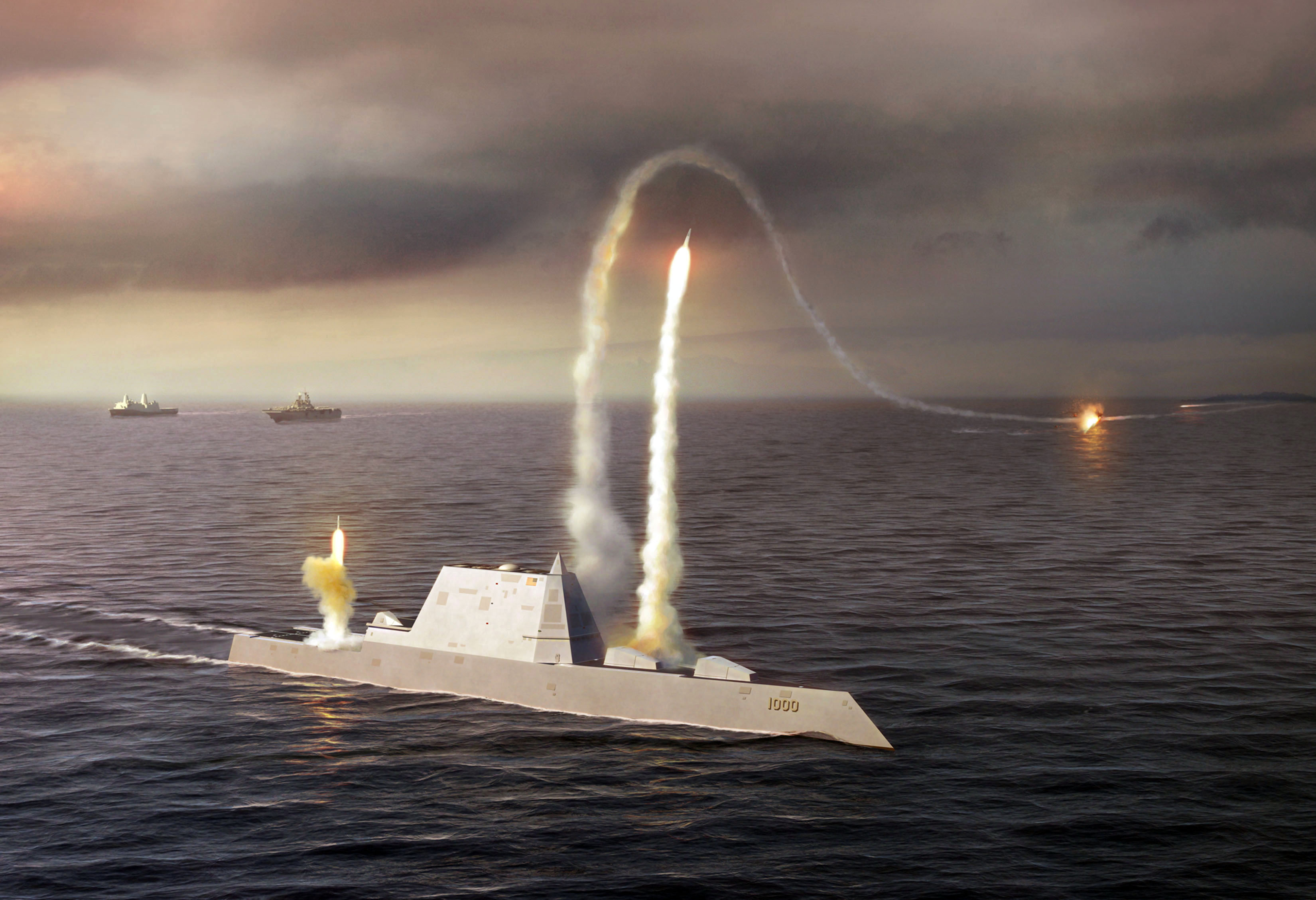
Known as the Next-Generation Cruiser in the early 1990s, it was part of the Navy’s Surface Combatant for the 21st Century program. However, budget cuts resulted in the program being split up in 2001 with the destroyer-variant being renamed the DD(X) and then the Zumwalt-class of destroyers. While the DD(X) is a case study in and of itself, the CG(X) actually looked like it might increase its allocation of ships before abruptly being cancelled in 2010. Deemed too similar in capability to the existing, upgraded Arleigh Burke-class of destroyers, the ship was never built, but not beforespending more than $200,000,000 in development costs
Zumwalt-class destroyer DDG 1000 (U.S. Government Work)

9. Kinetic Energy Interceptor (KEI)

Rattled by Chinese submarines, India joins other nations in rebuilding fleet

SANJEEV MIGLANI AND TOMMY WILKES
Dec 2, 2014 

Indian Navy's INS Arihant submarine is pictured at the naval warehouse in the southern Indian city of Visakhapatnam November 18, 2014.

(Reuters) - India is speeding up a navy modernization program and leaning on its neighbors to curb Chinese submarine activity in the Indian Ocean, as nations in the region become increasingly jittery over Beijing's growing undersea prowess.

Just months after a stand-off along the disputed border dividingIndia and China in the Himalayas, Chinese submarines have shown up in Sri Lanka, the island nation off India's southern coast. China has also strengthened ties with the Maldives, the Indian Ocean archipelago.

China's moves reflect its determination to beef up its presence in the Indian Ocean, through which four-fifths of its oil imports pass, and coincides with escalating tension in the disputed SouthChina Sea, where Beijing's naval superiority has rattled its neighbors.

"We should be worried the way we have run down our submarine fleet. But with China bearing down on us, the way it is on the Himalayas, the South China Sea and now the Indian Ocean, we should be even more worried," said Arun Prakash, former chief of the Indian navy.

"Fortunately, there are signs this government has woken up to the crisis," he said. "But it will take time to rebuild. We should hope that we don't get into a face-off with the Chinese, that our diplomacy and alliances will keep things in check."

Performance Counseling Doesn’t Have To Be A Wasted Experience


Using performance counseling as a way to start a dialogue with your subordinates will shape their professional growth and help them become better leaders.

Editor’s note: This article was originally published at the blog From The Green Notebook.

When it comes to intentionally developing our subordinates, one of the greatest tools in a leader’s kit bag is one-on-one counseling. Unfortunately, counseling is hit or miss across the Army. I would argue that the majority of officers and noncommissioned officers receive formal performance counseling only a handful of times over the course of their careers, leaving inflated officer and NCO evaluation reports as their only source of professional feedback. When we don’t provide subordinates with feedback, their professional growth is left up to chance; as a result we see toxic and weak leaders rise through the system, damaging the effectiveness of the overall Army.

I personally witnessed the power of counseling as I watched a young officer transform from an unproductive and poor leader into a highly effective one in just a few short months. All it took was a commander who was willing to take the time and sit down with him to have an open and honest dialogue. The commander’s commitment to that individual helped him become a stronger platoon leader, and in turn, improved the performance of the platoon and the company.

The Bookcase in the Corner Reading for Change


My office is adorned with the usual military paraphernalia found in the workplaces of most uniformed leaders. Plaques and memorabilia from past assignments, mementos from combat zones in faraway lands, and a military print or two, meticulously framed and matted. There’s even a HAL 9000 Bluetooth speaker on the corner of my desk and a football autographed bySeattle Seahawks coach Pete Carroll. All in all, a fairly ordinary office.

Then there’s the bookcases.

I keep two barrister bookcases in my office. In one, you'll find a wide array of military history books that range from Thucydides to Stephen Ambrose, from the Battle of the Little Bighorn to the War on Terror. Intermixed with those volumes are the thinkers that shape my approach to “the job” — Machiavelli, Clausewitz, Mahan, and countless others — capped with a select collection of biographies that run the gamut from our founding fathers to the memoirs of Andrew Exum and Nate Fick.

But it’s the other bookcase — the bookcase in the corner — that usually draws the most attention. Beneath a miniature concrete “Texas” barrier and a custom rosewood humidor rest several shelves of books that capture what is arguably our most daunting leadership challenge: leading change.

Why leading change? Because few other undertakings require such a wide spectrum of leadership attributes. Leading change requires imagination, perseverance, and commitment. It requires decisiveness, social intelligence, and humility. Leading change requires an ability to communicate vision and direction, build teams, recruit and develop talent, engender trust, foster innovation, motivate and inspire others, and anticipate, recognize and manage changing conditions. Leading change can take place occur on a mountainside in Afghanistan or in an insurgent stronghold in Iraq. It can happen in garrison, during deployment, or at a CTC. It unfolds in the office, in the field, and on the hood of HMMWV in the motor pool.

The bookcase in the corner contains a compilation of knowledge gained over the course of a career leading change. The doors have been opened and closed so many times that the corners of the wood shelves are worn bare. The books themselves are dog-eared from handling, with long passages highlighted, tabbed, and folded over. Within the pages of those books you'll find boarding passes, business cards, and hotel stationary. The margins are filled with notes, often written in a cramped seat in a military aircraft transiting from one corner of the country to another. For good reason, these books have seen “a lot of love” over the years.

The bookcase in the corner is a curiosity, more at home in a university business school than a military headquarters. But at some point, most leaders find themselves discussing, debating, or even writing on the same subjects. Because at the very core of each volume is a key component of leading change. This is what we do. When asked — because, inevitably, someone asks where to start and what to read — I typically recommend a short list to whet the appetite.

FINALLY, A BLANK PAGE

December 2, 2014

Editor’s Note: This is the latest article in our partnership with the Art of Future Warfare initiative at the Atlantic Council’s Scowcroft Center. Check out the project and keep an eye on our Art of War blog for what we are up to.

For a writer, there are few things more terrifying than a blank page. How many painters freeze when faced with a white canvas? The potential and promise amid deep doubt and nagging conformity can be debilitating.

That is worth keeping in mind as Defense Secretary Chuck Hagel prepares to step down from his post, and his deputy Robert Work is left to tackle one of the Pentagon’s biggest challenges: how to evolve the U.S. military from its roots in the past 100 years into a force that will become more effective, not outmoded, with each passing decade of the 21st Century.

Now with the equivalent of a bureaucratic blank slate, the Department of Defense is in the midst of casting far and wide for new ideas and approaches to figure out how to preserve and increase America’s strategic advantage. One of the more promising measures, as Secretary Hagel recently told a gathering of defense heavyweights in California, is the creation of the Advanced Capability and Deterrent Panel, which “will invite some of the brightest minds from inside and outside government to start with a clean sheet of paper, and assess what technologies and systems DoD ought to develop over the next three to five years and beyond.”

If the Department really wants to break with the traditional approaches to figuring out the future, they should take this as an opportunity to remake the composition of the advisory panels tasked with cracking some of the country’s toughest national security problems. They should set new standards for creativity and insight by adding artists to the Advanced Capability and Deterrent Panel.

4 December 2014

What Modi could learn from Deng

December 4, 2014 

The most important and obvious factor in New Delhi’s favour is its strategic role as a regional counterweight to China.

Even the most casual observer of Prime Minister Narendra Modi’s hectic schedule will be impressed by the renewed vigour he has brought to India’s diplomacy. Since taking office at the end of May, Modi has paid state visits to five countries (Nepal, Japan, the US, Australia and Fiji) and attended four summits (BRICS East Asia, G-20 and Saarc). While some may reasonably question whether Modi should be spending so much time jetting around the world while his bold economic reform plan needs his laser-like focus, the undeniable fact remains that Modi apparently is aware that India has much catching-up to do in competing with China for diplomatic influence in the Asia-Pacific.

By all accounts, China continues to enjoy a huge lead, despite its more recent setbacks in the region. Beijing began its diplomatic charm offensive in the late 1990s, taking advantage of the East Asian financial crisis and leveraging its growing economic muscle to strengthen trade links with its neighbours. Beijing’s efforts were generally considered clever and successful until 2010, when, for reasons that continue to puzzle China watchers, Chinese leaders opted for a far more confrontational regional diplomatic strategy, asserting territorial claims and taking unprecedented aggressive measures to intimidate neighbours (such as by declaring an air defence identification zone in the East China Sea).

Such muscle-flexing has boomeranged on Beijing. Most of its neighbours grew alarmed and, contrary to Beijing’s wishes, moved closer to Washington, which seized the opportunity to announce a “pivot” — the redeployment of US military capabilities and refocusing of American diplomatic attention to Asia.

Facing a concerted push-back by the US and its regional allies, China seems to be readjusting its Asian strategy. At the recent Apec summit, Chinese President Xi Jinping met Japanese Prime Minister Shinzo Abe, a hardline nationalist leader vilified by China for the last two years. Although the meeting was awkward, it likely signified the beginning of a process of repairing badly damaged Sino-Japanese ties.
What is even more noticeable is Xi’s own energetic diplomatic offensive in Asia. Like Modi, Xi has also been burning a prodigious amount of aviation fuel. Indeed, he happened to be in the same neighbourhood this month as Modi — the south Pacific.

Judging by the trade and investment deals struck by Xi during his visit to Fiji and Australia two countries (China signed a free trade agreement with the latter), one may get the impression that it will be really difficult, if not impossible, for India to match Chinese influence in the region.

Anatomy of a diplomatic handshake

ASHOK K. MEHTA

Reuters“Thawing the cold India-Pakistan relations became paramount at the SAARC summit in Kathmandu.” Picture shows the leaders of the two countries at the summit.

Contrary to reports, the hugely publicised handshake between Nawaz Sharif and Narendra Modi at the SAARC summit was preceded by other exchanges of pleasantries

On November 27, the second day of the SAARC summit, Kathmandu newspapers showed a grim looking Nawaz Sharif and a grumpy looking Narendra Modi on their front pages. Both were sitting on the dais, seemingly oblivious to each other, with the Kathmandu Post headline reading: “So close yet so far.” Tensions between India and Pakistan had clouded the SAARC summit with the Kathmandu Declaration also in trouble due to Islamabad expressing reservations over three proposed regional agreements for connectivity and integration: motor vehicles, rail and energy cooperation. Regionalism, bilateralism and sub-regionalism are all enmeshed in a SAARC hostage to the perennial coldness between New Delhi and Islamabad.

Thawing the cold relations became paramount. Contrary to visuals and reports, the hugely publicised long handshake between Mr. Sharif and Mr. Modi at the end of the concluding session of the summit was actually preceded by at least two other exchanges of pleasantries: the first was in the holding half prior to the inaugural session where leaders arrive in country-alphabetical order. Mr. Modi, having reached before Mr. Sharif, shook his hand the second time after his own inaugural in New Delhi in May this year. At the Dhulikhel retreat they shook hands a second time around, and went unaccompanied by aides for a walk in the woods around Dwarika Shangri La. After that they sat around the same table at lunch. They also met during Nepal Prime Minister Sushil Koirala and President Ram Baran Yadav’s banquets. The display of bonhomie was aplenty, but without any public ‘evidence’ other than the November 27 handshake where an animated conversation could be deciphered through lip reading. Elsewhere, cloak and dagger stories were doing the rounds: like for example, miffed by India’s refusal to resume the composite dialogue, Mr. Sharif was prepared to wreck the summit.

Breaking the deadlock

A day before, on November 26, Foreign Ministers hit a cul-de-sac. The Kathmandu Declaration was deadlocked. While India wanted all the three agreements or none, Pakistan blocked all three saying it had to take its four provinces along. The Declaration document was sent to Mr. Koirala who had to do some back-channelling in order to create a level-playing field at Dhulikhel. He told Mr. Modi that he was the regional leader and must act appropriately; otherwise there would be no worthwhile Kathmandu Declaration. The Modi-Sharif walk in the woods broke the ice as did the charmed yellow scarf of Goddess Baglamukhi in Patan that the leaders wore at the retreat. Before the sun set over the majestic Mount Everest visible from Dhulikhel, a compromise had been cobbled together. Both Mr. Sharif and Mr. Modi had agreed to the electricity cooperation agreement, and with gentle persuasion, Mr. Sharif also agreed to SAARC transport Ministers hammering out an agreement on motor and rail connectivity within three months.

“The takeaways from Kathmandu were images of Mr. Sharif and Mr. Modi, transformed from being grim and grumpy at the inaugural session to beaming and blushing at the concluding ceremony”

WHEN RELIGION BECKONS XI JINPING AND THE REST

04 December 2014

Chen Quanguo, Tibet's party secretary, warned the cadres not to be trapped in ‘Dalai Lama's illusions'. By doing this, the Communist Party simultaneously promoted Buddhism on a large scale in Eastern Tibet

The Xinhua news agency recently reported that the People’s Liberation Army was getting tougher on corruption, “reflecting the Party’s resolution to ‘purify’ the Army,” it says. The communist mouthpiece added: “With great power comes great corruption risk. Too many temptations and traps surround official posts in China, which become high risks if officials don’t have self-discipline.”

It’s difficult to say if this is a sign that the Middle Kingdom is entering Kalyug. Another interesting development is the sudden appeal for religion in China, particularly the Buddha’s teachings.

But despite this newly-found love for Dharma, practice is something strictly forbidden for the party cadres. In an Op-ed in the Global Times, Zhu Weiqun, the chairman of the ethnic and religious affairs committee of the Chinese People’s Political Consultative Conference and a former interlocutor of the Dalai Lama’s envoy, refuses to link the lack of religious belief and corruption; atheism “can’t be blamed for widespread corruption among cadres or any moral decay in Chinese society,” says Mr Zhu, who admonished his colleagues: “Communist Party members must not follow any religion; it is an ‘unshakeable’ principle of the party … Communist Party members cannot follow any religion — this is the important ideological and organisational principle.”

A few weeks ago, the all-powerful Central Commission for Discipline Inspection criticised some party cadres for secretly taking part in religious activities in Tibet.

Chen Quanguo, Tibet’s party secretary told the cadres in Lhasa: “One should not believe in the 14th Dalai group’s illusions, or follow the Dalai group; one should beware of infiltration and sabotage activities in which are involved separatist party cadres.” While warning the cadres not to be trapped in the ‘Dalai Lama’s illusions’, the Party is simultaneously promoting Buddhism on a large scale in Eastern Tibet.

An article in China Tibet Online, an affiliate of Xinhua, praises ‘Larung Gar Five Sciences Buddhist Academy, a Buddhist University in Eastern Tibet, pointing out that a previous incarnation of Jigme Phuntsok Rinpoche, Larung Gar’s founder was a teacher of His Holiness (sic) the 13th Dalai Lama (of course, it is not mentioned that the same Khenpo Phuntsok once visited Dharamsala to share teachings with the present Dalai Lama).

The article explains that: “Jigme Phuntsok Rinpoche established the Larung Gar Five Sciences Buddhist Academy in Larung Valley near Serthar, Sichuan Province in 1980, with the aim to revitalise Dharma and benefit all sentient beings.”

An over-reliance on fencing

Written by Thomas L Friedman
December 4, 2014

The focus on terrorism, combined with our gotcha politics, has ‘killed creative thinking’ in Washington, let alone anything ‘aspirational’ in our foreign policy. (Source: Reuters photo/file)

Flying into New York the other day, I got my first good look at the Freedom Tower, now known as 1 World Trade Centre, the skyscraper that sits atop 9/11’s ground zero. It does, indeed, scrape the sky, topping out at a patriotic 1,776 feet. Thirteen years after 9/11, I appreciate the nationalist pride that, while terrorists can knock down our buildings, we can just build them right back up. Take that, Osama bin Laden.

If only the story ended there. Alas, bin Laden really did mess us up, and continues to do so. We’ve erased the ruins of the World Trade Centre, but the foreign policy of fear that 9/11 instilled is still very much inside us — too much so. It remains the subtext of so much that we do in the world today, which is why it’s the subtitle of a new book by David Rothkopf, National Insecurity: American Leadership in an Age of Fear.

Much of the book is an inside look at how foreign policy was made under the two presidents since 9/11. But, in many ways, the real star of the book, the ubershaper of everything, is this “age of fear” that has so warped our institutions and policy priorities. Will it ever go away or will bin Laden be forever that gift that keeps on giving? This is the question I emailed to Rothkopf, the editor of Foreign Policy magazine.

Deconstructing the Modi foreign policy

BRAHMA CHELLANEY

Deconstructing the Modi foreign policy

The Modi foreign policy appears geared to reinvent India as a more competitive, confident and secure country. A robust foreign policy, however, can sustain itself only on the foundation of a strong domestic policy

India — home to more than a sixth of the human race — punches far below its weight. Internationally, it is a rule-taker, not a rule-maker. A 2013 essay in the journal Foreign Affairs, titled “India’s Feeble Foreign Policy,” focussed on how India is resisting its own rise, as if political drift had turned the country into its own worst enemy.

Since the Berlin Wall fell 25 years ago, the world has witnessed the most profound technological, economic and geopolitical change in the most compressed time frame in history. Unfortunately for India, despite its impressive economic growth overall, much of its last 25 years has been characterised by political weakness and drift. For example, between 1989 and 1998, India had a succession of weak governments. It is not an exaggeration to call Prime Minister Manmohan Singh’s two terms “the lost decade” for India strategically.

Waning regional influence

The result of the prolonged leadership crisis has been a sharp erosion in India’s regional and extra-regional clout. The gap in power and stature between China and India has widened significantly. After all, this was the quarter-century in which China took off.

MIT-Oxford physicist to tango with IIT engineer in US-India defense ties

Dec 4, 2014

When the defence chiefs of India and the United States meet next, it could well be an IIT engineer engaging an Oxford-MIT physicist.

WASHINGTON: When the defence chiefs of India and the United States meet next, it could well be an IIT engineer engaging an Oxford-MIT physicist. 

President Barack Obama intends to nominate former Pentagon #2 Ashton Carter as the new US Defense Secretary to replace Chuck Hagel, it was widely reported on Tuesday, amid broad acclaim in Washington DC and relief in New Delhi. The veteran defense maven, a Rhodes scholar with a Ph.D in theoretical physics, is highly respected in Washington, and more pertinently for India, has been hands-on in accelerating U.S-India defense cooperation. 

In his previous avatar as Pentagon deputy secretary of defense, Carter headed a task force to expedite sale of sensitive military equipment to India. He and India's then National Security Advisor Shiv Shankar Menon helmed the India-US Defense Trade and Technology Initiative (DTTI) envisaging technology transfer and co-production and co-development of defense equipment, an enterprise that has made substantial progress but is still incomplete. 

A strong votary of US-India military ties who believes the two countries are "destined to be strategic partners," he will now have an IIT-engineer in India's new defense minister Manohar Panikkar to pick up the threads. Carter is also part of the team behind the United States' Asia pivot. 

The White House has not officially confirmed the nomination pending a vetting process, but press secretary Josh Earnest suggested it was a formality. "He is somebody who deserves and has demonstrated strong bipartisan support for his previous service in government," Earnest said. "He has a detailed understanding of the way the Department of Defence works." 

Weakest part of Russia’s relations with India

December 1, 2014
http://in.rbth.com/blogs/2014/12/01/weakest_part_of_russias_relations_with_india_40035.html

Russia needs to use every opportunity to inform the Indian Government and public about Moscow’s priorities in regional and global politics and about its views on all issues which are relevant to Indians.
 It Russian Defence Minister Sergey Shoygu's visit to Pakistan raised many eyebrows in India. Source: Igor Russak / RIA Novosti

The visit to Pakistan by a large delegation from the Russian Ministry of Defence, led by Sergey Shoygu last month once again showed a particular weakness in Russia-India relations, and in particular, government and public relations.

There are at least two reasons that should make the Russian authorities pay careful attention to government and public relations. The first reason is the complicated relationship between India and Pakistan. In the context of this relationship any news about the development of Russian-Pakistan relations can be negatively interpreted in India. The second reason is the existence in political, business and media circles of Indian groups largely focused on countries other than Russia. For this group the above mentioned weakness in Russia-India relations is a gift which they will use to criticise Russia and promote the interests of other countries.

For these reasons, Russia (and its representatives in India) should use every opportunity to inform the Indian Government and public about Moscow’s priorities in regional and global politics and about its views on all issues which are of relevant to Indians.

As it is, Russia often misses the opportunity to effectively use public and government relations. This year there have been plenty of cases showing the weakness of Russian-Indian relations in the area of government and public relations. One of the most notable cases was the July 2 announcement by Rostec Chief Executive Sergey Chemezov about the so called lifting of a Russian embargo on the supply of arms and military equipment to Pakistan. There never was such an embargo in the first place. The issue was about including Pakistan on a list of countries to which Russia could deliver weapons and military equipment. If Chemezov had not made this announcement, the inclusion of Pakistan on this list would have remained an internal department matter, and Russia would have had sufficient time to carry out outreach work in India at political, business and media levels. However, this conspicuous announcement was made and the negative response in India was not slow in coming.

Chinese Takeaway: Modi’s Buddhism

Written by C Raja Mohan 
December 3, 2014

In his outreach to leaders in the subcontinent and Asia, from Nepal to Japan and China to Myanmar, Modi has projected Buddhism as one of India’s bridges to these nations.

As Prime Minister Narendra Modi winds down an intensive phase of foreign policy activism, one surprising feature of his diplomacy has been the frequent evocation of Buddhism. In his outreach to leaders in the subcontinent and Asia, from Nepal to Japan and China to Myanmar, Modi has projected Buddhism as one of India’s bridges to these nations. The PM’s overt expression of his Hindu religiosity has been controversial, but not surprising.

But Buddhism?

Some have seen it as an effort to compete with China for leadership in Buddhist Asia. Others have viewed it as a fond hope of finding a spiritual connection to China. Some point to Modi’s personal interest in Buddhism and cite his commitment to restoring the rich Buddhist heritage of Gujarat when he was chief minister there.

It does not really matter if none of the above can explain Modi’s emphasis on Buddhism. What does matter is the fact that the PM has put Buddhism at the heart of India’s vigorous new diplomacy. The Buddha has long figured prominently in India’s international engagement. As the land from where Buddhism was born and spread around Eurasia, India did not have to work too hard to make it part of its cultural interaction with the rest of the world. One out of six tourists to India visits Bodh Gaya. Buddhism has long been an integral part of India’s relations with many countries in Asia. Buddhism brought a few problems as well. By hosting the Dalai Lama since 1959 amidst continuing restiveness in Tibet, India has created an enduring source of tension with China.

Beijing Rivalry?

INDIA REINFORCES MARITIME DOMAIN AWARENESS BUT CHALLENGES REMAIN – ANALYSIS

By Vijay Sakhuja

Six years ago, in November 2008, a group of Pakistan-based terrorists landed at unsecured waterfronts in Mumbai, the financial capital of India, and attacked public places such as hotels, restaurants, and a railway station. Although the Indian security forces were quick to respond, the attack, popularly referred to as 26/11, exposed three significant gaps in India’s maritime security apparatus: a. the porous nature of India’s coastline; b. the poor surveillance of the maritime domain; and c. the lack of inter-agency coordination.

Post the 26/11 attacks, the Indian government undertook a number of proactive measures to restructure coastal security and push the defensive perimeter further away from the coast into the seas. The focus was on building national maritime domain awareness (NMDA) grid via a number of organisational, operational and technological changes. The Indian Navy has now set up the National Command Control Communication Intelligence (NC3I) network that hosts the Information Management and Analysis Centre (IMAC).

It connects 41 radar stations (20 Indian Navy and 31 Coast Guard) located along the coast and on the island territories, and helps collate, fuse and disseminate critical intelligence and information about ‘unusual or suspicious movements and activities at sea’. There are plans for additional coastal radar stations to cover gap/shadow zones in the second phase; these are currently addressed through deployment of ships and aircraft of the Indian Navy and the Coast Guard.

The IMAC receives vital operational data from multiple sources such as the Automatic Identification System (AIS) and the long-range identification and tracking (LRIT), a satellite-based, real-time reporting mechanism for reporting the position of ships. This information is further supplemented by shore based electro-optical systems and high definition radars. Significantly, maritime domain awareness is also received through satellite data.

PAKISTAN EYES CHINESE JETS TO COUNTER INDIAN AIR FORCE DOMINANCE

December 1, 2014

Pakistan Eyes Chinese Jets To Counter Indian Air Force Dominance

Pakistan eyes Chinese jets to counter IAF dominance Chinese FC-31 stealth fighter.

The Pakistani military authorities are determined to acquire 30 to 40 fourth generation stealth fighter (FC-31) aircraft from China with a view to pre-empting the rapidly increasing aerial dominance of the Indian Air Force (IAF) in the region.

Conceding that senior Pakistani defense officials were already holding talks with their Chinese counterparts to acquire the fourth generation stealth aircraft (also called Shenyang FC31 Multi-Purpose Medium Fighter Jets), informed sources in the security establishment said that Pakistan has been made to approach China and Russia to fulfill its defense procurements as the Pak-US ties continue to chill, despite General Raheel Shareef’s recent visit to the United States.

The Pakistani defense officials are already in the process of signing an agreement with Russia to purchase 20 Mi-35 gunship helicopters which can be operated in the mountainous terrain of the Waziristan region where a military operation is in full swing against the Taliban militants.

The sources said Pakistan wants to procure the Chinese FC31 aircraft as part of its ongoing efforts to boost the air combat capabilities of the PAF and offset the growing strength of the Indian Air Force in the region.

International media reports say China is offering its 18 tonne J-31 stealth fighter to export customers as the FC-31.

The FC-31 stealth fighter jet reportedly matches a strong need for fifth generation fighters by the Pakistan Air Force, which is already struggling to find an aircraft to go up against the Russian-made T-50 fifth-generation fighter, being acquired by India.

The twin-engine FC-31 fighter jet resembles the American Air Force’s F-35 Joint Strike Fighter, being produced by Lockheed Martin Corporation. FC-31 is the export version of the Shenyang J-31 which is already flying since 2012 and is powered by two Russian-made engines.

Designed to fly close air support, air interdiction and other missions, the Pakistan Air Force intends to buy FC-31 to replace the American-made F-16s, although it is to employ tactical rather than stealth aircraft in actual missions to support ground troops.

Being produced by the Shenyang Aircraft Corporation, China’s Shenyang FC-31 Fighter Jet is intended to be a rival to the American F-35 and Russian Sukhoi Su-35. The Chinese fighter jet was displayed at the recently held air show in China’s Zhuhai city in Guangdong Province.

AFGHANISTAN: A SIMILAR PATTERN OF MILITARY INCOMPETENCE – OPED

As U.S. forces withdraw from parts of Afghanistan, the Taliban is making gains in several areas of the country. The Afghan police and army are slowly giving way, despite the United States spending 13 years and tens of billions of dollars training those forces. When the United States completes its withdrawal from ground combat at the end of this year, this unfavorable trend will undoubtedly accelerate—that is, if the Afghan security forces don’t collapse altogether, as did similarly U.S. trained Iraqi forces in that country. Thus, in the longest war in American history, the U.S. military has failed to pacify Afghanistan—as had the mighty British Empire three times in the 19th and early 20th centuries and the Soviet superpower more recently in the 1980s. In fact, an outside force has not pacified Afghanistan since Cyrus the Great of Persia did it in ancient times.

Why did the United States have the hubris to think it could succeed in taming Afghanistan, when all of these other strenuous efforts had failed? Because many in the American foreign policy elite, media, and citizenry believe in “American exceptionalism.” As propounded by politicians of both parties—for example, Hillary Clinton and Madeleine Albright in the Democratic Party and people such as John McCain and his sidekick Lindsay Graham in the Republican Party—America is the “indispensable nation” to a world that cannot do without its solving most major problems using military power. Yet despite the current public fawning over military personnel and veterans of American wars, the U.S. military has been fairly incompetent in most major engagements since World War II that required significant ground forces—with only Desert Storm in 1991 being an unvarnished success in recent years. The U.S. armed forces are probably more powerful than any other military in world history, both absolutely and relative to other countries, yet their battlefield performance has not been that great, especially against irregular guerrilla forces in the developing world.

In the post-World War II era, the U.S. military managed to fight the then-poor nation of China to only a draw in the Korean War (1950-1953); lost the Vietnam War (1965-1973) to ragtag Viet Cong guerrillas and North Vietnamese; and made the same mistakes of Vietnam in Iraq and Afghanistan—initially using excessive firepower and alienating the population, the allegiance of which is key to fighting guerrillas.