11 December 2014

Syrian Army and Pro-Assad Militias Getting Bigger and Better

strategypage.com
December 9, 2014

In southern and central Syria (south and north of Damascus) and along the coast the army and pro-government militias have been able to expel rebels and form a continuous Assad controlled area. Thanks to Iranian trainers, the pro-government militias are better trained and more effective as are the soldiers. All of these men are paid regularly and most see a better future than do many of the rebel fighters. The army is about half its pre-war strength of 300,000 but the remaining troops are loyal and most have combat experience. The army is expanding back to its pre-war strength. This is thanks to cash from Iran, because the Syrian economy is wrecked. But that Iranian cash has been reduced recently as the plunging price of oil (down over 40 percent since 2013). This has forced Iran to cut its cash support for the Syrian economy. Thus while the Assad forces can provide some security, they are increasingly unable to provide much prosperity and even necessities are not arriving as frequently. What remains of the Syrian economy is in Assad controlled areas where there is an unemployment rate of over 50 percent and the size of government handouts is a matter of life or death. Iran does not want its Syrian ally to be destroyed but subsidizing the Assad controlled population costs more than Iran can afford right now. Unless the price of oil moves sharply north and the economic sanctions on Iran (because of the Iranian nuclear program) are reduced the hard times will be getting harder in Syria for Assad supporters. Despite that living in Assad controlled territory is still a pretty good deal compared to what life is like in ISIL or al Nusra controlled areas. 

ISIL is still concentrating on the Kurds, especially those defending the town of Kobane near the Turkish border. This has turned into a stalemate mainly because ISIL is willing to take the constant losses from American (and some NATO) bombers. The other major ISIL objective is Aleppo and progress is being made there. Meanwhile the Assad government keeps trying to get the West to admit that Assad forces are allies in the international battle against ISIL and that Syria has led the way in recognizing and fighting this international Islamic terrorist threat. Despite Russian efforts to publicize this belief the rest of the world is ignoring the Assad claims. Despite that the Assads and the rest of the world are both fighting ISIL. While this is awkward that is considered a minor problem compared to the threat ISIL and similar Islamic terrorist groups presents to the Islamic and non-Islamic nations as well. Even the Sunni (led by Saudi Arabia) and Shia (led by Iran) coalitions that are at each other throats right now have agreed to cooperate against the common threat.


The Senate Torture Report Has Arrived

December 9, 2014

Here it is. The 525-page declassified executive summary of the U.S. Senate Intelligence Committee’s torture report can be accessed here. I am going to start reading this monstrosity right now.

An Impending Royal Death: What Next in Oman?

Gulshan Dietl
December 09, 2014

18 November is the birthday of the Omani King Sultan Qaboos. Therefore, it is also the Omani National Day. This year Qaboos was not in Oman to celebrate the occasion. Instead, he chose to deliver a televised message from Germany, where he is undergoing medical treatment since July 2014. The country came to a sudden halt to see and hear him. There was relief that he was alive given persistent rumours that he could already be dead. But there was also grief that he would not celebrate the big occasion with them. There were spontaneous outpourings of support and prayers for his safe return home.

Qaboos is not just the King: he is the prime minister, foreign minister, defence minister, finance minister and the commander-in-chief of the Omani armed forces. As the British were withdrawing from the East of Suez, they helped Qaboos come to power after overthrowing his father in 1970. Within a few years, he had successfully crushed the secessionist movement in the Dhofar region and firmly put the country on the path of modernisation. He has ruled for 44 years and has remained a popular leader – a remarkable achievement in an otherwise turbulent region. Today, Oman can be neatly sliced into the pre-Qaboos and Qaboos eras.

A few interesting factoids illustrate his personality. He has been singularly successful in blending his unabashed Anglophilia into the traditional Omani milieu. A proud graduate of Sandhurst, Qaboos was made the Knight Grand Cross of the Most Distinguished Order of St. Michael and St. George, and a Knight Justice of the Most Venerable Order in 1976. In May 1990, the World Federation of the Rose Societies at the Chelsea annual flower show named a rose after him – Rosa Meitixia Sultan Qaboos. Conferring titles is a British genius and Qaboos is obviously appreciative of it.

Counterinsurgency Expert John Nagl, On The Parallels Of Business And War


War is the business of barbarians – Napoleon Bonaparte

We’ve all heard them before: “business as war” metaphors. While I won’t list any—no doubt you can list a bunch of your own—it is difficult to dispute the (at least) structural similarities between the two venues: Strategy, logistics, resource allocation, competencies, recruitment and retention, intelligence, leadership, and the list goes on.

Stakes are high in any business arena. Poorly outfitted strategies can affect market share; sufficiently convoluted institutional cultures can weaken moral and production; failure to innovate and outpace the market can quickly dwindle profits and catalyze a downward spiral. These challenges, and innumerable others, create real world problems. Jobs are lost. Mortgages go unpaid. College funds are vacated. But in war, the stakes are exponentially higher. If a strategy is poor, jobs aren’t lost, lives are. If a platoon’s cohesion is weakened, profits don’t dwindle, people die. Certainly, there is much to be learned from successful and unsuccessful entrepreneurs, executives, and practitioners. At the same time, where minds are focused by true life-and-death realities, gems of wisdom have to emerge.

Today, I speak with retired lieutenant colonel (US Army) and recognized counterinsurgency expert John Nagl. A West Point graduate, Rhodes Scholar, and having written his doctoral dissertation on insurgencies, Nagl has fought in two wars—Desert Storm and Operation Iraqi Freedom—co-authored, along with General David Patraeus, the Army/Marine Corps Counterinsurgency Field Manual, and is the author of two counterinsurgency books of his own—Learning to Eat Soup with a Knife: Counterinsurgency Lessons from Malaya and Vietnam and Knife Fights: A Memoir of Modern War in Theory and Practice. I explore Nagl’s thoughts on the parallels and contrasts between the theaters of business and war, seeking functional lessons that transcend boundaries. See our exchange below:

Seeking the Future of Europe in the Ancient Hanseatic League

By Mark Fleming-Williams
December 9, 2014

A bargain, forged in the fires of 2012's economic emergency, has defined the European Union for the past two years. It was an agreement made between two sides that can be defined in several terms — the center and the periphery, the north and the south, the producers and the consumers — but essentially one side, led by Germany, provided finance, while the other, fronted by Spain, Portugal, Ireland and Greece, promised change. In order to gauge this arrangement's chances of ultimately succeeding, it is important to understand what Germany was hoping to achieve with its conditional financing. The answer to that question lies in Germany's own history.

Last week, the Governing Council of the European Central Bank's monthly meeting left financial markets feeling frustrated. Instead of announcing the beginning of a highly anticipated bond-buying program known as quantitative easing, the European Central Bank, or ECB, only slightly changed the vocabulary it used to describe its plans: "We expect" became "we intend." Pulses did not race with excitement.

In fact, the most interesting news of the day was that seven of the 22 members of the council apparently voted against the change in vocabulary. Those opposed included four governors of national central banks and three of the EU executive board's six members, who, in theory, are responsible for shaping ECB policy. This ongoing debate over finances is deeply important to Europe's future because it touches on a key question at the heart of the European project: Is Germany willing to underwrite the whole venture? Germany gave a partial answer to this question in 2012 when it financed the EU rescues of several member states, but the conditions it attached have since created more problems.

Hackers Increasingly Focusing on Direct Cyber Attacks on Banks

Ilya Khrennikov
December 10, 2014

Hackers Hit Banks as Everyone Spies on Everyone, Kaspersky Says

Hackers are increasingly stealing directly from banks and other companies and helping organized crime to operate more efficiently, according to the chief of cyber-security firm Kaspersky Lab.

Examples range from infecting cash machines to dispense all their money to thieves, to hacking operations-management systems at ports so drugs can be smuggled more smoothly and at less risk, founder and Chief Executive Officer Eugene Kaspersky said in an interview at his Moscow office.

“Hackers have become capable of carrying out very advanced attacks,” Kaspersky said. In many cases “they infect corporate networks with viruses, which eventually — via files exchanged between departments — get into computers that handle money transfers,” which are usually separate from the main network.

Among recent high-profile hacking victims is Home Depot Inc., which suffered a data breach between April and September, in which 53 million e-mail addresses and details of 56 million payment cards were exposed. This month, it was reported that hackers with Wall Street expertise stole merger-and-acquisition information from more than 80 companies for more than a year.

“Everyone is spying on everyone, stealing information,” Kaspersky said. “Edward Snowden was right, but he was speaking of the U.S. only. In reality, there are cyber-attacks of different origin —- linked to native English speakers, to Chinese, to Russian-speaking programmers. There are also ones linked to France, Spain and Latin America.”
CASH MACHINES

This year, Kaspersky Lab identified Tyupkin malware used to attack cash machines. Hackers approached a machine from the back, where a camera couldn’t see them, and rebooted it using a CD with a virus. Several days later, entering certain digits on the cash machine’s keyboard, they could collect all its cash, Kaspersky said.

NRO About to Launch Secret Satellite Payload Into Space From Vandenberg AFB on Thursday

Justin Ray

December 9, 2014

Atlas 5 to sport new upper stage engine Thursday


The NROL-35 mission logo. Credit: NRO

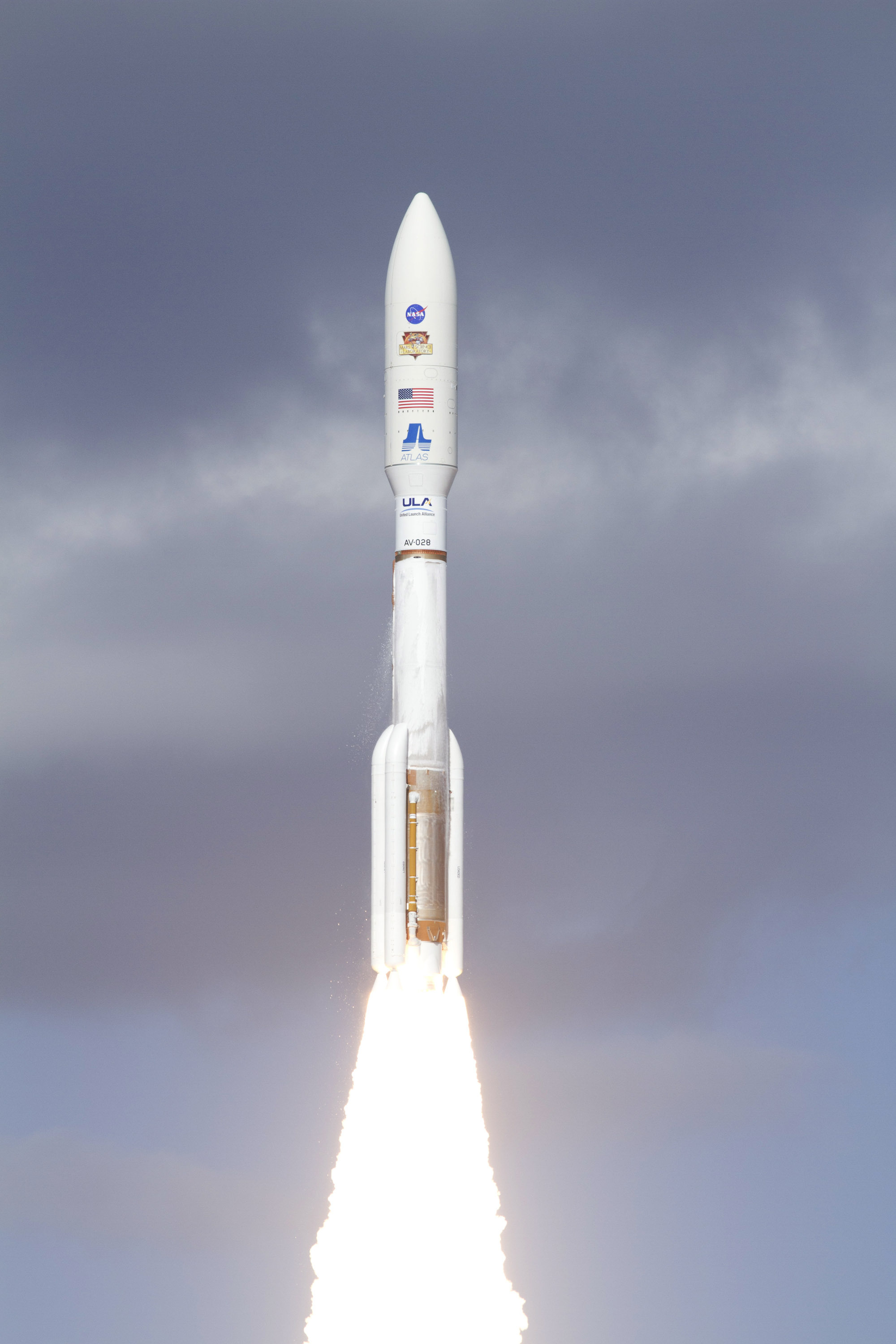
The most powerful Atlas rocket to ever fly from the West Coast is poised for launch Thursday to deliver a secret payload into orbit while debuting a new upper stage engine.

Lifting off on two million pounds of thrust, the 20-story rocket will fire away from Vandenberg Air Force Base in California some time between 6 and 8 p.m. local time (9-11 p.m. EST; 0200-0400 GMT).

The exact time is classified until closer to launch.

“This is the most powerful Atlas vehicle ever launched from Vandenberg Air Force Base, and that’s a history of decades of launching Atlases from here at Vandenberg,” said Lt. Col. Jim Bodnar, 4th Space Launch Squadron commander at the base.

Vandenberg’s first Atlas was an Intercontinental Ballistic Missile that blasted off from the base on Sept. 9, 1959. This will be 294th Atlas launch from Vandenberg and the 10th Atlas 5.

It is known as the 541 configuration in the Atlas 5 family, with a five-meter fairing, four solid rocket boosters and a single-engine Centaur upper stage.

Stacking of the rocket on the launch pad began in mid-September and took about three weeks to complete. The first stage and four solids were erected, followed by the interstage and Centaur. The satellite with its 68-foot-long payload fairing got delivered to the pad on Nov. 21.

“It’s quite an exciting time for us here,” said Capt. Jason Krahmer, the launch’s mission manager with the 4th SLS. “We have just a handful of tasks to complete before launch.”

Modifications had to be performed on the mobile service gantry to accomodate the four solid motors, Bodnar said.

The mission is known simply as NROL-35, a classified satellite-delivery flight for the U.S. National Reconnaissance Office. The NRO is the secretive government agency that controls the country’s spy satellites.

File photo of 541 configuration launching Curiosity. Credit: NASA

Researchers Have Found a Sophisticated and Stealthy Spyware System That Siphons Data From Linux Users

Dan Goodin

December 9, 2014

Powerful, highly stealthy Linux trojan may have infected victims for years

Researchers have uncovered an extremely stealthy trojan for Linux systems that attackers have been using to siphon sensitive data from governments and pharmaceutical companies around the world.

The previously undiscovered malware represents a missing puzzle piece tied to “Turla,” a so-called advanced persistent threat (APT) disclosed in August byKaspersky Lab and Symantec. For at least four years, the campaign targeted government institutions, embassies, military, education, research, and pharmaceutical companies in more than 45 countries. The unknown attackers—who are probably backed by a nation-state, according to Symantec—were known to have infected several hundred Windows-based computers by exploiting a variety of vulnerabilities, at least two of which were zero-day bugs. The malware was notable for its use of a rootkit that made it extremely hard to detect.

Now researchers from Moscow-based Kaspersky Lab have detected Linux-based malware used in the same campaign. Turla was already ranked as one of the top-tier APTs, in the same league as the recently disclosed Regin for instance. The discovery of the Linux component suggests it is bigger than previously thought and may presage the discovery of still more infected systems.

"The [Turla] operations are being carried out in broader environments than we previously knew," Kaspersky Lab expert Kurt Baumgartner told Ars. "All the other stuff we’ve seen from Turla has been windows based. This piece of the puzzle shows us that they do not limit themselves."
MAGIC NUMBERS

Like its Windows counterparts, the Linux trojan is extremely stealthy. It can’t be detected using the common netstat command. To conceal itself, the backdoor sits dormant until attackers send it unusually crafted packets that contain “magic numbers” in their sequence numbers. The malware may have sat unnoticed on at least one victim computer for years, although Kaspersky Lab researchers still have not confirmed that suspicion. The trojan is able to run arbitrary commands even though it requires no elevated system privileges.

"It’s a very interesting piece of code," Baumgartner said. "Not only does it run on Linux, but you can’t detect it in the usual ways."

Even a regular user with limited privileges can launch it, allowing it to intercept traffic and run commands on infected machines. Capabilities include the ability to communicate with servers under the control of attackers and functions allowing attackers to run commands of their choice and perform remote management.

Even after its discovery, the Linux component remains a mystery. The underlying executable file is written in the C and C++ languages and contains code from previously written libraries, a property that gives the malicious file self-reliance. The code is also stripped of symbol information, making it hard for researchers to reverse engineer or analyze. As a result, Baumgartner said the trojan may have capabilities that have not yet been uncovered.

Sony’s PlayStation Store Hit by Cyber Attack

December 9, 2014

Sony’s PlayStation store back online after cyber attack

Attendees walk past the Sony Playstation booth at the 2014 Electronic Entertainment Expo, known as E3, in Los Angeles, California June 11, 2014.

(Reuters) - Sony Corp said its PlayStation Network and Sony Entertainment Network had been disrupted by hackers in a distributed denial-of-service attack on Monday.

Sony said its systems were back online and the company was investigating the cause of the disruption.

The company has not received any report of user information being stolen, Sony spokeswoman Jennifer Clark told Reuters.

Sony said users faced difficulty accessing the PlayStation network between 8.52 a.m. and 11.18 a.m. Tokyo time on Monday (6.52 p.m.-9.18 p.m. ET Sunday), and the issue has been resolved.

The outage followed a distributed denial-of-service (DDOS) attack on the PlayStation network in August, for which a Twitter user with the handle @LizardSquad had claimed responsibility.

DDoS attacks attempt to cripple networks by overwhelming them with Internet traffic.

A tweet on Monday from a user with the handle @LizurdPatrol and account name Lizard Squad said: “50 RTs (retweets) and we will hit off PSN (PlayStation Network). 50 FAVs (favorites) and we will hit off XBOX LIVE.”

The Financial Times said that some visitors to the PlayStation online store were greeted with the message: “Page not found. It’s not you. It’s the internet’s fault.”

Last month, Sony’s Hollywood studio, Sony Pictures Entertainment, was hit by a massive hack that shut down most of the studio’s network for more than a week.

Following that attack, hackers released sensitive data over the Internet, including employee salaries and social security numbers along with high-quality digital versions of several unreleased films.

Sony’s brushes with hackers date back to 2011 when PlayStation network suffered a major attack, resulting in the theft of data belonging to 77 million users.

Sony’s U.S.-listed shares were down 4.3 percent at $21.21 on the New York Stock Exchange in afternoon trading on Monday.

Moving Mountains In Cyber War: Automated Virtual ‘Maneuver’

December 08, 2014


WASHINGTON: In real-world warfare, troops and tanks maneuver to take advantage of the terrain. In the looking-glass world of cyberspace, however, “maneuver” may mean changing the terrain itself. If the enemy’s invading your country, you can dig a trench or blow a bridge, but otherwise you go to war with the landscape you have.

If the enemy’s invading your network, however, you can rebuild it in an eyeblink to block their avenue of attack — provided you know how they’re getting in. You can reject incoming data from suspicious IP addresses, for example, or disable your users’ ability to download files (a common Trojan Horse), or, in the worst case, shut everything down before too much damage is done.

There are lots of options — too many, in fact, for the human brain to track of all of them, let alone decide which one is best, the Pentagon’s chief cybersecurity officer said Thursday. Think of all the different settings you have on whatever device you’re using to read this article. It’s not just about the obvious options like whether you accept cookies and block pop-ups. It’s not even the configuration of your firewall (you do have a firewall, don’t you?). It’s every program that has can take data from the Internet. Think of trying to choose the right settings across all those programs — keeping in mind how they all interact! — to stop a specific attack. Then do it again the next day when a new threat shows up. Now multiply that by thousands of computers interacting in a global network.

Researchers Have Found a Sophisticated and Stealthy Spyware System That Siphons Data From Linux Users

Dan Goodin
December 8, 2014

Researchers have uncovered an extremely stealthy trojan for Linux systems that attackers have been using to siphon sensitive data from governments and pharmaceutical companies around the world.

The previously undiscovered malware represents a missing puzzle piece tied to “Turla,” a so-called advanced persistent threat (APT) disclosed in August byKaspersky Lab and Symantec. For at least four years, the campaign targeted government institutions, embassies, military, education, research, and pharmaceutical companies in more than 45 countries. The unknown attackers—who are probably backed by a nation-state, according to Symantec—were known to have infected several hundred Windows-based computers by exploiting a variety of vulnerabilities, at least two of which were zero-day bugs. The malware was notable for its use of a rootkit that made it extremely hard to detect.

Now researchers from Moscow-based Kaspersky Lab have detected Linux-based malware used in the same campaign. Turla was already ranked as one of the top-tier APTs, in the same league as the recently disclosed Regin for instance. The discovery of the Linux component suggests it is bigger than previously thought and may presage the discovery of still more infected systems.

Cyber Security Situation Will Worsen in 2015 As Hackers Move Faster Than Cyber Security Defenses Can Be Erected

December 9, 2014

A series of spectacular cyberattacks drew headlines this year, and the situation will only worsen in 2015 as hackers use more advanced techniques to infiltrate networks, security researchers said Tuesday.

McAfee Labs’ 2015 Threats Predictions report sees increased cyber-warfare and espionage, along with new strategies from hackers to hide their tracks and steal sensitive data.

"Cyber espionage attacks will continue to increase in frequency," the report said.

"Long-term players will become stealthier information gatherers, while newcomers will look for ways to steal money and disrupt their adversaries."

McAfee said small nations and terror groups will become even more active and will “attack by launching crippling distributed denial of service attacks or using malware that wipes the master boot record to destroy their enemies’ networks.”

At the same time, cybercriminals will use better methods to remain hidden on a victim’s network, to carry out long-term theft of data without being detected, the researchers said.

"In this way, criminals are beginning to look and act more like sophisticated nation-state cyberespionage actors, who watch and wait to gather intelligence," the report said.

How Grassroots Initiatives are Spanning The Civilian-Military Gap

Nathan K. Finney
December 9, 2014
 
There is an increasing number of grassroots initiatives taking place across digital and physical spaces that are re-engaging the civilian-military relationship in America.

There’s been a lot of press on the breaking down of the civilian-military relationship in America. I speak here not of the inherent friction between those providing civilian oversight and control of the military and the leaders in the Pentagon and the regional combatant commands around the world. Instead, I want to address a more positive aspect of the interaction of civilians and the military — that between our service members and their civilian peers. This interaction comes in multiple forums, from writing to organizing, to daily interactions, and will be the most successful path to re-engaging the civilian-military relationship in America.

There are many blogs by military members talking about their service, their struggles, and their aspirations — many of them have been published here on Task & Purpose, including Don Gomez from Carrying the Gun, Crispin Burke from Wings Over Iraq, Andrew Steadman from The Military Leader, and Joe Byerly who writes atFrom the Green Notebook. There are also numerous groups of service members and veterans striving to understand, and help their peers to understand, the joys, dangers, and loss of war. Forums such as Words After War and Red Bull Rising encourage veteran authors to write their experiences, while those like War Stories and the Atlantic Council’s Art of Future Warfare project provide opportunities to envision the future through military and civilian experiences over the last decade.

AMERICA'S MILITARY: A force adrift

By Hope Hodge Seck

HOW THE NATION IS FAILING TODAY'S TROOPS AND VETERANS

AFTER 13 YEARS OF WAR, TROOPS FEEL BURNED OUT AND WITHOUT A SENSE OF MISSION. MORE DOUBT THEIR LEADERS AND THEIR JOB SECURITY.

For many of the war-weary troops who deployed to combat zones over and over again for 13 years, the end of an era of war in Iraq and Afghanistan is good news.

But for Marine Sgt. Zack Cantu and other service members, it's a total morale killer. For many of them, particularly the young grunts and others in combat arms specialties, it's the realization that they may never go into battle for their country and their comrades.

"Most people in [the Marine Corps] are in because of the wars," said the 25-year-old Cantu, a former infantryman at Camp Pendleton, California. Cantu has retrained as a telephone system and computer repairer, a specialty more likely to survive as the service downsizes.

"Now, everyone's coming to the realization, 'It's probably not going to happen for me,'" he said.

The wars against America's enemies gave troops like Cantu a noble purpose. Their training had focus, their sacrifices were appreciated by a largely grateful nation. That gratitude was reflected from the White House to the citizen in the street, all of whom heaped praise upon military members for their service.

Congress lavished generous pay increases and expanded benefits on them while spending deeply to provide the gear and weapons they needed. Recruiters raced to grow the size of the services, and society vowed to never again undervalue the 1 percent of the country who stepped forward to keep them safe.

Today, however, that gratitude seems to be dwindling. The services have weathered several years of deep cuts in funding and tens of thousands of troops have been unceremoniously given the boot. Many still in uniform and seeking to retire from the military fear the same fate, as those cuts are not yet complete.

Army launches new graduate school program


Jim Tice, Staff Writer
December 8, 2014 


Applications are being accepted for a new professional development initiative that will provide up to 18 months of fully-funded graduate studies to basic-branch captains and majors of the active component.

About 50 officers of the Operations, Operations Support and Force Sustainment functional categories will be selected for the Performance Based Graduate School Incentive Program that begins in the fall of 2016 or spring of 2017, depending on class start dates.

In announcing the PB-GSIP, Human Resources Command said the program "will allow our 'top performers' to obtain a fully-funded, 15- to 18-month master's degree as a resident student at an accredited U.S. institution."

Officers selected for participation by a board that convenes May 12 will pursue degrees in one of the following 10 academic disciplines: business administration, history, psychology, public administration and policy, computer science, international relations, philosophy, human resources, education or sociology.

Top Guns: The Most Lethal Air Forces on the Planet

December 9, 2014 


Qualifying the five most powerful air forces in the world is certainly a difficult and challenging proposition. There are large, well-trained and well-equipped air forces that are obvious candidates for such a list. Then there are less-obvious candidates—like Russia. The Russian Air Force, while plane-for-plane older than many air forces, has numbers, the ubiquity of the largest country by size on Earth, a modernization plan and nuclear weapons. It cannot be ignored, and thanks to Putin and his repeated sorties near NATO and Japanese air space, it certainly won’t be. China is in many ways similar.

After that, however, the road gets murky. Vulnerabilities become apparent. There are air forces that are well equipped and trained, but for budgetary reasons, are too small to adequately fulfill national roles and requirements (think all of Europe.) There are also air forces that are magnificently equipped, but poorly trained. (Think virtually all of the Middle East.)

For the purpose of this article, we’ll judge air forces by the following criteria: size, influence and doing the best job of matching capabilities to the mission.

The preeminent air arm of the United States, the U.S. Air Force (USAF), is the primary service responsible for air and space missions. It manages everything from intercontinental ballistic missiles to X-37 space planes to A-10 Thunderbolt tank killers. It coordinates military space launches, airdrops of Army paratroopers and drops bombs on ISIS insurgents.

What is on the Pentagon Cyber Chief’s Holiday Shopping List?

December 4, 2014 


Forget the Internet of Things. The Defense Department has to deal with an Internet of stuff -- helmets, heaters, prosthetics and every other piece of military equipment that is becoming computerized.

On Thursday evening, in front of cyber purveyors, DOD Chief Information Security Officer Richard Hale rattled off technologies he wants to help secure the stuff, the cloud and computer settings. 

1. Antivirus for Elevators

"DOD has a lot of stuff," Hale said at a forum hosted by the Security Innovation Network, a public-private initiative to advance the cyber field. For all the convenience the Internet of Things promises, it is a security problem.

Despite Looming Recession, Russian Military Spending to Increase 30% in 2015

Matthew Bodner 
December 8, 2014 


Denis Grishkin / VedomostiA Russian T-90 tank crew driving their vehicle through Red Square as part of 2014 Victory Day celebrations. 

Despite a looming recession, Russia will increase military spending by 30 percent next year to a record post-Soviet high of 3.3 trillion rubles ($62 billion), cash that will be used to buy more aircraft, submarines, missiles and weapons for an ascendent armed forces. 

The increase, which takes Russia’s spending on defense to 4.2 percent of gross domestic product, comes amid an ongoing crisis in Ukraine that has seen a return to Cold War-style rhetoric and the reinsertion of military posturing into international politics. 

Amid the muscle-flexing, the Russian military has had a good year. The Defense Ministry showed during the annexation of Crimea from Ukraine in March that it had successfully reformed its armed forces since the 2008 war with Georgia, when the Russian army looked disorganized and poorly equipped. 

10 December 2014

Electrifying truths - Banks may collapse because of power sector indiscipline

S.L. Rao 

P.V. Narasimha Rao, before he became prime minister, read all the reports by L.K. Jha and the economists employed at the World Bank, about what must be done to put Indian economy on the growth path. As prime minister, he came with a clear vision of goals and how to reach them. The reforms that followed transformed the Indian economy.

A report reviewing the Indian power sector written by the Indian economists, Sheoli Pargal and Sudeshna Ghosh Banerjee, at the World Bank, has the potential to transform the Indian power sector. The energy sector in India has been dominated by welfare ideology, poor implementation, inefficient institutional mechanisms, rampant populism, bureaucratic capture and compromises. The ideology is that State ownership is honest and more concerned about consumer interests. There is an unwillingness to accept that producing a surplus is important for any investment in order to provide sustained good service and to build more capacity. A preference for charity given to disadvantaged groups rather than opportunity has dominated the sector. Tariffs are skewed to favour the poor and needy groups like those under agriculture, but with no mechanism to ensure that the needy are properly identified. The State-owned electricity boards and others owning coal and gas function as government administrations. Independent regulatory mechanisms, created to insulate the sectors from political interference, are captured (like the State enterprises) by the top level bureaucracy. They function largely in compliance with government wishes. There is little financial discipline: the enterprises amass huge debts paid for by governments and are a burden on nationalized banks.

Government ownership (and guarantees) of banks has hidden the reality that this burden is excessive. It will lead to collapse or require their huge recapitalization by government. That will affect adversely the government's ability to build physical and human infrastructure and raise its deficit.

For a warmer Russian bear hug

Srinath Raghavan

New Delhi may be gearing up to roll-out the red carpet for Russian President Putin but if the relationship between India and Russia is not to flounder in the near future, it needs a sense of purpose and momentum

The symbolism of the moment was unmistakable. The new Indian Prime Minister was whisked to the head of a long queue of waiting foreign dignitaries and introduced to the Russian leader. The first handshake between Rajiv Gandhi and Mikhail Gorbachev — at Konstantin Chernenko’s funeral in March 1985 — said a great deal about the strategic relationship between their countries. As President Vladimir Putin arrives in India, Moscow and New Delhi should recall that meeting.

Then, as now, leaders on the top were keen to strike a personal rapport and emphasise the significance of their ties. Didn’t Prime Minister Modi tell Mr. Putin that “every child in India knows that our closest friend is Russia?” Yet, a couple of years after the warm encounter between Rajiv Gandhi and Mikhail Gorbachev, bilateral relations were turning cold. This was largely because the two countries were unable to calibrate their ties in a time of change. To be sure, the situation today is very different from the late 1980s. Still the relationship between New Delhi and Moscow needs a sense of purpose and momentum, if it is not to flounder in the near future.Ukraine crisis

Mr. Putin’s visit comes against the backdrop of a challenging strategic and domestic context. The crisis in Ukraine continues to simmer. Contrary to accusations of Russian “revanchism” or “imperialism,” the evidence suggests that Mr. Putin was taken unawares by the events leading to the overthrow of Viktor Yanukovych. His subsequent moves to annex Crimea and support rebels in eastern Ukraine were aimed at preserving Russia’s security interests. The Russian President is being no more — or no less — hypocritical than the United States when he couches his actions in the language of humanitarianism or religious piety. This is how great powers behave.

Uber’s constant overreach

Stephan Richter

APATTITUDE PROBLEM: "Whenever companies like Uber argue that they are prenaturally above the law, it demonstrates exactly the type of hyper-arrogance which much of the world has come to expect from U.S. businesses." Picture shows smartphones displaying Uber car availability in New York.

India is not alone in battling the U.S. app phenomenon

Don’t get me wrong. Real innovations are important — and increasingly hard to come by. In a never-ending flood of app offerings created in Silicon Valley, Uber seems to be one of the few based on a really good idea.

Unfortunately, the way in which Uber is doing its business is more reminiscent of the operating style of the George W. Bush administration in Iraq and elsewhere. He was famous for the “invade first, ask questions later” model.

National laws don’t apply to us.

The most breathtaking element of the Uber standard operating formula is to argue, as the company’s top executives regularly do, that no laws apply to the company. Why? Because, get this, the sharing economy wasn’t invented yet when the relevant laws and regulations for taxicabs were written. Ayn Rand, the godmother of all libertarians in America, must feel like resurrecting herself in excitement.

Russia-Pakistan ties in India’s long-term interest: Putin

Suhasini Haidar

PTIA file photo of Narendra Modi and Vladimir Putin

Russian President to reach India today for annual summit

Russia’s cooperation with Pakistan will serve the “long-term” interests of India, says Russian President Vladimir Putin, who is set to land here on Wednesday for the annual India-Russia summit.

Responding to questions submitted by The Hindu, Mr. Putin also said the scope of the agreement signed last month, which was the first of its kind between Russia and Pakistan, is limited. “[Regarding] Pakistan, we have held talks on Russia’s possible assistance aimed at improving the counter-terrorism and anti-drug operations. In my view, this kind of cooperation serves the long-term interests of all countries of the region, including India,” he said.

Brushing aside concerns that the cooperation would lead to a shift in India-Russia ties, or that India’s growing military closeness to the U.S. was “transforming” bilateral ties, he replied: “If some transformations take place, it would be a completely different kind of transformation. The high level of bilateral cooperation and trust allows us to start a gradual transition from the traditional producer-consumer model to joint development and production of advanced weapons systems,” he added, referring to the co-developed Brahmos missile as well as the fifth-generation fighter aircraft.

Mr. Putin, who will hold meetings on Thursday with Prime Minister Narendra Modi, will also meet President Pranab Mukherjee and Vice-President Hamid Ansari, hopes to see some “significant achievements” from these meetings. He listed nuclear energy cooperation as a “pillar of the India-Russia strategic partnership.” He hailed the Kudankulam plant built by Russia as the “world’s only nuclear power plant which meets all the “post-Fukushima” safety requirements.”Site for nuclear plant

A ‘Galle-ing’ experience

Dec 09, 2014

Arun Prakash

Instead of merely moaning about China’s ‘string of pearls’ and ‘maritime silk route’ strategies, India needs to craft creative, dynamic and long-term maritime alternatives

December 26, 2004, Sunday morning, saw the calm in Naval Headquarters (NHQ) being shattered by ominous reports of powerful seismic shocks and giant tidal surges in our Bay of Bengal islands and coastal areas. As the first Indian Navy (IN) warships and aircraft were being despatched on relief missions, appeals for assistance started coming from Sri Lanka and the Maldives. Having assigned resources to cope with the domestic emergency, NHQ considered it equally imperative to rush aid to stricken neighbours.

Given the languid functioning of our bureaucracy, a proposal of this nature could have taken weeks or months to be processed by the ministries of defence, external affairs and finance. To one’s utter amazement, the national security adviser (NSA) accorded instant approval on the phone, with the words, “We will sort out the paperwork on Monday”. Eighteen hours later, citizens of Galle on the southern tip of Sri Lanka awoke to see Indian warships, laden with relief material, anchored off the devastated harbour.

Fast-forward to December 1, 2014 — a decade. I arrive in this picturesque port town for the Galle Dialogue, to be told by a Sri Lankan admiral, “People in Galle remember the tsunami. If you tell shopkeepers that you are from the IN, they will not let you pay.”

Initiated by the Sri Lankan ministry of defence in 2010, the annual Galle Dialogue has gained in significance and momentum with 38 nations, spanning the full alphabet from Australia to Zambia, represented at its fifth edition. India was given due prominence and the printed programme showed Dr Ajit Doval, India’s NSA, as guest of honour and keynote speaker, with the first two sessions being chaired by Indians; one of them being the vice chief of naval staff (VCNS).

The NSA’s oration on regional maritime security issues was heard with rapt attention and drew applause as he, tactfully, mentioned the early contributions of Sri Lankan statesmen towards creating an Indian Ocean zone of peace. The anti-climax came when it was discovered that the Indian VCNS had not arrived on the expected flight. The hosts, too polite to pose awkward questions, quietly found a substitute to chair the session. The Galle Dialogue 2014, thus, saw participation by the commander of the Pakistan Fleet, the deputy Chief of Staff of the PLA Navy (PLAN) and a dozen other flag officers, but the IN invitee was absent; leaving many questions hanging in the air.

AHEAD IN NEPAL, BUT CHINA CLOSE BEHIND

http://www.dailypioneer.com/columnists/edit/ahead-in-nepal-but-china-close-behind.html

Wednesday, 10 December 2014 | Ashok K Mehta |

While India-Pakistan tensions clouded Saarc proceedings, the Chinese were active — being pushed for their elevation from an observer to a dialogue partner by Islamabad. China influences the commercial quarters

One country where the ‘neighbourhood first’ policy and Modi magic are working is Nepal. Returning from the Dhulikhel retreat during the recent Saarc summit to Soaltee Hotel, Prime Minister Narendra Modi put his security staff in a tizzy by stopping the car near Kalimati, plunging into the crowd and pumping hands with eager bystanders. “Modi Sir has really captured our hearts and minds!” said Gopaldai, my driver and political guide in Kathmandu. As the nearly-failed Saarc summit became a side event for Mr Modi and his team, the India-Nepal bilateral stole the show with a dozen pacts being signed. Six months of the Modi Government have been a transformational period; Mr Modi indicating that Nepal is India’s lead country. Gopaldai figures that what could not happen in 60 years is unfolding in just six months. The process of removing misperceptions, addressing grievances and addressing differences has begun. Though Sanju Upadhyaya in his book, Raj Lives On, and CK Lal in his column have said to the effect that whoever rules Nepal has to secure India’s blessings and be cognisant of its legitimate security concerns, the new relationship is only evolving. Willy nilly, Kathmandu is using the Beijing card subtly.

The second visit by Mr Modi developed hiccups over his proposed visit to Janakpur, Lumbini and Muktinath. Not only were there differences within the Koirala Cabinet, expressed notably by Foreign Minister Mahendra Bahadur Pandey, on Nepal’s TV24 but also certain discomfort egged on by China was apparent. Still, a surfeit of agreements ranging from Upper Karnali and Arun III hydel projects being awarded to GMR and Satluj, and the funding of the line of credit of $1 billion to permitting use of Rs1,000 and Rs500 currency notes which had created havoc at border crossings, and road and rail connectivity overshadowed the cancellation of the Janakpur visit which disappointed many Madhesis. The power trade agreement, the first with any country, resulted from eight rounds of inter-ministerial dialogue. For the Motor Vehicle Agreement, 21 routes have been found commercial; power transmission lines been upgraded to enhance capacity from 50MW to 500MW; and pipelines and railway lines are in the works. Above all, Prime Minister Modi’s commitment to respect Nepal’s sovereignty and engage Kathmandu politically are highly lauded.

Five months of life underground


The Statesman
10 Dec 2014
Oliver Carroll

Ilona already knows the sound a bomb makes. The three-year-old is keen to impress she can tell the difference between a mortar and the thud of the trap door, which periodically slams shut above her head.
The other children in the bomb shelter are even more knowledgeable. They know what a “Smerch” rocket is, and how it differs from the smaller “Uragan” and larger “Tochka-U” missiles. The boys explain how the rattle of machine gun fire can be differentiated from mortars, and from rocket launchers.

There are 40 adults and 12 children living in the damp and cramped cellars of 84 Kosareva Street in Petrovsky district in west Donetsk. Three of the children in the bomb shelter are now sure they want to become war journalists. Two are eyeing jobs as soldiers, and one wants to be an aid worker.
This week is an anniversary of sorts for them, marking five months of life underground.

Their home in Petrovsky is the last settlement before a buffer zone between rebel-controlled Donetsk and its suburb Marinka, which has been seized by government forces. The district is one of the most dangerous in all Ukraine. Almost half of the concrete residential blocks have been damaged. It remains too risky to spend long periods above ground. Nearly all the adults in the shelter have stories of a friend or relative dead or maimed. And all understand their temporary home offers little protection in the case of a direct hit.
Natalya Leonidovna, 59, tells The Independent that her sister and husband had been killed during fierce fighting in August. “Life is not without difficulties down here, but it gives us the best chance of staying alive,” she says. “My sister and her husband died: all they did was go out into the courtyard, and it was wrong place and wrong time.”

Caste matters, despite the great Indian lie

Amrit Dhillon
Dalit women remain discriminated against, despite calls to end positive discrimination in their favour. Photo: Pawan Kumar / Reuters

So the lie so beloved of the Indian elite – that the caste system is moribund and no one bothers about anyone’s caste any more – has been nailed.

The largest survey ever to look at caste attitudes has been carried out by the National Council for Applied Economic Research in New Delhi and the University of Maryland. It covered 42,000 households across the country and across religions.

Asked if they practised untouchability in the sense of not allowing a low caste person to enter their kitchen or touch their dishes, 30 per cent of Hindus and 52 per cent of Brahmins admitted they did. Even Sikhs (23 per cent) and Muslims (18 per cent), whose religions are meant to be free of caste, practise untouchability. Only Christians had a relatively low figure of five per cent.

For many years, the middle classes have attacked India’s affirmative action policy for Dalits, formerly known as untouchables. They say that the quotas for Dalits in college admissions and government jobs are unnecessary because this policy has empowered Dalits sufficiently by now and discrimination on the basis of caste has disappeared. They argue that merit should be the only deciding factor.

The irony that those who have ruled India for centuries on the basis of birth are now keen to honour the principle of merit is lost on them.

“They can’t go on being pampered” is the refrain often heard in India. The reality is that violence, rape, and humiliation are inflicted on Dalits all the time, particularly in rural areas.

TRADE AND INVESTMENT KEY TO STRENGTHENING US–INDIA RELATIONS – ANALYSIS


By William T. Wilson, Ph.D.

In the coming years and decades, the strategic interests of the United States and India are highly likely to become increasingly intertwined. Both sides want democracy to spread and thrive, and both seek to contain terrorism and counterbalance the downside security risks in the rapid rise of China. Stronger economic ties are essential to developing a relationship that is deep and resilient enough to support these objectives.
Growing Bilateral Trade

Making the most of U.S.–India trade and investment linkages has not been easy. Until the early 1990s, India’s economy was closed. Average tariffs exceeded 200 percent, non-tariff barriers were extensive, and foreign direct investment (FDI) was largely blocked.

Economic liberalization in 1991 changed this. India’s ratio of bilateral trade to gross domestic product (GDP) has increased from 15 percent in 1990 to 53 percent in 2013. Average non-agricultural tariffs have fallen below 15 percent, quantitative restrictions on imports have been largely eliminated, and foreign investment norms have been relaxed in a number of sectors, such as defense, auto parts, and insurance. As a result, despite some continuing trade frictions, total trade in goods and services between the U.S. and India has grown fivefold since the turn of the century to approximately $100 billion.
Trade Friction

Although India has steadily opened up its economy, the 2014 Index of Economic Freedom,[1] published by The Heritage Foundation and The Wall Street Journal, ranked India a dismal 142nd in both trade freedom and investment freedom. India’s average tariff rate is 7.2 percent, and non-tariff barriers, including tariff-rate quotas on corn and dairy imports, have driven up domestic prices. At 30 percent to 40 percent, India’s average agricultural tariffs are among the highest in the world.

India’s staggering wealth gap in five charts

RUKMINI S
December 8, 2014 

How does inequality in India really look? How much share does the country’s poorest 10 per cent have in its total wealth, how much does the richest, and are the rich getting richer?

We’ve been able to answer some of these questions from new estimates that came out of Credit Suisse’s Global Wealth Databook 2014.

For one, the difference in the wealth share held by India’s poorest 10 per cent and the richest 10 per cent is enormous; India’s richest 10 per cent holds 370 times the share of wealth that it’s poorest hold.

India’s richest 10 per cent have been getting steadily richer since 2000, and now hold nearly three-quarters of total wealth.

India’s 1 per centers – its super-rich – have been getting richer even faster. In the early 2000s, India’s top 1 per cent held a lower of share of India’s total wealth than the world’s top 1 per cent held of its total wealth. That changed just before and after the global recession – though the world’s super-rich are recovering - and India’s top 1% holds close to half of the country’s total wealth.

Not surprisingly, India then dominates the world’s poorest 10 per cent, while China dominates the global middle class and the United States the world’s rich.

The world’s super-rich – the top 1 per cent – is overwhelmingly American. Indians make up just 0.5 per cent of the world’s super-rich.

Senate Report Says Water boarding Did NOT Help CIA Find Bin Laden

Charlie Savage and James Risen
December 9, 2014

Senate Report Disputes C.I.A. Claims on Hunt for Osama bin Laden

The aftermath of the raid that killed Osama bin Laden in Abbottabad, Pakistan, in 2011. Credit Warrick Page for The New York Times

WASHINGTON — Months before the operation that killed Osama bin Laden in 2011, the Central Intelligence Agency secretly prepared a public relations plan that would stress that information gathered from its disputed interrogation program had played a critical role in the hunt. Starting the day after the raid, agency officials in classified briefings made the same point to Congress.

But in page after page of previously classified evidence, the Senate Intelligence Committee report on C.I.A. torture, released on Tuesday, rejects the notion that the agency would not have found Bin Laden if it had not tortured detainees.

“The vast majority of the intelligence” about the Qaeda courier who led the agency to Bin Laden “was originally acquired from sources unrelated to the C.I.A.’s detention and interrogation program, and the most accurate information acquired from a C.I.A. detainee was provided prior to the C.I.A. subjecting the detainee to the C.I.A.’s enhanced interrogation techniques,” the Senate report said.

It added that most of “the documents, statements and testimony” from the C.I.A. regarding a connection between the torture of detainees and the Bin Laden hunt were “inaccurate and incongruent with C.I.A. records.”

On Tuesday, the C.I.A. disputed the committee’s portrayal that it had been misleading and disingenuous about the role of that program in the hunt for Bin Laden.

The crucial breakthrough in the hunt was the identification of the courier, known as Abu Ahmed al-Kuwaiti, who served as the terrorist leader’s link to the outside world from his secret compound in Abbottabad, Pakistan. His significance gradually came into sharper focus.

But the Senate report shows that the C.I.A. was already actively collecting information about him earlier than was previously known and long before it had obtained any intelligence about him from detainees in its custody.

The United States had started wiretapping a phone number associated with Mr. Kuwaiti by late 2001, and as early as 2002, the C.I.A. had obtained from other sources — including reports from allies based on detainees in their custody — the courier’s alias and the fact that he was one of Bin Laden’s few close associates and “traveled frequently” to meet with him. It also had data on his age, physical appearance and family connections, as well as a recording of his voice — all of which would later prove crucial to finding him.