16 March 2015

7 Things I’d like To Tell Every Young Veteran

MARCH 10, 2015

1) Welcome home. 

We’re glad you are back. We’re really, really, really glad that you are home safe. 
2) Be kind to people when you come home. 

You may know that people are glad you are home. But—given the way that the world seems to have ticked on just fine while you were gone—you may find it hard to believe. 

I remember coming home from deployment and driving past a Wendy’s drive-thru. There everyone sat—waiting for their burgers and frosties, and I felt the urge to hit the brakes, get out of my truck and ask, “Do you know what is going on?” “Do you know that there are people fighting—and some of them dying and being maimed in your name half a world away?” 

You left, and the world kept on ticking. Your kids got older, your home team kept playing, your neighbors kept working. It’s natural to feel, because the world kept on moving, that nobody noticed that you were gone. 

But that’s not true. 

The Scunion Bringer A Lieutenant’s Life Lessons in Leadership, Part III


“That new commandah is gonna bring a fahr to this heah place,” exclaimed the First Sergeant, rubbing his hands together with a broad, toothy smile as disturbing as Jack Nicholson’s face coming through the bathroom door in The Shining.

“He’s a damn scunion bringah!”

I had no idea what a scunion bringer* was, but it didn't sound good. To a new Second Lieutenant who was lucky to find the motor pool for Wednesday afternoon motor stables, our new company commander was already intimidating enough without an added layer of ambiguity.

Broad-shouldered and thick-chested, Clem Ward never smiled as he labored through his change of command inventory. If a tool set layout wasn't executed to perfection, he simply made note of the hand receipt holder and walked away without conducting the inventory. His battle dress uniform was immaculate, perfectly pressed with crisp creases, his sleeves rolled tightly around arms that looked like they belonged on a professional wrestler. His jump boots carried a showroom shine, bright enough to reflect the Kentucky summer sun.

His recruiting poster appearance was impressive enough, but the “take no prisoners” attitude that he brought to the inventory signaled a sea change in leadership style. In the wake of his change of command, gone were the “good old days” we had known under his predecessor.

Lieutenants were charged for lost or missing property. Leaders who failed to perform were shown the door to the company headquarters.

There was a new sheriff in town, and Clem Ward was laying the scunion on anyone who couldn’t toe the line.

In time, he would ease us all back from the edge, and I would learn that he was more coach than poster boy, more teacher than disciplinarian, more mentor than scunion bringer. From him, I would learn many lessons, many of which remain with me today. We couldn't have been more different men, and as a young officer I often found myself struggling to come to terms with his decisions. But in Clem Ward I found the model leader that would guide my professional development through the formative years of my career, and the wisdom and patience to be a better husband, father, and human being.

FALLOUT The Residual Effects of Toxic Leadership


Nathan Wike is an officer and a strategist in the U.S. Army. The opinions expressed are his alone, and do not reflect those of the U.S. Army, the Department of Defense, or the U.S. Government 

There has been much ado recently about toxic leaders and their immediate effects on their environment. Like the first seconds of a nuclear explosion, witnesses report seeing a blinding flash of incompetence, risk-aversion, or antagonism. They hear a defining roar like a furnace spewing conflicting guidance, vague directives, and unclear intent. The shock wave advances, enveloping impressionable young leaders and experienced older leaders alike. The ground shakes with the coming of the toxic leader as all who are within the blast radius desperately attempt to seek cover by looking busy or disappearing behind a container in the motor pool. Toxic leaders advance through the ranks of the military, leaving destruction in their wake. They could be anyone from the soldier sporting a new set of corporal’s stripes to a commanding general. Oftentimes they do not realize that they are toxic — that their leadership style is what it is and subordinates need to fall into line. Just as frequently they do not realize or appreciate the power of their toxicity, nor the lasting damage they may have on the organization.

The immediate effects of a toxic leader, like a nuclear blast are nothing short of awesome. Victims who are not immediately consumed are left dazed and confused at what just occurred. With just a few words, the toxic leader may have undermined the authority of a platoon leader, usurped the responsibilities of a non-commissioned officer, or eroded the confidence of a soldier. Entire operations, meetings, and briefs grind to a halt. How could any one person be so erroneous, unreasonable, or indecisive? Why did the government allow the creation of weapons capable of such wanton destruction?

But what of the more insidious residual effects? The shock wave has passed — the toxic one has moved on, been relieved, or has disappeared back into their office. Exactly what constitutes toxicity is difficult to define, though it has been well covered in posts by other, much better informed authors. Yet a topic that has only just started to garner notice are the long term effects of a toxic leader on an individual and an organization. As a leader one is expected to be a steward of the profession. But if a leader is toxic, their judgment and their guidance is at best not to be trusted. This brings into question all their decisions, advice, recommendations, and their very legacy. It is a question that may echo through the future across multiple organizations and the careers of multiple individuals. How can one be expected to survive and thrive in the environment they have left in their wake? 

The army defines leadership as “the process of influencing people by providing purpose, direction, and motivation to accomplish the mission and improve the organization” (ADP 6–22). It stands to reason then, that a toxic leader fails in one or all of those precepts — they fail to influence effectively, provide little or no purpose, lack direction, are unable to motivate soldiers to accomplish a mission, and fail to improve the organization. Furthermore, by their very nature they are not mentors — and if they believe they are, they are a poor substitute.

Winning The War Of Electrons: Inside The New Maritime Strategy

March 13, 2015 

A Navy electronic warfare technician.

[UPDATED with comments from Rep. Randy Forbes, Cdr. Bryan Clark, & anonymous admiral]

WASHINGTON: We must win the war of electrons in a more dangerous world. That’s the stark imperative behind the bland title of the new maritime strategy released today by the Navy, Marine Corps, and Coast Guard.

“There is an offensive warfighting tone to this document that says, where the United States has interests, it needs access, [and] it can have that access,” said the new Commandant of the Marine Corps, Gen. Joseph Dunford, speaking this morning at the Center for Strategic and International Studies. What Dunford didn’t say explicitly, but the strategy does, is that we may have to fight for that access against increasingly sophisticated adversaries — including in cyberspace and the electromagnetic spectrum, domains where we long took dominance for granted.
Marine Commandant Gen. Joseph Dunford (left) and Chief of Naval Operations Adm. Jonathan Greenert (right)

Despite its benign title — “A Cooperative Strategy for 21st Century Seapower” — and plenty of boilerplate, the new strategy has a definite edge. In contrast to the 2007 strategy it replaces, which demurely didn’t mention any specific country as a threat, the new strategy calls out China, Russia,North Korea, and Iran by name. And in a departure from longstanding naval doctrine, it takes the traditional four functions of the fleet — deterrence, sea control, power projection, maritime security — and adds a fifth: “all-domain access.”

Pentagon To Launch Hacker Proof Helicopter Drone By 2018

MARCH 12, 2015

Boeing is set to replace 100,000 lines of code on its Little Bird drone before a test flight this summer. 

An unhackable Boeing Little Bird unmanned aircraft should be in flight around the end of 2017, Defense Department and company officials say.

Aliya Sternstein reports on cybersecurity and homeland security systems. She’s covered technology for more than a decade at such publications as National Journal's Technology Daily, Federal Computer Week and Forbes. Before joining Government Executive, Sternstein covered agriculture and derivatives ... Full Bio

Right now, defense industry programmers are rewriting software on the helicopter drone to encapsulate its communications computer. That way, no outsiders can steer the unmanned aerial vehicle to strike, say, civilians, or tamper with surveillance video to mask adversary targets.

An impermeable commercial quadcopter drone was successfully flown last May using the same type of technology.

“The intent is to conduct an experiment to prove that these new coding techniques can create secure code at full scale,” said John Launchbury, who leads the program for the Defense Advanced Research Projects Agency.

The concept — while not new — is becoming more vital as more computers are embedded into systems that carry precious cargo. 

“Cyberattacks on your PC — they can steal information and they can steal money, but they don’t cause physical damage, whereas cyberattacks in a UAV or a car can cause physical damage and we really don’t want to open that can of worms,” said Kathleen Fisher, the previous program manager of theDARPA project. The initiative, which launched in 2012, is called High-Assurance Cyber Military Systems.

A Steaming Cup of Joe Mentoring in the Millennial Era


On an unseasonably cold morning in Fort Campbell in November 1988, my platoon sergeant and I walked the perimeter of our defensive sector in Training Area 17, checking each fighting position and verifying fields of fire as we slogged along in the mud. This was my first training exercise as a platoon leader and my first opportunity to demonstrate some semblance of tactical skill. So after occupying the position before sunrise, I'd spent hours on the perimeter fine-tuning range cards, talking to my soldiers, and preparing for the inevitable attack by an aggressor platoon that night.

As we turned away from the perimeter toward the command post, my platoon sergeant suggested we instead pay a visit to the old 5-ton “Expando Van” that served as battalion maintenance officer’s motor pool on wheels while we were in the field. If the expanse of woodland camouflage netting wasn't enough of a waypoint, the scent of percolating coffee wafting in the air was. We climbed the metal stairs, filled our canteen cups with hot coffee, and found a pair of tree stumps to sit and talk.

Over the next few years, we spent countless hours on other tree stumps, field chairs, vehicle bumpers, and even sandbags, almost always with a cup of coffee in hand. Our professional relationship was set in the chain of command, but our personal relationship was forged over hot coffee and field time. In those early days, the formative years of my career, I learned many lessons, but none more important than how to transform a simple cup of coffee into something far more valuable: a tool for building relationships, a vehicle for mentoring.

In the years that followed, that steaming cup of Joe became a staple in my kit bag. I used it to break the ice with new arrivals (even when the I was the new arrival), broker back office deals when progress seemed at a standstill, counsel subordinates (sometimes without them even knowing), and gauge the climate of the workplace (whether that workplace was in an office or in the dirt on some faraway Forward Operating Base). Where I went, my coffee came with me.

The steaming cup of Joe possesses an uncanny ability to disarm even the most tense situation. Close your eyes and say the words “Let’s get a cup of coffee.” You can feel the calm, smell the aroma, sense the serenity. It produces a moment of zen unlike any other.

Lead By Example The Three Most Important Words for Leader

https://medium.com/the-smoking-gun/lead-by-example-ca506b94d434

He stood alone, visibly shaken, chain smoking from a pack of borrowed cigarettes. We’d just taken our first hostile fire of the war, some inaccurate mortar rounds that peppered the rocky soil just outside the hastily-strewn concertina wire that formed our defensive perimeter. But that fire, combined with early reports of division casualties, was enough to push him to the edge. I approached him and stood by his side, facing the opposite direction as I watched the soldiers maneuver carefully to keep their distance from their commander.

“You doin’ alright?” I asked quietly.

“I’m fine,” he answered, his hands shaking noticeably as he took a hard pull on the cigarette.

“I’ve never seen you smoke,” I replied.

“I’m out of Copenhagen.”

“You know,” I said, easing into the meat of the conversation, “this isn’t a good look for you.” I nodded toward the nearby troops, “They’re watching you. They see you’re upset, and it’s upsetting them.”

“What do you want me to do about it?” He spat. “I’m not like you. I can’t just turn it off.”

“Sir,” I began, “they need you now more than ever. This is ‘go time.’ They need to know that you’re in control. They need to see that command presence.”

He took another long pull from the cigarette in his hand, threw it to the ground, and crushed it under the toe of his boot. He stuck his forefinger into the pack and fished out a fresh cigarette and lit it. He looked down at his feet for a moment, then took a breath and turned his head in my direction. “Are you through?” He asked.

I was. I left him there, standing alone, cigarette in trembling hand. 

Author, ethnographer, and leadership expert Simon Sinek published a book last year titled “Leaders Eat Last.” On the surface, the main point seems obvious, something we've all heard and most of us emulate. In reality, there is far more to leading by example than waiting for everyone else to eat before you fill your plate. (And, in truth, there is a lot more to the book than the title suggests.)

Oops: US Close-Air Support Bomb Doesn't Fit on the F-35

March 14, 2015

Plus, the F-35 won’t receive the necessary software for full close-air support until 2022. 

The F-35 Joint Strike Fighter will not receive the software package required to operate the Pentagon’s top close-air support bomb until 2022, according tomilitary.com.

The article also stated that the JSF office already had discovered earlier that the precision-guided air-dropped Small Diameter Bomb II (SDB II) does not fit onto Joint Strike Fighter Marine Corps variant without modifications to the aircraft’s weapons bay.

Yet the Department of Defense will wait until the F-35 B (the Marine Corps variant of the F-35) reaches initial operability before modifying the F-35’s armament bay, since the weapon will be useless without the right software package.

The various systems of the plane require more than 10 billion individual lines of code, all of which are broken down by the developers into individual blocks numbered 1 to 4, then further subdivided into letters. Block 4 A will be ready by approximately 2022, and Block 4 B is slated to be completed by 2023.

Air Force Gen. Herbert “Hawk” Carlisle, Commander of Air Combat Command, noted cautiously: “When we get to the Block 4s of the F-35s those are going to be great CAS (close air support) platforms — when we get there. So we’ve got to continue to move down that with respect to the systems.”

He also reiterated the special capabilities of the new bomb, which includes a guidance system capable of directing the weapon using millimeter wave radar, among other cutting-edge technologies.

“Really, in the close-in CAS fight, and the most challenging being danger close where you have adversaries and friendlies in very close proximity — we have to be able to support the ground component at that point. We need the ability to deliver weapons rapidly. We need the high magazine, we need precision and we need to be able to control the yield,” the general notes.

The article quotes JSF officials who emphasize that that the F-35 will have close-air support capabilities by the time it reaches full operational capability in 2018 including, “the ability to fire an internal gun and drop a range of munitions including AIM-9X weapons, AMRAAMs, GBU 12s, GBU 31s and the Small Diameter Bomb I.”

WEEKEND READING: MARCH 13-15

March 13, 2015 

Another week down, another Friday reached. And like every Friday, it’s time for our Weekend Reading list: as dependable as a Swiss watch and much cooler than a gold Apple Watch. This Friday is extra special, though, because we’ve just announced the best (and booziest) referral relay on the Internet. Check out what we’ve got lined up for you if you can help us gin up support for our Indiegogo crowdfunding campaign!

Yours, &c. Ah, yes, the “Tom Cotton letter.” Signed by 47 Republican senators, the open letter “to the Leaders of the Islamic Republic of Iran” has given a partisan disagreement about the Obama administration’s Iran policy the look of one between two branches of government. At FPRI, Ronald J Granieri offers some thoughts. His main criticism is not of the substance of the claims made by Sen. Cotton and his compatriots, but the form it took as an open letter, which he says “is so inappropriate as to severely undermine any point the authors hoped to make.”

Well, I have never…! That was the sentiment of many in response to the Republican senators’ temerity, including members of the administration and the media. But for those expressing such outrage, Adam Elkus is here to provide a history lesson. Not only is the Cotton letter not without precedent (from members of both parties in Congress), but this is just the latest act in the ongoing and complicated story of congressional foreign policy activism.

Want more? The military satirists at The Duffel Blog have done it again, with an exclusive on the open letter Iran sent back to Tom Cotton: “Our English is not the best, but we believe we understand your main points. Thank you for your interest in joining the Revolutionary Guard…”

Iran has its own domestic politics. Think second-guessing of the president’s foreign policy by a legislative branch is bad? Imagine if a branch of the U.S. military were involved. Writing for the Bulleting of the Atomic Scientists, Ariane Tabatabai explores the Iranian Revolutionary Guards Corps’ position on the nuclear negotiations. The IRGC’s positioning might actually surprise some. In the United States, “the IRGC is often reduced to a caricature in the debates on Iran’s nuclear program…but its stance on the ongoing negotiations is clearly relatively centrist.”

(W)ARCHIVES: KNOWLEDGE WINS

March 13, 2015

One of the most famous American posters of the World War I era depicts a soldier climbing up stairs made of books toward a bright future, all under the bold slogan “Knowledge Wins.” That is a slogan that we here at War on the Rocks firmly believe in. We know that it is impossible for any country to have a sound foreign and defense policy or to properly conduct its military operations without a solid basis of knowledge and insight. We hope and believe that in the nineteen months that we’ve been operating we have contributed to that knowledge and insight.

We can’t help noticing that nineteen months is the same amount of time that the United States was in World War I. Over that brief period, the country mobilized an enormous Army and sent some two million soldiers to France to fight alongside the Allies who were already totally committed to the great and terrible war. As lovers of history, the efforts of a hundred years ago inspire us.

Today we at War on the Rocks want to consolidate our gains and prepare for the next big push. We want to make this online magazine a permanent and even bigger part of the national security landscape across the English-speaking world. So, just as the United States and the Allies did when they needed to keep the war effort going, we turn to you, the public. We do this with the assistance of the crowdfunding website, Indiegogo, and, in true (W)Archives fashion, the World War I poster collection of the Library of Congress.

What can you do?” Well, we created a platform for commentary and analysis that we’re proud of, and now you can “help us keep it.” We ask you to “sow the seeds” of War on the Rocks’ future growth. Not everyone can serve on the front lines of War on the Rocks, but “if you cannot put the ‘I’ in fight, you can put the pay in patriotism” by donating. We believe that “if you only knew” how vital your support is to War on the Rocks’ plans for the future “you’d give and give and give.”

15 March 2015

Beijing’s Cat’s Paw: China may improve relations with India, but not at Pakistan’s expense

March 14, 2015

Is China’s alliance with Pakistan in trouble? Pakistan’s recently announced intention to invite Chinese President Xi Jinping as chief guest at their joint military services parade and subsequent postponement has encouraged some to see cracks in the relationship. Like periodic reports about China’s unhappiness with Pakistani militants’ role in training and arming Xinjiang’s jihadi Uighurs or Beijing’s supposed distancing itself from Islamabad on the issue of Kashmir, this more recent flurry is also much ado about very little. Pakistan’s security situation and President Xi’s busy calendar may delay his first visit more than Islamabad would like, but the Sino-Pak friendship is based on too long a history of strategic cooperation to be affected by minor irritants.

Unlike the hyperbolic assertions about friendship between countries that sometimes dominate diplomatic discourse, the rather straightforward description of Sino-Pak relations as an ‘all-weather friendship’ is among the most accurate. It is a friendship that has lasted through 65 years of trials and tribulations, and as China challenges the post-Cold War global order, Pakistan is likely to become more – not less – indispensable as an ally. In his well-researched, ground-breaking book The China-Pakistan Axis: Asia’s New Geopolitics, Andrew Small says the ties are not only solid but set to become even stronger.

Small, who has had remarkable access to political, military and intelligence officials in both countries, writes that after nearly a decade of preparing PLA for ‘new historic missions’ across the world, Beijing is carefully weighing up which countries it can trust to facilitate the global projection of its power. He quotes a Chinese expert as saying: “If China decides to develop formal alliances, Pakistan would be the first place we would turn. It may be the only place we could turn”. This seemingly total trust in Pakistan is rooted in intimate and unwavering collaboration over decades from which both countries have benefited. It is also based, Small writes, on China’s “steady, long-term commitment to ensure that Pakistan has the capabilities it needs to play the role that China wants it to.”

Small details the early days of blossoming Sino-Pak military relations, focused at the time on mutual needs against a common strategic adversary – India. Mao passed away shortly after meeting Zulfikar Ali Bhutto and blessing nuclear cooperation with Islamabad. His funeral in September 1976 provided the occasion for A Q Khan, father of Pakistan’s nuclear bomb, to meet China’s top nuclear official in Beijing. Their secret collaboration has since enabled Pakistan to build an arsenal of warheads and long-range nuclear capable missiles. On the other hand Pakistani transfer of pilfered Western know-how – from centrifuge design to US Tomahawk and stealth helicopter technology – has given China ability to leapfrog the West.

Fighting Terrorism on Social Media

By Mina Sohail
March 13, 2015

Pakistan is trying to combat terrorist organizations online, with mixed results. 

Following the devastating attack on Peshawar’s Army Public School on December 16, 2014, where the Pakistan Taliban killed more than 130 children, military and political leaders formed a National Action Plan to counter terrorism. One point in the 20-point plan called for the formation of a committee to counter online terrorism, in a country estimated to have nearly 30 million Internet users.

The Pakistan Telecommunication Authority (PTA) has been taking action against pages on social media and online videos posted by terrorist groups. There are approximately 60 banned organizations in Pakistan, according to the National Internal Security Policy (NISP) document. Recently the federal government has been reluctant to confirm a reported ban on Jamat-ud-Dawa (JuD), but news reports say that the ban is part of the National Action Plan. The Twitter account of JUD chief Hafiz Saeed was suspended two months ago but the organization’s website can still be accessed and Twitter accounts with his name still exist. 

According to Ahmed Rashid, author of several books on Pakistan and Afghanistan and veteran policy critic, questions the priorities. “Social media is a very big part of recruitment in the West. In Pakistan it helps produce a point of view amongst those on Twitter and other such sites but doesn’t have the power to recruit.” Rashid says that access to social media is limited in Pakistan, as opposed to more developed societies in Europe where there are huge online followings.

“Before we get on to internet and social media, what is needed is better state control of mosques and seminaries,” says Rashid. “The real danger in Pakistan is from mosques that continue to deliver Friday sermons calling for jihad and extermination of India and America.” Rashid adds that most Muslim countries have a centralized system where the sermon is drafted and regulated by the state, unlike in Pakistan where, he says, “We have a free-for-all system which is extremely dangerous. It is from here that most of the hate material, posted online, actually finds inspiration.”

Yet addressing the mosque is but a fraction of the overall picture. There are a total of 22,052 seminaries in Pakistan, 15,954 in Punjab, 4,264 in Sindh, 1,400 in Khyber Pakhtunkhwa (KP), 1,247 in Balochistan and 187 in Islamabad.

Rashid maintains that, “The government should bring seminaries under control. A large number are under the control of militant groups and their ideology and don’t serve as function of seminaries which is to produce religious scholars and not preach militants.”

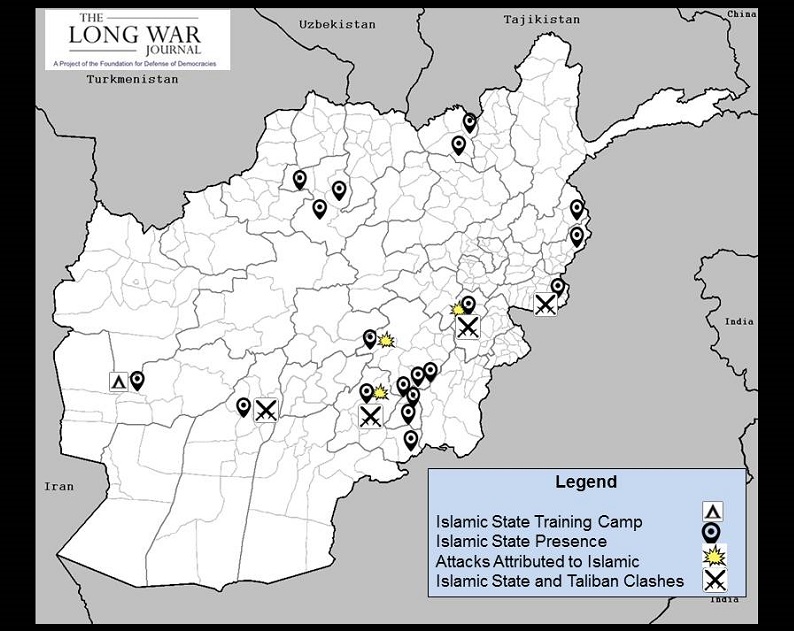
Mapping the emergence of the Islamic State in Afghanistan

March 5th, 2015
Source Link

Ever since disaffected Afghan and Pakistani Taliban insurgents began pledging allegiance to the Islamic State during the summer of 2014, rumors and reports have emerged indicating how the Islamic State has expanded its presence throughout South Asia. A chronological narrative of the rise of the jihadist group in Afghanistan follows below and the above graphic depicts its emergence.

In late September 2014, fierce battles raged between Afghan security forces and insurgents reported to be associated with the Islamic State in the Arjistan district of Ghazni province. At the time, Afghan officials reported that the insurgents had raised the black flag of the Islamic State and were burning down homes and beheading captured security forces and local residents alike. The incident in Arjistan is mired in controversy, as local Afghan officials allegedly recanted their versions of events and admitted to embellishing the presence of Islamic State fighters as a ploy to obtain more resources, according to a report by The New York Times.

It should also be noted that in early February 2015, the Chief of Police for Ghazni denied that the Islamic State had created a presence in the area, stating that the insurgents fighting against the Afghan Government were local Taliban members.

Osama bin Laden’s Files: The Pakistani government wanted to negotiate

March 9th, 2015

Recently released files recovered in Osama bin Laden’s compound show that parts of the Pakistani government made attempts to negotiate with al Qaeda in 2010. The letters were released as evidence in the trial of Abid Naseer, who was convicted on terrorism charges by a Brooklyn jury earlier this month.

One of the files is a letter written by Atiyah Abd al Rahman (“Mahmud”), who was then the general manager of al Qaeda, to Osama bin Laden (identified as Sheikh Abu Abdallah) in July 2010. The letter reveals a complicated game involving al Qaeda, the Pakistani Taliban, the brother of Pakistan’s current prime minister, and Pakistan’s intelligence service.

“Regarding the negotiations, dear Sheikh, I will give you an overview, may God support me in this,” Rahman wrote. “The Pakistani enemy has been corresponding with us and with Tahreek-i-Taliban (Hakeemullah) for a very short time, since the days of Hafiz, may God have mercy on him.” Hakeemullah Mehsud was the head of the Pakistani Taliban at the time. The “Hafiz” mentioned is Mustafa Abu Yazid (Sheikh Saeed al Masri), who served as al Qaeda’s general manager prior to his death in May 2010. Rahman succeeded Yazid in that role.

“We discussed the matter internally, then we talked with Abu-Muhammad later once we were able to resume correspondence with him,” Rahman explained. “Abu-Muhammad” is the nom de guerre of Ayman al Zawahiri. As a result of these discussions, al Qaeda was willing to broker a deal in which the jihadists’ would ease off the Pakistanis so long as the military and intelligence services stopped fighting al Qaeda and its allies.

South Asia's Hinge Moment

March 13, 2015 

Don't look now, but South Asia is getting its act together.

Nightmares of despair and disaster are an occupational hazard for those who follow developments in South Asia. But for once, the news from the region is not uniformly grim. Washington should take note.

National elections throughout the region have produced victors who, compared to their predecessors, appear to be agents of change. Elections last year in India and Afghanistan fit this pattern. But the starkest example is also the most recent: Sri Lankan voters, in an outcome anticipated by almost no one, summarily dispatched an autocratic ruler who had appeared entrenched for the long run this January. 

The encouraging signs go beyond elections. By some measures, India has surpassed China to boast the fastest growing economy in the world. The new prime minister, Narendra Modi, has taken a meat cleaver to bureaucracy and venality. In Pakistan, the army’s offensive against extremists in North Waziristan has proved far more sustained than most observers had expected. The December 16 massacre of 150 people in Peshawar, most of them young schoolchildren, seems to have reinforced Pakistan’s commitment to combating terrorist violence.

No, China’s Not About to Collapse

By Timothy Heath
March 13, 2015

Yes, the CCP faces challenges, but it is stronger than you think. 

The CCP’s liabilities are well known. These include an antiquated political identity, cumbersome ideology, and widespread disenchantment with Marxism among the public (and among more than a few party members). CCP-led government has failed to provide adequate services, ensure rule of law, and has long tolerated corruption, malfeasance, and widening inequality. Many of these vulnerabilities have persisted for years, and some have worsened over time.

The party’s advantages are less often discussed, but these bear reviewing if one is to evaluate the viability of CCP rule. One of the most overlooked, but important, assets is a lack of any credible alternative. The party’s repressive politics prevent the formation of potential candidates, so the alternative to CCP rule for now is anarchy. For a country still traumatized by its historic experience with national breakdown, this grants the party no small advantage. To truly imperil its authority, the CCP would need to behave in so damaging a manner as to make the certainty of political chaos and economic collapse preferable to the continuation of CCP rule. A party that attempted to return to extreme Mao-era policies such as the catastrophic Great Leap Forward could perhaps meet that threshold. But despite the numerous superficial comparisons in Western media, little about the current administration policy agenda resembles classic Maoism.

The second major political advantage lies in improvements to the party’s effectiveness in recent years. In a major paradigm shift, the CCP redefined itself as a “governing party” whose primary responsibility rests in addressing the myriad economic, political, cultural, ecological, and social welfare demands of the people. It has carried out ideological and political reforms to improve its competence and effectiveness accordingly. The Xi administration has refined, but upheld, the focus on increasing the nation’s standard of living and realizing national revitalization, objectives embodied in the vision of the “Chinese dream.” Although the party has rightly come in for criticism for moving slowly and inadequately on these issues, the policy agenda nevertheless appears to resonate with the majority of Chinese citizens. Independent polls consistently show that the party has in recent years enjoyed surprisingly strong public support.

When weighing the party’s political liabilities against its assets, therefore, the evidence suggests that the CCP faces little danger of imminent collapse. Improvements to its cohesion, competence, and responsiveness, combined with a policy agenda that resonates with most Chinese and the lack of a compelling alternative outweigh the persistent political liabilities. The party’s overall political stability throughout the 2000s, despite massive political unrest generated by breakneck economic growth, underscores this point.

The Insecure CCP

China’s Emerging Interests in the Arctic

Written by Nong Hong.
March 10, 2015

During the Cold War, the Arctic was a security flashpoint with nuclear submarines from the United States and the Soviet Union patrolling deep below the polar ice of the Arctic Ocean and bombers airborne over the region. Today, the Arctic may be disassociated from great power politics, but new geopolitical realities are taking shape, arising from the melting Arctic. Countries with military/security interests and naval capacity in the Arctic include Russia, Canada, the U.S., Norway, and Denmark. But the exclusivity of the region has been challenged by the activities of major powers from outside the region, such as the United Kingdom, France, Germany, China, Japan, South Korea and India, as they are taking special interest in many aspects of the Arctic that focus on scientific research, shipping and resource development. It is important to explore the growing interests of China, among a select group of non-Arctic states, in the Arctic and examine the nature of its interests and motivations in wanting to maintain both its involvement and presence in the region. The interests of China range from participating in Arctic governance affairs and accessing potential resources to exploiting shipping opportunities and undertaking polar research.

Seeking participation in the Arctic Council

Since 2007, China has participated as an ad hoc observer at Arctic Council meetings, allowing it to gain a better understanding of the Council’s work. In 2008, it also began officially expressing its intentions to become a permanent observer to the Arctic Council. Although China has yet to articulate an official policy for the Arctic, different voices in China’s academic circles have expressed views on how China should approach Arctic governance. Some hold that China has great strategic interest in the Arctic, but rather than adopting a “neutral” position as an outsider, it should push for the internationalization of the region instead. Some other scholars believe that the idea of internationalizing the Arctic might risk damaging China’s image in the international community, as taking such a stance would not conform to its consistent position of a principle of “non-interference”. In May 2013, the Arctic Council granted China, Japan, South Korea, India and Singapore an observer status.

Why China and the Philippines Won't Reconcile Anytime Soon

By Richard Javad Heydarian
March 13, 2015

Manila and Beijing have a long way to go before improving their troubled relations. 

Almost two years into Xi Jinping’s tenure at the helm of the Chinese political system, he had yet to meet his Filipino counterpart, Benigno Aquino III. His foreign minister, Wang Yi, who repeatedly got into heated exchanges with his Filipino counterpart, Albert Del Rosario, in various regional fora, had yet to make a single official visit to the Philippines more than a year into office.

The dearth of high-level dialogue between the two countries reflected the depth of bilateral animosities, especially after a dangerous standoff over the Scarborough Shoal in mid-2012, which perilously placed the two neighbors on the verge of an armed confrontation. But there was a whiff of new hope for revival in Philippine-China relations when Xi and Aquino managed to conduct an ‘icebreaker’ meeting on the sidelines of the Asia Pacific Economic Cooperation (APEC) summit in Beijing in late-2014.

In fact, Aquino was quite sentimental in describing his minutes-long encounter with Xi by claiming a ‘meeting of minds‘ with his Chinese counterpart. The confab marked the first face-to-face talk between the two heads of state. A closer look, however, reveals that the two neighbors will face an uphill battle in repairing their frayed ties.

China seems to be hardening its position in the South China Sea by ramping up its construction activities in disputed waters, frustrating efforts at negotiating a Code of Conduct (CoC) for maritime disputes in the region, and lambasting other claimant countries for fortifying their position on the ground.

The Dearth of Dialogue

China's Plan to Dominate World Markets

March 13, 2015

China hopes SOE mergers can result in internationally-respected brands. 

China will consolidate state-owned enterprises (SOEs) into mammoth companies, all with the hopes of winning China more of the global market share in key sectors – and the international prestige that entails.

SOE reform is only one piece in Beijing’s larger attempt to create globally attractive Chinese brands. During his work report to the National People’s Congress, Premier Li Keqiang introduced the “Made in China 2025” initiative. That’s only the first leg of a 30-year plan to transform China “from a big manufacturing power to a strong manufacturing power,” as China Daily explained. China may be the “world’s factory,” but its own domestic products and companies are not internationally competitive. The “Made in China 2025” plan aims to fix that, by focusing on “an innovation drive, intellectual property and green development.”

The initiative also called for “enterprises’ merger and reorganization” to promote competitiveness in global markets. That’s precisely what will happen to China’s SOEs, Reuters reports.

Beijing will pay particular attention to boosting China’s competitiveness in a number of key sectors, including railways and nuclear power plants, two areas where China is already actively promoting exports abroad. Those sectors will see the first round of consolidations, according to Reuters, beginning with previously announced mergers between China CNR Corp. Ltd. and China CSR Corp. Ltd (two locomotive manufacturers) and between China Power Investment Corp. and State Nuclear Power Technology Corp.

China also hopes to expand its competitiveness in other fields, including automobiles and aircraft (see, for example, the media push anticipating the first flight by China’s domestically-produced commercial jet, the COMAC C919). Shipbuilding is another field where China might pursue mergers to boost competitiveness.

4 Reasons China Can Fight a Modern War

March 13, 2015

Do not underestimate the PLA’s fighting capabilities, particularly its fighting resolve. 

Perhaps the biggest question about China’s rise is whether it will inevitably lead to a military conflict with other powers, particularly the existing superpower, the United States. It is undoubtedly true that no one wants to see a general war between China and the U.S., though in reality both countries might be dragged into a war that they do not want to fight in areas like the East China Sea. If that happens, many analysts believe that the PLA does not stand a chance against the mighty U.S. military for a series of reasons, ranging from poor training to lack of war experience. Such an estimate might be true, but it might also truly underestimate the fighting power of the PLA, thus contributing to misjudgment and poor policy-making overall. Thus, accurately assessing the power of the PLA is a critical part of any serious military planning by the U.S. and other countries.

As a general rule, the outcome of a possible war involving the PLA and another military depends on many factors such as comprehensive capabilities, strategies, and fighting resolve. Recent analyses (here, here, andhere) that are skeptical about the PLA’s probability of winning tend to focus on its command structure, training, corruption, inexperience, and inadequate equipment as key factors. But, there are four reasons that the PLA can fight a modern war and even win one under certain conditions.

First, equipment is essential. As has been pointed out, the PLA has transformed itself into a powerful militaryafter more than 20 years of continuous investment. Although in terms of hardware, the PLA still cannot compete with the U.S., the mightiest fighting machine in the world, the PLA nonetheless stands a good chance against its main potential rival in Asia, Japan. Although some might claim that Japan now has an edge over China, very soon China’s PLA will surpass Japan’s SDF in terms of hardware given China’s economic size and greater military spending. The PLA’s spending is already at least twice as large as Japan’s and this trend will continue in coming years, thus giving the PLA a big advantage down the road. So, in ten years’ time, the PLA will have superb military hardware that is only second to the United States. This is one necessary condition for the PLA to fight a modern war.

Sorry, America: India Won't Go to War with China

March 13, 2015 

In his latest contribution to our debate, Shashank Joshi raised some excellent points against my skeptical view of the emerging India-U.S. strategic partnership. But I'm still unpersuaded.

To explain why, it helps to step back and clarify the question we are debating here. It is not whether strategic relations between Delhi and Washington have grown closer in recent years, because clearly they have. It is what these closer relations mean for the geo-political contest between America and China.

India's position is clearly important to this contest. Many Americans, and many of America's friends in Asia, have long believed that India's growing wealth and power will be vital in helping America counterbalance China's growing strategic weight, and resist China's challenge to U.S. regional leadership.

Indeed, the belief many people have that India will play this role is central to their confidence that America can and will preserve the status quo against China's challenge. It is therefore important to decide whether the progress we have seen in U.S.-India relations justifies that confidence.

I have argued that in a geopolitical contest of the kind we see unfolding between America and China today, India's relations with America will only make a difference to the extent that India is seen to be willing to support America in a U.S.-China conflict.

The consequences of the strengthening US-India partnership are still uncertain

10 March 2015 

Over the past month, Hugh White and I have exchanged opposing views on the meaning of the US-India relationship on The Interpreter.

Hugh first argued that President Barack Obama's January trip to New Delhi failed, 'because India is not willing to make the preservation of US primacy its principal strategic aim in Asia.' I replied that this was an unfairly high bar to set in terms of judging India's role in the pivot. Hugh then clarified:

India's new alignment with the US will only make a real difference if it is credibly willing to support America militarily against China if and when US primacy is at stake. Diffuse and politically acceptable diplomatic support won't cut it at a time like this. So the test of the US-India alignment is simple: does anyone think India would send forces to help America defend Japan's claim to the Senkakus, or the Philippines' claims in the South China Sea, or Taiwan? If not, how does India's support help America deter China from challenging US primacy in these flashpoints? And if it doesn't do that, what use is it to Obama? 

In his book The China Choice, Hugh fleshes this out with three arguments. First, 'as India emerges as a great power in its own right...its aim will be to maximise its own power, not support America's.' Second, 'the stronger India becomes, the less it will need America to help balance China.' And third, 'the stronger China is relative to India, the more cautious Delhi will be about sacrificing its interest in a good relationship with Beijing.'

Against this, we might raise five issues:*

China's Myanmar Policy: Dilemma or Strategic Ambiguity?

Bernt Berger
2 March 2015

This brief discusses China’s problem of how to deal with ethnic Chinese irredentist groups involved in the ongoing ethnic conflict in Myanmar’s Shan State along the Chinese border. The author states the failure of Beijing to diffuse suspicions of Chinese support for such groups and to rein in local actors could undermine China's relations with Myanmar and its neighborhood policy more generally.
© 2015 The Institute for Security and Development Policy

Only China Can Contain China


12/03/2015


When Xi Jinping visits the U.S. this autumn, one of the items on his agenda is bound to be what he has called a "new type of major power relations." The term remains ambiguous and some Americans fear that it is a device for disrupting American alliances. Chinese scholars reply that it is a genuine effort to avoid the dangerous dynamics between a rising and an established power that helped precipitate the Peloponnesian War and World War I.

Looking ahead, pessimists predict an impending clash as China grows stronger and seeks to expel the U.S. from the Western Pacific. Some argue that this can be forestalled by the acceptance of spheres of influence in which the U.S. restricts its activities primarily to the Eastern Pacific. But such a response to China's rise would destroy American credibility and lead regional states into bandwagoning rather than balancing China. Instead, a continued U.S. presence in the Western Pacific can reinforce the natural balancing reactions of regional states and help to shape the environment in a way that encourages responsible Chinese behavior.

An appropriate policy response to the rise of China must balance realism and integration. When the Clinton Administration first considered how to respond to the rise of China in the 1990s, some critics urged a policy of containment before China became too strong. We rejected such advice for two reasons. First, it would have been impossible to forge an anti-China alliance since most countries in the region wanted (and still want) good relations with both the U.S. and China. Even more important, such a policy would have unnecessarily guaranteed future enmity with China. As I used to say in my speeches when I was responsible for East Asia in the Pentagon, if you treat China as an enemy, you are certain to have an enemy.