20 March 2015

France, Germany, Italy to join China-led $50bn infrastructure bank

March 18, 2015 
http://rt.com/business/241365-china-bank-eu-usa/

China's President Xi Jinping (3rd R) meets with the guests at the Asian Infrastructure Investment Bank launch ceremony at the Great Hall of the People in Beijing October 24, 2014. 

France, Germany and Italy have confirmed they’ll join China’s new Asian Infrastructure Investment Bank (AIIB). Participation in the rival to the US-led World Bank is seen as a setback for the Obama administration.

The three European countries on Tuesday confirmed in a statement they intend "to become founding members of the Asian Infrastructure Investment Bank," according to AFP.

"We want to bring our long experience... to help the bank build a solid reputation," said German Finance Minister Wolfgang Schaeuble, speaking also for Italy and France at a joint press conference with Chinese Deputy-Premier Ma Kai on Tuesday in Berlin. He added that the three countries want to make a contribution to the positive development of the Asian economy, in which German companies were actively taking part.

Chinese Foreign Ministry spokesman Hong Lei welcomed the decision, saying "the AIIB is an open and inclusive multilateral investment institution.”

"Participation by countries outside the region will intensify the extensive representatives of the AIIB," he added.

The decision of the three European countries comes after Britain last week became the first Western country to agree to become a founding member of the AIIB, FT reports. The UK government said the decision was in the country’s national interest, but it got a negative reaction from the United States.

The new China-led bank is expected to challenge the Washington-based World Bank, so the US is increasing pressure on its allies not to join the institution. The US’ concern is that the new investment bank might not have high standards of governance and environmental and social safeguards.

The new bank is expected to challenge the Western dominance of the US-led World Bank and IMF in global infrastructure projects, which experts believe will create healthy competition.

“Our messaging to the Chinese consistently has been to welcome investment in infrastructure but to seek unmistakable evidence that this bank… takes as its starting point the high watermark of what other multilateral development banks have done in terms of governance,” US Regional Assistant Secretary of State Daniel Russel said in Seoul, the Financial Times reports.

House Intelligence Committee to Hold Hearing Tomorrow on Cyber Threats

March 18, 2015

The following release appeared on the House Permanent Select Committee on Intelligence website:

House Intelligence Committee to Examine the Growing Cyber Threat and Its Impact on American Business

HPSCI to hold open hearing

Washington, D.C. – Chairman Devin Nunes and Ranking Member Adam Schiff of the House Permanent Select Committee on Intelligence (HPSCI) announced today that the Committee will hold an open hearing to publicly examine the growing cyber threat and its impact on American business.

The hearing will begin at 9:00 am on Thursday, March 19, 2015, in room HVC-210 of the Capitol Building.

Who: House Permanent Select Committee on Intelligence (HPSCI)

What: Hearing on the growing cyber threat and its impact on American business (Open)

When: Thursday, March 19, 2015

9:00 am – 12:00 pm ET

Where: Room HVC-210, Capitol Building

The hearing witnesses include: 
The Honorable Tim Pawlenty, Financial Services Roundtable 
John Latimer, TSYS 
Richard Bejtlich, FireEye 
Andrew Tannenbaum, IBM

Classified Document Reveals NSA Trying to Map the Communications of Major Corporations, Including Canadian Companies

COLIN FREEZE and CHRISTINE DOBBy 
March 17, 2015

NSA trying to map Rogers, RBC communications traffic, leak shows

The U.S. National Security Agency has been trying to map the communications traffic of corporations around the world, and a classified document reveals that at least two of Canada’s largest companies are included.

A 2012 presentation by a U.S. intelligence analyst, a copy of which was obtained by The Globe and Mail, includes a list of corporate networks that names Royal Bank of Canada and Rogers Communications Inc.

The presentation, titled “Private Networks: Analysis, Contextualization and Setting the Vision,” is among the NSA documents taken by former contractor Edward Snowden. It was obtained by The Globe from a confidential source.

Canada’s biggest bank and its largest wireless carrier are on a list of 15 entities that are visible in a drop-down menu on one of the presentation’s 40 pages. It shows part of an alphabetical list of entries beginning with the letter “R” that also includes two U.K.-headquartered companies – Rolls Royce Marine and Rio Tinto – and U.S.-based RigNet, among other global firms involved in telecom, finance, oil and manufacturing.

The document does not say what data the NSA has collected about these firms, or spell out the agency’s objective. A comparison of this document with previous Snowden leaks suggests it may be a preliminary step in broad efforts to identify, study and, if deemed necessary, “exploit” organizations’ internal communication networks.

Christopher Parsons, a researcher at the University of Toronto’s Citizen Lab, who reviewed the leaked document with The Globe, said the activity described could help determine useful access points in the future: “This is preparing the battlefield so it could later be used.

“This is … watching communications come in and out of a network and saying, ‘Okay, these are the places we need to go in.’”

DHS Report Indicates Highest Number of Cyber Attacks on U.S. Companies Focused on the Energy Sector

Jeremy Cowan
March 17, 2015

Washington, DC. March 12, 2015 — A report issued today by the US Department for Homeland Security says that in 2014 the Industrial Control Systems Cyber Emergency Response Team (ICS-CERT) responded to 245 incidents reported by asset owners and industry partners.

The energy sector, says Jeremy Cowan, led all others again in 2014 with 79 reported incidents, followed by manufacturing at 65 and worryingly healthcare at 15 reported incidents. ICS-CERT’s continuing partnership with the Energy sector reportedly provides many opportunities to share information and collaborate on incident response efforts.

Also noteworthy in 2014 were the incidents reported by the Critical Manufacturing sector, some of which were from control systems equipment manufacturers. The ICS vendor community may be a target for sophisticated threat actors for a variety of reasons, including economic espionage and reconnaissance. Of the total number of incidents reported to ICS-CERT, roughly 55% involved advanced persistent threats (APT) or sophisticated actors.

Other actor types included hacktivists, insider threats, and criminals. In many cases, the threat actors were unknown due to a lack of attributional data, says the US Department. The scope of incidents encompassed a vast range of threats and observed methods for attempting to gain access to both business and control systems infrastructure, including but not limited to the following: 
Unauthorised access and exploitation of Internet facing ICS/Supervisory Control and Data Acquisition (SCADA) devices 
Exploitation of zero-day vulnerabilities in control system devices and software 
Malware infections within air-gapped control system networks 
SQL injection via exploitation of web application vulnerabilities 
Network scanning and probing 
Lateral movement between network zones 
Targeted spear-phishing campaigns 
Strategic web site compromises (a.k.a., watering hole attacks.) 

British Intelligence to UK Companies: Stop Using Smart Phones If You Want to Prevent Hacking Of Computer Systems

Ben Riley-Smith
March 17, 2015

Britain’s spies have told businesses to consider stripping employees of company smart phones and memory sticks to protect themselves from cyber-attacks, The Telegraph can disclose.

Advice issued by GCHQ, the government’s listening post, and other departments warns firms that staff are the “weakest link in the security chain” and protective action must be taken.

Companies have been told staff should only use trusted Wi-Fi networks – effectively ruling out using laptops in coffee shops like Starbucks without special protections – and constantly update internet browsers.

They were also warned disgruntled employees may attempt to “steal or physically deface” computers or become vulnerable to blackmail if secrets about their personal lives become known.

The warnings were contained in ‘10 Steps to Cyber Security’ guidance issued by CESG – the Information Security arm of GCHQ – in conjunction with the Cabinet Office, Business Department and Centre for the Protection of National Infrastructure.

It comes after the Prime Minister called cyber-attacks “one of the biggest modern threats that we face” and prioritised improving Britain’s defences since taking office in 2010.

Part of the Coalition’s push to strengthen the country’s resistance to cyberterrorism is to build awareness and protection among the business community.

In a series of detailed guidance documents for businesses issued by GCHQ alongside other departments, firms are urged to take steps to make themselves less vulnerable to attacks.

“Monitor all user activity,” the advice says, telling companies they should be watching over the internet behaviour of employees at all times so they can always “identify” the staff member.

Make sure staff know “any abuse of the organisation’s security policies will result in disciplinary action”, the government says in another part of the advice.

Specific measures are also mentioned, including possibly stripping staff of company phones. “Assess business requirements for user access to input/output devices and removable media (this could include MP3 players and Smart phones),” the advice states.

US Military Losing Edge In Space: Kendall

March 17, 2015

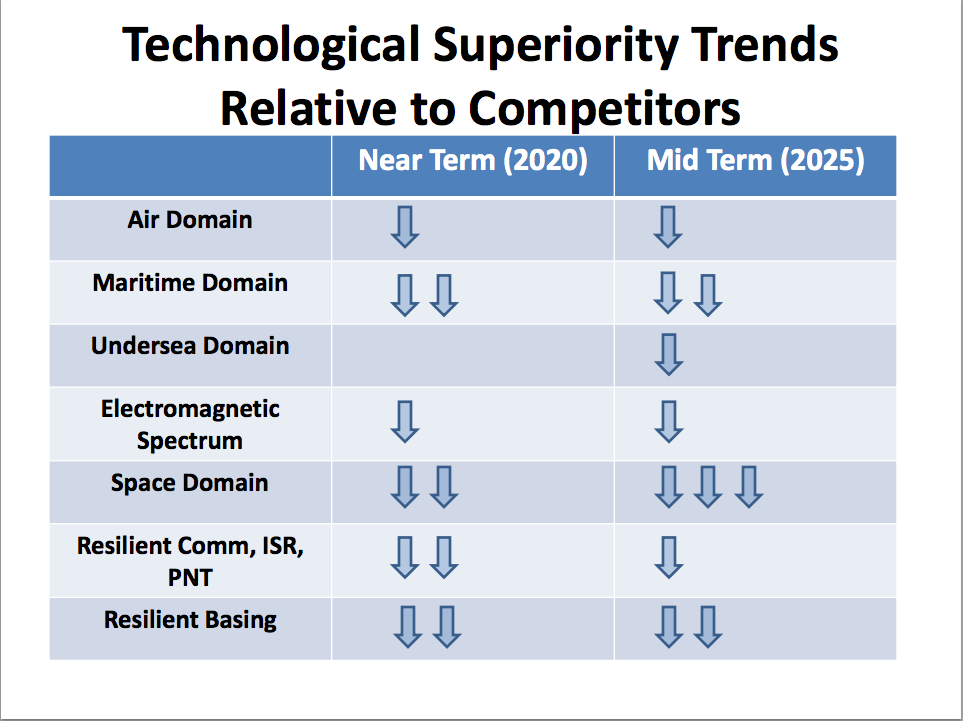
NEWSEUM: After more than a year of saying that the United States is losing its relative edge in military technology to China and Russia, the Pentagon’s top weapons buyer upped the ante today and said that the top American advantage — space — “is particularly bad” because both Russia and China are fielding a suite of anti-satellite capabilities.

The chart below sketches out the most detailed accounting Kendall has offered on this crucial topic. Of course, the details are classified as they involve threat assessments and assessments of foreign governments’ technological prowess. But in this simplified depiction, downward-pointing arrows are bad — and the “space domain” has more of them than any other category:

Areas where US technology advantage is eroding in the short term (2020) and long term (2025), according to Undersecretary Frank Kendall.

China has long targeted America’s space assets, having learned from the first Gulf War just how crucial those capabilities were and what an edge they gave American forces. First came their lazing of American spy satellites. Then they destroyed their own weather satellite in early 2007. Since then they have tested at least one more anti-satellite weapon — possibly two. And Russia has continued, Kendall made clear, to press ahead on its own systems.

MIT, Raytheon and others partner to combat cyber threats

Bill Kiczuk, Raytheon's vice president and chief technology officer.
Mar 16, 2015

MIT and companies including Waltham-based defense contractor Raytheon have teamed up to launch a cybersecurity initiative aimed at combating cyber threats on a broad scale.

The initiative involves five companies: Raytheon, Boeing, BP, BAE Systems, BBVA and various MIT divisions such as the Computer Science and Artificial Intelligence Laboratory and the Sloan School of Management, all of which are committed to "tackling the complex challenges involved in keeping our digital information safe," according to the university.

Bill Kiczuk, Raytheon's vice president and chief technology officer, said the initiative, which MIT officially unveiled last week, is timely and prudent.

"Technology is part of the fabric of our lives and (as) computing and software are more and more pervasive, so are the risks and potential impacts of cyber attacks," he said in an email. "This trend will not reverse anytime soon and protecting these systems we depend on for our security, health and way of life is incredibly important."

The partnership with MIT will provide companies like Raytheon (NYSE: RTN) access to the next generation of cyber engineers and experts, Kiczuk said.

The consortium of businesses and various MIT departments will be focused on preventing, working through and recovering from Web-based attacks, said Howard Shrobe, principal research scientist at MIT's Computer Science and Artificial Intelligence Laboratory.

Representatives from the companies will meet with researchers throughout the year to discuss issues and suggest new areas of research in the realm of cybersecurity, he said.

The cybersecurity initiative is funded with an undisclosed amount of money by the five member companies.

Shrobe said more companies will participate in the initiative in the coming years.

"We hope that these initiatives will help us work together with industry to create better systems to eliminate a lot of the current vulnerabilities that plague the digital landscape," he said in an email.

Pentagon Asking for $5.5 Billion for Cyber This Year; U.S. Cyber Command Budget Up 92%

Aliya Shernstein
March 17, 2015


U.S. Cyber Command spending will rocket 92 percent this year to get mission troops up and rolling in 2016, according to Defense Department budget figures. Last year, the force was funded at $190 million, while 2015 figures project a $364 million purse. 

Money for the command — tasked with orchestrating network defense maneuvers and offensive cyberattacks — eventually will stabilize over the next five years, totaling out at $1 billion.

About $500 million in 2016 would go toward compensating computer security whizzes departmentwide, according to budget materials provided to Nextgov. Earlier this month, Defense received the green light to fast-track the hiring of3,000 civilian cyber pros, in part, to staff the half-full Cyber Command.

The criticality of the command’s troops was underscored Friday, when Defense Secretary Ash Carter chose them as his first stateside military audience.

“That should tell you something about how vital the mission is that you all have taken on, how important it is for the security of our country and, for that matter, the security of our economy and our people in their individual lives, because cyber touches all aspects of their lives,” Carter said at command headquarters in Fort Meade, Maryland.

Defensewide, cyber funding would reach $5.5 billion under the White House’s 2016 budget, with more than half of that sum going toward operations and maintenance.

But a significant amount would also be devoted to innovation. The “research, development, test and evaluation” request totals $1 billion. That’s more than double the amount slotted for procuring new tools.

The Military’s Cybersecurity Budget in 4 Charts

MARCH 16, 2015

The White House is pitching $5.5 billion in cyber spending for FY 16. Here's what that money looks like. 

U.S. Cyber Command spending will rocket 92 percent this year to get mission troops up and rolling in 2016, according to Defense Department budget figures. Last year, the force was funded at $190 million, while 2015 figures project a $364 million purse. 

Aliya Sternstein reports on cybersecurity and homeland security systems. She’s covered technology for more than a decade at such publications as National Journal's Technology Daily, Federal Computer Week and Forbes. Before joining Government Executive, Sternstein covered agriculture and derivatives ... Full Bio

Money for the command — tasked with orchestrating network defense maneuvers and offensive cyberattacks — eventually will stabilize over the next five years, totaling out at $1 billion.

About $500 million in 2016 would go toward compensating computer security whizzes departmentwide, according to budget materials provided to Nextgov. Earlier this month, Defense received the green light to fast-track the hiring of 3,000 civilian cyber pros, in part, to staff the half-full Cyber Command.

Tragic Delusions: Neocons' Never-Ending Iraq Fairy-Tale

March 19, 2015

Will they ever give it a rest?

Old myths never die. So it is with the fable that neoconservatives and liberal interventionists alike keep telling: that President Bush left Iraq in pretty good shape in 2008 before President Obama’s withdrawal of U.S. troops in 2011 created a strategic opening for Iran today.

Take the Wall Street Journal’s recent editorial. The Obama administration, we are told, is primarily responsible for Iran’s military surge in Iraq. After all, the withdrawal of U.S. troops in 2011 helped destroy the sectarian peace that Washington had brokered following the surge in 2007. And the failure to deploy U.S. ground troops or rally a coalition of surrounding Sunni states to fight the Islamic State created security vacuums for Tehran to exploit.

Never mind that the U.S. troops left Iraq according to the very timetable President Bush himself had negotiated with Iraqi prime minister Nouri al-Maliki in 2008. Never mind the hatred and rivalries that are so much a part of Iraqi religious and tribal animosities were bound to erupt in the absence of a strong unitary state.

The point here is that the Journal, like most supporters of the decision to invade Iraq twelve years ago, still can’t acknowledge the taproot of today’s disaster: the toppling of Sunni rule that led to the Shia ascendancy in Baghdad.

Philippines: Questions Raised About US Anti-Terror Cooperation

March 19, 2015

A police report has confirmed a U.S. presence in the anti-terror operation in Mindanao. 

American soldiers did not join in any actual combat but they did provide intelligence, training, real-time information, equipment, and aircraft in a successful but controversial anti-terror operation in southern Philippines.

This was one of the findings of the Board of Inquiry of the Philippine National Police, which was created to probe the operation which killed 67 Filipinos, including 44 members of the police elite unit Special Action Force (SAF). The January 25, 2015 operation in Mamasapano, Maguindanao succeeded in killing Bali bomber Zhulkifli Bin Hir/Zulkifli Abhir (Marwan) but was also viewed as a tragedy because of the high number of casualties.

Marwan was a Malaysian citizen who escaped to the Philippines after the Bali bombing. He was a wanted international terrorist with a $5 million bounty placed by the U.S. Federal Bureau of Investigation.

The police operation to arrest Marwan raised several issues that have undermined the leadership of President Benigno Aquino III. The president was accused of violating the chain of command when he designated a suspended police general to coordinate the operation. The police general also failed to properly inform the army and even the top leadership of the police about the operation.

Another blunder is the failure to coordinate the planned attack with Muslim separatist rebels who control the area. The rebels are not linked to Marwan and they have a ceasefire agreement with the government. Aside from Marwan’s team, it was the rebels and other private armed groups which figured in a deadly clash with the police.

There is also the issue about the unclear involvement of the Americans in the operation. Residents recalled seeing foreigners and a flying object in their village during the week of the encounter. But an information officer of the U.S. embassy told local media that “no U.S. surveillance drone was used” in the operation.

Last week, the police finally released its report about the Mamasapano incident; and it tackled, among others, the role of the Americans in the operation.

Below are excerpts of the report:

“Six American nationals were at the Tactical Command Post in Shariff Aguak starting on the eve of the operations to provide real-time information (Intelligence, Surveillance and Reconnaisance) to the SAF troops.”

“The US counterparts provided real-time information on the actual movements of friendly and enemy forces in the area of operations…by providing technical equipment and aircraft, which they themselves operated.”

There’s A Systemic Lack Of Integrity Among Military Leaders

March 17, 2015


As long as military leaders compete to maintain perfection in metrics that have little to do with warfighting, a culture of dishonesty will always exist. 

Recently, a paper from the Strategic Studies Institute of the Army War College entered the military zeitgeist. Its title was provocative: “Lying to Ourselves: Dishonesty in the Army Profession.” Those who simply read the headlines and skimmed the condensed summaries in the civilian media likely just came away with the impression that the study was just another hit piece on military problems, bemoaning the poor character of service members.

To the contrary, the authors, Leonard Wong and Stephen J. Gerras, discussed dishonesty in the military with dozens of officers and describe situations that every military leader has seen in some form. From the motor pool reporting vehicles as ready because they aren’t technically broken until someone tries to drive them, to the individual soldier fudging the driving distance on his leave request, any veteran reading it will nod knowingly at many of the anecdotes in the report.

Let’s face it. Almost every leader in the military is a habitual liar. Don’t feel too bad. You wouldn’t have gotten as far as you have if you weren’t. It only hurts so much to think about it because the military is so hypocritical on the subject. Everyone expects a used car salesman to lie, but the services go on and on about honor and integrity even as they encourage their members to compromise that integrity on a daily basis. Unless you are the Jesus of training time, getting 297 days of annual training (the required time to execute all U.S. Army mandatory unit training, but typical throughout the services) completed in 256 available training days, you’re a liar. You may think you’re just “working the system” or “being efficient,” but the real word for those things is “lying.”

How to Finally Kill the Useless, Recurring Meeting Ryan Fuller


MARCH 17, 2015

How to Finally Kill the Useless, Recurring Meeting 

We’ve all been part of a bloated weekly meeting. You know the one, with 20-plus attendees that’s been happening every week for years; where everyone attends because they’re supposed to, but no one gets much value out of it; where everyone multitasks or wishes they were somewhere else (or both). The sheer amount of time invested in these low-value interactions is a high-cost impediment to getting things done. So how do you fix it?

Not with a sweeping gesture or an edict from a CEO. That’s because meetings tend to be reinforced by norms and network effects – if one person attempts to fix it by, say, declaring that they will no longer attend meetings on Wednesdays, the overall system tends to reject the change. In other words, their colleagues will just continue to schedule meetings on Wednesdays.

Popular tactics like removing conference room chairs, plastering the walls with meeting rules, or banishing PowerPoint presentations don’t work, either. They can be helpful, but aren’t sufficient to implement lasting cultural change.

The key is to engage all employees in a new way of thinking about time management and to encourage them to hold themselves and their colleagues accountable. To liberate victims from this seemingly inescapable vicious cycle, it’s necessary to kick-start a virtuous cycle in which everyone is empowered to say no, ask why, and identify strategies to allow everyone in an organization to be more effective on a day-to-day basis.

At VoloMetrix, we help companies quantify how much time goes into meetings and what effects they have on people. In the process, we have analyzed over 1 billion meetings across dozens of large businesses, so we have a rather unique perspective on both how widespread the problem is as well as how elusive the solutions are.

How to make them more productive. 

Leading with the Lights Out In The #FutureOfWar


Aaron Lapp is a U.S. Air Force officer. The opinions expressed here are his alone, and do not reflect those of the U.S. Air Force, the Department of Defense, or the U.S. Government. 

A mid-level Lieutenant Colonel is watching a full-motion video feed from a stealth drone overhead at the Combined Air Operations Center (CAOC). U.S. Soldiers are in a serious firefight, and the Lieutenant Colonel is about to use the information from the feed along with communications from a Joint Terminal Attack Controller on the ground to scramble F-35 fighters to the scene. Before he can give the order, the feed and all communication links go down. “There are troops in contact!” the Lieutenant Colonel yells to no one in particular. “Get that feed back on-line!” As the communications troops begin to work on the equipment, the lights go out. “How can this be happening, now?” the Lieutenant Colonel asks aloud, while silently wondering how to best support the battle and acknowledging that he hasn’t been trained for this. 

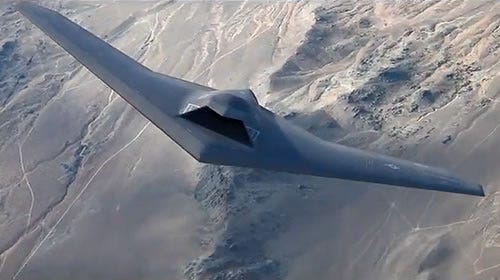
UCLASS Drone Concept Design (Lockheed Martin)

The future of war is unpredictable, but one thing is certain-there will be friction and fog. As Barry Watts highlights,“Clausewitzian friction is a basic structural feature of combat interactions between opposing polities.”[1] Human decision-making will cause most of this friction in future wars. Military theorists from Sun Tzu to John Boyd have extolled the virtues of making quick accurate decisions and using misdirection and surprise to interrupt an enemy’s ability to do the same. Making complex decisions is difficult under perfect conditions, because an unpredictable enemy always has a vote. “As Moltke remarked to his aides, the enemy always seemed to have three alternatives open to him and he usually chose the fourth.”[2]

Is the U.S. military currently training its future leaders to make decisions in a constrained information environment or is an over-reliance on technology disrupting this critical leadership ability?

Measure the Shade Part II: Challenge Accepted


James Auvil is a career officer who writes health policy for the U.S. Army and provides health care fraud expertise to federal entities. This article contains the views of the author and does not necessarily reflect the views of the Department of the Army, the Department of Defense or the United States Government. 

In Part I: A Prescription for Toxicosis, I defined the Boxer as a hybrid of the Boomer/Xer generation, cursed with unlimited drive and an absence of trust. Unlike the Boomers who saved the Army after Vietnam and prepared it to fight and win through Desert Shield/Desert Storm, Boxers nefariously used technology and policy to centralize power, punitively track effort and shift personal responsibility onto the organization. Boxers created timid permission-seeking leaders who became exceptionally good at telling them what they wanted to hear. This post presents a justification for change in case a total lack of trust across the enterprise isn't reason enough. It then describes the significant administrative challenge ahead and ends by explaining how my generation has the opportunity and skill set to restore trust.

“The people when rightly and fully trusted will return the trust.” — Abraham Lincoln

It’s always best to start with why. We need to restore trust so leaders feel comfortable reporting information honestly. Leaders need to know the bosscan handle the truth; if they report “bad news” the boss will primarily focus on fixing the problem and not blame. We are also strongly interested in winning on poorly defined, politically-charged and rapidly changing battlefields and that requires trust.

The Army Operating Concept (TRADOC Pam 525–3–1) states: “What all Army operations will have in common is a need for innovative and adaptive leaders and cohesive teams that thrive in conditions of complexity and uncertainty.” It says nothing about compliance-driven permission seekers wrapped in reflective belts. We won’t generate innovative and adaptive leaders by defining every aspect of their Army experience, boxing them into an increasingly delineated space. We need to make policy deliberately general and less specific so leaders have room to innovate and exercise judgement. The 10,000 foot screwdriver must become the tool of last resort. I’m talking to you, COL Mandatory Training.

NATO’s Article 5 and Russian Hybrid Warfare

BY EDGAR BUCKLEY AND IOAN PASCU
MARCH 17, 2015

NATO leaders at Cardiff Castle, Sept. 4, 2015 (photo: Tom Robinson/UK Foreign Ministry)

We warned last year (The Way to Avoid Wars: Article 5 and Strategic Reassurance Revisited) that any move by Russian forces into Eastern Ukraine would be highly destabilizing and have unpredictable results – probably including NATO countries providing logistical and intelligence support to Ukraine's military, possibly going beyond that.

That is what has happened and that is where we are today, with the risk of direct confrontation between NATO and Russian forces greater now than at any time since the end of the Cold War. The situation is exacerbated by the growing appreciation that Russia has engaged in hybrid warfare against Ukraine and that such tactics could also be used against NATO countries. How should NATO respond?

A fundamental shift in strategy is required, recognizing that Russia is no longer a country we can rely on not to attack NATO members. Russia has become a potential threat to our territorial integrity which must once again be deterred.

There is no obligation for NATO to intervene in the conflict in Ukraine because Ukraine is not a member of the Alliance. Nevertheless, there are important issues at stake for NATO.

The first is respect for international law, which underpins international security. Whatever we may think of President Putin's declaration that Russia will use all available means, including intervention under international humanitarian law, to defend the rights of Russian-speakers living abroad, we must reject and excoriate any interpretation of such policy to justify sending forces in disguise to support rebellions abroad and annex territory. If Russia believes it has the right to intervene in Ukraine under international humanitarian law, it should explain its case publicly - including the urgent humanitarian catastrophe it seeks to avert and why there is no alternative to its action - and be transparent about its actions. It should not act by stealth and revert to the "big lie", denying that its forces are engaged, denying that its missile units shot down Malaysian airliner MH17, pretending to be the peacemaker when the reality is the opposite.

19 March 2015

Sat Sri Akal Britain

http://www.asianage.com/columnists/sat-sri-akal-britain-326
Mar 18, 2015


The proposal of creating a Sikh Regiment in the British Army is partly due to the manpower shortage. Also, Britain wants to use the new regiment to tap into the political potential of British Sikh voters.

Reports in the British media indicate that a minister in the British government, “speaking on the sidelines”, touched upon a proposal under consideration in the British Army to raise a Sikh Regiment. The Indian Army is, of course, proud of having a Sikh Regiment (of 19 battalions), with a history going all the way back to the 19th century. The regiment has a proud record of valour, both pre- and post-Independence (including two winners of the Param Vir Chakra, India’s highest gallantry award). It can be reasonably assumed that proposed British Sikh Regiment would be basically of the same stock, raised from the manpower pool of the Sikh community domiciled in Britain, sometimes referred to as “British Sikhs”, all presumably British citizens and permanent residents of that country.

It can be further speculated that the new regiment might initially be a single active duty infantry battalion, after which the regiment would be progressed and expanded according to British government policy and availability of suitable manpower and finances. Not unnaturally, the news of a Sikh Regiment in the British Army has aroused interest and curiosity in India, because the Sikh faith is essentially of Indian origin, and India is historically the original habitat of the Sikhs.

A large number of Sikhs migrated mainly to Western countries like England, the United States, Canada, Australia, and other Commonwealth countries while many Sikhs living abroad have close family connections back home in India. This has created its own distinct social culture where the community abroad maintains home links with Punjab and its politics in India, and even replicates them in Britain in their own environment.

The distinctive trademark turbans and unshorn tresses and beards are no longer novelties abroad, but their presence in the armed forces of their adopted countries has not been in proportions to their numbers.

Unique identity dilemma

http://indianexpress.com/article/opinion/columns/unique-identity-dilemma/

All MGNREGA workers without a UID are supposed to be ‘escorted’ (sic) to enrolment centres, and after that to the bank so that their Aadhaar number can be seeded into their account. It is impossible to do this by March 31
Written by Jean Dreze | Updated: March 19, 2015

It is easy to see why the Unique Identity (UID) project, also known as Aadhaar, has caught the imagination of many administrators, economists and policymakers. Identity verification is a routine problem in India and Aadhaar sounds like a foolproof solution. The idea is really smart and the technology is cutting-edge. After the initial hurdle of universal enrolment, numerous applications are possible: monitoring the attendance of government employees, linking multiple databases, fighting tax evasion, facilitating the portability of social benefits and much more. When ace promoter Nandan Nilekani was appointed to lead the project, the happy fate of Aadhaar appeared to be sealed.

And yet, Nilekani’s sales pitch left one question unanswered: is Aadhaar voluntary or compulsory? The initial claim was that Aadhaar was a voluntary facility. Indeed, this is how the sceptics (like business guru Jaithirth Rao, a committed libertarian) were swayed. Yet this claim was clearly hollow: how could Nilekani, or the Unique Identity Authority of India (UIDAI), assure us that Aadhaar was voluntary when they had no control over its applications? The UIDAI’s real position was: “we provide the number, it is up to the government to decide what to do with it”.

This raised the possibility that Aadhaar would become mandatory for the purpose of various social programmes such as the MGNREGA and the public distribution system. Indeed, it quickly became clear that the Central government was keen to impose Aadhaar on a whole series of schemes — almost anything that involved identify verification. That suited the UIDAI very well, since it led people to rush to Aadhaar enrolment centres. But the UIDAI’s claim that Aadhaar was a voluntary facility posed a problem — how would enrolment be fast-tracked? The government’s imposition of UID as an eligibility condition for social benefits provided a neat answer.

And so, a tacit understanding quickly emerged that while Aadhaar was voluntary in principle, it was due to become essential for anyone who wanted to function — get a driving licence, transfer property, have a civil marriage or just get paid as a MGNREGA worker. In short, frankly speaking, it was compulsory.

Going nuclear at sea

http://indianexpress.com/article/opinion/columns/going-nuclear-at-sea/99/

As India’s nuclear submarine fleet gradually grows in size and importance, the challenge will be to ensure that the navy’sp new nuclear role develops alongside, rather than to the detriment of, its conventional missions.
Written by Iskander Rehman | Updated: March 19, 2015 

Almost six years ago, in Visakhapatnam, Gursharan Kaur, wife of then Prime Minister Manmohan Singh, cracked a coconut on the hull of India’s first nuclear-powered ballistic missile submarine (SSBN). Subsequently named the INS Arihant or “destroyer of enemies”, the vessel was the result of decades of efforts by India’s nuclear scientists. For many years, bureaucratic languor, technical challenges and chronic difficulties in nuclear reactor miniaturisation appeared to ensure that progress would be painstakingly slow. Indeed, at one stage, it became unclear whether the project would see the light of day.

In August 2013, when the Arihant’s nuclear reactor finally went critical, the event was thus widely hailed, both in India and abroad, as a major technological and symbolic milestone. Currently undergoing sea trials, the Arihant is destined to be the first vessel in a flotilla of up to five indigenously produced SSBNs, and it has been reported that a sister vessel, the INS Aridhaman, is nearing completion. Since the Pokhran-II series of nuclear tests in 1998, the Indian government has repeatedly iterated its desire to attain a credible minimum nuclear deterrent, structured around what nuclear strategists refer to as a triad, that is, a mixture of aircraft, land-based mobile missiles and naval assets. India’s nuclear doctrine states that it is a no-first-use power, and it is in this light that one must view the importance attached to the sea-based leg of its nuclear deterrent.

Indeed, the survivability and overall resiliency of India’s nuclear arsenal has become a growing concern for military planners in New Delhi, particularly as Beijing continues to make rapid advances in missile, space and cyber technology. Nuclear submarines, provided they are sufficiently quiet, are still considered to be the most survivable of nuclear platforms, due to their mobility and discretion. Placing nuclear assets underwater puts them at a safer distance from a crippling first strike. The development of the Arihant and its successors therefore constitutes the next logical step in Delhi’s quest for an assured retaliatory capability.

US begins destroying its largest cache of chemical weapons

Mar 19, 2015

The US Army has begun destroying the nation's largest remaining stockpile of chemical weapons, using explosives to rip open a container of mustard agent inside a sealed chamber and then flooding it with another chemical to neutralise it.

DENVER: The US Army has begun destroying the nation's largest remaining stockpile of chemical weapons, using explosives to rip open a container of mustard agent inside a sealed chamber and then flooding it with another chemical to neutralise it.

It was the first few pounds of 2,600 tons of mustard agent that will be destroyed at Pueblo Chemical Depot in southern Colorado, most of it contained in about 780,000 shells.

"Everybody's really excited, but we're being cautious, making sure all the procedures are followed exactly," said Bruce Huenefeld, manager of the first destruction process to get underway at the depot yesterday.

Mustard agent can maim or kill by damaging skin, the eyes and airways. It's being destroyed under a 1997 international treaty banning all chemical weapons. It will take four years to destroy the Pueblo stockpile.

Another 523 tons of mustard and deadly nerve agents are stored at Blue Grass Army Depot in Kentucky. Blue Grass isn't expected to start destroying its weapons until 2016 or 2017, finishing in 2023.

The destruction process is safe, officials said. Most of Pueblo's stockpile will be dismantled and neutralised in a highly automated USD 4.5 billion plant built at the depot.

About 1,400 damaged shells and a dozen metal bottles of mustard agent are considered unsuitable for that plant. They'll be opened with explosives and neutralised in the sealed chamber, which sits inside an airtight structure near the larger automated plant.

The metal bottles contain mustard that was extracted from the shells for testing.

A single bottle was the first container to be opened and neutralised yesterday. Crews were waiting for the neutralisation to finish before draining the chamber, rinsing it and then removing the remains of the bottle.

Once all the bottles are destroyed, crews will start work on the damaged shells, depot spokesman Thomas Schultz said.

The automated plant isn't expected to begin work until December or January. Design and construction have taken years, and final testing and training are underway.

India and Myanmar: A model of ‘working relation’

SUPARNA BANERJEE 
March 16, 2015 

Any current academic discussion on India Myanmar relation is phrased with words like ‘India’s renewed engagement with Myanmar’ or ‘India’s changed stance’ etc. However, India’s continued interest in Myanmar is guided by a couple of reasons apart from the fact that it shares more than 1600 km of border length with Myanmar and thus most wisely can never choose to ignore it. First among them is to counter the influence of China and second is the socio economic development of North East and the insurgency factor. Currently there is an added reason after the discovery of natural gas in the country which makes it sought after among the world communities despite the continued presence of the military junta, which had earlier prompted the world community to disown the country. India has termed its current engagement as ‘velvet glove’ which simultaneously has the privilege to constructively engage as well as wield influence for substantive political reforms. This may be attributed more to the manipulation of policy jargon than a definite shift in policy decisions. The paper seeks to argue that India has always maintained, if not a close relation, but definitely, a working relation with Myanmar despite the ideological racism between the two neighbours.

The background:

During the late 1980’s when democratic movements led by Aung San Suu Kyi, was at its full swing India provided all the necessary support to the democratic rebels. Be it the Indian Embassy in Myanmar or the borders in the north east- the democratic supporters had easy access. The election results which gave Aung San Suu Kyi a thumping majority were denied by the military rulers. They had refused to transfer power democratically. This was in the year 1988. 1989 witnessed yet another eastern neighbour, China swept by democratic upheavals. The notorious crackdown at Tiananmen Square attracted world criticism and isolation. These two separate incidents brought the two neighbours close to each other. One was supported by the other in need. India abandoned or at least proclaimed so, Myanmar at this critical juncture on the pretext of standing upright for democracy. Thus despite historical and cultural connection India’s relation with Myanmar suffered a major jolt. China filled the vacuum. It has taken over the market, has a huge stake in the natural gas sector, is in a position to influence political decision making and control the insurgency related troubles along its border states. The excessive interference could be one of the many possible reasons behind the recent decision of the Myanmar military junta to open up its economy for other international players.

Americans interrogated Indian PoWs in Pakistani jails in 1971, reveals former IAF officer

By ANI

New Delhi, Mar.18 (ANI): In a startling revelation in a recently published book authored by former Indian Air Force (IAF) pilot Wing Commander (Retired) Dhirendra S. Jafa, American military officers interrogated 1971 Indian Air Force prisoners of war (PoWs) in Pakistan in an attempt get information on Indian Air Force navigational techniques which were used with pinpoint accuracy to target Pakistani air fields.

In chapter seven of his 241-page book titled "Death Wasn't Painful", Wing Commander Jafa reveals that a well-known American flyer and test pilot was brought to his prison cell by a Pakistani officer around the 25th of December, 1971, who he saw as a symbol of the U.S. Seventh Fleet, "the coercive, high-handed, self-righteous aggressiveness of the ugly American."

The American military officer wanted know how the Indian Air pilots were accurately targeting Pakistani airfields at night.

Wing Commander Jafa recalls that the American officer interrogating him was taken aback by his (Jafa's) initial hostility, but recovered quickly enough to avoid a "slanging match" and begin a "dialogue" (read interrogation).

Wing Commander Jafa mentions that he was taken momentarily aback when the line of questioning shifted to the wreckage of his crashed aircraft, when the American test pilot referred to it as "very interesting, these Russian aeroplanes ..., which never depart from the basic concept."

Deciding to play along with the line of questioning being taken by his American interrogator, Wing Commander Jafa reveals the latter then asked him whether he was following the developments in Russian aviation, and specifically referred to aircraft such as the MiG series, the Sukhois and, of course, their bombers, and in a suggestive sort of way, sought to understand from the Indian PoW whether he was aware or not of whether they were of all of the same make or of different concepts.

Wing Commander Jafa reveals that he did not know precisely what his American interrogator was looking for through his line of questioning, and replied, "I am only a flyer, the end user, so to say. You'd know better, of course, being a test pilot..."

Border Corruption Costs Afghanistan a Quarter of Its Budget

by MATTHEW GAULT

Kabul loses cash to crooked officials and American taxpayers make up the loss

Afghanistan is losing cash. Kabul only collects around $2 billion annually and the majority of that comes from customs—the money importers pay to bring goods into the country. Now that number is falling fast.
Imports are an important part of the Afghan economy, and helps keep the central government afloat. The income fluctuates year to year, but customs revenue makes up between a third to half of the country’s total income. During 2012, Kabul collected $1.1 billion at its borders.

The number of American border agents and soldiers in the country has also fallen in the past few years. Last year, the U.S. handed control of regulating the borders over to their Afghan counterparts.

The results are dramatic. Afghanistan is on track to make $600 million off its borders this year, almost half what it made just three years ago. American officials in the country think they know why the number’s going down, but it’s not because of fewer imports.
“Approximately half of the customs duties for Afghan fiscal year [2015] are believed to have been stolen,” the U.S. Special Inspector General for Afghanistan Reconstruction wrote in a recent letter to P. Michael McKinley, the U.S. ambassador to Kabul.

“These continued economic conditions could lead to another shortage in revenue that will likely require the Afghan government to obtain additional assistance from the international community and the U.S. government,” SIGAR added.

In 2014, Kabul didn’t make enough money to pay its employees or deliver basic services. Washington pulled $100 million out of a reconstruction trust fund to keep the government afloat. It’s probably not the last time American taxpayers will pay to keep the lights on in Kabul.

To put it simply—Afghanistan has a corruption problem. Kabul runs on a network of bribes and patronage, and it’s hard to get anything done without paying off officials. The United Nations estimated that half of all Afghanspaid some form of a bribe in 2012.

Total cost of those bribes? Almost $4 billion. Kabul collected about $2 billion in revenue that year. That means government officials collected double in bribes what they did in taxes and custom duties.

In War Against ISIS, Numbers Don’t Always Tell the Story

By Robin Wright
March 13, 2015

In this still image taken from video, soldiers fire in Tikrit, Iraq, on March 11. Iraqi soldiers and Shiite militiamen entered the city on Wednesday.

Wars often degrade into numbers games of competing troop strengths, arsenals, territory held, bombing runs, and body counts. But judging an asymmetric conflict is complicated, and the battle against Islamic State involves militaries that are, in most respects, vastly different.

In Iraq, the battle for Tikrit reflects the imbalances and oddities. In Syria, the aftermath of the battle for Kobani shows how victories in this war are not always clean or decisive.

In Tikrit, some 30,000 have been fighting to retake Saddam Hussein‘s home town. There are at least three disparate forces-the Iraqi army, an umbrella group of Shiite militias, and Sunni tribal fighters-with senior military advisers from Iran’s Revolutionary Guards providing strategy. They attacked ISIS simultaneously on three fronts.

ISIS had only hundreds of militants in Tikrit, according to Gen. Martin Dempsey, chairman of the Joint Chiefs of Staff, who visited Iraq this week.

By numbers alone, the first major Iraqi offensive against ISIS should have been a romp.

Yet the fight to retake this city 90 miles north of Baghdad has been a slog, partly because of such immeasurable factors as motive, incentives, and ideological commitment. Sunni militants loyal to ISIS have repeatedly demonstrated more discipline and greater devotion, in Iraq and in Syria, than their rivals.

U.S. Institute of Peace data on coalition-led airstrikes in Iraq and Syria since August 2014.

Britain and United States Flawed Assessments on Pakistan’s Strategic Utility

By Dr Subhash Kapila
16-Mar-2015
http://www.southasiaanalysis.org/node/1737

The single-most striking feature of foreign policy formulations on South Asia of Britain and the United States are their flawed assessments on Pakistan’s strategic utility to their respective national security interests, singly and jointly.

Prevailing overwhelmingly in the strategic calculations of Britain and the United States centring on Pakistan are a number of flawed assessments that Pakistan is of great strategic value for the stability of South Asia and the region and that Pakistan is a reliable Western ally of long standing and strategic value in the furtherance of British and American security interests in South Asia and that Pakistan is an essential partner in combatting global terrorism.

Further, both Britain and the United States have bought the myth sold to them by successive Pakistan Army Chiefs that it is the Pakistan Army that shields the West from global terrorist outfits like the Al Qaeda earlier and now the ISIS as articulated by the present Pakistan Army Chief.

Flawed assessments of Pakistan’s strategic utility by Britain and the United States and imparting an over-sized strategic halo on Pakistan by both of them have encouraged Pakistan to box much above its strategic weight. Basking in this unwarranted strategic halo, Pakistan has pretentions of strategic equivalence with India, and hence its disruptive strategies in South Asia.

Pakistan as a dysfunctional and failing state stands reflected in many of the assessments of British and American intelligence agencies and in business risk-forecasting estimates. These estimates chiefly arise from the explosive mix of disruptive factors that characterise the Pakistan state in 2015. This explosive mix comprises political instability; constant spells of Pakistan Army rule; a Pakistan Army induced ‘garrison state’ and ‘siege mentality’; economic backwardness arising from disproportionate defence budgets dictated by the Pakistan Army; and, more significantly where nuclear weapons are bandied as ‘Islamic Nuclear Bombs’ combined with use of Islamic Jihadi terrorism as an instrument of state-policy; all of these threaten the stability of South Asia and contiguous regions.